

CEN/TS 16459:2013
(Main)External fire exposure of roofs and roof coverings - Extended application of test results from CEN/TS 1187
General Information
- Abstract
This Technical Specification gives guidance on the process and development of extended fields of application using test results obtained from CEN/TS 1187 test 1 to 4, and included in test reports, and other relevant information in order to evaluate and classify the performance of roofs/roof coverings. This Technical Specification provides a methodology to consider the possible effect(s) on classification to EN 13501 5 from single or multiple changes to the individual product and end-use application parameters of the roof/roof covering.
Specific application guidance is given in Annexe A, Annex B, Annex C and Annex D for CEN/TS 1187 tests 1 to 4 respectively.
- Status
- Withdrawn
- Publication Date
- 10-Dec-2013
- Withdrawal Date
- 29-Sep-2026
- Technical Committee
- CEN/TC 127 - Fire safety in buildings
- Drafting Committee
- CEN/TC 127/WG 5 - Roofs
- Current Stage
- 9960 - Withdrawal effective - Withdrawal
- Start Date
- 06-Nov-2019
- Completion Date
- 30-Sep-2026



Relations
- Effective Date
- 05-Dec-2014
- Effective Date
- 28-Jan-2026
- Effective Date
- 28-Jan-2026
- Effective Date
- 28-Jan-2026
- Effective Date
- 28-Jan-2026
- Effective Date
- 28-Jan-2026
- Effective Date
- 28-Jan-2026
- Effective Date
- 28-Jan-2026
- Effective Date
- 28-Jan-2026
- Effective Date
- 28-Jan-2026
- Effective Date
- 28-Jan-2026
- Effective Date
- 28-Jan-2026
- Effective Date
- 28-Jan-2026
- Effective Date
- 28-Jan-2026
- Effective Date
- 28-Jan-2026
Get Certified
Connect with accredited certification bodies for this standard

DIBt (Deutsches Institut für Bautechnik)
German Institute for Building Technology.
DIN CERTCO
DIN Group product certification.

Kiwa BDA Testing
Building and construction product certification.
Sponsored listings
Frequently Asked Questions
CEN/TS 16459:2013 is a technical specification published by the European Committee for Standardization (CEN). Its full title is "External fire exposure of roofs and roof coverings - Extended application of test results from CEN/TS 1187". This standard covers: This Technical Specification gives guidance on the process and development of extended fields of application using test results obtained from CEN/TS 1187 test 1 to 4, and included in test reports, and other relevant information in order to evaluate and classify the performance of roofs/roof coverings. This Technical Specification provides a methodology to consider the possible effect(s) on classification to EN 13501 5 from single or multiple changes to the individual product and end-use application parameters of the roof/roof covering. Specific application guidance is given in Annexe A, Annex B, Annex C and Annex D for CEN/TS 1187 tests 1 to 4 respectively.
This Technical Specification gives guidance on the process and development of extended fields of application using test results obtained from CEN/TS 1187 test 1 to 4, and included in test reports, and other relevant information in order to evaluate and classify the performance of roofs/roof coverings. This Technical Specification provides a methodology to consider the possible effect(s) on classification to EN 13501 5 from single or multiple changes to the individual product and end-use application parameters of the roof/roof covering. Specific application guidance is given in Annexe A, Annex B, Annex C and Annex D for CEN/TS 1187 tests 1 to 4 respectively.
CEN/TS 16459:2013 is classified under the following ICS (International Classification for Standards) categories: 13.220.50 - Fire-resistance of building materials and elements; 91.060.20 - Roofs. The ICS classification helps identify the subject area and facilitates finding related standards.
CEN/TS 16459:2013 has the following relationships with other standards: It is inter standard links to CEN/TS 16459:2019, EN 13164:2012+A1:2015, EN 14509:2013, EN 1873:2014+A1:2016, EN 13166:2012+A2:2016, EN 1013:2012+A1:2014, EN 13707:2013, EN 13169:2012+A1:2015, EN 14782:2006, EN 13165:2012+A2:2016, EN 508-1:2021, EN 508-3:2021+A1:2023, EN 494:2012+A1:2015, EN 1849-2:2019, EN 14783:2013. Understanding these relationships helps ensure you are using the most current and applicable version of the standard.
CEN/TS 16459:2013 is associated with the following European legislation: EU Directives/Regulations: 305/2011, 89/106/EEC; Standardization Mandates: M/117. When a standard is cited in the Official Journal of the European Union, products manufactured in conformity with it benefit from a presumption of conformity with the essential requirements of the corresponding EU directive or regulation.
CEN/TS 16459:2013 is available in PDF format for immediate download after purchase. The document can be added to your cart and obtained through the secure checkout process. Digital delivery ensures instant access to the complete standard document.
Standards Content (Sample)
SLOVENSKI STANDARD
01-februar-2014
Izpostavitev streh in strešnih kritin požaru z zunanje strani - Razširjena uporaba
rezultatov preskusa po CEN/TS 1187
External fire exposure of roofs and roof coverings - Extended application of test results
from CEN/TS 1187
Beanspruchung von Bedachungen durch Feuer von außen - Erweiterter
Anwendungsbereich der Prüfergebnisse aus CEN/TS 1187
Exposition des toitures et des couvertures à un feu extérieur - Application étendue des
résultats d'essai de la CEN/TS 1187
Ta slovenski standard je istoveten z: CEN/TS 16459:2013
ICS:
13.220.50 Požarna odpornost Fire-resistance of building
gradbenih materialov in materials and elements
elementov
91.060.20 Strehe Roofs
2003-01.Slovenski inštitut za standardizacijo. Razmnoževanje celote ali delov tega standarda ni dovoljeno.
TECHNICAL SPECIFICATION
CEN/TS 16459
SPÉCIFICATION TECHNIQUE
TECHNISCHE SPEZIFIKATION
December 2013
ICS 13.220.50; 91.060.20
English Version
External fire exposure of roofs and roof coverings - Extended
application of test results from CEN/TS 1187
Exposition des toitures et des couvertures à un feu Beanspruchung von Bedachungen durch Feuer von außen
extérieur - Application étendue des résultats d'essai de la - Erweiterter Anwendungsbereich der Prüfergebnisse aus
CEN/TS 1187 CEN/TS 1187
This Technical Specification (CEN/TS) was approved by CEN on 14 April 2013 for provisional application.
The period of validity of this CEN/TS is limited initially to three years. After two years the members of CEN will be requested to submit their
comments, particularly on the question whether the CEN/TS can be converted into a European Standard.
CEN members are required to announce the existence of this CEN/TS in the same way as for an EN and to make the CEN/TS available
promptly at national level in an appropriate form. It is permissible to keep conflicting national standards in force (in parallel to the CEN/TS)
until the final decision about the possible conversion of the CEN/TS into an EN is reached.
CEN members are the national standards bodies of Austria, Belgium, Bulgaria, Croatia, Cyprus, Czech Republic, Denmark, Estonia,
Finland, Former Yugoslav Republic of Macedonia, France, Germany, Greece, Hungary, Iceland, Ireland, Italy, Latvia, Lithuania,
Luxembourg, Malta, Netherlands, Norway, Poland, Portugal, Romania, Slovakia, Slovenia, Spain, Sweden, Switzerland, Turkey and United
Kingdom.
EUROPEAN COMMITTEE FOR STANDARDIZATION
COMITÉ EUROPÉEN DE NORMALISATION
EUROPÄISCHES KOMITEE FÜR NORMUNG
CEN-CENELEC Management Centre: Avenue Marnix 17, B-1000 Brussels
© 2013 CEN All rights of exploitation in any form and by any means reserved Ref. No. CEN/TS 16459:2013 E
worldwide for CEN national Members.
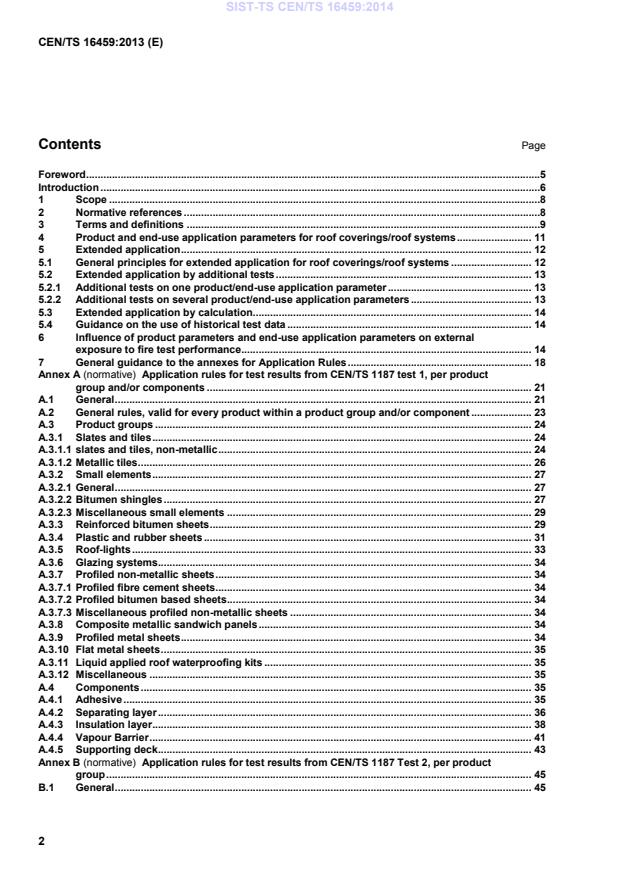
Contents Page
Foreword .5
Introduction .6
1 Scope .8
2 Normative references .8
3 Terms and definitions .9
4 Product and end-use application parameters for roof coverings/roof systems . 11
5 Extended application . 12
5.1 General principles for extended application for roof coverings/roof systems . 12
5.2 Extended application by additional tests . 13
5.2.1 Additional tests on one product/end-use application parameter . 13
5.2.2 Additional tests on several product/end-use application parameters . 13
5.3 Extended application by calculation. 14
5.4 Guidance on the use of historical test data . 14
6 Influence of product parameters and end-use application parameters on external
exposure to fire test performance . 14
7 General guidance to the annexes for Application Rules . 18
Annex A (normative) Application rules for test results from CEN/TS 1187 test 1, per product
group and/or components . 21
A.1 General . 21
A.2 General rules, valid for every product within a product group and/or component . 23
A.3 Product groups . 24
A.3.1 Slates and tiles . 24
A.3.1.1 slates and tiles, non-metallic . 24
A.3.1.2 Metallic tiles . 26
A.3.2 Small elements . 27
A.3.2.1 General . 27
A.3.2.2 Bitumen shingles . 27
A.3.2.3 Miscellaneous small elements . 29
A.3.3 Reinforced bitumen sheets . 29
A.3.4 Plastic and rubber sheets . 31
A.3.5 Roof-lights . 33
A.3.6 Glazing systems. 34
A.3.7 Profiled non-metallic sheets . 34
A.3.7.1 Profiled fibre cement sheets . 34
A.3.7.2 Profiled bitumen based sheets . 34
A.3.7.3 Miscellaneous profiled non-metallic sheets . 34
A.3.8 Composite metallic sandwich panels . 34
A.3.9 Profiled metal sheets . 34
A.3.10 Flat metal sheets . 35
A.3.11 Liquid applied roof waterproofing kits . 35
A.3.12 Miscellaneous . 35
A.4 Components . 35
A.4.1 Adhesive . 35
A.4.2 Separating layer . 36
A.4.3 Insulation layer . 38
A.4.4 Vapour Barrier . 41
A.4.5 Supporting deck. 43
Annex B (normative) Application rules for test results from CEN/TS 1187 Test 2, per product
group . 45
B.1 General . 45
B.2 General rules, valid for every product within a product group . 46
B.3 Product groups . 47
B.3.1 Slates and tiles . 47
B.3.1.1 Non-metallic slates and tiles (reaction-to-fire-class A1 to A2-s3 d2 according to
EN 13501-1) . 47
B.3.1.2 Metallic tiles . 49
B.3.2 Small elements (reaction-to-fire-class B-s1,d0 to F according to EN 13501-1) . 49
B.3.2.1 General . 49
B.3.2.2 Bitumen shingles . 49
B.3.2.3 Miscellaneous small elements . 50
B.3.3 Reinforced bitumen sheets . 51
B.3.4 Plastic and rubber sheets . 53
B.3.5 Roof-lights . 54
B.3.6 Glazing systems . 54
B.3.7 Profiled non-metallic sheets. 54
B.3.7.1 Profiled fibre cement sheets . 54
B.3.7.2 Profiled bitumen based sheets . 55
B.3.7.3 Miscellaneous profiled non-metallic sheets . 55
B.3.8 Composite metallic sandwich panels . 55
B.3.9 Profiled metal sheets . 55
B.3.10 Flat metal sheets . 55
B.3.11 Liquid applied waterproofing kits . 55
B.3.12 Miscellaneous . 55
Annex C (normative) Application rules for test results from CEN/TS 1187 test 3, per product
group . 56
C.1 General . 56
C.2 General rules, valid for every product within a product group . 58
C.3 Product groups . 59
C.3.1 Slates and tiles . 59
C.3.1.1 Non-metallic slates and tiles (reaction-to-fire-class A1 to A2 – s3 d2, according to
EN 13501-1) . 59
C.3.1.2 Metallic Tiles . 61
C.3.2 Small elements (reaction-to-fire-class B – s1, d0 to F; according to EN 13501-1) . 61
C.3.2.1 General . 61
C.3.2.2 Bitumen Shingles . 61
C.3.2.3 Miscellaneous small elements . 63
C.3.3 Reinforced bitumen sheets . 64
C.3.3.1 General . 64
C.3.3.2 Typical roof waterproofing system . 64
C.3.4 Plastic and rubber sheets . 69
C.3.4.1 General . 69
C.3.4.2 Typical roof waterproofing system . 70
C.3.5 Roof-lights . 75
C.3.6 Glazing systems . 76
C.3.7 Profiled non-metallic sheets. 76
C.3.7.1 Profiled fibre cement sheets . 76
C.3.7.2 Profiled bitumen-based Sheets . 76
C.3.7.3 Miscellaneous profiled non-metallic sheets . 76
C.3.8 Composite metallic sandwich panels . 76
C.3.9 Profiles metal sheets . 76
C.3.10 Flat metal sheets . 77
C.3.11 Liquid applied roof watering kits . 77
C.3.12 Miscellaneous . 77
Annex D (normative) Application rules for test results from CEN/TS 1187 Test 4 for individual
product groups . 78
D.1 General . 78
D.2 General EXAP rules for CEN/TS 1187 test 4, valid for every product within a product
group . 80
D.3 Product groups . 81
D.3.1 Slates and tiles . 81
D.3.1.1 Non-metallic slates and tiles . 81
D.3.1.2 Metallic slates and tiles . 84
D.3.2 Small elements . 84
D.3.2.1 General . 84
D.3.2.2 Bitumen shingles . 84
D.3.2.3 Miscellaneous small elements, e.g. plastic tiles . 87
D.3.3 Reinforced bitumen sheets (same as bitumen shingles) . 88
D.3.4 Plastic and rubber sheets . 91
D.3.5 Roof-lights . 94
D.3.6 Glazing systems. 94
D.3.7 Profiled non-metallic sheets . 94
D.3.7.1 Profiled fibre cement sheets . 94
D.3.7.2 Profiled bitumen based sheets . 94
D.3.7.3 Miscellaneous profiled non-metallic sheets . 94
D.3.8 Composite (including metal faced) sandwich panels . 95
D.3.9 Profiled metal sheets . 95
D.3.10 Flat metal sheets . 95
D.3.11 Liquid applied roof water-proofing kits . 95
D.3.12 Miscellaneous . 95
Bibliography . 96
Foreword
This document (CEN/TS 16459:2013) has been prepared by Technical Committee CEN/TC 127 “Fire safety in
buildings”, the secretariat of which is held by BSI.
Attention is drawn to the possibility that some of the elements of this document may be the subject of patent
rights. CEN [and/or CENELEC] shall not be held responsible for identifying any or all such patent rights.
This document has been prepared under a mandate given to CEN by the European Commission and the
European Free Trade Association.
According to the CEN-CENELEC Internal Regulations, the national standards organizations of the following
countries are bound to announce this Technical Specification: Austria, Belgium, Bulgaria, Croatia, Cyprus,
Czech Republic, Denmark, Estonia, Finland, Former Yugoslav Republic of Macedonia, France, Germany,
Greece, Hungary, Iceland, Ireland, Italy, Latvia, Lithuania, Luxembourg, Malta, Netherlands, Norway, Poland,
Portugal, Romania, Slovakia, Slovenia, Spain, Sweden, Switzerland, Turkey and the United Kingdom.
Introduction
Fire tests on individual roofs/roof coverings are carried out in accordance with CEN/TS 1187. The results from
these tests can then be classified in accordance with EN 13501-5.
In order to derive classifications for similar roofs/roof coverings based on the data determined from
CEN/TS 1187, additional rules are needed.
These rules are direct application rules or extended application rules. Rules within the direct field of
application of test results are given in EN 13501-5 (these rules correspond to CEN/TS 1187).
This document outlines a procedure to develop rules for extended application and lists application rules which
have already been developed in Annexes A to D for test methods 1 to 4 from CEN/TS 1187, where Annex A is
related to test method 1, Annex B relates to test method 2, and so forth.
Annexes A to D have been developed based upon the available information and the roof systems in the
market. The objective of this document is to provide a methodology for optimising the number of tests required
to cover the maximum field of application.
Whilst special attention has been focused on roofs typically comprising a support deck/substrate, vapour
barrier, insulation layer(s), membranes/roof coverings, there will be occasions when other separating layers or
intermediate layers will be needed to satisfy other roof characteristics. These layers should be included in the
consideration of the roof/the roof covering being classified.
NOTE Tests 1, 3 and 4 are carried out on a roof construction, whereas test 2 is done on a roof covering with its
substrate below.
The decision route from the diagram below shows ways to determine which procedure to follow.
The solid line is compulsory, whereas the dotted line is optional.
Figure 1 – Decision process on classification of roofs/roof coverings
1 Scope
This Technical Specification gives guidance on the process and development of extended fields of application
using test results obtained from CEN/TS 1187 test 1 to 4, and included in test reports, and other relevant
information in order to evaluate and classify the performance of roofs/roof coverings. This Technical
Specification provides a methodology to consider the possible effect(s) on classification to EN 13501-5 from
single or multiple changes to the individual product and end-use application parameters of the roof/roof
covering.
Specific application guidance is given in Annexe A, Annex B, Annex C and Annex D for CEN/TS 1187 tests 1
to 4 respectively.
2 Normative references
The following documents, in whole or in part, are normatively referenced in this document and are
indispensable for its application. For dated references, only the edition cited applies. For undated references,
the latest edition of the referenced document (including any amendments) applies.
CEN/TS 1187:2012, Test methods for external fire exposure to roofs
EN 490, Concrete roofing tiles and fittings for roof covering and wall cladding - Product specifications
EN 492, Fibre-cement slates and fittings - Product specification and test methods
EN 494, Fibre-cement profiled sheets and fittings - Product specification and test methods
EN 506, Roofing products of metal sheet - Specification for self-supporting products of copper or zinc sheet
EN 508-1, Roofing products from metal sheet - Specification for self-supporting products of steel, aluminium
or stainless steel sheet - Part 1: Steel
EN 508-2, Roofing products from metal sheet - Specification for self-supporting products of steel, aluminium
or stainless steel sheet - Part 2: Aluminium
EN 508-3, Roofing products from metal sheet - Specification for self-supporting products of steel, aluminium
or stainless steel sheet - Part 3: Stainless steel
EN 534, Corrugated bitumen sheets - Product specification and test methods
EN 544, Bitumen shingles with mineral and/or synthetic reinforcements - Product specification and test
methods
EN 1013 (all parts), Light transmitting profiled plastic sheeting for single skin roofing
EN 1304, Clay roofing tiles and fittings - Product definitions and specifications
EN 1849-2, Flexible sheets for waterproofing - Determination of thickness and mass per unit area - Part 2:
Plastic and rubber sheets
EN 1873, Prefabricated accessories for roofing - Individual roof lights of plastics - Product specification and
test methods
EN 12326-1, Slate and stone products for discontinuous roofing and cladding - Part 1: Product specification
EN 13162, Thermal insulation products for buildings - Factory made mineral wool (MW) products -
Specification
EN 13163, Thermal insulation products for buildings - Factory made expanded polystyrene (EPS) products -
Specification
EN 13164, Thermal insulation products for buildings - Factory made extruded polystyrene foam (XPS)
products - Specification
EN 13165, Thermal insulation products for buildings - Factory made rigid polyurethane foam (PU) products -
Specification
EN 13166, Thermal insulation products for buildings - Factory made phenolic foam (PF) products –
Specification
EN 13167, Thermal insulation products for buildings - Factory made cellular glass (CG) products -
Specification
EN 13169, Thermal insulation products for buildings - Factory made expanded perlite board (EPB) products -
Specification
EN 13501-5:2005+A1:2009, Fire classification of construction products and building elements - Part 5:
Classification using data from external fire exposure to roofs tests
EN 13707, Flexible sheets for waterproofing - Reinforced bitumen sheets for roof waterproofing - Definitions
and characteristics
EN 13956, Flexible sheets for waterproofing - Plastic and rubber sheets for roof waterproofing - Definitions
and characteristics
EN 14351-1, Windows and doors - Product standard, performance characteristics - Part 1: Windows and
external pedestrian doorsets without resistance to fire and/or smoke leakage characteristics
EN 14509, Self-supporting double skin metal faced insulating panels - Factory made products - Specifications
EN 14782, Self-supporting metal sheet for roofing, external cladding and internal lining - Product specification
and requirements
EN 14783, Fully supported metal sheet and strip for roofing, external cladding and internal lining - Product
specification and requirements
EN 14963, Roof coverings - Continuous rooflights of plastics with or without upstands - Classification,
requirements and test methods
3 Terms and definitions
For the purposes of this document, the relevant terms and definitions given in CEN/TS 1187:2012 and
EN 13501-5:2005+A1:2009, together with the following apply.
3.1
adhesive
organic or inorganic material e.g. polyurethane-based, bitumen-based, dispersion adhesive, glue which is
used to attach the surfaces of two or more products/components
Note 1 to entry: Adhesives or glues of the kind mentioned above could be applied separately and will thus form a
separate layer within the roof built-up, while factory pre-applied adhesives or glues are part of the specific
product/component forming a layer.
3.2
‘as tested’
this term is used when an application rule does not exist for a specific parameter
3.3
binder content
binder content is the amount of binding material (by % weight or % volume) within the product. The binder
could be inorganic or organic in nature. In the case of the latter, it will add a fire load to the product containing
the binder, and will be considered within the classification of products or product groups. Within the
substructure of products like mineral wool insulation products, particular felt layers, some tiling products, and
some multi layer weather-proofing surface products the binder will typically be cured
Note 1 to entry: The definition of this term does not apply to compound waterproofing sheets
3.4
direct field of application of test results
outcome of a process (involving the application of defined rules) whereby a test result is deemed to be equally
valid for variations in one or more of the product properties and/or intended end use applications
3.5
end-use application parameter
aspect of the mounting and fixing arrangement of a product reflecting/simulating its end-use application (e.g.
type of substrate, fixing method, type and position of joints) which can affect the fire performance
3.6
extended field of application of test results
outcome of a process (involving the application of defined rules that can incorporate calculation procedures)
that predicts, for a variation of a product property and/or its intended end use application(s), a test result on
the basis of one or more test results to the same test standard
3.7
product group
range of roof products within defined limits of variability (defined by the manufacturer or a Technical
Specification) of the product parameters and, if relevant, end-use parameters, for which the reaction of the
roof in end use application to external fire exposure remains unchanged (does not get worse)
Note 1 to entry: As Clause 7 is concerned, product groups also include components for Annex A.
3.8
product parameter
aspect of a product (for example thickness, composition, density) which may vary and which can have an
influence on the product’s fire performance
3.9
roof pitch
inclination of the roof surface to the horizontal
Note 1 to entry: In the case of a tiled roof, the roof pitch is the rafter pitch since the tile pitch will be a few degrees
lower due to the overlaps.
3.10
separating layer
functional layer within a roof construction that is typically used to separate layers that do not match for reason
of chemical incompatibility, or it is needed as underlay, where applicable
Note 1 to entry: Separating layers are products such as fire protective layers (e.g. glass fleece); under-slating (e.g.
polymeric sheet; polymeric sheet reinforced by polymeric fibres; bituminised reinforced sheets); and others such as
bituminous kraft paper; aluminium sheet with covering (organic); and similar.
3.11
surfacing
surface finish applied either during construction or prefabricated as part of the surfacing layer
Note 1 to entry: Surfacing may include materials such as lacquer, UV-protective coating,slate chips, ceramic-based
granules, products for factory-made lamination with glass-fleece or bituminous roofing felt, or similar.
3.12
test result
outcome of a testing process and its associated procedures detailed within a specific test standard (which can
include some processing of the results from the testing of a number of specimens)
Note 1 to entry: A test result is expressed in terms of one or more fire performance parameter(s).
3.13
type of product
products belonging to a subset of a product family (as defined in Guidance Paper G), grouping together
products having a similar nature (e.g. polymer modified bituminous roofing felts, single-ply PVC membranes,
cement based fibre boards, profiled metal roof sheets) and behaviour (e.g. products that melt or shrink under
flame attack, or decompose)
3.14
factory (pre-) applied adhesive
layer of organic or inorganic material e.g. polyurethane-based, bitumen-based, that is factory-applied to
products, such as to assist the installation, e.g. self-adhesion
4 Product and end-use application parameters for roof coverings/roof systems
Table 1 is the list of product parameters and end-use application parameters that shall be taken into account
in Annexes A to D in making application rules. If other parameters are found to be relevant for a given product,
then these too should be considered in accordance with the principles of Clauses 5 and 6.
Relevant information may be contained in other documents, such as harmonized Technical Specifications.
This information may be needed to define the end-use application parameters for the particular product (or
product group) that could influence the classification results in the external fire exposure tests to
CEN/TS 1187 Methods 1 to 4.
Table 1 — List of product parameters and end-use applications parameters
PRODUCT PARAMETERS FOR ROOF COVERINGS/ROOF SYSTEMS
Type of product
Product composition
Reaction-to-fire classification according to EN 13501–1
Colour (consider also pigments)
Binder content
Thickness
Mass per unit area
Density
Geometry (structure, shape and constitutive layers of multi-layer product)
Air gaps (perpendicular to surface)
Joints
Surfacing on lower side (backing)
Surfacing on upper side (facing)
Factory (pre-)applied adhesive
Reinforcement: mass per unit area, type of material; position within layer etc.
END-USE APPLICATION PARAMETERS FOR ROOF COVERINGS/ROOF SYSTEMS
End-use parameters-general
Number of layers (details see for each product)
Order of layer in the roofing system
Orientation of each layer
End-use parameters-support
Roof pitch
Substrate or under-laying construction details
Application on existing roofs (“renovation”)
Spacing of frame elements (non-standard-support)
End-use parameters-mounting and fixing
Mounting method
Fixing method (e.g. adhesive)
Distribution, Spacing and type of mechanical fixing (fasteners)
Joints
Air gaps
5 Extended application
5.1 General principles for extended application for roof coverings/roof systems
There are three options to establish rules for extended application. These are:
— by use of additional test results which, together with the initial test result, enables consideration of a larger
range of one or several product parameters and end-use application parameters;
— by use of tests results in combination with application of calculations methods (compare with 5.3) relating
the product and end-use application parameters to the fire performance;
— by use of historical data, see 5.4, and other relevant information e.g. data from previous tests.
NOTE Extended application rules are used to develop worst case ‘build ups’. Standard ‘build ups’ are identified in the
relevant product standards taking into account worst case ‘build ups’, e.g. where no specific test information is available,
indicative testing is used to establish the worst case scenario.
5.2 Extended application by additional tests
5.2.1 Additional tests on one product/end-use application parameter
It is assumed that only one product/end-use application parameter changes and the other parameters remain
constant and that there is an initial test result on one value of the product/end-use application parameter.
If the relationship between the fire performance and the product/end-use application parameter is unknown,
the tests will be carried out on several variants of the parameter to assess the complete range of the
product/end-use application parameter on which the extended application is required and to know this
relationship.
From this relationship it will be possible to predict the different levels of fire performance as a function of the
levels of the product/end-use application parameter and therefore the level of classification.
If there is an established rule about the relationship between the product/end-use parameter and the fire
performance (direct application) of a product or product group, it will be possible to optimize the additional
tests, as a function of the classification result which is expected, as follows:
— If the fire performance of the roof is known to be affected by the change of a product/end-use application
parameter(s) in a known direction, the test can be carried out on the parameter, the variation of which is
known to give the lowest (worst) performance in this instance for this product and/or its end use-
application, without changing the classification level.
— If it is known that the fire performance changes with a change of the product/end-use application
parameter but the relationship is not known, the number of additional tests shall be sufficient to define the
relationship (sufficient means that the relationship is adequately defined over the intended range of
parameter variation). For most relationships, this will require at least two additional test results.
When a relationship has been established between the fire performance and a product/end-use parameter, it
shall be used to determine the classification of any product or product group covered by this relationship.
5.2.2 Additional tests on several product/end-use application parameters
When more than one roof covering product parameter or end-use application parameter is to change at the
same time, and if the types of relationship are not known, it will be necessary to assess the tests needed
according to an experimental plan or an empirical approach. Then a more detailed series of tests shall be
performed to determine the relationship between these parameters, the external fire exposure performance,
and the resultant classification.
The study of this relationship shall be carried out from direct tests according to CEN/TS 1187 Methods 1, 2, 3
or 4 and Classification to EN 13501-5.
If the types of relationship between the fire performance and the product/end use application parameter are
not known, a series of tests will be necessary. The test series can be split into parts to get firstly a result on
the type of the relationship (qualitative result) and secondly information on the quantitative relationship, if
required.
In all cases the limits of field of application shall be complied with. When a limited approach is used, it has to
be kept in mind that the resulting relationships are only valid for the particular limits of the other parameters
that were kept constant in the test.
NOTE Results from other test methods can be used to determine which product parameter needs to be tested in
European Standard methods. Reports on extended application are given in accordance with prEN EXAPRPT – Extended
application reports on the fire performance of construction products and building elements.
5.3 Extended application by calculation
For extended application by calculation, it is necessary to have (an) established calculation method(s) shown
to be valid for the intended range of parameter(s). This requires the calculation method to be validated in
accordance with 5.2.1 or 5.2.2.
NOTE So far, there are no verified and validated published calculation methods that have been established and
agreed for use.
5.4 Guidance on the use of historical test data
When undertaking extended application (EXAP) a good understanding of the product performance in fire is
required. Some of this information will be known from the EN tests according to CEN/TS 1187, however for
some products there shall exist a record of test results against previous standards.
NOTE Under certain circumstances this information can be used as part of the EXAP procedure. This will help to
reduce the number of new tests which are required.
In applying these principles, the following conditions shall be met:
— EXAP is only undertaken by a Notified Body;
— Primary data shall be obtained from the relevant CEN/TS 1187 Test 1 to 4.
6 Influence of product parameters and end-use application parameters on external
exposure to fire test performance
In Clause 4 of this document, Table 1 shows the list of product and end-use application parameters that can
influence the results from external fire exposure tests to roofs.
The following is an analysis of how each of these parameters can influence the test result for each of the four
different CEN/TS 1187 test methods, assuming that all other parameters are kept unchanged.
The fire testing in different European countries has historically been based on different exposure to burning
brands, to radiant exposure and to wind, as shown in Table 2.
Individual European countries will require fire test 1, 2, 3 or 4 depending on these national regulatory
requirements. There is no ranking in the order of test methods.
Table 2 — Exposure conditions for CEN/TS 1187 tests 1 to 4
Use CEN/TS 1187 test 1, 2, 3 or 4
Burning brands Burning Burning Burning
brands and brands and brands and
wind wind and wind and
radiant heat radiant heat,
in two stages
Test 1 Test 2 Test 3 Test 4
One of the most important
...