

CEN/TR 18081:2024
(Main)Building automation, controls and building management - Smart building - Description and aspects
General Information
- Abstract
This document explains the term "smart building".
- Status
- Published
- Publication Date
- 23-Jul-2024
- Technical Committee
- CEN/TC 247 - Controls for mechanical building services
- Drafting Committee
- CEN/TC 247/WG 4 - Open System Data Transmission
- Current Stage
- 6060 - Definitive text made available (DAV) - Publishing
- Start Date
- 24-Jul-2024
- Due Date
- 14-May-2025
- Completion Date
- 24-Jul-2024
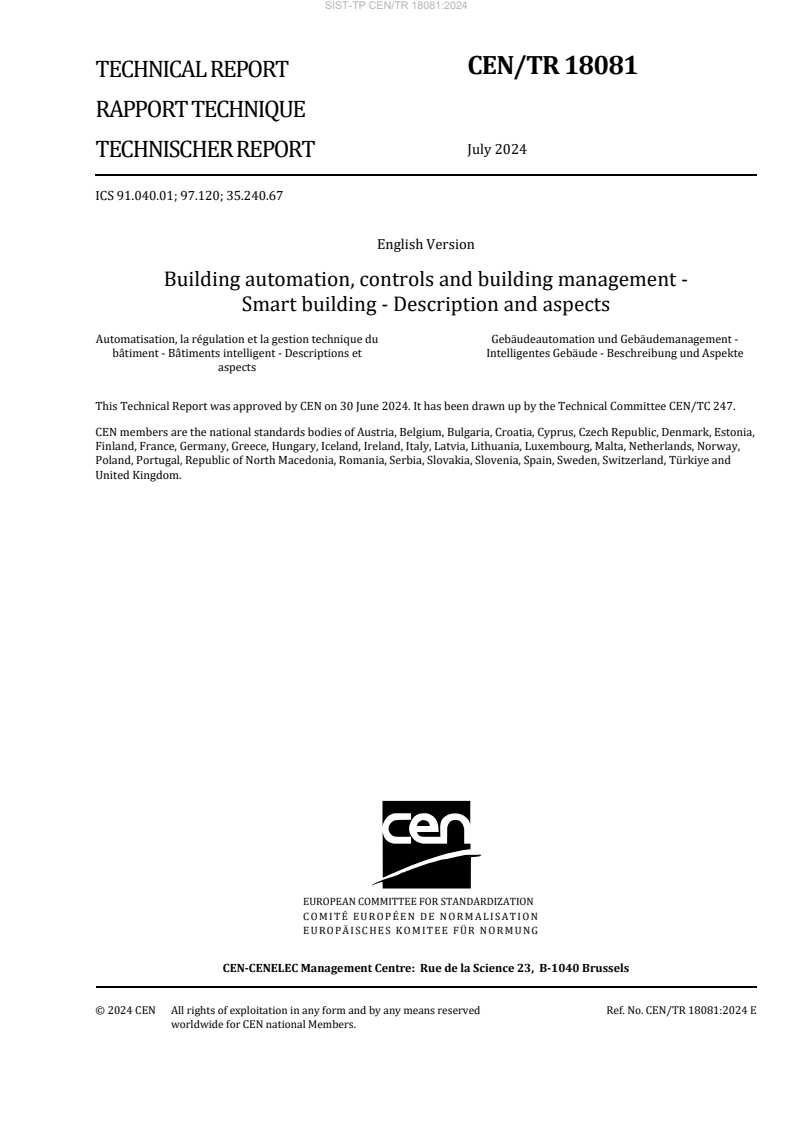

Overview - CEN/TR 18081:2024 (Smart building)
CEN/TR 18081:2024 is a Technical Report from CEN/TC 247 that explains the term “smart building” in the context of building automation, controls and building management (BACS/BMS). Rather than prescribing products or protocols, it describes the features, purpose and practical means to achieve smart buildings over their full lifecycle - covering functional adaptability, lifetime energy balance and material reuse/recycling. The report aligns with related standards (EN 13321‑1, EN 14908, EN 50090, EN ISO 16484) and references European work such as the Smart Readiness Indicator (SRI).
Key topics and technical requirements
- Core features of a smart building
- Adaptable building functions (structure, infrastructure, operation) to meet evolving user needs.
- Life‑time energy target: building generates or saves as much energy over its lifetime as was embodied and used to build and operate it.
- Material/resource circularity: structural and infrastructural components designed for reuse or recycling.
- Functional viewpoints
- Building structure, infrastructure (ducts, piping, cabling), and operation (energy, HVAC, lighting, security, EV charging, access control).
- SRI impact categories: energy efficiency, maintenance/predictive maintenance, comfort, convenience, health & wellbeing, occupant information, energy flexibility/storage.
- Means to realize smart buildings
- User interfaces that engage occupants in energy targets.
- Efficient use and documentation of resources via BIM and a Digital Twin database.
- Control of local energy generation, demand‑side management, and interaction with external systems (e.g., smart grid).
- Collection, analysis and use of operational data for predictive maintenance and optimization.
- System capabilities
- Continuous monitoring, logging and adjustable energy use.
- Benchmarking and loss detection with actionable alerts.
- Interoperability across devices and vendors and attention to cyber security and informational structures for Digital Twins/BIM.
Practical applications and who uses it
- Building owners and investors: set lifecycle energy and reuse targets; define required functions.
- Architects and designers: specify adaptable structures and infrastructure for future reuse.
- Facility and energy managers: apply monitoring, benchmarking and predictive maintenance practices.
- Systems integrators and BACS/BMS vendors: design interoperable, secure control systems and digital interfaces.
- BIM/Digital Twin specialists: document materials, resources and operational capabilities in standard formats.
- Policy makers and assessors: align certification, SRI implementation and lifecycle energy goals.
Related standards
- EN 13321‑1, EN 14908, EN 50090, EN ISO 16484 (referenced normative standards)
- EN 50491 series (HBES/BACS general requirements)
- ISO 52120‑1, ISO 52127‑1 (energy performance & building management)
- IEC/TS 62443 (industrial network/cyber security)
Keywords: smart building, building automation, building management, BACS, BMS, BIM, Digital Twin, energy efficiency, interoperability, Smart Readiness Indicator, predictive maintenance, lifecycle energy.
Relations
- Effective Date
- 02-Sep-2026
- Effective Date
- 22-Apr-2026
- Effective Date
- 09-Feb-2026
- Effective Date
- 09-Feb-2026
- Effective Date
- 09-Feb-2026
- Effective Date
- 09-Feb-2026
- Refers
EN 50090-4-4:2025 - Home and Building Electronic Systems (HBES) - Part 4-4: HBES IoT Point API - Effective Date
- 09-Feb-2026
- Effective Date
- 09-Feb-2026
- Effective Date
- 09-Feb-2026
- Effective Date
- 09-Feb-2026
- Effective Date
- 09-Feb-2026
- Refers
EN 50090-1:2011 - Home and Building Electronic Systems (HBES) - Part 1: Standardization structure - Effective Date
- 09-Feb-2026
- Effective Date
- 09-Feb-2026
- Effective Date
- 09-Feb-2026
- Effective Date
- 09-Feb-2026
Get Certified
Connect with accredited certification bodies for this standard

BSI Group
BSI (British Standards Institution) is the business standards company that helps organizations make excellence a habit.

DIBt (Deutsches Institut für Bautechnik)
German Institute for Building Technology.
DIN CERTCO
DIN Group product certification.
Sponsored listings
Frequently Asked Questions
CEN/TR 18081:2024 is a technical report published by the European Committee for Standardization (CEN). Its full title is "Building automation, controls and building management - Smart building - Description and aspects". This standard covers: This document explains the term "smart building".
This document explains the term "smart building".
CEN/TR 18081:2024 is classified under the following ICS (International Classification for Standards) categories: 35.240.67 - IT applications in building and construction industry; 91.040.01 - Buildings in general; 97.120 - Automatic controls for household use. The ICS classification helps identify the subject area and facilitates finding related standards.
CEN/TR 18081:2024 has the following relationships with other standards: It is inter standard links to EN ISO 16484-5:2026, EN ISO 16484-6:2026, EN 50090-3-3:2009, EN 50090-6-1:2017, EN 50090-6-2:2025, EN 50090-5-3:2016, EN 50090-4-4:2025, EN 50090-5-1:2020, EN 50090-5-2:2020, EN 50090-4-1:2004, EN 50090-8:2000, EN 50090-1:2011, EN 50090-7-1:2004, EN 50090-3-2:2004, EN 50090-4-3:2015. Understanding these relationships helps ensure you are using the most current and applicable version of the standard.
CEN/TR 18081:2024 is available in PDF format for immediate download after purchase. The document can be added to your cart and obtained through the secure checkout process. Digital delivery ensures instant access to the complete standard document.
Standards Content (Sample)
SLOVENSKI STANDARD
01-september-2024
Avtomatizacija stavb, regulacijia in upravljanje stavb - Pametna stavba - Opis in
vidiki
Building automation, controls and building management - Smart Building - Description
and Aspects
Gebäudeautomation und Gebäudemanagement - Intelligentes Gebäude - Beschreibung
und Aspekte
Automatisation, la régulation et la gestion technique du bâtiment - Bâtiments intelligent et
aspects
Ta slovenski standard je istoveten z: CEN/TR 18081:2024
ICS:
35.240.67 Uporabniške rešitve IT v IT applications in building
gradbeništvu and construction industry
91.040.01 Stavbe na splošno Buildings in general
97.120 Avtomatske krmilne naprave Automatic controls for
za dom household use
2003-01.Slovenski inštitut za standardizacijo. Razmnoževanje celote ali delov tega standarda ni dovoljeno.
CEN/TR 18081
TECHNICAL REPORT
RAPPORT TECHNIQUE
July 2024
TECHNISCHER REPORT
ICS 91.040.01; 97.120; 35.240.67
English Version
Building automation, controls and building management -
Smart building - Description and aspects
Automatisation, la régulation et la gestion technique du Gebäudeautomation und Gebäudemanagement -
bâtiment - Bâtiments intelligent - Descriptions et Intelligentes Gebäude - Beschreibung und Aspekte
aspects
This Technical Report was approved by CEN on 30 June 2024. It has been drawn up by the Technical Committee CEN/TC 247.
CEN members are the national standards bodies of Austria, Belgium, Bulgaria, Croatia, Cyprus, Czech Republic, Denmark, Estonia,
Finland, France, Germany, Greece, Hungary, Iceland, Ireland, Italy, Latvia, Lithuania, Luxembourg, Malta, Netherlands, Norway,
Poland, Portugal, Republic of North Macedonia, Romania, Serbia, Slovakia, Slovenia, Spain, Sweden, Switzerland, Türkiye and
United Kingdom.
EUROPEAN COMMITTEE FOR STANDARDIZATION
COMITÉ EUROPÉEN DE NORMALISATION
EUROPÄISCHES KOMITEE FÜR NORMUNG
CEN-CENELEC Management Centre: Rue de la Science 23, B-1040 Brussels
© 2024 CEN All rights of exploitation in any form and by any means reserved Ref. No. CEN/TR 18081:2024 E
worldwide for CEN national Members.
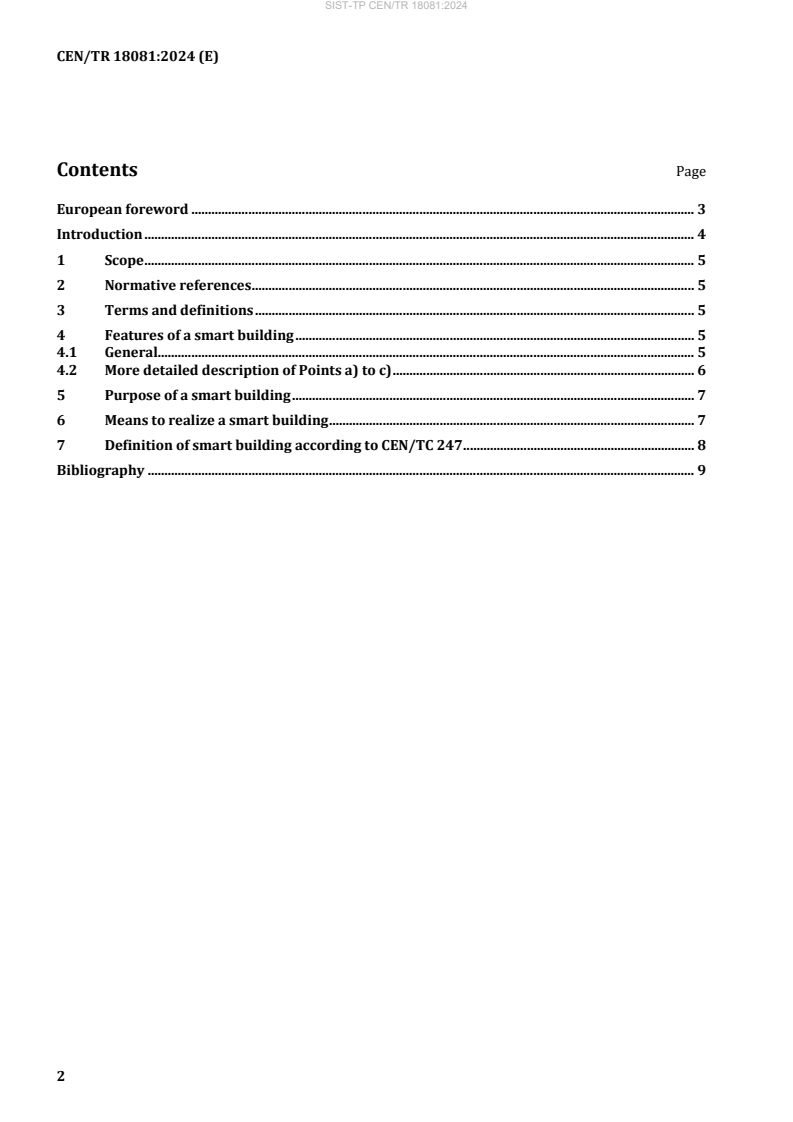
Contents Page
European foreword . 3
Introduction . 4
1 Scope . 5
2 Normative references . 5
3 Terms and definitions . 5
4 Features of a smart building . 5
4.1 General. 5
4.2 More detailed description of Points a) to c) . 6
5 Purpose of a smart building . 7
6 Means to realize a smart building . 7
7 Definition of smart building according to CEN/TC 247 . 8
Bibliography . 9
European foreword
This document (CEN/TR 18081:2024) has been prepared by Technical Committee CEN/TC 247
“Building Automation, Controls and Building Management” the secretariat of which is held by SNV.
Attention is drawn to the possibility that some of the elements of this document may be the subject of
patent rights. CEN shall not be held responsible for identifying any or all such patent rights.
CEN/TC 247, “Building Automation, Controls and Building Management” - in collaboration with
CLC/TC 205 “Home and Building Electronic Systems (HBES)” - has prepared this document to create a
report in which the view of both CEN/TC 247 as well as CLC/TC 205 on the aspect of smart buildings is
documented.
Any feedback and questions on this document should be directed to the users’ national standards body.
A complete listing of these bodies can be found on the CEN website.
Introduction
The use of a building changes over its lifespan and adapts to the changing usage and functional
expectations of the users regarding desired comfortable shelter, living and/or working space.
This can relate to:
— building structure;
— building operation;
— energy efficiency;
— maintenance and fault prediction;
— comfort;
— convenience;
— health and wellbeing;
— information to occupants;
— energy flexibility and storage.
The goal of integrating building automation control systems is to ensure maximum cost-neutrality and
environmental compatibility for the owner over the entire service life of a building. If this goal is
fulfilled for a specific building, then this building would be regarded as “smart”.
1 Scope
This document explains the term “smart building”.
2 Normative references
The following documents are referred to in the text in such a way that some or all of their content
constitutes requirements of this document. For dated references, only the edition cited applies. For
undated references, the latest edition of the referenced document (including any amendments) applies.
EN 13321-1, Open data communication in building automation, controls and building management —
Home and building electronic system — Part 1: Product and system requirements
EN 14908 (all parts), Open Data Communication in Building Automation, Controls and Building
Management — Control Network Protocol
EN 50090 (all parts), Home and Building Electronic Systems (HBES)
EN ISO 16484 (all parts), Building automation and control systems (BACS)
3 Terms and definitions
For the purposes of this document, the terms and definitions given in EN 13321-1, EN 14908 (all parts),
EN 50090 (all parts) and EN ISO 16484 (all parts) and the following apply.
ISO and IEC maintain terminology databases for use in standardization at the following addresses:
— ISO Online browsing platform: available at https://www.iso.org/obp/
— IEC Electropedia: available at https://www.electropedia.org/
3.1
user
person(s) or technical plant(s)
Note 1 to entry: A technical plant can be a data centre or assembly line.
3.2
investor
person or organization owning a building
4 Features of a smart building
4.1 General
A building (non-residential or residential) can be called a Smart Building, if
a) it provides the functions foreseen by the owner, which can be adapted over its lifetime to those
functions desired by the user(s),
b) it recovers the energy for it to be built over its full lifetime, and
c) its structural and infrastructural components can be fully reused or recycled for new buildings or as
resources for other purposes.
An extensive list of standards relevant for the domain of smart buildings is given in the Bibliography.
4.2 More detailed description of Points a) to c)
4.2.1 Point a)
The term “functions” in the above point a) covers these different viewpoints:
— Building structure
Everything
...