

EN 50090-7-1:2004
(Main)Home and Building Electronic Systems (HBES) - Part 7-1: System management - Management procedures
General Information
- Abstract
This international standard establishes general principles for network- and device-management shared by and independent of the installation mode. The goal is to standardize the interaction, between a management client and a management server, that shall lead to the successful configuration of the devices. In this way, these management procedures thus specify the highest level communication requirements between a management client and a management server. These requirements specify: a) the sequence of messages that shall be exchanged between a management client and a management server, and b) the contents and interpretation of the transported data, and c) the action to take based on these data (setting internal resources, state machines, physical actions, …), and d) the error and exception handling. The management procedures base on the application layer services. Some management procedures solely base on the use of one or a sequence of dedicated application layer services to achieve the required goal. For these, the documents EN 50090-4-1 and EN 50090-4-2 provide sufficient information for the underlying mechanisms. Other management procedures additionally use the application layer services to access internal data in the management server to achieve the required goal. These data are laid down as objects as specified in EN 50090 3 2.
- Status
- Published
- Publication Date
- 23-Feb-2004
- Withdrawal Date
- 30-Nov-2006
- Technical Committee
- CLC/TC 205 - Home and Building Electronic Systems (HBES)
- Drafting Committee
- ISO/IEC/JTC 1/SC25 - ISO/IEC_JTC_1/SC25
- Parallel Committee
- ISOIEC/JTC 1/SC25 - ISOIEC_JTC_1/SC25
- Current Stage
- 9093 - Decision to confirm - Review Enquiry
- Start Date
- 04-Oct-2023
- Completion Date
- 25-Aug-2026

Overview
EN 50090-7-1:2004 (HBES - Part 7-1) defines system management - management procedures for Home and Building Electronic Systems (HBES). Published by CLC/CENELEC, the standard specifies the high-level interaction between a management client and a management server to enable consistent device and network configuration. It standardizes message sequences, the structure and interpretation of transported data, required actions (e.g., setting internal resources or triggering state machines), and error/exception handling. The procedures are based on application layer services and reference object models defined elsewhere in the EN 50090 series.
Key topics and technical requirements
- Scope of procedures: Covers both network management (NM_ procedures) and device management (DM_ procedures) across installation modes.
- Message sequences: Defines ordered exchanges between management client and server needed to achieve tasks such as address read/write, scanning, routing, and verification.
- Data contents & interpretation: Specifies what data must be carried in messages and how the management server/client must interpret those data items.
- Actions triggered: Maps received management data to concrete actions (e.g., set internal resources, change device state, perform physical operations).
- Error and exception handling: Prescribes expected reactions to faults, timeouts and invalid data during management operations.
- Use of application layer services: Many procedures rely solely on application layer services (see EN 50090-4-1 / EN 50090-4-2); others require access to server internal data objects (see EN 50090-3-2).
- Representative procedures: Examples from the table of contents include NM_IndividualAddress_Read/Write, NM_Router_Scan, DM_Connect/Disconnect, DM_Authorize, DM_SetKey, DM_Restart, DM_MemWrite/Read/Verify and group object link operations.
Applications and who uses this standard
- Device manufacturers: implement standardized management interfaces and object models so devices can be configured and commissioned reliably.
- System integrators and installers: use management procedures for automated commissioning, address configuration, routing and diagnosing devices in smart homes and commercial buildings.
- Firmware and software developers: build management clients/servers, commissioning tools and diagnostics consoles that follow defined message sequences and error handling.
- Test laboratories and certification bodies: verify compliance and interoperability across HBES devices and management tools.
- Facility managers / building automation engineers: rely on standardized procedures for remote updates, reboots and managed configuration of building systems.
Related standards
- EN 50090-4-1 and EN 50090-4-2 - application layer services (underlying mechanisms)
- EN 50090-3-2 - object definitions used for internal management data
- EN 50090 family (HBES) - broader framework for home and building electronic systems
Keywords: EN 50090-7-1:2004, HBES, system management, management procedures, network management, device management, application layer services, CENELEC.
Relations
- Effective Date
- 09-Feb-2026
- Effective Date
- 09-Feb-2026
- Effective Date
- 09-Feb-2026
- Referred By
EN 15502-1:2012+A1:2015 - Gas-fired heating boilers - Part 1: General requirements and tests - Effective Date
- 09-Feb-2026
- Effective Date
- 09-Feb-2026
- Effective Date
- 09-Feb-2026
- Referred By
EN 50090-4-4:2025 - Home and Building Electronic Systems (HBES) - Part 4-4: HBES IoT Point API - Effective Date
- 03-Feb-2026
Frequently Asked Questions
EN 50090-7-1:2004 is a standard published by CLC. Its full title is "Home and Building Electronic Systems (HBES) - Part 7-1: System management - Management procedures". This standard covers: This international standard establishes general principles for network- and device-management shared by and independent of the installation mode. The goal is to standardize the interaction, between a management client and a management server, that shall lead to the successful configuration of the devices. In this way, these management procedures thus specify the highest level communication requirements between a management client and a management server. These requirements specify: a) the sequence of messages that shall be exchanged between a management client and a management server, and b) the contents and interpretation of the transported data, and c) the action to take based on these data (setting internal resources, state machines, physical actions, …), and d) the error and exception handling. The management procedures base on the application layer services. Some management procedures solely base on the use of one or a sequence of dedicated application layer services to achieve the required goal. For these, the documents EN 50090-4-1 and EN 50090-4-2 provide sufficient information for the underlying mechanisms. Other management procedures additionally use the application layer services to access internal data in the management server to achieve the required goal. These data are laid down as objects as specified in EN 50090 3 2.
This international standard establishes general principles for network- and device-management shared by and independent of the installation mode. The goal is to standardize the interaction, between a management client and a management server, that shall lead to the successful configuration of the devices. In this way, these management procedures thus specify the highest level communication requirements between a management client and a management server. These requirements specify: a) the sequence of messages that shall be exchanged between a management client and a management server, and b) the contents and interpretation of the transported data, and c) the action to take based on these data (setting internal resources, state machines, physical actions, …), and d) the error and exception handling. The management procedures base on the application layer services. Some management procedures solely base on the use of one or a sequence of dedicated application layer services to achieve the required goal. For these, the documents EN 50090-4-1 and EN 50090-4-2 provide sufficient information for the underlying mechanisms. Other management procedures additionally use the application layer services to access internal data in the management server to achieve the required goal. These data are laid down as objects as specified in EN 50090 3 2.
EN 50090-7-1:2004 is classified under the following ICS (International Classification for Standards) categories: 97.120 - Automatic controls for household use. The ICS classification helps identify the subject area and facilitates finding related standards.
EN 50090-7-1:2004 has the following relationships with other standards: It is inter standard links to EN 13321-1:2021, EN 17082:2019, EN 15502-1:2012, EN 15502-1:2012+A1:2015, CEN/TR 18081:2024, EN 13321-1:2012, EN 50090-4-4:2025. Understanding these relationships helps ensure you are using the most current and applicable version of the standard.
EN 50090-7-1:2004 is associated with the following European legislation: Standardization Mandates: M/490. When a standard is cited in the Official Journal of the European Union, products manufactured in conformity with it benefit from a presumption of conformity with the essential requirements of the corresponding EU directive or regulation.
EN 50090-7-1:2004 is available in PDF format for immediate download after purchase. The document can be added to your cart and obtained through the secure checkout process. Digital delivery ensures instant access to the complete standard document.
Standards Content (Sample)
SLOVENSKI SIST EN 50090-7-1:2005
STANDARD
september 2005
Stanovanjski in stavbni elektronski sistemi (HBES) – 7-1. del: Upravljanje
sistema – Upravljalni proces
Home and Building Electronic Systems (HBES) – Part 7-1: System management –
Management procedures
ICS 97.120 Referenčna številka
© Standard je založil in izdal Slovenski inštitut za standardizacijo. Razmnoževanje ali kopiranje celote ali delov tega dokumenta ni dovoljeno
EUROPEAN STANDARD EN 50090-7-1
NORME EUROPÉENNE
EUROPÄISCHE NORM February 2004
ICS 97.120 Supersedes R205-011:1996
English version
Home and Building Electronic Systems (HBES)
Part 7-1: System management -
Management procedures
Systèmes électroniques pour les foyers Elektrische Systemtechnik für Heim
domestiques et les bâtiments (HBES) und Gebäude (ESHG)
Partie 7-1: Management système - Teil 7-1: Systemmanagement -
Procédures de management Managementverfahren
This European Standard was approved by CENELEC on 2003-12-02. CENELEC members are bound to
comply with the CEN/CENELEC Internal Regulations which stipulate the conditions for giving this European
Standard the status of a national standard without any alteration.
Up-to-date lists and bibliographical references concerning such national standards may be obtained on
application to the Central Secretariat or to any CENELEC member.
This European Standard exists in one official version (English). A version in any other language made by
translation under the responsibility of a CENELEC member into its own language and notified to the Central
Secretariat has the same status as the official version.
CENELEC members are the national electrotechnical committees of Austria, Belgium, Cyprus, Czech
Republic, Denmark, Estonia, Finland, France, Germany, Greece, Hungary, Iceland, Ireland, Italy, Latvia,
Lithuania, Luxembourg, Malta, Netherlands, Norway, Poland, Portugal, Slovakia, Slovenia, Spain, Sweden,
Switzerland and United Kingdom.
CENELEC
European Committee for Electrotechnical Standardization
Comité Européen de Normalisation Electrotechnique
Europäisches Komitee für Elektrotechnische Normung
Central Secretariat: rue de Stassart 35, B - 1050 Brussels
© 2004 CENELEC - All rights of exploitation in any form and by any means reserved worldwide for CENELEC members.
Ref. No. EN 50090-7-1:2004 E
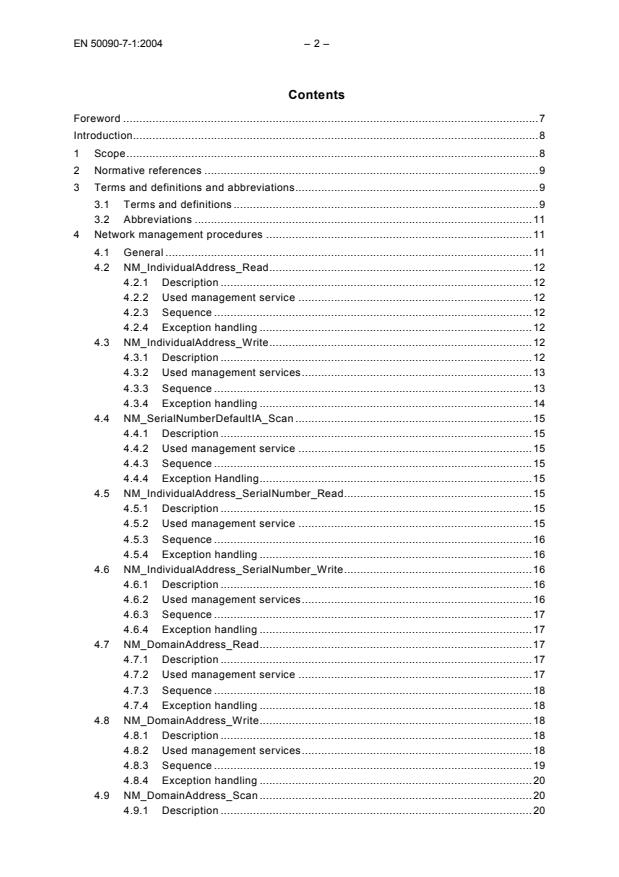
Contents
Foreword .7
Introduction.8
1 Scope.8
2 Normative references.9
3 Terms and definitions and abbreviations.9
3.1 Terms and definitions .9
3.2 Abbreviations.11
4 Network management procedures .11
4.1 General.11
4.2 NM_IndividualAddress_Read.12
4.2.1 Description.12
4.2.2 Used management service .12
4.2.3 Sequence.12
4.2.4 Exception handling .12
4.3 NM_IndividualAddress_Write.12
4.3.1 Description.12
4.3.2 Used management services.13
4.3.3 Sequence.13
4.3.4 Exception handling .14
4.4 NM_SerialNumberDefaultIA_Scan.15
4.4.1 Description.15
4.4.2 Used management service .15
4.4.3 Sequence.15
4.4.4 Exception Handling.15
4.5 NM_IndividualAddress_SerialNumber_Read.15
4.5.1 Description.15
4.5.2 Used management service .15
4.5.3 Sequence.16
4.5.4 Exception handling .16
4.6 NM_IndividualAddress_SerialNumber_Write.16
4.6.1 Description.16
4.6.2 Used management services.16
4.6.3 Sequence.17
4.6.4 Exception handling .17
4.7 NM_DomainAddress_Read.17
4.7.1 Description.17
4.7.2 Used management service .17
4.7.3 Sequence.18
4.7.4 Exception handling .18
4.8 NM_DomainAddress_Write.18
4.8.1 Description.18
4.8.2 Used management services.18
4.8.3 Sequence.19
4.8.4 Exception handling .20
4.9 NM_DomainAddress_Scan.20
4.9.1 Description.20
– 3 – EN 50090-7-1:2004
4.9.2 Used management service .20
4.9.3 Sequence.21
4.9.4 Exception handling .21
4.10 NM_Router_Scan.21
4.10.1 Description.21
4.10.2 Used management service .21
4.10.3 Sequence.22
4.11 NM_SubnetworkDevices_Scan.22
4.11.1 Description.22
4.11.2 Used management service .22
4.11.3 Sequence.23
4.12 NM_SubnetworkAddress_Read.23
4.12.1 Description.23
4.12.2 Used management service .23
4.12.3 Sequence.23
4.12.4 Exception handling .23
4.13 NM_IndividualAddress_Reset.24
4.13.1 Description.24
4.13.2 Used management services.24
4.13.3 Sequence.24
4.14 NM_IndividualAddress_Scan.25
4.14.1 Description.25
4.14.2 Used management services.25
4.14.3 Sequence.25
4.14.4 Possible Reactions.25
4.15 NM_IndividualAddress_Check.25
4.15.1 Description.25
4.15.2 Used management services.26
4.15.3 Sequence.26
4.16 NM_IndividualAddress_Check_LocalSubnetwork.27
4.16.1 Description.27
4.16.2 Used management service .27
4.16.3 Sequence.27
4.17 NM_GroupAddress_Check.27
4.17.1 Description.27
4.17.2 Used management service .27
4.17.3 Sequence.28
4.17.4 Exception handling .28
4.18 NM_FunctionalBlock_Scan.28
4.18.1 Description.28
4.18.2 Used management service .28
4.18.3 Sequence.29
4.18.4 Exception handling .29
5 Device management procedures.30
5.1 General.30
5.2 General exception handling.30
5.3 DM_Connect.30
5.3.1 General Description.30
5.3.2 Procedure: DMP_Connect_RCo.30
5.3.3 Procedure: DMP_Connect_RCl.31
5.4 DM_Disconnect .32
5.4.1 General Description.32
5.4.2 Procedure: DMP_Disconnect_RCo .32
5.4.3 Procedure: DMP_Disconnect_RCl .33
5.5 DM_Authorize.33
5.5.1 General Description.33
5.5.2 Procedure: DMP_Authorize_RCo.33
5.6 DM_SetKey.34
5.6.1 General description.34
5.6.2 Procedure: DM_SetKey_RCo.34
5.7 DM_Restart.35
5.7.1 General description.35
5.7.2 Procedure: DM_Restart_RCo.35
5.8 DM_Delay.36
5.8.1 Description.36
5.8.2 Procedure: DMP_Delay .36
5.9 DM_IndividualAddressRead.36
5.10 DM_IndividualAddressWrite.37
5.11 DM_DomainAddressRead.37
5.12 DM_DomainAddressWrite.37
5.13 DM_ProgMode_Switch .37
5.13.1 Description.37
5.13.2 Procedure: DMP_ProgModeSwitch_RCo .38
5.14 DM_GroupObject_Link_Read.38
5.14.1 Description.38
5.14.2 Used management service .38
5.14.3 Sequence.39
5.14.4 Exception handling .39
5.15 DM_GroupObject_Link_Write.39
5.15.1 Description.39
5.15.2 Used management services.39
5.15.3 Sequence.40
5.15.4 Exception handling .40
5.16 DM_MemWrite.40
5.16.1 General description.40
5.16.2 Procedure: DMP_MemWrite_RCo.41
5.16.3 Procedure: DMP_MemWrite_RCoV.42
5.17 DM_MemVerify.44
5.17.1 General description.44
5.17.2 Procedure: DMP_MemVerify_RCo .44
5.18 DM_MemRead.45
5.18.1 General description.45
5.18.2 Procedure: DMP_MemRead_RCo.46
5.19 DM_UserMemWrite.46
5.19.1 General description.46
5.19.2 Procedure: DMP_UserMemWrite_RCo.47
– 5 – EN 50090-7-1:2004
5.19.3 Procedure: DMP_UserMemWrite_RCoV.48
5.20 DM_UserMemVerify.50
5.20.1 General description.50
5.20.2 Procedure: DMP_UserMemVerify_RCo.50
5.21 DM_UserMemRead.51
5.21.1 General description.51
5.21.2 Procedure: DMP_UserMemRead_RCo .51
5.22 DM_InterfaceObjectWrite.52
5.22.1 General description.52
5.22.2 Procedure: DMP_InterfaceObjectWrite_R .52
5.23 DM_InterfaceObjectVerify.53
5.23.1 General description.53
5.23.2 Procedure: DMP_InterfaceObjectVerify_R .54
5.24 DM_InterfaceObjectRead.55
5.24.1 General description.55
5.24.2 Procedure: DMP_InterfaceObjectRead_R .56
5.25 DM_InterfaceObjectScan.57
5.25.1 General description.57
5.25.2 Procedure: DMP_InterfaceObjectScan_R .58
5.26 DM_LoadStateMachineWrite .59
5.26.1 General description.59
5.26.2 Procedure: DMP_LoadStateMachineWrite_RCo_Mem.61
5.26.3 Procedure: DMP_LoadStateMachineWrite_RCo_IO.65
5.27 DM_LoadStateMachineVerify .68
5.27.1 General description.68
5.27.2 Procedure: DM_LoadStateMachineVerify_RCo_Mem .69
5.27.3 Procedure: DMP_LoadStateMachineVerify_R_IO .69
5.28 DM_LoadStateMachineRead .70
5.28.1 General description.70
5.28.2 Procedure: DMP_LoadStateMachineRead_RCo_Mem.71
5.28.3 Procedure: DMP_LoadStateMachineRead_R_IO.72
5.29 DM_RunStateMachineWrite.73
5.29.1 General description.73
5.29.2 Procedure: DMP_RunStateMachineWrite_RCo_Mem.74
5.29.3 Procedure: DMP_RunStateMachineWrite_R_IO.75
5.30 DM_RunStateMachineVerify.76
5.30.1 General description.76
5.30.2 Procedure: DMP_RunStateMachineVerify_RCo_Mem.77
5.30.3 Procedure: DMP_RunStateMachineVerify_R_IO.78
5.31 DM_RunStateMachineRead.79
5.31.1 General description.79
5.31.2 Procedure: DMP_RunStateMachineRead_RCo_Mem .79
5.31.3 Procedure: DMP_RunStateMachineRead_R_IO.80
5.32 DM_LCSlaveMemWrite.81
5.32.1 General description.81
5.32.2 Procedure: DMP_LCSlaveMemWrite_RCo.82
5.33 DM_LCSlaveMemVerify.83
5.33.1 General description.83
5.33.2 Procedure: DMP_LCSlaveMemVerify_RCo.84
5.34 DM_LCSlaveMemRead.85
5.34.1 General description.85
5.34.2 Procedure: DMP_LCSlaveMemRead_RCo.85
5.35 DM_LCExtMemWrite.86
5.35.1 General description.86
5.35.2 Procedure: DMP_LCExtMemWrite_RCo .87
5.36 DM_LCExtMemVerify.88
5.36.1 General description.88
5.36.2 Procedure: DMP_LCExtMemVerify_RCo.89
5.37 DM_LCExtMemRead.90
5.37.1 General description.90
5.37.2 Procedure: DMP_LCExtMemRead_RCo .90
5.38 DM_LCExtMemOpen.91
5.38.1 General description.91
5.38.2 Procedure: DMP_LCExtMemOpen_RCo .91
5.39 DM_LCRouteTableStateWrite.91
5.39.1 General description.91
5.39.2 Procedure: DMP_LCRouteTableStateWrite_RCo .92
5.40 DM_LCRouteTableStateVerify.93
5.40.1 General description.93
5.40.2 Procedure: DMP_LCRouteTableStateVerify_RCo .93
5.41 DM_LCRouteTableStateRead.94
5.41.1 General description.94
5.41.2 Procedure: DMP_LCRouteTableStateRead_RCo .94
Table 1 – Resulting states after each event .60
Table 2 – Overview state machine types and tables.61
Table 3 – Overview addresses for the load management controls .61
Table 4 – Addresses of the load state controls.69
Table 5 – Addresses of the load state controls.71
Table 6 – Run state events and resulting run states.73
Table 7 – Addresses of the run state controls .74
– 7 – EN 50090-7-1:2004
Foreword
This European Standard was prepared by the Technical Committee CENELEC TC 205, Home and
Building Electronic Systems (HBES) with the help of CENELEC co-operation partner Konnex Association
(formerly EHBESA).
The text of the draft was submitted to the Unique Acceptance Procedure and was approved by CENELEC
as EN 50090-7-1 on 2003-12-02.
This European Standard supersedes R205-011:1996.
CENELEC takes no position concerning the evidence, validity and scope of patent rights.
Konnex Association as Cooperating Partner to CENELEC confirms that to the extent that the standard
contains patents and like rights, the Konnex Association's members are willing to negotiate licenses
thereof with applicants throughout the world on fair, reasonable and non-discriminatory terms and
conditions.
Konnex Association Tel.: + 32 2 775 85 90
Neerveldstraat, 105 Fax.: + 32 2 675 50 28
Twin House e-mail: info@konnex.org
B - 1200 Brussels www.konnex.org
Attention is drawn to the possibility that some of the elements of this standard may be the subject of
patent rights other than those identified above. CENELEC shall not be held responsible for identifying any
or all such patent rights.
The following dates were fixed:
– latest date by which the EN has to be implemented
at national level by publication of an identical
national standard or by endorsement (dop) 2004-12-01
– latest date by which the national standards conflicting
with the EN have to be withdrawn (dow) 2006-12-01
EN 50090-7-1 is part of the EN 50090 series of European Standards, which will comprise the following
parts:
Part 1: Standardisation structure
Part 2: System overview
Part 3: Aspects of application
Part 4: Media independent layers
Part 5: Media and media dependent layers
Part 6: Interfaces
Part 7: System management
Part 8: Conformity assessment of products
Part 9: Installation requirements
Introduction
The management procedures capture the dynamics of managing distributed resources on the network in
terms of abstract procedures. On the network itself, a procedure consists of a sequence of telegrams,
exchanged between two partners: the management client and the management server.
The management client is a powerful device with 'controller' functionality, typically but not exclusively PC-
based. Except for network-oriented management, the server is always one particular 'target device'. In the
former case, it is in fact the network as a whole which acts as partner or server. Ultimately, of course, the
response to a client request is always generated by the individual devices connected to the network,
either one or many. In addition to its run-time behaviour (based on group communication), every device
moreover supports a rich management server profile to this purpose. One important objective of this part
“Management Procedures” is precisely to allow a concise description of such a profile. It is clear that the
information about the full set of management procedures supported by a particular device or
implementation, tells us significantly more about the device than merely the list of services through which
this is realised.
Note that in general, one single device may well implement both client as well as server functionality. For
and during the execution of one particular management procedure, however, one device takes on one
single role.
1 Scope
This international standard establishes general principles for network- and device-management shared by
and independent of the installation mode. The goal is to standardize the interaction, between a
management client and a management server, that shall lead to the successful configuration of the
devices. In this way, these management procedures thus specify the highest level communication
requirements between a management client and a management server. These requirements specify
a) the sequence of messages that shall be exchanged between a management client and a
management server, and
b) the contents and interpretation of the transported data, and
c) the action to take based on these data (setting internal resources, state machines, physical
actions, …), and
d) the error and exception handling.
The management procedures base on the application layer services.
Some management procedures solely base on the use of one or a sequence of dedicated application
layer services to achieve the required goal. For these, the documents EN 50090-4-1 and EN 50090-4-2
provide sufficient information for the underlying mechanisms.
Other management procedures additionally use the application layer services to access internal data in
the management server to achieve the required goal. These data are laid down as objects as specified in
EN 50090-3-2.
– 9 – EN 50090-7-1:2004
2 Normative references
The following referenced documents are indispensable for the application of this document. For dated
references, only the edition cited applies. For undated references, the latest edition of the referenced
document (including any amendments) applies.
1)
EN 50090-1 Home and Building Electronic Systems (HBES) –
Part 1: Standardisation structure
EN 50090-3-2:2004 Home and Building Electronic Systems (HBES) –
Part 3-2: Aspects of application – User process for HBES Class 1
EN 50090-4-1:2004 Home and Building Electronic Systems (HBES) –
Part 4-1: Media independent layers – Application layer for HBES Class 1
EN 50090-4-2:2004 Home and Building Electronic Systems (HBES) –
Part 4-2: Media independent layers – Transport layer, network layer and general
parts of data link layer for HBES Class 1
3 Terms and definitions and abbreviations
3.1 Terms and definitions
For the purposes of this part the terms and definitions given in EN 50090-1 and the following apply.
3.1.1
network
a combination of several transmission links connected at individual points by electrical or optical means
as part of an installation, system, appliance or component
3.1.2
Bus Access Unit (BAU)
the bus access unit contains all protocol layers plus the optional internal user application
3.1.3
device
product
HBES Products consist of devices in the form of hardware, firmware and their associated software
3.1.4
management procedures
the dynamics of managing distributed resources on the network in terms of abstract procedures between
two partners: the management client and the management server
3.1.5
management client
a powerful device with 'controller' functionality, typically but not exclusively PC-based
———————
1)
At draft stage.
3.1.6
management server
always one particular device that acts as target device. Except for network-oriented management, where
it is in fact the network as a whole which acts as partner or server
3.1.7
network management
describes the device independent management procedures on the network. These are e.g. reading /
writing the individual address, scanning the network. For these procedures no knowledge of the single
devices is required
3.1.8
device management
describes the procedures to access one specific device. These procedures describe e.g. the load
procedures, reading the state. For these procedures a detailed knowledge of the device is required
3.1.9
communication mode
kind of object on which the communication relies, through relationship between communication points:
one-to-many connectionless (multicast), one-to-all connectionless (broadcast), one-to-one
connectionless, one-to-one connection-oriented
3.1.10
Group Address Table (GrAT)
the shared resource of both the Link Layer and the group oriented Transport Layer; used by the Link
Layer as a look up reference to check whether it should pass a received frame to the upper layers or not
and used by the group oriented Transport Layer to map an incoming LSAP (Group Address) to a TSAP in
receiving direction and vice versa in sending direction
3.1.11
Group Object Association Table
the resource of the Application Layer that stores the relationship between Transport Layer Service
Access Points (TSAPs) and Application Layer Service Access Points (ASAP), as needed when mapping
the Multicast Communication Mode messages A_GroupValue_Read and A_GroupValue_Write to
T_Data_Group messages and vice versa
NOTE 1 The TSAP is an index in the Group Address Table. The ASAP is the Group Object number. The lowest ASAP is 0.
NOTE 2 The ASAP is a unique identifier for a group object to the Application Layer. Please refer as well to the Application Layer
specifications in EN 50090-4-1. The ASAP is thus a group object number.
3.1.12
application program
the element within an installed system (i.e. in a device) which performs information processing for a
particular application. Ensures the operations needed to execute the application
3.1.13
Physical External Interface (PEI)
the physical and electrical interface situated in a device between the bus access unit and any hardware
performing applicative functionality
3.1.14
PEI Type
the physical and logical identifier of the configuration of the PEI to enable hardware compatibility
recognition
– 11 – EN 50090-7-1:2004
3.1.15
External Message Interface (EMI)
the collection of messages that together build a generic message interface to each protocol layer of a
BAU and any applicative functionality
3.2 Abbreviations
ASAP Application Layer Service Access Points
BAU Bus Access Unit
DoA Domain Address field in the frame
DoA_Device Domain Addresses of the Device of which the individual address is read; it is contained
in the response if the device is on Powerline
EMI External Message Interface
GrAT Group Address Table
IA Individual Address of the sender
PEI Physical External Interface
PPPP Individual address of the device, in the response
RCo Point-to-Point, Connection-oriented Communication Mode to a remote device
RCoV Point-to-Point, Connection-oriented Communication Mode with verification to a remote
device
RCl Point-to-Point, Connection-less Communication Mode to a remote device
SA Source Address of the sender
SN Serial Number field in the frame
SN_Device Serial Number of the Device of which the individual address is to be read
TL Transport Layer
TSAPs Transport Layer Service Access Points
4 Network management procedures
4.1 General
The network management procedures describe the device independent management procedures. These
procedures shall be used to configure the network, and to get the information about the configuration of
the network and connected devices.
For these procedures no knowledge of the single devices is required. They will work with every device
2)
connected to the network . Both management server and management client shall be based on the use
of the dedicated application layer services which are specified in EN 50090-4-1 for this purpose. Every
individual management procedure below contains a dedicated subclause “Used management services”
referencing - by name - the application layer services used. The procedures work independent of the
location of the management client in the network. Some procedures require the preceding configuration of
routers and domain addresses via other procedures.
———————
2)
The management server functionality has to be implemented.
4.2 NM_IndividualAddress_Read
4.2.1 Description
This network management procedure shall be used to read out the individual addresses of all the
devices, which are in programming mode.
This procedure works independently of the configuration of the individual address of the router. When
applicable this procedure shall be preceded by the configuration of the domain address.
4.2.2 Used management service
The NM_IndividualAddress_Read procedure shall use the following management service:
− A_IndividualAddress_Read
4.2.3 Sequence
Management Network / Remark
client Management
server
A_IndividualAddress_Read-PDU
()
The devices, one or more,
A_IndividualAddress_Response-PDU
which are in programming
(indiv. addr. = PPPP)
mode respond
timeout: 3 s
...
4.2.4 Exception handling
Always wait until the timeout has elapsed. Collect all responses during this timeout.
If no A_IndividualAddress_Response is received, no device is in programming mode.
If one A_IndividualAddress_Response is received, exactly one device is in programming mode.
If more than one response is received, several devices are in programming mode.
If two or more responses with the same individual address are received, there is more than one device
with the same individual addresses.
Do not evaluate Layer-2 repetitions.
4.3 NM_IndividualAddress_Write
4.3.1 Description
This network management procedure shall be used to write the individual address of one single device
which is in programming mode.
The procedure shall wait until exactly one device is in programming mode. It shall check that no other
device has the same individual address and only one device is in programming mode. The procedure
shall check if the programming was successful and switch off the programming mode by executing a
restart of the device.
When applicable this procedure shall be preceded by the configuration of the individual addresses of the
installed routers and the domain addresses.
– 13 – EN 50090-7-1:2004
4.3.2 Used management services
The NM_IndividualAddress_Write procedure shall use the following management services:
− A_IndividualAddress_Read
− A_IndividualAddress_Write
− A_DeviceDescriptor_Read
− A_Restart
− A_Connect
4.3.3 Sequence
Manageme Network / Remark
nt client Managem
ent server
1. Verify if individual address exists:
A_Connect-PDU negative A_Connect.Lcon
(indiv. addr. = PPPP)
⇒ individual address not
used
if positive A_Connect.Lcon is received
A_DeviceDescriptor_Read-PDU
()
A_DeviceDescriptor_Response-PDU no
(mask version) A_DeviceDescriptor_Resp
onse received ⇒ individual
address not used
endif
A_Disconnect_Req
()
Manageme Network / Remark
nt client Managem
ent server
2. Wait until device is in programming mode:
repeat until one A_IndividualAddress_Response is received
A_IndividualAddress_Read-PDU
()
A_IndividualAddress_Response-PDU One or more responses
(indiv. addr. = AAAA) may be received from
different devices
timeout: 1 s
...
if more than one response is received ⇒ more than one device in programming mode
end repeat
3. Set individual address
if PPPP ≠ AAAA
A_IndividualAddress_Write-PDU
(indiv. addr. = PPPP)
endif
4. Verify and switch LED off:
A_Connect-PDU
(indiv. addr. = PPPP)
A_DeviceDescriptor_Read-PDU
()
A_DeviceDescriptor_Response-PDU
(mask version)
A_Restart-PDU
()
abort the connection of the client side transport layer
4.3.4 Exception handling
to 1.: If an A_Disconnect.ind is received instead of an A_DeviceDescriptor_Response-PDU, then a
device with this individual address exists but it may either use another connection or does not support
connection-oriented mode. Continue with the procedure in every case.
to 2.: The management client shall always wait until the timeout has elapsed. It shall collect all the
3)
responses during this timeout. This procedures shall wait until one device is in programming mode .
The following cases may occur at this point:
− A device with the individual address exists, but it is not the one which is in programming
mode
⇒ don’t continue with the procedure.
− A device with the individual address exists, and it is the one which is in programming mode
⇒ continue with the procedure.
− No device with the individual address exists
⇒ continue with the procedure.
to 4.: If no A_DeviceDescriptor_Response-PDU is received, than the programming of the individual
address may have failed, or the system (router) was not configured correctly.
———————
3)
The user of the management client should get an information, how many devices are in programming mode (none
or more than one).
– 15 – EN 50090-7-1:2004
4.4 NM_SerialNumberDefaultIA_Scan
4.4.1 Description
This network management procedure shall be used to obtain the serial number of each device of which
the individual address (IA) is the default individual address.
4.4.2 Used management service
The NM_SerialNumberDeafultIA_Scan procedure shall use the following management service:
− A_PropertyValue_Read
4.4.3 Sequence
Manageme Network / Remark
nt client Managem
ent server
A_PropertyValue_Read-PDU
(IA = default IA, Obj. 00h, Prop. 0Bh, Length 1)
A_PropertyValue_Response-PDU Responses may be received
(IA = default IA, Obj. 00h, Prop. 0Bh, Length 1, SN) from none, one o
...