

CLC/TS 50491-7:2024
(Main)General requirements for Home and Building Electronic Systems (HBES) and Building Automation and Control Systems (BACS) - Part 7: IT security and data protection - User Guide
General Information
- Abstract
This document provides guidance to set-up and manage/update a cybersecure HBES/BACS connected to Internet. This document provides: 1) categories of HBES/BACS networks related to cybersecurity updates: - managed networks; - unmanaged networks; 2) risk analysis guide for the above-mentioned categories: - at device level for both managed and unmanaged networks; - at system level for managed ones only. For manufacturers, the document provides a classification based on the security levels from existing standards (ETSI EN 303 645, EN IEC 62443 (all parts)). For installers, system integrators and administrators of HBES/BACS this document provides guidance for each responsible actor, as listed below: - system integrators and administrators: - a generic method for assessment of the security risk for each product in the perspective of the overall system. The result of the evaluation gives the minimum required security level on product level corresponding to the manufacturer classification; - best practice measures on the system security level; - a guide to enhance the maturity level of the cyber security management process. - installers, system integrators and administrators: - a guide to select products to comply with the required security level during configuration and operation. In some commercial applications, dedicated standards can apply per country that are not covered by this document, e.g.: - fire (e.g. detection, alarm); - medical; - security applications: Intruder alarms, video surveillance, access control; - critical infrastructure; - AAL (Active assisted living). For such applications not covered by this document the specification could be used as guidance.
- Status
- Published
- Publication Date
- 14-Nov-2024
- Technical Committee
- CLC/TC 205 - Home and Building Electronic Systems (HBES)
- Drafting Committee
- CLC/TC 205 - Home and Building Electronic Systems (HBES)
- Current Stage
- 6060 - Document made available - Publishing
- Start Date
- 15-Nov-2024
- Due Date
- 06-Nov-2023
- Completion Date
- 15-Nov-2024

Overview
CLC/TS 50491-7:2024 - "General requirements for Home and Building Electronic Systems (HBES) and Building Automation and Control Systems (BACS) - Part 7: IT security and data protection - User Guide" is a CENELEC technical specification providing practical guidance to set up, operate and maintain cybersecure HBES/BACS connected to the Internet. It addresses lifecycle security (installation, configuration, operation, updates, end-of-life) for both small-scale (unmanaged) and larger (managed) building networks and was approved by CENELEC in 2024.
Key Topics
- Network categories: distinction between managed networks (with administrators/integrators and system-level update capabilities) and unmanaged networks (relying mainly on device-level security).
- Risk analysis guidance:
- Device-level risk assessment for both managed and unmanaged networks.
- System-level risk assessment for managed networks, including methods to derive minimum product security levels.
- Security classification: manufacturer guidance for labeling devices against security levels mapped from existing standards (e.g., ETSI EN 303 645, EN IEC 62443).
- Hardening and best practices:
- Recommended hardening measures for devices and networks.
- Guidance for enrolment, configuration and ongoing update management.
- Zoning and segmentation: logical network zoning for residential and non-residential buildings, assignment rules and filtering strategies.
- Operational processes: checklists for installers, integrators, administrators and end users; guidance to improve cybersecurity management maturity.
- Supporting annexes: update management good practices, threat mappings (ENISA to OWASP), and a constraint-based approach for system-level risk analysis.
Applications
This user guide is practical for:
- Manufacturers - to classify product security and provide appropriate update mechanisms and documentation.
- Installers & System Integrators - to perform product selection, device/system risk assessments and implement zoning, enrolment and hardening.
- Facility Managers / Administrators - to establish update policies, manage system-level protections and maintain cybersecurity processes.
- Building owners and smart-home adopters - to understand minimum-security expectations and select compliant devices.
Typical deployments include smart homes, commercial buildings and industrial-light automation where HBES/BACS are networked and Internet-connected. For specialized domains (fire detection, medical, critical infrastructure, AAL, security surveillance/access control), dedicated national or sector standards may also apply; this TS can be used as supporting guidance.
Related Standards
- ETSI EN 303 645 (consumer IoT security)
- EN IEC 62443 series (industrial automation and control systems security)
- EN 50491 series (HBES/BACS general requirements)
Keywords: HBES, BACS, cybersecurity, IT security, data protection, managed networks, unmanaged networks, risk analysis, update management, device security, network zoning.
Get Certified
Connect with accredited certification bodies for this standard

BSI Group
BSI (British Standards Institution) is the business standards company that helps organizations make excellence a habit.

Bureau Veritas
Bureau Veritas is a world leader in laboratory testing, inspection and certification services.

DNV
DNV is an independent assurance and risk management provider.
Sponsored listings
Frequently Asked Questions
CLC/TS 50491-7:2024 is a technical specification published by CLC. Its full title is "General requirements for Home and Building Electronic Systems (HBES) and Building Automation and Control Systems (BACS) - Part 7: IT security and data protection - User Guide". This standard covers: This document provides guidance to set-up and manage/update a cybersecure HBES/BACS connected to Internet. This document provides: 1) categories of HBES/BACS networks related to cybersecurity updates: - managed networks; - unmanaged networks; 2) risk analysis guide for the above-mentioned categories: - at device level for both managed and unmanaged networks; - at system level for managed ones only. For manufacturers, the document provides a classification based on the security levels from existing standards (ETSI EN 303 645, EN IEC 62443 (all parts)). For installers, system integrators and administrators of HBES/BACS this document provides guidance for each responsible actor, as listed below: - system integrators and administrators: - a generic method for assessment of the security risk for each product in the perspective of the overall system. The result of the evaluation gives the minimum required security level on product level corresponding to the manufacturer classification; - best practice measures on the system security level; - a guide to enhance the maturity level of the cyber security management process. - installers, system integrators and administrators: - a guide to select products to comply with the required security level during configuration and operation. In some commercial applications, dedicated standards can apply per country that are not covered by this document, e.g.: - fire (e.g. detection, alarm); - medical; - security applications: Intruder alarms, video surveillance, access control; - critical infrastructure; - AAL (Active assisted living). For such applications not covered by this document the specification could be used as guidance.
This document provides guidance to set-up and manage/update a cybersecure HBES/BACS connected to Internet. This document provides: 1) categories of HBES/BACS networks related to cybersecurity updates: - managed networks; - unmanaged networks; 2) risk analysis guide for the above-mentioned categories: - at device level for both managed and unmanaged networks; - at system level for managed ones only. For manufacturers, the document provides a classification based on the security levels from existing standards (ETSI EN 303 645, EN IEC 62443 (all parts)). For installers, system integrators and administrators of HBES/BACS this document provides guidance for each responsible actor, as listed below: - system integrators and administrators: - a generic method for assessment of the security risk for each product in the perspective of the overall system. The result of the evaluation gives the minimum required security level on product level corresponding to the manufacturer classification; - best practice measures on the system security level; - a guide to enhance the maturity level of the cyber security management process. - installers, system integrators and administrators: - a guide to select products to comply with the required security level during configuration and operation. In some commercial applications, dedicated standards can apply per country that are not covered by this document, e.g.: - fire (e.g. detection, alarm); - medical; - security applications: Intruder alarms, video surveillance, access control; - critical infrastructure; - AAL (Active assisted living). For such applications not covered by this document the specification could be used as guidance.
CLC/TS 50491-7:2024 is classified under the following ICS (International Classification for Standards) categories: 35.030 - IT Security; 97.120 - Automatic controls for household use. The ICS classification helps identify the subject area and facilitates finding related standards.
CLC/TS 50491-7:2024 is available in PDF format for immediate download after purchase. The document can be added to your cart and obtained through the secure checkout process. Digital delivery ensures instant access to the complete standard document.
Standards Content (Sample)
SLOVENSKI STANDARD
01-januar-2025
Splošne zahteve za elektronske sisteme za dom in stavbe (HBES) ter sisteme za
avtomatizacijo in krmiljenje stavb (BACS) - 7. del: varnost IT in zaščita podatkov –
Uporabniški priročnik
General requirements for Home and Building Electronic Systems (HBES) and Building
Automation and Control Systems (BACS) - Part 7: IT security and data protection - User
Guide
Elektrische Systemtechnik in Heim und Gebäude - IT-Sicherheit und Datenschutz - User
Guide
Systèmes Électroniques pour les Foyers Domestiques et les Bâtiments - Sécurité
informatique et protection des données - User Guide
Ta slovenski standard je istoveten z: CLC/TS 50491-7:2024
ICS:
35.030 Informacijska varnost IT Security
97.120 Avtomatske krmilne naprave Automatic controls for
za dom household use
2003-01.Slovenski inštitut za standardizacijo. Razmnoževanje celote ali delov tega standarda ni dovoljeno.
TECHNICAL SPECIFICATION CLC/TS 50491-7
SPÉCIFICATION TECHNIQUE
TECHNISCHE SPEZIFIKATION November 2024
ICS 97.120; 35.030
English Version
General requirements for Home and Building Electronic Systems
(HBES) and Building Automation and Control Systems (BACS) -
Part 7: IT security and data protection - User Guide
Systèmes Électroniques pour les Foyers Domestiques et Elektrische Systemtechnik in Heim und Gebäude - IT-
les Bâtiments - Sécurité informatique et protection des Sicherheit und Datenschutz - User Guide
données - User Guide
This Technical Specification was approved by CENELEC on 2024-10-21.
CENELEC members are required to announce the existence of this TS in the same way as for an EN and to make the TS available promptly
at national level in an appropriate form. It is permissible to keep conflicting national standards in force.
CENELEC members are the national electrotechnical committees of Austria, Belgium, Bulgaria, Croatia, Cyprus, the Czech Republic,
Denmark, Estonia, Finland, France, Germany, Greece, Hungary, Iceland, Ireland, Italy, Latvia, Lithuania, Luxembourg, Malta, the
Netherlands, Norway, Poland, Portugal, Republic of North Macedonia, Romania, Serbia, Slovakia, Slovenia, Spain, Sweden, Switzerland,
Türkiye and the United Kingdom.
European Committee for Electrotechnical Standardization
Comité Européen de Normalisation Electrotechnique
Europäisches Komitee für Elektrotechnische Normung
CEN-CENELEC Management Centre: Rue de la Science 23, B-1040 Brussels
© 2024 CENELEC All rights of exploitation in any form and by any means reserved worldwide for CENELEC Members.
Ref. No. CLC/TS 50491-7:2024 E
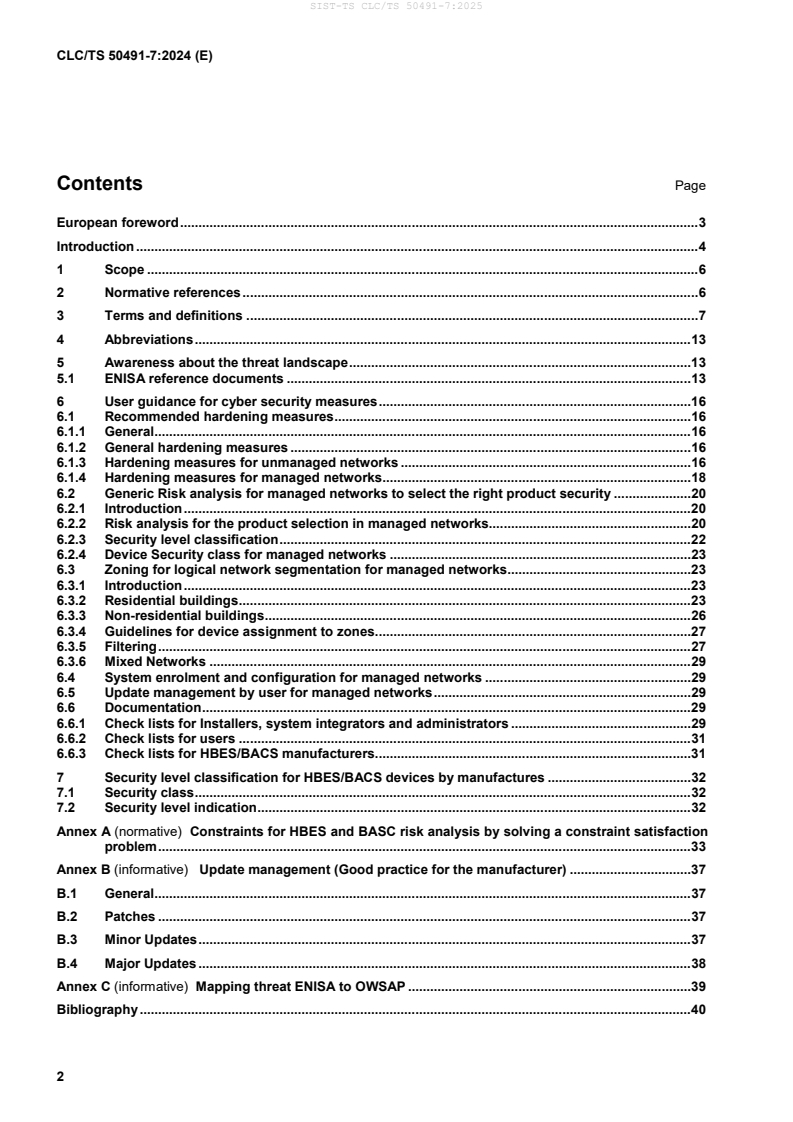
Contents Page
European foreword . 3
Introduction . 4
1 Scope . 6
2 Normative references . 6
3 Terms and definitions . 7
4 Abbreviations . 13
5 Awareness about the threat landscape . 13
5.1 ENISA reference documents . 13
6 User guidance for cyber security measures . 16
6.1 Recommended hardening measures . 16
6.1.1 General . 16
6.1.2 General hardening measures . 16
6.1.3 Hardening measures for unmanaged networks . 16
6.1.4 Hardening measures for managed networks. 18
6.2 Generic Risk analysis for managed networks to select the right product security . 20
6.2.1 Introduction . 20
6.2.2 Risk analysis for the product selection in managed networks. 20
6.2.3 Security level classification . 22
6.2.4 Device Security class for managed networks . 23
6.3 Zoning for logical network segmentation for managed networks . 23
6.3.1 Introduction . 23
6.3.2 Residential buildings . 23
6.3.3 Non-residential buildings . 26
6.3.4 Guidelines for device assignment to zones . 27
6.3.5 Filtering . 27
6.3.6 Mixed Networks . 29
6.4 System enrolment and configuration for managed networks . 29
6.5 Update management by user for managed networks . 29
6.6 Documentation . 29
6.6.1 Check lists for Installers, system integrators and administrators . 29
6.6.2 Check lists for users . 31
6.6.3 Check lists for HBES/BACS manufacturers. 31
7 Security level classification for HBES/BACS devices by manufactures . 32
7.1 Security class . 32
7.2 Security level indication . 32
Annex A (normative) Constraints for HBES and BASC risk analysis by solving a constraint satisfaction
problem . 33
Annex B (informative) Update management (Good practice for the manufacturer) . 37
B.1 General . 37
B.2 Patches . 37
B.3 Minor Updates . 37
B.4 Major Updates . 38
Annex C (informative) Mapping threat ENISA to OWSAP . 39
Bibliography . 40
European foreword
This document (CLC/TS 50491-7:2024) has been prepared by CLC/TC TC 205, “Home and Building Electronic
Systems (HBES)”.
Attention is drawn to the possibility that some of the elements of this document may be the subject of patent
rights. CENELEC shall not be held responsible for identifying any or all such patent rights.
This document is part of the EN 50491 series of European Standards — General requirements for Home and
Building Electronic Systems (HBES) and Building Automation and Control Systems (BACS) — which will
comprise the following parts:
— Part 1: General requirements.
— Part 2: Environmental Conditions.
— Part 3: Electric Safety Requirements.
— Part 4-1: General functional safety requirements for products intended to be integrated in Building
Electronic Systems (HBES) and Building Automation and Control Systems (BACS);
— Part 5-1: EMC requirements, conditions and test set-up.
— Part 5-2: EMC requirements for HBES/BACS used in residential, commercial and light industry
environment.
— Part 5-3: EMC requirements for HBES/BACS used in industry environment
— Part 6-1: HBES installations — Installation and planning.
— Part 6-3: HBES installations — Assessment and definition of levels.
— Part 7: IT security and data protection - User Guide
— Part 11: Smart Metering — Application Specification — Simple External Consumer Display.
— Part 12: Smart grid — Application specification — Interface and framework for customer.
— Part 12-1: Interface between the CEM and Home/Building Resource manager– General Requirements and
Architecture.
— Part 12-2: Interface between the Home/Building CEM and Resource manager(s) – Data model and
messaging.
— Future Part 12-3: Home/Building Customer Energy Manager (CEM);
— Future Part 12-4: Resource manager.
Any feedback and questions on this document should be directed to the users’ national committee. A complete
listing of these bodies can be found on the CENELEC website.
Introduction
When an HBES/BACS system is installed in a home or building and connected to internet, it should keep the
integrity of the connected cyberspace during all the products’ lifetime from installation and configuration
throughout all operation to the end of life.
Cybersecurity is a continuous process as cyber threats evolve over time. Thus, countermeasures should follow
any new threat also after the product has been installed.
The risk of cyber-attacks highly depends on the type of application, type of communication medium and the
location where the data are intercepted.
As examples,
— data that is transmitted wireless can be more easily intercepted than data transmitted via wire;
— devices installed in public areas (garden, hallways) or public buildings (schools, hotels, sports complex, …)
are more susceptible to attack than devices that are installed in private and closed areas;
— data that is transmitted to switch on light may be of lesser importance than data containing metering data;
— HBES/BACS connected to cloud servers may be more vulnerable to attack than HBES/BACS devices that
are stand-alone, i.e. not connected.
In buildings, two types of networks can be identified: managed and unmanaged, depending on available
resources (e.g. network administrator) to ensure cybersecurity update during the products’ lifetime.
Examples of applications typically implemented as
— unmanaged network: Home or small office including building control applications, … where no or insufficient
resources (e.g. network administrator) are available for network cybersecurity updates and device access
control. Cybersecurity updates at device level may be ensured by device manufacturers, provided the final
user has given consent;
— managed networks: larger size installations including building control applications where typically an
organization (e.g. an administrator) updates components and the network including its structure: Resources
(e.g. integrator, maintenance provider, asset owner) are available for cybersecurity updates.
Cybersecurity updates in HBES/BACS systems installed and connected to internet systems can be managed
at two different levels: device level and system level. Updates at device level are possible both for managed
and unmanaged networks, while updates at system level is possible for managed networks only.
Considering the two levels, two main areas of application for managed and unmanaged networks can be
identified:
1) in case of unmanaged networks, for device update one is relying on the device fulfilling the cybersecurity
requirements identified by risk analysis for their intended use (e.g. in EU: RED Delegated Act on
cybersecurity).
2) managed networks apply when:
a) an organization is available for updates of the devices and the network; or
b) some devices cannot be updated at the level identified by risk analysis: in this case, protection is to be
ensured at system level and access to non-updateable devices is to be protected/controlled (e.g. old
equipment’s that cannot be updated nor substituted with new ones) by moving it out of the trusted
security zone; or
c) additional cybersecurity requirements are necessary at system level on top of the device level updates
(e.g. defining trusted and untrusted zones).
In all cases a), b), c), use of system resources (e.g. devices) should be regulated according to a security policy
and permitted only by authorized entities (users, programs, processes, or other systems) according to that
policy.
When providing networked system for HBES and BACS, large organizations often have dedicated well trained
teams to provide full service cyber security from risk assessment, product selection to the operational
management.
For heterogeneous systems and in general smaller systems the cyber security aspect is often not covered so
well.
While on the product level several standards exist, there is a gap for the cyber secure system management in
this kind of installations.
Risk analysis for each device should be done by manufacturers for the intended use. Accordingly, cybersecurity
updates for devices should be made available by manufacturers.
Risk analysis for each system should be done by the system responsible person. Accordingly, cybersecurity
updates for systems should be made available and implemented by resources (e.g. end users).
For risk analysis of systems, it is therefore needed that appropriate guidelines are developed in order to support
both the end-users (as owner of a home or building) and all the persons involved in the building design,
installation, commissioning and operation, to make them aware about the risks, help to assess the risk to find
the appropriate minimum-security levels needed or desired for a product and give rules for securing the whole
network.
Depending on this security level, appropriate products could then be selected based on the indications given by
the suppliers on the product label and/or instruction sheet.
The security level classification gives to the market a classification scheme like the energy classification A, B,
C …
CEN-Cenelec have been requested by European Commission to publish harmonized standards supporting RED
Directive and Cyber Resilience Act (CRA). These draft standards are in progress at the time of the publication
of this document and when RED / CRA will enter into force this document could be reviewed.
1 Scope
This document provides guidance to set-up and manage/update a cybersecure HBES/BACS connected to
Internet.
This document provides:
1) categories of HBES/BACS networks related to cybersecurity updates:
— managed networks;
— unmanaged networks;
2) risk analysis guide for the above-mentioned categories:
— at device level for both managed and unmanaged networks;
— at system level for managed ones only.
For manufacturers, the document provides a classification based on the security levels from existing standards
(ETSI EN 303 645, EN IEC 62443 (all parts)).
For installers, system integrators and administrators of HBES/BACS this document provides guidance for each
responsible actor, as listed below:
— system integrators and administrators:
— a generic method for assessment of the security risk for each product in the perspective of the overall
system. The result of the evaluation gives the minimum required security level on product level
corresponding to the manufacturer classification;
— best practice measures on the system security level;
— a guide to enhance the maturity level of the cyber security management process.
— installers, system integrators and administrators:
— a guide to select products to comply with the required security level during configuration and operation.
In some commercial applications, dedicated standards can apply per country that are not covered by this
document, e.g.:
— fire (e.g. detection, alarm);
— medical;
— security applications: Intruder alarms, video surveillance, access control;
— critical infrastructure;
— AAL (Active assisted living).
For such applications not covered by this document the specification could be used as guidance.
2 Normative references
There are no normative references in this document.
3 Terms and definitions
For the purposes of this document, the following terms and definitions apply.
ISO and IEC maintain terminology databases for use in standardization at the following addresses:
— ISO Online browsing platform: available at https://www.iso.org/obp/
— IEC Electropedia: available at https://www.electropedia.org/
3.1
administrator
user who has been authorized to manage security policies/capabilities for a product or system
[SOURCE: EN IEC 62443-4-1:2018, 3.1.4]
3.2
asset owner
individual or company responsible for one or more IACS
Note 1 to entry: In this document IACS is equivalent to HBES / BACS.
Note 2 to entry: The term “asset owner” is used in place of the generic term “end user” to provide differentiation.
Note 3 to entry: This definition includes the components that are part of the IACS.
Note 4 to entry: In the context of this standard, an asset owner also includes the operator of the IACS.
[SOURCE: EN IEC 62443-3-3:2019, 3.1.2, modified, new Note 1 to entry has been added.]
3.3
authenticity
property of data that ensures that the identity of an entity is the one claimed
Note 1 to entry: The entity can be, for example, a user, a process, a system, information.
[SOURCE: IEV 171-08-07]
3.4
availability
property of being accessible and usable upon demand by an authorised entity (with timely response to the
intended use case)
3.5
behavioural PII
data that allows to infer behavioral information of a PII principal
Examples:
— status of light, heating;
— current energy consumption;
— presence detection.
3.6
cybersecurity
activities necessary to protect network and information systems, the users of such systems, and other persons
affected by cyber threats
3.7
conduit
logical grouping of communication channels, connecting two or more zones, that share common security
requirements
Note 1 to entry: A conduit is allowed to traverse a zone as long as the security of the channels contained within the conduit
is not impacted by the zone.
[SOURCE: EN IEC 62443-4-2:2019, 3.1.11]
3.8
gateway
functional unit that connects two computer networks with different architectures and protocols
3.9
HBES/BACS
Home and Building Electronic Systems (HBES) and Building Automation and Control Systems (BACS)
combination of HBES/BACS products (including their separate connected/detachable devices) linked together
via one or more HBES/BACS networks
Note 1 to entry: Other names used such as “home control network”, “home control systems”, “home and building electronic
systems”, “building systems”, “building automation system”, etc. describe types of HBES/BACS systems.
[SOURCE: EN 63044-1:2017 , 3.1.3]
3.10
HBES/BACS network
interconnection between HBES/BACS products used for communication, that can carry digital data as well as
analogue signals
[SOURCE: EN 63044-1:2017 , 3.1.2]
3.11
HBES/BACS product
device intended to be used for control, monitoring, operation or management of building services and/or home
electronic systems, able to interact via a dedicated HBES/BACS network
3.12
information security
protection of information against unauthorized disclosure, transfer, modification, or destruction, whether
accidental or intentional
Note 1 to entry: In addition, properties, such as authenticity, accountability, non-repudiation, and reliability can be involved.
Note 2 to entry: Information security is a broad term that can be used regardless of the form the data can take (e.g.
electronic, physical)
[SOURCE: IEV 721-08-57, modified – Notes 1 and 2 to entry have been added.]
As impacted by EN 63044-1:2017/A1:2021.
As impacted by EN 63044-1:2017/A1:2021.
3.13
integration service provider
service provider that provides integration activities for an automation solution including design, installation,
configuration, testing, commissioning, and handover
Note 1 to entry: Integration service providers are often referred to as integrators or Main Automation Contractors (MAC)
[SOURCE: EN IEC 62443-2-4:2024, 3.1.9]
3.14
integrity
property of accuracy and completeness
3.15
intended use
use of a product, process, or service in accordance with the information for use provided by the supplier
[SOURCE: ISO/IEC GUIDE 51:2014, 3.6]
3.16
maintenance provider
service provider that provides support activities for a HBES / BACS after handover
Note 1 to entry: Maintenance is often distinguished from operation (e.g. in common colloquial language it is often assumed
that an automation solution is either in operation or under maintenance). Maintenance service providers can perform support
activities during operations, e.g. managing user accounts, security monitoring, and security assessments
3.17
managed network
installations including building control applications where typically an organization (e.g., an administrator)
updates components and the network including its structure, and in which resources (e.g., integrator,
maintenance provider, asset owner) are available for cybersecurity updates
3.18
non-sensitive PII
data requiring more data elements to be linked together to establish an individual’s identity
Note 1 to entry: This kind of information is also referred to as linkable data.
Note 2 to entry: On the other hand, sensitive PII can reveal identity on its own or with very limited combined information
sources.
Examples:
— voice recording (local and/or cloud);
— first or last name;
— mother’s maiden name;
— partial address;
— age range;
— date of birth;
— gender;
— employer.
3.19
operational environment
physical environment of a functional component
3.20
organization
body that is based on the membership of other bodies or individuals and has an established constitution and its
own administration
[SOURCE: IEV 901-03-02]
3.21
personal data
information relating to an identified or identifiable natural person
[SOURCE: Article 4 of the EU Data Protection Regulation, (1), modified]
3.22
natural person
data subject
one who may be identified, directly or indirectly, in particular by reference to an identifier such as a name, an
identification number, location data, an online identifier or to one or more factors specific to the physical,
physiological, genetic, mental, economic, cultural or social identity of that natural person
[SOURCE: Article 4 of the EU Data Protection Regulation, (1), modified]
3.23
personally identifiable information
PII
information that can be used to establish a link between the information and the natural person to whom such
information relates, or is or can be directly or indirectly linked to a natural person
Note 1 to entry: The “natural person” in the definition is the PII principal (3.23). To determine whether a PII principal is
identifiable, account should be taken of all the means which can reasonably be used by the privacy stakeholder holding the
data, or by any other party, to establish the link between the set of PII and the natural person.
[SOURCE: EN ISO/IEC 29100:2020, 2.9, modified]
3.24
PII principal
natural person to whom the personally identifiable information (PII) relates
[SOURCE: EN ISO/IEC 29100:2020, 2.11, modified]
3.25
privacy
right of an entity (normally a person or an organization), acting on its own behalf, to determine the degree to
which the confidentiality of their private information is maintained
3.26
unmanaged network
network installed in a building and commissioned by an organization or private owner but not managed by any
organization during operation
Note 1 to entry: E.g. network made of plug and play devices.
3.27
security level
level corresponding to the required set of countermeasures and inherent security properties of devices and
systems for a zone or conduit based on assessment of risk for the zone or conduit
Note 1 to entry: Also defined as a measure of confidence that the IACS is free from vulnerabilities and functions in the
intended manner.
Note 2 to entry: Vulnerabilities can either be designed into the IACS, inserted at any time during its lifecycle or result from
changing threats. Designed-in vulnerabilities may be discovered long after the initial deployment of the IACS, for example
an encryption technique has been broken or an improper policy for account management such as not removing old user
accounts. Inserted vulnerabilities may be the result of a patch or a change in policy that opens up a new vulnerability.
[SOURCE: EN IEC 62443-3-3:2019, 3.1.38, and EN IEC 62443-4-2:2019, 3.1.37, modified]
3.28
security zone
grouping of logical or physical assets that share common security requirements
Note 1 to entry: All unqualified uses of the term “zone” in this document should be assumed to refer to a security zone.
Note 2 to entry: A zone has a clear border with other zones. The security policy of a zone is typically enforced by a
combination of mechanisms both at the zone edge and within the zone. Zones can be hierarchical in the sense that they
can be comprised of a collection of sub-zones
3.29
sensitive personally identifiable information
sensitive PII
linked data
PII that can be directly tied to a person’s identity, and of which the misuse could cause potential harm to a
person
Note 1 to entry: First and last name or credit card number are also referred to as sensitive personally identifiable
information, or linked data. This is because this information is directly or almost directly linked to, and can reveal, an
individual’s identity.
Note 2 to entry: The potential harm its misuse could do to a person ranges from public embarrassment to criminal
victimization, if the information is lost, stolen, or disclosed without authorization.
Examples:
— one-to-one voice conversation;
— geo location;
— first and last name;
— home address;
— email address;
— telephone number;
— passport number;
— driver’s license number;
— Social Security Number;
— photo of a face;
— credit card number;
— account username;
— fingerprints;
— financial records;
— medical records.
3.30
service provider
organization that has agreed to undertake responsibility for providing a given support service and obtaining,
when specified, supplies in accordance with an agreement
Note 1 to entry: This term is used in place of the generic word “vendor” to provide differentiation.
Note 2 to entry: An organization can be an internal or external organization, manufacturer, etc.
[SOURCE: EN IEC 62443-2-4:2024, 3.1.19, modified]
3.31
system integrator
person or company that specializes in bringing together component subsystems into a whole and ensuring that
those subsystems perform in accordance with project specifications
[SOURCE: EN IEC 62443-4-1:2018, 3.1.34]
3.32
system responsible person
user who has been authorized to manage security policies/capabilities for a product or system
3.33
trusted zone
all devices that are completely under control by the system responsible person in terms of physical access,
security updates, user access, user account credentials
3.34
untrusted zone
untrusted devices where the system responsible person has no control in terms of physical access and/or
security updates
3.35
zone
collection of entities that represents partitioning of a system under consideration based on their functional,
logical, and physical (including location) relationship
Note 1 to entry: A zone has a clear border. The security policy of a zone is typically enforced by a combination of
mechanisms both at the zone edge and within the zone.
[SOURCE: EN IEC 62443-4-2:2019, 3.1.49]
4 Abbreviations
For the purposes of this document, the following abbreviations apply.
CSP Constraint Satisfaction Problem
ENISA European Union Agency for Cybersecurity
ETSI European Telecommunications Standards Institute
HTTPS HyperText Transfer Protocol Secure
IACS Industrial Automation and Control Systems
IP Internet protocol
LAN Local Area Network
PBRA Property based risk analysis
PII Personal Identifiable Data
SF Security feature
VLAN Virtual local area network
5 Awareness about the threat landscape
5.1 ENISA reference documents
This clause gives a short introduction to the threats which HBES and BACs may be exposed to. The overall
threat landscape for smart home and converged media is described in detail in the 02/2015, ENISA “Threat
Landscape and Good Practice Guide for Smart Home and Converged Media” document.
The main conclusions from this document are:
— the equipment and user knowledge associated with “smart homes” vary significantly;
— “smart homes” will have an enormous impact on data protection and data security;
— poor data protection and data security are the result of various economic factors;
— the interests of the various asset owners in the field of “smart homes” lead to conflicts;
As Cyber security is a moving target, ENISA is informing about actual threats within its annual threat report.
This report gives a ranking and description of the major cyber attack threats:
https://www.enisa.europa.eu/topics/threat-risk-management
In the following clauses the typical assets and threats for HBES and BAC systems are described.
An overview about the main threats can be found in Figure 1 below.
A mapping from ENISA threat to OWSAP can be found in Annex C.
Figure 1 — ENISA 2020 top 15 Threats.
[SOURCE: Enisa Threat landscape (https://www.enisa.europa.eu/topics/threat-risk-management/threats-and-
trends/enisa-threat-landscape-2020-top-15-threats)]
5.2 Listing of home and building related Assets
In the context of homes and buildings, ENISA has identified the assets in the context of cyber security as shown
in Figure 2 below (non-exhaustive):
[Source: ENISA - Threat Landscape and Good Practice Guide for Smart Home and Converged Media 1
December 2014].
Figure 2 — Overview of Smart Home and Converged Media Assets
6 User guidance for cyber security measures
6.1 Recommended hardening measures
6.1.1 General
HBES/BACS products can be found both in environments that have a responsible person for the cyber security
(we call in this document ‘managed networks’) and in buildings where no instance is responsible for the overall
system management (we call in this document ‘unmanaged networks’). Also, a mix of these cases can be found.
This clause describes the protections adapted to these specific situations.
6.1.2 General hardening measures
This clause introduces some principal recommendations to harden the system towards the threats mentioned
in chapter 4.
It is recommended that:
— passwords should include upper case, lower case, number, and special characters;
— the password should have 8 characters minimum (recommended 12 or more);
— the password should not be a single word or an easy sequence, a phrase is suggested;
— a factory default password should be changed immediately when first received and after a factory reset;
— passwords should be changed regularly (for example 1 per year);
— passwords should not be reused.
For network access it is recommended that:
— device should not have a publicly accessible IP address;
— port forwarding should not be used to access a device from the public internet. Instead, a virtual private
network should be used in case a connection from the internet is needed;
— in case of Wi-Fi communication, the strongest available Wi-Fi encryption should be used;
— the use of secure communication protocols in local networks (e.g. HTTPS) may be adopted as additional
measure;
— the physical access to network cables should be protected e.g. by using installation tubes;
— unused LAN ports should not be patched to the network switch;
— assign device MAC address to the connected switch port;
— physical access to network components / distribution should be protected by a dedicated locked cabinet;
— physical access to the device should be limited as much as possible.
6.1.3 Hardening measures for unmanaged networks
According to the definition 3.25, an unmanaged network has no IT manager responsible to update the security
measures for the whole network. Network security depends on individual product security. The manufacturer is
responsible for security measures at market placement and for the update of each device, provided the final
user has given consent.
A typical example of a product in an unmanaged network is a connected thermostat which is normally
standalone and not integrated into a wider network.
For this kind of products, the manufacturer notifies the user in case a security related software update is
available, e.g. via the dedicated app on the smartphone. The user acknowledges the update.
A typical architecture of an ‘Unmanaged Network’ is shown in Figure 3 below.
Figure 3 — Example of an unmanaged network architecture.
Local standards may require an installer responsible for network commissioning. Do It Yourself (DIY) products
may be added to the network by the user.
It is recommended that the product manufacturer:
— identify the intended use and verify its suitability for unmanaged networks;
— perform the risk assessment for each device based on the intended use;
— implement the relevant requirements of ETSI EN 303-645 and/or a vertical security consumer IoT product
standard, based on results from risk assessment. Most of the ETSI EN 303-645 provisions can be mapped
into some equivalent EN IEC 62443-4-2 SL1/2/3/4 provisions;
— make available the security software updates timely to maintain the targeted security level of the device;
— guarantee the software updates for the device life cycle.
NOTE Attention is drawn to regulations that can require a minimum period of time for updates.
It is recommended that the installer (or user in case of DIY devices):
— select a device fulfilling security provisions in line with the intended use;
— install the device and set the requested security measures (see check list in 6.6);
— thereby observe the corresponding documentation and operating instructions, as for example:
— periodic update of login password;
— acknowledging the security software upgrade;
— specific data privacy protection measures when ceasing the use of a device (e.g. deleting PII and user
specific credentials when moving out from a rented flat).
It is recommended that the user:
— observe the user instructions given by the installer;
— provide product replacement when security software updates are no more available (after the guaranteed
update period is expired);
— when ceasing the use of a device deleting PII and user specific credentials from the device and, if used,
from related services (e.g. cloud-based ones).
6.1.4 Hardening measures for managed networks
A managed network in contrast is actively setup and maintained by a responsible person, i.e. an IT or Network
administrator. In managed networks the counter measures depend on the risk analysis that has to be performed
by the responsible person for each installed network to provide the security level needed for the overall system.
The responsible person is also considering additional protective measures at system level to harden the system.
Figure 4 — Example of a managed network architecture.
As shown Figure 4, a basic measure to harden the system it is advised to use Virtual LAN (VLANs) that brings
additional security to the network installation and limits the broadcast traffic to the corresponding network
segment (e.g. VLAN).
Each specific functional domain has its own network segment with a separate address range. It is strongly
recommended to setup the network in such a way that known devices is assigned to their corresponding network
segment and all unknown devices are bound automatically to an untrusted network segment.
A in depth guidance for a network setup is given in the following sections.
It is recommended that the product manufacturer:
— identify the intended use and verify its suitability for managed networks;
— perform the risk assessment for each device based on the intended use;
— implement the relevant measures according to applicable standards like ETSI EN 303-645,
EN IEC 62443-4-2;
— make available the security software updates timely to maintain the targeted security level of the device;
— guarantee the software updates for the device life cycle.
NOTE Attention is drawn to regulations that can require a minimum period of time for updates.
It is recommended that the installer:
— assess the risk of the concerned device which is exposed to the operational environment and select a
device fulfilling security provisions in line with the intended use.
— install the device according to the recommended practices in 6.1.2 and set the requested security measures
(see check list in 6.6)
It is recommended that the user:
— follow check list in 6.6.
6.2 Generic Risk analysis for managed networks to select the right product security
6.2.1 Introduction
A first step is to evaluate the risk of a device it is exposed to in a given operational environment of use. The
device and its operational environment of use is described by properties. Each property may contribute to the
overall risk with a certain weight which can be expressed in a formula to calculate the overall risk. This clause
describes the properties used and introduces the tool calculates the risk a device is exposed to.
The risk assessment shall be performed for each managed network.
Based on the result of the risk evaluation a device should be selected that has a sufficient security level so that
it is protected against the assumed risk.
6.2.2 Risk analysis for the product selection in managed networks
6.2.2.1 General
A risk analysis is the basis for the identification of the potential cyber-attack risks for the selection of products
having sufficient counter measures to build a system to defend effectively cyber-attacks.
The risk analysis proposed in this document is based on a method known as ‘Property Based Risk Analysis’
(PBRA) as described in Annex A.
This clause introduces properties that describe the categories having the most contribution to the overall risk of
a device in a system.
The considered categories are ‘attack surface’ and ‘Impact in the environment of use’.
The ‘attack surface’ is described by the following properties:
— physical device access in the installation environment;
— management level of the system;
— network security zoning;
— device access to the internet;
— device access from the internet.
The ‘Impact in the environment of use’ is described by the following properties:
— criticality of the device or peer device control aspect i.e. type and criticality of the load;
— sensitivity of data processed by a device.
A detailed description of these properties can be found in the following subclauses.
6.2.2.2 Physical device access in the installation environment
The physical access level of a device impacts the security level:
Values:
— not restricted;
— restricted.
NOTE: An area can be restricted to skilled persons or authorized persons for example.
The operational environment plays an essential role to evaluate the overall cyber security risk. The following
lists some typical restricted operational environments:
— lockable room for use by all residents/users of a house/building/property (e.g. bicycle cellar or laundry
cellar);
— apartments/offices with access limitations;
— a single-family house/apartment are treated as private areas.
Area accessible only by authorized persons e.g. cabinet by electrician.
6.2.2.3 Network security zones
The concept of network security zones is to group together (continuous) areas subject to the same security
characteristics (threat potential, motivation of an attacker, protection level).
Segregation is possible by physical separation of networks or by its logical separation. While pure physical
segregation is neither flexible nor scalable, a flexible segregation is typically achieved by logical segregation
such as grouping devices and connecting to edge or gateway devices for separation.
An example of a network securi
...