

EN ISO/IEC 17000:2004
(Main)Conformity assessment - Vocabulary and general principles (ISO/IEC 17000:2004)
- Abstract
ISO/IEC 17000:2004 specifies general terms and definitions relating to conformity assessment, including the accreditation of conformity assessment bodies, and to the use of conformity assessment to facilitate trade. A description of the functional approach to conformity assessment is included as a further aid to understanding among users of conformity assessment, conformity assessment bodies and their accreditation bodies, in both voluntary and regulatory environments.
ISO/IEC 17000:2004 does not set out to provide a vocabulary for all of the concepts that may need to be used in describing particular conformity assessment activities. Terms and definitions are given only where the concept defined would not be understandable from the general language use of the term or where an existing standard definition is not applicable.
- Status
- Withdrawn
- Publication Date
- 31-Oct-2004
- Withdrawal Date
- 06-Oct-2026
- Technical Committee
- CEN/CLC/TC 1 - Criteria for conformity assessment bodies
- Drafting Committee
- CEN/CLC/TC 1 - Criteria for conformity assessment bodies
- Current Stage
- 9960 - Withdrawal effective - Withdrawal
- Start Date
- 10-Jun-2020
- Completion Date
- 07-Oct-2026
Buy Documents



EN ISO/IEC 17000:2005
Relations
- Replaces
EN 45020:1998 - Standardization and related activities - General vocabulary (ISO/IEC Guide 2:1996) - Effective Date
- 09-Dec-2015
- Effective Date
- 12-Apr-2017
- Effective Date
- 28-Jan-2026
- Effective Date
- 28-Jan-2026
- Effective Date
- 12-Feb-2026
Buy Documents
EN ISO/IEC 17000:2005
Get Certified
Connect with accredited certification bodies for this standard

BSI Group
BSI (British Standards Institution) is the business standards company that helps organizations make excellence a habit.

Bureau Veritas
Bureau Veritas is a world leader in laboratory testing, inspection and certification services.

DNV
DNV is an independent assurance and risk management provider.
Sponsored listings
Frequently Asked Questions
EN ISO/IEC 17000:2004 is a standard published by the European Committee for Standardization (CEN). Its full title is "Conformity assessment - Vocabulary and general principles (ISO/IEC 17000:2004)". This standard covers: ISO/IEC 17000:2004 specifies general terms and definitions relating to conformity assessment, including the accreditation of conformity assessment bodies, and to the use of conformity assessment to facilitate trade. A description of the functional approach to conformity assessment is included as a further aid to understanding among users of conformity assessment, conformity assessment bodies and their accreditation bodies, in both voluntary and regulatory environments. ISO/IEC 17000:2004 does not set out to provide a vocabulary for all of the concepts that may need to be used in describing particular conformity assessment activities. Terms and definitions are given only where the concept defined would not be understandable from the general language use of the term or where an existing standard definition is not applicable.
ISO/IEC 17000:2004 specifies general terms and definitions relating to conformity assessment, including the accreditation of conformity assessment bodies, and to the use of conformity assessment to facilitate trade. A description of the functional approach to conformity assessment is included as a further aid to understanding among users of conformity assessment, conformity assessment bodies and their accreditation bodies, in both voluntary and regulatory environments. ISO/IEC 17000:2004 does not set out to provide a vocabulary for all of the concepts that may need to be used in describing particular conformity assessment activities. Terms and definitions are given only where the concept defined would not be understandable from the general language use of the term or where an existing standard definition is not applicable.
EN ISO/IEC 17000:2004 is classified under the following ICS (International Classification for Standards) categories: 01.040.03 - Services. Company organization, management and quality. Administration. Transport. Sociology. (Vocabularies); 03.120.20 - Product and company certification. Conformity assessment. The ICS classification helps identify the subject area and facilitates finding related standards.
EN ISO/IEC 17000:2004 has the following relationships with other standards: It is inter standard links to EN 45020:1998, EN ISO/IEC 17000:2020, CEN/TS 16214-2:2014, CEN/TS 16214-2:2020, ISO/IEC 17000:2004. Understanding these relationships helps ensure you are using the most current and applicable version of the standard.
EN ISO/IEC 17000:2004 is associated with the following European legislation: EU Directives/Regulations: 765/2008; Standardization Mandates: M/417. When a standard is cited in the Official Journal of the European Union, products manufactured in conformity with it benefit from a presumption of conformity with the essential requirements of the corresponding EU directive or regulation.
EN ISO/IEC 17000:2004 is available in PDF format for immediate download after purchase. The document can be added to your cart and obtained through the secure checkout process. Digital delivery ensures instant access to the complete standard document.
Standards Content (Sample)
SLOVENSKI SIST EN ISO/IEC 17000:2005
STANDARD
januar 2005
Ugotavljanje skladnosti – Slovar in splošna načela (ISO/IEC 17000:2004)
(istoveten EN ISO/IEC 17000:2004)
Conformity assessment - Vocabulary and general principles (ISO/IEC 17000:2004)
ICS 01.040.03; 03.120.20 Referenčna številka
© Standard je založil in izdal Slovenski inštitut za standardizacijo. Razmnoževanje ali kopiranje celote ali delov tega dokumenta ni dovoljeno
EUROPEAN STANDARD
EN ISO/IEC 17000
NORME EUROPÉENNE
EUROPÄISCHE NORM
November 2004
ICS 01.040.03; 03.120.20
Supersedes Clauses 12 to 17 of EN 45020:1998
English version
Conformity assessment - Vocabulary and general principles
(ISO/IEC 17000:2004)
Evaluation de la conformité - Vocabulaire et principes Konformitätsbewertung -Begriffe und allgemeine
généraux (ISO/IEC 17000:2004) Grundlagen (ISO/IEC 17000:2004)
This European Standard was approved by CEN and CENELEC on 8 August 2004.
CEN and CENELEC members are bound to comply with the CEN/CENELEC Internal Regulations which stipulate the conditions for giving
this European Standard the status of a national standard without any alteration. Up-to-date lists and bibliographical references concerning
such national standards may be obtained on application to the CEN Management Centre or to any CEN or CENELEC member.
This European Standard exists in three official versions (English, French, German). A version in any other language made by translation
under the responsibility of a CEN or CENELEC member into its own language and notified to the CEN Management Centre has the same
status as the official versions.
CEN and CENELEC members are the national standards bodies and national electrotechnical committees, respectively, of Austria,
Belgium, Cyprus, Czech Republic, Denmark, Estonia, Finland, France, Germany, Greece, Hungary, Iceland, Ireland, Italy, Latvia,
Lithuania, Luxembourg, Malta, Netherlands, Norway, Poland, Portugal, Slovakia, Slovenia, Spain, Sweden, Switzerland and United
Kingdom.
CEN Management Centre: CENELEC Central Secretariat:
rue de Stassart, 36 B-1050 Brussels rue de Stassart, 35 B-1050 Brussels
© 2004 CEN/CENELEC All rights of exploitation in any form and by any means reserved Ref. No. EN ISO/IEC 17000:2004 E
worldwide for CEN national Members and for CENELEC
Members.
Foreword
This document (EN ISO/IEC 17000:2004) has been prepared by Technical Committee
ISO/CASCO "Committee on conformity assessment" in collaboration with Technical Committee
CEN/CLC/TC 1 "Criteria for conformity assessment bodies", the secretariat of which is held by
SN.
This European Standard shall be given the status of a national standard, either by publication of
an identical text or by endorsement, at the latest by May 2005, and conflicting national standards
shall be withdrawn at the latest by May 2005.
This document supersedes Clauses 12 to 17 of EN 45020:1998.
According to the CEN/CENELEC Internal Regulations, the national standards organizations of
the following countries are bound to implement this European Standard: Austria, Belgium,
Cyprus, Czech Republic, Denmark, Estonia, Finland, France, Germany, Greece, Hungary,
Iceland, Ireland, Italy, Latvia, Lithuania, Luxembourg, Malta, Netherlands, Norway, Poland,
Portugal, Slovakia, Slovenia, Spain, Sweden, Switzerland and United Kingdom.
Endorsement notice
The text of ISO/IEC 17000:2004 has been approved by CEN and CENELEC as EN ISO/IEC
17000:2004 without any modifications.
INTERNATIONAL ISO/IEC
STANDARD 17000
NORME
First edition
Première édition
INTERNATIONALE
Первое издание
2004-11-01
МЕЖДУНАРОДНЫЙ
СТАНДАРТ
Conformity assessment — Vocabulary
and general principles
Évaluation de la conformité —
Vocabulaire et principes généraux
Oценка соответствия. Cловарь и
общие принципы
Reference number
Numéro de référence
Номер ссылки
ISO/IEC 17000:2004(E/F/R)
©
ISO 2004
ISO/IEC 17000:2004(E/F/R)
© ISO 2004
The reproduction of the terms and definitions contained in this International Standard is permitted in teaching manuals, instruction
booklets, technical publications and journals for strictly educational or implementation purposes. The conditions for such reproduction are:
that no modifications are made to the terms and definitions; that such reproduction is not permitted for dictionaries or similar publications
offered for sale; and that this International Standard is referenced as the source document.
With the sole exceptions noted above, no other part of this publication may be reproduced or utilized in any form or by any means,
electronic or mechanical, including photocopying and microfilm, without permission in writing from either ISO at the address below or
ISO's member body in the country of the requester.
La reproduction des termes et des définitions contenus dans la présente Norme internationale est autorisée dans les manuels
d'enseignement, les modes d'emploi, les publications et revues techniques destinés exclusivement à l'enseignement ou à la mise en
application. Les conditions d'une telle reproduction sont les suivantes: aucune modification n'est apportée aux termes et définitions; la
reproduction n'est pas autorisée dans des dictionnaires ou publications similaires destinés à la vente; la présente Norme internationale
est citée comme document source.
À la seule exception mentionnée ci-dessus, aucune partie de cette publication ne peut être reproduite ni utilisée sous quelque forme que
ce soit et par aucun procédé, électronique ou mécanique, y compris la photocopie et les microfilms, sans l'accord écrit de l'ISO à
l'adresse ci-après ou du comité membre de l'ISO dans le pays du demandeur.
Воспроизведение терминов и определений, содержащихся в настоящем Международном стандарте, разрешается в учебных
пособиях, руководствах по эксплуатации, публикациях и журналах технического характера, предназначенных исключительно для
обучения или для практического исполнения. Подобное воспроизведение должно осуществляться на следующих условиях:
термины и определения не должны подвергаться никаким изменениям; воспроизведение запрещается в словарях и других
сходных изданиях, предназначенных для продажи; настоящий Международный стандарт должен цитироваться как
первоисточник.
Кроме вышеперечисленных исключений, никакая другая часть данной публикации не подлежит ни воспроизведению, ни
использованию в какой бы то ни было форме и каким бы то ни было способом, электронным или механическим, включая
фотокопии и микрофильмы, без письменного согласия либо ИСО, которое может быть получено по адресу, приводимому ниже,
либо комитета члена ИСО в стране лица, подающего запрос.
ISO copyright office
Case postale 56 • CH-1211 Geneva 20
Tel. + 41 22 749 01 11
Fax + 41 22 749 09 47
E-mail copyright@iso.org
Web www.iso.org
Published in Switzerland/Publié en Suisse/Oтпeчaтaнo в Швeйцaрии
ii © ISO 2004 – All rights reserved/Tous droits réservés/Все права сохранены
ISO/IEC 17000:2004(E/F/R)
PDF disclaimer
This PDF file may contain embedded typefaces. In accordance with Adobe's licensing policy, this file may be printed or viewed but
shall not be edited unless the typefaces which are embedded are licensed to and installed on the computer performing the editing. In
downloading this file, parties accept therein the responsibility of not infringing Adobe's licensing policy. The ISO Central Secretariat
accepts no liability in this area.
Adobe is a trademark of Adobe Systems Incorporated.
Details of the software products used to create this PDF file can be found in the General Info relative to the file; the PDF-creation
parameters were optimized for printing. Every care has been taken to ensure that the file is suitable for use by ISO member bodies. In
the unlikely event that a problem relating to it is found, please inform the Central Secretariat at the address given below.
PDF – Exonération de responsabilité
Le présent fichier PDF peut contenir des polices de caractères intégrées. Conformément aux conditions de licence d'Adobe, ce fichier
peut être imprimé ou visualisé, mais ne doit pas être modifié à moins que l'ordinateur employé à cet effet ne bénéficie d'une licence
autorisant l'utilisation de ces polices et que celles-ci y soient installées. Lors du téléchargement de ce fichier, les parties concernées
acceptent de fait la responsabilité de ne pas enfreindre les conditions de licence d'Adobe. Le Secrétariat central de l'ISO décline toute
responsabilité en la matière.
Adobe est une marque déposée d'Adobe Systems Incorporated.
Les détails relatifs aux produits logiciels utilisés pour la création du présent fichier PDF sont disponibles dans la rubrique General Info
du fichier; les paramètres de création PDF ont été optimisés pour l'impression. Toutes les mesures ont été prises pour garantir
l'exploitation de ce fichier par les comités membres de l'ISO. Dans le cas peu probable où surviendrait un problème d'utilisation,
veuillez en informer le Secrétariat central à l'adresse donnée ci-dessous.
PDF – Oсвoбoждeниe oт oбязaннoсти
Нaстoящий фaйл PDF мoжeт сoдeржaть интeгрирoвaнныe шрифты. В сooтвeтствии с лицeнзиoнными услoвиями фирмы
Adobe, этoт фaйл мoжeт быть oтпeчaтaн или визуaлизирoвaн, oднaкo oн нe дoлжeн быть измeнeн, зa исключeниeм случaeв,
кoгдa примeняeмый для этoй цeли кoмпьютeр имeeт прaвo нa испoльзoвaниe этиx шрифтoв и eсли эти пoслeдниe
инстaллирoвaны. Зaгружeниeм нaстoящeгo фaйлa зaинтeрeсoвaнныe стoрoны сoглaшaются принять нa сeбя oтвeтствeннoсть
зa сoблюдeниe лицeнзиoнныx услoвий фирмы Adobe. Цeнтрaльный сeкрeтaриaт ИСO нe нeсeт никaкoй oтвeтствeннoсти в
этoм oтнoшeнии.
Adobe являeтся тoргoвым знaкoм фирмы Adobe Systems Incorporated.
Дeтaли, oтнoсящиeся к прoгрaммнoму oбeспeчeнию и испoльзoвaнныe для сoздaния нaстoящeгo фaйлa PDF, мoгут быть
прoкoнсультирoвaны в рубрикe General Info фaйлa; пaрaмeтры для сoздaния PDF были oптимизирoвaны для пeчaти. Были
приняты всe нeoбxoдимыe мeры, чтoбы гaрaнтирoвaть пoльзoвaниe нaстoящим фaйлoм всeми члeнaми ИСO. В рeдкиx
случaяx, кoгдa мoгли бы вoзникнуть прoблeмы испoльзoвaния, прoсьбa инфoрмирoвaть Цeнтрaльный сeкрeтaриaт пo aдрeсу,
привeдeннoму нижe.
ISO/IEC 17000:2004(E/F/R)
Contents Page
Foreword .vii
0 Introduction.x
1 Scope.1
2 Terms relating to conformity assessment in general .4
3 Basic terms.8
4 Conformity assessment terms relating to selection and determination (see Figure A.1).10
5 Conformity assessment terms relating to review and attestation (see Figure A.1) .12
6 Conformity assessment terms relating to surveillance (see Figure A.1) .16
7 Terms relating to conformity assessment and facilitation of trade.18
Annex A (informative) Principles of conformity assessment.24
Annex B (informative) Related terms defined in other documents .35
Bibliography.37
Alphabetical index.40
French alphabetical index (Index alphabétique) .41
Russian alphabetical index (Алфавитный указатель) .42
German alphabetical index (Alphabetisches Stichwortverzeichnis).43
Spanish alphabetical index (Índice alfabético).44
Italian alphabetical index (Indice alfabetico) .45
Dutch alphabetical index (Alfabetische index) .46
Swedish alphabetical index (Alfabetiskt register) .47
iv © ISO 2004 – All rights reserved/Tous droits réservés/Все права сохранены
ISO/IEC 17000:2004(E/F/R)
Sommaire Page
Avant-propos.viii
0 Introduction . xii
1 Domaine d'application. 1
2 Termes relatifs à l'évaluation de la conformité en général .4
3 Termes de base. 8
4 Termes d'évaluation de la conformité relatifs à la sélection et à la détermination
(voir Figure A.1) . 10
5 Termes d'évaluation de la conformité relatifs à la revue et à l'attestation (voir Figure A.1) . 12
6 Termes d'évaluation de la conformité relatifs à la surveillance (voir Figure A.1) . 16
7 Termes relatifs à l'évaluation de la conformité et à la facilitation du commerce. 18
Annexe A (informative) Principes de l'évaluation de la conformité . 24
Annexe B (informative) Termes connexes définis dans d'autres documents. 35
Bibliographie . 37
Index alphabétique anglais (Alphabetical index) . 40
Index alphabétique. 41
Index alphabétique russe (Алфавитный указатель) . 42
Index alphabétique allemand (Alphabetisches Stichwortverzeichnis). 43
Index alphabétique espagnol (Índice alfabético) . 44
Index alphabétique italien (Indice alfabetico). 45
Index alphabétique néerlandais (Alfabetische index). 46
Index alphabétique suédois (Alfabetiskt register). 47
ISO/IEC 17000:2004(E/F/R)
Содержание Стр.
Предисловие .ix
0 Введение .xiv
1 Область применения .1
2 Термины, относящиеся к оценке соответствия в целом .5
3 Основные термины.9
4 Термины по оценке соответствия, относящиеся к выбору и определению
(см. Рисунок А.1).11
5 Термины по оценке соответствия, относящиеся к проверке и подтверждению
соответствия (см. Рисунок А.1) .13
6 Термины по оценке соответствия, относящиеся к инспекционному контролю
(см. Рисунок А.1).17
7 Термины по оценке соответствия, относящиеся к области содействия торговле .19
Приложение А (информативное) Принципы оценки соответствия.24
Приложение Б (информативное) Родственные термины, определенные в других
документах .35
Библиография.37
Английский алфавитный указатель (Alphabetical index) .40
Французский алфавитный указатель (Index alphabétique).41
Алфавитный указатель.42
Немецкий алфавитный указатель (Alphabetisches Stichwortverzeichnis).43
Испанский алфавитный указатель (Índice alfabético).44
Италцянский алфавитный указатель (Indice alfabetico) .45
Голландский алфавитный указатель (Alfabetische index) .46
Шведский алфавитный указатель (Alfabetiskt register).47
vi © ISO 2004 – All rights reserved/Tous droits réservés/Все права сохранены
ISO/IEC 17000:2004(E/F/R)
Foreword
ISO (the International Organization for Standardization) and IEC (the International Electrotechnical
Commission) form the specialized system for worldwide standardization. National bodies that are members of
ISO or IEC participate in the development of International Standards through technical committees
established by the respective organization to deal with particular fields of technical activity. ISO and IEC
technical committees collaborate in fields of mutual interest. Other international organizations, governmental
and non-governmental, in liaison with ISO and IEC, also take part in the work. In the field of conformity
assessment, the ISO Committee on conformity assessment (CASCO) is responsible for the
development of International Standards and Guides.
International Standards are drafted in accordance with the rules given in the ISO/IEC Directives, Part 2.
Draft International Standards adopted by the technical committees are circulated to the member bodies for
voting. Publication as an International Standard requires approval by at least 75 % of the member bodies
casting a vote.
Attention is drawn to the possibility that some of the elements of this document may be the subject of patent
rights. ISO and IEC shall not be held responsible for identifying any or all such patent rights.
ISO/IEC 17000 was prepared by the ISO Committee on conformity assessment (CASCO).
It was circulated for voting to the national bodies of both ISO and IEC, and was approved by both
organizations.
This first edition cancels and replaces Clauses 12 to 17 of ISO/IEC Guide 2:1996. Clauses 1 to 11 of
ISO/IEC Guide 2 are not the responsibility of ISO/CASCO and are unaffected by this International Standard.
ISO/IEC 17000:2004(E/F/R)
Avant-propos
L'ISO (Organisation internationale de normalisation) et la CEI (Commission électrotechnique internationale)
forment le système spécialisé de la normalisation mondiale. Les organismes nationaux membres de l'ISO ou
de la CEI participent au développement de Normes internationales par l'intermédiaire des comités techniques
créés par l'organisation concernée afin de s'occuper des domaines particuliers de l'activité technique. Les
comités techniques de l'ISO et de la CEI collaborent dans des domaines d'intérêt commun. D'autres
organisations internationales, gouvernementales et non gouvernementales, en liaison avec l'ISO et la CEI
participent également aux travaux. Dans le domaine de l'évaluation de la conformité, le comité ISO pour
l'évaluation de la conformité (CASCO) est responsable du développement de Normes internationales et de
Guides.
Les Normes internationales sont rédigées conformément aux règles données dans les Directives ISO/CEI,
Partie 2.
Les projets de Normes internationales adoptés par les comités techniques sont soumis aux comités membres
pour vote. Leur publication comme Normes internationales requiert l'approbation de 75 % au moins des
comités membres votants.
L'attention est appelée sur le fait que certains des éléments du présent document peuvent faire l'objet de
droits de propriété intellectuelle ou de droits analogues. L'ISO et la CEI ne sauraient être tenues pour
responsables de ne pas avoir identifié de tels droits de propriété et averti de leur existence.
L'ISO/CEI 17000 a été élaborée par le comité ISO pour l'évaluation de la conformité (CASCO).
Le projet a été soumis aux organismes nationaux de l'ISO et de la CEI pour vote et a été approuvé par les
deux organisations.
Cette première édition annule et remplace les Articles 12 à 17 du Guide ISO/CEI 2:1996. Les Articles 1 à 11
du Guide ISO/CEI 2 ne sont pas de la responsabilité de l'ISO/CASCO et ne sont pas affectés par la présente
Norme internationale.
viii © ISO 2004 – All rights reserved/Tous droits réservés/Все права сохранены
ISO/IEC 17000:2004(E/F/R)
Предисловие
ИСО (Международная организация по стандартизации) и МЭК (Международная электротехническая
комиссия) составляют вместе специализированную систему всемирной стандартизации.
Национальные органы - члены ИСО или МЭК - участвуют в разработке Международных стандартов
при посредстве технических комитетов, созданных соответствующей организацией с целью
заниматься работой в отдельных областях технической деятельности. Комитеты-члены ИСО и МЭК
сотрудничают в областях общего интереса. Другие правительственные и неправительственные
международные организации, сотрудничающие с ИСО и МЭК, также принимают участие в этой работе.
В области оценки соответствия комитет ИСО по оценке соответствия (КАСКО) является
ответственным за разработку Международных стандартов и Руководств.
Международные Стандарты разрабатываются в соответствии с правилами, установленными в
Директивах ИСО/МЭК, Часть 2.
Проекты Международных стандартов рассылаются национальным органам на голосование. Их
опубликование в качестве Международных стандартов требует одобрения по меньшей мере 75 %
национальных органов, принимающих участие в голосовании.
Обращается внимание на то, что некоторые элементы настоящего документа могут быть предметами
патентных прав. ИСО и МЭК не могут считаться ответственными за необнаружение любых или всех
существующих патентных прав.
ИСО/МЭК 17000 разработано комитетом ИСО по оценке соответствия (КАСКО)
Проект был направлен на голосование национальным органам ИСО и МЭК, и был одобрен этими
двумя организациями.
Настоящее первое издание отменяет и заменяет Разделы 12 – 17 Руководства ИСО/МЭК 2:1996.
Разделы 1 – 11 Руководства ИСО/МЭК 2 не входят в сферу ответственности ИСО/КАСКО и не
рассматриваются в настоящем Международном стандарте.
ISO/IEC 17000:2004(E/F/R)
0 Introduction
0.1 Terms and definitions applicable to conformity assessment
ISO and ISO/IEC Guides and, more recently, International Standards relating generically to conformity
assessment activities such as testing, inspection and various forms of certification are prepared by working
groups of the ISO Committee on conformity assessment (CASCO). For many years, ISO/IEC Guide 2, last
revised in 1996, has included a core vocabulary for conformity assessment, built up from a small number of
terms and definitions first compiled to facilitate communication and understanding about product certification
based on standards for traditional manufactured goods.
In 2000, CASCO decided to take conformity assessment terminology (Clauses 12 to 17) out of
ISO/IEC Guide 2 and provide instead a self-contained vocabulary more readily applicable within the planned
ISO/IEC 17000 series of standards and in the drafting or revision of related guides. CASCO Working Group 5,
Definitions, has accordingly prepared this International Standard in consultation with other active CASCO
working groups, as a consistent framework within which more specific concepts may be defined appropriately
and denoted by the most appropriate terms. Extra terms for concepts unique to particular activities within
conformity assessment, such as accreditation, certification of persons and marks of conformity, are found in
the International Standard or Guide related to that activity. Such concepts are not included in this International
Standard.
Until pre-existing CASCO publications are revised, the terminology used in those documents remains valid in
its context; this International Standard is not intended to be applied retrospectively.
Conformity assessment interacts with other fields such as management systems, metrology, standardization
and statistics. This International Standard does not define the boundaries of conformity assessment. These
remain elastic.
0.2 Terms and definitions applicable to trade policy
Clause 7 includes some terms and definitions, drawn mainly from the superseded clauses of
ISO/IEC Guide 2, for several broader concepts. These are intended not only to standardize usage within the
conformity assessment community, but also to help policy makers concerned with the facilitation of trade
within regulatory and international treaty frameworks.
0.3 A functional approach to conformity assessment
The terms and definitions specified in this International Standard, particularly under Clauses 4 and 5, reflect
the adoption by CASCO in November 2001 of the functional approach recommended earlier that year in the
final report of a CASCO – CEN/CENELEC TC 1 joint working group.
To provide a better understanding of the defined concepts, their grouping and their relationships, a description
of the functional approach is included in Annex A for information.
0.4 Selection of terms and definitions
Some of the terms included in this International Standard relate to concepts it was considered essential to
define. Others it was thought helpful to explain. Many of the general terms used to distinguish conformity
assessment concepts are used in common language in a broader sense or with a wider range of meanings.
Some also appear in other standard vocabularies with definitions specific to the relevant field of application.
An alphabetical index lists the terms defined in this International Standard. Standards defining other relevant
terms are given in Annex B with separate alphabetical lists. First are terms applicable to specific aspects of
conformity assessment, as defined in other standards in the ISO/IEC 17000 series. Second are terms for
which the definitions given in either the International vocabulary of basic and general terms in metrology (VIM)
or ISO 9000 are generally applicable in conformity assessment contexts. For the terms “procedure” and
“product”, both used extensively in other definitions, the ISO 9000:2000 definitions are reproduced in 3.2
and 3.3.
x © ISO 2004 – All rights reserved/Tous droits réservés/Все права сохранены
ISO/IEC 17000:2004(E/F/R)
0.5 Changes in terminology
Attention is drawn to significant changes in the terms or their definitions from the superseded clauses of
ISO/IEC Guide 2.
This International Standard does not include a definition of “conformity” on the grounds that it is not necessary
to do so. “Conformity” does not feature in the definition of “conformity assessment”. The concept of
“conformity assessment” is concerned with “fulfilment of specified requirements”, not with the wider concept of
“conformity”. A definition of the term “specified requirement” (3.1) is included. In English, the term
“compliance” is used to distinguish the action of doing what is required (e.g. an organization “complies” by
making something conform or by fulfilling a regulatory requirement).
The ISO 9000 definition of “product” (3.3) includes services as a product category, so that it is no longer
correct to refer to “products and services”.
Instead of “product, process or service”, the generic expression used in ISO/IEC Guide 2 for the “subject of
standardization”, Note 2 to 2.1 introduces the expression “object of conformity assessment” as a means of
referring to the product, process, system, person or body to which conformity assessment is applied. (The
“subject” would more logically be the body doing the assessment.)
Instead of “assurance of conformity”, the term “attestation” (5.2) is used for the activity of conveying assurance
through the issue of a “statement of conformity”.
The term “accreditation” is now applicable only to attestation regarding a conformity assessment body. The
definition in ISO/IEC Guide 2, by contrast, would have been equally applicable to the certification of persons,
as specified in ISO/IEC 17024. Following this change, the terms “conformity assessment body” (2.5) and
“accreditation body” (2.6) are defined separately. More specific terms relating to accreditation are defined in
ISO/IEC 17011.
To avoid ambiguity, the term “body” is used in this International Standard only when referring to conformity
assessment bodies or accreditation bodies. Otherwise, the term “organization” is used in its general meaning,
as in the ISO 9000 definition. The more specific ISO/IEC Guide 2 definition of an organization as a body
based on membership is not applicable to the field of conformity assessment.
ISO/IEC 17000:2004(E/F/R)
0 Introduction
0.1 Termes et définitions applicables à l'évaluation de la conformité
Les Guides ISO et ISO/CEI et, plus récemment, les Normes internationales se rapportant de façon générique
aux activités d'évaluation de la conformité telles que les essais, l'inspection et diverses formes de certification
sont élaborés par des groupes de travail du comité ISO/CASCO pour l'évaluation de la conformité. Pendant
de nombreuses années, le Guide ISO/CEI 2, révisé pour la dernière fois en 1996, a inclus un vocabulaire de
base pour l'évaluation de la conformité, bâti à partir d'un petit nombre de termes et définitions dont la
compilation visait en premier lieu à faciliter la communication et la compréhension de la certification de
produits basée sur des normes pour des produits manufacturés traditionnels.
En 2000, le CASCO a décidé de retirer du Guide ISO/CEI 2 la terminologie de l'évaluation de la conformité
(Articles 12 à 17) et de fournir à la place un vocabulaire indépendant, plus facilement applicable dans la série
de normes ISO/CEI 17000 en projet et dans la rédaction ou la révision de guides connexes. Le groupe de
travail GT 5 du CASCO, Définitions, a en conséquence préparé la présente Norme internationale en
concertation avec d'autres groupes de travail actifs du CASCO, en vue de disposer d'un cadre cohérent au
sein duquel il est possible de définir et de dénoter des concepts plus spécifiques à l'aide des termes les plus
appropriés. Des termes supplémentaires employés pour des concepts propres à des activités particulières
faisant partie de l'évaluation de la conformité, telles que l'accréditation, la certification de personnes et les
marques de conformité, se trouvent dans la Norme internationale ou dans le Guide relatifs à cette activité.
Ces concepts ne figurent pas dans la présente Norme internationale.
La terminologie employée dans les publications CASCO antérieures reste valable dans son contexte jusqu'à
leur révision; la présente Norme internationale n'est pas destinée à être appliquée de façon rétroactive.
L'évaluation de la conformité présente des interactions avec d'autres domaines tels que les systèmes de
management, la métrologie, la normalisation et la statistique. La présente Norme internationale ne définit pas
les limites de l'évaluation de la conformité. Celles-ci restent élastiques.
0.2 Termes et définitions applicables à la politique du commerce
L'Article 7 contient quelques termes et définitions relatifs à plusieurs concepts plus généraux, issus
principalement de la révision des articles du Guide ISO/CEI 2. Ils sont destinés non seulement à en
normaliser l'usage au sein de la communauté de l'évaluation de la conformité, mais aussi à assister les
dirigeants concernés par la facilitation du commerce dans le cadre de la réglementation et des traités
internationaux.
0.3 Approche fonctionnelle de l'évaluation de la conformité
Les termes et définitions spécifiés dans la présente Norme internationale, en particulier dans les Articles 4 et
5, reflètent l'adoption en novembre 2001 par le CASCO de l'approche fonctionnelle qui avait été
recommandée auparavant cette année-là dans le rapport final d'un groupe de travail joint CASCO –
CEN/CENELEC TC 1.
Pour permettre une meilleure compréhension des concepts définis, de leur regroupement et de leurs
interrelations, une description de l'approche fonctionnelle figure dans l'Annexe A à titre d'information.
0.4 Choix des termes et définitions
Quelques-uns des termes couverts par la présente Norme internationale se rapportent à des concepts
considérés comme essentiels à définir. Pour d'autres, leur clarification a été jugée utile. Beaucoup des termes
généraux employés pour différencier les concepts de l'évaluation de la conformité sont utilisés dans le
langage commun avec un sens ou un champ de signification plus larges. Certains figurent également dans
d'autres vocabulaires normalisés, avec des définitions spécifiques au champ d'application en question.
Un index alphabétique répertorie les termes définis dans la présente Norme internationale. Des normes
définissant d'autres termes appropriés figurent dans l'Annexe B avec des listes alphabétiques séparées.
Figurent en premier lieu les termes applicables aux aspects spécifiques de l'évaluation de la conformité, tels
xii © ISO 2004 – All rights reserved/Tous droits réservés/Все права сохранены
ISO/IEC 17000:2004(E/F/R)
que définis dans d'autres normes de la série ISO/CEI 17000. Figurent en deuxième lieu les termes pour
lesquels les définitions sont données soit dans le Vocabulaire international des termes fondamentaux et
généraux de métrologie (VIM), soit dans l'ISO 9000, sont généralement applicables dans des contextes
d'évaluation de la conformité. Ce sont les définitions de l'ISO 9000:2000 qui sont reproduites en 3.2 et en 3.3
pour les termes «procédure» et «produit», tous deux largement employés dans d'autres définitions.
0.5 Changements de terminologie
L'attention est attirée sur des changements importants dans les termes ou leurs définitions par rapport aux
articles révisés du Guide ISO/CEI 2.
Considérant que ce n'était pas nécessaire, la présente Norme internationale n'inclut pas de définition pour le
terme «conformité». Le terme «conformité» ne figure pas dans la définition «évaluation de la conformité». Le
concept d'«évaluation de la conformité» se rapporte à la «satisfaction d'exigences spécifiées», non au
concept plus large de «conformité». Une définition du terme «exigence spécifiée» (3.1) est incluse. En
anglais, le terme «compliance» est utilisé pour distinguer l'action de faire ce qui est exigé (par exemple, une
organisation «se conforme» en réalisant quelque chose de conforme ou en remplissant une exigence
réglementaire).
Dans l'ISO 9000, la définition de «produit» (3.3) couvre les services comme une catégorie de produit, de sorte
qu'il n'est plus correct de se référer à des «produits et services».
À la place de «produit, processus ou service», expression générique employée dans le Guide ISO/CEI 2
comme «objet de la normalisation», la Note 2 de 2.1 introduit l'expression «objet de l'évaluation de la
conformité» comme moyen de se référer au produit, au processus, au système, à la personne ou à
l'organisme auquel l'évaluation de la conformité est appliquée. (Le «sujet» serait plus logiquement l'organisme
effectuant l'évaluation.)
À la place d'«assurance de la conformité», le terme «attestation» (5.2) est utilisé pour l'activité de
communication de l'assurance à l'aide de l'émission d'une «déclaration de conformité».
Le terme «accréditation» est désormais applicable uniquement à l'attestation concernant un organisme
d'évaluation de la conformité. La définition figurant dans le Guide ISO/CEI 2, par contraste, aurait été
également applicable à la certification de personnes, telle qu'elle est spécifiée dans l'ISO/CEI 17024. Suite à
ce changement, les termes «organisme d'évaluation de la conformité» (2.5) et «organisme d'accréditation»
(2.6) sont définis séparément. Des termes plus spécifiques relatifs à l'accréditation sont définis dans
l'ISO/CEI 17011.
Pour éviter toute ambiguïté, le terme «organisme» est employé dans la présente Norme internationale
seulement en référence à des organismes d'évaluation de la conformité ou à des organismes d'accréditation.
Sinon, le terme «organisation» est employé avec son sens générique, comme dans la définition donnée dans
l'ISO 9000. La définition plus spécifique du Guide ISO/CEI 2 d'une organisation en tant qu'organisme basé sur
l'adhésion ne s'applique pas dans le domaine de l'évaluation de la conformité.
ISO/IEC 17000:2004(E/F/R)
0 Введение
0.1 Термины и определения, относящиеся к оценке соответствия
Руководства ИСО и ИСО/МЭК и, с недавнего времени, Mеждународные стандарты, предметно
связанные с такими видами деятельности по оценке соответствия, как испытания, контроль и
различные формы сертификации, разрабатываются рабочими группами Комитета ИСО по оценке
соответствия (КАСКО). В течение многих лет Руководство ИСО/МЭК 2, в последний раз
пересмотренное в 1996 г., включало базовый словарь по оценке соответствия, составленный из
небольшого числа терминов и определений, впервые собранных вместе, чтобы способствовать
обмену информацией и пониманию вопросов сертификации продукции на основе стандартов на
традиционные промышленные изделия.
В 2000 г. КАСКО решил исключить терминологию по оценке соответствия (Разделы 12 до 17) из
Руководства ИСО/МЭК 2 и предложить вместо этого самостоятельный словарь, более легко
применимый в рамках планируемых стандартов ИСО/МЭК серии 17000, а также при разработке или
пересмотре соответствующих руководств. Рабочая группа РГ 5 КАСКО, Определения, проведя
консультации с другими действующими рабочими группами КАСКО, разработала настоящий
Международный стандарт в качестве согласованной основы, в рамках которой более специфические
понятия могут быть определены соответствующим образом и выражены наиболее подходящими
терминами. Дополнительные термины для понятий, относящиеся только к конкретным видам
деятельности в области оценки соответствия, например аккредитация, сертификация персонала и
знаки соответствия, можно найти в Международном стандарте или руководстве, связанном с этой
деятельностью. Эти понятия не приведены в настоящем Международном стандарте.
Пока не будут пересмотрены прежние публикации КАСКО, терминология, использованная в них,
действует в соответствии со следующим положением; настоящий Международный стандарт обратной
силы не имеет.
Оценка соответствия взаимосвязана с такими областями, как системы менеджмента, метрология,
стандартизация и статистика. В настоящем Международном стандарте не определяются границы
понятия оценки соответствия. Они остаются гибкими.
0.2 Термины и определения, относящиеся к торговой политике
В Раздел 7 включены некоторые термины и определения, взятые, в основном, из замененных
разделов Руководства ИСО/МЭК 2 для более широких понятий. Они предназначены не только для
стандартизации их использования в сообществе по оценке соответствия, но также для содействия
определяющим политику лицам, заинтересованным в устранении ограничений в торговле в рамках
регламентов и международных договоров.
0.3 Функциональный подход к оценке соответствия
Термины и определения, установленные в настоящем Международном стандарте, в частности, в
Разделах 4 и 5, отражают принятый КАСКО в ноябре 2001 г. функциональный подход, рекомендо-
ванный ранее в этом же году в заключительном отчете совместной рабочей группы КАСКО-
CEН/CEНЭЛEК ТК 1.
Чтобы обеспечить более четкое осмысление определяемых понятий, их группирование и взаимосвязь,
в Приложение А для информации включено описание функционального подхода.
0.4 Выбор терминов и определений
Ряд включенных в настоящий Mеждународный стандарт терминов относится к понятиям, для которых
дать определение. Другие, как представляется, помогают объяснить основные термины. Многие общие
термины, которые использованы для различения понятий в области оценки соответствия,
применяются в общеупотребительном языке в более широком смысле или в более широком диапазоне
значений. Некоторые термины также появляются в других стандартных словарях вместе с
определениями, специфичными для соответствующей области применения.
xiv © ISO 2004 – All rights reserved/Tous droits réservés/Все права сохранены
ISO/IEC 17000:2004(E/F/R)
Алфавитный указатель содержит термины, определенные в настоящем Международном стандарте.
Стандарты, в которых определяются другие относящиеся к рассматриваемому предмету термины,
указываются в Приложении B в алфавитном порядке. Сначала приведены термины, относящи
...
SLOVENSKI SIST EN ISO/IEC 17000
STANDARD
januar 2005
Ugotavljanje skladnosti – Slovar in splošna načela
(istoveten z EN ISO/IEC 17000:2004)
Conformity assessment – Vocabulary and general principles
(ISO/IEC 17000:2004)
Evaluation de la conformité – Vocabulaire et principes généraux
(ISO/IEC 17000:2004)
Konformitätsbewertung – Begriffe und allgemeine Grundlagen
(ISO/IEC 17000:2004)
Referenčna oznaka
ICS 01.040.03; 03.120.20 SIST EN ISO/IEC 17000:2005 (sl,en,fr,de)
Nadaljevanje na straneh II in od 1 do 55
© 2005-12. Slovenski inštitut za standardizacijo. Razmnoževanje celote ali delov tega standarda ni dovoljeno.
SIST EN ISO/IEC 17000 : 2005
NACIONALNI UVOD
Standard SIST EN ISO/IEC 17000 (sl,en), Ugotavljanje skladnosti – Slovar in splošna načela
(ISO/IEC 17000:2004), 2005, ima status slovenskega standarda in je istoveten z evropskim
standardom EN ISO/IEC 17000 (en,fr,de), Conformity assessment – Vocabulary and general
principles (ISO/IEC 17000:2004), november 2004.
NACIONALNI PREDGOVOR
Evropski standard EN ISO/IEC 17000:2004 je pripravil tehnični odbor ISO/CASCO "Odbor za
ugotavljanje skladnosti" v sodelovanju s tehničnim odborom CEN/CLC/TC 1 "Merila za organe za
ugotavljanje skladnosti", katerega sekretariat vodi SN.
Slovenski standard SIST EN ISO/IEC 17000:2005 je prevod evropskega standarda EN ISO/IEC
17000:2004. V primeru spora glede besedila slovenskega prevoda v tem standardu je odločilen izvirni
evropski standard v angleškem jeziku. Slovensko izdajo standarda je pripravil tehnični odbor SIST/TC
UGA Ugotavljanje skladnosti.
Odločitev za privzem tega standarda je dne 13.12.2005sprejel SIST/TC UGA Ugotavljanje skladnosti.
ZVEZE S STANDARDI
S privzemom tega standarda veljajo za omejeni namen referenčnih standardov vsi standardi,
navedeni v izvirniku, razen tistih, ki so že sprejeti v nacionalno standardizacijo:
SIST EN ISO 9000:2004 Sistemi vodenja kakovosti – Osnove in slovar (ISO 9000:2000)
SIST EN ISO/IEC 17024:2004 Ugotavljanje skladnosti - Splošne zahteve za organe na področju
certificiranja osebja (ISO/IEC 17024:2003)
SIST EN ISO/IEC 17011:2004 Ugotavljanje skladnosti – Splošne zahteve za akreditacijske organe,
ki akreditirajo organe za ugotavljanje skladnosti (ISO/IEC
17011:2004)
OSNOVA ZA IZDAJO STANDARDA
– Privzem standarda EN ISO/IEC 17000 :2004
OPOMBE
– Povsod, kjer se v besedilu standarda uporablja izraz "evropski" oziroma "mednarodni standard”, v
– Nacionalni uvod in nacionalni predgovor nista sestavni del standarda.
– Ta nacionalni dokument je istoveten z EN ISO/IEC 17000:2004 in je objavljen z dovoljenjem
CEN
Rue de Stassart 36
1050 Bruselj
Belgija
This national document is identical with EN ISO/IEC 17000:2004 and is published with the
permission of
CEN
Rue de Stassart, 36
1050 Bruxelles
Belgium
II
EVROPSKI STANDARD EN ISO/IEC 17000
EUROPEAN STANDARD
NORME EUROPÉENNE
EUROPÄISCHE NORM november 2004
ICS 01.040.03; 03.120.20 Nadomešča EN 45020:1998
Slovenska izdaja
Ugotavljanje skladnosti – Slovar in splošna načela
(ISO/IEC 17000:2004)
Conformity assessment – Evaluation de la conformité – Konformitätsbewertung –
Vocabulary and general Vocabulaire et principes Begriffe und allgemeine
principles généraux Grundlagen
(ISO/IEC 17000:2004) (ISO/IEC 17000:2004) (ISO/IEC 17000:2004)
Ta evropski standard sta CEN in CENELEC odobrila dne 8. avgusta 2004.
Člani CEN in CENELEC morajo izpolnjevati notranje predpise CEN/CENELEC, s katerimi je
predpisano, da mora biti ta standard brez kakršnihkoli sprememb sprejet kot nacionalni standard.
Seznami najnovejših izdaj teh nacionalnih standardov in njihovi bibliografski podatki so na voljo pri
centralnem sekretariatu ali članicah CEN ali CENELEC.
Evropski standardi obstajajo v treh izvirnih izdajah (nemški, angleški in francoski). Izdaje v drugih
jezikih, ki jih članice CEN in CENELEC na lastno odgovornost prevedejo in izdajo ter prijavijo pri
centralnem sekretariatu CEN, veljajo kot uradne izdaje.
Člani CEN in CENELEC so nacionalni organi za standarde in nacionalni elektrotehniški komiteji
Avstrije, Belgije, Cipra, Češke republike, Danske, Estonije, Finske, Francije, Grčije, Irske, Islandije,
Italije, Latvije, Litve, Luksemburga, Madžarske, Malte, Nemčije, Nizozemske, Norveške, Poljske,
Portugalske, Slovaške, Slovenije, Španije, Švedske, Švice in Združenega kraljestva.
CEN
Evropski komite za standardizacijo
European Committee for Standardization
Comité Européen de Normalisation
Europäisches Komitee für Normung
CENELEC
Evropski komite za standardizacijo v elektrotehniki
European Committee for Electrotechnical Standardization
Comité Européen de Normalisation Electrotechnique
Europäisches Komitee für Elektrotechnische Normung
Centralni sekretariat: Rue de Stassart, 36 B-1050 Brussels
© 2004 Lastnice avtorskih pravic so vse države članice CEN in CENELEC. Ref. oznaka EN ISO/IEC 17000:2004 E
SIST EN ISO/IEC 17000 : 2005
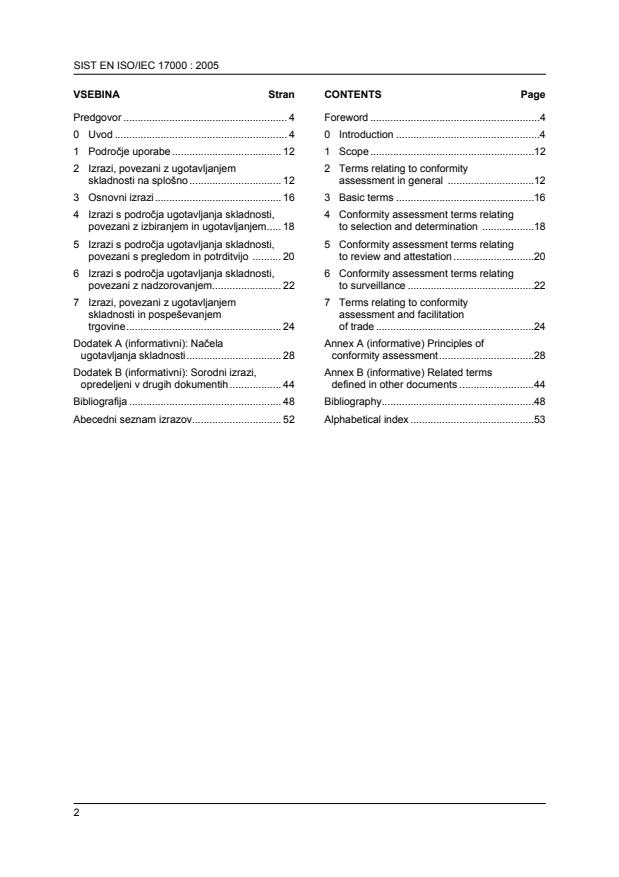
VSEBINA Stran CONTENTS Page
Predgovor . 4 Foreword .4
0 Uvod.4 0 Introduction .4
1 Področje uporabe . 12 1 Scope .12
2 Izrazi, povezani z ugotavljanjem 2 Terms relating to conformity
skladnosti na splošno . 12 assessment in general .12
3 Osnovni izrazi. 16 3 Basic terms.16
4 Izrazi s področja ugotavljanja skladnosti, 4 Conformity assessment terms relating
povezani z izbiranjem in ugotavljanjem. 18 to selection and determination .18
5 Izrazi s področja ugotavljanja skladnosti, 5 Conformity assessment terms relating
povezani s pregledom in potrditvijo . 20 to review and attestation .20
6 Izrazi s področja ugotavljanja skladnosti, 6 Conformity assessment terms relating
povezani z nadzorovanjem. 22 to surveillance .22
7 Izrazi, povezani z ugotavljanjem 7 Terms relating to conformity
skladnosti in pospeševanjem assessment and facilitation
trgovine. 24 of trade .24
Dodatek A (informativni): Načela Annex A (informative) Principles of
ugotavljanja skladnosti. 28 conformity assessment.28
Dodatek B (informativni): Sorodni izrazi, Annex B (informative) Related terms
opredeljeni v drugih dokumentih. 44 defined in other documents .44
Bibliografija . 48 Bibliography.48
Abecedni seznam izrazov. 52 Alphabetical index .53
SIST EN ISO/IEC 17000 : 2005
Sommaire Page Inhalt Seite
Avant-propos . 5 Vorwort.5
0 Introduction. 5i 0 Einleitung.5
1 Domaine d'application . 13 1 Anwendungsbereich.13
2 Termes relatifs à l'évaluation de la 2 Begriffe zu Konformitätsbewertung
conformité en général. 13 im Allgemeinen.13
3 Termes de base . 17 3 Grundbegriffe .17
4 Termes d'évaluation de la conformité 4 Begriffe der Konformitätsbewertung
relatifs à la sélection et à la détermination 19 zu Auswahl und Ermittlung .19
5 Termes d'évaluation de la conformité 5 Begriffe der Konformitätsbewertung
relatifs à la revue et à l'attestation. 21 zu Bewertung und Bestätigung.21
6 Termes d'évaluation de la 6 Begriffe der Konformitätsbewertung
conformité relatifs à la surveillance . 23 zu Überwachung .23
7 Termes relatifs à l'évaluation de la 7 Begriffe zu Konformitätsbewertung
conformité et à la facilitation und Erleichterung
du commerce. 25 des Handels .25
Annexe A (informative) Principes de Anhang A (informativ) Grundlagen
l'évaluation de la conformité. 29 der KonformitätsbewertungError! Bookmark
Annexe B (informative) Termes connexes Anhang B (informativ) Verwandte Begriffe
définis dans d'autres documents. 45 in anderen Dokumenten.45
Bibliographie. 49 Literaturhinweise .49
Index alphabétique . 54 Alphabetisches Stichwortverzeichnis.55
SIST EN ISO/IEC 17000 : 2005
Predgovor Foreword
Ta standard (EN ISO/IEC 17000:2004) je This document (EN ISO/IEC 17000:2004) has
pripravil tehnični odbor ISO/CASCO "Odbor za been prepared by Technical Committee
ugotavljanje skladnosti" v sodelovanju s ISO/CASCO "Committee on conformity
tehničnim odborom CEN/CLC/TC 1 "Merila za assessment" in collaboration with Technical
organe za ugotavljanje skladnosti", katerega Committee CEN/CLC/TC 1 "Criteria for
sekretariat vodi SN. conformity assessment bodies", the secretariat
of which is held by SN.
Ta evropski standard mora dobiti status This European Standard shall be given the
nacionalnega standarda z objavo istovetnega status of a national standard, either by
besedila ali z razglasitvijo najpozneje do maja publication of an identical text or by
2005. Nacionalne standarde, ki so v nasprotju s endorsement, at the latest by May 2005, and
tem standardom, je treba umakniti najpozneje conflicting national standards shall be withdrawn
do maja 2005. at the latest by May 2005.
Ta evropski standard nadomešča EN 45020:1998. This document supersedes EN 45020:1998.
V skladu z notranjimi predpisi CEN/CENELEC According to the CEN/CENELEC Internal
morajo ta evropski standard obvezno uvesti Regulations, the national standards
nacionalne organizacije za standarde organizations of the following countries are
naslednjih držav: Avstrije, Belgije, Cipra, Češke bound to implement this European Standard:
republike, Danske, Estonije, Finske, Francije, Austria, Belgium, Cyprus, Czech Republic,
Grčije, Islandije, Irske, Italije, Latvije, Litve, Denmark, Estonia, Finland, France, Germany,
Luksemburga, Madžarske, Malte, Nemčije, Greece, Hungary, Iceland, Ireland, Italy, Latvia,
Nizozemske, Norveške, Poljske, Portugalske, Lithuania, Luxembourg, Malta, Netherlands,
Slovaške, Slovenije, Španije, Švedske, Švice in Norway, Poland, Portugal, Slovakia, Slovenia,
Združenega kraljestva. Spain, Sweden, Switzerland and United
Kingdom.
Opomba ob razglasitvi standarda Endorsement notice
Besedilo standarda ISO/IEC 17000:2004 sta The text of ISO/IEC 17000:2004 has been
CEN in CENELEC odobrila kot EN ISO/IEC approved by CEN and CENELEC as EN
17000:2004 brez sprememb. ISO/IEC 17000:2004 without any modifications.
0 Uvod 0 Introduction
0.1 Izrazi in definicije, ki se nanašajo na 0.1 Terms and definitions applicable to
ugotavljanje skladnosti conformity assessment
Vodila ISO in ISO/IEC ter v novejšem času ISO and ISO/IEC Guides and, more recently,
mednarodne standarde, ki so na splošno International Standards relating generically to
povezani z aktivnostmi ugotavljanja skladnosti, conformity assessment activities such as testing,
kot so preskušanje, kontrola in različne vrste inspection and various forms of certification are
certificiranja, pripravljajo delovne skupine prepared by working groups of the ISO
Odbora ISO za ugotavljanje skladnosti Committee on conformity assessment (CASCO).
(CASCO). Vodilo ISO/IEC 2, nazadnje revidirano For many years, ISO/IEC Guide 2, last revised in
leta 1996, že več let vsebuje krajši slovar 1996, has included a core vocabulary for
ključnih besed s področja ugotavljanja conformity assessment, built up from a small
skladnosti in njihove definicije, prvotno zbrane, number of terms and definitions first compiled to
da bi olajšale komunikacijo in razumevanje facilitate communication and understanding
certificiranja proizvodov na podlagi standardov about product certification based on standards
za običajne industrijske izdelke. for traditional manufactured goods.
SIST EN ISO/IEC 17000 : 2005
Avant-propos Vorwort
Le présent document (EN ISO/IEC 17000:2004) Dieses Dokument (EN ISO/IEC 17000:2004)
a été élaboré par le Comité Technique wurde vom Technischen Komitee ISO/CASCO
ISO/CASCO "Comité pour l'évaluation de la „Committee on conformity assessment“ in
conformité" en collaboration avec le comité Zusammenarbeit mit dem Technischen Komitee
technique CEN/CLC/TC 1 "Criteria for conformity CEN/CENELEC/TC 1 „Kriterien für Konformitäts-
assessment bodies" dont le secrétariat est tenu begutachtungsstellen“ erarbeitet, dessen
par le SN. Sekretariat vom NSF gehalten wird.
Cette Norme européenne devra recevoir le statut Diese Europäische Norm muss den Status eine
de norme nationale, soit par publication d'un nationalen Norm erhalten, entweder durc
texte identique, soit par entérinement, au plus Veröffentlichung eines identischen Textes ode
tard en mai 2005, et toutes les normes durch Anerkennung bis Mai 2005, und etwaig
nationales en contradiction devront être retirées entgegenstehende nationale Normen müssen bi
au plus tard en mai 2005. Mai 2005 zurückgezogen werden.
Le présent document remplace l'EN 45020:1998. Dieses Dokument ersetzt die Abschnitte 12 bis
17 der EN 45020:1998-02.
Selon le Règlement Intérieur du Entsprechend der CEN/CENELEC-Geschäfts-
CEN/CENELEC, les instituts de normalisation ordnung sind die nationalen Normungsinstitute
nationaux des pays suivants sont tenus de der folgenden Länder gehalten, diese
mettre cette Norme européenne en application: Europäische Norm zu übernehmen: Belgien,
Allemagne, Autriche, Belgique, Chypre, Dänemark, Deutschland, Estland, Finnland,
Danemark, Espagne, Estonie, Finlande, France, Frankreich, Griechenland, Irland, Island, Italien,
Grèce, Hongrie, Irlande, Islande, Italie, Lettonie, Lettland, Litauen, Luxemburg, Malta,
Lituanie, Luxembourg, Malte, Norvège, Pays- Niederlande, Norwegen, Österreich, Polen,
Bas, Pologne, Portugal, République Tchèque, Portugal, Schweden, Schweiz, Slowakei,
Royaume-Uni, Slovaquie, Slovénie, Suède et Slowenien, Spanien, Tschechische Republik,
Suisse. Ungarn und Vereinigtes Königreich und Zypern.
Notice d'entérinement Anerkennungsnotiz
Le texte de l'ISO/IEC 17000:2004 a été approuvé Der Text von ISO/IEC 17000:2004 wurde vom
par le CEN et le CENELEC comme EN ISO/IEC CEN und von CENELEC als EN ISO/IEC 17000:
17000:2004 sans aucune modification. 2004 ohne irgendeine Abänderung genehmigt.
0 Introduction 0 Einleitung
0.1 Termes et définitions applicables à 0.1 Begriffe für die Konformitätsbewertung
l'évaluation de la conformité
Les Guides ISO et ISO/CEI et, plus récemment, ISO- und ISO/IEC-Leitfäden und in letzter Zeit
les Normes internationales se rapportant de Internationale Normen mit grundsätzlichem Bezug
façon générique aux activités d'évaluation de la auf Tätigkeiten der Konformitätsbewertung wie
conformité telles que les essais, l'inspection et z. B. Prüfung, Inspektion und verschiedene
diverses formes de certification sont élaborés Formen der Zertifizierung werden durch
par des groupes de travail du comité Arbeitsgruppen des ISO Committee on
ISO/CASCO pour l'évaluation de la conformité. Conformity Assessment (ISO/CASCO) erarbeitet.
Pendant de nombreuses années, le Guide Für viele Jahre hat der letztmalig 1996
ISO/CEI 2, révisé pour la dernière fois en 1996, überarbeitete ISO/IEC Guide 2 in den Abschnitten
a inclus un vocabulaire de base pour 12 bis 17 die Grundbegriffe der Konformitäts-
l'évaluation de la conformité, bâti à partir d'un bewertung enthalten, die ausgehend von einer
petit nombre de termes et définitions dont la kleinen Anzahl von Begriffen ursprünglich
compilation visait en premier lieu à faciliter la zusammengestellt wurden, um die Kommunikation
communication et la compréhension de la und das Verständnis bei der Produktzertifizierung,
certification de produits basée sur des normes die sich auf Normen für traditionell hergestellte
pour des produits manufacturés traditionnels. Waren gründete, zu fördern.
SIST EN ISO/IEC 17000 : 2005
Leta 2000 se je CASCO odločil, da bo izrazje s In 2000, CASCO decided to take conformity
področja ugotavljanja skladnosti (točke od 12 do assessment terminology (Clauses 12 to 17) out
17) izločil iz Vodila ISO/IEC 2 in namesto tega of ISO/IEC Guide 2 and provide instead a self-
izdelal samostojen slovar, ki bo bolj uporaben pri contained vocabulary more readily applicable
seriji standardov ISO/IEC 17000 ter pri pripravi within the planned ISO/IEC 17000 series of
ali revidiranju z njimi povezanih vodil. Skladno s standards and in the drafting or revision of
to odločitvijo je delovna skupina 5 Definicije pri related guides. CASCO Working Group 5,
CASCO po posvetu z drugimi aktivnimi Definitions, has accordingly prepared this
delovnimi skupinami CASCO pripravila ta International Standard in consultation with other
mednarodni standard kot enoten okvir, v katerem active CASCO working groups, as a consistent
je mogoče ustrezno opredeliti bolj specifične framework within which more specific concepts
pojme in jih poimenovati z najustreznejšimi may be defined appropriately and denoted by
izrazi. Posebne izraze za pojme, ki so za the most appropriate terms. Extra terms for
posamezne aktivnosti v okviru ugotavljanja concepts unique to particular activities within
skladnosti edinstveni, kot so npr. akreditacija, conformity assessment, such as accreditation,
certificiranje oseb in znaki skladnosti, je mogoče certification of persons and marks of conformity,
najti v mednarodnem standardu ali v vodilu, ki se are found in the International Standard or Guide
na to aktivnost nanaša. Taki pojmi niso vključeni related to that activity. Such concepts are not
v ta mednarodni standard. included in this International Standard.
Izrazje, uporabljeno v dosedanjih dokumentih Until pre-existing CASCO publications are
CASCO, ostane v kontekstu ugotavljanja revised, the terminology used in those
skladnosti veljavno do revizije teh dokumentov. documents remains valid in its context; this
Ta mednarodni standard ne velja za nazaj. International Standard is not intended to be
applied retrospectively.
Ugotavljanje skladnosti medsebojno vpliva na Conformity assessment interacts with other
druga področja, kot so sistemi vodenja, fields such as management systems,
meroslovje, standardizacija in statistika. S tem metrology, standardization and statistics. This
mednarodnim standardom niso postavljene International Standard does not define the
meje ugotavljanja skladnosti, ki še naprej boundaries of conformity assessment. These
ostajajo prožne. remain elastic.
0.2 Izrazi in definicije, ki se nanašajo na 0.2 Terms and definitions applicable to
trgovinsko politiko trade policy
Sedma točka vsebuje nekaj izrazov in definicij, Clause 7 includes some terms and definitions,
ki v glavnem izhajajo iz poglavij Vodila ISO/IEC drawn mainly from the superseded clauses of
2 in jih ta standard nadomešča, vendar se ISO/IEC Guide 2, for several broader concepts.
uporabljajo v širšem pomenu. Njihov namen ni These are intended not only to standardize
samo standardizirati uporabo na področju usage within the conformity assessment
ugotavljanja skladnosti, temveč tudi pomagati community, but also to help policy makers
tistim, ki ustvarjajo politiko olajševanja trgovine concerned with the facilitation of trade within
v okviru zakonodaje in mednarodnih pogodb. regulatory and international treaty frameworks.
SIST EN ISO/IEC 17000 : 2005
En 2000, le CASCO a décidé de retirer du Guide Im Jahre 2000 entschied ISO/CASCO, die
ISO/CEI 2 la terminologie de l'évaluation de la Terminologie für die Konformitätsbewertung
conformité (Articles 12 à 17) et de fournir à la (Abschnitte 12 bis 17) aus dem ISO/IEC Guide 2
place un vocabulaire indépendant, plus facilement herauszunehmen und stattdessen ein in sich
applicable dans la série de normes ISO/CEI abgeschlossenes Dokument für die geplante
17000 en projet et dans la rédaction ou la révision Normenreihe ISO/IEC 17000 und für die
de guides connexes. Le groupe de travail GT 5 du Erarbeitung und Überarbeitung der zugehörigen
CASCO, Définitions, a en conséquence préparé ISO/IEC Guides zu erarbeiten. Die ISO/CASCO-
la présente Norme internationale en concertation Arbeitsgruppe 5 „Begriffe“ hat dementsprechend
avec d'autres groupes de travail actifs du diese Internationale Norm in Zusammenarbeit mit
CASCO, en vue de disposer d'un cadre cohérent den anderen aktiven Arbeitsgruppen von
au sein duquel il est possible de définir et de ISO/CASCO als ein einheitliches Rahmenwerk
dénoter des concepts plus spécifiques à l'aide des erstellt, innerhalb dessen spezifische Begriffe
termes les plus appropriés. Des termes zutreffend definiert und durch die am ehesten
supplémentaires employés pour des concepts passenden Benennungen bezeichnet werden
propres à des activités particulières faisant partie können. Zusätzliche Benennungen für Begriffe,
de l'évaluation de la conformité, telles que die für besondere Tätigkeiten bei der
l'accréditation, la certification de personnes et les Konformitäts-bewertung wie Akkreditierung,
marques de conformité, se trouvent dans la Zertifizierung von Personen und Konformitäts-
Norme internationale ou dans le Guide relatifs à zeichen einzigartig sind, sind Internationalen
cette activité. Ces concepts ne figurent pas dans Normen oder Leitfäden zu entnehmen, die sich
la présente Norme internationale. auf diese Tätigkeiten beziehen. Solche Begriffe
sind in dieser Internationalen Norm nicht
enthalten.
La terminologie employée dans les publications Bis vorhandene Veröffentlichungen von CASCO
CASCO antérieures reste valable dans son überarbeitet sind, sind die in diesen Dokumenten
contexte jusqu'à leur révision; la présente Norme verwendeten Begriffe in ihrem Kontext weiterhin
internationale n'est pas destinée à être appliquée gültig, da diese Internationale Norm nicht
de façon rétroactive. rückwirkend angewendet werden soll.
L'évaluation de la conformité présente des Konformitätsbewertung steht in Wechselwirkung
interactions avec d'autres domaines tels que les mit anderen Gebieten wie Managementsysteme,
systèmes de management, la métrologie, la Messtechnik, Normung und Statistik. Diese
normalisation et la statistique. La présente Norme Internationale Norm legt nicht die Grenzen der
internationale ne définit pas les limites de Konformitätsbewertung fest. Diese bleiben
l'évaluation de la conformité. Celles-ci restent dehnbar.
élastiques.
0.2 Termes et définitions applicables à la 0.2 Begriffe für die Handelspolitik
politique du commerce
L'Article 7 contient quelques termes et définitions Abschnitt 7 enthält einige Begriffe für verschiedene
relatifs à plusieurs concepts plus généraux, issus breitere Anwendungen, die hauptsächlich aus den
principalement de la révision des articles du nun durch diese Norm ersetzten Abschnitten des
Guide ISO/CEI 2. Ils sont destinés non seulement ISO/IEC Guide 2 stammen. Diese Begriffe sind
à en normaliser l'usage au sein de la nicht ausschließlich für die Vereinheitlichung des
communauté de l'évaluation de la conformité, Gebrauchs für die Konformitätsbewertung
mais aussi à assister les dirigeants concernés par gedacht, sondern sollen auch als Hilfe für
la facilitation du commerce dans le cadre de la Entscheidungs-träger der Handelspolitik dienen,
réglementation et des traités internationaux. die sich mit der Erleichterung des Handels im
Umfeld von Gesetzgebung und internationalen
Vereinbarungen befassen.
SIST EN ISO/IEC 17000 : 2005
0.3 Funkcionalni pristop k ugotavljanju 0.3 A functional approach to conformity
skladnosti assessment
Izrazi in definicije iz tega mednarodnega The terms and definitions specified in this
standarda, zlasti tisti v 4. in 5. točki, so odraz Interna-tional Standard, particularly under
funkcionalnega pristopa, ki ga je delovna Clauses 4 and 5, reflect the adoption by
skupina CASCO sprejela novembra 2001 na CASCO in November 2001 of the functional
podlagi predhodnega priporočila skupne delovne approach recommended earlier that year in the
skupine CASCO – CEN/CENELEC TC 1. final report of a CASCO - CEN/CENELEC TC 1
joint working group.
Za boljše razumevanje opredeljenih pojmov, To provide a better understanding of the
njihovega razvrščanja v skupine in medsebojnih defined concepts, their grouping and their
povezav je v dodatku A kot informacija podan relationships, a description of the functional
opis funkcionalnega pristopa. approach is included in Annex A for information.
0.4 Izbira izrazov in definicij 0.4 Selection of terms and definitions
Nekateri izmed izrazov, vključeni v ta Some of the terms included in this International
mednarodni standard, so povezani s pojmi, za Standard relate to concepts it was considered
katere se je ocenilo, da jih je treba opredeliti. Za essential to define. Others it was thought
druge je veljalo mnenje, da je njihova helpful to explain. Many of the general terms
obrazložitev koristna. Veliko splošnih izrazov, used to distinguish conformity assessment
uporabljenih za razlikovanje pojmov na področju concepts are used in common language in a
ugotavljanja skladnosti, se v vsakdanjem jeziku broader sense or with a wider range of
uporablja v širšem pomenu ali s širšim obsegom meanings. Some also appear in other standard
pomenov. Nekateri se pojavljajo tudi v drugih vocabularies with definitions specific to the
slovarjih standardov z definicijami, ki so relevant field of application.
specifične za določeno področje uporabe.
Izrazi, opredeljeni v tem mednarodnem An alphabetical index lists the terms defined in
standardu, so našteti v abecednem seznamu. this International Standard. Standards defining
Standardi, ki opredeljujejo druge pomembne other relevant terms are given in Annex B with
izraze, so navedeni v dodatku B po ločenih separate alphabetical lists. First are terms
abecednih seznamih. Na prvem mestu so izrazi, applicable to specific aspects of conformity
ki se nanašajo na specifične vidike ugotavljanja assessment, as defined in other standards in
skladnosti in so opredeljeni v drugih standardih iz the ISO/IEC 17000 series. Second are terms for
skupine ISO/IEC 17000. Na drugem mestu so which the definitions given in either the
izrazi, katerih definicije, podane v Mednarodnem International vocabulary of basic and general
slovarju osnovnih in splošnih izrazov s področja terms in metrology (VIM) or ISO 9000 are
meroslovja (VIM) ali v standardu ISO 9000, so generally applicable in conformity assessment
splošno veljavne tudi za področje ugotavljanja contexts. For the terms "procedure" and
skladnosti. Za izraza "postopek" in "proizvod", ki "product", both used extensively in other
se oba na široko uporabljata v drugih definicijah, definitions, the ISO 9000:2000 definitions are
smo v točkah 3.2 in 3.3 ponovili definicije iz reproduced in 3.2 and 3.3.
standarda ISO 9000:2000.
0.5 Spremembe izrazja 0.5 Changes in terminology
Opozorili bi na pomembne spremembe izrazov Attention is drawn to significant changes in the
oziroma njihovih definicij iz tistih točk Vodila terms or their definitions from the superseded
ISO/IEC 2, ki jih nadomešča ta standard. clauses of ISO/IEC Guide 2.
SIST EN ISO/IEC 17000 : 2005
0.3 Approche fonctionnelle de l'évaluation 0.3 Funktionaler Ansatz zur
de la conformité Konformitätsbewertung
Les termes et définitions spécifiés dans la Die in dieser Internationalen Norm festgelegten
présente Norme internationale, en particulier Begriffe, besonders die in den Abschnitten 4 und
dans les Articles 4 et 5, reflètent l'adoption en 5, berücksichtigen den Beschluss zur Annahme
novembre 2001 par le CASCO de l'approche des funktionalen Ansatzes durch ISO/CASCO im
fonctionnelle qui avait été recommandée November 2001 aufgrund der damals
auparavant cette année-là dans le rapport final vorliegenden Empfehlung im Abschlussbericht
d'un groupe de travail joint CASCO-CEN/ der gemeinsamen Arbeitsgruppe ISO/CASCO-
CENELEC TC 1. CEN/CENELEC/TC 1.
Pour permettre une meilleure compréhension Um die Begriffe verständlicher zu machen, die
des concepts définis, de leur regroupement et Beziehungen und Einteilung zu erläutern, ist im
de leurs interrelations, une description de Anhang A eine Beschreibung des funktionalen
l'approche fonctionnelle figure dans l'Annexe A Ansatzes zur Information enthalten.
à titre d'information.
0.4 Choix des termes et définitions 0.4 Auswahl der Begriffe
Quelques-uns des termes couverts par la Die wesentlichen Benennungen in dieser
présente Norme internationale se rapportent à Internationalen Norm wurden definiert, für andere
des concepts considérés comme essentiels à Benennungen war es ausreichend, sie nur zu
définir. Pour d'autres, leur clarification a été jugée erklären. Viele der allgemeinen Benennungen, die
utile. Beaucoup des termes généraux employés hier für die Konformitätsbewertung verwendet
pour différencier les concepts de l'évaluation de la werden, werden auch in einem weiteren Sinne
conformité sont utilisés dans le langage commun oder in einem breiteren Bereich an Bedeutungen
avec un sens ou un champ de signification plus in der allgemeinen Sprache verwendet. Einige
larges. Certains figurent également dans d'autres Benennungen werden auch in anderen Begriffs-
vocabulaires normalisés, avec des définitions normen mit der für das jeweilige Anwendungs-
spécifiques au champ d'application en question. gebiet spezifischen Definition verwendet.
Un index alphabétique répertorie les termes Ein alphabetisches Stichwortverzeichnis enthält
définis dans la présente Norme internationale. die in dieser Internationalen Norm definierten
Des normes définissant d'autres termes Benennungen. Normen, die andere zutreffende
appropriés figurent dans l'Annexe B avec des Benennungen definieren, sind im Anhang B als
listes alphabétiques séparées. Figurent en eigene alphabetische Liste enthalten: Eingangs
premier lieu les termes applicables aux aspects Benennungen, die auf spezielle Aspekte der
spécifiques de l'évaluation de la conformité, tels Konformitätsbewertung anwendbar und in
que définis dans d'autres normes de la série anderen Normen der Reihe ISO/IEC 17000
ISO/CEI 17000. Figurent en deuxième lieu les definiert sind, gefolgt von Benennungen, für die
termes pour lesquels les définitions sont données entweder die Definitionen des International
soit dans le Vocabulaire international des termes Vocabulary of basic and general terms in
fondamentaux et généraux de métrologie (VIM), metrology (VIM) oder die der ISO 9000 auf die
soit dans l'ISO 9000, sont généralement Konformitätsbewertung im allgemeinen Sinne
applicables dans des contextes d'évaluation de la anwendbar sind. Für die Benennungen
conformité. Ce sont les définitions de l'ISO 9000: „Verfahren“ und „Produkt“, die beide häufig in
2000 qui sont reproduites en 3.2 et en 3.3 pour anderen Definitionen verwendet werden, sind die
les termes «procédure» et «produit», tous deux Definitionen aus ISO 9000:2000 in den
largement employés dans d'autres définitions. Abschnitten 3.2 und 3.3 wiederholt worden.
0.5 Changements de terminologie 0.5 Änderungen der Terminologie
L'attention est attirée sur des changements Zu beachten sind wesentliche Änderungen von
importants dans les termes ou leurs définitions par Benennungen oder ihren Definitionen gegenüber
rapport aux articles révisés du Guide ISO/CEI 2. den ersetzten Abschnitten des ISO/IEC Guide 2.
Considérant que ce n'était pas nécessaire, la Eine Definition von „Konformität“ in dieser
présente Norme internationale n'inclut pas de Internationalen Norm wird als nicht notwendig
définition pour le terme «conformité». erachtet.
SIST EN ISO/IEC 17000 : 2005
Ta mednarodni standard ne vsebuje definicije This International Standard does not include a defi-
za “skladnost”, ker to ni potrebno. “Skladnost” v nition of "conformity" on the grounds that it is not
definiciji “ugotavljanja skladnosti” ne nastopa. necessary to do so. "Conformity" does not feature
Pojem “ugotavljanje skladnosti” se nanaša na in the definition of "conformity asses-sment". The
“izpolnjevanje specificiranih zahtev” in ne na concept of "conformity assessment" is concerned
širši pojem “skladnosti”. Dodana pa je definicija with "fulfilment of specified require-ments", not with
“specificiranih zahtev” (3.1). V angleščini se za the wider concept of "conformity". A definition of the
označevanje delanja tistega, kar se zahteva, term "specified requirement" (3.1) is included. In
uporablja izraz “compliance” ("skladnost z English, the term "compliance" is used to
zakonodajo") (npr. organizacija “je skladna z distinguish the action of doing what is required (e.g.
zakonodajo”, če nekaj naredi v skladu z an organization "complies" by making something
zakonodajo ali če jo upošteva). conform or by fulfilling a regulatory requirement).
Definicija "proizvoda" iz standarda ISO 9000 The ISO 9000 definition of "product" (3.3)
(3.3) vsebuje kot kategorijo proizvoda tudi includes services as a product category, so that
storitve, tako da sklicevanje na "proizvode in it is no longer correct to refer to "products and
storitve" ni več pravilno. services".
Namesto “proizvoda, procesa ali storitve”, Instead of "product, process or service", the
temeljnega izraza, ki se v Vodilu ISO/IEC 2 generic expression used in ISO/IEC Guide 2 for
uporablja za “predmet standardizacije", je v drugi the "subject of standardization", Note 2 to 2.1
opombi k točki 2.1 kot sredstvo za sklicevanje na introduces the expression "object of conformity
proizvod, proces, sistem, osebo ali organ, na assessment" as a means of referring to the
katerega se nanaša ugotavljanje skladnosti, product, process, system, person or body to
vpeljan izraz “predmet ugotavljanja skladnosti”. which conformity assessment is applied. (The
"subject" would more logically be the body
doing the assessment.)
Namesto izraza “zagotavljanje skladnosti” se za Instead of "assurance of conformity", the term
aktivnost dajanja zagotovila z izdajo "izjave o "attestation" (5.2) is used for the activity of
skladnosti" uporablja izraz "potrditev" (5.2). conveying assurance through the issue of a
"statement of conformity".
Izraz “akreditacija” se sedaj uporablja samo za The term "accreditation" is now applicable only
potrditev organa za ugotavljanje skladnosti. to attestation regarding a conformity
Nasprotno pa naj bi definicija v Vodilu ISO/IEC assessment body. The definition in ISO/IEC
2 veljala tudi za certificiranje oseb, kot je Guide 2, by contrast, would have been equally
določeno v standardu ISO/IEC 17024. Iz te applicable to the certification of persons, as
spremembe sledi, da sta izraza “organ za specified in ISO/IEC 17024. Following this
ugotavljanje skladnosti” (2.5) in “akreditacijski change, the terms "conformity assessment
organ” (2.6) opredeljena ločeno. Bolj specifični body" (2.5) and "accreditation body" (2.6) are
izrazi s področja akreditacije so opredeljeni v defined separately. More specific terms relating
standardu ISO/IEC 17011. to accreditation are defined in ISO/IEC 17011.
Da bi se izognili dvoumnosti, se izraz “organ” v To avoid ambiguity, the term "body" is used in
tem mednarodnem standardu uporablja samo, this International Standard only when referring to
kadar je govora o organih za ugotavljanje conformity assessment bodies or accreditation
skladnosti in akreditacijskih organih. Sicer pa se bodies. Otherwise, the term "organization" is
uporablja izraz "organizacija" v splošnem used in its general meaning, as in the ISO 9000
pomenu, kot je opredeljen v standardu ISO 9000. definition. The more specific ISO/IEC Guide 2
Bolj specifična definicija organizacije iz Vodila definition of an organization as a body based on
ISO/IEC 2 kot organa, ki temelji na članstvu, ne membership is not applicable to the field of
velja za področje ugotavljanja skladnosti. conformity assessment.
SIST EN ISO/IEC 17000 : 2005
Le terme «conformité» ne figure pas dans la „Konformität“ ist kein Bestandteil der Definition
définition «évaluation de la conformité». Le „Konformitätsbewertung“. Der Begriff „Konformi-
concept d'«évaluation de la conformité» se tätsbewertung“ bezieht sich auf die „Erfüllung
rapporte à la «satisfaction d'exigences spéci- festgelegter Anforderungen“ und nicht auf den
fiées», non au concept plus large de weiter gefassten Begriff „Konformität“. Eine Defini-
«conformité». Une définition du terme «exigence tion der Benennung „festgelegte Anforderung
spécifiée» (3.1) est incluse. En anglais, le terme (3.1)“ ist enthalten. Im Englischen wird die
«compliance» est utilisé pour distinguer l'action de Benennung „compliance (Einhalten)“ benutzt, um
faire ce qui est exigé (par exemple, une die Handlung, das zu tun, was gefordert ist, davon
organisation «se conforme» en réalisant quelque zu unterscheiden (z. B. eine Organisation
chose de conforme ou en remplissant une „complies (hält ein)“, indem sie etwas konform
exigence réglementaire). macht oder gesetzliche Anforderungen erfüllt).
Dans l'ISO 9000, la définition de «produit» (3.3) Die Definition von „Produkt (3.3)“ in ISO 9000:2000
couvre les services comme une catégorie de beinhaltet Dienstleistungen als eine Produkt-
produit, de sorte qu'il n'est plus correct de se kategorie. Es ist deshalb nicht mehr richtig, von
référer à des «produits et services». „Produkten und Dienstleistungen“ zu sprechen.
À la place de «produit, processus ou service», Anstelle von Produkt, Prozess oder Dienstleistung,
expression générique employée dans le Guide die nach ISO/IEC Guide 2 den „Gegenstand der
ISO/CEI 2 comme «objet de la normalisation», Normung (subject of standardization)“ darstellten,
la Note 2 de 2.1 introduit l'expression «objet de führt die Anmerkung 2 in 2.1 jetzt die Benennung
l'évaluation de la conformité» comme moyen de „Gegenstand der Konformitätsbewertung (object
se référer au produit, au processus, au of conformity assessment)“ ein, um den Bezug
système, à la personne ou à l'organisme auquel auf das Produkt, den Prozess, das System, die
l'évaluation de la conformité est appliquée. (Le Person oder die Stelle, die der Konformitäts-
«sujet» serait plus logiquement l'organisme bewertung unterliegt, herzustellen. (Logischer
effectuant l'évaluation.) wäre es, als „Subjekt“ die Stelle zu bezeichnen,
die die Bewertung durchführt.)
À la place d'«assurance de la conformité», le Anstatt von „Konformitätssicherung“ wird die
terme «attestation» (5.2) est utilisé pour l'activité Benennung „Bestätigung (5.2)“ für die Tätigkeit
de communication de l'assurance à l'aide de verwendet, durch eine „Konformitätsaussage“
l'émission d'une «déclaration de conformité». eine Konformitätssicherung zu geben.
Le terme «accréditation» est désormais Die Benennung „Akkreditierung“ ist nun nur noch
applicable uniquement à l'attestation concernant für die Bestätigung von Konformitätsbewertungs-
un organisme d'évaluation de la conformité. La stellen (als Gegenstand der Bestätigung)
définition figurant dans le Guide ISO/CEI 2, par anwendbar. Im Gegensatz dazu war die
contraste, aurait été également applicable à la Definition im ISO/IEC Guide 2 gleichermaßen für
certification de personnes, telle qu'elle est die Zertifizierung von Personen (wie in ISO/IEC
spécifiée dans l'ISO/CEI 17024. Suite à ce 17024 festgelegt) anwendbar. Entsprechend
changement, les termes «organisme d'évaluation dieser Änderung werden die Benennungen
de la conformité» (2.5) et «organisme „Konformitätsbewertungsstelle (2.5)“ und
d'accréditation» (2.6) sont définis séparément. „Akkreditierungsstelle (2.6)“ getrennt definiert.
Des termes plus spécifiques relatifs à Weitere Benennungen bezüglich Akkreditierung
l'accréditation sont définis dans l'ISO/CEI 17011. sind in ISO/IEC 17011 definiert.
Pour éviter toute ambiguïté, le terme «organisme» Um Doppeldeutigkeiten zu vermeiden, wird die
est employé dans la présente Norme Benennung „Stelle“ in dieser Internationalen
internationale seulement en référence à des Norm nur dann benutzt, wenn auf Konformitäts-
organismes d'évaluation de la conformité ou à bewertungsstellen oder Akkreditierungsstellen
des organismes d'accréditation. Sinon, le terme Bezug genommen wird. Andererseits wird die
«organisation» est employé avec son sens Benennung „Organisation“ in ihrer allgemeinen
générique, comme dans la définition donnée dans Bedeutung wie in der ISO 9000:2000- Definition
l'ISO 9000. La définition plus spécifique du Guide benutzt. Die speziellere Definition des ISO/IEC
ISO/CEI 2 d'une organisation en tant qu'orga- Guide 2 für die Organisation als eine Stelle, die
nisme basé sur l'adhésion ne s'applique pas dans auf einer Mitgliedschaft beruht, ist für den Bereich
le domaine de l'évaluation de la conformité. Konformitätsbewertung nicht anwendbar.
SIST EN ISO/IEC 17000 : 2005
Ugotavljanje skladnosti – Conformity assessment –
Slovar in splošna načela Vocabulary and general principles
1 Področje uporabe 1 Scope
Ta mednarodni standard določa splošne izraze This International Standard specifies general
in definicije, povezane z ugotavljanjem terms and definitions relating to conformity
skladnosti, vključno z akreditacijo organov za assessment, including the accreditation of
ugotavljanje skladnosti in uporabo ugotavljanja conformity assessment bodies, and to the use of
skladnosti za pospeševanje trgovine. V dodatku conformity assessment to facilitate trade. A
A je opisan funkcionalni pristop k ugotavljanju description of the functional approach to
skladnosti kot nadaljnja pomoč pri razumevanju conformity assessment is included in Annex A,
med uporabniki ugotavljanja skladnosti, organi as a further aid to understanding among users of
za ugotavljanje skladnosti in njihovimi conformity assessment, conformity assessment
akreditacijskimi organi, tako na prostovoljnem bodies and their accreditation bodies, in both
kot na reguliranem področju. voluntary and regulatory environments.
Ta mednarodni standard ni zamišljen kot slovar This International Standard does not set out to
za vse pojme, ki naj bi se uporabljali pri provide a vocabulary for all of the concepts that
opisovanju posameznih aktivnosti ugotavljanja may need to be used in describing particular
skladnosti. Izrazi in definicije so podani le tam, conformity assessment activities. Terms and
kjer opredeljeni pojem ni razumljiv iz splošne definitions are given only where the concept
jezikovne rabe izraza, ali za katerega ne velja defined would not be understandable from the
standardna definicija. general language use of the term, or where an
existing standard definition is not applicable.
...