

EN 18061:2025
(Main)Road vehicles - Rechargeable batteries with internal energy storage - Steps, conditions and protocols for the safe repair and re-use and preparation for repurposing of modules and batteries designed for EV applications
- Abstract
This document describes steps, conditions and protocols for safe maintenance and repair to facilitate remanufacturing, re-use and preparation for repurposing of battery systems, battery packs and battery modules designed for EV applications for alkali-ion (Li-ion, Na-ion), Pb, NiMH and combined chemistries.
This document also includes an informative guidance on design and assembly techniques that facilitate the maintenance, repair, re-use and preparation for repurposing of EV battery systems, battery packs and battery modules (Annex B).
NOTE Individual cell is replaced when it is allowed and described by the EV battery systems, battery packs and battery modules manufacturer. In this case, battery modules manufacturer provides the necessary instructions for cell replacement.
- Status
- Published
- Publication Date
- 05-Aug-2025
- Technical Committee
- CEN/TC 301 - Electrically propelled road vehicles
- Drafting Committee
- CEN/TC 301/WG 18 - Electric vehicles batteries
- Current Stage
- 6060 - Definitive text made available (DAV) - Publishing
- Start Date
- 06-Aug-2025
- Due Date
- 02-May-2025
- Completion Date
- 06-Aug-2025

Overview
EN 18061:2025 (CEN) provides standardized steps, conditions and protocols for the safe maintenance, repair, re‑use and preparation for repurposing of rechargeable batteries, modules and packs originally designed for electric vehicle (EV) applications. The scope covers alkali‑ion chemistries (Li‑ion, Na‑ion), lead‑acid (Pb), NiMH and combined chemistries and addresses battery systems, battery packs and battery modules. The document includes informative guidance on design and assembly techniques that facilitate maintenance and future re‑use (Annex B). Note: EN 18061:2025 is intended for preparation for repurposing, not for carrying out repurposing itself.
Key topics and technical requirements
- Safety and general requirements for working on EV battery systems, including voltage class B recommendations (Annex C, F).
- Certified workshops: criteria and expectations for facilities carrying out maintenance and repair.
- Maintenance & repair procedures: incoming inspections, documentation, disassembly/assembly, component inspection and part replacement (Clauses 7, 7.4–7.10).
- Battery Management System (BMS) functions: requirements for BMS data, interactions and verification during repair and re‑use (Clause 7.5).
- Identification and traceability: Unique Identifier / Battery Identification Number (BIN) and labelling/marking requirements (Clauses 7.7, 7.11; Annex E: battery passport related data).
- Cell replacement policy: clarifies that individual cell replacement is allowed only where authorized and instructed by the original manufacturer.
- Supportive annexes: process flows for maintenance and repair (Annex A), design/assembly guidance to aid serviceability (Annex B), incoming inspection checklists (Annex D) and transport/storage considerations (Annex C).
Practical applications and users
EN 18061:2025 is intended for organizations involved in the EV battery lifecycle, including:
- EV manufacturers and battery module/pack designers (for design-for-service guidance).
- Remanufacturers, certified repair workshops and service centres performing maintenance and preparation for repurposing.
- Fleet operators and used‑EV battery asset managers assessing safe re‑use and remanufacturing pathways.
- Regulators, conformity assessors and recyclers seeking standardized documentation and traceability (battery passport).
- Safety officers and trainers implementing best practices for handling voltage class B battery systems.
Related standards and references
- Links to Regulation (EU) 2023/1542 terminology and battery requirements are referenced in EN 18061:2025.
- ISO and IEC terminology resources (ISO OBP, IEC Electropedia) are cited for harmonized definitions.
Keywords: EN 18061:2025, EV battery repair, battery reuse, battery repurposing, BMS, battery modules, battery packs, Li‑ion, Na‑ion, Pb, NiMH, certified workshops, battery passport.
Get Certified
Connect with accredited certification bodies for this standard

TÜV Rheinland
TÜV Rheinland is a leading international provider of technical services.

TÜV SÜD
TÜV SÜD is a trusted partner of choice for safety, security and sustainability solutions.

DEKRA Certification Inc.
DEKRA US certification services.
Sponsored listings
Frequently Asked Questions
EN 18061:2025 is a standard published by the European Committee for Standardization (CEN). Its full title is "Road vehicles - Rechargeable batteries with internal energy storage - Steps, conditions and protocols for the safe repair and re-use and preparation for repurposing of modules and batteries designed for EV applications". This standard covers: This document describes steps, conditions and protocols for safe maintenance and repair to facilitate remanufacturing, re-use and preparation for repurposing of battery systems, battery packs and battery modules designed for EV applications for alkali-ion (Li-ion, Na-ion), Pb, NiMH and combined chemistries. This document also includes an informative guidance on design and assembly techniques that facilitate the maintenance, repair, re-use and preparation for repurposing of EV battery systems, battery packs and battery modules (Annex B). NOTE Individual cell is replaced when it is allowed and described by the EV battery systems, battery packs and battery modules manufacturer. In this case, battery modules manufacturer provides the necessary instructions for cell replacement.
This document describes steps, conditions and protocols for safe maintenance and repair to facilitate remanufacturing, re-use and preparation for repurposing of battery systems, battery packs and battery modules designed for EV applications for alkali-ion (Li-ion, Na-ion), Pb, NiMH and combined chemistries. This document also includes an informative guidance on design and assembly techniques that facilitate the maintenance, repair, re-use and preparation for repurposing of EV battery systems, battery packs and battery modules (Annex B). NOTE Individual cell is replaced when it is allowed and described by the EV battery systems, battery packs and battery modules manufacturer. In this case, battery modules manufacturer provides the necessary instructions for cell replacement.
EN 18061:2025 is classified under the following ICS (International Classification for Standards) categories: 29.220.20 - Acid secondary cells and batteries; 29.220.30 - Alkaline secondary cells and batteries; 43.040.10 - Electrical and electronic equipment; 43.120 - Electric road vehicles. The ICS classification helps identify the subject area and facilitates finding related standards.
EN 18061:2025 is associated with the following European legislation: EU Directives/Regulations: 2023/1542; Standardization Mandates: M/579, M/579 AMD 1. When a standard is cited in the Official Journal of the European Union, products manufactured in conformity with it benefit from a presumption of conformity with the essential requirements of the corresponding EU directive or regulation.
EN 18061:2025 is available in PDF format for immediate download after purchase. The document can be added to your cart and obtained through the secure checkout process. Digital delivery ensures instant access to the complete standard document.
Standards Content (Sample)
SLOVENSKI STANDARD
01-oktober-2025
Cestna vozila - Polnilne baterije z notranjim shranjevanjem energije - Ukrepi,
pogoji in protokoli za varno popravilo in ponovno uporabo ter priprava na
ponovno uporabo modulov in baterij, namenjenih za uporabo v električnih vozilih
Road vehicles - Rechargeable batteries with internal energy storage - Steps, conditions
and protocols for the safe repair and re-use and preparation for repurposing of modules
and batteries designed for EV applications
Straßenfahrzeuge - Elektrisch angetriebene Fahrzeuge - Schritte, Bedingungen und
Protokolle für die sichere Reparatur, Wiederverwendung und Vorbereitung zur
Umnutzung von Modulen und Batterien, die ursprünglich für EV-Anwendungen
entwickelt wurden
Véhicules routiers - Véhicules à propulsion électrique - Étapes, conditions et protocoles
pour la réparation, la réutilisation et la préparation en vue de la réaffectation en toute
sécurité des modules et batteries conçus à l'origine pour des applications de véhicules
électriques
Ta slovenski standard je istoveten z: EN 18061:2025
ICS:
29.220.99 Drugi členi in baterije Other cells and batteries
43.120 Električna cestna vozila Electric road vehicles
2003-01.Slovenski inštitut za standardizacijo. Razmnoževanje celote ali delov tega standarda ni dovoljeno.
EN 18061
EUROPEAN STANDARD
NORME EUROPÉENNE
August 2025
EUROPÄISCHE NORM
ICS 43.120
English Version
Road vehicles - Rechargeable batteries with internal
energy storage - Steps, conditions and protocols for the
safe repair and re-use and preparation for repurposing of
modules and batteries designed for EV applications
Véhicules routiers - Véhicules à propulsion électrique - Straßenfahrzeuge - Elektrisch angetriebene Fahrzeuge
Étapes, conditions et protocoles pour la réparation, la - Schritte, Bedingungen und Protokolle für die sichere
réutilisation et la préparation en vue de la réaffectation Reparatur, Wiederverwendung und Vorbereitung zur
en toute sécurité des modules et batteries conçus à Umnutzung von Modulen und Batterien, die
l'origine pour des applications de véhicules électriques ursprünglich für EV-Anwendungen entwickelt wurden
This European Standard was approved by CEN on 2 June 2025.
CEN members are bound to comply with the CEN/CENELEC Internal Regulations which stipulate the conditions for giving this
European Standard the status of a national standard without any alteration. Up-to-date lists and bibliographical references
concerning such national standards may be obtained on application to the CEN-CENELEC Management Centre or to any CEN
member.
This European Standard exists in three official versions (English, French, German). A version in any other language made by
translation under the responsibility of a CEN member into its own language and notified to the CEN-CENELEC Management
Centre has the same status as the official versions.
CEN members are the national standards bodies of Austria, Belgium, Bulgaria, Croatia, Cyprus, Czech Republic, Denmark, Estonia,
Finland, France, Germany, Greece, Hungary, Iceland, Ireland, Italy, Latvia, Lithuania, Luxembourg, Malta, Netherlands, Norway,
Poland, Portugal, Republic of North Macedonia, Romania, Serbia, Slovakia, Slovenia, Spain, Sweden, Switzerland, Türkiye and
United Kingdom.
EUROPEAN COMMITTEE FOR STANDARDIZATION
COMITÉ EUROPÉEN DE NORMALISATION
EUROPÄISCHES KOMITEE FÜR NORMUNG
CEN-CENELEC Management Centre: Rue de la Science 23, B-1040 Brussels
© 2025 CEN All rights of exploitation in any form and by any means reserved Ref. No. EN 18061:2025 E
worldwide for CEN national Members.
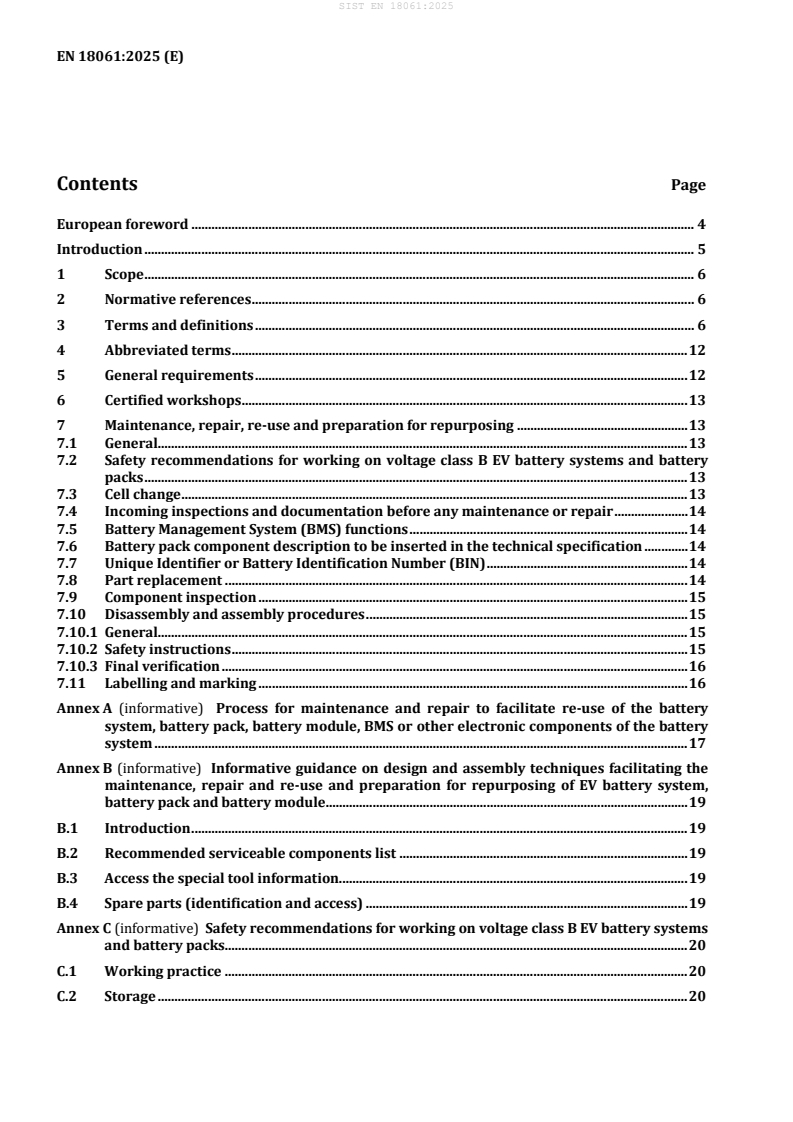
Contents Page
European foreword . 4
Introduction . 5
1 Scope . 6
2 Normative references . 6
3 Terms and definitions . 6
4 Abbreviated terms . 12
5 General requirements . 12
6 Certified workshops . 13
7 Maintenance, repair, re-use and preparation for repurposing . 13
7.1 General. 13
7.2 Safety recommendations for working on voltage class B EV battery systems and battery
packs . 13
7.3 Cell change . 13
7.4 Incoming inspections and documentation before any maintenance or repair . 14
7.5 Battery Management System (BMS) functions . 14
7.6 Battery pack component description to be inserted in the technical specification . 14
7.7 Unique Identifier or Battery Identification Number (BIN) . 14
7.8 Part replacement . 14
7.9 Component inspection . 15
7.10 Disassembly and assembly procedures . 15
7.10.1 General. 15
7.10.2 Safety instructions . 15
7.10.3 Final verification . 16
7.11 Labelling and marking . 16
Annex A (informative) Process for maintenance and repair to facilitate re-use of the battery
system, battery pack, battery module, BMS or other electronic components of the battery
system . 17
Annex B (informative) Informative guidance on design and assembly techniques facilitating the
maintenance, repair and re-use and preparation for repurposing of EV battery system,
battery pack and battery module . 19
B.1 Introduction . 19
B.2 Recommended serviceable components list . 19
B.3 Access the special tool information. 19
B.4 Spare parts (identification and access) . 19
Annex C (informative) Safety recommendations for working on voltage class B EV battery systems
and battery packs. 20
C.1 Working practice . 20
C.2 Storage . 20
C.3 Transport . 20
C.4 Transport and storage considerations . 20
Annex D (informative) Incoming inspections and documentation before any maintenance or repair
............................................................................................................................................................................. 21
Annex E (informative) Battery passport related data . 22
Annex F (informative) Examples of safety measures when working with voltage class B EV battery
systems and battery packs . 23
Bibliography . 24
European foreword
This document (EN 18061:2025) has been prepared by Technical Committee CEN/TC 301 “Road
vehicles”, the secretariat of which is held by DIN.
This European Standard shall be given the status of a national standard, either by publication of an
identical text or by endorsement, at the latest by February 2026, and conflicting national standards shall
be withdrawn at the latest by February 2026.
Attention is drawn to the possibility that some of the elements of this document may be the subject of
patent rights. CEN shall not be held responsible for identifying any or all such patent rights.
This document has been prepared under a standardization request addressed to CEN by the European
Commission. The Standing Committee of the EFTA States subsequently approves these requests for its
Member States.
Any feedback and questions on this document should be directed to the users’ national standards body.
A complete listing of these bodies can be found on the CEN website.
According to the CEN-CENELEC Internal Regulations, the national standards organisations of the
following countries are bound to implement this European Standard: Austria, Belgium, Bulgaria, Croatia,
Cyprus, Czech Republic, Denmark, Estonia, Finland, France, Germany, Greece, Hungary, Iceland, Ireland,
Italy, Latvia, Lithuania, Luxembourg, Malta, Netherlands, Norway, Poland, Portugal, Republic of North
Macedonia, Romania, Serbia, Slovakia, Slovenia, Spain, Sweden, Switzerland, Türkiye and the United
Kingdom.
Introduction
European Commission published the standardization request M/579 to the European standardization
organisations as regards to performance and sustainability requirements for batteries.
Battery systems are an efficient energy storage system for electrically propelled vehicles. The steps,
conditions and protocols for the safe repair and re-use and preparation for repurposing of modules and
batteries designed for EV applications are significantly different from those batteries used for consumer
electronics or stationary usage.
There are potential safety risks to be considered before reusing an EV battery system, battery pack and
battery modules. These should be thoroughly addressed before considering any kind of re-use
operations. Further, all re-used batteries or sub-units of batteries shall comply with all safety, transport
and product testing at the same level as new battery products (except tests requiring destructive
sampling).
This document provides specific steps, conditions and protocols for the safe repair and re-use and
preparation for repurposing of modules and batteries designed for EV battery systems, battery packs and
battery modules.
This document includes technical provisions to facilitate the safe repair and re-use and preparation for
repurposing of EV battery systems, battery packs and battery modules.
This document also includes an informative annex on guidance on design and assembly techniques
facilitating the maintenance, repair, re-use and preparation for repurposing of batteries designed for EV
applications.
NOTE This document is not intended for any repurposing of EV batteries, only for preparation for repurposing.
1 Scope
This document describes steps, conditions and protocols for safe maintenance and repair to facilitate
remanufacturing, re-use and preparation for repurposing of battery systems, battery packs and battery
modules designed for EV applications for alkali-ion (Li-ion, Na-ion), Pb, NiMH and combined chemistries.
This document also includes an informative guidance on design and assembly techniques that facilitate
the maintenance, repair, re-use and preparation for repurposing of EV battery systems, battery packs and
battery modules (Annex B).
NOTE Individual cell is replaced when it is allowed and described by the EV battery systems, battery packs and
battery modules manufacturer. In this case, battery modules manufacturer provides the necessary instructions for
cell replacement.
2 Normative references
There are no normative references in this document.
3 Terms and definitions
For the purposes of this document, the following terms and definitions apply.
ISO and IEC maintain terminology databases for use in standardization at the following addresses:
— ISO Online browsing platform: available at https://www.iso.org/obp
— IEC Electropedia: available at https://www.electropedia.org/
3.1
battery
device delivering electrical energy generated by direct conversion of chemical energy, having internal or
external storage, and consisting of one or more non-rechargeable or rechargeable battery cells, modules
or of packs of them, and include a battery that has been subject to preparation for re-use, preparing for
repurposing, repurposing, or remanufacturing
[SOURCE: REGULATION (EU) 2023/1542]
3.2
battery cell
basic functional unit in a battery composed of electrodes, electrolyte, container, terminals and, if
applicable, separators, and containing the active materials the reaction of which generates electrical
energy
[SOURCE: REGULATION (EU) 2023/1542]
3.3
battery control unit
BCU
electronic device that controls, manages, detects or calculates electric and thermal functions of the
battery system (3.9) and that provides communication between the battery system and other vehicle
controllers
[SOURCE: ISO 12405-4:2018, 3.1]
3.4
battery management system
BMS
electronic device that controls or manages the electric and thermal functions of the battery in order to
ensure the battery’s safety, performance and service life, manages and stores the data for the -parameters
for determining the battery’s state of health and expected lifetime and communicates with the vehicle,
light mean of transport or appliance in which the battery is incorporated, or with a public or private
charging infrastructure
[SOURCE: REGULATION (EU) 2023/1542]
3.5
battery manufacturer
natural or legal person who manufactures a battery or has a battery designed or manufactured, and
markets that battery under its own name or trademark or puts it into service for its own purposes
[SOURCE: REGULATION (EU) 2023/1542]
Note 1 to entry: The battery manufacturer(s) is(are) in charge of the battery CE marking and the type approval
from UNECE.
3.6
battery module
set of battery cells that are connected together or encapsulated within an outer casing to protect the cells
against external impact, and which is meant to be used either alone or in combination with other modules
Note 1 to entry: Battery modules may or may not include parts of the BMS such as sensors and/or electronics.
Note 2 to entry: Battery module encapsulation can also manage internal stress from the cells.
Note 3 to entry: Battery module is a voluntary design feature of an EV battery.
[SOURCE: REGULATION (EU) 2023/1542]
3.7
battery pack
set of battery cells or modules that are connected together or encapsulated within an outer casing to form
a complete unit which is not meant to be split up or opened by the end-user
[SOURCE: REGULATION (EU) 2023/1542]
3.8
battery producer
manufacturer, importer or distributor or other natural or legal person who, irrespective of the selling
technique used, including by means of distance contracts, either:
(i) is established in a Member State and manufactures batteries under its own name or trademark, or has
batteries designed or manufactured and supplies them for the first time under its own name or
trademark, including those incorporated in appliances, light means of transport or other vehicles, within
the territory of that Member State;
(ii) is established in a Member State and resells within the territory of that Member State, under its own
name or trademark, batteries, including those incorporated in appliances, light means of transport or
other vehicles, manufactured by others, on which the name or trademark of those other manufacturers
does not appear;
(iii) is established in a Member State and supplies for the first time in that Member State on a professional
basis, batteries, including those incorporated in appliances, light means of transport or other vehicles
from another Member State or from a third country; or
(iv) sells batteries, including those incorporated in appliances, light means of transport or other vehicles,
by means of distance contract directly to end-users, whether they are private households, in a Member
State, and is established in another Member State or in a third country
Note 1 to entry: Distance contracts as defined in Article 2, point (7), of Directive 2011/83/EU (definition 46 in EU
Battery Regulation.
[SOURCE: REGULATION (EU) 2023/1542]
3.9
battery system
energy storage device that includes cells or cell assemblies or battery pack(s) (3.7) as well as electrical
circuits and electronics
Note 1 to entry: Examples of electronics are the BCU and contactors.
[SOURCE: ISO 12405-4:2018, 3.3]
3.10
cell electronics
electronic device that collects and possibly monitors thermal or electric data of cells or cell assemblies
and contains electronics for cell balancing, if necessary
Note 1 to entry: The cell electronics can include a cell controller. The functionality of cell balancing can be
controlled by the cell electronics or by the BCU.
[SOURCE: ISO 12405-4:2018, 3.5]
3.11
cell monitoring circuit
CMC
electronic circuits that monitor one or more cell parameters which must be maintained within certain
limits, and take appropriate action if a parameter goes out of bounds, creating an unacceptable or
dangerous situation
3.12
certified workshop
workshop that has been certified or recognized by empowered authorities in the member states for its
competence to perform repair and/or re-use operations on electric vehicle batteries
Note 1 to entry: Such a workshop adheres to safety standards, employs trained and certified technicians, uses
approved equipment and methodologies, and follows prescribed protocols to ensure the functionality, safety, and
longevity of repaired batteries. A certified workshop ensures that electric vehicle battery repairs meet the highest
standards of quality, safety, and efficiency.
3.13
charge level
ratio of available charge in relation to actual capacity
3.14
combined battery and capacitor systems
systems combining both battery component and capacitor component which are used to supply electric
energy
3.15
combined chemistry cells
cells with more than one electrochemical system inside the same cell to support different types of
operating conditions and improve performance characteristics
Note 1 to entry: Combined chemistry cells can also be denoted as hybrid cells.
Note 2 to entry: A composite electrode material is not per definition the same as a combined chemistry cell.
Note 3 to entry: Combined chemistry cells may comprise a battery component and an electrochemical capacitor
component.
3.16
combined chemistry modules
modules with a selection of cells with more than one chemistry within or between cells
3.17
combined chemistry packs and systems
packs and systems combining different cell chemistries or cell designs or assembly configurations within
or between modules or cells
3.19
economic operators
manufacturer, authorised representative, importer, distributor or fulfilment service provider or any
other natural
...