

EN 13523-4:2014
(Main)Coil coated metals - Test methods - Part 4: Pencil hardness
- Abstract
This part of EN 13523 describes the procedure to assess the relative hardness of an organic coating on a metallic substrate, by means of pencils of known hardness.
Smooth surfaces will give more accurate results but the method is also applicable for textured surfaces. The more pronounced the texture, the greater the unreliability of results.
- Status
- Published
- Publication Date
- 29-Jul-2014
- Technical Committee
- CEN/TC 139 - Paints and varnishes
- Drafting Committee
- CEN/TC 139/WG 9 - Testing of coil coated metals
- Current Stage
- 9093 - Decision to confirm - Review Enquiry
- Start Date
- 08-Oct-2026
- Completion Date
- 30-Sep-2026

Overview
EN 13523-4:2014 - Coil coated metals - Test methods - Part 4: Pencil hardness is a CEN standard that specifies a simple, repeatable procedure to assess the relative surface hardness of an organic coating on metallic substrates. The method uses calibrated pencils of known hardness to determine the hardest lead that does not scratch the coating. It is applicable to smooth and textured coil-coated surfaces (with reduced reliability on pronounced textures).
Key topics and requirements
- Scope & principle: Measures resistance of the coating surface to scratching using pencils. The hardest pencil that does not produce a scratch ≥ 3 mm determines the pencil hardness.
- Apparatus & materials:
- Standard pencil range (e.g., Cretacolor or Faber-Castell equivalents): 6B → 6H.
- Special mechanical sharpener that exposes the lead cylindrically.
- Abrasive paper (No. 400/emery) for trimming the lead.
- Lead holder and optional mechanical test device (schematic provided in the standard).
- Test conditions:
- Ambient testing acceptable; for dispute-resolution use (23 ± 2) °C and (50 ± 5) % RH (per EN 23270).
- Conditioning per EN 13523-0.
- Procedure essentials:
- Prepare lead so 5–6 mm of cylindrical, undamaged lead projects; trim to a circular, square-cut end.
- Hold pencil at 45° and apply a downward force of (7.5 ± 0.1) N (manual or with mechanical device).
- Rotate pencil or holder between trials and repeat until the hardest non-scratching lead is found.
- Remove lead residue before inspection.
- Results & reporting:
- Report the reference hardness of the hardest pencil that does not scratch for ≥ 3 mm.
- State whether scratch penetrates to the substrate and include details: pencils used, device used, deviations, anomalies, date, and product identification.
- Limitations & precision:
- Results are qualitative; repeatability requires operator experience.
- Reproducibility can vary with devices, operators, and pencil batches.
- Smooth surfaces yield more accurate, reliable results than textured surfaces.
Applications and users
- Practical for coil coaters, quality control laboratories, paint and varnish testing labs, product specifiers, and procurement teams assessing organic coating hardness on pre-painted metal panels.
- Used to support product acceptance, in-house QC, comparative evaluation of coating formulations, and specification compliance checks.
Related standards
- EN 13523-0 (General introduction and sampling/test panels)
- EN 23270 (conditioning: temperatures and humidities for testing)
- EN ISO 15184:2012 (film hardness by pencil test - applicability guidance)
- EN 1396, EN 10169 (related coil-coated product specifications)
Keywords: EN 13523-4:2014, coil coated metals test methods, pencil hardness test, organic coating hardness, CEN standard, pre-painted metal testing.
Relations
- Effective Date
- 06-Aug-2014
- Effective Date
- 28-Jan-2026
- Effective Date
- 28-Jan-2026
- Effective Date
- 28-Jan-2026
- Effective Date
- 28-Jan-2026
- Effective Date
- 28-Jan-2026
- Effective Date
- 28-Jan-2026
- Effective Date
- 28-Jan-2026
- Effective Date
- 28-Jan-2026
- Effective Date
- 28-Jan-2026
- Effective Date
- 28-Jan-2026
- Effective Date
- 28-Jan-2026
Get Certified
Connect with accredited certification bodies for this standard

DVS-ZERT GmbH
German welding certification society.
BSMI (Bureau of Standards, Metrology and Inspection)
Taiwan's standards and inspection authority.
CARES (UK Certification Authority for Reinforcing Steels)
UK certification for reinforcing steels and construction.
Sponsored listings
Frequently Asked Questions
EN 13523-4:2014 is a standard published by the European Committee for Standardization (CEN). Its full title is "Coil coated metals - Test methods - Part 4: Pencil hardness". This standard covers: This part of EN 13523 describes the procedure to assess the relative hardness of an organic coating on a metallic substrate, by means of pencils of known hardness. Smooth surfaces will give more accurate results but the method is also applicable for textured surfaces. The more pronounced the texture, the greater the unreliability of results.
This part of EN 13523 describes the procedure to assess the relative hardness of an organic coating on a metallic substrate, by means of pencils of known hardness. Smooth surfaces will give more accurate results but the method is also applicable for textured surfaces. The more pronounced the texture, the greater the unreliability of results.
EN 13523-4:2014 is classified under the following ICS (International Classification for Standards) categories: 17.040.20 - Properties of surfaces; 25.220.60 - Organic coatings. The ICS classification helps identify the subject area and facilitates finding related standards.
EN 13523-4:2014 has the following relationships with other standards: It is inter standard links to EN 13523-4:2001, EN 23270:1991, EN 10169:2010+A1:2012, EN ISO 4545-1:2005, EN ISO 14705:2021, EN 13523-0:2014, EN 10169:2022, EN ISO 4545-3:2005, EN 13523-24:2017, EN 1396:2015, EN 13523-24:2004, EN ISO 4545-4:2005. Understanding these relationships helps ensure you are using the most current and applicable version of the standard.
EN 13523-4:2014 is available in PDF format for immediate download after purchase. The document can be added to your cart and obtained through the secure checkout process. Digital delivery ensures instant access to the complete standard document.
Standards Content (Sample)
2003-01.Slovenski inštitut za standardizacijo. Razmnoževanje celote ali delov tega standarda ni dovoljeno.VYLQþQLNRPBandbeschichtete Metalle - Prüfverfahren - Teil 4: BleistifthärteTôles prélaquées - Méthodes d'essai - Partie 4 : Dureté crayonCoil coated metals - Test methods - Part 4: Pencil hardness25.220.60Organske prevlekeOrganic coatings17.040.20Lastnosti površinProperties of surfacesICS:Ta slovenski standard je istoveten z:EN 13523-4:2014SIST EN 13523-4:2014en,fr,de01-oktober-2014SIST EN 13523-4:2014SLOVENSKI
STANDARDSIST EN 13523-4:20021DGRPHãþD
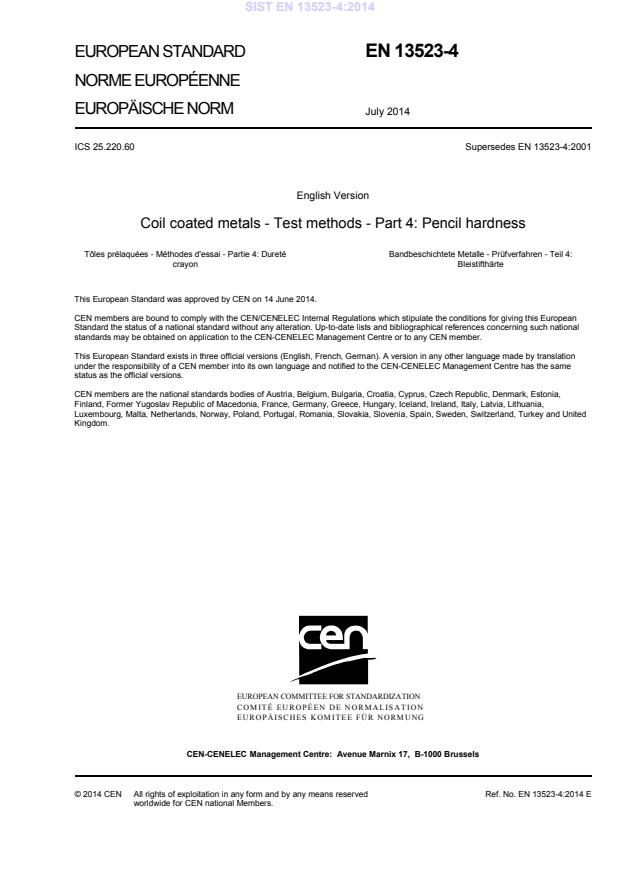
EUROPEAN STANDARD NORME EUROPÉENNE EUROPÄISCHE NORM
EN 13523-4
July 2014 ICS 25.220.60 Supersedes EN 13523-4:2001English Version
Coil coated metals - Test methods - Part 4: Pencil hardness
Tôles prélaquées - Méthodes d'essai - Partie 4: Dureté crayon
Bandbeschichtete Metalle - Prüfverfahren - Teil 4: Bleistifthärte This European Standard was approved by CEN on 14 June 2014.
CEN members are bound to comply with the CEN/CENELEC Internal Regulations which stipulate the conditions for giving this European Standard the status of a national standard without any alteration. Up-to-date lists and bibliographical references concerning such national standards may be obtained on application to the CEN-CENELEC Management Centre or to any CEN member.
This European Standard exists in three official versions (English, French, German). A version in any other language made by translation under the responsibility of a CEN member into its own language and notified to the CEN-CENELEC Management Centre has the same status as the official versions.
CEN members are the national standards bodies of Austria, Belgium, Bulgaria, Croatia, Cyprus, Czech Republic, Denmark, Estonia, Finland, Former Yugoslav Republic of Macedonia, France, Germany, Greece, Hungary, Iceland, Ireland, Italy, Latvia, Lithuania, Luxembourg, Malta, Netherlands, Norway, Poland, Portugal, Romania, Slovakia, Slovenia, Spain, Sweden, Switzerland, Turkey and United Kingdom.
EUROPEAN COMMITTEE FOR STANDARDIZATION
COMITÉ EUROPÉEN DE NORMALISATION EUROPÄISCHES KOMITEE FÜR NORMUNG
CEN-CENELEC Management Centre:
Avenue Marnix 17,
B-1000 Brussels © 2014 CEN All rights of exploitation in any form and by any means reserved worldwide for CEN national Members. Ref. No. EN 13523-4:2014 ESIST EN 13523-4:2014
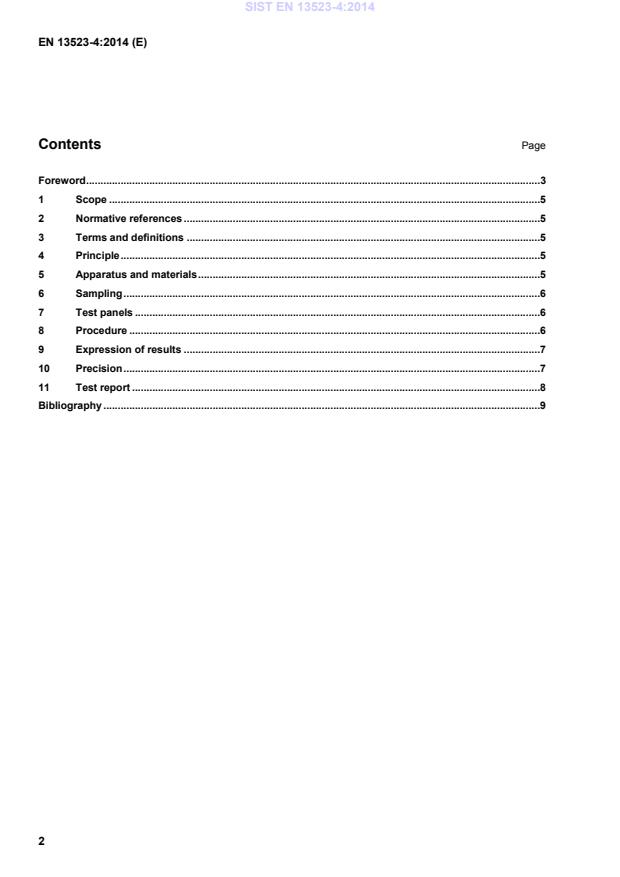
Foreword .3 1 Scope .5 2 Normative references .5 3 Terms and definitions .5 4 Principle .5 5 Apparatus and materials .5 6 Sampling .6 7 Test panels .6 8 Procedure .6 9 Expression of results .7 10 Precision .7 11 Test report .8 Bibliography .9
...