

EN 10228-3:1998
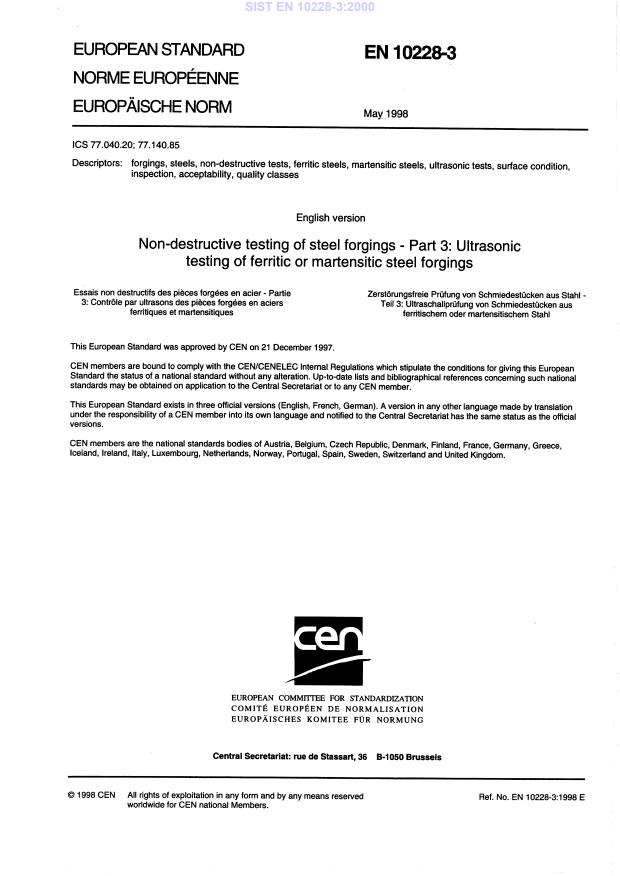
(Main)Non-destructive testing of steel forgings - Part 3: Ultrasonic testing of ferritic or martensitic steel forgings
- Abstract
This part of EN 10228 describes the techniques to be used for the manual, pulse-echo, ultrasonic testing of forgings manufactured from ferritic and martensitic steel. Mechanised scanning techniques such as immersion testing may be used but should be agreed between the purchaser and supplier. This part of EN 10228 applies to four types of forgings, classified according to their shape and method of production. Types 1, 2 and 3 are essentially simple shapes. Type 4 covers complex shapes.
- Status
- Withdrawn
- Publication Date
- 19-May-1998
- Withdrawal Date
- 06-Oct-2026
- Technical Committee
- ECISS/TC 111 - Steel castings and forgings
- Drafting Committee
- ECISS/TC 28/WG 1 - Steel forgings - Non destructive testing
- Current Stage
- 9960 - Withdrawal effective - Withdrawal
- Start Date
- 01-Jun-2016
- Completion Date
- 07-Oct-2026
- Directive
- 97/23/EC - Pressure equipment

Relations
- Effective Date
- 08-Jun-2016
- Effective Date
- 28-Jan-2026
- Effective Date
- 28-Jan-2026
- Effective Date
- 28-Jan-2026
- Effective Date
- 28-Jan-2026
- Effective Date
- 28-Jan-2026
- Effective Date
- 28-Jan-2026
Get Certified
Connect with accredited certification bodies for this standard

Element Materials Technology
Materials testing and product certification.

Inštitut za kovinske materiale in tehnologije
Institute of Metals and Technology. Materials testing, metallurgical analysis, NDT.
Sponsored listings
Frequently Asked Questions
EN 10228-3:1998 is a standard published by the European Committee for Standardization (CEN). Its full title is "Non-destructive testing of steel forgings - Part 3: Ultrasonic testing of ferritic or martensitic steel forgings". This standard covers: This part of EN 10228 describes the techniques to be used for the manual, pulse-echo, ultrasonic testing of forgings manufactured from ferritic and martensitic steel. Mechanised scanning techniques such as immersion testing may be used but should be agreed between the purchaser and supplier. This part of EN 10228 applies to four types of forgings, classified according to their shape and method of production. Types 1, 2 and 3 are essentially simple shapes. Type 4 covers complex shapes.
This part of EN 10228 describes the techniques to be used for the manual, pulse-echo, ultrasonic testing of forgings manufactured from ferritic and martensitic steel. Mechanised scanning techniques such as immersion testing may be used but should be agreed between the purchaser and supplier. This part of EN 10228 applies to four types of forgings, classified according to their shape and method of production. Types 1, 2 and 3 are essentially simple shapes. Type 4 covers complex shapes.
EN 10228-3:1998 is classified under the following ICS (International Classification for Standards) categories: 77.040.20 - Non-destructive testing of metals; 77.140.85 - Iron and steel forgings. The ICS classification helps identify the subject area and facilitates finding related standards.
EN 10228-3:1998 has the following relationships with other standards: It is inter standard links to EN 10228-3:2016, EN 12952-2:2011, CEN/TS 13001-3-5:2010, EN ISO 11140-4:2007, EN 12516-1:2005, EN ISO 11140-3:2009, EN 14141:2013. Understanding these relationships helps ensure you are using the most current and applicable version of the standard.
EN 10228-3:1998 is associated with the following European legislation: EU Directives/Regulations: 97/23/EC; Standardization Mandates: M/071. When a standard is cited in the Official Journal of the European Union, products manufactured in conformity with it benefit from a presumption of conformity with the essential requirements of the corresponding EU directive or regulation.
EN 10228-3:1998 is available in PDF format for immediate download after purchase. The document can be added to your cart and obtained through the secure checkout process. Digital delivery ensures instant access to the complete standard document.
Standards Content (Sample)
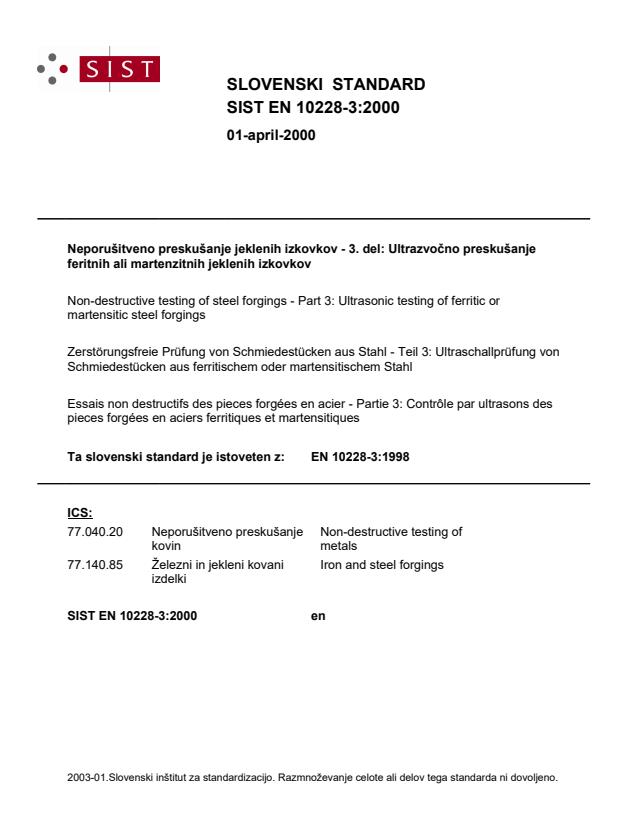
2003-01.Slovenski inštitut za standardizacijo. Razmnoževanje celote ali delov tega standarda ni dovoljeno.Zerstörungsfreie Prüfung von Schmiedestücken aus Stahl - Teil 3: Ultraschallprüfung von Schmiedestücken aus ferritischem oder martensitischem StahlEssais non destructifs des pieces forgées en acier - Partie 3: Contrôle par ultrasons des pieces forgées en aciers ferritiques et martensitiquesNon-destructive testing of steel forgings - Part 3: Ultrasonic testing of ferritic or martensitic steel forgings77.140.85Železni in jekleni kovani izdelkiIron and steel forgings77.040.20Neporušitveno preskušanje kovinNon-destructive testing o
...