


EN 13001-3-6:2018+A1:2021
(Main + Amendment)Cranes - General design - Part 3-6: Limit states and proof of competence of machinery - Hydraulic cylinders
Cranes - General design - Part 3-6: Limit states and proof of competence of machinery - Hydraulic cylinders
This document is to be used together with the other generic parts of EN 13001 series of standards, see Annex E, as well as pertinent crane type product EN standards, and as such they specify general conditions, requirements and methods to, by design and theoretical verification, prevent mechanical hazards of hydraulic cylinders that are part of the load carrying structures of cranes. Hydraulic piping, hoses and connectors used with the cylinders are not within the scope of this document, as well as cylinders made from other material than carbon steel.
NOTE 1 Specific requirements for particular crane types are given in the appropriate European product standards, see Annex E.
The significant hazardous situations and hazardous events that could result in risks to persons during intended use are identified in Annex F. Clauses 4 to 7 of this document provide requirements and methods to reduce or eliminate these risks:
a) exceeding the limits of strength (yield, ultimate, fatigue);
b) elastic instability (column buckling).
NOTE 2 EN 13001-3-6 deals only with the limit state method in accordance with EN 13001-1.
Krane - Konstruktion allgemein - Teil 3-6: Grenzzustände und Sicherheitsnachweis von Maschinenbauteilen - Hydraulikzylinder
Dieses Dokument ist gemeinsam mit den anderen allgemeinen Teilen der Normenreihe EN 13001, siehe Anhang E, anzuwenden sowie mit den einschlägigen EN-Produktnormen für Krane, die allgemeine Bedingungen, Anforderungen und Methoden festlegen, um so anhand der Konstruktion und des theoretischen Nachweises mechanische Gefährdungen der Hydraulikzylinder, die Teil der lasttragenden Struktur von Kranen sind, zu verhindern. Hydraulikleitungen, -schläuche und -anschlüsse von Zylindern fallen nicht in den Anwendungsbereich dieses Dokuments, genauso wie Zylinder, die aus anderen Werkstoffen als Kohlenstoffstahl bestehen.
ANMERKUNG 1 Besondere Anforderungen für spezielle Krantypen sind in den zutreffenden Europäischen Produktnormen angegeben; siehe Anhang E.
Die signifikanten Gefährdungssituationen und Gefährdungsereignisse, die bei bestimmungsgemäßer Verwendung zu Gefährdungen von Personen führen können, sind in Anhang F aufgeführt. Die Abschnitte 4 bis 7 dieses Dokuments enthalten Anforderungen und Verfahren zur Verringerung oder Beseitigung dieser Risiken:"
a) Überschreiten der Festigkeitsgrenzwerte (Fließgrenze, Bruch- und Ermüdungsfestigkeit);
b) elastische Instabilität (knickstabähnliches Verhalten).
!ANMERKUNG 2" EN 13001-3-6 behandelt ausschließlich die Methode der Grenzzustände in Übereinstimmung mit EN 13001-1.
Appareils de levage à charge suspendue - Conception générale - Partie 3-6 : États limites et vérification d'aptitude des éléments de mécanismes - Vérins hydrauliques
Le présent document doit être utilisé conjointement avec les autres parties génériques de la série des EN 13001, voir Annexe E, ainsi qu'avec les normes européennes pertinentes de type produit, pour appareil de levage à charge suspendue. Dans ce cadre, ils spécifient les conditions générales, les prescriptions et les méthodes visant à prévenir les dangers mécaniques liés aux vérins hydrauliques qui font partie des structures transmettant des charges dans les appareils de levage, par la conception et la vérification théorique. Les tuyaux, flexibles et raccords hydrauliques utilisés avec les vérins, ainsi que les vérins fabriqués dans un autre matériau que l'acier au carbone n'entrent pas dans le domaine d'application du présent document.
NOTE 1 Des prescriptions spécifiques pour des types particuliers d’appareil de levage à charge suspendue sont données dans la Norme européenne « Produit » appropriée au type particulier d’appareil de levage à charge suspendue, voir Annexe E.
Les situations et les événements dangereux significatifs susceptibles d’entraîner des risques pour les personnes lors d’une utilisation normale et d’une mauvaise utilisation raisonnablement prévisible sont identifiés à l’Annexe F. Les Articles 4 à 7 du présent document fournissent des prescriptions et des méthodes réduire ou éliminer ces risques :
a) dépassement des limites de résistance (élasticité, rupture, fatigue) ;
b) instabilité élastique (flambage de colonne).
NOTE 2 L'EN 13001-3-6 traite uniquement de la méthode des états limites selon l’EN 13001-1.
Žerjavi - Konstrukcija, splošno - 3-6. del: Mejna stanja in dokaz varnosti mehanizma - Hidravlični cilindri
General Information
- Status
- Published
- Publication Date
- 15-Jun-2021
- Withdrawal Date
- 30-Dec-2021
- Technical Committee
- CEN/TC 147 - Cranes - Safety
- Drafting Committee
- CEN/TC 147/WG 2 - Design - General
- Current Stage
- 9092 - Decision on results of review/2YR ENQ - revise - Review Enquiry
- Start Date
- 11-Apr-2024
- Completion Date
- 11-Feb-2026
Relations
- Effective Date
- 19-Jan-2023
- Effective Date
- 18-Jan-2023
- Effective Date
- 28-Jan-2026
- Effective Date
- 28-Jan-2026
- Effective Date
- 28-Jan-2026
- Effective Date
- 28-Jan-2026
- Effective Date
- 28-Jan-2026
- Effective Date
- 28-Jan-2026
- Effective Date
- 28-Jan-2026
- Effective Date
- 28-Jan-2026
- Effective Date
- 28-Jan-2026
- Effective Date
- 28-Jan-2026
- Effective Date
- 28-Jan-2026
- Effective Date
- 28-Jan-2026
- Effective Date
- 28-Jan-2026
Overview - EN 13001-3-6:2018+A1:2021 (Cranes - Hydraulic cylinders)
EN 13001-3-6:2018+A1:2021 is a CEN harmonized standard that specifies design principles and theoretical verification (limit state method) for hydraulic cylinders forming part of the load‑carrying structures of cranes. It is intended to be used together with other parts of the EN 13001 series and applicable crane product standards (see Annex E). The standard focuses on preventing mechanical hazards by defining requirements for static strength, fatigue resistance and elastic stability of cylinders made from carbon steel. Note: hydraulic piping, hoses and connectors and cylinders of non‑carbon steel are excluded from the scope.
Key topics and technical requirements
The standard provides practical methods and requirements for designers and manufacturers, including:
- Materials and documentation: requirements for carbon steel grades, drawings and design information.
- Proof of static strength: limit design stresses for structural members and welded joints, linear and nonlinear stress analysis methods for cylinder tubes, bottoms, heads, piston rods, threads and interfaces.
- Proof of fatigue strength: stress histories, limit design stress ranges, and details for common fatigue‑sensitive features (bottom welds, oil connector notches, piston rod, head bolts).
- Proof of elastic stability: column buckling checks, calculation of critical buckling loads and limit compressive design force (Annex A provides common buckling cases).
- Connections and interfaces: execution rules for bolted and welded connections, thread undercuts, locking grooves and mechanical interfaces to crane structures.
- Hazard identification: list of significant hazardous situations (Annex F) and methods to reduce risks such as exceeding yield/ultimate/fatigue limits and elastic instability.
The standard applies the limit state method per EN 13001‑1 and includes informative annexes on fatigue analysis, second‑order effects and selection of complementary crane standards.
Practical applications and users
EN 13001-3-6 is used by:
- Crane designers and structural engineers for verification of load‑bearing hydraulic cylinders.
- Component manufacturers producing crane cylinders (carbon steel).
- Safety assessors, notified bodies and conformity assessors verifying compliance with the Machinery Directive.
- Procurement specialists and OEMs specifying design and verification requirements in supplier contracts.
Typical uses include design verification, preparation of technical files, fatigue and buckling checks, and defining interfaces between purchaser, designer and cylinder manufacturer.
Related standards
- EN 13001 series (general design) - see EN 13001‑1 for the limit state framework.
- Applicable crane product EN standards (see Annex E).
- Relationship to Machinery Directive 2006/42/EC (informative Annex ZA).


Get Certified
Connect with accredited certification bodies for this standard

Institut za varilstvo d.o.o. (Welding Institute)
Slovenia's leading welding institute since 1952. ISO 3834, EN 1090, pressure equipment certification, NDT personnel, welder qualification. Only IIW Au
Sponsored listings
Frequently Asked Questions
EN 13001-3-6:2018+A1:2021 is a standard published by the European Committee for Standardization (CEN). Its full title is "Cranes - General design - Part 3-6: Limit states and proof of competence of machinery - Hydraulic cylinders". This standard covers: This document is to be used together with the other generic parts of EN 13001 series of standards, see Annex E, as well as pertinent crane type product EN standards, and as such they specify general conditions, requirements and methods to, by design and theoretical verification, prevent mechanical hazards of hydraulic cylinders that are part of the load carrying structures of cranes. Hydraulic piping, hoses and connectors used with the cylinders are not within the scope of this document, as well as cylinders made from other material than carbon steel. NOTE 1 Specific requirements for particular crane types are given in the appropriate European product standards, see Annex E. The significant hazardous situations and hazardous events that could result in risks to persons during intended use are identified in Annex F. Clauses 4 to 7 of this document provide requirements and methods to reduce or eliminate these risks: a) exceeding the limits of strength (yield, ultimate, fatigue); b) elastic instability (column buckling). NOTE 2 EN 13001-3-6 deals only with the limit state method in accordance with EN 13001-1.
This document is to be used together with the other generic parts of EN 13001 series of standards, see Annex E, as well as pertinent crane type product EN standards, and as such they specify general conditions, requirements and methods to, by design and theoretical verification, prevent mechanical hazards of hydraulic cylinders that are part of the load carrying structures of cranes. Hydraulic piping, hoses and connectors used with the cylinders are not within the scope of this document, as well as cylinders made from other material than carbon steel. NOTE 1 Specific requirements for particular crane types are given in the appropriate European product standards, see Annex E. The significant hazardous situations and hazardous events that could result in risks to persons during intended use are identified in Annex F. Clauses 4 to 7 of this document provide requirements and methods to reduce or eliminate these risks: a) exceeding the limits of strength (yield, ultimate, fatigue); b) elastic instability (column buckling). NOTE 2 EN 13001-3-6 deals only with the limit state method in accordance with EN 13001-1.
EN 13001-3-6:2018+A1:2021 is classified under the following ICS (International Classification for Standards) categories: 23.100.20 - Cylinders; 53.020.20 - Cranes. The ICS classification helps identify the subject area and facilitates finding related standards.
EN 13001-3-6:2018+A1:2021 has the following relationships with other standards: It is inter standard links to EN 13001-3-6:2018/FprA1, EN 13001-3-6:2018, EN 13001-2:2014, EN 10277-2:2008, EN 13001-1:2015, EN ISO 11127-2:1997, EN ISO 8492:2013, EN ISO 148-1:2016, EN ISO 12100:2010, EN ISO 683-2:2018, EN 13001-3-1:2012+A2:2018, EN ISO 5817:2014, EN 10297-1:2003, EN 10305-1:2016, EN 10305-2:2016. Understanding these relationships helps ensure you are using the most current and applicable version of the standard.
EN 13001-3-6:2018+A1:2021 is associated with the following European legislation: EU Directives/Regulations: 2006/42/EC; Standardization Mandates: M/396. When a standard is cited in the Official Journal of the European Union, products manufactured in conformity with it benefit from a presumption of conformity with the essential requirements of the corresponding EU directive or regulation.
EN 13001-3-6:2018+A1:2021 is available in PDF format for immediate download after purchase. The document can be added to your cart and obtained through the secure checkout process. Digital delivery ensures instant access to the complete standard document.
Standards Content (Sample)
SLOVENSKI STANDARD
01-september-2021
Žerjavi - Konstrukcija, splošno - 3-6. del: Mejna stanja in dokaz varnosti
mehanizma - Hidravlični cilindri
Cranes - General design - Part 3-6: Limit states and proof of competence of machinery -
Hydraulic cylinders
Krane - Konstruktion allgemein - Teil 3-6: Grenzzustände und Sicherheitsnachweis von
Maschinenbauteilen - Hydraulikzylinder
Appareils de levage à charge suspendue - Conception générale - Partie 3-6 : États
limites et vérification d'aptitude des éléments de mécanismes - Vérins hydrauliques
Ta slovenski standard je istoveten z: EN 13001-3-6:2018+A1:2021
ICS:
23.100.20 Hidravlični valji Cylinders
53.020.20 Dvigala Cranes
2003-01.Slovenski inštitut za standardizacijo. Razmnoževanje celote ali delov tega standarda ni dovoljeno.
EN 13001-3-6:2018+A1
EUROPEAN STANDARD
NORME EUROPÉENNE
June 2021
EUROPÄISCHE NORM
ICS 23.100.20; 53.020.20 Supersedes EN 13001-3-6:2018
English Version
Cranes - General design - Part 3-6: Limit states and proof
of competence of machinery - Hydraulic cylinders
Appareils de levage à charge suspendue - Conception Krane - Konstruktion allgemein - Teil 3-6:
générale - Partie 3-6 : États limites et vérification Grenzzustände und Sicherheitsnachweis von
d'aptitude des éléments de mécanismes - Vérins Maschinenbauteilen - Hydraulikzylinder
hydrauliques
This European Standard was approved by CEN on 13 November 2017 and includes Amendment 1 approved by CEN on 9 May
2021.
CEN members are bound to comply with the CEN/CENELEC Internal Regulations which stipulate the conditions for giving this
European Standard the status of a national standard without any alteration. Up-to-date lists and bibliographical references
concerning such national standards may be obtained on application to the CEN-CENELEC Management Centre or to any CEN
member.
This European Standard exists in three official versions (English, French, German). A version in any other language made by
translation under the responsibility of a CEN member into its own language and notified to the CEN-CENELEC Management
Centre has the same status as the official versions.
CEN members are the national standards bodies of Austria, Belgium, Bulgaria, Croatia, Cyprus, Czech Republic, Denmark, Estonia,
Finland, France, Germany, Greece, Hungary, Iceland, Ireland, Italy, Latvia, Lithuania, Luxembourg, Malta, Netherlands, Norway,
Poland, Portugal, Republic of North Macedonia, Romania, Serbia, Slovakia, Slovenia, Spain, Sweden, Switzerland, Turkey and
United Kingdom.
EUROPEAN COMMITTEE FOR STANDARDIZATION
COMITÉ EUROPÉEN DE NORMALISATION
EUROPÄISCHES KOMITEE FÜR NORMUNG
CEN-CENELEC Management Centre: Rue de la Science 23, B-1040 Brussels
© 2021 CEN All rights of exploitation in any form and by any means reserved Ref. No. EN 13001-3-6:2018+A1:2021 E
worldwide for CEN national Members.
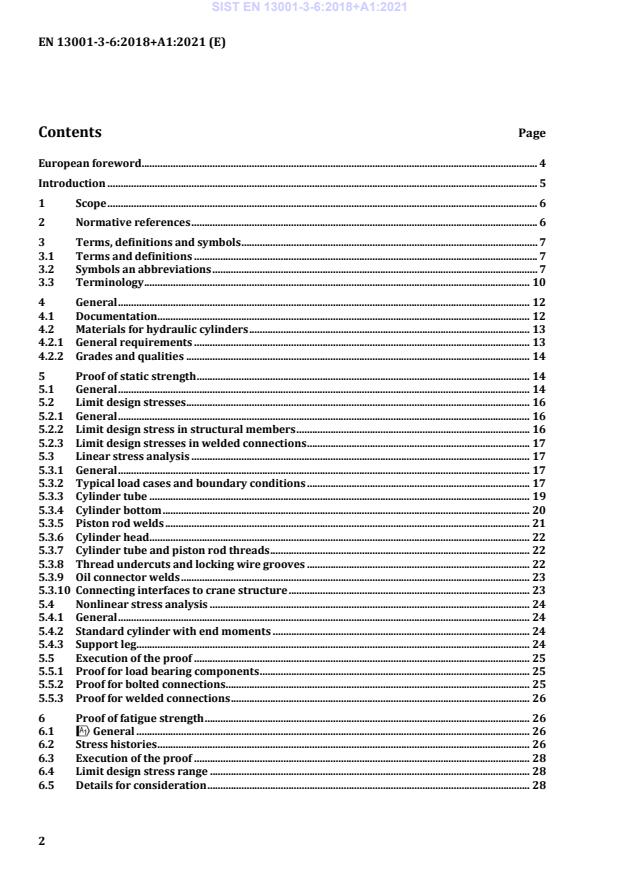
Contents Page
European foreword . 4
Introduction . 5
1 Scope . 6
2 Normative references . 6
3 Terms, definitions and symbols . 7
3.1 Terms and definitions . 7
3.2 Symbols an abbreviations . 7
3.3 Terminology . 10
4 General . 12
4.1 Documentation . 12
4.2 Materials for hydraulic cylinders . 13
4.2.1 General requirements . 13
4.2.2 Grades and qualities . 14
5 Proof of static strength . 14
5.1 General . 14
5.2 Limit design stresses . 16
5.2.1 General . 16
5.2.2 Limit design stress in structural members . 16
5.2.3 Limit design stresses in welded connections . 17
5.3 Linear stress analysis . 17
5.3.1 General . 17
5.3.2 Typical load cases and boundary conditions . 17
5.3.3 Cylinder tube . 19
5.3.4 Cylinder bottom . 20
5.3.5 Piston rod welds . 21
5.3.6 Cylinder head . 22
5.3.7 Cylinder tube and piston rod threads . 22
5.3.8 Thread undercuts and locking wire grooves . 22
5.3.9 Oil connector welds . 23
5.3.10 Connecting interfaces to crane structure . 23
5.4 Nonlinear stress analysis . 24
5.4.1 General . 24
5.4.2 Standard cylinder with end moments . 24
5.4.3 Support leg . 24
5.5 Execution of the proof . 25
5.5.1 Proof for load bearing components . 25
5.5.2 Proof for bolted connections . 25
5.5.3 Proof for welded connections . 26
6 Proof of fatigue strength . 26
6.1 !General . 26
6.2 Stress histories . 26
6.3 Execution of the proof . 28
6.4 Limit design stress range . 28
6.5 Details for consideration . 28
6.5.1 General . 28
6.5.2 Bottom weld. 29
6.5.3 Notch stress at oil connectors . 31
6.5.4 Cylinder head . 32
6.5.5 Piston rod . 34
6.5.6 Cylinder head bolts . 36
6.5.7 Cylinder head flange weld . 36
6.5.8 Mechanical interfaces . 39
7 Proof of elastic stability . 39
7.1 General . 39
7.2 Critical buckling load . 39
7.3 Limit compressive design force . 41
7.4 Execution of the proof . 42
Annex A (informative) Critical buckling load for common buckling cases . 43
A.1 General . 43
A.2 Buckling case A . 44
A.3 Buckling case B . 44
A.4 Buckling case C . 45
A.5 Buckling case D . 45
A.6 Buckling case E . 45
A.7 Buckling case F . 46
A.8 Buckling case G . 46
Annex B (informative) Second order analysis of two important cases . 47
B.1 Compressed cylinder with end moments and angular misalignment . 47
B.2 Compressed cylinder with lateral end force and angular misalignment . 48
B.3 Axial stresses for cases in B.1 and B.2 . 49
Annex C (informative) Shell section forces and moments for cylinder bottom . 50
Annex D (informative) Fatigue analysis of bottom weld for more complex cases . 53
Annex E (informative) Selection of a suitable set of crane standards for a given application . 56
Annex F (informative) List of hazards . 58
Annex ZA (informative) Relationship between this European Standard and the essential
requirements of Directive 2006/42/EC aimed to be covered . 59
Bibliography . 60
European foreword
This document (EN 13001-3-6:2018+2021) has been prepared by Technical Committee CEN/TC 147
“Cranes — Safety”, the secretariat of which is held by DIN.
This European Standard shall be given the status of a national standard, either by publication of an
identical text or by endorsement, at the latest by December 2021, and conflicting national standards
shall be withdrawn at the latest by December 2021.
This document includes Amendment 1 approved by CEN on 21 May 2021.
This document supersedes EN 13001-3-6:2018.
The start and finish of text introduced or altered by amendment is indicated in the text by tags !".
Attention is drawn to the possibility that some of the elements of this document may be the subject of
patent rights. CEN shall not be held responsible for identifying any or all such patent rights.
This document has been prepared under a mandate given to CEN by the European Commission and the
European Free Trade Association, and supports essential requirements of EU Directive(s).
For relationship with EU Directive(s), see informative Annex ZA, which is an integral part of this
document.
According to the CEN-CENELEC Internal Regulations, the national standards organisations of the
following countries are bound to implement this European Standard: Austria, Belgium, Bulgaria,
Croatia, Cyprus, Czech Republic, Denmark, Estonia, Finland, France, Germany, Greece, Hungary, Iceland,
Ireland, Italy, Latvia, Lithuania, Luxembourg, Malta, Netherlands, Norway, Poland, Portugal, Republic of
North Macedonia, Romania, Serbia, Slovakia, Slovenia, Spain, Sweden, Switzerland, Turkey and the
United Kingdom.
Introduction
This European Standard has been prepared to be a harmonized standard to provide one means for the
mechanical design and theoretical verification of cranes to conform with the essential health and safety
requirements of the Machinery Directive, as amended. This standard also establishes interfaces
between the user (purchaser) and the designer, as well as between the designer and the component
manufacturer, in order to form a basis for selecting cranes and components.
This European Standard is a type C standard as stated in EN ISO 12100:2010.
The machinery concerned and the extent to which hazards, hazardous situations and events are
covered are indicated in the scope of this standard.
When provisions of this type C standard are different from those which are stated in type A or B
standards, the provisions of this type C standard take precedence over the provisions of the other
standards, for machines that have been designed and built according to the provisions of this type C
standard.
1 Scope
!This document is to be used together with the other generic parts of EN 13001 series of standards,
see Annex E, as well as pertinent crane type product EN standards, and as such they specify general
conditions, requirements and methods to, by design and theoretical verification, prevent mechanical
hazards of hydraulic cylinders that are part of the load carrying structures of cranes. Hydraulic piping,
hoses and connectors used with the cylinders are not within the scope of this document, as well as
cylinders made from other material than carbon steel.
NOTE 1 Specific requirements for particular crane types are given in the appropriate European product
standards, see Annex E.
The significant hazardous situations and hazardous events that could result in risks to persons during
intended use are identified in Annex F. Clauses 4 to 7 of this document provide requirements and
methods to reduce or eliminate these risks:"
a) exceeding the limits of strength (yield, ultimate, fatigue);
b) elastic instability (column buckling).
!NOTE 2" EN 13001–3–6 deals only with the limit state method in accordance with EN 13001–1.
2 Normative references
The following documents are referred to in the text in such a way that some or all of their content
constitutes requirements of this document. For dated references, only the edition cited applies. For
undated references, the latest edition of the referenced document (including any amendments) applies.
!deleted text"
EN 10277-2:2008, Bright steel products — Technical delivery conditions — Part 2: Steels for general
engineering purposes
!EN 10297-1:2003, Seamless circular steel tubes for mechanical and general engineering purposes —
Technical delivery conditions — Part 1: Non-alloy and alloy steel tubes"
EN 10305-1:2016, Steel tubes for precision applications — Technical delivery conditions — Part 1:
Seamless cold drawn tubes
EN 10305-2:2016, Steel tubes for precision applications — Technical delivery conditions — Part 2:
Welded cold drawn tubes
!EN 13001-1:2015, Cranes — General design — Part 1: General principles and requirements
EN 13001-2:2014, Crane safety — General design — Part 2: Load actions
EN 13001-3-1:2012+A2:2018, Cranes — General design — Part 3-1: Limit States and proof competence
of steel structure"
EN ISO 148-1:2016, Metallic materials — Charpy pendulum impact test — Part 1: Test method (ISO 148-
1:2016)
!EN ISO 683-1:2018, Heat-treatable steels, alloy steels and free-cutting steels — Part 1: Non-alloy steels
for quenching and tempering (ISO 683-1:2016)
EN ISO 683-2:2018, Heat-treatable steels, alloy steels and free-cutting steels — Part 2: Alloy steels for
quenching and tempering (ISO 683-2:2016)"
EN ISO 5817:2014, Welding — Fusion-welded joints in steel, nickel, titanium and their alloys (beam
welding excluded) — Quality levels for imperfections (ISO 5817:2014)
EN ISO 8492:2013, Metallic materials — Tube — Flattening test (ISO 8492:2013)
EN ISO 12100:2010, Safety of machinery — General principles for design — Risk assessment and risk
reduction (ISO 12100:2010)
ISO 724:1993, ISO general-purpose metric screw threads — Basic dimensions
3 Terms, definitions and symbols
3.1 Terms and definitions
For the purposes of this document, the terms and definitions given in EN ISO 12100:2010 apply.
ISO and IEC maintain terminological databases for use in standardization at the following addresses:
— IEC Electropedia: available at http://www.electropedia.org/
— ISO Online browsing platform: available at http://www.iso.org/obp
3.2 Symbols an abbreviations
The essential symbols and abbreviations are given in Table 1.
Table 1 — Symbols and abbreviations
Symbols Description
A% Percentage elongation at fracture
a Weld throat thickness
A , B , C , D
Constants
i i i i
A
Stress area
s
D Piston diameter
d Rod diameter
D
Diameter of axles
a,i
D
Pressure affected diameter
p
D
Weld diameter
w
E Modulus of elasticity
F Compressive force
F
Compressive force
A
FE Finite Elements
f
Limit design stress
Rd
f
Limit design stress, normal
Rdσ
Symbols Description
f
Limit design stress, shear
Rdτ
F
Lateral force
S
F
External design force
Sd
f
Ultimate strength
u
f
Limit design weld stress
w,Rd
f
Yield strength
y
h thickness of the cylinder bottom
I Moment of inertia, generic
I
Moment of inertia of the tube
I
Moment of inertia of the rod
L Overall length of the cylinder
L
Length of the cylinder tube
L
Length of the cylinder rod
m Slope of the log Δσ – log N curve
Shell section bending moment, acting at the intersection between tube and
M
bottom
MB Bending moment
N Compressive force
N
Critical buckling load
k
N
Limit compressive design force
Rd
! deleted text"
p
Maximum pressure in piston side chamber
i1
p
Maximum pressure in rod side chamber
i2
p
Outer pressure
o
p
Design pressure
Sd
Middle radius of the tube (R = R + t/2)
R
i
r
Inner radius of the tube
i
R
Inner radius of the tube
i
r
Outer radius of the tube
o
r
Outer radius of the piston rod
r
Symbols Description
s
Stress history parameter (see EN 13001–3-1)
t Wall thickness of the tube
Shell section transverse force, acting at the intersection between tube and
T
bottom
x, y Longitudinal and lateral coordinates
α Angular misalignment, radians
γ General resistance factor (γ = 1,1, see EN 13001–2)
m m
γ
Fatigue strength specific resistance factor (see EN 13001–3-1)
mf
γ Total resistance factor (γ = γ · γ )
R R m s
γ
Specific resistance factor
s
Δσ Stress range
Δσ
Bending stress range in the tube
b
Δσ
Characteristic fatigue strength
c
Δσ
Membrane stress range in the tube (axial)
m
Δσ
Limit design stress range
Rd
Δσ
Design stress range
Sd
Δp
Design pressure range on piston side
Sd
δ
Maximum displacement
max
κ Reduction factor for buckling
λ Slenderness
λ
Friction parameters
i
μ
Friction factors
i
ν Poisson’s ratio (ν = 0,3 for steel)
σ
Axial stress in the tube
a
σ
Lower extreme value of a stress range
b
σ
Radial stress in the tube
r
σ
Design stress, normal
Sd
σ
Tangential stress in the tube (hoop stress)
t
σ
Upper extreme value of a stress range
u
σ
Weld design stress, normal
w,Sd
Symbols Description
τ
Design stress, shear
Sd
τ
Weld design stress, shear
w,Sd
3.3 Terminology
Terms which are used in this European Standard for the main parts of hydraulic cylinder are indicated
in Figure 1 to Figure 3.
Key
1 bushing
2 rod head
3 cylinder head
4 oil connector
5 piston rod
6 cylinder tube
7 spacer
8 piston
9 nut
10 cylinder bottom
11 grease nipple
12 piston side chamber
13 rod side chamber
Figure 1 — Complete cylinder
Key
1 wiper
2 O-ring
3 secondary seal
4 guide ring (2 × )
5 primary seal
6 backup ring
7 O-ring
Figure 2 — Cylinder head
Key
1 seal
2 pressure element
3 guide ring (2 × )
Figure 3 — Piston
The figures above show some specific design features in order to exemplify the terminology. Other
designs may be used.
4 General
4.1 Documentation
The documentation of the proof of competence shall include:
— design assumptions including calculation models;
— applicable loads and load combinations;
— material grades and qualities;
!— weld quality levels, in accordance with EN ISO 5817:2014 and EN 13001-3-
1:2012+A2:2018;"
— relevant limit states;
— results of the proof of competence calculation, and tests when applicable.
4.2 Materials for hydraulic cylinders
4.2.1 General requirements
!The materials for cylinder tubes and piston rods shall fulfil the following requirements:"
!— The impact toughness shall be tested in accordance with EN ISO 148-1:2016 and shall meet the
requirements stated in EN 13001-3-1:2012+A2:2018. Samples shall be cut out in the
longitudinal direction. For cylinder tubes and tubes for pressurized piston rods, samples shall
also be cut out in the transversal direction. The samples shall be prepared such that the axis of
the notch is perpendicular to the surface of the tube."
Key
1 sample cut out in longitudinal direction
2 sample cut out in transversal direction
Figure 4 — Sample for impact toughness testing
!— If the material thickness does not allow samples to be cut out in the transversal direction, the
tube material shall instead pass a flattening test in accordance with EN ISO 8492:2013. Two
flattening tests are required for welded tubes, one with the weld aligned with the press
direction and one where the weld is placed 90 degrees from the press direction. The tube
section shall be flattened down to a height H given by:"
!
1+⋅C t
( )
H=
t
C+
D
o
"
where
!C is a factor that depends on the yield strength of the tube,
C is 0,07 for f ≤ 400 MPa and C is 0,05 for f > 400 MPa;"
y y
D is the outer diameter of the tube;
o
t is the wall thickness of the tube.
!Material used in other parts shall meet the requirements stated in EN 13001-3-1:2012+A2:2018."
4.2.2 Grades and qualities
!European Standards specify materials and specific values. This standard gives a preferred selection.
Steels in accordance with the following European Standards shall be used as material for cylinder tubes
and piston rods:"
!— EN ISO 683-1:2018;
— EN ISO 683-2:2018;
— EN 10277-2:2008;
— EN 10297-1:2003;
— EN 10305-1:2016;
— EN 10305-2:2016."
!Alternatively, other steel grades and qualities than those listed in this clause may be used as
material for cylinder tubes and piston rods, provided that the following conditions apply:"
— the design value of f is limited to f /1,1 for materials with f /f < 1,1;
y u u y
— the percentage elongation at fracture A % ≥ 14 % on a gauge length LS5,65× (where S is
0 0 0
the original cross-sectional area);
!Grades and qualities of materials used in other parts of cylinders or mounting interfaces of cylinders
shall be selected in accordance with EN 13001-3-1:2012+A2:2018."
5 Proof of static strength
5.1 General
!A proof of static strength by calculation is intended to prevent excessive deformations due to
yielding of the material, elastic instability and fracture of structural members or connections. Dynamic
factors given in EN 13001-2:2014 or relevant product standards are used to produce equivalent static
loads to simulate dynamic effects. Also, load increasing effects due to deformation shall be considered.
The use of the theory of plasticity for calculation of ultimate load bearing capacity is not considered
acceptable within the terms of this standard. The proof shall be carried out for structural members and
connections while taking into account the most unfavourable load effects from the load combinations A,
B or C in accordance with EN 13001-2:2014 or relevant product standards.
Cylinder actions are either active or passive. The action is active when the force from the cylinder exerts
a positive work on the crane structure, elsewise the action is passive. As the forces applied to the
cylinder by the crane structure are computed in accordance with EN 13001-2:2014, they are already
increased by the partial safety factors γ and relevant dynamic factors. Formulae (1) and (2) give design
p
pressures p caused by forces acting on the cylinder from the crane structure. In addition, additional
Sd
=
pressures p caused by internal phenomena in the hydraulic circuit shall be considered and added to
Sde
the design pressures p . Such internally generated pressures can be caused e.g. by regenerative
Sd
connections, pressure drop in return lines or cushioning."
In case a cylinder is intended to be tested as a component at higher pressure than the design pressure
p , this load case shall also be taken into account in the proof of static strength, and in which case the
Sd
test pressure shall be multiplied by a partial safety factor γ equal to 1,05.
p
The design pressure p in the piston side chamber or in the rod side chamber shall be computed from
Sd
the design force F taking into account the force direction and the cylinder efficiency η due to friction.
Sd
An efficiency factor Ψ is used to handle the effect of cylinder friction. For active cylinders Ψ has the
value of 1/η and for passive cylinders Ψ has the value of η.
For the piston side chamber, the design pressure is given by:
4⋅ F
Sd
(1)
p ⋅Ψ
Sd
π⋅ D
where
F is the external design force;
Sd
D is the piston diameter.
Ψ is set to η for passive cylinders and to 1/η for active cylinders.
For the rod side chamber the design pressure is given by:
4⋅ F
Sd
(2)
pp⋅Ψ+
Sd Sde
π⋅ Dd−
( )
where
F is the external design force;
Sd
D is the piston diameter;
d is the rod diameter;
Ψ is set to η for passive cylinders and to 1/η for active cylinders;
p is additional pressure caused by internal phenomena.
Sde
!Unless justified information (e.g. obtained by test) for the value of η is used, Ψ shall be assigned the
value of 1,1 for active cylinders and the value of 1,0 for passive cylinders."
!
NOTE The cylinder efficiency η due to friction is assumed to be evaluated at the working pressure."
This standard is based on nominal stresses, i.e. stresses calculated using traditional elastic strength of
materials theory which in general neglect localized stress non-uniformities. When more accurate
alternative methods of stress calculation are used, such as finite element analysis, using those stresses
for the proof given in this standard may yield inordinately conservative results.
=
=
5.2 Limit design stresses
5.2.1 General
The limit design stresses shall be calculated from:
(3)
Limit desing stresses ff= function ,γ
( )
Rd k R
where
f is the characteristic values (or nominal value);
k
γ is the total resistance factor γ γγ⋅ ;
R
R m s
!γ is the general resistance factor γ = 1,1 (see EN 13001-2:2014);"
m m
γ is the specific resistance factor applicable to specific structural components as given in the
s
clauses below.
f R /γ
NOTE is equivalent to in EN 13001–1.
Rd d m
5.2.2 Limit design stress in structural members
The limit design stress f , used for the design of structural members, shall be calculated from:
Rd
f
y
f = for normal stresses (4)
Rdσ
γ
Rm
f
y
f = for shear stresses (5)
Rdτ
γ ⋅ 3
Rm
with
γ γγ⋅
Rm m sm
where
f is the minimum value of the yield stress of the material;
y
γ is the specific resistance factor for material.
sm
γ = 0, 95 for steels according to standards listed in 4.2.2;
sm
γ = 10, for other steels.
sm
!For tensile stresses perpendicular to the plane of rolling (see Figure 5), the material shall be suitable
for carrying perpendicular loads and be free of lamellar defects. EN 13001-3-1:2012+A2:2018 specifies
the values of γ for material loaded perpendicular to the rolling plane."
sm
Example from cylinder tube bottom, where plate steel is used (eye is welded). The figure shows a
tensile load perpendicular to plane of rolling where:
=
=
Key
1 is the plane of rolling
2 is the direction of stress/load
Figure 5 — Tensile load perpendicular to plane of rolling
5.2.3 Limit design stresses in welded connections
!The limit design weld stress f used for the design of a welded connection shall be in accordance
w,Rd
with EN 13001-3-1:2012+A2:2018."
5.3 Linear stress analysis
5.3.1 General
5.3 comprises typical details for consideration that are relevant for the proof of static strength. Details
that are only relevant for fatigue analysis (e.g. shell bending of tube) are not dealt with in 5.3. In cases or
conditions not covered here, other recognized sources or static pressure/force testing shall be used.
5.3.2 Typical load cases and boundary conditions
Before executing calculations, boundary conditions and loading shall be investigated. Typical conditions
to be determined are:
— external forces and directions;
— type of cylinder;
— cylinder tube and rod mounting to the machine;
— forces/stresses due to thread pre-tightening;
— direction of gravity.
Different load cases shall be considered when calculating static strength for cylinders.
Typical load cases are shown in Figure 6 to Figure 10 here below.
Figure 6 — Pushing cylinder with supported bottom
Figure 7 — Pushing cylinder, flange mounted with unsupported bottom
Figure 8 — Pulling cylinder or pushing cylinder with pressurized rod chamber
Figure 9 — Pushing cylinder at end of stroke
Figure 10 — Pulling cylinder at end of stroke
The worst load condition or combination shall be used when calculating stresses σ or σ for a
Sd w,Sd
feature.
5.3.3 Cylinder tube
Cylinder tube stresses shall be computed from three components. For calculation of each component,
forces and pressures shall be determined in accordance with 5.3.2.
Figure 11 — Stresses in cylinder tube
The tangential stress (hoop stress) is given by:
r r
o
i
+ 1 + 1
r
r
σ rp= ⋅ + p⋅ (6)
( )
ti o
r r
o
i
−−1 1
rr
io
For cylindrical shells such as tubes or hollow rods that are also loaded by an outer pressure, the
combination of inner and outer pressure that gives the largest absolute value of the tangential (hoop)
stress shall be used.
Maximum radial stress magnitude in the tube occurs at the inner radius r or the at the outer radius r
i o
and is given by:
σ =−p orσ =−p (7)
r i r o
For the cylinder arrangement shown in Figure 6, maximum axial stress in the tube is given by:
4⋅ r
o
(8)
σ M⋅
ab
π⋅ r − r
( )
oi
For the cylinder arrangements shown in Figure 8 and Figure 10, maximum axial stress in the tube is
given by:
2 2
p ⋅−r r
( )
i2 i r 4⋅ r
o
σ +⋅M (9)
ab
2 2
r − r
π⋅ r − r
oi ( )
oi
=
=
For the cylinder arrangement shown in Figure 7 and Figure 9, maximum axial stress in the tube is given
by:
p ⋅ r 4⋅ r
i1 i o
(10)
σ +⋅M
ab
2 2
r − r
π⋅ r − r
)
oi ( oi
where
r is an arbitrary radius of the tube;
r is the inner radius of the tube;
i
r is the outer radius of the tube;
o
r is the outer radius of the piston rod;
r
p is the inner pressure;
i
p is the inner maximum pressure in piston side chamber;
i1
p is the inner maximum pressure in rod side chamber;
i2
p is the outer pressure;
o
M is any bending moment acting on the cylinder tube (e.g. dead weight).
b
The von Mises equivalent stress shall be computed for the location having the most severe stress as:
σ σ++−σ σ σσ−σσ−σ σ (11)
Sd t r a t a t r r a
5.3.4 Cylinder bottom
5.3.4.1 Bottom plate
The stress in an unsupported bottom plate, in a cylinder with the ratio outer diameter to inner diameter
in the range 1,07 to 1,24, shall be calculated as:
341 3 D+⋅2 tD
σ = p⋅ −⋅ ⋅ (12)
Sd i
350 7 D h
where
p is the inner pressure;
i
D is the inner diameter;
t is the tube thickness;
h is the bottom thickness.
=
=
Figure 12 — Stresses in unsupported cylinder bottom
5.3.4.2 Bottom weld
Bottom welds shall be calculated for different load cases in accordance with 5.3.2.
Figure 13 — Bottom weld
The bottom weld is loaded by the axial force in the tube, caused by internal pressure (Figure 7 and
Figure 8) or by pushing cylinder coming to end of stroke (Figure 9).
F
Sdt
σ = (13)
w,Sd
2⋅π⋅ R⋅ a
where
F is the design axial force acting in the tube;
Sdt
!a is the effective throat thickness of the weld, see EN 13001-3-1:2012+A2:2018, Annex C;"
R is the middle radius of the weld.
5.3.5 Piston rod welds
Piston rod welds shall be calculated for different load cases according to 5.3.2, in the same way as the
calculation of bottom welds.
F
Sdw
σ = (14)
w,Sd
2⋅π⋅ R⋅ a
where
F is the maximum design force acting in the rod;
Sdw
!a is the effective throat thickness of the weld, see EN 13001-3-1:2012+A2:2018, Annex C;"
R is the middle radius of the weld.
5.3.6 Cylinder head
Depending on the design, the cylinder head has a governing stress area A , which is the smallest area
c
that carries the axial load. Axial force can be caused by internal pressure, external force or pre-
tightening. The stresses in the cylinder head shall be calculated for the different load cases in
accordance with 5.3.2. The design stress shall be computed as:
F
Sdh
σ = (15)
Sd
A
c
where
F is the maximum axial design force acting on the head;
Sdh
A is the critical stress area for the axial force holding the cylinder head.
c
5.3.7 Cylinder tube and piston rod threads
Stresses in cylinder tube threads and piston rod threads shall be calculated for the different load cases
in accordance with 5.3.2. The design stress shall be computed as:
F
Sdr
σ = (16)
Sd
A
s
2⋅ F
Sdr
τ = (17)
Sd
π⋅ Ld⋅
where
F is the maximum design force acting on the cylinder head or the piston rod head;
Sdr
A is the stress area of the threaded cylinder tube or piston rod (equivalent to stress area of
s
bolt or nut);
!L is the effective threaded length, maximum 0,9 · d ;"
d is the pitch diameter of the thread in accordance to ISO 724.
It should be considered that the tube diameter can increase due to the internal pressure and thus
decrease the shear area in Formula (17).
5.3.8 Thread undercuts and locking wire grooves
Stresses in thread undercuts or locking wire grooves shall be calculated for the different load cases in
accordance with 5.3.2.
The design stress shall be computed as:
F
Sdu
σ = (18)
Sd
A
c
where
F is the maximum design force acting at the undercut;
Sdu
A is the critical stress area at the undercut or locking wire groove.
c
Figure 14 — Undercuts at thread run out
5.3.9 Oil connector welds
This clause considers oil connectors welded to the tube. The design stress σ shall be computed as:
w,Sd
F
Sdo
σ = (19)
w,Sd
A
with
A=π⋅ D ⋅ a (20)
w
and
⋅π⋅
pD
Sd p
F = (21)
Sdo
where
p is the design pressure for chamber side;
Sd
D is the pressure affected diameter;
p
!a is the effective throat thickness of the weld, see EN 13001-3-1:2012+A2:2018, Annex C;"
D is the effective weld diameter.
w
Figure 15 — Welded oil connector
5.3.10 Connecting interfaces to crane structure
!The design stresses in parts connecting the cylinder to the crane structure shall be calculated in
accordance with EN 13001-3-1:2012+A2:2018."
5.4 Nonlinear stress analysis
5.4.1 General
Nonlinear stress analysis takes into account the force balance in the deformed shape of the cylinder and
can be governing when the compressive force acts together with bending moment or lateral force, or
due to the angular misalignment α between rod and tube caused by the play at the guide rings.
Nonlinear stress analysis may be omitted if lateral forces and bending moments are negligible, and if
the maximum displacement δ due to the angular misalignment α is smaller than L/600, where L is
max
the overall length of the cylinder. If the misalignment is unknown, δ shall be set to L/300. The
max
omission of a second order analysis shall be justified.
In particular the cases described in 5.4.2 and 5.4.3 might require nonlinear stress analysis. The
nonlinear stress analyses may either be made with FE-analysis or by the analytical equations given in
Annex B.
5.4.2 Standard cylinder with end moments
Standard cylinder with the same configuration as in buckling case D (see 7.2), loaded by a compressive
force F and by moments M and M caused by axle frictions acting at the bushings at the cylinder’s
1 2
ends, and with an angular misalignment α between the cylinder tube and the piston rod caused by play
at guide rings, see Figure 16.
Figure 16 — Cylinder with end moments from axle frictions and angular misalignment
5.4.3 Support leg
Support leg cylinder loaded by a compressive force F and by a lateral force F , and with an angular
A S
misalignment α between the cylinder tube and the piston rod caused by play at guide rings, see
Figure 17.
Figure 17 — Support leg cylinder with lateral force and angular misalignment
5.5 Execution of the proof
5.5.1 Proof for load bearing components
For the load bearing components (e.g. tube, rod, lugs) it shall be proven that:
σ ≤ f and τ ≤ f (22)
Sd Rdσ Sd Rdτ
where
σ is the design normal stress or the von Mises equivalent stress;
Sd
τ is the design shear s
...
Questions, Comments and Discussion
Ask us and Technical Secretary will try to provide an answer. You can facilitate discussion about the standard in here.
Loading comments...