

ASTM F3059-18
(Specification)Standard Specification for Fiber-Reinforced Polymer (FRP) Gratings Used in Marine Construction and Shipbuilding
General Information
- Abstract
ABSTRACT
This specification provides the testing and performance requirements for fiber-reinforced polymer (FRP) gratings used in marine construction and shipbuilding to ensure personnel safety. It is intended for use by all persons designing, manufacturing, testing, inspecting, and maintaining FRP gratings. It does not address the ability of the gratings to support either moving or stationary equipment during or after a fire exposure, as well as hydrocarbon pool or jet fire exposures.
This specification covers test requirements that must be met, namely: deflection limits, assembled grating ultimate failure, wheel loading, assembled panel impact resistance, skid resistance, durability, ultraviolet resistance, salt spray, surface flammability, and structural fire integrity.
SCOPE
1.1 This specification provides the testing and performance requirements for fiber-reinforced polymer (FRP) gratings used in marine construction and shipbuilding as an equivalency to the specification of steel gratings rated for a maximum load of 94 lbf/ft2 (4.5 kN/m2).
1.2 The purpose of this specification is to ensure that all FRP gratings are designed and tested appropriately to ensure personnel safety. It does not address the ability of the gratings to support either moving or stationary equipment during or after a fire exposure.
1.3 This specification addresses fire conditions based on Test Methods E119 fire exposure and does not address hydrocarbon pool or jet fire exposures.
1.4 This specification is intended for use by all persons designing, manufacturing, testing, inspecting, and maintaining FRP gratings.
1.5 Units—The values stated in inch-pound units are to be regarded as the standard. The values given in parentheses are mathematical conversions to SI units that are provided for information only and are not considered standard.
1.6 This specification does not constitute regulations or ship classification rules, which shall be consulted where applicable.
1.7 This standard does not purport to address all of the safety concerns, if any, associated with its use. It is the responsibility of the user of this standard to establish appropriate safety, health, and environmental practices and determine the applicability of regulatory limitations prior to use.
1.8 This international standard was developed in accordance with internationally recognized principles on standardization established in the Decision on Principles for the Development of International Standards, Guides and Recommendations issued by the World Trade Organization Technical Barriers to Trade (TBT) Committee.
- Status
- Published
- Publication Date
- 30-Jun-2018
- Technical Committee
- F25 - Ships and Marine Technology
- Drafting Committee
- F25.03 - Outfitting and Deck Machinery
Buy Documents
ASTM F3059-18 - Standard Specification for Fiber-Reinforced Polymer (FRP) Gratings Used in Marine Construction and Shipbuilding
REDLINE ASTM F3059-18 - Standard Specification for Fiber-Reinforced Polymer (FRP) Gratings Used in Marine Construction and Shipbuilding
Overview
ASTM F3059-18: Standard Specification for Fiber-Reinforced Polymer (FRP) Gratings Used in Marine Construction and Shipbuilding establishes critical testing and performance criteria for FRP gratings used in marine environments. Developed by ASTM International, this standard aims to ensure personnel safety by providing equivalency to steel grating specifications and addressing performance requirements such as structural integrity, fire resistance, durability, and resistance to environmental factors. This specification is intended for use by designers, manufacturers, inspectors, and maintenance teams responsible for FRP gratings in applications exposed to challenging marine conditions.
Key Topics
Core requirements and features addressed by ASTM F3059-18 include:
- Deflection limits: Ensuring grating panels maintain structural performance under load, with set limits on mid-span deflection.
- Ultimate failure strength: Verification that FRP gratings meet necessary flexural strength using standardized testing procedures.
- Wheel loading capability: The standard includes testing methods to confirm gratings can withstand repeated rolling load cycles without significant deterioration.
- Impact resistance: Panels must demonstrate adequate resistance to impacts, simulating accidental drops or equipment strikes.
- Skid resistance: Minimum coefficient of friction requirements are set to reduce slip hazards and enhance personnel safety.
- Durability and abrasion resistance: Prolonged wear testing evaluates the longevity of nonskid surfaces applied to FRP panels.
- Ultraviolet (UV) and salt spray resistance: The specification outlines test methods to verify resistance to UV degradation and saltwater corrosion, crucial for marine operations.
- Surface flammability and fire integrity: FRP gratings must meet strict criteria for flame spread and structural integrity under fire exposure, using multiple fire integrity classification levels (L1, L2, L3, L0) tailored for different shipboard and offshore areas.
- Inspection and marking: The document includes guidelines for inspection processes, certification, and product marking to ensure compliance and traceability.
Applications
FRP gratings compliant with ASTM F3059-18 are utilized in a range of marine and shipboard settings, such as:
- Offshore platforms and vessels: Used for walkways, escape routes, access platforms, and maintenance catwalks due to their corrosion resistance and slip resistance.
- Machinery and cargo areas: Specified for operational spaces requiring high fire integrity and structural performance after fire exposure.
- Lifeboat embarkation stations and safe refuge areas: Where personnel must gather during emergencies and evacuation scenarios.
- Deck operations in corrosive environments: Particularly where traditional steel grating would suffer from corrosion or require excessive maintenance.
- Temporary or permanent installations on Mobile Offshore Drilling Units (MODUs), production platforms, and tanker bows.
The specification provides designators (L1, L2, L3, L0) matched to the particular risk level and required structural fire integrity, enabling specifiers to choose the appropriate grating type based on intended use and safety requirements.
Related Standards
ASTM F3059-18 references and interrelates with several established standards and regulatory documents, ensuring consistency and reliability:
- ASTM B117 - Practice for Operating Salt Spray (Fog) Apparatus
- ASTM D2047 - Test Method for Static Coefficient of Friction
- ASTM D4060 - Test Method for Abrasion Resistance of Organic Coatings
- ASTM D4329 - Practice for UV Exposure of Plastics
- ASTM E84 - Test Method for Surface Burning Characteristics
- ASTM E119 - Fire Tests of Building Construction and Materials
- ASTM E695 - Impact Loading Resistance Test
- 46 CFR 159 - Approval of Equipment and Materials (U.S. Code of Federal Regulations)
- USCG NVIC 02-06 and NVIC 9-97 – U.S. Coast Guard guidance on fire protection and safety
Keywords: fiber-reinforced polymer gratings, FRP grating, marine construction, shipbuilding, ship grating, offshore decks, ASTM F3059, safety standards, fire integrity, corrosion resistance.
By adopting ASTM F3059-18, organizations ensure that FRP gratings installed in marine and shipboard environments deliver the required level of safety, durability, and compliance with fire and environmental performance expectations.
Relations
- Effective Date
- 01-Jul-2018
- Effective Date
- 01-Dec-2023
- Effective Date
- 01-Sep-2023
- Effective Date
- 01-Oct-2019
- Effective Date
- 01-Jul-2019
- Effective Date
- 15-Apr-2019
- Effective Date
- 01-Mar-2019
- Effective Date
- 01-Nov-2018
- Effective Date
- 01-Nov-2018
- Effective Date
- 01-Oct-2018
- Effective Date
- 01-Sep-2018
- Effective Date
- 01-Jul-2018
- Effective Date
- 01-Jun-2018
- Effective Date
- 01-Mar-2018
- Effective Date
- 01-Mar-2018
Buy Documents
ASTM F3059-18 - Standard Specification for Fiber-Reinforced Polymer (FRP) Gratings Used in Marine Construction and Shipbuilding
REDLINE ASTM F3059-18 - Standard Specification for Fiber-Reinforced Polymer (FRP) Gratings Used in Marine Construction and Shipbuilding
Get Certified
Connect with accredited certification bodies for this standard

DNV
DNV is an independent assurance and risk management provider.

Lloyd's Register
Lloyd's Register is a global professional services organisation specialising in engineering and technology.

DIN CERTCO
DIN Group product certification.
Sponsored listings
Frequently Asked Questions
ASTM F3059-18 is a technical specification published by ASTM International. Its full title is "Standard Specification for Fiber-Reinforced Polymer (FRP) Gratings Used in Marine Construction and Shipbuilding". This standard covers: ABSTRACT This specification provides the testing and performance requirements for fiber-reinforced polymer (FRP) gratings used in marine construction and shipbuilding to ensure personnel safety. It is intended for use by all persons designing, manufacturing, testing, inspecting, and maintaining FRP gratings. It does not address the ability of the gratings to support either moving or stationary equipment during or after a fire exposure, as well as hydrocarbon pool or jet fire exposures. This specification covers test requirements that must be met, namely: deflection limits, assembled grating ultimate failure, wheel loading, assembled panel impact resistance, skid resistance, durability, ultraviolet resistance, salt spray, surface flammability, and structural fire integrity. SCOPE 1.1 This specification provides the testing and performance requirements for fiber-reinforced polymer (FRP) gratings used in marine construction and shipbuilding as an equivalency to the specification of steel gratings rated for a maximum load of 94 lbf/ft2 (4.5 kN/m2). 1.2 The purpose of this specification is to ensure that all FRP gratings are designed and tested appropriately to ensure personnel safety. It does not address the ability of the gratings to support either moving or stationary equipment during or after a fire exposure. 1.3 This specification addresses fire conditions based on Test Methods E119 fire exposure and does not address hydrocarbon pool or jet fire exposures. 1.4 This specification is intended for use by all persons designing, manufacturing, testing, inspecting, and maintaining FRP gratings. 1.5 Units—The values stated in inch-pound units are to be regarded as the standard. The values given in parentheses are mathematical conversions to SI units that are provided for information only and are not considered standard. 1.6 This specification does not constitute regulations or ship classification rules, which shall be consulted where applicable. 1.7 This standard does not purport to address all of the safety concerns, if any, associated with its use. It is the responsibility of the user of this standard to establish appropriate safety, health, and environmental practices and determine the applicability of regulatory limitations prior to use. 1.8 This international standard was developed in accordance with internationally recognized principles on standardization established in the Decision on Principles for the Development of International Standards, Guides and Recommendations issued by the World Trade Organization Technical Barriers to Trade (TBT) Committee.
ABSTRACT This specification provides the testing and performance requirements for fiber-reinforced polymer (FRP) gratings used in marine construction and shipbuilding to ensure personnel safety. It is intended for use by all persons designing, manufacturing, testing, inspecting, and maintaining FRP gratings. It does not address the ability of the gratings to support either moving or stationary equipment during or after a fire exposure, as well as hydrocarbon pool or jet fire exposures. This specification covers test requirements that must be met, namely: deflection limits, assembled grating ultimate failure, wheel loading, assembled panel impact resistance, skid resistance, durability, ultraviolet resistance, salt spray, surface flammability, and structural fire integrity. SCOPE 1.1 This specification provides the testing and performance requirements for fiber-reinforced polymer (FRP) gratings used in marine construction and shipbuilding as an equivalency to the specification of steel gratings rated for a maximum load of 94 lbf/ft2 (4.5 kN/m2). 1.2 The purpose of this specification is to ensure that all FRP gratings are designed and tested appropriately to ensure personnel safety. It does not address the ability of the gratings to support either moving or stationary equipment during or after a fire exposure. 1.3 This specification addresses fire conditions based on Test Methods E119 fire exposure and does not address hydrocarbon pool or jet fire exposures. 1.4 This specification is intended for use by all persons designing, manufacturing, testing, inspecting, and maintaining FRP gratings. 1.5 Units—The values stated in inch-pound units are to be regarded as the standard. The values given in parentheses are mathematical conversions to SI units that are provided for information only and are not considered standard. 1.6 This specification does not constitute regulations or ship classification rules, which shall be consulted where applicable. 1.7 This standard does not purport to address all of the safety concerns, if any, associated with its use. It is the responsibility of the user of this standard to establish appropriate safety, health, and environmental practices and determine the applicability of regulatory limitations prior to use. 1.8 This international standard was developed in accordance with internationally recognized principles on standardization established in the Decision on Principles for the Development of International Standards, Guides and Recommendations issued by the World Trade Organization Technical Barriers to Trade (TBT) Committee.
ASTM F3059-18 is classified under the following ICS (International Classification for Standards) categories: 47.040 - Seagoing vessels; 83.120 - Reinforced plastics. The ICS classification helps identify the subject area and facilitates finding related standards.
ASTM F3059-18 has the following relationships with other standards: It is inter standard links to ASTM F3059-15, ASTM E84-23d, ASTM E84-23c, ASTM E119-19, ASTM E84-19b, ASTM E84-19a, ASTM E84-19, ASTM E119-18c, ASTM E119-18ce1, ASTM E84-18b, ASTM E119-18b, ASTM E84-18a, ASTM E119-18a, ASTM E119-18, ASTM E84-18. Understanding these relationships helps ensure you are using the most current and applicable version of the standard.
ASTM F3059-18 is available in PDF format for immediate download after purchase. The document can be added to your cart and obtained through the secure checkout process. Digital delivery ensures instant access to the complete standard document.
Standards Content (Sample)
This international standard was developed in accordance with internationally recognized principles on standardization established in the Decision on Principles for the
Development of International Standards, Guides and Recommendations issued by the World Trade Organization Technical Barriers to Trade (TBT) Committee.
Designation:F3059 −18 An American National Standard
Standard Specification for
Fiber-Reinforced Polymer (FRP) Gratings Used in Marine
Construction and Shipbuilding
This standard is issued under the fixed designation F3059; the number immediately following the designation indicates the year of
original adoption or, in the case of revision, the year of last revision. A number in parentheses indicates the year of last reapproval. A
superscript epsilon (´) indicates an editorial change since the last revision or reapproval.
1. Scope 2. Referenced Documents
1.1 This specification provides the testing and performance 2.1 ASTM Standards:
requirements for fiber-reinforced polymer (FRP) gratings used B117 Practice for Operating Salt Spray (Fog) Apparatus
in marine construction and shipbuilding as an equivalency to D2047 Test Method for Static Coefficient of Friction of
the specification of steel gratings rated for a maximum load of Polish-Coated Flooring Surfaces as Measured by the
2 2
94 lbf/ft (4.5 kN/m ). James Machine
D4060 Test Method for Abrasion Resistance of Organic
1.2 The purpose of this specification is to ensure that all
Coatings by the Taber Abraser
FRP gratings are designed and tested appropriately to ensure
D4329 Practice for Fluorescent Ultraviolet (UV) Lamp Ap-
personnel safety. It does not address the ability of the gratings
paratus Exposure of Plastics
to support either moving or stationary equipment during or
E84 Test Method for Surface Burning Characteristics of
after a fire exposure.
Building Materials
1.3 This specification addresses fire conditions based on
E119 Test Methods for Fire Tests of Building Construction
Test Methods E119 fire exposure and does not address hydro-
and Materials
carbon pool or jet fire exposures.
E695 Test Method of Measuring Relative Resistance of
Wall, Floor, and Roof Construction to Impact Loading
1.4 This specification is intended for use by all persons
designing, manufacturing, testing, inspecting, and maintaining 2.2 Other Standards:
46 CFR 159 Shipping—Approval of Equipment and Mate-
FRP gratings.
rials
1.5 Units—The values stated in inch-pound units are to be
NVIC 02-06 Follow-Up Programs for Fire-Safety Type-
regarded as the standard. The values given in parentheses are
Approved Products
mathematical conversions to SI units that are provided for
NVIC 9-97 Change 1—Guide to Structural Fire Protection
information only and are not considered standard.
3. Terminology
1.6 This specification does not constitute regulations or ship
classification rules, which shall be consulted where applicable.
3.1 Definitions:
3.1.1 compression molding, v—manufacturing process in-
1.7 This standard does not purport to address all of the
volving match die molds that compress the fiber reinforced
safety concerns, if any, associated with its use. It is the
matrix, generally under pressure and heat, to produce the
responsibility of the user of this standard to establish appro-
finished product.
priate safety, health, and environmental practices and deter-
mine the applicability of regulatory limitations prior to use.
3.1.2 fiber-reinforced polymer, FRP, n—composite material
1.8 This international standard was developed in accor-
made of a resin matrix reinforced with fibers.
dance with internationally recognized principles on standard-
ization established in the Decision on Principles for the
For referenced ASTM standards, visit the ASTM website, www.astm.org, or
Development of International Standards, Guides and Recom- contact ASTM Customer Service at service@astm.org. For Annual Book of ASTM
Standards volume information, refer to the standard’s Document Summary page on
mendations issued by the World Trade Organization Technical
the ASTM website.
Barriers to Trade (TBT) Committee.
Available from U.S. Government Printing Office, Superintendent of
Documents, 732 N. Capitol St., NW, Washington, DC 20401-0001, http://
www.access.gpo.gov.
1 4
This specification is under the jurisdiction of ASTM Committee F25 on Ships Available from United States Coast Guard (USCG), U.S. Coast Guard
and Marine Technology and is the direct responsibility of Subcommittee F25.03 on Headquarters, 2703 Martin Luther King Jr. Ave. SE Stop 7509, Washington, DC,
Outfitting and Deck Machinery. 20593-7509, http://www.uscg.mil/hq/cg5/cg5214/docs/NVIC02-06.pdf.
Current edition approved July 1, 2018. Published July 2018. Originally approved Available from United States Coast Guard (USCG), U.S. Coast Guard
in 2014. Last previous edition approved in 2015 as F3059 – 15. DOI: 10.1520/ Headquarters, 2703 Martin Luther King Jr. Ave. SE Stop 7509, Washington, DC,
F3059-18. 20593-7509, http://www.uscg.mil/hq/cg5/nvic/pdf/1997/n9-97ch1.pdf.
Copyright © ASTM International, 100 Barr Harbor Drive, PO Box C700, West Conshohocken, PA 19428-2959. United States
F3059−18
3.1.2.1 Discussion—The fibers are usually made of glass or 3.1.9 qualified span, n—FRP grating span used during
carbonfiber,whilethepolymerisusuallyanepoxy,vinylester, preload and post load fire tests [minimum 44 in. (112 cm)].
or polyester thermosetting plastic. The term “polymer” is
3.1.10 surface flame spread, n—propagation of a flame
sometimes replaced by “plastic.”
away from the source of ignition across the surface of the
3.1.3 fire integrity, n—ability of a structure to retain func- specimen.
tionality after a fire.
3.2 Definitions of Terms Specific to This Standard:
3.1.3.1 Discussion—Fire integrity levels for FRP gratings
3.2.1 shall, v—in this specification, indicates a mandatory
are described as (from lowest to highest) Level 3, Level 2, and
requirement.
Level 1. Level 0 gratings are not qualified for fire integrity.
3.2.2 should, n—in this specification, indicates a recom-
3.1.4 glass-reinforced polymer, GRP, n—fiber-reinforced
mended requirement.
polymer made of a resin matrix reinforced by glass fibers.
3.3 Abbreviations:
3.1.5 molded grating, n—FRPgrating produced by the open
3.3.1 AFFF—Aqueous film-forming foam
mold process in which dry glass fiber and thermoset resin is
3.3.2 AHJ—Authority having jurisdiction
placed in the mold in both directions.
3.1.5.1 Discussion—After filling the mold with the desig-
3.3.3 ASTM—American Society for Testing and Materials
nated amount of material, the resin is allowed to cure in the
3.3.4 L1—Level 1 fire integrity grating
open mold. Square mesh molded grating has nearly equal
3.3.5 L2—Level 2 fire integrity grating
strength and stiffness in longitudinal and transverse directions.
3.3.6 L3—Level 3 fire integrity grating
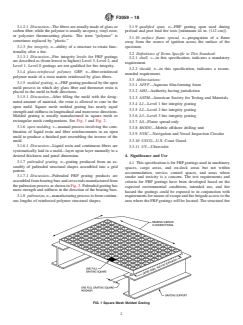
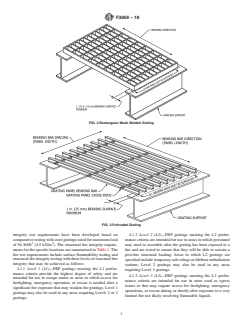
Molded grating is usually manufactured in square mesh or
rectangular mesh configurations. See Fig. 1 and Fig. 2.
3.3.7 L0—Flame spread only
3.1.6 open molding, v—manual process involving the com-
3.3.8 MODU—Mobile offshore drilling unit
bination of liquid resin and fiber reinforcements in an open
3.3.9 NVIC—Navigation and Vessel Inspection Circular
mold to produce a finished part resembling the inverse of the
3.3.10 USCG—U.S. Coast Guard
mold.
3.1.6.1 Discussion—Liquid resin and continuous fibers are
3.3.11 UV—Ultraviolet
systematically laid in a mold—layer upon layer manually to a
desired thickness and panel dimension.
4. Significance and Use
3.1.7 pultruded grating, n—grating produced from an as-
4.1 This specification is for FRPgratings used in machinery
sembly of pultruded structural shapes assembled into a grid
spaces, cargo areas, and on-deck areas but not within
pattern.
accommodation, service, control spaces, and areas where
3.1.7.1 Discussion—Pultruded FRP grating products are
smoke and toxicity is a concern. The test requirements and
assembledfrombearingbarsandcrossrodsmanufacturedfrom
criteria for FRP gratings have been developed based on the
thepultrusionprocessasshowninFig.3.Pultrudedgratinghas
expected environmental conditions, intended use, and fire
more strength and stiffness in the direction of the bearing bars.
hazard the gratings could be exposed to in conjunction with
3.1.8 pultrusion, n—manufacturingprocesstoformcontinu- requirements for means of escape and fire brigade access to the
ous lengths of reinforced polymer structural shapes. area where the FRPgratings will be located. The structural fire
FIG. 1Square Mesh Molded Grating
F3059−18
FIG. 2Rectangular Mesh Molded Grating
FIG. 3Pultruded Grating
integrity test requirements have been developed based on 4.1.2 Level 2 (L2)—FRP gratings meeting the L2 perfor-
comparativetestingwithsteelgratingsratedformaximumload mance criteria are intended for use in areas in which personnel
2 2
of 94 lbf/ft (4.5 kN/m ). The structural fire integrity require-
may need to assemble after the grating has been exposed to a
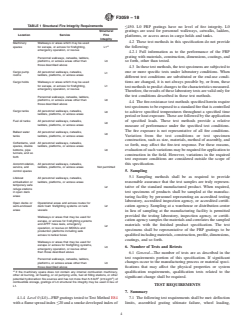
mentsforthespecificlocationsaresummarizedinTable1.The
fire and are tested to ensure that they will be able to sustain a
fire test requirements include surface flammability testing and
post-fire structural loading. Areas in which L2 gratings are
structuralfireintegritytestingwiththreelevelsofstructuralfire
specifiedincludetemporarysaferefugeorlifeboatembarkation
integrity that may be achieved as follows:
stations. Level 2 gratings may also be used in any areas
4.1.1 Level 1 (L1)—FRP gratings meeting the L1 perfor-
requiring Level 3 gratings.
mance criteria provide the highest degree of safety and are
4.1.3 Level 3 (L3)—FRP gratings meeting the L3 perfor-
intended for use in escape routes or areas in which access for
mance criteria are intended for use in areas used as egress
firefighting, emergency operation, or rescue is needed after a
routes or that may require access for firefighting, emergency
significant fire exposure that may weaken the gratings. Level 1
operations, or rescue during or shortly after exposure to a very
gratings may also be used in any areas requiring Levels 2 or 3
limited fire not likely involving flammable liquids.
gratings.
F3059−18
TABLE 1 Structural Fire Integrity Requirements
≤450. L0 FRP gratings have no level of fire integrity. L0
Structural gratings are used for personnel walkways, catwalks, ladders,
Location Service Fire
platforms, or access areas in cargo holds and tanks.
Integrity
4.2 These test methods in this specification do not provide
Machinery Walkways or areas which may be used
A
spaces for escape, or access for firefighting, L1 the following:
emergency operation, or rescue
4.2.1 Full information as to the performance of the FRP
grating with materials, construction, dimensions, coatings, and
Personnel walkways, catwalks, ladders,
platforms, or access areas other than L3
so forth, other than tested.
those described above
4.3 Inthesetestmethods,thetestspecimensaresubjectedto
Cargo pump All personnel walkways, catwalks,
one or more specific tests under laboratory conditions. When
L1
rooms ladders, platforms, or access areas
different test conditions are substituted or the end-use condi-
tions are changed, it is not always possible by, or from, these
Cargo holds Walkways or areas which may be used
for escape, or access for firefighting, L1
testmethodstopredictchangestothecharacteristicsmeasured.
emergency operation, or rescue
Therefore,theresultsoftheselaboratorytestsarevalidonlyfor
the test conditions described in these test methods.
Personnel walkways, catwalks, ladders,
platforms, or access areas other than L0
4.4 The fire-resistance test methods specified herein require
those described above
testspecimenstobeexposedtoastandardfirethatiscontrolled
Cargo tanks All personnel walkways, catwalks,
to achieve specified temperatures throughout a specified time
L0
ladders, platforms, or access areas
period or heat exposure. These are followed by the application
Fuel oil tanks All personnel walkways, catwalks, of specified loads. These test methods provide a relative
L0
ladders, platforms, or access areas
measure of performance under the specified test conditions.
The fire exposure is not representative of all fire conditions.
Ballast water All personnel walkways, catwalks,
L0
tanks ladders, platforms, or access areas Variation from the test conditions or test specimen
construction, such as size, materials, method of assembly, and
Cofferdams, void All personnel walkways, catwalks,
so forth, may affect the fire-test response. For these reasons,
spaces, double ladders, platforms, or access areas
bottoms, pipe L0 evaluationofsuchvariationsmayberequiredforapplicationto
tunnels, and so
construction in the field. However, variations in the required
forth
test exposure conditions are considered outside the scope of
Accommodation, All personnel walkways, catwalks,
this specification.
service, and ladders, platforms, or access areas Not permitted
control spaces
5. Sampling
5.1 Sampling methods shall be as required to provide
Lifeboat All personnel walkways, catwalks,
embarkation or ladders, platforms, or access areas
reasonable assurance that the test samples are truly represen-
temporary safe
L2
tative of the standard manufactured product. When required,
refuge stations
test specimens of products shall be sampled at the manufac-
in open deck
areas
turing facility by personnel representing an accredited testing
laboratory, accredited inspection agency, or accredited certifi-
Open decks or Operational areas and access routes for
semi-enclosed deck foam firefighting systems on tank L2 cation agency. Sampling at a warehouse or distribution center
areas vessels
in lieu of sampling at the manufacturing facility is permitted
provided the testing laboratory, inspection agency, or certifi-
Walkways or areas that may be used for
escape, or access for firefighting systems cation agency samples the materials and correlates the sampled
and AFFF hose reels, emergency
materials with the finished product specification. The test
L2
operation, or rescue on MODUs and
specimens shall be representative of the FRP gratings to be
production platforms including safe
access to tanker bows qualifiedincludingmaterials,construction,profile,dimensions,
coatings, and so forth.
Walkways or areas that may be used for
escape or access for firefighting systems,
6. Number of Tests and Retests
L3
emergency operation, or rescue other
than those described above
6.1 General—The number of tests are as described in the
test requirements portion of this specification. If significant
Personnel walkways, catwalks, ladders,
changes occur to the manufacturing process or material speci-
platforms, or access areas other than L3
those described above
fications that may affect the physical properties or system
A
If the machinery space does not contain any internal combustion machinery, qualification requirements, qualification tests related to the
other oil burning, oil heating, or oil pumping units, fuel oil filling stations, or other
significant change shall be required.
2 2
potential hydrocarbon fire sources and has not more than 5.5 lb/ft (2.5 kg/m )of
combustible storage, gratings of L3 structural fire integrity may be used in lieu of
TEST REQUIREMENTS
L1.
7. Summary
4.1.4 Level 0 (L0)—FRPgratings tested toTest Method E84 7.1 The following test requirements shall be met: deflection
with a flame spread index≤20 and a smoke developed index of limits, assembled grating ultimate failure, wheel loading,
F3059−18
assembled panel impact resistance, skid resistance, durability, 10.1.11.2 The grating panel height (of the wheel contact
ultraviolet (UV) resistance, salt spray, surface flammability, area) shall not be worn away/reduced by more than 0.03 in.
and structural fire integrity. Testing shall be conducted by a (0.8 mm).
laboratory acceptable to the AHJ.
11. Assembled Panel Impact Resistance
8. Deflection Limits (Application, Not Fire)
11.1 The manufacturer shall supply test data showing that
8.1 The grating panel shall meet the following load deflec-
the proposed grating product has passed the following impact
tion limits:
test:
8.1.1 The specified performance requirements for each plat-
7 7
11.2 One continuous 11 ⁄8-to13 ⁄8-in. (302- to 352-mm)
form area shall include the qualified span (L), the uniform load
wide panel of sufficient length shall be cut in half along its
(U), or the concentrated load (C), or combination thereof.
length to allow for two panel lengths to be tested to full section
8.1.2 The minimum uniform design load of the grating shall
failure on the qualified span. These two panels shall be the
2 2
be 150-lb/ft (7.2 kN/m ) (safety factor included).
control panel and the impact test panel (see Fig. 4).
8.1.3 The maximum mid-span deflection of the grating
11.2.1 Pultruded panels shall have the grating bars in the
panel shall not exceed 0.25 in. (0.6 cm) when tested at the
long direction, such that the cutting in half is perpendicular to
qualified span.
the grating bars as shown in Fig. 4.
11.2.2 There is no bearing bar alignment for molded
9. Assembled Grating Ultimate Failure
grating.
9.1 The grating panel shall have a flexural strength of 50
11.3 The control panel shall be tested to failure at the
000 psi (344 738 kPa) or greater using the three-point bending
qualified span in a simply supported condition to determine the
test procedure in Appendix X5. The flexural strength shall be
flexural strength and stiffness (see Fig. 5).
determined from an average of five test specimens that shall be
cut from three different panels. Each test specimen shall be
11.4 The impact test panel shall be tested as follows:
7 7
11 ⁄8 to 13 ⁄8 in. (302 to 352 mm) in width to allow for the
11.4.1 The grating shall be tested at the qualified span (see
differences in the spacing of longitudinal load-bearing mem-
Fig. 5).
bers. The width shall be measured at the top surface from
11.4.2 An impact load of 12 000 in.-lb (68 520 mm-N) of
outside load-bearing member to outside load-bearing member.
kinetic energy shall be dropped from a free fall height of no
The unsupported span of each specimen shall be equal or
less than 36 in. (91 cm) above the grating (see Fig. 6).
greater than the qualified span. Test specimens shall be cut
11.4.2.1 The impact energy is the product of the applied
when required using representative methods and equipment as
load and the clear drop distance.
recommended by the manufacturer.
11.4.3 The surface that impacts the grating shall be steel, it
shalldirectlyimpactthegrating(thatis,thegratingshallnotbe
10. Wheel Loading
buffered with sand bags), and it shall be allowed to bounce
10.1 The manufacturer shall supply test data showing that
uninterrupted until it comes to rest by itself. The allowable
2 2
the proposed grating product has passed the following wheel
impact area of 120 in. (775 cm ) is shown in Fig. 6.
load test:
11.5 After the grating is subjected to the impact load, the
10.1.1 A 36-in. (91-cm) wide panel shall be supported on
impacted panel shall be tested to failure at the qualified span in
two steel beams at the qualified span.
a simply supported condition to determine the flexural strength
10.1.2 A hard rubber wheel shall be cycled over the panel.
and stiffness. The flexural strength and stiffness (EI at L/50) of
One cycle is equal to two passes.
the impact panel shall be at least 90 % of the control panel.
10.1.3 The wheel shall travel 24 in. (61 cm) per pass.
10.1.4 Thewheelshallhaveaminimumdurometerhardness
12. Skid Resistance (Test Method D2047)
of 75 (Shore A).
12.1 FRP grating shall be evaluated for skid resistance in
10.1.5 The wheel shall be 6 in. (15 cm) in diameter by 2 in.
accordance withTest Method D2047 and shall have an average
(5 cm) wide.
coefficient of friction greater than 0.75 for dry leather condi-
10.1.6 The wheel travel shall be perpendicular to the bear-
tions in accordance with the referenced standard.
ing bars.
10.1.7 The wheel shall be positioned at the midspan of the
13. Durability (Test Method D4060)
qualified span.
13.1 FRP gratings shall be tested for durability in accor-
10.1.8 The wheel shall make a minimum of five cycles (ten
passes) per minute. dance with Test Method D4060.
10.1.9 The wheel shall be loaded to a minimum of 1000 lbs
13.2 The test requires a 4-in. (10-cm) square or 4-in.
(454 kg).
(10-cm) diameter round, flat plate.
10.1.10 The loaded wheel shall be cycled 500 times (1000
13.3 For the flat plate, the manufacturer shall use the same
passes).
composite laminate as would be used in the FRP grating.
10.1.11 The grating panel shall be considered to have
successfully passed the wheel loading test if: 13.4 The manufacturer shall prepare two sets of samples
10.1.11.1 The cyclic loading produces no visual cracks in using the same nonskid surface (grit and adhesive combina-
the top/bottom flanges or the webs of the bearing bars, and tion) that is intended to be applied to the FRP grating.
F3059−18
FIG. 4How to Obtain Impact Test Panel and Control Panel
FIG. 5Impact Panel Simply Supported at the Qualified Span
13.4.1 One set of samples shall be considered the “standard 13.6.1 If tested to failure, report the number of cycles to
sample.” wear through the grit to the substrate; and
13.4.2 One set of samples shall be considered the “UV 13.6.2 The wear index in accordance with Test Method
sample” and shall be tested to Practice D4329 Cycle A for a D4060.
minimum of 720 h.
14. UV Resistance (Practice D4329)
13.5 Both the standard sample and the UV sample shall be
tested to Test Method D4060 using H-22 type wheels. The 14.1 FRP gratings shall be evaluated for resistance to UV
number of cycles to wear through the grit to the substrate shall exposure when such exposure exists in service.
be at least 1200.
14.2 Subject FRP grating specimens to accelerated weath-
13.6 The manufacturer shall report the following for both ering in accordance with Test Method D4329 for a minimum
the standard sample and the UV sample: period of 720 h.
F3059−18
FIG. 6Impact Load Schematic
14.3 After the specimens have undergone accelerated 17. Structural Fire Integrity
weathering, visually examine the specimens for damage.
17.1 Test Specimens:
14.4 After accelerated weathering of the FRP grating
17.1.1 A set of two test specimens (one preload and one
specimens, no evidence of damage including breaks, cracks,
postload are required for Levels 2 and 3 testing; a set of four
blistering, delaminating, or exposure of fibers, or combination
testspecimens(onepreloadandthreepostload)arerequiredfor
thereof, shall be present.
Level 1 testing.
17.1.2 The test specimens shall be tested without any
15. Saltwater Spray Test
coatings (for example, UV coating, skid-resistant coating, and
15.1 The saltwater spray test shall be conducted in accor- so forth).
7 7
dance with Practice B117.
17.1.3 Each test specimen shall be 11 ⁄8 to 13 ⁄8 in. (302 to
352 mm) in width to allow for the differences in the spacing of
15.2 The specimen for the saltwater spray test shall be an
longitudinal load-bearing members. The width shall be mea-
assembled FRP grating panel of the dimensions of 9.1.
sured at the top surface from outside load-bearing member to
15.3 The salt water spray test shall be conducted for a
outside load-bearing member.The length of each test specimen
period of seven days.
shall be the maximum length to be qualified for service plus 8
15.4 The specimen shall be load tested after salt spray
in. (203 mm) but a minimum of 52 in. (1321 mm) long. Test
exposure and shall meet the criteria for assembled grating
specimens shall be cut when required using representative
ultimate failure in 9.1.
methods and equipment as recommended by the manufacturer.
17.2 Conditioning—Test specimens shall be conditioned for
16. Surface Flammability
a minimum of 24 h at a temperature of 73.4 6 5°F (23 6
16.1 All FRP gratings shall have low flame spread charac-
2.8°C) and at a relative humidity of 50 65%.
teristics determined through testing in accordance with 16.2.
17.3 Furnace Control:
Test specimens shall be tested with and without any coatings
17.3.1 FurnaceandcontrolsshallbeinaccordancewithTest
(for example, UV coating, skid-resistant coating, and so forth).
Methods E119 unless otherwise specified in the following.
16.2 Surface Flammability in Accordance with Test Method
17.3.2 A minimum of eight furnace thermocouples shall be
E84:
located at an elevation within 6 in. (152 mm) of the test
16.2.1 The test specimen shall be tested in accordance with
specimen elevation. Furnace thermocouples shall be symmetri-
Test Method E84 and as follows:
cally disposed and distributed to show the temperature near all
16.2.1.1 The test specimens shall be arranged with load-
parts of the sets of test specimens without being within any
bearing members running the length of the Test Method E84
flames from the test specimens.
tunnel.
16.2.1.2 The test specimens shall be tested from both sides. 17.4 Support for Test Specimens—Steelorconcretesupports
16.2.2 Acceptance criterion is a flame spread index ≤20. shall be used with a minimum support surface width of 4 in.
The smoke developed index limit is ≤450. (102 mm). The supports shall be positioned as required to
F3059−18
establish the qualified span to be seen in service. The supports 17.10 Postload Test:
shallbeperpendiculartotheplaneoftheFRPgratings.Thetop 17.10.1 The specimens shall be allowed to cool to ambient
bearing surface of the supports shall be as required to allow conditions before the postload test.
adequate FRP grating deflection for evaluation without inter- 17.10.2 Postload tests shall be conducted on the test speci-
ference of the furnace floor.
mens not used for the preload test in 17.8.1.4. For Levels 2 and
3 qualifications, only one test specimen of each set is required
17.5 Static Load System—The system shall be capable of
tobetested.ForLevel1qualification,eachtestspecimenofthe
imposing a centrally located static load of a minimum 88 lbf
set shall be tested other than the preload specimen.
(391 N) at the mid span of the test specimen and distributed
17.10.3 For Level 3, conduct the center load test in 17.10.4.
evenly across the load-bearing members. This 88 lbf (391 N)
For Level 2, consecutively conduct the center load test in
load shall consist of a steel container filled with sand, the base
2 2
17.10.4 and the uniform load test in 17.10.5. For Level 1,
of which shall be square with an area of 1 ft (0.09 m ).
consecutively conduct for each test specimen the center load
17.6 Deflection Monitoring System—The system shall be
test in 17.10.4, the uniform load test in 17.10.5, the impact test
capable of monitoring deflection of the preloaded test speci-
in 17.10.6, and again the uniform load test in 17.10.5.
mens continuously throughout the duration of the fire test as
17.10.4 Center Load Test:
required to determine the time, within 6 s, at which the
17.10.4.1 Each postload test specimen shall be supported as
maximum deflection criteria is exceeded.
in17.8.1.3andshallbesubjecttothe88-lbf(392-N)staticload
17.7 Distributed Load System—The load system shall be
at center of the unsupported span as required in 17.8.1.4 (the
such that a distributed load in increments not exceeding 44 lbf
preloadedtest).Thestaticloadshallbeappliedfor15minafter
(196 N) can be applied until a uniform load of 94 lbf/ft (4.5
the specimen appears motionless.
kN/m ) is reached.
17.10.4.2 Record whether each test specimen sustained the
load without collapse. The specimen touching the ground or
17.8 Furnace Test Procedure:
falling off the supports shall be considered as a collapse.
17.8.1 Placement of Test Specimens:
17.10.5 Uniform Load Test:
17.8.1.1 Place a complete set of test specimens in the
17.10.5.1 Each postload test specimen shall be supported as
furnace.Morethanonesetmaybeplacedinthefurnaceifeach
in 17.8.1.3.
whole additional set can be accommodated. Individual speci-
17.10.5.2 To each, apply a uniform distributed load gradu-
mens of a set shall not be tested in separate runs of the furnace.
ally in increments not exceeding 44 lbf (196 N) until a load of
17.8.1.2 The specimens shall have a minimum 12-in. (305-
2 2
94 lbf/ft (4.5 kN/m ) is reached or until collapse, whichever
mm) clearance to the furnace walls and a minimum 24-in.
occurs first. The final load shall be applied for 15 min after the
(610-mm) clearance to the furnace floor or more as required
specimen appears motionless.
ensuring maximum deflection limits can be properly evaluated.
17.10.5.3 Record the load resulting in collapse for each
17.8.1.3 Each specimen shall be simply supported on mini-
specimen. Record whether each test specimen sustained the
mum 4-in. (102-mm) wide steel or concrete supports without
final load without collapse. The specimen touching the ground
any other restraint to simulate the
...
This document is not an ASTM standard and is intended only to provide the user of an ASTM standard an indication of what changes have been made to the previous version. Because
it may not be technically possible to adequately depict all changes accurately, ASTM recommends that users consult prior editions as appropriate. In all cases only the current version
of the standard as published by ASTM is to be considered the official document.
Designation: F3059 − 15 F3059 − 18 An American National Standard
Standard Specification for
Fiber-Reinforced Polymer (FRP) Gratings Used in Marine
Construction and Shipbuilding
This standard is issued under the fixed designation F3059; the number immediately following the designation indicates the year of
original adoption or, in the case of revision, the year of last revision. A number in parentheses indicates the year of last reapproval. A
superscript epsilon (´) indicates an editorial change since the last revision or reapproval.
1. Scope
1.1 This specification provides the testing and performance requirements for fiber-reinforced polymer (FRP) gratings used in
marine construction and shipbuilding as an equivalency to the specification of steel gratings rated for a maximum load of 94 lbf/ft
(4.5 kN/m ).
1.2 The purpose of this specification is to ensure that all FRP gratings are designed and tested appropriately to ensure personnel
safety. It does not address the ability of the gratings to support either moving or stationary equipment during or after a fire exposure.
1.3 This specification addresses fire conditions based on Test Methods E119 fire exposure and does not address hydrocarbon
pool or jet fire exposures.
1.4 This specification is intended for use by all persons designing, manufacturing, testing, inspecting, and maintaining FRP
gratings.
1.5 Units—The values stated in inch-pound units are to be regarded as the standard. The values given in parentheses are
mathematical conversions to SI units that are provided for information only and are not considered standard.
1.6 This specification does not constitute regulations or ship classification rules, which shall be consulted where applicable.
1.7 This standard does not purport to address all of the safety concerns, if any, associated with its use. It is the responsibility
of the user of this standard to establish appropriate safety, health, and environmental practices and determine the applicability of
regulatory limitations prior to use.
1.8 This international standard was developed in accordance with internationally recognized principles on standardization
established in the Decision on Principles for the Development of International Standards, Guides and Recommendations issued
by the World Trade Organization Technical Barriers to Trade (TBT) Committee.
2. Referenced Documents
2.1 ASTM Standards:
B117 Practice for Operating Salt Spray (Fog) Apparatus
D2047 Test Method for Static Coefficient of Friction of Polish-Coated Flooring Surfaces as Measured by the James Machine
D4060 Test Method for Abrasion Resistance of Organic Coatings by the Taber Abraser
D4329 Practice for Fluorescent Ultraviolet (UV) Lamp Apparatus Exposure of Plastics
E84 Test Method for Surface Burning Characteristics of Building Materials
E119 Test Methods for Fire Tests of Building Construction and Materials
E695 Test Method of Measuring Relative Resistance of Wall, Floor, and Roof Construction to Impact Loading
2.2 Other Standards:
46 CFR 159 Shipping—Approval of Equipment and Materials
NVIC 02-06 Follow-Up Programs for Fire-Safety Type-Approved Products
This specification is under the jurisdiction of ASTM Committee F25 on Ships and Marine Technology and is the direct responsibility of Subcommittee F25.03 on
Outfitting and Deck Machinery.
Current edition approved Nov. 15, 2015July 1, 2018. Published December 2015July 2018. Originally approved in 2014. Last previous edition approved in 20142015 as
F3059 – 14.15. DOI: 10.1520/F3059-15.10.1520/F3059-18.
For referenced ASTM standards, visit the ASTM website, www.astm.org, or contact ASTM Customer Service at service@astm.org. For Annual Book of ASTM Standards
volume information, refer to the standard’s Document Summary page on the ASTM website.
Available from U.S. Government Printing Office, Superintendent of Documents, 732 N. Capitol St., NW, Washington, DC 20401-0001, http://www.access.gpo.gov.
Available from United States Coast Guard (USCG), U.S. Coast Guard Headquarters, 2703 Martin Luther King Jr. Ave. SE Stop 7509, Washington, DC, 20593-7509,
http://www.uscg.mil/hq/cg5/cg5214/docs/NVIC02-06.pdf.
Copyright © ASTM International, 100 Barr Harbor Drive, PO Box C700, West Conshohocken, PA 19428-2959. United States
F3059 − 18
NVIC 9-97 Change 1—Guide to Structural Fire Protection
3. Terminology
3.1 Definitions:
3.1.1 compression molding, v—manufacturing process involving match die molds that compress the fiber reinforced matrix,
generally under pressure and heat, to produce the finished product.
3.1.2 fiber-reinforced polymer, FRP, n—composite material made of a resin matrix reinforced with fibers.
3.1.2.1 Discussion—
The fibers are usually made of glass or carbon fiber, while the polymer is usually an epoxy, vinyl ester, or polyester thermosetting
plastic. The term “polymer” is sometimes replaced by “plastic.”
3.1.3 fire integrity, n—ability of a structure to retain functionality after a fire.
3.1.3.1 Discussion—
Fire integrity levels for FRP gratings are described as (from lowest to highest) Level 3, Level 2, and Level 1. Level 0 gratings are
not qualified for fire integrity.
3.1.4 glass-reinforced polymer, GRP, n—fiber-reinforced polymer made of a resin matrix reinforced by glass fibers.
3.1.5 molded grating, n—FRP grating produced by the open mold process in which dry glass fiber and thermoset resin is placed
in the mold in both directions.
3.1.5.1 Discussion—
After filling the mold with the designated amount of material, the resin is allowed to cure in the open mold. Square mesh molded
grating has nearly equal strength and stiffness in longitudinal and transverse directions. Molded grating is usually manufactured
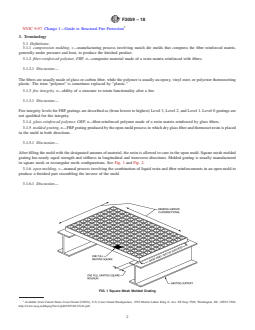
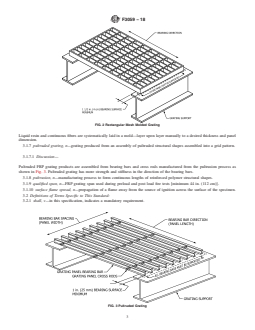
in square mesh or rectangular mesh configurations. See Fig. 1 and Fig. 2.
3.1.6 open molding, v—manual process involving the combination of liquid resin and fiber reinforcements in an open mold to
produce a finished part resembling the inverse of the mold.
3.1.6.1 Discussion—
FIG. 1 Square Mesh Molded Grating
Available from United States Coast Guard (USCG), U.S. Coast Guard Headquarters, 2703 Martin Luther King Jr. Ave. SE Stop 7509, Washington, DC, 20593-7509,
http://www.uscg.mil/hq/cg5/nvic/pdf/1997/n9-97ch1.pdf.
F3059 − 18
FIG. 2 Rectangular Mesh Molded Grating
Liquid resin and continuous fibers are systematically laid in a mold—layer upon layer manually to a desired thickness and panel
dimension.
3.1.7 pultruded grating, n—grating produced from an assembly of pultruded structural shapes assembled into a grid pattern.
3.1.7.1 Discussion—
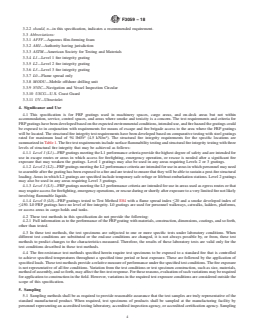
Pultruded FRP grating products are assembled from bearing bars and cross rods manufactured from the pultrusion process as
shown in Fig. 3. Pultruded grating has more strength and stiffness in the direction of the bearing bars.
3.1.8 pultrusion, n—manufacturing process to form continuous lengths of reinforced polymer structural shapes.
3.1.9 qualified span, n—FRP grating span used during preload and post load fire tests [minimum 44 in. (112 cm)].
3.1.10 surface flame spread, n—propagation of a flame away from the source of ignition across the surface of the specimen.
3.2 Definitions of Terms Specific to This Standard:
3.2.1 shall, v—in this specification, indicates a mandatory requirement.
FIG. 3 Pultruded Grating
F3059 − 18
3.2.2 should, n—in this specification, indicates a recommended requirement.
3.3 Abbreviations:
3.3.1 AFFF—Aqueous film-forming foam
3.3.2 AHJ—Authority having jurisdiction
3.3.3 ASTM—American Society for Testing and Materials
3.3.4 L1—Level 1 fire integrity grating
3.3.5 L2—Level 2 fire integrity grating
3.3.6 L3—Level 3 fire integrity grating
3.3.7 L0—Flame spread only
3.3.8 MODU—Mobile offshore drilling unit
3.3.9 NVIC—Navigation and Vessel Inspection Circular
3.3.10 USCG—U.S. Coast Guard
3.3.11 UV—Ultraviolet
4. Significance and Use
4.1 This specification is for FRP gratings used in machinery spaces, cargo areas, and on-deck areas but not within
accommodation, service, control spaces, and areas where smoke and toxicity is a concern. The test requirements and criteria for
FRP gratings have been developed based on the expected environmental conditions, intended use, and fire hazard the gratings could
be exposed to in conjunction with requirements for means of escape and fire brigade access to the area where the FRP gratings
will be located. The structural fire integrity test requirements have been developed based on comparative testing with steel gratings
2 2
rated for maximum load of 94 lbf/ft (4.5 kN/m ). The structural fire integrity requirements for the specific locations are
summarized in Table 1. The fire test requirements include surface flammability testing and structural fire integrity testing with three
levels of structural fire integrity that may be achieved as follows:
4.1.1 Level 1 (L1)—FRP gratings meeting the L1 performance criteria provide the highest degree of safety and are intended for
use in escape routes or areas in which access for firefighting, emergency operation, or rescue is needed after a significant fire
exposure that may weaken the gratings. Level 1 gratings may also be used in any areas requiring Levels 2 or 3 gratings.
4.1.2 Level 2 (L2)—FRP gratings meeting the L2 performance criteria are intended for use in areas in which personnel may need
to assemble after the grating has been exposed to a fire and are tested to ensure that they will be able to sustain a post-fire structural
loading. Areas in which L2 gratings are specified include temporary safe refuge or lifeboat embarkation stations. Level 2 gratings
may also be used in any areas requiring Level 3 gratings.
4.1.3 Level 3 (L3)—FRP gratings meeting the L3 performance criteria are intended for use in areas used as egress routes or that
may require access for firefighting, emergency operations, or rescue during or shortly after exposure to a very limited fire not likely
involving flammable liquids.
4.1.4 Level 0 (L0)—FRP gratings tested to Test Method E84 with a flame spread index ≤20 and a smoke developed index of
≤450. L0 FRP gratings have no level of fire integrity. L0 gratings are used for personnel walkways, catwalks, ladders, platforms,
or access areas in cargo holds and tanks.
4.2 These test methods in this specification do not provide the following:
4.2.1 Full information as to the performance of the FRP grating with materials, construction, dimensions, coatings, and so forth,
other than tested.
4.3 In these test methods, the test specimens are subjected to one or more specific tests under laboratory conditions. When
different test conditions are substituted or the end-use conditions are changed, it is not always possible by, or from, these test
methods to predict changes to the characteristics measured. Therefore, the results of these laboratory tests are valid only for the
test conditions described in these test methods.
4.4 The fire-resistance test methods specified herein require test specimens to be exposed to a standard fire that is controlled
to achieve specified temperatures throughout a specified time period or heat exposure. These are followed by the application of
specified loads. These test methods provide a relative measure of performance under the specified test conditions. The fire exposure
is not representative of all fire conditions. Variation from the test conditions or test specimen construction, such as size, materials,
method of assembly, and so forth, may affect the fire-test response. For these reasons, evaluation of such variations may be required
for application to construction in the field. However, variations in the required test exposure conditions are considered outside the
scope of this specification.
5. Sampling
5.1 Sampling methods shall be as required to provide reasonable assurance that the test samples are truly representative of the
standard manufactured product. When required, test specimens of products shall be sampled at the manufacturing facility by
personnel representing an accredited testing laboratory, accredited inspection agency, or accredited certification agency. Sampling
F3059 − 18
TABLE 1 Structural Fire Integrity Requirements
Structural
Location Service Fire
Integrity
Machinery Walkways or areas which may be used
A
spaces for escape, or access for firefighting, L1
emergency operation, or rescue
Personnel walkways, catwalks, ladders,
platforms, or access areas other than L3
those described above
Cargo pump All personnel walkways, catwalks,
L1
rooms ladders, platforms, or access areas
Cargo holds Walkways or areas which may be used
for escape, or access for firefighting, L1
emergency operation, or rescue
Personnel walkways, catwalks, ladders,
platforms, or access areas other than L0
those described above
Cargo tanks All personnel walkways, catwalks,
L0
ladders, platforms, or access areas
Fuel oil tanks All personnel walkways, catwalks,
L0
ladders, platforms, or access areas
Ballast water All personnel walkways, catwalks,
L0
tanks ladders, platforms, or access areas
Cofferdams, void All personnel walkways, catwalks,
spaces, double ladders, platforms, or access areas
bottoms, pipe L0
tunnels, and so
forth
Accommodation, All personnel walkways, catwalks,
service, and ladders, platforms, or access areas Not permitted
control spaces
Lifeboat All personnel walkways, catwalks,
embarkation or ladders, platforms, or access areas
temporary safe
L2
refuge stations
in open deck
areas
Open decks or Operational areas and access routes for
semi-enclosed deck foam firefighting systems on tank L2
areas vessels
Walkways or areas that may be used for
escape, or access for firefighting systems
and AFFF hose reels, emergency
L2
operation, or rescue on MODUs and
production platforms including safe
access to tanker bows
Walkways or areas that may be used for
escape or access for firefighting systems,
L3
emergency operation, or rescue other
than those described above
Personnel walkways, catwalks, ladders,
platforms, or access areas other than L3
those described above
A
If the machinery space does not contain any internal combustion machinery,
other oil burning, oil heating, or oil pumping units, fuel oil filling stations, or other
2 2
potential hydrocarbon fire sources and has not more than 5.5 lb/ft (2.5 kg/m ) of
combustible storage, gratings of L3 structural fire integrity may be used in lieu of
L1.
at a warehouse or distribution center in lieu of sampling at the manufacturing facility is permitted provided the testing laboratory,
F3059 − 18
inspection agency, or certification agency samples the materials and correlates the sampled materials with the finished product
specification. The test specimens shall be representative of the FRP gratings to be qualified including materials, construction,
profile, dimensions, coatings, and so forth.
6. Number of Tests and Retests
6.1 General—The number of tests are as described in the test requirements portion of this specification. If significant changes
occur to the manufacturing process or material specifications that may affect the physical properties or system qualification
requirements, qualification tests related to the significant change shall be required.
TEST REQUIREMENTS
7. Summary
7.1 The following test requirements shall be met: deflection limits, assembled grating ultimate failure, wheel loading, assembled
panel impact resistance, skid resistance, durability, ultraviolet (UV) resistance, salt spray, surface flammability, and structural fire
integrity. Testing shall be conducted by a laboratory acceptable to the AHJ.
8. Deflection Limits (Application, Not Fire)
8.1 The grating panel shall meet the following load deflection limits:
8.1.1 The specified performance requirements for each platform area shall include the qualified span (L), the uniform load (U),
or the concentrated load (C), or combination thereof.
2 2
8.1.2 The minimum uniform design load of the grating shall be 150-lb/ft (7.2 kN/m ) (safety factor included).
8.1.3 The maximum mid-span deflection of the grating panel shall not exceed 0.25 in. (0.6 cm) when tested at the qualified span.
9. Assembled Grating Ultimate Failure
9.1 The grating panel shall have a flexural strength of 50 000 psi (344 738 kPa) or greater using the three-point bending test
procedure in Appendix X5. The flexural strength shall be determined from an average of five test specimens that shall be cut from
7 7
three different panels. Each test specimen shall be 11 ⁄8 to 13 ⁄8 in. (302 to 352 mm) in width to allow for the differences in the
spacing of longitudinal load-bearing members. The width shall be measured at the top surface from outside load-bearing member
to outside load-bearing member. The unsupported span of each specimen shall be equal or greater than the qualified span. Test
specimens shall be cut when required using representative methods and equipment as recommended by the manufacturer.
10. Wheel Loading
10.1 The manufacturer shall supply test data showing that the proposed grating product has passed the following wheel load
test:
10.1.1 A 36-in. (91-cm) wide panel shall be supported on two steel beams at the qualified span.
10.1.2 A hard rubber wheel shall be cycled over the panel. One cycle is equal to two passes.
10.1.3 The wheel shall travel 24 in. (61 cm) per pass.
10.1.4 The wheel shall have a minimum durometer hardness of 75 (Shore A).
10.1.5 The wheel shall be 6 in. (15 cm) in diameter by 2 in. (5 cm) wide.
10.1.6 The wheel travel shall be perpendicular to the bearing bars.
10.1.7 The wheel shall be positioned at the midspan of the qualified span.
10.1.8 The wheel shall make a minimum of five cycles (ten passes) per minute.
10.1.9 The wheel shall be loaded to a minimum of 1000 lbs (454 kg).
10.1.10 The loaded wheel shall be cycled 500 times (1000 passes).
10.1.11 The grating panel shall be considered to have successfully passed the wheel loading test if:
10.1.11.1 The cyclic loading produces no visual cracks in the top/bottom flanges or the webs of the bearing bars, and
10.1.11.2 The grating panel height (of the wheel contact area) shall not be worn away/reduced by more than 0.03 in. (0.8 mm).
11. Assembled Panel Impact Resistance
11.1 The manufacturer shall supply test data showing that the proposed grating product has passed the following impact test:
7 7
11.2 One continuous 11 ⁄8- to 13 ⁄8-in. (302- to 352-mm) wide panel of sufficient length shall be cut in half along its length to
allow for two panel lengths to be tested to full section failure on the qualified span. These two panels shall be the control panel
and the impact test panel (see Fig. 4).
11.2.1 Pultruded panels shall have the grating bars in the long direction, such that the cutting in half is perpendicular to the
grating bars as shown in Fig. 4.
11.2.2 There is no bearing bar alignment for molded grating.
11.3 The control panel shall be tested to failure at the qualified span in a simply supported condition to determine the flexural
strength and stiffness (see Fig. 5).
F3059 − 18
FIG. 4 How to Obtain Impact Test Panel and Control Panel
FIG. 5 Impact Panel Simply Supported at the Qualified Span
11.4 The impact test panel shall be tested as follows:
11.4.1 The grating shall be tested at the qualified span (see Fig. 5).
11.4.2 An impact load of 12 000 in.-lb (68 520 mm-N) of kinetic energy shall be dropped from a free fall height of no less than
36 in. (91 cm) above the grating (see Fig. 6).
11.4.2.1 The impact energy is the product of the applied load and the clear drop distance.
11.4.3 The surface that impacts the grating shall be steel, it shall directly impact the grating (that is, the grating shall not be
buffered with sand bags), and it shall be allowed to bounce uninterrupted until it comes to rest by itself. The allowable impact area
2 2
of 120 in. (775 cm ) is shown in Fig. 6.
11.5 After the grating is subjected to the impact load, the impacted panel shall be tested to failure at the qualified span in a
simply supported condition to determine the flexural strength and stiffness. The flexural strength and stiffness (EI at L/50) of the
impact panel shall be at least 90 % of the control panel.
F3059 − 18
FIG. 6 Impact Load Schematic
12. Skid Resistance (Test Method D2047)
12.1 FRP grating shall be evaluated for skid resistance in accordance with Test Method D2047 and shall have an average
coefficient of friction greater than 0.75 for dry leather conditions in accordance with the referenced standard.
13. Durability (Test Method D4060)
13.1 FRP gratings shall be tested for durability in accordance with Test Method D4060.
13.2 The test requires a 4-in. (10-cm) square or 4-in. (10-cm) diameter round, flat plate.
13.3 For the flat plate, the manufacturer shall use the same composite laminate as would be used in the FRP grating.
13.4 The manufacturer shall prepare two sets of samples using the same nonskid surface (grit and adhesive combination) that
is intended to be applied to the FRP grating.
13.4.1 One set of samples shall be considered the “standard sample.”
13.4.2 One set of samples shall be considered the “UV sample” and shall be tested to Practice D4329 Cycle A for a minimum
of 720 h.
13.5 Both the standard sample and the UV sample shall be tested to Test Method D4060 using H-22 type wheels. The number
of cycles to wear through the grit to the substrate shall be at least 1200.
13.6 The manufacturer shall report the following for both the standard sample and the UV sample:
13.6.1 If tested to failure, report the number of cycles to wear through the grit to the substrate; and
13.6.2 The wear index in accordance with Test Method D4060.
14. UV Resistance (Practice D4329)
14.1 FRP gratings shall be evaluated for resistance to UV exposure when such exposure exists in service.
14.2 Subject FRP grating specimens to accelerated weathering in accordance with Test Method D4329 for a minimum period
of 720 h.
14.3 After the specimens have undergone accelerated weathering, visually examine the specimens for damage.
14.4 After accelerated weathering of the FRP grating specimens, no evidence of damage including breaks, cracks, blistering,
delaminating, or exposure of fibers, or combination thereof, shall be present.
15. Saltwater Spray Test
15.1 The saltwater spray test shall be conducted in accordance with Practice B117.
15.2 The specimen for the saltwater spray test shall be an assembled FRP grating panel of the dimensions of 9.1.
15.3 The salt water spray test shall be conducted for a period of seven days.
F3059 − 18
15.4 The specimen shall be load tested after salt spray exposure and shall meet the criteria for assembled grating ultimate failure
in 9.1.
16. Surface Flammability
16.1 All FRP gratings shall have low flame spread characteristics determined through testing in accordance with 16.2. Test
specimens shall be tested with and without any coatings (for example, UV coating, skid-resistant coating, and so forth).
16.2 Surface Flammability in Accordance with Test Method E84:
16.2.1 The test specimen shall be tested in accordance with Test Method E84 and as follows:
16.2.1.1 The test specimens shall be arranged with load-bearing members running the length of the Test Method E84 tunnel.
16.2.1.2 The test specimens shall be tested from both sides.
16.2.2 Acceptance criterion is a flame spread index ≤20. The smoke developed index limit is ≤450.
17. Structural Fire Integrity
17.1 Test Specimens:
17.1.1 A set of two test specimens (one preload and one postload are required for Levels 2 and 3 testing; a set of four test
specimens (one preload and three postload) are required for Level 1 testing.
17.1.2 The test specimens shall be tested without any coatings (for example, UV coating, skid-resistant coating, and so forth).
7 7
17.1.3 Each test specimen shall be 11 ⁄8 to 13 ⁄8 in. (302 to 352 mm) in width to allow for the differences in the spacing of
longitudinal load-bearing members. The width shall be measured at the top surface from outside load-bearing member to outside
load-bearing member. The length of each test specimen shall be the maximum length to be qualified for service plus 8 in. (203
mm) but a minimum of 52 in. (1321 mm) long. Test specimens shall be cut when required using representative methods and
equipment as recommended by the manufacturer.
17.2 Conditioning—Test specimens shall be conditioned for a minimum of 24 h at a temperature of 73.4 6 5°F (23 6 2.8°C)
and at a relative humidity of 50 6 5 %.
17.3 Furnace Control:
17.3.1 Furnace and controls shall be in accordance with Test Methods E119 unless otherwise specified in the following.
17.3.2 A minimum of eight furnace thermocouples shall be located at an elevation within 6 in. (152 mm) of the test specimen
elevation. Furnace thermocouples shall be symmetrically disposed and distributed to show the temperature near all parts of the sets
of test specimens without being within any flames from the test specimens.
17.4 Support for Test Specimens—Steel or concrete supports shall be used with a minimum support surface width of 4 in. (102
mm). The supports shall be positioned as required to establish the qualified span to be seen in service. The supports shall be
perpendicular to the plane of the FRP gratings. The top bearing surface of the supports shall be as required to allow adequate FRP
grating deflection for evaluation without interference of the furnace floor.
17.5 Static Load System—The system shall be capable of imposing a centrally located static load of a minimum 88 lbf (391 N)
at the mid span of the test specimen and distributed evenly across the load-bearing members. This 88 lbf (391 N) load shall consist
2 2
of a steel container filled with sand, the base of which shall be square with an area of 1 ft (0.09 m ).
17.6 Deflection Monitoring System—The system shall be capable of monitoring deflection of the preloaded test specimens
continuously throughout the duration of the fire test as required to determine the time, within 6 s, at which the maximum deflection
criteria is exceeded.
17.7 Distributed Load System—The load system shall be such that a distributed load in increments not exceeding 44 lbf (196
2 2
N) can be applied until a uniform load of 94 lbf/ft (4.5 kN/m ) is reached.
17.8 Furnace Test Procedure:
17.8.1 Placement of Test Specimens:
17.8.1.1 Place a complete set of test specimens in the furnace. More than one set may be placed in the furnace if each whole
additional set can be accommodated. Individual specimens of a set shall not be tested in separate runs of the furnace.
17.8.1.2 The specimens shall have a minimum 12-in. (305-mm) clearance to the furnace walls and a minimum 24-in. (610-mm)
clearance to the furnace floor or more as required ensuring maximum deflection limits can be properly evaluated.
17.8.1.3 Each specimen shall be simply supported on minimum 4-in. (102-mm) wide steel or concrete supports without any
other restraint to simulate the maximum unsupported span. Place the test specimen with 4 in. (100 mm) of each end resting on
the supports.
17.8.1.4 Preload Test Specimen—For the preload test specimen of each set, apply the 88-lbf (391-N) static load system at the
center of the unsupported span of the test specimen. The load shall be applied over 4 in. (102 mm) of the longitudinalas a square
2 2
with an area of 1 ft span (0.09 m ) and distributed evenly across the load-bearing members. The load shall be as required in 17.5.
17.8.2 Duration of Test—Conduct test for a furnace exposure duration of 60 min.
17.8.3 Data Recording:
17.8.3.1 Record the furnace temperature measurements at a maximum of 1-min intervals.
F3059 − 18
17.8.3.2 Record the time at which the vertical deflection of the preload test specimen exceeds a distance equal to the length of
the unsupported span divided by 10 (L/10). The recorded time shall be within 6 s of the occurrence.
17.8.3.3 Record the time when each of the unloaded test specimens collapse. If the specimen does not collapse, record this
information.
17.9 Calculations—Calculate the value L/10, which corresponds to the length of the unsupported span divided by 10.
F3059 − 18
17.10 Postload Test:
17.10.1 The specimens shall be allowed to cool to ambient conditions before the postload test.
17.10.2 Postload tests shall be conducted on the test specimens not used for the preload test in 17.8.1.4. For Levels 2 and 3
qualifications, only one test specimen of each set is required to be tested. For Level 1 qualification, each test specimen of the set
shall be tested other than the preload specimen.
17.10.3 For Level 3, conduct the center load test in 17.10.4. For Level 2, consecutively conduct the center load test in 17.10.4
and the uniform load test in 17.10.5. For Level 1, consecutively conduct for each test specimen the center load test
...