

ASTM C1639-19
(Specification)Standard Specification for Fabrication Of Cellular Glass Pipe And Tubing Insulation
General Information
- Abstract
ABSTRACT
This specification covers fabrication techniques for cellular glass block into billets to fabricate pipe and tubing insulation. The optimization of the thermal performance of installed cellular glass insulation systems is discussed. This is best achieved by limiting the number of joints, in particular through joints. Cellular glass pipe and tubing insulation shall be fabricated from the minimum number of insulation blocks. Sectional pipe insulation shall contain not more than four through joints per full section of insulation, excluding the half section mating plane. Fabrication adhesive shall be hot asphalt, Type II operating at some temperature. For operating temperatures above ambient, fabrication adhesive shall include but not be limited to Type II hot asphalt, elastomeric asphalt, or gypsum-based cement of the type and grade specified. Fabricating adhesive shall be applied such that there is 100% coverage of adhesive on the mating surfaces. Billet and miter construction shall conform to the following: insulation blocks or sections shall be hand rubbed if necessary to fit prior to bonding and bond joints shall be made with a full depth of approved adhesive. Bond joints can be classified as “non-through” joints which start at the outside circumference and run continuously in a straight line to the opposite side terminating at the outside circumference. “Through” joints start at the outside circumference and runs continuously in a straight line to the opposite side and terminates at the inside circumference. All segmented pipe insulation shall be edge trimmed at the fabrication site. Either a grinder or a saw shall be used to edge trim segmented pipe insulation. If segmented pipe insulation is edge trimmed using a saw blade, edges shall be rubbed to remove uneven patterns caused by flexing blade where needed. Fittings for all sizes shall be either factory ground or factory mitered.
SCOPE
1.1 This specification covers fabrication techniques for cellular glass block into billets to fabricate pipe and tubing insulation. All materials shall be in accordance with Specification C552.
1.2 The purpose of this specification is to optimize the thermal performance of installed cellular glass insulation systems. This is best achieved by limiting the number of joints, in particular through joints.
1.3 The values stated in inch-pound units are to be regarded as standard. The values given in parentheses are mathematical conversions to SI units that are provided for information only and are not considered standard.
1.4 This standard does not purport to address all of the safety concerns, if any, associated with its use. It is the responsibility of the user of this standard to establish appropriate safety, health, and environmental practices and determine the applicability of regulatory limitations prior to use.
1.5 This international standard was developed in accordance with internationally recognized principles on standardization established in the Decision on Principles for the Development of International Standards, Guides and Recommendations issued by the World Trade Organization Technical Barriers to Trade (TBT) Committee.
- Status
- Published
- Publication Date
- 28-Feb-2019
- Technical Committee
- C16 - Thermal Insulation
- Drafting Committee
- C16.40 - Insulation Systems
Buy Documents

ASTM C1639-19 - Standard Specification for Fabrication Of Cellular Glass Pipe And Tubing Insulation
REDLINE ASTM C1639-19 - Standard Specification for Fabrication Of Cellular Glass Pipe And Tubing Insulation
Overview
ASTM C1639-19: Standard Specification for Fabrication Of Cellular Glass Pipe And Tubing Insulation establishes requirements for the fabrication techniques used to convert cellular glass blocks into billets for pipe and tubing insulation. Developed by ASTM International, this specification aims to optimize the thermal performance of cellular glass insulation systems by controlling assembly methods and minimizing the number of fabrication joints, particularly through joints that directly impact insulation performance.
Cellular glass insulation is recognized for its durability, moisture resistance, and thermal efficiency, making fabrication standards critical for quality control in industrial, commercial, and specialty applications.
Key Topics
- Fabrication Techniques: Covers the processes for shaping and assembling cellular glass insulation into pipes and tubing, including block selection and cutting to minimize joint frequency.
- Joint Optimization: Emphasizes limiting through joints in pipe insulation sections to enhance thermal performance and integrity.
- Adhesive Requirements: Specifies the types of adhesives suitable for different operating temperatures, including hot asphalt, elastomeric asphalt, and gypsum-based cements.
- Dimensional Tolerances: Outlines size tolerances for bore diameter, wall thickness, and insulation length, ensuring a precise and secure fit around pipes and tubing.
- Sectional and Segmented Insulation: Defines minimum and maximum sizes, as well as acceptable methods for fabrication, including bevel lags, precision V-groove, and curved segment techniques for larger diameters.
- Workmanship & Finish: Details acceptable appearance and finish for insulation, requiring smooth, void-free joints, and precise edge trimming for optimal field installation.
- Packaging & Marking: Specifies packaging practices and labeling information for traceability and quality assurance.
Applications
ASTM C1639-19 is essential across industries where cellular glass insulation offers value due to its physical properties:
- Industrial Piping Systems: Used to insulate pipes and tubing in chemical plants, refineries, and power generation facilities where moisture resistance and high compressive strength are vital.
- Cryogenic and High-Temperature Applications: The specification supports fabrication for applications involving extreme temperatures, preserving system efficiency and safety.
- Commercial HVAC and Mechanical Systems: Ensures thermal insulation in large-scale air handling and mechanical piping installations is reliable and durable.
- Specialized Insulation Needs: Provides guidance for custom-fabricated fittings, multi-layer insulation systems, and applications requiring specific joint and seam quality.
The standard directs fabricators, specifiers, and contractors in ensuring that the installed insulation system meets performance expectations while supporting ease of installation and long service life.
Related Standards
ASTM C1639-19 references and aligns with several related ASTM standards for consistency in terminology and application:
- ASTM C552 - Specification for Cellular Glass Thermal Insulation: Defines material quality and classification for cellular glass blocks.
- ASTM C168 - Terminology Relating to Thermal Insulation: Provides uniform definitions for insulation terms.
- ASTM C585 - Practice for Inner and Outer Diameters of Thermal Insulation for Nominal Sizes of Pipe and Tubing: Ensures dimensional compatibility.
- ASTM C450 - Practice for Fabrication of Thermal Insulating Fitting Covers: Addresses techniques for fabricating insulation covers for fittings and vessels.
- ASTM D312 - Specification for Asphalt Used in Roofing: Cites requirements for suitable hot asphalt adhesives used in fabrication.
Following ASTM C1639-19 helps achieve consistent, high-quality fabrication of cellular glass pipe and tubing insulation, contributing to energy conservation, system longevity, and reliable performance in challenging environments.
Keywords: cellular glass insulation, pipe insulation fabrication, ASTM C1639, thermal insulation systems, joint optimization, industrial insulation standards
Relations
- Replaces
ASTM C1639-17 - Standard Specification for Fabrication Of Cellular Glass Pipe And Tubing Insulation - Effective Date
- 01-Mar-2019
- Effective Date
- 15-Apr-2024
- Effective Date
- 15-Apr-2018
- Effective Date
- 01-Apr-2018
- Effective Date
- 01-Nov-2017
- Effective Date
- 01-Oct-2017
- Effective Date
- 01-Jun-2017
- Effective Date
- 01-Sep-2016
- Effective Date
- 01-Mar-2016
- Effective Date
- 15-Oct-2015
- Effective Date
- 01-Jun-2015
- Effective Date
- 01-May-2015
- Effective Date
- 01-Sep-2014
- Effective Date
- 01-Apr-2014
- Effective Date
- 01-Sep-2013
Buy Documents
ASTM C1639-19 - Standard Specification for Fabrication Of Cellular Glass Pipe And Tubing Insulation
REDLINE ASTM C1639-19 - Standard Specification for Fabrication Of Cellular Glass Pipe And Tubing Insulation
Get Certified
Connect with accredited certification bodies for this standard

Institut za varilstvo d.o.o. (Welding Institute)
Slovenia's leading welding institute since 1952. ISO 3834, EN 1090, pressure equipment certification, NDT personnel, welder qualification. Only IIW Au
Sponsored listings
Frequently Asked Questions
ASTM C1639-19 is a technical specification published by ASTM International. Its full title is "Standard Specification for Fabrication Of Cellular Glass Pipe And Tubing Insulation". This standard covers: ABSTRACT This specification covers fabrication techniques for cellular glass block into billets to fabricate pipe and tubing insulation. The optimization of the thermal performance of installed cellular glass insulation systems is discussed. This is best achieved by limiting the number of joints, in particular through joints. Cellular glass pipe and tubing insulation shall be fabricated from the minimum number of insulation blocks. Sectional pipe insulation shall contain not more than four through joints per full section of insulation, excluding the half section mating plane. Fabrication adhesive shall be hot asphalt, Type II operating at some temperature. For operating temperatures above ambient, fabrication adhesive shall include but not be limited to Type II hot asphalt, elastomeric asphalt, or gypsum-based cement of the type and grade specified. Fabricating adhesive shall be applied such that there is 100% coverage of adhesive on the mating surfaces. Billet and miter construction shall conform to the following: insulation blocks or sections shall be hand rubbed if necessary to fit prior to bonding and bond joints shall be made with a full depth of approved adhesive. Bond joints can be classified as “non-through” joints which start at the outside circumference and run continuously in a straight line to the opposite side terminating at the outside circumference. “Through” joints start at the outside circumference and runs continuously in a straight line to the opposite side and terminates at the inside circumference. All segmented pipe insulation shall be edge trimmed at the fabrication site. Either a grinder or a saw shall be used to edge trim segmented pipe insulation. If segmented pipe insulation is edge trimmed using a saw blade, edges shall be rubbed to remove uneven patterns caused by flexing blade where needed. Fittings for all sizes shall be either factory ground or factory mitered. SCOPE 1.1 This specification covers fabrication techniques for cellular glass block into billets to fabricate pipe and tubing insulation. All materials shall be in accordance with Specification C552. 1.2 The purpose of this specification is to optimize the thermal performance of installed cellular glass insulation systems. This is best achieved by limiting the number of joints, in particular through joints. 1.3 The values stated in inch-pound units are to be regarded as standard. The values given in parentheses are mathematical conversions to SI units that are provided for information only and are not considered standard. 1.4 This standard does not purport to address all of the safety concerns, if any, associated with its use. It is the responsibility of the user of this standard to establish appropriate safety, health, and environmental practices and determine the applicability of regulatory limitations prior to use. 1.5 This international standard was developed in accordance with internationally recognized principles on standardization established in the Decision on Principles for the Development of International Standards, Guides and Recommendations issued by the World Trade Organization Technical Barriers to Trade (TBT) Committee.
ABSTRACT This specification covers fabrication techniques for cellular glass block into billets to fabricate pipe and tubing insulation. The optimization of the thermal performance of installed cellular glass insulation systems is discussed. This is best achieved by limiting the number of joints, in particular through joints. Cellular glass pipe and tubing insulation shall be fabricated from the minimum number of insulation blocks. Sectional pipe insulation shall contain not more than four through joints per full section of insulation, excluding the half section mating plane. Fabrication adhesive shall be hot asphalt, Type II operating at some temperature. For operating temperatures above ambient, fabrication adhesive shall include but not be limited to Type II hot asphalt, elastomeric asphalt, or gypsum-based cement of the type and grade specified. Fabricating adhesive shall be applied such that there is 100% coverage of adhesive on the mating surfaces. Billet and miter construction shall conform to the following: insulation blocks or sections shall be hand rubbed if necessary to fit prior to bonding and bond joints shall be made with a full depth of approved adhesive. Bond joints can be classified as “non-through” joints which start at the outside circumference and run continuously in a straight line to the opposite side terminating at the outside circumference. “Through” joints start at the outside circumference and runs continuously in a straight line to the opposite side and terminates at the inside circumference. All segmented pipe insulation shall be edge trimmed at the fabrication site. Either a grinder or a saw shall be used to edge trim segmented pipe insulation. If segmented pipe insulation is edge trimmed using a saw blade, edges shall be rubbed to remove uneven patterns caused by flexing blade where needed. Fittings for all sizes shall be either factory ground or factory mitered. SCOPE 1.1 This specification covers fabrication techniques for cellular glass block into billets to fabricate pipe and tubing insulation. All materials shall be in accordance with Specification C552. 1.2 The purpose of this specification is to optimize the thermal performance of installed cellular glass insulation systems. This is best achieved by limiting the number of joints, in particular through joints. 1.3 The values stated in inch-pound units are to be regarded as standard. The values given in parentheses are mathematical conversions to SI units that are provided for information only and are not considered standard. 1.4 This standard does not purport to address all of the safety concerns, if any, associated with its use. It is the responsibility of the user of this standard to establish appropriate safety, health, and environmental practices and determine the applicability of regulatory limitations prior to use. 1.5 This international standard was developed in accordance with internationally recognized principles on standardization established in the Decision on Principles for the Development of International Standards, Guides and Recommendations issued by the World Trade Organization Technical Barriers to Trade (TBT) Committee.
ASTM C1639-19 is classified under the following ICS (International Classification for Standards) categories: 23.040.99 - Other pipeline components; 81.040.30 - Glass products. The ICS classification helps identify the subject area and facilitates finding related standards.
ASTM C1639-19 has the following relationships with other standards: It is inter standard links to ASTM C1639-17, ASTM C168-24, ASTM C168-18, ASTM C450-18, ASTM C450-17, ASTM C552-17, ASTM C168-17, ASTM C552-16a, ASTM C552-16, ASTM C168-15a, ASTM C168-15, ASTM C552-15, ASTM C552-14, ASTM C450-08(2014), ASTM C552-13. Understanding these relationships helps ensure you are using the most current and applicable version of the standard.
ASTM C1639-19 is available in PDF format for immediate download after purchase. The document can be added to your cart and obtained through the secure checkout process. Digital delivery ensures instant access to the complete standard document.
Standards Content (Sample)
This international standard was developed in accordance with internationally recognized principles on standardization established in the Decision on Principles for the
Development of International Standards, Guides and Recommendations issued by the World Trade Organization Technical Barriers to Trade (TBT) Committee.
Designation: C1639 −19
Standard Specification for
Fabrication Of Cellular Glass Pipe And Tubing Insulation
This standard is issued under the fixed designation C1639; the number immediately following the designation indicates the year of
original adoption or, in the case of revision, the year of last revision. A number in parentheses indicates the year of last reapproval. A
superscript epsilon (´) indicates an editorial change since the last revision or reapproval.
1. Scope D312 Specification for Asphalt Used in Roofing
2.2 ASTM Adjuncts:
1.1 This specification covers fabrication techniques for
cellular glass block into billets to fabricate pipe and tubing ADJC0450A ASTM Recommended Dimensional Standards
insulation. All materials shall be in accordance with Specifi- for Fabrication of Thermal Insulation Fitting Covers
cation C552.
3. Terminology
1.2 The purpose of this specification is to optimize the
thermal performance of installed cellular glass insulation 3.1 Terminology C168 shall be considered as applying to
systems.This is best achieved by limiting the number of joints,
the terms in this specification.
in particular through joints.
3.2 Definitions of Terms Specific to This Standard:
1.3 The values stated in inch-pound units are to be regarded
3.2.1 billet / bun—a single piece of insulation made up from
as standard. The values given in parentheses are mathematical a number of smaller blocks held together with an adhesive.
conversions to SI units that are provided for information only
3.2.2 lags—pieces of insulation typically curved or tapered
and are not considered standard.
used for insulating pipes, tanks and other cylindrical equip-
1.4 This standard does not purport to address all of the
ment.
safety concerns, if any, associated with its use. It is the
3.2.3 precision cut V-grooved pipe insulation, n—rigid in-
responsibility of the user of this standard to establish appro-
sulation pieces cut into 4-sided polygons, of two parallel
priate safety, health, and environmental practices and deter-
surfaces and two non-parallel surfaces of equal angles = 180°
mine the applicability of regulatory limitations prior to use.
/ N, such that when N number of these sections are assembled,
1.5 This international standard was developed in accor-
they form an approximate circle and can be installed around a
dance with internationally recognized principles on standard-
pipe.
ization established in the Decision on Principles for the
3.2.3.1 Discussion—The adjective precision refers to the
Development of International Standards, Guides and Recom-
fact that when these N sections are installed onto a pipe, they
mendations issued by the World Trade Organization Technical
fit exactly with no appreciable gaps between sections.
Barriers to Trade (TBT) Committee.
3.2.4 bond joint, n—the joint formed by the adhered mating
surfaces of several thicknesses of cellular glass block or
2. Referenced Documents
fabricatedcellularglassinsulationpiecesthatareusedtocreate
2.1 ASTM Standards:
a cellular glass insulation billet, bun, or pipe and tubing
C168 Terminology Relating to Thermal Insulation
insulation segments. See Fig. 1.
C450 Practice for Fabrication of Thermal Insulating Fitting
3.2.4.1 Discussion—A bond joint is created during the
Covers for NPS Piping, and Vessel Lagging
fabrication of cellular glass pipe and tubing insulation and is
C552 Specification for Cellular Glass Thermal Insulation
made with a full depth (100 % coverage) of an approved
C585 Practice for Inner and Outer Diameters of Thermal
adhesive. (See 3.2.1 and 8.4).
Insulation for Nominal Sizes of Pipe and Tubing
3.2.5 fabrication joints – see bond joint, n—the joint be-
tweenadheredmatingsurfacesofcellularglasspipeandtubing
insulation segments formed by fabricated segments or sections
This specification is under the jurisdiction of ASTM Committee C16 on
Thermal Insulation and is the direct responsibility of Subcommittee C16.40 on
of cellular glass insulation that are assembled in the fabrication
Insulation Systems.
shop, facility, or jobsite, to produce the cellular glass pipe and
Current edition approved March 1, 2019. Published March 2019. Originally
tubing insulation. See Figs. 2-4.
approved in 2007. Last previous edition approved in 2017 as C1639 – 17. DOI:
10.1520/C1639-19.
For referenced ASTM standards, visit the ASTM website, www.astm.org, or
contact ASTM Customer Service at service@astm.org. For Annual Book of ASTM
Standards volume information, refer to the standard’s Document Summary page on Available from ASTM International Headquarters. Order Adjunct No.
the ASTM website. ADJC0450A.
Copyright © ASTM International, 100 Barr Harbor Drive, PO Box C700, West Conshohocken, PA 19428-2959. United States
C1639 − 19
3.2.6.1 Discussion—Field joints shall be formed with full
depth adhesive, full depth of sealant or from the mating
surfaces of the cellular glass insulation.
3.2.7 non-through joints, n—bond or fabrication joints that
start at the outside circumference of fabricated insulation and
run continuously in a straight line to the opposite side
terminating at the outside circumference of the pipe insulation.
(See Fig. 2.)
3.2.7.1 Discussion—Non-through joints do not intersect the
pipe insulation’s inside diameter (ID).
3.2.8 through joints, n—bond or fabrication joints that start
FIG. 1 Cellular Glass Insulation Billet
at the outside circumference of fabricated insulation and run
continuously in a straight line through the fabricated piece and
terminates at the pipe insulation’s inside diameter (ID) (See
Fig. 3.)
3.2.8.1 Discussion—Through joints intersect the pipe/
insulation interface.
3.2.9 beveled lag, n—rigid insulation pieces cut into isosce-
les trapezoid shape used to form a 360° circle that is installed
around pipe or tubing.
3.2.9.1 Discussion—Beveled lags differ from precision cut
V-grooved in that pieces are a minimum of 8 in. (203 mm)
wide and are not bonded to a scrim, fabric or jacketing.
FIG. 2 Non-through Joints
4. Classification
4.1 Specification C552 definesType I andType II materials.
The same classifications shall be used in this standard.
5. Workmanship, Finish, and Appearance
5.1 The insulation shall have no visible defects that will
adversely affect its performance.
6. Standard Sizes, Dimensions, and Fabrication
Configurations of Cellular Glass Pipe and Tubing
Insulation
6.1 Cellular glass pipe and tubing insulation shall be fabri-
FIG. 3 Through Joints
cated in lengths as agreed to by the purchaser and the supplier.
1 5
Typical lengths are 23 ⁄2 in. (597 mm), 23 ⁄8 in. (600 mm), 24
in. (610 mm), 35 ⁄2 in. (902 mm), or 36 in. (914 mm).
6.2 Cellular glass pipe and tubing insulation with outer
diameters that are ≤ 6 ⁄8 in. (≤168 mm) shall be made to a
minimum thickness of 1-in. (25 mm). Pipe insulation with
outer diameter that is >6 ⁄8 in. (>168 mm) shall be made to a
minimum 1 ⁄2-in. (38 mm) thickness. Sizes shall conform to
Practice C585.
6.3 Cellular glass pipe insulation with outer diameters that
are <15 ⁄4 in. (<400 mm) shall be provided in half sections.
Half sections shall consist of hollow cylindrical sections split
FIG. 4 90° Joint Intersection
lengthwise in a plane that includes the cylindrical axis.
6.4 Cellular glass pipe insulation with outer diameters that
are ≥15 ⁄4 in. (≥400 mm) and ≤ 30 in. (≤762 mm) shall be
provided in half-sections, quarter-sections or curved sidewall
3.2.5.1 Discussion—A fabrication joint is created at a fab-
segments, as agreed upon by the fabricator and purchaser.
rication shop or facility and is made with a full depth (100 %
coverage) of an approved adhesive.
6.5 Cellular glass pipe insulation with outer diameters that
3.2.6 field joints, n—mating surfaces of cellular glass insu- are >30 in. (>762 mm) shall be furnished as curved sidewall
lation created during the installation process. segments (see Fig. 5) which shall be fabricated in equal size
C1639 − 19
7.4.3 Half-Section Balance—the plane formed by the slit
between half sections shall include the cylindrical axis. Devia-
tion of the split plane from the cylindrical axis over a 24-in.
(610-mm) length shall not exceed ⁄8 in. (3.2 mm).
7.4.4 Multi-layer cellular g
...
This document is not an ASTM standard and is intended only to provide the user of an ASTM standard an indication of what changes have been made to the previous version. Because
it may not be technically possible to adequately depict all changes accurately, ASTM recommends that users consult prior editions as appropriate. In all cases only the current version
of the standard as published by ASTM is to be considered the official document.
Designation: C1639 − 17 C1639 − 19
Standard Specification for
Fabrication Of Cellular Glass Pipe And Tubing Insulation
This standard is issued under the fixed designation C1639; the number immediately following the designation indicates the year of
original adoption or, in the case of revision, the year of last revision. A number in parentheses indicates the year of last reapproval. A
superscript epsilon (´) indicates an editorial change since the last revision or reapproval.
1. Scope
1.1 This specification covers fabrication techniques for cellular glass block into billets to fabricate pipe and tubing insulation.
All materials shall be in accordance with Specification C552.
1.2 The purpose of this specification is to optimize the thermal performance of installed cellular glass insulation systems. This
is best achieved by limiting the number of joints, in particular through joints.
1.3 The values stated in inch-pound units are to be regarded as standard. The values given in parentheses are mathematical
conversions to SI units that are provided for information only and are not considered standard.
1.4 This standard does not purport to address all of the safety concerns, if any, associated with its use. It is the responsibility
of the user of this standard to establish appropriate safety and health practices and determine the applicability of regulatory
limitations prior to use.
1.4 This standard does not purport to address all of the safety concerns, if any, associated with its use. It is the responsibility
of the user of this standard to establish appropriate safety, health, and environmental practices and determine the applicability of
regulatory limitations prior to use.
1.5 This international standard was developed in accordance with internationally recognized principles on standardization
established in the Decision on Principles for the Development of International Standards, Guides and Recommendations issued
by the World Trade Organization Technical Barriers to Trade (TBT) Committee.
2. Referenced Documents
2.1 ASTM Standards:
C168 Terminology Relating to Thermal Insulation
C450 Practice for Fabrication of Thermal Insulating Fitting Covers for NPS Piping, and Vessel Lagging
C552 Specification for Cellular Glass Thermal Insulation
C585 Practice for Inner and Outer Diameters of Thermal Insulation for Nominal Sizes of Pipe and Tubing
D312 Specification for Asphalt Used in Roofing
2.2 ASTM Adjuncts:
ADJC0450A ASTM Recommended Dimensional Standards for Fabrication of Thermal Insulation Fitting Covers
3. Terminology
3.1 Terminology C168 shall be considered as applying to the terms in this specification.
3.2 Definitions of Terms Specific to This Standard:
3.2.1 billet / bun—a single piece of insulation made up from a number of smaller blocks held together with an adhesive.
3.2.2 lags—pieces of insulation typically curved or tapered used for insulating pipes, tanks and other cylindrical equipment.
3.2.3 precision cut V-grooved pipe insulation, n—rigid insulation pieces cut into 4-sided polygons, of two parallel surfaces and
two non-parallel surfaces of equal angles = 180° / N, such that when N number of these sections are assembled, they form an
approximate circle and can be installed around a pipe.
This specification is under the jurisdiction of ASTM Committee C16 on Thermal Insulation and is the direct responsibility of Subcommittee C16.40 on Insulation
Systems.
Current edition approved April 15, 2017March 1, 2019. Published April 2017March 2019. Originally approved in 2007. Last previous edition approved in 20162017 as
C1639 – 16.C1639 – 17. DOI: 10.1520/C1639-17.10.1520/C1639-19.
For referenced ASTM standards, visit the ASTM website, www.astm.org, or contact ASTM Customer Service at service@astm.org. For Annual Book of ASTM Standards
volume information, refer to the standard’s Document Summary page on the ASTM website.
Available from ASTM International Headquarters. Order Adjunct No. ADJC0450A.
Copyright © ASTM International, 100 Barr Harbor Drive, PO Box C700, West Conshohocken, PA 19428-2959. United States
C1639 − 19
3.2.3.1 Discussion—
The adjective precision refers to the fact that when these N sections are installed onto a pipe, they fit exactly with no appreciable
gaps between sections.
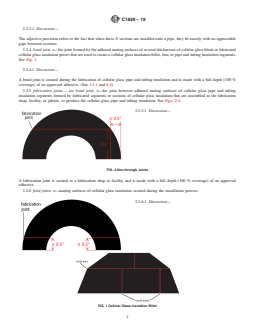
3.2.4 bond joint, n—the joint formed by the adhered mating surfaces of several thicknesses of cellular glass block or fabricated
cellular glass insulation pieces that are used to create a cellular glass insulation billet, bun, or pipe and tubing insulation segments.
See Fig. 1.
3.2.4.1 Discussion—
A bond joint is created during the fabrication of cellular glass pipe and tubing insulation and is made with a full depth (100 %
coverage) of an approved adhesive. (See 3.2.1 and 8.4).
3.2.5 fabrication joints – see bond joint, n—the joint between adhered mating surfaces of cellular glass pipe and tubing
insulation segments formed by fabricated segments or sections of cellular glass insulation that are assembled in the fabrication
shop, facility, or jobsite, to produce the cellular glass pipe and tubing insulation. See Figs. 2-4.
3.2.5.1 Discussion—
FIG. 2 Non-through Joints
A fabrication joint is created at a fabrication shop or facility and is made with a full depth (100 % coverage) of an approved
adhesive.
3.2.6 field joints, n—mating surfaces of cellular glass insulation created during the installation process.
3.2.6.1 Discussion—
FIG. 1 Cellular Glass Insulation Billet
C1639 − 19
FIG. 3 Through Joints
FIG. 4 90° Joint Intersection
Field joints shall be formed with full depth adhesive, full depth of sealant or from the mating surfaces of the cellular glass
insulation.
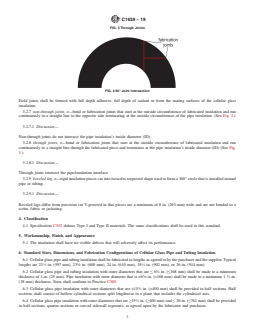
3.2.7 non-through joints, n—bond or fabrication joints that start at the outside circumference of fabricated insulation and run
continuously in a straight line to the opposite side terminating at the outside circumference of the pipe insulation. (See Fig. 2.)
3.2.7.1 Discussion—
Non-through joints do not intersect the pipe insulation’s inside diameter (ID).
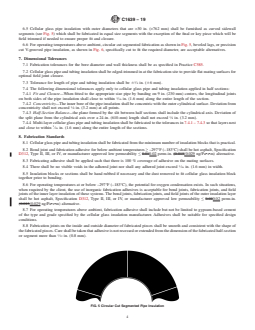
3.2.8 through joints, n—bond or fabrication joints that start at the outside circumference of fabricated insulation and run
continuously in a straight line through the fabricated piece and terminates at the pipe insulation’s inside diameter (ID) (See Fig.
3.)
3.2.8.1 Discussion—
Through joints intersect the pipe/insulation interface.
3.2.9 beveled lag, n—rigid insulation pieces cut into isosceles trapezoid shape used to form a 360° circle that is installed around
pipe or tubing.
3.2.9.1 Discussion—
Beveled lags differ from precision cut V-grooved in that pieces are a minimum of 8 in. (203 mm) wide and are not bonded to a
scrim, fabric or jacketing.
4. Classification
4.1 Specification C552 defines Type I and Type II materials. The same classifications shall be used in this standard.
5. Workmanship, Finish, and Appearance
5.1 The insulation shall have no visible defects that will adversely affect its performance.
6. Standard Sizes, Dimensions, and Fabrication Configurations of Cellular Glass Pipe and Tubing Insulation
6.1 Cellular glass pipe and tubing insulation shall be fabricated in lengths as agreed to by the purchaser and the supplier. Typical
1 5 1
lengths are 23 ⁄2 in. (597 mm), 23 ⁄8 in. (600 mm), 24 in. (610 mm), 35 ⁄2 in. (902 mm), or 36 in. (914 mm).
6.2 Cellular glass pipe and tubing insulation with outer diameters that are ≤ 6 ⁄8 in. (≤168 mm) shall be made to a minimum
5 1
thickness of 1-in. (25 mm). Pipe insulation with outer diameter that is >6 ⁄8 in. (>168 mm) shall be made to a minimum 1 ⁄2-in.
(38 mm) thickness. Sizes shall conform to Practice C585.
6.3 Cellular glass pipe insulation with outer diameters that are <15 ⁄4 in. (<400 mm) shall be provided in half sections. Half
sections shall consist of hollow cylindrical sections split lengthwise in a plane that includes the cylindrical axis.
6.4 Cellular glass pipe insulation with outer diameters that are ≥15 ⁄4 in. (≥400 mm) and ≤ 30 in. (≤762 mm) shall be provided
in half-sections, quarter-sections or curved sidewall segments, as agreed upon by the fabricator and purchaser.
C1639 − 19
6.5 Cellular glass pipe insulation with outer diameters that are >30 in. (>762 mm) shall be furnished as curved sidewall
segments (see Fig. 5) which shall be fabricated in equal size segments with the exception of the final or key piece whi
...