

ASTM C552-22
(Specification)Standard Specification for Cellular Glass Thermal Insulation
General Information
- Abstract
ABSTRACT
This specification covers the composition, sizes, dimensions, and physical properties of cellular glass thermal insulation. The material shall consist of a glass composition that has been foamed or cellulated under molten conditions, annealed, and set to form a rigid noncombustible material with hermetically sealed cells. The materials shall also be trimmed into rectangular or tapered blocks of standard dimensions. All specimens shall also comply with with qualification requirements such as compressive strength, flexural strength, water absorption, water vapor permeability, thermal conductivity, hot-surface performance, thermal conductivity and surface burning characteristics. These properties shall be determined in accordance with test methods specified herein.
SCOPE
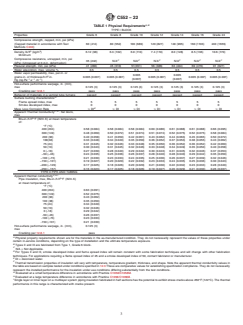
1.1 This specification covers the composition, sizes, dimensions, and physical properties of cellular glass thermal insulation intended for use on commercial or industrial systems with operating temperatures between −450 and 800°F (−268 and 427°C). It is possible that special fabrication or techniques for pipe insulation, or both, will be required for application in the temperature range from 250 to 800°F (121 to 427°C). Contact the manufacturer for recommendations regarding fabrication and application procedures for use in this temperature range. For specific applications, the actual temperature limits shall be agreed upon between the manufacturer and the purchaser.
1.2 This specification does not cover cellular glass insulation used for building envelope applications. For cellular glass insulation used in building applications refer to Specification C1902.
1.3 Cellular glass insulation has the potential to exhibit stress cracks if the rate of temperature change exceeds 200°F (112°C) per hour.
1.4 The values stated in inch-pound units are to be regarded as standard. The values given in parentheses are mathematical conversions to SI units that are provided for information only and are not considered standard.
1.5 This standard does not purport to address all of the safety concerns, if any, associated with its use. It is the responsibility of the user of this standard to establish appropriate safety, health, and environmental practices and determine the applicability of regulatory limitations prior to use.
1.6 This international standard was developed in accordance with internationally recognized principles on standardization established in the Decision on Principles for the Development of International Standards, Guides and Recommendations issued by the World Trade Organization Technical Barriers to Trade (TBT) Committee.
- Status
- Published
- Publication Date
- 28-Feb-2022
- Technical Committee
- C16 - Thermal Insulation
- Drafting Committee
- C16.20 - Homogeneous Inorganic Thermal Insulations
Overview
ASTM C552-22: Standard Specification for Cellular Glass Thermal Insulation defines requirements for cellular glass thermal insulation materials used in commercial and industrial applications. This standard, developed by ASTM International, specifies the composition, physical properties, sizes, and dimensions of these insulations. Cellular glass is a rigid, noncombustible insulating material formed by foaming molten glass and setting it into blocks with hermetically sealed cells, resulting in high durability, low water absorption, and excellent thermal insulation properties across a wide temperature range.
ASTM C552-22 is essential for professionals seeking reliable, durable, and safe insulation for extreme temperature environments, ensuring compliance with quality and performance standards.
Key Topics
- Material Composition: Cellular glass insulation must be made from glass material foamed under molten conditions, annealed, and trimmed to standard block or shape dimensions.
- Product Types:
- Type I: Flat block
- Type II: Pipe and tubing insulation (fabricated from Type I)
- Type III: Special shapes (fabricated from Type I)
- Type IV: Board (fabricated from Type I)
- Physical Properties: Products must meet rigorous requirements for:
- Compressive strength
- Flexural strength
- Water absorption (maximum of 0.5% by volume)
- Water vapor permeability
- Thermal conductivity (performance calculated at various temperatures)
- Hot-surface performance and surface burning characteristics
- Operating Range: Suitable for operating temperatures from –450 to 800°F (–268 to 427°C), with special attention required for applications above 250°F (121°C).
- Dimensions and Tolerances: Blocks, boards, and fabricated shapes must adhere to strict physical and dimensional tolerances, with custom sizes agreed upon by supplier and purchaser.
- Testing Methods: Qualification and acceptance tests are specified, including procedures for sampling, measuring compressive and flexural strength, thermal performance, and other key properties.
Applications
- Industrial and Commercial Systems: Cellular glass insulation is ideal for piping, equipment, tanks, and vessels requiring reliable performance in extreme hot or cold conditions across a range of industries like petrochemical, power generation, and refrigeration.
- Cryogenic and High-Temperature Use: Its noncombustibility and stability suit applications at ultra-low and high temperatures, including LNG plants and high-temperature process lines.
- Moisture-Resistant Installations: With virtually zero water absorption and vapor permeability, cellular glass is frequently specified where integrity against moisture intrusion is critical, such as underground or outdoor installations.
- Corrosive and Harsh Environments: The closed-cell structure and chemical stability make cellular glass insulation a preferred choice where exposure to aggressive chemicals or corrosive atmospheres occurs.
Note: ASTM C552-22 does not cover building envelope applications. For such uses, refer to ASTM C1902.
Related Standards
These referenced and associated ASTM and ISO standards are relevant for compliance, testing, and terminology:
- ASTM C165: Compressive Properties of Thermal Insulations
- ASTM C295: Thermal Insulation for Use in Contact with Austenitic Stainless Steel
- ASTM C240/C302/C303: Physical testing methods for dimensions, density, and quality
- ASTM C335/C335M: Heat Transfer Properties of Pipe Insulation
- ASTM C411: Hot-Surface Performance Testing
- ASTM E84: Surface Burning Characteristics testing for fire safety
- ASTM E96/E96M: Water Vapor Transmission Rate Measurement
- ASTM C1639 & C1902: Specifications for fabrication and construction of cellular glass insulation for different applications
- ISO 3951: Sampling Procedures for Inspection by Variables
- ISO 8497: Thermal Transmission Testing for Circular Pipes
For detailed installation, product selection, and test procedures, consult the referenced standards and coordinate specifications between manufacturers and project teams.
Keywords: ASTM C552, cellular glass insulation, thermal insulation standard, noncombustible insulation, high temperature insulation, industrial pipe insulation, moisture-resistant insulation, ASTM thermal insulation specifications, insulation materials testing.
Relations
- Effective Date
- 15-Apr-2024
- Effective Date
- 01-Mar-2024
- Effective Date
- 01-Mar-2024
- Effective Date
- 01-Dec-2023
- Effective Date
- 15-Nov-2023
- Effective Date
- 01-Sep-2023
- Effective Date
- 01-Sep-2019
- Effective Date
- 01-Jul-2019
- Effective Date
- 01-May-2019
- Effective Date
- 15-Apr-2019
- Effective Date
- 01-Apr-2019
- Effective Date
- 01-Apr-2019
- Effective Date
- 01-Mar-2019
- Refers
ASTM C1639-19 - Standard Specification for Fabrication Of Cellular Glass Pipe And Tubing Insulation - Effective Date
- 01-Mar-2019
- Effective Date
- 01-Mar-2019
Get Certified
Connect with accredited certification bodies for this standard

Institut za varilstvo d.o.o. (Welding Institute)
Slovenia's leading welding institute since 1952. ISO 3834, EN 1090, pressure equipment certification, NDT personnel, welder qualification. Only IIW Au
Sponsored listings
Frequently Asked Questions
ASTM C552-22 is a technical specification published by ASTM International. Its full title is "Standard Specification for Cellular Glass Thermal Insulation". This standard covers: ABSTRACT This specification covers the composition, sizes, dimensions, and physical properties of cellular glass thermal insulation. The material shall consist of a glass composition that has been foamed or cellulated under molten conditions, annealed, and set to form a rigid noncombustible material with hermetically sealed cells. The materials shall also be trimmed into rectangular or tapered blocks of standard dimensions. All specimens shall also comply with with qualification requirements such as compressive strength, flexural strength, water absorption, water vapor permeability, thermal conductivity, hot-surface performance, thermal conductivity and surface burning characteristics. These properties shall be determined in accordance with test methods specified herein. SCOPE 1.1 This specification covers the composition, sizes, dimensions, and physical properties of cellular glass thermal insulation intended for use on commercial or industrial systems with operating temperatures between −450 and 800°F (−268 and 427°C). It is possible that special fabrication or techniques for pipe insulation, or both, will be required for application in the temperature range from 250 to 800°F (121 to 427°C). Contact the manufacturer for recommendations regarding fabrication and application procedures for use in this temperature range. For specific applications, the actual temperature limits shall be agreed upon between the manufacturer and the purchaser. 1.2 This specification does not cover cellular glass insulation used for building envelope applications. For cellular glass insulation used in building applications refer to Specification C1902. 1.3 Cellular glass insulation has the potential to exhibit stress cracks if the rate of temperature change exceeds 200°F (112°C) per hour. 1.4 The values stated in inch-pound units are to be regarded as standard. The values given in parentheses are mathematical conversions to SI units that are provided for information only and are not considered standard. 1.5 This standard does not purport to address all of the safety concerns, if any, associated with its use. It is the responsibility of the user of this standard to establish appropriate safety, health, and environmental practices and determine the applicability of regulatory limitations prior to use. 1.6 This international standard was developed in accordance with internationally recognized principles on standardization established in the Decision on Principles for the Development of International Standards, Guides and Recommendations issued by the World Trade Organization Technical Barriers to Trade (TBT) Committee.
ABSTRACT This specification covers the composition, sizes, dimensions, and physical properties of cellular glass thermal insulation. The material shall consist of a glass composition that has been foamed or cellulated under molten conditions, annealed, and set to form a rigid noncombustible material with hermetically sealed cells. The materials shall also be trimmed into rectangular or tapered blocks of standard dimensions. All specimens shall also comply with with qualification requirements such as compressive strength, flexural strength, water absorption, water vapor permeability, thermal conductivity, hot-surface performance, thermal conductivity and surface burning characteristics. These properties shall be determined in accordance with test methods specified herein. SCOPE 1.1 This specification covers the composition, sizes, dimensions, and physical properties of cellular glass thermal insulation intended for use on commercial or industrial systems with operating temperatures between −450 and 800°F (−268 and 427°C). It is possible that special fabrication or techniques for pipe insulation, or both, will be required for application in the temperature range from 250 to 800°F (121 to 427°C). Contact the manufacturer for recommendations regarding fabrication and application procedures for use in this temperature range. For specific applications, the actual temperature limits shall be agreed upon between the manufacturer and the purchaser. 1.2 This specification does not cover cellular glass insulation used for building envelope applications. For cellular glass insulation used in building applications refer to Specification C1902. 1.3 Cellular glass insulation has the potential to exhibit stress cracks if the rate of temperature change exceeds 200°F (112°C) per hour. 1.4 The values stated in inch-pound units are to be regarded as standard. The values given in parentheses are mathematical conversions to SI units that are provided for information only and are not considered standard. 1.5 This standard does not purport to address all of the safety concerns, if any, associated with its use. It is the responsibility of the user of this standard to establish appropriate safety, health, and environmental practices and determine the applicability of regulatory limitations prior to use. 1.6 This international standard was developed in accordance with internationally recognized principles on standardization established in the Decision on Principles for the Development of International Standards, Guides and Recommendations issued by the World Trade Organization Technical Barriers to Trade (TBT) Committee.
ASTM C552-22 is classified under the following ICS (International Classification for Standards) categories: 23.040.99 - Other pipeline components; 81.040.30 - Glass products. The ICS classification helps identify the subject area and facilitates finding related standards.
ASTM C552-22 has the following relationships with other standards: It is inter standard links to ASTM C168-24, ASTM C390-08(2024), ASTM E96/E96M-24, ASTM E84-23d, ASTM E96/E96M-23, ASTM E84-23c, ASTM C390-08(2019), ASTM E84-19b, ASTM C1617-19, ASTM E84-19a, ASTM C240-19, ASTM C1045-19, ASTM C411-19, ASTM C1639-19, ASTM C1114-06(2019). Understanding these relationships helps ensure you are using the most current and applicable version of the standard.
ASTM C552-22 is available in PDF format for immediate download after purchase. The document can be added to your cart and obtained through the secure checkout process. Digital delivery ensures instant access to the complete standard document.
Standards Content (Sample)
This international standard was developed in accordance with internationally recognized principles on standardization established in the Decision on Principles for the
Development of International Standards, Guides and Recommendations issued by the World Trade Organization Technical Barriers to Trade (TBT) Committee.
Designation:C552 −22
Standard Specification for
Cellular Glass Thermal Insulation
This standard is issued under the fixed designation C552; the number immediately following the designation indicates the year of
original adoption or, in the case of revision, the year of last revision.Anumber in parentheses indicates the year of last reapproval.A
superscript epsilon (´) indicates an editorial change since the last revision or reapproval.
This standard has been approved for use by agencies of the U.S. Department of Defense.
1. Scope 2. Referenced Documents
1.1 This specification covers the composition, sizes, 2.1 ASTM Standards:
dimensions, and physical properties of cellular glass thermal C165TestMethodforMeasuringCompressivePropertiesof
insulationintendedforuseoncommercialorindustrialsystems Thermal Insulations
with operating temperatures between −450 and 800°F (−268 C168Terminology Relating to Thermal Insulation
and427°C).Itispossiblethatspecialfabricationortechniques C177Test Method for Steady-State Heat Flux Measure-
for pipe insulation, or both, will be required for application in ments and Thermal Transmission Properties by Means of
the temperature range from 250 to 800°F (121 to 427°C). the Guarded-Hot-Plate Apparatus
Contact the manufacturer for recommendations regarding fab- C203Test Methods for Breaking Load and Flexural Proper-
rication and application procedures for use in this temperature ties of Block-Type Thermal Insulation
range. For specific applications, the actual temperature limits C240Test Methods for Testing Cellular Glass Insulation
shall be agreed upon between the manufacturer and the Block
purchaser. C302Test Method for Density and Dimensions of Pre-
formed Pipe-Covering-Type Thermal Insulation
1.2 This specification does not cover cellular glass insula-
C303Test Method for Dimensions and Density of Pre-
tion used for building envelope applications. For cellular glass
formed Block and Board–Type Thermal Insulation
insulation used in building applications refer to Specification
C335/C335MTest Method for Steady-State Heat Transfer
C1902.
Properties of Pipe Insulation
1.3 Cellular glass insulation has the potential to exhibit
C390Practice for Sampling and Acceptance of Thermal
stress cracks if the rate of temperature change exceeds 200°F
Insulation Lots
(112°C) per hour.
C411Test Method for Hot-Surface Performance of High-
1.4 The values stated in inch-pound units are to be regarded Temperature Thermal Insulation
C450Practice for Fabrication of Thermal Insulating Fitting
as standard. The values given in parentheses are mathematical
conversions to SI units that are provided for information only Covers for NPS Piping, and Vessel Lagging
C518Test Method for Steady-State Thermal Transmission
and are not considered standard.
Properties by Means of the Heat Flow Meter Apparatus
1.5 This standard does not purport to address all of the
C585Practice for Inner and Outer Diameters of Thermal
safety concerns, if any, associated with its use. It is the
Insulation for Nominal Sizes of Pipe and Tubing
responsibility of the user of this standard to establish appro-
C692Test Method for Evaluating the Influence of Thermal
priate safety, health, and environmental practices and deter-
Insulations on External Stress Corrosion Cracking Ten-
mine the applicability of regulatory limitations prior to use.
dency of Austenitic Stainless Steel
1.6 This international standard was developed in accor-
C795Specification for Thermal Insulation for Use in Con-
dance with internationally recognized principles on standard-
tact with Austenitic Stainless Steel
ization established in the Decision on Principles for the
C871Test Methods for ChemicalAnalysis of Thermal Insu-
Development of International Standards, Guides and Recom-
lationMaterialsforLeachableChloride,Fluoride,Silicate,
mendations issued by the World Trade Organization Technical
and Sodium Ions
Barriers to Trade (TBT) Committee.
C1045Practice for Calculating Thermal Transmission Prop-
erties Under Steady-State Conditions
This specification is under the jurisdiction of ASTM Committee C16 on
Thermal Insulation and is the direct responsibility of Subcommittee C16.20 on
Homogeneous Inorganic Thermal Insulations. For referenced ASTM standards, visit the ASTM website, www.astm.org, or
Current edition approved March 1, 2022. Published March 2022. Originally contactASTM Customer Service at service@astm.org. ForAnnual Book ofASTM
approved in 1965 to replace C381–58 and C343–56. Last previous edition Standards volume information, refer to the standard’s Document Summary page on
approved in 2021 as C552–21a. DOI: 10.1520/C0552-22. theASTM website.
Copyright © ASTM International, 100 Barr Harbor Drive, PO Box C700, West Conshohocken, PA 19428-2959. United States
C552−22
C1058/C1058MPractice for Selecting Temperatures for 6. Materials and Manufacture
Evaluating and Reporting Thermal Properties of Thermal
6.1 The block material shall consist of a glass composition
Insulation
that has been foamed or cellulated under molten conditions,
C1114Test Method for Steady-State Thermal Transmission
annealed, and set to form a rigid noncombustible material with
Properties by Means of the Thin-Heater Apparatus
hermetically sealed cells. The material shall be trimmed into
C1617Practice for Quantitative Accelerated Laboratory
blocks of standard dimensions that are rectangular or tapered.
Evaluation of Extraction Solutions Containing Ions
6.2 Special shapes and pipe covering shall be fabricated
Leached from Thermal Insulation on Aqueous Corrosion
from blocks in accordance with Practices C450, C585 and
of Metals
Specification C1639.
C1639Specification for Fabrication Of Cellular Glass Pipe
And Tubing Insulation
7. Physical Properties
C1902Specification for Cellular Glass Insulation Used in
7.1 The cellular glass insulation shall conform to the physi-
Building and Roof Applications
cal requirements in Table 1. Contact the manufacturer for
E84Test Method for Surface Burning Characteristics of
specific design recommendations for all material types.
Building Materials
E96/E96MTest Methods for Gravimetric Determination of
8. Qualification Requirements
Water Vapor Transmission Rate of Materials
8.1 The following requirements are generally employed for
2.2 ISO Documents:
the purpose of initial material or product qualification forType
ISO 3951Sampling Procedure and Charts for Inspection by
I, Block Material:
Variables for Percent Defective
8.1.1 Compressive strength.
ISO 8497Determination of steady-state thermal transmis-
8.1.2 Flexural strength.
sion properties of thermal insulation for circular pipes
8.1.3 Water absorption.
3. Terminology
8.1.4 Water vapor permeability.
8.1.5 Thermal conductivity.
3.1 For definitions used in this specification, see Terminol-
8.1.6 Hot-surface performance.
ogy C168.
8.1.7 Surface burning characteristics.
4. Classification
8.2 The following requirements are generally employed for
4.1 Cellular glass insulation covered by this specification qualification of Type II, pipe and tubing insulation:
shallbeclassifiedinthesevengradesshowninTable1.Grades
8.2.1 Thermal Conductivity.
vary in compressive strength, density, thermal conductivity, 8.2.2 Type II, pipe and tubing insulation shall be fabricated
and flexural strength. Cellular glass insulation is furnished in
from material having met the qualification requirements of
the following types: Grade 6 Type I block.
4.1.1 Type I—Flat block manufactured,
8.3 Type III material shall be fabricated from material
4.1.2 Type II—Pipe and tubing insulation fabricated from
having met the qualification requirements of Grade 6 Type I
Type I, and
block.
4.1.3 Type III—Special shapes fabricated from Type I.
9. Dimensions, Mass, and Permissible Variations
NOTE 1—Types not listed here may not be commercially available.
These would be considered special order items.
9.1 Type I, Flat Block—Blocks shall be nominal rectangular
sections. The dimensions shall be as agreed upon by the
5. Ordering Information
purchaser and the supplier. Cellular glass thermal insulation
5.1 Purchaseordersforcellularglassinsulationfurnishedto
block is available in lengths from 24 in. to 36 in. (600 mm to
this specification shall include the following information:
914mm)andwidthsfrom18in.to24in.(450mmto610mm).
5.1.1 Type designation (see 4.1),
Cellular glass thermal insulation block is available in thick-
5.1.2 Dimensions according to type (see Section 9), and
nesses from 1.5 in. to 8 in. (38 mm to 203 mm).
5.1.3 Jacketing when required.
9.2 Type II, Pipe and Tubing Insulation—See Specification
5.2 Any special requirements, such as, type, fabrication
C1639.
combinations not listed in accordance with Section 4, nonstan-
9.3 Type III, Special Shapes—Dimensions of special shapes
dard dimensions in accordance with Section 9, inspection
shallbeasagreeduponbetweenthesupplierandthepurchaser.
requirements in accordance with Section 13, or certification
9.4 Dimensional Tolerances:
requirements in accordance with Section 16 shall be agreed
9.4.1 For Type I, the average measured length, width, and
upon between the purchaser and the supplier and stated in the
thickness tolerances shall be in accordance with those listed in
purchase contract.
Table 2.
9.4.2 For Type II, the dimensional tolerances are given in
Available fromAmerican National Standards Institute (ANSI), 25 W. 43rd St.,
Table 3.
4th Floor, New York, NY 10036, http://www.ansi.org.
9.4.3 For Type III, dimensional tolerances shall be agreed
Type and grade designations are in accordance with Form and Style for ASTM
Standards, Part B, Section B8, March 2002. upon between the purchaser and the supplier.
C552−22
A,B
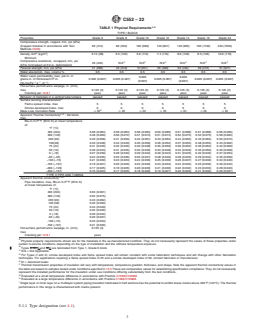
TABLE 1 Physical Requirements
TYPE I BLOCK
Properties Grade 6 Grade 8 Grade 10 Grade 12 Grade 14 Grade 16 Grade 24
Compressive strength, capped, min, psi (kPa)
(Capped material in accordance with Test 60 (414) 80 (552) 100 (689) 120 (827) 140 (965) 160 (1103) 240 (1655)
Methods C240)
3 3
Density, lb/ft (kg/m ) 6.12 (98) 6.3 (102) 6.9 (110) 7.4 (119) 8.0 (128) 8.5 (136) 10.6 (170)
Minimum
Compressive resistance, uncapped, min, psi
C C C C C C
35 (242) N/A N/A N/A N/A N/A N/A
(kPa) (Uncapped at 0.2-in. deformation)
Flexural strength, min, psi (kPa) 41 (283) 45 (310) 51(351) 56 (386) 63 (434) 69 (476) 91 (627)
Water absorption, max, volume % 0.5 0.5 0.5 0.5 0.5 0.5 0.5
Water vapor permeability, max, per·in. or
0.005 0.005
grains·in. of thickness/h·ft ·in. 0.005 (0.007) 0.005 (0.007) 0.005 (0.007) 0.005 (0.007) 0.005 (0.007)
(0.007) (0.007)
–1 –1 –1
Hg (ng·Pa ·s ·m )
Hot-surface performance warpage, in. (mm),
max 0.125 (3) 0.125 (3) 0.125 (3) 0.125 (3) 0.125 (3) 0.125 (3) 0.125 (3)
Cracking per 12.8.1 pass pass pass pass pass pass pass
Behavior of materials in a vertical tube furnace passed passed passed passed passed passed passed
D
Surface burning characteristics
Flame spread index, max 5 5 5 5 5 5 5
Smoke developed index, max 0 0 0 0 0 0 0
E
Mass Loss Corrosion Rate # DI # DI # DI # DI # DI # DI # DI
F,G
Apparent Thermal Conductivity : flat block,
max
Btu-in./h·ft °F (W/m·K) at mean temperature
of:
°F (°C)
400 (204) 0.58 (0.084) 0.58 (0.084) 0.58 (0.084) 0.60 (0.086) 0.61 (0.088) 0.61 (0.088) 0.66 (0.095)
300 (149) 0.48 (0.069) 0.50 (0.072) 0.51 (0.074) 0.51 (0.074) 0.52 (0.075) 0.52 (0.075) 0.58 (0.084)
200 (93) 0.40 (0.058) 0.41 (0.059) 0.42 (0.061) 0.43 (0.062) 0.44 (0.063) 0.45 (0.065) 0.50 (0.072)
100(38) 0.33 (0.048) 0.34 (0.049) 0.35 (0.050) 0.36 (0.052) 0.37 (0.053) 0.38 (0.055) 0.43 (0.062)
75 (24) 0.31 (0.045) 0.32 (0.046) 0.33 (0.048) 0.35 (0.050) 0.36 (0.052) 0.36 (0.052) 0.42 (0.060)
50 (10) 0.30 (0.043) 0.31 (0.045) 0.32 (0.046) 0.33 (0.048) 0.34 (0.049) 0.35 (0.050) 0.40 (0.058)
0 (–18) 0.27 (0.039) 0.28 (0.040) 0.29 (0.042) 0.30 (0.043) 0.31 (0.045) 0.32 (0.046) 0.37 (0.053)
–50 (–46) 0.24 (0.035) 0.25 (0.036) 0.26 (0.037) 0.28 (0.040) 0.28 (0.040) 0.29 (0.042) 0.35 (0.050)
–100 (–73) 0.21 (0.030) 0.23 (0.033) 0.24 (0.035) 0.25 (0.036) 0.26 (0.037) 0.27 (0.039) 0.32 (0.046)
–150 (–101) 0.19 (0.027) 0.20 (0.029) 0.22 (0.032) 0.23 (0.033) 0.24 (0.035) 0.25 (0.036) 0.30 (0.043)
–200 (–129) 0.17 (0.025) 0.18 (0.026) 0.20 (0.029) 0.21 (0.030) 0.22 (0.032) 0.23 (0.033) 0.28 (0.040)
–250 (–157) 0.16 (0.023) 0.17 (0.025) 0.18 (0.026) 0.19 (0.027) 0.20 (0.029) 0.21 (0.030) 0.26 (0.037)
TYPE II PIPE AND TUBING
F,H,I
Apparent thermal conductivity
Pipe insulation, max, Btu·in./h·ft °F (W/m·K)
at mean temperature of:
°F (°C)
400 (204) 0.63 (0.091)
300 (149) 0.52 (0.075)
200 (93) 0.43 (0.062)
100 (38) 0.35 (0.050)
75 (24) 0.34 (0.049)
50 (10) 0.32 (0.046)
0 (-18) 0.29 (0.042)
-50 (-46) 0.26 (0.037)
-100 (-73) 0.23 (0.033)
-150 (-101) 0.21 (0.030)
Hot-surface performance warpage, in. (mm), 0.125 (3)
max
Cracking per 12.8.1 pass
A
Physical property requirements shown are for the materials in the as-manufactured condition. They do not necessarily rep
...
This document is not an ASTM standard and is intended only to provide the user of an ASTM standard an indication of what changes have been made to the previous version. Because
it may not be technically possible to adequately depict all changes accurately, ASTM recommends that users consult prior editions as appropriate. In all cases only the current version
of the standard as published by ASTM is to be considered the official document.
Designation: C552 − 21a C552 − 22
Standard Specification for
Cellular Glass Thermal Insulation
This standard is issued under the fixed designation C552; the number immediately following the designation indicates the year of
original adoption or, in the case of revision, the year of last revision. A number in parentheses indicates the year of last reapproval. A
superscript epsilon (´) indicates an editorial change since the last revision or reapproval.
This standard has been approved for use by agencies of the U.S. Department of Defense.
1. Scope
1.1 This specification covers the composition, sizes, dimensions, and physical properties of cellular glass thermal insulation
intended for use on surfaces operating at commercial or industrial systems with operating temperatures between −450 and 800°F
(−268 and 427°C). It is possible that special fabrication or techniques for pipe insulation, or both, will be required for application
in the temperature range from 250 to 800°F (121 to 427°C). Contact the manufacturer for recommendations regarding fabrication
and application procedures for use in this temperature range. For specific applications, the actual temperature limits shall be agreed
upon between the manufacturer and the purchaser.
1.2 This specification does not cover cellular glass insulation used for building envelope applications. For cellular glass insulation
used in building applications refer to Specification C1902.
1.3 Cellular glass insulation has the potential to exhibit stress cracks if the rate of temperature change exceeds 200°F (112°C) per
hour.
1.4 The values stated in inch-pound units are to be regarded as standard. The values given in parentheses are mathematical
conversions to SI units that are provided for information only and are not considered standard.
1.5 This standard does not purport to address all of the safety concerns, if any, associated with its use. It is the responsibility
of the user of this standard to establish appropriate safety, health, and environmental practices and determine the applicability of
regulatory limitations prior to use.
1.6 This international standard was developed in accordance with internationally recognized principles on standardization
established in the Decision on Principles for the Development of International Standards, Guides and Recommendations issued
by the World Trade Organization Technical Barriers to Trade (TBT) Committee.
2. Referenced Documents
2.1 ASTM Standards:
C165 Test Method for Measuring Compressive Properties of Thermal Insulations
C168 Terminology Relating to Thermal Insulation
C177 Test Method for Steady-State Heat Flux Measurements and Thermal Transmission Properties by Means of the
Guarded-Hot-Plate Apparatus
This specification is under the jurisdiction of ASTM Committee C16 on Thermal Insulation and is the direct responsibility of Subcommittee C16.20 on Homogeneous
Inorganic Thermal Insulations.
Current edition approved Sept. 1, 2021March 1, 2022. Published September 2021March 2022. Originally approved in 1965 to replace C381 – 58 and C343 – 56. Last
previous edition approved in 2021 as C552 – 21.C552 – 21a. DOI: 10.1520/C0552-21A.10.1520/C0552-22.
For referenced ASTM standards, visit the ASTM website, www.astm.org, or contact ASTM Customer Service at service@astm.org. For Annual Book of ASTM Standards
volume information, refer to the standard’s Document Summary page on the ASTM website.
Copyright © ASTM International, 100 Barr Harbor Drive, PO Box C700, West Conshohocken, PA 19428-2959. United States
C552 − 22
C203 Test Methods for Breaking Load and Flexural Properties of Block-Type Thermal Insulation
C240 Test Methods for Testing Cellular Glass Insulation Block
C302 Test Method for Density and Dimensions of Preformed Pipe-Covering-Type Thermal Insulation
C303 Test Method for Dimensions and Density of Preformed Block and Board–Type Thermal Insulation
C335/C335M Test Method for Steady-State Heat Transfer Properties of Pipe Insulation
C390 Practice for Sampling and Acceptance of Thermal Insulation Lots
C411 Test Method for Hot-Surface Performance of High-Temperature Thermal Insulation
C450 Practice for Fabrication of Thermal Insulating Fitting Covers for NPS Piping, and Vessel Lagging
C518 Test Method for Steady-State Thermal Transmission Properties by Means of the Heat Flow Meter Apparatus
C585 Practice for Inner and Outer Diameters of Thermal Insulation for Nominal Sizes of Pipe and Tubing
C692 Test Method for Evaluating the Influence of Thermal Insulations on External Stress Corrosion Cracking Tendency of
Austenitic Stainless Steel
C795 Specification for Thermal Insulation for Use in Contact with Austenitic Stainless Steel
C871 Test Methods for Chemical Analysis of Thermal Insulation Materials for Leachable Chloride, Fluoride, Silicate, and
Sodium Ions
C1045 Practice for Calculating Thermal Transmission Properties Under Steady-State Conditions
C1058/C1058M Practice for Selecting Temperatures for Evaluating and Reporting Thermal Properties of Thermal Insulation
C1114 Test Method for Steady-State Thermal Transmission Properties by Means of the Thin-Heater Apparatus
C1617 Practice for Quantitative Accelerated Laboratory Evaluation of Extraction Solutions Containing Ions Leached from
Thermal Insulation on Aqueous Corrosion of Metals
C1639 Specification for Fabrication Of Cellular Glass Pipe And Tubing Insulation
C1902 Specification for Cellular Glass Insulation Used in Building and Roof Applications
E84 Test Method for Surface Burning Characteristics of Building Materials
E96/E96M Test Methods for Gravimetric Determination of Water Vapor Transmission Rate of Materials
2.2 ISO Documents:
ISO 3951 Sampling Procedure and Charts for Inspection by Variables for Percent Defective
ISO 8497 Determination of steady-state thermal transmission properties of thermal insulation for circular pipes
3. Terminology
3.1 For definitions used in this specification, see Terminology C168.
3.2 Definitions of Terms Specific to This Standard:
3.2.1 board—fabricated sections of cellular glass adhered and together covered with a facing such as a laminated kraft paper
adhered to both faces.
4. Classification
4.1 Cellular glass insulation covered by this specification shall be classified in the seven grades shown in Table 1. Grades vary
in compressive strength, density, thermal conductivity, and flexural strength. Cellular glass insulation is furnished in the following
types:
4.1.1 Type I—Flat block manufactured,
4.1.2 Type II—Pipe and tubing insulation fabricated from Type I, and
4.1.3 Type III—Special shapes fabricated from Type I,
4.1.3 Type IV—III—Board Special shapes fabricated from Type I,I.
NOTE 1—Types not listed here may not be commercially available. These would be considered special order items.
5. Ordering Information
5.1 Purchase orders for cellular glass insulation furnished to this specification shall include the following information:
Available from American National Standards Institute (ANSI), 25 W. 43rd St., 4th Floor, New York, NY 10036, http://www.ansi.org.
Type and grade designations are in accordance with Form and Style for ASTM Standards, Part B, Section B8, March 2002.
C552 − 22
A,B
TABLE 1 Physical Requirements
TYPE I BLOCK
Properties Grade 6 Grade 8 Grade 10 Grade 12 Grade 14 Grade 16 Grade 24
Compressive strength, capped, min, psi (kPa)
(Capped material in accordance with Test 60 (414) 80 (552) 100 (689) 120 (827) 140 (965) 160 (1103) 240 (1655)
Methods C240)
3 3
Density, lb/ft (kg/m ) 6.12 (98) 6.3 (102) 6.9 (110) 7.4 (119) 8.0 (128) 8.5 (136) 10.6 (170)
Minimum
Compressive resistance, uncapped, min, psi
C C C C C C
35 (242) N/A N/A N/A N/A N/A N/A
(kPa) (Uncapped at 0.2-in. deformation)
Flexural strength, min, psi (kPa) 41 (283) 45 (310) 51(351) 56 (386) 63 (434) 69 (476) 91 (627)
Water absorption, max, volume % 0.5 0.5 0.5 0.5 0.5 0.5 0.5
Water vapor permeability, max, per·in. or
0.005 0.005
grains·in. of thickness/h·ft ·in. 0.005 (0.007) 0.005 (0.007) 0.005 (0.007) 0.005 (0.007) 0.005 (0.007)
(0.007) (0.007)
–1 –1 –1
Hg (ng·Pa ·s ·m )
Hot-surface performance warpage, in. (mm),
max 0.125 (3) 0.125 (3) 0.125 (3) 0.125 (3) 0.125 (3) 0.125 (3) 0.125 (3)
Cracking per 12.8.1 pass pass pass pass pass pass pass
Behavior of materials in a vertical tube furnace passed passed passed passed passed passed passed
D
Surface burning characteristics
Flame spread index, max 5 5 5 5 5 5 5
Smoke developed index, max 0 0 0 0 0 0 0
E
Mass Loss Corrosion Rate # DI # DI # DI # DI # DI # DI # DI
F,G
Apparent Thermal Conductivity : flat block,
max
Btu-in./h·ft °F (W/m·K) at mean temperature
of:
°F (°C)
400 (204) 0.58 (0.084) 0.58 (0.084) 0.58 (0.084) 0.60 (0.086) 0.61 (0.088) 0.61 (0.088) 0.66 (0.095)
300 (149) 0.48 (0.069) 0.50 (0.072) 0.51 (0.074) 0.51 (0.074) 0.52 (0.075) 0.52 (0.075) 0.58 (0.084)
200 (93) 0.40 (0.058) 0.41 (0.059) 0.42 (0.061) 0.43 (0.062) 0.44 (0.063) 0.45 (0.065) 0.50 (0.072)
100(38) 0.33 (0.048) 0.34 (0.049) 0.35 (0.050) 0.36 (0.052) 0.37 (0.053) 0.38 (0.055) 0.43 (0.062)
75 (24) 0.31 (0.045) 0.32 (0.046) 0.33 (0.048) 0.35 (0.050) 0.36 (0.052) 0.36 (0.052) 0.42 (0.060)
50 (10) 0.30 (0.043) 0.31 (0.045) 0.32 (0.046) 0.33 (0.048) 0.34 (0.049) 0.35 (0.050) 0.40 (0.058)
0 (–18) 0.27 (0.039) 0.28 (0.040) 0.29 (0.042) 0.30 (0.043) 0.31 (0.045) 0.32 (0.046) 0.37 (0.053)
–50 (–46) 0.24 (0.035) 0.25 (0.036) 0.26 (0.037) 0.28 (0.040) 0.28 (0.040) 0.29 (0.042) 0.35 (0.050)
–100 (–73) 0.21 (0.030) 0.23 (0.033) 0.24 (0.035) 0.25 (0.036) 0.26 (0.037) 0.27 (0.039) 0.32 (0.046)
–150 (–101) 0.19 (0.027) 0.20 (0.029) 0.22 (0.032) 0.23 (0.033) 0.24 (0.035) 0.25 (0.036) 0.30 (0.043)
–200 (–129) 0.17 (0.025) 0.18 (0.026) 0.20 (0.029) 0.21 (0.030) 0.22 (0.032) 0.23 (0.033) 0.28 (0.040)
–250 (–157) 0.16 (0.023) 0.17 (0.025) 0.18 (0.026) 0.19 (0.027) 0.20 (0.029) 0.21 (0.030) 0.26 (0.037)
TYPE II PIPE AND TUBING
F,H,I
Apparent thermal conductivity
Pipe insulation, max, Btu·in./h·ft °F (W/m·K)
at mean temperature of:
°F (°C)
400 (204) 0.63 (0.091)
300 (149) 0.52 (0.075)
200 (93) 0.43 (0.062)
100 (38) 0.35 (0.050)
75 (24) 0.34 (0.049)
50 (10) 0.32 (0.046)
0 (-18) 0.29 (0.042)
-50 (-46) 0.26 (0.037)
-100 (-73) 0.23 (0.033)
-150 (-101) 0.21 (0.030)
Hot-surface performance warpage, in. (mm), 0.125 (3)
max
Cracking per 12.8.1 pass
A
Physical property requirements shown are for the materials in the as-manufactured condition. They do not necessarily represent the values of these properties under
certain in-service conditions, depending on the type of installation and the ultimate temperature exposure.
B
Types II, III, II and IVIII are fabricated from Type 1, Grade 6 block.
C
N/A = Not Applicable.
D
For Types II and III, smoke developed index and flame spread index will remain constant with some fabrication techniques and will change with other fabrication
techniques. For applications requiring a flame spread index of 25 and a smoke developed index of 50, contact fabricator or manufacturer.
E
DI = deionized water.
F
Thermal transmission properties of insulation will vary with temperature, temperature gradient, thickness, and shape. Note the apparent thermal conductivity values in
the table are based on samples tested under conditions specified in 12.3 These are comparative values for establishing specification compliance. They do not necessarily
represent the installed performance for the insulation under use conditions differing substantially from the test conditions.
G
Evaluated at a small temperature difference in accordance with Practice C1058/C1058M.
H
Evaluated at a large temperature difference in accordance with Practice C1058/C1058M.
I
Single layer or inner layer on a multilayer system piping insulation fabricated in half sections has the potential to exhibit stress cracks above 250°F (122°C). The thermal
performance in this range is characterized with cracks present.
5.1.1 Type designation (see 4.1),
C552 − 22
5.1.2 Dimensions according to type (see Section 9), and
5.1.3 Jacketing when required.
5.2 Any special requirements, such as, type, fabrication combinations not listed in accordance with Section 4, nonstandard
dimensions in accordance with Section 9, inspection requirements in accordance with Section 13, or certification requirements in
accordance with Section 16 shall be agreed upon between the purchaser and the supplier and stated in the purchase contract.
6. Materials and Manufacture
6.1 The block material shall consist of a glass composition that has been foamed or cellulated under molten conditions, annealed,
and set to form a rigid noncombustible material with hermetically sealed cells. The material shall be trimmed into blocks of
standard dimensions that are rectangular or tapered.
6.2 Special shapes and pipe covering shall be fabricated from blocks in accordance with Practices C450, C585 and Specification
C1639.
6.3 Board, tapered or flat, shall be fabricated from blocks.
7. Physical Properties
7.1 The cellular glass insulation shall conform to the physical requirements in Table 1. Contact the manufacturer for specific
design recommendations for all material types.
8. Qualification Requirements
8.1 The following requirements are generally employed for the purpose of initial material or product qualification for Type I,
Block Material:
8.1.1 Compressive strength.
8.1.2 Flexural strength.
8.1.3 Water absorption.
8.1.4 Water vapor permeability.
8.1.5 Thermal conductivity.
8.1.6 Hot-surface performance.
8.1.7 Surf
...