

ASTM E662-21ae1
(Test Method)Standard Test Method for Specific Optical Density of Smoke Generated by Solid Materials
General Information
- Abstract
SIGNIFICANCE AND USE
5.1 This test method provides a means for determining the specific optical density of the smoke generated by specimens of materials and assemblies under the specified exposure conditions. Values determined by this test are specific to the specimen or assembly in the form and thickness tested and are not to be considered inherent fundamental properties of the material tested. Thus, it is likely that closely repeatable or reproducible experimental results are not to be expected from tests of a given material when specimen thickness, density, or other variables are involved.
5.2 The photometric scale used to measure smoke by this test method is similar to the optical density scale for human vision. However, physiological aspects associated with vision are not measured by this test method. Correlation with measurements by other test methods has not been established.5
5.3 At the present time no basis is provided for predicting the density of smoke generated by the materials upon exposure to heat and flame under other fire conditions.
5.4 The test method is of a complex nature and the data obtained are sensitive to variations which in other test methods might be considered to be insignificant (see Section 6). A precision statement based on the results of a round-robin test by a prior draft version of this test method is given in 14.1
5.5 In this procedure, the specimens are subjected to one or more specific sets of laboratory test conditions. If different test conditions are substituted or the end-use conditions are changed, it is not always possible by or from this test method to predict changes in the fire-test-response characteristics measured. Therefore, the results are valid only for the fire test exposure conditions described in this procedure.
SCOPE
1.1 This fire-test-response standard covers determination of the specific optical density of smoke generated by solid materials and assemblies mounted in the vertical position in thicknesses up to and including 1 in. (25.4 mm).
1.2 Measurement is made of the attenuation of a light beam by smoke (suspended solid or liquid particles) accumulating within a closed chamber due to nonflaming pyrolytic decomposition and flaming combustion.
1.3 Results are expressed in terms of specific optical density which is derived from a geometrical factor and the measured optical density, a measurement characteristic of the concentration of smoke.
1.4 The values stated in inch-pound units are to be regarded as standard. The values given in parentheses are mathematical conversions to SI units that are provided for information only and are not considered standard.
1.5 This standard measures and describes the response of materials, products, or assemblies to heat and flame under controlled conditions, but does not by itself incorporate all factors required for fire hazard or fire risk assessment of the materials, products or assemblies under actual fire conditions.
1.6 This standard does not purport to address all of the safety concerns, if any, associated with its use. It is the responsibility of the user of this standard to establish appropriate safety, health, and environmental practices and determine the applicability of regulatory limitations prior to use.
1.7 This international standard was developed in accordance with internationally recognized principles on standardization established in the Decision on Principles for the Development of International Standards, Guides and Recommendations issued by the World Trade Organization Technical Barriers to Trade (TBT) Committee.
- Status
- Published
- Publication Date
- 31-May-2021
- Technical Committee
- E05 - Fire Standards
- Drafting Committee
- E05.21 - Smoke and Combustion Products
Overview
ASTM E662-21ae1: Standard Test Method for Specific Optical Density of Smoke Generated by Solid Materials is an internationally recognized test method developed by ASTM International. It determines the specific optical density of smoke produced by solid materials and assemblies when subjected to controlled laboratory conditions. The test provides valuable data on smoke generation, relevant for the evaluation of building materials, components, and assemblies for fire safety compliance.
This standard outlines the procedures for exposing specimens to nonflaming pyrolytic decomposition and flaming combustion within a closed chamber, measuring the attenuation of a light beam by the smoke produced. Results are expressed as specific optical density, indicating smoke concentration. The method is approved for use by agencies such as the U.S. Department of Defense and aligns with principles set by the World Trade Organization Technical Barriers to Trade (TBT) Committee.
Key Topics
- Specific Optical Density: The core measurement assessed is the specific optical density of smoke generated under defined conditions, representative of smoke's ability to obscure vision during a fire event.
- Controlled Exposure Conditions: Specimens are tested in a standardized chamber under strictly controlled heat and combustion exposure, with tests conducted in both nonflaming and flaming modes.
- Data Sensitivity: The method is highly sensitive to factors such as specimen thickness, density, and composition. Repeatable or reproducible results may be affected by these variables.
- Measurement System: Utilizes a photometric system aligned with optical density relevant to human vision. Results are comparable only within this method due to unique calibration and chamber conditions.
- Limitations: Results are specific to the tested configuration and may not predict smoke development in actual fire scenarios. The method does not address physiological vision responses, nor does it include direct fire hazard or fire risk assessment.
Applications
- Building Materials Evaluation: Commonly used in the construction sector to assess the smoke-generating characteristics of wall panels, flooring, ceiling tiles, cables, and insulation materials.
- Product Safety Compliance: Helps manufacturers demonstrate that their products meet fire resistance and smoke development requirements mandated by codes and regulations for commercial and public buildings.
- Fire Safety Engineering: Provides essential data for fire safety engineers engaged in risk assessments and the design of smoke control systems in buildings.
- Quality Control and Research: Offers laboratories and material scientists a repeatable procedure for testing new materials or comparing products for development and certification purposes.
Related Standards
- ASTM D2843 – Test Method for Density of Smoke from the Burning or Decomposition of Plastics
- ASTM E176 – Terminology of Fire Standards
- ASTM C1186 – Specification for Flat Fiber-Cement Sheets
- ASTM C1288 – Specification for Fiber-Cement Interior Substrate Sheets
- ANSI/AHA A135.4 – Basic Hardboard Specification
These referenced standards provide definitions, background, and parallel test methods that support a comprehensive approach to fire and smoke testing as required by industry and regulatory bodies.
Keywords: ASTM E662, specific optical density, smoke testing, fire safety, material testing, building materials, flaming combustion test, nonflaming decomposition, smoke density chamber, fire-test-response standard, optical density measurement, product compliance.
Relations
- Effective Date
- 01-Jan-2024
- Effective Date
- 15-Dec-2018
- Effective Date
- 01-Dec-2018
- Effective Date
- 01-Mar-2018
- Effective Date
- 01-Jul-2017
- Effective Date
- 01-Feb-2017
- Effective Date
- 01-May-2016
- Effective Date
- 01-Nov-2015
- Effective Date
- 01-Aug-2015
- Effective Date
- 01-Aug-2015
- Effective Date
- 01-Apr-2015
- Effective Date
- 01-Feb-2015
- Effective Date
- 01-Oct-2014
- Effective Date
- 15-Aug-2014
- Effective Date
- 01-Aug-2014
Get Certified
Connect with accredited certification bodies for this standard

BSMI (Bureau of Standards, Metrology and Inspection)
Taiwan's standards and inspection authority.
CIS Institut d.o.o.
Personal Protective Equipment (PPE) certification body. Notified Body NB-2890 for EU Regulation 2016/425 PPE.

Kiwa BDA Testing
Building and construction product certification.
Sponsored listings
Frequently Asked Questions
ASTM E662-21ae1 is a standard published by ASTM International. Its full title is "Standard Test Method for Specific Optical Density of Smoke Generated by Solid Materials". This standard covers: SIGNIFICANCE AND USE 5.1 This test method provides a means for determining the specific optical density of the smoke generated by specimens of materials and assemblies under the specified exposure conditions. Values determined by this test are specific to the specimen or assembly in the form and thickness tested and are not to be considered inherent fundamental properties of the material tested. Thus, it is likely that closely repeatable or reproducible experimental results are not to be expected from tests of a given material when specimen thickness, density, or other variables are involved. 5.2 The photometric scale used to measure smoke by this test method is similar to the optical density scale for human vision. However, physiological aspects associated with vision are not measured by this test method. Correlation with measurements by other test methods has not been established.5 5.3 At the present time no basis is provided for predicting the density of smoke generated by the materials upon exposure to heat and flame under other fire conditions. 5.4 The test method is of a complex nature and the data obtained are sensitive to variations which in other test methods might be considered to be insignificant (see Section 6). A precision statement based on the results of a round-robin test by a prior draft version of this test method is given in 14.1 5.5 In this procedure, the specimens are subjected to one or more specific sets of laboratory test conditions. If different test conditions are substituted or the end-use conditions are changed, it is not always possible by or from this test method to predict changes in the fire-test-response characteristics measured. Therefore, the results are valid only for the fire test exposure conditions described in this procedure. SCOPE 1.1 This fire-test-response standard covers determination of the specific optical density of smoke generated by solid materials and assemblies mounted in the vertical position in thicknesses up to and including 1 in. (25.4 mm). 1.2 Measurement is made of the attenuation of a light beam by smoke (suspended solid or liquid particles) accumulating within a closed chamber due to nonflaming pyrolytic decomposition and flaming combustion. 1.3 Results are expressed in terms of specific optical density which is derived from a geometrical factor and the measured optical density, a measurement characteristic of the concentration of smoke. 1.4 The values stated in inch-pound units are to be regarded as standard. The values given in parentheses are mathematical conversions to SI units that are provided for information only and are not considered standard. 1.5 This standard measures and describes the response of materials, products, or assemblies to heat and flame under controlled conditions, but does not by itself incorporate all factors required for fire hazard or fire risk assessment of the materials, products or assemblies under actual fire conditions. 1.6 This standard does not purport to address all of the safety concerns, if any, associated with its use. It is the responsibility of the user of this standard to establish appropriate safety, health, and environmental practices and determine the applicability of regulatory limitations prior to use. 1.7 This international standard was developed in accordance with internationally recognized principles on standardization established in the Decision on Principles for the Development of International Standards, Guides and Recommendations issued by the World Trade Organization Technical Barriers to Trade (TBT) Committee.
SIGNIFICANCE AND USE 5.1 This test method provides a means for determining the specific optical density of the smoke generated by specimens of materials and assemblies under the specified exposure conditions. Values determined by this test are specific to the specimen or assembly in the form and thickness tested and are not to be considered inherent fundamental properties of the material tested. Thus, it is likely that closely repeatable or reproducible experimental results are not to be expected from tests of a given material when specimen thickness, density, or other variables are involved. 5.2 The photometric scale used to measure smoke by this test method is similar to the optical density scale for human vision. However, physiological aspects associated with vision are not measured by this test method. Correlation with measurements by other test methods has not been established.5 5.3 At the present time no basis is provided for predicting the density of smoke generated by the materials upon exposure to heat and flame under other fire conditions. 5.4 The test method is of a complex nature and the data obtained are sensitive to variations which in other test methods might be considered to be insignificant (see Section 6). A precision statement based on the results of a round-robin test by a prior draft version of this test method is given in 14.1 5.5 In this procedure, the specimens are subjected to one or more specific sets of laboratory test conditions. If different test conditions are substituted or the end-use conditions are changed, it is not always possible by or from this test method to predict changes in the fire-test-response characteristics measured. Therefore, the results are valid only for the fire test exposure conditions described in this procedure. SCOPE 1.1 This fire-test-response standard covers determination of the specific optical density of smoke generated by solid materials and assemblies mounted in the vertical position in thicknesses up to and including 1 in. (25.4 mm). 1.2 Measurement is made of the attenuation of a light beam by smoke (suspended solid or liquid particles) accumulating within a closed chamber due to nonflaming pyrolytic decomposition and flaming combustion. 1.3 Results are expressed in terms of specific optical density which is derived from a geometrical factor and the measured optical density, a measurement characteristic of the concentration of smoke. 1.4 The values stated in inch-pound units are to be regarded as standard. The values given in parentheses are mathematical conversions to SI units that are provided for information only and are not considered standard. 1.5 This standard measures and describes the response of materials, products, or assemblies to heat and flame under controlled conditions, but does not by itself incorporate all factors required for fire hazard or fire risk assessment of the materials, products or assemblies under actual fire conditions. 1.6 This standard does not purport to address all of the safety concerns, if any, associated with its use. It is the responsibility of the user of this standard to establish appropriate safety, health, and environmental practices and determine the applicability of regulatory limitations prior to use. 1.7 This international standard was developed in accordance with internationally recognized principles on standardization established in the Decision on Principles for the Development of International Standards, Guides and Recommendations issued by the World Trade Organization Technical Barriers to Trade (TBT) Committee.
ASTM E662-21ae1 is classified under the following ICS (International Classification for Standards) categories: 13.220.40 - Ignitability and burning behaviour of materials and products; 17.180.99 - Other standards related to optics and optical measurements. The ICS classification helps identify the subject area and facilitates finding related standards.
ASTM E662-21ae1 has the following relationships with other standards: It is inter standard links to ASTM E176-24, ASTM E176-18a, ASTM E662-18, ASTM E176-18, ASTM E662-17a, ASTM E662-17, ASTM D2843-16, ASTM E662-15a, ASTM E176-15a, ASTM E176-15ae1, ASTM E662-15, ASTM E176-15, ASTM E176-14c, ASTM E176-14b, ASTM E662-14. Understanding these relationships helps ensure you are using the most current and applicable version of the standard.
ASTM E662-21ae1 is available in PDF format for immediate download after purchase. The document can be added to your cart and obtained through the secure checkout process. Digital delivery ensures instant access to the complete standard document.
Standards Content (Sample)
This international standard was developed in accordance with internationally recognized principles on standardization established in the Decision on Principles for the
Development of International Standards, Guides and Recommendations issued by the World Trade Organization Technical Barriers to Trade (TBT) Committee.
´1
Designation:E662 −21a An American National Standard
Standard Test Method for
Specific Optical Density of Smoke Generated by Solid
Materials
This standard is issued under the fixed designation E662; the number immediately following the designation indicates the year of
original adoption or, in the case of revision, the year of last revision.Anumber in parentheses indicates the year of last reapproval.A
superscript epsilon (´) indicates an editorial change since the last revision or reapproval.
This standard has been approved for use by agencies of the U.S. Department of Defense.
ε NOTE—In 7.1.2.1(2), the temperature tolerance was corrected to 5 °F and in Note 2, the degree symbol was removed
from °K in September 2021.
1. Scope* mendations issued by the World Trade Organization Technical
Barriers to Trade (TBT) Committee.
1.1 This fire-test-response standard covers determination of
the specific optical density of smoke generated by solid
2. Referenced Documents
materials and assemblies mounted in the vertical position in
2.1 ASTM Standards:
thicknesses up to and including 1 in. (25.4 mm).
C1186Specification for Flat Fiber-Cement Sheets
1.2 Measurement is made of the attenuation of a light beam
C1288Specification for Fiber-Cement Interior Substrate
by smoke (suspended solid or liquid particles) accumulating
Sheets
within a closed chamber due to nonflaming pyrolytic decom-
D2843Test Method for Density of Smoke from the Burning
position and flaming combustion.
or Decomposition of Plastics
1.3 Resultsareexpressedintermsofspecificopticaldensity
E176Terminology of Fire Standards
which is derived from a geometrical factor and the measured
E662Test Method for Specific Optical Density of Smoke
optical density, a measurement characteristic of the concentra-
Generated by Solid Materials
tion of smoke.
2.2 ANSI/AHA:
1.4 The values stated in inch-pound units are to be regarded
A135.4Basic Hardboard
as standard. The values given in parentheses are mathematical
conversions to SI units that are provided for information only
3. Terminology
and are not considered standard.
3.1 Definitions—For definitions of terms found in this test
1.5 This standard measures and describes the response of
method refer to Terminology E176.
materials, products, or assemblies to heat and flame under
controlled conditions, but does not by itself incorporate all
4. Summary of Test Method
factors required for fire hazard or fire risk assessment of the
4.1 This test method employs an electrically heated radiant-
materials, products or assemblies under actual fire conditions.
energy source mounted within an insulated ceramic tube and
1.6 This standard does not purport to address all of the
positioned so as to produce an irradiance level of 2.2 Btu/s·ft
safety concerns, if any, associated with its use. It is the
(2.5 W/cm ) averaged over the central 1.5-in. (38.1 mm)
responsibility of the user of this standard to establish appro-
diameter area of a vertically mounted specimen facing the
priate safety, health, and environmental practices and deter-
radiant heater. The nominal 3 by 3-in. (76.2 by 76.2 mm)
mine the applicability of regulatory limitations prior to use.
specimen is mounted within a holder which exposes an area
1.7 This international standard was developed in accor-
9 9
measuring 2 ⁄16 by 2 ⁄16 in. (65.1 by 65.1 mm). The holder is
dance with internationally recognized principles on standard-
able to accommodate specimens up to 1 in. (25.4 mm) thick.
ization established in the Decision on Principles for the
This exposure provides the nonflaming condition of the test.
Development of International Standards, Guides and Recom-
1 2
This test method is under the jurisdiction of ASTM Committee E05 on Fire For referenced ASTM standards, visit the ASTM website, www.astm.org, or
Standards and is the direct responsibility of Subcommittee E05.21 on Smoke and contact ASTM Customer Service at service@astm.org. For Annual Book of ASTM
Combustion Products. Standards volume information, refer to the standard’s Document Summary page on
Current edition approved June 1, 2021. Published June 2021. Originally the ASTM website.
approved in 1979. Last previous edition approved in 2021 as E662–21. DOI: American HardboardAssociation, 1210 West Northwest Highway, Palatine, IL
10.1520/E0662-21AE01. 60067, United States.
*A Summary of Changes section appears at the end of this standard
Copyright © ASTM International, 100 Barr Harbor Drive, PO Box C700, West Conshohocken, PA 19428-2959. United States
´1
E662−21a
4.2 For the flaming condition, a six-tube burner is used to men falling out of the holder, (2) melted material overflowing
apply a row of equidistant flamelets across the lower edge of the sample holder trough, (3) self-ignition in the pyrolysis
the exposed specimen area and into the specimen holder mode, (4) extinguishment of the flame tiplets (even for a short
trough. This application of flame in addition to the specified period of time), or (5) a specimen being displaced from the
irradiance level from the heating element constitutes the zone of controlled irradiance, then an additional three samples
flaming combustion exposure. of the identical preconditioned materials shall be tested in the
test mode in which the unusual behavior occurred. Data
4.3 The test specimens are exposed to the flaming and
obtained from the improper tests noted above shall not be
nonflaming conditions within a closed chamber.Aphotometric
incorporated in the averaged data but the occurrence shall be
systemwithaverticallightpathisusedtomeasurethevarying
reported. The test method is not suitable if more than three of
light transmission as smoke accumulates. The light transmit-
the six replicates tested show these characteristics.
tance measurements are used to calculate specific optical
6.2 Thetestmethodhasprovensensitivetosmallvariations
density of the smoke generated during the time period to reach
the maximum value. in sample geometry, surface orientation, thickness (either
overall or individual layer), weight, and composition. It is,
5. Significance and Use
therefore, critical that the replicate samples be cut, sawed, or
blanked to identical sample areas, 3 by 3,+0,−0.03 in. (76.2
5.1 This test method provides a means for determining the
by 76.2,+0,−0.8 mm), and that records be kept of the
specificopticaldensityofthesmokegeneratedbyspecimensof
respective weights with the individual test data. It is feasible
materials and assemblies under the specified exposure condi-
thatevaluationoftheobtaineddatatogetherwiththeindividual
tions. Values determined by this test are specific to the
weights will assist in assessing the reasons for any observed
specimen or assembly in the form and thickness tested and are
variability in measurements. Preselection of samples with
not to be considered inherent fundamental properties of the
identical thickness or weight, or both, are potential methods to
material tested. Thus, it is likely that closely repeatable or
reducethevariabilitybutarelikelytonotbetrulyindicativeof
reproducible experimental results are not to be expected from
the actual variability to be expected from the material as
tests of a given material when specimen thickness, density, or
normally supplied.
other variables are involved.
6.3 The results of the test apply only to the thickness of the
5.2 The photometric scale used to measure smoke by this
specimenastested.Thereisnocommonmathematicalformula
test method is similar to the optical density scale for human
to calculate the specific optical density of one thickness of a
vision. However, physiological aspects associated with vision
material when the specific optical density of another thickness
are not measured by this test method. Correlation with mea-
of the same material is known.
surements by other test methods has not been established.
6.4 The test method is sensitive to small variations of the
5.3 At the present time no basis is provided for predicting
position of the specimen and radiometer relative to the radiant
thedensityofsmokegeneratedbythematerialsuponexposure
heat source.
to heat and flame under other fire conditions.
6.5 It is critical to clean the test chamber, and to remove
5.4 The test method is of a complex nature and the data
accumulated residues from the walls when changing from one
obtainedaresensitivetovariationswhichinothertestmethods
test material to another, to ensure that chemical or physical
might be considered to be insignificant (see Section 6). A
recombination with the effluents or residues produced does not
precision statement based on the results of a round-robin test
affect the data obtained. Even when testing the same material,
by a prior draft version of this test method is given in 14.1
excessive accumulations of residue shall not be permitted to
5.5 In this procedure, the specimens are subjected to one or
build up since ruggedness tests have indicated that such
more specific sets of laboratory test conditions. If different test
accumulations serve as additional insulators tending to reduce
conditions are substituted or the end-use conditions are
normally expected condensation of the aerosol, thereby raising
changed, it is not always possible by or from this test method
the measured specific optical density.
to predict changes in the fire-test-response characteristics
6.6 With resilient samples, take extreme care to ensure that
measured. Therefore, the results are valid only for the fire test
each replicate sample in its aluminum foil wrapper is installed
exposure conditions described in this procedure.
so that each protrudes identically through the front sample
6. Limitations holderopening.Unequalprotrusionwillsubjectthesamplesto
different effective irradiances and to slightly different ignition
6.1 If during the test of one or more of the three replicate
exposures.Excessiveprotrusionofspecimenshasthepotential
samples there occurs such unusual behavior as (1) the speci-
to cause drips or for the specimen to sag onto the burner,
clogging the flame jets and thereby invalidating the test.
Additionalparameters,suchasthemaximumrateofsmokeaccumulation,time
6.7 The measurements obtained have also proven sensitive
to a fixed optical density level, or a smoke obscuration index provide potentially
to small differences in conditioning (see Section 9). Many
useful information. See Appendix X1.
Other test methods for measuring smoke available at the time of the publica-
materials such as carpeting and thick sections of wood,
tions referenced have been reviewed and summarized in “The Control of Smoke in
plastics, or plywood require long periods to attain equilibrium
BuildingFires—AStateoftheArtReview.” Materials Research and Standards,Vol
(constant weight) even in a forced-draft humidification cham-
42, April 1971, pp. 16–23 and “A Report on Smoke Test Methods,” ASTM
Standardization News, August 1976, pp. 18–26. ber.
´1
E662−21a
7. Apparatus
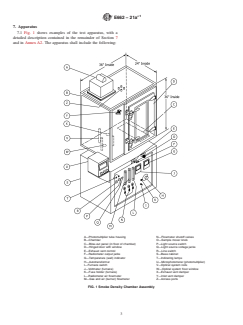
7.1 Fig. 1 shows examples of the test apparatus, with a
detailed description contained in the remainder of Section 7
and in Annex A2. The apparatus shall include the following:
A—Photomultiplier tube housing N—Flowmeter shutoff valves
B—Chamber O—Sample mover knob
C—Blow-out panel (in floor of chamber) P—Light source switch
D—Hinged door with window Q—Light source voltage jacks
E—Exhaust vent control R—Line switch
F—Radiometer output jacks S—Base cabinet
G—Temperature (wall) indicator T—Indicating lamps
H—Autotransformer U—Microphotometer (photomultiplier)
I—Furnace switch V—Optical system rods
J—Voltmeter (furnace) W—Optical system floor window
K—Fuse holder (furnace) X—Exhaust vent damper
L—Radiometer air flowmeter Y—Inlet vent damper
M—Gas and air (burner) flowmeter Z—Access ports
FIG. 1Smoke Density Chamber Assembly
´1
E662−21a
7.1.1 Test Chamber—As shown in Fig. 1, the test chamber periods, in accordance with 11.12. The air-tightness of the
shall be fabricated from laminated panels to provide inside chamber shall be tested at least one per test day in accordance
dimensions of 36 by 24 by 36 6 ⁄8 in. (914 by 610 by 914 6 with 11.2.
3 mm) for width, depth, and height, respectively. The interior
7.1.1.1 If the interior wall surfaces become corroded or the
surfaces shall consist of porcelain enameled metal, or other
coating starts to peel off, users shall repair the damaged area
coated metal, which shall be resistant to chemical attack and
using any suitable coating material, installed to the coating
corrosion, and suitable for periodic cleaning. Sealed windows
manufacturer’s instructions.
shall be provided to accommodate a vertical photometric
NOTE 1—Some high temperature paints have been found satisfactory
system. All other chamber penetrations shall be sealed. When
for this purpose.
all openings are closed, the chamber shall be capable of
7.1.1.2 Fit the chamber with a safety blow-out panel,
developing and maintaining positive pressure during test
consisting of a sheet of aluminum foil of thickness not greater
–3
than 1.63 × 10 in. (0.04 mm) and having a minimum area of
2 2
125in. (80600mm ),fastenedinsuchawayastoprovidean
airtight seal.
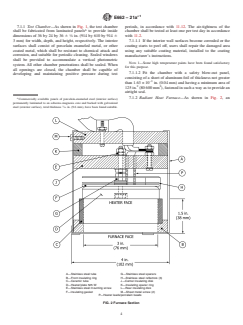
7.1.2 Radiant Heat Furnace—As shown in Fig. 2,an
Commercially available panels of porcelain-enameled steel (interior surface)
permanently laminated to an asbestos-magnesia core and backed with galvanized
steel (exterior surface), total thickness ⁄16 in. (9.6 mm), have been found suitable.
A—Stainless steel tube G—Stainless steel spacers
B—Front insulating ring H—Stainless steel reflectors (3)
C—Ceramic tube J—Center insulating disk
D—Heater/plate 525 W K—Insulating spacer ring
E—Stainless steel mounting screw L—Rear insulating disk
F—Insulating gasket M—Sheet metal screw (2)
P—Heater leads/porcelain beads
FIG. 2Furnace Section
´1
E662−21a
electric furnace with a 3-in. (76.2 mm) diameter opening shall Also shown in Fig. 3 are the spring and rods for retaining the
be used to provide a constant irradiance on the specimen specimen within the holders.
surface. The furnace shall be located along the centerline
7.1.4 Framework for Support of Furnace and Specimen
equidistantbetweenthefrontandbackofthechamber,withthe
Holder—The furnace and specimen supporting framework
opening facing toward and about 12 in. (305 mm) from the
shall be constructed essentially in accordance with Fig. 4.
right wall. The centerline of the furnace shall be about 7 ⁄4 in.
7.1.5 Photometric System—The photometric system shall
(195mm)abovethechamberfloor.Thefurnacecontrolsystem
consist of a light source and photodetector, oriented vertically
shall maintain the required irradiance level, under steady-state
to reduce measurement variations resulting from stratification
conditions with the chamber door closed, of 2.20 6 0.04
2 2 of the smoke generated by materials under test. The system
Btu/ft ·s (2.50 6 0.05 W/cm ) for 20 min.
shall be as shown in Figs. 5 and 6 and include the following:
7.1.2.1 The control system shall consist of one of the
7.1.5.1 The light source shall be a 6.5 V incandescent lamp
following:
operated at 4 V in a circuit powered by a constant-voltage
(1)An autotransformer and a voltmeter for monitoring the
transformer. The light source shall be mounted in a sealed and
electricalinput.Wherelinevoltagefluctuationsexceed 62.5V,
light-tight box. This box shall contain the necessary optics to
a constant voltage transformer is required to maintain the
prescribed irradiance level. provide a collimated light beam passing vertically through the
(2)An electronic temperature controller capable of main- chamber.
tainingfurnacetemperature 65°F(3°C).Ifthisoptionisused,
NOTE 2—Operating the light source at 4 V is intended to provide a
athermocoupleformonitoringthefurnacetemperatureshallbe
brightness temperature of 2200 6 100 K.
required,andthefurnacetemperatureshallbedisplayedonthe
7.1.5.2 The photodetector shall be a photomultiplier tube,
controller or software.
7.1.3 Specimen Holder—Specimenholdersshallconformin withanS-4spectralsensitivityresponseandadarkcurrentless
−9
than 10 A.Aset of nine gelatin compensating filters varying
shape and dimension to that shown in Fig. 3 and be fabricated
9 9
to expose a 2 ⁄16 by 2 ⁄16-in. (65.1 by 65.1 mm) specimen area. from 0.1 to 0.9 neutral density are mounted one or more as
FIG. 3Details of Specimen Holder and Pilot Burner
´1
E662−21a
FIG. 4Furnace Support
required in the optical measuring system to correct for differ- 7.1.6.1 As an option to the air-cooled radiometer, a water-
ences in the luminous sensitivity of the photomultiplier tube. cooled heat flux meter is suitable for use in measuring the heat
These filters also provide correction for light source or photo- flux. The heat flux meter shall consist of a Schmidt-Boelter
multiplier aging and reduction in light transmission, through (thermopile) sensor approximately 1.0 in. (25.4 mm) in diam-
discolored or abraded optical windows.An additional criterion eter mounted in a specimen holder. The specimen holder shall
for selection of photomultiplier tubes requires a minimum include the millboard described in 8.3.4.2, with a hole in the
sensitivity equivalent to that required to give a full scale center to accommodate the meter. The meter shall be mounted
reading with only the No. 5 compensating filter in the light such that the sensing surface is flush with the millboard. The
path.Alight-tightboxlocateddirectlyoppositethelightsource meter shall have an operating range of 0-4.4 Btu/s·ft (0-5.0
shall be provided to mount the photodetector housing and the W/cm ) and an accuracy of within 63%.
associated optics. A glass window shall be used to isolate the
7.1.7 Thermocouple—A thermocouple shall be fixed to the
photodetector and its optics from the chamber atmosphere.
center of the inner surface of the wall opposite the door.
7.1.5.3 In addition to the above compensating filter, a
7.1.8 Output Instrumentation—The outputs of the radiom-
neutral density range extender filter permitting the system to
eter shall be measured using a potentiometer and the results
measuretoOpticalDensity6isincorporatedinthecommercial
recorded. The photodetector output shall be measured with a
version of the smoke density chamber. The accuracy of
potentiometer or other suitable instrument capable of measure-
read-outsintherangeaboveD 528isaffectedbytheexcessive
s
ment over the range of the apparatus. See Annex A1.
light scattering present in such heavy smoke concentration.
7.1.9 Sensor for Chamber Pressure Measurements—Apres-
Where D values over 500 are measured, it is necessary to
s
sure sensor (for example, a manometer or pressure transducer)
provide a chamber window cover to prevent room light from
with a range up to 6 in. (152 mm) of water (1.5 kPa) shall be
being scattered into the photomultiplier, thereby providing an
provided to monitor chamber pressure and leakage. The
incorrect higher transmission value.
pressure measurement point shall be through a gas-sampling
7.1.6 Radiometer—The radiometer for standardizing the
port in the chamber.
output of the radiant heat furnace shall be of the circular foil
7.1.10 Chamber Pressure Relief System—A simple water
type, the operation of which was described by Gardon. The
column or relief valve shall be provided to permit control of
construction of the radiometer shall be as shown in Fig. 7.It
chamber pressure (see A2.8).
shall have a stainless steel reflective heat shield with a 1 ⁄2-in.
7.1.11 Multiple Flamelet Burner—For a flaming exposure
(38.1 mm) aperture on the front and a finned cooler supplied
test, a six-tube burner, with construction details as shown in
withcompressedairmountedonthereartomaintainaconstant
Fig. 3, shall be used. The burner shall be centered in front of
body temperature of 200 6 5°F (93 6 3°C).
and parallel to the specimen holder. The tips of the two
1 1
horizontal tubes shall be centered ⁄4 6 ⁄16 in. (6.4 6 1.5 mm)
1 1
above the lower opening of the specimen holder and ⁄4 6 ⁄32
Gardon R., “An Instrument for the Direct Measurement of Intense Thermal
Radiation,” Review of Scientific Instruments, Vol 24, 1953, pp. 366–370. in.(6.4 60.8mm)awayfromthefaceofthespecimensurface.
´1
E662−21a
A—Photomultiplier housing K—Optical system platforms (2)
B—Photomultiplier tube and socket L—Optical windows (2)
C—Upper shutter blade, with ND2 filter M—Chamber roof
over one aperture
D—Lower shutter blade, with single N—Alignment rods (3)
aperture
E—Opal diffuser filter P—Parallel light beam, 1.5-in. (37.5
mm) diameter
F—Aperature disk Q—Chamber floor
G—Neutral density compensating filter R—Optical window heater, silicone-
(from set of 9) fiberglass 50 W/115 V
H—Lens, 7 diopter (2) S—Regulated light source transformer,
115/125 V-6 V
J—Optical system housing (2) T—Adjustable resistor, light source,
adjusted for 4 V
U—Light source
FIG. 5Photometer Details
Provision shall be made to rotate or move the burner out of propane shall be fed through calibrated flowmeters and needle
3 3
position during nonflaming exposures. The fuel shall be valves at 500 cm /min for air and 50 cm /min for the propane
propanehavinga95%purityorbetter.Filteredoil-freeairand and premixed prior to entry into burner.
´1
E662−21a
rately if required under 8.3.1.The results are valid only for the
thickness and form in which it is tested.
8.2 Specimen Orientation—Ifvisualinspectionofamaterial
indicates a pronounced grain pattern, process-induced orienta-
tion or other nonisotropic property, a minimum of three
specimens shall be tested for each orientation in each test
mode. Exception: Where data are available and to show that
orientation of a specimen has no significant effect on test
results, the specimen is only required to be tested in one
orientation with each test mode (Note 3). When specimens
require testing in different orientations, results of tests for each
orientation shall be reported separately. Test results from
specimens tested under different orientations shall not be used
to obtain average values.
NOTE 3—It has been shown the orientation of carpet test specimens in
terms of length and width (parallel and perpendicular to manufactured
direction) has no statistically significant effect on the specific optical
density obtained using this test method (1).
8.3 Specimen Assembly and Mounting:
8.3.1 General—The specimen shall be representative of the
materials or composite and shall be prepared in accordance
with recommended application procedures. Flat sections of the
FIG. 6Photometer Location
same thickness and composition are to be tested rather than
curved, molded, or specialty parts. Substrate or core materials
for the test specimens shall be the same as those for the
7.1.11.1 It is possible that sample drippings or residue will
intendedapplication.Ifamaterialorassemblyhasthepotential
cause constrictions (or even completely seal) the small open-
tobeexposedtoafireoneitherside,bothsidesshallbetested.
ings in the individual burner tiplets unless the test residues are
If an adhesive is intended for field application of a finish
immediately removed while still warm and viscous. One way
material or substrate, the prescribed type of adhesive and the
to correct or prevent this situation, is for the user to prepare a
spreadingraterecommendedforfieldapplicationoftheassem-
set of six tempered spring steel wires each approximately 3 ⁄2
bly of test specimen shall be used and the details shall be
in. (89 mm) long fabricated from 30-gauge (0.014 in.) wire,
reported.
withoneendcrimpedorbrazedtoaknobtofacilitatehandling
and to prevent possible loss of the wire by complete insertion. 8.3.2 Finish Materials—Finish materials, including sheet
laminates, tiles, fabrics, and others secured to a substrate
When a burner tiplet becomes clogged as indicated by flame
materialwithadhesive,andcompositematerialsnotattachedto
extinguishment and inability to relight or by a distorted flame
a substrate, have the potential to be subject to delamination,
shape, thus invalidating the test, insert one of the wires and
cracking, peeling, or other separations affecting their smoke
work it through several times to clear the obstruction. Imme-
generation. To evaluate these effects, it is often necessary to
diatelyuponremovaloftheburnerfromthechamberwhilestill
perform supplementary tests on a scored (split) exposed
warm, insert all six wires in a like manner but leave them in
surface, or on interior layers or surfaces. When supplementary
placeuntilthenexttimetheburnerisused.Whereresiduesand
tests are conducted for this purpose, the manner of performing
clogging persist, prepare a suitable solvent bath so as to
suchsupplementarytests,andthetestresults,shallbeincluded
immerse the complete burner and use the wires to loosen any
in the report, together with the test results from the conven-
hardened residue. Because of the construction, it is impossible
tional tests.
to service the individual burner tiplets from the opposite
8.3.2.1 Finish Materials without Substrate or Core—For
direction, but because of ratio of diameters any obstruction
comparativetestsoffinishmaterialswithoutanormalsubstrate
pushed through the small diameter tiplets is likely to readily
or core, and for screening purposes only, the following
drop through the large diameter body tubing. Since most of
procedures shall be employed:
these solvents are hazardous, take proper precautions for
handlingandprotectionofpersonnel.Ifflammablesolventsare 8.3.2.2 Rigid or semirigid sheet materials shall be tested by
the standard procedure regardless of thickness.
used, take care to ensure that “hot” burners are not immersed
until cooled to room temperature. 8.3.2.3 In the absence of a specified assembly system,
veneers that are not rigid or semi-rigid sheet materials, in-
8. Test Specimens
tended for application to combustible substrate materials, shall
be applied to the smooth face of ⁄4-in. (6.4 mm) nominal
8.1 Size—The test specimens shall be 3 by 3, +0, −0.03 in.
(76.2 by 76.2, +0, −0.8 mm) by the intended installation
thickness up to and including 1 in. (25.4 mm). Materials
greater than 1 in. (25.4 mm) thick shall be sliced to 1-in. (25.4
Theboldfacenumbersinparenthesesrefertothelistofreferencesattheendof
mm) thickness, and each original (uncut) surface tested sepa- this standard.
´1
E662−21a
FIG. 7Radiometer Details
tempered hardboard, complying withANSI/AHAA135.4 “Ba- thick inorganic insulation millboard with aluminum foil and
sicHardboard”usingrecommendedapplicationtechniquesand placeitbehindthewiresasabackingboardbeforeinsertingthe
coverage rates. Supplementarytestsshallalsobeconductedon spring and retaining rod.
the hardboard alone, and these values shall be recorded as
8.3.4 Specimen Mounting:
supplemental to the measured values for the composite speci-
8.3.4.1 All specimens shall be covered across the back,
men. Both sets of values shall be reported.
along the edges, and over the front surface periphery with a
single sheet of aluminum foil (0.001 6 0.0005 in. or approxi-
NOTE 4—Tempered hardboard sheets conforming to ANSI/AHA
A135.4 are marked with a 0.5 in. (12.7 mm) wide single red stripe placed
mately 0.04 mm) with the dull side in contact with the
on the thickness side approximately 3 in. (76 mm) from each corner.
specimen. Care shall be taken not to puncture the foil or
Service tempered hardboard sheets are marked with two red stripes.
introduceunnecessarywrinklesduringthewrappingoperation.
8.3.2.4 Paints, adhesives, or similar finish materials shall be
Fold in such a way so as to minimize losses of melted material
applied to the smooth face of ⁄4-in. (6.4 mm) thick uncoated
at the bottom of the holder. Excess foil along the front edges
fiber cement board, nominally 90 6 10 lb/ft (1440 6 160
shall be trimmed off after mounting.Aflap of foil shall be cut
kg/m ) in density, complying with Specification C1288 or
and bent forward at the spout to permit flow from melting
C1186, Grade II, using recommended application techniques
specimens.
and coverage rates.
8.3.4.2 All specimens shall be backed with a sheet of ⁄2-in.
8.3.2.5 Fabrics and Thin Films—If fabrics or thin flexible
(12.7 mm) thick inorganic insulation millboard. The specimen
films tend to shrink, to bunch, to blister, or to pull out from
and its backing shall be secured with the spring and retaining
under the specimen holder during the test, the three test
rod.AmodifiedC-shaperetainingrodorsimilardeviceshallbe
specimens shall be stapled with its aluminum foil wrapper to
used with specimens from ⁄8 to 1 in. (16 to 25 mm) thick. Do
the inorganic insulation millboard backing. Five standard size
not deform compressible specimens below their normal thick-
1 1
wirestaples,approximately ⁄2by ⁄4by0.02in.(12.7by6.3by
ness.
0.5 mm), shall be positioned horizontally at the center, and at
the center of the four quadrants.
9. Conditioning
8.3.3 Electrical and Optical Fiber Cables—For test speci-
mens of electrical or optical fiber cables up to 1 in. (25.4 mm) 9.1 Pre-dryspecimensfor24hat140 65°F(60 63°C)and
in diameter, cut the cables to3+0, −0.03 in. (76.2+0−0.8 then condition to equilibrium (constant weight) at an ambient
mm) lengths and insert enough pieces in the specimen holder temperatureof73 65°F(23 63°C)andarelativehumidityof
to fill it, arranged vertically. Wrap a sheet of ⁄2-in. (12.7 mm) 50 6 5% (see 6.7).
´1
E662−21a
9.2 While in the conditioning chamber, specimens shall be 11.3 Clean the chamber walls whenever periodic visual
supported in racks so that air has access to all surfaces. inspection indicates the need. Clean the exposed surfaces of
the glass windows separating the photodetector and light
Forced-airmovementintheconditioningchamberwillassistin
source housing from the interior of the chamber, before each
accelerating the conditioning process.
test (ethyl alcohol is generally effective). Charred residues on
the specimen holder and horizontal rods shall be removed
10. Number of Test Specimens
between tests to avoid contamination.
10.1 Conduct three tests under flaming exposure and three
11.4 During the warm-up period all electric systems
tests under nonflaming exposure on each material (total of six
(furnace,lightsource,photometerreadout,etc.)shallbeon,the
specimens)inaccordancewiththeconditionsdescribedherein.
exhaustventandchamberdoorclosed,andtheinletventopen.
10.1.1 When any result in any set of three replicates is such
When the temperature on the center surface of the back wall
that it exceeds the minimum result by 50%, test an additional
reaches a steady-state value in the range of 95 6 4°F (35 6
set of three replicates and report the average of all six results.
2°C)thechamberisreadyforfurnacecalibratingortesting.To
10.1.2 Where one or more of the three replicate tests increasechamberwallsurfacetemperaturetothestatedlevelit
is permissible for an auxiliary heater to be used but it shall be
demonstrate an unusual behavior such as detailed in 6.1, test
removed prior to performing tests; conversely to decrease this
three additional replicates. Average only the data from the
temperature, the exhaust blower is a useful tool to introduce
successful tests.
cooler air from the laboratory. Standardize the furnace output
10.2 Priortouseinatest,recordtheweightofeachsample.
irradiance at periodic intervals according to test experience
Comparison of the weights with the individual optical density
(normally twice per test day).
resultshasthepotentialtoassistinassessingthereasonsforthe
11.5 A “blank” specimen holder, with the inorganic insula-
variability in measurements.
tion millboard backing exposed shall always be directly in
frontofthefurnaceexceptwhendisplacedtothesideby(1)the
11. Procedure
specimen holder during a test or (2) the radiometer during
calibration. It shall be returned immediately to this position
11.1 Conductalltestsinaroomorenclosedspacehavingan
when testing or calibration is completed to prevent excessive
ambienttemperatureof73 65°F(23 63°C)atthetimeofthe
heating of the adjacent wall surface.
test. After conditioning, (see 9.1), specimens shall be moved
directlytotheroomorenclosedspacewherethesmokedensity 11.6 Perform a furnace calibration in accordance with
chamber is located. Specimens shall not be exposed to an 11.6.1 if using the radiometer, or 11.6.2 if using a heat flux
meter.
environment with an uncontrolled relative humidity for more
11.6.1 Place the radiometer on the horizontal rods of the
than 15 min prior to testing. Take precautions to provide a
furnace support framework and accurately position in front of
means for removing potentially hazardous gases from the area
the furnace opening, by sliding and displacing the “blank”
of operation.
specimen holder against the pre-positioned stop. With the
11.1.1 Caution is urged during use of apparatus to prevent
chamber door closed and inlet vent opened, adjust the com-
explosion of pyrolyzates, particularly under nonflaming condi-
pressedairsupplytotheradiometercoolertomaintainitsbody
tions. Good laboratory procedure is urged also to prevent
temperature at 200 6 5°F (93° 6 3°C). Adjust the autotrans-
exposure of the operatortosmoke,particularlyduringremoval
former or temperature controller setting so as to obtain the
of the sample from the chamber or in clean-up.
calibratedmillivoltoutputoftheradiometercorrespondingtoa
steady-state irradiance of 2.2 6 0.04 Btu/s·ft (2.5 6 0.05
11.2 Measure the air-tightness of the test chamber at least
W/cm ) averaged over the central 1.5-in. (38.1 mm) diameter
once per test day (with the door, vents and spare gas sampling
area. Use the recorder or meter described in 7.1.8 to monitor
pipes closed) by introducing compressed air into the test
the radiometer output.After the prescribed irradiance level has
chamber. Air shall be introduced through one of the gas
reached steady-state, remove the radiometer from the chamber
sampling pipes or through the cooling air supply to the
and replace with the “blank” specimen holder.
radiometer until the pressure is between 3 and 3.5 in. of water
11.6.2 Placetheheatfluxmeteronthehorizontalrodsofthe
gauge (0.76 – 0.87 kPa) and then shutting the air supply off.
furnace support framework and accurately position in front of
The chamber shall be considered airtight if the pressure after 5
the furnace opening, by sliding and displacing the “blank”
min is greater than 2 in. of water (0.5 kPa).
specimen holder against the prepositioned stop. With the
11.2.1 Testing shall not be conducted until the chamber
chamber door open and inlet vent opened, turn on the cooling
passes the air-tightness check in accordance with 11.2.
water supply. Adjust the autotransformer or temperature con-
11.2.2 The air-tightness check shall be repeated in between
troller setting so as to obtain the calibrated millivolt output of
tests if there is any reason to believe the integrity of any of the theheatfluxmetercorrespondingtoasteady-stateirradianceof
2 2
2.2 6 0.04 Btu/s·ft (2.5 6 0.05 W/cm ) as measured by the
seals has been compromised.
NOTE 5—An airtight test chamber helps to ensure accurate results.
Leaks in the chamber allow smoke to escape during the test, leading to
smoke density results that are lower than those obtained with an airtight
An ammoniated spray detergent and soft scouring pads have been found
chamber. effective.
´1
E662−21a
heat flux meter. Use the recorder or meter described in 7.1.8 to 11.14 Continue the test for a period of 3 min after a
monitor the heat flux meter output. After the prescribed minimum light transmittance value is reached or after an
irradiance level has reached steady-state, remove the heat flux exposure of 20 min, whichever occurs first.
meterfromthechamberandreplacewiththe“blank”specimen
11.14.1 Optionally, the test shall be permitted to be con-
holder.
ducted for periods in excess of 20 min at the request of the test
sponsor.
11.7 After the system has reached steady-state conditions,
adjust the zero of the meter or recorder, or both. Adjust the
11.15 If transmittance falls below 0.01%, the chamber
amplifier sensitivity to obtain a full-scale reading of the
window shall be covered with an opaque screen to avoid
photodetector(100%transmittance)ontherecorderorreadout
possible light-scattering effects from room light. Also any
meter.Determinethe“darkcurrent”(0%transmittance)onthe
supplementary optical filter in the photometer system shall be
maximum sensitivity range of the readout meter by blocking
removed or displaced in order to extend the measuring range.
the light. Adjust the “dark current” reading to zero.
If the potential exists for extraneous light to reflect into the
11.8 For nonflaming exposures, remove the multiple flame-
photometer during removal of the filter, turn the high voltage
let burner. For flaming exposures, position the burner across
offoradjustthescaletominimizesensitivity.Replacethefilter
the lower edge of the specimen as described in 7.1.11. Check
before exhausting smoke from the chamber.
the burner distances relative to the “blank” specimen before
11.16 Extinguish the burner on flaming exposures and start
fuel adjustment and ignition.
exhausting the chamber within 1 min after terminating the test
11.9 Beforepositioningthetestspecimen,flushthechamber
(see 11.14 and Note 6). Displace the specimen from the front
withthedoorandexhaustandinletventsopenforabout2min,
ofthefurnacebypushingthe“blank”specimenholderwiththe
and verify the starting temperature of the chamber, using the
positioning rod. Continue to exhaust with the inlet vent open
procedure described in 11.4.
until maximum transmittance is reached. Record this transmit-
11.10 Close the exhaust vent and blower. Place the loaded
tance value as the T , “clear beam” reading.
c
specimen holder on the bar support and push it into position in
NOTE 6—In some cases the transmittance will increase somewhat and
front of the furnace (with burner in position for flaming
subsequently decrease to the ultimate minimum transmittance.
exposure) by displacing the “blank” holder. Quickly close the
chamber door and simultaneously start the timer or recorder
12. Calculation
chart drive, or both. Close the inlet vent completely only when
the photometer indicates the presence of smoke.
12.1 Calculatespecificopticaldensity, D ,atanygiventime
s
11.11 Record the light transmittance and the corresponding as follows:
time either as a continuous plot with a multirange recorder or
D 5 G log 100/T 1F
@ ~ ! #
s 10
at time intervals no greater than 30 s with a multirange meter
where:
readout. Make and note the necessary full-scale range changes
in decade steps. G = V/AL,
3 3
11.11.1 Thephotometerusedwiththisinstrumentshallhave V = volume of the closed chamber, ft (or m ),
2 2
A = exposed area of the specimen, ft (or m ),
anaccuracyof 63%orbetterofthemaximumreadingonany
L = length of the light path through the smoke, ft (or m),
range. As such, the percentage error of a given reading
T = percent light transmittance as read from the light-
becomes progressively worse at the lower portion of the scale.
sensing instrument, and
Avoid light transmittance on scale readings less than 10 by
F = depends on the following:
making the appropriate decade range change.
(1) Ifthemovable filter(see7.1.5.3)is in the light pathat
11.11.2 Some chambers are equipped with a switch that not
the time that T is being measured, F=0, and T is the actual
only incorporates ranges of 100, 10, 1, and 0.1 but also ranges
percent transmittance.
of30,3,and0.3.Withsuchaninstrumentthegreatestaccuracy
(2) If the filter has been moved out of the light path (see
would be achieved in light transmittance readings by making a
7.1.5.3and11.15)atthetimethatTisbeingmeasured,F = the
range change in these intermediate ranges when the light
known optical density of the filter (see A1.1.4), and T is an
transmittancereadingreaches30onthe0-to-100meterscaleor
apparent percent transmittance.
10 on the 0-to-33 scale.
(3) If the optical system is not equipped with a movable
11.12 Observe the increase in chamber pressure with the
filter in accordance with 7.1.5.3, F=0, and T is the actual
manometer described in 7.1.9. Use regulator (see A2.8)to
percent transmittance.
maintain the pressure in the range of 4 6 2 in. (100 6 50 mm)
of water during most of the test. If negative pressure develops
12.1.1 For an instrument constructed in accordance with
afterveryintensespecimenflaming,opentheinletventslightly
this standard, corrections for the volume of the furnace
to equalize the pressure.As a result of pressure rise, adjust the
assembly and the volume included in the door recess are
fuel and air valves during the flaming test to maintain constant
generally less than 1%. As such, G =132.
flow rate.
12.1.2 A table for D versus actual percent light transmit-
s
11.13 Record any observations pertinent to the burning and tance is given in Appendix X2. The D values above 528 are
s
smoke generating properties of the material under test, in based on an assumed optical density of 2.00 for the movable
accordance with 13.1.6 and 13.1.7. filter.
´1
E662−21a
12.2 Calculate the maximum specific optical density, D , 13.1.9 Test results, rounded to two significant figures as
m
using the equation in 12.1 with a light transmittance corre- described in Section 12, including the average and range on
sponding to the minimum level reached during the test. each set of specimens for D with time of occurrence, and
m
12.2.1 Similarly, calculate D using the T value. D (corr).
c c m
12.2.2 Calculate D (corrected) as follows:
m
NOTE 7—Prior to the adoption of this test method, it was customary to
D corr 5 D 2 D report the maximum smoke accumulated as D (corr), and for that reason
~ !
m
m m c
it has been included as a part of the test report. Subsequently, a statistical
12.3 For systems without “dark current” cancellation or
analysis of the round-robin data upon which the precision statement is
“blank adjust” provisions, a correction shall be made for any
based, showed that the D values were more uniform. Therefore, it is
m
light transmittance reading, T, approaching the dark current required that both D and D (corr) be reported.
m m
value, T . Calculate the corrected light transmittance, T', as
d 13.1.9.1 If supplementary tests are required by Section 8,
follows:
the results of those tests shall also be reported.
1 2 T T 2 T
d
T' 5 1 2 5
14. Precision and Bias
1 2 T 1 2 T
d d
14.1 Precision:
and is used for the specific optical density calculations
14.1.1 Tables 1 and 2 are calculated from the results
described in 12.1 and 12.2.
obtained when 25 materials were tested by 20 laboratories in a
12.4 Determine t , the time in minutes for the smoke to
D
round-robinstudyconductedbyASTMSubcommitteeE05.02,
m
accumulate to the maximum specific optical density.
following a prior draft version of this method. That study
indicated several sections of the test procedure that required
12.5 Whenthetestiscontinuedbeyondthestandard20-min
additional description, and this version has been revised
exposure, make all calculations in accordance with 12.1 – 12.4
accordingly. It is reasonable to expect that this version of the
and identify the results as “Extended Exposure.”
method will provide better precision than that tabulated.
13. Report
14.1.2 The precision statements in these tables are ex-
pressedasapercentageoftheaverage D ofeachmaterialand
13.1 Report the following information:
m
arebasedononlythevalidatedresults(seeSection3)fromthe
13.1.1 Complete description of the material tested includ-
three replicates submitted to each laboratory.
ing: type, manufacturer, shape, thickness, or other appropriate
14.1.3 Coeffıcient of Variation—The ratio of either the
dimensions,weightordensity,coloring,andanyotherrelevant
“within laboratory” or “between laboratories” standard devia-
details.
tiontotheoverallaverage D valueforthematerial,expressed
13.1.2 Complete description of the test specimens, includ-
m
as a percent.
ing: substrate or core, special preparation, mounting, specimen
14.1.4 Relative Precision:
orientation, and any other relevant details.
14.1.4.1 Repeatability, R —The critical difference within
13.1.3 Informa
...