

ASTM D5652-21
(Test Method)Standard Test Methods for Single-Bolt Connections in Wood and Wood-Based Products
General Information
- Abstract
SIGNIFICANCE AND USE
4.1 Connections are one of the most important components in wood construction. While the strength of metal bolts and of wood or wood-based products are ascertainable, a full evaluation of the performance of the combination is only possible through the testing of a complete connection assembly. Such variables as member thickness, member width, end and edge distances, type of bolt, fabrication tolerances, moisture content of the wood or wood-based product, preservative or fire-retardant treatment of the wood or wood-based product, species of wood, and/or material type and orientation of wood-based material may affect connection behavior. In order to develop design criteria for established bolt types as well as those under development, the effect of these variables on connection strength and stiffness must be known. The tests described herein permit the observation of data on the strength and stiffness of wood or wood-based connections, or both, under the influence of any or all of these factors.
SCOPE
1.1 These test methods cover procedures for evaluating the strength and stiffness of single-bolt connections in wood or wood-based products when subjected to short-term static loading. These test methods serve as a basis for determining the effects of various factors on the strength and stiffness of the connection. Long-term loading and creep displacement characteristics are outside the scope of this protocol.
1.2 These test methods are intended for situations employing a smooth shank bolt with a constant diameter.
1.3 The values stated in inch-pound units are to be regarded as standard. The values given in parentheses are mathematical conversions to SI units that are provided for information only and are not considered standard.
1.4 This standard does not purport to address all of the safety concerns, if any, associated with its use. It is the responsibility of the user of this standard to establish appropriate safety, health, and environmental practices and determine the applicability of regulatory limitations prior to use.
1.5 This international standard was developed in accordance with internationally recognized principles on standardization established in the Decision on Principles for the Development of International Standards, Guides and Recommendations issued by the World Trade Organization Technical Barriers to Trade (TBT) Committee.
- Status
- Published
- Publication Date
- 14-Mar-2021
- Technical Committee
- D07 - Wood
- Drafting Committee
- D07.05 - Wood Assemblies
Buy Documents
ASTM D5652-21 - Standard Test Methods for Single-Bolt Connections in Wood and Wood-Based Products
REDLINE ASTM D5652-21 - Standard Test Methods for Single-Bolt Connections in Wood and Wood-Based Products
Overview
ASTM D5652-21: Standard Test Methods for Single-Bolt Connections in Wood and Wood-Based Products sets out uniform procedures for evaluating the strength and stiffness of single-bolt connections in wood and wood-based materials under short-term static loading. Developed by ASTM International, this standard supports the structural wood industry and provides a reliable foundation for assessing the performance of bolted connections, which are critical in wood construction.
The standard is applicable to connections using smooth-shank bolts with a constant diameter and focuses on evaluating full connection assemblies to provide practical insights into real-world performance. It addresses key variables affecting connection strength and stiffness, including wood species, member dimensions, moisture content, and fabrication details.
Key Topics
- Testing Procedures
Outlines methods to measure the capacity and slip (displacement) of single-bolt connections under static load, including both compressive and tensile forces. - Variable Analysis
Permits evaluation of a wide range of variables that influence joint strength, such as:- Thickness and width of members
- End and edge distances
- Bolt type and fit
- Moisture and conditioning of materials
- Species and grading of wood products
- Orientation and uniformity of wood-based materials
- Specimen Preparation
Details requirements for preparing test specimens, ensuring exclusion or inclusion of knots and cross grain based on test objectives and emphasizing representativeness of structural applications. - Measurement and Reporting
Specifies load application rates, measurement of slip, and procedures for data collection and interpretation, including:- Yield load
- Proportional limit load
- Initial stiffness
- Failure mode
- Sampling and Data Analysis
Recommends minimum sample sizes and guidance for achieving statistically significant results, plus detailed reporting of key connection properties and performance characteristics.
Applications
ASTM D5652-21 is widely used in:
- Structural Design
Enables engineers and designers to develop reliable design criteria for wood and wood-based structures using bolted connections, accounting for different materials and joint configurations. - Product Development and Evaluation
Assists manufacturers and testing laboratories in evaluating the performance of new or existing wood-based construction products, including engineered wood and composite lumber. - Quality Assurance and Research
Provides a standardized methodology for research institutions and quality control processes seeking to assess the mechanical properties and safe use of bolted joints in wood structures. - Regulatory Compliance
Supports compliance with building codes and referenced standards that require data on connection strength and behavior, especially for safety-critical applications in construction.
Related Standards
For holistic evaluation and compliance, ASTM D5652-21 references and complements the following standards:
- ASTM D2395: Test Methods for Density and Specific Gravity of Wood and Wood-Based Materials
- ASTM D2915: Practice for Sampling and Data-Analysis for Structural Wood and Wood-Based Products
- ASTM D4442: Test Methods for Direct Moisture Content Measurement of Wood and Wood-Based Materials
- ASTM E4: Practices for Force Verification of Testing Machines
- ASTM E2309/E2309M: Practices for Verification of Displacement Measuring Systems
- ASTM F606/F606M: Test Methods for Determining the Mechanical Properties of Fasteners
- Fed. Spec. FF-W-92: Specification for Metal Flat Washers
- ANSI/AWC NDS: National Design Specification for Wood Construction
Keywords: ASTM D5652-21, single-bolt connections, wood-based products, connection strength, connection stiffness, static loading, bolted joints, wood construction, test methods, structural wood, bolted connection testing.
Relations
- Effective Date
- 01-Mar-2020
- Effective Date
- 01-Feb-2020
- Effective Date
- 15-Nov-2016
- Effective Date
- 01-Sep-2016
- Effective Date
- 01-Jun-2015
- Effective Date
- 01-Nov-2014
- Effective Date
- 01-Jun-2014
- Effective Date
- 01-May-2014
- Effective Date
- 01-May-2014
- Effective Date
- 15-Jan-2011
- Refers
ASTM D2915-10 - Practice for Sampling and Data-Analysis for Structural Wood and Wood-Based Products - Effective Date
- 01-Nov-2010
- Effective Date
- 01-Jun-2010
- Effective Date
- 01-Nov-2009
- Effective Date
- 01-Apr-2009
- Effective Date
- 01-Dec-2008
Buy Documents
ASTM D5652-21 - Standard Test Methods for Single-Bolt Connections in Wood and Wood-Based Products
REDLINE ASTM D5652-21 - Standard Test Methods for Single-Bolt Connections in Wood and Wood-Based Products
Get Certified
Connect with accredited certification bodies for this standard

Gozdarski inštitut Slovenije
Slovenian Forestry Institute. Forest management certification support, timber testing.
Sponsored listings
Frequently Asked Questions
ASTM D5652-21 is a standard published by ASTM International. Its full title is "Standard Test Methods for Single-Bolt Connections in Wood and Wood-Based Products". This standard covers: SIGNIFICANCE AND USE 4.1 Connections are one of the most important components in wood construction. While the strength of metal bolts and of wood or wood-based products are ascertainable, a full evaluation of the performance of the combination is only possible through the testing of a complete connection assembly. Such variables as member thickness, member width, end and edge distances, type of bolt, fabrication tolerances, moisture content of the wood or wood-based product, preservative or fire-retardant treatment of the wood or wood-based product, species of wood, and/or material type and orientation of wood-based material may affect connection behavior. In order to develop design criteria for established bolt types as well as those under development, the effect of these variables on connection strength and stiffness must be known. The tests described herein permit the observation of data on the strength and stiffness of wood or wood-based connections, or both, under the influence of any or all of these factors. SCOPE 1.1 These test methods cover procedures for evaluating the strength and stiffness of single-bolt connections in wood or wood-based products when subjected to short-term static loading. These test methods serve as a basis for determining the effects of various factors on the strength and stiffness of the connection. Long-term loading and creep displacement characteristics are outside the scope of this protocol. 1.2 These test methods are intended for situations employing a smooth shank bolt with a constant diameter. 1.3 The values stated in inch-pound units are to be regarded as standard. The values given in parentheses are mathematical conversions to SI units that are provided for information only and are not considered standard. 1.4 This standard does not purport to address all of the safety concerns, if any, associated with its use. It is the responsibility of the user of this standard to establish appropriate safety, health, and environmental practices and determine the applicability of regulatory limitations prior to use. 1.5 This international standard was developed in accordance with internationally recognized principles on standardization established in the Decision on Principles for the Development of International Standards, Guides and Recommendations issued by the World Trade Organization Technical Barriers to Trade (TBT) Committee.
SIGNIFICANCE AND USE 4.1 Connections are one of the most important components in wood construction. While the strength of metal bolts and of wood or wood-based products are ascertainable, a full evaluation of the performance of the combination is only possible through the testing of a complete connection assembly. Such variables as member thickness, member width, end and edge distances, type of bolt, fabrication tolerances, moisture content of the wood or wood-based product, preservative or fire-retardant treatment of the wood or wood-based product, species of wood, and/or material type and orientation of wood-based material may affect connection behavior. In order to develop design criteria for established bolt types as well as those under development, the effect of these variables on connection strength and stiffness must be known. The tests described herein permit the observation of data on the strength and stiffness of wood or wood-based connections, or both, under the influence of any or all of these factors. SCOPE 1.1 These test methods cover procedures for evaluating the strength and stiffness of single-bolt connections in wood or wood-based products when subjected to short-term static loading. These test methods serve as a basis for determining the effects of various factors on the strength and stiffness of the connection. Long-term loading and creep displacement characteristics are outside the scope of this protocol. 1.2 These test methods are intended for situations employing a smooth shank bolt with a constant diameter. 1.3 The values stated in inch-pound units are to be regarded as standard. The values given in parentheses are mathematical conversions to SI units that are provided for information only and are not considered standard. 1.4 This standard does not purport to address all of the safety concerns, if any, associated with its use. It is the responsibility of the user of this standard to establish appropriate safety, health, and environmental practices and determine the applicability of regulatory limitations prior to use. 1.5 This international standard was developed in accordance with internationally recognized principles on standardization established in the Decision on Principles for the Development of International Standards, Guides and Recommendations issued by the World Trade Organization Technical Barriers to Trade (TBT) Committee.
ASTM D5652-21 is classified under the following ICS (International Classification for Standards) categories: 21.060.01 - Fasteners in general; 79.020 - Wood technology processes. The ICS classification helps identify the subject area and facilitates finding related standards.
ASTM D5652-21 has the following relationships with other standards: It is inter standard links to ASTM D4442-20, ASTM E2309/E2309M-20, ASTM D4442-16, ASTM F606/F606M-16, ASTM D4442-15, ASTM F606/F606M-14a, ASTM E4-14, ASTM D2395-14e1, ASTM D2395-14, ASTM E2309/E2309M-05(2011)e1, ASTM D2915-10, ASTM E4-10, ASTM E4-09a, ASTM E4-09, ASTM E4-08. Understanding these relationships helps ensure you are using the most current and applicable version of the standard.
ASTM D5652-21 is available in PDF format for immediate download after purchase. The document can be added to your cart and obtained through the secure checkout process. Digital delivery ensures instant access to the complete standard document.
Standards Content (Sample)
This international standard was developed in accordance with internationally recognized principles on standardization established in the Decision on Principles for the
Development of International Standards, Guides and Recommendations issued by the World Trade Organization Technical Barriers to Trade (TBT) Committee.
Designation: D5652 − 21
Standard Test Methods for
Single-Bolt Connections in Wood and Wood-Based
Products
This standard is issued under the fixed designation D5652; the number immediately following the designation indicates the year of
original adoption or, in the case of revision, the year of last revision. A number in parentheses indicates the year of last reapproval. A
superscript epsilon (´) indicates an editorial change since the last revision or reapproval.
1. Scope D4442 Test Methods for Direct Moisture Content Measure-
ment of Wood and Wood-Based Materials
1.1 These test methods cover procedures for evaluating the
E4 Practices for Force Verification of Testing Machines
strength and stiffness of single-bolt connections in wood or
E2309/E2309M Practices for Verification of Displacement
wood-based products when subjected to short-term static
Measuring Systems and Devices Used in Material Testing
loading.Thesetestmethodsserveasabasisfordeterminingthe
Machines
effects of various factors on the strength and stiffness of the
F606/F606M Test Methods for Determining the Mechanical
connection. Long-term loading and creep displacement char-
Properties of Externally and Internally Threaded
acteristics are outside the scope of this protocol.
Fasteners, Washers, Direct Tension Indicators, and Rivets
1.2 These test methods are intended for situations employ-
2.2 Federal Specification:
ing a smooth shank bolt with a constant diameter.
Fed. Spec. FF-W-92 for Washers, Metal, Flat (Plain)
2.3 Other Standards:
1.3 The values stated in inch-pound units are to be regarded
as standard. The values given in parentheses are mathematical NDS ANSI/AWC National Design Specification for Wood
Construction
conversions to SI units that are provided for information only
and are not considered standard.
3. Summary of Test Methods
1.4 This standard does not purport to address all of the
3.1 Specimens consisting of at least one wood or wood-
safety concerns, if any, associated with its use. It is the
based member fastened with one bolt to at least one other
responsibility of the user of this standard to establish appro-
member of any material are evaluated for capacity to resist
priate safety, health, and environmental practices and deter-
compressive or tensile forces applied at a constant speed of
mine the applicability of regulatory limitations prior to use.
displacement with a suitable testing machine. The slip, or
1.5 This international standard was developed in accor-
displacement, of the connection at various intervals of loading
dance with internationally recognized principles on standard-
is measured. Supplementary physical properties of the wood or
ization established in the Decision on Principles for the
wood-based members are also determined.
Development of International Standards, Guides and Recom-
mendations issued by the World Trade Organization Technical
4. Significance and Use
Barriers to Trade (TBT) Committee.
4.1 Connections are one of the most important components
in wood construction. While the strength of metal bolts and of
2. Referenced Documents
wood or wood-based products are ascertainable, a full evalu-
2.1 ASTM Standards:
ation of the performance of the combination is only possible
D2395 TestMethodsforDensityandSpecificGravity(Rela-
through the testing of a complete connection assembly. Such
tive Density) of Wood and Wood-Based Materials
variables as member thickness, member width, end and edge
D2915 Practice for Sampling and Data-Analysis for Struc-
distances, type of bolt, fabrication tolerances, moisture content
tural Wood and Wood-Based Products
of the wood or wood-based product, preservative or fire-
retardant treatment of the wood or wood-based product,
These test methods are under the jurisdiction of ASTM Committee D07 on
species of wood, and/or material type and orientation of
Wood and are the direct responsibility of Subcommittee D07.05 on Wood Assem-
wood-based material may affect connection behavior. In order
blies.
to develop design criteria for established bolt types as well as
Current edition approved March 15, 2021. Published April 2021. Originally
those under development, the effect of these variables on
approved in 1995. Last previous edition approved in 2015 as D5652 – 15. DOI:
10.1520/D5652-21.
connection strength and stiffness must be known. The tests
For referenced ASTM standards, visit the ASTM website, www.astm.org, or
described herein permit the observation of data on the strength
contact ASTM Customer Service at service@astm.org. For Annual Book of ASTM
and stiffness of wood or wood-based connections, or both,
Standards volume information, refer to the standard’s Document Summary page on
the ASTM website. under the influence of any or all of these factors.
Copyright © ASTM International, 100 Barr Harbor Drive, PO Box C700, West Conshohocken, PA 19428-2959. United States
D5652 − 21
5. Apparatus berandomlypositionedintothememberwithoutfurtherbiasto
consider strength reducing characteristics.
5.1 Testing Machine—Any suitable testing machine capable
7.1.3 Non-Uniform Cross-Sections—Cross-sectionsselected
of operation at a constant movable crosshead speed and having
for testing shall be representative of the product to be evalu-
an accuracy of 61 % when calibrated in accordance with
ated. Some wood-based products are made with a hollow
Practices E4.
extrusion, significant density gradient profile, or other non-
5.2 Spherical Bearing Block, for compressive loading of
uniformitythathasthepotentialtoimpactthetestresults.Ifthe
specimens.
wood-based product to be tested has a non-uniform cross-
section, then the related product characteristics and the bolt
5.3 Grips—Gripping devices capable of attaching the speci-
position shall be reported in detail.
men to the stationary and moving heads of the testing machine
7.1.4 Steel—Steel members used as part of the test program
in such a way as to ensure true axial tensile loads.
shall have their nominal thickness and grade chosen to satisfy
5.4 Displacement Measurement Devices—At least two dis-
the experimental objectives and be recorded.
placement measurement devices for measuring the slip be-
7.1.5 Bolts—The nominal bolt diameter and grade shall be
tween connection members during load application. These
chosen to satisfy the experimental objectives and be recorded.
devices shall be capable of at least a Class B rating when
NOTE 2—For product evaluation purposes, it may be desirable to select
evaluated in accordance with Practice E2309/E2309M.
materialsthatconservativelyrepresenttherangeofpermittedapplications.
For example, using the lowest permitted specific gravity of wood, the
6. Sampling
lowest grade of wood-based material, the worst-case non-uniform cross-
section, etc. These constraints should be considered on a case-by-case
6.1 Sampling shall provide for selection of representative
basis.
test specimens that are appropriate to the objectives of the
7.2 Primary Tests:
testing program.
7.2.1 Primary tests shall be made on connections loaded
6.2 Sample size shall be estimated in accordance with the
parallel to the grain and perpendicular to the grain of members.
proceduresofMethodD2915;however,aminimumoftentests
7.2.1.1 Parallel to the grain tests shall be conducted with the
shallbeconductedtoevaluateeachconnectionconfigurationor
grain or strength-axis of the main and of the side members
variable.
parallel to the direction of the load.
7.2.1.2 Perpendiculartothegraintestsshallbeconductedas
NOTE 1—The precision required, and thus, the manner of sampling and
the number of tests, depend upon the specific test objectives. No specific
follows:
criteria can therefore be established. General experience indicates that the
(1) with the grain or strength-axis of the main member
coefficients of variation from tests on connections range from approxi-
perpendicular and the side members perpendicular to the
mately 15 to 30 %. Depending upon the objectives of the test, it is
direction of the load,
important to understand the different failure modes that might occur
between specimens for a given test configuration, the variation associated (2) with the grain or strength-axis of the main member
with those modes, and their impact upon variability. For those configu-
parallel and the side members perpendicular to the direction of
rations that result in multiple modes of failure, it may be necessary to
the load, or
conduct exploratory testing to establish the expected variability.
(3) with the grain or strength-axis of the main member
perpendicular and the side members parallel to the direction of
7. Test Specimens
the load.
7.1 Material Selection:
7.2.2 Primary tests shall be made by applying compressive
7.1.1 Wood—Select the material, and position the bolt in the
or tensile loads to the connection assembly as required;
members in such a way that the results are not affected by however, application of tensile load is preferred.
knots, cross grain, or other natural or manufacturing charac-
7.2.3 Connection assemblies for primary tests shall consist
teristics unless the purpose of the test methods is to evaluate of three members as shown in Fig. 1, Fig. 2,or Fig. 3. Where
the effects of such characteristics. When the effects of manu-
specific data on two-member or multiple-member connections
facturing and growth characteristics are not being evaluated, are being sought, see 7.3.
wood members shall be essentially clear and straight-grained.
7.2.3.1 Select the width, length, and thickness of the mem-
Unless otherwise specified to satisfy the test objectives, the bers considering the required edge and end distances. Member
wood members shall be selected to target an average oven-dry
dimensions shall be representative of the test objectives or as
specific gravity representative of the material to be evaluated. required to target specific yield modes or failure modes.
7.1.2 Wood-Based Material—For wood-based products, 7.2.3.2 For members loaded parallel to the grain, the end
such as structural composite lumber or wood plastic distance shall be seven times the bolt diameter for tensile
composites, the specimen grade, density, thickness and other loading (Fig. 1) and four times the bolt diameter for compres-
manufactured characteristics shall be representative of the sive loading (Fig. 2), unless the effect of various end distances
material to be evaluated. Since the connection properties of a is to be studied (see 7.3).
wood-based product typically vary with the cross-sectional 7.2.3.3 Formembersloadedperpendiculartothegrain(Fig.
product orientation, the bolt shall be positioned in the cross- 3), the unloaded edge distance shall be 1.5 times the bolt
sectional orientation to be evaluated and that orientation shall diameter and the loaded edge distance shall be four times the
be recorded. Unless the purpose of the study is to evaluate a bolt diameter, unless the effect of various edge distances is to
product’s known strength reducing characteristics, bolts shall be studied (see 7.3).
D5652 − 21
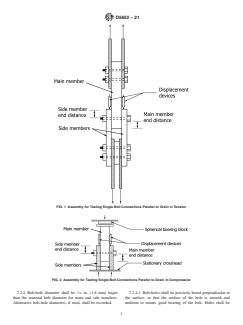
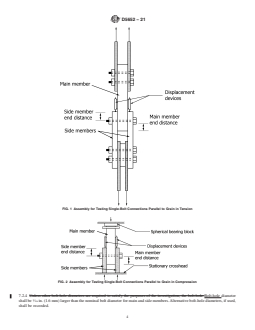
FIG. 1 Assembly for Testing Single-Bolt Connections Parallel to Grain in Tension
FIG. 2 Assembly for Testing Single-Bolt Connections Parallel to Grain in Compression
7.2.4 Bolt-hole diameter shall be ⁄16 in. (1.6 mm) larger 7.2.4.1 Bolt-holes shall be precisely bored perpendicular to
than the nominal bolt diameter for main and side members. the surface, so that the surface of the hole is smooth and
Alternative bolt-hole diameters, if used, shall
...
This document is not an ASTM standard and is intended only to provide the user of an ASTM standard an indication of what changes have been made to the previous version. Because
it may not be technically possible to adequately depict all changes accurately, ASTM recommends that users consult prior editions as appropriate. In all cases only the current version
of the standard as published by ASTM is to be considered the official document.
Designation: D5652 − 15 D5652 − 21
Standard Test Methods for
Single-Bolt Connections in Wood and Wood-Based
Products
This standard is issued under the fixed designation D5652; the number immediately following the designation indicates the year of
original adoption or, in the case of revision, the year of last revision. A number in parentheses indicates the year of last reapproval. A
superscript epsilon (´) indicates an editorial change since the last revision or reapproval.
1. Scope
1.1 These test methods cover procedures for evaluating the strength and stiffness of single-bolt connections in wood or
wood-based products when subjected to short-term static loading. These test methods serve as a basis for determining the effects
of various factors on the strength and stiffness of the connection. Long-term loading and creep displacement characteristics are
outside the scope of this protocol.
1.2 These test methods are intended for situations employing a smooth shank bolt with a constant diameter.
1.3 The values stated in inch-pound units are to be regarded as the standard. The SI unitsvalues given in parentheses are for
information only.mathematical conversions to SI units that are provided for information only and are not considered standard.
1.4 This standard does not purport to address all of the safety concerns, if any, associated with its use. It is the responsibility
of the user of this standard to establish appropriate safety safety, health, and healthenvironmental practices and determine the
applicability of regulatory limitations prior to use.
1.5 This international standard was developed in accordance with internationally recognized principles on standardization
established in the Decision on Principles for the Development of International Standards, Guides and Recommendations issued
by the World Trade Organization Technical Barriers to Trade (TBT) Committee.
2. Referenced Documents
2.1 ASTM Standards:
D2395 Test Methods for Density and Specific Gravity (Relative Density) of Wood and Wood-Based Materials
D2915 Practice for Sampling and Data-Analysis for Structural Wood and Wood-Based Products
D4442 Test Methods for Direct Moisture Content Measurement of Wood and Wood-Based Materials
E4 Practices for Force Verification of Testing Machines
E2309/E2309M Practices for Verification of Displacement Measuring Systems and Devices Used in Material Testing Machines
F606/F606M Test Methods for Determining the Mechanical Properties of Externally and Internally Threaded Fasteners,
Washers, Direct Tension Indicators, and Rivets
2.2 Federal Specification:
Fed. Spec. FF-W-92 for Washers, Metal, Flat (Plain)
2.3 Other Standards:
NDS ANSI/AWC National Design Specification for Wood Construction
These test methods are under the jurisdiction of ASTM Committee D07 on Wood and are the direct responsibility of Subcommittee D07.05 on Wood Assemblies.
Current edition approved Dec. 1, 2015March 15, 2021. Published February 2016April 2021. Originally approved in 1995. Last previous edition approved in 20132015
as D5652 – 95 (2013).D5652 – 15. DOI: 10.1520/D5652-15.10.1520/D5652-21.
For referenced ASTM standards, visit the ASTM website, www.astm.org, or contact ASTM Customer Service at service@astm.org. For Annual Book of ASTM Standards
volume information, refer to the standard’s Document Summary page on the ASTM website.
Copyright © ASTM International, 100 Barr Harbor Drive, PO Box C700, West Conshohocken, PA 19428-2959. United States
D5652 − 21
3. Summary of Test Methods
3.1 Specimens consisting of at least one wood or wood-based member fastened with one bolt to at least one other member of any
material are evaluated for capacity to resist compressive or tensile forces applied at a constant speed of displacement with a suitable
testing machine. The slip, or displacement, of the connection at various intervals of loading is measured. Supplementary physical
properties of the wood or wood-based members are also determined.
4. Significance and Use
4.1 Connections are one of the most important components in wood construction. While the strength of metal bolts and of wood
or wood-based products are ascertainable, a full evaluation of the performance of the combination is only possible through the
testing of a complete connection assembly. Such variables as member thickness, member width, end and edge distances, type of
bolt, fabrication tolerances, moisture content of the wood or wood-based product, preservative or fire-retardant treatment of the
wood or wood-based product, species of wood, and/or material type and orientation of wood-based material may affect connection
behavior. In order to develop design criteria for established bolt types as well as those under development, the effect of these
variables on connection strength and stiffness must be known. The tests described herein permit the observation of data on the
strength and stiffness of wood or wood-based connections, or both, under the influence of any or all of these factors.
5. Apparatus
5.1 Testing Machine—Any suitable testing machine capable of operation at a constant movable crosshead speed and having an
accuracy of 61 % when calibrated in accordance with Practices E4.
5.2 Spherical Bearing Block, for compressive loading of specimens.
5.3 Grips—Gripping devices capable of attaching the specimen to the stationary and moving heads of the testing machine in such
a way as to ensure true axial tensile loads.
5.4 Displacement Measurement Devices—At least two displacement measurement devices for measuring the slip between
connection members during load application. These devices shall be capable of at least a Class B rating when evaluated in
accordance with Practice E2309/E2309M.
6. Sampling
6.1 Sampling shall provide for selection of representative test specimens that are appropriate to the objectives of the testing
program.
6.2 Sample size shall be estimated in accordance with the procedures of Method D2915; however, a minimum of ten tests shall
be conducted to evaluate each connection configuration or variable. See Note 1 for guidance in this respect.
NOTE 1—The precision required, and thus, the manner of sampling and the number of tests, depend upon the specific test objectives. No specific criteria
can therefore be established. General experience indicates that the coefficients of variation from tests on connections range from approximately 15 to
30 %. Depending upon the objectives of the test, it is important to understand the different failure modes that might occur between specimens for a given
test configuration, the variation associated with those modes, and their impact upon variability. For those configurations that result in multiple modes of
failure, it may be necessary to conduct exploratory testing to establish the expected variability.
7. Test Specimens
7.1 Material Selection:
7.1.1 Wood—Select wood members,the material, and position the bolt in them the members in such a way that the results are not
affected by knots, cross grain, or other natural or manufacturing characteristics unless the purpose of the test methods is to evaluate
the effects of such growth characteristics. When the effects of manufacturing and growth characteristics are not being evaluated,
wood members shall be essentially clear and straight-grained. Unless otherwise specified to satisfy the test objectives, the wood
members shall be selected to target an average oven-dry specific gravity representative of the material to be evaluated.
7.1.2 Wood-Based Material—For wood-based products, such as structural composite lumber or wood plastic composites, the
D5652 − 21
specimen grade, density, thickness and other manufactured characteristics shall be representative of the material to be evaluated.
Since the connection properties of a wood-based product typically vary with the cross-sectional product orientation, the bolt shall
be positioned in the cross-sectional orientation to be evaluated and that orientation shall be recorded. Unless the purpose of the
study is to evaluate a product’s known strength reducing characteristics, bolts shall be randomly positioned into the member
without further bias to consider strength reducing characteristics.
7.1.3 Non-Uniform Cross-Sections—Cross-sections selected for testing shall be representative of the product to be evaluated.
Some wood-based products are made with a hollow extrusion, significant density gradient profile, or other non-uniformity that has
the potential to impact the test results. If the wood-based product to be tested has a non-uniform cross-section, then the related
product characteristics and the bolt position shall be reported in detail.
7.1.4 Steel—Steel members used as part of the test program shall have their nominal thickness and grade chosen to satisfy the
experimental objectives and be recorded.
7.1.5 Bolts—The nominal bolt diameter and grade shall be chosen to satisfy the experimental objectives and be recorded.
NOTE 2—For product evaluation purposes, it may be desirable to select materials that conservatively represent the range of permitted applications. For
example, using the lowest permitted specific gravity of wood, the lowest grade of wood-based material, the worst-case non-uniform cross-section, etc.
These constraints should be considered on a case-by-case basis.
7.2 Connection Assembly:Primary Tests:
7.2.1 Connection assemblies shall consist of three members as shown in Primary tests shall Figs. 1-3 except where specific data
on two- or multiple-member connections are being sought. Select the width, length, and thickness of the members with
consideration of required edge and end distances. Member dimensions shall be representative of the test objectives or as required
to target specific yield or failure modes.be made on connections loaded parallel to the grain and perpendicular to the grain of
members.
7.2.1.1 Parallel to the grain tests shall be conducted with the grain or strength-axis of the main and of the side members parallel
to the direction of the load.
7.2.1.2 Perpendicular to the grain tests shall be conducted as follows:
(1) with the grain or strength-axis of the main member perpendicular and the side members perpendicular to the direction of
the load,
(2) with the grain or strength-axis of the main member parallel and the side members perpendicular to the direction of the load,
or
(3) with the grain or strength-axis of the main member perpendicular and the side members parallel to the direction of the load.
7.2.2 Primary tests shall be made by applying compressive or tensile loads to the connection assembly as required; however,
application of tensile load is preferred.
7.2.3 For members loaded parallel to grain, the minimum end distance shall be seven bolt diameters for tension loading
(Connection assemblies for primary tests shall consist of three members as shown in Fig. 1) and four bolt diameters for
compression loading (, Fig. 2), unless the effect of various end distances is to be studied. For members loaded perpendicular to
grain (, or Fig. 3), the minimum unloaded edge distance shall be 1.5 bolt diameters and the. Where specific data on two-member
or multiple-member connections are being sought, see 7.3minimum loaded edge distance shall be four diameters, unless the effect
of various edge distances is to be studied.
7.2.3.1 Select the width, length, and thickness of the members considering the required edge and end distances. Member
dimensions shall be representative of the test objectives or as required to target specific yield modes or failure modes.
7.2.3.2 For members loaded parallel to the grain, the end distance shall be seven times the bolt diameter for tensile loading (Fig.
1) and four times the bolt diameter for compressive loading (Fig. 2), unless the effect of various end distances is to be studied (see
7.3).
7.2.3.3 For members loaded perpendicular to the grain (Fig. 3), the unloaded edge distance shall be 1.5 times the bolt diameter
and the loaded edge distance shall be four times the bolt diameter, unless the effect of various edge distances is to be studied (see
7.3).
D5652 − 21
FIG. 1 Assembly for Testing Single-Bolt Connections Parallel to Grain in Tension
FIG. 2 Assembly for Testing Single-Bolt Connections Parallel to Grain in Compression
7.2.4 Unless other bolt-hole diameters are required to satisfy the purposes of the investigation, the bolt-hole Bolt-hole diameter
shall be ⁄16 in. (1.6 mm) larger than the nominal bolt diameter for main and side members. Alternative bolt-hole diameters, if used,
shall be recorded.
D5652 − 21
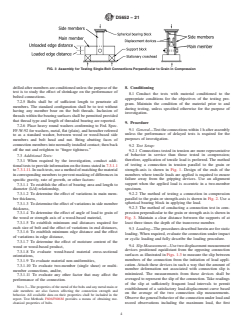
FIG. 3 Assembly for Testing Single-Bolt Connections Perpendicular to Grain in Compression
7.2.4.1 Bolt-holes shall be precisely bored perpendicular to the surface, so that the surface of the hole is smooth and uniform to
ensure good bearing of the bolt. Holes shall be drilled after members are conditioned unless the purpose of the test is to study the
effect of shrinkage on the performance of bolted connections.
7.2.5 Bolts shall be of sufficient length to penetrate all members. The standard configuration shall be to test without having any
member bear on the bolt threads.
...