

ASTM D6545-22
(Test Method)Standard Test Method for Flammability of Textiles Used in Children's Sleepwear
General Information
- Abstract
SIGNIFICANCE AND USE
5.1 This test method is suitable for evaluating flammability characteristics and laundering durability of textiles used in the manufacture of children's sleepwear. It is not suitable for evaluating the flammability characteristics of textiles for other product applications or ignition scenarios.
5.2 The procedure for flammability testing used in this test method is technically equivalent to those used in 16 CFR 1615 and 1616. This test method does not include detailed specimen sampling plans, or the regulatory and record keeping requirements cited in the federal regulations. Please consult 16 CFR 1615 and 1616 for information for these operations.
5.3 This test method is suitable for training technicians to conduct the federal test and can serve as a laboratory reference.
5.4 Test Method D6545 is very different from 16 CFR 1610 and from Test Method D1230.
SCOPE
1.1 This test method evaluates the relative flammability of textiles and garments intended for use in children's sleepwear. The procedures of this test method follow testing and laundering procedures used to evaluate the flammability of children's sleepwear contained in U.S. Federal Regulations 16 CFR 1615 and 1616.
1.2 A textile used in children's sleepwear must be tested in its original state and after 50 laundering and drying cycles to assess the flame resistance of the textile relative to its use life.
1.3 This method is identical to the method outlined in the regulations 16 CFR 1615 or 1616. The regulation includes additional information such as sampling plans, record keeping requirements, and interpretations for compliance applicable to children’s sleepwear. Please consult 16 CFR 1615 and 1616 for these operations and interpretations.
1.4 The values stated in SI units are to be regarded as standard. The values given in parentheses after SI units are provided for information only and are not considered standard.
1.5 This test method is used to measure and describe the response of materials, products, or assemblies to heat and flame under controlled conditions, but does not by itself incorporate all factors required for fire hazard or fire risk assessment of the materials, products, or assemblies under actual fire conditions.
1.6 Fire testing is inherently hazardous. Adequate safeguards for personnel and property shall be employed in conducting these tests.
1.7 This standard does not purport to address all of the safety concerns, if any, associated with its use. It is the responsibility of the user of this standard to establish appropriate safety, health, and environmental health practices and determines the applicability of regulatory limitations prior to use. Specific precautionary information is found in 8.5 and 9.5.
1.8 This international standard was developed in accordance with internationally recognized principles on standardization established in the Decision on Principles for the Development of International Standards, Guides and Recommendations issued by the World Trade Organization Technical Barriers to Trade (TBT) Committee.
- Status
- Published
- Publication Date
- 31-May-2022
- Technical Committee
- D13 - Textiles
- Drafting Committee
- D13.52 - Flammability
Buy Documents
ASTM D6545-22 - Standard Test Method for Flammability of Textiles Used in Children's Sleepwear
REDLINE ASTM D6545-22 - Standard Test Method for Flammability of Textiles Used in Children's Sleepwear
Overview
ASTM D6545-22: Standard Test Method for Flammability of Textiles Used in Children’s Sleepwear is a crucial safety standard developed by ASTM International. This test method is specifically designed to evaluate the flammability characteristics and laundering durability of textiles intended for children's sleepwear. The procedure is technically equivalent to those outlined in U.S. Federal Regulations 16 CFR 1615 and 1616, ensuring alignment with regulatory requirements for sleepwear safety in sizes ranging from infants to older children.
ASTM D6545-22 establishes a rigorous testing protocol that assesses flame resistance both in the original state and after 50 laundering cycles. Its intent is to help manufacturers, testing laboratories, and compliance officers ensure that children's sleepwear textiles manage flammability risks throughout the product's lifecycle.
Key Topics
Flammability Testing of Children's Sleepwear
Measures the vertical flame spread of textiles when exposed to a controlled flame, simulating real-world ignition hazards specific to sleepwear.Laundering Durability
Requires the evaluation of textile performance both as-produced and after 50 standardized laundering and drying cycles, ensuring flame resistance over time.Regulatory Alignment
Technically equivalent to federal flammability regulations (16 CFR 1615 and 1616), ASTM D6545-22 offers consistency for U.S. regulatory compliance in children’s sleepwear.Laboratory and Training Reference
Suitable as a reference method for laboratories and for training technicians to conduct federally recognized flammability tests.Exclusions
Not suitable for testing textiles intended for other uses or for different ignition scenarios; specifically different from methods like 16 CFR 1610 and ASTM D1230.Safety and Best Practices
Highlights the inherent hazards in fire testing and urges appropriate safety measures for personnel and property.
Applications
Children’s Sleepwear Manufacturing
Used by manufacturers to verify that children’s pajamas, nightgowns, and similar garments meet statutory flammability safety standards before entering the market.Quality Assurance and Compliance Testing
Employed by quality control laboratories and third-party certifiers to provide documented proof of compliance and product safety.Training and Standardization
Utilized by technical trainers and supervisors to educate laboratory staff on regulatory testing protocols and result interpretation.Product Development and Textile Research
Supports R&D departments in evaluating new materials for sleepwear by providing a reliable benchmark for flame resistance and durability.
Related Standards
16 CFR Part 1615 and 1616
U.S. Federal Regulations for flammability of children’s sleepwear, sizes 0–6X and 7–14.ASTM D1230
Test method for flammability of general apparel textiles (distinct from D6545-22).ASTM D4391
Terminology relating to the burning behavior of textiles.ASTM D123
Standard terminology relating to textiles.AATCC Test Method 124
Procedure for evaluating fabrics after repeated home laundering.ISO 13943
International vocabulary for fire safety and terminology.16 CFR Part 1610
Standard for the flammability of clothing textiles other than children’s sleepwear.
Practical Value
ASTM D6545-22 provides essential criteria for textile flammability safety, helping ensure that children’s sleepwear remains flame resistant through repeated laundry cycles. This standard is an indispensable resource for textile manufacturers, regulatory bodies, testing laboratories, and product developers committed to child safety and compliance with recognized regulations. Its use mitigates fire hazards and supports consistent, reliable safety assurance in children’s apparel. For full compliance, users should consult the official federal regulations (16 CFR 1615/1616) alongside this ASTM test method.
Relations
- Effective Date
- 01-Jan-2024
- Effective Date
- 15-Dec-2018
- Effective Date
- 01-May-2018
- Effective Date
- 01-Mar-2018
- Effective Date
- 01-Mar-2017
- Effective Date
- 01-Apr-2016
- Effective Date
- 15-Feb-2016
- Effective Date
- 15-Feb-2016
- Effective Date
- 15-Sep-2015
- Effective Date
- 01-Sep-2015
- Effective Date
- 01-Aug-2015
- Effective Date
- 01-Aug-2015
- Effective Date
- 01-Apr-2015
- Effective Date
- 01-Feb-2015
- Effective Date
- 01-Oct-2014
Buy Documents
ASTM D6545-22 - Standard Test Method for Flammability of Textiles Used in Children's Sleepwear
REDLINE ASTM D6545-22 - Standard Test Method for Flammability of Textiles Used in Children's Sleepwear
Get Certified
Connect with accredited certification bodies for this standard

CIS Institut d.o.o.
Personal Protective Equipment (PPE) certification body. Notified Body NB-2890 for EU Regulation 2016/425 PPE.

Kiwa BDA Testing
Building and construction product certification.
Kmetijski inštitut Slovenije
Agricultural Institute of Slovenia. Soil testing, plant health, agricultural product analysis.
Sponsored listings
Frequently Asked Questions
ASTM D6545-22 is a standard published by ASTM International. Its full title is "Standard Test Method for Flammability of Textiles Used in Children's Sleepwear". This standard covers: SIGNIFICANCE AND USE 5.1 This test method is suitable for evaluating flammability characteristics and laundering durability of textiles used in the manufacture of children's sleepwear. It is not suitable for evaluating the flammability characteristics of textiles for other product applications or ignition scenarios. 5.2 The procedure for flammability testing used in this test method is technically equivalent to those used in 16 CFR 1615 and 1616. This test method does not include detailed specimen sampling plans, or the regulatory and record keeping requirements cited in the federal regulations. Please consult 16 CFR 1615 and 1616 for information for these operations. 5.3 This test method is suitable for training technicians to conduct the federal test and can serve as a laboratory reference. 5.4 Test Method D6545 is very different from 16 CFR 1610 and from Test Method D1230. SCOPE 1.1 This test method evaluates the relative flammability of textiles and garments intended for use in children's sleepwear. The procedures of this test method follow testing and laundering procedures used to evaluate the flammability of children's sleepwear contained in U.S. Federal Regulations 16 CFR 1615 and 1616. 1.2 A textile used in children's sleepwear must be tested in its original state and after 50 laundering and drying cycles to assess the flame resistance of the textile relative to its use life. 1.3 This method is identical to the method outlined in the regulations 16 CFR 1615 or 1616. The regulation includes additional information such as sampling plans, record keeping requirements, and interpretations for compliance applicable to children’s sleepwear. Please consult 16 CFR 1615 and 1616 for these operations and interpretations. 1.4 The values stated in SI units are to be regarded as standard. The values given in parentheses after SI units are provided for information only and are not considered standard. 1.5 This test method is used to measure and describe the response of materials, products, or assemblies to heat and flame under controlled conditions, but does not by itself incorporate all factors required for fire hazard or fire risk assessment of the materials, products, or assemblies under actual fire conditions. 1.6 Fire testing is inherently hazardous. Adequate safeguards for personnel and property shall be employed in conducting these tests. 1.7 This standard does not purport to address all of the safety concerns, if any, associated with its use. It is the responsibility of the user of this standard to establish appropriate safety, health, and environmental health practices and determines the applicability of regulatory limitations prior to use. Specific precautionary information is found in 8.5 and 9.5. 1.8 This international standard was developed in accordance with internationally recognized principles on standardization established in the Decision on Principles for the Development of International Standards, Guides and Recommendations issued by the World Trade Organization Technical Barriers to Trade (TBT) Committee.
SIGNIFICANCE AND USE 5.1 This test method is suitable for evaluating flammability characteristics and laundering durability of textiles used in the manufacture of children's sleepwear. It is not suitable for evaluating the flammability characteristics of textiles for other product applications or ignition scenarios. 5.2 The procedure for flammability testing used in this test method is technically equivalent to those used in 16 CFR 1615 and 1616. This test method does not include detailed specimen sampling plans, or the regulatory and record keeping requirements cited in the federal regulations. Please consult 16 CFR 1615 and 1616 for information for these operations. 5.3 This test method is suitable for training technicians to conduct the federal test and can serve as a laboratory reference. 5.4 Test Method D6545 is very different from 16 CFR 1610 and from Test Method D1230. SCOPE 1.1 This test method evaluates the relative flammability of textiles and garments intended for use in children's sleepwear. The procedures of this test method follow testing and laundering procedures used to evaluate the flammability of children's sleepwear contained in U.S. Federal Regulations 16 CFR 1615 and 1616. 1.2 A textile used in children's sleepwear must be tested in its original state and after 50 laundering and drying cycles to assess the flame resistance of the textile relative to its use life. 1.3 This method is identical to the method outlined in the regulations 16 CFR 1615 or 1616. The regulation includes additional information such as sampling plans, record keeping requirements, and interpretations for compliance applicable to children’s sleepwear. Please consult 16 CFR 1615 and 1616 for these operations and interpretations. 1.4 The values stated in SI units are to be regarded as standard. The values given in parentheses after SI units are provided for information only and are not considered standard. 1.5 This test method is used to measure and describe the response of materials, products, or assemblies to heat and flame under controlled conditions, but does not by itself incorporate all factors required for fire hazard or fire risk assessment of the materials, products, or assemblies under actual fire conditions. 1.6 Fire testing is inherently hazardous. Adequate safeguards for personnel and property shall be employed in conducting these tests. 1.7 This standard does not purport to address all of the safety concerns, if any, associated with its use. It is the responsibility of the user of this standard to establish appropriate safety, health, and environmental health practices and determines the applicability of regulatory limitations prior to use. Specific precautionary information is found in 8.5 and 9.5. 1.8 This international standard was developed in accordance with internationally recognized principles on standardization established in the Decision on Principles for the Development of International Standards, Guides and Recommendations issued by the World Trade Organization Technical Barriers to Trade (TBT) Committee.
ASTM D6545-22 is classified under the following ICS (International Classification for Standards) categories: 13.220.40 - Ignitability and burning behaviour of materials and products; 97.160 - Home textiles. Linen. The ICS classification helps identify the subject area and facilitates finding related standards.
ASTM D6545-22 has the following relationships with other standards: It is inter standard links to ASTM E176-24, ASTM E176-18a, ASTM D4391-18, ASTM E176-18, ASTM D123-17, ASTM D1230-10(2016)e1, ASTM D4391-16, ASTM D4391-16e1, ASTM D123-15b, ASTM D123-15a, ASTM E176-15a, ASTM E176-15ae1, ASTM D123-15, ASTM E176-15, ASTM E176-14c. Understanding these relationships helps ensure you are using the most current and applicable version of the standard.
ASTM D6545-22 is available in PDF format for immediate download after purchase. The document can be added to your cart and obtained through the secure checkout process. Digital delivery ensures instant access to the complete standard document.
Standards Content (Sample)
This international standard was developed in accordance with internationally recognized principles on standardization established in the Decision on Principles for the
Development of International Standards, Guides and Recommendations issued by the World Trade Organization Technical Barriers to Trade (TBT) Committee.
Designation: D6545 − 22
Standard Test Method for
Flammability of Textiles Used in Children’s Sleepwear
This standard is issued under the fixed designation D6545; the number immediately following the designation indicates the year of
original adoption or, in the case of revision, the year of last revision. A number in parentheses indicates the year of last reapproval. A
superscript epsilon (´) indicates an editorial change since the last revision or reapproval.
1. Scope ization established in the Decision on Principles for the
Development of International Standards, Guides and Recom-
1.1 This test method evaluates the relative flammability of
mendations issued by the World Trade Organization Technical
textiles and garments intended for use in children’s sleepwear.
Barriers to Trade (TBT) Committee.
The procedures of this test method follow testing and launder-
ing procedures used to evaluate the flammability of children’s
2. Referenced Documents
sleepwear contained in U.S. Federal Regulations 16 CFR 1615
2.1 ASTM Standards:
and 1616.
D123 Terminology Relating to Textiles
1.2 A textile used in children’s sleepwear must be tested in
D1230 Test Method for Flammability of Apparel Textiles
its original state and after 50 laundering and drying cycles to
D4391 Terminology Relating to The Burning Behavior of
assess the flame resistance of the textile relative to its use life.
Textiles
1.3 This method is identical to the method outlined in the
E176 Terminology of Fire Standards
regulations 16 CFR 1615 or 1616. The regulation includes
2.2 AATCC Test Method:
additional information such as sampling plans, record keeping
AATCC Manual of International Test Methods and Proce-
requirements, and interpretations for compliance applicable to
dures
children’ssleepwear.Pleaseconsult16CFR1615and1616for
LP1 Home Laundering: Machine Washing
these operations and interpretations.
M11 Glossary of AATCC Standard Terminology
2.3 Federal Standards and Regulations:
1.4 The values stated in SI units are to be regarded as
standard. The values given in parentheses after SI units are 16CFRPart1610 StandardfortheFlammabilityofClothing
Textiles
provided for information only and are not considered standard.
16 CFR Part 1611 Vinyl Plastic Film
1.5 This test method is used to measure and describe the
16 CFR Part 1615 Standard for the Flammability of Chil-
response of materials, products, or assemblies to heat and
dren’s Sleepwear: Sizes 0 through 6X
flame under controlled conditions, but does not by itself
16 CFR Part 1616 Standard for the Flammability of Chil-
incorporate all factors required for fire hazard or fire risk
dren’s Sleepwear: Sizes 7 through 14
assessment of the materials, products, or assemblies under
Department of Commerce Voluntary Product Standard, pre-
actual fire conditions.
viously identified as Commercial Standard, CS 151-50
1.6 Fire testing is inherently hazardous. Adequate safe-
“Body Measurements for the Sizing of Apparel for
guards for personnel and property shall be employed in
Infants, Babies, Toddlers, and Children”
conducting these tests. 6
2.4 ISO Standard:
1.7 This standard does not purport to address all of the
ISO 13943 Fire Safety — Vocabulary
safety concerns, if any, associated with its use. It is the
responsibility of the user of this standard to establish appro-
For referenced ASTM standards, visit the ASTM website, www.astm.org, or
priate safety, health, and environmental health practices and
contact ASTM Customer Service at service@astm.org. For Annual Book of ASTM
determines the applicability of regulatory limitations prior to
Standards volume information, refer to the standard’s Document Summary page on
use. Specific precautionary information is found in 8.5 and 9.5.
the ASTM website.
Available from American Association of Textile Chemists and Colorists
1.8 This international standard was developed in accor-
(AATCC), P.O. Box 12215, Research Triangle Park, NC 27709-2215, http://
dance with internationally recognized principles on standard-
www.aatcc.org. Reference from the 1970 edition of the manual.
Available from U.S. Government Publishing Office, 732 N. Capitol Street, NW,
Washington, DC 20401, http://www.gpo.gov.
1 5
This test method is under the jurisdiction ofASTM Committee D13 on Textiles Available from National Technical Information Service (NTIS), 5301 Shawnee
and is the direct responsibility of Subcommittee D13.52 on Flammability. Rd., Alexandria, VA 22312, http://www.ntis.gov.
CurrenteditionapprovedJune1,2022.PublishedJuly2022.Originallyapproved Available from International Organization for Standardization (ISO), ISO
in 2000. Last previous edition approved in 2018 as D6545–18. DOI:10.1520/ Central Secretariat, Chemin de Blandonnet 8, CP 401, 1214 Vernier, Geneva,
D6545-22. Switzerland, https://www.iso.org.
Copyright © ASTM International, 100 Barr Harbor Drive, PO Box C700, West Conshohocken, PA 19428-2959. United States
D6545 − 22
3. Terminology close-fitting door with a glass insert to permit observation of
the entire test. The inside rear vertical surface of the cabinet
3.1 Definitions—The following terms are relevant to this
will be painted flat black to improve visibility of the burning
test method: char length; children’s sleepwear; fabric piece
specimenduringthetest.Thecabinetfloorcanbecoveredwith
(piece); fabric production unit (unit); flame retardant; flame
a piece of noncombustible paper, fabric, or film whose length
retardant treated; flammability; flammable textile; garment
andwidthareapproximately2.5cm(1in.)lessthanthecabinet
production unit (unit); infant garment; item.
floor dimensions. The cabinet to be used in this test method is
3.2 For terms related to the burning behavior of textiles, see
illustrated in Fig. 1 and detailed in Figs. 1-4. A suitable flame
Terminology D4391.
height indicator is shown in Fig. 5.
3.3 For terminology related to fire issues other than burning
6.2 Specimen Holder, n—The specimen holder is designed
behavior of textiles, see Terminology E176 and ISO 13943. In
to permit suspension of the specimen in a fixed vertical
case of conflict, the terminology in E176 will prevail.
position and to prevent curling of the specimen when the flame
is applied. It shall consist of two U-shaped 0.19 cm (0.074 in.;
3.4 For terms related to laundering and drycleaning, see
14-gauge USS) thick steel or stainless steel plates, 42.2 cm 6
TerminologyinthereferencedAATCCManualofInternational
0.15cm(16.62in. 60.06in.)long,and8.9cm 60.15cm(3.5
Test Methods and Procedures and M11.
in. 6 0.06 in.) wide, with aligning pins. The openings in the
3.5 For other terms related to textiles, see Terminology
plates shall be 35.6 cm (14 in. 6 0.06 in.) long and 5.1 cm 6
D123 and AATCC M11.
0.15 cm (2 in. 6 0.06 in.) wide.The specimen is fixed between
the plates, which shall be held together with side clamps. The
4. Summary of Test Method
holder to be used in this test method is illustrated in Fig. 6.
4.1 This test method evaluates the extent of vertical flame
6.3 Burner, n—The burner is substantially the same as that
spread of a textile after a flame is applied to the bottom edge
illustratedinFigs.7and8.Theburnerwillhavetheinsidetube
of the specimen.The specimen is oriented vertically during the
diameter of 1.1 cm (0.437 in.). The input line to the burner
test and is exposed to a 38 mm (1.5-in.) flame for 3 s.
shall be equipped with a needle valve to provide a variable
4.2 The extent of flame spread is determined by measuring
orificetoadjusttheheightoftheflame.Thebarreloftheburner
the distance from the lower edge of the specimen to the point
is positioned at an angle of 25° from the vertical.The burner is
at which the specimen ceases to tear when subjected to a
equipped with an adjustable stop collar so that it is quickly
specified tearing load.
located correctly under the test specimen. The burner is
connected to the gas source by rubber or other flexible tubing.
5. Significance and Use
6.4 Gas Supply System, n—A pressure regulator to furnish
5.1 This test method is suitable for evaluating flammability
gas to the burner will deliver a pressure of 129 mm 6 13 mm
characteristics and laundering durability of textiles used in the 2 2
1 1
Hg (2 ⁄2 lb/in. 6 ⁄4 lb/in. ) at the burner inlet.
manufacture of children’s sleepwear. It is not suitable for
6.5 Gas, n—The gas is at least 97 % pure methane.
evaluating the flammability characteristics of textiles for other
6.6 Hooks and Weights, n—Metal hooks and weights are
product applications or ignition scenarios.
used to produce a series of loads for char length determina-
5.2 The procedure for flammability testing used in this test
tions. Suitable metal hooks consist of 1.1 mm (0.043-in.; No.
method is technically equivalent to those used in 16 CFR 1615
19 gauge) diameter steel or stainless steel wire, or equivalent,
and 1616. This test method does not include detailed specimen
made from 7.6 cm (3-in.) lengths of the wire, bent 1.3 cm
sampling plans, or the regulatory and record keeping require-
(0.5 in.) from one end to a 45° angle hook. The longer end of
ments cited in the federal regulations. Please consult 16 CFR
the wire is fastened around the neck of the weight to be used
1615 and 1616 for information for these operations.
and the other in the lower end of each burned specimen to one
5.3 This test method is suitable for training technicians to
side of the burned area. The requisite loads are given in Table
conductthefederaltestandcanserveasalaboratoryreference.
1.
5.4 Test Method D6545 is very different from 16 CFR 1610
6.7 Stopwatch—A stopwatch or similar timing device is
and from Test Method D1230.
used to measure time to 0.1 s.
6.8 Scale—Alinear scale graduated in millimetres or 0.1-in.
6. Apparatus and Materials
divisions is used to measure char length.
6.1 Test Chamber—Thetestchambershallbeconstructedof
6.9 Circulating Air Oven—Aforced-circulation drying oven
a steel or stainless steel cabinet with inside dimensions of 32.9
capable of maintaining the specimens at 105 °C 6 2.8 °C
cm 6 0.15 cm (12.94 in. 6 0.06 in.) wide, 32.9 cm 6 0.15 cm
(221 °F 6 5 °F), is used to dry the specimen while mounted in
(12.94 in. 6 0.06 in.) deep, and 76.2 cm 6 0.15 cm (30 in. 6
the specimen holders.
0.06 in.) high.The cabinet shall have a frame, perpendicular to
6.10 Desiccator—An airtight and moisture-tight desiccating
the front of the cabinet, which permits the suspension of the
chamber is used for cooling mounted specimens after drying.
specimen holder over the center of the base of the cabinet at
Anhydrous silica gel will be used as the desiccant.
such a height that the bottom of the specimen holder is 1.9 cm
6 0.15 cm (0.75 in. 6 0.06 in.) above the highest point of the 6.11 Hood—Ahood or other suitable enclosures are used to
barrel of the gas burner. The front of the cabinet shall be a provide a draft-free environment surrounding the test chamber.
D6545 − 22
FIG. 1 Test Apparatus
The enclosure has a fan or other suitable means for exhausting 7.5 Fabrics used in the manufacture of children’s sleepwear
smoke or toxic gases, or both, produced by testin
...
This document is not an ASTM standard and is intended only to provide the user of an ASTM standard an indication of what changes have been made to the previous version. Because
it may not be technically possible to adequately depict all changes accurately, ASTM recommends that users consult prior editions as appropriate. In all cases only the current version
of the standard as published by ASTM is to be considered the official document.
Designation: D6545 − 18 D6545 − 22
Standard Test Method for
Flammability of Textiles Used in Children’s Sleepwear
This standard is issued under the fixed designation D6545; the number immediately following the designation indicates the year of
original adoption or, in the case of revision, the year of last revision. A number in parentheses indicates the year of last reapproval. A
superscript epsilon (´) indicates an editorial change since the last revision or reapproval.
1. Scope
1.1 This test method evaluates the relative flammability of textiles and garments intended for use in children’s sleepwear. The
procedures of this test method follow testing and laundering procedures used to evaluate the flammability of children’s sleepwear
contained in U.S. Federal Regulations 16 CFR 1615 and 1616.
1.2 A textile used in children’s sleepwear must be tested in its original state and after 50 laundering and drying cycles to assess
the flame resistance of the textile relative to its use life.
1.3 This method is identical to the method outlined in the regulations 16 CFR 1615 or 1616. The regulation includes additional
information such as sampling plans, record keeping requirements, and interpretations for compliance applicable to children’s
sleepwear. Please consult 16 CFR 1615 and 1616 for these operations and interpretations.
1.4 The values stated in SI units are to be regarded as the standard; inch-pound standard. The values given in parentheses after
SI units are provided for information only.only and are not considered standard.
1.5 This test method is used to measure and describe the response of materials, products, or assemblies to heat and flame under
controlled conditions, but does not by itself incorporate all factors required for fire hazard or fire risk assessment of the materials,
products, or assemblies under actual fire conditions.
1.6 Fire testing is inherently hazardous. Adequate safeguards for personnel and property shall be employed in conducting these
tests.
1.7 This standard does not purport to address all of the safety concerns, if any, associated with its use. It is the responsibility
of the user of this standard to establish appropriate safety, health, and environmental health practices and determines the
applicability of regulatory limitations prior to use. Specific precautionary information is found in 8.5 and 9.5.
1.8 This international standard was developed in accordance with internationally recognized principles on standardization
established in the Decision on Principles for the Development of International Standards, Guides and Recommendations issued
by the World Trade Organization Technical Barriers to Trade (TBT) Committee.
2. Referenced Documents
2.1 ASTM Standards:
This test method is under the jurisdiction of ASTM Committee D13 on Textiles and is the direct responsibility of Subcommittee D13.52 on Flammability.
Current edition approved Jan. 1, 2018June 1, 2022. Published March 2018July 2022. Originally approved in 2000. Last previous edition approved in 20102018 as
D6545–10. DOI:10.1520/D6545-18.–18. DOI:10.1520/D6545-22.
For referenced ASTM standards, visit the ASTM website, www.astm.org, or contact ASTM Customer Service at service@astm.org. For Annual Book of ASTM Standards
volume information, refer to the standard’s Document Summary page on the ASTM website.
Copyright © ASTM International, 100 Barr Harbor Drive, PO Box C700, West Conshohocken, PA 19428-2959. United States
D6545 − 22
D123 Terminology Relating to Textiles
D1230 Test Method for Flammability of Apparel Textiles
D4391 Terminology Relating to The Burning Behavior of Textiles
E176 Terminology of Fire Standards
2.2 AATCC Test Method:
AATCC Manual of International Test Methods and Procedures
LP1 Home Laundering: Machine Washing
Glossary of AATCC Standard TerminologyM11 Glossary of AATCC Standard Terminology
AATCC Test Method 124 Appearance of Fabrics After Repeated Home Laundering
2.3 Federal Standards and Regulations:
16 CFR Part 1610 Standard for the Flammability of Clothing Textiles
16 CFR Part 1611 Vinyl Plastic Film
16 CFR Part 1615 Standard for the Flammability of Children’s Sleepwear: Sizes 0 through 6X
16 CFR Part 1616 Standard for the Flammability of Children’s Sleepwear: Sizes 7 through 14
Department of Commerce Voluntary Product Standard, previously identified as Commercial Standard, CS 151-50 “Body
Measurements for the Sizing of Apparel for Infants, Babies, Toddlers, and Children”
2.4 ISO Standard:
ISO 13943 Fire Safety — Vocabulary
3. Terminology
3.1 Definitions—The following terms are relevant to this test method: char length; children’s sleepwear; fabric piece (piece); fabric
production unit (unit); flame retardant; flame retardant treated; flammability; flammable textile; garment production unit (unit);
infant garment; item.
3.2 For terms related to the burning behavior of textiles, see Terminology D4391.
3.3 For terminology related to fire issues other than burning behavior of textiles, see Terminology E176 and ISO 13943. In case
of conflict, the terminology in E176 will prevail.
3.4 For definitions of other terms used in this test method, refer to terminology terms related to laundering and drycleaning, see
Terminology in the referenced AATCC test methods.Manual of International Test Methods and Procedures and M11.
3.5 For other terms related to textiles, see Terminology D123. and AATCC M11.
4. Summary of Test Method
4.1 This test method evaluates the extent of vertical flame spread of a textile after a flame is applied to the bottom edge of the
specimen. The specimen is oriented vertically during the test and is exposed to a 38-mm 38 mm (1.5-in.) flame for 3 s.
4.2 The extent of flame spread is determined by measuring the distance from the lower edge of the specimen to the point at which
the specimen ceases to tear when subjected to a specified tearing load.
5. Significance and Use
5.1 This test method is suitable for evaluating flammability characteristics and laundering durability of textiles used in the
manufacture of children’s sleepwear. It is not suitable for evaluating the flammability characteristics of textiles for other product
applications or ignition scenarios.
Available from American Association of Textile Chemists and Colorists (AATCC), P.O. Box 12215, Research Triangle Park, NC 27709-2215, http://www.aatcc.org.
Reference from the 1970 edition of the manual.
Available from U.S. Government Publishing Office, 732 N. Capitol Street, NW, Washington, DC 20401, http://www.gpo.gov.
Available from National Technical Information Service (NTIS), 5301 Shawnee Rd., Alexandria, VA 22312, http://www.ntis.gov.
Available from International Organization for Standardization (ISO), ISO Central Secretariat, Chemin de Blandonnet 8, CP 401, 1214 Vernier, Geneva, Switzerland,
https://www.iso.org.
D6545 − 22
5.2 The procedure for flammability testing used in this test method is technically equivalent to those used in 16 CFR 1615 and
1616. This test method does not include detailed specimen sampling plans, or the regulatory and record keeping requirements cited
in the federal regulations. Please consult 16 CFR 1615 and 1616 for information for these operations.
5.3 This test method is suitable for training technicians to conduct the federal test and can serve as a laboratory reference.
5.4 Test Method D6545 is very different from 16 CFR 1610 and from Test Method D1230.
6. Apparatus and Materials
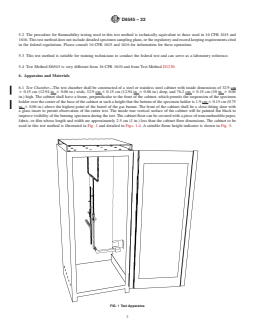
6.1 Test Chamber—The test chamber shall be constructed of a steel or stainless steel cabinet with inside dimensions of 32.9 cm
6 0.15 cm (12.94 in. 6 0.06 in.) wide, 32.9 cm 6 0.15 cm (12.94 in. 6 0.06 in.) deep, and 76.2 cm 6 0.15 cm (30 in. 6 0.06
in.) high. The cabinet shall have a frame, perpendicular to the front of the cabinet, which permits the suspension of the specimen
holder over the center of the base of the cabinet at such a height that the bottom of the specimen holder is 1.9 cm 6 0.15 cm (0.75
in. 6 0.06 in.) above the highest point of the barrel of the gas burner. The front of the cabinet shall be a close-fitting door with
a glass insert to permit observation of the entire test. The inside rear vertical surface of the cabinet will be painted flat black to
improve visibility of the burning specimen during the test. The cabinet floor can be covered with a piece of noncombustible paper,
fabric, or film whose length and width are approximately 2.5 cm (1 in.) less than the cabinet floor dimensions. The cabinet to be
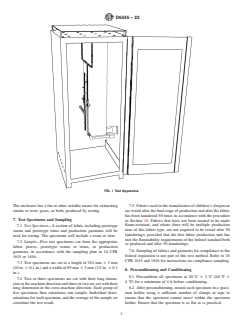
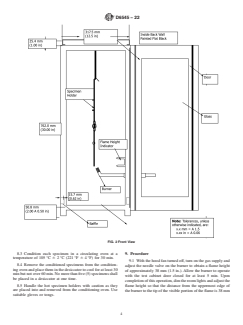
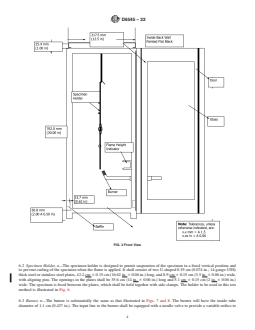
used in this test method is illustrated in Fig. 1 and detailed in Figs. 1-4. A suitable flame height indicator is shown in Fig. 5.
FIG. 1 Test Apparatus
D6545 − 22
FIG. 2 Front View
6.2 Specimen Holder, n—The specimen holder is designed to permit suspension of the specimen in a fixed vertical position and
to prevent curling of the specimen when the flame is applied. It shall consist of two U-shaped 0.19 cm (0.074 in.; 14-gauge USS)
thick steel or stainless steel plates, 42.2 cm 6 0.15 cm (16.62 in. 6 0.06 in.) long, and 8.9 cm 6 0.15 cm (3.5 in. 6 0.06 in.) wide,
with aligning pins. The openings in the plates shall be 35.6 cm (14 in. 6 0.06 in.) long and 5.1 cm 6 0.15 cm (2 in. 6 0.06 in.)
wide. The specimen is fixed between the plates, which shall be held together with side clamps. The holder to be used in this test
method is illustrated in Fig. 6.
6.3 Burner, n—The burner is substantially the same as that illustrated in Figs. 7 and 8. The burner will have the inside tube
diameter of 1.1 cm (0.437 in.). The input line to the burner shall be equipped with a needle valve to provide a variable orifice to
D6545 − 22
FIG. 3 Top View
adjust the height of the flame. The barrel of the burner is positioned at an angle of 25° from the vertical. The burner is equipped
with an adjustable stop collar so that it is quickly located correctly under the test specimen. The burner is connected to the gas
source by rubber or other flexible tubing.
6.4 Gas Supply System, n—A pressure regulator to furnish gas to the burner will deliver a pressure of 129 mm 6 13 mm Hg (2 ⁄2
2 2
lb/in. 6 ⁄4 lb/in. ) at the burner inlet.
6.5 Gas, n—The gas is at least 97 % pure methane.
6.6 Hooks and Weights, n—Metal hooks and weights are used to produce a series of loads for char length determinations. Suitable
metal hooks consist of 1.1-mm 1.1 mm (0.043-in.; No. 19 gauge) diameter steel or stainless steel wire, or equivalent, made from
7.6-cm 7.6 cm (3-in.) lengths of the wire, bent 1.3 cm (0.5 in.) from one end to a 45° angle hook. The longer end of the wire is
fastened around the neck of the weight to be used and the other in the lower end of each burned specimen to one side of the burned
area. The requisite loads are given in Table 1.
6.7 Stopwatch—A stopwatch or similar timing device is used to measure time to 0.1 s.
6.8 Scale—A linear scale graduated in millimetres or 0.1-in. divisions is used to measure char length.
6.9 Circulating Air Oven—A forced-circulation drying oven capable of maintaining the specimens at 105105 °C 6 2.8 °C
(221(221 °F 6 5 °F), is used to dry the specimen while mounted in the specimen holders.
6.10 Desiccator—An airtight and moisture-tight desiccating chamber is used for cooling mounted specimens after drying.
Anhydrous silica gel will be used as the desiccant.
D6545 − 22
FIG. 4 Left-Side View (Left-Side Panel Removed)
6.11 Hood—A hood or other suita
...