

ASTM D3957-09(2020)
(Practice)Standard Practices for Establishing Stress Grades for Structural Members Used in Log Buildings
General Information
- Abstract
ABSTRACT
These practices cover the visual stress-grading principles applicable to structural wood members of nonrectangular shape, as typically used in log buildings. The grading provisions presented herein are not intended to establish grades for purchase, but rather to show how stress-grading principles are applied to members used in log buildings.
SCOPE
1.1 These practices cover the visual stress-grading principles applicable to structural wood members of nonrectangular shape, as typically used in log buildings. These practices are meant to supplement the ASTM standards listed in Section 2, which cover stress-grading of sawn lumber and round timbers. Pieces covered by these practices may also be used in building types other than log buildings.
1.2 The grading provisions used as illustrations herein are not intended to establish grades for purchase, but rather to show how stress-grading principles are applied to members used in log buildings. Detailed grading rules for commercial stress grades which serve as purchase specifications are established and published by agencies that formulate and maintain such rules and operate inspection facilities covering the various species.
1.3 The values stated in inch-pound units are to be regarded as standard. The values given in parentheses are mathematical conversions to SI units that are provided for information only and are not considered standard.
1.4 This standard does not purport to address all of the safety concerns, if any, associated with its use. It is the responsibility of the user of this standard to establish appropriate safety, health, and environmental practices and determine the applicability of regulatory limitations prior to use.
1.5 This international standard was developed in accordance with internationally recognized principles on standardization established in the Decision on Principles for the Development of International Standards, Guides and Recommendations issued by the World Trade Organization Technical Barriers to Trade (TBT) Committee.
- Status
- Published
- Publication Date
- 31-Mar-2020
- Technical Committee
- D07 - Wood
- Drafting Committee
- D07.04 - Pole and Pile Products
Overview
ASTM D3957-09(2020), Standard Practices for Establishing Stress Grades for Structural Members Used in Log Buildings, provides essential guidance on visual stress-grading for wood members with nonrectangular shapes, as used in log building construction. Developed by ASTM International, this standard addresses the unique characteristics of structural log members that differ from conventional sawn lumber or round timbers. The practice ensures that log building components are evaluated for structural reliability using a methodology based on accepted grading systems, supporting safe and consistent log construction.
Key Topics
Visual Stress-Grading Principles
- Focuses on log members with nonrectangular shapes commonly found in log buildings, such as wall-logs and round timber beams.
- Establishes conventions for grading logs based on an inscribed rectangular section, allowing application of existing sawn lumber standards where possible.
- Explains grading for round timber beams that may have flat sawn faces, referencing sawn lumber and round timber methodologies.
Supplement to Existing Standards
- Serves as a supplement to other ASTM standards covering sawn lumber (ASTM D245) and round timber (ASTM D2899, D25, D2555, D3200).
- Provides guidelines for applying stress grading principles where log member shapes deviate from standard lumber or timber sections.
Stress Grading Components
- Covers determination of design stress values such as bending, tension, compression, shear, and modulus of elasticity, adapted for log structure applications.
- Outlines the use of strength ratios for knots and slope-of-grain limitations to assure conservative and reliable structural values.
Quality Requirements
- Stipulates the importance of inspecting for decay, insect attack, defects, straightness, checks, and shakes.
- Details limitations and conventions for cuts and shaping after grading, ensuring integrity and ongoing compliance with stress grading.
Applications
ASTM D3957-09(2020) is primarily intended for:
Log Buildings
- Used in designing and evaluating structural members such as wall-logs, beams, joists, rafters, and purlins in log homes, log cabins, and similar structures.
- Ensures that visually graded log members meet safe and consistent design criteria for various loading conditions.
Non-Log Structures
- Although focused on log buildings, the practices can be applied to other building types using nonrectangular wood members that do not fit conventional lumber grading.
Inspection and Design
- Provides valuable support for architects, engineers, builders, and inspectors in establishing structural grades, ensuring compliance with industry best practices.
Resource Optimization
- Promotes effective use of wood resources by applying conservative design stress values tailored to unique log shapes, minimizing unnecessary material restrictions.
Related Standards
The following ASTM standards are referenced and closely related:
- ASTM D245 - Practice for Establishing Structural Grades and Related Allowable Properties for Visually Graded Lumber
- ASTM D2899 - Practice for Establishing Allowable Stresses for Round Timber Piles
- ASTM D25 - Specification for Round Timber Piles
- ASTM D2555 - Practice for Establishing Clear Wood Strength Values
- ASTM D3200 - Specification and Test Method for Establishing Recommended Design Stresses for Round Timber Construction Poles
These standards provide foundational grading and testing methods for traditional sawn lumber and round timber-ASTM D3957 adapts these approaches for the special requirements of log building construction.
Keywords: ASTM D3957, stress grades, structural wood members, log buildings, visual grading, round timber beams, wall-logs, structural members, building standards, wood grading practices
Relations
- Effective Date
- 01-Feb-2024
- Effective Date
- 01-Feb-2024
- Refers
ASTM D2899-12(2017) - Standard Practice for Establishing Allowable Stresses for Round Timber Piles - Effective Date
- 01-Oct-2017
- Effective Date
- 01-Aug-2017
- Effective Date
- 15-Apr-2017
- Effective Date
- 01-Aug-2016
- Effective Date
- 01-Sep-2015
- Effective Date
- 01-May-2012
- Effective Date
- 01-Apr-2012
- Effective Date
- 01-Apr-2012
- Effective Date
- 15-Nov-2011
- Effective Date
- 01-Oct-2011
- Effective Date
- 01-Oct-2011
- Effective Date
- 01-Mar-2006
- Effective Date
- 01-Mar-2006
Get Certified
Connect with accredited certification bodies for this standard

DIBt (Deutsches Institut für Bautechnik)
German Institute for Building Technology.
DIN CERTCO
DIN Group product certification.

Aboma Certification B.V.
Specialized in construction, metal, and transport sectors.
Sponsored listings
Frequently Asked Questions
ASTM D3957-09(2020) is a standard published by ASTM International. Its full title is "Standard Practices for Establishing Stress Grades for Structural Members Used in Log Buildings". This standard covers: ABSTRACT These practices cover the visual stress-grading principles applicable to structural wood members of nonrectangular shape, as typically used in log buildings. The grading provisions presented herein are not intended to establish grades for purchase, but rather to show how stress-grading principles are applied to members used in log buildings. SCOPE 1.1 These practices cover the visual stress-grading principles applicable to structural wood members of nonrectangular shape, as typically used in log buildings. These practices are meant to supplement the ASTM standards listed in Section 2, which cover stress-grading of sawn lumber and round timbers. Pieces covered by these practices may also be used in building types other than log buildings. 1.2 The grading provisions used as illustrations herein are not intended to establish grades for purchase, but rather to show how stress-grading principles are applied to members used in log buildings. Detailed grading rules for commercial stress grades which serve as purchase specifications are established and published by agencies that formulate and maintain such rules and operate inspection facilities covering the various species. 1.3 The values stated in inch-pound units are to be regarded as standard. The values given in parentheses are mathematical conversions to SI units that are provided for information only and are not considered standard. 1.4 This standard does not purport to address all of the safety concerns, if any, associated with its use. It is the responsibility of the user of this standard to establish appropriate safety, health, and environmental practices and determine the applicability of regulatory limitations prior to use. 1.5 This international standard was developed in accordance with internationally recognized principles on standardization established in the Decision on Principles for the Development of International Standards, Guides and Recommendations issued by the World Trade Organization Technical Barriers to Trade (TBT) Committee.
ABSTRACT These practices cover the visual stress-grading principles applicable to structural wood members of nonrectangular shape, as typically used in log buildings. The grading provisions presented herein are not intended to establish grades for purchase, but rather to show how stress-grading principles are applied to members used in log buildings. SCOPE 1.1 These practices cover the visual stress-grading principles applicable to structural wood members of nonrectangular shape, as typically used in log buildings. These practices are meant to supplement the ASTM standards listed in Section 2, which cover stress-grading of sawn lumber and round timbers. Pieces covered by these practices may also be used in building types other than log buildings. 1.2 The grading provisions used as illustrations herein are not intended to establish grades for purchase, but rather to show how stress-grading principles are applied to members used in log buildings. Detailed grading rules for commercial stress grades which serve as purchase specifications are established and published by agencies that formulate and maintain such rules and operate inspection facilities covering the various species. 1.3 The values stated in inch-pound units are to be regarded as standard. The values given in parentheses are mathematical conversions to SI units that are provided for information only and are not considered standard. 1.4 This standard does not purport to address all of the safety concerns, if any, associated with its use. It is the responsibility of the user of this standard to establish appropriate safety, health, and environmental practices and determine the applicability of regulatory limitations prior to use. 1.5 This international standard was developed in accordance with internationally recognized principles on standardization established in the Decision on Principles for the Development of International Standards, Guides and Recommendations issued by the World Trade Organization Technical Barriers to Trade (TBT) Committee.
ASTM D3957-09(2020) is classified under the following ICS (International Classification for Standards) categories: 91.080.20 - Timber structures. The ICS classification helps identify the subject area and facilitates finding related standards.
ASTM D3957-09(2020) has the following relationships with other standards: It is inter standard links to ASTM D2555-17a(2024), ASTM D2555-17a(2024)e1, ASTM D2899-12(2017), ASTM D2555-17a, ASTM D2555-17, ASTM D2555-16, ASTM D2555-15, ASTM D25-12, ASTM D2899-12, ASTM D3200-74(2012), ASTM D2899-11, ASTM D2555-06(2011), ASTM D245-06(2011), ASTM D245-06, ASTM D2555-06. Understanding these relationships helps ensure you are using the most current and applicable version of the standard.
ASTM D3957-09(2020) is available in PDF format for immediate download after purchase. The document can be added to your cart and obtained through the secure checkout process. Digital delivery ensures instant access to the complete standard document.
Standards Content (Sample)
This international standard was developed in accordance with internationally recognized principles on standardization established in the Decision on Principles for the
Development of International Standards, Guides and Recommendations issued by the World Trade Organization Technical Barriers to Trade (TBT) Committee.
Designation: D3957 − 09 (Reapproved 2020)
Standard Practices for
Establishing Stress Grades for Structural Members Used in
Log Buildings
This standard is issued under the fixed designation D3957; the number immediately following the designation indicates the year of
original adoption or, in the case of revision, the year of last revision.Anumber in parentheses indicates the year of last reapproval.A
superscript epsilon (´) indicates an editorial change since the last revision or reapproval.
INTRODUCTION
These practices are based on the assumption that structural members in log buildings can be
stress-gradedbymethodsthatderivefromacceptedstandardsforconventionalsolidsawnlumberand
round timbers. It is assumed that the material to be graded bears enough similarity to either sawn
lumber or round timber, both in dimensional properties and in use, to warrant application of
stress-grading standards written for sawn-lumber or round-timber, or both. These practices, such as
Practices D245 and D2899, cannot be applied directly because the structural members used in log
buildingsaregenerallyneitherperfectlyrectangularnorperfectlyroundinsection.Thesepracticesuse
certain conventions regarding cross-sectional dimensions that make it possible to extend established
stress-grading methodologies to cover the members used in log buildings.
Where log member characteristics deviate from sawn lumber or round timber standards, there may
be uncertainty as to the exact effect of the deviation on strength properties. To compensate for this
uncertainty, some design stress values are herein derived with practices that are, by engineering
judgment, conservative. The philosophy guiding this approach is that while the absence of
experimental data may make a measure of conservatism unavoidable, the reliability of design stress
valuesmustnotbeachievedthroughwoodqualityorsizerequirementsthatareanunnecessaryburden
on the wood resource.
In general, the sawing, cutting, and shaving required to bring a piece to its final shape must be
completed before it can be visually graded using the principles in these practices. Small cuts may be
allowedaftergradingifitcanbeshownthateither(1)thecutsdonotaffectthegrade,or(2)thegrade
takes the additional cuts into consideration.
Both sawn lumber standards and round timber standards are herein referenced, because these two
stress-grading methodologies can be assumed to apply to two different types of structural members
used in log buildings: wall-logs and round timber beams. Since wall-logs must be provided with a
meansofjoiningtogether(forexample,tongue-and-groovejoints),theyresemblesawnlumberandare
treated as such in the standard. Rafters, purlins, and beams, on the other hand, are sometimes left as
roundlogs,exceptforasmallamountofsawingtoprovideaflatnailingsurface.Thesepracticesthus
deal with stress-grading of wall-logs and round-timber beams separately.
1. Scope Pieces covered by these practices may also be used in building
types other than log buildings.
1.1 These practices cover the visual stress-grading prin-
ciples applicable to structural wood members of nonrectangu- 1.2 The grading provisions used as illustrations herein are
larshape,astypicallyusedinlogbuildings.Thesepracticesare
not intended to establish grades for purchase, but rather to
meant to supplement the ASTM standards listed in Section 2, show how stress-grading principles are applied to members
which cover stress-grading of sawn lumber and round timbers.
used in log buildings. Detailed grading rules for commercial
stress grades which serve as purchase specifications are estab-
lished and published by agencies that formulate and maintain
suchrulesandoperateinspectionfacilitiescoveringthevarious
These practices are under the jurisdiction ofASTM Committee D07 on Wood
species.
andarethedirectresponsibilityofSubcommitteeD07.04onPoleandPileProducts.
Current edition approved April 1, 2020. Published April 2020. Originally
1.3 Thevaluesstatedininch-poundunitsaretoberegarded
approved in 1980. Last previous edition approved in 2015 as D3957–09 (2015).
DOI: 10.1520/D3957-09R20. as standard. The values given in parentheses are mathematical
Copyright © ASTM International, 100 Barr Harbor Drive, PO Box C700, West Conshohocken, PA 19428-2959. United States
D3957 − 09 (2020)
conversions to SI units that are provided for information only 3. Significance and Use
and are not considered standard.
3.1 It is useful to grade logs to improve the consistency in
1.4 This standard does not purport to address all of the
performance. Using the visual stress-grading principles appli-
safety concerns, if any, associated with its use. It is the
cabletorectangularandroundshapestructuralwoodmembers,
responsibility of the user of this standard to establish appro-
these practices illustrate the development of stress grading
priate safety, health, and environmental practices and deter-
methodologies for wall-logs and round timber beams, as
mine the applicability of regulatory limitations prior to use.
typically used in log buildings.The clear wood strength values
1.5 This international standard was developed in accor-
are used as the basis for deriving the design stress values in
dance with internationally recognized principles on standard-
these applications.
ization established in the Decision on Principles for the
4. Stress-Grading of Wall-Logs
Development of International Standards, Guides and Recom-
mendations issued by the World Trade Organization Technical
4.1 General:
Barriers to Trade (TBT) Committee.
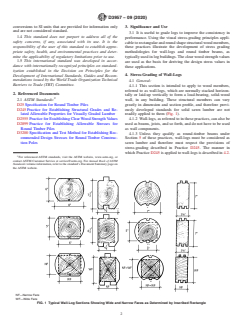
4.1.1 This section is intended to apply to wood members,
referred to as wall-logs, which are normally stacked horizon-
2. Referenced Documents
tally or laid-up vertically to form a load-bearing, solid-wood
2.1 ASTM Standards: wall, in any building. These structural members can vary
D25Specification for Round Timber Piles greatly in dimension and section profile, and therefore previ-
D245Practice for Establishing Structural Grades and Re- ously developed standards for solid sawn lumber are not
lated Allowable Properties for Visually Graded Lumber readily applied to them (Fig. 1).
D2555PracticeforEstablishingClearWoodStrengthValues 4.1.2 Wall-logs,asreferredtointhesepractices,canalsobe
D2899Practice for Establishing Allowable Stresses for used as beams, joists, and so forth, and do not have to be used
Round Timber Piles
as wall components.
D3200Specification and Test Method for Establishing Rec- 4.1.3 Unless they qualify as round-timber beams under
ommended Design Stresses for Round Timber Construc-
Section 5 of these practices, wall-logs must be considered as
tion Poles sawn lumber and therefore must respect the provisions of
stress-grading described in Practice D245. The manner in
whichPracticeD245isappliedtowall-logsisdescribedin4.2.
For referenced ASTM standards, visit the ASTM website, www.astm.org, or
contact ASTM Customer Service at service@astm.org. For Annual Book of ASTM
Standards volume information, refer to the standard’s Document Summary page on
the ASTM website.
NF—Narrow Face
WF—Wide Face
FIG. 1 Typical Wall-Log Sections Showing Wide and Narrow Faces as Determined by Inscribed Rectangle
D3957 − 09 (2020)
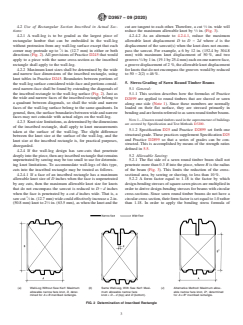
4.2 Use of Rectangular Section Inscribed in Actual Sec- cut are tangent to each other. Therefore, a cut ⁄2 in. wide will
tions: reduce the maximum allowable knot by ⁄2 in. (Fig. 3).
4.2.1 A wall-log is to be graded as the largest piece of 4.2.4.2 As an alternate to 4.2.4.1, reduce the maximum
rectangular lumber that can be embedded in the wall-log allowable knot displacement D to D−2d where d is the
without protrusion from any wall-log surface except that each displacement of the sawcut(s) when the knot does not encom-
corner may protrude up to ⁄2 in. (12.7 mm) in either or both pass the sawcut. For example, a 6 by 12 in. (152.4 by 304.8
directions (Fig. 2).All provisions of Practice D245 that would mm) with maximum knot displacement of 50%, and two
apply to a piece with the same cross-section as the inscribed grooves ⁄4by1in.(19.1by25.4mm)eachononenarrowface,
rectangle shall apply to the wall-log. agroovedisplacementof2%,theallowableknotdisplacement
4.2.2 Maximum knot sizes shall be determined by the wide for knots that do not encompass the grooves would by reduced
and narrow face dimensions of the inscribed rectangle, using to50−2(2)=46%.
knot tables in Practice D245. Boundaries between portions of
5. Stress-Grading of Sawn Round Timber Beams
thewall-logsurfaceconsideredwide-faceandportionsconsid-
ered narrow-face shall be found by extending the diagonals of
5.1 General:
the inscribed rectangle to the wall-log surface (Fig. 2). Just as
5.1.1 This section describes how the formulas of Practice
the wide and narrow faces of the inscribed rectangle belong to
D2899 are applied to round timbers that are shaved or sawn
a quadrant between diagonals, so shall the wide and narrow
along one side (Note 1). Since these members are normally
faces of the wall-log surface belong to the same quadrants. In
loaded on their flat surface, they are stressed primarily in
general,then,thesurfaceboundariesbetweenwideandnarrow
bendingandarehereinreferredtoassawnroundtimberbeams.
faces may not coincide with actual edges on the wall-log.
NOTE1—Unsawnroundtimbersusedinthesuperstructureofbuildings
4.2.3 Knotsizelimitations,asdeterminedbythedimensions
are covered by Specification and Test Methods D3200.
of the inscribed rectangle, shall apply to knot measurements
5.1.2 Specification D25 and Practice D2899 set forth one
taken at the surface of the wall-log. The slight difference
structuralgrade.ThesepracticessupplementSpecificationD25
between the knot size at the surface of the wall-log, and the
and Practice D2899 so that a series of grades can be con-
knot size at the inscribed rectangle is, for practical purposes,
structed. This is accomplished by means of the strength ratios
disregarded.
defined in 5.5.
4.2.4 If the wall-log design has saw-cuts that penetrate
deeplyintothepiece,thenanyinscribedrectanglethatremains 5.2 Allowable Sawing:
unpenetrated by sawing may be too small to use for determin- 5.2.1 The flat side of a sawn round timber beam shall not
ing knot limitations. To accommodate wall-logs of this type, penetrate more than 0.3 R into the piece, where R is the radius
cuts into the inscribed rectangle may be treated as follows. of the beam (Fig. 3). This limits the reduction of the cross-
4.2.4.1 If a face of an inscribed rectangle has a maximum sectional area, by sawing or shaving, to less than 10%.
allowable knot size of D inches when the face is unpenetrated 5.2.2 A form factor equal to 1.18 is the factor by which
by any cuts, then the maximum allowable knot size for knots design-bendingstressesofsquare-sawnpiecesaremultipliedin
that do not encompass the sawcut is reduced to D− d inches ordertoderivedesign-bendingstressesforbeamswithcircular
when the face is penetrated by a cut d inches wide. That is, a cross-sections. Since sawn round timber beams do not have a
sawcut ⁄2in.(12.7mm)widecouldeffectivelyincreasea2-in. circularcrosssection,theirformfactorissetequalto1.0rather
(50.8mm)knotto2 ⁄2in.(63.5mm),aswhentheknotandthe than 1.18. In order to apply the bending stress formula of
(a) Wall-Log Without Saw Kerf: Maximum (b) Same Wall-Log, With Saw Kerf: Maxi- (c) Alternative Method: Maximum allow-
allowable narrow face knot, D, deter- mum allowable narrow face able narrow face knot, D*, determined
mined for A × B inscribed rectangle. knot =D−d (top) and D (bottom). for A × B* inscribed rectangle.
FIG. 2 Determination of Inscribed Rectangle
D3957 − 09 (2020)
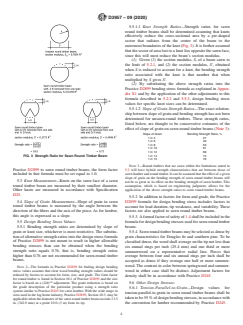
5.5.1.1 Knot Strength Ratios—Strength ratios for sawn
round timber beams shall be determined assuming that knots
effectively reduce the cross-sectional area by a pie-shaped
sector that radiates from the center of the beam to the
outermostboundariesoftheknot(Fig.3).Itisfurtherassumed
thatthesectorofarealosttoaknotliesoppositethesawnface,
since this will most reduce the beam’s section modulus.
(1) Given (1) the section modulus, S, of a beam sawn to
the limit of 5.2.1, and (2) the section modulus, Sʹ, obtained
when S is reduced to account for a knot, the bending strength
ratio associated with the knot is that number that when
multiplied by S gives Sʹ.
(2) By substituting the above strength ratios into the
Practice D2899 bending stress formula as explained in Appen-
dix X1 and by the application of the other adjustments to this
formula described in 5.2.2 and 5.5.3, design bending stress
values for specific knot sizes can be determined.
5.5.1.2 Slope of Grain Strength Ratios—The exact relation-
ship between slope of grain and bending strength has not been
determined for unsawn-round timbers. These strength ratios,
listed below, are thought to be conservative estimates of the
effect of slope of grain on sawn-round timber beams (Note 3):
Slope of Grain Bending Strength Ratio, %
1in4 27
1in6 40
1in8 53
1in10 61
1in12 69
1in14 74
FIG. 3 Strength Ratio for Sawn Round Timber Beam
1in15 76
NOTE 3—Round timbers that are sawn within the limitations stated in
Practice D2899 to sawn round timber beams, the form factor
5.2 will have hybrid strength characteristics that are between those of
included in that formula must be set equal to 1.0. sawnlumberandroundtimber.Itcanbeassumedthattheeffectofagiven
slope of grain on the bending strength of sawn round timber
...