

ASTM D7469-23
(Test Method)Standard Test Methods for End Joints in Structural Wood Products
General Information
- Abstract
SIGNIFICANCE AND USE
4.1 These test methods are applicable to specimens with or without specific conditioning regimens. Tests are permitted to be performed on specimens that are not at moisture equilibrium, such as under production conditions in a plant, or on specimens that have been conditioned to specified moisture content or durability conditioning prior to testing.
4.2 These test methods can be used as follows:
4.2.1 To standardize the determination of strength properties for the material and joint being tested.
4.2.2 To investigate the effect of parameters that may influence the structural capacity of the joint, such as joint profile, adhesive type, moisture content, temperature, and strength-reducing characteristics in the assembly.
4.3 These test methods do not intend to address all possible exposure or performance expectations of end joints. The following are some performance characteristics not considered:
4.3.1 Long-term strength and permanence of the wood adhesive.
4.3.2 Time dependent mechanical properties of the joint.
4.3.3 Elevated temperature performance of the joint.
SCOPE
1.1 This standard provides test methods for evaluating the structural capacity and integrity of end joints in structural wood products.
1.2 Off-line test methods include: (1) Axial Tension, (2) Bending, and (3) Cyclic Delamination.
1.3 In-line test methods include: (1) Tension Proofload and (2) Bending Proofload.
1.4 The values stated in inch-pound units are to be regarded as standard. The values given in parentheses are mathematical conversions to SI units that are provided for information only and are not considered standard.
1.5 This standard does not purport to address all of the safety concerns, if any, associated with its use. It is the responsibility of the user of this standard to establish appropriate safety, health, and environmental practices and determine the applicability of regulatory limitations prior to use.
1.6 This international standard was developed in accordance with internationally recognized principles on standardization established in the Decision on Principles for the Development of International Standards, Guides and Recommendations issued by the World Trade Organization Technical Barriers to Trade (TBT) Committee.
- Status
- Published
- Publication Date
- 14-Nov-2023
- Technical Committee
- D07 - Wood
- Drafting Committee
- D07.01 - Fundamental Test Methods and Properties
Overview
ASTM D7469-23, "Standard Test Methods for End Joints in Structural Wood Products," provides standardized procedures to evaluate the structural integrity and bond performance of end joints-key connections in engineered wood products such as glued laminated timber and structural composite lumber. This standard, developed by ASTM Committee D07 on Wood, addresses various test methods for assessing strength, durability, and manufacturing quality of finger joints and scarf joints formed by adhesive bonding at the ends of wood elements.
Understanding end joint performance is essential for ensuring the safety, reliability, and serviceability of structural wood products used in construction. ASTM D7469-23 offers both off-line and in-line test methods, supporting manufacturers, quality control personnel, and engineers in verifying product conformance and process consistency.
Key Topics
Scope of Application
- Procedures for both conditioned and non-conditioned (as-produced) specimens, allowing tests under production or laboratory conditions.
- Applicable to common end joint profiles, including finger joints and scarf joints, in both full-size and reduced-size specimens.
Test Methods Provided
- Axial Tension: Measures the tensile capacity of end-jointed specimens.
- Bending: Evaluates bending strength using three-point or four-point loading configurations.
- Cyclic Delamination: Assesses adhesive bond durability through repeated moisture and drying cycles.
- Proofload Testing: In-line procedures for tension and bending, used to cull low-strength joints during production.
Significance and Use
- Standardizes the determination of end joint strength properties, supporting product qualification and quality control.
- Allows investigation into the effects of joint profile, adhesive type, moisture content, temperature, and manufacturing defects on structural performance.
- Does not address long-term strength, time-dependent properties, or high-temperature performance.
Practical Testing Considerations
- Standardized specimen dimensions and setups for reliable, comparable results.
- Guidelines for specimen conditioning, moisture measurement, and failure mode recording.
- Requirements for test apparatus accuracy, calibration, and consistent load application rates.
Applications
Product Qualification and Certification
- Use by manufacturers to qualify new adhesive systems, joint configurations, or lumber products for commercial and regulatory acceptance.
Quality Control in Production
- Supports ongoing monitoring of manufacturing processes: daily testing, proof-loading for in-line assurance, and process troubleshooting.
- Rapid identification and removal of low-strength or mis-manufactured joints before products reach market.
Research & Development
- Offers a framework for testing the impact of material changes, adhesive innovation, and design modifications on end joint performance.
Compliance and Safety
- Reference standard for compliance with U.S. and international building codes and regulatory requirements for engineered wood products.
- Assists specifiers and engineers in ensuring materials meet minimum structural safety standards in building construction.
Related Standards
ASTM D7469-23 references and complements numerous other standards for structural wood products and adhesives, including:
- ASTM D9: Terminology relating to wood and wood-based products.
- ASTM D198: Static tests of lumber in structural sizes.
- ASTM D1101: Integrity of adhesive joints in laminated wood products for exterior use.
- ASTM D1151: Effects of moisture and temperature on adhesive bonds.
- ASTM D1183: Resistance of adhesives to cyclic aging.
- ASTM D2559: Adhesives for bonded structural wood for exterior use.
- ASTM D2915: Sampling and data analysis for wood products.
- ASTM D3434: Accelerated aging tests for wet-use wood adhesives.
- ASTM D4442: Direct moisture measurement of wood.
- ASTM D4761: Mechanical properties of lumber and structural materials.
- ASTM D7247: Shear strength of adhesive bonds at elevated temperatures.
- ASTM D7438: Calibration and application of hand-held moisture meters.
- ASTM E4 / E6 / E177: Practices and terminology relating to mechanical testing and precision.
Using ASTM D7469-23 in conjunction with these related standards creates a robust framework for evaluating, controlling, and validating the structural integrity of end joints in engineered wood products-an essential aspect of quality construction and wood product manufacturing.
Relations
- Effective Date
- 15-Nov-2023
Get Certified
Connect with accredited certification bodies for this standard

DIBt (Deutsches Institut für Bautechnik)
German Institute for Building Technology.
DIN CERTCO
DIN Group product certification.

Aboma Certification B.V.
Specialized in construction, metal, and transport sectors.
Sponsored listings
Frequently Asked Questions
ASTM D7469-23 is a standard published by ASTM International. Its full title is "Standard Test Methods for End Joints in Structural Wood Products". This standard covers: SIGNIFICANCE AND USE 4.1 These test methods are applicable to specimens with or without specific conditioning regimens. Tests are permitted to be performed on specimens that are not at moisture equilibrium, such as under production conditions in a plant, or on specimens that have been conditioned to specified moisture content or durability conditioning prior to testing. 4.2 These test methods can be used as follows: 4.2.1 To standardize the determination of strength properties for the material and joint being tested. 4.2.2 To investigate the effect of parameters that may influence the structural capacity of the joint, such as joint profile, adhesive type, moisture content, temperature, and strength-reducing characteristics in the assembly. 4.3 These test methods do not intend to address all possible exposure or performance expectations of end joints. The following are some performance characteristics not considered: 4.3.1 Long-term strength and permanence of the wood adhesive. 4.3.2 Time dependent mechanical properties of the joint. 4.3.3 Elevated temperature performance of the joint. SCOPE 1.1 This standard provides test methods for evaluating the structural capacity and integrity of end joints in structural wood products. 1.2 Off-line test methods include: (1) Axial Tension, (2) Bending, and (3) Cyclic Delamination. 1.3 In-line test methods include: (1) Tension Proofload and (2) Bending Proofload. 1.4 The values stated in inch-pound units are to be regarded as standard. The values given in parentheses are mathematical conversions to SI units that are provided for information only and are not considered standard. 1.5 This standard does not purport to address all of the safety concerns, if any, associated with its use. It is the responsibility of the user of this standard to establish appropriate safety, health, and environmental practices and determine the applicability of regulatory limitations prior to use. 1.6 This international standard was developed in accordance with internationally recognized principles on standardization established in the Decision on Principles for the Development of International Standards, Guides and Recommendations issued by the World Trade Organization Technical Barriers to Trade (TBT) Committee.
SIGNIFICANCE AND USE 4.1 These test methods are applicable to specimens with or without specific conditioning regimens. Tests are permitted to be performed on specimens that are not at moisture equilibrium, such as under production conditions in a plant, or on specimens that have been conditioned to specified moisture content or durability conditioning prior to testing. 4.2 These test methods can be used as follows: 4.2.1 To standardize the determination of strength properties for the material and joint being tested. 4.2.2 To investigate the effect of parameters that may influence the structural capacity of the joint, such as joint profile, adhesive type, moisture content, temperature, and strength-reducing characteristics in the assembly. 4.3 These test methods do not intend to address all possible exposure or performance expectations of end joints. The following are some performance characteristics not considered: 4.3.1 Long-term strength and permanence of the wood adhesive. 4.3.2 Time dependent mechanical properties of the joint. 4.3.3 Elevated temperature performance of the joint. SCOPE 1.1 This standard provides test methods for evaluating the structural capacity and integrity of end joints in structural wood products. 1.2 Off-line test methods include: (1) Axial Tension, (2) Bending, and (3) Cyclic Delamination. 1.3 In-line test methods include: (1) Tension Proofload and (2) Bending Proofload. 1.4 The values stated in inch-pound units are to be regarded as standard. The values given in parentheses are mathematical conversions to SI units that are provided for information only and are not considered standard. 1.5 This standard does not purport to address all of the safety concerns, if any, associated with its use. It is the responsibility of the user of this standard to establish appropriate safety, health, and environmental practices and determine the applicability of regulatory limitations prior to use. 1.6 This international standard was developed in accordance with internationally recognized principles on standardization established in the Decision on Principles for the Development of International Standards, Guides and Recommendations issued by the World Trade Organization Technical Barriers to Trade (TBT) Committee.
ASTM D7469-23 is classified under the following ICS (International Classification for Standards) categories: 91.080.20 - Timber structures. The ICS classification helps identify the subject area and facilitates finding related standards.
ASTM D7469-23 has the following relationships with other standards: It is inter standard links to ASTM D7469-22. Understanding these relationships helps ensure you are using the most current and applicable version of the standard.
ASTM D7469-23 is available in PDF format for immediate download after purchase. The document can be added to your cart and obtained through the secure checkout process. Digital delivery ensures instant access to the complete standard document.
Standards Content (Sample)
This international standard was developed in accordance with internationally recognized principles on standardization established in the Decision on Principles for the
Development of International Standards, Guides and Recommendations issued by the World Trade Organization Technical Barriers to Trade (TBT) Committee.
Designation: D7469 − 23
Standard Test Methods for
End Joints in Structural Wood Products
This standard is issued under the fixed designation D7469; the number immediately following the designation indicates the year of
original adoption or, in the case of revision, the year of last revision. A number in parentheses indicates the year of last reapproval. A
superscript epsilon (´) indicates an editorial change since the last revision or reapproval.
INTRODUCTION
Adhesive bonded end joints are used in structural glued wood products. The bond performance of
these end joints is only one of several parameters that influence the in-service performance of these
products. Evaluating the performance of these end joints require specific tests.
The testing regimen, which consists of one or more of the test methods specified in this standard,
is dependent on the type of product, the stage in the manufacturing of the product or sub-components
when the testing is to be performed, and the objective of the evaluation. Appendix X1 – Appendix X7
provide an overview of considerations for developing a testing regimen.
1. Scope 2. Referenced Documents
1.1 This standard provides test methods for evaluating the 2.1 ASTM Standards:
structural capacity and integrity of end joints in structural wood D9 Terminology Relating to Wood and Wood-Based Prod-
products. ucts
D198 Test Methods of Static Tests of Lumber in Structural
1.2 Off-line test methods include: (1) Axial Tension, (2)
Sizes
Bending, and (3) Cyclic Delamination.
D1101 Test Methods for Integrity of Adhesive Joints in
1.3 In-line test methods include: (1) Tension Proofload and
Structural Laminated Wood Products for Exterior Use
(2) Bending Proofload.
D1151 Practice for Effect of Moisture and Temperature on
Adhesive Bonds
1.4 The values stated in inch-pound units are to be regarded
as standard. The values given in parentheses are mathematical D1183 Practices for Resistance of Adhesives to Cyclic
Laboratory Aging Conditions
conversions to SI units that are provided for information only
and are not considered standard. D2559 Specification for Adhesives for Bonded Structural
Wood Products for Use Under Exterior Exposure Condi-
1.5 This standard does not purport to address all of the
tions
safety concerns, if any, associated with its use. It is the
D2915 Practice for Sampling and Data-Analysis for Struc-
responsibility of the user of this standard to establish appro-
tural Wood and Wood-Based Products
priate safety, health, and environmental practices and deter-
D3434 Test Method for Multiple-Cycle Accelerated Aging
mine the applicability of regulatory limitations prior to use.
Test (Automatic Boil Test) for Exterior Wet Use Wood
1.6 This international standard was developed in accor-
Adhesives
dance with internationally recognized principles on standard-
D4442 Test Methods for Direct Moisture Content Measure-
ization established in the Decision on Principles for the
ment of Wood and Wood-Based Materials
Development of International Standards, Guides and Recom-
D5456 Specification for Evaluation of Structural Composite
mendations issued by the World Trade Organization Technical
Lumber Products
Barriers to Trade (TBT) Committee.
D4688 Test Method for Evaluating Structural Adhesives for
Finger Jointing Lumber
These test methods are under the jurisdiction of ASTM Committee D07 on
Wood and are the direct responsibility of Subcommittee D07.01 on Fundamental
Test Methods and Properties. For referenced ASTM standards, visit the ASTM website, www.astm.org, or
Current edition approved Nov. 15, 2023. Published December 2023. Originally contact ASTM Customer Service at service@astm.org. For Annual Book of ASTM
approved in 2008. Last previous edition approved in 2022 as D7469 – 22. DOI: Standards volume information, refer to the standard’s Document Summary page on
10.1520/D7469-23. the ASTM website.
Copyright © ASTM International, 100 Barr Harbor Drive, PO Box C700, West Conshohocken, PA 19428-2959. United States
D7469 − 23
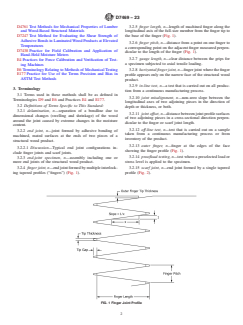
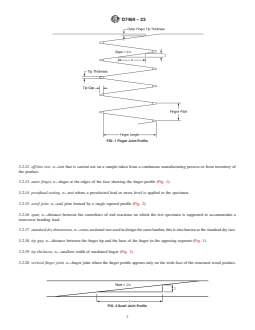
D4761 Test Methods for Mechanical Properties of Lumber 3.2.5 finger length, n—length of machined finger along the
and Wood-Based Structural Materials longitudinal axis of the full-size member from the finger tip to
D7247 Test Method for Evaluating the Shear Strength of the base of the finger (Fig. 1).
Adhesive Bonds in Laminated Wood Products at Elevated
3.2.6 finger pitch, n—distance from a point on one finger to
Temperatures
a corresponding point on the adjacent finger measured perpen-
D7438 Practice for Field Calibration and Application of
dicular to the length of the finger (Fig. 1).
Hand-Held Moisture Meters
3.2.7 gauge length, n—clear distance between the grips for
E4 Practices for Force Calibration and Verification of Test-
a specimen subjected to axial tensile loading.
ing Machines
E6 Terminology Relating to Methods of Mechanical Testing
3.2.8 horizontal finger joint, n—finger joint where the finger
E177 Practice for Use of the Terms Precision and Bias in
profile appears only on the narrow face of the structural wood
ASTM Test Methods
product.
3.2.9 in-line test, n—a test that is carried out on all produc-
3. Terminology
tion from a continuous manufacturing process.
3.1 Terms used in these methods shall be as defined in
3.2.10 joint misalignment, n—non-zero slope between the
Terminologies D9 and E6 and Practices E4 and E177.
longitudinal axes of two adjoining pieces in the direction of
3.2 Definitions of Terms Specific to This Standard:
depth or thickness, or both.
3.2.1 delamination, n—separation of a bondline due to
3.2.11 joint offset, n—distance between joint profile surfaces
dimensional changes (swelling and shrinkage) of the wood
of two adjoining pieces in a cross-sectional direction perpen-
around the joint caused by extreme changes in the moisture
dicular to the finger or scarf joint length.
content.
3.2.12 off-line test, n—test that is carried out on a sample
3.2.2 end joint, n—joint formed by adhesive bonding of
taken from a continuous manufacturing process or from
machined, mated surfaces at the ends of two pieces of a
inventory of the product.
structural wood product.
3.2.13 outer finger, n—finger at the edges of the face
3.2.2.1 Discussion—Typical end joint configurations in-
showing the finger profile (Fig. 1).
clude finger joints and scarf joints.
3.2.14 proofload testing, n—test where a preselected load or
3.2.3 end-joint specimen, n—assembly including one or
stress level is applied to the specimen.
more end joints of the structural wood product.
3.2.4 finger joint, n—end joint formed by multiple interlock- 3.2.15 scarf joint, n—end joint formed by a single tapered
ing tapered profiles (“fingers”) (Fig. 1). profile (Fig. 2).
FIG. 1 Finger Joint Profile
D7469 − 23
FIG. 2 Scarf Joint Profile
3.2.16 span, n—distance between the centerlines of end occur primarily at or as a result of the joint, but long enough
reactions on which the test specimen is supported to accom- such that the stresses around the joint are not affected by the
modate a transverse bending load. grips.
3.2.17 standard dry dimensions, n—cross-sectional size
6.2 Except as specified below, the specimens shall be tested
used in design for sawn lumber, this is also known as the
in accordance with Test Methods D4761 for Axial Strength in
standard dry size.
Tension.
3.2.18 tip gap, n—distance between the finger tip and the
6.3 The specimen is loaded so that failure occurs or a
base of the finger in the opposing segment (Fig. 1).
preselected load is reached within the prescribed amount of
3.2.19 tip thickness, n—smallest width of machined finger
time.
(Fig. 1).
NOTE 1—It is preferred to apply load at a constant rate of increase.
Either load or displacement control is acceptable. Apply load at a rate that
3.2.20 vertical finger joint, n—finger joint where the finger
is as close to constant as is practical. Sudden increases in load should be
profile appears only on the wide face of the structural wood
avoided.
product.
7. Apparatus
4. Significance and Use
4.1 These test methods are applicable to specimens with or
7.1 Test Machine—As specified in Test Methods D4761.
without specific conditioning regimens. Tests are permitted to
7.2 Grips or Clamping Devices—As specified in Test Meth-
be performed on specimens that are not at moisture
ods D4761.
equilibrium, such as under production conditions in a plant, or
NOTE 2—Grip designs that do not minimize damage from clamping
on specimens that have been conditioned to specified moisture
may result in a high frequency of failure at the edge of the grips.
content or durability conditioning prior to testing.
Generally, if a specimen fails at the edge of the grips, the result should be
disregarded unless the load level attains a load level that is sufficient to
4.2 These test methods can be used as follows:
demonstrate a minimum end-joint capacity. When a high frequency of grip
4.2.1 To standardize the determination of strength properties
related failure occurs at or below the load levels of interest, the grips
for the material and joint being tested.
should be redesigned as excessive culling of specimens for this reason
4.2.2 To investigate the effect of parameters that may
may impact the representativeness of the tensile strength for the sample
tested.
influence the structural capacity of the joint, such as joint
profile, adhesive type, moisture content, temperature, and
7.3 Distance Between Grips—The gauge length for finger-
strength-reducing characteristics in the assembly.
joint testing shall be selected such that the edges of the grips
are 2 ft (610 mm) apart. The gauge length for scarf joint testing
4.3 These test methods do not intend to address all possible
exposure or performance expectations of end joints. The shall be set to the nearest 1 ft (305 mm) increment greater than
following are some performance characteristics not considered: the length of the joint plus 2 ft (610 mm). With either joint
4.3.1 Long-term strength and permanence of the wood type, the tolerance for gauge length shall be 62 in. (51 mm).
adhesive.
NOTE 3—The gauge length used for the test is intended to be long
enough to result in uniform tensile stress across the joint and short enough
4.3.2 Time dependent mechanical properties of the joint.
to minimize the number of failures that occur away from the joint. The
4.3.3 Elevated temperature performance of the joint.
specification outlined in 7.3 has proven reasonable for testing commonly
fingerjoined dimension lumber sizes. larger cross-sections may require
longer gauge lengths.
AXIAL TENSION TEST METHOD (OFF-LINE)
7.4 Accuracy—As specified in Test Methods D4761.
5. Scope
5.1 This test method provides procedures for the determi-
8. Test Specimens and Conditioning
nation of the axial tensile capacity of full-size end-joint
8.1 Cross-Section—The specimen shall be tested without
specimen off-line.
modifying the dimensions of the commercial cross-section.
5.2 Applications of this test method include: end-joint
The use of reduced cross-section test specimens is permissible
qualification and daily quality control of production, and other
according to considerations and guidelines for developing test
purposes where the strength of a full-size end joint must be
procedures provided in Appendix X5.
verified or determined.
8.2 Length—The minimum specimen length shall be the
6. Summary of Test Method
gauge length, determined in accordance with 7.3, plus any
6.1 The test specimen is subjected to an axial tensile load. required length to achieve contact along the full length of the
The length of the specimen is short enough such that failures grips.
D7469 − 23
8.3 Conditioning—Specimens are permitted to be tested as BENDING TEST METHOD (OFF-LINE)
produced or following a specified conditioning regimen de-
10. Scope
pending on the purpose of the test program. The specimen
conditions and details of the conditioning regimen, if 10.1 This test method provides off-line test procedures for
applicable, shall be reported.
the determination of the capacity of the end joint in bending on
short spans when subjected to either three-point or four-point
9. Procedure loading.
10.2 Applications of this test method include: end-joint
9.1 Specimen Measurements:
qualification and daily quality control, and other purposes
9.1.1 Cross-Sectional Dimensions—The cross-sectional di-
where the strength of a full-size end joint are to be verified or
mensions of each specimen for which the tensile strength is to
determined.
be determined shall be measured to the nearest 0.01 in.
(0.25 mm) and recorded. Where the cross-sectional dimensions
11. Summary of Test Method
differ on either side of the joint, such as when testing samples
11.1 The test specimen is simply supported and transversely
before they are planed to a standard size, the cross-sectional
loaded in bending. Depending upon the test objectives and
dimensions used to calculate the tensile strength shall be
end-joint type, the test specimen may be loaded by two equal,
reported. The width and thickness shall be measured at the least
concentrated forces spaced equidistant from the center of the
dimensional plane of the adjoining segment.
supports (four-point load configuration) or by a single concen-
NOTE 4—When testing for end-joint quality control at a production
trated force centered within the test span (three-point load
facility, it may be acceptable to determine the tensile strength using the
configuration). The specimen is loaded so that failure occurs or
standard dry cross-sectional dimensions.
a preselected load is reached within the prescribed amount of
9.1.2 Moisture Content—Unless otherwise specified by a
time.
durability conditioning protocol or product standard, measure
NOTE 6—It is preferred to apply load at a constant rate of increase.
and record the moisture content of the specimens following a Either load or displacement control is acceptable. Apply load at a rate that
is as close to constant as is practical. Sudden increases in load should be
test on each side of the joint and as close to the failure zone as
avoided.
practical in accordance with the procedures outlined in Test
Methods D4442. Alternatively, the moisture content of solid 11.2 Except as specified below, the specimens shall either
be tested in accordance with Test Methods D4761 for Bending
wood specimens shall be permitted to be determined using a
calibrated moisture meter according to Practice D7438 guide- Edge-Wise or Bending Flat-Wise. The test method used shall
be reported.
lines. For specimens tested as produced from a manufacturing
process in which moisture content is controlled or where all
12. Apparatus
specimens are pre-conditioned to a uniform moisture content
prior to mechanical testing, moisture content measurements for 12.1 Test Machine—As specified in Test Methods D4761.
each specimen are not required. In those instances, the reduced
12.2 Load and Support Apparatus—As specified in Test
number of specimens from the sample shall be determined in
Methods D4761, with the exception that finger jointed speci-
accordance with the guidelines in Practice D2915.
mens shall also be permitted to be tested using a single
concentrated point load (three-point load configuration) for
9.2 Test Setup—The end joint shall be centered between the
both the edgewise and flatwise bending test methods.
two grips. The specimen shall also be centered in the grips so
that the longitudinal axis of the specimen coincides with the
12.3 Load Configuration:
direction of the load application. Load shall be applied to the
12.3.1 The standard span for this test shall be 21 times the
specimen at a rate determined in accordance with 9.3.
specimen depth, however other spans shall be permitted. If
NOTE 5—Centering the joint in the grip span minimizes the bias
another span is used, it shall be reported.
between joint tests due to bending moments induced by grip head balance.
12.3.2 The specimen is permitted to be placed in either the
It is recognized that bending moments caused by non-homogeneity in the
flat-wise or edge-wise orientation according to the require-
specimen’s mechanical properties cannot be eliminated.
ments of the test program. The test orientation and the direction
9.3 Speed of Testing—A constant test rate shall be selected
of the applied load relative to the joint profile shall be reported.
for testing the sample such that the specimen failure load is
In the case of square cross-sections, the applied load shall be
achieved between 1 min and 10 min.
described as being applied either parallel or perpendicular to
the face showing the joint profile.
9.4 Maximum Load—The maximum load attained in the test
12.3.3 Four-Point Load Configuration—The four-point load
shall be recorded.
configuration shall be required for scarf jointed materials and
9.5 Record of Test Rate—A description of the rate of loading
permitted for finger jointed materials. In both cases, the
and method of application shall be recorded.
simple-span test specimen shall be subjected to two equal
9.6 Record of Failure—For all specimens tested to failure, a transverse concentrated loads equidistant from the center of
description of the failure mode in accordance with Annex A1 supports. The centerline of action of the applied loads shall not
shall be recorded. Any specimen irregularities or the presence be closer than 2.0 in. (51 mm) from the joint area, and the
of strength reducing defects within the joint shall also be edges of bearing plates under the loads shall not impinge on the
recorded. cross-section of the specimen occupied by the end joint. Test
D7469 − 23
specimens shall be prepared such that the end joint is placed 14.4 Maximum Load—The maximum load attained in the
within and, whenever possible, centered in the maximum test shall be recorded.
moment zone.
14.5 Record of Test Rate—A description of the rate of
12.3.4 Three-Point Load Configuration—The three-point
loading and method of application shall be recorded.
load configuration shall be permitted to test finger jointed
14.6 Record of Failure—For all specimens tested to failure,
materials. The simple-span test specimen shall be subjected to
a description of the failure mode in accordance with Annex A1
a single concentrated load centered between the supports. The
shall be recorded. Any specimen irregularities or the presence
finger joint shall be centered beneath the load point and the
of strength reducing defects within the joint shall also be
load shall be applied through a curved surface with a radius
recorded.
sufficient to avoid a localized crushing failure.
NOTE 7—To minimize the number of failures occurring away from the
joint regardless of load configuration selected, the overall span should be CYCLIC DELAMINATION TEST METHOD
selected to be as short as possible but sufficiently long to avoid shear and
(OFF-LINE)
bearing failures before the end-joint bending capacity is reached. The
shear span (as defined in Test Methods D198) should be selected to be as
15. Scope
long as possible to minimize failure at strength-reducing characteristics
close to the end joint.
15.1 This test method provides procedures for assessing the
NOTE 8—Experience has shown that a curved load head with a radius
ability of the bond to resist separation after repeated exposure
between two and four times the member depth is typically sufficient to
to moisture and drying. This test method is for end joints in
avoid a localized crushing failure with a three-point load configuration.
products requiring evaluation of durability, and also provides
12.4 Accuracy—As specified in Test Methods D4761.
an indication of the overall consistency of the end-joint
manufacturing process.
13. Test Specimens and Conditioning
NOTE 10—This is adopted from Test Methods D1101, Test Method B,
13.1 Cross-Section—The specimen shall be tested without for finger joints.
modifying the dimensions of the commercial cross-section.
16. Summary of Test Method
The use of reduced cross-section test specimens is permissible
according to considerations and guidelines for developing test
16.1 The end-grain surfaces of a bonded wood cross-section
procedures provided in Appendix X5.
are exposed to a vacuum-pressure soak treatment in room
temperature water to saturate the specimen. The specimen is
13.2 Conditioning—Specimens are permitted to be tested as
then dried under mild conditions to within 15 % above its
produced or following a specified conditioning regimen de-
original weight. The vacuum-pressure soaking and drying
pending on the purpose of the test program. The specimen
constitute one cycle. The total length of bondlines on the
conditions and details of the conditioning regimen, if
exposed end-grain that separated or delaminated as a result of
applicable, shall be reported.
the treatment is measured and expressed as a percentage of the
14. Procedure original length prior to the exposure. One or multiple cycles are
conducted according to the requirements of the test program or
14.1 Specimen Measurements:
product specifications.
14.1.1 Cross-Sectional Dimensions—The cross-sectional di-
mensions of each specimen for which the bending strength is to 16.2 When the delamination exceeds a predetermined level,
be determined shall be measured to the nearest 0.01 in. the population represented by the sample shall be deemed to be
(0.25 mm) and recorded. Where the cross-sectional dimensions non-compliant, and the end-joint manufacturing process, if
differ on either side of the joint, such as when testing samples applicable, shall be evaluated to determine the reasons for the
before they are planed to a standard size, the cross-sectional
adverse test results.
dimensions used to calculate the flexural strength shall be
reported. The use of reduced cross-section test specimens is 17. Apparatus
permissible according to considerations and guidelines for
17.1 Autoclave—An autoclave or similar pressure vessel
developing test procedures provided in Appendix X5.
designed to safely withstand pressures of at least 75 psi
(520 kPa) is required for impregnating the specimens with
NOTE 9—When testing for end-joint quality control at a production
facility, it may be acceptable to determine the flexural strength using the
water. The pressure vessel shall be equipped with a vacuum
standard dry cross-sectional dimensions.
pump or similar device capable of drawing a vacuum of at least
14.1.2 Moisture Content—The moisture content of the test 25 in. (635 mm) mercury (Hg) (at sea level) in the vessel, and
a pump or similar device for obtaining a pressure of at least
specimens shall be determined as described in 9.1.2.
75 psi (520 kPa).
14.2 Test Setup—As specified in Test Methods D4761, with
17.2 Drying Oven—The drying oven shall be capable of
the exception that it is permissible to apply a single concen-
trated load in both the flatwise and edgewise bending test maintaining the conditions necessary to dry specimens in 10 h
to 15 h to within 15 % above its original weight.
methods when testing finger jointed material.
NOTE 11—Suitable drying conditions may be obtained from cross-flow,
14.3 Speed of Testing—A constant test rate shall be selected
laboratory type ovens of the circulating type. They can also be obtained
for testing the sample such that the specimen target failure load
using a non-circulating configuration in which air heated by a space heater
is achieved between 1 min and 10 min. is passed over the specimens and vented.
D7469 − 23
NOTE 12—Conditions that affect the drying rate include cross-flow air saturation point. The final moisture condition in which bondline delami-
velocity; humidity; air temperature; and the arrangement, size, and nation is most evident and measurable should be determined for each
number of specimens in the oven. product and specified in the applicable product standard.
NOTE 13—Circulating type ovens that provide a cross-flow air velocity
19.6 During drying, the specimens shall be placed at least
of 250 fpm 6 50 fpm (75 m ⁄min 6 15 m ⁄min) in the center of the drying
2 in. (50 mm) apart, with the exposed bondlines on the
chamber and maintain an air temperature of 160 °F 6 5 °F (70 °C 6 3 °C)
should be capable of achieving the specified drying rate. end-grain surfaces parallel to the direction of the airflow.
19.7 After drying, the delamination shall be measured and
18. Test Specimens and Conditioning
recorded immediately following the procedures set forth in
18.1 Specimen Dimensions—The test specimen shall be
Section 20. The percentage delamination shall be calculated in
prepared from a full cross-section piece, measuring approxi-
accordance with Section 20.
mately 6 in. (152 mm) long, and containing the joint in the
19.8 For multiple-cycle delamination testing, steps 19.1 to
center of the length.
19.7 shall be repeated the required number of times based on
18.2 Pre-Conditioning—Unless the conditioning is part of
the test program or product specification. The percentage
the adhesive curing process, specimens shall be tested as delamination after each cycle shall be determined and recorded
sampled.
after each cycle.
18.3 Specimen Preparation—The specimen shall be cross-
20. Measurements and Calculation
cut through the center of the joint to expose the bondlines on
20.1 At the end of the drying period, the crosscut surface of
the end-grain and yielding two test specimens, 3 in. (76 mm)
the specimens shall be examined immediately for delamination
long.
(separation of the bondlines), and indeterminate areas shall be
18.3.1 The cut surface shall be smooth and perpendicular to
probed with a 0.004-in. (0.102 mm) feeler gauge.
the longitudinal axis of the end-jointed member.
NOTE 16—If the delamination specimens are removed from the oven
18.4 At least 0.25 in. (6 mm) of the joint (measured from the
and allowed to reabsorb moisture from the atmosphere, the delaminations
tips of the finger or end of the scarf to the cut face) shall remain in the bondlines will tend to close up.
NOTE 17—Care should be exercised to limit the applied pressure to the
on each test specimen. If the length of the joint does not permit
feeler gauge so as not to lengthen or widen the bondline separation beyond
this to be met by cutting at the center of the joint, the joint shall
that observed immediately after drying.
be cut at the tips of the fingers or end of the scarf to yield one
20.2 The length of the delaminated portions shall be mea-
test specimen, and such that the full length of the joint is
sured to the nearest ⁄16 in. (1 mm), and the delamination
retained.
lengths shall be summed. This result shall be divided by the
total length of exposed bondlines on the end-grain surfaces,
19. Procedure
excluding those lengths of delamination permitted to be
19.1 The test specimens shall be placed in the pressure
ignored by 20.3.
vessel and weighted down. Sufficient water shall be admitted at
20.3 In finger joints, it is permissible to ignore the follow-
a temperature of 65 °F to 85 °F (18 °C to 30 °C), so that the
ing:
test specimens are completely submerged.
20.3.1 Any delamination in the bondlines adjacent to the
19.2 Stickering, wire screens, or other means shall be used
outer fingers;
to separate the test specimens so that all end grain surfaces are
20.3.2 Any delamination less than 0.1 in. (2.5 mm) long;
freely exposed to water.
and
19.3 A vacuum of 20 in. to 25 in. (510 mm to 640 mm) Hg
20.3.3 Any delamination within knot boundaries visible in
shall be drawn and held for 30 min then released.
the crosscut surface.
19.4 A pressure of 75 psi 6 5 psi (520 kPa 6 34 kPa) shall
be applied for a period of 2 h.
PROOFLOADING (IN-LINE)
NOTE 14—For scarf joints and finger joints longer than about 1 in.
(25.4 mm), two additional vacuum-pressure cycles as described in 19.3
21. Scope
and 19.4 may be necessary to fully saturate the specimens.
21.1 This test method provides an in-line quality assurance
19.5 The test specimens shall be dried using air at a
procedure for end-joint strength.
temperature of 160 °F 6 5 °F (71 °C 6 3 °C). The air
21.2 This method does not provide sufficient means to fully
circulation and number of specimens in the oven at any time
shall be selected such that the specimens are dried to within characterize the strength parameters of a population or sample
of end joints, and is not intended to be a substitute for off-line
15 % above their original weight in 10 h to 15 h.
NOTE 15—Experience from the U.S. structural glued laminated timber
process qualification and on-going quality control testing.
industry indicates that bondline delamination in specimens with original
21.3 This method reduces the variability of the lower end of
average moisture content of approximately 12 % become most evident
strength distribution by culling low-strength end joints.
when the specimens are dried to within 110 % to 115 % of their original
weight. Further drying tends to reduce the moisture gradient in the NOTE 18—Although this method improves the structural reliability, it
specimens and allows bondline separations to close, masking the delami- does not necessarily provide absolute assurance those end joints proof-
nation. Products bonded at higher initial moisture contents, especially at loaded to a specified test level will not fail when reloaded to the same
19 % or more, may require further drying to ensure that a similar moisture tension stress level.
gradient is created and the outer fibers are significantly below the fiber NOTE 19—In a continuous end joining process, end joints may
D7469 − 23
occasionally appear in the grips. Provided this is a random occurrence, the
be applied to the end joint, either from two equal transverse
application is still considered to meet the requirements of this method.
concentrated loads equidistant from the supports or a single
concentrated load at mid-span.
22. Summary of Test Method
NOTE 25—Simple end supports are recommended. Other types of end
22.1 End joints are either tested in axial tension or in
fixity may be used if it is taken into account when selecting the appropriate
bending with a 3- or 4-point loading configuration.
proofload. The standard span range is 15 to 30 times the specimen depth.
22.1.1 Load is applied to the test specimen until a prese-
23.3 Gauges and Controls—The necessary controls and
lected load is reached or the specimen fails under load or
gauges shall be capable of being calibrated to consistently
exceeds a predefined deflection.
measure and control the required proofload for all grades,
22.2 Intact specimens supporting the preselected load are
width and thickness intended to be proofloaded.
accepted and continue to the next step in the production
23.4 Accuracy—The force-measuring apparatus shall be
process, while failed specimens are rejected and removed from
such as to permit load measurements with an error not to
the production process.
exceed 2.0 % of the load.
22.3 This process identifies low-strength specimens primar-
NOTE 26—Consideration should be given to dynamic effects of the
loading apparatus on the accuracy of the measured loads. It is recom-
ily by destroying them.
mended that the apparatus be designed and maintained such that it can be
NOTE 20—Means should be provided to monitor production during
demonstrated that 95 % of the time, the applied load level is between
proofloading to eliminate specimens that provide visual or audible
100 % and 110 % of the specified proofload level.
evidence of excessive damage from the test.
22.4 This method is permitted to be applied to single end
24. Test Specimens and Conditioning
joints or to long lengths of joined lumber containing one or
24.1 Cross-Section—The specimens shall be tested as
multiple end joints.
produced, without modification of the cross-section.
NOTE 21—Proofloading may be applied to production before or after
the point where samples are drawn for off-line qualification and quality
24.2 Length—The minimum specimen length shall be the
control testing. Where this method is used and no formal feedback exists
clear distance between grips or supports plus any required
between the frequency of specimens failing the proofload test level and the
length to achieve full contact along the length of the grips or
manufacturing process controls, it is recommended that proofloading be
applied to production after the point where samples are drawn for off-line supports.
tests.
24.3 Moisture Content—Specimens shall be tested as pro-
duced without further moisture conditioning.
23. Apparatus
24.4 Temperature and Adhesive Cure—Proofload testing of
23.1 Test Machine—A device combining (1) a mechanism
end joints with partially cured adhesive bonds shall only be
transmitting the load to the test specimen; (2) a mechanism for
performed after it has been established that the performance of
applying a load up to a preselected value; (3) a device or
the end joint when the adhesive has reached full cure is not
mechanism for measuring the applied load and ending the test
affected. If a lower proofload level is used for partially cured
when a preselected load is reached; (4) the necessary controls,
adhesive bonds in place of a proofload level that has been
gauges, etc., to ensure consistent application of the preselected
established for end joints with fully cured bonds, the method
load; and (5) a mechanism or device to ensure that specimens
for establishing the lower proofload level shall be documented.
failing to achieve the preselected load are removed or marked
NOTE 27—The lower proofload level should consider the variability in
for subsequent removal from production.
degree of cure between specimens and how this may change with the
NOTE 22—When bending proofload testing is adopted, the bending
lumber or ambient environmental conditions.
stiffness can also be used as criterion for rejecting end joints. Because of
NOTE 28—Aside from the adhesive bond, some end use applications
the non-uniform bending within the test span, the set-up will need to
specify and rely on the tension proofload testing to also assess the joint
include a mechanism for noting the position of the joint relative to the
fabrication quality and wood quality. Use of a proofload level lower than
applied loads.
that specified in the applicable product standard should be discussed with
NOTE 23—When proofloading in tension is used, grips or clamping
the end user.
devices shall be designed and used such that damage to the specimen by
the grips during the proofloading process is minimized. The textured
25. Procedure
surfaces left by steel grip plates are generally inconsequential for members
used in most structural applications, but may be an issue if a smooth
25.1 Test Setup—When proofloading in tension, the speci-
surface is required for face bonding. Other damage should be assessed and
men shall be centered in the grips with the long axis of the
confirmed to be insignificant to the desired end use.
specimen coinciding with the direction of load application.
23.2 Test Span:
When testing in bending, the specimen shall be placed with an
23.2.1 When proofloading in tension, the clear distance
end joint located within the maximum moment zone.
between grips shall be selected such that the edges of the grips
25.2 Speed of Testing—The load rate shall be consistent for
are at least 2 ft (610 mm) apart for finger joints and at least 2 ft
all end joints within a production run.
(610 mm) longer than the length of the joint for scarf joints.
NOTE 29—Typical line speeds result in the proofload being reached in
less than three seconds.
NOTE 24—It is recommended that the tension test span be the maximum
span possible so that the number of joints positioned near or within the
25.3 Proofload—The applied proofload shall be selected in
grips during the test is kept to a minimum.
accordance with the objectives of the quality control program.
23.2.2 When testing in bending, the test span shall be
NOTE 30—The applied proofload level should be sufficiently high to
selected which will permit a predetermined bending moment to reject mismanufactured or low-strength specimens, but low enough to
D7469 − 23
minimize failure of acceptable specimens. Because the degree of damage
28. Apparatus
to a specimen is a function of the test load level and the actual but
28.1 Calipers or any other device suitable for measuring the
unknown strength of the specimen, the few pieces that marginally pass the
proofload test will likely encounter some damage. Therefore, it is advised distances and cross-sectional dimensions to the nearest 0.01 in.
that the proofload level be set higher than that to be encountered by the
(0.2 mm).
product when in service. For example, SPS-1 for structural fingerjoined
lumber requires a minimum proofload level of 1.33 times the design
29. Procedure
capacity, while some manufacturers of I-joists have specified 1.5 times the
design capacity for their fingerjoined flange components.
29.1 End-Joint Offset—The procedure used to measure end-
NOTE 31—For partially cured joints, the proofload levels may need to
joint offset corresponds with the diagram illustrated in Fig. 3
be reduced to account for the degree of cure and temperature of the
and includes the following steps:
specimen at the time of test. Guidelines on acceptable proofload level
reductions should be developed for the specific adhesive and manufactur-
29.1.1 Remove adhesive squeeze-out, torn fibers, or any
ing conditions. Labeling or reporting of the actual proofload level used
surface defects prior to measuring.
may be required.
29.1.2 For both sides of the end joint, measure and report
25.4 If required, Practice D2915 and these methods shall be
the end-joint offset as the distance between the protruding edge
used to assess the effect of the proofloading program on the
of the end joint and the nearest point on the adjoining piece.
end-joint strength distribution.
Take the offset measurement at a position not impacted by edge
tearout.
JOINT OFFSET AND MISALIGNMENT
29.1.3 Measure and report the cross-sectional dimensions
26. Scope
for each piece of wood adjacent to the end joint.
26.1 This test method defines procedures used to measure
29.2 End-Joint Misalignment—The procedure to measure
end-joint offset or misalignment, or both. These test methods
the end-joint misalignment corresponds with diagram illus-
shall be permitted to characterize the installation tolerances of
trated in Fig. 4 and includes the following steps:
an end joint for comparison against an applicable performance
29.2.1 Identify the side of the end joint where the two pieces
specification for these parameters.
form an angle of less than 180°.
29.2.2 From the side of the joint identified in 29.2.1, use a
27. Summary of Test Method
straight-edge to draw a set of intersecting lines parallel to the
27.1 End-Joint Offset—Specified measurement techniques
member edges as depicted in Fig. 2.
are provided to measure the relative offset of two adjoining
29.2.3 Measure and report the end-joint misalignment as the
pieces in a cross-sectional direction perpendicular to the finger
vertical leg of the slope depicted in Fig. 4. Whenever possible,
or scarf joint length.
report the end-joint misalignment as the slope that occurs along
12 in. (30.5 cm) of the member length. Alternatively, the slope
27.2 End-Joint Misalignment—Specified measurement
techniques are provided to measure and characterize the measurements shall be permitted to be taken over longer or
shorter distances and mathematically converted to the slope
relative misalignment of the joined pieces about the axes
parallel to the member depth or thickness, or both. that occurs along 12 in. (30.5 cm) of member length.
FIG. 3 End-Joint Offset
D7469 − 23
FIG. 4 End-Joint Misalignment
29.2.4 Measure and report the end-joint misalignment inde- 30.2.2 Description of the population sampled, including (1)
pendently for both axes defined by the member depth and species or species group; (2) specimen geometry (for example,
thickness, taking at least one measurement in each direction. If nominal cross-section and length); (3) end-joint profile (for
more than one measurement is taken in one direction, it is
example, theoretical dimension of fingers, tip gaps, and shoul-
permitted to report their average. ders) and joint orientation; (4) adhesive used (including a
29.2.5 Measure and report the cross-sectional dimensions
reference to the adhesive qualification test report) and the
for each piece of wood adjacent to the end joint.
method of curing; (5) grade or grades combination; and (6) any
wood product treatment at the time of production (for example
30. Report
preservative treatment), if applicable.
30.1 The report content depends on the purpose of the test
30.2.3 Description of the sample, including (1) sample size;
program. The report shall include, at the minimum, the
(2) conditioning, if applicable; (3) temperature of specimens at
information specified in the section above and the following:
the time of testing; (4) degree of cure of the adhesive; (5)
30.1.1 Description of the test machine, including detailed
number of specimens that failed during the test; and (6) the
drawings of the test setup, the span or gauge length, and the
level of wood product treatment (for example chemical reten-
location of the force-measuring device.
tion levels), if applicable.
30.1.2 Description of calibration procedures, frequency, and
30.2.4 Data on test specimens, including, as applicable: (1)
records.
grade, (2) actual cross-sectional dimensions, (3) moisture
30.1.3 Method used for the measurement of the moisture
content, (4) maximum load, and (5) failure description and
content of specimens, if applicable. If Practice D7438 is used,
location.
report the basis and nature of any corrections or adjustments to
the moisture content readings. If no moisture measurements are 30.3 For in-line test methods, the report shall also include:
made, state the range of moisture content assumed and the
30.3.1 Proofload test levels.
environmental conditions or conditioning supporting this as-
30.3.2 Proofload test repeatability results.
sumption.
30.1.4 Speed of testing, means of control of the speed of
31. Precision and Bias
testing, and time to failure.
31.1 The precision and bias of these test methods have not
30.1.5 Details of any deviations from the prescribed or
yet been established.
recommended procedures as outlined in these test methods.
30.2 For off-line test methods, the report shall also include
32. Keywords
the following:
30.2.1 Method of selection of the tension edge for bending 32.1 cyclic delamination; end joint; finger joint; lumber;
specimens. mechanical properties; proofloading; scarf joint; strength
D7469 − 23
ANNEX
(Mandatory Information)
A1. FAILURE MODE CLASSIFICATION OF TESTED SPECIMENS
A1.1 The types of failure that occur in finger jointed A1.2 Failure modes 1 and 2 require the evaluator to make a
specimens due to tension loading shall be permitted to be distinction between less than 70 % wood failure and more than
roughly classified into six modes. Determine the failure mode 70 % wood failure. This is often a difficult quantity to judge
of each specimen based on the written and graphical descrip- from an oblique angle. In difficult cases it is suggested that the
tion given in Fig. A1.1. Failure modes not similar to any of fingers be cut off at their roots so that the failed surfaces of the
these six modes shall be described. finger can be viewed directly.
D7469 − 23
FIG. A1.1 Failure Mode Criteria
APPENDIXES
(Nonmandatory Information)
X1. GUIDELINES FOR PRODUCT QUALIFICATION AND QUALITY CONTROL
X1.1 Sample Sizes sampled for off-line testing. See, for example, References (6)
or (7) in X7.3 as examples of how end-joint frequency is
X1.1.1 The selection of sample sizes for off-line test meth-
addressed.
ods should follow, for example, Practice D2915. At a
minimum, samples sizes should be selected to infer lower fifth
X1.2 Effect of Test Mode on Capacity and Modes of Fail-
percentile strength properties. In assemblies involving a large
ure
number of finger joints within a standard test length, consid-
erations should be given to also monitoring the variability X1.2.1 For purposes of monitor
...
This document is not an ASTM standard and is intended only to provide the user of an ASTM standard an indication of what changes have been made to the previous version. Because
it may not be technically possible to adequately depict all changes accurately, ASTM recommends that users consult prior editions as appropriate. In all cases only the current version
of the standard as published by ASTM is to be considered the official document.
Designation: D7469 − 22 D7469 − 23
Standard Test Methods for
End Joints in Structural Wood Products
This standard is issued under the fixed designation D7469; the number immediately following the designation indicates the year of
original adoption or, in the case of revision, the year of last revision. A number in parentheses indicates the year of last reapproval. A
superscript epsilon (´) indicates an editorial change since the last revision or reapproval.
INTRODUCTION
Adhesive bonded end joints are used in structural glued wood products. The bond performance of
these end joints is only one of several parameters that influence the in-service performance of these
products. Evaluating the performance of these end joints require specific tests.
The testing regimen, which may consist consists of one or more of the test methods specified in this
standard, is dependent on the type of product, the stage in the manufacturing of the product or
sub-components when the testing is to be performed, and the objective of the evaluation. Appendix
X1 – Appendix X7 provide an overview of considerations for developing a testing regimen.
1. Scope
1.1 This standard provides test methods for evaluating the structural capacity and integrity of end joints in structural wood
products.
1.2 Off-line test methods include: (1) Axial Tension, (2) Bending, and (3) Cyclic Delamination.
1.3 In-line test methods include: (1) Tension Proofload and (2) Bending Proofload.
1.4 The values stated in inch-pound units are to be regarded as standard. The values given in parentheses are mathematical
conversions to SI units that are provided for information only and are not considered standard.
1.5 This standard does not purport to address all of the safety concerns, if any, associated with its use. It is the responsibility
of the user of this standard to establish appropriate safety, health, and environmental practices and determine the applicability of
regulatory limitations prior to use.
1.6 This international standard was developed in accordance with internationally recognized principles on standardization
established in the Decision on Principles for the Development of International Standards, Guides and Recommendations issued
by the World Trade Organization Technical Barriers to Trade (TBT) Committee.
2. Referenced Documents
2.1 ASTM Standards:
D9 Terminology Relating to Wood and Wood-Based Products
These test methods are under the jurisdiction of ASTM Committee D07 on Wood and are the direct responsibility of Subcommittee D07.01 on Fundamental Test Methods
and Properties.
Current edition approved Feb. 1, 2022Nov. 15, 2023. Published March 2022December 2023. Originally approved in 2008. Last previous edition approved in 20212022
as D7469 – 21.D7469 – 22. DOI: 10.1520/D7469-22.10.1520/D7469-23.
For referenced ASTM standards, visit the ASTM website, www.astm.org, or contact ASTM Customer Service at service@astm.org. For Annual Book of ASTM Standards
volume information, refer to the standard’s Document Summary page on the ASTM website.
Copyright © ASTM International, 100 Barr Harbor Drive, PO Box C700, West Conshohocken, PA 19428-2959. United States
D7469 − 23
D198 Test Methods of Static Tests of Lumber in Structural Sizes
D1101 Test Methods for Integrity of Adhesive Joints in Structural Laminated Wood Products for Exterior Use
D1151 Practice for Effect of Moisture and Temperature on Adhesive Bonds
D1183 Practices for Resistance of Adhesives to Cyclic Laboratory Aging Conditions
D2559 Specification for Adhesives for Bonded Structural Wood Products for Use Under Exterior Exposure Conditions
D2915 Practice for Sampling and Data-Analysis for Structural Wood and Wood-Based Products
D3434 Test Method for Multiple-Cycle Accelerated Aging Test (Automatic Boil Test) for Exterior Wet Use Wood Adhesives
D4442 Test Methods for Direct Moisture Content Measurement of Wood and Wood-Based Materials
D5456 Specification for Evaluation of Structural Composite Lumber Products
D4688 Test Method for Evaluating Structural Adhesives for Finger Jointing Lumber
D4761 Test Methods for Mechanical Properties of Lumber and Wood-Based Structural Materials
D7247 Test Method for Evaluating the Shear Strength of Adhesive Bonds in Laminated Wood Products at Elevated
Temperatures
D7438 Practice for Field Calibration and Application of Hand-Held Moisture Meters
E4 Practices for Force Calibration and Verification of Testing Machines
E6 Terminology Relating to Methods of Mechanical Testing
E177 Practice for Use of the Terms Precision and Bias in ASTM Test Methods
3. Terminology
3.1 Terms used in these methods shall be as defined in Terminologies D9 and E6 and Practices E4 and E177.
3.2 Definitions of Terms Specific to This Standard:
3.2.1 delamination, n—separation of a bondline due to dimensional changes (swelling and shrinkage) of the wood around the joint
caused by extreme changes in the moisture content.
3.2.2 end joint, n—joint formed by adhesive bonding of machined, mated surfaces at the ends of two pieces of a structural wood
product.
3.2.2.1 Discussion—
Typical end joint configurations include finger joints and scarf joints.
3.2.3 end-joint specimen, n—assembly including one or more end joints of the structural wood product.
3.2.4 finger joint, n—end joint formed by multiple interlocking tapered profiles (“fingers”) (Fig. 1).
3.2.5 finger length, n—length of machined finger along the longitudinal axis of the full-size member from the finger tip to the base
of the finger (Fig. 1).
3.2.6 finger pitch, n—distance from a point on one finger to a corresponding point on the adjacent finger measured perpendicular
to the length of the finger (Fig. 1).
3.2.7 gauge length, n—clear distance between the grips for a specimen subjected to axial tensile loading.
3.2.8 horizontal finger joint, n—finger joint where the finger profile appears only on the narrow face of the structural wood
product.
3.2.9 in-line test, n—a test that is carried out on all production from a continuous manufacturing process.
3.2.10 joint misalignment, n—non-zero slope between the longitudinal axes of two adjoining pieces in the direction of depth or
thickness, or both.
3.2.11 joint offset, n—distance between joint profile surfaces of two adjoining pieces in a cross-sectional direction perpendicular
to the finger or scarf joint length.
D7469 − 23
FIG. 1 Finger Joint Profile
3.2.12 off-line test, n—test that is carried out on a sample taken from a continuous manufacturing process or from inventory of
the product.
3.2.13 outer finger, n—finger at the edges of the face showing the finger profile (Fig. 1).
3.2.14 proofload testing, n—test where a preselected load or stress level is applied to the specimen.
3.2.15 scarf joint, n—end joint formed by a single tapered profile (Fig. 2).
3.2.16 span, n—distance between the centerlines of end reactions on which the test specimen is supported to accommodate a
transverse bending load.
3.2.17 standard dry dimensions, n—cross-sectional size used in design for sawn lumber, this is also known as the standard dry size.
3.2.18 tip gap, n—distance between the finger tip and the base of the finger in the opposing segment (Fig. 1).
3.2.19 tip thickness, n—smallest width of machined finger (Fig. 1).
3.2.20 vertical finger joint, n—finger joint where the finger profile appears only on the wide face of the structural wood product.
FIG. 2 Scarf Joint Profile
D7469 − 23
4. Significance and Use
4.1 These test methods are applicable to specimens with or without specific conditioning regimens. Tests are permitted to be
performed on specimens that are not at moisture equilibrium, such as under production conditions in a plant, or on specimens that
have been conditioned to specified moisture content or durability conditioning prior to testing.
4.2 These test methods can be used as follows:
4.2.1 To standardize the determination of strength properties for the material and joint being tested.
4.2.2 To investigate the effect of parameters that may influence the structural capacity of the joint, such as joint profile, adhesive
type, moisture content, temperature, and strength-reducing characteristics in the assembly.
4.3 These test methods do not intend to address all possible exposure or performance expectations of end joints. The following
are some performance characteristics not considered:
4.3.1 Long-term strength and permanence of the wood adhesive.
4.3.2 Time dependent mechanical properties of the joint.
4.3.3 Elevated temperature performance of the joint.
AXIAL TENSION TEST METHOD (OFF-LINE)
5. Scope
5.1 This test method provides procedures for the determination of the axial tensile capacity of full-size end-joint specimen off-line.
5.2 Applications of this test method include: end-joint qualification and daily quality control of production, and other purposes
where the strength of a full-size end joint must be verified or determined.
5. Scope
5.1 This test method provides procedures for the determination of the axial tensile capacity of full-size end-joint specimen off-line.
5.2 Applications of this test method include: end-joint qualification and daily quality control of production, and other purposes
where the strength of a full-size end joint must be verified or determined.
6. Summary of Test Method
6.1 The test specimen is subjected to an axial tensile load. The length of the specimen is short enough such that failures occur
primarily at or as a result of the joint, but long enough such that the stresses around the joint are not affected by the grips.
6.2 Except as specified below, the specimens shall be tested in accordance with Test Methods D4761 for Axial Strength in Tension.
6.3 The specimen is loaded so that failure occurs or a preselected load is reached within the prescribed amount of time.
NOTE 1—It is preferred to apply load at a constant rate of increase. Either load or displacement control is acceptable. Apply load at a rate that is as close
to constant as is practical. Sudden increases in load should be avoided.
7. Apparatus
7.1 Test Machine—As specified in Test Methods D4761.
D7469 − 23
7.2 Grips or Clamping Devices—As specified in Test Methods D4761.
NOTE 2—Grip designs that do not minimize damage from clamping may result in a high frequency of failure at the edge of the grips. Generally, if a
specimen fails at the edge of the grips, the result should be disregarded unless the load level attains a load level that is sufficient to demonstrate a minimum
end-joint capacity. When a high frequency of grip related failure occurs at or below the load levels of interest, the grips should be redesigned as excessive
culling of specimens for this reason may impact the representativeness of the tensile strength for the sample tested.
7.3 Distance Between Grips—The gauge length for fingerjoint testing shall be selected such that the edges of the grips are 2 ft
(610 mm) apart. The gauge length for scarf joint testing shall be set to the nearest 1 ft 1 ft (305 mm) increment greater than the
length of the joint plus 2 ft (610 mm). With either joint type, the tolerance for gauge length shall be 62 in. (51 mm).
NOTE 3—The gauge length used for the test is intended to be long enough to result in uniform tensile stress across the joint and short enough to minimize
the number of failures that occur away from the joint. The specification outlined in 7.3 has proven reasonable for testing commonly fingerjoined dimension
lumber sizes. larger cross-sections may require longer gauge lengths.
7.4 Accuracy—As specified in Test Methods D4761.
8. Test Specimens and Conditioning
8.1 Cross-Section—The specimen shall be tested without modifying the dimensions of the commercial cross-section. The use of
reduced cross-section test specimens is permissible according to considerations and guidelines for developing test procedures
provided in Appendix X5.
8.2 Length—The minimum specimen length shall be the gauge length, determined in accordance with 7.3, plus any required length
to achieve contact along the full length of the grips.
8.3 Conditioning—Specimens are permitted to be tested as produced or following a specified conditioning regimen depending on
the purpose of the test program. The specimen conditions and details of the conditioning regimen, if applicable, shall be reported.
9. Procedure
9.1 Specimen Measurements:
9.1.1 Cross-Sectional Dimensions—The cross-sectional dimensions of each specimen for which the tensile strength is to be
determined shall be measured to the nearest 0.01 in. (0.25 mm) 0.01 in. (0.25 mm) and recorded. Where the cross-sectional
dimensions differ on either side of the joint, such as when testing samples before they are planed to a standard size, the
cross-sectional dimensions used to calculate the tensile strength shall be reported. The width and thickness shouldshall be measured
at the least dimensional plane of the adjoining segment.
NOTE 4—When testing for end-joint quality control at a production facility, it may be acceptable to determine the tensile strength using the standard dry
cross-sectional dimensions.
9.1.2 Moisture Content—Unless otherwise specified by a durability conditioning protocol or product standard, measure and record
the moisture content of the specimens following a test on each side of the joint and as close to the failure zone as practical in
accordance with the procedures outlined in Test Methods D4442 or . Alternatively, the moisture content of solid wood specimens
shall be permitted to be determined using a calibrated moisture meter according to Practice D7438 guidelines. For specimens tested
as produced from a manufacturing process in which lumber moisture content is controlled or where all specimens are
pre-conditioned to a uniform moisture content prior to mechanical testing, moisture content measurements for each specimen are
not required. In those instances, the reduced number of specimens from the sample shall be determined in accordance with the
guidelines in Practice D2915.
9.2 Test Setup—The end joint shall be centered between the two grips. The specimen shall also be centered in the grips so that
the longitudinal axis of the specimen coincides with the direction of the load application. Load shall be applied to the specimen
at a rate determined in accordance with 9.3.
NOTE 5—Centering the joint in the grip span minimizes the bias between joint tests due to bending moments induced by grip head balance. It is recognized
that bending moments caused by non-homogeneity in the specimen’s mechanical properties cannot be eliminated.
D7469 − 23
9.3 Speed of Testing—A constant test rate shall be selected for testing the sample such that the specimen failure load is achieved
between 1 and 10 min.1 min and 10 min.
9.4 Maximum Load—The maximum load attained in the test shall be recorded.
9.5 Record of Test Rate—A description of the rate of loading and method of application shall be recorded.
9.6 Record of Failure—For all specimens tested to failure, a description of the failure mode in accordance with Annex A1 shall
be recorded. Any specimen irregularities or the presence of strength reducing defects within the joint shall also be recorded.
BENDING TEST METHOD (OFF-LINE)
10. Scope
10.1 This test method provides off-line test procedures for the determination of the capacity of the end joint in bending on short
spans when subjected to either three-point or four-point loading.
10.2 Applications of this test method include: end-joint qualification and daily quality control, and other purposes where the
strength of a full-size end joint are to be verified or determined.
10. Scope
10.1 This test method provides off-line test procedures for the determination of the capacity of the end joint in bending on short
spans when subjected to either three-point or four-point loading.
10.2 Applications of this test method include: end-joint qualification and daily quality control, and other purposes where the
strength of a full-size end joint are to be verified or determined.
11. Summary of Test Method
11.1 The test specimen is simply supported and transversely loaded in bending. Depending upon the test objectives and end-joint
type, the test specimen may be loaded by two equal, concentrated forces spaced equidistant from the center of the supports
(four-point load configuration) or by a single concentrated force centered within the test span (three-point load configuration). The
specimen is loaded so that failure occurs or a preselected load is reached within the prescribed amount of time.
NOTE 6—It is preferred to apply load at a constant rate of increase. Either load or displacement control is acceptable. Apply load at a rate that is as close
to constant as is practical. Sudden increases in load should be avoided.
11.2 Except as specified below, the specimens shall either be tested in accordance with Test Methods D4761 for Bending
Edge-Wise or Bending Flat-Wise. The test method used shall be reported.
12. Apparatus
12.1 Test Machine—As specified in Test Methods D4761.
12.2 Load and Support Apparatus—As specified in Test Methods D4761, with the exception that finger jointed specimens
mayshall also be permitted to be tested using a single concentrated point load (three-point load configuration) for both the edgewise
and flatwise bending test methods.
12.3 Load Configuration:
D7469 − 23
12.3.1 The standard span for this test shall be 21 times the specimen depth, however other spans shall be permitted. If another
span is used, it shall be reported.
12.3.2 The specimen is permitted to be placed in either the flat-wise or edge-wise orientation according to the requirements of the
test program. The test orientation and the direction of the applied load relative to the joint profile shall be reported. In the case of
square cross-sections, the applied load shall be described as being applied either parallel or perpendicular to the face showing the
joint profile.
12.3.3 Four-Point Load Configuration—The four-point load configuration may be used for finger or scarf shall be required for
scarf jointed materials and permitted for finger jointed materials. In both cases, the simple-span test specimen shall be subjected
to two equal transverse concentrated loads equidistant from the center of supports. The centerline of action of the applied loads
shall not be closer than 2.0 in. (51 mm) from the joint area, and the edges of bearing plates under the loads shall not impinge on
the cross-section of the specimen occupied by the end joint. Test specimens shall be prepared such that the end joint is placed
within and, whenever possible, centered in the maximum moment zone.
12.3.4 Three-Point Load Configuration—The three-point load configuration shall be permitted to test finger jointed materials. The
simple-span test specimen shall be subjected to a single concentrated load centered between the supports. The finger joint shall
be centered beneath the load point and the load shall be applied through a curved surface with a radius sufficient to avoid a localized
crushing failure.
NOTE 7—To minimize the number of failures occurring away from the joint regardless of load configuration selected, the overall span should be selected
to be as short as possible but sufficiently long to avoid shear and bearing failures before the end-joint bending capacity is reached. The shear span (as
defined in Test Methods D198) should be selected to be as long as possible to minimize failure at strength-reducing characteristics close to the end joint.
NOTE 8—Experience has shown that a curved load head with a radius between two and four times the member depth is typically sufficient to avoid a
localized crushing failure with a three-point load configuration.
12.4 Accuracy—As specified in Test Methods D4761.
13. Test Specimens and Conditioning
13.1 Cross-Section—The specimen shall be tested without modifying the dimensions of the commercial cross-section. The use of
reduced cross-section test specimens is permissible according to considerations and guidelines for developing test procedures
provided in Appendix X5.
13.2 Conditioning—Specimens are permitted to be tested as produced or following a specified conditioning regimen depending
on the purpose of the test program. The specimen conditions and details of the conditioning regimen, if applicable, shall be
reported.
14. Procedure
14.1 Specimen Measurements:
14.1.1 Cross-Sectional Dimensions—The cross-sectional dimensions of each specimen for which the bending strength is to be
determined shall be measured to the nearest 0.01 in. (0.25 mm) (0.25 mm) and recorded. Where the cross-sectional dimensions
differ on either side of the joint, such as when testing samples before they are planed to a standard size, the cross-sectional
dimensions used to calculate the flexural strength shall be reported. The use of reduced cross-section test specimens is permissible
according to considerations and guidelines for developing test procedures provided in Appendix X5.
NOTE 9—When testing for end-joint quality control at a production facility, it may be acceptable to determine the flexural strength using the standard dry
cross-sectional dimensions.
14.1.2 Moisture Content—The moisture content of the test specimens shall be determined as described in 9.1.2.
14.2 Test Setup—As specified in Test Methods D4761, with the exception that it is permissible to apply a single concentrated load
in both the flatwise and edgewise bending test methods when testing finger jointed material.
D7469 − 23
14.3 Speed of Testing—A constant test rate shall be selected for testing the sample such that the specimen target failure load is
achieved between 11 min and 10 min.
14.4 Maximum Load—The maximum load attained in the test shall be recorded.
14.5 Record of Test Rate—A description of the rate of loading and method of application shall be recorded.
14.6 Record of Failure—For all specimens tested to failure, a description of the failure mode in accordance with Annex A1 shall
be recorded. Any specimen irregularities or the presence of strength reducing defects within the joint shall also be recorded.
CYCLIC DELAMINATION TEST METHOD
(OFF-LINE)
15. Scope
15.1 This test method provides procedures for assessing the ability of the bond to resist separation after repeated exposure to
moisture and drying. This test method is for end joints in products requiring evaluation of durability, and also provides an
indication of the overall consistency of the end-joint manufacturing process.
NOTE 10—This is adopted from Test Methods D1101, Test Method B, for finger joints.
15. Scope
15.1 This test method provides procedures for assessing the ability of the bond to resist separation after repeated exposure to
moisture and drying. This test method is for end joints in products requiring evaluation of durability, and also provides an
indication of the overall consistency of the end-joint manufacturing process.
NOTE 10—This is adopted from Test Methods D1101, Test Method B, for finger joints.
16. Summary of Test Method
16.1 The end-grain surfaces of a bonded wood cross-section are exposed to a vacuum-pressure soak treatment in room temperature
water to saturate the specimen. The specimen is then dried under mild conditions to within 15 % above its original weight. The
vacuum-pressure soaking and drying constitute one cycle. The total length of bondlines on the exposed end-grain that separated
or delaminated as a result of the treatment is measured and expressed as a percentage of the original length prior to the exposure.
One or multiple cycles are conducted according to the requirements of the test program or product specifications.
16.2 When the delamination exceeds a predetermined level, the population represented by the sample shall be deemed to be
non-compliant, and the end-joint manufacturing process, if applicable, shall be evaluated to determine the reasons for the adverse
test results.
17. Apparatus
17.1 Autoclave—An autoclave or similar pressure vessel designed to safely withstand pressures of at least 75 psi (520 kPa)
(520 kPa) is required for impregnating the specimens with water. The pressure vessel shall be equipped with a vacuum pump or
similar device capable of drawing a vacuum of at least 25 in. (635 mm) (635 mm) mercury (Hg) (at sea level) in the vessel, and
a pump or similar device for obtaining a pressure of at least 75 psi (520 kPa).75 psi (520 kPa).
17.2 Drying Oven—The drying oven shall be capable of maintaining the conditions necessary to dry specimens in 1010 h to 15
h to within 15 % above its original weight.
NOTE 11—Suitable drying conditions may be obtained from cross-flow, laboratory type ovens of the circulating type. They can also be obtained using
a non-circulating configuration in which air heated by a space heater is passed over the specimens and vented.
D7469 − 23
NOTE 12—Conditions that affect the drying rate include cross-flow air velocity; humidity; air temperature; and the arrangement, size, and number of
specimens in the oven.
NOTE 13—Circulating type ovens that provide a cross-flow air velocity of 250250 fpm 6 50 fpm (75(75 m ⁄min 6 1515 m m/min) ⁄min) in the center
of the drying chamber and maintain an air temperature of 160 6 5 °F (70 6 3 °C) 160 °F 6 5 °F (70 °C 6 3 °C) should be capable of achieving the
specified drying rate.
18. Test Specimens and Conditioning
18.1 Specimen Dimensions—The test specimen shall be prepared from a full cross-section piece, measuring approximately 6 in.
(152 mm) long, and containing the joint in the center of the length.
18.2 Pre-Conditioning—Unless the conditioning is part of the adhesive curing process, specimens shall be tested as sampled.
18.3 Specimen Preparation—The specimen shall be crosscut through the center of the joint to expose the bondlines on the
end-grain and yielding two test specimens, 3 in. 3 in. (76 mm) long.
18.3.1 The cut surface shall be smooth and perpendicular to the longitudinal axis of the end-jointed member.
18.4 At least 0.25 in. (6 mm) of the joint (measured from the tips of the finger or end of the scarf to the cut face) shall remain
on each test specimen. If the length of the joint does not permit this to be met by cutting at the center of the joint, the joint shall
be cut at the tips of the fingers or end of the scarf to yield one test specimen, and such that the full length of the joint is retained.
19. Procedure
19.1 The test specimens shall be placed in the pressure vessel and weighted down. Sufficient water shall be admitted at a
temperature of 65 to 85°F (18 to 30°C),65 °F to 85 °F (18 °C to 30 °C), so that the test specimens are completely submerged.
19.2 Stickering, wire screens, or other means shall be used to separate the test specimens so that all end grain surfaces are freely
exposed to water.
19.3 A vacuum of 2020 in. to 25 in. (510(510 mm to 640 mm) Hg shall be drawn and held for 30 min then released.
19.4 A pressure of 7575 psi 6 5 psi (520(520 kPa 6 34 kPa) shall be applied for a period of 2 h.
NOTE 14—For scarf joints and finger joints longer than about 1 in. (25.4 mm), (25.4 mm), two additional vacuum-pressure cycles as described in 19.3
and 19.4 may be necessary to fully saturate the specimens.
19.5 The test specimens shall be dried using air at a temperature of 160 6 5 °F (71 6 3 °C). 160 °F 6 5 °F (71 °C 6 3 °C). The
air circulation and number of specimens in the oven at any time shall be selected such that the specimens are dried to within 15 %
above their original weight in 10 to 15 h.10 h to 15 h.
NOTE 15—Experience from the U.S. structural glued laminated timber industry indicates that bondline delamination in specimens with original average
moisture content of approximately 12 % become most evident when the specimens are dried to within 110110 % to 115 % of their original weight. Further
drying tends to reduce the moisture gradient in the specimens and allows bondline separations to close, masking the delamination. Products bonded at
higher initial moisture contents, especially at 19 % or more, may require further drying to ensure that a similar moisture gradient is created and the outer
fibers are significantly below the fiber saturation point. The final moisture condition in which bondline delamination is most evident and measurable
should be determined for each product and specified in the applicable product standard.
19.6 During drying, the specimens shall be placed at least 2 in. 2 in. (50 mm) apart, with the exposed bondlines on the end-grain
surfaces parallel to the direction of the airflow.
19.7 After drying, the delamination shall be measured and recorded immediately following the procedures set forth in Section 20.
The percentage delamination shall be calculated in accordance with Section 20.
19.8 For multiple-cycle delamination testing, steps 19.1 to 19.7 shall be repeated the required number of times based on the test
program or product specification. The percentage delamination after each cycle shall be determined and recorded after each cycle.
D7469 − 23
20. Measurements and Calculation
20.1 At the end of the drying period, the crosscut surface of the specimens shall be examined immediately for delamination
(separation of the bondlines), and indeterminate areas shall be probed with a 0.004-in. (0.102 mm) feeler gauge.
NOTE 16—If the delamination specimens are removed from the oven and allowed to reabsorb moisture from the atmosphere, the delaminations in the
bondlines will tend to close up.
NOTE 17—Care should be exercised to limit the applied pressure to the feeler gauge so as not to lengthen or widen the bondline separation beyond that
observed immediately after drying.
20.2 The length of the delaminated portions shall be measured to the nearest ⁄16 in. (1 mm), (1 mm), and the delamination lengths
shall be summed. This result shall be divided by the total length of exposed bondlines on the end-grain surfaces, excluding those
lengths of delamination permitted to be ignored by section 20.3.
20.3 In finger joints, it is permissible to ignore the following:
20.3.1 Any delamination in the bondlines adjacent to the outer fingers;
20.3.2 Any delamination less than 0.1 in. (2.5 mm) (2.5 mm) long; and
20.3.3 Any delamination within knot boundaries visible in the crosscut surface.
PROOFLOADING (IN-LINE)
21. Scope
21.1 This test method provides an in-line quality assurance procedure for end-joint strength.
21.2 This method does not provide sufficient means to fully characterize the strength parameters of a population or sample of end
joints, and is not intended to be a substitute for off-line process qualification and on-going quality control testing.
21.3 This method reduces the variability of the lower end of strength distribution by culling low-strength end joints.
NOTE 18—Although this method improves the structural reliability, it does not necessarily provide absolute assurance those end joints proofloaded to a
specified test level will not fail when reloaded to the same tension stress level.
NOTE 19—In a continuous end joining process, end joints may occasionally appear in the grips. Provided this is a random occurrence, the application is
still considered to meet the requirements of this method.
21. Scope
21.1 This test method provides an in-line quality assurance procedure for end-joint strength.
21.2 This method does not provide sufficient means to fully characterize the strength parameters of a population or sample of end
joints, and is not intended to be a substitute for off-line process qualification and on-going quality control testing.
21.3 This method reduces the variability of the lower end of strength distribution by culling low-strength end joints.
NOTE 18—Although this method improves the structural reliability, it does not necessarily provide absolute assurance those end joints proofloaded to a
specified test level will not fail when reloaded to the same tension stress level.
NOTE 19—In a continuous end joining process, end joints may occasionally appear in the grips. Provided this is a random occurrence, the application is
still considered to meet the requirements of this method.
D7469 − 23
22. Summary of Test Method
22.1 End joints are either tested in axial tension or in bending with a 33- or 4-point loading configuration.
22.1.1 Load is applied to the test specimen until a preselected load is reached or the specimen fails under load or exceeds a
predefined deflection.
22.2 Intact specimens supporting the preselected load are accepted and continue to the next step in the production process, while
failed specimens are rejected and removed from the production process.
22.3 This process identifies low-strength specimens primarily by destroying them.
NOTE 20—Means should be provided to monitor production during proofloading to eliminate specimens that provide visual or audible evidence of
excessive damage from the test.
22.4 This method is permitted to be applied to single end joints or to long lengths of joined lumber containing one or multiple
end joints.
NOTE 21—Proofloading may be applied to production before or after the point where samples are drawn for off-line qualification and quality control
testing. Where this method is used and no formal feedback exists between the frequency of specimens failing the proofload test level and the
manufacturing process controls, it is recommended that proofloading be applied to production after the point where samples are drawn for off-line tests.
23. Apparatus
23.1 Test Machine—A device combining (1) a mechanism transmitting the load to the test specimen; (2) a mechanism for applying
a load up to a preselected value; (3) a device or mechanism for measuring the applied load and ending the test when a preselected
load is reached; (4) the necessary controls, gauges, etc., to ensure consistent application of the preselected load; and (5) a
mechanism or device to ensure that specimens failing to achieve the preselected load are removed or marked for subsequent
removal from production.
NOTE 22—When bending proofload testing is adopted, the bending stiffness can also be used as criterion for rejecting end joints. Because of the
non-uniform bending within the test span, the set-up will need to include a mechanism for noting the position of the joint relative to the applied loads.
NOTE 23—When proofloading in tension is used, grips or clamping devices shall be designed and used such that damage to the specimen by the grips
during the proofloading process is minimized. The textured surfaces left by steel grip plates are generally inconsequential for members used in most
structural applications, but may be an issue if a smooth surface is required for face bonding. Other damage should be assessed and confirmed to be
insignificant to the desired end use.
23.2 Test Span:
23.2.1 When proofloading in tension, the clear distance between grips shall be selected such that the edges of the grips are at least
2 ft (610 mm) apart for finger joints and at least 2 ft 2 ft (610 mm) longer than the length of the joint for scarf joints.
NOTE 24—It is recommended that the tension test span be the maximum span possible so that the number of joints positioned near or within the grips
during the test is kept to a minimum.
23.2.2 When testing in bending, the test span shall be selected which will permit a predetermined bending moment to be applied
to the end joint, either from two equal transverse concentrated loads equidistant from the supports or a single concentrated load
at mid-span.
NOTE 25—Simple end supports are recommended. Other types of end fixity may be used if it is taken into account when selecting the appropriate
proofload. The standard span range is 15 to 30 times the specimen depth.
23.3 Gauges and Controls—The necessary controls and gauges shall be capable of being calibrated to consistently measure and
control the required proofload for all grades, width and thickness intended to be proofloaded.
23.4 Accuracy—The force-measuring apparatus shall be such as to permit load measurements with an error not to exceed 2.0 %
of the load.
D7469 − 23
NOTE 26—Consideration should be given to dynamic effects of the loading apparatus on the accuracy of the measured loads. It is recommended that the
apparatus be designed and maintained such that it can be demonstrated that 95 % of the time, the applied load level is between 100100 % and 110 % of
the specified proofload level.
24. Test Specimens and Conditioning
24.1 Cross-Section—The specimens shall be tested as produced, without modification of the cross-section.
24.2 Length—The minimum specimen length shall be the clear distance between grips or supports plus any required length to
achieve full contact along the length of the grips or supports.
24.3 Moisture Content—Specimens shall be tested as produced without further moisture conditioning.
24.4 Temperature and Adhesive Cure—Proofload testing of end joints with partially cured adhesive bonds shall only be performed
after it has been established that the performance of the end joint when the adhesive has reached full cure is not affected. If a lower
proofload level is used for partially cured adhesive bonds in place of a proofload level that has been established for end joints with
fully cured bonds, the method for establishing the lower proofload level shall be documented.
NOTE 27—The lower proofload level should consider the variability in degree of cure between specimens and how this may change with the lumber or
ambient environmental conditions.
NOTE 28—Aside from the adhesive bond, some end use applications specify and rely on the tension proofload testing to also assess the joint fabrication
quality and wood quality. Use of a proofload level lower than that specified in the applicable product standard should be discussed with the end user.
25. Procedure
25.1 Test Setup—When proofloading in tension, the specimen shall be centered in the grips with the long axis of the specimen
coinciding with the direction of load application. When testing in bending, the specimen shall be placed with an end joint located
within the maximum moment zone.
25.2 Speed of Testing—The load rate shall be consistent for all end joints within a production run.
NOTE 29—Typical line speeds result in the proofload being reached in less than three seconds.
25.3 Proofload—The applied proofload shall be selected in accordance with the objectives of the quality control program.
NOTE 30—The applied proofload level should be sufficiently high to reject mismanufactured or low-strength specimens, but low enough to minimize
failure of acceptable specimens. Because the degree of damage to a specimen is a function of the test load level and the actual but unknown strength of
the specimen, the few pieces that marginally pass the proofload test will likely encounter some damage. Therefore, it is advised that the proofload level
be set higher than that to be encountered by the product when in service. For example, SPS-1 for structural fingerjoined lumber requires a minimum
proofload level of 1.33 times the design capacity, while some manufacturers of I-joists have specified 1.5 times the design capacity for their fingerjoined
flange components.
NOTE 31—For partially cured joints, the proofload levels may need to be reduced to account for the degree of cure and temperature of the specimen at
the time of test. Guidelines on acceptable proofload level reductions should be developed for the specific adhesive and manufacturing conditions. Labeling
or reporting of the actual proofload level used may be required.
25.4 If required, Practice D2915 and these methods shall be used to assess the effect of the proofloading program on the end-joint
strength distribution.
JOINT OFFSET AND MISALIGNMENT
26. Scope
26.1 This test method defines procedures used to measure end-joint offset or misalignment, or both. These test methods may be
usedshall be permitted to characterize the installation tolerances of an end joint for comparison against an applicable performance
specification for these parameters.
D7469 − 23
27. Summary of Test Method
27.1 End-Joint Offset—Specified measurement techniques are provided to measure the relative offset of two adjoining pieces in
a cross-sectional direction perpendicular to the finger or scarf joint length.
27.2 End-Joint Misalignment—Specified measurement techniques are provided to measure and characterize the relative
misalignment of the joined pieces about the axes parallel to the member depth or thickness, or both.
28. Apparatus
28.1 Calipers or any other device suitable for measuring the distances and cross-sectional dimensions to the nearest 0.01 in. (0.2
mm).
29. Procedure
29.1 End-Joint Offset—The procedure used to measure end-joint offset corresponds with the diagram illustrated in Fig. 3 and
includes the following steps:
29.1.1 Remove adhesive squeeze-out, torn fibers, or any surface defects prior to measuring.
29.1.2 For both sides of the end joint, measure and report the end-joint offset as the distance between the protruding edge of the
end joint and the nearest point on the adjoining piece. Take the offset measurement at a position not impacted by edge tearout.
29.1.3 Measure and report the cross-sectional dimensions for each piece of wood adjacent to the end joint.
29.2 End-Joint Misalignment—The procedure to measure the end-joint misalignment corresponds with diagram illustrated in Fig.
4 and includes the following steps:
29.2.1 Identify the side of the end joint where the two pieces form an angle of less than 180°.
29.2.2 From the side of the joint identified in 29.2.1, use a straight-edge to draw a set of intersecting lines parallel to the member
edges as depicted in Fig. 2.
29.2.3 Measure and report the end-joint misalignment as the vertical leg of the slope depicted in Fig. 4. Whenever possible, report
the end-joint misalignment as the slope that occurs along 12 in. (30.5 cm) of the member length. Alternatively, the slope
measurements shall be permitted to be taken over longer or shorter distances and mathematically converted to the slope that occurs
along 12 in. (30.5 cm) of member length.
FIG. 3 End-Joint Offset
D7469 − 23
FIG. 4 End-Joint Misalignment
29.2.4 Measure and report the end-joint misalignment independently for both axes defined by the member depth and thickness,
taking at least one measurement in each direction. If more than one measurement is taken in one direction, it is permitted to report
their average.
29.2.5 Measure and report the cross-sectional dimensions for each piece of wood adjacent to the end joint.
30. Report
30.1 The report content depends on the purpose of the test program. The report shouldshall include, at the minimum, the
information specified in the section above and the following:
30.1.1 Description of the test machine, including detailed drawings of the test setup, the span or gauge length, and the location
of the force-measuring device.
30.1.2 Description of calibration procedures, frequency, and records.
30.1.3 Method used for the measurement of the moisture content of specimens, if applicable. If Practice D7438 is used, report the
basis and nature of any corrections or adjustments to the moisture content readings. If no moisture measurements are made, state
the range of moisture content assumed and the environmental conditions or conditioning supporting this assumption.
30.1.4 Speed of testing, means of control of the speed of testing, and time to failure.
30.1.5 Details of any deviations from the prescribed or recommended procedures as outlined in these test methods.
30.2 For off-line test methods, the report shouldshall also include the following:
30.2.1 Method of selection of the tension edge for bending specimens.
30.2.2 Description of the population sampled, including (1) species or species group; (2) specimen geometry (for example,
nominal cross-section and length); (3) end-joint profile
...