

ASTM E3081-21
(Practice)Standard Practice for Outlier Screening Using Process Compensated Resonance Testing via Swept Sine Input for Metallic and Non-Metallic Parts
General Information
- Abstract
SIGNIFICANCE AND USE
5.1 PCRT Applications and Capabilities—PCRT has been applied successfully to a wide range of outlier screening applications in the manufacture and maintenance of metallic and non-metallic parts. Examples of anomalies detected are discussed in 1.1. PCRT has been shown to provide cost effective and accurate outlier screening solutions in many industries including automotive, aerospace, and power generation. Examples of successful applications currently employed in commercial use include, but are not limited to:
(1) Silicon nitride bearing elements,
(2) Steel, iron, and aluminum rocker and control arms,
(3) Aircraft and industrial gas turbine engine components (blades, vanes, disks),
(4) Cast cylinder heads and cylinder blocks,
(5) Sintered powder metal gears and clutch plates,
(6) Machined forged steel steering and transmission components (gears, shafts, racks),
(7) Ceramic oxygen sensors,
(8) Silicon wafers,
(9) Gears, including those with induction hardened or carburized teeth,
(10) Ceramic matrix composite (CMC) material samples and components,
(11) Components with shot peened surfaces,
(12) Machined or rolled-formed steel fasteners, or both,
(13) Components made with additive manufacturing,
(14) Aircraft landing gear, wheel and brake components, and
(15) Components made with metal injection molding.
5.2 General Approach and Equipment Requirements for PCRT via Swept Sine Input:
5.2.1 PCRT systems are comprised of hardware and software capable of inducing swept sine vibrations, recording the component response to the induced vibrations, and executing analysis of the data collected. Inputting a swept sine wave into the part has proven to be an effective means of introducing mechanical vibration and can be achieved with a high quality signal generator coupled with an appropriate active transducer in physical contact with the part. Collection of the part’s frequency response can be achieved by recording the signal generated by an a...
SCOPE
1.1 This practice describes a general procedure for using the process compensated resonance testing (PCRT) via swept sine input method to perform outlier screening on populations of newly manufactured and in-service parts. PCRT excites the resonance frequencies of metallic and non-metallic test components using a swept sine wave input over a set frequency range. PCRT detects and analyzes component resonance frequency patterns and uses the differences in resonance patterns between acceptable and unacceptable components to perform non-destructive testing. PCRT frequency analysis compares the resonance pattern of a component to the patterns of known reference populations of the same component and renders a pass or fail result based on the similarity of the tested component to those populations. For non-destructive testing applications with known defects or material states of interest, or both, Practice E2534 covers the development and application of PCRT sorting modules that compare test components to known acceptable and unacceptable component populations. However, some applications do not have physical examples of components with known defects or material states. Other applications experience isolated component failures with unknown causes or causes that propagate from defects that are beyond the sensitivity of the current required inspections, or both. In these cases, PCRT is applied in an outlier screening mode that develops a sorting module using only a population of presumed acceptable production components, and then compares test components for similarity to that presumed acceptable population. The resonance differences can be used to distinguish acceptable components with normal process variation from outlier components that may have material states or defects, or both, that will cause performance deficiencies. These material states and defects include, but are not limited to, cracks, voids, porosity, shrink, inclus...
- Status
- Published
- Publication Date
- 31-May-2021
- Technical Committee
- E07 - Nondestructive Testing
- Drafting Committee
- E07.06 - Ultrasonic Method
Buy Documents
ASTM E3081-21 - Standard Practice for Outlier Screening Using Process Compensated Resonance Testing via Swept Sine Input for Metallic and Non-Metallic Parts
REDLINE ASTM E3081-21 - Standard Practice for Outlier Screening Using Process Compensated Resonance Testing via Swept Sine Input for Metallic and Non-Metallic Parts
Overview
ASTM E3081-21 is the international standard practice for Outlier Screening Using Process Compensated Resonance Testing (PCRT) via Swept Sine Input for both metallic and non-metallic parts. Developed by ASTM Committee E07 on Nondestructive Testing, this document specifies a procedure to perform nondestructive testing (NDT) of components in manufacturing and service environments, focusing on accurately identifying anomalous items through resonance frequency analysis.
PCRT is a comparison-based NDT method that analyzes the resonance patterns of parts excited with a swept sine input. By comparing the actual frequency response of a part to reference populations, PCRT distinguishes between acceptable process variation and structural or material outliers, thereby enabling effective quality control and defect detection.
Key Topics
- Resonance Testing with Swept Sine Input: PCRT utilizes swept sine vibration to excite parts and measure their natural resonance frequencies, which are highly sensitive to internal and structural defects.
- Outlier Detection: The method compares the measured resonance signature of a test part to a “teaching set” of known good parts, flagging outlier units that deviate beyond acceptable statistical limits.
- Nondestructive and Whole-Body Testing: PCRT efficiently detects cracks, voids, porosity, inclusions, heat treatment variation, dimensional anomalies, and other defects that affect performance, without damaging the part or requiring alteration.
- Adaptability: Applicable to a mix of metallic and non-metallic components, including those manufactured by additive, forging, casting, sintering, or machining processes.
- Statistical Analysis: Leverages advanced pattern recognition, Z-score analysis, and Mahalanobis-Taguchi methods to classify components with high sensitivity.
Applications
PCRT via ASTM E3081-21 is widely used across industries for both production quality assurance and maintenance inspection. The standard is especially valuable in environments where high reliability and structural integrity are critical. Key applications include:
- Automotive: Outlier screening for steel, iron, and aluminum rocker arms, control arms, sintered powder metal gears, clutch plates, machined fasteners, and components fabricated by metal injection molding.
- Aerospace & Power Generation: Inspection of aircraft and turbine engine components (blades, vanes, disks), landing gear, wheels, brake systems, and parts with shot-peened surfaces.
- Electronics and Ceramics: Quality control for silicon nitride bearing elements, silicon wafers, ceramic matrix composites, and oxygen sensors.
- Additive Manufacturing: Verification of parts with complex geometries and material properties, where conventional inspection may be challenging.
- General Industry: Assessment of cast cylinder heads/blocks and rolled-formed steel fasteners, ensuring homogeneous quality and performance.
PCRT supports both newly manufactured and in-service components, with procedures designed for initial screening or periodic health monitoring.
Related Standards
ASTM E3081-21 is often applied alongside other ASTM nondestructive testing standards for resonance and ultrasonic inspection:
- ASTM E1316: Terminology for Nondestructive Examinations, providing key definitions.
- ASTM E2001: Guide for Resonant Ultrasound Spectroscopy for Defect Detection in Both Metallic and Non-metallic Parts.
- ASTM E2534: Practice for Targeted Defect Detection Using PCRT via Swept Sine Input.
- ASTM E3213: Practice for Part-to-Itself Examination Using PCRT via Swept Sine Input.
These standards help build a comprehensive nondestructive testing program, supporting effective process monitoring, statistical quality control, and system health monitoring.
Keywords: nondestructive testing, process compensated resonance testing, PCRT, outlier screening, resonance inspection, swept sine input, defect detection, quality control, metallic and non-metallic parts, manufacturing, ASTM E3081-21.
Relations
- Effective Date
- 01-Feb-2024
- Effective Date
- 01-Dec-2019
- Effective Date
- 01-May-2019
- Effective Date
- 01-Mar-2019
- Effective Date
- 01-Nov-2018
- Effective Date
- 01-Jan-2018
- Effective Date
- 15-Jun-2017
- Effective Date
- 01-Feb-2017
- Effective Date
- 01-Aug-2016
- Effective Date
- 01-Feb-2016
- Effective Date
- 01-Dec-2015
- Effective Date
- 01-Sep-2015
- Effective Date
- 01-Jun-2014
- Effective Date
- 01-Jun-2014
- Effective Date
- 01-Dec-2013
Buy Documents
ASTM E3081-21 - Standard Practice for Outlier Screening Using Process Compensated Resonance Testing via Swept Sine Input for Metallic and Non-Metallic Parts
REDLINE ASTM E3081-21 - Standard Practice for Outlier Screening Using Process Compensated Resonance Testing via Swept Sine Input for Metallic and Non-Metallic Parts
Get Certified
Connect with accredited certification bodies for this standard

BSMI (Bureau of Standards, Metrology and Inspection)
Taiwan's standards and inspection authority.
IMP NDT d.o.o.
Non-destructive testing services. Radiography, ultrasonic, magnetic particle, penetrant, visual inspection.
Inštitut za kovinske materiale in tehnologije
Institute of Metals and Technology. Materials testing, metallurgical analysis, NDT.
Sponsored listings
Frequently Asked Questions
ASTM E3081-21 is a standard published by ASTM International. Its full title is "Standard Practice for Outlier Screening Using Process Compensated Resonance Testing via Swept Sine Input for Metallic and Non-Metallic Parts". This standard covers: SIGNIFICANCE AND USE 5.1 PCRT Applications and Capabilities—PCRT has been applied successfully to a wide range of outlier screening applications in the manufacture and maintenance of metallic and non-metallic parts. Examples of anomalies detected are discussed in 1.1. PCRT has been shown to provide cost effective and accurate outlier screening solutions in many industries including automotive, aerospace, and power generation. Examples of successful applications currently employed in commercial use include, but are not limited to: (1) Silicon nitride bearing elements, (2) Steel, iron, and aluminum rocker and control arms, (3) Aircraft and industrial gas turbine engine components (blades, vanes, disks), (4) Cast cylinder heads and cylinder blocks, (5) Sintered powder metal gears and clutch plates, (6) Machined forged steel steering and transmission components (gears, shafts, racks), (7) Ceramic oxygen sensors, (8) Silicon wafers, (9) Gears, including those with induction hardened or carburized teeth, (10) Ceramic matrix composite (CMC) material samples and components, (11) Components with shot peened surfaces, (12) Machined or rolled-formed steel fasteners, or both, (13) Components made with additive manufacturing, (14) Aircraft landing gear, wheel and brake components, and (15) Components made with metal injection molding. 5.2 General Approach and Equipment Requirements for PCRT via Swept Sine Input: 5.2.1 PCRT systems are comprised of hardware and software capable of inducing swept sine vibrations, recording the component response to the induced vibrations, and executing analysis of the data collected. Inputting a swept sine wave into the part has proven to be an effective means of introducing mechanical vibration and can be achieved with a high quality signal generator coupled with an appropriate active transducer in physical contact with the part. Collection of the part’s frequency response can be achieved by recording the signal generated by an a... SCOPE 1.1 This practice describes a general procedure for using the process compensated resonance testing (PCRT) via swept sine input method to perform outlier screening on populations of newly manufactured and in-service parts. PCRT excites the resonance frequencies of metallic and non-metallic test components using a swept sine wave input over a set frequency range. PCRT detects and analyzes component resonance frequency patterns and uses the differences in resonance patterns between acceptable and unacceptable components to perform non-destructive testing. PCRT frequency analysis compares the resonance pattern of a component to the patterns of known reference populations of the same component and renders a pass or fail result based on the similarity of the tested component to those populations. For non-destructive testing applications with known defects or material states of interest, or both, Practice E2534 covers the development and application of PCRT sorting modules that compare test components to known acceptable and unacceptable component populations. However, some applications do not have physical examples of components with known defects or material states. Other applications experience isolated component failures with unknown causes or causes that propagate from defects that are beyond the sensitivity of the current required inspections, or both. In these cases, PCRT is applied in an outlier screening mode that develops a sorting module using only a population of presumed acceptable production components, and then compares test components for similarity to that presumed acceptable population. The resonance differences can be used to distinguish acceptable components with normal process variation from outlier components that may have material states or defects, or both, that will cause performance deficiencies. These material states and defects include, but are not limited to, cracks, voids, porosity, shrink, inclus...
SIGNIFICANCE AND USE 5.1 PCRT Applications and Capabilities—PCRT has been applied successfully to a wide range of outlier screening applications in the manufacture and maintenance of metallic and non-metallic parts. Examples of anomalies detected are discussed in 1.1. PCRT has been shown to provide cost effective and accurate outlier screening solutions in many industries including automotive, aerospace, and power generation. Examples of successful applications currently employed in commercial use include, but are not limited to: (1) Silicon nitride bearing elements, (2) Steel, iron, and aluminum rocker and control arms, (3) Aircraft and industrial gas turbine engine components (blades, vanes, disks), (4) Cast cylinder heads and cylinder blocks, (5) Sintered powder metal gears and clutch plates, (6) Machined forged steel steering and transmission components (gears, shafts, racks), (7) Ceramic oxygen sensors, (8) Silicon wafers, (9) Gears, including those with induction hardened or carburized teeth, (10) Ceramic matrix composite (CMC) material samples and components, (11) Components with shot peened surfaces, (12) Machined or rolled-formed steel fasteners, or both, (13) Components made with additive manufacturing, (14) Aircraft landing gear, wheel and brake components, and (15) Components made with metal injection molding. 5.2 General Approach and Equipment Requirements for PCRT via Swept Sine Input: 5.2.1 PCRT systems are comprised of hardware and software capable of inducing swept sine vibrations, recording the component response to the induced vibrations, and executing analysis of the data collected. Inputting a swept sine wave into the part has proven to be an effective means of introducing mechanical vibration and can be achieved with a high quality signal generator coupled with an appropriate active transducer in physical contact with the part. Collection of the part’s frequency response can be achieved by recording the signal generated by an a... SCOPE 1.1 This practice describes a general procedure for using the process compensated resonance testing (PCRT) via swept sine input method to perform outlier screening on populations of newly manufactured and in-service parts. PCRT excites the resonance frequencies of metallic and non-metallic test components using a swept sine wave input over a set frequency range. PCRT detects and analyzes component resonance frequency patterns and uses the differences in resonance patterns between acceptable and unacceptable components to perform non-destructive testing. PCRT frequency analysis compares the resonance pattern of a component to the patterns of known reference populations of the same component and renders a pass or fail result based on the similarity of the tested component to those populations. For non-destructive testing applications with known defects or material states of interest, or both, Practice E2534 covers the development and application of PCRT sorting modules that compare test components to known acceptable and unacceptable component populations. However, some applications do not have physical examples of components with known defects or material states. Other applications experience isolated component failures with unknown causes or causes that propagate from defects that are beyond the sensitivity of the current required inspections, or both. In these cases, PCRT is applied in an outlier screening mode that develops a sorting module using only a population of presumed acceptable production components, and then compares test components for similarity to that presumed acceptable population. The resonance differences can be used to distinguish acceptable components with normal process variation from outlier components that may have material states or defects, or both, that will cause performance deficiencies. These material states and defects include, but are not limited to, cracks, voids, porosity, shrink, inclus...
ASTM E3081-21 is classified under the following ICS (International Classification for Standards) categories: 17.160 - Vibrations, shock and vibration measurements; 19.100 - Non-destructive testing. The ICS classification helps identify the subject area and facilitates finding related standards.
ASTM E3081-21 has the following relationships with other standards: It is inter standard links to ASTM E1316-24, ASTM E1316-19b, ASTM E3213-19, ASTM E1316-19, ASTM E2001-18, ASTM E1316-18, ASTM E1316-17a, ASTM E1316-17, ASTM E1316-16a, ASTM E1316-16, ASTM E1316-15a, ASTM E1316-15, ASTM E1316-14e1, ASTM E1316-14, ASTM E1316-13d. Understanding these relationships helps ensure you are using the most current and applicable version of the standard.
ASTM E3081-21 is available in PDF format for immediate download after purchase. The document can be added to your cart and obtained through the secure checkout process. Digital delivery ensures instant access to the complete standard document.
Standards Content (Sample)
This international standard was developed in accordance with internationally recognized principles on standardization established in the Decision on Principles for the
Development of International Standards, Guides and Recommendations issued by the World Trade Organization Technical Barriers to Trade (TBT) Committee.
Designation: E3081 − 21
Standard Practice for
Outlier Screening Using Process Compensated Resonance
Testing via Swept Sine Input for Metallic and Non-Metallic
Parts
This standard is issued under the fixed designation E3081; the number immediately following the designation indicates the year of
original adoption or, in the case of revision, the year of last revision. A number in parentheses indicates the year of last reapproval. A
superscript epsilon (´) indicates an editorial change since the last revision or reapproval.
1. Scope* and crystalline structure differences, density-related anomalies,
heat treatment variations, material elastic property differences,
1.1 Thispracticedescribesageneralprocedureforusingthe
residual stress, and dimensional variations. This practice is
process compensated resonance testing (PCRT) via swept sine
intended for use with instruments capable of exciting,
input method to perform outlier screening on populations of
measuring, recording, and analyzing multiple, whole body,
newly manufactured and in-service parts. PCRT excites the
mechanical vibration resonance frequencies in acoustic or
resonance frequencies of metallic and non-metallic test com-
ultrasonic frequency ranges, or both.
ponents using a swept sine wave input over a set frequency
range. PCRT detects and analyzes component resonance fre- 1.2 Units—The values stated in inch-pound units are to be
regarded as standard. The values given in parentheses are
quency patterns and uses the differences in resonance patterns
between acceptable and unacceptable components to perform mathematical conversions to SI units that are provided for
information only and are not considered standard.
non-destructivetesting.PCRTfrequencyanalysiscomparesthe
resonance pattern of a component to the patterns of known
1.3 This standard does not purport to address all of the
reference populations of the same component and renders a
safety concerns, if any, associated with its use. It is the
pass or fail result based on the similarity of the tested
responsibility of the user of this standard to establish appro-
component to those populations. For non-destructive testing
priate safety, health, and environmental practices and deter-
applications with known defects or material states of interest,
mine the applicability of regulatory limitations prior to use.
or both, Practice E2534 covers the development and applica-
1.4 This international standard was developed in accor-
tion of PCRTsorting modules that compare test components to
dance with internationally recognized principles on standard-
known acceptable and unacceptable component populations.
ization established in the Decision on Principles for the
However, some applications do not have physical examples of
Development of International Standards, Guides and Recom-
components with known defects or material states. Other
mendations issued by the World Trade Organization Technical
applications experience isolated component failures with un-
Barriers to Trade (TBT) Committee.
known causes or causes that propagate from defects that are
2. Referenced Documents
beyond the sensitivity of the current required inspections, or
both. In these cases, PCRT is applied in an outlier screening 2.1 ASTM Standards:
modethatdevelopsasortingmoduleusingonlyapopulationof E1316 Terminology for Nondestructive Examinations
presumed acceptable production components, and then com- E2001 Guide for Resonant Ultrasound Spectroscopy for
pares test components for similarity to that presumed accept- Defect Detection in Both Metallic and Non-metallic Parts
able population. The resonance differences can be used to E2534 Practice for Targeted Defect Detection Using Process
Compensated ResonanceTestingVia Swept Sine Input for
distinguish acceptable components with normal process varia-
tion from outlier components that may have material states or Metallic and Non-Metallic Parts
E3213 Practice for Part-to-Itself Examination Using Process
defects, or both, that will cause performance deficiencies.
Thesematerialstatesanddefectsinclude,butarenotlimitedto, Compensated ResonanceTestingVia Swept Sine Input for
Metallic and Non-Metallic Parts
cracks,voids,porosity,shrink,inclusions,discontinuities,grain
3. Terminology
3.1 Definitions:
This practice is under the jurisdiction of ASTM Committee E07 on Nonde-
structive Testing and is the direct responsibility of Subcommittee E07.06 on
Ultrasonic Method. For referenced ASTM standards, visit the ASTM website, www.astm.org, or
CurrenteditionapprovedJune1,2021.PublishedJuly2021.Originallyapproved contact ASTM Customer Service at service@astm.org. For Annual Book of ASTM
in 2016. Last previous edition approved in 2016 as E3081 – 16. DOI: 10.1520/ Standards volume information, refer to the standard’s Document Summary page on
E3081-21. the ASTM website.
*A Summary of Changes section appears at the end of this standard
Copyright © ASTM International, 100 Barr Harbor Drive, PO Box C700, West Conshohocken, PA 19428-2959. United States
E3081 − 21
3.1.1 The definitions of terms relating to conventional resonance frequency patterns previously defined as acceptable.
ultrasonic examination can be found in Terminology E1316. Based on this comparison, the part is judged to be acceptable
3.2 Definitions: or, if it does not conform to the established pattern, unaccept-
3.2.1 broadband, n—the range of frequencies, excitation able.
parameters, and data collection parameters developed specifi-
3.2.10 sort, n—for outlier screening applications, a software
cally for a particular part type.
program capable of classifying a component as acceptable or
3.2.2 classification, n—thelabelingofateachingsetofparts outlying.
as acceptable or unacceptable.
3.2.11 teaching set, n—for outlier screening applications, a
3.2.3 false negative, n—part failing the sort but deemed by group of like components including examples of only pre-
other method of post-test/analysis to have acceptable or con- sumed acceptable production components representative of the
forming specifications. range of acceptable variability.
3.2.4 false positive, n—part passing the sort but exhibiting a 3.2.12 work instruction, n—stepwise instructions developed
flaw (either inside the teaching set of flaws or possibly outside for each examination program detailing the order and applica-
the teaching set range of flaws) or nonconforming to specifi- tion of operations for PCRT examination of a part.
cation.
4. Summary of Practice
3.2.5 margin part, n—a single part representative of a part
4.1 Introduction:
type that is used to determine measurement repeatability and
4.1.1 Many variations on resonance testing have been ap-
for system verification.
plied as nondestructive examination tools to detect structural
3.2.6 Process Compensated Resonance Testing (PCRT),
anomalies that significantly alter component performance. The
n—PCRT is a nondestructive examination method that en-
details of this basic form of resonance testing are outlined in
hances RUS with pattern recognition capability. PCRT more
Guide E2001.
effectively discriminates resonance frequency shifts due to
4.1.2 Process Compensated Resonance Testing (PCRT) is a
unacceptable conditions from resonance frequency shifts due
progressive development of the fundamental principles of
to normal, acceptable manufacturing process variations. The
RUS, and can employ various methods for enhancing the
process employs the swept sine measurement and analysis of
discrimination capability of RUS. Throughout the 1990s,
acoustic or ultrasonic resonance frequency patterns, or both.
application of RUS for production NDT led to better under-
PCRT pattern recognition tools identify the combinations of
standing of the challenges associated with differentiating
resonancepatternsthatmosteffectivelydifferentiateacceptable
resonance variations caused by structural anomalies from
and unacceptable components. In outlier screening
resonance variations from normal and acceptable process
applications, statistical scoring of the resonance frequencies is
variation in mass, material properties and dimensions (2), (3).
used to compare components of the presumed acceptable
PCRT first became commonly used in the production exami-
population, quantify process variation, and characterize com-
nation of metal and ceramic parts in the late 1990s (4). By the
ponent populations.
early 2000s, PCRT had essentially developed into the robust
3.2.7 quality factor (Q factor), n—dimensionless property
NDT capability it is today (5).
of resonance peak that describes the peak shape, that is, width
4.1.3 PCRT is a comparison technology using a swept sine
relative to the peak center frequency; peaks with higher Q
wave to excite the components through a range of resonance
factor values are narrower and sharper.
frequencies determined by the part’s mass, geometry, and
3.2.8 resonance spectra, n—the recorded collection of reso- material properties. In outlier screening applications, the reso-
nance frequency data, including frequency peak locations and
nance spectrum is then compared to resonance spectra for
the characteristics of the peaks, for a particular part. presumed acceptable components. The database of presumed
acceptable components is established through the collection of
3.2.9 Resonant Ultrasound Spectroscopy (RUS), n—basic
a teaching set of components that represent the range of
RUS was originally applied in fundamental research applica-
acceptable process variation. PCRT outlier screening applica-
tions in physics and materials science (1) . Other recognizable
tions are taught to be insensitive to variations associated with
names include acoustic resonance spectroscopy, acoustic reso-
acceptable components and identify resonance variations that
nant inspection, and resonant inspection. Guide E2001 docu-
indicate outlier components. PCRT outlier screening can use
ments RUS extensively. RUS is a nondestructive examination
Z-score statistical analysis of frequencies for a large number of
method that employs the measurement and analysis of acoustic
resonance modes to determine frequency averages and fre-
or ultrasonic resonance frequencies, or both, for the identifi-
quency deviation and set limits for each value. A component
cationofacceptablevariationsinthephysicalcharacteristicsof
that exceeds either the frequency average or frequency devia-
test parts in production environments. In this procedure an
tionlimitsisflaggedasoutlier.PCRToutlierscreeningcanalso
isolated, rigid component is excited, producing oscillation at
use pattern recognition and statistical scoring using the
the natural frequencies of vibration of the component. Diag-
Mahalanobis-Taguchi System (MTS) to evaluate a test com-
nostic resonance frequencies are measured and compared to
ponent for similarity to the training population using a smaller
number of resonance modes. A component that exceeds the
MTS-based limits is flagged as an outlier. In one examination
The boldface numbers in parentheses refer to the list of references at the end of
this standard. cycle, PCRT-based outlier screening can identify outlier parts
E3081 − 21
that may contain a single anomaly or combinations of broadband frequency range of interest. When the excitation
anomalies, as listed in 1.1. The PCRT measurement yields a frequency is not matched to one of the part’s resonance
whole-body response, finding structurally significant anoma- frequencies, very little energy is coupled to the part; that is,
lies anywhere within the part, but it is generally not capable of there is essentially no vibration. At resonance, however, the
determining the type or location of the anomaly. energy delivered to the part is coupled, generating much larger
4.1.4 PCRT outlier screening can be applied to new parts in vibrations.Apart’sresonancefrequenciesaredeterminedbyits
the production environment, to parts currently in service, or in geometry, density, and material elastic constants (mechanically
a combined program in which parts are initially classified as equivalent to mass, stiffness, and damping) of the material.An
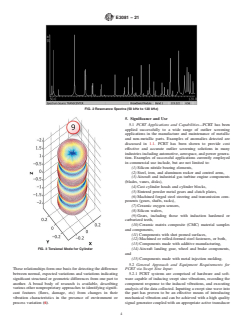
free of substantial anomalies in production, and then periodi- example of the resonance spectra for a part is shown in Fig. 2
cally re-examined with PCRT in order to monitor for the for reference.
accumulation of fatigue and damage resulting from use. The
4.2.2 If a structural anomaly, such as a crack, is introduced
process for using frequency changes between different points
into a region under strain, it will change the effective stiffness
in time to perform NDT and process monitoring and control is
of a part (decrease stiffness for a crack). That is, the part’s
described in more detail in Practice E3213. One example of a
resistancetodeformationwillchangeandwillshiftsomeofthe
PCRT outlier screening application is gas turbine engine
part’s resonant frequencies (downward for decreasing stiff-
blades. Outlier screening is used to detect material anomalies
ness). Voids in a region can reduce mass and increase certain
and conditions resulting from out-of-control manufacturing
resonantfrequencies.Ingeneral,anychangetoapartthatalters
processes for new production blades. For in-service blades,
the structural integrity, changes a geometric feature or affects
outlier screening detects unexpected side effects from repair
the material properties will alter its natural resonance frequen-
processes and non-repairable conditions from in-service aging/
cies. Graphic examples of the effects of various anomalies on
damage.
resonances are presented in Guide E2001.
4.1.5 Thispracticeisintendedtoprovideapracticalguideto
4.2.3 For example, the torsional (twisting) (Fig. 3) resonant
theapplicationofPCRT-basedoutlierscreeningtometallicand
modesrepresentatwistingofapartaboutitsaxis.Inthesimple
non-metallic parts. It highlights the steps necessary to produce
example of a long cylinder, these resonances are easily
robust and accurate test applications and outlines potential
identified because some of their frequencies remain constant
weaknesses, limitations and factors that could lead to misclas-
for a fixed length, independent of diameter.Acrack will reduce
sificationofapart.Somebasicexplanationsofresonances,and
the ability of the part to resist twisting, thereby reducing the
the effects of anomalies on them, are found in 4.2. Some
effective stiffness, and thus, the frequency of a torsional mode
successful applications and general description of the equip-
both shifts to a lower value and then alters the mode shape.
mentnecessarytosuccessfullyapplyPCRTforclassificationof
Otherresonancesrepresentingdifferentresonancemodeshapes
production parts are outlined in 5.1 and 5.2, respectively.
ofthepartwillnotbeaffectedinthesamemanner.Also,alarge
Additionally, some constraints and limitations are discussed in
structural anomaly can be detected readily by its effect on the
5.3.Thegeneralprocedurefordevelopingapart-specificPCRT
first few resonant frequencies. However, smaller structural
application is laid out in 6.1.
anomalies have much more subtle and localized effects on
4.2 Resonance and the Effect of Anomalies: stiffness, and therefore, often require higher frequencies (high-
4.2.1 The swept sine method of vibration analysis operates order resonant modes and harmonics) to be detected. In
by driving a part at given frequencies (acoustic through general, it must be remembered that most parts will exhibit
ultrasonic, depending on the part characteristics) and measur- complex motions when resonating. Analyzing the relationship
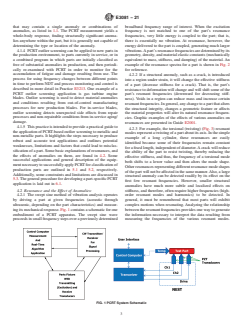
ingitsmechanicalresponse.Fig.1containsaschematicforone between the resonant frequencies provides one waytogenerate
embodiment of a PCRT apparatus. The swept sine wave the information necessary to interpret the data resulting from
proceedsinsmallfrequencystepsoverapreviouslydetermined measuring the frequencies of the various resonant modes.
FIG. 1 PCRT System Schematic
E3081 − 21
FIG. 2 Resonance Spectra (50 kHz to 120 kHz)
5. Significance and Use
5.1 PCRT Applications and Capabilities—PCRT has been
applied successfully to a wide range of outlier screening
applications in the manufacture and maintenance of metallic
and non-metallic parts. Examples of anomalies detected are
discussed in 1.1. PCRT has been shown to provide cost
effective and accurate outlier screening solutions in many
industries including automotive, aerospace, and power genera-
tion. Examples of successful applications currently employed
in commercial use include, but are not limited to:
(1) Silicon nitride bearing elements,
(2) Steel, iron, and aluminum rocker and control arms,
(3) Aircraft and industrial gas turbine engine components
(blades, vanes, disks),
(4) Cast cylinder heads and cylinder blocks,
(5) Sintered powder metal gears and clutch plates,
(6) Machined forged steel steering and transmission com-
ponents (gears, shafts, racks),
(7) Ceramic oxygen sensors,
(8) Silicon wafers,
(9) Gears, including those with induction hardened or
carburized teeth,
(10) Ceramic matrix composite (CMC) material samples
and components,
(11) Components with shot peened surfaces,
(12) Machined or rolled-formed steel fasteners, or both,
(13) Components made with additive manufacturing,
FIG. 3 Torsional Mode for Cylinder (14) Aircraft landing gear, wheel and brake components,
and
(15) Components made with metal injection molding.
5.2 General Approach and Equipment Requirements for
These relationships form one basis for detecting the difference PCRT via Swept Sine Input:
between normal, expected variations and variations indicating 5.2.1 PCRT systems are comprised of hardware and soft-
significant structural or geometric differences from one part to ware capable of inducing swept sine vibrations, recording the
another. A broad body of research is available, describing component response to the induced vibrations, and executing
various other nonproprietary approaches to identifying signifi- analysis of the data collected. Inputting a swept sine wave into
cant features (flaws, damage, etc) from changes in their the part has proven to be an effective means of introducing
vibration characteristics in the presence of environment or mechanical vibration and can be achieved with a high quality
process variation (6). signal generator coupled with an appropriate active transducer
E3081 − 21
in physical contact with the part. Collection of the part’s 6. Procedure
frequency response can be achieved by recording the signal
6.1 Successful PCRT application development and imple-
generated by an appropriate passive vibration transducer. The
mentation follows a standard flow. The stepwise functions
software required to analyze the available data may include a
required in the flow are:
variety of suitable statistical analysis and pattern recognition
(1) Collection of a teaching set of components,
tools. Measurement accuracy and repeatability are extremely
(2) Design and fabrication of a test nest or appropriate
important to the application of PCRT.
fixturing,
5.2.2 Hardware Requirements—A swept sine wave signal
(3) An understanding of the effects of temperature on the
generatorandresponsemeasurementsystemoperatingoverthe
resonance spectra,
desired frequency range of the test part are required with
(4) Specification of a resonance broadband data collection
accuracy better than 0.002 %. The signal generator should be
parameters,
calibrated to applicable industry standards. Transducers must
(5) Evaluation of system measurement repeatability and
be operable over same frequency range. Three transducers are
reproducibility (similar to Gauge R and R) with respect to
typically used; one “drive” transducer and two “receive”
mounting parameters,
transducers. Transducers typically operate in a dry
(6) Collection of data from the teaching set of parts,
environment, providing direct contact coupling to the part
(7) Analysis of collected data for pattern recognition,
under examination. However, noncontacting response methods
(8) Generation of a sort to classify examined parts,
can operate suitably when parts are wet or oil-coated. Other
(9) Validation of the sort against the teaching set compo-
than fixturing and transducer contact, no other contact with the
nents and unknown components,
part is allowed as these mechanical forces
...
This document is not an ASTM standard and is intended only to provide the user of an ASTM standard an indication of what changes have been made to the previous version. Because
it may not be technically possible to adequately depict all changes accurately, ASTM recommends that users consult prior editions as appropriate. In all cases only the current version
of the standard as published by ASTM is to be considered the official document.
Designation: E3081 − 16 E3081 − 21
Standard Practice for
Outlier Screening Using Process Compensated Resonance
Testing via Swept Sine Input for Metallic and Non-Metallic
Parts
This standard is issued under the fixed designation E3081; the number immediately following the designation indicates the year of
original adoption or, in the case of revision, the year of last revision. A number in parentheses indicates the year of last reapproval. A
superscript epsilon (´) indicates an editorial change since the last revision or reapproval.
1. Scope Scope*
1.1 This practice describes a general procedure for using the process compensated resonance testing (PCRT) via swept sine input
method to perform outlier screening on populations of newly manufactured and in-service parts. PCRT excites the resonance
frequencies of metallic and non-metallic test components using a swept sine wave input over a set frequency range. PCRT detects
and analyzes component resonance frequency patterns,patterns and uses the differences in resonance patterns between acceptable
and unacceptable components to perform non-destructive testing. PCRT frequency analysis compares the resonance pattern of a
component to the patterns of known acceptable and unacceptable reference populations of the same component,component and
renders a pass or fail result based on the similarity of the tested component to those populations. For non-destructive testing
applications with known defects or material states of interest, or both, Practice E2534 covers the development and application of
PCRT sorting modules that compare test components to known acceptable and unacceptable component populations. However,
some applications do not have physical examples of components with known defects or material states. Other applications
experience isolated component failures with unknown causes or causes that propagate from defects that are beyond the sensitivity
of the current required inspections, or both. In these cases, PCRT is applied in an outlier screening mode that develops a sorting
module using only a population of presumed acceptable production components, and then compares test components for similarity
to that presumed acceptable population. The resonance differences can be used to distinguish acceptable components with normal
process variation from outlier components that may have material states or defects, or both, that will cause performance
deficiencies. These material states and defects include, but are not limited to, cracks, voids, porosity, shrink, inclusions,
discontinuities, grain and crystalline structure differences, density-related anomalies, heat treatment variations, material elastic
property differences, residual stress, and dimensional variations. This practice is intended for use with instruments capable of
exciting, measuring, recording, and analyzing multiple, whole body, mechanical vibration resonance frequencies in acoustic or
ultrasonic frequency ranges, or both.
1.2 Units—The values stated in inch-pound units are to be regarded as standard. The values given in parentheses are mathematical
conversions to SI units that are provided for information only and are not considered standard.
1.3 This standard does not purport to address all of the safety concerns, if any, associated with its use. It is the responsibility
of the user of this standard to establish appropriate safety safety, health, and healthenvironmental practices and determine the
applicability of regulatory limitations prior to use. Some specific hazards statements are given in Section 7 on Hazards.
1.4 This international standard was developed in accordance with internationally recognized principles on standardization
established in the Decision on Principles for the Development of International Standards, Guides and Recommendations issued
by the World Trade Organization Technical Barriers to Trade (TBT) Committee.
This test method practice is under the jurisdiction of ASTM Committee E07 on Nondestructive Testing and is the direct responsibility of Subcommittee E07.06 on
Ultrasonic Method.
Current edition approved Dec. 1, 2016June 1, 2021. Published December 2016July 2021. Originally approved in 2016. Last previous edition approved in 2016 as
E3081 – 16. DOI: 10.1520/E3081–16.10.1520/E3081-21.
*A Summary of Changes section appears at the end of this standard
Copyright © ASTM International, 100 Barr Harbor Drive, PO Box C700, West Conshohocken, PA 19428-2959. United States
E3081 − 21
2. Referenced Documents
2.1 ASTM Standards:
E1316 Terminology for Nondestructive Examinations
E2001 Guide for Resonant Ultrasound Spectroscopy for Defect Detection in Both Metallic and Non-metallic Parts
E2534 Practice for Targeted Defect Detection Using Process Compensated Resonance Testing Via Swept Sine Input for Metallic
and Non-Metallic Parts
E3213 Practice for Part-to-Itself Examination Using Process Compensated Resonance Testing Via Swept Sine Input for Metallic
and Non-Metallic Parts
3. Terminology
3.1 Definitions:
3.1.1 The definitions of terms relating to conventional ultrasonic examination can be found in Terminology E1316.
3.2 Definitions:
3.2.1 broadband, n—the range of frequencies, excitation parameters, and data collection parameters developed specifically for a
particular part type.
3.2.2 classification, n—the labeling of a teaching set of parts as acceptable or unacceptable.
3.2.3 false negative, n—part failing the sort but deemed by other method of post-test/analysis to have acceptable or conforming
specifications.
3.2.4 false positive, n—part passing the sort but exhibiting a flaw (either inside the teaching set of flaws or possibly outside the
teaching set range of flaws) or nonconforming to specification.
3.2.5 margin part, n—a single part representative of a part type that is used to determine measurement repeatability and for system
verification.
3.2.6 Process Compensated ResonantResonance Testing (PCRT), n—PCRT is a nondestructive examination method that enhances
RUS with pattern recognition capability. PCRT more effectively discriminates resonance frequency shifts due to unacceptable
conditions from resonance frequency shifts due to normal, acceptable manufacturing process variations. The process employs the
swept sine measurement and analysis of acoustic or ultrasonic resonance frequency patterns, or both. PCRT pattern recognition
tools identify the combinations of resonance patterns that most effectively differentiate acceptable and unacceptable components.
In outlier screening applications, statistical scoring of the resonance frequencies is used to compare components of the presumed
acceptable population, quantify process variation, and characterize component populations.
3.2.7 quality factor (Q factor), n—dimensionless property of resonance peak that describes the peak shape, that is, width relative
to the peak center frequency; peaks with higher Q factor values are narrower and sharper.
3.2.8 resonance spectra, n—the recorded collection of resonance frequency data, including frequency peak locations and the
characteristics of the peaks, for a particular part.
3.2.9 Resonant Ultrasound Spectroscopy (RUS), n—Basicbasic RUS was originally applied in fundamental research applications
in physics and materials science (1) . Other recognizable names include acoustic resonance spectroscopy, acoustic resonant
inspection, and resonant inspection. Guide E2001 documents RUS extensively. RUS is a nondestructive examination method that
employs the measurement and analysis of acoustic or ultrasonic resonance frequencies, or both, for the identification of acceptable
variations in the physical characteristics of test parts in production environments. In this procedure an isolated, rigid component
is excited, producing oscillation at the natural frequencies of vibration of the component. Diagnostic resonance frequencies are
measured and compared to resonance frequency patterns previously defined as acceptable. Based on this comparison, the part is
judged to be acceptable or, if it does not conform to the established pattern, unacceptable.
For referenced ASTM standards, visit the ASTM website, www.astm.org, or contact ASTM Customer Service at service@astm.org. For Annual Book of ASTM Standards
volume information, refer to the standard’s Document Summary page on the ASTM website.
The boldface numbers in parentheses refer to athe list of references at the end of this standard.
E3081 − 21
3.2.10 sort, n—for outlier screening applications, a software program capable of classifying a component as acceptable or
outlying.
3.2.11 teaching set, n—for outlier screening applications, a group of like components including examples of only presumed
acceptable production components representative of the range of acceptable variability.
3.2.12 work instruction, n—stepwise instructions developed for each examination program detailing the order and application of
operations for PCRT examination of a part.
4. Summary of Practice
4.1 Introduction:
4.1.1 Many variations on resonance testing have been applied as nondestructive examination tools to detect structural anomalies
that significantly alter component performance. The details of this basic form of resonance testing are outlined in Guide E2001.
4.1.2 Process Compensated Resonance Testing (PCRT) is a progressive development of the fundamental principles of RUS, and
can employ various methods for enhancing the discrimination capability of RUS. Throughout the 1990s, application of RUS for
production NDT led to better understanding of the challenges associated with differentiating resonance variations caused by
structural anomalies from resonance variations from normal and acceptable process variation in mass, material properties and
dimensions (2), (3). PCRT first became commonly used in the production examination of metal and ceramic parts in the late 1990s
(4). By the early 2000s, PCRT had essentially developed into the robust NDT capability it is today (5).
4.1.3 PCRT is a comparison technology using a swept sine wave to excite the components through a range of resonance
frequencies determined by the part’s mass, geometry, and material properties. In outlier screening applications, the resonance
spectrum is then compared to resonance spectra for presumed acceptable components. The database of presumed acceptable
components is established through the collection of a teaching set of components that represent the range of acceptable process
variation. PCRT outlier screening applications are taught to be insensitive to variations associated with acceptable components and
identify resonance variations that indicate outlier components. PCRT outlier screening can use Z-score statistical analysis of
frequencies for a large number of resonance modes to determine frequency averages and frequency deviation and set limits for each
value. A component that exceeds either the frequency average or frequency deviation limits is flagged as outlier. PCRT outlier
screening can also use pattern recognition and statistical scoring using the Mahalanobis-Taguchi System (MTS) to evaluate a test
component for similarity to the training population using a smaller number of resonance modes. A component that exceeds the
MTS-based limits is flagged as an outlier. In one examination cycle, PCRT-based outlier screening can identify outlier parts that
may contain a single anomaly or combinations of anomalies, as listed in 1.1. The PCRT measurement yields a whole body
whole-body response, finding structurally-significant structurally significant anomalies anywhere within the part, but it is generally
not capable of determining the type or location of the anomaly.
4.1.4 PCRT outlier screening can be applied to new parts in the production environment, to parts currently in service, or in a
combined program in which parts are initially classified as free of substantial anomalies in production, and then periodically
re-examined with PCRT in order to monitor for the accumulation of fatigue and damage resulting from use. The process for using
frequency changes between different points in time to perform NDT and process monitoring and control is described in more detail
in Practice E3213. One example of a PCRT outlier screening application is gas turbine engine blades. Outlier screening is used
to detect material anomalies and conditions resulting from out-of-control manufacturing processes for new production blades. For
in-service blades, outlier screening detects unexpected side effects from repair processes and non-repairable conditions from
in-service aging/damage.
4.1.5 This practice is intended to provide a practical guide to the application of PCRT-based outlier screening to metallic and
non-metallic parts. It highlights the steps necessary to produce robust and accurate test applications and outlines potential
weaknesses, limitations and factors that could lead to misclassification of a part. Some basic explanations of resonances, and the
effects of anomalies on them, are found in 4.2. Some successful applications and general description of the equipment necessary
to successfully apply PCRT for classification of production parts are outlined in 5.1 and 5.2, respectively. Additionally, some
constraints and limitations are discussed in 5.3. The general procedure for developing a part-specific PCRT application is laid out
in 6.1.
4.2 Resonance and the Effect of Anomalities:Anomalies:
E3081 − 21
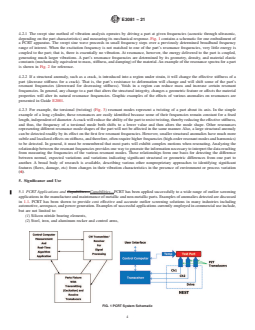
4.2.1 The swept sine method of vibration analysis operates by driving a part at given frequencies (acoustic through ultrasonic,
depending on the part characteristics) and measuring its mechanical response. Fig. 1 contains a schematic for one embodiment of
a PCRT apparatus. The swept sine wave proceeds in small frequency steps over a previously determined broadband frequency
range of interest. When the excitation frequency is not matched to one of the part’s resonance frequencies, very little energy is
coupled to the part; that is, there is essentially no vibration. At resonance, however, the energy delivered to the part is coupled,
generating much larger vibrations. A part’s resonance frequencies are determined by its geometry, density, and material elastic
constants (mechanically equivalent to mass, stiffness, and damping) of the material. An example of the resonance spectra for a part
is shown in Fig. 2 for reference.
4.2.2 If a structural anomaly, such as a crack, is introduced into a region under strain, it will change the effective stiffness of a
part (decrease stiffness for a crack). That is, the part’s resistance to deformation will change and will shift some of the part’s
resonant frequencies (downward for decreasing stiffness). Voids in a region can reduce mass and increase certain resonant
frequencies. In general, any change to a part that alters the structural integrity, changes a geometric feature or affects the material
properties will alter its natural resonance frequencies. Graphic examples of the effects of various anomalies on resonances are
presented in Guide E2001.
4.2.3 For example, the torsional (twisting) (Fig. 3) resonant modes represent a twisting of a part about its axis. In the simple
example of a long cylinder, these resonances are easily identified because some of their frequencies remain constant for a fixed
length, independent of diameter. A crack will reduce the ability of the part to resist twisting, thereby reducing the effective stiffness,
and thus, the frequency of a torsional mode both shifts to a lower value and then alters the mode shape. Other resonances
representing different resonance mode shapes of the part will not be affected in the same manner. Also, a large structural anomaly
can be detected readily by its effect on the first few resonant frequencies. However, smaller structural anomalies have much more
subtle and localized effects on stiffness, and therefore, often require higher frequencies (high-order resonant modes and harmonics)
to be detected. In general, it must be remembered that most parts will exhibit complex motions when resonating. Analyzing the
relationship between the resonant frequencies provides one way to generate the information necessary to interpret the data resulting
from measuring the frequencies of the various resonant modes. These relationships form one basis for detecting the difference
between normal, expected variations and variations indicating significant structural or geometric differences from one part to
another. A broad body of research is available, describing various other nonproprietary approaches to identifying significant
features (flaws, damage, etc) from changes in their vibration characteristics in the presence of environment or process variation
(6).
5. Significance and Use
5.1 PCRT Applications and Capabilites—Capabilities—PCRT has been applied successfully to a wide range of outlier screening
applications in the manufacture and maintenance of metallic and non-metallic parts. Examples of anomalies detected are discussed
in 1.1. PCRT has been shown to provide cost effective and accurate outlier screening solutions in many industries including
automotive, aerospace, and power generation. Examples of successful applications currently employed in commercial use include,
but are not limited to:
(1) Silicon nitride bearing elements,
(2) Steel, iron, and aluminum rocker and control arms,
FIG. 1 PCRT System Schematic
E3081 − 21
FIG. 2 Resonance Spectra (50 kHz to 120 kHz)
FIG. 3 Torsional Mode for Cylinder
(3) Gas Aircraft and industrial gas turbine engine components (blades, vanes, disks),
(4) Cast cylinder heads and cylinder blocks,
(5) Sintered powder metal gears and clutch plates,
(6) Machined forged steel steering and transmission components (gears, shafts, racks),
(7) Ceramic oxygen sensors,
(8) Silicon wafers,
(9) Gears Gears, including those with induction hardened or carburized teeth,
(10) Ceramic matrix composite (CMC) material samples and components,
(11) Components with shot peened surfaces,
(12) Machined and/oror rolled-formed steel fasteners, and or both,
E3081 − 21
(13) Additive manufactured components.Components made with additive manufacturing,
(14) Aircraft landing gear, wheel and brake components, and
(15) Components made with metal injection molding.
5.2 General Approach and Equipment Requirements for PCRT via Swept Sine Input:
5.2.1 PCRT systems are comprised of hardware and software capable of inducing swept sine vibrations, recording the component
response to the induced vibrations, and executing analysis of the data collected. Inputting a swept sine wave into the part has
proven to be an effective means of introducing mechanical vibration,vibration and can be achieved with a high quality signal
generator coupled with an appropriate active transducer in physical contact with the part. Collection of the part’s frequency
response can be achieved by recording the signal generated by an appropriate passive vibration transducer. The software required
to analyze the available data may include a variety of suitable statistical analysis and pattern recognition tools. Measurement
accuracy and repeatability are extremely important to the application of PCRT.
5.2.2 Hardware Requirements—A swept sine wave signal generator and response measurement system operating over the desired
frequency range of the test part are required with accuracy better than 0.002 %. The signal generator should be calibrated to
applicable industry standards. Transducers must be operable over same frequency range. Three transducers are typically used; one
“drive” transducer and two “receive” transducers. Transducers typically operate in a dry environment, providing direct contact
coupling to the part under examination. However, noncontacting response methods can operate suitably when parts are wet or
oil-coated. Other than fixturing and transducer contact, no other contact with the part is allowed as these mechanical forces dampen
certain vibrations. For optimal examination, parts should be placed precisely on the transducers (generally, 60.062 in. (1.6 mm)
in each axis provides acceptable results). The examination nest and cabling shall isolate the drive from receive signals and ground
returns, so as to not produce (mechanical or electrical) cross talk between channels. Excessive external vibration or audible noise,
or both, will compromise the measurements.
5.3 Constraints and Limitations:
5.3.1 PCRT cannot separate parts based on visually detectable anomalies that do not affect the structural integrity of the part. It
may be necessary to provide additional visual inspection of parts to identify these indications.
5.3.2 Excessive process variation of parts may limit the sensitivity of PCRT outlier screening.
5.3.3 Specific anomaly identification is highly unlikely. PCRT is a whole body measurement, andso differentiating between a crack
and a void in the same location is generally not possible. It may be possible to differentiate some an
...