

ASTM F2446-04(2018)
(Classification)Standard Classification for Hierarchy of Equipment Identifiers and Boundaries for Reliability, Availability, and Maintainability (RAM) Performance Data Exchange
General Information
- Abstract
SIGNIFICANCE AND USE
4.1 Capturing high quality RAM performance data requires careful and consistent collection of equipment failure and repair data, operating hours, and repair time. A standard hierarchy of equipment boundaries has been needed for machinery data exchange among the stakeholders in shipbuilding, ship classification, and ship operations.
4.2 Industry and government will use a world standard method for setting the hierarchy of indentures and boundaries required for assigning failure and repair events to equipment for the tracking and calculation of equipment RAM performance.
4.3 Agreed boundaries and equipment identifiers make it possible to share equipment data among organizations, benchmark equipment performance, perform modeling and simulation of current and proposed systems, or use performance data to improve operations of commercial and naval vessels.
4.4 RAM analysis is primarily based on the observation of individual components among which identical items contribute to the same data sample. This classification is designed to be used for the identification of individual (unique) components in such a way that identical components can be identified within a given data sample.
SCOPE
1.1 This classification is to serve as an international standard for marine equipment nomenclature, taxonomy, hierarchical data structure, unique identifiers, and boundary definition for the consistent acquisition and exchange of equipment RAM performance data. The standard addresses the classification of mechanical and software products.
1.2 RAM in an acronym for Reliability, Availability, and Maintainability where:
1.2.1 Reliability is the probability that an item can perform a required function under given conditions for a given time interval (t1, t2). It is generally assumed that the item is in a state to perform this required function at the beginning of the time interval.
1.2.2 Availability is the probability that an item is in a state to perform a required function under given conditions at a given instant of time, assuming that the required external resources are provided.
1.2.3 Maintainability is the probability that a given active maintenance action, for an item under given conditions of use can be carried out within a stated time interval, when the maintenance is performed under stated conditions and using stated procedures and resources.
1.3 This standard does not purport to address all of the safety concerns, if any, associated with its use. It is the responsibility of the user of this standard to establish appropriate safety, health, and environmental practices and determine the applicability of regulatory limitations prior to use.
1.4 This international standard was developed in accordance with internationally recognized principles on standardization established in the Decision on Principles for the Development of International Standards, Guides and Recommendations issued by the World Trade Organization Technical Barriers to Trade (TBT) Committee.
- Status
- Published
- Publication Date
- 30-Nov-2018
- Technical Committee
- F25 - Ships and Marine Technology
- Drafting Committee
- F25.05 - Computer Applications
Overview
ASTM F2446-04(2018), developed by ASTM International, establishes a standardized hierarchy for equipment identifiers and boundaries to enable reliable collection and exchange of data related to Reliability, Availability, and Maintainability (RAM) performance. This international standard is crucial for industries involved in shipbuilding, ship classification, and ship operations. It provides a globally recognized method for naming, classifying, and structuring equipment data, facilitating the consistent tracking, benchmarking, and analysis of equipment performance across diverse stakeholder organizations. By defining a clear taxonomy, nomenclature, and data structure for marine equipment-including both mechanical and software products-ASTM F2446 supports improved RAM analysis and fosters data-driven operational improvements in commercial and naval fleets.
Key Topics
- RAM Performance Data: Focuses on the structured collection and sharing of equipment failure, repair events, operating hours, and repair time for accurate RAM assessments.
- Reliability: Probability that equipment performs its required function under defined conditions for a set time period.
- Availability: Likelihood that equipment is ready to perform its function at any given moment, provided necessary resources are met.
- Maintainability: Probability that maintenance can be performed within a stated time when following defined procedures.
- Hierarchy and Boundaries: Outlines a hierarchical approach to uniquely identify systems, equipment, and components within vessels, using agreed boundaries and identifiers.
- Taxonomy and Nomenclature: Standardizes equipment terminology, class structure, and identification for the marine industry.
- Unique Identification: Employs unique vessel and component identifiers-such as IMO numbers or Navy hull numbers-to distinguish equipment and track performance data accurately.
- Data Exchange: Enables seamless and compatible performance data sharing among industry and government entities on a global scale.
Applications
- Marine Equipment Management: Supports consistent acquisition, organization, and analysis of reliability, availability, and maintainability data for all shipboard mechanical and software equipment.
- Performance Benchmarking: Facilitates comparative analysis and benchmarking of equipment performance across fleets, ship types, and organizations.
- Regulatory Compliance: Assists stakeholders in meeting international requirements for equipment identification and RAM data management.
- Modeling and Simulation: Provides foundational structure for modeling existing systems and simulating future designs to optimize operational performance.
- Operational Improvement: Informs maintenance strategies and life-cycle management, ultimately leading to improved reliability, reduced downtime, and cost efficiency for commercial and naval vessels.
Related Standards
ASTM F2446-04(2018) references and aligns with several key international standards and guidelines to ensure consistency and interoperability, including:
- ISO 3166-1 - Codes for the Representation of Names of Countries and Their Subdivisions
- ISO 10303 - Industrial Automation Systems and Integration-Product Data Representation and Exchange
- ISO 13584 - Industrial Automation Systems and Integration-Parts Library
- ISO/IEC TR 12182 - Information Technology-Categorization of Software
- ISO/FDIS 14224 - Petroleum and Natural Gas Industries-Collection and Exchange of Reliability and Maintenance Data for Equipment
- IEC 60050-191 - International Electrotechnical Vocabulary, Dependability and Quality of Service
- IMO Ship Identification Number Scheme - Unique vessel identification for commercial ships
- Naval Sea Systems Command ESWBS - Expanded Ship Work Breakdown Structure
- AIChE Guidelines - Plant reliability improvement through data collection and analysis
Practical Value
Implementing ASTM F2446-04(2018) delivers major benefits for reliability engineering, asset management, and operational efficiency in marine contexts:
- Promotes consistency in equipment identification across global organizations
- Enables accurate, data-driven RAM analysis
- Streamlines inter-organizational data exchange
- Enhances safety, regulatory adherence, and asset life-cycle management
Keywords: RAM performance, marine equipment identification, equipment boundaries, reliability, availability, maintainability, equipment classification, data exchange, ship operations, standard nomenclature, vessel identifiers, hierarchical data structure.
Relations
- Effective Date
- 01-Dec-2018
- Referred By
ASTM F2283-12(2018) - Standard Specification for Shipboard Oil Pollution Abatement System - Effective Date
- 01-Dec-2018
Get Certified
Connect with accredited certification bodies for this standard

BSI Group
BSI (British Standards Institution) is the business standards company that helps organizations make excellence a habit.

DNV
DNV is an independent assurance and risk management provider.

Lloyd's Register
Lloyd's Register is a global professional services organisation specialising in engineering and technology.
Sponsored listings
Frequently Asked Questions
ASTM F2446-04(2018) is a standard published by ASTM International. Its full title is "Standard Classification for Hierarchy of Equipment Identifiers and Boundaries for Reliability, Availability, and Maintainability (RAM) Performance Data Exchange". This standard covers: SIGNIFICANCE AND USE 4.1 Capturing high quality RAM performance data requires careful and consistent collection of equipment failure and repair data, operating hours, and repair time. A standard hierarchy of equipment boundaries has been needed for machinery data exchange among the stakeholders in shipbuilding, ship classification, and ship operations. 4.2 Industry and government will use a world standard method for setting the hierarchy of indentures and boundaries required for assigning failure and repair events to equipment for the tracking and calculation of equipment RAM performance. 4.3 Agreed boundaries and equipment identifiers make it possible to share equipment data among organizations, benchmark equipment performance, perform modeling and simulation of current and proposed systems, or use performance data to improve operations of commercial and naval vessels. 4.4 RAM analysis is primarily based on the observation of individual components among which identical items contribute to the same data sample. This classification is designed to be used for the identification of individual (unique) components in such a way that identical components can be identified within a given data sample. SCOPE 1.1 This classification is to serve as an international standard for marine equipment nomenclature, taxonomy, hierarchical data structure, unique identifiers, and boundary definition for the consistent acquisition and exchange of equipment RAM performance data. The standard addresses the classification of mechanical and software products. 1.2 RAM in an acronym for Reliability, Availability, and Maintainability where: 1.2.1 Reliability is the probability that an item can perform a required function under given conditions for a given time interval (t1, t2). It is generally assumed that the item is in a state to perform this required function at the beginning of the time interval. 1.2.2 Availability is the probability that an item is in a state to perform a required function under given conditions at a given instant of time, assuming that the required external resources are provided. 1.2.3 Maintainability is the probability that a given active maintenance action, for an item under given conditions of use can be carried out within a stated time interval, when the maintenance is performed under stated conditions and using stated procedures and resources. 1.3 This standard does not purport to address all of the safety concerns, if any, associated with its use. It is the responsibility of the user of this standard to establish appropriate safety, health, and environmental practices and determine the applicability of regulatory limitations prior to use. 1.4 This international standard was developed in accordance with internationally recognized principles on standardization established in the Decision on Principles for the Development of International Standards, Guides and Recommendations issued by the World Trade Organization Technical Barriers to Trade (TBT) Committee.
SIGNIFICANCE AND USE 4.1 Capturing high quality RAM performance data requires careful and consistent collection of equipment failure and repair data, operating hours, and repair time. A standard hierarchy of equipment boundaries has been needed for machinery data exchange among the stakeholders in shipbuilding, ship classification, and ship operations. 4.2 Industry and government will use a world standard method for setting the hierarchy of indentures and boundaries required for assigning failure and repair events to equipment for the tracking and calculation of equipment RAM performance. 4.3 Agreed boundaries and equipment identifiers make it possible to share equipment data among organizations, benchmark equipment performance, perform modeling and simulation of current and proposed systems, or use performance data to improve operations of commercial and naval vessels. 4.4 RAM analysis is primarily based on the observation of individual components among which identical items contribute to the same data sample. This classification is designed to be used for the identification of individual (unique) components in such a way that identical components can be identified within a given data sample. SCOPE 1.1 This classification is to serve as an international standard for marine equipment nomenclature, taxonomy, hierarchical data structure, unique identifiers, and boundary definition for the consistent acquisition and exchange of equipment RAM performance data. The standard addresses the classification of mechanical and software products. 1.2 RAM in an acronym for Reliability, Availability, and Maintainability where: 1.2.1 Reliability is the probability that an item can perform a required function under given conditions for a given time interval (t1, t2). It is generally assumed that the item is in a state to perform this required function at the beginning of the time interval. 1.2.2 Availability is the probability that an item is in a state to perform a required function under given conditions at a given instant of time, assuming that the required external resources are provided. 1.2.3 Maintainability is the probability that a given active maintenance action, for an item under given conditions of use can be carried out within a stated time interval, when the maintenance is performed under stated conditions and using stated procedures and resources. 1.3 This standard does not purport to address all of the safety concerns, if any, associated with its use. It is the responsibility of the user of this standard to establish appropriate safety, health, and environmental practices and determine the applicability of regulatory limitations prior to use. 1.4 This international standard was developed in accordance with internationally recognized principles on standardization established in the Decision on Principles for the Development of International Standards, Guides and Recommendations issued by the World Trade Organization Technical Barriers to Trade (TBT) Committee.
ASTM F2446-04(2018) is classified under the following ICS (International Classification for Standards) categories: 35.240.50 - IT applications in industry; 47.020.01 - General standards related to shipbuilding and marine structures. The ICS classification helps identify the subject area and facilitates finding related standards.
ASTM F2446-04(2018) has the following relationships with other standards: It is inter standard links to ASTM F2446-04(2010), ASTM F2283-12(2018). Understanding these relationships helps ensure you are using the most current and applicable version of the standard.
ASTM F2446-04(2018) is available in PDF format for immediate download after purchase. The document can be added to your cart and obtained through the secure checkout process. Digital delivery ensures instant access to the complete standard document.
Standards Content (Sample)
This international standard was developed in accordance with internationally recognized principles on standardization established in the Decision on Principles for the
Development of International Standards, Guides and Recommendations issued by the World Trade Organization Technical Barriers to Trade (TBT) Committee.
Designation:F2446 −04 (Reapproved 2018) An American National Standard
Standard Classification for
Hierarchy of Equipment Identifiers and Boundaries for
Reliability, Availability, and Maintainability (RAM)
Performance Data Exchange
This standard is issued under the fixed designation F2446; the number immediately following the designation indicates the year of
original adoption or, in the case of revision, the year of last revision. A number in parentheses indicates the year of last reapproval. A
superscript epsilon (´) indicates an editorial change since the last revision or reapproval.
1. Scope mendations issued by the World Trade Organization Technical
Barriers to Trade (TBT) Committee.
1.1 This classification is to serve as an international stan-
dard for marine equipment nomenclature, taxonomy, hierarchi-
2. Referenced Documents
cal data structure, unique identifiers, and boundary definition
2.1 ISO Standards:
fortheconsistentacquisitionandexchangeofequipmentRAM
ISO 3166-1:1997 Codes for the Representation of Names of
performance data. The standard addresses the classification of
Countries and Their Subdivisions — Part 1: Country
mechanical and software products.
Codes, 1997
1.2 RAM in an acronym for Reliability, Availability, and
ISO 10303 Industrial Automation Systems and Integration
Maintainability where:
— Product Data Representation and Exchange
1.2.1 Reliability is the probability that an item can perform
ISO 13584 Industrial Automation Systems and Integration
a required function under given conditions for a given time
— Parts Library
interval (t1, t2). It is generally assumed that the item is in a
ISO/IEC TR 12182 Information Technology — Categoriza-
state to perform this required function at the beginning of the
tion of Software, Technical Report, 1998
time interval.
ISO/TC 67/WG 4 ISO/FDIS 14224:1998(E), Petroleum and
1.2.2 Availability is the probability that an item is in a state
Natural Gas Industries — Collection and Exchange of
to perform a required function under given conditions at a
Reliability and Maintenance Data for Equipment, 1998
given instant of time, assuming that the required external
2.2 Other Standards:
resources are provided.
CenterforChemicalProcessSafetyoftheAmericanInstitute
1.2.3 Maintainability is the probability that a given active
of Chemical Engineers Guidelines for Improving Plant
maintenance action, for an item under given conditions of use 3
Reliability through Data Collection and Analysis, 1998
can be carried out within a stated time interval, when the
IEC 60050-191 International Electrotechnical Vocabulary,
maintenance is performed under stated conditions and using 4
Chapter 191, Dependability and Quality of Service
stated procedures and resources.
International Maritime Organization (IMO) Circular letter
1.3 This standard does not purport to address all of the
No. 1886/Rev. 2 Implementation of ResolutionA.600(15)
safety concerns, if any, associated with its use. It is the
— IMO Ship Identification Number Scheme, 2002
responsibility of the user of this standard to establish appro-
Naval Sea Systems Command Expanded Ship Work Break-
priate safety, health, and environmental practices and deter-
down Structure (ESWBS) for All Ships and Ship/Combat
mine the applicability of regulatory limitations prior to use.
Systems, Volumes 1 and 2, 1985
1.4 This international standard was developed in accor-
dance with internationally recognized principles on standard-
Available from International Organization for Standardization (ISO), ISO
ization established in the Decision on Principles for the
Central Secretariat, BIBC II, Chemin de Blandonnet 8, CP 401, 1214 Vernier,
Development of International Standards, Guides and Recom- Geneva, Switzerland, http://www.iso.org.
Available from American Institute of Chemical Engineers (AIChE), 120 Wall
Street, FL 23, New York, NY 10005-4020, https://www.aiche.org.
Available from International Electrotechnical Commission (IEC), 3, rue de
This classification is under the jurisdiction of ASTM Committee F25 on Ships Varembé, 1st floor, P.O. Box 131, CH-1211, Geneva 20, Switzerland, https://
and Marine Technology and is the direct responsibility of Subcommittee F25.05 on www.iec.ch.
Computer Applications. Available from International Maritime Organization (IMO), 4, Albert
Current edition approved Dec. 1, 2018. Published December 2018. Originally Embankment, London SE1 7SR, United Kingdom, http://www.imo.org.
approved in 2004. Last previous edition approved in 2010 as F2446 – 04 (2010). Available from Naval Sea Systems Command, 1333 Isaac Hull Avenue, SE,
DOI: 10.1520/F2446-04R18. Washington Navy Yard, DC 20376, https://www.navsea.navy.mil.
Copyright © ASTM International, 100 Barr Harbor Drive, PO Box C700, West Conshohocken, PA 19428-2959. United States
F2446−04 (2018)
3. Terminology 3.1.9.3 location ID, n—when multiple identical components
arelocatedonthesamesite,thelocationIDidentifiesaspecific
3.1 Definitions:
piece of equipment within the site. Examples of location IDs
3.1.1 boundary, n—item boundaries define the subordinate
include bolt hole location and deck/port-to-starboard/aft-to-
components that are to be included in the item. The purpose of
forward sequencing. The method used for setting up location
the boundary definition is to ensure a common understanding
IDs is irrelevant for the standard. It is useful to the standard
of which components are to be included within a specific item.
implementer only and thus it is left to the standard implement-
3.1.2 class, n—a concept to group objects with similar
er’s discretion.
characteristics, with the purpose of describing common prop-
3.1.10 unique vessel identification, n—unique equipment
erties.
identification requires a unique site or vessel identifier. This
3.1.2.1 Discussion—The ISO 10303 definition of a class is
classificationproposesthatcommercialvesselsbeidentifiedby
“a concept to group items with similar characteristics, with the
their International Maritime Organization (IMO) number. IMO
purpose of describing the common properties of the class
assigns a unique number to every commercial vessel in the
members. Each item belongs to at least one class. A class
world to be used for the vessel tracking. The structure of the
usually has a criterion for inclusion or exclusion of items.” A
IMO number comprises two parts: a variable seven-digit
class is only an abstraction that helps the categorization of
numeric number (the Lloyd’s Register number) and a constant
objects.
alphaprefix“IMO”(forexample,IMO1234567).Theconstant
3.1.3 instance, n—the physical representation of the mem-
3-alpha prefix by definition contributes nothing to the identi-
ber of an object class. For example, the main propulsion diesel
fication of the ship. Therefore, only the variable seven-digit
engineofvesselXYZisaninstanceofthediesel_engineobject
numeric element of the IMO number is used. The seven-digit
class.
numeric number is maintained by Lloyd’s Register which
assigns a number to a ship at any time following the initiation
3.1.4 object, n—any item that has properties and functions.
of its construction. This classification also proposes that navy
3.1.5 product identification, n—this classification proposes
vessels be identified by Navy Specific Identification (Hull)
that products be uniquely identified using the following com-
Number preceded by the country code. The structure comprise
bination:ManufacturerCountryCode—ManufacturerNational
of two parts: a variable 3-alpha prefix country code followed
Tax ID—Manufacturer Model Number—Manufacturer Model
by five to seven digit alphanumeric hull number (for example,
Type. The manufacturer country code must be the ISO 3166-1
USA LPD17). The five to seven digit alphanumeric hull
code for the manufacturer’s country of origin.
numbers are maintained by corresponding country navies.
3.1.6 property, n—an object’s attribute whose value charac-
terizesaspecificclassinstance.Theprocessofinitializingaset
4. Significance and Use
of properties for a specific instance is called instantiation.
4.1 Capturing high quality RAM performance data requires
3.1.7 string, n—any list of ACSII characters with variable
careful and consistent collection of equipment failure and
length.
repair data, operating hours, and repair time. A standard
hierarchy of equipment boundaries has been needed for ma-
3.1.8 string array, n—a dimensionless array of string val-
chinery data exchange among the stakeholders in shipbuilding,
ues.
ship classification, and ship operations.
3.1.9 unique component identification, n—this classification
4.2 Industry and government will use a world standard
proposes that components be uniquely identified using the
method for setting the hierarchy of indentures and boundaries
following combination: Site ID—Generic ID—Location ID.
required for assigning failure and repair events to equipment
The description of the various identifiers is as follows:
for the tracking and calculation of equipment RAM perfor-
3.1.9.1 site ID, n—unique vessel identifier. In some cases,
mance.
shipping organizations manage their inventory at the fleet level
4.3 Agreed boundaries and equipment identifiers make it
in such a way that pieces of equipment are removed from one
possible to share equipment data among organizations, bench-
vessel to be brought back to shore for repairs or overhauls
mark equipment performance, perform modeling and simula-
whilealreadyservicedpiecesofequipmentpreviouslyinstalled
tion of current and proposed systems, or use performance data
on board another vessel are used as replacements. This method
to improve operations of commercial and naval vessels.
of managing inventory makes it impractical to associate a
specific component with a vessel ID. The following two
4.4 RAM analysis is primarily based on the observation of
alternativesareacceptable: (1)keepingtheIDofthefirstvessel
individual components among which identical items contribute
on which it was installed throughout the component’s entire
to the same data sample. This classification is designed to be
life time, and (2) assigning a warehouse ID to components that
usedfortheidentificationofindividual(unique)componentsin
can potentially be installed on multiple vessels.
such a way that identical components can be identified within
a given data sample.
3.1.9.2 generic ID, n—the name or code of the object class
to which the component belong. Standard implementers are
5. Basis of Classification
free to use either the class name or code, depending on data
storage preferences given that class names are string values 5.1 The class library constitutes a generic list of objects to
whereas class codes are numeric values. be used as a toolbox for the development of specific ship
F2446−04 (2018)
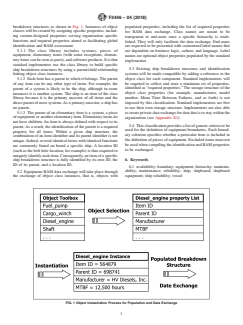
breakdown structures as shown in Fig. 1. Instances of object populated properties, including the list of required properties
classes will be created by assigning specific properties, includ- for RAM data exchange. Class names are meant to be
ing custom-designed properties serving organization specific
transparent to end-users once a specific hierarchy is estab-
functions and required properties aimed at facilitating global
lished. They will only facilitate the data exchange. End-users
identification and RAM assessment.
are expected to be presented with customized label names that
5.1.1 The class library includes systems, pieces of
are dependent on business logic, culture, and language. Label
equipment, elementary items (with some exceptions, elemen-
names are optional object properties populated by the standard
taryitemscanbeseenasparts),andsoftwareproducts.Itisthat
implementer.
standard implementers use the class library to build specific
5.3 Existing ship breakdown structures and identification
ship breakdown structures by using a parent/child relationship
systems will be made compatible by adding a reference to the
linking object class instances.
object class for each component. Standard implementers will
5.1.2 Each item has a parent to which it belongs.The parent
be required to collect and store a minimum set of properties,
of any item can be any other type of items. For example, the
identified as “required properties.” The storage structure of the
parent of a system is likely to be the ship, although in some
instances it is another system. The ship is an item of the class object class properties (for example, manufacturer, model
library because it is the primary ancestor of all items and the
number, Mean Time Between Failures, and so forth) is not
directparentofmostsystems.Asaprimaryancestor,ashiphas imposed by this classification. Standard implementers are free
no parent.
to use their own storage structure. Implementers are also able
5.1.3 The parent of an elementary item is a system, a piece
tocreateprivatedataexchangefordatathatistostaywithinthe
of equipment or another elementary item. Elementary items do
organization (see Appendix X1).
not have children.An item is always defined with respect to its
5.4 Thisclassificationprovidesalistofgenericcriteriatobe
parent.As a result, the identification of the parent is a required
used for the definition of equipment boundaries. Each bound-
property for all items. Within a given ship structure, the
ary criterion specifies whether a particular item is included in
combination of an item identifier and its parent identifier is not
the definition of pieces of equipment. Excluded items must not
unique. Indeed, several identical items with identical functions
be used when compiling the identification and RAM properties
are commonly found on board a specific ship. A location ID
to be exchanged.
(such as the bolt hole location, for example) is thus required to
uniquelyidentifyeachitem.Consequently,anitemofaspecific
6. Keywords
ship breakdown structure is fully identified by its own ID, the
ID of its parent, and a location ID.
6.1 availability; boundary; equipment; hierarchy; maintain-
ability; maintenance; reliability; ship; shipboard; shipboard
5.2 Equipment RAM data exchange will take place through
the exchange of object class instances, that is, objects with equipment; ship reliability; vessel
FIG. 1Object Instantiation Process for Population and Data Exchange
F2446−04 (2018)
ANNEX
(Mandatory Information)
A1. MECHANICAL AND SOFTWARE PRODUCT CLASS LIBRARY
A1.1 See Table A1.1, Table A1.2, Table A1.3, Table A1.4,
and Table A1.5.
TABLE A1.1 Boundary Criteria
Boundary
Boundary Element Included in Parent? Element Description
Code
b_00001 associated valves yes a valve that is required for the proper operation of the product
b_00002 attached indicating yes an integrated part of the product used for measuring and displaying a variable
instruments
b_00003 built-in tanks yes an integrated part of the product that is a container used for holding a liquid or gas
b_00004 coils yes one or more turns of wire through which an electric current travels
b_00005 cooling device yes a device used to lower or maintain the temperature of the product or one of its components
b_00006 electric motors yes a motor that is powered by electricity
b_00007 electrical hull fittings yes any hull-attached element that is electrical in nature and used for the product (for example,
a plug)
b_00008 electronic signal cabling dedicated branch circuit a set of cables used to transport an electronic signal
only
b_00009 filters yes a device through which a gas or liquid is passed in order to remove solids or impurities
b_00010 flex connections yes a bendable device that joins two internal components of the product or the product with its
environment
b_00011 handwheels yes a circular object that is turned to control a quantity
b_00012 hull fasteners yes a structural connection between the product and the hull
b_00013 hull structural foundations no a hull structure that is used as the product’s foundation
b_00014 hydraulic control valves yes a valve that controls the flow of a fluid within an hydraulic device
b_00015 hydraulic cylinders yes the cylindrical chamber of a device that produces hydraulic energy
b_00016 hydraulic pumps and yes a pump and motor assembly used to provide a source of hydraulic energy
motors
b_00017 inserts into structural yes an integrated part of the product that is inserted into the ship’s structural elements
members
b_00018 integrated foundations yes the foundation elements that come with the product (for example, support legs)
b_00019 label plates yes a piece of paper, metal, or other material that is attached to the product to provide
information on it
b_00020 mechanical hull fittings yes any hull-attached element that is mechanical in nature and used for the product (for
example, a hinge)
b_00021 motor controllers yes when not mounted a device that governs an electric motor in some predetermined manner
on a group control
switchboard
b_00022 motor foundations yes the foundation elements of a motor
b_00023 non-built in tanks no a liquid or gas container that is required by the product and that is not an integrated part of
the product
b_00024 penetrations into yes an integrated part of the product that penetrates the ship’s structural elements
structural members
b_00025 pipe hangers yes a device which lends support to a pipe
b_00026 pipe markings yes a mark or series of marks on the surface of a pipe
b_00027 piping up to the flanged integral a system of pipes used to carry a fluid
part of the unit only
b_00028 power supply dedicated branch circuit a source of electrical energy
only
b_00029 remote indicating no a separate device remotely connected to the product used for measuring and displaying a
instruments variable
b_00030 resilient and sound yes a device which lends flexible support to a product in order to reduce vibration and minimize
mounts noise
b_00031 strainers yes a porous or screen medium used ahead of the product to filter out harmful solid objects and
particles from a fluid stream
b_00032 valve actuators yes a device used to control the rate of a fluid flow by opening or closing a valve
b_00033 wiring dedicated branch circuit a system of wires used to carry electricity
only
F2446−04 (2018)
TABLE A1.2 Mechanical and Software Product Class Library
Class Code Class Name Class Description
1 ship a large vessel which travels over the seas, rivers, or lakes
2 system an assembly of one or more items, with functional and physical relationships
between them, which performs or can perform a clearly identified function as a
whole. A system has both physical and functional properties.
201 accommodation_system a group of interacting components designed for the crew and passenger living
quarters
202 alarm_system a means of warning to the operator if abnormal operating conditions are
detected in the equipment
203 anchoring_and_mooring_system a system designed for securing a ship by attaching it to a fixed object or a
mooring buoy with chains or lines, or with anchors or other devices.
204 azimuth_thruster a propulsor consisting of a propeller driven from a vertical shaft, which rotates
about its vertical axis
205 ballast_system a system designed to ensure stability by adjusting the list, trim, and draft of a
ship
206 brake_system a system that applies friction to a moving surface to slow it down or bring it to
rest
207 cargo_system a system designed to process cargo
208 condition_and_monitoring_system a system that records and processes salient operating data from equipment so
that trends in its performance characteristics can be assessed for appropriate
action to avoid failures
209 control_and_monitoring_system a device for controlling a process or activity
210 data_logging_system a system used to measure and record a set of data over time
211 electric_power_distribution_system a system used to provide a black box representation of all ship machinery
electrical transmission systems with limited internal details of such systems
212 electric_power_generation_system a group of interacting components that generate electric power
21201 combined_cycle_plant a plant comprised of a mix of diesel engines, gas turbines, and steam turbines
21202 diesel_electric_plant an electric power plant which uses only a diesel engine as a prime mover
21203 gas_turbine_plant an electric power plant that uses only gas turbine engines as prime movers
21204 shaft_generator_system a marine electric generator that uses part of the ship main engines as its prime
mover
21205 steam_power_plant a power plant that uses a steam turbine for generating electrical energy
213 electrical_system a group of interacting electrical components
214 fire_fighting_system a system designed for extinguishing fires
21401 carbon_dioxide_system a fire extinguishing system in which the extinguishing agent is carbon dioxide
21402 halon_system a fire extinguishing system in which the extinguishing agent is halon
21403 nitrogen_system a fire extinguishing system in which the extinguishing agent is nitrogen
21404 sprinkling_system a system in which water flows through a nozzle that transforms water into a
spray pattern of fine droplets
215 garbage_and_solid_waste_system a system designed to process garbage and solid waste material
216 gland_seal_system a system that provides steam to the labyrinth packing glands located at turbine
casing penetrations
217 hydraulic_system a system composed of machinery and auxiliary components which function to
generate, transmit, control, and utilize hydraulic energy
218 lifting_system a system designed to carry objects from a lower position to a higher position
219 maneuvering_system a system used to perform planned movement or change from the straight steady
course and speed of a ship
220 mechanical_transmission_system a system used to transmit torque at fixed or variable speed between prime
movers and energy absorbers
221 oil_mist_detection_system a system used in the diesel engines to prevent crankcase explosions
222 piping_system a group of interacting piping components
22201 air_system a system designed to process air
22202 bilge_water_system a system used to drain liquid from machinery-space bilges, tank tops, shaft
alleys, and watertight compartments located throughout a vessel
22203 bleed_air_system a system designed to let air escape under controlled conditions from a pipe,
tank, or the like through a valve or outlet
22204 compressed_air_system a system used to supply compressed air to locations throughout a vessel
22205 drainage_system a piping system designed to remove water from surfaces or structures by mean
of gravity or pumps
22206 exhaust_system a system designed for the escape of gases, fumes, combustion products, and
odors from a mechanical device or an enclosure
22207 feed_water_system a system used to regulate the flow of water into the steam drum of a boiler
22208 flush_system a system designed to remove lodged deposits of rock fragments and other
debris by water flow at high velocity
22209 fresh_water_system a group of interacting mechanical and electrical components that control fresh
water
22210 fuel_injection_system a group of interacting piping components that control fuel injection
22211 fueling_system a group of interacting piping components that control fuel oil
22212 fuel_supply_system a system used to purify, store, and deliver fuel to ship prime movers and
auxiliary machinery
22213 inert_gas_system a system used to handle inert gas
22214 lubrication_system a system used to provide a film of lubricant in order to control friction and wear
22215 potable_water_system a group of interacting mechanical and electrical components that produces,
distributes, and control potable water
22216 sea_water_system a system that provides sea water to another system
F2446−04 (2018)
TABLEA1.2 Continued
Class Code Class Name Class Description
22217 sewage_treatment_system a system used to separate, modify, remove, and destroy objectionable,
hazardous, and pathogenic substances carried by wastewater in solution or
suspension
22218 vacuum_system a system used to remove air or gas from an enclosed space
22219 ventilation_system a system that provides movement, circulation, and quality control of air in an
enclosed space
223 process_system a system that is involved in part of a process
22301 air_conditioning_system a system designed for the maintenance of certain aspects of the environment
within a defined space to facilitate the function of that space; aspects
controlled include air temperature and motion, radiant heat level, moisture,
and concentration of pollutants such as dust, microorganisms, and gases
22303 chemical_treatment_system a system used to treat a fluid by the addition of chemicals
22304 combustion_air_system a system used to provide air to a combustion process
22305 condensate_system a system designed to transform a gas to a liquid
22306 cooling_system a heat transfer system that is used for cooling processed fluids
2230601 air_cooling_system a heat transfer system that is used for processing cooled air
2230602 water_cooling_system a heat transfer system that is used for reducing the water temperature
22307 demineralizer_system a system designed to remove mineral constituents from water
22308 distilling_system a system that distills fresh water from sea water
22309 exhaust_gas_treatment_system a system used to treat exhaust gas by capturing or reducing undesirable
emissions
22310 filtration_system a system used to filter a gas or liquid in order to remove solids or other
impurities
22311 heating_system a system used to increase the temperature of a fluid
22312 refrigeration_system a system designed for the cooling of a space or substance below the
environmental temperature
224 propeller_system a system that creates the required thrust for ship movements using a screw
propeller
225 propulsion_system a system that produces the required thrust for ship movement using fuel as the
primary energy source
22501 electrical_propulsion_system a system where the propulsor is driven by an electric motor by mean of a
mechanical transmission system
22502 mechanical_propulsion_system a system where the propulsor is driven by a prime mover by mean of a
mechanical transmissions system
226 pump_jet_propulsor a propulsor that accelerates a large volume of water, drawn in from beneath the
ship, and expels it as a high speed horizontal jet, setting up a sufficient
reaction force to propel the vessel
227 rudder_system a system comprised of the rudder, shaft, bearings, and associated components
that are part of the ship maneuvering system
228 safety_system a means for automatically altering the operating conditions of piece of equipment
in order to prevent damage to it
229 starting_system a system used to set a piece of machinery into motion, until it can sustain its
motion by mean of its internal processes
22901 electric_starting_system a system used to electrically set the machinery into motion, until it can sustain
its motion by mean of its internal processes
22902 manual_starting_system a system used to manually set the machinery into motion, until it can sustain its
motion by mean of its internal processes
22903 pneumatic_starting_system a system that uses pneumatic pressure to set the machinery into motion, until it
can sustain its motion by mean of its internal processes
230 steam_generation_system a group of interacting components that generate steam
231 steering_control_mechanism a mechanism used to control the steering of a ship
232 steering_system a means for altering the direction of propulsor thrust to control ship direction of
movement
233 water_jet_propulsor a machine which takes in water by means of a suitable inlet and ducting system
and accelerates the mass of water using an impeller and nozzle
234 workshop_system a group of interacting components used for manufacturing and repairing using
machines and tools
3 equipment a mechanical product that carries out a generally self contained function and to
a large extent is treated as a single mechanical product for the purpose of
design, acquisition, or operation. A piece of equipment has both physical and
functional properties
301 control_equipment a piece of equipment that directs a function of the mechanical product
30101 actuator a mechanical control device used to move or control another mechanical device
3010101 electric_actuator a control device that is electrically operated
3010102 hydraulic_actuator a control device that is hydraulically operated
3010103 manual_actuator a control device that is manually operated
3010104 pneumatic_actuator a control device that is pneumatically operated
30102 analyzer an instrument that is used for making electronic measurements
30103 flame_controller A device that governs the condition of a flame in some predetermined manner
30104 regulator a control device designed to maintain the value of some quantity at a relatively
constant value
30105 signal_conditioner used in control and measurement systems to improve or transform measured
signals for later use
302 electrical_equipment a piece of equipment that is electrically operated
F2446−04 (2018)
TABLEA1.2 Continued
Class Code Class Name Class Description
30201 motor_starter a piece of equipment used for driving an engine from standstill in order to initiate
the engine combustion process and attain its self-sustained rotation
30202 switch_board a large panel of assembled switches, circuit breakers, meters, fuses and
terminals that are primary to the operation of electric or electronic equipment
30203 transformer a device that reduces or increases the voltage and current of the input electricity,
while keeping the same frequency
303 galley_equipment a piece of equipment used in the galley for the storage, processing and
distribution of food and beverages
30301 batter_breader_machine a machine designed to apply coating to food items before deep frying
30302 beverage_and_food_dispenser a device that automatically dispenses food and beverage
30303 blender an electric machine used for breaking down foods or making smooth liquid
substances from soft foods and liquids
30304 broiler an open metal container, often with a frame of metal bars inside, on which food
is cooked under a heat source
30305 can_opener a tool for opening cans of food
30306 coffee_maker an apparatus that brews coffee
30307 deep_fryer a device used to fry food in which it is completely covered by oil
30308 dishwasher a machine that washes and cleans dirty plates, glasses and flatware
30309 food_cutter a device used to cut food into pieces
30310 food_processor a machine that cuts, slices and mixes food quickly
30311 food_warmer a device that brings and maintains food to a certain temperature through a
heating process
30312 freezer an insulated unit or compartment in which perishable foods are maintained at or
below freezing temperatures
30313 french_fry_extruder a device that forms French fries from potatoes by forcing or pushing them
through a grid
30314 galley_saw a tool with a blade and a row of sharp points along one edge, which is used for
cutting food
30315 griddle a piece of metal used for cooking over a fire or cooker
30316 grill a metallic surface which can be heated to very high temperatures and on which
food is put in order to be cooked
30317 grinder a device used for breaking food into smaller particles
30318 hot_food_table a table equipped with heater wells designed to keep food hot
30319 hotplate a small movable cooker on which pans of food are heated
30320 ice_making_machine a device that produces ice cubes using water
30321 kettle a covered container used for boiling water
30322 microwave a device used to heat food by means of electromagnetic waves
30323 mixer a device that mixes food and liquids
30324 oven an enclosed space with a door which is used to cook food or heat other
substances
30325 peeler a device used to remove the skin of fruit and vegetables
30326 pressure_cooker a cooking pan with a tightly fitting lid which allows food to cook quickly in steam
under pressure
30327 proofer a device used for the proofing (raising) of breads and baked goods
30328 refrigerator an insulated unit or compartment in which perishable foods are maintained at
cool temperatures
30329 salad_bar a type of table where different prepared salads are served
30330 slicer a machine used for cutting food into flat, thin pieces
30331 steam_table a table that uses steam to maintain the temperature of food items
30332 steamer a container, with holes in its bottom, which can be placed over boiling water in
order to allow steam to cook food
30333 tenderizer a device used to make food easy to cut or chew
30334 toaster a device that makes sliced bread warm, crisp and brown by putting it near a
high heat
30335 vaccum_cleaning_equipment a piece of equipment used for sucking dirt from floors and other surfaces
30336 ventilator a device that causes fresh air to enter and move around an enclosed space
30337 waffle_iron a device used to cook waffles
304 laundry_and_dry_cleaning_equipment a piece of equipment involved in the process of washing and dry cleaning
laundry
30401 dry_cleaner a machine used for dry cleaning clothes
30402 dryer a machine used for drying clothes
30403 ironer a device used for making clothes smooth
30404 laundry_dispenser a device that dispenses laundry
30405 laundry_press a device used for making or keeping clothes smooth by pressing them between
two boards
30406 sleever a machine used to finish shirt sleeves
30407 washer a machine used for washing clothes
30408 washer_and_dryer a machine used for washing and drying clothes
305 lifting_equipment an equipment that carries objects from a lower position to a higher position
30501 cargo_handling_equipment a device designed to move cargo
30502 conveyor a materials-handling device designed to move individual articles such as solids
or free-flowing bulk materials over a horizontal, inclined, declined, or vertical
path of travel with continuous motion
30503 crane a power-oriented hoisting machine with lifting and pivoted boom that allows
movement of loads horizontally as well as vertically
F2446−04 (2018)
TABLEA1.2 Continued
Class Code Class Name Class Description
3050301 deck_crane a crane that is located on the deck of a ship
30504 elevator a platform or enclosure that is raised and lowered in a vertical hoistway to
transport freight or people
30505 hoist a device designed to lift from a position directly above the load
30506 lift_machinery a unit assembly used to operate a lift
306 machine_shop_equipment a machine used in workshops for manufacturing and repairing items
30601 bending_machine a machine used to bend metals
30602 cutting_machine a machine designed to cut pieces of material
30603 drill_machine a machine which makes holes
30604 electric_hammer a hammer in which electricity is utilized for producing the impacting blow
30605 electrode_oven a machine designed to dry and store electrodes
30606 forming_machine a machine used to form or shape pieces of metal
30607 grinding_machine a machine used to make something into small pieces or a powder by pressing
between hard surfaces
30608 hydraulic_intensifier a device which increases the power of a signal in a hydraulic servomechanism
or other system through the use of fixed and variable orifices
30609 hydraulic_press a combination of a large and a small cylinder connected by a pipe and filled with
a fluid so that the fluid pressure created by a small force acting on the small-
cylinder piston will result in a large force on the large piston
30610 lathe a machine for shaping a workpiece by turning it while a sharp tool is pressed
against it
30611 milling_machine a machine used for the removal of metal by feeding a workpiece through the
periphery of a rotating circular cutter
30612 painting_machine a machine used to paint
30613 pneumatic_hammer a hammer in which compressed air is utilized for producing the impacting blow
30614 power_saw a power-operated saw
30615 press_machine a machine used to make something firm and flat or to put weight on something
to push it down
30616 reeling_machine a machine used to pull in, take, or give out by turning something round and
round
30617 sanding_machine a machine that uses a moving sheet or disc of rough paper to abrade other
surfaces in order to maker them smoother
30618 sewing_machine a mechanism that stitches cloth, leather, or other material by means of a double-
pointed or eye-pointed needle
30619 shearing_machine a machine for cutting cloth or bars, sheets, or plates of metal or other material
30620 sheet_metal_working_machine a machine used to process sheet metal
30621 thermal_drying_oven a closed chamber for drying an object by heating at relatively low temperatures
30622 threading_machine a machine used to cut or form threads inside or outside a cylinder or cone
30623 welding_machine a machine used to join two pieces of metal together permanently by melting the
parts that are in contact with one another
307 machinery a reciprocating or rotating equipment that performs some sort of energy
conversion as its underlying function
30701 electrical_machinery a working electrical part of a machine
3070101 electric_generator a machine that generates electricity by transforming mechanical energy
307010101 electric_generator_AC an electric generator that produces alternating current
307010102 electric_generator_DC an electric generator that produces direct current
3070102 electric_motor a motor that is powered by electricity
307010201 electric_motor_AC an electric motor that uses alternating current
307010202 electric_motor_DC an electric motor that uses direct current
30702 mechanical_machinery a piece of machinery that is primarily used in mechanical systems
3070201 inboard_motor a unit assembly of engine, propeller, and vertical drive shaft used to propel a
boat and located inside the hull perimeter
3070202 outboard_motor a unit assembly of engine, propeller, and vertical drive shaft used to propel a
boat and usually clamped to the boat transom
3070203 reciprocating_machinery a working part of a machine that works complementary to the machine
307020301 diesel_engine an internal combustion engine operating on the compression ignition principle
3070204 rotating_machinery a non-electrical working part of a machine that moves in a circular motion
307020401 air_charger a device in the intake system of an internal combustion engine used to increase
the air-charge weight and therefore boost the amount of fuel that can be
burned in the cylinder
307020402 anchor_windlass a machine designed to raise or lower an anchor and generally consisted of a
horizontal barrel that is fitted with gearlike projections that engage the links of
the anchor chain
307020403 compressor a device used to increase the pressure of a gas
307020404 garbage_grinder a machine designed for grinding garbage material
307020405 gas_turbine_engine a device that expands a compressed gas through nozzles thereby changing its
pressure to velocity and directing the gas into the turbine blades in order to
convert the energy to rotational work
307020406 gear_assembly an assembly of toothed cylinders that are used to transmit torque from one shaft
to another
307020407 gear_box a housing for gears that are used to transmit power between shafts rotating at
different speeds
307020408 propulsion_shafting a group of interacting shafts and shaft components that are used for the
propulsion of a ship
307020409 pump a device used to add energy to liquids to produce flow or increase pressure
F2446−04 (2018)
TABLEA1.2 Continued
Class Code Class Name Class Description
30702040901 ballast_pump a pump used to transfer seawater into and out of a vessel’s ballast tanks in
order to adjust list, trim, and draft
30702040902 bilge/ballast_pump a pump which is used to discharge water ballast and remove water that collects
in the bottom of a ship
30702040903 bilge_pump a pump used to drain liquid from machinery-space bilges, tank tops, shaft alleys,
and other watertight compartments
30702040904 booster_pump a pump used to increase pressure in a water or compressed-air pipe
30702040905 brine_ pump a pump used for a ship brine system
30702040906 cargo_pump a pump used to load and discharge liquid cargo
30702040907 circulating_pump a pump used to circulate a fluid
30702040908 cleaning_pump a pump used to move a cleaning fluid
30702040909 condensate_ pump a pump used to move condensate
30702040910 cooling_pump a pump used to move a cooling fluid
30702040911 discharge_pump a pump used to discharge a fluid
30702040912 distillate_pump a pump used to move distillate
30702040913 distilled_water_pump a pump used to move distilled water
30702040914 dosage_pump a pump used to move a specified dosage of fluid
30702040915 drinking_water_pump a pump used to circulate drinking water
30702040916 ejector_pump a pump with no internal moving parts that moves a fluid
30702040917 engine_fuel_pump a pump used to supply fuel to an engine
30702040918 feed_pump a pump used to supply water to a steam boiler
30702040919 fire_pump a pump used to supply water to shipboard fire-fighting systems
30702040920 fire/bilge/ballast_pump a pump used to supply fire-fighting water, to remove water from bilges, and to
discharge water ballast
30702040921 fire/general_service_pump a pump used to supply fire-fighting water and general service water
30702040922 fresh_water_pump a pump used to circulate fresh water
30702040923 fuel_oil_pump a pump used to circulate fuel oil
30702040924 fuel_oil_transfer_pump a pump user to transfer fuel oil
30702040925 gear_oil_pump an oil pump that uses gears to move oil
30702040926 general_service_pump a pump used for general service
30702040927 generic_pump a pump that is not specific to any area
30702040928 hydraulic_oil_pump a pump used to circulate hydraulic oil
30702040929 lube_oil_pump a pump used to circulate lube oil
30702040930 lube_oil_transfer_pump a pump user to transfer lube oil
30702040931 priming_pump a pump used to provide priming to a system
30702040932 process_pump a pump involved in a specific process
30702040933 return_pump a pump used to return a fluid
30702040934 sea_water_pump a pump used to circulate sea water
30702040935 scavenging_air_pump a pump used to supply scavenging air to a diesel engine
30702040936 sewage_pump a pump used for a sewage system
30702040937 sludge_pump a pump capable of handling sand- and gravel-laden liquids without clogging or
wearing unduly used to extract mud and cuttings from a borehole
30702040938 stripping_pump a pump used to perform stripping operations on tanks
30702040939 supply_pump a pump used to supply a fluid
30702040940 trimming_pump a pump involved in a trimming process
30702040941 vacuum_pump a pump used to remove air or gas from an enclosed space
307020410 screw_propeller a device that creates the required thrust for ship movements while rotating in the
water
307020411 turbine a device for generating rotary mechanical power from the energy in a stream of
fluid.
307020412 steam_turbine_engine a machine used to convert the energy of high-pressure steam into the
mechanical energy of a rotating shaft that performs work
307020413 steering_unit a unit used for directional control
307020414 winch a device having a drum on which to coil a rope, cable, or chain for hauling,
pulling, or hoisting
30702041401 anchor_winch a winch designed to raise or lower an anchor
30702041402 cargo_winch a winch designed to move cargo
30702041403 crane_winch a winch utilized as part of a crane machinery
30702041404 hoisting_winch a winch that is part of a hoisting machine for raising and lowering material with
intermittent motion while holding the material freely suspended. Hoisting
machines are capable of picking up loads at one location and depositing them
at another anywhere within a limited area
30702041405 lifeboat_winch a winch designed to raise or lower a lifeboat
30702041406 mooring_winch a winch used for the mooring system of a ship
30702041407 portable_winch a winch capable of being easily and conveniently transported
30702041408 slewing_winch a winch which permits rapid traverse or change in elevation
30702041409 topping_winch a winch with a topping mechanism
30702041410 topping/slewing_winch a winch that performs the functions of both a topping winch and a slewing winch
...