

ASTM D6979-24
(Test Method)Standard Test Method for Polyurethane Raw Materials: Determination of Basicity in Polyols, Expressed as Percent Nitrogen
General Information
- Abstract
SIGNIFICANCE AND USE
5.1 This test method is suitable for quality control, as a specification test, and for research. The results are measures of batch-to-batch uniformity and are useful in estimating reactivity.
5.1.1 The percent nitrogen can be used to characterize a polyol or indicate amounts of certain components in a polyol blend.
5.1.2 It is permissible to also express the results in equivalents of base per gram of sample, if desired.
SCOPE
1.1 This test method measures the basic constituents in polyols that are soluble in glacial acetic acid and reactive with perchloric acid. Samples containing 0.3 % to 10 % nitrogen have been evaluated by this method. This test method is applicable to polyether polyols and polyether polyol blends that are used in urethane reactions. (See Note 1.)
1.2 The values stated in SI units are to be regarded as standard. No other units of measurement are included in this standard.
1.3 This standard does not purport to address all of the safety concerns, if any, associated with its use. It is the responsibility of the user of this standard to establish appropriate safety, health, and environmental practices and determine the applicability of regulatory limitations prior to use.
Note 1: This standard is equivalent to ISO 25761:08.
1.4 This international standard was developed in accordance with internationally recognized principles on standardization established in the Decision on Principles for the Development of International Standards, Guides and Recommendations issued by the World Trade Organization Technical Barriers to Trade (TBT) Committee.
- Status
- Published
- Publication Date
- 31-Jan-2024
- Technical Committee
- D20 - Plastics
- Drafting Committee
- D20.22 - Cellular Materials - Plastics and Elastomers
Buy Documents


ASTM D6979-24 - Standard Test Method for Polyurethane Raw Materials: Determination of Basicity in Polyols, Expressed as Percent Nitrogen
REDLINE ASTM D6979-24 - Standard Test Method for Polyurethane Raw Materials: Determination of Basicity in Polyols, Expressed as Percent Nitrogen
Overview
ASTM D6979-24: Standard Test Method for Polyurethane Raw Materials: Determination of Basicity in Polyols, Expressed as Percent Nitrogen is an internationally recognized test method developed by ASTM. This standard outlines procedures to accurately determine the basic content in polyether polyols and polyol blends used as raw materials for polyurethane production. The basicity is measured as percent nitrogen, offering a reliable metric for batch-to-batch quality control and material characterization. Applicable to samples containing 0.3% to 10% nitrogen, this standard ensures consistency and precision in quality assurance processes throughout the polyurethane industry.
Key Topics
- Measurement Principle: The standard specifies dissolution of polyol in glacial acetic acid followed by potentiometric titration with perchloric acid. The endpoint is determined by a clear voltage marker, and the calculation is based on the volume of titrant consumed.
- Result Expression: The method provides results as percent nitrogen-valuable for characterizing polyol batches and blends. Results may also be expressed in equivalents of base per gram, if desired.
- Scope of Application: Designed for use on polyether polyols and polyol blends that are soluble in glacial acetic acid and reactive to perchloric acid.
- Precision and Uniformity: The method offers validated repeatability and reproducibility, promoting reliable batch-to-batch uniformity and supporting statistical process control in production and research laboratories.
- Safety and Compliance: Users must adhere to appropriate safety, health, and environmental protocols. The standard references the safety data sheet (SDS) for all hazardous chemicals used, such as perchloric acid.
Applications
ASTM D6979-24 is widely used for:
- Quality Control: Supporting manufacturers in monitoring and ensuring batch consistency of polyurethane-grade polyols, minimizing variability in the final product’s properties.
- Specification Test: Serving as a reference method for confirming raw material conformity to technical specifications during procurement or before production.
- Research and Development: Providing valuable data on the basicity (percent nitrogen) of new formulations for polyurethane products, allowing optimization for desired reactivity and performance.
- Material Characterization: Enabling the identification of certain component concentrations within polyol blends, useful for custom formulations and troubleshooting processes.
By implementing ASTM D6979-24, organizations can ensure greater confidence in the reactivity and performance of polyols used in critical polyurethane applications. The standard helps reduce risks of formulation failure and contributes to overall product reliability.
Related Standards
- ISO 25761: Plastics-Polyols for use in the production of polyurethanes-Determination of basicity (total amine value), expressed as percent nitrogen (equivalent to ASTM D6979).
- ASTM D883: Terminology relating to plastics.
- ASTM E456: Terminology relating to quality and statistics.
- ASTM E691: Practice for conducting interlaboratory studies to determine precision of test methods.
- ASTM E2935: Practice for evaluating equivalence of two testing processes.
Practical Value
Adopting ASTM D6979-24 enables the polyurethane industry to:
- Maintain stringent quality control for raw materials.
- Detect batch-to-batch variability early in the manufacturing process.
- Ensure compliance with international standards and customer requirements.
- Optimize formulation for consistent processing and final product performance.
In summary, ASTM D6979-24 is a critical standard for laboratories, manufacturers, and researchers seeking accuracy, consistency, and traceability in the assessment of polyol basicity, ultimately ensuring the quality and uniformity of polyurethane products throughout the supply chain.
Relations
- Effective Date
- 01-Feb-2024
- Effective Date
- 01-Feb-2024
- Effective Date
- 01-Nov-2023
- Effective Date
- 01-Apr-2022
- Effective Date
- 01-Apr-2022
Buy Documents
ASTM D6979-24 - Standard Test Method for Polyurethane Raw Materials: Determination of Basicity in Polyols, Expressed as Percent Nitrogen
REDLINE ASTM D6979-24 - Standard Test Method for Polyurethane Raw Materials: Determination of Basicity in Polyols, Expressed as Percent Nitrogen
Get Certified
Connect with accredited certification bodies for this standard

DIN CERTCO
DIN Group product certification.

Smithers Quality Assessments
US management systems and product certification.
Sponsored listings
Frequently Asked Questions
ASTM D6979-24 is a standard published by ASTM International. Its full title is "Standard Test Method for Polyurethane Raw Materials: Determination of Basicity in Polyols, Expressed as Percent Nitrogen". This standard covers: SIGNIFICANCE AND USE 5.1 This test method is suitable for quality control, as a specification test, and for research. The results are measures of batch-to-batch uniformity and are useful in estimating reactivity. 5.1.1 The percent nitrogen can be used to characterize a polyol or indicate amounts of certain components in a polyol blend. 5.1.2 It is permissible to also express the results in equivalents of base per gram of sample, if desired. SCOPE 1.1 This test method measures the basic constituents in polyols that are soluble in glacial acetic acid and reactive with perchloric acid. Samples containing 0.3 % to 10 % nitrogen have been evaluated by this method. This test method is applicable to polyether polyols and polyether polyol blends that are used in urethane reactions. (See Note 1.) 1.2 The values stated in SI units are to be regarded as standard. No other units of measurement are included in this standard. 1.3 This standard does not purport to address all of the safety concerns, if any, associated with its use. It is the responsibility of the user of this standard to establish appropriate safety, health, and environmental practices and determine the applicability of regulatory limitations prior to use. Note 1: This standard is equivalent to ISO 25761:08. 1.4 This international standard was developed in accordance with internationally recognized principles on standardization established in the Decision on Principles for the Development of International Standards, Guides and Recommendations issued by the World Trade Organization Technical Barriers to Trade (TBT) Committee.
SIGNIFICANCE AND USE 5.1 This test method is suitable for quality control, as a specification test, and for research. The results are measures of batch-to-batch uniformity and are useful in estimating reactivity. 5.1.1 The percent nitrogen can be used to characterize a polyol or indicate amounts of certain components in a polyol blend. 5.1.2 It is permissible to also express the results in equivalents of base per gram of sample, if desired. SCOPE 1.1 This test method measures the basic constituents in polyols that are soluble in glacial acetic acid and reactive with perchloric acid. Samples containing 0.3 % to 10 % nitrogen have been evaluated by this method. This test method is applicable to polyether polyols and polyether polyol blends that are used in urethane reactions. (See Note 1.) 1.2 The values stated in SI units are to be regarded as standard. No other units of measurement are included in this standard. 1.3 This standard does not purport to address all of the safety concerns, if any, associated with its use. It is the responsibility of the user of this standard to establish appropriate safety, health, and environmental practices and determine the applicability of regulatory limitations prior to use. Note 1: This standard is equivalent to ISO 25761:08. 1.4 This international standard was developed in accordance with internationally recognized principles on standardization established in the Decision on Principles for the Development of International Standards, Guides and Recommendations issued by the World Trade Organization Technical Barriers to Trade (TBT) Committee.
ASTM D6979-24 is classified under the following ICS (International Classification for Standards) categories: 83.100 - Cellular materials. The ICS classification helps identify the subject area and facilitates finding related standards.
ASTM D6979-24 has the following relationships with other standards: It is inter standard links to ASTM D6979-18, ASTM D883-24, ASTM D883-23, ASTM E456-13a(2022)e1, ASTM E456-13a(2022). Understanding these relationships helps ensure you are using the most current and applicable version of the standard.
ASTM D6979-24 is available in PDF format for immediate download after purchase. The document can be added to your cart and obtained through the secure checkout process. Digital delivery ensures instant access to the complete standard document.
Standards Content (Sample)
This international standard was developed in accordance with internationally recognized principles on standardization established in the Decision on Principles for the
Development of International Standards, Guides and Recommendations issued by the World Trade Organization Technical Barriers to Trade (TBT) Committee.
Designation: D6979 − 24
Standard Test Method for
Polyurethane Raw Materials: Determination of Basicity in
Polyols, Expressed as Percent Nitrogen
This standard is issued under the fixed designation D6979; the number immediately following the designation indicates the year of
original adoption or, in the case of revision, the year of last revision. A number in parentheses indicates the year of last reapproval. A
superscript epsilon (´) indicates an editorial change since the last revision or reapproval.
1. Scope* E691 Practice for Conducting an Interlaboratory Study to
Determine the Precision of a Test Method
1.1 This test method measures the basic constituents in
E2935 Practice for Evaluating Equivalence of Two Testing
polyols that are soluble in glacial acetic acid and reactive with
Processes
perchloric acid. Samples containing 0.3 % to 10 % nitrogen
have been evaluated by this method. This test method is 2.2 ISO Standards:
applicable to polyether polyols and polyether polyol blends ISO 25761 Plastics—Polyols for use in the production of
that are used in urethane reactions. (See Note 1.) polyurethanes—Determination of basicity (total amine
value), expressed as percent nitrogen
1.2 The values stated in SI units are to be regarded as
standard. No other units of measurement are included in this
3. Terminology
standard.
3.1 Definitions—Terms used in this standard are defined in
1.3 This standard does not purport to address all of the
accordance with Terminology D883, unless otherwise speci-
safety concerns, if any, associated with its use. It is the
fied. For terms relating to precision and bias and associated
responsibility of the user of this standard to establish appro-
issues, the terms used in this standard are defined in accordance
priate safety, health, and environmental practices and deter-
with Terminology E456.
mine the applicability of regulatory limitations prior to use.
3.2 Definitions of Terms Specific to This Standard:
NOTE 1—This standard is equivalent to ISO 25761:08.
3.2.1 percent nitrogen, n—the quantity of perchloric acid-
1.4 This international standard was developed in accor-
titratable base, expressed as a weight percentage of nitrogen in
dance with internationally recognized principles on standard-
a sample.
ization established in the Decision on Principles for the
Development of International Standards, Guides and Recom-
4. Summary of Test Method
mendations issued by the World Trade Organization Technical
4.1 The sample is dissolved in glacial acetic acid. The
Barriers to Trade (TBT) Committee.
resulting single-phase solution is titrated at room temperature
2. Referenced Documents
to a potentiometric end point with a standardized solution of
perchloric acid in acetic acid. Results are reported as percent
2.1 ASTM Standards:
nitrogen.
D883 Terminology Relating to Plastics
E180 Practice for Determining the Precision of ASTM
5. Significance and Use
Methods for Analysis and Testing of Industrial and Spe-
cialty Chemicals (Withdrawn 2009)
5.1 This test method is suitable for quality control, as a
E456 Terminology Relating to Quality and Statistics
specification test, and for research. The results are measures of
batch-to-batch uniformity and are useful in estimating reactiv-
ity.
This test method is under the jurisdiction of ASTM Committee D20 on Plastics
5.1.1 The percent nitrogen can be used to characterize a
and is the direct responsibility of Subcommittee D20.22 on Cellular Materials -
polyol or indicate amounts of certain components in a polyol
Plastics and Elastomers.
Current edition approved Feb. 1, 2024. Published February 2024. Originally
blend.
approved in 2003. Last previous edition approved in 2018 as D6979 – 18. DOI:
5.1.2 It is permissible to also express the results in equiva-
10.1520/D6979-24.
2 lents of base per gram of sample, if desired.
For referenced ASTM standards, visit the ASTM website, www.astm.org, or
contact ASTM Customer Service at service@astm.org. For Annual Book of ASTM
Standards volume information, refer to the standard’s Document Summary page on
the ASTM website.
3 4
The last approved version of this historical standard is referenced on Available from American National Standards Institute (ANSI), 25 W. 43rd St.,
www.astm.org. 4th Floor, New York, NY 10036, http://www.ansi.org.
*A Summary of Changes section appears at the end of this standard
Copyright © ASTM International, 100 Barr Harbor Drive, PO Box C700, West Conshohocken, PA 19428-2959. United States
D6979 − 24
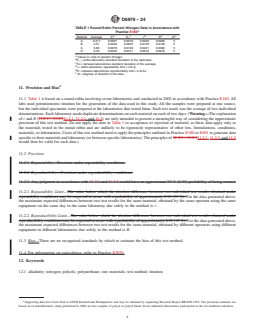
TABLE 1 Round-Robin Percent Nitrogen Data in Accordance with
6. Apparatus
A
Practice E180
6.1 Potentiometric Automatic Titrator
B C D E F
Material Average S S r R df
r R
A 0.317 0.0007 0.0018 0.0020 0.0050 5
6.2 Autotitrator Buret with Dosing Device, 20-mL
B 2.51 0.0046 0.0053 0.0129 0.0148 5
C 5.86 0.0079 0.0139 0.0221 0.0392 5
6.3 pH Glass Electrode and Reference Electrode or a
D 9.45 0.0220 0.0217 0.0616 0.0618 5
Combination Glass Electrode
A
Values in units of percent nitrogen.
B
6.4 Analytical Balances, capable of weighing to the nearest
S = within-laboratory standard deviation of the replicates.
r
C
S = between-laboratories standard deviation of the average.
0.01 g and 0.0001 g R
D
r = within-laboratory repeatability limit = 2.8·S .
r
E
6.5 Magnetic Stirrer/Hotplate R = between-laboratories reproducibility limit = 2.8·S .
R
F
df = degrees of freedom in the data.
7. Reagents and Materials
7.1 Purity of Reagents—Use reagent-grade chemicals in all
tests. Unless otherwise indicated, it is intended that all reagents 8.3 Titrate the sample solution potentiometrically with
conform to the specifications of the Committee on Analytical 0.10 N perchloric acid through the end point which occurs at
Reagents of the American Chemical Society where such ca. 600 mV.
specifications are available. It is permissible to use other
9. Calculation
grades provided it is first ascertained that the reagent is of
sufficiently high purity to permit its use without lessening the
9.1 Calculate the basicity in the sample, as percent nitrogen
accuracy of the determination.
as follows:
7.2 Acetic Acid, Glacial
S × N × 14.00
% N 5 × 100 % (2)
W × 1000
7.3 Acetic Anhydride
where:
7.4 Perchloric Acid, (70 % nominal)
S = the volume of titrant used to reach the end point of
7.5 Perchloric acid in Acetic Acid (0.10 N)—Prepare 0.10 N
the sample solution titration in milliliters,
perchloric acid in acetic acid. For example, in a 10
...
This document is not an ASTM standard and is intended only to provide the user of an ASTM standard an indication of what changes have been made to the previous version. Because
it may not be technically possible to adequately depict all changes accurately, ASTM recommends that users consult prior editions as appropriate. In all cases only the current version
of the standard as published by ASTM is to be considered the official document.
Designation: D6979 − 18 D6979 − 24
Standard Test Method for
Polyurethane Raw Materials: Determination of Basicity in
Polyols, Expressed as Percent Nitrogen
This standard is issued under the fixed designation D6979; the number immediately following the designation indicates the year of
original adoption or, in the case of revision, the year of last revision. A number in parentheses indicates the year of last reapproval. A
superscript epsilon (´) indicates an editorial change since the last revision or reapproval.
1. Scope*
1.1 This test method measures the basic constituents in polyols that are soluble in glacial acetic acid and reactive with perchloric
acid. Samples containing 0.3 –0.3 % to 10 % nitrogen have been evaluated by this method. This test method is applicable to
polyether polyols and polyether polyol blends that are used in urethane reactions. (See Note 1.)
1.2 The values stated in SI units are to be regarded as standard. No other units of measurement are included in this standard.
1.3 This standard does not purport to address all of the safety concerns, if any, associated with its use. It is the responsibility
of the user of this standard to establish appropriate safety, health, and environmental practices and determine the applicability of
regulatory limitations prior to use.
NOTE 1—This standard is equivalent to ISO 25761:08.
1.4 This international standard was developed in accordance with internationally recognized principles on standardization
established in the Decision on Principles for the Development of International Standards, Guides and Recommendations issued
by the World Trade Organization Technical Barriers to Trade (TBT) Committee.
2. Referenced Documents
2.1 ASTM Standards:
D883 Terminology Relating to Plastics
E180 Practice for Determining the Precision of ASTM Methods for Analysis and Testing of Industrial and Specialty Chemicals
(Withdrawn 2009)
E456 Terminology Relating to Quality and Statistics
E691 Practice for Conducting an Interlaboratory Study to Determine the Precision of a Test Method
E2935 Practice for Evaluating Equivalence of Two Testing Processes
2.2 ISO Standards:
ISO 25761 Plastics—Polyols for use in the production of polyurethanes—Determination of basicity (total amine value),
expressed as percent nitrogen
This test method is under the jurisdiction of ASTM Committee D20 on Plastics and is the direct responsibility of Subcommittee D20.22 on Cellular Materials - Plastics
and Elastomers.
Current edition approved Aug. 1, 2018Feb. 1, 2024. Published August 2018February 2024. Originally approved in 2003. Last previous edition approved in 20132018 as
D6979 - 13.D6979 – 18. DOI: 10.1520/D6979-18.10.1520/D6979-24.
For referenced ASTM standards, visit the ASTM website, www.astm.org, or contact ASTM Customer Service at service@astm.org. For Annual Book of ASTM Standards
volume information, refer to the standard’s Document Summary page on the ASTM website.
The last approved version of this historical standard is referenced on www.astm.org.
Available from American National Standards Institute (ANSI), 25 W. 43rd St., 4th Floor, New York, NY 10036, http://www.ansi.org.
*A Summary of Changes section appears at the end of this standard
Copyright © ASTM International, 100 Barr Harbor Drive, PO Box C700, West Conshohocken, PA 19428-2959. United States
D6979 − 24
3. Terminology
3.1 Definitions—For definitions of terms Terms used in this test method see standard are defined in accordance with Terminology
D883, unless otherwise specified. For terms relating to precision and bias and associated issues, the terms used in this standard
are defined in accordance with Terminology E456.
3.2 Definitions of Terms Specific to This Standard:
3.2.1 percent nitrogen—nitrogen, n—the quantity of perchloric acid-titratable base, expressed as a weight percentage of nitrogen
in a sample.
4. Summary of Test Method
4.1 The sample is dissolved in glacial acetic acid. The resulting single-phase solution is titrated at room temperature to a
potentiometric end point with a standardized solution of perchloric acid in acetic acid. Results are reported as percent nitrogen.
5. Significance and Use
5.1 This test method is suitable for quality control, as a specification test, and for research. The results are measures of
batch-to-batch uniformity and are useful in estimating reactivity.
5.1.1 The percent nitrogen can be used to characterize a polyol or indicate amounts of certain components in a polyol blend.
5.1.2 It is permissible to also express the results in equivalents of base per gram of sample, if desired.
6. Apparatus
6.1 Potentiometric Automatic Titrator
6.2 Autotitrator Buret with Dosing Device, 20-mL
6.3 pH Glass Electrode and Reference Electrode or a Combination Glass Electrode
6.4 Analytical Balances, capable of weighing to the nearest 0.01g0.01 g and 0.0001 g
6.5 Magnetic Stirrer/Hotplate
7. Reagents and Materials
7.1 Purity of Reagents—Use reagent-grade chemicals in all tests. Unless otherwise indicated, it is intended that all reagents
conform to the specifications of the Committee on Analytical Reagents of the American Chemical Society where such
specifications are available. It is permissible to use other grades provided it is first ascertained that the reagent is of sufficiently
high purity to permit its use without lessening the accuracy of the determination.
7.2 Acetic Acid, Glacial
7.3 Acetic Anhydride
7.4 Perchloric Acid, (70 % nominal)
Reagent Chemicals, American Chemical Society Specifications, ACS Reagent Chemicals, Specifications and Procedures for Reagents and Standard-Grade Reference
Materials, American Chemical Society, Washington, DC. For suggestions on the testing of reagents not listed by the American Chemical Society, see Analar Standards for
Laboratory Chemicals, BDH Ltd., Poole, Dorset, U.K., and the United States Pharmacopeia and National Formulary, U.S. Pharmacopeial Convention, Inc. (USPC),
Rockville, MD.
D6979 − 24
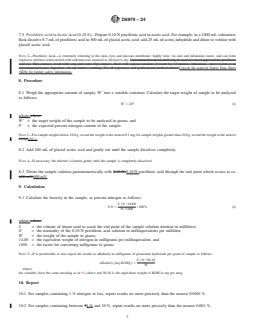
7.5 Perchloric acid in Acetic Acid (0.10 N)—Prepare 0.10 N perchloric acid in acetic acid. For example, in a 1000-mL volumetric
flask dissolve 8.7 mL of perchloric acid in 500 mL of glacial acetic acid; add 25 mL of acetic anhydride and dilute to volume with
glacial acetic acid.
NOTE 2—Perchloric Acid—is extremely irritating to the skin, eyes and mucous membrane; highly toxic via oral and inhalation routes; and can form
explosive mixtures when mixed with carbonaceous material or allowed to dry. Concentrated material shall only be used in a hood approved for perchloric
acid use. Skin contact—wash with soap and water. Eye contact—flush with copious amounts of water for 15 minutes. Inhalation - move victim to an
uncontaminated area. Ingestion—do not induce vomiting. For all exposures seek professional medical advice.Consult the material Safety Data Sheet
(SDS) for further safety information.
8. Procedure
8.1 Weigh the appropriate amount of sample, W’ into a suitable container. Calculate the target weight of sample to be analyzed
as follows:
W’5 2/P (1
...