

ASTM D1667-22
(Specification)Standard Specification for Flexible Cellular Materials-Poly (Vinyl Chloride) Foam (Closed-Cell)
General Information
- Abstract
ABSTRACT
This specification covers flexible closed-cell or non-interconnecting cellular products, the elastomer content of which is predominantly poly(vinyl chloride) foam or copolymers thereof. Materials shall be produced in sheet, strip, molded, or simple specific shapes. Complete details about apparatuses needed, specimen preparation, and procedures for the testing of compression deflection, compression set under constant deflection, and water absorption are thoroughly itemized.
SCOPE
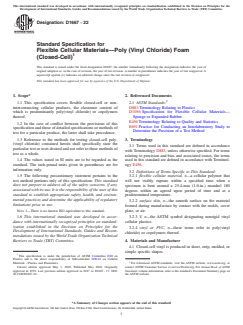
1.1 This specification covers flexible closed-cell or non-interconnecting cellular products, the elastomer content of which is predominantly poly(vinyl chloride) or copolymers thereof.
1.2 In the case of conflict between the provisions of this specification and those of detailed specifications or methods of test for a particular product, the latter shall take precedence.
1.3 Reference to the methods for testing closed-cell poly(vinyl chloride) contained herein shall specifically state the particular test or tests desired and not refer to these methods of test as a whole.
1.4 The values stated in SI units are to be regarded as the standard. The inch-pound units given in parentheses are for information only.
1.5 The following precautionary statement pertains to the test method portions only of this specification: This standard does not purport to address all of the safety concerns, if any, associated with its use. It is the responsibility of the user of this standard to establish appropriate safety, health, and environmental practices and determine the applicability of regulatory limitations prior to use.
Note 1: There is no known ISO equivalent to this standard.
1.6 This international standard was developed in accordance with internationally recognized principles on standardization established in the Decision on Principles for the Development of International Standards, Guides and Recommendations issued by the World Trade Organization Technical Barriers to Trade (TBT) Committee.
- Status
- Published
- Publication Date
- 30-Apr-2022
- Technical Committee
- D20 - Plastics
- Drafting Committee
- D20.22 - Cellular Materials - Plastics and Elastomers
Buy Documents
ASTM D1667-22 - Standard Specification for Flexible Cellular Materials—Poly (Vinyl Chloride) Foam (Closed-Cell)
REDLINE ASTM D1667-22 - Standard Specification for Flexible Cellular Materials—Poly (Vinyl Chloride) Foam (Closed-Cell)
Overview
ASTM D1667-22: Standard Specification for Flexible Cellular Materials – Poly (Vinyl Chloride) Foam (Closed-Cell) establishes key requirements for flexible, closed-cell poly(vinyl chloride) (PVC) foam and its copolymers. This standard, published by ASTM International, outlines both material properties and testing protocols for closed-cell or non-interconnecting cellular PVC foam products, which are widely used across various industries due to their cushioning, sealing, and insulating properties.
The standard applies to products made primarily from PVC foam, produced in sheet, strip, molded, or simple specific shapes. It defines core testing and acceptance criteria focusing on performance, safety, and dimensional tolerances, ensuring these flexible cellular materials meet strict quality demands in their practical applications.
Key Topics
- Material Scope: Focuses exclusively on flexible, closed-cell, or non-interconnecting PVC or PVC copolymer cellular materials.
- Product Forms: Covers materials manufactured as sheets, strips, molded, or basic shapes.
- Properties and Grades:
- Grades are designated by the symbol “VE” followed by two digits indicating cell type and firmness.
- Physical requirements include compression deflection, compression set under constant deflection, and water absorption.
- Optional suffix letters denote additional requirements (such as water resistance, flame resistance, density, abrasion resistance, and more).
- Testing Methods:
- Specifies apparatus and procedures for key tests: compression deflection, compression set, and water absorption.
- Details sampling provisions, specimen preparation, and test conditions to ensure repeatability and precision.
- Dimensional Tolerances: Provides tolerances for product thickness, length, and width, supporting consistent dimensional quality across batches.
- Workmanship and Appearance: Stipulates that products must be free from defects affecting serviceability and allows for material repair under specific conditions.
- Packaging and Marking: Each package must be properly labeled with product and manufacturer details for traceability.
Applications
Flexible closed-cell PVC foam materials conforming to ASTM D1667-22 are integral to a wide range of industries and applications, chosen for their durability, cushioning, and insulation characteristics. Common uses include:
- Automotive: Seals, gaskets, sound dampening pads, and protective linings.
- Construction: Weatherstripping, insulation panels, expansion joints, and vibration dampers.
- Electronics and Appliances: Padding, shock absorption, and insulating components.
- Packaging: Protective packaging inserts and custom-shaped cushions.
- Marine and Aerospace: Non-absorptive seals and flotation devices.
The closed-cell structure delivers excellent water, air, and chemical resistance, making these PVC foams suitable for both indoor and outdoor environments.
Related Standards
ASTM D1667-22 references and aligns with several related ASTM standards to ensure harmonization in terminology, testing, and performance assessment, including:
- ASTM D395 – Test Methods for Rubber Property - Compression Set
- ASTM D883 – Terminology Relating to Plastics
- ASTM D1056 – Specification for Flexible Cellular Materials - Sponge or Expanded Rubber
- ASTM E456 – Terminology Relating to Quality and Statistics
- ASTM E691 – Practice for Conducting an Interlaboratory Study to Determine the Precision of a Test Method
Note: There is no known ISO equivalent for ASTM D1667-22, making it a uniquely American and international benchmark for closed-cell PVC foam materials.
Keywords: ASTM D1667, closed-cell PVC foam, flexible cellular material, poly(vinyl chloride) standard, compression deflection, testing methods, industrial foam applications, quality standards, water absorption, dimensional tolerances, ASTM foam specification.
Relations
- Effective Date
- 01-Feb-2024
- Effective Date
- 01-Nov-2023
- Effective Date
- 01-Apr-2022
- Effective Date
- 01-Jan-2020
- Effective Date
- 01-Aug-2019
- Effective Date
- 15-Apr-2019
- Effective Date
- 01-Feb-2019
- Effective Date
- 01-Dec-2018
- Effective Date
- 01-Nov-2018
- Effective Date
- 01-Oct-2017
- Effective Date
- 01-Oct-2017
- Effective Date
- 15-Aug-2017
- Effective Date
- 15-Nov-2013
- Effective Date
- 15-Nov-2013
- Effective Date
- 15-Nov-2013
Buy Documents
ASTM D1667-22 - Standard Specification for Flexible Cellular Materials—Poly (Vinyl Chloride) Foam (Closed-Cell)
REDLINE ASTM D1667-22 - Standard Specification for Flexible Cellular Materials—Poly (Vinyl Chloride) Foam (Closed-Cell)
Get Certified
Connect with accredited certification bodies for this standard

DIN CERTCO
DIN Group product certification.

Smithers Quality Assessments
US management systems and product certification.
Sponsored listings
Frequently Asked Questions
ASTM D1667-22 is a technical specification published by ASTM International. Its full title is "Standard Specification for Flexible Cellular Materials-Poly (Vinyl Chloride) Foam (Closed-Cell)". This standard covers: ABSTRACT This specification covers flexible closed-cell or non-interconnecting cellular products, the elastomer content of which is predominantly poly(vinyl chloride) foam or copolymers thereof. Materials shall be produced in sheet, strip, molded, or simple specific shapes. Complete details about apparatuses needed, specimen preparation, and procedures for the testing of compression deflection, compression set under constant deflection, and water absorption are thoroughly itemized. SCOPE 1.1 This specification covers flexible closed-cell or non-interconnecting cellular products, the elastomer content of which is predominantly poly(vinyl chloride) or copolymers thereof. 1.2 In the case of conflict between the provisions of this specification and those of detailed specifications or methods of test for a particular product, the latter shall take precedence. 1.3 Reference to the methods for testing closed-cell poly(vinyl chloride) contained herein shall specifically state the particular test or tests desired and not refer to these methods of test as a whole. 1.4 The values stated in SI units are to be regarded as the standard. The inch-pound units given in parentheses are for information only. 1.5 The following precautionary statement pertains to the test method portions only of this specification: This standard does not purport to address all of the safety concerns, if any, associated with its use. It is the responsibility of the user of this standard to establish appropriate safety, health, and environmental practices and determine the applicability of regulatory limitations prior to use. Note 1: There is no known ISO equivalent to this standard. 1.6 This international standard was developed in accordance with internationally recognized principles on standardization established in the Decision on Principles for the Development of International Standards, Guides and Recommendations issued by the World Trade Organization Technical Barriers to Trade (TBT) Committee.
ABSTRACT This specification covers flexible closed-cell or non-interconnecting cellular products, the elastomer content of which is predominantly poly(vinyl chloride) foam or copolymers thereof. Materials shall be produced in sheet, strip, molded, or simple specific shapes. Complete details about apparatuses needed, specimen preparation, and procedures for the testing of compression deflection, compression set under constant deflection, and water absorption are thoroughly itemized. SCOPE 1.1 This specification covers flexible closed-cell or non-interconnecting cellular products, the elastomer content of which is predominantly poly(vinyl chloride) or copolymers thereof. 1.2 In the case of conflict between the provisions of this specification and those of detailed specifications or methods of test for a particular product, the latter shall take precedence. 1.3 Reference to the methods for testing closed-cell poly(vinyl chloride) contained herein shall specifically state the particular test or tests desired and not refer to these methods of test as a whole. 1.4 The values stated in SI units are to be regarded as the standard. The inch-pound units given in parentheses are for information only. 1.5 The following precautionary statement pertains to the test method portions only of this specification: This standard does not purport to address all of the safety concerns, if any, associated with its use. It is the responsibility of the user of this standard to establish appropriate safety, health, and environmental practices and determine the applicability of regulatory limitations prior to use. Note 1: There is no known ISO equivalent to this standard. 1.6 This international standard was developed in accordance with internationally recognized principles on standardization established in the Decision on Principles for the Development of International Standards, Guides and Recommendations issued by the World Trade Organization Technical Barriers to Trade (TBT) Committee.
ASTM D1667-22 is classified under the following ICS (International Classification for Standards) categories: 83.100 - Cellular materials. The ICS classification helps identify the subject area and facilitates finding related standards.
ASTM D1667-22 has the following relationships with other standards: It is inter standard links to ASTM D883-24, ASTM D883-23, ASTM E456-13a(2022)e1, ASTM D883-20, ASTM D883-19c, ASTM D883-19a, ASTM D883-19, ASTM D883-18a, ASTM D883-18, ASTM E456-13A(2017)e1, ASTM E456-13A(2017)e3, ASTM D883-17, ASTM E456-13ae3, ASTM E456-13ae2, ASTM E456-13ae1. Understanding these relationships helps ensure you are using the most current and applicable version of the standard.
ASTM D1667-22 is available in PDF format for immediate download after purchase. The document can be added to your cart and obtained through the secure checkout process. Digital delivery ensures instant access to the complete standard document.
Standards Content (Sample)
This international standard was developed in accordance with internationally recognized principles on standardization established in the Decision on Principles for the
Development of International Standards, Guides and Recommendations issued by the World Trade Organization Technical Barriers to Trade (TBT) Committee.
Designation:D1667 −22
Standard Specification for
Flexible Cellular Materials—Poly (Vinyl Chloride) Foam
(Closed-Cell)
This standard is issued under the fixed designation D1667; the number immediately following the designation indicates the year of
original adoption or, in the case of revision, the year of last revision. A number in parentheses indicates the year of last reapproval. A
superscript epsilon (´) indicates an editorial change since the last revision or reapproval.
This standard has been approved for use by agencies of the U.S. Department of Defense.
1. Scope* 2. Referenced Documents
1.1 This specification covers flexible closed-cell or non- 2.1 ASTM Standards:
interconnecting cellular products, the elastomer content of D883 Terminology Relating to Plastics
which is predominantly poly(vinyl chloride) or copolymers D1056 Specification for Flexible Cellular Materials—
thereof. Sponge or Expanded Rubber
E456 Terminology Relating to Quality and Statistics
1.2 In the case of conflict between the provisions of this
E691 Practice for Conducting an Interlaboratory Study to
specification and those of detailed specifications or methods of
Determine the Precision of a Test Method
test for a particular product, the latter shall take precedence.
1.3 Reference to the methods for testing closed-cell poly- 3. Terminology
(vinyl chloride) contained herein shall specifically state the
3.1 Terms used in this standard are defined in accordance
particular test or tests desired and not refer to these methods of
with Terminology D883, unless otherwise specified. For terms
test as a whole.
relating to precision and bias and associated issues, the terms
1.4 The values stated in SI units are to be regarded as the used in this standard are defined in accordance with Terminol-
standard. The inch-pound units given in parentheses are for ogy E456.
information only.
3.2 Definitions of Terms Specific to This Standard:
1.5 The following precautionary statement pertains to the
3.2.1 flexible cellular material, n—a cellular polymer that
test method portions only of this specification: This standard
will not visibly rupture within a specified time when a
does not purport to address all of the safety concerns, if any,
specimen is bent around a 25.4-mm (1.0-in.) mandrel 180
associated with its use. It is the responsibility of the user of this
degrees within an agreed upon period of time and at a
standard to establish appropriate safety, health, and environ-
predetermined temperature.
mental practices and determine the applicability of regulatory
3.2.2 surface skin, n—the smooth surface on the material
limitations prior to use.
formed during manufacture by contact with the molds, cover
plate, or air.
NOTE 1—There is no known ISO equivalent to this standard.
1.6 This international standard was developed in accor- 3.2.3 V, n—the ASTM symbol designating nonrigid vinyl
dance with internationally recognized principles on standard- cellular plastics.
ization established in the Decision on Principles for the
3.2.4 vinyl or PVC, n—these terms refer to poly(vinyl
Development of International Standards, Guides and Recom-
chloride) or copolymers thereof.
mendations issued by the World Trade Organization Technical
Barriers to Trade (TBT) Committee. 4. Materials and Manufacture
4.1 Closed-cell vinyl is produced in sheet, strip, molded, or
simple specific shapes.
This specification is under the jurisdiction of ASTM Committee D20 on
Plastics and is the direct responsibility of Subcommittee D20.22 on Cellular
Materials - Plastics and Elastomers. For referenced ASTM standards, visit the ASTM website, www.astm.org, or
Current edition approved May 1, 2022. Published May 2022. Originally contact ASTM Customer Service at service@astm.org. For Annual Book of ASTM
approved in 1959. Last previous edition approved in 2017 as D1667 - 17. DOI: Standards volume information, refer to the standard’s Document Summary page on
10.1520/D1667-22. the ASTM website.
*A Summary of Changes section appears at the end of this standard
Copyright © ASTM International, 100 Barr Harbor Drive, PO Box C700, West Conshohocken, PA 19428-2959. United States
D1667−22
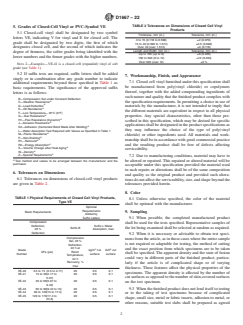
TABLE 2 Tolerances on Dimensions of Closed Cell Vinyl
5. Grades of Closed-Cell Vinyl or PVC-Symbol VE
Products
5.1 Closed-cell vinyl shall be designated by two symbol
Thickness, mm (in.) Tolerance, mm (in.)
letters VE, indicating V for vinyl and E for closed cell. The
3 to 15 (0.118 to 0.590) ±2 (0.079)
grade shall be designated by two digits, the first of which
15 to 40 (0.590 to 1.574) ±2.5 (0.098)
designates closed cell, and the second of which indicates the Over 40 (over 1.574) ±3 (0.118)
Length and Width, mm (in.) Tolerance, mm (in.)
degree of firmness, the softer grades being identified with the
Up to 150 (up to 6) ±6 (0.236)
lower numbers and the firmer grades with the higher numbers.
150 to 300 (6 to 12) ±10 (0.393)
Over 300 (over 12) ±3 %
NOTE 2—Examples—VE-41 is a closed cell (expanded) vinyl of soft
grade (see Table 1).
5.2 If suffix tests are required, suffix letters shall be added
7. Workmanship, Finish, and Appearance
singly or in combination after any grade number to indicate
7.1 Closed cell vinyl furnished under this specification shall
additional requirements beyond those specified in Table 1 as
be manufactured from poly(vinyl chloride) or copolymers
basic requirements. The significance of the approved suffix
thereof, together with the added compounding ingredients of
letters is as follows:
such nature and quality that the finished product complies with
B—Compression Set under Constant Deflection
A
the specification requirements. In permitting a choice in use of
C—Weather Resistance
A
D—Load Deflection
materials by the manufacturer, it is not intended to imply that
A
E—Oil Resistance
the different materials are equivalent in respect to all physical
F—Low Temperature—18°C (0°F)
A
properties. Any special characteristics, other than those pre-
G—Tear Resistance
A
H1—Flex Resistance (Dynamic)
scribed in this specification, which may be desired for specific
A
J—Abrasion Resistance
applications shall be designated in the product specifications as
A
K2—Adhesion (Cemented Bond Made After Molding)
they may influence the choice of the type of poly(vinyl
L—Water Absorption Test Required with Values as Specified in Table 1
A
M—Flame Resistance
chloride) or other ingredients used. All materials and work-
A
P—Non-Staining
manship shall be in accordance with good commercial practice
A
R1—Rebound
A
R2—Energy Absorption and the resulting product shall be free of defects affecting
A
S—Volume Change after Heat Aging
serviceability.
A
W—Density
A
Z—Special Requirements
7.2 Due to manufacturing conditions, material may have to
A
be altered or repaired. This repaired or altered material will be
Test method and values to be arranged between the manufacturer and the
purchaser.
acceptable under this specification provided the material used
in such repairs or alterations shall be of the same composition
6. Tolerances on Dimensions
and quality as the original product and provided such altera-
6.1 Tolerances on dimensions of closed-cell vinyl products
tionsdonotaffecttheserviceability,size,andshapebeyondthe
are given in Table 2.
tolerances provided herein.
8. Color
TABLE 1 Physical Requirements of Closed Cell Vinyl Products,
8.1 Unless otherwise specified, the color of the material
Type VE
shall be optional with the manufacturer.
Optional
Requirements
Basic Requirements 9. Sampling
Added by
Suffix Letters
9.1 When possible, the completed manufactured product
Compression
shall be used for the tests specified. Representative samples of
Deflection, Suffix L Water
Suffix B
the lot being examined shall be selected at random as required.
25 % Absorption, max
Deflection
9.2 When it is necessary or advisable to obtain test speci-
Compression
mensfromthearticle,asinthosecaseswheretheentiresample
Set, 25 %
is not required or adaptable for testing, the method of cutting
Deflection,
22hat
and the exact position from which specimens are to be taken
2 2
Grade kg/m cut lb/ft cut
kPa (psi) Room
shall be specified. The apparent density and the state of fusion
Number surface surface
Temperature,
could vary in different parts of the finished product, particu-
24 h
Recovery, %
larly if the article is of complicated shape or of varying
max
thickness. These features affect the physical properties of the
VE-40 3.5 to 15 (0.5 to 2.17) 20 0.5 0.1
specimens. The apparent density is affected by the number of
VE-41 15 to 35(2.17 to 20 0.5 0.1
cut surfaces as opposed to the number of skin-covered surfaces
5.07)
VE-42 35 to 65(5.07 to 20 0.5 0.1
on the test specimen.
9.42)
VE-43 65 to 90(9.42 to 13) 20 0.5 0.1 9.3 When the finished product does not lend itself to testing
VE-44 90 to 120(13 to 17.4) 20 0.5 0.1
or to the taking of test specimens because of complicated
VE-45 120 to 170(17.4 to 20 0.5 0.1
shape, small size, metal or fabric inserts, adhesion to metal, or
24.6)
other reasons, suitable test slabs shall be prepared as agreed
D1667−22
between the supplier and purchaser. When differences arise, made with the gauge out of contact with the closed cell vinyl.
due to the difficulty in obtaining suitable test specimens from The sample shall be passed through the previously set gauge
the finished part, the supplier and the purchaser shall agree on and the proper setting shall be the one in which the measuring
acceptable deviations. faces of the gauge contact the surfaces of the article without
compressing it.
10. Physical Properties
14.3 Length and width measurements over 25.4mm (1.0 in.)
10.1 The various grades of closed-cell vinyl shall conform
shall be measured using the gauge specified in 14.1, a sliding
totherequirementsastobasicphysicalpropertiesprescribedin
caliper specified in 14.2 or a steel rule or tape graduated to a
Table 1, together with any additional requirements indicated.
maximum of 1 mm (0.039 in.).
11. Inspection and Rejection
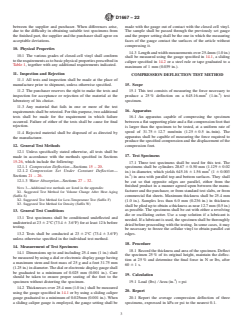
COMPRESSION DEFLECTION TEST METHOD
11.1 All tests and inspection shall be made at the place of
manufacture prior to shipment, unless otherwise specified. 15. Scope
11.2 The purchaser reserves the right to make the tests and
15.1 This test consists of measuring the force necessary to
2 2
inspection for acceptance or rejection of the material at the produce a 25 % deflection on a 645.16-mm (1-in. ) test
laboratory of his choice.
specimen.
11.3 Any material that fails in one or more of the test
16. Apparatus
requirements shall be retested. For this purpose, two additional
tests shall be made for the requirement in which failure
16.1 An apparatus capable of compressing the specimen
occurred. Failure of either of the tests shall be cause for final
between a flat supporting plate and a flat compression foot that
rejection.
is larger than the specimen to be tested, at a uniform rate of
speed of 31.75 6 12.7 mm/min (1.25 6 0.5 in.⁄min). The
11.4 Rejected material shall be disposed of as directed by
apparatus shall be capable of measuring the force required to
the manufacturer.
produce the specified compression and the displacement of the
12. General Test Methods compression foot.
12.1 Unless specifically stated otherwise, all tests shall be
17. Test Specimens
made in accordance with the methods specified in Sections
15-26, which include the following:
17.1 Three test specimens shall be used for this test. The
12.1.1 Compression Deflection—Sections15–20.
specimens shall be cylinders 28.67 6 0.50 mm (1.129 6 0.02
12.1.2 Compression Set Under Constant Deflection—
in.) in diameter, which yields 645.16 6 1.56 mm (1 6 0.003
Sections21–26.
in. ) in area with parallel top and bottom surfaces. They shall
12.1.3 Water Absorption—Sections27–32.
be cut so that opposite edges are parallel, either from the
finished product in a manner agreed upon between the manu-
NOTE 3—Additional test methods are listed in the appendix:
facturer and the purchaser, or from standard test slabs, or from
X1. Suggested Test Method for Volume Change After Heat Aging
(Suffix S)
commercial flat sheets. Maximum thickness shall be 25.4 mm
X2. Suggeste
...
This document is not an ASTM standard and is intended only to provide the user of an ASTM standard an indication of what changes have been made to the previous version. Because
it may not be technically possible to adequately depict all changes accurately, ASTM recommends that users consult prior editions as appropriate. In all cases only the current version
of the standard as published by ASTM is to be considered the official document.
Designation: D1667 − 17 D1667 − 22
Standard Specification for
Flexible Cellular Materials—Poly (Vinyl Chloride) Foam
(Closed-Cell)
This standard is issued under the fixed designation D1667; the number immediately following the designation indicates the year of
original adoption or, in the case of revision, the year of last revision. A number in parentheses indicates the year of last reapproval. A
superscript epsilon (´) indicates an editorial change since the last revision or reapproval.
This standard has been approved for use by agencies of the U.S. Department of Defense.
1. Scope*
1.1 This specification covers flexible closed-cell or non-interconnecting cellular products, the elastomer content of which is
predominantly poly(vinyl chloride) or copolymers thereof.
1.2 In the case of conflict between the provisions of this specification and those of detailed specifications or methods of test for
a particular product, the latter shall take precedence.
1.3 Reference to the methods for testing closed-cell poly(vinyl chloride) contained herein shall specifically state the particular test
or tests desired and not refer to these methods of test as a whole.
1.4 The values stated in SI units are to be regarded as the standard. The inch-pound units given in parentheses are for information
only.
1.5 The following precautionary statement pertains to the test method portions only of this specification:This standard does not
purport to address all of the safety concerns, if any, associated with its use. It is the responsibility of the user of this standard to
establish appropriate safety safety, health, and healthenvironmental practices and determine the applicability of regulatory
limitations prior to use.
NOTE 1—There is no known ISO equivalent to this standard.
1.6 This international standard was developed in accordance with internationally recognized principles on standardization
established in the Decision on Principles for the Development of International Standards, Guides and Recommendations issued
by the World Trade Organization Technical Barriers to Trade (TBT) Committee.
2. Referenced Documents
2.1 ASTM Standards:
D395D883 Test Methods for Rubber Property—Compression SetTerminology Relating to Plastics
D573 Test Method for Rubber—Deterioration in an Air Oven
D1056 Specification for Flexible Cellular Materials—Sponge or Expanded Rubber
This specification is under the jurisdiction of ASTM Committee D20 on Plastics and is the direct responsibility of Subcommittee D20.22 on Cellular Materials - Plastics
and Elastomers.
Current edition approved March 1, 2017May 1, 2022. Published March 2017May 2022. Originally approved in 1959. Last previous edition approved in 20112017 as
D1667 - 05D1667 - 17.(2011). DOI: 10.1520/D1667-17.10.1520/D1667-22.
For referenced ASTM standards, visit the ASTM website, www.astm.org, or contact ASTM Customer Service at service@astm.org. For Annual Book of ASTM Standards
volume information, refer to the standard’s Document Summary page on the ASTM website.
*A Summary of Changes section appears at the end of this standard
Copyright © ASTM International, 100 Barr Harbor Drive, PO Box C700, West Conshohocken, PA 19428-2959. United States
D1667 − 22
E456 Terminology Relating to Quality and Statistics
E691 Practice for Conducting an Interlaboratory Study to Determine the Precision of a Test Method
3. Terminology
3.1 Terms used in this standard are defined in accordance with Terminology D883, unless otherwise specified. For terms relating
to precision and bias and associated issues, the terms used in this standard are defined in accordance with Terminology E456.
3.2 Definitions of Terms Specific to This Standard:
3.1.1 closed cell—an expanded structure consisting of a multitude of individual, non-connecting, gas-tight cells.
3.2.1 flexible cellular material—material, n—a cellular organic polymeric material which polymer that will not visibly rupture
when a specimen 200 by 25 by 25 mm (8 by 1 by 1 in.) within a specified time when a specimen is bent around at 25-mm (1-in.)
diameter mandrel at a uniform rate of one lap in 5 s at a temperature between 18 and 29°C (65 and 85°F).a 25.4-mm (1.0-in.)
mandrel 180 degrees within an agreed upon period of time and at a predetermined temperature.
3.2.2 surface skin—skin, n—the smooth surface on the material formed during manufacture by contact with the molds, cover plate,
or air.
3.2.3 V—V, n—the ASTM symbol designating nonrigid vinyl cellular plastics.
3.2.4 vinyl or PVC—PVC, n—these terms refer to poly(vinyl chloride) or copolymers thereof.
4. Materials and Manufacture
4.1 Closed-cell vinyl is produced in sheet, strip, molded, or simple specific shapes.
5. Grades of Closed-Cell Vinyl or PVC-Symbol VE
5.1 Closed-cell vinyl shall be designated by two symbol letters VE, indicating V for vinyl and E for closed cell. The grade shall
be designated by two digits, the first of which designates closed cell, and the second of which indicates the degree of firmness,
the softer grades being identified with the lower numbers and the firmer grades with the higher numbers.
NOTE 2—Examples—VE-41 is a closed cell (expanded) vinyl of soft grade (see Table 1).
D1667 − 22
TABLE 1 Physical Requirements of Closed Cell Vinyl Products,
Type VE
Optional
Requirements
Basic Requirements
Added by
Suffix Letters
Compression
Deflection, Suffix L Water
Suffix B
25 % Absorption, max
Deflection
Compression
Set, 25 %
Deflection,
22 h at
2 2
Grade kg/m cut lb/ft cut
kPa (psi) Room
Number surface surface
Temperature,
24 h
Recovery, %
max
VE-40 3.5 to 15 (0.5 to 2.17) 20 0.5 0.1
VE-41 15 to 35(2.17 to 20 0.5 0.1
5.07)
VE-42 35 to 65(5.07 to 20 0.5 0.1
9.42)
VE-43 65 to 90(9.42 to 13) 20 0.5 0.1
VE-44 90 to 120(13 to 17.4) 20 0.5 0.1
VE-45 120 to 170(17.4 to 20 0.5 0.1
24.6)
5.2 If suffix tests are required, suffix letters shall be added singly or in combination after any grade number to indicate additional
requirements beyond those specified in Table 1 as basic requirements. The significance of the approved suffix letters is as follows:
B—Compression Set under Constant Deflection
A
C—Weather Resistance
A
D—Load Deflection
A
E—Oil Resistance
F—Low Temperature—18°C (0°F)
A
G—Tear Resistance
A
H1—Flex Resistance (Dynamic)
A
J—Abrasion Resistance
A
K2—Adhesion (Cemented Bond Made After Molding)
L—Water Absorption Test Required with Values as Specified in Table 1
A
M—Flame Resistance
A
P—Non-Staining
A
R1—Rebound
A
R2—Energy Absorption
A
S—Volume Change after Heat Aging
A
W—Density
A
Z—Special Requirements
A
Test method and values to be arranged between the manufacturer and the purchaser.
6. Tolerances on Dimensions
6.1 Tolerances on dimensions of closed-cell vinyl products are given in Table 2.
TABLE 2 Tolerances on Dimensions of Closed Cell Vinyl
Products
Thickness, mm (in.) Tolerance, mm (in.)
3 to 15 (0.118 to 0.590) ±2 (0.079)
15 to 40 (0.590 to 1.574) ±2.5 (0.098)
Over 40 (over 1.574) ±3 (0.118)
Length and Width, mm (in.) Tolerance, mm (in.)
Up to 150 (up to 6) ±6 (0.236)
150 to 300 (6 to 12) ±10 (0.393)
Over 300 (over 12) ±3 %
D1667 − 22
7. Workmanship, Finish, and Appearance
7.1 Closed cell vinyl furnished under this specification shall be manufactured from poly(vinyl chloride) or copolymers thereof,
together with the added compounding ingredients of such nature and quality that the finished product complies with the
specification requirements. In permitting a choice in use of materials by the manufacturer, it is not intended to imply that the
different materials are equivalent in respect to all physical properties. Any special characteristics, other than those prescribed in
this specification, which may be desired for specific applications shall be designated in the product specifications as they may
influence the choice of the type of poly(vinyl chloride) or other ingredients used. All materials and workmanship shall be in
accordance with good commercial practice and the resulting product shall be free of defects affecting serviceability.
7.2 Due to manufacturing conditions, material may have to be altered or repaired. This repaired or altered material will be
acceptable under this specification provided the material used in such repairs or alterations shall be of the same composition and
quality as the original product and provided such alterations do not affect the serviceability, size, and shape beyond the tolerances
provided herein.
8. Color
8.1 Unless otherwise specified, the color of the material shall be optional with the manufacturer.
9. Sampling
9.1 When possible, the completed manufactured product shall be used for the tests specified. Representative samples of the lot
being examined shall be selected at random as required.
9.2 When it is necessary or advisable to obtain test specimens from the article, as in those cases where the entire sample is not
required or adaptable for testing, the method of cutting and the exact position from which specimens are to be taken shall be
specified. The apparent density and the state of fusion could vary in different parts of the finished product, particularly if the article
is of complicated shape or of varying thickness. These features affect the physical properties of the specimens. The apparent density
is affected by the number of cut surfaces as opposed to the number of skin-covered surfaces on the test specimen.
9.3 When the finished product does not lend itself to testing or to the taking of test specimens because of complicated shape, small
size, metal or fabric inserts, adhesion to metal, or other reasons, suitable test slabs shall be prepared as agreed between the supplier
and purchaser. When differences arise, due to the difficulty in obtaining suitable test specimens from the finished part, the supplier
and the purchaser shall agree on acceptable deviations.
10. Physical Properties
10.1 The various grades of closed-cell vinyl shall conform to the requirements as to basic physical properties prescribed in Table
1, together with any additional requirements indicated.
11. Test Methods
11.1 Unless specifically stated otherwise, make all tests in accordance with the methods specified in Section 14.
11. Inspection and Rejection
11.1 All tests and inspection shall be made at the place of manufacture prior to shipment, unless otherwise specified.
11.2 The purchaser reserves the right to make the tests and inspection for acceptance or rejection of the material at the laboratory
of his choice.
11.3 Any material that fails in one or more of the test requirements shall be retested. For this purpose, two additional tests shall
be made for the requirement in which failure occurred. Failure of either of the tests shall be cause for final rejection.
11.4 Rejected material shall be disposed of as directed by the manufacturer.
D1667 − 22
13. Packaging and Package Marking
13.1 The material shall be properly and adequately packaged. Each package or container shall be legibly marked with the name
of the material, name or trademark of the manufacturer, and any required purchaser’s designations.
12. General Test Methods
12.1 The following Unless specifically stated otherwise, all tests shall be applicablemade in the physical testing of closedaccor-
dance with the methods specified in Sections 15cell-26 poly(vinyl chloride) or copolymers thereof:, which include the following:
12.1.1 Compression Deflection—Test method described in Sections 1615 – 20.
12.1.2 Compression Set Under Constant Deflection—Test method described in Sections 21 – 2526.
12.1.3 Water Absorption—Test method described in Sections 2627 – 3032.
NOTE 3—Additional test methods are listed in the appendix.appendix:
X1. Suggested Test Method for Volume Change After Heat Aging (Suffix S)
X2. Suggested Test Method for Low-Temperature Test (Suffix F)
X3. Suggested Test Method for Density (Suffix W)
13. General Test Conditions
13.1 Test specimens shall be conditioned undeflected and undistorted at 23 6 2°C (73.4 6 3.6°F) for at least 12 h before testing.
13.2 Tests shall be conducted at 23 6 2°C (73.4 6 3.6°F) unless otherwise specified in the individual test method.
14. Measurement of Test Specimens
14.1 The length and width Dimensions up to and including 25.4 mm (1 in.) shall be measured with a steel scale or tape. Care shall
be taken not to distort the material.by using a dial or electronic display gauge having a maximum stem and foot mass of 25 g and
a foot 31.75 mm (1.25 in.) in diameter. The dial or electronic display gauge shall be graduated to a minimum of 0.025 mm (0.001
in.). Care should be taken to ensure proper seating of the foot to the specimen without distorting the specimen.
14.2 Thicknesses up to and including 25 mm (1over 25.4 mm (1.0 in.) shall be measured using a dial-type gauge having a
maximum stem and foot mass of 25 g and a foot 32 mm (1.25 in.) in diameter, taking care not to compress the specimen.
Thicknesses over 25the gauge specified in 14.1 mm (1 in.) shall be measured or by using a sliding caliper gage or as specified
ingauge graduated to a minimum 15.1. of 0.025mm (0.001 in.). When a sliding caliper gagegauge is employed, the gagegauge
setting shall be made with the gagegauge out of contact with the closed cell vinyl. The specimensample shall be passed through
the previously set gage,gauge and the proper setting shall be the one when in which the measuredmeasuring faces of the gagegauge
contact the surfaces of the article without compressing it.
14.3 The steel scale or tape used to measure length or width shall be graduated in divisions not over 1Length and width
measurements over 25.4mm (1.0 in.) shall be measured using the gauge specified in 14.1mm (0.031 in.). The dial gage for, a sliding
caliper specified in 14.2 measuring thickness shall be graduated in divisions not over 0.02 mm (0.001 in.). The calipers used for
measuring thickness shall be graduated in divisions not over 0.1 mm (0.005 or a steel rule or tape graduated to a maximum of 1
mm (0.039 in.).
15.4 Results reported shall be the average of a minimum of three measurements.
COMPRESSION DEFLECTION TEST METHOD
15. Scope
2 2
15.1 This test consists of measuring the force necessary to produce a 25 % deflection on a 645.16-mm (1-in. ) test specimen.
D1667 − 22
16. Apparatus
16.1 The apparatus used for this test shall have a flat indentor foot, An apparatus capable of compressing the specimen between
a flat supporting plate and a flat compression foot that is larger than the specimen being tested, connected to a force-measuring
device, and mounted in such a manner that the specimen shall be deflected at a rate between 0.2 and 0.8 mm/s (0.5 andto be tested,
at a uniform rate of speed of 31.75 6 12.7 mm/min (1.25 6 0.5 in. 2.0 in./min). ⁄min). The apparatus shall be arranged to support
the specimen on a level, horizontal plate.capable of measuring the force required to produce the specified compression and the
displacement of the compression foot.
17. Test Specimens
17.1 Three test specimens shall be used for this test. The specimens shall be cylinders 28.67 6 0.50 mm (1.129 6 0.02 in.) in
2 2
diameter, which yields 645.16 6 0.20645.16 6 1.56 mm (1(1 6 0.003 in. ) in area with parallel top and bottom surfaces. They
shall be cut so that opposite edges are parallel, either from the finished product in a manner agreed upon between the manufacturer
and the purchaser, or from standard test slabs, or from commercial flat sheets. The thickness of the test specimens shall be measured
and stated in the report. Maximum thickness shall be 25.4 mm (1.0 in.). Maximum thickness shall be 25.4 mm (1.0 in.). Samples
less than 6.0 mm (0.236 in.) in thickness shall be plied up to obtain a thickness as near 12.7 mm (0.5 in.) as possible. The specimens
shall be cut with either a revolving die or oscillating cutter. Use a soap solution if a lubricant is needed. If a lubricant is used, the
specimen shall be thoroughly dried before proceeding with the testing. In some cases, it may be necessary to freeze the cellular
vinyl to obtain parallel cut edges.
NOTE 4—Other specimen sizes can be used as agreed upon between user and supplier.
18. Procedure
18.1 Test closed-cell vinyl (grades VE-40 to VE-45) samples less than 6.0 mm (0.236 in.) in thickness by plying up to obtain a
thickness as near 12.7 mm (Record the thickness and area of the specimen. ⁄2 in.) as possible. Deflect the specimen 25 % of its
original height. Maintainheight, maintain the deflection at 25 % with automatic or manual control and record the force in newtons
or pounds force 60 6 1 s after the 25 % deflection is reached. The result obtained in this test is influenced by temperature, and
tests that are to be compared shall be conducted under substantially the same temperature. In all cases, report the actual temperature
during the test.and determine the final force in N or lbs, after 60 6 1 s.
19.2 In case of dispute perform the test at a temperature of 23 6 2°C (73.4 6 3.6°F). Condition the specimen undeflected and
undistorted at this temperature for at least 12 h before testing. Ordinarily only one test shall be made, but in case of dispute express
the result as the average of three tests on three different specimens.
NOTE 5—Humidity does not affect the results.
19. Calculation
19.1 Load (lbs) ⁄ Area (in. ) = psi
20. Report
20.1 Report the unit force required, average compression deflection of three specimens, expressed in kPa or psi.psi to the nearest
0.1.
COMPRESSION SET UNDER CONSTANT DEFLECTION (SUFFIX B)
21. Scope
21.1 This test determines the compression set afte
...