

ASTM D3768-22
(Test Method)Standard Test Method for Microcellular Urethanes-Flexural Recovery
General Information
- Abstract
SIGNIFICANCE AND USE
4.1 This test method is used to indicate the ability of a material to recover after a 180° bend around a 12.7-mm (0.5-in.) diameter mandrel at room temperature.
4.2 Before proceeding with this test method, reference shall be made to any specification for the material being tested. Any test specimen preparation, conditioning, or dimensions, or combination thereof, and testing parameters covered in the materials specification shall take precedence over those mentioned in these test methods. If there are no material specifications, then the default conditions apply.
Note 2: This test method is applicable to solid urethanes.
SCOPE
1.1 This test method covers the procedure and apparatus for measuring the flexural recovery of microcellular urethanes.
1.2 The values stated in SI units are to be regarded as standard.
1.3 This standard does not purport to address all of the safety concerns, if any, associated with its use. It is the responsibility of the user of this standard to establish appropriate safety, health, and environmental practices and determine the applicability of regulatory limitations prior to use.
Note 1: There is no known ISO equivalent to this standard.
1.4 This international standard was developed in accordance with internationally recognized principles on standardization established in the Decision on Principles for the Development of International Standards, Guides and Recommendations issued by the World Trade Organization Technical Barriers to Trade (TBT) Committee.
- Status
- Published
- Publication Date
- 14-Mar-2022
- Technical Committee
- D20 - Plastics
- Drafting Committee
- D20.22 - Cellular Materials - Plastics and Elastomers

Overview
ASTM D3768-22: Standard Test Method for Microcellular Urethanes-Flexural Recovery provides a widely recognized procedure for determining the flexural recovery properties of microcellular urethanes. This ASTM standard specifies the apparatus and method to evaluate the ability of a microcellular urethane material to recover its original shape after being bent 180° around a 12.7-mm (0.5-in.) diameter mandrel at room temperature. The test results, often expressed as the degree of flexural recovery after specific times, are crucial for assessing the durability, flexibility, and resilience of urethane-based materials.
Developed in accordance with international best practices, ASTM D3768-22 is primarily used in industries where microcellular urethanes contribute to performance-critical components such as automotive, consumer goods, and industrial applications.
Key Topics
- Flexural Recovery Assessment: The method evaluates the material’s ability to regain its original form after bending, which is essential for products exposed to repeated flexing or deformation.
- Test Procedure and Apparatus: The standard provides clear guidelines on sample preparation, specimen dimensions, conditioning, and use of a dedicated test fixture featuring a 12.7-mm mandrel and protractor.
- Measurement and Reporting: Requires measurement of angular recovery after 30 seconds and 300 seconds, as well as specifics on specimen direction, conditioning, and sample thickness.
- Applicability: Suitable for solid microcellular urethanes - elastomeric materials made from polyol and organic isocyanate with specific cell diameters and densities.
- Interlaboratory Consistency: Outlines precision analysis and repeatability, helping laboratories assess in-house quality and compare results across facilities.
- Reference to Material Specifications: Before using this test method, any material-specific test preparation or parameters override the default test conditions provided.
Applications
ASTM D3768-22 is relevant across various sectors that utilize microcellular urethane materials. Practical applications include:
- Automotive Industry: Used for evaluating seat padding, suspension bushings, and vibration dampening elements, where the flexural recovery property predicts service life and material reliability.
- Footwear and Sporting Goods: Assesses the resilience of insoles or padding exposed to repeated mechanical stress.
- Industrial Equipment: Tests gaskets, seals, or shock-absorbing components for continued performance after flexing or deformation.
- Consumer Products: Applied in assessing flexible urethane parts found in furniture, protective gear, and electronics.
The standard guides manufacturers in selecting materials that maintain shape, comfort, and function after prolonged use, ensuring products meet both performance and longevity criteria.
Related Standards
ASTM D3768-22 references several other standards and practices for complete evaluation and terminology alignment, including:
- ASTM D883 - Terminology Relating to Plastics
- ASTM D3489 - Test Methods for Microcellular Urethane Materials
- ASTM E456 - Terminology Relating to Quality and Statistics
- ASTM E691 - Practice for Conducting an Interlaboratory Study to Determine the Precision of a Test Method
- Note: There is no known ISO equivalent for this standard, making ASTM D3768-22 an essential reference for microcellular urethane testing.
Keywords: ASTM D3768-22, microcellular urethanes, flexural recovery, urethane testing, elastomer resilience, material testing, standard test method, flexural set, quality control, industrial materials
For professionals involved in material selection, quality assurance, and product design, complying with ASTM D3768-22 ensures reliable, standardized evaluation of microcellular urethane recovery behavior, supporting informed engineering decisions and consistent product performance.
Relations
- Effective Date
- 01-Feb-2024
- Effective Date
- 01-Nov-2023
- Effective Date
- 01-Apr-2022
- Effective Date
- 01-Jan-2020
- Effective Date
- 01-Aug-2019
- Effective Date
- 15-Apr-2019
- Effective Date
- 01-Feb-2019
- Effective Date
- 01-Dec-2018
- Effective Date
- 01-Nov-2018
- Effective Date
- 01-Oct-2017
- Effective Date
- 01-Oct-2017
- Refers
ASTM E2935-17 - Standard Practice for Conducting Equivalence Testing in Laboratory Applications - Effective Date
- 01-Oct-2017
- Effective Date
- 15-Aug-2017
- Refers
ASTM E2935-16 - Standard Practice for Conducting Equivalence Testing in Laboratory Applications - Effective Date
- 15-Nov-2016
- Refers
ASTM E2935-15 - Standard Practice for Conducting Equivalence Testing in Laboratory Applications - Effective Date
- 01-Oct-2015
Get Certified
Connect with accredited certification bodies for this standard

DIN CERTCO
DIN Group product certification.

Smithers Quality Assessments
US management systems and product certification.
Sponsored listings
Frequently Asked Questions
ASTM D3768-22 is a standard published by ASTM International. Its full title is "Standard Test Method for Microcellular Urethanes-Flexural Recovery". This standard covers: SIGNIFICANCE AND USE 4.1 This test method is used to indicate the ability of a material to recover after a 180° bend around a 12.7-mm (0.5-in.) diameter mandrel at room temperature. 4.2 Before proceeding with this test method, reference shall be made to any specification for the material being tested. Any test specimen preparation, conditioning, or dimensions, or combination thereof, and testing parameters covered in the materials specification shall take precedence over those mentioned in these test methods. If there are no material specifications, then the default conditions apply. Note 2: This test method is applicable to solid urethanes. SCOPE 1.1 This test method covers the procedure and apparatus for measuring the flexural recovery of microcellular urethanes. 1.2 The values stated in SI units are to be regarded as standard. 1.3 This standard does not purport to address all of the safety concerns, if any, associated with its use. It is the responsibility of the user of this standard to establish appropriate safety, health, and environmental practices and determine the applicability of regulatory limitations prior to use. Note 1: There is no known ISO equivalent to this standard. 1.4 This international standard was developed in accordance with internationally recognized principles on standardization established in the Decision on Principles for the Development of International Standards, Guides and Recommendations issued by the World Trade Organization Technical Barriers to Trade (TBT) Committee.
SIGNIFICANCE AND USE 4.1 This test method is used to indicate the ability of a material to recover after a 180° bend around a 12.7-mm (0.5-in.) diameter mandrel at room temperature. 4.2 Before proceeding with this test method, reference shall be made to any specification for the material being tested. Any test specimen preparation, conditioning, or dimensions, or combination thereof, and testing parameters covered in the materials specification shall take precedence over those mentioned in these test methods. If there are no material specifications, then the default conditions apply. Note 2: This test method is applicable to solid urethanes. SCOPE 1.1 This test method covers the procedure and apparatus for measuring the flexural recovery of microcellular urethanes. 1.2 The values stated in SI units are to be regarded as standard. 1.3 This standard does not purport to address all of the safety concerns, if any, associated with its use. It is the responsibility of the user of this standard to establish appropriate safety, health, and environmental practices and determine the applicability of regulatory limitations prior to use. Note 1: There is no known ISO equivalent to this standard. 1.4 This international standard was developed in accordance with internationally recognized principles on standardization established in the Decision on Principles for the Development of International Standards, Guides and Recommendations issued by the World Trade Organization Technical Barriers to Trade (TBT) Committee.
ASTM D3768-22 is classified under the following ICS (International Classification for Standards) categories: 83.100 - Cellular materials. The ICS classification helps identify the subject area and facilitates finding related standards.
ASTM D3768-22 has the following relationships with other standards: It is inter standard links to ASTM D883-24, ASTM D883-23, ASTM E456-13a(2022)e1, ASTM D883-20, ASTM D883-19c, ASTM D883-19a, ASTM D883-19, ASTM D883-18a, ASTM D883-18, ASTM E456-13A(2017)e1, ASTM E456-13A(2017)e3, ASTM E2935-17, ASTM D883-17, ASTM E2935-16, ASTM E2935-15. Understanding these relationships helps ensure you are using the most current and applicable version of the standard.
ASTM D3768-22 is available in PDF format for immediate download after purchase. The document can be added to your cart and obtained through the secure checkout process. Digital delivery ensures instant access to the complete standard document.
Standards Content (Sample)
This international standard was developed in accordance with internationally recognized principles on standardization established in the Decision on Principles for the
Development of International Standards, Guides and Recommendations issued by the World Trade Organization Technical Barriers to Trade (TBT) Committee.
Designation: D3768 − 22
Standard Test Method for
Microcellular Urethanes—Flexural Recovery
This standard is issued under the fixed designation D3768; the number immediately following the designation indicates the year of
original adoption or, in the case of revision, the year of last revision.Anumber in parentheses indicates the year of last reapproval.A
superscript epsilon (´) indicates an editorial change since the last revision or reapproval.
1. Scope* 3. Terminology
1.1 Thistestmethodcoverstheprocedureandapparatusfor
3.1 Terms used in this standard are defined in accordance
measuring the flexural recovery of microcellular urethanes.
with Terminology D883, unless otherwise specified. For terms
relating to precision and bias and associated issues, the terms
1.2 The values stated in SI units are to be regarded as
used in this standard are defined in accordance with Terminol-
standard.
ogy E456.
1.3 This standard does not purport to address all of the
3.2 The following definition is from Test Methods D3489:
safety concerns, if any, associated with its use. It is the
responsibility of the user of this standard to establish appro-
3.2.1 microcellular urethane, n—an elastomeric material
priate safety, health, and environmental practices and deter- made by the interaction of a polyol and an organic isocyanate,
mine the applicability of regulatory limitations prior to use.
having cell diameters in the range from 0.0001 to 0.001 mm,
3 3
with a minimum density of 160 kg/m (10 lb/ft ).
NOTE 1—There is no known ISO equivalent to this standard.
1.4 This international standard was developed in accor-
4. Significance and Use
dance with internationally recognized principles on standard-
4.1 This test method is used to indicate the ability of a
ization established in the Decision on Principles for the
Development of International Standards, Guides and Recom- material to recover after a 180° bend around a 12.7-mm
(0.5-in.) diameter mandrel at room temperature.
mendations issued by the World Trade Organization Technical
Barriers to Trade (TBT) Committee.
4.2 Before proceeding with this test method, reference shall
be made to any specification for the material being tested.Any
2. Referenced Documents
test specimen preparation, conditioning, or dimensions, or
2.1 ASTM Standards:
combination thereof, and testing parameters covered in the
D883Terminology Relating to Plastics
materials specification shall take precedence over those men-
D3040Practice for Preparing Precision Statements for Stan-
tioned in these test methods. If there are no material
dards Related to Rubber and Rubber Testing (Withdrawn
specifications, then the default conditions apply.
1987)
NOTE 2—This test method is applicable to solid urethanes.
D3489Test Methods for Microcellular Urethane Materials
E456Terminology Relating to Quality and Statistics
5. Apparatus
E691Practice for Conducting an Interlaboratory Study to
Determine the Precision of a Test Method
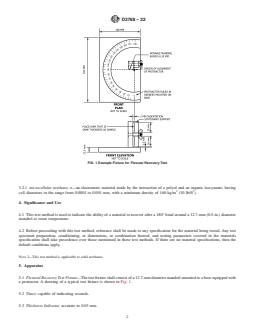
5.1 Flexural Recovery Test Fixture—The test fixture shall
E2935Practice for Evaluating Equivalence of Two Testing
consist of a 12.7-mm diameter mandrel mounted to a base
Processes
equipped with a protractor. A drawing of a typical test fixture
is shown in Fig. 1.
5.2 Timer, capable of indicating seconds.
ThistestmethodisunderthejurisdictionofASTMCommitteeD20onPlastics
and is the direct responsibility of Subcommittee D20.22 on Cellular Materials -
5.3 Thickness Indicator, accurate to 0.03 mm.
Plastics and Elastomers.
Current edition approved March 15, 2022. Published March 2022. Originally
6. Test Specimens
approved in 1979. Last previous edition approved in 2016 as D3768-16. DOI:
10.1520/D3768-22.
6.1 The test specimens shall be cut from molded plaques or
For referenced ASTM standards, visit the ASTM website, www.astm.org, or
contact ASTM Customer Service at service@astm.org. For Annual Book of ASTM
parts. The recommended standard test specimen is 4 mm in
Standards volume information, refer to the standard’s Document Summary page on
thickness, and the minimum specimen thickness shall not be
the ASTM website.
less than 3 mm.The specimen shall be 25 mm in width by 150
The last approved version of this historical standard is referenced on
www.astm.org. mm in length (1 by 6 in.).
*A Summary of Changes section appears at the end of this standard
Copyright © ASTM International, 100 Barr Harbor Drive, PO Box C700, West Conshohocken, PA 19428-2959. United States
D3768 − 22
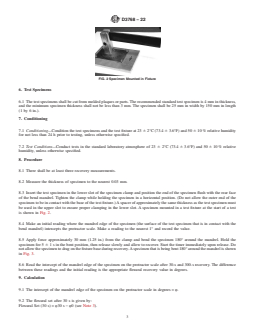
FIG. 2 Specimen Mounted in Fixture
8.5 Apply force approximately 30 mm (1.25 in.) from the
clamp and bend the specimen 180° around the mandrel. Hold
the specimen for 5 6 1 s in the bent position, then release
slowly and allow to recover. Start the timer immediately upon
release. Do not allow the specimen to drag on the fixture base
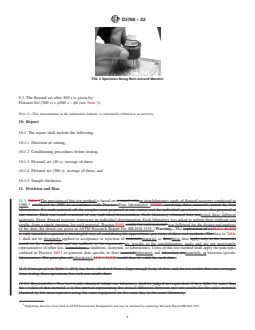
duringrecovery.Aspecimenthatisbeingbent180°aroundthe
mandrel is shown in Fig. 3.
8.6 Read the intercept of the mandrel edge of the specimen
on the protractor scale after 30-s and 300-s recovery. The
difference between these readings and the initial reading is the
appropriate flexural recovery value in degrees.
9. Calculation
9.1 The intercept of the mandrel edge of the specimen on
the protractor scale in degrees=φ.
FIG. 1 Example Fixture for Flex
...
This document is not an ASTM standard and is intended only to provide the user of an ASTM standard an indication of what changes have been made to the previous version. Because
it may not be technically possible to adequately depict all changes accurately, ASTM recommends that users consult prior editions as appropriate. In all cases only the current version
of the standard as published by ASTM is to be considered the official document.
Designation: D3768 − 16 D3768 − 22
Standard Test Method for
Microcellular Urethanes—Flexural Recovery
This standard is issued under the fixed designation D3768; the number immediately following the designation indicates the year of
original adoption or, in the case of revision, the year of last revision. A number in parentheses indicates the year of last reapproval. A
superscript epsilon (´) indicates an editorial change since the last revision or reapproval.
1. Scope*
1.1 This test method covers the procedure and apparatus for measuring the flexural recovery of microcellular urethanes.
1.2 The values stated in SI units are to be regarded as standard.
1.3 This standard does not purport to address all of the safety concerns, if any, associated with its use. It is the responsibility
of the user of this standard to establish appropriate safety safety, health, and healthenvironmental practices and determine the
applicability of regulatory limitations prior to use.
NOTE 1—There is no known ISO equivalent to this standard.
1.4 This international standard was developed in accordance with internationally recognized principles on standardization
established in the Decision on Principles for the Development of International Standards, Guides and Recommendations issued
by the World Trade Organization Technical Barriers to Trade (TBT) Committee.
2. Referenced Documents
2.1 ASTM Standards:
D883 Terminology Relating to Plastics
D3040 Practice for Preparing Precision Statements for Standards Related to Rubber and Rubber Testing (Withdrawn 1987)
D3489 Test Methods for Microcellular Urethane Materials
E456 Terminology Relating to Quality and Statistics
E691 Practice for Conducting an Interlaboratory Study to Determine the Precision of a Test Method
E2935 Practice for Evaluating Equivalence of Two Testing Processes
3. Terminology
3.1 For definitions of terms Terms used in this test method standard are defined in accordance with Terminology D883and
associated with plastics issues, refer to terminology contained in , unless otherwise specified. For terms relating to precision and
bias and associated issues, the terms used in this standard are defined in accordance with Terminology D883E456.
3.2 The following definition is from Test Methods D3489:
This test method is under the jurisdiction of ASTM Committee D20 on Plastics and is the direct responsibility of Subcommittee D20.22 on Cellular Materials - Plastics
and Elastomers.
Current edition approved Oct. 1, 2016March 15, 2022. Published October 2016March 2022. Originally approved in 1979. Last previous edition approved in 20112016
as D3768 - 11.D3768 - 16. DOI: 10.1520/D3768-16.10.1520/D3768-22.
For referenced ASTM standards, visit the ASTM website, www.astm.org, or contact ASTM Customer Service at service@astm.org. For Annual Book of ASTM Standards
volume information, refer to the standard’s Document Summary page on the ASTM website.
The last approved version of this historical standard is referenced on www.astm.org.
*A Summary of Changes section appears at the end of this standard
Copyright © ASTM International, 100 Barr Harbor Drive, PO Box C700, West Conshohocken, PA 19428-2959. United States
D3768 − 22
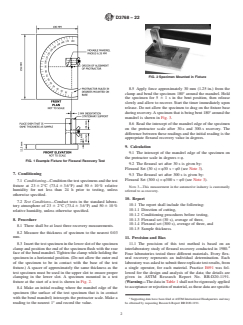
FIG. 1 Example Fixture for Flexural Recovery Test
3.2.1 microcellular urethane, n—an elastomeric material made by the interaction of a polyol and an organic isocyanate, having
3 3
cell diameters in the range from 0.0001 to 0.001 mm, with a minimum density of 160 kg/m (10 lb/ft ).
4. Significance and Use
4.1 This test method is used to indicate the ability of a material to recover after a 180° bend around a 12.7-mm (0.5-in.) diameter
mandrel at room temperature.
4.2 Before proceeding with this test method, reference shall be made to any specification for the material being tested. Any test
specimen preparation, conditioning, or dimensions, or combination thereof, and testing parameters covered in the materials
specification shall take precedence over those mentioned in these test methods. If there are no material specifications, then the
default conditions apply.
NOTE 2—This test method is applicable to solid urethanes.
5. Apparatus
5.1 Flexural Recovery Test Fixture—The test fixture shall consist of a 12.7-mm diameter mandrel mounted to a base equipped with
a protractor. A drawing of a typical test fixture is shown in Fig. 1.
5.2 Timer, capable of indicating seconds.
5.3 Thickness Indicator, accurate to 0.03 mm.
D3768 − 22
FIG. 2 Specimen Mounted in Fixture
6. Test Specimens
6.1 The test specimens shall be cut from molded plaques or parts. The recommended standard test specimen is 4 mm in thickness,
and the minimum specimen thickness shall not be less than 3 mm. The specimen shall be 25 mm in width by 150 mm in length
(1 by 6 in.).
7. Conditioning
7.1 Conditioning—Condition the test specimens and the test fixture at 23 6 2°C (73.4 6 3.6°F) and 50 6 10 % relative humidity
for not less than 24 h prior to testing, unless otherwise specified.
7.2 Test Conditions—Conduct tests in the standard laboratory atmosphere of 23 6 2°C (73.4 6 3.6°F) and 50 6 10 % relative
humidity, unless otherwise specified.
8. Procedure
8.1 There shall be at least three recovery measurements.
8.2 Measure the thickness of specimen to the nearest 0.03 mm.
8.3 Insert the test specimen in the lower slot of the specimen clamp and position the end of the specimen flush with the rear face
of the bend mandrel. Tighten the clamp while holding the specimen in a horizontal position. (Do not allow the outer end of the
specimen to be in contact with the base of the test fixture.) A spacer of approximately the same thickness as the test specimen must
be used in the upper slot to ensure proper clamping in the lower slot. A specimen mounted in a test fixture at the start of a test
is shown in Fig. 2.
8.4 Make an initial reading where the mandrel edge of the specimen (the surface of the test specimen that is in contact with the
bend mandrel) intercepts the protractor scale. Make a reading to the nearest 1° and record the value.
8.5 Apply force approximately 30 mm (1.25 in.) from the clamp and bend the specimen 180° around the mandrel. Hold the
specimen fo
...