

ASTM F3372-20
(Practice)Standard Practice for Butt Fusion Joining of PA12 Pipe and Fittings
General Information
- Abstract
SCOPE
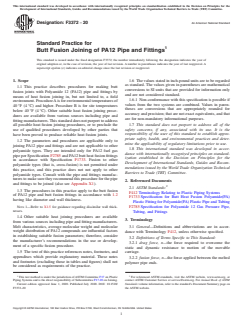
1.1 This practice describes procedures for making butt fusion joints with Polyamide 12 (PA12) pipe and fittings by means of heat fusion joining in, but not limited to, a field environment. Procedure A is for environmental temperatures of 40 °F (4 °C) and higher. Procedure B is for site temperatures below 40 °F (4 °C). Other suitable heat fusion joining procedures are available from various sources including pipe and fitting manufacturers. This standard does not purport to address all possible heat fusion joining procedures, or to preclude the use of qualified procedures developed by other parties that have been proved to produce reliable heat fusion joints.
1.2 The parameters and procedures are applicable only to joining PA12 pipe and fittings and are not applicable to other polyamide types. They are intended only for PA12 fuel gas pipe per Specification F2785 and PA12 butt heat fusion fittings in accordance with Specification F1733. Fusion to other polyamide types (that is, cross-fusion) is not permitted under this practice, and this practice does not not apply to other polyamide types. Consult with the pipe and fittings manufacturers to make sure they recommend this procedure for the pipe and fittings to be joined (also see Appendix X1).
1.3 The procedures in this practice apply to the butt fusion of PA12 pipe and butt fusion fittings in accordance with 1.2 having like diameter and wall thickness.
Note 1: Refer to X1.5 for guidance regarding dissimilar wall thicknesses.
1.4 Other suitable heat joining procedures are available from various sources including pipe and fitting manufacturers. Melt characteristics, average molecular weight and molecular weight distribution of PA12 compounds are influential factors in establishing suitable fusion parameters; therefore, consider the manufacturer’s recommendations in the use or development of a specific fusion procedure.
1.5 The text of this practice references notes, footnotes, and appendixes which provide explanatory material. These notes and footnotes (excluding those in tables and figures) shall not be considered as requirements of the practice.
1.6 The values stated in inch-pound units are to be regarded as standard. The values given in parentheses are mathematical conversions to SI units that are provided for information only and are not considered standard.
1.6.1 Non-conformance with this specification is possible if values from the two systems are combined. Values in parentheses are conversions that are appropriately rounded for accuracy and precision; that are not exact equivalents, and that are for non-mandatory informational purposes.
1.7 This standard does not purport to address all of the safety concerns, if any, associated with its use. It is the responsibility of the user of this standard to establish appropriate safety, health, and environmental practices and determine the applicability of regulatory limitations prior to use.
1.8 This international standard was developed in accordance with internationally recognized principles on standardization established in the Decision on Principles for the Development of International Standards, Guides and Recommendations issued by the World Trade Organization Technical Barriers to Trade (TBT) Committee.
- Status
- Published
- Publication Date
- 31-May-2020
- Technical Committee
- F17 - Plastic Piping Systems
- Drafting Committee
- F17.20 - Joining
Overview
ASTM F3372-20 is the internationally recognized standard practice for the butt fusion joining of Polyamide 12 (PA12) pipe and fittings. Established by ASTM International, this standard outlines the recommended procedures and requirements for performing butt fusion heat joining of PA12 piping systems, including in-field and controlled environments. The purpose of ASTM F3372-20 is to ensure the creation of strong, reliable, pressure- and leak-tight joints in PA12 pipelines, primarily used in fuel gas and related applications. The practice covers both standard (temperatures ≥40°F/4°C) and cold-weather (<40°F/4°C) joining procedures, providing guidance for adapting to various environments and field conditions.
Key Topics
- Applicability: Procedures outlined are strictly for PA12 (polyamide 12) pipe and fittings-typically for fuel gas distribution per ASTM F2785 and butt fusion fittings per ASTM F1733. Fusion with other polyamide types is not permitted.
- Butt Fusion Process: The process involves heating the squared ends of two pipes or fittings with a designated heating tool, then pressing them together under controlled force to achieve molecular bonding. Correct machine setup, heating plate temperature (470–500°F), and interfacial pressure (60–90 psi) are essential.
- Field vs. Factory Conditions: The standard addresses differences in field installations compared to controlled factory settings, emphasizing environmental controls, especially in cold or adverse weather.
- Equipment Requirements:
- Butt fusion machines and heaters capable of maintaining specified temperatures and forces.
- Non-stick coating on heating surfaces to improve joint quality and prevent PA12 from sticking.
- Operator Proficiency: Calls for proper training, skill verification through test joints, and use of quality assurance tools like data loggers for tracking fusion parameters.
- Quality Assurance: Guidance on visual inspection of joints for bead shape and size, as well as mandatory cleaning procedures to minimize contamination.
- Adaptation to Environmental Conditions: Instructions for proper fusion when operating at temperatures below 40°F (4°C), including weather protection measures and pipe pre-heating.
Applications
- Fuel Gas Distribution: Tailored for joining PA12 pipes and fittings in natural gas and other fuel gas applications, meeting regulatory and safety standards.
- Oil and Gas Utilities: Used in the installation and maintenance of PA12 piping systems for regulated oil, gas, and certain industrial pipelines where reliability and leak-tight joints are critical.
- Industrial Piping: Suitable for industries requiring chemically resistant, high-performance, and robust piping systems using PA12 materials.
- Construction Environments: Procedures accommodate both field installations and factory settings, making it practical for contractors, utility companies, and maintenance teams.
Practical Value
- Consistency & Safety: Ensures uniformity in butt fusion joint integrity, reducing the risk of gas leaks and enhancing long-term system reliability.
- Environmental Flexibility: Provides solutions for adverse weather, enabling year-round installations.
- Compliance: Supports regulatory compliance and adherence to international standards.
- Quality Control: Encourages best practices for training, operator evaluation, and data tracking, contributing to better project outcomes.
Related Standards
- ASTM F2785: Specification for Polyamide 12 Gas Pressure Pipe, Tubing, and Fittings-defines the physical and performance requirements for PA12 piping products.
- ASTM F1733: Specification for Butt Heat Fusion Polyamide (PA) Plastic Fittings-standards for fittings compatible with PA12 piping systems.
- ASTM F412: Terminology Relating to Plastic Piping Systems-provides definitions and terms used in plastic piping technology.
- General Fusion Standards: Additional guidance may be available from PA12 pipe and fitting manufacturers and applicable industry codes.
Keywords: ASTM F3372-20, butt fusion, PA12 pipe, PA12 fittings, polyamide 12, heat fusion joining, fuel gas pipeline, standard practice, pipeline joining procedure, gas distribution piping, cold weather fusion, pipe installation standards.
Relations
- Effective Date
- 01-Feb-2024
- Effective Date
- 01-Apr-2020
- Effective Date
- 01-Jan-2019
- Refers
ASTM F2785-18 - Standard Specification for Polyamide 12 Gas Pressure Pipe, Tubing, and Fittings - Effective Date
- 15-Apr-2018
- Effective Date
- 01-Aug-2017
- Effective Date
- 01-Feb-2017
- Effective Date
- 15-Nov-2016
- Effective Date
- 01-Aug-2016
- Effective Date
- 01-Jun-2015
- Effective Date
- 15-Feb-2013
- Refers
ASTM F2785-12 - Standard Specification for Polyamide 12 Gas Pressure Pipe, Tubing, and Fittings - Effective Date
- 01-Aug-2012
- Effective Date
- 01-Apr-2012
- Refers
ASTM F2785-10a - Standard Specification for Polyamide 12 Gas Pressure Pipe, Tubing, and Fittings - Effective Date
- 01-Dec-2010
- Refers
ASTM F2785-10 - Standard Specification for Polyamide 12 Gas Pressure Pipe, Tubing, and Fittings - Effective Date
- 01-Oct-2010
- Refers
ASTM F2785-09 - Standard Specification for Polyamide 12 Gas Pressure Pipe, Tubing, and Fittings - Effective Date
- 01-Aug-2009
Get Certified
Connect with accredited certification bodies for this standard

DVS-ZERT GmbH
German welding certification society.
CARES (UK Certification Authority for Reinforcing Steels)
UK certification for reinforcing steels and construction.
EWF/IIW (European/International Welding Federation)
International welding personnel certification.
Sponsored listings
Frequently Asked Questions
ASTM F3372-20 is a standard published by ASTM International. Its full title is "Standard Practice for Butt Fusion Joining of PA12 Pipe and Fittings". This standard covers: SCOPE 1.1 This practice describes procedures for making butt fusion joints with Polyamide 12 (PA12) pipe and fittings by means of heat fusion joining in, but not limited to, a field environment. Procedure A is for environmental temperatures of 40 °F (4 °C) and higher. Procedure B is for site temperatures below 40 °F (4 °C). Other suitable heat fusion joining procedures are available from various sources including pipe and fitting manufacturers. This standard does not purport to address all possible heat fusion joining procedures, or to preclude the use of qualified procedures developed by other parties that have been proved to produce reliable heat fusion joints. 1.2 The parameters and procedures are applicable only to joining PA12 pipe and fittings and are not applicable to other polyamide types. They are intended only for PA12 fuel gas pipe per Specification F2785 and PA12 butt heat fusion fittings in accordance with Specification F1733. Fusion to other polyamide types (that is, cross-fusion) is not permitted under this practice, and this practice does not not apply to other polyamide types. Consult with the pipe and fittings manufacturers to make sure they recommend this procedure for the pipe and fittings to be joined (also see Appendix X1). 1.3 The procedures in this practice apply to the butt fusion of PA12 pipe and butt fusion fittings in accordance with 1.2 having like diameter and wall thickness. Note 1: Refer to X1.5 for guidance regarding dissimilar wall thicknesses. 1.4 Other suitable heat joining procedures are available from various sources including pipe and fitting manufacturers. Melt characteristics, average molecular weight and molecular weight distribution of PA12 compounds are influential factors in establishing suitable fusion parameters; therefore, consider the manufacturer’s recommendations in the use or development of a specific fusion procedure. 1.5 The text of this practice references notes, footnotes, and appendixes which provide explanatory material. These notes and footnotes (excluding those in tables and figures) shall not be considered as requirements of the practice. 1.6 The values stated in inch-pound units are to be regarded as standard. The values given in parentheses are mathematical conversions to SI units that are provided for information only and are not considered standard. 1.6.1 Non-conformance with this specification is possible if values from the two systems are combined. Values in parentheses are conversions that are appropriately rounded for accuracy and precision; that are not exact equivalents, and that are for non-mandatory informational purposes. 1.7 This standard does not purport to address all of the safety concerns, if any, associated with its use. It is the responsibility of the user of this standard to establish appropriate safety, health, and environmental practices and determine the applicability of regulatory limitations prior to use. 1.8 This international standard was developed in accordance with internationally recognized principles on standardization established in the Decision on Principles for the Development of International Standards, Guides and Recommendations issued by the World Trade Organization Technical Barriers to Trade (TBT) Committee.
SCOPE 1.1 This practice describes procedures for making butt fusion joints with Polyamide 12 (PA12) pipe and fittings by means of heat fusion joining in, but not limited to, a field environment. Procedure A is for environmental temperatures of 40 °F (4 °C) and higher. Procedure B is for site temperatures below 40 °F (4 °C). Other suitable heat fusion joining procedures are available from various sources including pipe and fitting manufacturers. This standard does not purport to address all possible heat fusion joining procedures, or to preclude the use of qualified procedures developed by other parties that have been proved to produce reliable heat fusion joints. 1.2 The parameters and procedures are applicable only to joining PA12 pipe and fittings and are not applicable to other polyamide types. They are intended only for PA12 fuel gas pipe per Specification F2785 and PA12 butt heat fusion fittings in accordance with Specification F1733. Fusion to other polyamide types (that is, cross-fusion) is not permitted under this practice, and this practice does not not apply to other polyamide types. Consult with the pipe and fittings manufacturers to make sure they recommend this procedure for the pipe and fittings to be joined (also see Appendix X1). 1.3 The procedures in this practice apply to the butt fusion of PA12 pipe and butt fusion fittings in accordance with 1.2 having like diameter and wall thickness. Note 1: Refer to X1.5 for guidance regarding dissimilar wall thicknesses. 1.4 Other suitable heat joining procedures are available from various sources including pipe and fitting manufacturers. Melt characteristics, average molecular weight and molecular weight distribution of PA12 compounds are influential factors in establishing suitable fusion parameters; therefore, consider the manufacturer’s recommendations in the use or development of a specific fusion procedure. 1.5 The text of this practice references notes, footnotes, and appendixes which provide explanatory material. These notes and footnotes (excluding those in tables and figures) shall not be considered as requirements of the practice. 1.6 The values stated in inch-pound units are to be regarded as standard. The values given in parentheses are mathematical conversions to SI units that are provided for information only and are not considered standard. 1.6.1 Non-conformance with this specification is possible if values from the two systems are combined. Values in parentheses are conversions that are appropriately rounded for accuracy and precision; that are not exact equivalents, and that are for non-mandatory informational purposes. 1.7 This standard does not purport to address all of the safety concerns, if any, associated with its use. It is the responsibility of the user of this standard to establish appropriate safety, health, and environmental practices and determine the applicability of regulatory limitations prior to use. 1.8 This international standard was developed in accordance with internationally recognized principles on standardization established in the Decision on Principles for the Development of International Standards, Guides and Recommendations issued by the World Trade Organization Technical Barriers to Trade (TBT) Committee.
ASTM F3372-20 is classified under the following ICS (International Classification for Standards) categories: 25.160.10 - Welding processes. The ICS classification helps identify the subject area and facilitates finding related standards.
ASTM F3372-20 has the following relationships with other standards: It is inter standard links to ASTM F1733-24, ASTM F412-20, ASTM F412-19, ASTM F2785-18, ASTM F412-17a, ASTM F412-17, ASTM F412-16a, ASTM F412-16, ASTM F412-15, ASTM F412-13, ASTM F2785-12, ASTM F412-12, ASTM F2785-10a, ASTM F2785-10, ASTM F2785-09. Understanding these relationships helps ensure you are using the most current and applicable version of the standard.
ASTM F3372-20 is available in PDF format for immediate download after purchase. The document can be added to your cart and obtained through the secure checkout process. Digital delivery ensures instant access to the complete standard document.
Standards Content (Sample)
This international standard was developed in accordance with internationally recognized principles on standardization established in the Decision on Principles for the
Development of International Standards, Guides and Recommendations issued by the World Trade Organization Technical Barriers to Trade (TBT) Committee.
Designation: F3372 − 20 An American National Standard
Standard Practice for
Butt Fusion Joining of PA12 Pipe and Fittings
This standard is issued under the fixed designation F3372; the number immediately following the designation indicates the year of
original adoption or, in the case of revision, the year of last revision. A number in parentheses indicates the year of last reapproval. A
superscript epsilon (´) indicates an editorial change since the last revision or reapproval.
1. Scope 1.6 The values stated in inch-pound units are to be regarded
as standard. The values given in parentheses are mathematical
1.1 This practice describes procedures for making butt
conversions to SI units that are provided for information only
fusion joints with Polyamide 12 (PA12) pipe and fittings by
and are not considered standard.
means of heat fusion joining in, but not limited to, a field
1.6.1 Non-conformance with this specification is possible if
environment.ProcedureAisforenvironmentaltemperaturesof
values from the two systems are combined. Values in paren-
40 °F (4 °C) and higher. Procedure B is for site temperatures
theses are conversions that are appropriately rounded for
below 40 °F (4 °C). Other suitable heat fusion joining proce-
accuracy and precision; that are not exact equivalents, and that
dures are available from various sources including pipe and
are for non-mandatory informational purposes.
fittingmanufacturers.Thisstandarddoesnotpurporttoaddress
1.7 This standard does not purport to address all of the
all possible heat fusion joining procedures, or to preclude the
safety concerns, if any, associated with its use. It is the
use of qualified procedures developed by other parties that
responsibility of the user of this standard to establish appro-
have been proved to produce reliable heat fusion joints.
priate safety, health, and environmental practices and deter-
1.2 The parameters and procedures are applicable only to
mine the applicability of regulatory limitations prior to use.
joining PA12 pipe and fittings and are not applicable to other
1.8 This international standard was developed in accor-
polyamide types. They are intended only for PA12 fuel gas
dance with internationally recognized principles on standard-
pipe per Specification F2785 and PA12 butt heat fusion fittings
ization established in the Decision on Principles for the
in accordance with Specification F1733. Fusion to other
Development of International Standards, Guides and Recom-
polyamide types (that is, cross-fusion) is not permitted under
mendations issued by the World Trade Organization Technical
this practice, and this practice does not not apply to other
Barriers to Trade (TBT) Committee.
polyamide types. Consult with the pipe and fittings manufac-
turerstomakesuretheyrecommendthisprocedureforthepipe
2. Referenced Documents
and fittings to be joined (also see Appendix X1).
2.1 ASTM Standards:
1.3 The procedures in this practice apply to the butt fusion
F412 Terminology Relating to Plastic Piping Systems
of PA12 pipe and butt fusion fittings in accordance with 1.2
F1733 Specification for Butt Heat Fusion Polyamide(PA)
having like diameter and wall thickness.
Plastic Fitting for Polyamide(PA) Plastic Pipe and Tubing
NOTE 1—Refer to X1.5 for guidance regarding dissimilar wall thick- F2785 Specification for Polyamide 12 Gas Pressure Pipe,
nesses.
Tubing, and Fittings
1.4 Other suitable heat joining procedures are available
3. Terminology
from various sources including pipe and fitting manufacturers.
Melt characteristics, average molecular weight and molecular
3.1 General—Definitions and abbreviations are in accor-
weight distribution of PA12 compounds are influential factors
dance with Terminology F412, unless otherwise specified.
in establishing suitable fusion parameters; therefore, consider
3.2 Definitions of Terms Specific to This Standard:
the manufacturer’s recommendations in the use or develop-
3.2.1 drag force, n—the force required to overcome the
ment of a specific fusion procedure.
static and dynamic resistance to motion of the movable
1.5 The text of this practice references notes, footnotes, and
carriage.
appendixes which provide explanatory material. These notes
3.2.2 fusion force, n—the force applied between the melted
and footnotes (excluding those in tables and figures) shall not
polymer pipe ends.
be considered as requirements of the practice.
1 2
This test method is under the jurisdiction of ASTM Committee F17 on Plastic For referenced ASTM standards, visit the ASTM website, www.astm.org, or
Piping Systems and is the direct responsibility of Subcommittee F17.20 on Joining. contact ASTM Customer Service at service@astm.org. For Annual Book of ASTM
Current edition approved June 1, 2020. Published July 2020. DOI: 10.1520/ Standards volume information, refer to the standard’s Document Summary page on
F3372–20 the ASTM website.
Copyright © ASTM International, 100 Barr Harbor Drive, PO Box C700, West Conshohocken, PA 19428-2959. United States
F3372 − 20
3.2.3 total effective piston area, n—the surface area of the 4.6 For fuel gas applications, regulated oil and gas
piston face that drives the hydraulic fusion machine moveable applications, and some industrial applications, qualification of
carriage. the procedure by testing joints made using the procedure in
accordance with regulations from the authority having juris-
3.2.4 fusion machine gauge pressure, n—the pressure indi-
diction is required.
cated on the hydraulic system pressure gauge on a hydraulic
butt fusion machine.
4.7 The party responsible for the joining of PA12 pipe and
fittings shall ensure that detailed procedures developed in
3.2.5 facer—a rotating cutting device used to square-off the
conjunction with applicable codes and regulations and the
pipe or fitting ends to obtain properly mating fusion surfaces.
manufacturers of the pipe, fittings, and joining equipment
4. Summary of Practice
involved, including the safety precautions to be followed, are
issued before actual joining operations begin.
4.1 The principle of heat fusion joining of PA12 pipe is to
heat two prepared surfaces to a designated temperature, then
5. Operator Experience
fuse them together by application of a sufficient force. This
force causes the melted materials to flow and mix, thereby 5.1 Skill, and knowledge, and proficiency on the part of the
resulting in fusion.
operator are required to obtain a good quality joint. This skill
andknowledgeisobtainedbymakingjointsinaccordancewith
4.2 Only butt heat-fusion procedures are covered in this
proven procedures under the guidance of skilled operators.
practice.
Evaluate operator proficiency by testing sample joints.
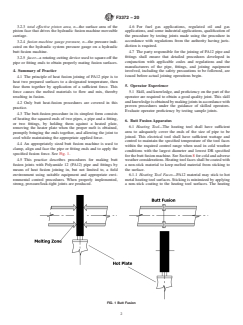
4.3 The butt-fusion procedure in its simplest form consists
of heating the squared ends of two pipes, a pipe and a fitting,
6. Butt Fusion Apparatus
or two fittings, by holding them against a heated plate,
6.1 Heating Tool—The heating tool shall have sufficient
removing the heater plate when the proper melt is obtained,
area to adequately cover the ends of the size of pipe to be
promptly bringing the ends together, and allowing the joint to
joined. This electrical tool shall have sufficient wattage and
cool while maintaining the appropriate applied force.
control to maintain the specified temperature of the tool faces
4.4 An appropriately sized butt fusion machine is used to
within the required control range when used in cold weather
clamp, align and face the pipe or fitting ends and to apply the
conditions with the largest diameter and lowest DR specified
specified fusion force. See Fig. 1.
for the butt fusion machine. See Section 8 for cold and adverse
4.5 This practice describes procedures for making butt weather considerations. Heating tool faces shall be coated with
fusion joints with Polyamide 12 (PA12) pipe and fittings by a non-stick material to keep melted material from sticking to
means of heat fusion joining in, but not limited to, a field the surface.
environment using suitable equipment and appropriate envi- 6.1.1 Heating Tool Faces—PA12 material may stick to hot
ronmental control procedures. When properly implemented, metal heating tool surfaces. Sticking is minimized by applying
strong, pressure/leak-tight joints are produced. a non-stick coating to the heating tool surfaces. The heating
FIG. 1 Butt Fusion
F3372 − 20
tool surfaces shall be kept clean and free of contaminants such ingandsquaringtheendsofthepipeorfittingtobejoined;and
as dirt, grease and plastic build-up, which may cause excessive (3) appropriate inserts for clamping different pipe sizes or
sticking and create unsatisfactory joints. Most contaminants fitting shapes. Butt fusion machines are operated manually or
areremovedfromthehotorcoldheatingtoolsurfacesbyusing hydraulically. Butt fusion machines are available for various
a clean, dry, lint-free, non-synthetic cloth such as cotton. Do pipe and tubing size ranges.
not use synthetic fabrics that char and stick to the heating tool
6.3 Pipe Support Stands—Optional pipe support stands or
surface.
racksareusedtosupportthepipeatbothendsofthebuttfusion
6.1.2 After a period of time in service, non-stick coatings
machine to assist with pipe loading and alignment.
will deteriorate and become less effective. Worn, scratched, or
gouged non-stick coatings shall be re-coated when they lose
7. Procedure A-For Site Temperature of 40 °F (4 °C) and
effectiveness. Heat fusion quality is adversely affected by
Higher
deteriorated non-stick surfaces. Spray-on chemicals, such as
NOTE 4—For site temperatures lower than 40°F(4°C)see Section 8.
nonsticklubricantsoroilsshallneverbeappliedtoheatingiron
7.1 Setup:
surfaces as they will contaminate the joint.
7.1.1 Butt fusion machine setup parameters for manual and
6.1.3 Temperature Indicator—Heating tools shall be
hydraulic machines are prescribed in Table 1.
equipped with a thermometer or other built-in temperature
indicating device. This device indicates the internal tempera- 7.1.2 Manual butt fusion machine—An interfacial pressure
ture of the heating iron, which is not necessarily the tempera- (IFP) of 60 to 90 psi (0.41 to 0.62 MPa) is used to determine
ture of the heating tool surfaces. Use a pyrometer, or other the fusion force required to butt fuse the pipe components.
surface-temperature measuring device to measure the heating Fusion force is applied to achieve the required bead height and
tool surface temperature, at the time of the first joint of the day width. For a manually operated fusion machine the IFP is
and periodically during the day to verify the temperature of the multiplied by the pipe area (A ) to obtain the fusion force
P
tool face surfaces at the pipe or fitting contact area. Select required in pounds. (See Eq 3.) A torque wrench may be used
multiple checkpoints around the diameter of the pipe contact to apply the proper force. Consult the manual butt fusion
area to ensure uniform surface temperature. machine manufacturer’s operating manual for the correct
conversionoftorquetoforce.Ifatorquewrenchisnotusedthe
NOTE 2—An infrared pyrometer can be calibrated by comparison to a
visual guidelines in 7.2 shall apply.
calibrated surface pyrometer and adjusted to match on each heating tool.
NOTE 3—Asignificant temperature variation, that is, cold spots, on the
NOTE 5—The drag force on manual machines should be considered
heating tool surfaces may indicate a faulty heating iron which should not
when determining the torque necessary to achieve the correct IFP. See
be used.
Note 6 regarding the components of drag force which for hydraulic
6.2 Butt Fusion Machine—A butt fusion machine has three machines is expressed as drag pressure. On manual machines a torque
wrench may be used to measure the drag force.The torque value when the
basic parts: (1) a stationary clamping fixture and a movable
carriage starts moving is the drag force.
clamping fixture for aligning and holding each of the pipe or
fitting ends to be fused, (2) a facer for simultaneously machin- 7.1.3 Hydraulic butt fusion machine:
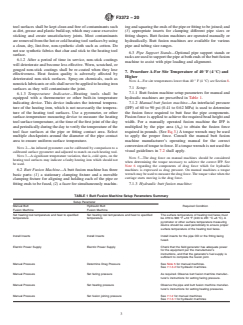
TABLE 1 Butt Fusion Machine Setup Parameters Summary
Setup Parameter
Required Condition
Manual Butt Hydraulic Butt
Fusion Machine Fusion Machine
Set heating tool temperature and heat to specified Set heating tool temperature and heat to specified The surface temperature of heating tool faces must
temperature temperature be 470 to 500 °F ±10 °F (243 to 261 °C ±6 °C). A
pyrometer or other surface temperature measuring
device should be used periodically to ensure proper
surface temperature of the heating tool faces.
Install Inserts Install Inserts Install inserts for the pipe OD or the fitting being
fused.
Electric Power Supply Electric Power Supply Check that the field generator has adequate power
for the equipment per the manufacturer’s
instructions, and that the generator’s fuel supply is
sufficient to complete the fusion joint.
Manual Pressure Determine Drag Pressure See Note 5 for manual machines.
See 7.1.3.2 for hydraulic machines.
Manual Pressure Set facing pressure As required. Observe butt fusion machine manufac-
turer’s instructions for setting facing pressure.
Manual Pressure Set heating pressure Observe the pipe and butt fusion machine manufac-
turer’s instructions for setting heating pressures.
Manual Pressure Set fusion joining pressure See 7.1.2 for manual machines
See 7.1.3.1 for hydraulic machines
F3372 − 20
7.1.3.1 Calculate the Fusion Force and Theoretical Fusion Do not use solvents. Also clean the outside surfaces of piping
Pressure—The IFPis multiplied by the pipe area (A ) to obtain components where they will be clamped in the butt fusion
P
machine. (See X1.8.)
the fusion force required in pounds. The fusion force required
is then divided by the total effective piston area (TEPA) of the
7.2.2 If applicable, place pipe support stands at both ends of
fusion machine carriage to obtain the theoretical fusion pres-
the butt fusion machine and adjust the support stands to align
sure (TFP) See Eq 2. the pipe with the fusion machine centerline. Install the pipes or
fittings being joined in the stationary and movable clamps of
7.1.3.2 Determine the Drag Pressure, P —P is found by
D D
thebuttfusionmachine.Leaveenoughpipeprotrudingthrough
bringingthefacedpipeendswithin2in.(50mm)ofeachother
the clamps to allow for facing and clamp the pipe or fitting in
and increasing the pressure on the carriage until it starts
the machine.
moving. Reduce the pressure until the carriage is barely
7.2.2.1 Take care when placing pipe or fittings in the butt
moving. The hydraulic machine gauge pressure at this point is
fusion machine. Pipes shall be aligned before the alignment
the drag pressure. Record the drag pressure P in psig.
D
clamp is closed. Do not force the pipe into alignment by
NOTE 6—Drag pressure, P , will vary depending on the components
D
pushing it against the side of an open butt fusion machine
being fused and site conditions. Long pipe strings, or pulling pipe lengths
clamp.
uphill or downhill, can have different movement resistance compared to
7.2.2.2 Clamps shall be tightened securely. Security is
fittings, or shorter pipe lengths, or fusion on level terrain. P should be
D
determined for the specific conditions, and re-determined if conditions checked by bringing the piping component ends together under
change.
pressure and assuring that the components do not slip in the
clamps. When clamping pipes in a two-clamp carriage, tighten
7.1.3.3 Determine the Fusion Machine Gauge Pressure,
the rear clamp more than the front clamp. This will facilitate
P —An interfacial pressure (IFP) of 60 to 90 psi (0.41 to 0.62
G
front clamp high-low alignment adjustment.
MPa) is required for butt fusion. To determine the hydraulic
7.2.2.3 Pipes that are freshly cut, and molded fittings
butt fusion machine gauge pressure, P , the IFP is multiplied
G
generallydonothavetoe-in,andwhenmatedtoold-cutpipeor
by the cross-section area of the pipe end (A ) to obtain the
p
fabricated fittings, adjustment for high-low alignment is eased
required fusion force in pounds. The fusion force is then
by removing toe-in. Refer to X1.7.
dividedbytheTotalEffectivePistonArea(TEPA)ofthefusion
7.2.3 Install the facer between the piping component ends.
machine’s carriage hydraulic cylinders to obtain the Theoreti-
Face the piping component ends until the facer bottoms out
cal Fusion Pressure (TFP). The drag pressure (P ) is then
D
against the stops. To assure complete facing, operate the facer
added to the TFP to obtain the fusion machine gauge pressure
for at least two additional revolutions and then stop facing.
(P ) in psig required for the hydraulic butt fusion machine, see
G
Move the carriage to separate the pipe component ends from
(Eq 1). (TFP and IFP are not the same value.) The equations
the facer, remove the facer and clear all shavings and debris
below are used for these calculations.
from the facing operation. Use a clean, dry, lint-free, non-
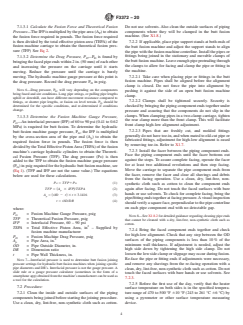
P 5 TFP1P (1)
G D
synthetic cloth such as cotton to clean the component ends
TFP 5 A 3 IFP ⁄TEPA (2) again after facing. Do not touch the faced surfaces with bare
~ !
p
hands or use solvents. To check for complete facing, bring the
A 5 OD 2 t 3 t 33.1416 (3)
~ !
p
pipe/fittingendstogetheratfacingpressure.Avisualinspection
t 5 OD⁄DR (4)
shouldverifyasquareface,perpendiculartothepipecenterline
on each pipe component end with no detectable gap.
where:
P = Fusion Machine Gauge Pressure, psig
G
NOTE8—SeeX1.8.2fordetailedguidanceregardingcleaningpipeends
TFP = Theoretical Fusion Pressure, psig
that cannot be cleaned with a dry, lint-free, non-synthetic cloth such as
IFP = Interfacial Pressure, 60 – 90 psi
cotton.
TEPA = Total Effective Piston Area, in – Supplied by
7.2.4 Bring the faced component ends together and check
fusion machine manufacturer
for high-low alignment. Check that any step between the OD
P = Fusion Machine Drag Pressure, psig
D
surfaces of the piping components is less than 10 % of the
A = Pipe Area, in.
p
minimum wall thickness. If adjustment is needed, adjust the
OD = Pipe Outside Diameter, in.
high side down by tightening the high side clamp. Do not
DR = Dimension ratio
loosenthelowsideclamporslippagemayoccurduringfusion.
t = Pipe Wall Thickness, in.
Re-face the pipe or fitting ends if adjustments were necessary,
NOTE 7—Interfacial pressure is used to determine butt fusion joining
and remove any shavings from the re-facing operation with a
pressure settings for hydraulic butt fusion machines when joining specific
pipe diameters and DR’s. Interfacial pressure is not the gauge pressure.A
clean, dry, lint-free, non-synthetic cloth such as cotton. Do not
slide rule or a gauge pressure calculator (sometimes in the form of a
touch the faced surfaces with bare hands or use solvents. See
smartphoneapp)obtainedfromthemachine’smanufacturercanbeusedas
7.2.3.
a tool for the calculation.
7.2.5 Before the first use of the day, verify that the heater
7.2 Procedure:
surface temperature on both sides is in the specified tempera-
7.2.1 Clean the inside and outside surfaces of the piping ture range of 470 to 500 °F 610 °F (243 to 261 °C 66 °C) by
components being joined before starting the joining procedure.
using a pyrometer or other surface temperature measuring
Use a clean, dry, lint-free, non-synthetic cloth such as cotton. device.
F3372 − 20
7.2.5.1 When measuring heating tool surface temperature, 7.2.6.1 It is normal for PA12 melt to have small bubbles.
also record the heating tool thermometer temperature, and Unacceptablemeltappearanceisanycombinationofaconcave
before each fusion, verify that the heating tool thermometer surface, unmelted areas, or melted material sticking to heating
reading is the same as the temperature record during the tool surfaces. Low strength joints result from unacceptable
heating tool surface temperature verification.
melt appearance. If unacceptable melt appearance is observed,
7.2.5.2 Re-verify heating tool surface temperature periodi- discontinuethejoiningprocedure,allowthecomponentendsto
cally throughout the day. All pyrometers and surface tempera-
cool completely and restart from 7.2.1.
ture measurement devices are sensitive to usage techniques.
7.2.6.2 The maximum time allowed for opening the
Carefully follow the manufacturer’s instructions for best re-
machine, removing the heater and bringing the pipe ends
sults.
togetherisshowninTable3.Fortubingsizesthataregenerally
7.2.5.3 Clean the contact surfaces of the heating tool with a
butt fused with mechanical fusion machines (not hydraulically
clean, dry, lint-free, non-synthetic cloth such as cotton. Do not 1 1
controlled)(CTS ⁄2toIPS1 ⁄2),themaximumopen/closetime
touch the faced surfaces with bare hands or use solvents. Place
is 4 s. The quicker this can be done, the better. Do not slam the
the heating tool in the butt fusion machine between the piping
pipeendstogether. SeeSection8 for guidanceonbuttfusionin
component ends and bring the pipe or fitting ends into full
cold temperatures below 40 °F (4 °C).
contactwiththeheatingtoolatfusionpressurebrieflytoensure
7.2.6.3 Assuming the equipment set-up, temperatures, and
full contact between piping component ends and the heating
procedures are followed to this point, the correct fusion
tool and then reduce the pressure to drag pressure but without
pressure creates a single bead, usually with small bubbles or
breaking contact between the piping component ends and the
roughness evident on the surface. Do not use excessive or
heating tool.
insufficient force (more than or less than the fusion interfacial
7.2.5.4 Once the indication of melt is observed around the
pressure range). If the components are brought together with
circumference of the pipe, begin the heat soak by reducing the
excessiveforce,moltenmaterialmaybepushedoutofthejoint
pressure to maintain contact, without force, while a bead of
and cold material brought into contact forming a “cold” joint.
molten PA12 develops between the heater and the pipe or
If too little force is used, voids and weak bonded areas can
fitting ends
...