

ASTM D3380-22
(Test Method)Standard Test Method for Relative Permittivity (Dielectric Constant) and Dissipation Factor of Polymer-Based Microwave Circuit Substrates
General Information
- Abstract
SIGNIFICANCE AND USE
5.1 Permittivity and dissipation factor are fundamental design parameters for design of microwave circuitry. Permittivity plays a principal role in determining the wavelength and the impedance of transmission lines. Dissipation factor (along with copper losses) influence attenuation and power losses.
5.2 This test method is suitable for polymeric materials having permittivity in the order of two to eleven. Such materials are popular in applications of stripline and microstrip configurations used in the 1 GHz to 18 GHz range.
5.3 This test method is suitable for design, development, acceptance specifications, and manufacturing quality control.
Note 2: See Appendix X1 for additional information regarding significance of this test method and the application of the results.
SCOPE
1.1 This test method permits the rapid measurement of apparent relative permittivity and loss tangent (dissipation factor) of metal-clad polymer-based circuit substrates in the X-band (8 GHz to 12.4 GHz).
1.2 This test method is suitable for testing PTFE (polytetrafluorethylene) impregnated glass cloth or random-oriented fiber mats, glass fiber-reinforced polystyrene, polyphenyleneoxide, irradiated polyethylene, and similar materials having a nominal specimen thickness of 1/16 in. (1.6 mm). The materials listed in the preceding sentence have been used in commercial applications at nominal frequency of 9.6 GHz.
Note 1: See Appendix X1 for additional information about range of permittivity, thickness other than 1/16 in. (1.6 mm), and tests at frequencies other than 9.6 GHz.
1.3 The values stated in inch-pound units are to be regarded as standard. The values given in parentheses are mathematical conversions to SI units that are provided for information only and are not considered standard.
1.4 This standard does not purport to address all of the safety concerns, if any, associated with its use. It is the responsibility of the user of this standard to establish appropriate safety, health, and environmental practices and determine the applicability of regulatory limitations prior to use.
1.5 This international standard was developed in accordance with internationally recognized principles on standardization established in the Decision on Principles for the Development of International Standards, Guides and Recommendations issued by the World Trade Organization Technical Barriers to Trade (TBT) Committee.
- Status
- Published
- Publication Date
- 14-Mar-2022
- Technical Committee
- D09 - Electrical and Electronic Insulating Materials
- Drafting Committee
- D09.12 - Electrical Tests
Buy Documents
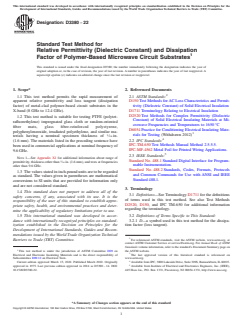
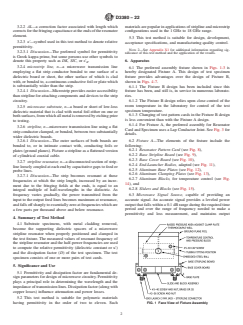
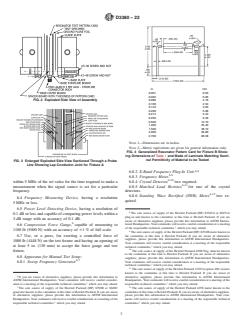
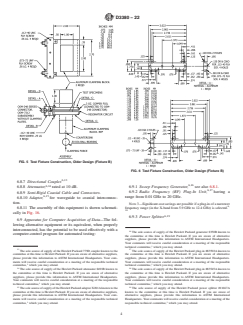
ASTM D3380-22 - Standard Test Method for Relative Permittivity (Dielectric Constant) and Dissipation Factor of Polymer-Based Microwave Circuit Substrates
REDLINE ASTM D3380-22 - Standard Test Method for Relative Permittivity (Dielectric Constant) and Dissipation Factor of Polymer-Based Microwave Circuit Substrates
Overview
ASTM D3380-22: Standard Test Method for Relative Permittivity (Dielectric Constant) and Dissipation Factor of Polymer-Based Microwave Circuit Substrates provides a key methodology for rapidly measuring the dielectric properties of polymer-based circuit substrates, specifically in the X-band frequency range of 8 GHz to 12.4 GHz. Developed by ASTM International, this standard is vital for evaluating the performance of microwave substrates used in advanced electronic applications, such as stripline and microstrip circuitry. Measuring both relative permittivity (dielectric constant) and dissipation factor (loss tangent) enables engineers and manufacturers to assess the essential electrical characteristics that influence circuit design, signal integrity, attenuation, and power loss in high-frequency circuits.
Key Topics
- Dielectric Characterization: The method focuses on determining the apparent relative permittivity and dissipation factor-two fundamental material parameters-under controlled laboratory conditions.
- Specimen Requirements: Suitable for materials like PTFE-impregnated glass cloth, glass fiber-reinforced polystyrene, polyphenylene oxide, and irradiated polyethylene. Typical specimen thickness is 1/16 inch (1.6 mm).
- Frequency Range: Primarily used in the X-band (8 GHz to 12.4 GHz), with specimen materials often characterized at a nominal frequency of 9.6 GHz.
- Test Setup: Utilizes metal-clad polymer substrates with the cladding removed and employs a microwave stripline resonator for measurement.
- Practical Testing: The test supports both manual and automated measurement setups, allowing flexibility for laboratory capabilities.
- Accuracy Factors: Includes control and documentation of temperature conditions, as permittivity (especially for materials like PTFE) can change near transition regions.
- Specimen Preparation: Details on etching, storage, and handling to ensure consistent, repeatable measurements.
Applications
ASTM D3380-22 is widely adopted across industries that design, manufacture, or specify microwave circuit boards and RF electronic components. Key applications include:
- Microwave Circuit Design: Ensures accurate impedance matching and prediction of signal propagation by characterizing polymer substrate dielectric properties.
- Quality Control: Used for acceptance specification and routine quality checks of polymer-based laminates.
- Research and Development: Supports materials engineers and scientists in the evaluation of new polymer-based substrate materials for improved high-frequency performance.
- Manufacturing: Enables manufacturers to verify the dielectric constant and loss tangent of raw materials used in high-frequency and high-speed PCB production.
- Telecommunications and Aerospace: Essential for optimizing circuit integrity in radar, satellite, and wireless communication systems where X-band performance is critical.
Related Standards
To ensure comprehensive dielectric testing and compatibility within the industry, the following ASTM, IPC, and IEEE standards are frequently referenced alongside ASTM D3380:
- ASTM D150: Test Methods for AC Loss Characteristics and Permittivity (Dielectric Constant) of Solid Electrical Insulation
- ASTM D2520: Test Methods for Complex Permittivity of Solid Electrical Insulating Materials at Microwave Frequencies
- IPC-TM-650: Test Methods Manual, Method 2.5.5.5 for electrical testing of printed wiring board materials
- IPC-MF-4562: Specification for metal foil for printed wiring applications
- IEEE 488.1 & 488.2: Standards for digital interface and protocols for instrumentation, supporting automated measurement setups
By following the guidelines of ASTM D3380-22, engineers and technologists ensure robust, reproducible dielectric measurements, enhancing the design and reliability of next-generation microwave electronics. This standard is a cornerstone document for anyone working with polymer-based substrates in the rapidly evolving field of high-frequency circuit technology.
Relations
- Effective Date
- 01-Mar-2024
- Effective Date
- 01-Nov-2015
- Effective Date
- 01-Nov-2014
- Effective Date
- 01-May-2014
- Effective Date
- 01-Nov-2013
- Effective Date
- 01-Aug-2011
- Effective Date
- 01-May-2008
- Effective Date
- 01-Mar-2004
- Effective Date
- 10-Mar-2002
- Effective Date
- 10-May-2001
- Effective Date
- 10-May-2001
- Effective Date
- 10-Oct-1999
- Effective Date
- 10-Feb-1998
- Refers
ASTM D6054-97 - Standard Practice for Conditioning Electrical Insulating Materials for Testing - Effective Date
- 10-Feb-1997
Buy Documents
ASTM D3380-22 - Standard Test Method for Relative Permittivity (Dielectric Constant) and Dissipation Factor of Polymer-Based Microwave Circuit Substrates
REDLINE ASTM D3380-22 - Standard Test Method for Relative Permittivity (Dielectric Constant) and Dissipation Factor of Polymer-Based Microwave Circuit Substrates
Frequently Asked Questions
ASTM D3380-22 is a standard published by ASTM International. Its full title is "Standard Test Method for Relative Permittivity (Dielectric Constant) and Dissipation Factor of Polymer-Based Microwave Circuit Substrates". This standard covers: SIGNIFICANCE AND USE 5.1 Permittivity and dissipation factor are fundamental design parameters for design of microwave circuitry. Permittivity plays a principal role in determining the wavelength and the impedance of transmission lines. Dissipation factor (along with copper losses) influence attenuation and power losses. 5.2 This test method is suitable for polymeric materials having permittivity in the order of two to eleven. Such materials are popular in applications of stripline and microstrip configurations used in the 1 GHz to 18 GHz range. 5.3 This test method is suitable for design, development, acceptance specifications, and manufacturing quality control. Note 2: See Appendix X1 for additional information regarding significance of this test method and the application of the results. SCOPE 1.1 This test method permits the rapid measurement of apparent relative permittivity and loss tangent (dissipation factor) of metal-clad polymer-based circuit substrates in the X-band (8 GHz to 12.4 GHz). 1.2 This test method is suitable for testing PTFE (polytetrafluorethylene) impregnated glass cloth or random-oriented fiber mats, glass fiber-reinforced polystyrene, polyphenyleneoxide, irradiated polyethylene, and similar materials having a nominal specimen thickness of 1/16 in. (1.6 mm). The materials listed in the preceding sentence have been used in commercial applications at nominal frequency of 9.6 GHz. Note 1: See Appendix X1 for additional information about range of permittivity, thickness other than 1/16 in. (1.6 mm), and tests at frequencies other than 9.6 GHz. 1.3 The values stated in inch-pound units are to be regarded as standard. The values given in parentheses are mathematical conversions to SI units that are provided for information only and are not considered standard. 1.4 This standard does not purport to address all of the safety concerns, if any, associated with its use. It is the responsibility of the user of this standard to establish appropriate safety, health, and environmental practices and determine the applicability of regulatory limitations prior to use. 1.5 This international standard was developed in accordance with internationally recognized principles on standardization established in the Decision on Principles for the Development of International Standards, Guides and Recommendations issued by the World Trade Organization Technical Barriers to Trade (TBT) Committee.
SIGNIFICANCE AND USE 5.1 Permittivity and dissipation factor are fundamental design parameters for design of microwave circuitry. Permittivity plays a principal role in determining the wavelength and the impedance of transmission lines. Dissipation factor (along with copper losses) influence attenuation and power losses. 5.2 This test method is suitable for polymeric materials having permittivity in the order of two to eleven. Such materials are popular in applications of stripline and microstrip configurations used in the 1 GHz to 18 GHz range. 5.3 This test method is suitable for design, development, acceptance specifications, and manufacturing quality control. Note 2: See Appendix X1 for additional information regarding significance of this test method and the application of the results. SCOPE 1.1 This test method permits the rapid measurement of apparent relative permittivity and loss tangent (dissipation factor) of metal-clad polymer-based circuit substrates in the X-band (8 GHz to 12.4 GHz). 1.2 This test method is suitable for testing PTFE (polytetrafluorethylene) impregnated glass cloth or random-oriented fiber mats, glass fiber-reinforced polystyrene, polyphenyleneoxide, irradiated polyethylene, and similar materials having a nominal specimen thickness of 1/16 in. (1.6 mm). The materials listed in the preceding sentence have been used in commercial applications at nominal frequency of 9.6 GHz. Note 1: See Appendix X1 for additional information about range of permittivity, thickness other than 1/16 in. (1.6 mm), and tests at frequencies other than 9.6 GHz. 1.3 The values stated in inch-pound units are to be regarded as standard. The values given in parentheses are mathematical conversions to SI units that are provided for information only and are not considered standard. 1.4 This standard does not purport to address all of the safety concerns, if any, associated with its use. It is the responsibility of the user of this standard to establish appropriate safety, health, and environmental practices and determine the applicability of regulatory limitations prior to use. 1.5 This international standard was developed in accordance with internationally recognized principles on standardization established in the Decision on Principles for the Development of International Standards, Guides and Recommendations issued by the World Trade Organization Technical Barriers to Trade (TBT) Committee.
ASTM D3380-22 is classified under the following ICS (International Classification for Standards) categories: 31.180 - Printed circuits and boards. The ICS classification helps identify the subject area and facilitates finding related standards.
ASTM D3380-22 has the following relationships with other standards: It is inter standard links to ASTM D1711-24, ASTM D1711-15, ASTM D1711-14a, ASTM D1711-14, ASTM D1711-13, ASTM D1711-11a, ASTM D1711-08, ASTM D150-98(2004), ASTM D1711-02, ASTM D2520-01, ASTM D2520-95, ASTM D1711-99, ASTM D150-98, ASTM D6054-97. Understanding these relationships helps ensure you are using the most current and applicable version of the standard.
ASTM D3380-22 is available in PDF format for immediate download after purchase. The document can be added to your cart and obtained through the secure checkout process. Digital delivery ensures instant access to the complete standard document.
Standards Content (Sample)
This international standard was developed in accordance with internationally recognized principles on standardization established in the Decision on Principles for the
Development of International Standards, Guides and Recommendations issued by the World Trade Organization Technical Barriers to Trade (TBT) Committee.
Designation: D3380 − 22
Standard Test Method for
Relative Permittivity (Dielectric Constant) and Dissipation
Factor of Polymer-Based Microwave Circuit Substrates
This standard is issued under the fixed designation D3380; the number immediately following the designation indicates the year of
original adoption or, in the case of revision, the year of last revision.Anumber in parentheses indicates the year of last reapproval.A
superscript epsilon (´) indicates an editorial change since the last revision or reapproval.
1. Scope* 2. Referenced Documents
1.1 This test method permits the rapid measurement of 2.1 ASTM Standards:
apparent relative permittivity and loss tangent (dissipation D150Test Methods forAC Loss Characteristics and Permit-
factor) of metal-clad polymer-based circuit substrates in the tivity (Dielectric Constant) of Solid Electrical Insulation
X-band (8GHz to 12.4 GHz). D1711Terminology Relating to Electrical Insulation
D2520Test Methods for Complex Permittivity (Dielectric
1.2 This test method is suitable for testing PTFE (polytet-
Constant) of Solid Electrical Insulating Materials at Mi-
rafluorethylene) impregnated glass cloth or random-oriented
crowave Frequencies and Temperatures to 1650°C
fiber mats, glass fiber-reinforced polystyrene,
D6054Practice for Conditioning Electrical Insulating Mate-
polyphenyleneoxide, irradiated polyethylene, and similar ma-
rials for Testing (Withdrawn 2012)
terials having a nominal specimen thickness of ⁄16 in.
2.2 IPC Standards:
(1.6mm). The materials listed in the preceding sentence have
IPC-TM-650Test Methods Manual Method 2.5.5.5.
been used in commercial applications at nominal frequency of
IPC-MF-4562Metal Foil for Printed Wiring Applications.
9.6GHz.
2.3 IEEE Standards:
NOTE 1—See Appendix X1 for additional information about range of
1 Standard No.488.1Standard Digital Interface for Program-
permittivity,thicknessotherthan ⁄16in.(1.6mm),andtestsatfrequencies
other than 9.6GHz. mable Instrumentation.
Standard No.488.2Standards, Codes, Formats, Protocols
1.3 The values stated in inch-pound units are to be regarded
and Common Commands for Use with ANSI and IEEE
as standard. The values given in parentheses are mathematical
Standard488.1.
conversions to SI units that are provided for information only
and are not considered standard.
3. Terminology
1.4 This standard does not purport to address all of the
3.1 Definitions—SeeTerminology D1711 for the definitions
safety concerns, if any, associated with its use. It is the
of terms used in this test method. See also Test Methods
responsibility of the user of this standard to establish appro-
D2520, D150, and IPC TM-650 for additional information
priate safety, health, and environmental practices and deter-
regarding the terminology.
mine the applicability of regulatory limitations prior to use.
1.5 This international standard was developed in accor- 3.2 Definitions of Terms Specific to This Standard:
dance with internationally recognized principles on standard-
3.2.1 D—a symbol used in this test method for the dissipa-
ization established in the Decision on Principles for the tion factor (loss tangent).
Development of International Standards, Guides and Recom-
mendations issued by the World Trade Organization Technical
Barriers to Trade (TBT) Committee. For referenced ASTM standards, visit the ASTM website, www.astm.org, or
contact ASTM Customer Service at service@astm.org. For Annual Book of ASTM
Standards volume information, refer to the standard’s Document Summary page on
This test method is under the jurisdiction of ASTM Committee D09 on the ASTM website.
Electrical and Electronic Insulating Materials and is the direct responsibility of The last approved version of this historical standard is referenced on
Subcommittee D09.12 on Electrical Tests. www.astm.org.
Current edition approved March 15, 2022. Published March 2022. Originally AvailablefromIPC,3000LakesideDrive,Suite309S,Bannockburn,IL60015.
approved in 1975. Last previous edition approved in 2014 as D3380–14. DOI: Available from Institute of Electrical and Electronics Engineers, Inc. (IEEE),
10.1520/D3380-22. 445 Hoes Ln., P.O. Box 1331, Piscataway, NJ 08854-1331, http://www.ieee.org.
*A Summary of Changes section appears at the end of this standard
Copyright © ASTM International, 100 Barr Harbor Drive, PO Box C700, West Conshohocken, PA 19428-2959. United States
D3380 − 22
3.2.2 ∆L—a correction factor associated with length which materialsarepopularinapplicationsofstriplineandmicrostrip
correctsforthefringingcapacitanceattheendsoftheresonator configurations used in the 1GHz to 18 GHz range.
element.
5.3 This test method is suitable for design, development,
3.2.3 κ'—symbol used in this test method to denote relative
acceptance specifications, and manufacturing quality control.
permittivity.
NOTE 2—See Appendix X1 for additional information regarding sig-
3.2.3.1 Discussion—The preferred symbol for permittivity
nificance of this test method and the application of the results.
is Greek kappa prime, but some persons use other symbols to
6. Apparatus
denote this property such as DK, SIC,or ε' .
R
3.2.4 microstrip line, n—a microwave transmission line
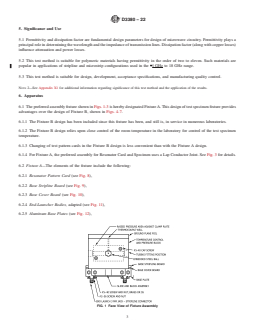
6.1 The preferred assembly fixture shown in Figs. 1-3 is
employing a flat strip conductor bonded to one surface of a hereby designated Fixture A. This design of test specimen
dielectric board or sheet, the other surface of which is clad
fixture provides advantages over the design of Fixture B,
with,orbondedto,acontinuousconductivefoilorplatewhich shown in Figs. 4-7.
is substantially wider than the strip.
6.1.1 The Fixture B design has been included since this
3.2.4.1 Discussion—Microstrip provides easier accessibility
fixture has been, and still is, in service in numerous laborato-
thanstriplineforattachingcomponentsanddevicestothestrip
ries.
circuitry.
6.1.2 The Fixture B design relies upon close control of the
room temperature in the laboratory for control of the test
3.2.5 microwave substrate, n—a board or sheet of low-loss
specimen temperature.
dielectric material that is clad with metal foil either on one or
6.1.3 Changing of test pattern cards in the Fixture B design
bothsurfaces,fromwhichallmetalisremovedbyetchingprior
is less convenient than with the Fixture A design.
to testing.
6.1.4 For Fixture A, the preferred assembly for Resonator
3.2.6 stripline, n—microwave transmission line using a flat
Card and Specimen uses a Lap Conductor Joint. See Fig. 3 for
strip conductor clamped, or bonded, between two substantially
details.
wider dielectric boards.
6.2 Fixture A—The elements of the fixture include the
3.2.6.1 Discussion—The outer surfaces of both boards are
following:
bonded to, or in intimate contact with, conducting foils or
6.2.1 Resonator Pattern Card (see Fig. 8),
plates (ground planes). Picture a stripline as a flattened version
6.2.2 Base Stripline Board (see Fig. 9),
of cylindrical coaxial cable.
6.2.3 Base Cover Board (see Fig. 10),
3.2.7 stripline resonator, n—a disconnected section of strip-
6.2.4 End-Launcher Bodies, adapted (see Fig. 11),
linelooselycoupledateachendbycapacitativegapstofeedor
6.2.5 Aluminum Base Plates (see Fig. 12),
probe lines.
6.2.6 Aluminum Clamping Plates (see Fig. 13),
3.2.7.1 Discussion—The strip becomes resonant at those
6.2.7 Aluminum Blocks, for temperature control (see Fig.
frequencies at which the strip length, increased by an incre-
14), and
ment due to the fringing fields at the ends, is equal to an
6.2.8 Sliders and Blocks (see Fig. 15).
integral multiple of half-wavelengths in the dielectric. As
frequency varies gradually, the power transmitted from the 6.3 Microwave Signal Source, capable of providing an
input to the output feed lines becomes maximum at resonance, accurate signal. An accurate signal provides a leveled power
andfallsoffsharplytoessentiallyzeroatfrequencieswhichare outputthatfallswithina0.1dBrangeduringtherequiredtime
period and over the range of frequency needed to make a
a few parts per thousand above and below resonance.
permittivity and loss measurement, and maintains output
4. Summary of Test Method
4.1 Substrate specimens, with metal cladding removed,
become the supporting dielectric spacers of a microwave
stripline resonator when properly positioned and clamped in
the test fixture. The measured values of resonant frequency of
the stripline resonator and the half-power frequencies are used
to compute the relative permittivity (dielectric constant or κ')
and the dissipation factor (D) of the test specimen. The test
specimen consists of one or more pairs of test cards.
5. Significance and Use
5.1 Permittivity and dissipation factor are fundamental de-
signparametersfordesignofmicrowavecircuitry.Permittivity
plays a principal role in determining the wavelength and the
impedanceoftransmissionlines.Dissipationfactor(alongwith
copper losses) influence attenuation and power losses.
5.2 This test method is suitable for polymeric materials
having permittivity in the order of two to eleven. Such FIG. 1 Face View of Fixture Assembly
D3380 − 22
in. mm
0.001 0.03
0.002 0.05
FIG. 2 Exploded Side View of Assembly 0.086 2.18
0.100 2.54
0.143 3.63
0.200 5.08
0.214 5.44
0.250 6.35
0.500 12.70
1.000 25.40
1.500 38.10
2.000 50.80
2.700 68.58
NOTE 1—Dimensions are in inches.
NOTE 2—Metric equivalents are given for general information only.
FIG. 4 Generalized Resonator Pattern Card for Fixture B Show-
ing Dimensions of Table 1 and Made of Laminate Matching Nomi-
nal Permittivity of Material to be Tested
FIG. 3 Enlarged Exploded Side View Sectioned Through a Probe
Line Showing Lap Conductor Joint for Fixture A
6,8
6.8.2 X-Band Frequency Plug-In Unit.
6,9
6.8.3 Frequency Meter.
6,10
6.8.4 Crystal Detector, two required.
within 5 MHz of the set value for the time required to make a
6,11
measurement when the signal source is set for a particular 6.8.5 Matched Load Resistor, for one of the crystal
frequency. detectors.
6,12
6.8.6 Standing Wave Rectified (SWR) Meter, two re-
6.4 Frequency Measuring Device, having a resolution
quired.
5MHz or less.
6.5 Power Level Detecting Device, having a resolution of
The sole source of supply of the Hewlett Packard (HP) 83545A or 86251A
0.1 dB or less and capable of comparing power levels within a
plug-in unit known to the committee at this time is Hewlett Packard. If you are
3-dB range with an accuracy of 0.1 dB.
aware of alternative suppliers, please provide this information to ASTM Interna-
tional Headquarters.Your comments will receive careful consideration at a meeting
6.6 Compression Force Gauge, capable of measuring to
of the responsible technical committee, which you may attend.
1100 lb (5000 N) with an accuracy of 61% of full scale.
The sole source of supply of the Hewlett Packard (HP) X532B meter known to
the committee at this time is Hewlett Packard. If you are aware of alternative
6.7 Vise, or a press, for exerting a controlled force of
suppliers, please provide this information to ASTM International Headquarters.
1000lb (4448N) on the test fixture and having an opening of
Your comments will receive careful consideration at a meeting of the responsible
at least 5 in. (130 mm) to accept the force gauge and test
technical committee, which you may attend.
The sole source of supply of the Hewlett Packard 423B Neg. detector known
fixture.
to the committee at this time is Hewlett Packard. If you are aware of alternative
6.8 Apparatus for Manual Test Setup:
suppliers, please provide this information to ASTM International Headquarters.
6,7
Your comments will receive careful consideration at a meeting of the responsible
6.8.1 Sweep Frequency Generator.
technical committee, which you may attend.
The sole source of supply of the Hewlett Packard 11523Aoption .001 resistor
known to the committee at this time is Hewlett Packard. If you are aware of
If you are aware of alternative suppliers, please provide this information to alternative suppliers, please provide this information to ASTM International
ASTM International Headquarters. Your comments will receive careful consider- Headquarters.Your comments will receive careful consideration at a meeting of the
1 1
ation at a meeting of the responsible technical committee, which you may attend. responsible technical committee, which you may attend.
7 12
The sole source of supply of the Hewlett Packard (HP) 8350B or 8620C The sole source of supply of the Hewlett Packard 415E meter known to the
generator known to the committee at this time is Hewlett Packard. If you are aware committee at this time is Hewlett Packard. If you are aware of alternative suppliers,
of alternative suppliers, please provide this information to ASTM International please provide this information to ASTM International Headquarters. Your com-
Headquarters.Your comments will receive careful consideration at a meeting of the ments will receive careful consideration at a meeting of the responsible technical
1 1
responsible technical committee, which you may attend. committee, which you may attend.
D3380 − 22
FIG. 5 Test Fixture Construction, Older Design (Fixture B)
FIG. 6 Test Fixture Construction, Older Design (Fixture B)
6,13
6.8.7 Directional Coupler.
6,14 6,16
6.9.1 Sweep Frequency Generator, see also 6.8.1.
6.8.8 Attenuator, rated at 10 dB.
6,17
6.9.2 Radio Frequency (RF) Plug-In Unit, having a
6.8.9 Semi-Rigid Coaxial Cable and Connectors.
6,15
range from 0.01GHz to 20 GHz.
6.8.10 Adapter, for waveguide to coaxial interconnec-
tion.
NOTE3—Significantcostsavingsarepossibleifaplug-inofanarrower
6,
frequency range (in the X-band from 5.9GHz to 12.4 GHz) is selected.
6.8.11 The assembly of this equipment is shown schemati-
cally in Fig. 16.
6,19
6.9.3 Power Splitter.
6.9 Apparatus for Computer Acquisition of Data—The fol-
lowing alternative equipment or its equivalent, when properly
interconnected, has the potential to be used effectively with a
The sole source of supply of the Hewlett Packard generator 8350B known to
computer-control program for automated testing:
the committee at this time is Hewlett Packard. If you are aware of alternative
suppliers, please provide this information to ASTM International Headquarters.
Your comments will receive careful consideration at a meeting of the responsible
technical committee, which you may attend.
13 17
The sole source of supply of the Hewlett Packard 779D coupler known to the The sole source of supply of the Hewlett Packard plug-in #83592Aknown to
committee at this time is Hewlett Packard. If you are aware of alternative suppliers, the committee at this time is Hewlett Packard. If you are aware of alternative
please provide this information to ASTM International Headquarters. Your com- suppliers, please provide this information to ASTM International Headquarters.
ments will receive careful consideration at a meeting of the responsible technical Your comments will receive careful consideration at a meeting of the responsible
1 1
committee, which you may attend. technical committee, which you may attend.
14 18
The sole source of supply of the Hewlett Packard attenuator 8491B known to The sole source of supply of the Hewlett Packard plug-in #83545Aknown to
the committee at this time is Hewlett Packard. If you are aware of alternative the committee at this time is Hewlett Packard. If you are aware of alternative
suppliers, please provide this information to ASTM International Headquarters. suppliers, please provide this information to ASTM International Headquarters.
Your comments will receive careful consideration at a meeting of the responsible Your comments will receive careful consideration at a meeting of the responsible
1 1
technical committee, which you may attend. technical committee, which you may attend.
15 19
ThesolesourceofsupplyoftheHewlettPackardadapterX281Aknowntothe The sole source of supply of the Hewlett Packard power splitter #11667A
committee at this time is Hewlett Packard. If you are aware of alternative suppliers, known to the committee at this time is Hewlett Packard. If you are aware of
please provide this information to ASTM International Headquarters. Your com- alternative suppliers, please provide this information to ASTM International
ments will receive careful consideration at a meeting of the responsible technical Headquarters.Your comments will receive careful consideration at a meeting of the
1 1
committee, which you may attend. responsible technical committee, which you may attend.
D3380 − 22
FIG. 9 Base Stripline Board with Copper Foil and Dielectric
Matching Nominal Permittivity of Material to be Tested
FIG. 7 Test Fixture Construction, Older Design (Fixture B)
FIG. 10 Base Cover Board with Copper Foil Ground Plane
FIG. 11 Detail of Supplied End Launcher Body Adapted by Bor-
ing Out Tapped Holes
FIG. 8 Generalized Resonator Pattern Card for Fixture A Show-
ing Dimensions of and Made of Laminate Matching Nominal Per-
mittivity of Materials to be Tested
6,22
6.9.6 Attenuator, 10 dB, see also 6.8.8.
6,20
6,23
6.9.4 Automatic Frequency Counter.
6.9.7 Programmable Power Meter.
6,21
6.9.5 Source Synchronizer.
20 22
The sole source of supply of the Hewlett Packard frequency counter #5343A ThesolesourceofsupplyoftheHewlettPackardattenuator#8491Bknownto
known to the committee at this time is Hewlett Packard. If you are aware of the committee at this time is Hewlett Packard. If you are aware of alternative
alternative suppliers, please provide this information to ASTM International suppliers, please provide this information to ASTM International Headquarters.
Headquarters.Your comments will receive careful consideration at a meeting of the Your comments will receive careful consideration at a meeting of the responsible
1 1
responsible technical committee, which you may attend. technical committee, which you may attend.
21 23
ThesolesourceofsupplyoftheHewlettPackardsynchronizer#5344Aknown The sole source of supply of the Hewlett Packard power meter #436Aknown
to the committee at this time is Hewlett Packard. If you are aware of alternative to the committee at this time is Hewlett Packard. If you are aware of alternative
suppliers, please provide this information to ASTM International Headquarters. suppliers, please provide this information to ASTM International Headquarters.
Your comments will receive careful consideration at a meeting of the responsible Your comments will receive careful consideration at a meeting of the responsible
1 1
technical committee, which you may attend. technical committee, which you may attend.
D3380 − 22
FIG. 12 Aluminum Base Plate for Clamping Base Cards and Con-
necting Launcher Bodies to Base Card
FIG. 14 Aluminum Block for Temperature Control and Transfer of
Pressure to Clamp Plates, Fitted with Tapped Holes for Slide,
Embedded Steel Ball, and Tapped for Tubing Fittings for Circulat-
ing Fluid
FIG. 13 Aluminum Clamping Plate Provided with Tapped Holes
for Pressure Block and Thermocouple Well
6,24
6.9.8 Power Sensor, having a range from −70
to+10dBm.
6.9.9 Controlling Computer, with a General Purpose Inter-
face Bus (GPIB) interface.
6.9.10 IEEE 488 (GPIB) Cables, Adapters, and Coaxial
Cables, suitable for proper interconnecting of all of the
components, as illustrated in Fig. 17 and described in 6.9.11.
6.9.11 Interconnecting Instructions (applicable to 6.9 only):
6.9.11.1 Connect the power splitter directly to the RF
plug-inoutput.Connectoneoutputofthesplittertothecounter
input using an RF cable. With another RF cable, connect the
other output to the attenuator. Connect the attenuator to one of
the test fixture probe lines.
FIG. 15 Slider and Block for Connecting Pressure Block and
6.9.11.2 Connect the counter and the synchronizer as speci-
Base Plate with Allowance for Opening Fixture
fied by the manufacturer of this equipment. Connect the FM
ThesolesourceofsupplyoftheHewlettPackardpowersensor#8484Aknown
output from the synchronizer to the FM input on the sweep
to the committee at this time is Hewlett Packard. If you are aware of alternative
frequency generator using a BNC connector.
suppliers, please provide this information to ASTM International Headquarters.
6.9.11.3 Use GPIB cables to parallel connect sweeper,
Your comments will receive careful consideration at a meeting of the responsible
technical committee, which you may attend. synchronizer, power meter, and computer interface.
D3380 − 22
FIG. 18 Simplified Automated Permittivity Test Setup
klystron (at a significantly lower cost) and manually adjusting
the power input to the test fixture to a prescribed level using a
variable attenuator.
6.11 Alternative Equipment—Use alternative types or mod-
els of equipment if it can be demonstrated that equivalent
resultsareobtained.Forexample,ifapowerlevelingsystemis
notused,andthepoweroutputofthesourcevarieswidelywith
NOTE 1—All coaxial cable connections.
NOTE 2—It is acceptable to substitute equivalent makes and models of frequency, substitute a ratiometer for the two SWR meters. If
equipment where it can be shown that equivalent results are obtained.
only a measurement of permittivity is desired, it has been
NOTE 3—It is acceptable to use alternate test setups provided that
reported that leveling the input is not necessary.
equivalent results are obtained.
6.11.1 Frequency Measurement Apparatus Alternatives:
FIG. 16 X-Band Permittivity Test Setup
6.11.1.1 Digital frequency meter with automatic phase-
locking (requires unmodulated signal).
6.11.1.2 Digital frequency meter, manually tuned hetero-
dyne type.
6.11.1.3 Manually tuned resonant wavemeter (less accurate
than digital types). Use of this requires a resonance indicator.
6.11.2 Resonance Indicator Alternatives:
6.11.2.1 Power meter with thermistor transducer.
6.11.2.2 SWRmeterwithcrystaltransducer(requiresmodu-
lated signal).
6.11.2.3 Dual-trace oscilloscope when a sweep generator is
used.
6.11.3 Power Measurement Alternatives:
6.11.3.1 Calibrated variable attenuator in conjunction with
one of the above resonance indicators (see 6.11.1).
6.11.3.2 Calibrated power meter with thermistor transducer.
6.11.3.3 Calibrated SWR meter with crystal transducer
FIG. 17 Automated Permittivity Test Setup
(requiresmodulatedsignal)andmustbeoperatedinthesquare
law range of the crystal).
6.11.3.4 Calibrated dual-trace oscilloscope when a sweep
oscillator is used.
6.9.11.4 Connect the power sensor to the other probe of the
6.11.4 Signal Generator Alternatives:
test fixture and connect its special cable to the power meter.
6.11.4.1 Variable-frequencysignalgeneratorwithavariable
6.9.11.5 Asynthesizedcontinuouswave(CW)generatorhas
attenuator and internal square-wave modulation (for operation
been used to replace the sweeper, plug-in, power splitter
either modulated or unmodulated). Square-wave modulation is
connector, and the source synchronizer to provide the simpli-
also obtainable from a PIN modulator between the signal
fied automated set-up shown in Fig. 18.
generator and the resonant cavity.
6.11.4.2 Klystron tube and mount with power supply and
6.10 Signal Source—The type of signal source used in a
the means for varying the frequency.
manual test setup will dictate the method by which the
6.11.4.3 Variable-frequency sweep oscillator with expanded
half-powerpointsaredetermined.Ifthepowerinputtothetest
sweep capability for bandwidths of 25 MHz or less.
fixture is maintained constant as the frequency is varied, then
it is permissible to use an SWR meter to determine the 6.12 Temperature Control Apparatus—Temperature control
half-power points at the output of the test fixture. This is apparatus for use with Fixture A design shall include the
accomplishedbyusingasweepgeneratororbyusingatunable following:
D3380 − 22
6.12.1 Alaboratory constant temperature bath with circula- 8.4 Use a photo resist and an etching process capable of
tor connected in series with the clamping blocks using 0.25 in. reproducing the circuit dimensions within 60.001 in. (25 µm)
(6 mm) inside diameter tubing and a return line to the bath. of the requirements of Table 1.
6.12.2 Two fine diameter thermocouple probes, with leads,
8.5 Remove all copper from the side of the pattern card that
and suitable instrumentation for readout or recording of tem-
does not contain the circuit.
perature.Adigitalthermometerisconvenientformonitoringof
8.6 Test pattern cards made using soft, compliant, PTFE-
the temperature.
ceramic substrate laminates have been reported to require
additional steps in the preparation of resonator test pattern
7. Test Specimens
cards.Theextrastepsinvolvetheembeddingoftheconductors
7.1 The test specimen shall consist of two sheets, or two
into the surface of the substrate so that any variable in the
packets of sheets if thin materials are to be tested. Each sheet
thickness of the card is minimized and the same in both the
shall be at least 2 by 2.7 in. (50 by 70 mm).
pattern and non-pattern areas. Embedding is accomplished as
follows:
7.2 Remove the metal cladding from the dielectric sheet
8.6.1 Clamp the pattern card between stainless steel or
using any standard etching process, including rinsing and
aluminum release foils.
drying.Incaseofrefereetests,thismetalremovalprocessshall
8.6.2 Clamp at 100 to 200 psi (0.7 to 1.4 MPa) between
be in accordance with I.P.C. TM-650, subsection 2.3.7.1.
accurately planar metal blocks while heating the blocks to a
7.3 The test fixture design provides spacing for total speci-
temperature above the polymer melt point. Hold at that
men thickness of 0.125 6 0.009 in. or 0.100 6 0.007 in. (3 or
temperature until permanent conformance is attained. Cool to
2.5 mm) from an even number of sheets or layers.
room temperature while under pressure, then release the
clamping force.
NOTE 4—The testing of specimens comprised of layers will introduce
some error due to air gaps between layers. The magnitude of such errors
8.7 The clamping force applicable to the pattern cards in
can be as much as 5% of the permittivity. Exact correlation factors and
Table 1 is 1000 lbf (4448 N).
techniques of measurement should be mutually agreed upon or other
8.7.1 Patterncardsizeis2.70in.wideby2.18in.long(68.6
methodsoftestused.Method2.5.5.3ofI.P.C.TM-650at1MHzhasbeen
by 55.4 mm), and is designed for the fixture hardware
used to generate a correlation factor by testing specimens of nominal
thickness shown in Table 1 of this test method, using both the techniques
apparatus described in 6.8.
of this ASTM test method and the IPC method.
8.8 The resonator le
...
This document is not an ASTM standard and is intended only to provide the user of an ASTM standard an indication of what changes have been made to the previous version. Because
it may not be technically possible to adequately depict all changes accurately, ASTM recommends that users consult prior editions as appropriate. In all cases only the current version
of the standard as published by ASTM is to be considered the official document.
Designation: D3380 − 14 D3380 − 22
Standard Test Method for
Relative Permittivity (Dielectric Constant) and Dissipation
Factor of Polymer-Based Microwave Circuit Substrates
This standard is issued under the fixed designation D3380; the number immediately following the designation indicates the year of
original adoption or, in the case of revision, the year of last revision. A number in parentheses indicates the year of last reapproval. A
superscript epsilon (´) indicates an editorial change since the last revision or reapproval.
1. Scope*
1.1 This test method permits the rapid measurement of apparent relative permittivity and loss tangent (dissipation factor) of
metal-clad polymer-based circuit substrates in the X-band (8(8 GHz to 12.4 GHz).
1.2 This test method is suitable for testing PTFE (polytetrafluorethylene) impregnated glass cloth or random-oriented fiber mats,
glass fiber-reinforced polystyrene, polyphenyleneoxide, irradiated polyethylene, and similar materials having a nominal specimen
thickness of ⁄16 in. (1.6 mm). The materials listed in the preceding sentence have been used in commercial applications at nominal
frequency of 9.6 GHz.
NOTE 1—See Appendix X1 for additional information about range of permittivity, thickness other than ⁄161.6 mm, in. (1.6 mm), and tests at frequencies
other than 9.6 GHz.
1.3 The values stated in inch-pound units are to be regarded as standard. The values given in parentheses are mathematical
conversions to SI units that are provided for information only and are not considered standard.
1.4 This standard does not purport to address all of the safety concerns, if any, associated with its use. It is the responsibility
of the user of this standard to establish appropriate safety safety, health, and healthenvironmental practices and determine the
applicability of regulatory limitations prior to use.
1.5 This international standard was developed in accordance with internationally recognized principles on standardization
established in the Decision on Principles for the Development of International Standards, Guides and Recommendations issued
by the World Trade Organization Technical Barriers to Trade (TBT) Committee.
2. Referenced Documents
2.1 ASTM Standards:
D150 Test Methods for AC Loss Characteristics and Permittivity (Dielectric Constant) of Solid Electrical Insulation
D1711 Terminology Relating to Electrical Insulation
D2520 Test Methods for Complex Permittivity (Dielectric Constant) of Solid Electrical Insulating Materials at Microwave
Frequencies and Temperatures to 1650 °C
D6054 Practice for Conditioning Electrical Insulating Materials for Testing (Withdrawn 2012)
This test method is under the jurisdiction of ASTM Committee D09 on Electrical and Electronic Insulating Materials and is the direct responsibility of Subcommittee
D09.12 on Electrical Tests.
Current edition approved Nov. 1, 2014March 15, 2022. Published November 2014March 2022. Originally approved in 1975. Last previous edition approved in 20102014
as D3380 – 10.D3380 – 14. DOI: 10.1520/D3380-14.10.1520/D3380-22.
For referenced ASTM standards, visit the ASTM website, www.astm.org, or contact ASTM Customer Service at service@astm.org. For Annual Book of ASTM Standards
volume information, refer to the standard’s Document Summary page on the ASTM website.
The last approved version of this historical standard is referenced on www.astm.org.
*A Summary of Changes section appears at the end of this standard
Copyright © ASTM International, 100 Barr Harbor Drive, PO Box C700, West Conshohocken, PA 19428-2959. United States
D3380 − 22
2.2 IPC Standards:
IPC-TM-650 Test Methods Manual Method 2.5.5.5.
IPC-MF-4562 Metal Foil for Printed Wiring Applications.
2.3 IEEE Standards:
Standard No. 488.1 Standard Digital Interface for Programmable Instrumentation.
Standard No. 488.2 Standards, Codes, Formats, Protocols and Common Commands for Use with ANSI and IEEE Stan-
dard 488.1.
3. Terminology
3.1 Definitions—See Terminology D1711 for the definitions of terms used in this test method. See also Test Methods D2520,
D150, and IPC TM-650 for additional information regarding the terminology.
3.2 Definitions of Terms Specific to This Standard:
3.2.1 D—a symbol used in this test method for the dissipation factor.factor (loss tangent).
3.2.2 ΔL—a correction factor associated with length which corrects for the fringing capacitance at the ends of the resonator
element.
3.2.3 κ'—symbol used in this test method to denote relative permittivity.
3.2.3.1 Discussion—
The preferred symbol for permittivity is Greek kappa prime, but some persons use other symbols to denote this property such as
DK, SIC, or ε' .
R
3.2.4 microstrip line, n—a microwave transmission line employing a flat strip conductor bonded to one surface of a dielectric
board or sheet, the other surface of which is clad with, or bonded to, a continuous conductive foil or plate which is substantially
wider than the strip.
3.2.4.1 Discussion—
Microstrip provides easier accessibility than stripline for attaching components and devices to the strip circuitry.
3.2.5 microwave substrate, n—a board or sheet of low-loss dielectric material that is clad with metal foil either on one or both
surfaces, from which all metal is removed by etching prior to testing.
3.2.6 stripline, n—microwave transmission line using a flat strip conductor clamped, or bonded, between two substantially wider
dielectric boards.
3.2.6.1 Discussion—
The outer surfaces of both boards are bonded to, or in intimate contact with, conducting foils or plates (ground planes). Picture
a stripline as a flattened version of cylindrical coaxial cable.
3.2.7 stripline resonator, n—a disconnected section of stripline loosely coupled at each end by capacitative gaps to feed or probe
lines.
3.2.7.1 Discussion—
The strip becomes resonant at those frequencies at which the strip length, increased by an increment due to the fringing fields at
the ends, is equal to an integral multiple of half-wavelengths in the dielectric. As frequency varies gradually, the power transmitted
from the input to the output feed lines becomes maximum at resonance, and falls off sharply to essentially zero at frequencies
which are a few parts per thousand above and below resonance.
4. Summary of Test Method
4.1 Substrate specimens, with metal cladding removed, become the supporting dielectric spacers of a microwave stripline
resonator when properly positioned and clamped in the test fixture. The measured values of resonant frequency of the stripline
resonator and the half-power frequencies are used to compute the relative permittivity (dielectric constant or κ') and the dissipation
factor (D) of the test specimen. The test specimen consists of one or more pairs of test cards.
Available from IPC, 3000 Lakeside Drive, Suite 309S, Bannockburn, IL 60015.
Available from Institute of Electrical and Electronics Engineers, Inc. (IEEE), 445 Hoes Ln., P.O. Box 1331, Piscataway, NJ 08854-1331, http://www.ieee.org.
D3380 − 22
5. Significance and Use
5.1 Permittivity and dissipation factor are fundamental design parameters for design of microwave circuitry. Permittivity plays a
principal role in determining the wavelength and the impedance of transmission lines. Dissipation factor (along with copper losses)
influence attenuation and power losses.
5.2 This test method is suitable for polymeric materials having permittivity in the order of two to eleven. Such materials are
popular in applications of stripline and microstrip configurations used in the 11 GHz to 18 GHz range.
5.3 This test method is suitable for design, development, acceptance specifications, and manufacturing quality control.
NOTE 2—See Appendix X1 for additional information regarding significance of this test method and the application of the results.
6. Apparatus
6.1 The preferred assembly fixture shown in Figs. 1-3 is hereby designated Fixture A. This design of test specimen fixture provides
advantages over the design of Fixture B, shown in Figs. 4-7.
6.1.1 The Fixture B design has been included since this fixture has been, and still is, in service in numerous laboratories.
6.1.2 The Fixture B design relies upon close control of the room temperature in the laboratory for control of the test specimen
temperature.
6.1.3 Changing of test pattern cards in the Fixture B design is less convenient than with the Fixture A design.
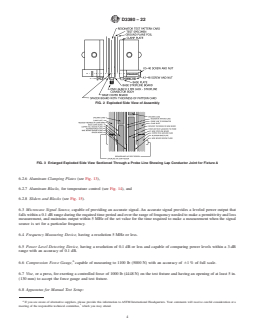
6.1.4 For Fixture A, the preferred assembly for Resonator Card and Specimen uses a Lap Conductor Joint. See Fig. 3 for details.
6.2 Fixture A—The elements of the fixture include the following:
6.2.1 Resonator Pattern Card (see Fig. 8),
6.2.2 Base Stripline Board (see Fig. 9),
6.2.3 Base Cover Board (see Fig. 10),
6.2.4 End-Launcher Bodies, adapted (see Fig. 11),
6.2.5 Aluminum Base Plates (see Fig. 12),
FIG. 1 Face View of Fixture Assembly
D3380 − 22
FIG. 2 Exploded Side View of Assembly
FIG. 3 Enlarged Exploded Side View Sectioned Through a Probe Line Showing Lap Conductor Joint for Fixture A
6.2.6 Aluminum Clamping Plates (see Fig. 13),
6.2.7 Aluminum Blocks, for temperature control (see Fig. 14), and
6.2.8 Sliders and Blocks (see Fig. 15).
6.3 Microwave Signal Source, capable of providing an accurate signal. An accurate signal provides a leveled power output that
falls within a 0.1 dB range during the required time period and over the range of frequency needed to make a permittivity and loss
measurement, and maintains output within 5 MHz of the set value for the time required to make a measurement when the signal
source is set for a particular frequency.
6.4 Frequency Measuring Device, having a resolution 5 MHz or less.
6.5 Power Level Detecting Device, having a resolution of 0.1 dB or less and capable of comparing power levels within a 3-dB
range with an accuracy of 0.1 dB.
6.6 Compression Force Gauge, capable of measuring to 1100 lb (5000 N) with an accuracy of 61 % of full scale.
6.7 Vise, or a press, for exerting a controlled force of 1000 lb (4448 N) on the test fixture and having an opening of at least 5 in.
(130 mm) to accept the force gauge and test fixture.
6.8 Apparatus for Manual Test Setup:
If you are aware of alternative suppliers, please provide this information to ASTM International Headquarters. Your comments will receive careful consideration at a
meeting of the responsible technical committee, which you may attend.
D3380 − 22
in. mm
0.001 0.03
0.002 0.05
0.086 2.18
0.100 2.54
0.143 3.63
0.200 5.08
0.214 5.44
0.250 6.35
0.500 12.70
1.000 25.40
1.500 38.10
2.000 50.80
2.700 68.58
NOTE 1—Dimensions are in inches.
NOTE 2—Metric equivalents are given for general information only.
FIG. 4 Generalized Resonator Pattern Card for Fixture B Showing Dimensions of Table 1 and Made of Laminate Matching Nominal Per-
mittivity of Material to be Tested
FIG. 5 Test Fixture Construction, Older Design (Fixture B)
D3380 − 22
FIG. 6 Test Fixture Construction, Older Design (Fixture B)
FIG. 7 Test Fixture Construction, Older Design (Fixture B)
D3380 − 22
FIG. 8 Generalized Resonator Pattern Card for Fixture A Showing Dimensions of and Made of Laminate Matching Nominal Permittivity
of Materials to be Tested
FIG. 9 Base Stripline Board with Copper Foil and Dielectric Matching Nominal Permittivity of Material to be Tested
FIG. 10 Base Cover Board with Copper Foil Ground Plane
6,7
6.8.1 Sweep Frequency Generator.
6,8
6.8.2 X-Band Frequency Plug-In Unit.
6,9
6.8.3 Frequency Meter.
The sole source of supply of the Hewlett Packard (HP) 8350B or 8620C generator known to the committee at this time is Hewlett Packard. If you are aware of alternative
suppliers, please provide this information to ASTM International Headquarters. Your comments will receive careful consideration at a meeting of the responsible technical
committee, which you may attend.
The sole source of supply of the Hewlett Packard (HP) 83545A or 86251A plug-in unit known to the committee at this time is Hewlett Packard. If you are aware of
alternative suppliers, please provide this information to ASTM International Headquarters. Your comments will receive careful consideration at a meeting of the responsible
technical committee, which you may attend.
The sole source of supply of the Hewlett Packard (HP) X532B meter known to the committee at this time is Hewlett Packard. If you are aware of alternative suppliers,
please provide this information to ASTM International Headquarters. Your comments will receive careful consideration at a meeting of the responsible technical committee,
which you may attend.
D3380 − 22
FIG. 11 Detail of Supplied End Launcher Body Adapted by Boring Out Tapped Holes
FIG. 12 Aluminum Base Plate for Clamping Base Cards and Connecting Launcher Bodies to Base Card
FIG. 13 Aluminum Clamping Plate Provided with Tapped Holes for Pressure Block and Thermocouple Well
6,10
6.8.4 Crystal Detector, two required.
6,11
6.8.5 Matched Load Resistor, for one of the crystal detectors.
The sole source of supply of the Hewlett Packard 423B Neg. detector known to the committee at this time is Hewlett Packard. If you are aware of alternative suppliers,
please provide this information to ASTM International Headquarters. Your comments will receive careful consideration at a meeting of the responsible technical committee,
which you may attend.
The sole source of supply of the Hewlett Packard 11523A option .001 resistor known to the committee at this time is Hewlett Packard. If you are aware of alternative
suppliers, please provide this information to ASTM International Headquarters. Your comments will receive careful consideration at a meeting of the responsible technical
committee, which you may attend.
D3380 − 22
FIG. 14 Aluminum Block for Temperature Control and Transfer of Pressure to Clamp Plates, Fitted with Tapped Holes for Slide, Embed-
ded Steel Ball, and Tapped for Tubing Fittings for Circulating Fluid
FIG. 15 Slider and Block for Connecting Pressure Block and Base Plate with Allowance for Opening Fixture
6,12
6.8.6 Standing Wave Rectified (SWR) Meter, two required.
The sole source of supply of the Hewlett Packard 415E meter known to the committee at this time is Hewlett Packard. If you are aware of alternative suppliers, please
provide this information to ASTM International Headquarters. Your comments will receive careful consideration at a meeting of the responsible technical committee, which
you may attend.
D3380 − 22
6,13
6.8.7 Directional Coupler.
6,14
6.8.8 Attenuator, rated at 10 dB.
6.8.9 Semi-Rigid Coaxial Cable and Connectors.
6,15
6.8.10 Adapter, for waveguide to coaxial interconnection.
6.8.11 The assembly of this equipment is shown schematically in Fig. 16.
6.9 Apparatus for Computer Acquisition of Data—The following alternative equipment or its equivalent, when properly
interconnected, has the potential to be used effectively with a computer-control program for automated testing:
6,16
6.9.1 Sweep Frequency Generator, see also 6.8.1.
6,17
6.9.2 Radio Frequency (RF) Plug-In Unit, having a range from 0.010.01 GHz to 20 GHz.
NOTE 1—All coaxial cable connections.
NOTE 2—It is acceptable to substitute equivalent makes and models of equipment where it can be shown that equivalent results are obtained.
NOTE 3—It is acceptable to use alternate test setups provided that equivalent results are obtained.
FIG. 16 X-Band Permittivity Test Setup
The sole source of supply of the Hewlett Packard 779D coupler known to the committee at this time is Hewlett Packard. If you are aware of alternative suppliers, please
provide this information to ASTM International Headquarters. Your comments will receive careful consideration at a meeting of the responsible technical committee, which
you may attend.
The sole source of supply of the Hewlett Packard attenuator 8491B known to the committee at this time is Hewlett Packard. If you are aware of alternative suppliers,
please provide this information to ASTM International Headquarters. Your comments will receive careful consideration at a meeting of the responsible technical committee,
which you may attend.
The sole source of supply of the Hewlett Packard adapter X281A known to the committee at this time is Hewlett Packard. If you are aware of alternative suppliers,
please provide this information to ASTM International Headquarters. Your comments will receive careful consideration at a meeting of the responsible technical committee,
which you may attend.
The sole source of supply of the Hewlett Packard generator 8350B known to the committee at this time is Hewlett Packard. If you are aware of alternative suppliers,
please provide this information to ASTM International Headquarters. Your comments will receive careful consideration at a meeting of the responsible technical committee,
which you may attend.
The sole source of supply of the Hewlett Packard plug-in #83592A known to the committee at this time is Hewlett Packard. If you are aware of alternative suppliers,
please provide this information to ASTM International Headquarters. Your comments will receive careful consideration at a meeting of the responsible technical committee,
which you may attend.
D3380 − 22
6,18
NOTE 3—Significant cost savings are possible if a plug-in of a narrower frequency range (in the X-band from 5.95.9 GHz to 12.4 GHz) is selected.
6,19
6.9.3 Power Splitter.
6,20
6.9.4 Automatic Frequency Counter.
6,21
6.9.5 Source Synchronizer.
6,22
6.9.6 Attenuator, 10 dB, see also 6.8.8.
6,23
6.9.7 Programmable Power Meter.
6,24
6.9.8 Power Sensor, having a range from −70 to +10 dBm.
6.9.9 Controlling Computer, with a General Purpose Interface Bus (GPIB) interface.
6.9.10 IEEE 488 (GPIB) Cables, Adapters, and Coaxial Cables, suitable for proper interconnecting of all of the components, as
illustrated in Fig. 17 and described in 6.9.11.
6.9.11 Interconnecting Instructions (applicable to 6.9 only):
FIG. 17 Automated Permittivity Test Setup
The sole source of supply of the Hewlett Packard plug-in #83545A known to the committee at this time is Hewlett Packard. If you are aware of alternative suppliers,
please provide this information to ASTM International Headquarters. Your comments will receive careful consideration at a meeting of the responsible technical committee,
which you may attend.
The sole source of supply of the Hewlett Packard power splitter #11667A known to the committee at this time is Hewlett Packard. If you are aware of alternative
suppliers, please provide this information to ASTM International Headquarters. Your comments will receive careful consideration at a meeting of the responsible technical
committee, which you may attend.
The sole source of supply of the Hewlett Packard frequency counter #5343A known to the committee at this time is Hewlett Packard. If you are aware of alternative
suppliers, please provide this information to ASTM International Headquarters. Your comments will receive careful consideration at a meeting of the responsible technical
committee, which you may attend.
The sole source of supply of the Hewlett Packard synchronizer #5344A known to the committee at this time is Hewlett Packard. If you are aware of alternative suppliers,
please provide this information to ASTM International Headquarters. Your comments will receive careful consideration at a meeting of the responsible technical committee,
which you may attend.
The sole source of supply of the Hewlett Packard attenuator #8491B known to the committee at this time is Hewlett Packard. If you are aware of alternative suppliers,
please provide this information to ASTM International Headquarters. Your comments will receive careful consideration at a meeting of the responsible technical committee,
which you may attend.
The sole source of supply of the Hewlett Packard power meter #436A known to the committee at this time is Hewlett Packard. If you are aware of alternative suppliers,
please provide this information to ASTM International Headquarters. Your comments will receive careful consideration at a meeting of the responsible technical committee,
which you may attend.
The sole source of supply of the Hewlett Packard power sensor #8484A known to the committee at this time is Hewlett Packard. If you are aware of alternative suppliers,
please provide this information to ASTM International Headquarters. Your comments will receive careful consideration at a meeting of the responsible technical committee,
which you may attend.
D3380 − 22
6.9.11.1 Connect the power splitter directly to the RF plug-in output. Connect one output of the splitter to the counter input using
an RF cable. With another RF cable, connect the other output to the attenuator. Connect the attenuator to one of the test fixture
probe lines.
6.9.11.2 Connect the counter and the synchronizer as specified by the manufacturer of this equipment. Connect the FM output
from the synchronizer to the FM input on the sweep frequency generator using a BNC connector.
6.9.11.3 Use GPIB cables to parallel connect sweeper, synchronizer, power meter, and computer interface.
6.9.11.4 Connect the power sensor to the other probe of the test fixture and connect its special cable to the power meter.
6.9.11.5 A synthesized continuous wave (CW) generator has been used to replace the sweeper, plug-in, power splitter connector,
and the source synchronizer to provide the simplified automated set-up shown in Fig. 18.
6.10 Signal Source—The type of signal source used in a manual test setup will dictate the method by which the half-power points
are determined. If the power input to the test fixture is maintained constant as the frequency is varied, then it is permissible to use
an SWR meter to determine the half-power points at the output of the test fixture. This is accomplished by using a sweep generator
or by using a tunable klystron (at a significantly lower cost) and manually adjusting the power input to the test fixture to a
prescribed level using a variable attenuator.
6.11 Alternative Equipment—Use alternative types or models of equipment if it can be demonstrated that equivalent results are
obtained. For example, if a power leveling system is not used, and the power output of the source varies widely with frequency,
substitute a ratiometer for the two SWR meters. If only a measurement of permittivity is desired, it has been reported that leveling
the input is not necessary.
6.11.1 Frequency Measurement Apparatus Alternatives:
6.11.1.1 Digital frequency meter with automatic phase-locking (requires unmodulated signal).
6.11.1.2 Digital frequency meter, manually tuned heterodyne type.
6.11.1.3 Manually tuned resonant wavemeter (less accurate than digital types). Use of this requires a resonance indicator.
6.11.2 Resonance Indicator Alternatives:
6.11.2.1 Power meter with thermistor transducer.
6.11.2.2 SWR meter with crystal transducer (requires modulated signal).
6.11.2.3 Dual-trace oscilloscope when a sweep generator is used.
6.11.3 Power Measurement Alternatives:
FIG. 18 Simplified Automated Permittivity Test Setup
D3380 − 22
6.11.3.1 Calibrated variable attenuator in conjunction with one of the above resonance indicators (see 6.11.1).
6.11.3.2 Calibrated power meter with thermistor transducer.
6.11.3.3 Calibrated SWR meter with crystal transducer (requires modulated signal) and must be operated in the square law range
of the crystal).
6.11.3.4 Calibrated dual-trace oscilloscope when a sweep oscillator is used.
6.11.4 Signal Generator Alternatives:
6.11.4.1 Variable-frequency signal generator with a variable attenuator and internal square-wave modulation (for operation either
modulated or unmodulated). Square-wave modulation is also obtainable from a PIN modulator between the signal generator and
the resonant cavity.
6.11.4.2 Klystron tube and mount with power supply and the means for varying the frequency.
6.11.4.3 Variable-frequency sweep oscillator with expanded sweep capability for bandwidths of 25 MHz or less.
6.12 Temperature Control Apparatus—Temperature control apparatus for use with Fixture A design shall include the following:
6.12.1 A laboratory constant temperature bath with circulator connected in series with the clamping blocks using 0.25 in. (6 mm)
inside diameter tubing and a return line to the bath.
6.12.2 Two fine diameter thermocouple probes, with leads, and suitable instrumentation for readout or recording of temperature.
A digital thermometer is convenient for monitoring of the temperature.
7. Test Specimens
7.1 The test specimen shall consist of two sheets, or two packets of sheets if thin materials are to be tested. Each sheet shall be
at least 2 by 2.7 in. (50 by 70 mm).
7.2 Remove the metal cladding from the dielectric sheet using any standard etching process, including rinsing and drying. In case
of referee tests, this metal removal process shall be in accordance with I.P.C. TM-650, subsection 2.3.7.1.
7.3 The test fixture design provides spacing for total specimen thickness of 0.125 6 0.009 in. or 0.100 6 0.007 in. (3 or 2.5 mm)
from an even number of sheets or layers.
NOTE 4—The testing of specimens comprised of layers will introduce some error due to air gaps between layers. The magnitude of such errors can be
as much as 5 % of the permittivity. Exact correlation factors and techniques of measurement should be mutually agreed upon or other methods of test
used. Method 2.5.5.3 of I.P.C. TM-650 at 1 MHz has been used to generate a correlation factor by testing specimens of nominal thickness shown in Table
1 of this test method, using both the techniques of this ASTM test method and the IPC method.
7.4 For certain materials not based on woven glass cloth construction, machine the specimens to a desired thickness so as to fit
the fixture.
8. Preparation of Resonator Pattern Cards
8.1 The resonator circuit shown is an example of a pattern suitable for use in testing a material having a nominal permittivity of
2.20. For use in testing materials of other permittivity values, different pattern dimensions will be required as outlined in Table
1 and Fig. 4.
8.2 Select a copper-clad laminate for fabrication of the test pattern card using the following criteria:
8.2.1 The dielectric shall be a material similar to the type of material to be tested and shall be clad on both sides with copper
having basis weight of one ounce per square foot.
D3380 − 22
8.2.2 The dielectric thickness shall be 0.0085 6 0.0007 in. (0.216 6 0.018 mm).
8.2.3 The copper foil shall meet the requirements of IPC-MF-4562, Type 1 (electro-deposited), Type 5 (wrought), or Type 7
(wrought-annealed). The Q (quality factor) measurement will be affected by the type of copper foil and the surface treatments
thereon which have been applied for bond strength enhancement. The reciprocal Q values listed in Table 1 do not take into account
any of these variables upon the resistivity of the copper due to type of foil or surface treatment.
8.3 The test pattern card shall have a permittivity within 62.5 % of the nominal value of the material to be
...