

ASTM E2058-19
(Test Method)Standard Test Methods for Measurement of Material Flammability Using a Fire Propagation Apparatus (FPA)
General Information
- Abstract
SIGNIFICANCE AND USE
5.1 These test methods are an integral part of existing test standards for cable fire propagation and clean room material flammability, as well as, in an approval standard for conveyor belting (1-3).3 Refs (1-3) use these test methods because fire-test-response results obtained from the test methods correlate with fire behavior during real-scale fire propagation tests, as discussed in X1.4.
5.2 The Ignition, Combustion, or Fire Propagation test method, or a combination thereof, have been performed with materials and products containing a wide range of polymer compositions and structures, as described in X1.7.
5.3 The Fire Propagation test method is different from the test methods in the ASTM standards listed in 2.1 by virtue of producing laboratory measurements of the chemical heat release rate during upward fire propagation and burning on a vertical test specimen in normal air, oxygen-enriched air, or in oxygen-vitiated air. Test methods from other standards, for example, Test Method E1321, which yields measurements during lateral/horizontal or downward flame spread on materials and Test Methods E906, E1354, and E1623, which yield measurements of the rate of heat release from materials fully involved in flaming combustion, generally use an external radiant flux, rather than the flames from the burning material itself, to characterize fire behavior.
5.4 These test methods are not intended to be routine quality control tests. They are intended for evaluation of specific flammability characteristics of materials. Materials to be analyzed consist of specimens from an end-use product or the various components used in the end-use product. Results from the laboratory procedures provide input to fire propagation and fire growth models, risk analysis studies, building and product designs, and materials research and development.
SCOPE
1.1 This fire-test-response standard determines and quantifies material flammability characteristics, related to the propensity of materials to support fire propagation, by means of a fire propagation apparatus (FPA). Material flammability characteristics that are quantified include time to ignition (tign), chemical ( Q˙chem), and convective ( Q˙c) heat release rates, mass loss rate ( m˙) and effective heat of combustion (EHC).
1.2 The following test methods, capable of being performed separately and independently, are included herein:
1.2.1 Ignition Test, to determine tign for a horizontal specimen;
1.2.2 Combustion Test, to determine Q˙chem, Q˙c, m˙, and EHC from burning of a horizontal specimen; and,
1.2.3 Fire Propagation Test, to determine Q˙chem from burning of a vertical specimen.
1.3 Distinguishing features of the FPA include tungsten-quartz external, isolated heaters to provide a radiant flux of up to 110 kW/m2 to the test specimen, which remains constant whether the surface regresses or expands; provision for combustion or upward fire propagation in prescribed flows of normal air, air enriched with up to 40 % oxygen, air oxygen vitiated, pure nitrogen or mixtures of gaseous suppression agents with the preceding air mixtures; and, the capability of measuring heat release rates and exhaust product flows generated during upward fire propagation on a vertical test specimen 0.305 m high.
1.4 The FPA is used to evaluate the flammability of materials and products. It is also designed to obtain the transient response of such materials and products to prescribed heat fluxes in specified inert or oxidizing environments and to obtain laboratory measurements of generation rates of fire products (CO2, CO, and, if desired, gaseous hydrocarbons) for use in fire safety engineering.
1.5 Ignition of the specimen is by means of a pilot flame at a prescribed location with respect to the specimen surface.
1.6 The Fire Propagation test of vertical specimens is not suitable for materials that, on heating, melt sufficiently to form a liquid pool...
- Status
- Published
- Publication Date
- 30-Jun-2019
- Technical Committee
- E05 - Fire Standards
- Drafting Committee
- E05.22 - Surface Burning
Buy Documents
ASTM E2058-19 - Standard Test Methods for Measurement of Material Flammability Using a Fire Propagation Apparatus (FPA)
REDLINE ASTM E2058-19 - Standard Test Methods for Measurement of Material Flammability Using a Fire Propagation Apparatus (FPA)
Overview
ASTM E2058-19: Standard Test Methods for Measurement of Material Flammability Using a Fire Propagation Apparatus (FPA) establishes procedures for quantifying the flammability characteristics of materials. Developed by ASTM International, this standard is widely recognized for its robust approach to evaluating the fire-test-response of materials under controlled laboratory conditions. The test measures parameters such as time to ignition, heat release rates (chemical and convective), mass loss rate, and effective heat of combustion, utilizing a specialized Fire Propagation Apparatus. The results play a critical role in fire safety engineering, fire risk analysis, and the design of safer building products and assemblies.
Key Topics
- Material Flammability Assessment: The standard outlines methods to determine how likely a material is to support fire propagation, measuring critical flammability characteristics.
- Test Methods: Three core tests can be performed independently:
- Ignition Test: Determines the time to ignition for horizontal specimens under controlled radiant heat.
- Combustion Test: Measures chemical and convective heat release rates, mass loss, and effective heat of combustion from horizontal specimens.
- Fire Propagation Test: Determines the chemical heat release rate from vertical specimens during upward fire spread.
- Controlled Laboratory Conditions: Testing uses a Fire Propagation Apparatus equipped with:
- Radiant heaters providing up to 110 kW/m² of heat flux.
- Options for normal air, oxygen-enriched, or oxygen-vitiated atmospheres.
- Real-time monitoring of combustion gases (CO₂, CO, etc.) and heat outputs.
- Data for Fire Modeling: Results are suitable as input for fire growth simulations, building code compliance, and performance-based fire safety assessments.
- Specimen Preparation: Procedures ensure material samples are tested in a representative, standardized manner.
Applications
The methods defined in ASTM E2058-19 are not intended for routine quality control but are critical in the following applications:
- Fire Safety Engineering: Generating input data for models and risk analysis to predict real-world fire behavior and inform fire protection strategies.
- Product Development and Material Research: Evaluating new materials, composites, and products-such as cables, conveyor belts, and clean room materials-for flammability characteristics.
- Building and Product Design: Aiding architects and engineers in selecting or specifying materials with known fire performance, leading to safer built environments.
- Regulatory Compliance and Approvals: Supporting code compliance and product certification for fire-resistant materials and assemblies, particularly where fire propagation is a concern.
- Comparative Performance Assessment: Distinguishing how changes in composition or structure affect fire performance across a variety of polymers and material types.
Related Standards
ASTM E2058-19 is frequently used in conjunction with or as an integral part of other fire propagation and flammability standards, including:
- ASTM E1321: Test Method for Determining Material Ignition and Flame Spread Properties
- ASTM E906: Test Method for Heat and Visible Smoke Release Rates Using a Thermopile Method
- ASTM E1354: Test Method for Heat and Visible Smoke Release Rates Using an Oxygen Consumption Calorimeter
- ASTM E1623: Test Method for Determination of Fire and Thermal Parameters of Materials Using an Intermediate Scale Calorimeter
These related documents provide complementary methods for measuring fire performance in different orientations or under varying exposure conditions.
Keywords: ASTM E2058-19, material flammability, fire propagation apparatus, heat release rate, ignition, combustion test, fire safety, laboratory testing, building product standards, flammability testing, fire risk analysis, fire engineering.
Relations
- Effective Date
- 01-Jul-2019
- Effective Date
- 01-Jan-2024
- Effective Date
- 15-Dec-2018
- Refers
ASTM E1321-18 - Standard Test Method for Determining Material Ignition and Flame Spread Properties - Effective Date
- 01-Nov-2018
- Effective Date
- 01-Mar-2018
- Effective Date
- 01-May-2016
- Effective Date
- 01-Feb-2016
- Effective Date
- 01-Aug-2015
- Effective Date
- 01-Aug-2015
- Effective Date
- 01-Aug-2015
- Effective Date
- 15-May-2015
- Effective Date
- 01-Feb-2015
- Effective Date
- 01-Oct-2014
- Effective Date
- 01-Oct-2014
- Effective Date
- 15-Aug-2014
Buy Documents
ASTM E2058-19 - Standard Test Methods for Measurement of Material Flammability Using a Fire Propagation Apparatus (FPA)
REDLINE ASTM E2058-19 - Standard Test Methods for Measurement of Material Flammability Using a Fire Propagation Apparatus (FPA)
Get Certified
Connect with accredited certification bodies for this standard

Control Union Certifications
Global certification for agriculture and sustainability.

Hohenstein Institut
Textile testing and certification.

Bureau Veritas Bangladesh
Bureau Veritas certification services in Bangladesh.
Sponsored listings
Frequently Asked Questions
ASTM E2058-19 is a standard published by ASTM International. Its full title is "Standard Test Methods for Measurement of Material Flammability Using a Fire Propagation Apparatus (FPA)". This standard covers: SIGNIFICANCE AND USE 5.1 These test methods are an integral part of existing test standards for cable fire propagation and clean room material flammability, as well as, in an approval standard for conveyor belting (1-3).3 Refs (1-3) use these test methods because fire-test-response results obtained from the test methods correlate with fire behavior during real-scale fire propagation tests, as discussed in X1.4. 5.2 The Ignition, Combustion, or Fire Propagation test method, or a combination thereof, have been performed with materials and products containing a wide range of polymer compositions and structures, as described in X1.7. 5.3 The Fire Propagation test method is different from the test methods in the ASTM standards listed in 2.1 by virtue of producing laboratory measurements of the chemical heat release rate during upward fire propagation and burning on a vertical test specimen in normal air, oxygen-enriched air, or in oxygen-vitiated air. Test methods from other standards, for example, Test Method E1321, which yields measurements during lateral/horizontal or downward flame spread on materials and Test Methods E906, E1354, and E1623, which yield measurements of the rate of heat release from materials fully involved in flaming combustion, generally use an external radiant flux, rather than the flames from the burning material itself, to characterize fire behavior. 5.4 These test methods are not intended to be routine quality control tests. They are intended for evaluation of specific flammability characteristics of materials. Materials to be analyzed consist of specimens from an end-use product or the various components used in the end-use product. Results from the laboratory procedures provide input to fire propagation and fire growth models, risk analysis studies, building and product designs, and materials research and development. SCOPE 1.1 This fire-test-response standard determines and quantifies material flammability characteristics, related to the propensity of materials to support fire propagation, by means of a fire propagation apparatus (FPA). Material flammability characteristics that are quantified include time to ignition (tign), chemical ( Q˙chem), and convective ( Q˙c) heat release rates, mass loss rate ( m˙) and effective heat of combustion (EHC). 1.2 The following test methods, capable of being performed separately and independently, are included herein: 1.2.1 Ignition Test, to determine tign for a horizontal specimen; 1.2.2 Combustion Test, to determine Q˙chem, Q˙c, m˙, and EHC from burning of a horizontal specimen; and, 1.2.3 Fire Propagation Test, to determine Q˙chem from burning of a vertical specimen. 1.3 Distinguishing features of the FPA include tungsten-quartz external, isolated heaters to provide a radiant flux of up to 110 kW/m2 to the test specimen, which remains constant whether the surface regresses or expands; provision for combustion or upward fire propagation in prescribed flows of normal air, air enriched with up to 40 % oxygen, air oxygen vitiated, pure nitrogen or mixtures of gaseous suppression agents with the preceding air mixtures; and, the capability of measuring heat release rates and exhaust product flows generated during upward fire propagation on a vertical test specimen 0.305 m high. 1.4 The FPA is used to evaluate the flammability of materials and products. It is also designed to obtain the transient response of such materials and products to prescribed heat fluxes in specified inert or oxidizing environments and to obtain laboratory measurements of generation rates of fire products (CO2, CO, and, if desired, gaseous hydrocarbons) for use in fire safety engineering. 1.5 Ignition of the specimen is by means of a pilot flame at a prescribed location with respect to the specimen surface. 1.6 The Fire Propagation test of vertical specimens is not suitable for materials that, on heating, melt sufficiently to form a liquid pool...
SIGNIFICANCE AND USE 5.1 These test methods are an integral part of existing test standards for cable fire propagation and clean room material flammability, as well as, in an approval standard for conveyor belting (1-3).3 Refs (1-3) use these test methods because fire-test-response results obtained from the test methods correlate with fire behavior during real-scale fire propagation tests, as discussed in X1.4. 5.2 The Ignition, Combustion, or Fire Propagation test method, or a combination thereof, have been performed with materials and products containing a wide range of polymer compositions and structures, as described in X1.7. 5.3 The Fire Propagation test method is different from the test methods in the ASTM standards listed in 2.1 by virtue of producing laboratory measurements of the chemical heat release rate during upward fire propagation and burning on a vertical test specimen in normal air, oxygen-enriched air, or in oxygen-vitiated air. Test methods from other standards, for example, Test Method E1321, which yields measurements during lateral/horizontal or downward flame spread on materials and Test Methods E906, E1354, and E1623, which yield measurements of the rate of heat release from materials fully involved in flaming combustion, generally use an external radiant flux, rather than the flames from the burning material itself, to characterize fire behavior. 5.4 These test methods are not intended to be routine quality control tests. They are intended for evaluation of specific flammability characteristics of materials. Materials to be analyzed consist of specimens from an end-use product or the various components used in the end-use product. Results from the laboratory procedures provide input to fire propagation and fire growth models, risk analysis studies, building and product designs, and materials research and development. SCOPE 1.1 This fire-test-response standard determines and quantifies material flammability characteristics, related to the propensity of materials to support fire propagation, by means of a fire propagation apparatus (FPA). Material flammability characteristics that are quantified include time to ignition (tign), chemical ( Q˙chem), and convective ( Q˙c) heat release rates, mass loss rate ( m˙) and effective heat of combustion (EHC). 1.2 The following test methods, capable of being performed separately and independently, are included herein: 1.2.1 Ignition Test, to determine tign for a horizontal specimen; 1.2.2 Combustion Test, to determine Q˙chem, Q˙c, m˙, and EHC from burning of a horizontal specimen; and, 1.2.3 Fire Propagation Test, to determine Q˙chem from burning of a vertical specimen. 1.3 Distinguishing features of the FPA include tungsten-quartz external, isolated heaters to provide a radiant flux of up to 110 kW/m2 to the test specimen, which remains constant whether the surface regresses or expands; provision for combustion or upward fire propagation in prescribed flows of normal air, air enriched with up to 40 % oxygen, air oxygen vitiated, pure nitrogen or mixtures of gaseous suppression agents with the preceding air mixtures; and, the capability of measuring heat release rates and exhaust product flows generated during upward fire propagation on a vertical test specimen 0.305 m high. 1.4 The FPA is used to evaluate the flammability of materials and products. It is also designed to obtain the transient response of such materials and products to prescribed heat fluxes in specified inert or oxidizing environments and to obtain laboratory measurements of generation rates of fire products (CO2, CO, and, if desired, gaseous hydrocarbons) for use in fire safety engineering. 1.5 Ignition of the specimen is by means of a pilot flame at a prescribed location with respect to the specimen surface. 1.6 The Fire Propagation test of vertical specimens is not suitable for materials that, on heating, melt sufficiently to form a liquid pool...
ASTM E2058-19 is classified under the following ICS (International Classification for Standards) categories: 13.220.40 - Ignitability and burning behaviour of materials and products; 59.060.20 - Man-made fibres. The ICS classification helps identify the subject area and facilitates finding related standards.
ASTM E2058-19 has the following relationships with other standards: It is inter standard links to ASTM E2058-13a, ASTM E176-24, ASTM E176-18a, ASTM E1321-18, ASTM E176-18, ASTM E1354-16a, ASTM E1354-16, ASTM E176-15a, ASTM E1354-15a, ASTM E176-15ae1, ASTM E1354-15, ASTM E176-15, ASTM E176-14c, ASTM E1623-14, ASTM E176-14b. Understanding these relationships helps ensure you are using the most current and applicable version of the standard.
ASTM E2058-19 is available in PDF format for immediate download after purchase. The document can be added to your cart and obtained through the secure checkout process. Digital delivery ensures instant access to the complete standard document.
Standards Content (Sample)
This international standard was developed in accordance with internationally recognized principles on standardization established in the Decision on Principles for the
Development of International Standards, Guides and Recommendations issued by the World Trade Organization Technical Barriers to Trade (TBT) Committee.
Designation: E2058 − 19 An American National Standard
Standard Test Methods for
Measurement of Material Flammability Using a Fire
Propagation Apparatus (FPA)
This standard is issued under the fixed designation E2058; the number immediately following the designation indicates the year of
original adoption or, in the case of revision, the year of last revision.Anumber in parentheses indicates the year of last reapproval.A
superscript epsilon (´) indicates an editorial change since the last revision or reapproval.
1. Scope 1.5 Ignition of the specimen is by means of a pilot flame at
a prescribed location with respect to the specimen surface.
1.1 This fire-test-response standard determines and quanti-
fiesmaterialflammabilitycharacteristics,relatedtothepropen- 1.6 The Fire Propagation test of vertical specimens is not
suitable for materials that, on heating, melt sufficiently to form
sity of materials to support fire propagation, by means of a fire
propagation apparatus (FPA). Material flammability character- a liquid pool.
isticsthatarequantifiedincludetimetoignition(t ),chemical
ign
1.7 Values stated are in SI units. Values in parentheses are
˙ ˙
(Q ), and convective (Q ) heat release rates, mass loss rate
chem c
for information only.
(m˙) and effective heat of combustion (EHC).
1.8 This standard is used to measure and describe the
1.2 Thefollowingtestmethods,capableofbeingperformed
responseofmaterials,products,orassembliestoheatandflame
separately and independently, are included herein:
under controlled conditions, but does not by itself incorporate
1.2.1 Ignition Test, to determine t for a horizontal speci-
ign
allfactorsrequiredforfirehazardorfireriskassessmentofthe
men;
materials, products or assemblies under actual fire conditions.
˙ ˙
1.2.2 Combustion Test,todetermine Q , Q , m˙,andEHC
chem c
1.9 This standard does not purport to address all of the
from burning of a horizontal specimen; and,
safety concerns, if any, associated with its use. It is the
˙
1.2.3 Fire Propagation Test, to determine Q from burn-
chem
responsibility of the user of this standard to establish appro-
ing of a vertical specimen.
priate safety, health, and environmental practices and deter-
1.3 Distinguishing features of the FPA include tungsten- mine the applicability of regulatory limitations prior to use.
quartz external, isolated heaters to provide a radiant flux of up For specific hazard statements, see Section 7.
to 110 kW/m to the test specimen, which remains constant 1.10 This international standard was developed in accor-
whether the surface regresses or expands; provision for com- dance with internationally recognized principles on standard-
ization established in the Decision on Principles for the
bustion or upward fire propagation in prescribed flows of
normal air, air enriched with up to 40% oxygen, air oxygen Development of International Standards, Guides and Recom-
mendations issued by the World Trade Organization Technical
vitiated, pure nitrogen or mixtures of gaseous suppression
agents with the preceding air mixtures; and, the capability of Barriers to Trade (TBT) Committee.
measuring heat release rates and exhaust product flows gener-
2. Referenced Documents
atedduringupwardfirepropagationonaverticaltestspecimen
0.305 m high.
2.1 ASTM Standards:
E176Terminology of Fire Standards
1.4 The FPA is used to evaluate the flammability of mate-
E906Test Method for Heat and Visible Smoke Release
rials and products. It is also designed to obtain the transient
Rates for Materials and Products Using a Thermopile
response of such materials and products to prescribed heat
Method
fluxes in specified inert or oxidizing environments and to
E1321Test Method for Determining Material Ignition and
obtain laboratory measurements of generation rates of fire
Flame Spread Properties
products (CO , CO, and, if desired, gaseous hydrocarbons) for
E1354Test Method for Heat and Visible Smoke Release
use in fire safety engineering.
Rates for Materials and Products Using an Oxygen Con-
sumption Calorimeter
ThesetestmethodsareunderthejurisdictionofASTMCommitteeE05onFire
Standards and are the direct responsibility of Subcommittee E05.22 on Surface
Burning. For referenced ASTM standards, visit the ASTM website, www.astm.org, or
CurrenteditionapprovedJuly1,2019.PublishedJuly2019.Originallyapproved contact ASTM Customer Service at service@astm.org. For Annual Book of ASTM
in 2000. Last previous edition approved in 2013 as E2058–13a. DOI: 10.1520/ Standards volume information, refer to the standard’s Document Summary page on
E2058-19. the ASTM website.
Copyright © ASTM International, 100 Barr Harbor Drive, PO Box C700, West Conshohocken, PA 19428-2959. United States
E2058 − 19
E1623Test Method for Determination of Fire and Thermal specimen from an external radiant heat flux and a pilot flame.
Parameters of Materials, Products, and Systems Using an BoththeCombustionandFirePropagationtestmethodscanbe
Intermediate Scale Calorimeter (ICAL) performed using an inlet air supply that is either normal air or
other gaseous mixtures, such as air with added nitrogen or air
3. Terminology enriched with up to 40% oxygen.
3.1 Definitions—For definitions of terms used in these test 4.2 The Ignition test method is used to determine the time
methods, refer to Terminology E176. required for ignition, t , of horizontal specimens by a pilot
ign
flame as a function of the magnitude of a constant, externally
3.2 Definitions of Terms Specific to This Standard:
applied radiant heat flux. Measurements also are made of time
3.2.1 fire propagation, n—increase in the exposed surface
required until initial fuel vaporization. The surface of these
area of the specimen that is actively involved in flaming
specimens is coated with a thin layer of black paint to ensure
combustion.
complete absorption of the radiant heat flux from the infrared
3.3 Symbols:
heating system (note that the coating does not itself undergo
2 sustained flaming).
A = cross sectional area of test section duct (m )
d
c = specific heat of air at constant pressure (kJ/kg K) 4.3 The Combustion test method is used to determine the
p
˙
G = mass flow rate of CO in test section duct (kg/s) chemicalandconvectiveheatreleaserateswhenthehorizontal
co
˙
G = mass flow rate of CO in test section duct (kg/s)
test specimen is exposed to an external radiant heat flux.
co 2
∆H = effective heat of combustion (kJ/kg)
eff
4.4 The Fire Propagation test method is used to determine
K = flow coefficient of averaging Pitot tube [duct gas
1/2 the chemical heat release rate of a burning, vertical specimen
velocity/(2∆p /ρ) ] (-)
m
during upward fire propagation and burning initiated by a heat
M = ultimate change in specimen mass resulting from
loss
flux near the base of the specimen. Chemical heat release rate
combustion (kg)
is derived from the release rates of carbon dioxide and carbon
m˙ = mass loss rate of test specimen (kg/s)
monoxide. Observations also are made of the flame height on
m˙ = mass flow rate of gaseous mixture in test section
d
the vertical specimen during fire propagation.
duct (kg/s)
P = atmospheric pressure (Pa)
atm
5. Significance and Use
∆p = pressure differential across averaging Pitot tube in
m
5.1 These test methods are an integral part of existing test
test section duct (Pa)
standards for cable fire propagation and clean room material
Q = cumulative heat released during Combustion Test
flammability, as well as, in an approval standard for conveyor
(kJ)
˙
Q = chemical heat release rate (kW) belting (1-3). Refs (1-3) use these test methods because
chem
˙
Q = convective heat release rate (kW)
fire-test-response results obtained from the test methods cor-
c
T = gas temperature in test section duct before ignition
relatewithfirebehaviorduringreal-scalefirepropagationtests,
a
(K)
as discussed in X1.4.
T = gas temperature in test section duct (K)
d
5.2 The Ignition, Combustion, or Fire Propagation test
t = time (s)
method, or a combination thereof, have been performed with
t = ignition time (s)
ign
materials and products containing a wide range of polymer
∆t = time between data scans (s)
compositions and structures, as described in X1.7.
X = measured carbon dioxide analyzer reading or mole
CO
fraction of carbon dioxide (-)
5.3 The Fire Propagation test method is different from the
X = measured carbon monoxide analyzer reading or
CO test methods in the ASTM standards listed in 2.1 by virtue of
mole fraction of CO (-)
producing laboratory measurements of the chemical heat
release rate during upward fire propagation and burning on a
3.4 Superscripts:
vertical test specimen in normal air, oxygen-enriched air, or in
• –1
= per unit time (s )
oxygen-vitiated air. Test methods from other standards, for
= before ignition of the specimen
example, Test Method E1321, which yields measurements
during lateral/horizontal or downward flame spread on mate-
3.5 Subscripts:
rials and Test Methods E906, E1354, and E1623, which yield
= test section duct
measurements of the rate of heat release from materials fully
d
= fire product
j involved in flaming combustion, generally use an external
radiant flux, rather than the flames from the burning material
4. Summary of Test Method
itself, to characterize fire behavior.
4.1 Three separate test methods are composed herein, and
5.4 Thesetestmethodsarenotintendedtoberoutinequality
are used independently in conjunction with a Fire Propagation
control tests. They are intended for evaluation of specific
Apparatus. The Ignition and Combustion test methods involve
flammability characteristics of materials. Materials to be ana-
the use of horizontal specimens subjected to a controlled,
lyzed consist of specimens from an end-use product or the
external radiant heat flux, which can be set from 0 up to 110
kW/m . The Fire Propagation test method involves the use of
Theboldfacenumbersinparenthesesrefertothelistofreferencesattheendof
vertical specimens subjected to ignition near the base of the this standard.
E2058 − 19
various components used in the end-use product. Results from bushing bearings that guide the shaft as it passes through the
thelaboratoryproceduresprovideinputtofirepropagationand top and bottom, respectively, of the air distribution chamber.
fire growth models, risk analysis studies, building and product The stainless steel shaft shall incorporate, at the lower end, a
designs, and materials research and development. threaded adjustment rod to compensate for horizontal test
specimens of different thicknesses.
6. Apparatus
6.4 Ignition Pilot Flame—The ignition pilot shall consist of
6.1 General:
an ethylene/air (6.5/93.5 by volume) flame adjusted for a
6.1.1 Where dimensions are stated in the text or in figures,
10-mm length. The pilot flame is anchored at the 50-mm long,
they shall be considered mandatory and shall be followed
horizontalendofa6.35-mmO.D.,4.70-mmI.D.stainlesssteel
withinanominaltoleranceof 60.5%.Anexceptionisthecase
tube. In the horizontal tube section, use a four-hole ceramic
of components meant to fit together, where the joint tolerance
insert to produce a stable flame and prevent flashback. The
shall be appropriate for a sliding fit.
pilot flame tube shall be able to be rotated and elevated to
6.1.2 The apparatus (see overview in Fig. 1 and exploded
position the horizontal flame at specified locations near the
views in Figs. 2 and 3) shall consist of the following compo-
specimen, as shown in Figs. 2 and 3.
nents: an infrared heating system, a load cell system, an
6.5 Ignition Timer—The device for measuring time to sus-
ignition pilot flame and timer, a product gas analysis system, a
tainedflamingshallbecapableofrecordingelapsedtimetothe
combustion air distribution system, a water-cooled shield, an
nearest tenth of 1 s and have an accuracy of better than1sin
exhaust system, test section instruments, calibration
1h.
instruments, and a digital data acquisition system.
6.6 Gas Analysis System—The gas analysis system shall
6.2 Infrared (IR) Heating System—The IR Heating System
consist of a gas sampling system and gas analysis instruments,
shall consist of four 241-mm long heaters (see different views
described in 6.6.1 – 6.6.4
in Figs. 1-3) and a power controller.
6.6.1 Gas Sampling—The gas sampling arrangement is
6.2.1 IR Heaters—Each of four IR heaters shall contain six
tungsten filament tubular quartz lamps in a compact reflector showninFig.4.Thisarrangementconsistsofasamplingprobe
in the test section duct, a plastic filter (5-micron pore size) to
body that produces up to 510 kW/m of radiant flux in front of
the quartz window that covers the lamps.The reflector body is prevent entry of soot, a condenser operating at temperatures in
the range –5°C to 0°C to remove liquids, a tube containing an
water cooled and the lamp chamber, between the quartz
window and reflector, is air cooled for prolonged life. The indicating desiccant (10–20 mesh) to remove most of the
remaining moisture, a filter to prevent soot from entering the
emitter of each lamp is a 127-mm long tungsten filament in an
argon atmosphere enclosed in a 9.5-mm outer diameter clear analyzers, if not already removed, a sampling pump that
quartz tube. The emitter operates at approximately 2205°C transports the flow through the sampling line, a system flow
(4000°F) at rated voltage, with a spectral energy peak at 1.15 meter, and manifolds to direct the flow to individual analyzers
micron. Wavelengths greater than about 2-microns are ab- (CO, CO,O , and hydrocarbon gas). The sampling probe,
2 2
sorbed by the quartz bulb envelope and heater front window, madeof6.35-mm(0.25-in.)O.D.stainlesssteeltubinginserted
which are air cooled. through a test section port, shall be positioned such that the
6.2.2 Power Controller—The controller shall maintain the open end of the tube is at the center of the test section. The
outputvoltagerequiredbytheheaterarraydespitevariationsin sampling probe is connected to a tee fitting that allows either
load impedance through the use of phase angle power control sampleorcalibrationgastoflowtotheanalyzer,andtheexcess
to match the hot/cold resistance characteristics of the tungsten/ to waste.
quartz lamps. The controller also shall incorporate average
6.6.2 Carbon Dioxide/Carbon Monoxide Analyzers—The
voltage feedback to linearize the relationship between the
carbon dioxide analyzer shall permit measurements from 0 to
voltagesetbytheoperatorandtheoutputvoltagetothelamps.
15000 ppm and the carbon monoxide analyzer shall permit
measurements from 0 to 500 ppm concentration levels. Drift
6.3 Load Cell System—Theloadcellsystem,showninFigs.
shall be not more than 61% of full scale over a 24-h period.
1-3, shall consist of a load cell, which shall have an accuracy
Precision shall be 1% of full-scale and the 10 to 90% of
of 0.1 g, and a measuring range of 0–1000 g; a 6.35-mm
full-scale response time shall be 10 s or less (typically5sfor
diameter stainless steel shaft, at least 330 mm long, resting on
the ranges specified).
the load cell support point; a 100-mm diameter, 1.5-mm thick
6.6.3 Inlet-Air OxygenAnalyzer—Thisanalyzershallhavea
aluminum load platform connected to the upper end of the
10 to 90% of full-scale response time of 12 s or less, an
stainless steel shaft by a collar; and two low friction, ball-
accuracyof1%offull-scale,anoiseanddriftofnotmorethan
6 100 ppm O over a one-half-hour period anda0to50%
The Model 5208-05 high density infrared heater with Model 500T3/CL/HT
range.
lamps and Model 664 SCR power controller; or Hi-Temp 5209-05 with QIH240-
6.6.4 Optional Product Analyzers for the Combustion
1000R12 lamps and Model 3629C power controller, manufactured by Research,
Test—An additional oxygen analyzer can be used to measure
Inc., P.O. Box 24064, Minneapolis, MN 55424 is suitable for this purpose.
The sole source of supply of the apparatus known to the committee at this time
the depletion of oxygen in the combustion products. This
is Research, Inc. If you are aware of alternative suppliers, please provide this
analyzer should have the same specifications as the inlet-air
information to ASTM International Headquarters. Your comments will receive
analyzer but should have a concentration range of 19 to 21%.
careful consideration at a meeting of the responsible technical committee, which
you may attend. A hydrocarbon gas analyzer employing the flame ionization
E2058 − 19
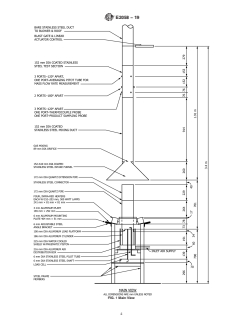
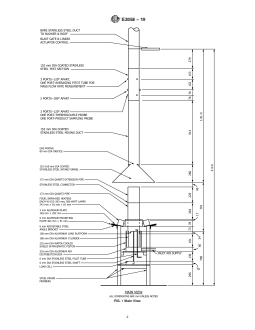
FIG. 1 Main View
E2058 − 19
FIG. 2 Exploded View of Specimen Mounting
E2058 − 19
NOTE 1—All dimensions are in mm unless noted.
FIG. 3 Exploded Main View
E2058 − 19
FIG. 4 Flow Diagram of Gas Sampling System
E2058 − 19
methodofdetectioncanbeusedtodeterminethetotalgaseous to 230 mm downstream of the thermocouple port, shall
hydrocarbon concentration. This analyzer should have a 10 to measurethemassflowrateofthegasstreamusingatleastfour
90% of full-scale response time of1sor less and multiple sets of flow sensing openings, one set facing upstream and the
ranges to permit measurements from a full-scale of 10 ppm second downstream and shall be designed for compatibility
methane equivalent to 10000 ppm. withthetestsectiondiameter.Measurethedifferentialpressure
generated by the probe with an electronic pressure transducer
6.7 Combustion Air Distribution System—This system shall
(electronic manometer). The measured differential pressure is
consist of an air distribution chamber, shown in Fig. 5, and air
proportional to the square of the flow rate. Experience has
supply pipes, shown in Figs. 6 and 7.
shown that the averaging Pitot probe in this application is
6.7.1 Air Distribution Chamber—This aluminum chamber,
reliable (not susceptible to plugging), while minimizing pres-
showninFig.5,shallcontaineightdischargetubesarrangedin
sure losses in the exhaust system.
a circle of 165-mm inside diameter. Each tube shall be
aluminum and built to distribute inlet gases (air, O,N , etc.) 6.11 Heat-Flux Gauge—For calibration of the IR heating
2 2
to three sets of screens (stainless steel woven wire cloth of 10,
system, use a Gardon type, or equivalent, total heat-flux gauge
20, and 30 mesh from bottom to top, respectively), for having a nominal range of 0 to 100 kW/m and a flat, 6 to
producingauniformairflow.Inletairflowsdownwardthrough
8-mm diameter sensing surface coated with a durable, flat-
the eight discharge tubes, disperses on the bottom plate, then black finish. The body of the gauge shall be cooled by water
rises through the mesh screens toward the aluminum support
abovethedewpointofthegaugeenvironment.Thegaugeshall
cylinder. be rugged and maintain an accuracy of within 63% and a
6.7.2 Air Supply Pipes—These pipes shall consist of an repeatability within 0.5% between calibrations. Check the
aluminum cylinder, shown in Figs. 3 and 6 extending from the calibration of the heat-flux gauge monthly through the use of a
air distribution chamber up to the load platform. This cylinder black-body oven calibration facility that compares the gauge
shallcontainastep(seeFigs.6and7)tosupportaquartzpipe. response to that of a NIST-traceable optical pyrometer.
Alternatively, compare the gauge output to that of a reference
Above the load platform elevation, the quartz pipe (see Figs. 6
and 7) shall supply oxidant to the specimen flame while standard.
allowing radiant energy from the IR heating system to reach
6.12 Digital Data Collection System—Digitally record the
the specimen surface. The aluminum support cylinder shall be
outputfromtheCO,CO ,hydrocarbongas,O combustionand
2 2
rigidlyattachedtothedistributionchamber,butthequartzpipe
O inlet-air analyzers, the load cell, the test section duct
shall be removable.
thermocouple, and the electronic pressure transducer at 1 s
6.8 Water-Cooled Shield—To prevent the specimen from
intervals. Time shift the data for the gas concentrations to
being exposed to the IR heaters during the one minute heater
accountfordelayswithinthegassamplinglinesandrespective
stabilization period, there shall be a shield (see Fig. 8)
instrument response times. The data collection system shall be
consisting of two aluminum cylinders welded together with an
accurate to within 61°C for temperature measurement and
inlet and outlet for water circulation. An electrically-actuated,
60.01% of full-scale instrument output for all other channels.
pneumatic piston shall raise the shield to cover the specimen
The system shall be capable of recording data for at least 1 h
during test preparation and shall lower the shield within1sto
at 1-s intervals, although test duration typically is between 8
expose the specimen at the start of a test.
and 15 minutes.
6.9 Exhaust System—The exhaust system shall consist of
7. Hazards
the following main components: an intake funnel (Figs. 9 and
10), a mixing duct (Fig. 11), a test section (Fig. 12), duct
7.1 All normal laboratory safety precautions must be fol-
flanges (Fig. 13), and a high temperature blower to draw gases
lowed since the test procedures involve high temperatures and
through the intake funnel, mixing duct and test section at flow
combustion reactions, as well as the use of electric radiant
rates from 0.1 to 0.3 m /s (212 to 636 cfm).The intake funnel,
heaters, laboratory glassware, and different types of com-
mixing duct and test section shall be coated internally with
pressed gases.
fluorinated ethylene propylene (FEP) resin enamel and finish
7.1.1 Hazardous conditions leading, for example, to burns,
layers over a suitable primer to form a three layer coating that
ignition of extraneous objects or clothing, and inhalation of
shall withstand temperatures of at least 200°C.
combustion products, may exist. During the operation of the
6.10 Test Section Instruments: apparatus,theoperatormustusehearingprotectionandatleast
shade five welding goggles or glasses. The operator must use
6.10.1 Test Section Thermocouple Probe—A thermocouple
protective gloves for insertion and removal of test specimens.
probe, inserted through a test section port, shall be positioned
Specimens must be removed to a fume hood. Neither the
such that the exposed, type K measurement bead is at the
heaters nor the associated fixtures can be touched while hot
center of the test section, at the axial position of the gas
except with protective gloves.
sampling port. Fabricate the thermocouple probe of wire no
larger than 0.254-mm diameter for measurement of gas tem-
7.1.2 The exhaust system must be checked for proper
peraturewithatimeresponse(inthespecifiedexhaustflow)of
operation before testing and must be discharged away from
no more than 1 s and an accuracy of 1.0°C.
intakes for the building ventilation system. Provision must be
6.10.2 AveragingPitotProbeandPressureTransducer—An made for collecting and venting any combustion products that
averaging Pitot probe, inserted through a test section port 220 fail to be collected by the exhaust system.
E2058 − 19
FIG. 5 Air Distribution Chamber
E2058 − 19
0.075-mm thick fiberglass adhesive aluminum tape and then
mountedinawell-insulatedaluminumdish(62.6g 62g)(Fig.
15). The side of specimen in the specimen holder shall be
insulated with three layers of 3-mm thick ceramic paper. The
bottom of specimen in the specimen holder shall be insulated
with layers of 3-mm thick ceramic paper in order to maintain
the top surface of each specimen flush with the top of the
ceramic insulation, as shown in Fig. 15.The vertical specimen
holder is a 485-mm high × 133-mm wide ladder rack (see Fig.
16).Theverticalcableholderis825-mmhigh(seeFig.17)and
can support a cable specimen 81-mm long and up to 51-mm
diameter.
8.2 Specimen Size and Preparation:
8.2.1 Ignition and Combustion Tests of Horizontal
Specimens—Cutspecimensfromessentiallyplanarmaterialsor
products to be 101.6 by 101.6 mm (4 by 4 in.) in area.
Specimens shall have a thickness of no less than 3 mm and no
more than 25.4 mm and be representative of the end-use
material or product. For testing, place the square specimen in
thehorizontalsquareholder.Placegranularorcablespecimens
in the horizontal circular holder, with the cable specimens cut
to cover the center and at least 20-mm on each side of the
center of the aluminum dish. Spray the exposed top surface of
the specimen with a single coat of flat black paint that is
designed to withstand temperatures of 540 6 10°C. Prior to
testing, cure the paint coating by conditioning the specimen at
atemperatureof23 63°Candarelativehumidityof50 65%
for48h.Thiscoatingisappliedtoinsuresurfaceabsorptionof
the imposed radiant heat flux. Place the holder containing the
specimen on a 13-mm thick, calcium silicate board (density
700–750 kg/m , thermal conductivity 0.11–0.13 W/m K)
having the same dimensions as the holder, as shown in Fig. 2,
just before a test is to be performed.
8.2.2 Fire Propagation Test of Vertical, Rectangular Speci-
mens:
8.2.2.1 Cut specimens from essentially planar materials or
products to be 101.6 mm in width and 305 mm in height (4 by
12 in.). Specimens shall have a thickness of no less than 3 mm
and no more than 13 mm and be representative of the end-use
material or product.
8.2.2.2 Place ceramic paper (density 190–200 kg/m ) of 3.2
mm(0.125in.)thicknesstocoverthesidesandbacksurfaceof
the specimen and then wrap the specimen, with the ceramic
paper, in two layers of aluminum foil of 2-mil (0.05-mm)
FIG. 6 Exploded View of Quartz Pipe Assembly
thickness to expose only the front surface to be tested.
8.2.2.3 Wrap the covered and exposed width of the speci-
8. Test Specimen
men securely with one turn of No. 24-gauge nickel/chromium
8.1 Specimen Holders—Four types of specimen holders are
wire at distances of 50-mm from each end and at the midpoint
used: horizontal square; horizontal circular specimen holders
of the 305-mm length of the specimen.
(Fig. 14 and Fig. 15); a vertical specimen holder (Fig. 16); and
a vertical cable specimen holder (Fig. 17). The horizontal
square holder consists of two layers of 0.05-mm (2-mil
Thurmalox® Solar Collector Coating, No. 250 Selective Black spray paint,
thickness) aluminum foil molded to the sides and bottom of a
packaged for the Dampney Company, 85 Paris St., Everett, MA 02149, is suitable
square specimen. For liquid specimens, melting materials, and
for this purpose.
The sole source of supply of the apparatus known to the committee at this time
powderedspecimens,thehorizontalcircularholderisa99-mm
is the Dampney Company. If you are aware of alternative suppliers, please provide
diameter aluminum dish (see Fig. 14). For charring and
this information toASTM International Headquarters. Your comments will receive
non-melting materials, the horizontal circular specimens of
careful consideration at a meeting of the responsible technical committee, which
diameter, 96.5-mm shall be sealed (both rear and side) with you may attend.
E2058 − 19
FIG. 7 Combustion Enclosure
E2058 − 19
NOTE 1—All dimensions are mm unless noted.
FIG. 8 Water Cooled Shield
8.2.2.4 Place the bottom of the specimen on the metal 9. Calibration
base-plate (see Fig. 16) of the vertical holder with the covered
9.1 Radiant-Flux Heater:
(back) surface of the specimen against the ladder rack.
9.1.1 Routine Calibration—Calibrate IR heaters at the start
8.2.2.5 Wrap one turn of No. 24 gauge nickel/chromium
of the test day. Clean the quartz windows, lamps, and back
wire securely around the specimen, the ladder rack and the
reflective surfaces of the heaters to keep them free of any
threadedrodsatdistancesof100and200mmfromthebottom
impurity buildup or scratches. Position the heat-flux gauge-
ofthespecimentokeepthespecimenfirmlyincontactwiththe
sensing surface to be horizontal, at a location equivalent to the
vertical specimen holder.
center of the top surface of a horizontal specimen. Place the
8.2.3 Fire Propagation Test of Vertical, Cable Specimens:
quartz pipe in position, as required, and record IR heater
8.2.3.1 Mount cable specimens as explained in Fig. 17.
voltage settings and measured radiant flux levels for planned
8.3 Expose composite specimens in a manner typical of the
tests.
end-use condition.
9.1.2 Positioning of Radiant-Flux Heaters—At least
8.4 If the preparation techniques in 8.2 do not retain annually, check the position of the IR heaters. Set the heater
specimens within the specimen holder during combustion, voltage at 90% of the maximum value. Position the heat-flux
specify the exact mounting and retaining methods used in the gauge sensing surface to be horizontal and measure the heat
test report. fluxateachoffivelocations,correspondingtoeachcornerand
E2058 − 19
NOTE 1—Coat inside of funnel with FEP after welding.
coat thickness: 0.5 mm
All dimensions are in mm unless noted.
FIG. 9 Intake Funnel
the center of a square, horizontal specimen, at an elevation 9.2.2 Oxygen Analyzer—Calibrate the oxygen analyzer for
equivalent to that of the specimen top surface. Adjust the measurement of inlet oxygen concentration (and the optional
position of each IR heater symmetrically and repeat these heat
oxygen analyzer for combustion gases) by establishing a
flux measurements, if necessary, until there is at most a 5%
downscale calibration point and an upscale calibration point.
mean deviation of the five readings from the average value.
Perform the upscale calibration with a “span gas” at the upper
Then, position the heat-flux gauge to locations equivalent to
endoftherangethatwillbeusedduringactualsampleanalysis
the vertical axis at the center of a square specimen. Measure
andusea“zerogas”forthedown-scalecalibrationpointatthe
the heat flux at elevations of 10 mm and 20 mm above and
lowerendoftheanalyzerrange.Tocalibratetheanalyzer,open
below that equivalent to the specimen top surface. Check that
the span gas at 1.0 L/minute, set the analyzer span, close the
the heat flux at these four elevations is within 5% of the value
span gas, and open the zero gas at the same flow rate, and then
at the elevation of the specimen face.
set the lower end of the analyzer range. Re-span and re-zero
9.2 Gas-Analyzer Calibration—Calibrate the carbon several times, if necessary.
dioxide, carbon monoxide, oxygen, and total hydrocarbon
9.2.3 Optional Hydrocarbon GasAnalyzer—Adjustthezero
analyzers before the first Combustion or Fire Propagation test
control of the analyzer by using ultra pure nitrogen flowing at
of the day.
3 L/minute as the “zero gas.” As the “span gas,” use methane
9.2.1 Carbon Dioxide/Carbon Monoxide Analyzers—
at a concentration that matches the operating range of the
Calibrate the CO and CO analyzers for measurement of
analyzer.
combustiongasesbyestablishingadownscalecalibrationpoint
9.3 Load Cell—Calibrate the load cell each time it is used.
and an upscale calibration point. Perform the upscale calibra-
Set the output voltage to zero by adjusting the tare, with the
tionwitha“spangas”attheupperendoftherangethatwillbe
appropriate empty specimen holder in position. Then, place a
usedduringactualsampleanalysisandusea“zerogas”forthe
NIST-traceable weight corresponding to the weight of the
down-scale calibration point at the lower end of the analyzer
specimen to be tested on the empty holder and measure the
range. Use nitrogen as the “zero gas” reference source by
turning on a Grade 5 nitrogen cylinder at 0.8 L/minute. Zero output voltage. Check linearity by repeating this procedure
with three other NIST-traceable weights so as to cover the
the CO and CO analyzers. Span each analyzer with its
appropriate gas for the corresponding range. entire specimen weight range.
E2058 − 19
NOTE 1—All dimensions are in mm unless noted.
FIG. 10 Funnel Flange
9.4 Heat Release Calibration—Calibrate the heat release 9.4.7 End data acquisition two minutes after the end of
ratemeasurementprocessatleastmonthlytoensuretheproper visible flaming.
functioningoftheFPA.Checkthatthemeasuredeffectiveheat
9.4.8 Determine the effective heat of combustion following
ofcombustionofacetoneiswithin 65%ofthereferencevalue
the calculation procedure in Section 12.
of 27900 kJ/kg (5) and that the measured total delay (or lag)
9.4.9 Determine the delay time for the gas analyzers by
time of the gas analyzers is less than 15 s.
computing the difference between the time when the test
9.4.1 Do not use the IR heaters or the pilot.
section duct gas temperature reaches 50% of its steady-state
9.4.2 Performtherestoftherequiredcalibrationprocedures
value and the time when the reading of each analyzer reaches
as described in this section.
50% of its steady-state value.
9.4.3 Check that inlet air flow is set at 200 L/minute.
9.4.4 Start data acquisition program.
10. Conditioning
9.4.5 Place100.0mLofacetoneinaspecimendish0.097-m
(3.8-in.) diameter on the load cell. 10.1 Conditionspecimenstomoistureequilibrium(constant
9.4.6 Ignite the acetone using a match 30 s after the start of weight) at an ambient temperature of 23 6 3°C and a relative
data acquisition. humidity of 50 6 5% for 24 h.
E2058 − 19
NOTE 1—Flanges to be square with tube.
Coat inside of duct with FEP after welding.
NOTE 1—Flanges to be square with tube.
Material 304 S.S.
Coat inside of duct with FEP after welding. All dimensions are in mm unless noted.
Material 304 S.S.
FIG. 12 Test Section
All dimensions are in mm unless noted.
FIG. 11 Mixing Duct
11.1.4 Light the pilot flame and adjust for a 10-mm flame
length.
11. Procedure
11.1.5 Move the lighted pilot flame to a position 10-mm
11.1 Procedure 1: Ignition Test—The ignition test is per- above the specimen surface and 10-mm from the perimeter of
formed to determine the time required from the application of the specimen.
an externally applied heat flux to a horizontal test specimen 11.1.6 Turn on air and water to cool the infrared radiant
until ignition of that specimen. heaters.
11.1.1 Verify that nitrogen for flame extinguishment is 11.1.7 Raise the water-cooled shield surrounding the speci-
available for flow at 100 6 10 L/minute and that pilot flame menholdertopreventspecimenexposuretoexternalheatflux.
gases (ethylene to air ratio 60:40) are regulated to give 11.1.8 Set the IR heater voltage to produce the desired heat
specified flame length when needed. flux and allow for one minute of stabilization.
11.1.2 Place the 13-mm thick calcium silicate board sup- 11.1.9 Lower the water-cooled shield to expose the sample
porting the appropriate horizontal specimen holder in position to the external heat flux. Simultaneously start a timer.
(centered)onthealuminumloadplatform(confirmthatthereis 11.1.10 Record the time when vapors are first observed
no quartz pipe in place, to insure natural air flow). coming from the test specimen.
11.1.3 Turn on the exhaust blower and set an exhaust flow 11.1.11 Record the time to ignition as the time duration
rate of 0.25 m /s (530 cfm). from exposure to the external heat flux until sustained flaming
E2058 − 19
NOTE 1—Material 304 S.S.
A matching pair consists of one flange with O-ring groove, and one flange without.
All dimensions are in mm unless noted.
FIG. 13 Duct Flanges
(existenceofflameonorovermostofthespecimensurfacefor
at least a four-s duration). If there is no ignition after a
15-minute heat flux exposure time, turn off the IR heater
voltage and stop the test.
11.1.12 If there is sustained flaming, turn off the IR heater
voltage and introduce nitrogen to extinguish flames.
11.1.13 When the specimen has cooled sufficiently to be
handled safely, remove the specimen to a ventilated environ-
ment.
11.1.14 Repeat this procedure for additional infrared heater
settings, as required.
11.2 Procedure 2: Combustion Test—Thecombustiontestis
conductedtomeasurethechemicalandconvectiveheatrelease
˙ ˙
rates (Q and Q ), mass loss rate (m˙) and to determine the
chem c
EHC of a horizontal specimen.
11.2.1 Place the 13-mm thick calcium silicate board sup-
porting the appropriate horizontal specimen holder in position
NOTE 1—This holder is used to hold and melting materials as well as
powdered specimens. (centered) on the aluminum load platform.
All dimensions are in mm unless noted.
11.2.2 Verify that the gas sampling system is removing all
FIG. 14 Horizontal Circular Specimen Holder
watervaporandsimilarlycondensablecombustionproducts.If
E2058 − 19
NOTE 1—Holder shown in Fig. 14 is used to hold liquid specimens, melting materials, and powdered specimens.
NOTE 2—Holder shown in Fig. 15 is used for charring as well as non-melting.
FIG. 15 Horizontal Circular Insulated Specimen Holder (see Ref 4)
the sampling system flow meter indicates less than 10 11.2.17 At 30 s, lower the cooling shield to expose speci-
L/minute, then replace sampling system filter elements. men to infrared radiant heaters.
11.2.3 Installfreshindicatingdesiccantandsootfilterinthe
11.2.18 Record the time when vapors are first observed
gas sampling line.
coming from the test specimen, the time at ignition, flame
11.2.4 Ignite the flame in the hydrocarbon gas analyzer and
height, flame color/smokiness, any unusual flame or specimen
check the flame out indicator on the front panel to assure that
behavior and flame extinction time.
there is flame ignition.
11.2.19 Maintainthepositionofthepilotflametobea10 6
11.2.5 Verify that nitrogen for flame extinguishment is
5-mm height above the exposed surface of any specimen that
available for flow at 100 6 10 L/minute into the inlet-air
regresses or expands during the test period.
supply line and that pilot flame gases (ethylene to air ratio
11.2.20 Turn off the IR heaters and introduce nitrogen two
60:40) are regulated to give specified flame length when
minutesaftertheendofvisibleflamingorifflamesreach35 6
needed.
10 mm above the rim of the collection funnel for more than30
11.2.6 Turn on gas sampling pump and set correct sampling
s.
flow rate for each gas analyzer (gas analyzers, the electronic
11.2.21 When the specimen has cooled sufficiently to be
pressuretransducer,andloadcellarepoweredonatalltimesto
safely removed from the specimen holder, weigh the residue
maintain constant internal temperatures).
and record the result.
11.2.7 Perform required calibration procedures as specified
in Section 9.
11.2.22 Repeat the above procedures to give a total of three
11.2.8 Turn on the exhaust blowers and set an exhaust flow
chemical heat release rate and mass loss rate determinations.
rate of 0.25 m /s (530 cfm).
11.3 Procedure 3: Fire Propagation Test—The fire propa-
11.2.9 Light the pilot flame and adjust for a 10-mm flame
gation test is performed to determine the chemical heat release
length.
˙
rate (Q ) of a vertical specimen during upward fire propa-
chem
11.2.10 Move the lighted pilot flame to a position 10-mm
gation and burning.
above the specimen surface and 10-mm from the perimeter of
11.3.1 Repeat steps needed for measurement of heat release
the specimen.
rate in 11.2.2 – 11.2.8, with the exception of the load cell
11.2.11 Turn on air and water to cool the infrared radiant
calibration.
heaters.
11.2.12 Install the quartz pipe on the mounting step in the 11.3.2 Remove the stainless steel load cell shaft and the
aluminum oxidant supply pipe.
ball-bushing bearings from the air distribution chamber and
11.2.13 Raise the water-cooled shield to cover the speci- replace with the appropriate vertical specimen holder.
men.
11.3.3 Install specimen such that the bottom edge of the
11.2.14 Set an inlet-air supply rate of 200 L/minute into the
vertical specimen that is to be exposed to IR heating is at an
air distribution chamber.To change oxygen content of inlet air
elevation equivalent to that of the top surface of a horizontal
supply from that of normal air, introduce oxygen or nitrogen
specimen.
(from grade 2.6 and 4.8 cylinders, respectively) into the
11.3.4 Light the pilot flame and adjust for a 10-mm flame
inlet-air supply line and check oxygen concentration with
length.
inlet-air oxygen analyzer (maximum oxygen concentration
11.3.5 Turn on air and water to cool the infrared radiant
shall be 40% by volume).
heaters.
11.2.15 Set the IR heater voltage to produce the desired
11.3.6 Install the quartz pipe on the mounting step in the
radiant exposure of the specimen surface and allow the IR
aluminum oxidant supply pipe.
heaters to stabilize for one minute.
11.3.7 Raise the water-cooled shield surrounding the speci-
11.2.16 Start the digital data collection system to record at
1-s intervals. men holder to prevent pre-exposure to external heat flux.
E2058 − 19
NOTE 1—All dimensions are in mm unless noted.
FIG. 16 Vertical Specimen Holder
E2058 − 19
NOTE 1—The cable specimen is placed in the center of the holder with the lower end on the steel plate. It is secured by three tie wires and is centered
by tightening the three bolts in the steel tube.
All dimensions are in mm unless noted.
FIG. 17 Cable Specimen Holder
E2058 − 19
11.3.8 Move the pilot flame to a position 75 mm from the where:
bottom of the specimen and 10 mm away from the specimen
m˙ (kg/s) = the mass flow rate of combustion products in
d
surface.
the test section duct (an expression for which
11.3.9 Set an inlet-air supply rate of 200 L/minute into the is derived in X1.3),
c (kJ/kg•K) = the specific heat of air,
air distribution chamber.To change oxygen content of inlet air
p
T (K) = the gas temperature in the test section duct,
supply from that of normal air, introduce oxygen, or nitrogen
d
and
(from grade 2.6 and 4.8 cylinders, respectively) into the
T (K) = thegastemperatureinthetestsectionductjust
inlet-air supply line and check oxygen concentration with
a
before pilot flame ignition occurs.
inlet-air oxygen analyzer (maximum oxygen concentration
shall be 40% by volume).
Correct the specific heat, c , for temperature, T, as follows:
p
11.3.10 Set the IR heater voltage to produce 50 kW/m and 24 2
c 51.0011.34*10 T 22590/T (5)
p
allow to stabilize for one minute.
Insummary,determinetheconvectiveheatreleaseratefrom
11.3.11 Start the digital data collection system to record at
the following equation:
1-s intervals.
˙ 1/2 1/2
11.3.12 At30s,lowerthewater-cooledshieldtoexposethe Q 5 A K P /101000 706∆p /T 3 1.0011.34
~ ! ~ ! @~
c d atm m d
24 2 24
lower portion of the vertical sample to the external heat flux
310 T 22590/T T 2 1.0011.34 310 T
! ~
d d d a
from the infrared radiant heaters. Simultaneously start a timer.
22590/T !T # (6)
a a
11.3.13 After preheating the base area of the specimen for
12.3 Determine specimen mass loss rate, m˙, from the slope
one minute, move the pilot flame into contact with the
of five-point, straight-line regression fits to the data on mass
specimensurfacetoinitiatefirepropagation,ifignitionandfire
loss versus time. Compute the slope at each time using mass
propagation has not already occurred, and then move the pilot
loss data from the current time record, from the two preceding
flame away from the specimen.
time records and from the two succeeding time records.
11.3.14 Measurethechemicalheatreleaserateasafunction
12.4 Determine the effective heat of combustion, ∆H ,
eff
of time during fire propagation, using the Combustion test
from the following expression:
procedures.
∆H 5 Q/M (7)
11.3.15 Record the time when vapors are first observed
eff loss
coming from the test specimen, the time at ignition, flame
where:
height at one-minute intervals, flame characteristics, such as
Q = the cumulative heat generated during the Combus-
color, and the time at flame extinction.
tiontest,basedonasummationoveralldatascansof
11.3.16 Turn off the IR heaters and introduce nitrogen two
˙
the product of Q , from Eq 1, and ∆t, the time
chem
minutesaftertheendofvisibleflamingorifflamesreach35 6
between scans; and,
10 mm above the rim of the collection funnel for more than 30
M = the change in measured specimen mass (by labora-
loss
s, or if the specimen u
...
This document is not an ASTM standard and is intended only to provide the user of an ASTM standard an indication of what changes have been made to the previous version. Because
it may not be technically possible to adequately depict all changes accurately, ASTM recommends that users consult prior editions as appropriate. In all cases only the current version
of the standard as published by ASTM is to be considered the official document.
Designation: E2058 − 13a E2058 − 19 An American National Standard
Standard Test Methods for
Measurement of Material Flammability Using a Fire
Propagation Apparatus (FPA)
This standard is issued under the fixed designation E2058; the number immediately following the designation indicates the year of
original adoption or, in the case of revision, the year of last revision. A number in parentheses indicates the year of last reapproval. A
superscript epsilon (´) indicates an editorial change since the last revision or reapproval.
1. Scope
1.1 This fire-test-response standard determines and quantifies material flammability characteristics, related to the propensity of
materials to support fire propagation, by means of a fire propagation apparatus (FPA). Material flammability characteristics that
are quantified include time to ignition (t ), chemical (Q˙ ), and convective (Q˙ ) heat release rates, mass loss rate (m˙) and
ign chem c
effective heat of combustion (EHC).
1.2 The following test methods, capable of being performed separately and independently, are included herein:
1.2.1 Ignition Test, to determine t for a horizontal specimen;
ign
1.2.2 Combustion Test, to determine Q˙ ,Q˙ ,m˙, and EHC from burning of a horizontal specimen; and,
chem c
1.2.3 Fire Propagation Test, to determine Q˙ from burning of a vertical specimen.
chem
1.3 Distinguishing features of the FPA include tungsten-quartz external, isolated heaters to provide a radiant flux of up to 110
kW/m to the test specimen, which remains constant whether the surface regresses or expands; provision for combustion or upward
fire propagation in prescribed flows of normal air, air enriched with up to 40 % oxygen, air oxygen vitiated, pure nitrogen or
mixtures of gaseous suppression agents with the preceding air mixtures; and, the capability of measuring heat release rates and
exhaust product flows generated during upward fire propagation on a vertical test specimen 0.305 m high.
1.4 The FPA is used to evaluate the flammability of materials and products. It is also designed to obtain the transient response
of such materials and products to prescribed heat fluxes in specified inert or oxidizing environments and to obtain laboratory
measurements of generation rates of fire products (CO , CO, and, if desired, gaseous hydrocarbons) for use in fire safety
engineering.
1.5 Ignition of the specimen is by means of a pilot flame at a prescribed location with respect to the specimen surface.
1.6 The Fire Propagation test of vertical specimens is not suitable for materials that, on heating, melt sufficiently to form a liquid
pool.
1.7 Values stated are in SI units. Values in parentheses are for information only.
1.8 This standard is used to measure and describe the response of materials, products, or assemblies to heat and flame under
controlled conditions, but does not by itself incorporate all factors required for fire hazard or fire risk assessment of the materials,
products or assemblies under actual fire conditions.
1.9 This standard does not purport to address all of the safety concerns, if any, associated with its use. It is the responsibility
of the user of this standard to establish appropriate safety safety, health, and healthenvironmental practices and determine the
applicability of regulatory limitations prior to use. For specific hazard statements, see Section 7.
1.10 This international standard was developed in accordance with internationally recognized principles on standardization
established in the Decision on Principles for the Development of International Standards, Guides and Recommendations issued
by the World Trade Organization Technical Barriers to Trade (TBT) Committee.
2. Referenced Documents
2.1 ASTM Standards:
E176 Terminology of Fire Standards
These test methods are under the jurisdiction of ASTM Committee E05 on Fire Standards and are the direct responsibility of Subcommittee E05.22 on Surface Burning.
Current edition approved Nov. 1, 2013July 1, 2019. Published November 2013July 2019. Originally approved in 2000. Last previous edition approved in 20112013 as
E2058 – 11.E2058 – 13a. DOI: 10.1520/E2058-13A.10.1520/E2058-19.
For referenced ASTM standards, visit the ASTM website, www.astm.org, or contact ASTM Customer Service at service@astm.org. For Annual Book of ASTM Standards
volume information, refer to the standard’s Document Summary page on the ASTM website.
Copyright © ASTM International, 100 Barr Harbor Drive, PO Box C700, West Conshohocken, PA 19428-2959. United States
E2058 − 19
E906 Test Method for Heat and Visible Smoke Release Rates for Materials and Products Using a Thermopile Method
E1321 Test Method for Determining Material Ignition and Flame Spread Properties
E1354 Test Method for Heat and Visible Smoke Release Rates for Materials and Products Using an Oxygen Consumption
Calorimeter
E1623 Test Method for Determination of Fire and Thermal Parameters of Materials, Products, and Systems Using an
Intermediate Scale Calorimeter (ICAL)
3. Terminology
3.1 Definitions—For definitions of terms used in these test methods, refer to Terminology E176.
3.2 Definitions of Terms Specific to This Standard:
3.2.1 fire propagation, n—increase in the exposed surface area of the specimen that is actively involved in flaming combustion.
3.3 Symbols:
A = cross sectional area of test section duct (m )
d
c = specific heat of air at constant pressure (kJ/kg K)
p
G˙ = mass flow rate of CO in test section duct (kg/s)
co
G˙ = mass flow rate of CO in test section duct (kg/s)
co 2
ΔH = effective heat of combustion (kJ/kg)
eff
1/2
K = flow coefficient of averaging Pitot tube [duct gas velocity/(2Δp /ρ) ] (-)
m
M = ultimate change in specimen mass resulting from combustion (kg)
loss
m˙ = mass loss rate of test specimen (kg/s)
m˙ = mass flow rate of gaseous mixture in test section duct (kg/s)
d
P = atmospheric pressure (Pa)
atm
Δp = pressure differential across averaging Pitot tube in test section duct (Pa)
m
Q = cumulative heat released during Combustion Test (kJ)
Q˙ = chemical heat release rate (kW)
chem
Q˙ = convective heat release rate (kW)
c
T = gas temperature in test section duct before ignition (K)
a
T = gas temperature in test section duct (K)
d
t = time (s)
t = ignition time (s)
ign
Δt = time between data scans (s)
X = measured carbon dioxide analyzer reading or mole fraction of carbon dioxide (-)
CO
X = measured carbon monoxide analyzer reading or mole fraction of CO (-)
CO
3.4 Superscripts:
• –1
= per unit time (s )
= before ignition of the specimen
3.5 Subscripts:
= test section duct
d
= fire product
j
4. Summary of Test Method
4.1 Three separate test methods are composed herein, and are used independently in conjunction with a Fire Propagation
Apparatus. The Ignition and Combustion test methods involve the use of horizontal specimens subjected to a controlled, external
radiant heat flux, which can be set from 0 up to 110 kW/m . The Fire Propagation test method involves the use of vertical
specimens subjected to ignition near the base of the specimen from an external radiant heat flux and a pilot flame. Both the
Combustion and Fire Propagation test methods can be performed using an inlet air supply that is either normal air or other gaseous
mixtures, such as air with added nitrogen or air enriched with up to 40 % oxygen.
4.2 The Ignition test method is used to determine the time required for ignition, t , of horizontal specimens by a pilot flame
ign
as a function of the magnitude of a constant, externally applied radiant heat flux. Measurements also are made of time required
until initial fuel vaporization. The surface of these specimens is coated with a thin layer of black paint to ensure complete
absorption of the radiant heat flux from the infrared heating system (note that the coating does not itself undergo sustained flaming).
4.3 The Combustion test method is used to determine the chemical and convective heat release rates when the horizontal test
specimen is exposed to an external radiant heat flux.
E2058 − 19
4.4 The Fire Propagation test method is used to determine the chemical heat release rate of a burning, vertical specimen during
upward fire propagation and burning initiated by a heat flux near the base of the specimen. Chemical heat release rate is derived
from the release rates of carbon dioxide and carbon monoxide. Observations also are made of the flame height on the vertical
specimen during fire propagation.
5. Significance and Use
5.1 These test methods are an integral part of existing test standards for cable fire propagation and clean room material
flammability, as well as, in an approval standard for conveyor belting (1-3). Refs (1-3) use these test methods because
fire-test-response results obtained from the test methods correlate with fire behavior during real-scale fire propagation tests, as
discussed in X1.4.
5.2 The Ignition, Combustion, or Fire Propagation test method, or a combination thereof, have been performed with materials
and products containing a wide range of polymer compositions and structures, as described in X1.7.
5.3 The Fire Propagation test method is different from the test methods in the ASTM standards listed in 2.1 by virtue of
producing laboratory measurements of the chemical heat release rate during upward fire propagation and burning on a vertical test
specimen in normal air, oxygen-enriched air, or in oxygen-vitiated air. Test methods from other standards, for example, Test
Method E1321, which yields measurements during lateral/horizontal or downward flame spread on materials and Test Methods
E906, E1354, and E1623, which yield measurements of the rate of heat release from materials fully involved in flaming
combustion, generally use an external radiant flux, rather than the flames from the burning material itself, to characterize fire
behavior.
5.4 These test methods are not intended to be routine quality control tests. They are intended for evaluation of specific
flammability characteristics of materials. Materials to be analyzed consist of specimens from an end-use product or the various
components used in the end-use product. Results from the laboratory procedures provide input to fire propagation and fire growth
models, risk analysis studies, building and product designs, and materials research and development.
6. Apparatus
6.1 General:
6.1.1 Where dimensions are stated in the text or in figures, they shall be considered mandatory and shall be followed within a
nominal tolerance of 60.5 %. An exception is the case of components meant to fit together, where the joint tolerance shall be
appropriate for a sliding fit.
6.1.2 The apparatus (see overview in Fig. 1 and exploded views in Figs. 2 and 3) shall consist of the following components:
an infrared heating system, a load cell system, an ignition pilot flame and timer, a product gas analysis system, a combustion air
distribution system, a water-cooled shield, an exhaust system, test section instruments, calibration instruments, and a digital data
acquisition system.
6.2 Infrared (IR) Heating System—The IR Heating System shall consist of four 241-mm long heaters (see different views in
Figs. 1-3) and a power controller.
6.2.1 IR Heaters—Each of four IR heaters shall contain six tungsten filament tubular quartz lamps in a compact reflector body
that produces up to 510 kW/m of radiant flux in front of the quartz window that covers the lamps. The reflector body is water
cooled and the lamp chamber, between the quartz window and reflector, is air cooled for prolonged life. The emitter of each lamp
is a 127-mm long tungsten filament in an argon atmosphere enclosed in a 9.5-mm outer diameter clear quartz tube. The emitter
operates at approximately 2205°C (4000°F) at rated voltage, with a spectral energy peak at 1.15 micron. Wavelengths greater than
about 2-microns are absorbed by the quartz bulb envelope and heater front window, which are air cooled.
6.2.2 Power Controller—The controller shall maintain the output voltage required by the heater array despite variations in load
impedance through the use of phase angle power control to match the hot/cold resistance characteristics of the tungsten/quartz
lamps. The controller also shall incorporate average voltage feedback to linearize the relationship between the voltage set by the
operator and the output voltage to the lamps.
6.3 Load Cell System—The load cell system, shown in Figs. 1-3, shall consist of a load cell, which shall have an accuracy of
0.1 g, and a measuring range of 0–1000 g; a 6.35-mm diameter stainless steel shaft, at least 330 mm long, resting on the load cell
support point; a 100-mm diameter, 1.5-mm thick aluminum load platform connected to the upper end of the stainless steel shaft
by a collar; and two low friction, ball-bushing bearings that guide the shaft as it passes through the top and bottom, respectively,
of the air distribution chamber. The stainless steel shaft shall incorporate, at the lower end, a threaded adjustment rod to compensate
for horizontal test specimens of different thicknesses.
The boldface numbers in parentheses refer to the list of references at the end of this standard.
The Model 5208-05 high density infrared heater with Model 500T3/CL/HT lamps and Model 664 SCR power controller; or Hi-Temp 5209-05 with QIH240-1000R12
lamps and Model 3629C power controller, manufactured by Research, Inc., P.O. Box 24064, Minneapolis, MN 55424 is suitable for this purpose.
The sole source of supply of the apparatus known to the committee at this time is Research, Inc. If you are aware of alternative suppliers, please provide this information
to ASTM International Headquarters. Your comments will receive careful consideration at a meeting of the responsible technical committee, which you may attend.
E2058 − 19
FIG. 1 Main View
E2058 − 19
FIG. 2 Exploded View of Specimen Mounting
E2058 − 19
NOTE 1—All dimensions are in mm unless noted.
FIG. 3 Exploded Main View
E2058 − 19
6.4 Ignition Pilot Flame—The ignition pilot shall consist of an ethylene/air (60/40(6.5/93.5 by volume) flame adjusted for a
10-mm length. The pilot flame is anchored at the 50-mm long, horizontal end of a 6.35-mm O.D., 4.70-mm I.D. stainless steel tube.
In the horizontal tube section, use a four-hole ceramic insert to produce a stable flame and prevent flashback. The pilot flame tube
shall be able to be rotated and elevated to position the horizontal flame at specified locations near the specimen, as shown in Figs.
2 and 3.
6.5 Ignition Timer—The device for measuring time to sustained flaming shall be capable of recording elapsed time to the nearest
tenth of 1 s and have an accuracy of better than 1 s in 1 h.
6.6 Gas Analysis System—The gas analysis system shall consist of a gas sampling system and gas analysis instruments,
described in 6.6.1 – 6.6.4
6.6.1 Gas Sampling—The gas sampling arrangement is shown in Fig. 4. This arrangement consists of a sampling probe in the
test section duct, a plastic filter (5-micron pore size) to prevent entry of soot, a condenser operating at temperatures in the range
–5°C to 0°C to remove liquids, a tube containing an indicating desiccant (10–20 mesh) to remove most of the remaining moisture,
a filter to prevent soot from entering the analyzers, if not already removed, a sampling pump that transports the flow through the
sampling line, a system flow meter, and manifolds to direct the flow to individual analyzers (CO, CO , O , and hydrocarbon gas).
2 2
The sampling probe, made of 6.35-mm (0.25-in.) O.D. stainless steel tubing inserted through a test section port, shall be positioned
such that the open end of the tube is at the center of the test section. The sampling probe is connected to a tee fitting that allows
either sample or calibration gas to flow to the analyzer, and the excess to waste.
6.6.2 Carbon Dioxide/Carbon Monoxide Analyzers—The carbon dioxide analyzer shall permit measurements from 0 to 15 000
ppm and the carbon monoxide analyzer shall permit measurements from 0 to 500 ppm concentration levels. Drift shall be not more
than 61 % of full scale over a 24-h period. Precision shall be 1 % of full-scale and the 10 to 90 % of full-scale response time shall
be 10 s or less (typically 5 s for the ranges specified).
6.6.3 Inlet-Air Oxygen Analyzer—This analyzer shall have a 10 to 90 % of full-scale response time of 12 s or less, an accuracy
of 1 % of full-scale, a noise and drift of not more than 6 100 ppm O over a one-half-hour period and a 0 to 50 % range.
6.6.4 Optional Product Analyzers for the Combustion Test—An additional oxygen analyzer can be used to measure the depletion
of oxygen in the combustion products. This analyzer should have the same specifications as the inlet-air analyzer but should have
a concentration range of 19 to 21 %. A hydrocarbon gas analyzer employing the flame ionization method of detection can be used
to determine the total gaseous hydrocarbon concentration. This analyzer should have a 10 to 90 % of full-scale response time of
1 s or less and multiple ranges to permit measurements from a full-scale of 10 ppm methane equivalent to 10 000 ppm.
6.7 Combustion Air Distribution System—This system shall consist of an air distribution chamber, shown in Fig. 5, and air
supply pipes, shown in Figs. 6 and 7.
6.7.1 Air Distribution Chamber—This aluminum chamber, shown in Fig. 5, shall contain eight discharge tubes arranged in a
circle of 165-mm inside diameter. Each tube shall be aluminum and built to distribute inlet gases (air, O , N , etc.) to three sets
2 2
of screens (stainless steel woven wire cloth of 10, 20, and 30 mesh from bottom to top, respectively), for producing a uniform air
flow. Inlet air flows downward through the eight discharge tubes, disperses on the bottom plate, then rises through the mesh screens
toward the aluminum support cylinder.
6.7.2 Air Supply Pipes—These pipes shall consist of an aluminum cylinder, shown in Figs. 3 and 6 extending from the air
distribution chamber up to the load platform. This cylinder shall contain a step (see Figs. 6 and 7) to support a quartz pipe. Above
the load platform elevation, the quartz pipe (see Figs. 6 and 7) shall supply oxidant to the specimen flame while allowing radiant
energy from the IR heating system to reach the specimen surface. The aluminum support cylinder shall be rigidly attached to the
distribution chamber, but the quartz pipe shall be removable.
6.8 Water-Cooled Shield—To prevent the specimen from being exposed to the IR heaters during the one minute heater
stabilization period, there shall be a shield (see Fig. 8) consisting of two aluminum cylinders welded together with an inlet and
outlet for water circulation. An electrically-actuated, pneumatic piston shall raise the shield to cover the specimen during test
preparation and shall lower the shield within 1 s to expose the specimen at the start of a test.
6.9 Exhaust System—The exhaust system shall consist of the following main components: an intake funnel (Figs. 9 and 10), a
mixing duct (Fig. 11), a test section (Fig. 12), duct flanges (Fig. 13), and a high temperature blower to draw gases through the
intake funnel, mixing duct and test section at flow rates from 0.1 to 0.3 m /s (212 to 636 cfm). The intake funnel, mixing duct and
test section shall be coated internally with fluorinated ethylene propylene (FEP) resin enamel and finish layers over a suitable
primer to form a three layer coating that shall withstand temperatures of at least 200°C.
6.10 Test Section Instruments:
6.10.1 Test Section Thermocouple Probe—A thermocouple probe, inserted through a test section port, shall be positioned such
that the exposed, type K measurement bead is at the center of the test section, at the axial position of the gas sampling port.
Fabricate the thermocouple probe of wire no larger than 0.254-mm diameter for measurement of gas temperature with a time
response (in the specified exhaust flow) of no more than 1 s and an accuracy of 1.0°C.
6.10.2 Averaging Pitot Probe and Pressure Transducer—An averaging Pitot probe, inserted through a test section port 220 to
230 mm downstream of the thermocouple port, shall measure the mass flow rate of the gas stream using at least four sets of flow
E2058 − 19
FIG. 4 Flow Diagram of Gas Sampling System
E2058 − 19
FIG. 5 Air Distribution Chamber
E2058 − 19
FIG. 6 Exploded View of Quartz Pipe Assembly
sensing openings, one set facing upstream and the second downstream and shall be designed for compatibility with the test section
diameter. Measure the differential pressure generated by the probe with an electronic pressure transducer (electronic manometer).
The measured differential pressure is proportional to the square of the flow rate. Experience has shown that the averaging Pitot
probe in this application is reliable (not susceptible to plugging), while minimizing pressure losses in the exhaust system.
6.11 Heat-Flux Gage—Gauge—For calibration of the IR heating system, use a Gardon type, or equivalent, total heat-flux
gagegauge having a nominal range of 0 to 100 kW/m and a flat, 6 to 8-mm diameter sensing surface coated with a durable,
flat-black finish. The body of the gagegauge shall be cooled by water above the dew point of the gagegauge environment. The
gagegauge shall be rugged and maintain an accuracy of within 63 % and a repeatability within 0.5 % between calibrations. Check
the calibration of the heat-flux gagegauge monthly through the use of a black-body oven calibration facility that compares the
gagegauge response to that of a NIST-traceable optical pyrometer. Alternatively, compare the gagegauge output to that of a
reference standard.
E2058 − 19
FIG. 7 Combustion Enclosure
E2058 − 19
NOTE 1—All dimensions are mm unless noted.
FIG. 8 Water Cooled Shield
6.12 Digital Data Collection System—Digitally record the output from the CO, CO , hydrocarbon gas, O combustion and O
2 2
inlet-air analyzers, the load cell, the test section duct thermocouple, and the electronic pressure transducer at 1 s intervals. Time
shift the data for the gas concentrations to account for delays within the gas sampling lines and respective instrument response
times. The data collection system shall be accurate to within 61°C for temperature measurement and 60.01 % of full-scale
instrument output for all other channels. The system shall be capable of recording data for at least 1 h at 1-s intervals, although
test duration typically is between 8 and 15 minutes.
7. Hazards
7.1 All normal laboratory safety precautions must be followed since the test procedures involve high temperatures and
combustion reactions, as well as the use of electric radiant heaters, laboratory glassware, and different types of compressed gases.
7.1.1 Hazardous conditions leading, for example, to burns, ignition of extraneous objects or clothing, and inhalation of
combustion products, may exist. During the operation of the apparatus, the operator must use hearing protection and at least shade
five welding goggles or glasses. The operator must use protective gloves for insertion and removal of test specimens. Specimens
must be removed to a fume hood. Neither the heaters nor the associated fixtures can be touched while hot except with protective
gloves.
E2058 − 19
NOTE 1—Coat inside of funnel with FEP after welding.
coat thickness: 0.5 mm
All dimensions are in mm unless noted.
FIG. 9 Intake Funnel
7.1.2 The exhaust system must be checked for proper operation before testing and must be discharged away from intakes for
the building ventilation system. Provision must be made for collecting and venting any combustion products that fail to be collected
by the exhaust system.
8. Test Specimen
8.1 Specimen Holders—Four types of specimen holders are used: horizontal square; horizontal circular specimen holders (Fig.
14 and Fig. 15); a vertical specimen holder (Fig. 16); and a vertical cable specimen holder (Fig. 17). The horizontal square holder
consists of two layers of 0.05-mm (2-mil thickness) aluminum foil molded to the sides and bottom of a square specimen. For liquid
specimens, melting materials, and powdered specimens, the horizontal circular holder is a 99-mm diameter aluminum dish (see
Fig. 14). For charring and non-melting materials, the horizontal circular specimens of diameter, 96.5-mm shall be sealed (both rear
and side) with 0.075-mm thick fiberglass adhesive aluminum tape and then mounted in a well-insulated aluminum dish (62.6 g 6
2 g) (Fig. 15). The side of specimen in the specimen holder shall be insulated with three layers of 3-mm thick ceramic paper. The
bottom of specimen in the specimen holder shall be insulated with layers of 3-mm thick ceramic paper in order to maintain the
top surface of each specimen flush with the top of the ceramic insulation, as shown in Fig. 15. The vertical specimen holder is a
485-mm high × 133-mm wide ladder rack (see Fig. 16). The vertical cable holder is 825-mm high (see Fig. 17) and can support
a cable specimen 81-mm long and up to 51-mm diameter.
8.2 Specimen Size and Preparation:
8.2.1 Ignition and Combustion Tests of Horizontal Specimens—Cut specimens from essentially planar materials or products to
be 101.6 by 101.6 mm (4 by 4 in.) in area. Specimens shall have a thickness of no less than 3 mm and no more than 25.4 mm
and be representative of the end-use material or product. For testing, place the square specimen in the horizontal square holder.
Place granular or cable specimens in the horizontal circular holder, with the cable specimens cut to cover the center and at least
20-mm on each side of the center of the aluminum dish. Spray the exposed top surface of the specimen with a single coat of flat
E2058 − 19
NOTE 1—All dimensions are in mm unless noted.
FIG. 10 Funnel Flange
black paint that is designed to withstand temperatures of 540 6 10°C. Prior to testing, cure the paint coating by conditioning the
specimen at a temperature of 23 6 3°C and a relative humidity of 50 6 5 % for 48 h. This coating is applied to insure surface
absorption of the imposed radiant heat flux. Place the holder containing the specimen on a 13-mm thick, calcium silicate board
(density 700–750 kg/m , thermal conductivity 0.11–0.13 W/m K) having the same dimensions as the holder, as shown in Fig. 2,
just before a test is to be performed.
8.2.2 Fire Propagation Test of Vertical, Rectangular Specimens:
8.2.2.1 Cut specimens from essentially planar materials or products to be 101.6 mm in width and 305 mm in height (4 by 12
in.). Specimens shall have a thickness of no less than 3 mm and no more than 13 mm and be representative of the end-use material
or product.
Thurmalox® Solar Collector Coating, No. 250 Selective Black spray paint, packaged for the Dampney Company, 85 Paris St., Everett, MA 02149, is suitable for this
purpose.
The sole source of supply of the apparatus known to the committee at this time is the Dampney Company. If you are aware of alternative suppliers, please provide this
information to ASTM International Headquarters. Your comments will receive careful consideration at a meeting of the responsible technical committee, which you may
attend.
E2058 − 19
NOTE 1—Flanges to be square with tube.
Coat inside of duct with FEP after welding.
Material 304 S.S.
All dimensions are in mm unless noted.
FIG. 11 Mixing Duct
8.2.2.2 Place ceramic paper (density 190–200 kg/m ) of 3.2 mm (0.125 in.) thickness to cover the sides and back surface of the
specimen and then wrap the specimen, with the ceramic paper, in two layers of aluminum foil of 2-mil (0.05-mm) thickness to
expose only the front surface to be tested.
8.2.2.3 Wrap the covered and exposed width of the specimen securely with one turn of No. 24-gage24-gauge nickel/chromium
wire at distances of 50-mm from each end and at the midpoint of the 305-mm length of the specimen.
8.2.2.4 Place the bottom of the specimen on the metal base-plate (see Fig. 16) of the vertical holder with the covered (back)
surface of the specimen against the ladder rack.
8.2.2.5 Wrap one turn of No. 24 gagegauge nickel/chromium wire securely around the specimen, the ladder rack and the
threaded rods at distances of 100 and 200 mm from the bottom of the specimen to keep the specimen firmly in contact with the
vertical specimen holder.
8.2.3 Fire Propagation Test of Vertical, Cable Specimens:
8.2.3.1 Mount cable specimens as explained in Fig. 17.
8.3 Expose composite specimens in a manner typical of the end-use condition.
8.4 If the preparation techniques in 8.2 do not retain specimens within the specimen holder during combustion, specify the exact
mounting and retaining methods used in the test report.
E2058 − 19
NOTE 1—Flanges to be square with tube.
Coat inside of duct with FEP after welding.
Material 304 S.S.
All dimensions are in mm unless noted.
FIG. 12 Test Section
9. Calibration
9.1 Radiant-Flux Heater:
9.1.1 Routine Calibration—Calibrate IR heaters at the start of the test day. Clean the quartz windows, lamps, and back reflective
surfaces of the heaters to keep them free of any impurity buildup or scratches. Position the heat-flux gage-sensinggauge-sensing
surface to be horizontal, at a location equivalent to the center of the top surface of a horizontal specimen. Place the quartz pipe
in position, as required, and record IR heater voltage settings and measured radiant flux levels for planned tests.
9.1.2 Positioning of Radiant-Flux Heaters—At least annually, check the position of the IR heaters. Set the heater voltage at
90 % of the maximum value. Position the heat-flux gagegauge sensing surface to be horizontal and measure the heat flux at each
of five locations, corresponding to each corner and the center of a square, horizontal specimen, at an elevation equivalent to that
of the specimen top surface. Adjust the position of each IR heater symmetrically and repeat these heat flux measurements, if
necessary, until there is at most a 5 % mean deviation of the five readings from the average value. Then, position the heat-flux
gagegauge to locations equivalent to the vertical axis at the center of a square specimen. Measure the heat flux at elevations of
10 mm and 20 mm above and below that equivalent to the specimen top surface. Check that the heat flux at these four elevations
is within 5 % of the value at the elevation of the specimen face.
9.2 Gas-Analyzer Calibration—Calibrate the carbon dioxide, carbon monoxide, oxygen, and total hydrocarbon analyzers before
the first Combustion or Fire Propagation test of the day.
E2058 − 19
NOTE 1—Material 304 S.S.
A matching pair consists of one flange with O-ring groove, and one flange without.
All dimensions are in mm unless noted.
FIG. 13 Duct Flanges
NOTE 1—This holder is used to hold and melting materials as well as powdered specimens.
All dimensions are in mm unless noted.
FIG. 14 Horizontal Circular Specimen Holder
E2058 − 19
NOTE 1—Holder shown in Fig. 14 is used to hold liquid specimens, melting materials, and powdered specimens.
NOTE 2—Holder shown in Fig. 15 is used for charring as well as non-melting.
FIG. 15 Horizontal Circular Insulated Specimen Holder (see Ref 4)
9.2.1 Carbon Dioxide/Carbon Monoxide Analyzers—Calibrate the CO and CO analyzers for measurement of combustion gases
by establishing a downscale calibration point and an upscale calibration point. Perform the upscale calibration with a “span gas”
at the upper end of the range that will be used during actual sample analysis and use a “zero gas” for the down-scale calibration
point at the lower end of the analyzer range. Use nitrogen as the “zero gas” reference source by turning on a Grade 5 nitrogen
cylinder at 0.8 L/minute. Zero the CO and CO analyzers. Span each analyzer with its appropriate gas for the corresponding range.
9.2.2 Oxygen Analyzer—Calibrate the oxygen analyzer for measurement of inlet oxygen concentration (and the optional oxygen
analyzer for combustion gases) by establishing a downscale calibration point and an upscale calibration point. Perform the upscale
calibration with a “span gas” at the upper end of the range that will be used during actual sample analysis and use a “zero gas”
for the down-scale calibration point at the lower end of the analyzer range. To calibrate the analyzer, open the span gas at 1.0
L/minute, set the analyzer span, close the span gas, and open the zero gas at the same flow rate, and then set the lower end of the
analyzer range. Re-span and re-zero several times, if necessary.
9.2.3 Optional Hydrocarbon Gas Analyzer—Adjust the zero control of the analyzer by using ultra pure nitrogen flowing at 3
L/minute as the “zero gas.” As the “span gas,” use methane at a concentration that matches the operating range of the analyzer.
9.3 Load Cell—Calibrate the load cell each time it is used. Set the output voltage to zero by adjusting the tare, with the
appropriate empty specimen holder in position. Then, place a NIST-traceable weight corresponding to the weight of the specimen
to be tested on the empty holder and measure the output voltage. Check linearity by repeating this procedure with three other
NIST-traceable weights so as to cover the entire specimen weight range.
9.4 Heat Release Calibration—Calibrate the heat release rate measurement process at least monthly to ensure the proper
functioning of the FPA. Check that the measured effective heat of combustion of acetone is within 65 % of the reference value
of 27 900 kJ/kg (5) and that the measured total delay (or lag) time of the gas analyzers is less than 15 s.
9.4.1 Do not use the IR heaters or the pilot.
9.4.2 Perform the rest of the required calibration procedures as described in this section.
9.4.3 Check that inlet air flow is set at 200 L/minute.
9.4.4 Start data acquisition program.
9.4.5 Place 100.0 mL of acetone in a specimen dish 0.097-m (3.8-in.) diameter on the load cell.
9.4.6 Ignite the acetone using a match 30 s after the start of data acquisition.
9.4.7 End data acquisition two minutes after the end of visible flaming.
9.4.8 Determine the effective heat of combustion following the calculation procedure in Section 12.
9.4.9 Determine the delay time for the gas analyzers by computing the difference between the time when the test section duct
gas temperature reaches 50 % of its steady-state value and the time when the reading of each analyzer reaches 50 % of its
steady-state value.
10. Conditioning
10.1 Condition specimens to moisture equilibrium (constant weight) at an ambient temperature of 23 6 3°C and a relative
humidity of 50 6 5 % for 24 h.
11. Procedure
11.1 Procedure 1: Ignition Test—The ignition test is performed to determine the time required from the application of an
externally applied heat flux to a horizontal test specimen until ignition of that specimen.
11.1.1 Verify that nitrogen for flame extinguishment is available for flow at 100 6 10 L/minute and that pilot flame gases
(ethylene to air ratio 60:40) are regulated to give specified flame length when needed.
E2058 − 19
NOTE 1—All dimensions are in mm unless noted.
FIG. 16 Vertical Specimen Holder
E2058 − 19
NOTE 1—The cable specimen is placed in the center of the holder with the lower end on the steel plate. It is secured by three tie wires and is centered
by tightening the three bolts in the steel tube.
All dimensions are in mm unless noted.
E2058 − 19
FIG. 17 Cable Specimen Holder
11.1.2 Place the 13-mm thick calcium silicate board supporting the appropriate horizontal specimen holder in position
(centered) on the aluminum load platform (confirm that there is no quartz pipe in place, to insure natural air flow).
11.1.3 Turn on the exhaust blower and set an exhaust flow rate of 0.25 m /s (530 cfm).
11.1.4 Light the pilot flame and adjust for a 10-mm flame length.
11.1.5 Move the lighted pilot flame to a position 10-mm above the specimen surface and 10-mm from the perimeter of the
specimen.
11.1.6 Turn on air and water to cool the infrared radiant heaters.
11.1.7 Raise the water-cooled shield surrounding the specimen holder to prevent specimen exposure to external heat flux.
11.1.8 Set the IR heater voltage to produce the desired heat flux and allow for one minute of stabilization.
11.1.9 Lower the water-cooled shield to expose the sample to the external heat flux. Simultaneously start a timer.
11.1.10 Record the time when vapors are first observed coming from the test specimen.
11.1.11 Record the time to ignition as the time duration from exposure to the external heat flux until sustained flaming (existence
of flame on or over most of the specimen surface for at least a four-s duration). If there is no ignition after a 15-minute heat flux
exposure time, turn off the IR heater voltage and stop the test.
11.1.12 If there is sustained flaming, turn off the IR heater voltage and introduce nitrogen to extinguish flames.
11.1.13 When the specimen has cooled sufficiently to be handled safely, remove the specimen to a ventilated environment.
11.1.14 Repeat this procedure for additional infrared heater settings, as required.
11.2 Procedure 2: Combustion Test—The combustion test is conducted to measure the chemical and convective heat release
rates (Q˙ and Q˙ ), mass loss rate (m˙) and to determine the EHC of a horizontal specimen.
chem c
11.2.1 Place the 13-mm thick calcium silicate board supporting the appropriate horizontal specimen holder in position
(centered) on the aluminum load platform.
11.2.2 Verify that the gas sampling system is removing all water vapor and similarly condensable combustion products. If the
sampling system flow meter indicates less than 10 L/minute, then replace sampling system filter elements.
11.2.3 Install fresh indicating desiccant and soot filter in the gas sampling line.
11.2.4 Ignite the flame in the hydrocarbon gas analyzer and check the flame out indicator on the front panel to assure that there
is flame ignition.
11.2.5 Verify that nitrogen for flame extinguishment is available for flow at 100 6 10 L/minute into the inlet-air supply line and
that pilot flame gases (ethylene to air ratio 60:40) are regulated to give specified flame length when needed.
11.2.6 Turn on gas sampling pump and set correct sampling flow rate for each gas analyzer (gas analyzers, the electronic
pressure transducer, and load cell are powered on at all times to maintain constant internal temperatures).
11.2.7 Perform required calibration procedures as specified in Section 9.
11.2.8 Turn on the exhaust blowers and set an exhaust flow rate of 0.25 m /s (530 cfm).
11.2.9 Light the pilot flame and adjust for a 10-mm flame length.
11.2.10 Move the lighted pilot flame to a position 10-mm above the specimen surface and 10-mm from the perimeter of the
specimen.
11.2.11 Turn on air and water to cool the infrared radiant heaters.
11.2.12 Install the quartz pipe on the mounting step in the aluminum oxidant supply pipe.
11.2.13 Raise the water-cooled shield to cover the specimen.
11.2.14 Set an inlet-air supply rate of 200 L/minute into the air distribution chamber. To change oxygen content of inlet air
supply from that of normal air, introduce oxygen or nitrogen (from grade 2.6 and 4.8 cylinders, respectively) into the inlet-air
supply line and check oxygen concentration with inlet-air oxygen analyzer (maximum oxygen concentration shall be 40 % by
volume).
11.2.15 Set the IR heater voltage to produce the desired radiant exposure of the specimen surface and allow the IR heaters to
stabilize for one minute.
11.2.16 Start the digital data collection system to record at 1-s intervals.
11.2.17 At 30 s, lower the cooling shield to expose specimen to infrared radiant heaters.
11.2.18 Record the time when vapors are first observed coming from the test specimen, the time at ignition, flame height, flame
color/smokiness, any unusual flame or specimen behavior and flame extinction time.
11.2.19 Maintain the position of the pilot flame to be a 10 6 5-mm height above the exposed surface of any specimen that
regresses or expands during the test period.
11.2.20 Turn off the IR heaters and introduce nitrogen two minutes after the end of visible flaming or if flames reach 35 6 10
mm above the rim of the collection funnel for more than 30 s.
11.2.21 When the specimen has cooled sufficiently to be safely removed from the specimen holder, weigh the residue and record
the result.
11.2.22 Repeat the above procedures to give a total of three chemical heat release rate and mass loss rate determinations.
E2058 − 19
11.3 Procedure 3: Fire Propagation Test—The fire propagation test is performed to determine the chemical heat release rate
(Q˙ ) of a vertical specimen during upward fire propagation and burning.
chem
11.3.1 Repeat steps needed for measurement of heat release rate in 11.2.2 – 11.2.8, with the exception of the load cell
calibration.
11.3.2 Remove the stainless steel load cell shaft and the ball-bushing bearings from the air distribution chamber and replace with
the appropriate vertical specimen holder.
11.3.3 Install specimen such that the bottom edge of the vertical specimen that is to be exposed to IR heating is at an elevation
equivalent to that of the top surface of a horizontal specimen.
11.3.4 Light the pilot flame and adjust for a 10-mm flame length.
11.3.5 Turn on air and water to cool the infrared radiant heaters.
11.3.6 Install the quartz pipe on the mounting step in the aluminum oxidant supply pipe.
11.3.7 Raise the water-cooled shield surrounding the specimen holder to prevent pre-exposure to external heat flux.
11.3.8 Move the pilot flame to a position 75 mm from the bottom of the specimen and 10 mm away from the specimen surface.
11.3.9 Set an inlet-air supply rate of 200 L/minute into the air distribution chamber. To change oxygen content of inlet air supply
from that of normal air, introduce oxygen, or nitrogen (from grade 2.6 and 4.8 cylinders, respectively) into the inlet-air supply line
and check oxygen concentration with inlet-air oxygen analyzer (maximum oxygen concentration shall be 40 % by volume).
11.3.10 Set the IR heater voltage to produce 50 kW/m and allow to stabilize for one minute.
11.3.11 Start the digital data collection system to record at 1-s intervals.
11.3.12 At 30 s, lower the water-cooled shield to expose the lower portion of the vertical sample to the external heat flux from
the infrared radiant heaters. Simultaneously start a timer.
11.3.13 After preheating the base area of the specimen for one minute, move the pilot flame into contact with the specimen
surface to initiate fire propagation, if ignition and fire propagation has not already occurred, and then move the pilot flame away
from the specimen.
11.3.14 Measure the chemical heat release rate as a function of time during fire propagation, using the Combustion test
procedures.
11.3.15 Record the time when vapors are first observed coming from the test specimen, the time at ignition, flame height at
one-minute intervals, flame characteristics, such as color, and the time at flame extinction.
11.3.16 Turn off the IR heaters and introduce nitrogen two minutes after the end of visible flaming or if flames reach 35 6 10
mm above the rim of the collection funnel for more than 30 s, or if the specimen undergoes noticeable structural deformation.
11.3.17 Repeat the above procedures to give a total of three heat release rate determinations.
12. Calculation
12.1 Determine the chemical heat release rate,
...