

ASTM E2874-23
(Test Method)Standard Test Method for Determining the Fire-Test Response Characteristics of a Building Spandrel-Panel Assembly Due to External Spread of Fire
General Information
- Abstract
SIGNIFICANCE AND USE
5.1 This test method provides for the following measurements and evaluations:
5.1.1 Ability of the spandrel-panel assembly to resist the passage of flames or hot gases sufficient to ignite a cotton pad, or be visible to an observer.
5.1.2 Transmission of heat through, and above, the spandrel-panel assembly using heat flux and unexposed surface temperature measurements.
5.2 This test method does not provide the following:
5.2.1 This test method does not evaluate the fire propagation characteristics of exterior nonload-bearing wall assemblies containing combustible components, or flame spread over the test assembly.
5.2.2 This test method does not evaluate the fire-test-response characteristics of the perimeter joint protection between the floor assembly and the exterior wall assembly. This is covered in Test Method E2307.
5.2.3 Evaluation of the degree to which the spandrel-panel assembly contributes to the fire hazard by generation of smoke, toxic gases, or other products of combustion,
5.2.4 Measurement of the degree of control or limitation of the passage of smoke or products of combustion through the spandrel-panel assembly,
5.2.5 Measurement of flame spread over the surface of the spandrel-panel assembly or exterior wall assembly,
5.2.6 Durability of the test specimen under actual service conditions, including the effects of cycled temperature,
5.2.7 Effects of loads (for example, wind, seismic, etc.) on the spandrel-panel assembly established by this test method,
5.2.8 Movement capabilities of the test specimen,
5.2.9 Other attributes of the test specimen, such as wear resistance, chemical resistance, air infiltration, water-tightness, and so forth, and
5.2.10 Lateral spread of flame from the compartment of fire origin to adjacent spaces.
5.3 In this test method, the test specimens are subjected to one or more specific test conditions. When different test conditions are substituted or the end-use conditions are changed,...
SCOPE
1.1 This test method evaluates the fire-test response characteristics of a spandrel-panel assembly spanning the intersection of a floor assembly.
1.2 This test method is used to assess the spandrel-panel assembly’s ability to impede spread of fire to the interior of the room or the story immediately above it via fire spread from the exterior of a building, and provide a quantitative measure of the fire hazard in terms of an I-Rating, T-Rating, and F-Rating from a specified set of fire conditions involving specific materials, products, or assemblies.
1.3 This test evaluates the performance of the portions of the exterior wall installed between vertically adjacent window openings in multi-story buildings.
1.4 This test method addresses the potential for fire spread to a single story immediately above the room of fire origin.
1.5 The test method simulates a fire in a post-flashover condition in a compartment that is venting to the exterior through a window opening.
1.6 The fire exposure conditions within the test room are those specified by this test method for the first 30 min of exposure and then conform to Test Methods E119 time-temperature curve for the remainder of the test. The fire exposure on the exterior surface of the test specimen comprises both the exposure from the fire plume exiting the window opening of the test room and the exterior burner, although the fire exposure on the exterior surface of the test assembly is not equivalent to that of Test Methods E119.
1.7 This test method specifies the heating conditions, methods of test, and criteria for evaluation of a building’s spandrel-panel assembly. Specimens are not tested using any super-imposed axial load.
1.8 Test results establish the performance of the spandrel-panel assembly during the fire-exposure period and shall not be construed as having determined the suitability of a spandrel-panel assembly for use after that exposure.
1.9 ...
- Status
- Published
- Publication Date
- 31-Oct-2023
- Technical Committee
- E05 - Fire Standards
- Drafting Committee
- E05.11 - Fire Resistance
Buy Documents
ASTM E2874-23 - Standard Test Method for Determining the Fire-Test Response Characteristics of a Building Spandrel-Panel Assembly Due to External Spread of Fire
REDLINE ASTM E2874-23 - Standard Test Method for Determining the Fire-Test Response Characteristics of a Building Spandrel-Panel Assembly Due to External Spread of Fire
Overview
ASTM E2874-23: Standard Test Method for Determining the Fire-Test Response Characteristics of a Building Spandrel-Panel Assembly Due to External Spread of Fire is a key standard developed by ASTM International. It specifies a reliable, repeatable method for evaluating the fire resistance and fire-test response of spandrel-panel assemblies in the exterior walls of multistory buildings. The focus is on the ability of these assemblies-positioned between vertically aligned window openings-to resist vertical fire spread from a fire event venting through a window and to limit transmission of flames and heat to protected spaces above the fire's origin.
This fire test method is especially significant for building code compliance, high-rise construction, facade design, and safety engineering, where preventing vertical fire spread via the building envelope is critical for occupant safety and property protection.
Key Topics
- Spandrel-Panel Assemblies: Testing evaluates portions of the exterior wall located between adjacent windows, including their integrated glazing, fasteners, and supports.
- Fire Exposure Conditions: The method simulates a post-flashover compartment fire venting out of a window, exposing the exterior wall to fire and heat, controlled for the first 30 minutes and then following ASTM E119 time-temperature exposure.
- Performance Metrics: Assessment is based on measurable criteria such as I-Rating (integrity), T-Rating (temperature transmission), and F-Rating (flame passage).
- Heat and Flame Resistance: The test determines the assembly's ability to impede passage of flames or hot gases and assesses heat transfer through and above the assembly using heat flux and surface temperature measurements.
- Limitations: The method does not address fire propagation on or within walls containing combustible materials, perimeter joint protection, smoke or gas leakage, or other mechanical properties like water-tightness or air infiltration.
- Testing Apparatus: A two-story structure (Intermediate-Scale, Multi-story Test Apparatus - ISMA) is used to replicate realistic settings.
Applications
The ASTM E2874-23 standard is used extensively in:
- Building Facade Design: Ensuring spandrel-panel solutions in curtain walls and other external wall systems can resist vertical fire spread.
- Construction Material Evaluation: Comparing fire performance among different spandrel-panel materials and assemblies for code and specification compliance.
- Code Compliance and Regulatory Approval: Satisfying requirements in international, national, or local building codes regarding fire resistance of exterior wall elements.
- Safety Engineering: Supporting risk assessments and fire safety planning in multistory and high-rise buildings by quantifying the resistance of facade elements to external fire exposure.
- Product Certification: Providing manufacturers with an objective method to demonstrate the fire-test response of their spandrel and glazing systems.
Related Standards
ASTM E2874-23 references and aligns with several other important fire testing and building standards, including:
- ASTM E119 – Test Methods for Fire Tests of Building Construction and Materials: Governs the time-temperature exposure portion of this method.
- ASTM E2307 – Test Method for Determining Fire Resistance of Perimeter Fire Barriers Using Intermediate-Scale, Multi-story Test Apparatus: Focuses on perimeter joint protection, not covered in E2874.
- NFPA 285 – Standard Method of Test for the Evaluation of Flammability Characteristics of Exterior Non-Load-Bearing Wall Assemblies Containing Combustible Components: Addresses fire propagation in facades with combustible materials.
- ASTM E108, E176, E511, E1529, E1966 – Related fire standards for terminology, heat flux measurement, and other aspects of fire testing.
- ASTM E631 – Terminology of Building Constructions: Provides standardized terms used in E2874.
By following ASTM E2874-23, design professionals, manufacturers, and regulators can reliably assess and compare the fire-test response characteristics of spandrel-panel assemblies. This supports safer building practices, facilitates code compliance, and promotes confidence in exterior wall system performance against external fire risks.
Relations
- Effective Date
- 01-Nov-2023
- Effective Date
- 01-Jan-2024
- Effective Date
- 01-Nov-2023
- Effective Date
- 01-Jul-2023
- Effective Date
- 01-Nov-2023
Buy Documents
ASTM E2874-23 - Standard Test Method for Determining the Fire-Test Response Characteristics of a Building Spandrel-Panel Assembly Due to External Spread of Fire
REDLINE ASTM E2874-23 - Standard Test Method for Determining the Fire-Test Response Characteristics of a Building Spandrel-Panel Assembly Due to External Spread of Fire
Get Certified
Connect with accredited certification bodies for this standard

DIBt (Deutsches Institut für Bautechnik)
German Institute for Building Technology.
DIN CERTCO
DIN Group product certification.

Kiwa BDA Testing
Building and construction product certification.
Sponsored listings
Frequently Asked Questions
ASTM E2874-23 is a standard published by ASTM International. Its full title is "Standard Test Method for Determining the Fire-Test Response Characteristics of a Building Spandrel-Panel Assembly Due to External Spread of Fire". This standard covers: SIGNIFICANCE AND USE 5.1 This test method provides for the following measurements and evaluations: 5.1.1 Ability of the spandrel-panel assembly to resist the passage of flames or hot gases sufficient to ignite a cotton pad, or be visible to an observer. 5.1.2 Transmission of heat through, and above, the spandrel-panel assembly using heat flux and unexposed surface temperature measurements. 5.2 This test method does not provide the following: 5.2.1 This test method does not evaluate the fire propagation characteristics of exterior nonload-bearing wall assemblies containing combustible components, or flame spread over the test assembly. 5.2.2 This test method does not evaluate the fire-test-response characteristics of the perimeter joint protection between the floor assembly and the exterior wall assembly. This is covered in Test Method E2307. 5.2.3 Evaluation of the degree to which the spandrel-panel assembly contributes to the fire hazard by generation of smoke, toxic gases, or other products of combustion, 5.2.4 Measurement of the degree of control or limitation of the passage of smoke or products of combustion through the spandrel-panel assembly, 5.2.5 Measurement of flame spread over the surface of the spandrel-panel assembly or exterior wall assembly, 5.2.6 Durability of the test specimen under actual service conditions, including the effects of cycled temperature, 5.2.7 Effects of loads (for example, wind, seismic, etc.) on the spandrel-panel assembly established by this test method, 5.2.8 Movement capabilities of the test specimen, 5.2.9 Other attributes of the test specimen, such as wear resistance, chemical resistance, air infiltration, water-tightness, and so forth, and 5.2.10 Lateral spread of flame from the compartment of fire origin to adjacent spaces. 5.3 In this test method, the test specimens are subjected to one or more specific test conditions. When different test conditions are substituted or the end-use conditions are changed,... SCOPE 1.1 This test method evaluates the fire-test response characteristics of a spandrel-panel assembly spanning the intersection of a floor assembly. 1.2 This test method is used to assess the spandrel-panel assembly’s ability to impede spread of fire to the interior of the room or the story immediately above it via fire spread from the exterior of a building, and provide a quantitative measure of the fire hazard in terms of an I-Rating, T-Rating, and F-Rating from a specified set of fire conditions involving specific materials, products, or assemblies. 1.3 This test evaluates the performance of the portions of the exterior wall installed between vertically adjacent window openings in multi-story buildings. 1.4 This test method addresses the potential for fire spread to a single story immediately above the room of fire origin. 1.5 The test method simulates a fire in a post-flashover condition in a compartment that is venting to the exterior through a window opening. 1.6 The fire exposure conditions within the test room are those specified by this test method for the first 30 min of exposure and then conform to Test Methods E119 time-temperature curve for the remainder of the test. The fire exposure on the exterior surface of the test specimen comprises both the exposure from the fire plume exiting the window opening of the test room and the exterior burner, although the fire exposure on the exterior surface of the test assembly is not equivalent to that of Test Methods E119. 1.7 This test method specifies the heating conditions, methods of test, and criteria for evaluation of a building’s spandrel-panel assembly. Specimens are not tested using any super-imposed axial load. 1.8 Test results establish the performance of the spandrel-panel assembly during the fire-exposure period and shall not be construed as having determined the suitability of a spandrel-panel assembly for use after that exposure. 1.9 ...
SIGNIFICANCE AND USE 5.1 This test method provides for the following measurements and evaluations: 5.1.1 Ability of the spandrel-panel assembly to resist the passage of flames or hot gases sufficient to ignite a cotton pad, or be visible to an observer. 5.1.2 Transmission of heat through, and above, the spandrel-panel assembly using heat flux and unexposed surface temperature measurements. 5.2 This test method does not provide the following: 5.2.1 This test method does not evaluate the fire propagation characteristics of exterior nonload-bearing wall assemblies containing combustible components, or flame spread over the test assembly. 5.2.2 This test method does not evaluate the fire-test-response characteristics of the perimeter joint protection between the floor assembly and the exterior wall assembly. This is covered in Test Method E2307. 5.2.3 Evaluation of the degree to which the spandrel-panel assembly contributes to the fire hazard by generation of smoke, toxic gases, or other products of combustion, 5.2.4 Measurement of the degree of control or limitation of the passage of smoke or products of combustion through the spandrel-panel assembly, 5.2.5 Measurement of flame spread over the surface of the spandrel-panel assembly or exterior wall assembly, 5.2.6 Durability of the test specimen under actual service conditions, including the effects of cycled temperature, 5.2.7 Effects of loads (for example, wind, seismic, etc.) on the spandrel-panel assembly established by this test method, 5.2.8 Movement capabilities of the test specimen, 5.2.9 Other attributes of the test specimen, such as wear resistance, chemical resistance, air infiltration, water-tightness, and so forth, and 5.2.10 Lateral spread of flame from the compartment of fire origin to adjacent spaces. 5.3 In this test method, the test specimens are subjected to one or more specific test conditions. When different test conditions are substituted or the end-use conditions are changed,... SCOPE 1.1 This test method evaluates the fire-test response characteristics of a spandrel-panel assembly spanning the intersection of a floor assembly. 1.2 This test method is used to assess the spandrel-panel assembly’s ability to impede spread of fire to the interior of the room or the story immediately above it via fire spread from the exterior of a building, and provide a quantitative measure of the fire hazard in terms of an I-Rating, T-Rating, and F-Rating from a specified set of fire conditions involving specific materials, products, or assemblies. 1.3 This test evaluates the performance of the portions of the exterior wall installed between vertically adjacent window openings in multi-story buildings. 1.4 This test method addresses the potential for fire spread to a single story immediately above the room of fire origin. 1.5 The test method simulates a fire in a post-flashover condition in a compartment that is venting to the exterior through a window opening. 1.6 The fire exposure conditions within the test room are those specified by this test method for the first 30 min of exposure and then conform to Test Methods E119 time-temperature curve for the remainder of the test. The fire exposure on the exterior surface of the test specimen comprises both the exposure from the fire plume exiting the window opening of the test room and the exterior burner, although the fire exposure on the exterior surface of the test assembly is not equivalent to that of Test Methods E119. 1.7 This test method specifies the heating conditions, methods of test, and criteria for evaluation of a building’s spandrel-panel assembly. Specimens are not tested using any super-imposed axial load. 1.8 Test results establish the performance of the spandrel-panel assembly during the fire-exposure period and shall not be construed as having determined the suitability of a spandrel-panel assembly for use after that exposure. 1.9 ...
ASTM E2874-23 is classified under the following ICS (International Classification for Standards) categories: 13.220.50 - Fire-resistance of building materials and elements; 91.090 - External structures. The ICS classification helps identify the subject area and facilitates finding related standards.
ASTM E2874-23 has the following relationships with other standards: It is inter standard links to ASTM E2874-19, ASTM E176-24, ASTM E2307-23b, ASTM E2307-23a, ASTM E176-21ae1. Understanding these relationships helps ensure you are using the most current and applicable version of the standard.
ASTM E2874-23 is available in PDF format for immediate download after purchase. The document can be added to your cart and obtained through the secure checkout process. Digital delivery ensures instant access to the complete standard document.
Standards Content (Sample)
This international standard was developed in accordance with internationally recognized principles on standardization established in the Decision on Principles for the
Development of International Standards, Guides and Recommendations issued by the World Trade Organization Technical Barriers to Trade (TBT) Committee.
Designation: E2874 − 23 An American National Standard
Standard Test Method for
Determining the Fire-Test Response Characteristics of a
Building Spandrel-Panel Assembly Due to External Spread
of Fire
This standard is issued under the fixed designation E2874; the number immediately following the designation indicates the year of
original adoption or, in the case of revision, the year of last revision. A number in parentheses indicates the year of last reapproval. A
superscript epsilon (´) indicates an editorial change since the last revision or reapproval.
INTRODUCTION
This standard test method evaluates the ability of the spandrel-panel assembly in an exterior wall
assembly, with or without glazing, to impede the spread of fire to the interior of the room or the story
immediately above it via fire spread from the exterior of a building. A building spandrel-panel
assembly includes the exterior wall spandrel-panel assembly and any glazing. The spandrel-panel
assembly is a unique building construction detail not addressed by other fire test methods.
A building’s spandrel-panel assembly impedes the vertical spread of fire from the floor of origin to
the floor immediately above it, via an exterior fire exposure.
This test method describes criteria used to determine the fire performance of spandrel-panel
assemblies when subjected to standard fire exposure conditions. This test method is intended to
simulate a possible fire exposure due to a post flashover compartment fire venting through an opening,
onto the exterior surface of a spandrel-panel assembly.
1. Scope 1.6 The fire exposure conditions within the test room are
those specified by this test method for the first 30 min of
1.1 This test method evaluates the fire-test response charac-
exposure and then conform to Test Methods E119 time-
teristics of a spandrel-panel assembly spanning the intersection
temperature curve for the remainder of the test. The fire
of a floor assembly.
exposure on the exterior surface of the test specimen comprises
1.2 This test method is used to assess the spandrel-panel
both the exposure from the fire plume exiting the window
assembly’s ability to impede spread of fire to the interior of the
opening of the test room and the exterior burner, although the
room or the story immediately above it via fire spread from the
fire exposure on the exterior surface of the test assembly is not
exterior of a building, and provide a quantitative measure of
equivalent to that of Test Methods E119.
the fire hazard in terms of an I-Rating, T-Rating, and F-Rating
1.7 This test method specifies the heating conditions, meth-
from a specified set of fire conditions involving specific
ods of test, and criteria for evaluation of a building’s spandrel-
materials, products, or assemblies.
panel assembly. Specimens are not tested using any super-
1.3 This test evaluates the performance of the portions of
imposed axial load.
the exterior wall installed between vertically adjacent window
1.8 Test results establish the performance of the spandrel-
openings in multi-story buildings.
panel assembly during the fire-exposure period and shall not be
1.4 This test method addresses the potential for fire spread
construed as having determined the suitability of a spandrel-
to a single story immediately above the room of fire origin.
panel assembly for use after that exposure.
1.5 The test method simulates a fire in a post-flashover
1.9 This test method does not provide quantitative informa-
condition in a compartment that is venting to the exterior
tion about the spandrel-panel assembly relative to the rate of
through a window opening.
leakage of smoke or gases, or both.
1.9.1 This test method does not evaluate the fire-test-
response characteristics of perimeter joint protection between
This test method is under the jurisdiction of ASTM Committee E05 on Fire
the floor assembly and the exterior wall assembly. This is
Standards and is the direct responsibility of Subcommittee E05.11 on Fire
Resistance. covered in Test Method E2307.
Current edition approved Nov. 1, 2023. Published December 2023. Originally
1.10 This test method does not evaluate the fire-test-
approved in 2019. Last previous edition approved in 2019 as E2874 – 19. DOI:
10.1520/E2874-23. response characteristics or fire propagation propensity of
Copyright © ASTM International, 100 Barr Harbor Drive, PO Box C700, West Conshohocken, PA 19428-2959. United States
E2874 − 23
material installed on, or within, exterior non-load-bearing wall Bearing Wall Assemblies Containing Combustible Com-
assemblies containing combustible components. This is cov- ponents Using the Intermediate-Scale, Multistory Test
ered in NFPA 285. Apparatus
1.11 The values stated in inch-pound units are to be re-
3. Terminology
garded as the standard. Where provided, the SI values given in
3.1 Terms defined in Terminology E176 and E631 shall
parentheses are for information only.
prevail for fire standard and building terms not defined in this
1.12 The text of this test method references notes and
document.
footnotes which provide explanatory material. These notes and
3.2 exterior wall assembly, n—a non-load bearing or load
footnotes (excluding those in tables and figures) shall not be
bearing wall located on the exterior of a building that is either
considered as requirements of the standard.
fire resistance rated or one that is not.
1.13 This test method is used to measure and describe the
3.3 floor assembly, n—a fire resistance rated load bearing
response of materials, products or assemblies to heat and flame
horizontal assembly which is either adjacent, or part of the
under controlled conditions but does not by itself incorporate
floor of the observation room.
all factors required for the fire-hazard or fire-risk assessment of
3.3.1 Discussion—Floor assemblies tested in accordance
the materials, products, or assemblies under actual fire condi-
with Test Methods E119 are required to be load bearing.
tions.
3.4 integrity rating, n—ability of the spandrel-panel assem-
1.14 This standard does not purport to address all of the
bly to prevent the passage of flame and hot gases through it,
safety concerns, if any, associated with its use. It is the
and the occurrence of flames on its unexposed side.
responsibility of the user of this standard to establish appro-
3.5 observation room, n—the second-story room of the
priate safety, health, and environmental practices and deter-
Intermediate-Scale, Multi-story Test Apparatus (ISMA).
mine the applicability of regulatory limitations prior to use.
1.15 Fire testing is inherently hazardous. Adequate safe-
3.6 spandrel-panel assembly, n—the portion of a building’s
guards for personnel and property shall be employed in
exterior wall assembly, which is comprised of the spandrel-
conducting these tests.
panel, fasteners, structural supports and any glazing, located
between the top of the window opening in one story and the sill
1.16 This international standard was developed in accor-
of the window opening one adjacent story immediately above.
dance with internationally recognized principles on standard-
3.6.1 Discussion—The term “spandrel-panel” is a com-
ization established in the Decision on Principles for the
monly used architectural term. When used in conjunction with
Development of International Standards, Guides and Recom-
a curtain wall, this term is defined by The Oxford Dictionary of
mendations issued by the World Trade Organization Technical
Architecture (3rd ed.), as follows: Part of a wall between the
Barriers to Trade (TBT) Committee.
head of a window-aperture and the sill of the window above in
2. Referenced Documents a building of two or more stories, especially in a curtain-wall.
3.7 test assembly, n—the complete assembly of the test
2.1 ASTM Standards
specimen together with the test apparatus.
E108 Test Methods for Fire Tests of Roof Coverings
3.8 test room, n—the first-story room of the ISMA.
E119 Test Methods for Fire Tests of Building Construction
and Materials
3.9 test specimen, n—the specific design details of the
E176 Terminology of Fire Standards
spandrel-panel assembly evaluated during the test.
E511 Test Method for Measuring Heat Flux Using a Copper-
4. Summary of Test Method
Constantan Circular Foil, Heat-Flux Transducer
E631 Terminology of Building Constructions
4.1 This test method describes the following test sequence
E1529 Test Methods for Determining Effects of Large Hy-
and procedure:
drocarbon Pool Fires on Structural Members and Assem-
4.1.1 A spandrel-panel assembly is conditioned and fire
blies
tested.
E1966 Test Method for Fire-Resistive Joint Systems
4.1.2 During the fire test, the performance of the spandrel-
E2307 Test Method for Determining Fire Resistance of
panel assembly is determined by use of a cotton pad; the
Perimeter Fire Barriers Using Intermediate-Scale, Multi-
resistance to flames and hot gases is determined by visual
story Test Apparatus
observations; the resistance to heat transfer is determined by
2.2 NFPA Standard:
unexposed surface temperature measurements; and heat flux is
NFPA 285 Standard Method of Test for the Evaluation of
determined using radiometers.
Flammability Characteristics of Exterior Non-Load-
4.2 The end point of the fire test occurs at the time the first
interpretation of results is reached when the spandrel-panel
assembly is subjected to the time-temperature fire exposure
For referenced ASTM standards, visit the ASTM website, www.astm.org, or
described in this test method.
contact ASTM Customer Service at service@astm.org. For Annual Book of ASTM
Standards volume information, refer to the standard’s Document Summary page on
the ASTM website.
3 4
Available from National Fire Protection Association (NFPA), 1 Batterymarch James Stevens Curl and Susan Wilson, Oxford University Press, 2015.
Park, Quincy, MA 02169-7471, http://www.nfpa.org. Originally published by Oxford University Press in 2000.
E2874 − 23
5. Significance and Use 6.2 Test Apparatus:
6.2.1 The ISMA consists of a two-story test structure
5.1 This test method provides for the following measure-
consisting of a test room and observation room (See Fig. 1).
ments and evaluations:
Each room in the test apparatus is square having inside length
5.1.1 Ability of the spandrel-panel assembly to resist the
and width dimensions (unfinished and unprotected by any fire
passage of flames or hot gases sufficient to ignite a cotton pad,
resistive materials) of 120 6 0.5 in. (3048 6 13 mm) and a
or be visible to an observer.
height (unfinished and unprotected by any fire resistive mate-
5.1.2 Transmission of heat through, and above, the
rials) of 84 6 0.5 in. (2134 6 13 mm).
spandrel-panel assembly using heat flux and unexposed surface
temperature measurements.
NOTE 1—The test apparatus is similar to the one used in NFPA 285 and
Test Method E2307.
5.2 This test method does not provide the following:
6.2.2 The floors and roof of the test apparatus shall be
5.2.1 This test method does not evaluate the fire propagation
supported by columns and beams of a size that will support the
characteristics of exterior nonload-bearing wall assemblies
load of the floor and roof. These supports shall be located
containing combustible components, or flame spread over the
outside of both the test room and the observation room. (See
test assembly.
Fig. 2 and Fig. 3.)
5.2.2 This test method does not evaluate the fire-test-
6.2.3 The three permanent non-bearing walls that form each
response characteristics of the perimeter joint protection be-
room of the test apparatus shall support the insulation defined
tween the floor assembly and the exterior wall assembly. This
in 6.2.4.1 during the entire fire test.
is covered in Test Method E2307.
5.2.3 Evaluation of the degree to which the spandrel-panel
NOTE 2—Concrete block, 8 6 0.5 in. (203 6 13 mm) thick, has been
assembly contributes to the fire hazard by generation of smoke,
found to be acceptable.
toxic gases, or other products of combustion,
6.2.4 No insulation is required in the observation room; but
5.2.4 Measurement of the degree of control or limitation of
the interior surfaces of the test room shall be insulated.
the passage of smoke or products of combustion through the
6.2.4.1 Insulate the interior face of the walls forming the test
spandrel-panel assembly,
room with one layer of 2.0 6 0.5 in. (51 6 13 mm) thick
5.2.5 Measurement of flame spread over the surface of the
ceramic fiber insulation, having a minimum density of 8 lb/ft
spandrel-panel assembly or exterior wall assembly,
(128 kg/m ). Insulate the underside of the floor of the obser-
5.2.6 Durability of the test specimen under actual service
vation room in the same manner, except that the portion that is
conditions, including the effects of cycled temperature,
designated the “floor assembly,” which is adjacent to the test
5.2.7 Effects of loads (for example, wind, seismic, etc.) on
specimen, shall not be insulated (See Fig. 1 and 7.4).
the spandrel-panel assembly established by this test method,
6.2.4.2 Insulate the floor of the test room with two layers of
5.2.8 Movement capabilities of the test specimen,
nominal 0.625-in. (15.9-mm) thick, Type X gypsum wallboard.
5.2.9 Other attributes of the test specimen, such as wear
6.2.5 Openings are permitted in the test room and in the
resistance, chemical resistance, air infiltration, water-tightness,
observation room.
and so forth, and
6.2.5.1 The observation room shall have one access opening
5.2.10 Lateral spread of flame from the compartment of fire
with a width and height of nominal 3.5 by 6.75 ft (1.07 by 2.06
origin to adjacent spaces.
m). The access opening shall remain open during tests.
5.3 In this test method, the test specimens are subjected to
Additional access openings are permitted in the observation
one or more specific test conditions. When different test
room for instrumentation and video; however, they shall be
conditions are substituted or the end-use conditions are
closed during the test.
changed, it is not always possible by, or from, this test method
6.2.5.2 The test room is permitted to have one access
to predict changes to the characteristics measured.
opening with a width and height of nominal 3.5 by 6.75 ft (1.07
by 2.06 m). This opening shall be closed during tests.
5.4 This test method is not intended to be used as the only
test method in the selection of a spandrel-panel assembly. It is
6.3 Burners:
not intended as a specification for all attributes required by a
6.3.1 The test apparatus in 6.2 shall be equipped with two
spandrel-panel assembly, or any of its individual components,
gas-fired burners.
in order for a spandrel-panel assembly to be used in a particular
6.3.2 Test Room Burner:
application.
6.3.2.1 Position the test room burner inside the test room.
Construct the test room burner (See Fig. 2) as follows:
6. Apparatus
6.3.2.2 Use a nominal 2-in. (51-mm) OD steel pipe. The test
room burner shall be rectangular shaped with its longitudinal
6.1 The test apparatus described in 6.2 shall be located
inside a test facility. The facility shall have provisions for axis at least 78.75 in. (2000 mm) long and its transverse axis at
least 60 in. (1524 mm) wide. Extend 72 6 1 in. (1829 6 25
supplying fresh combustion make-up air during the test. The
facility shall be constructed to allow for the exhaust of the mm) of the test room burner into the test room.
combustion by-products during the test, while not inducing 6.3.2.3 Drill upward facing nominal diameter 0.125-in.
airflow on the exterior face of the test specimen. The test (3.2-mm) holes in the pipe. Locate the holes in the front “U”
facility shall protect the test apparatus and test specimen from shaped portion of the test room burner. Start holes at a nominal
weather conditions such as wind and rain. location of 42 in. (1066 mm) from the back wall on both sides
E2874 − 23
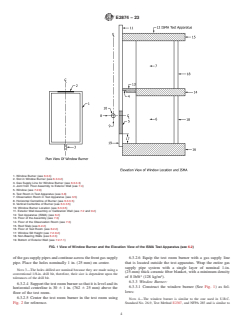
1. Window Burner (see 6.3.3)
2. Slot in Window Burner (see 6.3.3.2)
3. Gas Supply Line for Window Burner (see 6.3.3.3)
4. Joint from Floor Assembly to Exterior Wall (see 7.4)
5. Window (see 7.2.9)
6. Test Room in Test Apparatus (see 3.8)
7. Observation Room in Test Apparatus (see 3.5)
8. Horizontal Centerline of Burner (see 6.3.3.5)
9. Vertical Centerline of Burner (see 6.3.3.5)
10. Window Burner Location (see 6.3.3.5)
11. Exterior Wall Assembly or Calibration Wall (see 7.2 and 9.2)
12. Test Apparatus (ISMA) (see 6.2)
13. Floor of the Assembly (see 7.3)
14. Floor of the Observation Room (see 7.3)
15. Roof Slab (see 6.2.2)
16. Floor of Test Room (see 6.2.2)
17. Window Sill Height (see 7.2.9.2)
18. Non-Bearing Walls (see 6.2.3)
19. Bottom of Exterior Wall (see 7.2.7.1)
FIG. 1 View of Window Burner and the Elevation View of the ISMA Test Apparatus (see 6.2)
of the gas supply pipes and continue across the front gas supply 6.3.2.6 Equip the test room burner with a gas supply line
pipe. Place the holes nominally 1 in. (25 mm) on center. that is located outside the test apparatus. Wrap the entire gas
supply pipe system with a single layer of nominal 1-in.
NOTE 3—The holes drilled are nominal because they are made using a
(25-mm) thick ceramic fiber blanket, with a minimum density
conventional 1/8-in. drill bit, therefore, their size is dependent upon the
3 3
of 8 lb/ft (128 kg/m ).
tolerances of the drill bit.
6.3.3 Window Burner:
6.3.2.4 Support the test room burner so that it is level and its
6.3.3.1 Construct the window burner (See Fig. 1) as fol-
horizontal centerline is 30 6 1 in. (762 6 25 mm) above the
lows:
floor of the test room.
6.3.2.5 Center the test room burner in the test room using
NOTE 4—The window burner is similar to the one used in U.B.C.
Fig. 2 for reference. Standard No. 26-9, Test Method E2307, and NFPA 285 and is similar to
E2874 − 23
1. Gas Supply Line (see 6.3.2)
2. Concrete Slab (Floor of Test Room (see 6.2.2))
3. Walls (see 6.2.3)
4. Test Room Burner (see 6.3.2)
5. Area of Burner Holes (see 6.3.2.3)
6. Columns (see 6.2.2)
FIG. 2 Plan View of Test Room Burner Positioned in Test Room (see 6.3.1 for dimensions)
the burner used in the “Spread of Flame Test” portion of Test Methods
6.4 Test Room and Exterior Wall Assembly Thermocouples:
E108.
6.4.1 All thermocouples shall be a bare wire type.
6.3.3.2 The window burner shall be rectangular shaped. Use 6.4.2 The twelve test room thermocouples used to measure
a 60 6 0.5-in. (1524 6 13-mm) long piece of nominal 2-in.
the temperatures in the test room, reference the thermocouples
(51-mm) OD pipe for the front of the burner. Cut an upward in 8.1, 8.1.1, and 8.1.2, shall be 18 gauge Type K (See Fig. 3).
facing slot having a width and length measuring 0.5 6 0.06 in.
6.4.3 The 14 exterior wall assembly thermocouples used to
(13 6 1.5 mm) by 44 6 0.5 in. (1118 6 13 mm), respectively, measure the temperatures on the exterior face of the exterior
in the top of the pipe.
and calibration wall assemblies shall be no larger than 20
6.3.3.3 Supply the window burner with gas at both ends gauge Type K (See Fig. 4.).
using nominal 1-in. (25-mm) OD pipe and a “T” junction at the
6.5 Copper Disc Thermocouples:
back of the window burner to provide uniform gas pressure at
6.5.1 The copper disc thermocouples shall be covered by
the burner slot.
pads as specified in 6.7, and shall:
6.3.3.4 Wrap the window burner, including the slot, and the
6.5.1.1 Have a wire diameter of not more than 0.03 in. (0.7
entire gas supply pipe system with a layer of nominal 1-in. (25-
mm), and
mm) thick ceramic fiber insulation, with a minimum density of
6.5.1.2 Be brazed to the center of the face of a copper disk
3 3
8 lb/ft (128 kg/m ).
having the following nominal measurements: 0.5 in. (12 mm)
6.3.3.5 Position the window burner so that the slot is facing
diameter and 0.008 in. (0.2 mm) thick.
up and parallel with the exterior wall assembly. Align the
6.6 Thermocouple Insulating Pads:
horizontal center of the window burner slot with the window’s
6.6.1 Refractory fiber pads shall have the following prop-
horizontal centerline (See Fig. 1). Locate the horizontal cen-
erties:
terline of the window burner 9 6 0.5 in. (229 6 13 mm) below
6.6.1.1 Length and width, 1.20 6 0.02 in. (30 6 0.5 mm).
the window header’s surface on the exterior of the test room.
Place the window burner’s vertical centerline a maximum of 6.6.1.2 Thickness, 0.08 6 0.02 in. (2 6 0.5 mm). The
thickness measurement shall be made using a ⁄2-in. (13-mm)
6 in. (152 mm) from the exterior face of the exterior wall
assembly. The window burner’s exact distance from the wall’s diameter, anvil head micrometer, without compression of the
pad.
exterior face of the exterior wall assembly shall be determined
3 3
during the calibration procedure, as specified in 9.6. 6.6.1.3 Density of 56.2 6 6.2 lb/ft (900 6 100 kg/m ).
E2874 − 23
mm) diameter, be coated with a durable matt black finish, and
shall not be closed with a transparent cover.
NOTE 5—Commercially available heat flux meters are commonly
referred to as “heat flux transducers” or “heat flux gauges.”
6.7.2 Locate the heat flux meter either 6 6 in. (152 mm)
from the vertical centerline of the window opening, or, where
a center mullion is installed in the story above the window
opening in the test apparatus, 6 6 in. (152 mm) horizontally
from the edge of the center mullion.
6.7.3 Where a spandrel-panel or transom is installed as part
of the test specimen, the heat flux meter shall be located at a
height of 6 6 0.5 in. (152 6 13 mm) vertically above the top
of the spandrel-panel or transom.
6.7.4 Except as required in 6.7.3, the heat flux meter shall be
installed at a height of 12 6 0.5 in. (305 6 13 mm) above the
unexposed surface of the observation room floor.
6.7.5 Locate the measuring surface of the heat flux meter in
the observation room, at the required height, in a plane 4 6
0.25 in. (102 6 6 mm) from the interior face of the test
specimen.
6.7.6 Recorder—The output from the heat flux meter shall
be recorded by a strip chart recording millivoltmeter, computer
data logger, or other comparable method.
NOTE 6—A digital voltmeter capable of indicating signal changes of 10
μV has been found to be convenient for monitoring changes in operating
conditions of the radiant panel. A strip chart recorder with a paper speed
of 12 in./min (5 mm/s) has been found to be suitable.
6.7.7 Timing Devices—A chronograph and either an electric
clock with a sweep second hand or a digital clock shall be used
1. Roof Slab (see 6.2.2)
to measure time to ignition and to track the advancement of the
2. Columns (Typical) (see 6.2.2)
flame front with time.
3. Floor of Observation Room (see 7.3)
4. Floor of Test Room (see 6.2.4.2)
6.8 Cotton Pads:
5. Exterior Face of Calibration Wall (see 9.2.1)
6. Window Opening (see 6.2.2) 6.8.1 The cotton pad’s nominal size shall be 4 by 4 by 0.75
7. Horizontal Centerline of Calibration Wall (see 9.2.3)
in. (100 by 100 by 19 mm). Cotton pads are to consist of new,
8. Thermocouple #1 Location (see 9.4.2.1)
undyed, and soft cotton fibers, without any admixture of
9. Thermocouple #2 Location (see 9.4.2.2)
artificial fibers. Each cotton pad shall weigh 3 to 4 g. The
10. Thermocouple #3 and Lower Heat Flux Location (see 9.4.2.3 and 9.5.2)
11. Thermocouple #4 and Middle Heat Flux Location (see 9.4.2.3 and 9.5.2)
cotton pads are to be conditioned prior to use by drying in an
12. Thermocouple #5 and Upper Heat Flux Location (see 9.4.2.3 and 9.5.2)
oven at 212 6 9 °F (100 6 5 °C) for at least 30 h. After drying,
13. Thermocouple #6 Location (see 9.4.2.2)
the cotton pads shall be stored in a desiccator for up to 24 h
NOTE 1—Item 6 for Window Opening, reference should be made to
immediately prior to use.
7.2.9 for window opening information.
6.8.2 The frame used to hold the cotton pad is to be formed
NOTE 2—Item 13 for Thermocouple #6 Location, refer to 9.4.2.3 which
of No. 16 AWG (1.31-mm) steel wire and is to be provided
refers to the successive placement of thermocouples after the second
with a handle that will reach all points of the test specimen
thermocouple.
accessible from the observation room (See Fig. 5).
FIG. 3 ISMA and Calibration Wall Layout for Thermocouple and
Heat Flux Locations (see 6.2 and 9.2)
6.9 Pressure-Sensing Probes—Except for the diameters of
the steel tubes, tolerances are 65 % of dimensions shown in
Fig. 6 or Fig. 7.
3 3
6.9.1 The pressure-sensing probes shall be either:
6.6.1.4 Density of 56.2 6 6.2 lb/ft (900 6 100 kg/m ).
6.6.2 When necessary, shape the pads by wetting, forming, 6.9.1.1 A T-shaped sensor as shown in Fig. 6, or
6.9.1.2 A tube sensor as shown in Fig. 7.
and then drying them to provide complete contact on contoured
surfaces.
6.10 Differential Pressure Measurement Instruments:
6.10.1 The differential pressure measurement instrument
6.7 Heat Flux Measurements:
6.7.1 A Schmidt-Boelter (thermopile) type heat flux meter shall be:
with a nominal range of 0 to 50 kW/m and a time constant of 6.10.1.1 A manometer or transducer, and
not more than 3 s (corresponding to a time to reach 95 % of 6.10.1.2 Capable of reading in graduated increments of no
final output of not more than 10 s) shall be provided. The heat greater than 0.01 in. H O (2.5 Pa) with a precision of not less
flux meter’s sensing surface shall be flat, be less than 0.4 in. (10 than 60.005 in. H O (61.25 Pa).
E2874 − 23
(1) Roof Slab (Ref. 6.2.2)
(2) Column (Ref. 6.2.2)
(3) Floor of Observation Room (Ref. 6.2.2)
(4) Floor of Test Room (Ref. 6.2.2)
(5) Window Opening (Ref. 9.2.2)
(6) Visual Face of Calibration Wall (Ref. 9.2)
(7) Vertical Centerline of Test Wall (Ref. 9.4.2)
(8) Thermocouple #1 Location (Ref. 9.4.2.1)
(9) Thermocouple #2 Location (Ref. 9.4.2.2)
(10) Thermocouple #6 Location (Ref. 9.4.2.4)
FIG. 4 Thermocouple Layout on Visual Exterior Face of Calibration or Test Wall (See 9.4)
6.11 Calibration Instrumentation: 7.1.1.2 The position of the window burner relative to the
6.11.1 The total heat flux shall be measured using a mini- window opening shall be as established in 9.2.2.
mum of three circular foil heat flux gauges.
7.1.1.3 The window burner shall be located as specified in
6.3.3.5.
NOTE 7—More information about the Gardon gauge is contained in Test
Methods E511 and E1529.
7.2 Exterior Wall Assemblies:
6.11.2 Flow rate measurement equipment shall be provided
7.2.1 The exterior wall assembly shall be of a construction
for each of the burners.
agreed upon by the test sponsor and laboratory (See Fig. 8).
7.2.2 The exterior wall assembly shall be representative of
7. Test Specimen
that used in common construction practice.
7.1 The test specimen shall be representative of the con-
7.2.2.1 Where the exterior wall assembly includes seam,
struction for which the rating is desired with respect to
splices or joints, at least one vertical and one horizontal seam,
materials, workmanship, and details. Install the test specimen
splice or joint shall be located in the spandrel-panel. Vertical
according to the manufacturer’s specified procedure for con-
seams, splices or joints shall be located 63 in. from the vertical
ditions representative of those found in building construction.
centerline of the window opening of the test room, and
7.1.1 The top of the glazed opening in the test specimen
horizontal seams, splices or joints shall be located within 24
shall be located in the same horizontal plane as the bottom of
in., and directly above the window opening in the test
the spandrel-panel assembly.
7.1.1.1 The window opening shall be as specified in 7.2.9. assembly.
E2874 − 23
FIG. 5 Typical Cotton Wool Pad Holder (see 6.8.2)
7.2.3 The exterior wall assembly shall be secured to the test window burner relative to the window opening shall be that
apparatus at each end and to the floor assembly. These established from the calibration wall. The top of the window
fastening details to the test apparatus and those elsewhere
opening shall be coincident with the bottom edge of the
within the test specimen shall be representative of that used in spandrel-panel in the test specimen. This distance shall be
practice.
maintained during the conduct of the fire test of the test
7.2.4 Details of the erection shall follow the manufacturer’s specimen.
instructions and shall be typical of actual use.
NOTE 8—Test data has demonstrated that the calibrated exposure can be
7.2.5 Prior to the test, the exterior wall assembly and its
maintained with location of the window opening in the test specimen
components shall be conditioned as outlined in Section 10.
offset up to 9 inches from that used in the calibration wall.
7.2.6 The minimum height and width of the exterior wall
7.2.9.3 Be centered horizontally with respect to the test
assembly shall be 17.5 by 13.33 ft (5.34 by 4.06 m wide).
room, and
7.2.7 The exterior wall assembly shall extend as follows:
7.2.9.4 Be the only window opening at the start of the test.
7.2.7.1 Below the floor of the test room a minimum of 2 in.
(51 mm),
7.2.10 Structural Members:
7.2.7.2 Above the top of the test apparatus a minimum of 24
7.2.10.1 Secure a structural member to the underside of the
in. (610 mm), and
floor assembly construction when its use is required to repre-
7.2.7.3 Past the inside edges of both sidewalls of the
sent the common construction practice attachment of the
apparatus a minimum of 12 in. (305 mm).
exterior wall assembly,
7.2.8 The exterior wall assembly shall completely close the
7.2.10.2 Extend the structural member across the test room
front face of the test apparatus except for a simulated window
from one interior wall surface to the opposite interior wall
opening in the test room.
surface of the test room.
7.2.9 The window opening in the test room shall:
7.2.10.3 The structural member shall be as used in common
7.2.9.1 Have a height and width measuring 30 by 78 in. (762
construction practice. Protect any outriggers and additional
by 1981 mm) with a tolerance of 60.5 in. (613 mm). The
connections as used in common construction practice.
exterior wall assembly shall include two layers of nominal
0.625-in. (15.9-mm) thick Type X gypsum wallboard covering
7.3 Floor Assembly:
an area extending downward from a horizontal line at the
7.3.1 The floor assembly shall be a construction agreed
elevation of the window lintel to the bottom of the exterior wall
upon by the test sponsor and laboratory (See Fig. 1).
assembly minus the window opening. The gypsum wallboard
7.3.2 The floor assembly installed into the test apparatus
shall be located and fastened as shown on Fig. 8.
shall have a fire resistance rating and be representative of that
7.2.9.2 For the exterior wall assembly, the position of the
used in common construction practice and be at least 12 in.
window opening shall be 30 to 39 in. (762 to 990 mm)
(305 mm) wide and at least 12 ft (3.96 m) long.
measured between the bottom edge (sill) of the opening and the
top of the floor assembly of the test room. The position of the 7.4 Floor Assembly – Exterior Wall Assembly Intersection:
E2874 − 23
FIG. 6 T-Shaped Pressure Sensor (see 6.9.1.1)
7.4.1 Where a void is created at the intersection of the 8.1.1 Uniformly distribute at least five bare wire thermo-
exterior wall assembly and the floor assembly, it shall be couples to measure the temperature at the underside of the floor
protected so as to prevent the vertical interior spread of fire, of the observation room (See Fig. 9).
heat and hot gases.
8.1.2 The exposed length of the bare wire thermocouples
positioned at the underside of the observation room floor shall
NOTE 9—While not part of the test specimen, it is important to ensure
be at least 6 in. (152 mm).
that the linear void located between the exterior wall and the floor slab is
filled and protected in such a manner as to be capable of preventing
8.2 Test Room Pressure:
temperature rise on the unexposed surface measured above the horizontal
separation, so as not to affect the measurements described in 8.2.1. 8.2.1 The minimum vertical distance between pressure
sensors, referenced in 6.10, shall be one-half the height of the
8. Test Room Controls
test room or locate one probe 12 in. below the exposed surface
8.1 Test Room Thermocouples–Underside of the of the floor assembly. Locate the pressure sensors where they
Observation-Room Floor: will not be subjected to direct impingement of convection
E2874 − 23
FIG. 7 Tube Sensor (see 6.9.1.2)
currents. Tubing connected to each pre
...
This document is not an ASTM standard and is intended only to provide the user of an ASTM standard an indication of what changes have been made to the previous version. Because
it may not be technically possible to adequately depict all changes accurately, ASTM recommends that users consult prior editions as appropriate. In all cases only the current version
of the standard as published by ASTM is to be considered the official document.
Designation: E2874 − 19 E2874 − 23 An American National Standard
Standard Test Method for
Determining the Fire-Test Response Characteristics of a
Building Spandrel-Panel Assembly Due to External Spread
of Fire
This standard is issued under the fixed designation E2874; the number immediately following the designation indicates the year of
original adoption or, in the case of revision, the year of last revision. A number in parentheses indicates the year of last reapproval. A
superscript epsilon (´) indicates an editorial change since the last revision or reapproval.
INTRODUCTION
This standard test method evaluates the ability of the spandrel-panel assembly in an exterior wall
assembly, with or without glazing, to impede the spread of fire to the interior of the room or the story
immediately above it via fire spread from the exterior of a building. A building spandrel-panel
assembly includes the exterior wall spandrel-panel assembly and any glazing. The spandrel-panel
assembly is a unique building construction detail not addressed by other fire test methods.
A building’s spandrel-panel assembly impedes the vertical spread of fire from the floor of origin to
the floor immediately above it, via an exterior fire exposure.
This test method describes criteria used to determine the fire performance of spandrel-panel
assemblies when subjected to standard fire exposure conditions. This test method is intended to
simulate a possible fire exposure due to a post flashover compartment fire venting through an opening,
onto the exterior surface of a spandrel-panel assembly.
1. Scope
1.1 This test method evaluates the fire-test response characteristics of a spandrel-panel assembly spanning the intersection of a
floor assembly.
1.2 This test method is used to assess the spandrel-panel assembly’s ability to impede spread of fire to the interior of the room
or the story immediately above it via fire spread from the exterior of a building, and provide a quantitative measure of the fire
hazard in terms of an I-Rating, T-Rating, and F-Rating from a specified set of fire conditions involving specific materials, products,
or assemblies.
1.3 This test evaluates the performance of the portions of the exterior wall installed between vertically adjacent window openings
in multi-story buildings.
1.4 This test method addresses the potential for fire spread to a single story immediately above the room of fire origin.
1.5 The test method simulates a fire in a post-flashover condition in a compartment that is venting to the exterior through a window
opening.
This test method is under the jurisdiction of ASTM Committee E05 on Fire Standards and is the direct responsibility of Subcommittee E05.11 on Fire Resistance.
Current edition approved Feb. 1, 2019Nov. 1, 2023. Published March 2019December 2023. Originally approved in 2019. Last previous edition approved in 2019 as
E2874 – 19. DOI: 10.1520/E2874-19.10.1520/E2874-23.
Copyright © ASTM International, 100 Barr Harbor Drive, PO Box C700, West Conshohocken, PA 19428-2959. United States
E2874 − 23
1.6 The fire exposure conditions within the test room are those specified by this test method for the first 30 min of exposure and
then conform to Test Methods E119 time-temperature curve for the remainder of the test. The fire exposure on the exterior surface
of the test specimen comprises both the exposure from the fire plume exiting the window opening of the test room and the exterior
burner, although the fire exposure on the exterior surface of the test assembly is not equivalent to that of Test Methods E119.
1.7 This test method specifies the heating conditions, methods of test, and criteria for evaluation of a building’s spandrel-panel
assembly. Specimens are not tested using any super-imposed axial load.
1.8 Test results establish the performance of the spandrel-panel assembly during the fire-exposure period and shall not be
construed as having determined the suitability of a spandrel-panel assembly for use after that exposure.
1.9 This test method does not provide quantitative information about the spandrel-panel assembly relative to the rate of leakage
of smoke or gases, or both.
1.9.1 This test method does not evaluate the fire-test-response characteristics of perimeter joint protection between the floor
assembly and the exterior wall assembly. This is covered in Test Method E2307.
1.10 This test method does not evaluate the fire-test-response characteristics or fire propagation propensity of material installed
on, or within, exterior non-load-bearing wall assemblies containing combustible components. This is covered in NFPA 285.
1.11 The values stated in inch-pound units are to be regarded as the standard. Where provided, the SI values given in parentheses
are for information only.
1.12 The text of this test method references notes and footnotes which provide explanatory material. These notes and footnotes
(excluding those in tables and figures) shall not be considered as requirements of the standard.
1.13 This test method is used to measure and describe the response of materials, products or assemblies to heat and flame under
controlled conditions but does not by itself incorporate all factors required for the fire-hazard or fire-risk assessment of the
materials, products, or assemblies under actual fire conditions.
1.14 This standard does not purport to address all of the safety concerns, if any, associated with its use. It is the responsibility
of the user of this standard to establish appropriate safety, health, and environmental practices and determine the applicability of
regulatory limitations prior to use.
1.15 Fire testing is inherently hazardous. Adequate safeguards for personnel and property shall be employed in conducting these
tests.
1.16 This international standard was developed in accordance with internationally recognized principles on standardization
established in the Decision on Principles for the Development of International Standards, Guides and Recommendations issued
by the World Trade Organization Technical Barriers to Trade (TBT) Committee.
2. Referenced Documents
2.1 ASTM Standards
E108 Test Methods for Fire Tests of Roof Coverings
E119 Test Methods for Fire Tests of Building Construction and Materials
E176 Terminology of Fire Standards
E511 Test Method for Measuring Heat Flux Using a Copper-Constantan Circular Foil, Heat-Flux Transducer
E631 Terminology of Building Constructions
E1529 Test Methods for Determining Effects of Large Hydrocarbon Pool Fires on Structural Members and Assemblies
E1966 Test Method for Fire-Resistive Joint Systems
E2307 Test Method for Determining Fire Resistance of Perimeter Fire Barriers Using Intermediate-Scale, Multi-story Test
Apparatus
For referenced ASTM standards, visit the ASTM website, www.astm.org, or contact ASTM Customer Service at service@astm.org. For Annual Book of ASTM Standards
volume information, refer to the standard’s Document Summary page on the ASTM website.
E2874 − 23
2.2 NFPA Standard:
NFPA 285 Standard Method of Test for the Evaluation of Flammability Characteristics of Exterior Non-Load-Bearing Wall
Assemblies Containing Combustible Components Using the Intermediate-Scale, Multistory Test Apparatus
3. Terminology
3.1 Terms defined in Terminology E176 and E631 shall prevail for fire standard and building terms not defined in this document.
3.2 exterior wall assembly, n—a non-load bearing or load bearing wall located on the exterior of a building that is either fire
resistance rated or one that is not.
3.3 floor assembly, n—a fire resistance rated load bearing horizontal assembly which is either adjacent, or part of the floor of the
observation room.
3.3.1 Discussion—
Floor assemblies tested in accordance with Test Methods E119 are required to be load bearing.
3.4 integrity rating, n—ability of the spandrel-panel assembly to prevent the passage of flame and hot gases through it, and the
occurrence of flames on its unexposed side.
3.5 observation room, n—the second-story room of the Intermediate-Scale, Multi-story Test Apparatus (ISMA).
3.6 spandrel-panel assembly, n—the portion of a building’s exterior wall assembly, which is comprised of the spandrel-panel,
fasteners, structural supports and any glazing, located between the top of the window opening in one story and the sill of the
window opening one adjacent story immediately above.
3.6.1 Discussion—
The term “spandrel-panel” is a commonly used architectural term. When used in conjunction with a curtain wall, this term is
defined by The Oxford Dictionary of Architecture (3rd ed.), as follows: Part of a wall between the head of a window-aperture and
the sill of the window above in a building of two or more stories, especially in a curtain-wall.
3.7 test assembly, n—the complete assembly of the test specimen together with the test apparatus.
3.8 test room, n—the first-story room of the ISMA.
3.9 test specimen, n—the specific design details of the spandrel-panel assembly evaluated during the test.
4. Summary of Test Method
4.1 This test method describes the following test sequence and procedure:
4.1.1 A spandrel-panel assembly is conditioned and fire tested.
4.1.2 During the fire test, the performance of the spandrel-panel assembly is determined by use of a cotton pad; the resistance to
flames and hot gases is determined by visual observations; the resistance to heat transfer is determined by unexposed surface
temperature measurements; and heat flux is determined using radiometers.
4.2 The end point of the fire test occurs at the time the first interpretation of results is reached when the spandrel-panel assembly
is subjected to the time-temperature fire exposure described in this test method.
5. Significance and Use
5.1 This test method provides for the following measurements and evaluations:
5.1.1 Ability of the spandrel-panel assembly to resist the passage of flames or hot gases sufficient to ignite a cotton pad, or be
visible to an observer.
Available from National Fire Protection Association (NFPA), 1 Batterymarch Park, Quincy, MA 02169-7471, http://www.nfpa.org.
James Stevens Curl and Susan Wilson, Oxford University Press, 2015. Originally published by Oxford University Press in 2000.
E2874 − 23
5.1.2 Transmission of heat through, and above, the spandrel-panel assembly using heat flux and unexposed surface temperature
measurements.
5.2 This test method does not provide the following:
5.2.1 This test method does not evaluate the fire propagation characteristics of exterior nonload-bearing wall assemblies
containing combustible components, or flame spread over the test assembly.
5.2.2 This test method does not evaluate the fire-test-response characteristics of the perimeter joint protection between the floor
assembly and the exterior wall assembly. This is covered in Test Method E2307.
5.2.3 Evaluation of the degree to which the spandrel-panel assembly contributes to the fire hazard by generation of smoke, toxic
gases, or other products of combustion,
5.2.4 Measurement of the degree of control or limitation of the passage of smoke or products of combustion through the
spandrel-panel assembly,
5.2.5 Measurement of flame spread over the surface of the spandrel-panel assembly or exterior wall assembly,
5.2.6 Durability of the test specimen under actual service conditions, including the effects of cycled temperature,
5.2.7 Effects of loads (for example, wind, seismic, etc.) on the spandrel-panel assembly established by this test method,
5.2.8 Movement capabilities of the test specimen,
5.2.9 Other attributes of the test specimen, such as wear resistance, chemical resistance, air infiltration, water-tightness, and so
forth, and
5.2.10 Lateral spread of flame from the compartment of fire origin to adjacent spaces.
5.3 In this test method, the test specimens are subjected to one or more specific test conditions. When different test conditions are
substituted or the end-use conditions are changed, it is not always possible by, or from, this test method to predict changes to the
characteristics measured.
5.4 This test method is not intended to be used as the only test method in the selection of a spandrel-panel assembly. It is not
intended as a specification for all attributes required by a spandrel-panel assembly, or any of its individual components, in order
for a spandrel-panel assembly to be used in a particular application.
6. Apparatus
6.1 The test apparatus described in 6.2 shall be located inside a test facility. The facility shall have provisions for supplying fresh
combustion make-up air during the test. The facility shall be constructed to allow for the exhaust of the combustion by-products
during the test, while not inducing airflow on the exterior face of the test specimen. The test facility shall protect the test apparatus
and test specimen from weather conditions such as wind and rain.
6.2 Test Apparatus:
6.2.1 The ISMA consists of a two-story test structure consisting of a test room and observation room (See Fig. 1). Each room in
the test apparatus is square having inside length and width dimensions (unfinished and unprotected by any fire resistive materials)
of 120 6 0.5 in. (3048 6 13 mm) and a height (unfinished and unprotected by any fire resistive materials) of 84 6 0.5 in. (2134
6 13 mm).
NOTE 1—The test apparatus is similar to the one used in NFPA 285 and Test Method E2307.
E2874 − 23
1. Window Burner (see 6.3.3)
2. Slot in Window Burner (see 6.3.3.2)
3. Gas Supply Line for Window Burner (see 6.3.3.3)
4. Joint from Floor Assembly to Exterior Wall (see 7.4)
5. Window (see 7.2.9)
6. Test Room in Test Apparatus (see 3.8)
7. Observation Room in Test Apparatus (see 3.5)
8. Horizontal Centerline of Burner (see 6.3.3.5)
9. Vertical Centerline of Burner (see 6.3.3.5)
10. Window Burner Location (see 6.3.3.5)
11. Exterior Wall Assembly or Calibration Wall (see 7.2 and 9.2)
12. Test Apparatus (ISMA) (see 6.2)
13. Floor of the Assembly (see 7.3)
14. Floor of the Observation Room (see 7.3)
15. Roof Slab (see 6.2.2)
16. Floor of Test Room (see 6.2.2)
17. Window Sill Height (see 7.2.9.2)
18. Non-Bearing Walls (see 6.2.3)
19. Bottom of Exterior Wall (see 7.2.7.1)
FIG. 1 View of Window Burner and the Elevation View of the ISMA Test Apparatus (see 6.2)
6.2.2 The floors and roof of the test apparatus shall be supported by columns and beams of a size that will support the load of
the floor and roof. These supports shall be located outside of both the test room and the observation room. (See Fig. 2 and Fig.
3.)
6.2.3 The three permanent non-bearing walls that form each room of the test apparatus shall support the insulation defined in
6.2.4.1 during the entire fire test.
NOTE 2—Concrete block, 8 6 0.5 in. (203 6 13 mm) thick, has been found to be acceptable.
E2874 − 23
1. Gas Supply Line (see 6.3.2)
2. Concrete Slab (Floor of Test Room (see 6.2.2))
3. Walls (see 6.2.3)
4. Test Room Burner (see 6.3.2)
5. Area of Burner Holes (see 6.3.2.3)
6. Columns (see 6.2.2)
FIG. 2 Plan View of Test Room Burner Positioned in Test Room (see 6.3.1 for dimensions)
6.2.4 No insulation is required in the observation room; but the interior surfaces of the test room shall be insulated.
6.2.4.1 Insulate the interior face of the walls forming the test room with one layer of 2.0 6 0.5 in. (51 6 13 mm) thick ceramic
3 3
fiber insulation, having a minimum density of 8 lb/ft (128 kg/m ). Insulate the underside of the floor of the observation room in
the same manner, except that the portion that is designated the “floor assembly,” which is adjacent to the test specimen, shall not
be insulated (See Fig. 1 and 7.4).
6.2.4.2 Insulate the floor of the test room with two layers of nominal 0.625-in. (15.9-mm) thick, Type X gypsum wallboard.
6.2.5 Openings are permitted in the test room and in the observation room.
6.2.5.1 The observation room shall have one access opening with a width and height of nominal 3.5 by 6.75 ft (1.07 by 2.06 m).
The access opening shall remain open during tests. Additional access openings are permitted in the observation room for
instrumentation and video; however, they shall be closed during the test.
6.2.5.2 The test room is permitted to have one access opening with a width and height of nominal 3.5 by 6.75 ft (1.07 by 2.06
m). This opening shall be closed during tests.
6.3 Burners:
6.3.1 The test apparatus in 6.2 shall be equipped with two gas-fired burners.
6.3.2 Test Room Burner:
6.3.2.1 Position the test room burner inside the test room. Construct the test room burner (See Fig. 2) as follows:
E2874 − 23
1. Roof Slab (see 6.2.2)
2. Columns (Typical) (see 6.2.2)
3. Floor of Observation Room (see 7.3)
4. Floor of Test Room (see 6.2.4.2)
5. Exterior Face of Calibration Wall (see 9.2.1)
6. Window Opening (see 6.2.2)
7. Horizontal Centerline of Calibration Wall (see 9.2.3)
8. Thermocouple #1 Location (see 9.4.2.1)
9. Thermocouple #2 Location (see 9.4.2.2)
10. Thermocouple #3 and Lower Heat Flux Location (see 9.4.2.3 and 9.5.2)
11. Thermocouple #4 and Middle Heat Flux Location (see 9.4.2.3 and 9.5.2)
12. Thermocouple #5 and Upper Heat Flux Location (see 9.4.2.3 and 9.5.2)
13. Thermocouple #6 Location (see 9.4.2.2)
NOTE 1—Item 6 for Window Opening, reference should be made to 7.2.9 for window opening information.
NOTE 2—Item 13 for Thermocouple #6 Location, refer to 9.4.2.3 which refers to the successive placement of thermocouples after the second
thermocouple.
FIG. 3 ISMA and Calibration Wall Layout for Thermocouple and Heat Flux Locations (see 6.2 and 9.2)
6.3.2.2 Use a nominal 2-in. (51-mm) OD steel pipe. The test room burner shall be rectangular shaped with its longitudinal axis
at least 78.75 in. (2000 mm) long and its transverse axis at least 60 in. (1524 mm) wide. Extend 72 6 1 in. (1829 6 25 mm) of
the test room burner into the test room.
6.3.2.3 Drill upward facing nominal diameter 0.125-in. (3.2-mm) holes in the pipe. Locate the holes in the front “U” shaped
portion of the test room burner. Start holes at a nominal location of 42 in. (1066 mm) from the back wall on both sides of the gas
supply pipes and continue across the front gas supply pipe. Place the holes nominally 1 in. (25 mm) on center.
NOTE 3—The holes drilled are nominal because they are made using a conventional 1/8-in. drill bit, therefore, their size is dependent upon the tolerances
of the drill bit.
6.3.2.4 Support the test room burner so that it is level and its horizontal centerline is 30 6 1 in. (762 6 25 mm) above the floor
of the test room.
E2874 − 23
6.3.2.5 Center the test room burner in the test room using Fig. 2 for reference.
6.3.2.6 Equip the test room burner with a gas supply line that is located outside the test apparatus. Wrap the entire gas supply pipe
3 3
system with a single layer of nominal 1-in. (25-mm) thick ceramic fiber blanket, with a minimum density of 8 lb/ft (128 kg/m ).
6.3.3 Window Burner:
6.3.3.1 Construct the window burner (See Fig. 1) as follows:
NOTE 4—The window burner is similar to the one used in U.B.C. Standard No. 26-9, Test Method E2307, and NFPA 285 and is similar to the burner
used in the “Spread of Flame Test” portion of Test Methods E108.
6.3.3.2 The window burner shall be rectangular shaped. Use a 60 6 0.5-in. (1524 6 13-mm) long piece of nominal 2-in. (51-mm)
OD pipe for the front of the burner. Cut an upward facing slot having a width and length measuring 0.5 6 0.06 in. (13 6 1.5 mm)
by 44 6 0.5 in. (1118 6 13 mm), respectively, in the top of the pipe.
6.3.3.3 Supply the window burner with gas at both ends using nominal 1-in. (25-mm) OD pipe and a “T” junction at the back of
the window burner to provide uniform gas pressure at the burner slot.
6.3.3.4 Wrap the window burner, including the slot, and the entire gas supply pipe system with a layer of nominal 1-in. (25- mm)
3 3
thick ceramic fiber insulation, with a minimum density of 8 lb/ft (128 kg/m ).
6.3.3.5 Position the window burner so that the slot is facing up and parallel with the exterior wall assembly. Align the horizontal
center of the window burner slot with the window’s horizontal centerline (See Fig. 1). Locate the horizontal centerline of the
window burner 9 6 0.5 in. (229 6 13 mm) below the window header’s surface on the exterior of the test room. Place the window
burner’s vertical centerline a maximum of 6 in. (152 mm) from the exterior face of the exterior wall assembly. The window
burner’s exact distance from the wall’s exterior face of the exterior wall assembly shall be determined during the calibration
procedure, as specified in 9.6.
6.4 Test Room and Exterior Wall Assembly Thermocouples:
6.4.1 All thermocouples shall be a bare wire type.
6.4.2 The twelve test room thermocouples used to measure the temperatures in the test room, reference the thermocouples in 8.1,
8.1.1, and 8.1.2, shall be 18 gauge Type K (See Fig. 3).
6.4.3 The 14 exterior wall assembly thermocouples used to measure the temperatures on the exterior face of the exterior wall
assembly shall be and calibration wall assemblies shall be no larger than 20 gauge Type K. K (See Fig. 4.).
6.5 Copper Disc Thermocouples:
6.5.1 The copper disc thermocouples shall be covered by pads as specified in 6.7, and shall:
6.5.1.1 Have a wire diameter of not more than 0.03 in. (0.7 mm), and
6.5.1.2 Be brazed to the center of the face of a copper disk having the following nominal measurements: 0.5 in. (12 mm) diameter
and 0.008 in. (0.2 mm) thick.
6.6 Thermocouple Insulating Pads:
6.6.1 Refractory fiber pads shall have the following properties:
6.6.1.1 Length and width, 1.20 6 0.02 in. (30 6 0.5 mm).
6.6.1.2 Thickness, 0.08 6 0.02 in. (2 6 0.5 mm). The thickness measurement shall be made using a ⁄2-in. (13-mm) diameter, anvil
head micrometer, without compression of the pad.
E2874 − 23
(1) Roof Slab (Ref. 6.2.2)
(2) Column (Ref. 6.2.2)
(3) Floor of Observation Room (Ref. 6.2.2)
(4) Floor of Test Room (Ref. 6.2.2)
(5) Window Opening (Ref. 9.2.2)
(6) Visual Face of Calibration Wall (Ref. 9.2)
(7) Vertical Centerline of Test Wall (Ref. 9.4.2)
(8) Thermocouple #1 Location (Ref. 9.4.2.1)
(9) Thermocouple #2 Location (Ref. 9.4.2.2)
(10) Thermocouple #6 Location (Ref. 9.4.2.4)
FIG. 4 Thermocouple Layout on Visual Exterior Face of Calibration or Test Wall (See 9.4)
3 3
6.6.1.3 Density of 56.2 6 6.2 lb/ft (900 6 100 kg/m ).
3 3
6.6.1.4 Density of 56.2 6 6.2 lb/ft (900 6 100 kg/m ).
6.6.2 When necessary, shape the pads by wetting, forming, and then drying them to provide complete contact on contoured
surfaces.
6.7 Heat Flux Measurements:
6.7.1 A Schmidt-Boelter (thermopile) type heat flux meter with a nominal range of 0 to 50 kW/m and a time constant of not more
than 3 s (corresponding to a time to reach 95 % of final output of not more than 10 s) shall be provided. The heat flux meter’s
sensing surface shall be flat, be less than 0.4 in. (10 mm) diameter, be coated with a durable matt black finish, and shall not be
closed with a transparent cover.
NOTE 5—Commercially available heat flux meters are commonly referred to as “heat flux transducers” or “heat flux gauges.”
E2874 − 23
6.7.2 Locate the heat flux meter either 6 6 in. (152 mm) from the vertical centerline of the window opening, or, where a center
mullion is installed in the story above the window opening in the test apparatus, 6 6 in. (152 mm) horizontally from the edge of
the center mullion.
6.7.3 Where a spandrel-panel or transom is installed as part of the test specimen, the heat flux meter shall be located at a height
of 6 6 0.5 in. (152 6 13 mm) vertically above the top of the spandrel-panel or transom.
6.7.4 Except as required in 6.7.3, the heat flux meter shall be installed at a height of 12 6 0.5 in. (305 6 13 mm) above the
unexposed surface of the observation room floor.
6.7.5 Locate the measuring surface of the heat flux meter in the observation room, at the required height, in a plane 4 6 0.25 in.
(102 6 6 mm) from the interior face of the test specimen.
6.7.6 Recorder—The output from the heat flux meter shall be recorded by a strip chart recording millivoltmeter, computer data
logger, or other comparable method.
NOTE 6—A digital voltmeter capable of indicating signal changes of 10 μV has been found to be convenient for monitoring changes in operating conditions
of the radiant panel. A strip chart recorder with a paper speed of 12 in./min (5 mm/s) has been found to be suitable.
6.7.7 Timing Devices—A chronograph and either an electric clock with a sweep second hand or a digital clock shall be used to
measure time to ignition and to track the advancement of the flame front with time.
6.8 Cotton Pads:
6.8.1 The cotton pad’s nominal size shall be 4 by 4 by 0.75 in. (100 by 100 by 19 mm). Cotton pads are to consist of new, undyed,
and soft cotton fibers, without any admixture of artificial fibers. Each cotton pad shall weigh 3 to 4 g. The cotton pads are to be
conditioned prior to use by drying in an oven at 212 6 9 °F (100 6 5 °C) for at least 30 h. After drying, the cotton pads shall
be stored in a desiccator for up to 24 h immediately prior to use.
6.8.2 The frame used to hold the cotton pad is to be formed of No. 16 AWG (1.31-mm) steel wire and is to be provided with a
handle that will reach all points of the test specimen accessible from the observation room (See Fig. 45).
FIG. 45 Typical Cotton Wool Pad Holder (see 6.8.2)
E2874 − 23
6.9 Pressure-Sensing Probes—Except for the diameters of the steel tubes, tolerances are 65 % of dimensions shown in Fig. 56
or Fig. 67.
6.9.1 The pressure-sensing probes shall be either:
6.9.1.1 A T-shaped sensor as shown in Fig. 56, or
6.9.1.2 A tube sensor as shown in Fig. 67.
6.10 Differential Pressure Measurement Instruments:
6.10.1 The differential pressure measurement instrument shall be:
6.10.1.1 A manometer or transducer, and
FIG. 56 T-Shaped Pressure Sensor (see 6.9.1.1)
E2874 − 23
FIG. 67 Tube Sensor (see 6.9.1.2)
6.10.1.2 Capable of reading in graduated increments of no greater than 0.01 in. H O (2.5 Pa) with a precision of not less than
60.005 in. H O (61.25 Pa).
6.11 Calibration Instrumentation:
6.11.1 The total heat flux shall be measured using a minimum of three circular foil heat flux gauges.
NOTE 7—More information about the Gardon gauge is contained in Test Methods E511 and E1529.
6.11.2 Flow rate measurement equipment shall be provided for each of the burners.
7. Test Specimen
7.1 The test specimen shall be representative of the construction for which the rating is desired with respect to materials,
workmanship, and details. Install the test specimen according to the manufacturer’s specified procedure for conditions
representative of those found in building construction.
7.1.1 The top of the glazed opening in the test specimen shall be located in the same horizontal plane as the bottom of the
spandrel-panel assembly.
7.1.1.1 The window opening shall be as specified in 7.2.9.
7.1.1.2 The position of the window burner relative to the window opening shall be as established in 9.2.2.
7.1.1.3 The window burner shall be located as specified in 6.3.3.5.
7.2 Exterior Wall Assemblies:
E2874 − 23
7.2.1 The exterior wall assembly shall be of a construction agreed upon by the test sponsor and laboratory (See Fig. 78).
1. Exterior Wall Assembly or Clarification Wall (see 7.2 or 9.2)
2. Window (see 7.2.9)
3. Test Frame (optional)
FIG. 78 Example of an Exterior Wall Assembly with the Window Opening in a Test Frame (see 7.2.1). (Examples of Center Mullion or
Center Spandrel Configurations are shown.)
E2874 − 23
7.2.2 The exterior wall assembly shall be representative of that used in common construction practice.
7.2.2.1 Where the exterior wall assembly includes seam, splices or joints, at least one vertical and one horizontal seam, splice or
joint shall be located in the spandrel-panel. Vertical seams, splices or joints shall be located 63 in. from the vertical centerline of
the window opening of the test room, and horizontal seams, splices or joints shall be located within 24 in., and directly above the
window opening in the test assembly.
7.2.3 The exterior wall assembly shall be secured to the test apparatus at each end and to the floor assembly. These fastening
details to the test apparatus and those elsewhere within the test specimen shall be representative of that used in practice.
7.2.4 Details of the erection shall follow the manufacturer’s instructions and shall be typical of actual use.
7.2.5 Prior to the test, the exterior wall assembly and its components shall be conditioned as outlined in Section 10.
7.2.6 The minimum height and width of the exterior wall assembly shall be 17.5 by 13.33 ft (5.34 by 4.06 m wide).
7.2.7 The exterior wall assembly shall extend as follows:
7.2.7.1 Below the floor of the test room a minimum of 2 in. (51 mm),
7.2.7.2 Above the top of the test apparatus a minimum of 24 in. (610 mm), and
7.2.7.3 Past the inside edges of both sidewalls of the apparatus a minimum of 12 in. (305 mm).
7.2.8 The exterior wall assembly shall completely close the front face of the test apparatus except for a simulated window opening
in the test room.
7.2.9 The window opening in the test room shall:
7.2.9.1 Have a height and width measuring 30 by 78 in. (762 by 1981 mm) with a tolerance of 60.5 in. (613 mm). The exterior
wall assembly shall include two layers of nominal 0.625-in. (15.9-mm) thick Type X gypsum wallboard covering an area extending
downward from a horizontal line at the elevation of the window lintel to the bottom of the exterior wall assembly minus the
window opening. The gypsum wallboard shall be located and fastened as shown on Fig. 78.
7.2.9.2 For the exterior wall assembly, the position of the window opening shall be 30 to 39 in. (762 to 990 mm) measured between
the bottom edge (sill) of the opening and the top of the floor assembly of the test room. The position of the window burner relative
to the window opening shall be that established from the calibration wall. The top of the window opening shall be coincident with
the bottom edge of the spandrel-panel in the test specimen. This distance shall be maintained during the conduct of the fire test
of the test specimen.
NOTE 8—Test data has demonstrated that the calibrated exposure can be maintained with location of the window opening in the test specimen offset up
to 9 inches from that used in the calibration wall.
7.2.9.3 Be centered horizontally with respect to the test room, and
7.2.9.4 Be the only window opening at the start of the test.
7.2.10 Structural Members:
7.2.10.1 Secure a structural member to the underside of the floor assembly construction when its use is required to represent the
common construction practice attachment of the exterior wall assembly,
7.2.10.2 Extend the structural member across the test room from one interior wall surface to the opposite interior wall surface of
the test room.
7.2.10.3 The structural member shall be as used in common construction practice. Protect any outriggers and additional
connections as used in common construction practice.
E2874 − 23
7.3 Floor Assembly:
7.3.1 The floor assembly shall be a construction agreed upon by the test sponsor and laboratory (See Fig. 1).
7.3.2 The floor assembly installed into the test apparatus shall have a fire resistance rating and be representative of that used in
common construction practice and be at least 12 in. (305 mm) wide and at least 12 ft (3.96 m) long.
7.4 Floor Assembly – Exterior Wall Assembly Intersection:
7.4.1 Where a void is created at the intersection of the exterior wall assembly and the floor assembly, it shall be protected so as
to prevent the vertical interior spread of fire, heat and hot gases.
NOTE 9—While not part of the test specimen, it is important to ensure that the linear void located between the exterior wall and the floor slab is filled
and protected in such a manner as to be capable of preventing temperature rise on the unexposed surface measured above the horizontal separation, so
as not to affect the measurements described in 8.2.1.
8. Test Room Controls
8.1 Test Room Thermocouples–Underside of the Observation-Room Floor:
8.1.1 Uniformly distribute at least five bare wire thermocouples to measure the temperature at the underside of the floor of the
observation room (See Fig. 89).
8.1.2 The exposed length of the bare wire thermocouples positioned at the underside of the observation room floor shall be at least
6 in. (152 mm).
8.2 Test Room Pressure:
8.2.1 The minimum vertical distance between pressure sensors, referenced in 6.10, shall be one-half the height of the test room
or locate one probe 12 in. below the exposed surface of the floor assembly. Locate the pressure sensors where they will not be
subjected to direct impingement of convection currents. Tubing connected to each pressure sensor horizontal both in the test room
and at its egress through the test room wall shall be such that the pressure is relative to the same elevation from the inside to the
outside of the test room.
9. Calibration and Standardization
9.1 Frequency:
1. Test Room Thermocouple Locations (Typical) (see 8.1)
2. Floor of Test Room (see 6.2.2)
3. Wall (see 6.2.3)
4. Column (Typical) (see 6.2.2)
FIG. 89 Exposed Thermocouple Layout on the Underside of the Observation Room Floor (see 8.1.1)
E2874 − 23
9.1.1 Perform the following calibration procedure to evaluate the flow rates of the gas burners:
9.1.1.1 Prior to product testing, or
9.1.1.2 When significant changes to the gas flow systems are made (that is, new flow meters, and the like), or
9.1.1.3 Within one year prior to the test of an actual product wall assembly.
9.2 Calibration Wall:
9.2.1 Construct the calibration wall for the calibration test of two layers of nominal 0.625 in. (15.9 mm) thick, Type X gypsum
wallboard applied to both sides of 18-gauge steel studs spaced approximately 24 in. (610 mm) on centers. Tape all butt joints of
the gypsum wallboard. Extend the calibration wall at least 18 ft (5.49 m) above the floor of the test room and make the calibration
wall at least 12 ft (4.27 m) wide.
NOTE 10—The 21st Edition of the Gypsum Association’s Fire Resistance Design Manual (GA-600-15) provides a detail of this construction designated
GA File No. WP 1548.
9.2.2 For the calibration wall, locate the sill at a height of 30 6 0.5 in. (762 6 13 mm) above the top of the floor assembly of
the test room. The position of the window burner relative to the window opening shall be established from the calibration wall.
9.2.3 The window opening shall be centered horizontally with respect to the test room, and
9.2.4 The window opening shall be the only opening in the test room at the start of the test.
9.2.5 Line the interior surface of the window opening with gypsum wallboard, ceramic fiber insulation, or mineral wool insulation.
9.2.6 Do not use a spandrel beam
9.2.7 Measure the distance from the inside of the back wall of the test room to the interior face of the calibration wall. Record
this measurement.
9.2.8 When an opening between the test room and the calibration wall exists, fill it with a ceramic fiber material having a nominal
3 3
density of at least 8 lb/ft (128 kg/m ).
9.3 Preparation of Calibration Wall Construction:
9.3.1 Before conducting the calibration test, burn away the paper facing of the gypsum wallboard on the exterior face of the
calibration wall assembly.
9.3.2 To accomplish this, ignite both the test room burner and the window burner while immediately adjusting the burners to their
maximum flow rates as prescribed in Table 1.
9.3.3 Run the burners for 5 min at these maximum flow rates and then shut them off.
TABLE 1 Gas and Heat Flow Rates
Test Room Test Room Window Burner Window
Time Interval Burner SCFM Burner SCFM (m /min) Burner
(m /min) Btu/min (kW) Btu/min (kW)
0:00 - 5:00 38.0 (1.08) 39 064 (687) 0.0 (0.00) 0 (0)
5:00 - 10:00 38.0 (1.08) 39 064 (687) 9.0 (0.25) 9252 (163)
10:00 - 15:00 43.0 (1.22) 44 204 (777) 12.0 (0.34) 12 336 (217)
15:00 - 20:00 46.0 (1.30) 47 288 (831) 16.0 (0.45) 16 448 (289)
20:00 - 25:00 46.0 (1.30) 47 288 (831) 19.0 (0.54) 19 532 (343)
25:00 - 30:00 50.0 (1.42) 51 400 (904) 22.0 (0.62) 22 616 (398)
Available from The Gypsum Association, 962 Wayne Ave., Suite 620, Silver Spring, MD, 20910, www.gypsum.org.
E2874 − 23
9.4 Temperature Measurement:
9.4.1 As a minimum, record temperature measurements at the following locations:
9.4.2 At six locations on the vertical centerline of the exterior surface of the calibration wall assembly.
9.4.2.1 Place the first bare wire thermocouple 12 6 0.25 in. (305 6 6 mm) above the top of the window opening.
9.4.2.2 Place the second bare wire thermocouple 12 6 0.25 in. (305 6 6 mm) above the one in 9.4.2.1.
9.4.2.3 Successively place each of the remaining bare wire thermocouples 12 6 0.25 in. (305 6 6 mm) above the one previously
placed (See Fig. 3).
9.4.2.4 Successively number the bare wire thermocouples on the exterior face of the exterior wall assembly 1 through 6. Number
the thermocouple in the window opening #1 and the thermocouple at the top of the calibration wall #6. The higher the location
of the thermocouple, the higher the number of the thermocouple.
9.4.3 Place three bare wire thermocouples on the face of the calibration wall exposed to the test room burner. Place the three bare
wire thermocouples on the interior face, exposed to the test room burner, of the exterior wall assembly. Locate these thermocouples
on the horizontal plane that is 12 6 1 in. (305 6 6 mm) above the window opening.
9.5 Heat Flux Measurements:
9.5.1 Measure the total heat flux at a minimum of three locations (See 6.7).
9.5.2 Locate the devices on the face exposed to the test room burner opposite thermocouples 3, 4, and 5 referenced in 9.4.2.3.
9.5.3 Make the devices flush with the exterior surface of the calibration wall.
9.6 Calibration Test Procedure:
9.6.1 Start the calibration test and conduct it for 30 minutes so that the burners are fired according to Table 1. Stabilize each burner
at its assigned flow rate within 15 s 15 s of each change.
NOTE 11—The type of gas used to fuel the burners is not critical because Table 2 provides the temperatures that are to be obtained during the calibration
procedure. If those temperatures obtained during the initial calibration are not within the tolerance of Table 2, then the calibration procedure is to be rerun
in accordance with 9.10.
9.6.2 For tests up to 30 min in duration, follow Table 1.
9.6.3 For tests greater than 30 min in duration, follow Table 1 for the first 30 min then:
9.6.3.1 Maintain the window burner at the maximum gas flow rate in Table 1 for the remainder of the fire test.
9.6.3.2 After the first 30 min of a test, if the average temperature of the thermocouples in 8.1 in the test room is more or less than
specified in the Test Methods E119 time-temperature curve, adjust the gas flow to conform to the Test Methods E119
time-temperature curve. See Fig. 8 for location of the thermocouples in 8.1 in the test room.
9.6.2 Conduct the initial calibration test with the window burner positioned so that the vertical centerline of the burner is flush
with the exterior face of the wall assembly.
9.7 At the conclusion of the calibration test, compare the data obtained to the specified values in Table 2. To prevent burner
changes from affecting the data, determine the average values for each time period using data from 15 s into the period through
15 s short of the end of the period. For example, if the average for the 5-10 min time interval is being processed, use the data from
the actual times of 5:15 through 9:45 for the average.
E2874 − 23
TABLE 2 Average Calibration Values
Time (min)
0–5 5–10 10–15 15–20 20–25 25–30
Test Room Average °F (°C) 1151 (622) 1346 (730) 1482 (806) 1600 (871) 1597 (869) 1648 (898)
using TC’s in 8.1. Test Room
Average Temperatures
(underside of deck) °F (°C)
using TC’s in 8.1
Interior Face of Exterior Wall 1065 (574) 1298 (703) 1433 (778) 1578 (859) 1576 (858) 1655 (902)
Assembly Average °F (°C) using
TC’s in 9.4.1
TC#1 12 ± 0.25 in. (305 ± 6 602 (317) 870 (466) 952 (511) 992 (533) 1046 (563) 1078 (581)
mm) above Window on Exterior
Face of Exterior Wall °F (°C)
(Ref 9.4.2.1)
TC#2 24 ± 0.25 in. (610 ± 6 679 (359) 1015 (546) 1121 (605) 1183 (639) 1245 (674) 1296 (702)
mm) above Window on Exterior
Face of Exterior Wall °F (°C)
(Ref 9.4.2.2)
TC#3 36 ± 0.25 in. (914 ± 6 646 (341) 971 (521) 1096 (591) 1174 (634) 1245 (674) 1314 (712)
mm) above Window on Exterior
Face of Exterior Wall °F (°C)
(Ref 9.4.2.2)
TC#4 48 ± 0.25 in. (1219 ± 6 577 (302) 858 (459) 982 (528) 1063 (573) 1135 (613) 1224 (662)
mm) above Window on Exterior
Face of Exterior Wall °F (°C)
(Ref 9.4.2.2)
TC#5 60 ± 0.25 in. (1524 ± 6 521 (272) 765 (407) 875 (469) 949 (509) 1007 (542) 1106 (597)
mm) above Window on Exterior
Face of Exterior Wall °F (°C)
(Ref 9.4.2.2)
TC#6 72 ± 0.25 in. (1829 ± 6 472 (244) 690 (366) 787 (419) 856 (458) 913 (489) 1010 (543)
mm) above Window on Exterior
Face of Exterior Wall °F (°C)
(Ref 9.4.2.2)
Calorimeter (Lower) 36 ± 0.25 5.81 ± 1.29 12.26 ± 2.58 16.13 ± 3.23 18.7 ± 3.87 21.94 ± 4.52 24.52 ± 5.16
in. (914 ± 6 mm) above Window (0.9 ± 0.2) (1.9 ± 0.4) (2.5 ± 0.5) (2.9 ± 0.6) (3.4 ± 0.7) (3.8 ± 0.8)
on Exterior Face of Exterior Wall
(Ref 9.5.2 TC#3 and 9.4.2.3 (W/
2 2
in. (W/cm )
Calorimeter (Middle) 48 ± 0.25 6.45 ± 1.29 12.90 ± 2.58 16.77 ± 3.23 20.65 ± 3.87 23.87 ± 4.52 25.81 ± 5.16
in. (1219 ± 6 mm) above (1.0 ± 0.2) (2.0 ± 0.4) (2.6 ± 0.5) (3.2 ± 0.6) (3.7 ± 0.7) (4.0 ± 0.8)
Window on Exterior Face of
Exterior Wall (Ref 9.5.2 TC#4
2 2
and 9.4.2.3) W/in. (W/cm )
Calorimeter (Upper) 60 ± 0.25 5.16 ± 1.29 9.68 ± 1.94 12.90 ± 2.58 16.13 ± 3.23 19.35 ± 3.87 21.94 ± 4.52
in. (1524 ± 6 mm) above (0.8 ± 0.2) (1.5 ± 0.3) (2.0 ± 0.4) (2.5 ± 0.5) (3.0 ± 0.6) (3.4 ± 0.7)
Window on Exterior Face of
Exterior Wall (Ref 9.5.2 TC#5
2 2
and 9.4.2.3) W/in. (W/cm )
NOTE 12—When the average calibration values in Table 2 are met, the time-temperature curve during the first 30 min of this fire test will be higher than
the standard Test Methods E119 time-temperature curve (See Fig. 910).
9.8 All of the determined average values for the locations shown in Table 2 shall fall within the tolerances of those specified in
Table 2. The allowable tolerances for the comparison of determined average values to the specified average values in Table 2 are:
9.8.1 610 % for temperatures, and
9.8.2 As shown in Table 2 for the heat flux measurements.
9.9 When the actual test values are not within tolerance, do the following until the determined values are within tolerance:
E2874 − 23
FIG. 910 ISMA/Test Methods E119 Time-Temperature Curve
9.9.1 Repeat the calibration and the gas flows, or
9.9.2 Adjust the window burner position.
9.10 Use the flow rates derived from the calibration test when it is demonstrated that the burners must follow different flow rates
to attain the following:
9.10.1 The prescribed test room temperatures, or
9.10.2 Exterior temperatures and heat fluxes, or both.
9.11 When it is demonstrated that the window burner must be repositioned within 0 and 6 in. (152 mm) of the calibration wall’s
exterior face to attain the prescribed exterior temperatures and heat fluxes, then use the position derived from the calibration test
in all subsequent testing.
10. Conditioning
10.1 Prior to testing, the test assembly and its components shall be cured using the conditions specified by the manufacturer. Prior
to the test, the test assembly shall be protected from weather in the laboratory’s normal ambient condition.
10.1.1 As an alternative to 10.1, condition the test specimen
...