

ASTM G86-17
(Test Method)Standard Test Method for Determining Ignition Sensitivity of Materials to Mechanical Impact in Ambient Liquid Oxygen and Pressurized Liquid and Gaseous Oxygen Environments
General Information
- Abstract
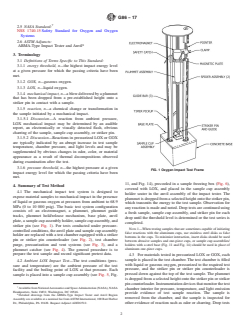
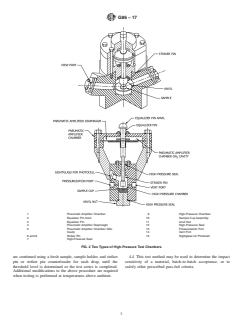
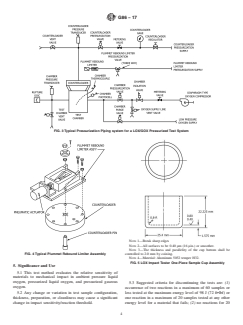
SIGNIFICANCE AND USE
5.1 This test method evaluates the relative sensitivity of materials to mechanical impact in ambient pressure liquid oxygen, pressurized liquid oxygen, and pressurized gaseous oxygen.
5.2 Any change or variation in test sample configuration, thickness, preparation, or cleanliness may cause a significant change in impact sensitivity/reaction threshold.
5.3 Suggested criteria for discontinuing the tests are: (1) occurrence of two reactions in a maximum of 60 samples or less tested at the maximum energy level of 98 J (72 ft•lbf) or one reaction in a maximum of 20 samples tested at any other energy level for a material that fails; (2) no reactions for 20 samples tested at the 98-J (72-ft•lbf) energy level; or (3) a maximum of one reaction in 60 samples tested at the maximum energy level.
SCOPE
1.1 This test method2 describes test equipment and techniques to determine the impact sensitivity of materials in oxygen under two different conditions: (1) in ambient pressure liquid oxygen (LOX) or (2) under pressure-controlled conditions in LOX or gaseous oxygen (GOX). It is applicable to materials for use in LOX or GOX systems at pressures from ambient to 68.9 MPa (0 to 10 000 psig). The test method described herein addresses testing with pure oxygen environments; however, other oxygen-enriched fluids may be substituted throughout this document.
1.2 This test method provides a means for ranking nonmetallic materials as defined in Guide G63 for use in liquid and gaseous oxygen systems and may not be directly applicable to the determination of the sensitivity of the materials in an end-use configuration. This test method may be used to provide batch-to batch acceptance data. This test method may provide a means for evaluating metallic materials in oxygen-enriched atmospheres also; however, Guide G94 should be consulted for preferred testing methods.
1.3 Values stated in SI units are to be regarded as the standard. The values given in parentheses are for information only.
1.4 This standard does not purport to address all of the safety concerns, if any, associated with its use. It is the responsibility of the user of this standard to establish appropriate safety, health, and environmental practices and determine the applicability of regulatory limitations prior to use. See also Section 9.
1.5 This international standard was developed in accordance with internationally recognized principles on standardization established in the Decision on Principles for the Development of International Standards, Guides and Recommendations issued by the World Trade Organization Technical Barriers to Trade (TBT) Committee.
- Status
- Published
- Publication Date
- 30-Nov-2017
- Drafting Committee
- G04.01 - Test Methods
Buy Documents
ASTM G86-17 - Standard Test Method for Determining Ignition Sensitivity of Materials to Mechanical Impact in Ambient Liquid Oxygen and Pressurized Liquid and Gaseous Oxygen Environments
REDLINE ASTM G86-17 - Standard Test Method for Determining Ignition Sensitivity of Materials to Mechanical Impact in Ambient Liquid Oxygen and Pressurized Liquid and Gaseous Oxygen Environments
Overview
ASTM G86-17 is the internationally recognized standard test method for determining the ignition sensitivity of materials to mechanical impact in both ambient and pressurized liquid and gaseous oxygen environments. Developed by ASTM International, this standard provides guidance on test equipment, sample preparation, and test procedures to assess how materials used in liquid oxygen (LOX) and gaseous oxygen (GOX) systems respond to mechanical impact under varied oxygen conditions. Ensuring material compatibility and safety in oxygen-enriched environments is critical in industries such as aerospace, medical, and chemical processing, where ignition hazards can present significant risks.
Key Topics
ASTM G86-17 addresses several important areas:
- Test Environments: Applicable to both ambient pressure LOX and pressure-controlled LOX or GOX systems, at pressures up to 68.9 MPa (10,000 psig).
- Material Types: Primarily focuses on nonmetallic materials, but is also referenced for metallic materials in oxygen-enriched atmospheres.
- Sample Preparation: Emphasizes traceability, correct sample thickness (worst-case use), and thorough cleaning to prevent contamination artifacts.
- Testing Criteria: Provides clear pass/fail criteria for sensitivity reactions, including audible explosions, flashes, burning, or major discoloration.
- Test Methodology: Utilizes a standardized drop-tower impact tester equipped with sample holders and striker pins to deliver mechanical impacts under controlled oxygen conditions.
- Batch Acceptance and Threshold Determination: Useful for batch-to-batch acceptance and for establishing reaction or impact energy thresholds for materials.
Applications
ASTM G86-17 is widely implemented across various sectors for:
- Aerospace: Verification of material compatibility for components exposed to LOX/GOX in propulsion or life-support systems, reducing the risk of ignition due to mechanical impacts.
- Medical Devices: Assessment of polymers and nonmetallic parts used in oxygen-delivery equipment and high-pressure gas cylinders or manifolds.
- Industrial Gas: Qualification of seals, gaskets, lubricants, adhesives, and insulating materials in pipelines, valves, and storage tanks handling pure or enriched oxygen.
- Process Safety: Selection and certification of materials for critical containment, transfer, and application points where accidental impact could trigger ignition.
Practical benefits include:
- Enhanced safety and reduced hazard potential for oxygen-rich operations
- Reliable selection and acceptance testing for new materials and suppliers
- Documentation trail for regulatory compliance and risk management
Related Standards
For a comprehensive approach to evaluating material behavior in oxygen-rich environments, consider these associated standards:
- ASTM G63: Guide for Evaluating Nonmetallic Materials for Oxygen Service
- ASTM G94: Guide for Evaluating Metals for Oxygen Service
- ASTM G88: Guide for Designing Systems for Oxygen Service
- ASTM G93: Practice for Cleaning Methods and Cleanliness Levels for Materials and Equipment Used in Oxygen-Enriched Environments
- ASTM D1193, D4080: Specifications for clean water and solvents used in sample preparation
- CGA G-4, G-4.1, G-4.3: Oxygen and cleaning specifications from the Compressed Gas Association
- NASA Standards (e.g., NSS 1740.15, Handbook 8060.1B): Additional guidance for oxygen system safety and impact testing procedures
Summary
By following ASTM G86-17, manufacturers and testing laboratories can confidently assess and mitigate ignition risks related to mechanical impact in oxygen systems. Repeatable, standardized testing under this protocol supports safer system design, material selection, and quality control in high-stakes oxygen service environments. Compliance with this and related oxygen compatibility standards demonstrates proactive management of ignition hazards, supporting personnel safety and operational integrity.
Relations
- Effective Date
- 01-Jan-2020
- Refers
ASTM D4080-15 - Standard Specification for Trichloroethylene, Technical and Vapor-Degreasing Grade - Effective Date
- 01-Jun-2015
- Effective Date
- 01-Aug-2011
- Effective Date
- 01-Apr-2011
- Effective Date
- 15-Mar-2007
- Effective Date
- 01-Mar-2006
- Effective Date
- 01-Jan-2006
- Effective Date
- 01-Sep-2005
- Effective Date
- 01-Jul-2005
- Effective Date
- 01-Nov-2003
- Refers
ASTM D4080-00 - Standard Specification for Trichloroethylene, Technical and Vapor-Degreasing Grade - Effective Date
- 10-Dec-2000
- Effective Date
- 10-Mar-1999
- Effective Date
- 10-Feb-1999
- Effective Date
- 10-Feb-1999
- Effective Date
- 10-Sep-1998
Buy Documents
ASTM G86-17 - Standard Test Method for Determining Ignition Sensitivity of Materials to Mechanical Impact in Ambient Liquid Oxygen and Pressurized Liquid and Gaseous Oxygen Environments
REDLINE ASTM G86-17 - Standard Test Method for Determining Ignition Sensitivity of Materials to Mechanical Impact in Ambient Liquid Oxygen and Pressurized Liquid and Gaseous Oxygen Environments
Get Certified
Connect with accredited certification bodies for this standard

CIS Institut d.o.o.
Personal Protective Equipment (PPE) certification body. Notified Body NB-2890 for EU Regulation 2016/425 PPE.

Kiwa BDA Testing
Building and construction product certification.
Kmetijski inštitut Slovenije
Agricultural Institute of Slovenia. Soil testing, plant health, agricultural product analysis.
Sponsored listings
Frequently Asked Questions
ASTM G86-17 is a standard published by ASTM International. Its full title is "Standard Test Method for Determining Ignition Sensitivity of Materials to Mechanical Impact in Ambient Liquid Oxygen and Pressurized Liquid and Gaseous Oxygen Environments". This standard covers: SIGNIFICANCE AND USE 5.1 This test method evaluates the relative sensitivity of materials to mechanical impact in ambient pressure liquid oxygen, pressurized liquid oxygen, and pressurized gaseous oxygen. 5.2 Any change or variation in test sample configuration, thickness, preparation, or cleanliness may cause a significant change in impact sensitivity/reaction threshold. 5.3 Suggested criteria for discontinuing the tests are: (1) occurrence of two reactions in a maximum of 60 samples or less tested at the maximum energy level of 98 J (72 ft•lbf) or one reaction in a maximum of 20 samples tested at any other energy level for a material that fails; (2) no reactions for 20 samples tested at the 98-J (72-ft•lbf) energy level; or (3) a maximum of one reaction in 60 samples tested at the maximum energy level. SCOPE 1.1 This test method2 describes test equipment and techniques to determine the impact sensitivity of materials in oxygen under two different conditions: (1) in ambient pressure liquid oxygen (LOX) or (2) under pressure-controlled conditions in LOX or gaseous oxygen (GOX). It is applicable to materials for use in LOX or GOX systems at pressures from ambient to 68.9 MPa (0 to 10 000 psig). The test method described herein addresses testing with pure oxygen environments; however, other oxygen-enriched fluids may be substituted throughout this document. 1.2 This test method provides a means for ranking nonmetallic materials as defined in Guide G63 for use in liquid and gaseous oxygen systems and may not be directly applicable to the determination of the sensitivity of the materials in an end-use configuration. This test method may be used to provide batch-to batch acceptance data. This test method may provide a means for evaluating metallic materials in oxygen-enriched atmospheres also; however, Guide G94 should be consulted for preferred testing methods. 1.3 Values stated in SI units are to be regarded as the standard. The values given in parentheses are for information only. 1.4 This standard does not purport to address all of the safety concerns, if any, associated with its use. It is the responsibility of the user of this standard to establish appropriate safety, health, and environmental practices and determine the applicability of regulatory limitations prior to use. See also Section 9. 1.5 This international standard was developed in accordance with internationally recognized principles on standardization established in the Decision on Principles for the Development of International Standards, Guides and Recommendations issued by the World Trade Organization Technical Barriers to Trade (TBT) Committee.
SIGNIFICANCE AND USE 5.1 This test method evaluates the relative sensitivity of materials to mechanical impact in ambient pressure liquid oxygen, pressurized liquid oxygen, and pressurized gaseous oxygen. 5.2 Any change or variation in test sample configuration, thickness, preparation, or cleanliness may cause a significant change in impact sensitivity/reaction threshold. 5.3 Suggested criteria for discontinuing the tests are: (1) occurrence of two reactions in a maximum of 60 samples or less tested at the maximum energy level of 98 J (72 ft•lbf) or one reaction in a maximum of 20 samples tested at any other energy level for a material that fails; (2) no reactions for 20 samples tested at the 98-J (72-ft•lbf) energy level; or (3) a maximum of one reaction in 60 samples tested at the maximum energy level. SCOPE 1.1 This test method2 describes test equipment and techniques to determine the impact sensitivity of materials in oxygen under two different conditions: (1) in ambient pressure liquid oxygen (LOX) or (2) under pressure-controlled conditions in LOX or gaseous oxygen (GOX). It is applicable to materials for use in LOX or GOX systems at pressures from ambient to 68.9 MPa (0 to 10 000 psig). The test method described herein addresses testing with pure oxygen environments; however, other oxygen-enriched fluids may be substituted throughout this document. 1.2 This test method provides a means for ranking nonmetallic materials as defined in Guide G63 for use in liquid and gaseous oxygen systems and may not be directly applicable to the determination of the sensitivity of the materials in an end-use configuration. This test method may be used to provide batch-to batch acceptance data. This test method may provide a means for evaluating metallic materials in oxygen-enriched atmospheres also; however, Guide G94 should be consulted for preferred testing methods. 1.3 Values stated in SI units are to be regarded as the standard. The values given in parentheses are for information only. 1.4 This standard does not purport to address all of the safety concerns, if any, associated with its use. It is the responsibility of the user of this standard to establish appropriate safety, health, and environmental practices and determine the applicability of regulatory limitations prior to use. See also Section 9. 1.5 This international standard was developed in accordance with internationally recognized principles on standardization established in the Decision on Principles for the Development of International Standards, Guides and Recommendations issued by the World Trade Organization Technical Barriers to Trade (TBT) Committee.
ASTM G86-17 is classified under the following ICS (International Classification for Standards) categories: 13.220.40 - Ignitability and burning behaviour of materials and products; 95.020 - Military in general. The ICS classification helps identify the subject area and facilitates finding related standards.
ASTM G86-17 has the following relationships with other standards: It is inter standard links to ASTM D4080-15(2020), ASTM D4080-15, ASTM D4080-00(2011), ASTM G93-03(2011), ASTM G63-99(2007), ASTM D1193-06, ASTM D4080-00(2006), ASTM G94-05, ASTM G88-05, ASTM G93-03e1, ASTM D4080-00, ASTM G63-99, ASTM D1193-99e1, ASTM D1193-99, ASTM G94-92(1998). Understanding these relationships helps ensure you are using the most current and applicable version of the standard.
ASTM G86-17 is available in PDF format for immediate download after purchase. The document can be added to your cart and obtained through the secure checkout process. Digital delivery ensures instant access to the complete standard document.
Standards Content (Sample)
This international standard was developed in accordance with internationally recognized principles on standardization established in the Decision on Principles for the
Development of International Standards, Guides and Recommendations issued by the World Trade Organization Technical Barriers to Trade (TBT) Committee.
Designation: G86 − 17
Standard Test Method for
Determining Ignition Sensitivity of Materials to Mechanical
Impact in Ambient Liquid Oxygen and Pressurized Liquid
and Gaseous Oxygen Environments
ThisstandardisissuedunderthefixeddesignationG86;thenumberimmediatelyfollowingthedesignationindicatestheyearoforiginal
adoption or, in the case of revision, the year of last revision.Anumber in parentheses indicates the year of last reapproval.Asuperscript
epsilon (´) indicates an editorial change since the last revision or reapproval.
1. Scope Development of International Standards, Guides and Recom-
mendations issued by the World Trade Organization Technical
1.1 This test method describes test equipment and tech-
Barriers to Trade (TBT) Committee.
niques to determine the impact sensitivity of materials in
oxygen under two different conditions: (1) in ambient pressure
2. Referenced Documents
liquid oxygen (LOX) or (2) under pressure-controlled condi-
tions in LOX or gaseous oxygen (GOX). It is applicable to
2.1 ASTM Standards:
materials for use in LOX or GOX systems at pressures from
D1193 Specification for Reagent Water
ambient to 68.9 MPa (0 to 10 000 psig). The test method
D4080 Specification for Trichloroethylene, Technical and
described herein addresses testing with pure oxygen environ-
Vapor-Degreasing Grade
ments; however, other oxygen-enriched fluids may be substi-
G63 Guide for Evaluating Nonmetallic Materials for Oxy-
tuted throughout this document.
gen Service
1.2 This test method provides a means for ranking nonme-
G88 Guide for Designing Systems for Oxygen Service
tallic materials as defined in Guide G63 for use in liquid and
G93 Guide for Cleanliness Levels and Cleaning Methods for
gaseous oxygen systems and may not be directly applicable to
Materials and Equipment Used in Oxygen-Enriched En-
the determination of the sensitivity of the materials in an
vironments
end-useconfiguration.Thistestmethodmaybeusedtoprovide
G94 Guide for Evaluating Metals for Oxygen Service
batch-to batch acceptance data. This test method may provide
2.2 Military Document:
a means for evaluating metallic materials in oxygen-enriched
MIL-D-16791 Detergent, General Purpose (Liquid, Non-
atmospheresalso;however,GuideG94shouldbeconsultedfor
ionic), Type One
preferred testing methods.
2.3 American Chemical Society:
1.3 Values stated in SI units are to be regarded as the
Trichloroethylene, Reagent Grade
standard. The values given in parentheses are for information
only.
2.4 Compressed Gas Association:
G-4 Oxygen
1.4 This standard does not purport to address all of the
G-4.1 Cleaning Equipment for Oxygen Service
safety concerns, if any, associated with its use. It is the
G-4.3 Oxygen, Gaseous, Type I B
responsibility of the user of this standard to establish appro-
priate safety, health, and environmental practices and deter- G-4.3 Oxygen, Liquid, Type II B
mine the applicability of regulatory limitations prior to use. G-10.1 Nitrogen, Gaseous, Type I B
See also Section 9. G-10.1 Nitrogen, Liquid, Type II B
1.5 This international standard was developed in accor-
dance with internationally recognized principles on standard-
ization established in the Decision on Principles for the
For referenced ASTM standards, visit the ASTM website, www.astm.org, or
contact ASTM Customer Service at service@astm.org. For Annual Book of ASTM
Standards volume information, refer to the standard’s Document Summary page on
This test method is under the jurisdiction of ASTM Committee G04 on the ASTM website.
Compatibility and Sensitivity of Materials in Oxygen EnrichedAtmospheres and is Available from Standardization Documents Order Desk, DODSSP, Bldg. 4,
the direct responsibility of G04.01 on Test Methods. Section D, 700 Robbins Ave., Philadelphia, PA 19111-5098, http://
Current edition approved Dec. 1, 2017. Published February 2018. Originally dodssp.daps.dla.mil.
approvedin1984.Lastpreviouseditionapprovedin2011asG86 – 98a(2011).DOI: Available fromAmerican Chemical Society (ACS), 1155 Sixteenth Street, NW
10.1520/G0086-17. Washington, DC 20036, http://www.acs.org.
2 6
NASA Handbook 8060.1B, Pressurized Liquid and Gaseous Oxygen Mechani- Available from Compressed Gas Association (CGA), 4221 Walney Rd., 5th
cal Impact Test, Sept. 1981, pp. 4-72. Floor, Chantilly, VA 20151-2923, http://www.cganet.com.
Copyright © ASTM International, 100 Barr Harbor Drive, PO Box C700, West Conshohocken, PA 19428-2959. United States
G86−17
2.5 NASA Standard:
NSS 1740.15 Safety Standard for Oxygen and Oxygen
Systems
2.6 ASTM Adjuncts:
ABMA-Type Impact Tester and Anvil
3. Terminology
3.1 Definitions of Terms Specific to This Standard:
3.1.1 energy threshold, n—the highest impact energy level
at a given pressure for which the passing criteria have been
met.
3.1.2 GOX, n—gaseous oxygen.
3.1.3 LOX, n—liquid oxygen.
3.1.4 mechanical impact, n—ablowdeliveredbyaplummet
that has been dropped from a pre-established height onto a
striker pin in contact with a sample.
3.1.5 reaction, n—a chemical change or transformation in
the sample initiated by a mechanical impact.
3.1.5.1 Discussion—A reaction from ambient pressure,
LOX mechanical impact may be determined by an audible
report, an electronically or visually detected flash, obvious
charring of the sample, sample cup assembly, or striker pin.
3.1.5.2 Discussion—Reactions in pressurized LOX or GOX
are typically indicated by an abrupt increase in test sample
temperature, chamber pressure, and light levels and may be
supplemented by obvious changes in odor, color, or material
appearance as a result of thermal decompositions observed
during examination after the test.
3.1.6 pressure threshold, n—the highest pressure at a given
FIG. 1 Oxygen Impact Test Frame
impact energy level for which the passing criteria have been
met.
11, and Fig. 14), precooled in a sample freezing box (Fig. 6),
4. Summary of Test Method
covered with LOX, and placed in the sample cup assembly
4.1 The mechanical impact test system is designed to
holder seater in the anvil assembly of the impact tester. The
expose material samples to mechanical impact in the presence
plummet is dropped from a selected height onto the striker pin,
of liquid or gaseous oxygen at pressures from ambient to 68.9
which transmits the energy to the test sample. Observation for
MPa (0 to 10 000 psig). The basic test system configuration
any reaction is made and noted. Drop tests are continued using
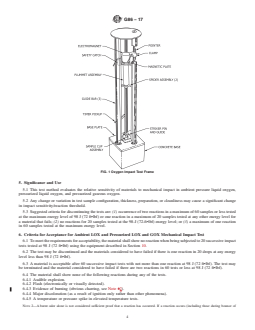
consists of: an electromagnet, a plummet, plummet guide
a fresh sample, sample cup assembly, and striker pin for each
tracks, plummet hold/release mechanism, base plate, anvil
drop until the threshold level is determined or the test series is
plate, a sample cup assembly holder, sample cup assembly, and
completed.
striker pin (see Fig. 1). For tests conducted under pressure-
NOTE 1—When testing samples that are sometimes capable of initiating
controlled conditions, the anvil plate and sample cup assembly
false reactions with the aluminum cups, use stainless steel disks as false
holder are replaced with a test chamber equipped with a striker
bottoms in the cups. To minimize interaction, insert disks should be used
pin or striker pin counterloader (see Fig. 2), test chamber
between abrasive samples and one-piece cups, or sample cup assemblies/
purge, pressurization and vent systems (see Fig. 3), and a holders with a steel base (Fig. 11 and Fig. 14) should be used in place of
aluminum one-piece cups.
plummet catcher (see Fig. 4). The general procedure is to
prepare the test sample and record significant pretest data.
4.3 For materials tested in pressurized LOX or GOX, each
sample is placed in the test chamber. The test chamber is filled
4.2 Ambient LOX Impact Test—The test conditions (pres-
with liquid or gaseous oxygen, pressurized to the required test
sure and temperature) are the ambient pressure of the test
pressure, and the striker pin or striker pin counterloader is
facility and the boiling point of LOX at that pressure. Each
pressed down against the top of the test sample. The plummet
sample is placed into a sample cup assembly (see Fig. 5, Fig.
is dropped from a selected height onto the striker pin or striker
pincounterloader.Instrumentationdevicesthatmonitorthetest
AvailablefromNationalAeronauticsandSpaceAdminstration(NASA),NASA
chamber interior for pressure, temperature, and light emission
Headquarters, Suite 1M32, Washington, DC 20546.
provide evidence of test sample reaction. The sample is
Detailed drawings from the ABMA-Type Impact Tester and Anvil Region
removed from the chamber, and the sample is inspected for
Assembly are available at a nominal fee fromASTM International, 100 Barr Harbor
Dr., Philadelphia, PA 19428. Request Adjunct ADJD2512. other evidence of reaction such as odor or charring. Drop tests
G86−17
1 Pneumatic Amplifier Chamber 9 High-Pressure Chamber
2 Equalizer Pin Anvil 10 Sample Cup Assembly
3 Equalizer Pin 11 Anvil Nut
4 Pneumatic Amplifier Diaphragm 12 High-Pressure Seal
5 Pneumatic Amplifier Chamber GN 13 Pressurization Port
Cavity 14 Vent Port
6 and 8 Striker Pin 15 Sightglass for Photocell
7 High-Pressure Seal
FIG. 2 Two Types of High-Pressure Test Chambers
are continued using a fresh sample, sample holder, and striker 4.4 This test method may be used to determine the impact
pin or striker pin counterloader for each drop, until the sensitivity of a material, batch-to-batch acceptance, or to
threshold level is determined or the test series is completed.
satisfy other prescribed pass-fail criteria.
Additional modifications to the above procedure are required
when testing is performed at temperatures above ambient.
G86−17
FIG. 3 Typical Pressurization Piping system for a LOX/GOX Pressurized Test System
NOTE 1—Break sharp edges
NOTE 2—All surfaces to be 0.40 µm (16 µin.) or smoother.
NOTE 3—The thickness and parallelity of the cup bottom shall be
FIG. 4 Typical Plummet Rebound Limiter Assembly controlled to 2.0 mm by coining.
NOTE 4—Material: Aluminum 5052 temper H32.
FIG. 5 LOX Impact Tester One-Piece Sample Cup Assembly
5. Significance and Use
5.1 This test method evaluates the relative sensitivity of
materials to mechanical impact in ambient pressure liquid
oxygen, pressurized liquid oxygen, and pressurized gaseous
5.3 Suggested criteria for discontinuing the tests are: (1)
oxygen.
occurrence of two reactions in a maximum of 60 samples or
less tested at the maximum energy level of 98 J (72 ft•lbf) or
5.2 Any change or variation in test sample configuration,
one reaction in a maximum of 20 samples tested at any other
thickness, preparation, or cleanliness may cause a significant
change in impact sensitivity/reaction threshold. energy level for a material that fails; (2) no reactions for 20
G86−17
FIG. 6 Typical Sample Freezing Box
samples tested at the 98-J (72-ft•lbf) energy level; or (3) a 6.4 The material shall show none of the following reactions
maximumofonereactionin60samplestestedatthemaximum during any of the tests.
energy level.
6.4.1 Audible explosion.
6.4.2 Flash (electronically or visually detected).
6. Criteria for Acceptance for Ambient LOX and
6.4.3 Evidence of burning (obvious charring, see Note 2).
Pressurized LOX and GOX Mechanical Impact Test
6.4.4 Major discoloration (as a result of ignition only rather
6.1 To meet the requirements for acceptability, the material
than other phenomena).
shall show no reaction when being subjected to 20 successive
6.4.5 A temperature or pressure spike in elevated tempera-
impact tests tested at 98 J (72 ft•lbf) using the equipment
ture tests.
described in Section 10.
6.2 The test may be discontinued and the materials consid-
NOTE 2—A burnt odor alone is not considered sufficient proof that a
ered to have failed if there is one reaction in 20 drops at any reaction has occurred. If a reaction occurs (including those during bounce
of plummet), it shall be reported as evidence of sensitivity. Inclusion of
energy level less than 98 J (72 ft•lbf).
bounce reactions applies to ambient LOX mechanical impact tests only.
6.3 Amaterial is acceptable after 60 successive impact tests
6.5 All materials that fail and remain candidates for use
withnotmorethanonereactionat98J(72ft•lbf).Thetestmay
shall be subjected to LOX or GOX mechanical impact energy
be terminated and the material considered to have failed if
there are two reactions in 60 tests or less at 98 J (72 ft•lbf). threshold determinations in the thickness of use.
G86−17
6.6 The material to be tested must be traceable back to the 7.2.2 Preparing Samples to the Proper Dimensions:
original manufacturer and to a specific batch or lot numbers, or 7.2.2.1 Materials normally used in thicknesses greater than
both. 6.35 mm ( ⁄4 in.) shall be sized and tested as 17.5-mm diameter
disks of 6.35 6 0.13-mm (0.250 6 0.005-in.) thickness.
6.7 The thickness of the sample shall be the worst-case
Failure of samples to meet the requirements of this test method
thickness. While the worst-case thickness has been found to
shall be cause for the rejection of the material. Greases, fluids,
vary from material to material, the general trend has been that
and other materials, whose thicknesses are directed by condi-
thinner samples of materials are more reactive.
tions of use, shall be tested as 1.27 6 0.13-mm (0.050 6
6.8 For the ambient LOX impact test, test conditions (pres-
0.005-in.) layers in insert cups. Materials not readily available
sure and temperature) are the ambient pressure of the test
in sheet form shall be tested in the available configuration.
facility and the boiling point of LOX at that pressure. For the
Specimens shall be free of ragged edges, fins, or other
pressurized test, test conditions (pressure and temperature)
irregularities.
shall be determined for each test according to the requirements
NOTE 3—Unless otherwise requested by procuring authority, the test
specified by the requester.
facility should filter all test liquids using ≤5 micron filters to prevent
6.9 Preparation of the samples for testing involve the
particulate contamination.
following tasks.
7.2.2.2 Preparation of Liquid Samples as Supplied—
6.9.1 Receiving the visually inspecting the material,
Prepare a homogenous sample. A microburet may be used to
6.9.2 Preparing the sample to the specified dimensions,
transfer the specimen into the sample cup assemblies. For
6.9.3 Cleaning the samples, and
viscous materials, a microsyringe may be used. Determine the
6.9.4 Inspecting the samples.
volume of the sample required to obtain a sample thickness of
1.27 6 0.13 mm (0.050 6 0.005 in.) and transfer directly into
7. Sample Preparation
the sample cup assembly or insert cup before freezing. (This
7.1 Test material requirements and documentation:
determinationisrequiredduetovariationsfromliquidtoliquid
7.1.1 Traceability—The material to be tested may be trace-
in physical properties such as density, surface tension, and
able back to the original manufacturer and to specific batch or
volatility.) A micrometer depth gage with leveling blocks is
lotnumbers,ortoboth.Whenreceived,thetestmaterialshould
suggested for measurement. The work table must be level. If
be accompanied by proper identification (for example, product
testing in liquid oxygen is to be performed in LOX, check the
data sheets, batch or lot numbers) identifying the sample,
thickness of four liquid samples after they are frozen and
material manufacturer, and appropriate material safety data
record. Limit exposure to atmosphere during preparation of
sheets. It is the responsibility of the procuring authority to
liquid samples and prepare all samples to be tested for the day
identify material traceability.
simultaneously.
7.1.2 Usage Conditions—The worst-case usage thickness,
7.2.2.3 Preparation of Liquid Samples, Concentrated—
conditions and any cleanliness requirements shall be identified
Concentrate the liquid specimens of cleaning agents before
by the procuring authority.
their addition to the one-piece sample cup assembly if accep-
7.1.3 Minimum Recommended Material Quantities—
tance is based on a nonvolatile residue insensitivity require-
Sufficient material shall be available to permit preparation and
ment. Concentrate the liquid sample to 2 % of its original
testing of 140 separate samples as defined in Table 1.
volume by evaporating the sample in a large round-bottom
7.2 Test Material Receiving and Sample Processing
7.2.1 Receiving and Inspection—Upon receipt the testing
facility shall inspect the supplied test material and documen-
tation to verify that all requirements of subsection 7.1 have
been met. The material shall be inspected and any flaws shall
benotedanddiscussedwiththeprocuringauthority.Additional
cleaning procedures shall be implemented if required by the
procuring authority.
TABLE 1 Recommended Minimum Quantities of Material
Required for Testing
A
Material Form Minimum Quantities
2 2
Sheets 2000-cm (319-in. ) total area by 3.5-mm ( ⁄8-in.)
maximum thickness
Coatings, inks, and 120 cm (4 fluid oz.)
adhesives
2 2
Foams 2000-cm (310-in. ) total area by 3.5-mm ( ⁄8-in.)
maximum thickness
Insulated wires 267 cm (105 in.) in length
A
Actual test configurations and material quantities for material forms other than
NOTE 1—Material: stainless steel 300 series.
thoselisted(forexample,O-ringsandseals)mustbeestablishedandapprovedby
NOTE 2—Break all sharp edges 0.19 mm.
the responsible procurement or user materials organization.
FIG. 7 LOX Impact Tester Insert Cup
G86−17
flask heated in a constant-temperature water bath, at a tem- performed using virgin substrate discs, cleaned by the same
perature no higher than 5 °C below the boiling point of the process as those used for the test samples.
sample. Pass air over the surface of the sample at a rapid rate. 7.2.2.5.1 Reactions involving materials prepared on alumi-
Apotential apparatus and procedure for the sample preparation num disks have the potential to be extremely severe as a result
is given in Annex A1, Method A. Add the 2 % concentrated
of ignition of the aluminum disk, which may be initiated by a
sample to the one-piece sample cup assembly, two-piece reaction of the test material. For this reason, insert discs (Fig.
sample cup assembly base, or insert cup until a thickness of
8) are typically used for preparing this type of material.
1.27 6 0.13 mm (0.050 6 0.005 in.) is obtained. If testing is
7.2.2.6 Preparation of Greases and Semisolids—Press a
to be performed in LOX, check the thickness of four liquid
sufficient amount of sample material (a slight excess) into an
samples after they are frozen and record. Limit exposure to
insert cup or the sample recess of a two-piece sample cup
atmosphere during preparation of liquid samples and prepare
assembly 1.27 6 0.13 mm (0.050 6 0.005 in.) deep (see Fig.
all samples to be tested for the day simultaneously.
7) with a cleaned, stainless steel spatula to form a uniform
7.2.2.4 PreparationofLiquidSampleResidues—Place5mL
sample free of bubbles and void areas. Scrape the excess
of the concentrated sample (obtained as is described in 7.2.2.3)
sample level to the rim of the insert/recessed sample cup until
in the one-piece sample cup assemblies or insert cups and heat
a smooth surface is obtained. It is necessary to fill the cup
in an oven at 5°C below the boiling point. Blow filtered air
uniformly. Store the prepared cups in a clean container until
over the samples and remove the vapors by vacuum.Adetailed
required for testing.
description of the apparatus and the procedure is presented in
7.2.2.7 Preparation of Solids—Cut and prepare samples of
Annex A2, Method B. If testing is to be performed in LOX,
solid material to a diameter of 17.5 to 19.1 mm (0.69 to
check the thickness of four liquid samples after they are frozen
0.75 in.). Sheet material not available in 1.52 6 0.13-mm
and record. Limit exposure to atmosphere during preparation
(0.060 6 0.005-in.) thickness is tested in the thickness in-
of liquid samples and prepare all samples to be tested for the
tended for use when that thickness is not more than 6.35 mm
day simultaneously.
(0.250 in.). Materials normally used in a thickness greater than
7.2.2.5 Leak Check Compounds, Dye, Dye Penetrant, and
6.35mm(0.250in.)arecuttoprovidedisksof6.35 60.13mm
Emulsifier—Clean, unsealed, undyed sulfuric acid-anodized
(0.250 6 0.005-in.) thickness.
6061-T6 aluminum alloy disks (or other substrate specified by
7.2.2.8 Sample Preparation of Material Configurations In-
the manufacturer or requester as a means to simulate end-use
suffıcient for Standard Sample Fabrication—Cut or otherwise
configuration), of similar dimensions to the insert disk (Fig. 8)
section the test material into small pieces 1.27 to 6.35 mm
are used as a substrate. When appropriate, insert disks maybe
(0.05-0.25 in.) along each dimension and combine multiple
used as the substrate disc. Clean the disks before use (see
pieces to form a collection of uniform thickness constituting an
11.2.2.1). After cleaning, dip new anodized disks in the test
individual test sample with a total mass of 400 to 600 mg
materials for 15 min and drain for 15 min with the disks
(0.0141 to 0.0212 oz).
oriented vertically. Cure the sample as specified, then store the
prepared disks in a clean container until required for testing. If
NOTE 4—This method is only intended for use when a material’s usage
the substrate disc is not a standard Insert Disc, blank insert disc
configuration renders all other preparation methods impractical.
test checks (see 11.4) preformed during testing shall be
7.2.2.9 Preparation of Solder (Solid or Flux-Core Type)—
Prepare solder samples as follows: melt the solder (solid or
flux-core type) at a temperature no higher than 25°C above the
melting point of the solder in a mold to form an ingot. Roll the
ingottoformaflatsheet0.51 60.13(0.020 60.005in.)thick.
Punch disks of 17.5-mm ( ⁄16-in.) diameter from the sheet.
Clean the disks by detergent washing, water rinsing, drying,
and vapor degreasing in an appropriate solvent. Store the
prepared samples in a clean container until required for testing.
7.2.2.10 Preparation of Coatings, Paints, Adhesives, and
Potting Compounds—Materials of this type are prepared as
follows.
(1) Coating materials (such as paints, dry film lubricants,
and conformal coatings) shall be applied to 17.5-mm ( ⁄16-in.)
diameter by 1.6-mm (0.063-in.) thick 300 series stainless steel
disks in the same manner and to the same thickness intended
for use. After the samples have dried, they shall be placed in
the regular sample cup assemblies for ambient pressure testing
and used as prepared in the pressurized impact tester.
(2) Elastomeric coatings and adhesives shall be applied as
acoatingto300stainlesssteeldisksusingMethod1orMethod
NOTE 1—Material: Type 347 stainless steel.
2 described below and cured according to applicable instruc-
NOTE 2—Break all sharp edges 0.19 mm.
FIG. 8 Insert Disk tions.
G86−17
(a) Method 1 (Single-Dip Coat)—Dip coat insert disks to (25-µm absolute or smaller filter rating) distilled water, and
specified thickness and place on clean aluminum foil or on using filtered (25-µm absolute or smaller filter rating), dry, low
polytetrafluoroethylene (PTFE) to air dry. The coated inserts hydrocarbon air or inert gas. If necessary, the samples may be
shall be removed from the foil and turned over after 30 min to cleaned by rinsing with an oxygen-compatible solvent that is
allow both sides to dry. The specimens shall be cured as compatible with the test material, prior to the fore mentioned
specifiedbeforetesting.Thecoatingthicknessshallbechecked cleaning procedure.
on at least four samples and recorded. 7.2.3.3 If the sample material cannot be wetted with any
(b) Method 2 (Brush Coat)—Material shall be applied cleaning solution without altering the test sample, the samples
onto insert disks using a single brush stroke with a soft shall be blown clean using filtered (25-µm absolute or smaller
nonshedding brush, in single brush coats of finished coating as filter rating), dry, low hydrocarbon air or inert gas.
specified. Each specimen shall be visually examined for
7.3 Nonmetallic, Solid, Metallic, and Solvent-Resistant
contamination (especially bristles from the brush) following
Samples—If received in a certified clean condition, test in the
application of each coat. The coated specimens shall be air
as-received condition. Otherwise, clean the sample before
dried for a minimum of 24 h following application of the final
testing by rinsing with tap water, then washing in nonionic
coat before testing.
detergent solution, then finally rinsing in DI water. Drain for a
7.2.2.11 O-Rings—Each size from each batch of O-rings or
minimum of 10 min and dry using a gaseous nitrogen purge.
O-ring materials or both shall be sampled and tested as follows
unless it can be demonstrated that test results on different sizes
8. Reagents and Materials
and batches are comparable. To clean O-rings before testing,
8.1 Alkaline Cleaner, for test chambers, striker pins, sample
rinse with tap water, rinse in nonionic detergent solution, rinse
cup assemblies, and sample holder units, consisting of a
in DI water, drain for a minimum of 10 min, and dry using a
solution of 15 g of sodium hydroxide (NaOH), 15 g of
gaseous nitrogen purge.
trisodium phosphate (Na PO ), and 1 L of distilled or deion-
11 3 4
(1) Extruded O-Rings140 sample disks 17.5-mm ( ⁄16-in.)
ized water.
diameter by the thickness of the O-rings shall be cut from a
strip after the chopping operation. The disks shall be similarly 8.2 Deionized Water, conforming to Specification D1193,
processed and deflashed with the same equipment used for the Type IV.
O-rings.Thedisksshallbecleanedasspecifiedforthematerial
8.3 Detergent, a noncorrosive cleaner that is compatible
and its use.
with liquid oxygen in the concentration used, conforming to
(2) Molded O-Rings140 sample disks 17.5-mm ( ⁄16-in.)
MIL-D-16791.
diameter by the thickness of the O-rings, and which have been
8.4 Gaseous Oxygen, conforming to CGA G–4.3 Type I B.
similarly processed and deflashed, shall be furnished.
Oxygen of higher purity may be used if desired (see Note 5).
(3) O-Rings From Standard Stock or Where Above Proce-
duresAreImpracticalO-rings1.27-cm( ⁄2-in.)outsidediameter 8.5 Liquid Oxygen, conforming to CGA G–4.3, Type II B.
or less shall be sampled and tested as a complete O-ring.
NOTE 5—Gaseous mixtures of the appropriate oxygen concentration
O-rings larger than 1.27-cm ( ⁄2-in.) outside diameter shall be
and certified analysis may be purchased commercially.
tested as one segment (approximately 1.91 cm ( ⁄4-in.) long).
8.6 Gaseous Nitrogen, CGA G–10.1, Type IB.
To clean O-rings before testing, rinse with tap water, wash in
8.7 Liquid Nitrogen, CGA G–10.1, Type IIB.
nonionic detergent solution, rinse in DI water, drain for a
minimum of 10 min, and dry using a gaseous nitrogen purge.
8.8 Trichloroethylene, ACS reagent grade or Specification
If a sample is not impacted during testing, it shall be placed in
D4080.
a new sample cup assembly and precooled before retesting.As
an alternative, sufficient samples may be prepared to account
9. Safety Precautions
for the normal impact misses.
9.1 LOX
7.2.2.12 Heat Shrink Tubing—Heat shrunk tubing shall be
9.1.1 When testing is to be performed in liquid oxygen,
preshrunkbeforetestinginaccordancewiththemanufacturer’s
normal safety precautions applicable to the handling and use of
instructions.
liquid oxygen must be used.
7.2.2.13 Insulated Wires—Tests samples shall be cut to 17.5
9.1.2 The hazards associated with handling oxygen are very
to 19.1 mm (0.69 to 0.75-in.) lengths. Ends shall remain
serious. Contact with the skin can cause frostbite. Contact of
unstripped. Test samples shall be straightened as much as
liquid oxygen with hydrocarbons or other fuels constitutes a
possible and tested in this configuration.
fire or explosion hazard because such mixtures can be sensitive
7.2.3 Cleaning—The samples should be cleaned by the
to shock, impact, or vibration.
same method that will be used in the material application.
9.1.3 Personnel working with liquid oxygen must be famil-
7.2.3.1 Test in the as-received condition when the test
iar with its characteristics. Approved goggles or face shields,
material is received in a certified clean condition or customer
fire-retardant protective clothing, gloves, and boots must be
specified final use condition.
worn during handling or transfer. Such operations should be
7.2.3.2 If the cleaning procedure is not specified, clean the performedbynolessthantwopersons,asaminimum.Extreme
sample before testing by rinsing with tap water, then washing caution should be exercised in preventing contact with oils or
in a nonionic detergent solution, then rinsing with filtered other combustible materials. All tools must be degreased
G86−17
before use. Precautions should be taken to prevent accumula- 9.2.4 Equipment used in a 69-MPa (10 000-psig) oxygen
tion of moisture in lines, valves, traps, and so forth to avert system must be properly designed and rated for oxygen
freezing and plugging which would cause subsequent pressure service. Proper design of high-pressure oxygen systems in-
ruptures. Care should also be taken to prevent undesired cludes designing for minimum internal volumes, thereby lim-
entrapment of liquid oxygen in unvented sections of any iting the magnitude of catastrophic reactions that may occur
system. while testing materials. Components such as valves, pressure
regulators, gages, filters, and the like, must be fabricated from
9.1.4 Direct physical contact with LOX, cold vapor, or cold
materials that have a proven record of suitability for high-
equipmentcancauseserioustissuedamage.Medicalassistance
pressure oxygen service. Examples of such materials are
should be obtained as soon as possible for any cold injury.
Monel 400, Inconel 600, nickel, and selected stainless steels
Proper immediate bystander response be as follows:
(see Note 6).
9.1.4.1 If it is safe to do so, remove the patient from the
source of the cold.
NOTE 6—Where not otherwise indicated, stainless steel shall be of the
AISI 300 series.
9.1.4.2 In the event of limb-size cryogenic exposure, appro-
priate response may include an attempt to warm the affected
9.2.5 High-pressure oxygen systems require the utmost
area rapidly with moist heat from a shower, eyewash, or warm
cleanliness. Therefore, components should be designed to
water bath, not exceeding 39°C (102°F).
facilitatedisassembly,thoroughcleaning,andreassemblywith-
9.1.4.3 Massive full-body cryogenic exposures present sig-
outcompromiseofcleanlinesslevel.Screeningtestsperformed
nificantadditionalconcerns,butremovalofthevictimfromthe
onnonmetallicmaterialshaveshownthattheimpactsensitivity
exposure atmosphere and keeping the victim’s airway open are
of these materials can vary from batch to batch. Since
important. Loosely wrapping the victim in a blanket until the
nonmetallic materials are usually the most easily ignited
arrival of the ambulance team is also advised.
components in a high-pressure oxygen system, nonmetallic
9.1.4.4 Some important don’ts: don’t remove frozen gloves, items to be used in this test apparatus, such as seats, seals, and
shoes, or clothing; salvageable skin may be pulled off inadver-
gaskets, should be chosen from the best (that is, least sensitive)
tently.Don’tmassagetheaffectedpart;don’texposethepartto available batch of material.
temperatures higher than 45°C (112°F), such as heat or fire;
9.2.6 The test chamber shall be isolated from the oxygen
this superimposes a burn and further tissue damage; don’t
source by a double-block-and-bleed valve arrangement con-
apply, ice, snow, or ointments.
sisting of two block valves in series with a vent valve between
9.1.5 Safety shower and other protective equipment should them. Each block valve shall be locked closed and the vent
be inspected periodically to ensure that they are operational valve locked open whenever personnel are working in test cell.
when needed. Personnel handling liquid oxygen must ensure By ensuring two-valve isolation and continuous venting, the
that oxygen vapors do not remain absorbed in their clothing chance of exposing personnel to high-pressure oxygen as a
before smoking or approaching any source of ignition. Des- result of inadvertent valve actuation or leakage during sample
orption of oxygen may be accomplished by remaining in a changeout is minimized (see Fig. 9).
well-ventilated area for 30 min after exiting the test area.
9.2.7 When testing is to be performed at elevated
temperature, normal safety precautions applicable to the op-
9.2 GOX
eration and maintenance of electrical systems must be fol-
9.2.1 This is a hazardous test. Normal safety precautions
lowed.
applicable to the operation and maintenance of high-pressure
9.2.8 The sample heater, heater wiring, and control system
gas systems must be followed when working with the test
must be designed for continuous usage. Adequate precautions
system.
must be taken to eliminate the potential for electrical shock.
9.2.2 Complete isolation of personnel from the test appara-
The heater circuit shall be equipped with a safety switch and
tus is required whenever the test chamber contains a test
warning lights in the immediate vicinity of the tester to permit
sample and is pressurized above atmospheric pressure with
personnel working on the test chamber to assess the condition
oxygen. Violent reactions between test materials and high-
oftheheatercircuit.Alocalmethodofopeningthecircuitmust
pressure oxygen must be expected at all times. Test chamber
be provided in the test chamber area which is in series with the
component failure caused by violent test sample reaction has
control area heater control switch. A typical instrumentation
produced shrapnel, flying objects, dense smoke, and high-
control system is shown in Fig. 3.
pressure gas jets and flames inside the test cell.Test cell design
9.2.9 When performing tests at elevated temperatures, per-
and layout, test procedures, personnel access controls, and
sonnel must wear heat-resistant gloves for handling hot com-
emergency shutdown procedures must be designed with this
ponents or allow the heated components to cool completely
type of failure expected any time the test system contains
before handling them.
oxygen.
9.3 Trichloroethylene
9.2.3 Complete isolation is assured by locating the test
apparatus in an enclosure and behind an barricade. The 9.3.1 Warning—Harmful if inhaled. High concentrations
operator is stationed in a control room on the other side of the may cause unconsciousness or death. Contact may cause skin
barricade. Visual observation of the test shall be accomplished irritationanddermatitis.Avoidprolongedorrepeatedbreathing
by means such as a reinforced window, periscope, mirrors, or ofvapororspraymist.Useonlywithadequateventilation.Eye
closed-circuit television. irritation and dizziness are indications of overexposure. Do not
G86−17
FIG. 9 Typical Instrumentation/Control Diagram for Pressurized LOX/GOX System
take internally. Swallowing may cause injury, illness, or death. vice” for details of safe practice in the use of oxygen. Practice
Avoid prolonged or repeated contact with skin. Do not get in G93 may be consulted for cleaning practices also.
the eyes. Do not allow to contact hot surfaces, since toxic
10. Test Apparatus
products can be formed.
10.1 Ambient Mechanical Impact Test System—The impact
9.4 Oxygen
tester for the ambient LOX impact test shall have a rugged
9.4.1 Warning—Oxygen vigorously accelerates combus-
structural frame capable of maintaining accurate vertical align-
tion. Keep oil and grease away. Do not use oil or grease on
ment under repeated shock conditions (see Fig. 1), a mecha-
pressure regulators, gages, or control equipment, except as
nism for dropping a plummet which weighs 9.072 6 0.023 kg
suggestedbyGuideG63.GuidesG63,G88,andG94shouldbe
(20 6 0.05 lb) (see Note 7) through a distance of 1.10 6 0.005
usedintheselectionofmaterialsusedintestsystems.Useonly
m (43.3 6 0.2 in.), which will transmit to the test sample an
with equipment conditioned for oxygen service by carefully
approximate impact energy of 98 J (72 ft•lbf), a striker pin (see
cleaning to remove oil, grease, and other combustibles. Keep
Fig. 10) nominally 1.27 cm ( ⁄2 in.) in diameter and 5.08 cm (2
combustibles away from oxygen and eliminate ignition
in.) long, and a one- or two-piece sample cup assembly (see
sources. Keep surfaces clean to prevent ignition or explosion,
Fig. 5 and Fig. 11) approximately 2.22-cm ( ⁄8-in.) inside
or both, on contact with oxygen. Always use a pressure
diameter by approximately 2.22-cm ( ⁄8-in.) inside depth made
regulator. Release pressure regulator tension before opening
from 0.16-cm ( ⁄16-in.) thick aluminum alloy. The initial
the cylinder valve.All equipment and containers used must be
alignment and subsequent operation of the impact tester shall
suitable and recommended for oxygen service. Never attempt
be such that the plummet falls uniformly under essentially
to transfer oxygen from the cylinder in which it is received to
friction-free conditions. This shall be verified by suitable
any other cylinder. Do not mix gases in cylinders. Do not drop
meansoneachdroptoensurethat 63 %ofthetheoreticaldrop
the cylinders. Make sure cylinders are maintained upright and
time is attained. Measurement shall be made as close to the
secured at all times. Keep cylinder valves closed and capped
striker pin as possible. See Section 12 for the calibration of the
when not in use. Stand away from outlet when opening a
impact tester.
cylindervalve.Fortechnicaluseonly;donotuseforinhalation
purposes. Keep cylinders out of sun and away from heat. Keep
NOTE 7—The weight times the drop height specified is not duplicated
for the purposes of this test by combinations other than 9.072 6 0.023 kg
cylinders away from corrosive environments. Do not use a
(206 0.05 lb) through a distance of 1.10 6 0.005 m (43.3 + 0.2 in.). For
cylinder without a label. Do not use dented or damaged
example, doubling the mass of the plummet and halving the drop height
cylinders.
would not duplicate the specified requirement. Drop height shall be
9.4.2 See Compressed Gas Association Pamphlets G-4,
measured from the nose of the plummet to the top of the striker pin with
“Oxygen” and G-4.1, “Cleaning Equipment for Oxygen Ser-
the cup and stainless steel disk in position.
G86−17
10.1.1.2 Safety Catch—The solenoid-operated safety catch
shall be designed to hold the plummet near the base of the
magnet in the event of a power failure.
10.1.1.3 Base Plate—The base shall be constructed from
2.54-cm (1-in.) minimum thick stainless steel plate and shall
rest solidly and level on a base of reinforced concrete. It is
recommendedthatgroutbeappliedtopreventanyspilledLOX
from being trapped under the steel plate. A minimum of four
stainlesssteelfoundationboltsshallbeusedtoanchortheplate
to the concrete.
10.1.1.4 Anvil Plate and Sample Cup Assembly Holder (see
Fig. 12)—A stainless steel, Type 440B, or equivalent, heat-
treated (56 to 58 Rockwell Hardness C (HRC)) anvil plate 12.7
by 12.7 by 5.1 cm (5 by 5 by 2 in.) thick, shall be bolted to the
NOTE 1—Break sharp edges.
base plate in the center of the machine. This plate shall center
NOTE 2—Machine all surfaces to 0.40 mm (16 µin.) or smoother.
thesamplecupassemblyholderandprovidethebaseplatewith
NOTE 3—Material: stainless steel AMS 5643D (17-4 PH).
protection from denting upon impact. A 12.7- by 12.7-cm (5-
NOTE 4—Heat treatment: obtain H900.
by5-in.)stainlesssteelsamplecupassemblyholder,2.54cm(1
NOTE 5—Finish: electropolish after heat treatment (measured immedi-
in.) thick, shall be bolted on top of the anvil plate. The sample
ately after manufacturing).
cup assembly holder shall have a slightly tapered hole into
NOTE 6—Surfaces A and B should be parallel and perpendicular to the
center line.
which the test sample cup assembly can be placed.
FIG. 10 LOX Impact Striker Pin
10.1.1.5 Sample CupAssembly—Several samplecupassem-
bly designs are available for use depending on material type
and test configuration.
(1) One-Piece Sample Cup Assembly—One-piece sample
cup assemblies (see Fig. 5) shall be made of aluminum 5052,
temper H-32.
(2) Multi-Piece Sample Cup Assembly—Multi-piece
samplecupassembliesconsistofabase,sleeveandanoptional
centering ring (centering ring shown in Fig. 14). Multi-piece
sample cup assembly designs may include a base with a recess
for testing liquid and semisolid materials without the use of
insert cups. Two designs are currently in use:
(a) Inconel base, stainless steel sleeve, and stainless steel
centering ring (Fig. 14).
(b) 17-4PH base, PTFE sleeve, and brass centering ring
as required (Fig. 11).
(3) Inserts:
(a) Insert Cup—An insert cup may be used when testing
liquid or semisolid materials, and are placed inside the one- or
multi-piecesamplecupassemblies.Insertcupsaremadeofany
stainless 300 series stainless steel (see Fig. 7 and Fig. 14) with
aninsidedepthof1.27mm 60.13mm(0.050 60.005in.).No
insertcupisrequiredforsolidmaterials;solidmaterialsamples
are placed directly on top of the sample holder plate and
NOTE 1—Break sharp edges 0.19 mm.
retained under the striker pin by a centering ring. Insert disks
NOTE 2—Material: Typically 17-4PH H900 stainless steel alloy (base);
and insert cups should not be used together.
PTFE (sleeve).
(b) Insert Disk—Insert disks (see Fig. 8) are used as the
NOTE 3—PTFE sleeve is intended to have an interference fit with the
substratefortheapplicationoftestmaterialsandduringsystem
base.
FIG. 11 LOX Impact Tester Two-Piece Cup Assembly cleanliness verification (see 11.4).
One-piece sample cups (see ) shall be made of any dead soft
3000 or 5000 series aluminum alloy.Aspecial insert cup made
10.1.1 The tester also consists of the following parts:
of any 3000 or 5000 series aluminum alloy (see Fig. 7) with an
10.1.1.1 Electromagnet—The electromagnet (if used) shall
inside depth of 0.127 6 0.013 cm (0.050 + 0.005 in.) shall also
be designed with a sufficient safety factor to hold over 9.08 kg
be used when testing semisolid materials. These special insert
(20 lb) of weight with a minimum energizing wattage. Me-
cups shall be placed inside the one-piece specimen cups.
chanical suspension/release devices shall be designed with a
sufficient safety factor to hold a 9.08-kg (20-lb) plummet 10.1.1.6 Striker Pins—The striker pins shall be made from
positively. 17-4 PH (AMS 5643D) stainless steel, or equivalent, with
G86−17
FIG. 12 LOX Impact Tester Sample Cup, Sample Cup Holder, Striker Pin, and Anvil Configuration
catch and electromagnet, and timing instrumentation to mea-
sure the drop time of the plummet or its velocity just before
impact.
10.1.1.8 Timer—Auniversal counter and timer shall be used
to measure drop time. The overall drop time shall be measured
and recorded for each drop to ensure that the rated accuracy of
the equipment is maintained.Atypical timing circuit is shown
in Fig. 13.
10.1.1.9 Plummet Catcher—The plummet catcher limits the
plummet to one impact on the striker pin per test (see Fig. 4).
This component is optional, but has been found to improve test
repeatability.
10.1.1.10 Test Cell—The impact tester shall be housed in a
test cell with a concrete floor. Walls shall be constructed of
reinforced concrete or metal to provide protection from explo-
sion or fire hazards. The cell shall contain a shatterproof glass
observation window. It shall be darkened sufficiently for
observation of flashes. Continuous ventilation shall provide
fresh air to the test cell. Construction of the test cell shall be
directed at providing a facility that can be economically
maintained at a high level of good housekeeping.
10.2 Pressurized Mechanical Impact Test System—The me-
chanicalimpacttestsystemusedfordeterminingthesensitivity
FIG. 13 Typical Free-Fall Timing Circuit
of materials to mechanical impact in pressurized LOX or GOX
is similar to theAB
...
This document is not an ASTM standard and is intended only to provide the user of an ASTM standard an indication of what changes have been made to the previous version. Because
it may not be technically possible to adequately depict all changes accurately, ASTM recommends that users consult prior editions as appropriate. In all cases only the current version
of the standard as published by ASTM is to be considered the official document.
Designation: G86 − 98a (Reapproved 2011) G86 − 17
Standard Test Method for
Determining Ignition Sensitivity of Materials to Mechanical
Impact in Ambient Liquid Oxygen and Pressurized Liquid
and Gaseous Oxygen Environments
This standard is issued under the fixed designation G86; the number immediately following the designation indicates the year of original
adoption or, in the case of revision, the year of last revision. A number in parentheses indicates the year of last reapproval. A superscript
epsilon (´) indicates an editorial change since the last revision or reapproval.
1. Scope
1.1 This test method describes test equipment and techniques to determine the impact sensitivity of materials in oxygen under
two different conditions: (1) in ambient pressure liquid oxygen (LOX) or (2) under pressure-controlled conditions in LOX or
gaseous oxygen (GOX). It is applicable to materials for use in LOX or GOX systems at pressures from ambient to 68.9 MPa (0
to 10 000 psig). The test method described herein addresses testing with pure oxygen environments; however, other
oxygen-enriched fluids may be substituted throughout this document.
1.2 This test method provides a means for ranking nonmetallic materials as defined in Guide G63 for use in liquid and gaseous
oxygen systems and may not be directly applicable to the determination of the sensitivity of the materials in an end-use
configuration. This test method may be used to provide batch-to batch acceptance data. This test method may provide a means for
evaluating metallic materials in oxygen-enriched atmospheres also; however, Guide G94 should be consulted for preferred testing
methods.
1.3 Values stated in SI units are to be regarded as the standard. The values given in parentheses are for information only.
1.4 This standard does not purport to address all of the safety concerns, if any, associated with its use. It is the responsibility
of the user of this standard to establish appropriate safety safety, health, and healthenvironmental practices and determine the
applicability of regulatory limitations prior to use. See also Section 9.
1.5 This international standard was developed in accordance with internationally recognized principles on standardization
established in the Decision on Principles for the Development of International Standards, Guides and Recommendations issued
by the World Trade Organization Technical Barriers to Trade (TBT) Committee.
2. Referenced Documents
2.1 ASTM Standards:
D1193 Specification for Reagent Water
D4080 Specification for Trichloroethylene, Technical and Vapor-Degreasing Grade
G63 Guide for Evaluating Nonmetallic Materials for Oxygen Service
G88 Guide for Designing Systems for Oxygen Service
G93 Practice for Cleaning Methods and Cleanliness Levels for Material and Equipment Used in Oxygen-Enriched Environments
G94 Guide for Evaluating Metals for Oxygen Service
2.2 Military Document:
MIL-D-16791 Detergent, General Purpose (Liquid, Non-ionic), Type One
2.3 American Chemical Society:
Trichloroethylene, Reagent Grade
This test method is under the jurisdiction of ASTM Committee G04 on Compatibility and Sensitivity of Materials in Oxygen Enriched Atmospheres and is the direct
responsibility of G04.01 on Test Methods.
Current edition approved April 1, 2011Dec. 1, 2017. Published April 2011February 2018. Originally approved in 1984. Last previous edition approved in 20052011 as
G86 - 98aG86 – 98a(2005).(2011). DOI: 10.1520/G0086-98AR11.10.1520/G0086-17.
NASA Handbook 8060.1B, Pressurized Liquid and Gaseous Oxygen Mechanical Impact Test, Sept. 1981, pp. 4-72.
For referenced ASTM standards, visit the ASTM website, www.astm.org, or contact ASTM Customer Service at service@astm.org. For Annual Book of ASTM Standards
volume information, refer to the standard’s Document Summary page on the ASTM website.
Available from Standardization Documents Order Desk, DODSSP, Bldg. 4, Section D, 700 Robbins Ave., Philadelphia, PA 19111-5098, http://dodssp.daps.dla.mil.
Available from American Chemical Society (ACS), 1155 Sixteenth Street, NW Washington, DC 20036, http://www.acs.org.
Copyright © ASTM International, 100 Barr Harbor Drive, PO Box C700, West Conshohocken, PA 19428-2959. United States
G86 − 17
2.4 Compressed Gas Association:
G-4 Oxygen
G-4.1 Cleaning Equipment for Oxygen Service
G-4.3 Oxygen, Gaseous, Type I B
G-4.3 Oxygen, Liquid, Type II B
G-10.1 Nitrogen, Gaseous, Type I B
G-10.1 Nitrogen, Liquid, Type II B
2.5 NASA Standard:
NSS 1740.15 Safety Standard for Oxygen and Oxygen Systems
Available from Compressed Gas Association (CGA), 4221 Walney Rd., 5th Floor, Chantilly, VA 20151-2923, http://www.cganet.com.
Available from National Aeronautics and Space Adminstration (NASA), NASA Headquarters, Suite 1M32, Washington, DC 20546.
G86 − 17
2.6 ASTM Adjuncts:
ABMA-Type Impact Tester and Anvil
3. Terminology
3.1 Definitions of Terms Specific to This Standard:
3.1.1 energy threshold, n—the highest impact energy level at a given pressure for which the passing criteria have been met.
3.1.2 GOX, n—gaseous oxygen.
3.1.3 LOX, n—liquid oxygen.
3.1.4 mechanical impact, n—a blow delivered by a plummet that has been dropped from a preestablishedpre-established height
onto a striker pin in contact with a sample.
3.1.5 reaction, n—a chemical change or transformation in the sample initiated by a mechanical impact.
3.1.5.1 Discussion—
A reaction from ambient pressure, LOX mechanical impact may be determined by an audible report, an electronically or visually
detected flash, obvious charring of the sample, cup, sample cup assembly, or striker pin.
3.1.5.2 Discussion—
Reactions in pressurized LOX or GOX are typically indicated by an abrupt increase in test sample temperature, chamber pressure,
and light levels and may be supplemented by obvious changes in odor, color, or material appearance as a result of thermal
decompositions observed during examination after the test.
3.1.6 pressure threshold, n—the highest pressure at a given impact energy level for which the passing criteria have been met.
3.1.6 energy threshold, n—the highest impact energy level at a given pressure for which the passing criteria have been met.
4. Summary of Test Method
4.1 The mechanical impact test system is designed to expose material samples to mechanical impact in the presence of liquid
or gaseous oxygen at pressures from ambient to 68.9 MPa (0 to 10 000 psig). The basic drop towertest system configuration
consists of: an electromagnet, a plummet, plummet guide tracks, plummet hold/release mechanism, base plate, anvil plate, a
specimensample cup assembly holder, sample cup, cup assembly, and striker pin (see Fig. 1). For tests conducted under
pressure-controlled conditions, the anvil plate and specimensample cup assembly holder are replaced with a test chamber equipped
with a striker pin or striker pin counterloader (see Fig. 2), test chamber purge, pressurization and vent systems (see Fig. 3), and
a plummet catcher (see Fig. 4). The general procedure is to prepare the test sample and record significant pretest data.
4.2 Ambient LOX Impact Test—The test conditions (pressure and temperature) are the ambient pressure of the test facility and
the boiling point of LOX at that pressure. Each sample is placed into a specimensample cup assembly (see Fig. 5), , Fig. 11, and
Fig. 14), precooled in a sample freezing box (Fig. 6), covered with LOX, and placed in the sample cup assembly holder seater in
the anvil assembly of the impact tester. The plummet is dropped from a selected height onto the striker pin, which transmits the
energy to the test sample. Observation for any reaction is made and noted. Drop tests are continued using a fresh sample, sample
cup, cup assembly, and striker pin for each drop until the threshold level is determined or the test series is completed.
NOTE 1—When testing samples that are sometimes capable of initiating false reactions with the aluminum cups, use stainless steel disks as false
bottoms in the cups. To minimize interaction, insert disks should be used between abrasive samples and one-piece cups, or sample cup assemblies/holders
with a steel base (Fig. 11 and Fig. 14) should be used in place of aluminum one-piece cups.
4.3 For materials tested in pressurized LOX or GOX, each sample is placed in the test chamber. The test chamber is filled with
liquid or gaseous oxygen, pressurized to the required test pressure, and the striker pin or striker pin counterloader is pressed down
against the top of the test sample. The plummet is dropped from a selected height onto the striker pin or striker pin counterloader.
Instrumentation devices that monitor the test chamber interior for pressure, temperature, and light emission provide evidence of
test sample reaction. The sample is removed from the chamber, and the sample is inspected for other evidence of reaction such
as odor or charring. Drop tests are continued using a fresh sample, sample holder, and striker pin or striker pin counterloader for
each drop, until the threshold level is determined or the test series is completed. Additional modifications to the above procedure
are required when testing is performed at temperatures above ambient.
4.4 This test method may be used to determine the impact sensitivity of a material, batch-to-batch acceptance, or to satisfy other
prescribed pass-fail criteria.
Detailed drawings from the ABMA-Type Impact Tester and Anvil Region Assembly are available at a nominal fee from ASTM International, 100 Barr Harbor Dr.,
Philadelphia, PA 19428. Request Adjunct ADJD2512.
G86 − 17
FIG. 1 Oxygen Impact Test Frame
5. Significance and Use
5.1 This test method evaluates the relative sensitivity of materials to mechanical impact in ambient pressure liquid oxygen,
pressurized liquid oxygen, and pressurized gaseous oxygen.
5.2 Any change or variation in test sample configuration, thickness, preparation, or cleanliness may cause a significant change
in impact sensitivity/reaction threshold.
5.3 Suggested criteria for discontinuing the tests are: (1) occurrence of two reactions in a maximum of 60 samples or less tested
at the maximum energy level of 98 J (72 ft•lbf) or one reaction in a maximum of 20 samples tested at any other energy level for
a material that fails; (2) no reactions for 20 samples tested at the 98-J (72-ft•lbf) energy level; or (3) a maximum of one reaction
in 60 samples tested at the maximum energy level.
6. Criteria for Acceptance for Ambient LOX and Pressurized LOX and GOX Mechanical Impact Test
6.1 To meet the requirements for acceptability, the material shall show no reaction when being subjected to 20 successive impact
tests tested at 98 J (72 ft•lbf) using the equipment described in Section 10.
6.2 The test may be discontinued and the materials considered to have failed if there is one reaction in 20 drops at any energy
level less than 98 J (72 ft•lbf).
6.3 A material is acceptable after 60 successive impact tests with not more than one reaction at 98 J (72 ft•lbf). The test may
be terminated and the material considered to have failed if there are two reactions in 60 tests or less at 98 J (72 ft•lbf).
6.4 The material shall show none of the following reactions during any of the tests.
6.4.1 Audible explosion.
6.4.2 Flash (electronically or visually detected).
6.4.3 Evidence of burning (obvious charring, see Note 12).
6.4.4 Major discoloration (as a result of ignition only rather than other phenomena).
6.4.5 A temperature or pressure spike in elevated temperature tests.
NOTE 2—A burnt odor alone is not considered sufficient proof that a reaction has occurred. If a reaction occurs (including those during bounce of
G86 − 17
1 Pneumatic Amplifier Chamber 9 High-Pressure Chamber
2 Equalizer Pin Anvil 10 Sample Cup Assembly
3 Equalizer Pin 11 Anvil Nut
4 Pneumatic Amplifier Diaphragm 12 High-Pressure Seal
5 Pneumatic Amplifier Chamber GN 13 Pressurization Port
Cavity 14 Vent Port
6 and 8 Striker Pin 15 Sightglass for Photocell
7 High-Pressure Seal
FIG. 2 Two Types of High-Pressure Test Chambers
plummet), it shall be reported as evidence of sensitivity. Inclusion of bounce reactions applies to ambient LOX mechanical impact tests only.
6.5 All materials that fail 6.1 criteria and remain candidates for use mustshall be subjected to LOX or GOX mechanical impact
energy threshold determinations in the thickness of use.
6.6 The material to be tested must be traceable back to the original manufacturer and to a specific batch or lot numbers, or both.
6.7 The thickness of the sample shall be the worst-case thickness. While the worst-case thickness has been found to vary from
material to material, the general trend has been that thinner samples of materials are generally more reactive.
6.8 For the ambient LOX impact test, test conditions (pressure and temperature) are the ambient pressure of the test facility and
the boiling point of LOX at that pressure. For the pressurized test, test conditions (pressure and temperature) shall be determined
for each test according to the requirements specified by the requester.
G86 − 17
FIG. 3 Typical Pressurization Piping system for a LOX/GOX Pressurized Test System
FIG. 4 Typical Plummet Rebound Limiter Assembly
6.9 Preparation of the samples for testing involve the following tasks.
6.9.1 Receiving the visually inspecting the material.material,
6.9.2 Preparing the sample to the specified dimensions. dimensions,
6.9.3 Cleaning the samples.samples, and
6.9.4 Inspecting the samples.
7. Sample Preparation
7.1 The material to be tested must be traceable back to the original manufacturer and to specific batch or lot numbers, or to both.
When received, the test material must be accompanied by proper identification, for example, product data sheets, batch or lot
G86 − 17
NOTE 1—Break sharp edges 0.4 mm.
NOTE 2—The cup is formed by deep drawing.All surfaces to be 0.40 μm (16 μin.) or smoother.
NOTE 3—The thickness and parallelnessparallelity of the cup bottom shall be controlled to 2.0 mm by coining.
NOTE 4—Material: any 3000 or 5000 series aluminum alloy.Aluminum 5052 temper H32.
FIG. 5 LOX Impact Tester One-Piece Sample Cup Assembly
numbers identifying the sample, material manufacturer, and appropriate material safety data sheets. The material must be inspected
to ensure that it is at the worst-case use thickness and any flaws shall be noted. Preparation of samples for testing involve the
following tasks: Test material requirements and documentation: (1) receiving and visually inspecting the material, (2) preparing
samples to the proper dimensions, (3) cleaning the samples, and (4) inspecting the samples.
7.1.1 Traceability—The material to be tested may be traceable back to the original manufacturer and to specific batch or lot
numbers, or to both. When received, the test material should be accompanied by proper identification (for example, product data
sheets, batch or lot numbers) identifying the sample, material manufacturer, and appropriate material safety data sheets. It is the
responsibility of the procuring authority to identify material traceability.
7.1.2 Usage Conditions—The worst-case usage thickness, conditions and any cleanliness requirements shall be identified by the
procuring authority.
7.1.3 Minimum Recommended Material Quantities—Sufficient material shall be available to permit preparation and testing of
11 1
140 separate 17.5-mm (samples ⁄16-in.) diameter disk samples. Sheet materials up to 6.3-mm ( ⁄4-in.) in thickness shall be tested
as 17.5 mm (as defined ⁄16-in.) diameter disks in the thickness intended for use (see in Table 1).
7.1.2 Materials normally used in thicknesses greater than 6.35 mm ( ⁄4 in.) shall be sized and tested as 17.5-mm diameter disks
of 6.35- 6 0.13-mm (0.250- 6 0.006-in.) thickness. Failure of samples to meet the requirements of this test method shall be cause
for the rejection of the material. Greases, fluids, and other materials, whose thicknesses are directed by conditions of use, shall be
tested as 1.27- 6 0.13-mm (0.050- 6 0.005-in.) layers in special test cups. Materials not readily available in sheet form shall be
tested in the available configuration. Specimens shall be free of ragged edges, fins, or other irregularities.
7.2 Liquid Samples—Prepare a homogeneous sample. A microburette may be used to transfer the sample into special sample
cups 1.27 6 0.13 mm (0.050 6 0.005 in.) deep (see Fig. 7). For highly viscous materials, a microsyringe may be used. Determine
the volume of the sample required to obtain a sample thickness of 1.27 6 0.13 mm (0.050 6 0.005 in.) in the sample cup. This
determination is required due to variations in such physical properties as density, surface tension, and volatility from liquid to
liquid. A micrometre depth gauge with leveling blocks is suggested for measurement. The work table must be level. Test material
should be loaded into the sample cup just before loading the cup into the test chamber (or freezing box, if testing in liquid oxygen).
7.3 Leak Check Compounds, Dye, Dye Penetrant, and Emulsifier, Method 1—Clean, unsealed, sulfuric acid-anodized 6061-T6
aluminum alloy disks (or any other substrate specified by the manufacturer or requester), 17.5 mm ( ⁄16 in.) in diameter by 1.60
mm (0.063 in.) thick are used as a carrier. Clean the disks before use (see 11.2.2.1). To ascertain the effectiveness of the cleaning
procedure, test a minimum of 20 blank disks. After cleaning and blank testing, dip new anodized disks in the test materials for 15
min and drain for 15 min with the disks oriented vertically. Cure the sample as specified, then store the prepared disks in a clean
container until required for testing.
G86 − 17
FIG. 6 Typical Sample Freezing Box
TABLE 1 Recommended Minimum Quantities of Material
Required for Testing
A
Material Form Minimum Quantities
2 2
Sheets 2000-cm (319-in. ) total area by 3.5-mm ( ⁄8-in.)
maximum thickness
Coatings, inks, and 120 cm (4 fluid oz.)
adhesives
2 2
Foams 2000-cm (310-in. ) total area by 3.5-mm ( ⁄8-in.)
maximum thickness
Insulated wires 50 cm (20 in.) in length
Insulated wires 267 cm (105 in.) in length
A
Actual test configurations and material quantities for material forms other than
those listed (for example, O-rings and seals) must be established and approved by
the responsible procurement or user materials organization.
7.3.1 Reactions involving materials prepared on aluminum disks have the potential for being extremely severe as a result of
ignition of the aluminum disk, which may be initiated by a reaction of the test material. For this reason, Method 2 (7.4) is provided
as an alternative procedure for preparing this type of material. In conjunction with Method 2, the user or test agency may elect
to use sample cups of the same material on which the dye, dye penetrant, or emulsifier is used in actual service.
G86 − 17
NOTE 1—Material: any 3000 or 5000 series aluminum alloy.stainless steel 300 series.
NOTE 2—Break all sharp edges 0.19 mm.
FIG. 7 LOX Impact Tester Special InsertInsert Cup
7.4 Preparation of Dye, Dye Penetrant, Leak Check Compounds, and Emulsifier, Method 2—Clean sample cups 1.27 6 0.13
mm (0.050 6 0.005 in.) deep or Type 316 stainless steel disks (see Fig. 8) of the same dimensions specified for the aluminum disks
in 10.1.1.5 are used as a carrier (unless other base metal is specified). Before use, the sample cups or disks are cleaned as directed
in 11.2.5, and the effectiveness of the cleaning procedure is verified in 11.4. The test material is applied to the inside bottom of
the sample cup or to one side of the stainless steel disks in a thickness and a manner simulating actual use, then dried or cured
as it would be in actual use. (Alternative method: dip and drain as directed in 7.8.) The resultant thickness is measured and recorded
on the test data sheet. Store the prepared test samples in a clean container until required for testing.
7.5 Preparation of Greases and Semisolids—Press a sufficient amount of sample material (a slight excess) into a special sample
cup 1.27 6 0.13 mm (0.050 6 0.005 in.) deep (see Fig. 7) with a cleaned, stainless steel spatula to form a uniform sample free
of bubbles and void areas. Scrape the excess sample level to the rim of the sample cup until a smooth surface is obtained. It is
necessary to fill the sample cup uniformly. Store the prepared sample cups in a clean container until required for testing.
7.6 Preparation of Solids—Cut and prepare samples of solid material to a diameter of 17.5 mm ( ⁄16 in.). Sheet material not
available in 1.52- 6 0.13-mm (0.060- 6 0.005-in.) thickness is tested in the thickness intended for use when that thickness is not
more than 6.35 mm (0.250 in.). Materials normally used in a thickness greater than 6.35 mm (0.250 in.) are cut to provide disks
of 1.52- 6 0.13-mm (0.060- 6 0.005-in.) thickness. The samples should be cleaned by the same method that will be used in the
NOTE 1—Material: Type 347 stainless steel.
NOTE 2—Break all sharp edges 0.19 mm.
FIG. 8 One-Piece Insert CupDisk
G86 − 17
material application. Alternatively, the samples may be cleaned by rinsing with an oxygen-compatible solvent that is compatible
with the test material, then detergent rinsed, distilled-water rinsed, and dried using filtered (25-μm absolute or smaller filter rating)
dry air or inert gas, unless otherwise specified. If the sample material cannot be wetted with any cleaning solution without altering
the test sample, the samples shall be blown clean using filtered (25-μm absolute or smaller filter rating) dry air or inert gas.
7.7 Preparation of Solder (Solid or Flux-Core Type)—Prepare solder samples as follows: melt the solder (solid or flux-core
type) at a temperature not higher than 25°C above the melting point of the solder in a mold to form an ingot. Roll the ingot to form
a flat sheet 0.51 6 0.13 (0.020 6 0.005 in.) thick. Punch disks of 17.5-mm ( ⁄16-in.) diameter from the sheet. Clean the disks by
detergent washing, water rinsing, drying, and vapor degreasing in an appropriate solvent. Store the prepared samples in a clean
container until required for testing.
7.8 Preparation of Coatings, Paints, Adhesives, and Potting Compounds—Materials of this type are prepared as follows.
7.8.1 Coating materials, such as paints, dry film lubricants, and conformal coatings, shall be applied to 17.5-mm ( ⁄16-in.)
diameter by 1.6-mm (0.063-in.) thick 316 or 347 stainless steel disks in the same manner and to the same thickness intended for
use. After the samples have dried, they shall be placed in the regular sample cups for ambient pressure testing and used as prepared
in the pressurized impact tester.
7.8.2 Elastomeric coatings and adhesives shall be applied as a coating to 316 or 347 stainless steel disks using Method 1 or
Method 2 described below and cured according to applicable instructions.
7.8.2.1 Method 1 (Single-Dip Coat)—Dip coat inserts to specified thickness and place on clean aluminum foil or on PTFE to
air dry. The coated inserts shall be removed from the foil and turned over after 30 min to allow both sides to dry. The specimens
shall be cured as specified before testing. The coating thickness shall be checked on at least four samples and recorded.
7.8.2.2 Method 2 (Brush Coat)—Material shall be applied to inserts using a single brush stroke with a soft nonshedding brush,
in single brush coats of finished coating as specified. Each specimen shall be visually examined for contamination (especially
bristles from the brush) following application of each coat. The coated specimens shall be air dried for a minimum of 24 h
following application of the final coat before testing.
7.2 O-Rings—Test Material Receiving and Sample Processing Each size from each batch of O-rings or O-ring materials or both
shall be sampled and tested as follows unless it can be demonstrated that test results on different sizes and batches are comparable.
To clean O-rings before testing, rinse with tap water, rinse in nonionic detergent solution, rinse in DI water, drain for a minimum
of 10 min, and dry using a gaseous nitrogen purge.
7.2.1 Extruded O-Rings—Receiving and Inspection—140 sample disks 17.5-mm (Upon receipt ⁄16-in.) diameter by the
thickness of the O-rings shall be cut from a strip after the chopping operation. the testing facility shall inspect the supplied test
material and documentation to verify that all requirements of subsection 7.1The disks have been met. The material shall be
similarly processed and deflashed with the same equipment used for the O-rings. The disks shall be cleaned as specified for the
material and its use.inspected and any flaws shall be noted and discussed with the procuring authority. Additional cleaning
procedures shall be implemented if required by the procuring authority.
7.9.2 Molded O-Rings—140 sample disks 17.5-mm ( ⁄16-in.) diameter by the thickness of the O-rings, and which have been
similarly processed and deflashed, shall be furnished.
7.2.2 O-Rings From Standard Stock or Where Above Procedures Are Impractical—Preparing Samples to the Proper
Dimensions: O-rings 1.27-cm ( ⁄2-in.) outside diameter or less shall be sampled and tested as a complete O-ring. O-rings larger than
1 3
1.27-cm ( ⁄2-in.) outside diameter shall be tested as one segment (approximately 1.90 cm ( ⁄4-in.) long). To clean O-rings before
testing, rinse with tap water, wash in nonionic detergent solution, rinse in DI water, drain for a minimum of 10 min, and dry using
a gaseous nitrogen purge. If a sample is not impacted during testing, it shall be placed in a new cup and precooled before retesting.
As an alternative, sufficient samples may be prepared to account for the normal impact misses.
7.2.2.1 Materials normally used in thicknesses greater than 6.35 mm ( ⁄4 in.) shall be sized and tested as 17.5-mm diameter disks
of 6.35 6 0.13-mm (0.250 6 0.005-in.) thickness. Failure of samples to meet the requirements of this test method shall be cause
for the rejection of the material. Greases, fluids, and other materials, whose thicknesses are directed by conditions of use, shall be
tested as 1.27 6 0.13-mm (0.050 6 0.005-in.) layers in insert cups. Materials not readily available in sheet form shall be tested
in the available configuration. Specimens shall be free of ragged edges, fins, or other irregularities.
NOTE 3—Unless otherwise requested by procuring authority, the test facility should filter all test liquids using ≤5 micron filters to prevent particulate
contamination.
7.2.2.2 Preparation of Liquid Samples as Supplied—Prepare a homogenous sample. A microburet may be used to transfer the
specimen into the sample cup assemblies. For viscous materials, a microsyringe may be used. Determine the volume of the sample
required to obtain a sample thickness of 1.27 6 0.13 mm (0.050 6 0.005 in.) and transfer directly into the sample cup assembly
or insert cup before freezing. (This determination is required due to variations from liquid to liquid in physical properties such as
density, surface tension, and volatility.) A micrometer depth gage with leveling blocks is suggested for measurement. The work
table must be level. If testing in liquid oxygen is to be performed in LOX, check the thickness of four liquid samples after they
are frozen and record. Limit exposure to atmosphere during preparation of liquid samples and prepare all samples to be tested for
the day simultaneously.
G86 − 17
7.2.2.3 Preparation of Liquid Samples, Concentrated—Concentrate the liquid specimens of cleaning agents before their
addition to the one-piece sample cup assembly if acceptance is based on a nonvolatile residue insensitivity requirement.
Concentrate the liquid sample to 2 % of its original volume by evaporating the sample in a large round-bottom flask heated in a
constant-temperature water bath, at a temperature no higher than 5 °C below the boiling point of the sample. Pass air over the
surface of the sample at a rapid rate. A potential apparatus and procedure for the sample preparation is given in Annex A1, Method
A. Add the 2 % concentrated sample to the one-piece sample cup assembly, two-piece sample cup assembly base, or insert cup
until a thickness of 1.27 6 0.13 mm (0.050 6 0.005 in.) is obtained. If testing is to be performed in LOX, check the thickness
of four liquid samples after they are frozen and record. Limit exposure to atmosphere during preparation of liquid samples and
prepare all samples to be tested for the day simultaneously.
7.2.2.4 Preparation of Liquid Sample Residues—Place 5 mL of the concentrated sample (obtained as is described in 7.2.2.3) in
the one-piece sample cup assemblies or insert cups and heat in an oven at 5°C below the boiling point. Blow filtered air over the
samples and remove the vapors by vacuum. A detailed description of the apparatus and the procedure is presented in Annex A2,
Method B. If testing is to be performed in LOX, check the thickness of four liquid samples after they are frozen and record. Limit
exposure to atmosphere during preparation of liquid samples and prepare all samples to be tested for the day simultaneously.
7.2.2.5 Leak Check Compounds, Dye, Dye Penetrant, and Emulsifier—Clean, unsealed, undyed sulfuric acid-anodized 6061-T6
aluminum alloy disks (or other substrate specified by the manufacturer or requester as a means to simulate end-use configuration),
of similar dimensions to the insert disk (Fig. 8) are used as a substrate. When appropriate, insert disks maybe used as the substrate
disc. Clean the disks before use (see 11.2.2.1). After cleaning, dip new anodized disks in the test materials for 15 min and drain
for 15 min with the disks oriented vertically. Cure the sample as specified, then store the prepared disks in a clean container until
required for testing. If the substrate disc is not a standard Insert Disc, blank insert disc test checks (see 11.4) preformed during
testing shall be performed using virgin substrate discs, cleaned by the same process as those used for the test samples.
7.2.2.5.1 Reactions involving materials prepared on aluminum disks have the potential to be extremely severe as a result of
ignition of the aluminum disk, which may be initiated by a reaction of the test material. For this reason, insert discs (Fig. 8) are
typically used for preparing this type of material.
7.2.2.6 Preparation of Greases and Semisolids—Press a sufficient amount of sample material (a slight excess) into an insert cup
or the sample recess of a two-piece sample cup assembly 1.27 6 0.13 mm (0.050 6 0.005 in.) deep (see Fig. 7) with a cleaned,
stainless steel spatula to form a uniform sample free of bubbles and void areas. Scrape the excess sample level to the rim of the
insert/recessed sample cup until a smooth surface is obtained. It is necessary to fill the cup uniformly. Store the prepared cups in
a clean container until required for testing.
7.2.2.7 Preparation of Solids—Cut and prepare samples of solid material to a diameter of 17.5 to 19.1 mm (0.69 to 0.75 in.).
Sheet material not available in 1.52 6 0.13-mm (0.060 6 0.005-in.) thickness is tested in the thickness intended for use when that
thickness is not more than 6.35 mm (0.250 in.). Materials normally used in a thickness greater than 6.35 mm (0.250 in.) are cut
to provide disks of 6.35 6 0.13 mm (0.250 6 0.005-in.) thickness.
7.2.2.8 Sample Preparation of Material Configurations Insuffıcient for Standard Sample Fabrication—Cut or otherwise section
the test material into small pieces 1.27 to 6.35 mm (0.05-0.25 in.) along each dimension and combine multiple pieces to form a
collection of uniform thickness constituting an individual test sample with a total mass of 400 to 600 mg (0.0141 to 0.0212 oz).
NOTE 4—This method is only intended for use when a material’s usage configuration renders all other preparation methods impractical.
7.2.2.9 Preparation of Solder (Solid or Flux-Core Type)—Prepare solder samples as follows: melt the solder (solid or flux-core
type) at a temperature no higher than 25°C above the melting point of the solder in a mold to form an ingot. Roll the ingot to form
a flat sheet 0.51 6 0.13 (0.020 6 0.005 in.) thick. Punch disks of 17.5-mm ( ⁄16-in.) diameter from the sheet. Clean the disks by
detergent washing, water rinsing, drying, and vapor degreasing in an appropriate solvent. Store the prepared samples in a clean
container until required for testing.
7.2.2.10 Preparation of Coatings, Paints, Adhesives, and Potting Compounds—Materials of this type are prepared as follows.
(1) Coating materials (such as paints, dry film lubricants, and conformal coatings) shall be applied to 17.5-mm ( ⁄16-in.)
diameter by 1.6-mm (0.063-in.) thick 300 series stainless steel disks in the same manner and to the same thickness intended for
use. After the samples have dried, they shall be placed in the regular sample cup assemblies for ambient pressure testing and used
as prepared in the pressurized impact tester.
(2) Elastomeric coatings and adhesives shall be applied as a coating to 300 stainless steel disks using Method 1 or Method 2
described below and cured according to applicable instructions.
(a) Method 1 (Single-Dip Coat)—Dip coat insert disks to specified thickness and place on clean aluminum foil or on
polytetrafluoroethylene (PTFE) to air dry. The coated inserts shall be removed from the foil and turned over after 30 min to allow
both sides to dry. The specimens shall be cured as specified before testing. The coating thickness shall be checked on at least four
samples and recorded.
(b) Method 2 (Brush Coat)—Material shall be applied onto insert disks using a single brush stroke with a soft nonshedding
brush, in single brush coats of finished coating as specified. Each specimen shall be visually examined for contamination
(especially bristles from the brush) following application of each coat. The coated specimens shall be air dried for a minimum of
24 h following application of the final coat before testing.
G86 − 17
7.2.2.11 O-Rings—Each size from each batch of O-rings or O-ring materials or both shall be sampled and tested as follows
unless it can be demonstrated that test results on different sizes and batches are comparable. To clean O-rings before testing, rinse
with tap water, rinse in nonionic detergent solution, rinse in DI water, drain for a minimum of 10 min, and dry using a gaseous
nitrogen purge.
(1) Extruded O-Rings140 sample disks 17.5-mm ( ⁄16-in.) diameter by the thickness of the O-rings shall be cut from a strip
after the chopping operation. The disks shall be similarly processed and deflashed with the same equipment used for the O-rings.
The disks shall be cleaned as specified for the material and its use.
(2) Molded O-Rings140 sample disks 17.5-mm ( ⁄16-in.) diameter by the thickness of the O-rings, and which have been
similarly processed and deflashed, shall be furnished.
(3) O-Rings From Standard Stock or Where Above Procedures Are ImpracticalO-rings 1.27-cm ( ⁄2-in.) outside diameter or less
shall be sampled and tested as a complete O-ring. O-rings larger than 1.27-cm ( ⁄2-in.) outside diameter shall be tested as one
segment (approximately 1.91 cm ( ⁄4-in.) long). To clean O-rings before testing, rinse with tap water, wash in nonionic detergent
solution, rinse in DI water, drain for a minimum of 10 min, and dry using a gaseous nitrogen purge. If a sample is not impacted
during testing, it shall be placed in a new sample cup assembly and precooled before retesting. As an alternative, sufficient samples
may be prepared to account for the normal impact misses.
7.2.2.12 Heat Shrink Tubing—Heat shrunk tubing shall be preshrunk before testing in accordance with the manufacturer’s
instructions.
7.2.2.13 Insulated Wires—Tests samples shall be cut to 17.5 to 19.1 mm (0.69 to 0.75-in.) lengths. Ends shall remain unstripped.
Test samples shall be straightened as much as possible and tested in this configuration.
7.2.3 Cleaning—The samples should be cleaned by the same method that will be used in the material application.
7.2.3.1 Test in the as-received condition when the test material is received in a certified clean condition or customer specified
final use condition.
7.2.3.2 If the cleaning procedure is not specified, clean the sample before testing by rinsing with tap water, then washing in a
nonionic detergent solution, then rinsing with filtered (25-μm absolute or smaller filter rating) distilled water, and using filtered
(25-μm absolute or smaller filter rating), dry, low hydrocarbon air or inert gas. If necessary, the samples may be cleaned by rinsing
with an oxygen-compatible solvent that is compatible with the test material, prior to the fore mentioned cleaning procedure.
7.2.3.3 If the sample material cannot be wetted with any cleaning solution without altering the test sample, the samples shall
be blown clean using filtered (25-μm absolute or smaller filter rating), dry, low hydrocarbon air or inert gas.
7.10 Heat Shrink Tubing—Heat shrunk tubing shall be preshrunk before testing in accordance with the manufacturer’s
instructions.
7.3 Nonmetallic, Solid, Metallic, and Solvent-Resistant Samples—If received in a certified clean condition, test in the
as-received condition. Otherwise, clean the sample before testing by rinsing with tap water, then washing in nonionic detergent
solution, then finally rinsing in DI water. Drain for a minimum of 10 min and dry using a gaseous nitrogen purge.
8. Reagents and Materials
8.1 Alkaline Cleaner, for test chambers, striker pins, sample cups, cup assemblies, and sample holder units, consisting of a
solution of 15 g of sodium hydroxide (NaOH), 15 g of trisodium phosphate (Na PO ), and 1 L of distilled or deionized water.
3 4
8.2 Deionized Water, conforming to Specification D1193, Type IV.
8.3 Detergent, a noncorrosive cleaner that is compatible with liquid oxygen compatible in the concentration used, conforming
to MIL-D-16791.
8.4 Gaseous Oxygen, conforming to CGA G–4.3 Type I B. Oxygen of higher purity may be used if desired (see Note 25).
8.5 Liquid Oxygen, conforming to CGA G–4.3, Type II B.
NOTE 5—Gaseous mixtures of the appropriate oxygen concentration and certified analysis may be purchased commercially.
8.6 Gaseous Nitrogen, CGA G–10.1, Type IB.
8.7 Liquid Nitrogen, CGA G–10.1, Type IIB.
8.8 Trichloroethylene, ACS reagent grade or Specification D4080.
9. Safety Precautions
9.1 LOX
9.1.1 When testing is to be performed in liquid oxygen, normal safety precautions applicable to the handling and use of liquid
oxygen must be used.
9.1.2 The hazards associated with handling oxygen are very serious. Contact with the skin can cause frostbite. Contact of liquid
oxygen with hydrocarbons or other fuels constitutes a fire or explosion hazard because such mixtures can be sensitive to shock,
impact, or vibration.
G86 − 17
9.1.3 Personnel working with liquid oxygen must be familiar with its characteristics. Approved goggles or face shields,
fire-retardant protective clothing, gloves, and boots must be worn during handling or transfer. Such operations should be performed
by no less than two persons, as a minimum. Extreme caution should be exercised in preventing contact with oils or other
combustible materials. All tools must be degreased before use. Precautions should be taken to prevent accumulation of moisture
in lines, valves, traps, and so forth to avert freezing and plugging which would cause subsequent pressure ruptures. Care should
also be taken to prevent undesired entrapment of liquid oxygen in unvented sections of any system.
9.1.4 Direct physical contact with LOX, cold vapor, or cold equipment can cause serious tissue damage. Medical assistance
should be obtained as soon as possible for any cold injury. Proper immediate bystander response be as follows:
(1) If it is safe to do so, remove the patient from the source of the cold.
(2) In the event of limb-size cryogenic exposure, appropriate response may include an attempt to warm the affected area
rapidly with moist heat from a shower, eyewash, or warm water bath, not exceeding 39°C (102°F).
(3) Massive full-body cryogenic exposures present significant additional concerns, but removal of the victim from the exposure
atmosphere and keeping the victim’s airway open are important. Loosely wrapping the victim in a blanket until the arrival of the
ambulance team is also advised.
(4) Some important don’ts: don’t remove frozen gloves, shoes, or clothing; slaveageable skin may be pulled off inadvertently.
Don’t massage the affected part; don’t expose the part to temperatures higher than 45°C (112°F), such as heat or fire; this
superimposes a burn and further tissue damage; don’t apply, ice, snow, or ointments.
9.1.4.1 If it is safe to do so, remove the patient from the source of the cold.
9.1.4.2 In the event of limb-size cryogenic exposure, appropriate response may include an attempt to warm the affected area
rapidly with moist heat from a shower, eyewash, or warm water bath, not exceeding 39°C (102°F).
9.1.4.3 Massive full-body cryogenic exposures present significant additional concerns, but removal of the victim from the
exposure atmosphere and keeping the victim’s airway open are important. Loosely wrapping the victim in a blanket until the arrival
of the ambulance team is also advised.
9.1.4.4 Some important don’ts: don’t remove frozen gloves, shoes, or clothing; salvageable skin may be pulled off inadvertently.
Don’t massage the affected part; don’t expose the part to temperatures higher than 45°C (112°F), such as heat or fire; this
superimposes a burn and further tissue damage; don’t apply, ice, snow, or ointments.
9.1.5 Safety shower and other protective equipment should be inspected periodically to ensure that they are operational when
needed. Personnel handling liquid oxygen must ensure that oxygen vapors do not remain absorbed in their clothing before smoking
or approaching any source of ignition. DesorbtionDesorption of oxygen may be accomplished by remaining in a well-ventilated
area for 30 min after exiting the test area.
9.2 GOX
9.2.1 This is a hazardous test. Normal safety precautions applicable to the operation and maintenance of high-pressure gas
systems must be followed when working with the test system.
9.2.2 Complete isolation of personnel from the test apparatus is required whenever the test chamber contains a test sample and
is pressurized above atmospheric pressure with oxygen. Violent reactions between test materials and high-pressure oxygen must
be expected at all times. Test chamber component failure caused by violent test sample reaction has produced shrapnel, flying
objects, dense smoke, and high-pressure gas jets and flames inside the test cell. Test cell design and layout, test procedures,
personnel access controls, and emergency shutdown procedures must be designed with this type of failure expected any time the
test system contains oxygen.
9.2.3 Complete isolation is assured by locating the test apparatus in an enclosure and behind an barricade. The operator is
stationed in a control room on the other side of the barricade. Visual observation of the test shall be accomplished by means such
as a reinforced window, periscope, mirrors, or closed-circuit television.
9.2.4 Equipment used in a 69-MPa (10 000-psig) oxygen system must be properly designed and rated for oxygen service. Proper
design of high-pressure oxygen systems includes designing for minimum internal volumes, thereby limiting the magnitude of
catastrophic reactions that may occur while testing materials. Components such as valves, pressure regulators, gages, filters, and
the like, must be fabricated from materials that have a proven record of suitability for high-pressure oxygen service. Examples of
such materials are Monel 400, Inconel 600, nickel, and selected stainless
...