

ASTM F842-17(2023)
(Test Method)Standard Test Methods for Measuring the Forced Entry Resistance of Sliding Door Assemblies, Excluding Glazing Impact
General Information
- Abstract
SIGNIFICANCE AND USE
5.1 These test methods are intended to establish a measure of resistance for sliding door assemblies subjected to attacks (other than impacting glazing materials) by unskilled or opportunistic burglars. Resistance to higher levels of force generated by skilled burglary attack requires methods, such as alarms, communication, or apprehension systems, or special security glazing materials more sophisticated than those evaluated by these test methods. Technicians performing the test should understand the intent of this test method and should be trained on the execution and pass/fail criteria.
5.2 Entry through a sliding door assembly can be accomplished by impacting or removing glazing materials. This method does not evaluate glazing materials for breakage or de-glazing. Other standards must be used to evaluate forced entry by impacting or removing glazing.
5.3 Acceptance criteria for performance levels are a matter for authorities having specific jurisdiction to establish. Suggested guidelines are found in Annex A1.
SCOPE
1.1 These test methods determine the ability of sliding door assemblies to restrain, delay, or frustrate forced entry.
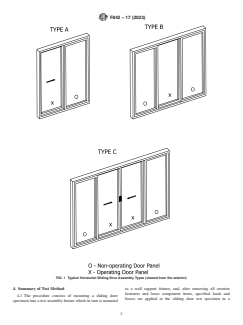
1.2 For purposes of these test methods, sliding door assemblies are defined as described in 1.2.1 – 1.2.4 and as shown in Fig. 1. Sliding door assemblies with a combination of operable panels and fixed panels (lites) shall be classified and tested separately for each type.
FIG. 1 Typical Horizontal Sliding Door Assembly Types (viewed from the exterior)
1.2.1 Type A—A sliding door assembly which incorporates one or more sliding panels that lock to the jamb.
1.2.2 Type B—A sliding door assembly which incorporates one or more sliding panels that lock to an intermediate jamb.
1.2.3 Type C—A sliding door assembly which incorporates one or more sliding panels that abut and lock to other panels.
1.2.4 Type D—A sliding door assembly which incorporates one or more fixed or stationary panels that are designed not to open.
Note 1: See Fig. 1 for graphic depiction of sliding door assembly types.
1.3 The values stated in inch-pound units are to be regarded as standard. The values given in parentheses are mathematical conversions to SI units that are provided for information only and are not considered standard.
1.4 This standard does not purport to address all of the safety concerns, if any, associated with its use. It is the responsibility of the user of this standard to establish appropriate safety, health, and environmental practices and determine the applicability of regulatory limitations prior to use.
1.5 This international standard was developed in accordance with internationally recognized principles on standardization established in the Decision on Principles for the Development of International Standards, Guides and Recommendations issued by the World Trade Organization Technical Barriers to Trade (TBT) Committee.
- Status
- Published
- Publication Date
- 30-Apr-2023
- Technical Committee
- E06 - Performance of Buildings
- Drafting Committee
- E06.51 - Performance of Windows, Doors, Skylights and Curtain Walls
Overview
ASTM F842-17(2023) - Standard Test Methods for Measuring the Forced Entry Resistance of Sliding Door Assemblies, Excluding Glazing Impact provides industry-accepted procedures for assessing the resistance of sliding door assemblies against forced entry attempts, excluding impact on glazing materials. Developed by ASTM International, this standard is designed to establish a measure of security for building entrances against unskilled or opportunistic intrusions, helping manufacturers, specifiers, and regulators determine product suitability for various applications.
This standard is widely referenced in building and security codes, and it is aligned with principles established by the World Trade Organization Technical Barriers to Trade (TBT) Committee. It addresses the need for objective evaluation methods to ensure that sliding door assemblies deliver dependable protection and meet safety and regulatory requirements.
Key Topics
- Scope of Testing: ASTM F842 covers the evaluation of sliding door assemblies, focusing on forced entry resistance without assessing the integrity of glazing materials. The methods apply to attacks perpetrated by unskilled intruders using basic hand tools.
- Sliding Door Assembly Types: The standard classifies sliding door assemblies into four types based on panel configuration and locking mechanisms:
- Type A: Panels lock to the jamb.
- Type B: Panels lock to an intermediate jamb.
- Type C: Panels abut and lock to other panels.
- Type D: Includes fixed, non-operable panels.
- Test Procedures: The methods involve mounting the door assembly in a secure fixture and applying loads and forces in a prescribed sequence. Key tests include disassembly, hardware manipulation, and panel manipulation, all performed under controlled conditions.
- Performance Criteria: Acceptance criteria are jurisdiction-dependent, but suggested guidelines are included. Passing the test requires all locking mechanisms to stay engaged and no entry gained during or after testing.
- Test Equipment: Standard tool sets, including spatulas, screwdrivers, pliers, and specific load application devices, are prescribed for consistent, repeatable measurements.
- Limitations: The standard does not evaluate the impact resistance or removal of glazing materials, for which other standards must be referenced.
Applications
ASTM F842-17(2023) provides valuable guidance for the following sectors:
- Door and Window Manufacturers: Enables manufacturers to objectively test and validate the forced entry resistance of their sliding door products, ensuring customer confidence and compliance with building security codes.
- Building Code Officials and Inspectors: Assists authorities in determining compliance with security standards for residential and commercial properties, ensuring that installed products meet jurisdictional requirements.
- Architects and Specifiers: Provides a reliable reference point for specifying security-rated sliding door assemblies in construction projects.
- Testing and Certification Laboratories: Establishes a consistent methodology for performance evaluation, enabling third-party verification and certification of security products.
- Security Consultants: Offers a recognized benchmark for security assessments when recommending physical safeguards for buildings.
Note: Selection of performance criteria and acceptance levels should be determined by the relevant regulatory authority or project requirements.
Related Standards
- ASTM E631: Terminology of Building Constructions
- ASTM E699: Specification for Agencies Involved in Testing, Quality Assurance, and Evaluating of Manufactured Building Components
- AAMA 1303.5: Voluntary Specifications for Forced Entry Resistant Aluminum Sliding Glass Doors
- CAWM 300-96: Forced Entry Resistance Tests for Sliding Glass Doors
- CMBSO 1-79: California Model Building Security Ordinance
For comprehensive evaluation of glazing impact or removal, refer to standards specifically addressing glazing materials.
Summary
ASTM F842-17(2023) plays a critical role in enhancing building security by setting recognized procedures for forced entry resistance testing of sliding door assemblies. It aids designers, manufacturers, and regulatory authorities in selecting and approving doors that restrict unauthorized access, support code compliance, and contribute to occupant safety. Integrating this standard into product development, specification, and regulatory frameworks leads to more secure buildings and peace of mind for occupants and property owners.
Keywords: ASTM F842, forced entry resistance, sliding door assemblies, security test methods, building security standards, laboratory testing, door hardware, fenestration, physical security, regulatory compliance.
Relations
- Effective Date
- 01-Aug-2016
- Effective Date
- 01-Mar-2015
- Effective Date
- 01-Nov-2014
- Effective Date
- 01-Jan-2009
- Effective Date
- 01-May-2008
- Effective Date
- 01-Jun-2006
- Effective Date
- 10-Jun-2003
- Effective Date
- 28-Jul-2000
- Effective Date
- 10-Dec-1999
Get Certified
Connect with accredited certification bodies for this standard

DIBt (Deutsches Institut für Bautechnik)
German Institute for Building Technology.
DIN CERTCO
DIN Group product certification.

Kiwa BDA Testing
Building and construction product certification.
Sponsored listings
Frequently Asked Questions
ASTM F842-17(2023) is a standard published by ASTM International. Its full title is "Standard Test Methods for Measuring the Forced Entry Resistance of Sliding Door Assemblies, Excluding Glazing Impact". This standard covers: SIGNIFICANCE AND USE 5.1 These test methods are intended to establish a measure of resistance for sliding door assemblies subjected to attacks (other than impacting glazing materials) by unskilled or opportunistic burglars. Resistance to higher levels of force generated by skilled burglary attack requires methods, such as alarms, communication, or apprehension systems, or special security glazing materials more sophisticated than those evaluated by these test methods. Technicians performing the test should understand the intent of this test method and should be trained on the execution and pass/fail criteria. 5.2 Entry through a sliding door assembly can be accomplished by impacting or removing glazing materials. This method does not evaluate glazing materials for breakage or de-glazing. Other standards must be used to evaluate forced entry by impacting or removing glazing. 5.3 Acceptance criteria for performance levels are a matter for authorities having specific jurisdiction to establish. Suggested guidelines are found in Annex A1. SCOPE 1.1 These test methods determine the ability of sliding door assemblies to restrain, delay, or frustrate forced entry. 1.2 For purposes of these test methods, sliding door assemblies are defined as described in 1.2.1 – 1.2.4 and as shown in Fig. 1. Sliding door assemblies with a combination of operable panels and fixed panels (lites) shall be classified and tested separately for each type. FIG. 1 Typical Horizontal Sliding Door Assembly Types (viewed from the exterior) 1.2.1 Type A—A sliding door assembly which incorporates one or more sliding panels that lock to the jamb. 1.2.2 Type B—A sliding door assembly which incorporates one or more sliding panels that lock to an intermediate jamb. 1.2.3 Type C—A sliding door assembly which incorporates one or more sliding panels that abut and lock to other panels. 1.2.4 Type D—A sliding door assembly which incorporates one or more fixed or stationary panels that are designed not to open. Note 1: See Fig. 1 for graphic depiction of sliding door assembly types. 1.3 The values stated in inch-pound units are to be regarded as standard. The values given in parentheses are mathematical conversions to SI units that are provided for information only and are not considered standard. 1.4 This standard does not purport to address all of the safety concerns, if any, associated with its use. It is the responsibility of the user of this standard to establish appropriate safety, health, and environmental practices and determine the applicability of regulatory limitations prior to use. 1.5 This international standard was developed in accordance with internationally recognized principles on standardization established in the Decision on Principles for the Development of International Standards, Guides and Recommendations issued by the World Trade Organization Technical Barriers to Trade (TBT) Committee.
SIGNIFICANCE AND USE 5.1 These test methods are intended to establish a measure of resistance for sliding door assemblies subjected to attacks (other than impacting glazing materials) by unskilled or opportunistic burglars. Resistance to higher levels of force generated by skilled burglary attack requires methods, such as alarms, communication, or apprehension systems, or special security glazing materials more sophisticated than those evaluated by these test methods. Technicians performing the test should understand the intent of this test method and should be trained on the execution and pass/fail criteria. 5.2 Entry through a sliding door assembly can be accomplished by impacting or removing glazing materials. This method does not evaluate glazing materials for breakage or de-glazing. Other standards must be used to evaluate forced entry by impacting or removing glazing. 5.3 Acceptance criteria for performance levels are a matter for authorities having specific jurisdiction to establish. Suggested guidelines are found in Annex A1. SCOPE 1.1 These test methods determine the ability of sliding door assemblies to restrain, delay, or frustrate forced entry. 1.2 For purposes of these test methods, sliding door assemblies are defined as described in 1.2.1 – 1.2.4 and as shown in Fig. 1. Sliding door assemblies with a combination of operable panels and fixed panels (lites) shall be classified and tested separately for each type. FIG. 1 Typical Horizontal Sliding Door Assembly Types (viewed from the exterior) 1.2.1 Type A—A sliding door assembly which incorporates one or more sliding panels that lock to the jamb. 1.2.2 Type B—A sliding door assembly which incorporates one or more sliding panels that lock to an intermediate jamb. 1.2.3 Type C—A sliding door assembly which incorporates one or more sliding panels that abut and lock to other panels. 1.2.4 Type D—A sliding door assembly which incorporates one or more fixed or stationary panels that are designed not to open. Note 1: See Fig. 1 for graphic depiction of sliding door assembly types. 1.3 The values stated in inch-pound units are to be regarded as standard. The values given in parentheses are mathematical conversions to SI units that are provided for information only and are not considered standard. 1.4 This standard does not purport to address all of the safety concerns, if any, associated with its use. It is the responsibility of the user of this standard to establish appropriate safety, health, and environmental practices and determine the applicability of regulatory limitations prior to use. 1.5 This international standard was developed in accordance with internationally recognized principles on standardization established in the Decision on Principles for the Development of International Standards, Guides and Recommendations issued by the World Trade Organization Technical Barriers to Trade (TBT) Committee.
ASTM F842-17(2023) is classified under the following ICS (International Classification for Standards) categories: 13.310 - Protection against crime; 91.060.50 - Doors and windows. The ICS classification helps identify the subject area and facilitates finding related standards.
ASTM F842-17(2023) has the following relationships with other standards: It is inter standard links to ASTM E699-16, ASTM E631-15, ASTM E631-14, ASTM E699-09, ASTM E699-03(2008), ASTM E631-06, ASTM E699-03, ASTM E631-93a(1998)e1, ASTM E699-99. Understanding these relationships helps ensure you are using the most current and applicable version of the standard.
ASTM F842-17(2023) is available in PDF format for immediate download after purchase. The document can be added to your cart and obtained through the secure checkout process. Digital delivery ensures instant access to the complete standard document.
Standards Content (Sample)
This international standard was developed in accordance with internationally recognized principles on standardization established in the Decision on Principles for the
Development of International Standards, Guides and Recommendations issued by the World Trade Organization Technical Barriers to Trade (TBT) Committee.
Designation: F842 − 17 (Reapproved 2023)
Standard Test Methods for
Measuring the Forced Entry Resistance of Sliding Door
Assemblies, Excluding Glazing Impact
This standard is issued under the fixed designation F842; the number immediately following the designation indicates the year of original
adoption or, in the case of revision, the year of last revision. A number in parentheses indicates the year of last reapproval. A superscript
epsilon (´) indicates an editorial change since the last revision or reapproval.
This standard has been approved for use by agencies of the U.S. Department of Defense.
1. Scope 2. Referenced Documents
1.1 These test methods determine the ability of sliding door 2.1 ASTM Standards:
assemblies to restrain, delay, or frustrate forced entry. E631 Terminology of Building Constructions
E699 Specification for Agencies Involved in Testing, Quality
1.2 For purposes of these test methods, sliding door assem-
Assurance, and Evaluating of Manufactured Building
blies are defined as described in 1.2.1 – 1.2.4 and as shown in
Components
Fig. 1. Sliding door assemblies with a combination of operable
2.2 AAMA Standard:
panels and fixed panels (lites) shall be classified and tested
AAMA 1303.5 Voluntary Specifications for Forced Entry
separately for each type.
Resistant Aluminum Sliding Glass Doors
1.2.1 Type A—A sliding door assembly which incorporates
2.3 CAWM Standards:
one or more sliding panels that lock to the jamb.
CAWM 300-96 Forced Entry Resistance Tests for Sliding
1.2.2 Type B—A sliding door assembly which incorporates
Glass Doors
one or more sliding panels that lock to an intermediate jamb.
CMBSO 1-79 California Model Building Security Ordi-
1.2.3 Type C—A sliding door assembly which incorporates
nance
one or more sliding panels that abut and lock to other panels.
1.2.4 Type D—A sliding door assembly which incorporates
3. Terminology
one or more fixed or stationary panels that are designed not to
open.
3.1 Definitions—Definitions for standard terminology can
be found in Terminology E631.
NOTE 1—See Fig. 1 for graphic depiction of sliding door assembly
types.
3.2 Definitions of Terms Specific to This Standard:
3.2.1 door frame assembly, n—the combination of a head,
1.3 The values stated in inch-pound units are to be regarded
sill, and jambs surrounding and supporting fixed and sliding
as standard. The values given in parentheses are mathematical
panels.
conversions to SI units that are provided for information only
and are not considered standard.
3.2.2 fixed jamb stile, n—vertical members of fixed or
stationary panels adjacent to any jamb.
1.4 This standard does not purport to address all of the
safety concerns, if any, associated with its use. It is the
3.2.3 intermediate jamb, n—vertical member of a frame
responsibility of the user of this standard to establish appro-
other than the outermost vertical members.
priate safety, health, and environmental practices and deter-
3.2.4 locking device(s) (lock), n—one or more components
mine the applicability of regulatory limitations prior to use.
of a sliding door assembly intended to resist opening of the
1.5 This international standard was developed in accor-
sliding door panel from the exterior.
dance with internationally recognized principles on standard-
3.2.5 sliding door assembly, n—a combination of one or
ization established in the Decision on Principles for the
more sliding door panels with or without one or more fixed
Development of International Standards, Guides and Recom-
panels within a common frame.
mendations issued by the World Trade Organization Technical
Barriers to Trade (TBT) Committee.
For referenced ASTM standards, visit the ASTM website, www.astm.org, or
These test methods are under the jurisdiction of ASTM Committee E06 on contact ASTM Customer Service at service@astm.org. For Annual Book of ASTM
Performance of Buildings and are the direct responsibility of Subcommittee E06.51 Standards volume information, refer to the standard’s Document Summary page on
on Performance of Windows, Doors, Skylights and Curtain Walls. the ASTM website.
Current edition approved May 1, 2023. Published May 2023. Originally Available from the American Architectural Manufacturers Association
approved in 1983. Last previous edition approved in 2017 as F842 – 17. DOI: (AAMA), 1827 Walden Office Square, Suite 550, Schaumburg, IL 60173-4268,
10.1520/F0842-17R23. http://www.aamanet.org.
Copyright © ASTM International, 100 Barr Harbor Drive, PO Box C700, West Conshohocken, PA 19428-2959. United States
F842 − 17 (2023)
FIG. 1 Typical Horizontal Sliding Door Assembly Types (viewed from the exterior)
4. Summary of Test Method to a wall support fixture, and, after removing all exterior
fasteners and loose component items, specified loads and
4.1 The procedure consists of mounting a sliding door
forces are applied to the sliding door test specimen in a
specimen into a test assembly fixture which in turn is mounted
F842 − 17 (2023)
prescribed sequence. Following removal of all loads, a deter- classified and tested separately for each panel type. If multiple
mination is made by the laboratory technician, as defined by panels within a sliding door assembly are identical in construc-
Section 9 of Specification E699, whether or not entry can be tion and locking condition, only one panel need be tested.
gained through the sliding door test specimen from the exterior.
6.4 Test Sequence—Perform the tests for each sliding door
test specimen in the sequence as outlined in Section 10. The
5. Significance and Use
sequence for testing multiple panels shall be at the discretion of
5.1 These test methods are intended to establish a measure
the testing agency.
of resistance for sliding door assemblies subjected to attacks
6.5 Loading—Apply test loads and forces at a rate not to
(other than impacting glazing materials) by unskilled or
exceed 10 lb/s (45 N/s). Maintain performance loads for a
opportunistic burglars. Resistance to higher levels of force
period of 60 s 6 5 s.
generated by skilled burglary attack requires methods, such as
6.6 Load Removal—At the conclusion of each test, remove
alarms, communication, or apprehension systems, or special
all loads before starting the next test.
security glazing materials more sophisticated than those evalu-
ated by these test methods. Technicians performing the test
7. Apparatus
should understand the intent of this test method and should be
trained on the execution and pass/fail criteria.
7.1 Instrumentation—Load and time measuring devices
with an accuracy of 62 % of the full scale shall be incorpo-
5.2 Entry through a sliding door assembly can be accom-
rated in the test setups. The scale ranges used shall assure that
plished by impacting or removing glazing materials. This
the performance levels are within an accuracy of 65 %.
method does not evaluate glazing materials for breakage or
de-glazing. Other standards must be used to evaluate forced
7.2 Load Attachments—Brackets, fasteners, or other devices
entry by impacting or removing glazing.
used in performing these tests shall be designed and attached so
as to minimize their influence on the test results.
5.3 Acceptance criteria for performance levels are a matter
for authorities having specific jurisdiction to establish. Sug-
7.3 Test Frame—The test fixture shall be designed and
gested guidelines are found in Annex A1.
constructed to accept and rigidly secure the sliding door
specimen and to provide rigid points of anchor for all test loads
6. Test Criteria
described in 10.3. The load bearing members of the test fixture
6.1 Sliding Door Test Specimen—The same sliding door shall be constructed to limit deflection of such members to a
assembly shall be used for all testing and shall contain panels maximum of ⁄8 in. (3 mm) under full prescribed load.
having the greatest height and width for which approval is
7.4 Tools for Disassembly—The following tools shall be
sought. Each unique panel/frame arrangement and locking
used for disassembly of the test specimen:
arrangement shall be tested.
7.4.1 A spatula, putty knife, or other non-cutting tool with a
6.1.1 The construction of the sliding door test specimen,
thin blade, 24 gauge stainless steel 0.024 in. 6 0.004 in.
including all hardware, components, and arrangement of panels
(0.6 mm 6 1 mm) thick, 0.78 in. 6 0.08 in. (20 mm 6 2 mm)
shall be representative of that for which acceptance is desired.
wide, and 3.5 in. 6 0.4 in. (90 mm 6 10 mm) long. The
6.1.2 The sliding door test specimen shall consist of the
bottom may be wrapped for safety provided the 3.5 in. 6 0.4
entire assembled unit, including frame, glazing, and anchorage
in. (90 mm 6 10 mm) length remains exposed.
as supplied by the manufacturer for installation in the building.
7.4.2 Any non-powered, straight, or Phillips head screw-
6.1.3 Unless otherwise specified, the test specimen shall
driver appropriate to the mechanical fastener with a maximum
contain the weakest code compliant safety glazing for testing
length of 6 in. (150 mm).
and shall be single glazed if designed for either single or
7.4.3 Standard slot-type pliers with a 6 in. to 7 in. (150 mm
double glazing, or double glazed if designed exclusively for
to 175 mm) overall length.
multiple glazing. Products tested with glazing materials other
7.5 Tools for Hardware Manipulation—The following tools
than the weakest code compliant safety glazing shall qualify
shall be used for manipulation of the locks of the test specimen:
only the specific glazing material tested.
7.5.1 A spatula, putty knife, or other non-cutting tool with a
6.1.4 Sliding door assemblies tested with more than one
thin blade, 24 gauge stainless steel 0.024 in. 6 0.004 in.
locking device shall not qualify sliding door assemblies with
(0.6 mm 6 0.1 mm) thick, 0.78 in. 6 0.08 in. (20 mm 6
fewer locking devices, regardless of size.
2 mm) wide, and 3.5 in. 6 0.4 in. (90 mm 6 10 mm) long. The
6.2 Performance Criteria—The performance level is at-
bottom may be wrapped for safety provided the 3.5 in. 6
tained if all locking devices remain engaged and entry cannot
0.4 in. (90 mm 6 10 mm) length remains exposed.
be gained during the test or upon removal of loads. If during
7.5.2 A piece of black annealed 16 gauge straight wire at
testing, any component, including the glazing material, fails,
least long enough to reach from the point of insertion to the
allowing entry, this shall be considered a failure to attain the 4
locking device(s).
performance level. Glazing which breaks, but does not allow
entry, shall not be considered a failure to attain the perfor-
mance level.
The properties of black annealed 16 gauge wire are described in Machinery’s
6.3 Multiple Panels—Sliding door assemblies with a com-
Handbook, 22nd Edition, Available from Industrial Press, Inc., 32 Haviland Street,
bination of operable panels and fixed panels (lites) shall be Suite 3, South Norwalk, CT 06854.
F842 − 17 (2023)
8. Hazards performance grade desired using the loads and times indicated
in Table A1.1 in Annex A1. See 6.5 for load application details.
8.1 Glass breakage may occur during the application of
At the completion of tests B1 through B7 perform the hardware
loads or forces required by these test methods. Take adequate
manipulation test and the panel manipulation test defined in
precautions to protect personnel from broken glass.
Annex A2, A2.3, and A2.4.
8.2 Locking devices, glass, and other sliding door test
10.4 Type C Sliding Door Assembly:
specimen components may suddenly fail when loads and forces
10.4.1 Perform the disassembly test defined in Annex A2,
are applied during these test methods, causing panels to open
A2.2. Following the completion of the disassembly test per-
rapidly. Take adequate precautions to protect personnel from
form tests C1 through C7 as defined in Annex A2 for the
rapidly moving weights and sliding door test specimen com-
performance grade desired using the loads and times indicated
ponents.
in Table A1.1 in Annex A1. See 6.5 for load application details.
9. Preparation At the completion of tests C1 through C7 perform the hardware
manipulation test and the panel manipulation test defined in
9.1 Mount the sliding door test specimen into a 2 in. by 4 in.
Annex A2, A2.3, and A2.4.
or 2 in. by 6 in. (40 mm by 100 mm or 40 mm by 150 mm)
lumber surround fixture, in accordance with the manufacturer’s 10.5 Type D Sliding Door Assembly:
10.5.1 Perform the disassembly test defined in Annex A2,
written installation instructions. Additional attachment means
are permitted between the lock jamb and the test frame A2.2. Following the completion of the disassembly test per-
form tests D1 through D3 as defined in Annex A2 for the
provided such means do not increase the strength of the
connection between locking devices and the sliding door performance grade desired using the loads and times indicated
in Table A1.1 in Annex A1. See 6.5 for load application details.
members beyond the door manufacturer’s installation specifi-
cations. At the completion of tests C1 through C7 perform the hardware
manipulation test and the panel manipulation test defined in
9.2 Install the sliding door assembly specimen into the test
Annex A2, A2.3, and A2.4.
fixture.
11. Report
9.3 Close and lock the sliding door test specimen. Submit
each operable unit to five cycles of opening, closing, and
11.1 The report shall contain a description of the results of
locking prior to testing.
the test(s) performed in accordance with these test methods.
10. Procedure 11.2 The report shall include at least the following:
11.2.1 Identification of the sliding door test specimen;
10.1 The disassembly test, hardware manipulation test, and
11.2.2 Type, size, location, and number of locking devices
panel manipulation test referenced in the following parts of
and other hardware;
Section 10 are fully described in Annex A2.
11.2.3 Type, location, and number of installation fasteners;
10.1.1 Without in any other manner intentionally damaging
11.2.4 Type and thickness of glazing material;
the sliding door test specimen, remove from the sliding door
11.2.5 Bill of materials;
test specimens all screws, glazing beads, and any other
11.2.6 Assembly drawings;
members or other mechanical fasteners that can be removed
11.2.7 Performance level, loads, and times (L1, L2, L3, L4,
readily from the exterior within a time limit of 5 min using the
T1) used;
tools stipulated in 7.4.
11.2.8 A statement as to whether the sliding door specimen
10.2 Type A Sliding Door Assembly:
complies or not and the grade at which it complies;
10.2.1 Perform the disassembly test defined in Annex A2,
11.2.9 A description of the method of installation or instal-
A2.2. Following the completion of the disassembly test per-
lation fastening; and
form tests A1 through A7 as defined in Annex A2 for the
11.2.10 A description of the test equipment used.
performance grade desired using the loads and times indicated
in Table A1.1 in Annex A1. See 6.5 for load application details. 12. Precision and Bias
At the completion of tests A1 through A7 perform the hardware
12.1 These test methods do not generate numerical values.
manipulation test and the panel manipulation test defined in
They establish a pass/fail condition which cannot generate
Annex A2, A2.3, and A2.4.
numerical values for precision and bias.
10.3 Type B Sliding Door Assembly:
13. Keywords
10.3.1 Perform the disassembly test defined in Annex A2,
A2.2. Following the completion of the disassembly test per- 13.1 doors; fenestration; forced entry resistance; laboratory
form tests B1 through B7 as defined in Annex A2 for the method; sliding glass doors
F842 − 17 (2023)
ANNEXES
(Mandatory Information)
A1. SUGGESTED MEASURED PERFORMANCE
A
TABLE A1.1 Suggested Measured Performance
Identifications Grade 10 Grade 20 Grade 25 Grade 30 Grade 40
T1 5 min 5 min 5 min 10 min 10 min
L1 300 lbf (1334 N) 500 lbf (2224 N) 800 lbf (3559 N) 800 lbf (3559 N) 1100 lbf (4893 N)
L2 175 lbf (778 N) 200 lbf (890 N) 200 lbf (890 N) 400 lbf (1779 N) 550 lbf (2447 N)
L3 30 lbf (133 N) 50 lbf (222 N) 50 lbf (222 N) 100 lbf (445 N) 150 lbf (667 N)
L4 50 lbf (222 N) 50 lbf (222 N) 50 lbf (222 N) 50 lbf (222 N) 50 lbf (222 N)
plus weight of plus weight of plus weight of plus weight of plus weight of
panel panel panel panel panel
A
It is suggested that Table A1.1 be used with the understanding that five levels of load identification are established with load identification 40 being the highest and 10
being the lowest. Use of load identifications should be selected in accordance with security objective desired. Grade 25 parallels the requirements of CMBSO 1-79 and
CAWM 300-96. See 6.5 for load application details.
A2. TESTS
A2.1 The following tests shall be performed by laboratory A2.5.2 Test A1—With the sliding panels in the test position,
personnel only, as defined in Part A of Specification E699. a concentrated load (L1) shall be applied separately to each
member incorporating a locking device, at a point on the panel
A2.2 Disassembly Test
member within 3 in. (75 mm) of the locking device, in a
direction parallel to the plane of the glass that would tend to
A2.2.1 Remove from the door test specimen all screws,
open the panel. The load shall be distributed evenly between
glazing beads, and any other members or other mechanical
the interior and exterior sides of the locking device so as to
fasteners that can be removed readily from the exterior within
minimize rotation. (Two equal concentrated loads which to-
a time limit of 5 min using the tools stipulated in 7.4. Removal
gether equal L1.) (See Fig. A2.1.)
of the indicated parts shall be done carefully so as not to cause
A2.5.3 Test A2—With the sliding panels in the test position,
collateral damage to the specimen.
a concentrated load (L1) shall be applied separately, from the
A2.3 Hardware Manipulation Test
exterior, to each member incorporating a locking device, at a
point on the sash member within 3 in. (75 mm) of the locking
A2.3.1 Examine the door test specimen and determine a
device, in a direction parallel to the plane of the glass that
method of inserting the tools in 7.5 from the outside so as to
would tend to open the panel, while, simultaneously, an
contact the locking device(s). Using one technician only,
additional concentrated load (L2) is applied to the panel
attempt to gain entry by manipulating the locking device(s)
member containing the locking device in the direction perpen-
with these tools in any combination without intentionally
dicular to the plane of the glazing material toward the interior
removing material from the panel or frame to facilitate access
side of the sliding door test specimen. Where more than one
to the locking devices. Conduct this test continuously for a
primary lock is used, the loads shall be equally divided among
time limit of (T1). Manipulation of the locking devices shall be
the locks and shall be applied simultaneously. (Two equal
done in a manner that will not cause collateral damage to the
concentrated loads which together equal L1.) (See Fig. A2.2.)
specimen.
A2.5.4 Test A3—With the sliding panels in the test position,
a concentrated load (L1) shall be applied separately, from the
A2.4 Panel Manipulation Test
exterior, to each member incorporating a locking device, at a
A2.4.1 While attempting to open the sliding door assembly,
point on the sash member within 3 in. (75 mm) of the locking
lift, push, pull or otherwise manipulate by hand from the
device, in a direction parallel to the plane of the glass that
exterior all panels to the full confines of the frame. This test
would tend to open the panel, while, simultaneously, an
shall be conducted continuously for a time limit of (T1).
additional concentrated load (L2) is applied to the panel
member containing the locking device in the direction perpen-
A2.5 Type A Sliding Door Assembly Tests
dicular to the plane of the glazing material toward the exterior
A2.5.1 Perform the disassembly test defined in Annex A2,
side of the sliding door test specimen. Where more than one
subsection A2.2. primary lock is used, the loads shall be equally divided among
F842 − 17 (2023)
FIG. A2.1 Test A1
FIG. A2.2 Test A2
FIG. A2.3 Test A3
the locks and shall be applied simultaneously. (Two equal
concentrated loads which together equal L1.) (See Fig. A2.3.) rail of the test panel. Where more than one primary lock is
used, the loads shall be equally divided among the locks and
A2.5.5 Test A4—With the sliding panels in the test position,
shall be applied simultaneously. (Two equal concentrated loads
a concentrated load (L1) shall be applied separately, from the
which together equal L1.) (See Fig. A2.4.)
exterior, to each member incorporating a locking device, at a
point on the sash member within 3 in. (75 mm) of the locking A2.5.6 Test A5—With the sliding panels in the test position,
device, in a direction parallel to the plane of the glass that a concentrated load (L1) shall be applied separately, from the
would tend to open the panel, while, simultaneously, an exterior, to each member incorporating a locking device, at a
additional concentrated load (L2) is applied to the panel point on the sash member within 3 in. (75 mm) of the locking
member containing the locking device in the direction perpen- device, in a direction parallel to the plane of the glass that
dicular to the plane of the glazing material toward the interior would tend to open the panel, while, simultaneously, an
side of the sliding door test specimen and, simultaneously, additional concentrated load (L2) is applied to the panel
lifting the sliding door panel vertically to the uppermost limit member containing the locking device, in the direction perpen-
within the confines of the sliding door frame assembly with a dicular to the plane of the glazing material toward the exterior
load (L4). Apply the lifting load at the mid-span of the bottom side of the sliding door test specimen and, simultaneously,
F842 − 17 (2023)
load (L3) in the direction perpendicular to the plane of the
glazing material, toward the interior side of the sliding door
specimen, to the bottom rail on the same panel within 3 in.
(75 mm) of the corner opposite the stile containing the locking
device. Where more than one primary lock is used, the loads
shall be equally divided among the locks and shall be applied
simultaneously. (Two equal concentrated loads which together
equal L1.) (See Fig. A2.6.)
A2.5.8 Test A7, Outside Sliding Panels—With the sliding
door panel lifted vertically to the uppermost limit within the
confines of the sliding door frame assembly with a load (L4),
while, simultaneously, with the sliding panels in the test
position, a concentrated load (L1) shall be applied separately to
each member incorporating a locking device, at a point on the
panel member within 3 in. (75 mm) of the locking device, in a
direction parallel to the plane of the glass that would tend to
open the panel and simultaneously applying a concentrated
load (L3) in the direction perpendicular to the plane of the
FIG. A2.4 Test A4
glazing material, toward the exterior side of the sliding door
specimen, to the bottom rail on the same panel within 3 in.
(75 mm) of the corner opposite the stile containing the locking
lifting the sliding door panel vertically to the uppermost limit
device. Where more than one primary lock is used, the loads
within the confines of the sliding door frame assembly with a
shall be equally divided among the locks and shall be applied
load (L4). Apply the lifting load at the mid-span of the bottom
simultaneously. (Two equal concentrated loads which together
rail of the test panel. Where more than one primary lock is
equal L1.) (See Fig. A2.7.)
used, the loads shall be equally divided among the locks and
shall be applied simultaneously. (Two equal concentrated loads A2.5.9 After completion of tests A1 through A7 and with all
which together equal L1.) (See Fig. A2.5.)
loads removed, perform the hardware manipulation test and the
panel manipulation test.
A2.5.7 Test A6, Inside Sliding Panels—With the sliding
door panel lifted vertically to the uppermost limit within the
A2.6 Type B Sliding Door Assembly Tests
confines of the sliding door frame assembly with a load (L4),
A2.6.1 Perform the disassembly test defined in Annex A2,
while, simultaneously, with the sliding panels in the test
section A2.2.
position, a concentrated load (L1) shall be applied separately to
each member incorporating a locking device, at a point on the
A2.6.2 Test B1—With the sliding panels in the test position,
panel member within 3 in. (75 mm) of the locking device, in a
two concentrated loads (L1) shall be applied separately to each
direction parallel to the plane of the glass that would tend to
member incorporating a locking device, at a point on the panel
open the panel and simultaneously applying a concentrated
member within 3 in. (75 mm) of the locking device, in a
FIG. A2.5 Test A5 FIG. A2.6 Test A6—Inside Sliding Panels
F842 − 17 (2023)
FIG. A2.7 Test A7—Outside Sliding Panels
FIG. A2.8 Test B1
load (L1) at the intermediate jamb in such a manner as to exert
direction parallel to the plane of the glass that would tend to
the load on the intermediate jamb in a direction parallel to the
open the panel. Apply the first load (L1) at the stile in such a
plane of the glazing material and opposite to the first load (L1).
manner as to exert the load on the locking device or handle by
The load attachment point for the second load shall be at the
straddling it at points on the sliding door panel member within
same height above the frame sill and in the same vertical plane
3 in. (75 mm) of each side of the locking device in a direction
as the load attachment points for the first load. Apply both
parallel to the plane of the glazing material that would tend to
loads simultaneously and equally. Where more than one
open the door. Apply the second load (L1) at the intermediate
primary lock is used, the loads shall be equally divided among
jamb in such a manner as to exert the load on the intermediate
the locks and shall be applied simultaneously. (Two equal
jamb in a direction parallel to the plane of the glazing material
concentrated loads which together equal L1.) (See Fig. A2.9.)
and opposite to the first load (L1). The load attachment point
for the second load shall be at the same height above the frame
A2.6.4 Test B3—With the sliding panels in the test position,
sill and in the same vertical plane as the load attachment points
two concentrated loads (L1) shall be applied separately, from
for the first load. Apply both loads simultaneously and equally.
the exterior, to each member incorporating a locking device, at
The load shall be distributed evenly between the interior and
a point on the sash member within 3 in. (75 mm) of the locking
exterior sides of the locking device so as to minimize rotation.
device, in a direction parallel to the plane of the glass that
(Two equal concentrated loads which together equal L1.) (See
would tend to open the panel, while, simultaneously, an
Fig. A2.8.)
NOTE A2.1—The application of the (L1) loads singly or eccentrically
will tend to deglaze the adjacent fixed panel that could affect the results of
the test adversely. In order to alleviate this situation, apply the second
reactive load (L1) before the first load (L1), or apply both loads in equal
stages so that the results are not adversely affected by deglazing of the
fixed panel.
A2.6.3 Test B2—With the sliding panels in the test position,
two concentrated loads (L1) shall be applied separately, from
the exterior, to each member incorporating a locking device, at
a point on the sash member within 3 in. (75 mm) of the locking
device, in a direction parallel to the plane of the glass that
would tend to open the panel, while, simultaneously, an
additional concentrated load (L2) is applied to the panel
member containing the locking device in the direction perpen-
dicular to the plane of the glazing material toward the interior
side of the sliding door test specimen. Apply the first load (L1)
at the stile in such a manner as to exert the load on the locking
device or handle by straddling it at points on the sliding door
panel member within 3 in. (75 mm) of each side of the locking
device in a direction parallel to the plane of the glazing
material that would tend to open the door. Apply the second FIG. A2.9 Test B2
...