

ASTM F476-23
(Test Method)Standard Test Methods for Security of Swinging Door Assemblies
General Information
- Abstract
SCOPE
1.1 These test methods cover door assemblies of various materials and types of construction for use in wall openings to deter unwanted intruders.
1.2 Door assemblies, covered by these test methods, also include individual components such as the hinge, lock, door, strike, and jamb.
1.3 These test methods are designed to measure the capability of a swinging door assembly to restrain or delay and frustrate the commission of “break-in” crimes.
1.4 These test methods apply primarily to typical entry door assemblies.
1.5 The values stated in SI units are to be regarded as standard. The values given in parentheses after SI units are provided for information only and are not considered standard.
1.6 This standard does not purport to address all of the safety concerns, if any, associated with its use. It is the responsibility of the user of this standard to establish appropriate safety, health, and environmental practices and determine the applicability of regulatory limitations prior to use.
1.7 This international standard was developed in accordance with internationally recognized principles on standardization established in the Decision on Principles for the Development of International Standards, Guides and Recommendations issued by the World Trade Organization Technical Barriers to Trade (TBT) Committee.
- Status
- Published
- Publication Date
- 31-Dec-2022
- Technical Committee
- F12 - Security Systems and Equipment
- Drafting Committee
- F12.50 - Locking Devices
Overview
ASTM F476-23: Standard Test Methods for Security of Swinging Door Assemblies is an internationally recognized ASTM standard designed to evaluate the security performance of swinging doors and their individual components. The standard is applicable to various door materials and construction types intended for use in wall openings where the primary objective is to deter or delay unauthorized entry. It outlines procedures to test the ability of door assemblies-including the door, hinges, locks, strike plates, and jambs-to resist typical break-in methods and forced entry attempts. ASTM F476-23 is primarily focused on typical entry doors used in both residential and commercial settings.
Key Topics
- Comprehensive Security Testing: The standard provides detailed test methods for evaluating the resistance of swinging door assemblies to various forced entry techniques.
- Inclusive Component Assessment: It addresses not only the door as a unit but also critical components such as hinges, locks, strikes, and jambs, ensuring holistic security evaluation.
- Impact and Load Testing: Methods include impact resistance (using pendulum and vertical impactors), static bolt load tests, torque and tension tests on locksets, and jamb stiffness measurements.
- Test Procedure and Fixtures: Guidance for preparing specimens, mounting, and conducting each test is provided to standardize results across different laboratories and manufacturers.
- Pass/Fail Criteria: The standard establishes clear pass/fail conditions based on functional integrity after subjected tests, focusing on whether the door or its components can be bypassed or opened post-testing.
- Performance Grades: While ASTM F476-23 does not set mandatory acceptance criteria, it references established grading concepts for minimum performance levels in certain applications.
Applications
ASTM F476-23 is widely applicable for:
- Product Certification: Manufacturers use these test methods to certify the security performance of their swinging door products, ensuring compliance with industry standards.
- Security Specification in Construction: Architects, builders, and specifiers reference ASTM F476-23 to select appropriate entry doors and locking systems for both new construction and retrofit projects where enhanced security is a priority.
- Law Enforcement and Security Assessments: Security professionals and agencies employ the standard to evaluate vulnerability to forced entry, aiding in risk assessment and mitigation strategies for residential, commercial, and institutional buildings.
- Quality Control and Performance Benchmarking: Testing laboratories and door manufacturers perform standardized tests as part of quality assurance programs and to support marketing claims regarding entry resistance.
- Regulatory and Code Compliance: Authorities having jurisdiction (AHJs) may reference ASTM F476-23 when establishing building codes or security guidelines for building entrances and egress points.
Related Standards
- ASTM F476 (Previous Versions): Earlier editions of this standard may be referenced for historical testing or comparison purposes.
- ASTM F471: Terminology Relating to Combination Locks (Withdrawn).
- Other ASTM Security Standards: Such as those addressing padlocks, hardware security, and electronic access control devices.
- Building Codes and Security Guidelines: ASTM F476-23 is often referenced in conjunction with local, national, and international building codes and law enforcement security recommendations.
- WTO TBT Principles: The standard is developed in accordance with the World Trade Organization's Technical Barriers to Trade Committee principles, supporting global harmonization and acceptance.
By following ASTM F476-23, stakeholders can ensure a consistent, reliable approach to verifying the physical security of swinging door assemblies, thereby enhancing the safety and security of building occupants and assets. The standard is essential for anyone involved in the manufacture, specification, or enforcement of security door solutions.
Relations
- Effective Date
- 24-Sep-1976
- Effective Date
- 24-Sep-1976
Get Certified
Connect with accredited certification bodies for this standard

DIBt (Deutsches Institut für Bautechnik)
German Institute for Building Technology.
DIN CERTCO
DIN Group product certification.

Kiwa BDA Testing
Building and construction product certification.
Sponsored listings
Frequently Asked Questions
ASTM F476-23 is a standard published by ASTM International. Its full title is "Standard Test Methods for Security of Swinging Door Assemblies". This standard covers: SCOPE 1.1 These test methods cover door assemblies of various materials and types of construction for use in wall openings to deter unwanted intruders. 1.2 Door assemblies, covered by these test methods, also include individual components such as the hinge, lock, door, strike, and jamb. 1.3 These test methods are designed to measure the capability of a swinging door assembly to restrain or delay and frustrate the commission of “break-in” crimes. 1.4 These test methods apply primarily to typical entry door assemblies. 1.5 The values stated in SI units are to be regarded as standard. The values given in parentheses after SI units are provided for information only and are not considered standard. 1.6 This standard does not purport to address all of the safety concerns, if any, associated with its use. It is the responsibility of the user of this standard to establish appropriate safety, health, and environmental practices and determine the applicability of regulatory limitations prior to use. 1.7 This international standard was developed in accordance with internationally recognized principles on standardization established in the Decision on Principles for the Development of International Standards, Guides and Recommendations issued by the World Trade Organization Technical Barriers to Trade (TBT) Committee.
SCOPE 1.1 These test methods cover door assemblies of various materials and types of construction for use in wall openings to deter unwanted intruders. 1.2 Door assemblies, covered by these test methods, also include individual components such as the hinge, lock, door, strike, and jamb. 1.3 These test methods are designed to measure the capability of a swinging door assembly to restrain or delay and frustrate the commission of “break-in” crimes. 1.4 These test methods apply primarily to typical entry door assemblies. 1.5 The values stated in SI units are to be regarded as standard. The values given in parentheses after SI units are provided for information only and are not considered standard. 1.6 This standard does not purport to address all of the safety concerns, if any, associated with its use. It is the responsibility of the user of this standard to establish appropriate safety, health, and environmental practices and determine the applicability of regulatory limitations prior to use. 1.7 This international standard was developed in accordance with internationally recognized principles on standardization established in the Decision on Principles for the Development of International Standards, Guides and Recommendations issued by the World Trade Organization Technical Barriers to Trade (TBT) Committee.
ASTM F476-23 is classified under the following ICS (International Classification for Standards) categories: 13.310 - Protection against crime; 91.060.50 - Doors and windows. The ICS classification helps identify the subject area and facilitates finding related standards.
ASTM F476-23 has the following relationships with other standards: It is inter standard links to ASTM F471-76(1996), ASTM F471-76(2002). Understanding these relationships helps ensure you are using the most current and applicable version of the standard.
ASTM F476-23 is available in PDF format for immediate download after purchase. The document can be added to your cart and obtained through the secure checkout process. Digital delivery ensures instant access to the complete standard document.
Standards Content (Sample)
This international standard was developed in accordance with internationally recognized principles on standardization established in the Decision on Principles for the
Development of International Standards, Guides and Recommendations issued by the World Trade Organization Technical Barriers to Trade (TBT) Committee.
Designation: F476 − 23
Standard Test Methods for
Security of Swinging Door Assemblies
This standard is issued under the fixed designation F476; the number immediately following the designation indicates the year of original
adoption or, in the case of revision, the year of last revision. A number in parentheses indicates the year of last reapproval. A superscript
epsilon (´) indicates an editorial change since the last revision or reapproval.
1. Scope 3. Terminology
1.1 These test methods cover door assemblies of various 3.1 Definitions:
materials and types of construction for use in wall openings to
3.1.1 bolt, n—any movable projection that blocks the move-
deter unwanted intruders.
ment of one object relative to another.
1.2 Door assemblies, covered by these test methods, also 3.1.2 bolt projection (or bolt throw), n—distance from the
include individual components such as the hinge, lock, door,
edge of the door, at the bolt center line, to the farthest point on
strike, and jamb. the bolt in the projected position, when subjected to end
pressure.
1.3 These test methods are designed to measure the capa-
bility of a swinging door assembly to restrain or delay and 3.1.3 component, n—as distinguished from a part, a subas-
frustrate the commission of “break-in” crimes. sembly that combines with other components to make up a
total door assembly.
1.4 These test methods apply primarily to typical entry door
3.1.3.1 Discussion—The prime components of a door as-
assemblies.
sembly include: door, lock, hinges, jamb, strike, and wall.
1.5 The values stated in SI units are to be regarded as
3.1.4 cylinder, n—complete operating unit that usually con-
standard. The values given in parentheses after SI units are
sists of the plug shell, tumblers, springs, plug retainer, a
provided for information only and are not considered standard.
cam/tailpiece or other actuating device, and all other necessary
1.6 This standard does not purport to address all of the
operating parts.
safety concerns, if any, associated with its use. It is the
3.1.5 cylinder core (or cylinder plug), n—central part of a
responsibility of the user of this standard to establish appro-
cylinder, containing the keyway, that is rotated by the key to
priate safety, health, and environmental practices and deter-
operate the lock mechanism.
mine the applicability of regulatory limitations prior to use.
1.7 This international standard was developed in accor-
3.1.6 deadbolt, n—bolt, which requires a deliberate action
dance with internationally recognized principles on standard-
to extend, and resists end pressure in the unlocking direction
ization established in the Decision on Principles for the
when fully extended.
Development of International Standards, Guides and Recom-
3.1.7 dead latch (or dead locking latch bolt), n—latchbolt
mendations issued by the World Trade Organization Technical
with a deadlocking mechanism.
Barriers to Trade (TBT) Committee.
3.1.8 door assembly, n—any combination of a door, frame,
2. Referenced Documents hardware, and other accessories that is placed in an opening in
a wall that is intended primarily for access or for human
2.1 ASTM Standards:
entrance or exit.
F471 Terminology Relating to Combination Locks (With-
3.1.9 jamb, n—vertical members of a door frame (such as,
drawn 2011)
those fixed members to which the door is secured).
3.1.10 key-in-knob lockset, n—any lockset with a key oper-
These test methods are under the jurisdiction of ASTM Committee F12 on
Security Systems and Equipment and are the direct responsibility of Subcommittee ated cylinder in one or more knobs.
F12.50 on Locking Devices.
3.1.11 key-in-lever lockset, n—any lockset with a key oper-
Current edition approved Jan. 1, 2023. Published February 2023. Originally
ated cylinder in one or more level handles.
approved in 1976 . Last previous edition approved in 2014 as F476 – 14. DOI:
10.1520/F0476-23.
2 3.1.12 latch:
For referenced ASTM standards, visit the ASTM website, www.astm.org, or
contact ASTM Customer Service at service@astm.org. For Annual Book of ASTM
3.1.12.1 n—mechanical or magnetic door fastener that can
Standards volume information, refer to the standard’s Document Summary page on
automatically keep a door, gate, and so forth, closed.
the ASTM website.
3.1.12.2 v—engagement of a latch when a door, gate, and so
The last approved version of this historical standard is referenced on www.ast-
m.org. forth, is pushed or pulled closed.
Copyright © ASTM International, 100 Barr Harbor Drive, PO Box C700, West Conshohocken, PA 19428-2959. United States
F476 − 23
3.1.13 latch bolt, n—spring-actuated bolt, normally with
one or more beveled surfaces, that, when aligned with the
strike, engages it automatically.
3.1.14 lock, n—any device that prevents access or use by
requiring special knowledge or equipment.
3.1.15 lock front, n—outer plate through which the locking
bolt projects and which is usually flush with the edge of the
door.
3.1.16 part, n—as distinguished from component, a unit (or
subassembly) that combines with other units to make up a
component.
3.1.17 strike, n—bolt receptacle typically mounted in the
door jamb or the floor.
3.1.18 swinging door, n—stile (side)-hinged door.
3.1.19 Type A lock, n—lock that uses a single bolt or
separate latch and lock bolts that are mechanically intercon-
nected.
4. Apparatus
4.1 Test equipment suitable for use in evaluating the physi-
cal security of door assemblies and components is described in
this section. While certain commercial instruments are identi-
fied to adequately describe the test equipment, in no case does
such identification imply recommendation or endorsement, nor
does it imply that the material or equipment described is
necessarily the best for the purpose.
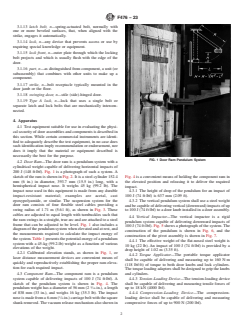
FIG. 1 Door Ram Pendulum System
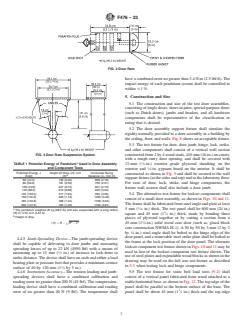
4.2 Door Ram—The door ram is a pendulum system with a
cylindrical weight capable of delivering horizontal impacts of
200 J (148 ft·lbf). Fig. 1 is a photograph of such a system. A
sketch of the ram is shown in Fig. 2. It is a steel cylinder 152.4
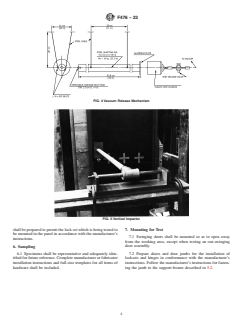
Fig. 4 is a convenient means of holding the component ram in
mm (6 in.) in diameter, 393.7 mm (15.5 in.) long, with a the elevated position and releasing it to deliver the required
hemispherical impact nose. It weighs 45 kg (99.2 lb). The
impact.
impact nose used in this equipment is made from any durable 4.3.1 The height of drop of the pendulum for an impact of
impact-resistant material; examples are acetal, cast
100 J (74 ft·lbf) is 637 mm (2.09 ft).
epoxypolyamide, or similar. The suspension system for the
4.3.2 The vertical pendulum system shall use a steel weight
door ram consists of four flexible steel cables providing a
and be capable of delivering vertical (downward) impacts of up
swing radius of 1.71 m (5.61 ft), as shown in Fig. 3. These
to 100 J (74 ft·lbf) to a door knob installed in a door assembly.
cables are adjusted to equal length with turnbuckles such that
4.4 Vertical Impactor—The vertical impactor is a rigid
the ram swings in a straight, true arc and are attached to a steel
pendulum system capable of delivering downward impacts of
frame that can be adjusted to be level. Fig. 1 also includes a
100 J (74 ft·lbf). Fig. 5 shows a photograph of the system. The
diagram of the pendulum system when elevated and at rest, and
construction of the pendulum is shown in Fig. 6, and the
the measurements required to calculate the impact energy of
construction of the pivot assembly is shown in Fig. 7.
the system. Table 1 presents the potential energy of a pendulum
4.4.1 The effective weight of the flat-nosed steel weight is
system with a 45-kg (99.2-lb) weight as a function of various
10 kg (22 lb). An impact of 100 J (74 ft·lbf) is provided by a
elevations of the weight.
drop height of 1.02 m (3.35 ft).
4.2.1 Calibrated elevation stands, as shown in Fig. 1, or
4.4.2 Torque Applicator—The portable torque applicator
laser distance measurement devices are convenient means of
shall be capable of delivering and measuring up to 160 N·m
quickly and reproductively establishing the proper ram eleva-
(118 lbf·ft) of torque to both door knobs and lock cylinders.
tion for each required impact.
The torque loading adapters shall be designed to grip the knobs
4.3 Component Ram—The component ram is a pendulum and cylinders.
system capable of delivering impacts of 100 J (74 ft·lbf). A 4.4.3 Tension-Loading Device—The tension-loading device
sketch of the pendulum system is shown in Fig. 4. The shall be capable of delivering and measuring tensile forces of
pendulum weight has a diameter of 56 mm (2 ⁄16 in.), a length up to 18 kN (4000 lbf).
of 838 mm (33 in.), and weighs 16 kg (35.3 lb). The impact 4.4.4 Compression-Loading Device—The compression-
nose is made from a 6-mm ( ⁄4-in.) carriage bolt with the square loading device shall be capable of delivering and measuring
shank removed. The vacuum release mechanism also shown in compressive forces of up to 900 N (200 lbf).
F476 − 23
FIG. 2 Door Ram
have a combined error no greater than 3.4 N·m (2.5 lbf·ft). The
impact energy of each pendulum system shall be controlled to
within 61 %.
5. Construction and Size
5.1 The construction and size of the test door assemblies,
consisting of single doors, doors in pairs, special-purpose doors
(such as Dutch doors), jambs and headers, and all hardware
components shall be representative of the classification or
rating that is desired.
5.2 The door assembly support fixture shall simulate the
rigidity normally provided to a door assembly in a building by
the ceiling, floor, and walls. Fig. 8 shows an acceptable fixture.
5.3 The test fixture for door, door jamb, hinge, lock, strike,
and other components shall consist of a vertical wall section
FIG. 3 Door Ram Suspension System constructed from 2 by 4 wood studs, 410 mm (16 in.) on center,
with a rough entry door opening, and shall be covered with
A 1
TABLE 1 Potential Energy of Pendulum Used in Door Assembly 13-mm ( ⁄2-in.) exterior grade plywood sheathing on the
and Component Tests
exterior and ⁄2-in. gypsum board on the interior. It shall be
Potential Energy, J Height Of Drop (H), mm Horizontal Swing
constructed as shown in Fig. 9 and shall be secured to the wall
B
(ft·lbf) (ft) Distance (L), mm (ft)
support fixture (at the sides and top) and to the laboratory floor.
60 (44.3) 136 (0.45) 668 (2.19)
80 (59.0) 181 (0.59) 765 (2.51) For tests of door, lock, strike, and hinge components, the
100 (73.8) 227 (0.74) 851 (2.79)
fixture wall section shall also include a door jamb.
120 (88.5) 272 (0.89) 925 (3.04)
140 (103.3) 317 (1.04) 992 (3.26)
5.4 The alternative test fixture for lockset components shall
160 (118.0) 363 (1.19) 1053 (3.46)
consist of a small door assembly, as shown in Figs. 10 and 11.
180 (132.8) 408 (1.34) 1108 (3.64)
The frame shall be fabricated from steel angle and plate at least
200 (147.5) 454 (1.49) 1160 (3.81)
A 5 mm ( ⁄16 in.) thick. The test panel shall be 600 mm (24 in.)
The pendulum weighed 45 kg (99.2 lb) and was suspended with a wing radius
(R) of 1710 mm (5.61 ft). square and 45 mm (1 ⁄4 in.) thick, made by bonding three
B
Height of drop.
pieces of plywood together or by cutting a section from a
2 2
sHd 5 R 2 R 2 L 45-mm (1 ⁄4-in.) solid wood core door (such as, glued block
œ
core construction NWMA IS-1). A 50 by 50 by 3-mm (2 by 2
by ⁄8-in.) steel angle shall be bolted to the hinge edge of the
door panel, and a removable steel strike plate shall be bolted to
4.4.5 Jamb-Spreading Device—The jamb-spreading device
the frame at the lock position of the door panel. The alternate
shall be capable of delivering to door jambs and measuring
lockset component test fixture shown in Figs. 10 and 11 may be
spreading forces of up to 22 kN (4950 lbf) with a means of
used in lieu of the lockset component test fixture shown. The
measuring up to 13 mm ( ⁄2 in.) of increase in lock-front to
use of steel plates and expendable wood blocks as shown in the
strike distance. The device shall have on each end either a load
drawing may be used on the full size test fixture as described
bearing plate or pressure foot that provides a minimum contact
in 5.3 when testing lock and hinge components.
surface of 40 by 120 mm (1 ⁄2 by 5 in.).
4.4.6 Instrument Accuracy—The tension loading and jamb- 5.5 The test fixture for static bolt load tests (9.2) shall
spreading devices shall have a combined calibration and consist of a vertical panel fabricated from wood attached to a
reading error no greater than 200 N (45 lbf). The compression- stable horizontal base, as shown in Fig. 12. The top edge of the
loading device shall have a combined calibration and reading panel shall be parallel to the bottom surface of the base. The
error of no greater than 40 N (9 lbf). The torquemeter shall panel shall be about 45 mm (1 ⁄4 in.) thick and the top edge
F476 − 23
FIG. 4 Vacuum Release Mechanism
FIG. 5 Vertical Impactor
shall be prepared to permit the lock set which is being tested to 7. Mounting for Test
be mounted in the panel in accordance with the manufacturer’s
7.1 Swinging doors shall be mounted so as to open away
instructions.
from the working area, except when testing an out-swinging
door assembly.
6. Sampling
6.1 Specimens shall be representative and adequately iden- 7.2 Prepare doors and door jambs for the installation of
tified for future reference. Complete manufacturer or fabricator locksets and hinges in conformance with the manufacturer’s
installation instructions and full-size templates for all items of instructions. Follow the manufacturer’s instructions for fasten-
hardware shall be included. ing the jamb to the support fixture described in 5.2.
F476 − 23
FIG. 6 Vertical Impactor Pendulum System
FIG. 7 Vertical Impactor Pivot Assembly
7.3 Install components such as test doors, door jambs, Tests under Sections 9, 11, 12, 13, 14, and 15, if conducted in
hinges, and jamb/strikes in the component test fixture de- the test panel, shall not be repeated in the door assembly being
scribed in 5.3. Except when testing hinges, hinge the door with tested. These tests need not be repeated for successive tests of
1 1
1 ⁄2 pairs of 115-mm (4 ⁄2-in.) steel butt hinges, and fix it in the other door assemblies where the same lock model is being
closed-locked position (at the normal lock point) with a real or used.
simulated latch bolt having sufficient strength and stiffness to
9. Static Bolt Load Test
prevent it from failing during test. In the absence of other
construction specifications, make the clearances on the lock
9.1 To test Type A and B locks and all door assembly locks,
1 1
side, hinge side, and top of the door 3.2 6 0.4 mm ( ⁄8 6 ⁄64
mount the lock in the test fixture described in 5.5. Lock the
in.). Clearance at the threshold is not considered critical in
door lock with the dead bolt or dead latch in the fully projected
these tests.
position. If the lock incorporates a dead-latch plunger, attach a
6.5-mm ( ⁄4-in.) spacer to the lock front. Allow the dead-latch
7.4 To test locksets as components, install them in the
plunger to project flush with the top of the spacer, and hold it
alternative component test fixture described in 5.4. Fix the test
in that position with a piece of tape, or by another suitable
panel in the closed locked position at the normal locking point.
means.
Hinge the test panel with two 115-mm (4 ⁄2-in.) steel butt
hinges.
9.2 Place the lock, in the test fixture, in a compression
testing machine, or mount it on a firm, level surface with the
7.5 To test lock sets for static bolt load, install them in the
compression loading device directly above it with the loading
test fixture described in 5.5.
face parallel to the lock front, and the axis of the hydraulic ram
8. Procedure
perpendicular to the lock front. Apply an increasing compres-
8.1 One complete assembly shall be used to conduct the sive load to the end of the latch bolt or the dead bolt. Note the
tests. Tests shall be given in the sequence of Sections 9 – 20. maximum force required to depress the latch bolt or the dead
F476 − 23
FIG. 8 Wall Support Fixture
bolt to where the farthest point on the bolt is 6 mm ( ⁄4 in.) from 10.2 While the required load is being applied, or the lock
the lock front surface. front-to-strike distance is increased, push or pull on the door to
determine whether the dead bolt or dead latch is engaged with
9.3 To test for bolt projection, apply end pressure to the
the strike.
projected dead bolt or dead latch and measure the distance
from the lock front surface to the farthest point on the bolt or
11. Knob Impact Test
latch at the center line.
9.3.1 Following the test of a lock incorporating a dead latch,
11.1 Prepare the test specimen in accordance with 7.3 or 7.4
place the strike plate provided with the lock over the latch of
and lock the door or test panel in the closed position. Position
a dead latch to determine whether it is possible for both the
the vertical impactor (4.4) so that the pendulum arm is
dead latch and the dead plunger to enter the hold in the strike
horizontal when the striking weight contacts the top of the door
simultaneously.
knob, and its center of gravity is in the vertical center-line
through the knob. Raise the weight to the height necessary to
10. Jamb Stiffness Test
deliver the required impact and release it. Deliver the required
10.1 Prepare the test specimen in accordance with 7.3. number of impacts to the knob. After each impact, attempt to
Position the jamb spreading device (4.4.5) between the door open the door or test panel by turning the knob. If the knob is
jambs, at lock height. Apply increasing force as required and broken off, manipulate the exposed lock mechanism by hand or
measure the space between the lock front and strike. with the aid of a screwdriver.
F476 − 23
NOTE 1—All studs, plates, and headers are 2-by-4s.
NOTE 2—Nail sole plate and lower member of top plate to each stud with 2—16d end nails.
NOTE 3—Nail upper member of top plate to the lower member with 16d nails, one nail near each stud and two near each end.
NOTE 4—Nail the double studs together with 16d nails not more than 610 mm (24 in.) on centers.
NOTE 5—Nail the header (two 2-by-4s) to each full length stud with 4—16d end nails.
NOTE 6—Nail ⁄2-in. gypsum drywall to all supports with threaded drywall nails at 200 mm (8 in.) on centers.
NOTE 7—Security blocking may be necessary to achieve successful jamb stiffness test results. If blocking is used, it shall be reported in the test report.
The nature of the blocking shall be indicated.
FIG. 9 Door, Door Jamb, Hinge, and Lock-Strike Component Fixture
11.2 With the door or test panel open, and the dead bolt or the cylinder face, to a minimum depth of 13 mm ( ⁄2 in.). If the
dead latch in the projected, locked position, attempt to (a)
lock is constructed such that only the cylinder core is exposed,
depress the dead bolt by applying hand pressure to its end or drill through the material covering the face of the cylinder
(b) depress the latch and dead-latch plunger fully, allow the
body, into the cylinder. Tap this hole with a ⁄4-28 thread.
latch to extend, then slowly allow the plunger to project until
Attach the cylinder tensile loading device (4.4.3) to a rigid
the last point of dead locking is reached.
load-bearing support in front of the cylinder, and align the
pulling axis with that of the hole in the cylinder. Attach the
12. Cylinder-Core Tension Test
pulling adapter to the cylinder with a ⁄4-28 hardened cap screw
12.1 Prepare the test specimen in accordance with 7.3 or 7.4
fully threaded into the tapped hole, or other appropriate
and lock the door or test panel in the closed position. Drill a
devices. Connect the cylinder pulling device to the adapter, and
hole in the cylinder core using a No. 21 drill, adjacent to the
apply the required tensile force to the cylinder. Following this
keyway to a minimum depth of 13 mm ( ⁄2 in.). Tap this hole
test, release the load and attempt to open the door or test panel
with a 10-32 thread. Attach the tensile loading device (4.4.3) to
by manipulating an exposed lock mechanism by hand or with
a rigid load-bearing support in front of the cylinder, and align
the aid of a screwdriver. If the cylinder is not damaged, open
the pulling axis with that of the hole in the cylinder. Attach the
the door, and test the dead latch or dead bolt for end pressure
pulling adapter to the cylinder with a 10-32 hardened cap screw
resistance as in 11.2.
fully threaded into the tapped hole. Connect the cylinder tensile
loading device to the adapter, and apply the required tensile
14. Knob Torque Test
force to the cylinder. Following this test, release the load and
14.1 Prepare the specimen test in accordance with 7.3 or 7.4
attempt to open the door or test panel by manipulating an
and lock the door or test panel in the closed position. Attach the
exposed lock mechanism by hand or with the aid of a
screwdriver. If the core or cylinder is not damaged, open the torque-loading adapter to the knob and connect the torque
applicator to it (4.4.2). Alternately subject the knob to the
door, and test the dead latch or dead bolt for end pressure
resistance as in 11.2. required torque in both the clockwise and counter-clockwise
directions, applying the torque as rapidly as possible. Inspect
13. Cylinder-Body Tension Test
the lock to determine whether the bolt is retracted from the
strike when the torque is applied. If the knob is broken off,
13.1 Prepare the test specimen in accordance with 7.3 or 7.4
attempt to open the door or test panel by manipulating the lock
and lock the door or test panel in the closed position. Drill a
hole in the cylinder body using a No. 3 drill, near the center of mechanism by hand or with the aid of a screwdriver. If the
F476 − 23
attempt to open the door or test panel by manipulating the lock
mechanisms by hand or with the aid of a screwdriver if the
cylinder is damaged. If the cylinder is not damaged, test the
dead bolt or dead latch for end pressure resistance as in 11.2.
17. Door Impact Test
17.1 Prepare the test specimen in accordance with 7.3 and
lock the door in the closed position. Set up the door ram
pendulum weight (4.2) so that its axis is horizontal and
perpendicular to the face of the door at a point defined by the
intersection of the vertical center line of the door and a line
from the center of the bolt to the center of the mid-height hinge
(or the midpoint between hinges, when the door is hung with
two hinges).
17.2 Attach to the door, centered on the impact point, a rigid
foamed polystyrene impact buffer that has a diameter of 150
mm (6 in.), a thickness of 50 mm (2 in.), and a density of 32
3 3
kg/m (2 lb/ft ). Position the door ram such that its striking
nose just touches the surface of the buffer when at rest. Pull
back the pendulum weight to the height necessary to produce
the required impact, and release it. Subject the door to two
impacts at each required impact level, attaching a new buffer
NOTE 1—The door panel consists of three pieces of plywood [610 mm
for each impact. If the door is forced open by the test, without
(24 in.) square] bonded together (1 piece, 19 mm ( ⁄4 in.) thick, between
damaging the jamb/strike or lock component, the door speci-
two pieces, each 13 mm ( ⁄2 in.) thick); or a glued block core door with
men fails the test. If the door surface is broken, attempt to reach
premium or good grade hardwood veneer (NWMA I.S. 1-74).
inside the door, and unlock it from the inside.
NOTE 2—The door panel shall have a steel angle bolted to the hinge
edge.
17.3 If the door has one or more recessed panels, subject the
NOTE 3—The steel angle frame and panel edge shall be 51 by 51 by 3
one closest to the lock to two i
...
This document is not an ASTM standard and is intended only to provide the user of an ASTM standard an indication of what changes have been made to the previous version. Because
it may not be technically possible to adequately depict all changes accurately, ASTM recommends that users consult prior editions as appropriate. In all cases only the current version
of the standard as published by ASTM is to be considered the official document.
Designation: F476 − 14 F476 − 23
Standard Test Methods for
Security of Swinging Door Assemblies
This standard is issued under the fixed designation F476; the number immediately following the designation indicates the year of original
adoption or, in the case of revision, the year of last revision. A number in parentheses indicates the year of last reapproval. A superscript
epsilon (´) indicates an editorial change since the last revision or reapproval.
1. Scope
1.1 These test methods cover door assemblies of various materials and types of construction for use in wall openings to deter
unwanted intruders.
1.2 Door assemblies, covered by these test methods, also include individual components such as the hinge, lock, door, strike, and
jamb.
1.3 These test methods are designed to measure the capability of a swinging door assembly to restrain or delay and frustrate the
commission of “break-in” crimes.
1.4 These test methods apply primarily to typical entry door assemblies.
1.5 The values stated in SI units are to be regarded as standard. The values given in parentheses after SI units are provided for
information only and are not considered standard.
1.6 This standard does not purport to address all of the safety concerns, if any, associated with its use. It is the responsibility
of the user of this standard to establish appropriate safety and healthsafety, health, and environmental practices and determine
the applicability of regulatory limitations prior to use.
1.7 This international standard was developed in accordance with internationally recognized principles on standardization
established in the Decision on Principles for the Development of International Standards, Guides and Recommendations issued
by the World Trade Organization Technical Barriers to Trade (TBT) Committee.
2. Referenced Documents
2.1 ASTM Standards:
F471 Terminology Relating to Combination Locks (Withdrawn 2011)
3. Terminology
3.1 Definitions:
3.1.1 bolt, n—any movable projection that blocks the movement of one object relative to another.
These test methods are under the jurisdiction of ASTM Committee F12 on Security Systems and Equipment and are the direct responsibility of Subcommittee F12.50
on Locking Devices.
Current edition approved Feb. 1, 2014Jan. 1, 2023. Published March 2014February 2023. Originally approved in 1976 as 1976 . F476 – 76 . Last previous edition approved
in 20022014 as F476 – 84 (2002)F476 – 14. which was withdrawn July 2011 and reinstated February 2014. DOI: 10.1520/F0476-14.DOI: 10.1520/F0476-23.
For referenced ASTM standards, visit the ASTM website, www.astm.org, or contact ASTM Customer Service at service@astm.org. For Annual Book of ASTM Standards
volume information, refer to the standard’s Document Summary page on the ASTM website.
The last approved version of this historical standard is referenced on www.astm.org.
Copyright © ASTM International, 100 Barr Harbor Drive, PO Box C700, West Conshohocken, PA 19428-2959. United States
F476 − 23
3.1.2 bolt projection (or bolt throw), n—distance from the edge of the door, at the bolt center line, to the farthest point on the bolt
in the projected position, when subjected to end pressure.
3.1.3 component, n—as distinguished from a part, a subassembly that combines with other components to make up a total door
assembly.
3.1.3.1 Discussion—
The prime components of a door assembly include: door, lock, hinges, jamb, strike, and wall.
3.1.4 cylinder, n—complete operating unit that usually consists of the plug shell, tumblers, springs, plug retainer, a cam/tailpiece
or other actuating device, and all other necessary operating parts.
3.1.5 cylinder core (or cylinder plug), n—central part of a cylinder, containing the keyway, that is rotated by the key to operate
the lock mechanism.
3.1.6 deadbolt, n—bolt, which requires a deliberate action to extend, and resists end pressure in the unlocking direction when fully
extended.
3.1.7 dead latch (or dead locking latch bolt), n—latchbolt with a deadlocking mechanism.
3.1.8 door assembly, n—any combination of a door, frame, hardware, and other accessories that is placed in an opening in a wall
that is intended primarily for access or for human entrance or exit.
3.1.9 jamb, n—vertical members of a door frame (such as, those fixed members to which the door is secured).
3.1.10 key-in-knob lockset, n—any lockset with a key operated cylinder in one or more knobs.
3.1.11 key-in-lever lockset, n—any lockset with a key operated cylinder in one or more level handles.
3.1.12 latch:
3.1.12.1 n—mechanical or magnetic door fastener that can automatically keep a door, gate, and so forth, closed.
3.1.12.2 v—engagement of a latch when a door, gate, and so forth, is pushed or pulled closed.
3.1.13 latch bolt, n—spring-actuated bolt, normally with one or more beveled surfaces, that, when aligned with the strike, engages
it automatically.
3.1.14 lock, n—any device that prevents access or use by requiring special knowledge or equipment.
3.1.15 lock front, n—outer plate through which the locking bolt projects and which is usually flush with the edge of the door.
3.1.16 part, n—as distinguished from component, a unit (or subassembly) that combines with other units to make up a component.
3.1.17 strike, n—bolt receptacle typically mounted in the door jamb or the floor.
3.1.18 swinging door, n—stile (side)-hinged door.
3.1.19 Type A lock, n—lock that uses a single bolt or separate latch and lock bolts that are mechanically interconnected.
4. Apparatus
4.1 Test equipment suitable for use in evaluating the physical security of door assemblies and components is described in this
F476 − 23
section. While certain commercial instruments are identified to adequately describe the test equipment, in no case does such
identification imply recommendation or endorsement, nor does it imply that the material or equipment described is necessarily the
best for the purpose.
4.2 Door Ram—The door ram is a pendulum system with a cylindrical weight capable of delivering horizontal impacts of 200 J
(148 ft·lbf). Fig. 1 is a photograph of such a system. A sketch of the ram is shown in Fig. 2. It is a steel cylinder 152.4 mm (6
in.) in diameter, 393.7 mm (15.5 in.) long, with a hemispherical impact nose. It weighs 45 kg (99.2 lb). The impact nose used in
this equipment is made from cast epoxy-polyamide resin; however, any durable impact-resistant material is satisfactory. material;
examples are acetal, cast epoxypolyamide, or similar. The suspension system for the door ram consists of four flexible steel cables
providing a swing radius of 1.71 m (5.61 ft), as shown in Fig. 3. These cables are adjusted to equal length with turnbuckles such
that the ram swings in a straight, true arc and are attached to a steel frame that can be adjusted to be level. Fig. 1 also includes
a diagram of the pendulum system when elevated and at rest, and the measurements required to calculate the impact energy of the
system. Table 1 presents the potential energy of a pendulum system with a 45-kg (99.2-lb) weight as a function of various
elevations of the weight.
4.2.1 The use of a calibrated elevation stand,Calibrated elevation stands, as shown in Fig. 1, is a or laser distance measurement
devices are convenient means of quickly and reproductively establishing the proper ram elevation for each required impact.
4.3 Component Ram—The component ram is a pendulum system capable of delivering impacts of 100 J (74 ft·lbf). A sketch of
the pendulum system is shown in Fig. 4. The pendulum weight has a diameter of 56 mm (2 ⁄16 in.), a length of 838 mm (33 in.),
and weighs 16 kg (35.3 lb). The impact nose is made from a 6-mm ( ⁄4-in.) carriage bolt with the square shank removed. The
vacuum release mechanism also shown in Fig. 4 is a convenient means of holding the component ram in the elevated position and
releasing it to deliver the required impact.
4.3.1 The height of drop of the pendulum for an impact of 100 J (74 ft·lbf) is 637 mm (2.09 ft).
4.3.2 The vertical pendulum system shall use a steel weight and be capable of delivering vertical (downward) impacts of up to
100 J (74 ft·lbf) to a door knob installed in a door assembly.
FIG. 1 Door Ram Pendulum System
F476 − 23
FIG. 2 Door Ram
FIG. 3 Door Ram Suspension System
A
TABLE 1 Potential Energy of Pendulum Used in Door Assembly
and Component Tests
Potential Energy, J Height Of Drop (H), mm Horizontal Swing
B
(ft·lbf) (ft) Distance (L), mm (ft)
60 (44.3) 136 (0.45) 668 (2.19)
80 (59.0) 181 (0.59) 765 (2.51)
100 (73.8) 227 (0.74) 851 (2.79)
120 (88.5) 272 (0.89) 925 (3.04)
140 (103.3) 317 (1.04) 992 (3.26)
160 (118.0) 363 (1.19) 1053 (3.46)
180 (132.8) 408 (1.34) 1108 (3.64)
200 (147.5) 454 (1.49) 1160 (3.81)
A
The pendulum weighed 45 kg (99.2 lb) and was suspended with a wing radius
(R) of 1710 mm (5.61 ft).
B
Height of drop.
2 2
sHd 5R 2 R 2L
œ
4.4 Vertical Impactor—The vertical impactor is a rigid pendulum system capable of delivering downward impacts of 100 J (74
ft·lbf). Fig. 5 shows a photograph of the system. The construction of the pendulum is shown in Fig. 6, and the construction of the
pivot assembly is shown in Fig. 7.
4.4.1 The effective weight of the flat-nosed steel weight is 10 kg (22 lb). An impact of 100 J (74 ft·lbf) is provided by a drop height
of 1.02 m (3.35 ft).
4.4.2 Torque Applicator—The portable torque applicator shall be capable of delivering and measuring up to 160 N·m (118 lbf·ft)
of torque to both door knobs and lock cylinders. The torque loading adapters shall be designed to grip the knobs and cylinders.
4.4.3 Tension-Loading Device—The tension-loading device shall be capable of delivering and measuring tensile forces of up to
18 kN (4000 lbf).
F476 − 23
FIG. 4 Vacuum Release Mechanism
FIG. 5 Vertical Impactor
4.4.4 Compression-Loading Device—The compression-loading device shall be capable of delivering and measuring compressive
forces of up to 900 N (200 lbf).
4.4.5 Jamb-Spreading Device—The jamb-spreading device shall be capable of delivering to door jambs and measuring spreading
forces of up to 22 kN (4950 lbf) with a means of measuring up to 13 mm ( ⁄2 in.) of increase in lock-front to strike distance. The
device shall have on each end either a load bearing plate or pressure foot that provides a minimum contact surface of 40 by 120
mm (1 ⁄2 by 5 in.).
4.4.6 Instrument Accuracy—The tension loading and jamb-spreading devices shall have a combined calibration and reading error
no greater than 200 N (45 lbf). The compression-loading device shall have a combined calibration and reading error of no greater
than 40 N (9 lbf). The torquemeter shall have a combined error no greater than 3.4 N·m (2.5 lbf·ft). The impact energy of each
pendulum system shall be controlled to within 61 %.
F476 − 23
FIG. 6 Vertical Impactor Pendulum System
FIG. 7 Vertical Impactor Pivot Assembly
5. Construction and Size
5.1 The construction and size of the test door assemblies, consisting of single doors, doors in pairs, special-purpose doors (such
as Dutch doors), jambs and headers, and all hardware components shall be representative of the classification or rating that is
desired.
5.2 The door assembly support fixture shall simulate the rigidity normally provided to a door assembly in a building by the ceiling,
floor, and walls. Fig. 8 shows an acceptable fixture.
5.3 The test fixture for door, door jamb, hinge, lock, strike, and other components shall consist of a vertical wall section
constructed from 2 by 4 wood studs, 410 mm (16 in.) on center, with a rough entry door opening, and shall be covered with 13-mm
1 1
( ⁄2-in.) exterior grade plywood sheathing on the exterior and ⁄2-in. gypsum board on the interior. It shall be constructed as shown
in Fig. 9 and shall be secured to the wall support fixture (at the sides and top) and to the laboratory floor. For tests of door, lock,
strike, and hinge components, the fixture wall section shall also include a door jamb.
5.4 The alternative test fixture for lockset components shall consist of a small door assembly, as shown in Figs. 10 and 11. The
frame shall be fabricated from steel angle and plate at least 5 mm ( ⁄16 in.) thick. The test panel shall be 600 mm (24 in.) square
3 3
and 45 mm (1 ⁄4 in.) thick, made by bonding three pieces of plywood together or by cutting a section from a 45-mm (1 ⁄4-in.) solid
wood core door (such as, glued block core construction NWMA IS-1). A 50 by 50 by 3-mm (2 by 2 by ⁄8-in.) steel angle shall
be bolted to the hinge edge of the door panel, and a removable steel strike plate shall be bolted to the frame at the lock position
F476 − 23
FIG. 8 Wall Support Fixture
of the door panel. The alternate lockset component test fixture shown in Figs. 10 and 11 may be used in lieu of the lockset
component test fixture shown. The use of steel plates and expendable wood blocks as shown in the drawing may be used on the
full size test fixture as described in 5.3 when testing lock and hinge components.
5.5 The test fixture for static bolt load tests (9.2) shall consist of a vertical panel fabricated from wood attached to a stable
horizontal base, as shown in Fig. 12. The top edge of the panel shall be parallel to the bottom surface of the base. The panel shall
be about 45 mm (1 ⁄4 in.) thick and the top edge shall be prepared to permit the lock set which is being tested to be mounted in
the panel in accordance with the manufacturer’s instructions.
6. Sampling
6.1 Specimens shall be representative and adequately identified for future reference. Complete manufacturer or fabricator
installation instructions and full-size templates for all items of hardware shall be included.
7. Mounting for Test
7.1 Swinging doors shall be mounted so as to open away from the working area, except when testing an out-swinging door
assembly.
F476 − 23
NOTE 1—All studs, plates, and headers are 2-by-4s.
NOTE 2—Nail sole plate and lower member of top plate to each stud with 2—16d end nails.
NOTE 3—Nail upper member of top plate to the lower member with 16d nails, one nail near each stud and two near each end.
NOTE 4—Nail the double studs together with 16d nails not more than 610 mm (24 in.) on centers.
NOTE 5—Nail the header (two 2-by-4s) to each full length stud with 4—16d end nails.
NOTE 6—Nail ⁄2-in. gypsum drywall to all supports with threaded drywall nails at 200 mm (8 in.) on centers.
NOTE 7—Security blocking may be necessary to achieve successful jamb stiffness test results. If blocking is used, it shall be reported in the test report.
The nature of the blocking shall be indicated.
FIG. 9 Door, Door Jamb, Hinge, and Lock-Strike Component Fixture
NOTE 1—The door panel consists of three pieces of plywood [610 mm (24 in.) square] bonded together (1 piece, 19 mm ( ⁄4 in.) thick, between two
pieces, each 13 mm ( ⁄2 in.) thick); or a glued block core door with premium or good grade hardwood veneer (NWMA I.S. 1-74).
NOTE 2—The door panel shall have a steel angle bolted to the hinge edge.
NOTE 3—The steel angle frame and panel edge shall be 51 by 51 by 3 mm (2 by 2 by ⁄8 in.) thick.
FIG. 10 Lockset Component Test Fixture
F476 − 23
FIG. 11 Alternate Lockset Component Test Fixture
NOTE 1—The wood block is nailed to the plywood base edge of block prepared for lock set. (The holes as shown are typical for key-in knob lock.)
FIG. 12 Static Bolt Load Test Fixture
7.2 Prepare doors and door jambs for the installation of locksets and hinges in conformance with the manufacturer’s instructions.
Follow the manufacturer’s instructions for fastening the jamb to the support fixture described in 5.2.
7.3 Install components such as test doors, door jambs, hinges, and jamb/strikes in the component test fixture described in 5.3.
1 1
Except when testing hinges, hinge the door with 1 ⁄2 pairs of 115-mm (4 ⁄2-in.) steel butt hinges, and fix it in the closed-locked
position (at the normal lock point) with a real or simulated latch bolt having sufficient strength and stiffness to prevent it from
failing during test. In the absence of other construction specifications, make the clearances on the lock side, hinge side, and top
1 1
of the door 3.2 6 0.4 mm ( ⁄8 6 ⁄64 in.). Clearance at the threshold is not considered critical in these tests.
7.4 To test locksets as components, install them in the alternative component test fixture described in 5.4. Fix the test panel in the
closed locked position at the normal locking point. Hinge the test panel with two 115-mm (4 ⁄2-in.) steel butt hinges.
F476 − 23
7.5 To test lock sets for static bolt load, install them in the test fixture described in 5.5.
8. Procedure
8.1 One complete assembly shall be used to conduct the tests. Tests shall be given in the sequence of Sections 9 – 20. Tests under
Sections 9, 11, 12, 13, 14, and 15, if conducted in the test panel, shall not be repeated in the door assembly being tested. These
tests need not be repeated for successive tests of other door assemblies where the same lock model is being used.
9. Static Bolt Load Test
9.1 To test Type A and B locks and all door assembly locks, mount the lock in the test fixture described in 5.5. Lock the door lock
with the dead bolt or dead latch in the fully projected position. If the lock incorporates a dead-latch plunger, attach a 6.5-mm
( ⁄4-in.) spacer to the lock front. Allow the dead-latch plunger to project flush with the top of the spacer, and hold it in that position
with a piece of tape, or by another suitable means.
9.2 Place the lock, in the test fixture, in a compression testing machine, or mount it on a firm, level surface with the compression
loading device directly above it with the loading face parallel to the lock front, and the axis of the hydraulic ram perpendicular
to the lock front. Apply an increasing compressive load to the end of the latch bolt or the dead bolt. Note the maximum force
required to depress the latch bolt or the dead bolt to where the farthest point on the bolt is 6 mm ( ⁄4 in.) from the lock front surface.
9.3 To test for bolt projection, apply end pressure to the projected dead bolt or dead latch and measure the distance from the lock
front surface to the farthest point on the bolt or latch at the center line.
9.3.1 Following the test of a lock incorporating a dead latch, place the strike plate provided with the lock over the latch of a dead
latch to determine whether it is possible for both the dead latch and the dead plunger to enter the hold in the strike simultaneously.
10. Jamb Stiffness Test
10.1 Prepare the test specimen in accordance with 7.3. Position the jamb spreading device (4.4.5) between the door jambs, at lock
height. Apply increasing force as required and measure the space between the lock front and strike.
10.2 While the required load is being applied, or the lock front-to-strike distance is increased, push or pull on the door to determine
whether the dead bolt or dead latch is engaged with the strike.
11. Knob Impact Test
11.1 Prepare the test specimen in accordance with 7.3 or 7.4 and lock the door or test panel in the closed position. Position the
vertical impactor (4.4) so that the pendulum arm is horizontal when the striking weight contacts the top of the door knob, and its
center of gravity is in the vertical center-line through the knob. Raise the weight to the height necessary to deliver the required
impact and release it. Deliver the required number of impacts to the knob. After each impact, attempt to open the door or test panel
by turning the knob. If the knob is broken off, manipulate the exposed lock mechanism by hand or with the aid of a screwdriver.
11.2 With the door or test panel open, and the dead bolt or dead latch in the projected, locked position, attempt to (a) depress the
dead bolt by applying hand pressure to its end or (b) depress the latch and dead-latch plunger fully, allow the latch to extend, then
slowly allow the plunger to project until the last point of dead locking is reached.
12. Cylinder-Core Tension Test
12.1 Prepare the test specimen in accordance with 7.3 or 7.4 and lock the door or test panel in the closed position. Drill a hole
in the cylinder core using a No. 21 drill, adjacent to the keyway to a minimum depth of 13 mm ( ⁄2 in.). Tap this hole with a 10-32
thread. Attach the tensile loading device (4.4.3) to a rigid load-bearing support in front of the cylinder, and align the pulling axis
with that of the hole in the cylinder. Attach the pulling adapter to the cylinder with a 10-32 hardened cap screw fully threaded into
the tapped hole. Connect the cylinder tensile loading device to the adapter, and apply the required tensile force to the cylinder.
Following this test, release the load and attempt to open the door or test panel by manipulating an exposed lock mechanism by
hand or with the aid of a screwdriver. If the core or cylinder is not damaged, open the door, and test the dead latch or dead bolt
for end pressure resistance as in 11.2.
F476 − 23
13. Cylinder-Body Tension Test
13.1 Prepare the test specimen in accordance with 7.3 or 7.4 and lock the door or test panel in the closed position. Drill a hole
in the cylinder body using a No. 3 drill, near the center of the cylinder face, to a minimum depth of 13 mm ( ⁄2 in.). If the lock
is constructed such that only the cylinder core is exposed, drill through the material covering the face of the cylinder body, into
the cylinder. Tap this hole with a ⁄4-28 thread. Attach the cylinder tensile loading device (4.4.3) to a rigid load-bearing support
in front of the cylinder, and align the pulling axis with that of the hole in the cylinder. Attach the pulling adapter to the cylinder
with a ⁄4-28 hardened cap screw fully threaded into the tapped hole, or other appropriate devices. Connect the cylinder pulling
device to the adapter, and apply the required tensile force to the cylinder. Following this test, release the load and attempt to open
the door or test panel by manipulating an exposed lock mechanism by hand or with the aid of a screwdriver. If the cylinder is not
damaged, open the door, and test the dead latch or dead bolt for end pressure resistance as in 11.2.
14. Knob Torque Test
14.1 Prepare the specimen test in accordance with 7.3 or 7.4 and lock the door or test panel in the closed position. Attach the
torque-loading adapter to the knob and connect the torque applicator to it (4.4.2). Alternately subject the knob to the required torque
in both the clockwise and counter-clockwise directions, applying the torque as rapidly as possible. Inspect the lock to determine
whether the bolt is retracted from the strike when the torque is applied. If the knob is broken off, attempt to open the door or test
panel by manipulating the lock mechanism by hand or with the aid of a screwdriver. If the knob is not broken off, test the dead
bolt or dead latch for end pressure resistance as in 11.2.
15. Cylinder Torque Test
15.1 Prepare the test specimen in accordance with 7.3 or 7.4 and lock the door or test panel in the closed position. Attach the torque
loading adapter to the cylinder and connect the torque applicator to it (4.4.2). Alternatively subject the cylinder to the required
torque in both the clockwise and counter-clockwise directions, applying the torque as rapidly as possible. Inspect the lock when
the torque is applied to determine whether the bolt is withdrawn from the strike. If the cylinder is loose, attempt to open the door
or test panel by manipulating the lock mechanism by hand or with the aid of a screwdriver. If the cylinder is not damaged, test
the dead bolt or dead latch for end pressure resistance as in 11.2.
16. Cylinder Impact Test
7.3 or 7.4 and lock the door or test panel in the closed position. Position the
16.1 Prepare the test specime
...