

ASTM B890-20
(Test Method)Standard Test Method for Determination of Metallic Constituents of Tungsten Alloys and Tungsten Hardmetals by X-Ray Fluorescence Spectrometry
General Information
- Abstract
SIGNIFICANCE AND USE
5.1 This test method allows the determination of the chemical composition of powdered and sintered tungsten-based hardmetals. This test method is not applicable to material which will not oxidize readily at high temperatures in air, such as tungsten/copper, tungsten/silver alloys, or tungsten/cobalt-ruthenium alloys.
5.2 This test method specified lithium-borate compounds for the glass fusion material. However, numerous other choices are available. These include other lithium-borate compounds, sodium carbonate and borate mixtures, and others. The methodology specified here is still applicable as long as the same fusion mixture is used for both standards and specimens.
SCOPE
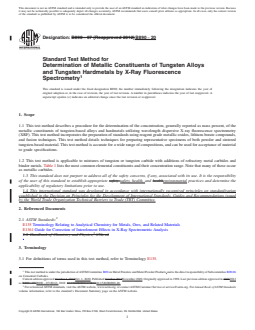
1.1 This test method describes a procedure for the determination of the concentration, generally reported as mass percent, of the metallic constituents of tungsten-based alloys and hardmetals utilizing wavelength dispersive X-ray fluorescence spectrometry (XRF). This test method incorporates the preparation of standards using reagent grade metallic oxides, lithium-borate compounds, and fusion techniques. This test method details techniques for preparing representative specimens of both powder and sintered tungsten-based material. This test method is accurate for a wide range of compositions, and can be used for acceptance of material to grade specifications.
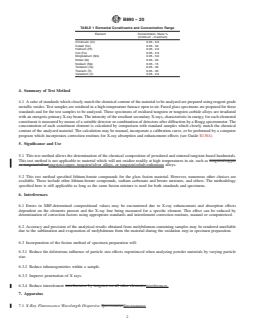
1.2 This test method is applicable to mixtures of tungsten or tungsten carbide with additions of refractory metal carbides and binder metals. Table 1 lists the most common elemental constituents and their concentration range. Note that many of these occur as metallic carbides.
1.3 This standard does not purport to address all of the safety concerns, if any, associated with its use. It is the responsibility of the user of this standard to establish appropriate safety, health, and environmental practices and determine the applicability of regulatory limitations prior to use.
1.4 This international standard was developed in accordance with internationally recognized principles on standardization established in the Decision on Principles for the Development of International Standards, Guides and Recommendations issued by the World Trade Organization Technical Barriers to Trade (TBT) Committee.
- Status
- Published
- Publication Date
- 30-Sep-2020
- Technical Committee
- B09 - Metal Powders and Metal Powder Products
- Drafting Committee
- B09.06 - Cemented Carbides
Buy Documents
ASTM B890-20 - Standard Test Method for Determination of Metallic Constituents of Tungsten Alloys and Tungsten Hardmetals by X-Ray Fluorescence Spectrometry
REDLINE ASTM B890-20 - Standard Test Method for Determination of Metallic Constituents of Tungsten Alloys and Tungsten Hardmetals by X-Ray Fluorescence Spectrometry
Overview
ASTM B890-20 outlines the standard test method for determining metallic constituents in tungsten alloys and tungsten hardmetals using wavelength dispersive X-ray fluorescence spectrometry (XRF). This method provides a reliable procedure for assessing the chemical composition-reported as mass percent-of powdered and sintered tungsten-based materials. The procedure includes careful specimen preparation, glass fusion techniques, and XRF analysis, with applications focused primarily on industrial quality control and material acceptance testing.
The method is applicable to mixtures consisting of tungsten or tungsten carbide combined with refractory metal carbides and binder metals, but is not suitable for tungsten/copper, tungsten/silver, or tungsten/cobalt-ruthenium alloys due to their resistance to high-temperature oxidation. Standard preparation requires the use of high-purity metallic oxides and glass fusion materials, such as lithium-borate compounds.
Key Topics
- X-Ray Fluorescence Spectrometry (XRF): Utilizes the wavelength dispersive XRF technique for precise, non-destructive chemical analysis.
- Specimen Preparation: Includes sample oxidation at high temperature, fusion with lithium-borate compounds, and production of homogenous glass specimens.
- Calibration Standards: Preparation of fused standards matched to anticipated sample compositions ensures accurate calibration and reliable results.
- Elemental Analysis: Common elements analyzed include chromium, cobalt, hafnium, iron, molybdenum, nickel, niobium, tantalum, titanium, and vanadium, with concentration ranges specified for each.
- Correction Techniques: Addresses the need for interelement corrections to mitigate errors from X-ray absorption and enhancement effects.
Applications
- Quality Assurance for Tungsten Alloys: Ensures alloy composition meets grade specifications for manufacturing and end-use requirements.
- Production Control: Validates the consistency of tungsten-based powders and hardmetals during and after production.
- Material Certification: Supports the provision of chemical analysis certificates required for commercial or regulatory acceptance.
- Research and Development: Facilitates material evaluation for new tungsten alloy formulations or process improvements.
- Failure Analysis: Assists in identifying compositional irregularities contributing to product deficiencies.
This standard test method delivers practical value in sectors such as aerospace, automotive, mining, defense, and tooling where reliable characterization of tungsten alloys and hardmetals is critical for safety, performance, and compliance.
Related Standards
- ASTM E135 - Terminology Relating to Analytical Chemistry for Metals, Ores, and Related Materials
- ASTM E1361 - Guide for Correction of Interelement Effects in X-Ray Spectrometric Analysis
Additional references include the Handbook of Chemistry and Physics for molecular conversion factors and analytical data.
Summary
ASTM B890-20 plays a pivotal role in the metallurgical industry by providing a standardized, reproducible method for analyzing the metallic constituents in tungsten alloys and hardmetals. By leveraging X-ray fluorescence spectrometry, this standard ensures accuracy, repeatability, and quality assurance for critical materials used in demanding applications. Use of this method supports compliance with international best practices and underpins trust in material certification processes.
Keywords: tungsten alloys, tungsten hardmetals, X-ray fluorescence spectrometry, XRF, chemical composition, quality assurance, metallic constituents, ASTM B890-20
Relations
- Effective Date
- 01-Jan-2020
- Effective Date
- 15-May-2019
- Effective Date
- 15-May-2016
- Effective Date
- 01-Jul-2015
- Effective Date
- 15-May-2015
- Effective Date
- 15-Aug-2014
- Effective Date
- 01-Apr-2014
- Effective Date
- 15-Feb-2014
- Effective Date
- 01-Dec-2013
- Effective Date
- 15-Sep-2011
- Effective Date
- 15-Jun-2011
- Effective Date
- 15-Jan-2011
- Effective Date
- 01-Jul-2010
- Effective Date
- 15-Jan-2010
- Effective Date
- 15-Jan-2010
Buy Documents
ASTM B890-20 - Standard Test Method for Determination of Metallic Constituents of Tungsten Alloys and Tungsten Hardmetals by X-Ray Fluorescence Spectrometry
REDLINE ASTM B890-20 - Standard Test Method for Determination of Metallic Constituents of Tungsten Alloys and Tungsten Hardmetals by X-Ray Fluorescence Spectrometry
Get Certified
Connect with accredited certification bodies for this standard

ECOCERT
Organic and sustainability certification.

Element Materials Technology
Materials testing and product certification.

Eurofins Food Testing Global
Global leader in food, environment, and pharmaceutical product testing.
Sponsored listings
Frequently Asked Questions
ASTM B890-20 is a standard published by ASTM International. Its full title is "Standard Test Method for Determination of Metallic Constituents of Tungsten Alloys and Tungsten Hardmetals by X-Ray Fluorescence Spectrometry". This standard covers: SIGNIFICANCE AND USE 5.1 This test method allows the determination of the chemical composition of powdered and sintered tungsten-based hardmetals. This test method is not applicable to material which will not oxidize readily at high temperatures in air, such as tungsten/copper, tungsten/silver alloys, or tungsten/cobalt-ruthenium alloys. 5.2 This test method specified lithium-borate compounds for the glass fusion material. However, numerous other choices are available. These include other lithium-borate compounds, sodium carbonate and borate mixtures, and others. The methodology specified here is still applicable as long as the same fusion mixture is used for both standards and specimens. SCOPE 1.1 This test method describes a procedure for the determination of the concentration, generally reported as mass percent, of the metallic constituents of tungsten-based alloys and hardmetals utilizing wavelength dispersive X-ray fluorescence spectrometry (XRF). This test method incorporates the preparation of standards using reagent grade metallic oxides, lithium-borate compounds, and fusion techniques. This test method details techniques for preparing representative specimens of both powder and sintered tungsten-based material. This test method is accurate for a wide range of compositions, and can be used for acceptance of material to grade specifications. 1.2 This test method is applicable to mixtures of tungsten or tungsten carbide with additions of refractory metal carbides and binder metals. Table 1 lists the most common elemental constituents and their concentration range. Note that many of these occur as metallic carbides. 1.3 This standard does not purport to address all of the safety concerns, if any, associated with its use. It is the responsibility of the user of this standard to establish appropriate safety, health, and environmental practices and determine the applicability of regulatory limitations prior to use. 1.4 This international standard was developed in accordance with internationally recognized principles on standardization established in the Decision on Principles for the Development of International Standards, Guides and Recommendations issued by the World Trade Organization Technical Barriers to Trade (TBT) Committee.
SIGNIFICANCE AND USE 5.1 This test method allows the determination of the chemical composition of powdered and sintered tungsten-based hardmetals. This test method is not applicable to material which will not oxidize readily at high temperatures in air, such as tungsten/copper, tungsten/silver alloys, or tungsten/cobalt-ruthenium alloys. 5.2 This test method specified lithium-borate compounds for the glass fusion material. However, numerous other choices are available. These include other lithium-borate compounds, sodium carbonate and borate mixtures, and others. The methodology specified here is still applicable as long as the same fusion mixture is used for both standards and specimens. SCOPE 1.1 This test method describes a procedure for the determination of the concentration, generally reported as mass percent, of the metallic constituents of tungsten-based alloys and hardmetals utilizing wavelength dispersive X-ray fluorescence spectrometry (XRF). This test method incorporates the preparation of standards using reagent grade metallic oxides, lithium-borate compounds, and fusion techniques. This test method details techniques for preparing representative specimens of both powder and sintered tungsten-based material. This test method is accurate for a wide range of compositions, and can be used for acceptance of material to grade specifications. 1.2 This test method is applicable to mixtures of tungsten or tungsten carbide with additions of refractory metal carbides and binder metals. Table 1 lists the most common elemental constituents and their concentration range. Note that many of these occur as metallic carbides. 1.3 This standard does not purport to address all of the safety concerns, if any, associated with its use. It is the responsibility of the user of this standard to establish appropriate safety, health, and environmental practices and determine the applicability of regulatory limitations prior to use. 1.4 This international standard was developed in accordance with internationally recognized principles on standardization established in the Decision on Principles for the Development of International Standards, Guides and Recommendations issued by the World Trade Organization Technical Barriers to Trade (TBT) Committee.
ASTM B890-20 is classified under the following ICS (International Classification for Standards) categories: 71.040.50 - Physicochemical methods of analysis; 77.040.30 - Chemical analysis of metals. The ICS classification helps identify the subject area and facilitates finding related standards.
ASTM B890-20 has the following relationships with other standards: It is inter standard links to ASTM E135-20, ASTM E135-19, ASTM E135-16, ASTM E135-15a, ASTM E135-15, ASTM E135-14b, ASTM E135-14a, ASTM E135-14, ASTM E135-13a, ASTM E135-11b, ASTM E135-11a, ASTM E135-11, ASTM E135-10b, ASTM E135-10, ASTM E135-10a. Understanding these relationships helps ensure you are using the most current and applicable version of the standard.
ASTM B890-20 is available in PDF format for immediate download after purchase. The document can be added to your cart and obtained through the secure checkout process. Digital delivery ensures instant access to the complete standard document.
Standards Content (Sample)
This international standard was developed in accordance with internationally recognized principles on standardization established in the Decision on Principles for the
Development of International Standards, Guides and Recommendations issued by the World Trade Organization Technical Barriers to Trade (TBT) Committee.
Designation: B890 − 20
Standard Test Method for
Determination of Metallic Constituents of Tungsten Alloys
and Tungsten Hardmetals by X-Ray Fluorescence
Spectrometry
This standard is issued under the fixed designation B890; the number immediately following the designation indicates the year of
original adoption or, in the case of revision, the year of last revision. A number in parentheses indicates the year of last reapproval. A
superscript epsilon (´) indicates an editorial change since the last revision or reapproval.
1. Scope 2. Referenced Documents
2.1 ASTM Standards:
1.1 This test method describes a procedure for the determi-
E135 Terminology Relating to Analytical Chemistry for
nationoftheconcentration,generallyreportedasmasspercent,
Metals, Ores, and Related Materials
of the metallic constituents of tungsten-based alloys and
E1361 Guide for Correction of Interelement Effects in
hardmetals utilizing wavelength dispersive X-ray fluorescence
X-Ray Spectrometric Analysis
spectrometry (XRF). This test method incorporates the prepa-
ration of standards using reagent grade metallic oxides,
3. Terminology
lithium-borate compounds, and fusion techniques. This test
3.1 For definitions of terms used in this test method, refer to
method details techniques for preparing representative speci-
Terminology E135.
mens of both powder and sintered tungsten-based material.
This test method is accurate for a wide range of compositions,
4. Summary of Test Method
and can be used for acceptance of material to grade specifica-
4.1 A suite of standards which closely match the chemical
tions.
content of the material to be analyzed are prepared using
1.2 This test method is applicable to mixtures of tungsten or
reagent grade metallic oxides. Test samples are oxidized in a
tungsten carbide with additions of refractory metal carbides
high-temperature furnace open to air. Fused glass specimens
and binder metals. Table 1 lists the most common elemental
are prepared for these standards and for the test samples to be
constituents and their concentration range. Note that many of
analyzed. These specimens of oxidized tungsten or tungsten
these occur as metallic carbides.
carbide alloys are irradiated with an energetic primary X-ray
beam. The intensity of the resultant secondary X-rays, charac-
1.3 This standard does not purport to address all of the
teristicinenergy,foreachelementalconstituentismeasuredby
safety concerns, if any, associated with its use. It is the
means of a suitable detector or combination of detectors after
responsibility of the user of this standard to establish appro-
diffraction by a Bragg spectrometer. The concentration of each
priate safety, health, and environmental practices and deter-
constituent element is calculated by comparison with standard
mine the applicability of regulatory limitations prior to use.
samples which closely match the chemical content of the
1.4 This international standard was developed in accor-
analyzed material.The calculation may be manual, incorporate
dance with internationally recognized principles on standard-
a calibration curve, or be performed by a computer program
ization established in the Decision on Principles for the
which incorporates correction routines for X-ray absorption
Development of International Standards, Guides and Recom-
and enhancement effects (see Guide E1361).
mendations issued by the World Trade Organization Technical
Barriers to Trade (TBT) Committee.
5. Significance and Use
5.1 This test method allows the determination of the chemi-
cal composition of powdered and sintered tungsten-based
This test method is under the jurisdiction of ASTM Committee B09 on Metal
Powders and Metal Powder Products and is the direct responsibility of Subcom-
mittee B09.06 on Cemented Carbides. For referenced ASTM standards, visit the ASTM website, www.astm.org, or
Current edition approved Oct. 1, 2020. Published November 2020. Originally contact ASTM Customer Service at service@astm.org. For Annual Book of ASTM
approvedin1998.Lastpreviouseditionapprovedin2012asB890 – 07(2012).DOI: Standards volume information, refer to the standard’s Document Summary page on
10.1520/B0890-20. the ASTM website.
Copyright © ASTM International, 100 Barr Harbor Drive, PO Box C700, West Conshohocken, PA 19428-2959. United States
B890 − 20
TABLE 1 Elemental Constituents and Concentration Range
7.8 Platinum Tipped Tongs.
Element Concentration, Mass %
7.9 Weighing Paper.
(minimum - maximum)
7.10 Chemical Spoon and Scoopula.
Chromium (Cr) 0.05 - 5.0
Cobalt (Co) 0.05 - 40
7.11 Ceramic or Quartz Combustion Boat.
Hafnium (Hf) 0.05 - 2.0
Iron (Fe) 0.05 - 2.0
7.12 High Temperature Tube or Muffle Furnace, open to the
Molybdenum (Mo) 0.05 - 5.0
atmosphere.
Nickel (Ni) 0.05 - 30
Niobium (Nb) 0.05 - 15
7.13 Self-adhering Stickers, ⁄4 by 1 in.
Tantalum (Ta) 0.05 - 30
Titanium (Ti) 0.05 - 30
7.14 Ceramic Mortar and Pestle.
Vanadium (V) 0.05 - 2.0
7.15 Tungsten Carbide Mortar and Pestle.
7.16 Miniature Mixer, optional.
hardmetals. This test method is not applicable to material
8. Reagents and Materials
which will not oxidize readily at high temperatures in air, such
as tungsten/copper, tungsten/silver alloys, or tungsten/cobalt-
8.1 Purity of Reagents—Reagent grade chemicals shall be
ruthenium alloys.
used in all tests. Unless otherwise indicated, it is intended that
all reagents conform to the specification of the Committee on
5.2 This test method specified lithium-borate compounds
Analytical Reagents of the American Chemical Society where
for the glass fusion material. However, numerous other choices
such specifications are available. Other grades may be used,
are available. These include other lithium-borate compounds,
provided it is first ascertained that the reagent is of sufficiently
sodium carbonate and borate mixtures, and others. The meth-
high purity to permit its use without lessening the accuracy of
odology specified here is still applicable as long as the same
the determination.
fusion mixture is used for both standards and specimens.
8.2 Di-lithiumtetraborate (Li B O ):Lithiummetaborate
2 4 7
6. Interferences
(LiBO ), 66 + 34 by mass percentage.
6.1 Errors in XRF-determined compositional values may be
8.3 Lithium Bromide (LiBr).
encountered due to X-ray enhancement and absorption effects
8.4 Metallic Oxide Powder, highest oxidation state for
dependent on the elements present and the X-ray line being
elements of interest; that is Co O,Cr O,Fe O , HfO ,
measured for a specific element. This effect can be reduced by 3 4 2 3 3 4 2
MoO,Nb O , NiO, Ta O,TiO,V O , and WO
determination of correction factors using appropriate standards
3 2 5 2 5 2 2 5 3
Warning—Several of the metallic oxides used in this test
and interelement correction routines, manual or computerized.
method are highly toxic and possibly carcinogenic, such as
6.2 Accuracyandprecisionoftheanalyticalresultsobtained
Cr O , NiO, or V O . Extreme care should be used at all times
2 3 2 5
from molybdenum-containing samples may be rendered unre-
when handling this material (especially V O ). All mixing of
2 5
liable due to the sublimation and evaporation of molybdenum
standards should be performed in a fume hood. All of the
from the material during the oxidation step in specimen
lithium compounds are water-soluble and therefore able to be
preparation.
absorbed into the body by inhalation and possibly by absorp-
6.3 Incorporation of the fusion method of specimen prepa-
tion through the skin. This material should be weighed in a
ration will:
fume hood.
6.3.1 Reduce the deleterious influence of particle size ef-
8.5 Citric Acid (HO·C(COOH)(CH ·COOH) , used for
2 2
fects experienced when analyzing powder materials by varying
cleaning purposes only.
particle size.
6.3.2 Reduce inhomogenieties within a sample.
9. Specimen Preparation
6.3.3 Improve penetration of X rays.
9.1 Prepare specimens of the material to be analyzed by
6.3.4 Reduce interelement interferences.
oxidizing, weighing, and fusing samples.
7. Apparatus
9.2 Place 3 to5gof powdered specimen in a labeled
ceramic combustion boat. If a sintered sample is to be
7.1 X-Ray Fluorescence Wavelength Dispersive Spectrom-
analyzed, then the sample must be crushed or pulverized into
eter.
small pieces or chips must be produced by machining prior to
7.2 Fluxer—An automated high-temperature mixing device
placement in the combustion boat. To crush or pulverize a
capable of melting, mixing, and pouring a molten liquid
sample, a tungsten carbide mortar and pestle should be used to
specimen into a proper casting dish, is highly preferred.
reduce the incidence of contamination.
7.3 Analytical Balance, readability of 0.0001 g.
7.4 Toploading Balance, readability of 0.001 g.
Reagent Chemicals, American Chemical Society Specification, American
Chemical Society, Washington, DC. For suggestions on the testing of reagents not
7.5 Ordinary Laboratory Apparatus.
listed by the American Chemical Society, see Analar Standards for Laboratory
Chemicals, BDH Ltd,. Poole, Dorset, U.K., and the United States Pharmacopeia
7.6 One Pt - 5 % Au Casting Dish (minimum).
and National Formulatory, U.S. Pharmaceutical Convention, Inc. (USPC),
7.7 One Pt - 5 % Au Crucible (minimum). Rockvale, MD.
B890 − 20
9.3 Oxidize the specimen in the heat zone of a high- 9.13 When the fused specimen is cool, remove from the
temperature tube or muffle furnace open to the atmosphere at casting dish by gripping the dish firmly with tongs, turning the
825 6 25 °C. All specimens must be fully oxidized. dish over, and gently tapping against a clean paper. The dish
and fused specimen should cleanly separate. Label the fused
9.4 When the specimen has been completely oxidized (4 to
specimen with a self-adhering tag.
6 h), remove from the furnace and allow to cool.
NOTE 4—Any evidence of wetting between the specimen and the
NOTE 1—Complete oxidation of a sintered magnetic tungsten hard
platinum crucible or casting dish is an indication that the specimen has
metal sample can be checked by testing the cool oxidized chips with a
reacted with these vessels and is not a valid representative sample.
ma
...
This document is not an ASTM standard and is intended only to provide the user of an ASTM standard an indication of what changes have been made to the previous version. Because
it may not be technically possible to adequately depict all changes accurately, ASTM recommends that users consult prior editions as appropriate. In all cases only the current version
of the standard as published by ASTM is to be considered the official document.
Designation: B890 − 07 (Reapproved 2012) B890 − 20
Standard Test Method for
Determination of Metallic Constituents of Tungsten Alloys
and Tungsten Hardmetals by X-Ray Fluorescence
Spectrometry
This standard is issued under the fixed designation B890; the number immediately following the designation indicates the year of
original adoption or, in the case of revision, the year of last revision. A number in parentheses indicates the year of last reapproval. A
superscript epsilon (´) indicates an editorial change since the last revision or reapproval.
1. Scope
1.1 This test method describes a procedure for the determination of the concentration, generally reported as mass percent, of the
metallic constituents of tungsten-based alloys and hardmetals utilizing wavelength dispersive X-ray fluorescence spectrometry
(XRF). This test method incorporates the preparation of standards using reagent grade metallic oxides, lithium-borate compounds,
and fusion techniques. This test method details techniques for preparing representative specimens of both powder and sintered
tungsten-based material. This test method is accurate for a wide range of compositions, and can be used for acceptance of material
to grade specifications.
1.2 This test method is applicable to mixtures of tungsten or tungsten carbide with additions of refractory metal carbides and
binder metals. Table 1 lists the most common elemental constituents and their concentration range. Note that many of these occur
as metallic carbides.
1.3 This standard does not purport to address all of the safety concerns, if any, associated with its use. It is the responsibility
of the user of this standard to establish appropriate safety safety, health, and healthenvironmental practices and determine the
applicability of regulatory limitations prior to use.
1.4 This international standard was developed in accordance with internationally recognized principles on standardization
established in the Decision on Principles for the Development of International Standards, Guides and Recommendations issued
by the World Trade Organization Technical Barriers to Trade (TBT) Committee.
2. Referenced Documents
2.1 ASTM Standards:
E135 Terminology Relating to Analytical Chemistry for Metals, Ores, and Related Materials
E1361 Guide for Correction of Interelement Effects in X-Ray Spectrometric Analysis
2.2 Handbook of Chemistry and Physics, 67th ed
3. Terminology
3.1 For definitions of terms used in this test method, refer to Terminology E135.
This test method is under the jurisdiction of ASTM Committee B09 on Metal Powders and Metal Powder Products and is the direct responsibility of Subcommittee B09.06
on Cemented Carbides.
Current edition approved October 1, 2012Oct. 1, 2020. Published October 2012November 2020. Originally approved in 1998. Last previous edition approved in 20072012
as B890 – 07.B890 – 07(2012). DOI: 10.1520/B0890-07R12.10.1520/B0890-20.
For referenced ASTM standards, visit the ASTM website, www.astm.org, or contact ASTM Customer Service at service@astm.org. For Annual Book of ASTM Standards
volume information, refer to the standard’s Document Summary page on the ASTM website.
Copyright © ASTM International, 100 Barr Harbor Drive, PO Box C700, West Conshohocken, PA 19428-2959. United States
B890 − 20
TABLE 1 Elemental Constituents and Concentration Range
Element Concentration, Mass %
(minimum - maximum)
Chromium (Cr) 0.05 - 5.0
Cobalt (Co) 0.05 - 40
Hafnium (Hf) 0.05 - 2.0
Iron (Fe) 0.05 - 2.0
Molybdenum (Mo) 0.05 - 5.0
Nickel (Ni) 0.05 - 30
Niobium (Nb) 0.05 - 15
Tantalum (Ta) 0.05 - 30
Titanium (Ti) 0.05 - 30
Vanadium (V) 0.05 - 2.0
4. Summary of Test Method
4.1 A suite of standards which closely match the chemical content of the material to be analyzed are prepared using reagent grade
metallic oxides. Test samples are oxidized in a high-temperature furnace open to air. Fused glass specimens are prepared for these
standards and for the test samples to be analyzed. These specimens of oxidized tungsten or tungsten carbide alloys are irradiated
with an energetic primary X-ray beam. The intensity of the resultant secondary X-rays, characteristic in energy, for each elemental
constituent is measured by means of a suitable detector or combination of detectors after diffraction by a Bragg spectrometer. The
concentration of each constituent element is calculated by comparison with standard samples which closely match the chemical
content of the analyzed material. The calculation may be manual, incorporate a calibration curve, or be performed by a computer
program which incorporates correction routines for X-ray absorption and enhancement effects (see Guide E1361).
5. Significance and Use
5.1 This test method allows the determination of the chemical composition of powdered and sintered tungsten-based hardmetals.
This test method is not applicable to material which will not oxidize readily at high temperatures in air, such as tungsten/copper
or tungsten/silvertungsten/copper, tungsten/silver alloys, or tungsten/cobalt-ruthenium alloys.
5.2 This test method specified lithium-borate compounds for the glass fusion material. However, numerous other choices are
available. These include other lithium-borate compounds, sodium carbonate and borate mixtures, and others. The methodology
specified here is still applicable as long as the same fusion mixture is used for both standards and specimens.
6. Interferences
6.1 Errors in XRF-determined compositional values may be encountered due to X-ray enhancement and absorption effects
dependent on the elements present and the X-ray line being measured for a specific element. This effect can be reduced by
determination of correction factors using appropriate standards and interelement correction routines, manual or computerized.
6.2 Accuracy and precision of the analytical results obtained from molybdenum-containing samples may be rendered unreliable
due to the sublimation and evaporation of molybdenum from the material during the oxidation step in specimen preparation.
6.3 Incorporation of the fusion method of specimen preparation will:
6.3.1 Reduce the deleterious influence of particle size effects experienced when analyzing powder materials by varying particle
size.
6.3.2 Reduce inhomogenieties within a sample.
6.3.3 Improve penetration of X rays.
6.3.4 Reduce interelement interferences by tungsten on all other elements.interferences.
7. Apparatus
7.1 X-Ray Fluorescence Wavelength Dispersive SpectrometerSpectrometer.
B890 − 20
7.2 Fluxer—An automated high-temperature mixing device capable of melting, mixing, and pouring a molten liquid specimen into
a proper casting dish, is highly preferredpreferred.
7.3 Analytical Balance, readability of 0.00001 g0.0001 g.
7.4 Toploading Balance, readability of 0.001 gg.
7.5 Ordinary Laboratory Apparatus . Apparatus.
7.6 One Pt - 5 % Au Casting Dish (minimum)(minimum).
7.7 One Pt - 5 % Au Crucible (minimum)(minimum).
7.8 Platinum Tipped TongsTongs.
7.9 Weighing PaperPaper.
7.10 Chemical Spoon and ScoopulaScoopula.
7.11 Ceramic or Quartz Combustion BoatBoat.
7.12 High Temperature Tube or Muffle Furnace, open to the atmosphereatmosphere.
7.13 Self-adhering Stickers, ⁄4 by 1 in.
7.14 High-Temperature marking pen
7.14 Ceramic Mortar and PestlePestle.
7.15 Tungsten Carbide Mortar and PestlePestle.
7.16 Miniature Mixer, optionaloptional.
8. Reagents and Materials
8.1 Purity of Reagents—Reagent grade chemicals shall be used in all tests. Unless otherwise indicated, it is intended that all
reagents conform to the specification of the Committee on Analytical Reagents of the American Chemical Society where such
specifications are available. Other grades may be used, provided it is first ascertained that the reagent is of sufficiently high purity
to permit its use without lessening the accuracy of the determination.
8.2 Di-lithiumtetraborate (Li B O ):Lithiummetaborate (LiBO ), 66 + 34.34 by mass percentage.
2 4 7 2
8.3 Lithium Bromide (LiBr).
8.4 Metallic Oxide Powder, highest oxidation state for elements of interest; that is Co O , Cr O , Fe O , HfO , MoO , Nb O ,
3 4 2 3 3 4 2 3 2 5
NiO, Ta O , TiO , V O , and WO
2 5 2 2 5 3
Reagent Chemicals, American Chemical Society Specification, American Chemical Society, Washington, DC. For suggestions on the testing of reagents not listed by the
American Chemical Society, see Analar Standards for Laboratory Chemicals, BDH Ltd,. Poole, Dorset, U.K., and the United States Pharmacopeia and National Formulatory,
U.S. Pharmaceutical Convention, Inc. (USPC), Rockvale, MD.
B890 − 20
Warning—Several of the metallic oxides used in this test method are highly toxic and possibly carcinogenic, such as Cr O ,
2 3
NiO, or V O . Extreme care should be used at all times when handling this material (especially V O ). All mixing of standards
2 5 2 5
should be performed in a fume hood. All of the lithium compounds are water-soluble and therefore able to be absorbed into the
body by inhalation and possibly by absorption through the skin. This material should be weighed in a fume hood.
8.5 Citric Acid (HO·C(COOH)(CH ·COOH) ., used for cleaning purposes only.
2 2
8.6 Silicic Acid (SiO ·xH 0).
2 2
9. Specimen Preparation
9.1 Prepare specimens of the material to be analyzed by oxidizing, weighing, and fusing starting powders, chips, or crushed
sintered hard metal samples.
9.2 Place 3 to 5 g of powdered specimen in a labeled ceramic combustion boat. If a sintered sample is to be analyzed, then the
sample must be crushed or pulverized into small pieces or chips must be produced by machining prior to placement in the
combustion boat. To crush or pulverize a sample, a tungsten carbide mortar and pestle should be used to reduce the incidence of
contamination.
9.3 Oxidize the specimen in the heat zone of a high-temperature tube or muffle furnace open to the atmosphere at 825 6
25°C.25 °C. All specimens must be fully oxidized.
9.4 When the specimen has been completely oxidized (4 to 6 h), remove from the furnace and allow to cool.
NOTE 1—Complete oxidation of a sintered magnetic tungsten hard metal sample can be checked by testing the cool oxidized chips with a magnet. If any
of the chips aresample is still magnetic, recrush the sample and place back in the furnace for further oxidation.
9.5 Pour the specimen onto a clean sheet of paper or into a clean mortar and gently crush with a pestle.
9.6 Transfer the specimen to a labeled specimen vial.
9.7 In a fume hood, weigh out 15.000 6 0.001 g of the dilithium tetraborate: lithiummetaborate mixture, 1.5 6 0.001 g of the
silicic acid, and 0.200 6 0.001 g of LiBr and transfer to a clean sample vial. This mixture will be referred to as the “fusion
...