

ASTM D402/D402M-24
(Test Method)Standard Test Method for Distillation of Cutback Asphalt
General Information
- Abstract
SIGNIFICANCE AND USE
4.1 This procedure measures the amount of the more volatile constituents in cutback asphalt. The properties of the residue after distillation are not necessarily characteristic of the asphalt used in the original mixture, nor of the residue which may be left at any particular time after field application of the cutback asphalt. The presence of silicone in the cutback asphalt may affect the distillation residue by retarding the loss of volatile material after the residue has been poured into the residue container.
Note 1: The quality of the results produced by this standard are dependent on the competence of the personnel performing the procedure and the capability, calibration, and maintenance of the equipment used. Agencies that meet the criteria of Specification D3666 are generally considered capable of competent and objective testing, sampling, inspection, etc. Users of this standard are cautioned that compliance with Specification D3666 alone does not completely ensure reliable results. Reliable results depend on many factors; following the suggestions of Specification D3666 or some similar acceptable guideline provides a means of evaluating and controlling some of those factors.
SCOPE
1.1 This test method covers a distillation test for cutback asphalts.
1.2 The values stated in either SI units or inch-pound units are to be regarded separately as standard. The values stated in each system may not be exact equivalents; therefore, each system shall be used independently of the other. Combining values from the two systems may result in nonconformance with the standard.
1.3 This standard does not purport to address all of the safety concerns, if any, associated with its use. It is the responsibility of the user of this standard to establish appropriate safety, health, and environmental practices and determine the applicability of regulatory limitations prior to use.
1.4 This international standard was developed in accordance with internationally recognized principles on standardization established in the Decision on Principles for the Development of International Standards, Guides and Recommendations issued by the World Trade Organization Technical Barriers to Trade (TBT) Committee.
- Status
- Published
- Publication Date
- 14-Jan-2024
- Technical Committee
- D04 - Road and Paving Materials
- Drafting Committee
- D04.46 - Durability and Distillation Tests
Overview
ASTM D402/D402M-24: Standard Test Method for Distillation of Cutback Asphalt is an internationally recognized standard developed by ASTM International. This test method is designed to determine the amount of volatile constituents in cutback asphalts through a controlled distillation process. By evaluating the distillation residue, the procedure aids in quality control and ensures materials meet specifications for use in road construction and paving applications.
Cutback asphalt, used widely in pavement construction and maintenance, contains volatile components that affect performance attributes such as curing times and handling. The distillation test covered by this standard provides essential data for manufacturers, laboratories, and transportation agencies regarding the volatile content and residue properties of these materials.
Key Topics
- Volatile Content Measurement: This standard outlines a procedure to measure the more volatile constituents of cutback asphalts by distillation, offering important quality metrics for these materials.
- Distillation Residue: The standard specifies methods for evaluating the residue after distillation, although it cautions that residue properties may not fully reflect those of the original asphalt or the field-aged residue.
- Precision and Equipment: ASTM D402/D402M-24 includes guidance on the competence of personnel, proper calibration, and maintenance of laboratory equipment for reliable results. The standard references the importance of following protocols such as ASTM D3666 for agency quality assurance.
- Unit Consistency: The method allows use of either SI or inch-pound units but cautions against mixing the two systems to ensure conformity.
- Safety and Environmental Considerations: The test addresses key safety, health, and environmental responsibilities, including the handling of hazardous materials like mercury, and stresses the importance of compliance with all applicable regulations.
Applications
- Pavement Construction and Maintenance: Results from ASTM D402/D402M-24 inform the selection and use of cutback asphalts in road building, repair, and preservation.
- Quality Control in Asphalt Production: Producers and inspection agencies use this test to assess batch consistency and comply with contract specifications or regulatory requirements.
- Laboratory Testing and Research: This standard supports testing for development, comparison, and certification of cutback asphalts by measuring volatile loss and residue properties under controlled laboratory conditions.
- Material Specification: Agencies and contractors reference the test results when specifying materials for paving projects, helping ensure product performance and longevity.
- Environmental Compliance: By quantifying volatile emissions, organizations can assess environmental impacts and verify compliance with emission standards.
Related Standards
For comprehensive analysis and accurate testing, ASTM D402/D402M-24 should be considered alongside related standards, including:
- ASTM D86: Test Method for Distillation of Petroleum Products and Liquid Fuels at Atmospheric Pressure.
- ASTM D3666: Specification for Minimum Requirements for Agencies Testing and Inspecting Road and Paving Materials.
- ASTM D370: Practice for Dehydration of Oil-Type Preservatives.
- ASTM D4311/D4311M: Practice for Determining Asphalt Volume Correction to a Base Temperature.
- ASTM E1, E77, E230/E230M, E644: Standards covering thermometer and temperature measurement requirements.
- IEC 60584: International Electrotechnical Commission standard for thermocouples.
By following ASTM D402/D402M-24 and its related standards, professionals in the construction, maintenance, and testing industries can ensure reliable, accurate assessment and quality control of cutback asphalt products.
Keywords: ASTM D402, cutback asphalt, distillation, asphalt residue, volatile content, road and paving standards, asphalt testing, quality control.
Relations
- Replaces
ASTM D402/D402M-14 - Standard Test Method for Distillation of Cutback Asphalt (Withdrawn 2023) - Effective Date
- 15-Jan-2024
- Effective Date
- 01-Dec-2023
- Effective Date
- 01-Mar-2023
- Referred By
ASTM D2028/D2028M-15(2021)e1 - Standard Specification for Cutback Asphalt (Rapid-Curing Type) - Effective Date
- 15-Jan-2024
- Effective Date
- 15-Jan-2024
- Effective Date
- 15-Jan-2024
- Referred By
ASTM D2026/D2026M-15(2021)e1 - Standard Specification for Cutback Asphalt (Slow-Curing Type) - Effective Date
- 15-Jan-2024
- Effective Date
- 15-Jan-2024
Frequently Asked Questions
ASTM D402/D402M-24 is a standard published by ASTM International. Its full title is "Standard Test Method for Distillation of Cutback Asphalt". This standard covers: SIGNIFICANCE AND USE 4.1 This procedure measures the amount of the more volatile constituents in cutback asphalt. The properties of the residue after distillation are not necessarily characteristic of the asphalt used in the original mixture, nor of the residue which may be left at any particular time after field application of the cutback asphalt. The presence of silicone in the cutback asphalt may affect the distillation residue by retarding the loss of volatile material after the residue has been poured into the residue container. Note 1: The quality of the results produced by this standard are dependent on the competence of the personnel performing the procedure and the capability, calibration, and maintenance of the equipment used. Agencies that meet the criteria of Specification D3666 are generally considered capable of competent and objective testing, sampling, inspection, etc. Users of this standard are cautioned that compliance with Specification D3666 alone does not completely ensure reliable results. Reliable results depend on many factors; following the suggestions of Specification D3666 or some similar acceptable guideline provides a means of evaluating and controlling some of those factors. SCOPE 1.1 This test method covers a distillation test for cutback asphalts. 1.2 The values stated in either SI units or inch-pound units are to be regarded separately as standard. The values stated in each system may not be exact equivalents; therefore, each system shall be used independently of the other. Combining values from the two systems may result in nonconformance with the standard. 1.3 This standard does not purport to address all of the safety concerns, if any, associated with its use. It is the responsibility of the user of this standard to establish appropriate safety, health, and environmental practices and determine the applicability of regulatory limitations prior to use. 1.4 This international standard was developed in accordance with internationally recognized principles on standardization established in the Decision on Principles for the Development of International Standards, Guides and Recommendations issued by the World Trade Organization Technical Barriers to Trade (TBT) Committee.
SIGNIFICANCE AND USE 4.1 This procedure measures the amount of the more volatile constituents in cutback asphalt. The properties of the residue after distillation are not necessarily characteristic of the asphalt used in the original mixture, nor of the residue which may be left at any particular time after field application of the cutback asphalt. The presence of silicone in the cutback asphalt may affect the distillation residue by retarding the loss of volatile material after the residue has been poured into the residue container. Note 1: The quality of the results produced by this standard are dependent on the competence of the personnel performing the procedure and the capability, calibration, and maintenance of the equipment used. Agencies that meet the criteria of Specification D3666 are generally considered capable of competent and objective testing, sampling, inspection, etc. Users of this standard are cautioned that compliance with Specification D3666 alone does not completely ensure reliable results. Reliable results depend on many factors; following the suggestions of Specification D3666 or some similar acceptable guideline provides a means of evaluating and controlling some of those factors. SCOPE 1.1 This test method covers a distillation test for cutback asphalts. 1.2 The values stated in either SI units or inch-pound units are to be regarded separately as standard. The values stated in each system may not be exact equivalents; therefore, each system shall be used independently of the other. Combining values from the two systems may result in nonconformance with the standard. 1.3 This standard does not purport to address all of the safety concerns, if any, associated with its use. It is the responsibility of the user of this standard to establish appropriate safety, health, and environmental practices and determine the applicability of regulatory limitations prior to use. 1.4 This international standard was developed in accordance with internationally recognized principles on standardization established in the Decision on Principles for the Development of International Standards, Guides and Recommendations issued by the World Trade Organization Technical Barriers to Trade (TBT) Committee.
ASTM D402/D402M-24 has the following relationships with other standards: It is inter standard links to ASTM D402/D402M-14, ASTM D86-23ae1, ASTM D86-23, ASTM D2028/D2028M-15(2021)e1, ASTM D41/D41M-11(2023), ASTM D2027/D2027M-19, ASTM D2026/D2026M-15(2021)e1, ASTM D113/D113M-17(2023)e1. Understanding these relationships helps ensure you are using the most current and applicable version of the standard.
ASTM D402/D402M-24 is available in PDF format for immediate download after purchase. The document can be added to your cart and obtained through the secure checkout process. Digital delivery ensures instant access to the complete standard document.
Standards Content (Sample)
This international standard was developed in accordance with internationally recognized principles on standardization established in the Decision on Principles for the
Development of International Standards, Guides and Recommendations issued by the World Trade Organization Technical Barriers to Trade (TBT) Committee.
Designation: D402/D402M − 24 American Association State
Highway and Transportation Officials Standard
AASHTO No.: T78
27/74 (88)
Standard Test Method for
Distillation of Cutback Asphalt
This standard is issued under the fixed designation D402/D402M; the number immediately following the designation indicates the year
of original adoption or, in the case of revision, the year of last revision. A number in parentheses indicates the year of last reapproval.
A superscript epsilon (´) indicates an editorial change since the last revision or reapproval.
1. Scope D8055 Guide for Selecting an Appropriate Electronic Ther-
mometer for Replacing Mercury Thermometers in D04
1.1 This test method covers a distillation test for cutback
Road and Paving Standards
asphalts.
E1 Specification for ASTM Liquid-in-Glass Thermometers
1.2 The values stated in either SI units or inch-pound units
E77 Test Method for Inspection and Verification of Ther-
are to be regarded separately as standard. The values stated in
mometers
each system may not be exact equivalents; therefore, each
E230/E230M Specification for Temperature-Electromotive
system shall be used independently of the other. Combining
Force (emf) Tables for Standardized Thermocouples
values from the two systems may result in nonconformance
E644 Test Methods for Testing Industrial Resistance Ther-
with the standard.
mometers
1.3 This standard does not purport to address all of the
2.2 IEC Standards:
safety concerns, if any, associated with its use. It is the
IEC 60584 Thermocouples—Part 3: Extension and Compen-
responsibility of the user of this standard to establish appro-
sating Cables—Tolerances and Identification System
priate safety, health, and environmental practices and deter-
mine the applicability of regulatory limitations prior to use. 3. Summary of Method
1.4 This international standard was developed in accor-
3.1 Two hundred milliliters of the sample are distilled in a
dance with internationally recognized principles on standard-
500 mL flask at a controlled rate to a temperature in the liquid
ization established in the Decision on Principles for the
of 360 °C [680 °F], and the volumes of distillate obtained at
Development of International Standards, Guides and Recom-
specified temperatures are measured. The residue from the
mendations issued by the World Trade Organization Technical
distillation, and also the distillate, may be tested as required.
Barriers to Trade (TBT) Committee.
4. Significance and Use
2. Referenced Documents
4.1 This procedure measures the amount of the more vola-
2.1 ASTM Standards:
tile constituents in cutback asphalt. The properties of the
D86 Test Method for Distillation of Petroleum Products and
residue after distillation are not necessarily characteristic of the
Liquid Fuels at Atmospheric Pressure
asphalt used in the original mixture, nor of the residue which
D370 Practice for Dehydration of Oil-Type Preservatives
may be left at any particular time after field application of the
D3666 Specification for Minimum Requirements for Agen-
cutback asphalt. The presence of silicone in the cutback asphalt
cies Testing and Inspecting Road and Paving Materials
may affect the distillation residue by retarding the loss of
D4311/D4311M Practice for Determining Asphalt Volume
volatile material after the residue has been poured into the
Correction to a Base Temperature
residue container.
NOTE 1—The quality of the results produced by this standard are
This test method is under the jurisdiction of ASTM Committee D04 on Road
dependent on the competence of the personnel performing the procedure
and Paving Materials and is the direct responsibility of Subcommittee D04.46 on
and the capability, calibration, and maintenance of the equipment used.
Durability and Distillation Tests.
Agencies that meet the criteria of Specification D3666 are generally
Current edition approved Jan. 15, 2024. Published February 2024. Originally
considered capable of competent and objective testing, sampling,
approved in 1934. Last previous edition approved in 2014 as D402/D402M – 14,
inspection, etc. Users of this standard are cautioned that compliance with
which was withdrawn in 2023 and reinstated January 2024. DOI: 10.1520/D0402
_D0402M-24.
For referenced ASTM standards, visit the ASTM website, www.astm.org, or
contact ASTM Customer Service at service@astm.org. For Annual Book of ASTM Available from International Electrotechnical Commission (IEC), 3, rue de
Standards volume information, refer to the standard’s Document Summary page on Varembé, 1st floor, P.O. Box 131, CH-1211, Geneva 20, Switzerland, https://
the ASTM website. www.iec.ch.
Copyright © ASTM International, 100 Barr Harbor Drive, PO Box C700, West Conshohocken, PA 19428-2959. United States
D402/D402M − 24
Specification D3666 alone does not completely ensure reliable results.
5.8 Residue Container—A seamless metal container with
Reliable results depend on many factors; following the suggestions of
slip-on cover 75 6 5 mm [3.0 6 0.2 in.] in diameter and 55 6
Specification D3666 or some similar acceptable guideline provides a
5 mm [2.2 6 0.2 in.] in height.
means of evaluating and controlling some of those factors.
5.9 Thermometer—A thermometer for measuring the tem-
5. Apparatus
perature of the sample during distillation. The thermometer
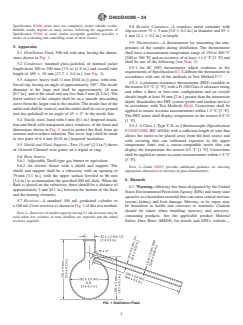
5.1 Distillation Flask, 500 mL side-arm, having the dimen- shall have a measurement temperature range of 150 to 400 °C
sions shown in Fig. 1. [300 to 760 °F] and an accuracy of at least 61.5 °C [3 °F] and
shall be one of the following (see Note 3):
5.2 Condenser, standard glass-jacketed, of nominal jacket
5.9.1 An 8C [8F] thermometer which conforms to the
length from 200 to 300 mm [7.9 to 11.8 in.] and overall tube
requirements of Specification E1. Calibrate the thermometer in
length of 450 6 10 mm [17.7 6 0.4 in.] (see Fig. 3).
accordance with one of the methods in Test Method E77.
5.3 Adapter, heavy-wall (1 mm [0.04 in.]) glass, with rein-
5.9.2 A platinum resistance thermometer (PRT) readable to
forced top, having an angle of approximately 105°. The inside
the nearest 0.5 °C [1 °F], with a Pt 100 Class A tolerance rating
diameter at the large end shall be approximately 18 mm
and either a three or four-wire configuration and an overall
[0.7 in.], and at the small end not less than 5 mm [0.2 in.]. The
sheath length at least 50 mm [2 in.] greater than the immersion
lower surface of the adapter shall be on a smooth descending
depth. Standardize the PRT system (probe and readout device)
curve from the larger end to the smaller. The inside line of the
in accordance with Test Methods E644. Corrections shall be
outlet end shall be vertical, and the outlet shall be cut or ground
applied to ensure accurate measurements within 1.5 °C [3 °F].
(not fire-polished) at an angle of 45 6 5° to the inside line.
The PRT meter shall display temperature to the nearest 0.5 °C
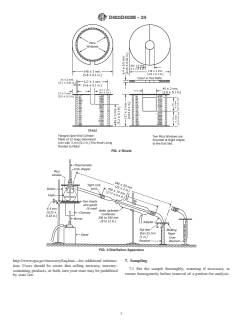
5.4 Shield, steel, lined with 3 mm [0.1 in.] fireproof insula-
[1 °F].
tion and fitted with transparent mica windows, of the form and
5.9.3 A Class 1, Type T, K, or J thermocouple (Specification
dimensions shown in Fig. 2, used to protect the flask from air
E230/E230M, IEC 60584) with a sufficient length of wire that
currents and to reduce radiation. The cover (top) shall be made
allows the meter to be placed away from the heat source and
in two parts of 6.4 mm [0.25 in.] fireproof insulation.
with covering that can withstand exposure to the upper
2 2
temperature limit, and a sensor-compatible meter that can
5.5 Shield and Flask Support—Two 15 cm [2.3 in. ] sheets
of 16-mesh Chromel wire gauze on a tripod or ring. display the temperature the nearest 0.5 °C [1 °F]. Corrections
shall be applied to ensure accurate measurements within 1.5 °C
5.6 Heat Source:
[3 °F].
5.6.1 Adjustable Tirrill-type gas burner or equivalent.
5.6.2 An electric heater with a shield and support. The
NOTE 3—Guide D8055 provides additional guidance on selecting
shield and support shall be a refractory with an opening of appropriate alternatives to mercury-in-glass thermometers.
79 mm [3.1 in.], with the upper surface beveled to 86 mm
[3.4 in.] to accommodate the specified 500 mL flask. When the 6. Hazards
flask is placed on the refractory, there should be a distance of
6.1 Warning—Mercury has been designated by the United
approximately 3 mm [0.1 in.] between the bottom of the flask
States Environmental Protection Agency (EPA) and many state
and the heating elements.
agencies as a hazardous material that can cause central nervous
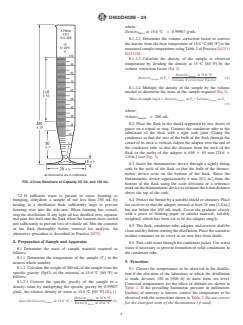
5.7 Receiver—A standard 100 mL graduated cylinder or
system, kidney, and liver damage. Mercury, or its vapor, may
a 100 mL Crow receiver as shown in Fig. 4 of this test method.
be hazardous to health and corrosive to materials. Caution
should be taken when handling mercury and mercury-
NOTE 2—Receivers of smaller capacity having 0.1 mL divisions may be
containing products. See the applicable product Material
used when low volumes of total distillate are expected and the added
accuracy required. Safety Data Sheet (MSDS) for details and EPA’s website—
FIG. 1 Distillation Flask
D402/D402M − 24
FIG. 2 Shield
FIG. 3 Distillation Apparatus
http://www.epa.gov/mercury/faq.htm—for additional informa- 7. Sampling
tion. Users should be aware that selling mercury, mercury-
7.1 Stir the sample thoroughly, warming if necessary, to
containing products, or both, into your state may be prohibited
ensure homogeneity before removal of a portion for analysis.
by state law.
D402/D402M − 24
where:
Density at 15.6 °C = 0.99907 g/mL.
Water
8.1.2.2 Determine the volume correction factor to convert
the density from the base temperature of 15.6 °C [60 °F] to the
measured sample temperature using Table 2 of Practice D4311/
D4311M.
8.1.2.3 Calculate the density of the sample at observed
temperature by dividing the density at 15 °C [60 °F] by the
volume correction factor (Eq 2).
Density at 15.6 °C
Sample
Density at T 5 (2)
Sample x
Volume Correction Factor
8.1.2.4 Multiply the density of the sample by the volume
needed to determine the mass of the sample required (Eq 3).
Mass of sample req’d 5 Density at T × Volume at T
Sample x Sample x
(3)
where:
Volume = 200 mL.
Sample
8.2 Place the flask in the shield supported by two sheets of
gauze on a tripod or ring. Connect the condenser tube to the
tubulature of the flask with a tight cork joint. Clamp the
condenser so that the axis of the bulb of the flask through the
center of its neck is vertical. Adjust the adapter over the end of
the condenser tube so that the distance from the neck of the
flask to the outlet of the adapter is 650 6 50 mm [25.6 6
2.0 in.] (see Fig. 3).
8.3 Insert the thermometric device through a tightly fitting
cork in the neck of the flask so that the bulb of the thermo-
metric device rests on the bottom of the flask. Raise the
All dimensions are in millimeters
thermometric device approximately 6 mm [0.2 in.] from the
FIG. 4 Crow Receivers of Capacity 25, 50, and 100 mL
bottom of the flask using the scale divisions or a reference
mark on the thermometric device t
...