

ASTM D113/D113M-17(2023)e1
(Test Method)Standard Test Method for Ductility of Asphalt Materials
General Information
- Abstract
SIGNIFICANCE AND USE
3.1 This test method provides one measure of tensile properties of asphalt materials and may be used to measure ductility for specification requirements.
Note 1: The quality of the results produced by this standard are dependent on the competence of the personnel performing the procedure and the capability, calibration, and maintenance of the equipment used. Agencies that meet the criteria of Specification D3666 are generally considered capable of competent and objective testing, sampling, inspection, etc. Users of this standard are cautioned that compliance with Specification D3666 alone does not completely ensure reliable results. Reliable results depend on many factors; following the suggestions of Specification D3666 or some similar acceptable guideline provides a means of evaluating and controlling some of those factors.
SCOPE
1.1 This test method describes the procedure for determining the ductility of an asphalt material measured by the distance to which it will elongate before breaking when two ends of a briquet specimen of the material of the form described in 4.1 are pulled apart at a specified speed and at a specified temperature. Unless otherwise specified, the test shall be made at a temperature of 25 ± 0.5 °C [77 ± 0.9 °F] and with a speed of 5 cm/min ± 5.0 %. At other temperatures the speed should be specified.
1.2 Because of the large number of methods for obtaining test samples, it is impractical to discuss specific products in this test method. Refer to individual product specifications for guidance in obtaining a test sample.
1.3 The text of this standard references notes and footnotes which provide explanatory material. These notes and footnotes (excluding those in tables and figures) shall not be considered as requirements of the standard.
1.4 The values stated in SI units or inch-pound units are to be regarded separately as standard. The values stated in each system may not be exact equivalents; therefore, each system shall be used independently of each other. Combining values from the two systems may result in nonconformance with the standard. Bath and mold dimensions are given in SI units only, as the equipment is not available in inch-pound units.
1.5 Warning—Mercury has been designated by the United States Environmental Protection Agency and many state agencies as a hazardous material that can cause central nervous system, kidney, and liver damage. Mercury or its vapor may be hazardous to health and corrosive to materials. Caution should be taken when handling mercury and mercury-containing products. See the applicable product Safety Data Sheet (SDS) for details and the EPA’s website (http://www.epa.gov/mercury/faq.htm) for additional information. Users should be aware that selling mercury or mercury-containing products, or both, in your state may be prohibited by state law.
1.6 This standard does not purport to address all of the safety concerns, if any, associated with its use. It is the responsibility of the user of this standard to establish appropriate safety, health, and environmental practices and determine the applicability of regulatory limitations prior to use.
1.7 This international standard was developed in accordance with internationally recognized principles on standardization established in the Decision on Principles for the Development of International Standards, Guides and Recommendations issued by the World Trade Organization Technical Barriers to Trade (TBT) Committee.
- Status
- Published
- Publication Date
- 14-Dec-2017
- Technical Committee
- D04 - Road and Paving Materials
- Drafting Committee
- D04.44 - Rheological Tests
Overview
ASTM D113/D113M-17(2023)e1 - Standard Test Method for Ductility of Asphalt Materials is an internationally recognized standard published by ASTM International. This test method specifies the procedure for determining the ductility of asphalt materials, measured by the distance a briquet specimen can elongate before breaking under controlled conditions. Ductility is a key measure of the tensile properties of asphalt and is commonly used for quality control and specification compliance in road and paving construction.
The method supports consistency and reliability in evaluating asphalt performance, aiding in the selection and grading of materials for durable pavements. The standard includes guidance on test temperatures, speeds, apparatus, and safety considerations, ensuring the accurate and safe execution of ductility tests.
Key Topics
- Ductility Measurement: Determines the extent to which asphalt can stretch before breaking, providing a direct indication of its flexibility and crack resistance.
- Test Conditions: Standard testing is conducted at 25 ± 0.5 °C (77 ± 0.9 °F) and a speed of 5 cm/min ± 5%. Other temperatures and speeds may be specified.
- Apparatus Requirements: Outlines specifications for molds, water baths, testing machines, thermometers, and release agents to maintain test validity.
- Sample Preparation: Describes the handling and preparation of unaged and aged asphalt binders, residues from emulsion or cutback asphalt, and recommendations for adequate sample conditioning.
- Result Reporting: Specifies that results should be averaged over three normal tests and documented per the defined criteria. Abnormal tests or deviations are addressed with guidance on reporting procedures.
- Safety and Environmental Considerations: Highlights handling precautions, especially regarding hazardous materials like mercury, and promotes adherence to health, safety, and environmental regulations.
- Precision and Reliability: Emphasizes repeatability, operator competence, equipment calibration, and adherence to related quality assurance standards such as ASTM D3666.
Applications
ASTM D113/D113M is widely applied in the road construction and paving materials industries to:
- Assess the flexibility and performance of asphalt binders and emulsified asphalts.
- Provide specification benchmarks for material selection and acceptance in highway and infrastructure projects.
- Compare ductility properties before and after aging methods such as the Rolling Thin-Film Oven Test (RTFOT) or Thin-Film Oven Test (TFOT).
- Ensure quality assurance in both laboratory and field settings, supporting the design and maintenance of long-lasting, crack-resistant pavements.
- Aid regulatory agencies, asphalt producers, and contractors in meeting project requirements and ensuring compliance with national or international standards.
Related Standards
ASTM D113/D113M references and is complemented by several other ASTM standards relevant to asphalt testing:
- ASTM D5/D5M: Test Method for Penetration of Bituminous Materials
- ASTM D1754/D1754M: Effects of Heat and Air on Asphaltic Materials (Thin-Film Oven Test)
- ASTM D2872: Effect of Heat and Air on a Moving Film of Asphalt Binder (Rolling Thin-Film Oven Test)
- ASTM D3666: Specification for Agencies Testing and Inspecting Road and Paving Materials
- ASTM D6934, D6997, D7403: Methods for residue determination from emulsified asphalts
- ASTM E1, E2251: Specifications for thermometers used in asphalt testing
- ASTM E11: Specification for Test Sieves
By aligning with these referenced standards, ASTM D113/D113M ensures a robust framework for the accurate, repeatable assessment of asphalt material ductility and overall quality in construction and engineering contexts.
Keywords: asphalt ductility test, ASTM D113, asphalt materials, ductility of asphalt, road construction, pavement testing, tensile properties, asphalt binder, highway quality control, paving standards.
Relations
- Effective Date
- 15-Dec-2017
- Effective Date
- 01-Feb-2024
- Effective Date
- 15-Jan-2024
- Effective Date
- 01-Jan-2024
- Effective Date
- 15-Jun-2015
- Refers
ASTM D402/D402M-14 - Standard Test Method for Distillation of Cutback Asphalt (Withdrawn 2023) - Effective Date
- 01-Jun-2014
Get Certified
Connect with accredited certification bodies for this standard

Element Materials Technology
Materials testing and product certification.

ABS Group Brazil
ABS Group certification services in Brazil.

ABS Quality Evaluations Inc.
American Bureau of Shipping quality certification.
Sponsored listings
Frequently Asked Questions
ASTM D113/D113M-17(2023)e1 is a standard published by ASTM International. Its full title is "Standard Test Method for Ductility of Asphalt Materials". This standard covers: SIGNIFICANCE AND USE 3.1 This test method provides one measure of tensile properties of asphalt materials and may be used to measure ductility for specification requirements. Note 1: The quality of the results produced by this standard are dependent on the competence of the personnel performing the procedure and the capability, calibration, and maintenance of the equipment used. Agencies that meet the criteria of Specification D3666 are generally considered capable of competent and objective testing, sampling, inspection, etc. Users of this standard are cautioned that compliance with Specification D3666 alone does not completely ensure reliable results. Reliable results depend on many factors; following the suggestions of Specification D3666 or some similar acceptable guideline provides a means of evaluating and controlling some of those factors. SCOPE 1.1 This test method describes the procedure for determining the ductility of an asphalt material measured by the distance to which it will elongate before breaking when two ends of a briquet specimen of the material of the form described in 4.1 are pulled apart at a specified speed and at a specified temperature. Unless otherwise specified, the test shall be made at a temperature of 25 ± 0.5 °C [77 ± 0.9 °F] and with a speed of 5 cm/min ± 5.0 %. At other temperatures the speed should be specified. 1.2 Because of the large number of methods for obtaining test samples, it is impractical to discuss specific products in this test method. Refer to individual product specifications for guidance in obtaining a test sample. 1.3 The text of this standard references notes and footnotes which provide explanatory material. These notes and footnotes (excluding those in tables and figures) shall not be considered as requirements of the standard. 1.4 The values stated in SI units or inch-pound units are to be regarded separately as standard. The values stated in each system may not be exact equivalents; therefore, each system shall be used independently of each other. Combining values from the two systems may result in nonconformance with the standard. Bath and mold dimensions are given in SI units only, as the equipment is not available in inch-pound units. 1.5 Warning—Mercury has been designated by the United States Environmental Protection Agency and many state agencies as a hazardous material that can cause central nervous system, kidney, and liver damage. Mercury or its vapor may be hazardous to health and corrosive to materials. Caution should be taken when handling mercury and mercury-containing products. See the applicable product Safety Data Sheet (SDS) for details and the EPA’s website (http://www.epa.gov/mercury/faq.htm) for additional information. Users should be aware that selling mercury or mercury-containing products, or both, in your state may be prohibited by state law. 1.6 This standard does not purport to address all of the safety concerns, if any, associated with its use. It is the responsibility of the user of this standard to establish appropriate safety, health, and environmental practices and determine the applicability of regulatory limitations prior to use. 1.7 This international standard was developed in accordance with internationally recognized principles on standardization established in the Decision on Principles for the Development of International Standards, Guides and Recommendations issued by the World Trade Organization Technical Barriers to Trade (TBT) Committee.
SIGNIFICANCE AND USE 3.1 This test method provides one measure of tensile properties of asphalt materials and may be used to measure ductility for specification requirements. Note 1: The quality of the results produced by this standard are dependent on the competence of the personnel performing the procedure and the capability, calibration, and maintenance of the equipment used. Agencies that meet the criteria of Specification D3666 are generally considered capable of competent and objective testing, sampling, inspection, etc. Users of this standard are cautioned that compliance with Specification D3666 alone does not completely ensure reliable results. Reliable results depend on many factors; following the suggestions of Specification D3666 or some similar acceptable guideline provides a means of evaluating and controlling some of those factors. SCOPE 1.1 This test method describes the procedure for determining the ductility of an asphalt material measured by the distance to which it will elongate before breaking when two ends of a briquet specimen of the material of the form described in 4.1 are pulled apart at a specified speed and at a specified temperature. Unless otherwise specified, the test shall be made at a temperature of 25 ± 0.5 °C [77 ± 0.9 °F] and with a speed of 5 cm/min ± 5.0 %. At other temperatures the speed should be specified. 1.2 Because of the large number of methods for obtaining test samples, it is impractical to discuss specific products in this test method. Refer to individual product specifications for guidance in obtaining a test sample. 1.3 The text of this standard references notes and footnotes which provide explanatory material. These notes and footnotes (excluding those in tables and figures) shall not be considered as requirements of the standard. 1.4 The values stated in SI units or inch-pound units are to be regarded separately as standard. The values stated in each system may not be exact equivalents; therefore, each system shall be used independently of each other. Combining values from the two systems may result in nonconformance with the standard. Bath and mold dimensions are given in SI units only, as the equipment is not available in inch-pound units. 1.5 Warning—Mercury has been designated by the United States Environmental Protection Agency and many state agencies as a hazardous material that can cause central nervous system, kidney, and liver damage. Mercury or its vapor may be hazardous to health and corrosive to materials. Caution should be taken when handling mercury and mercury-containing products. See the applicable product Safety Data Sheet (SDS) for details and the EPA’s website (http://www.epa.gov/mercury/faq.htm) for additional information. Users should be aware that selling mercury or mercury-containing products, or both, in your state may be prohibited by state law. 1.6 This standard does not purport to address all of the safety concerns, if any, associated with its use. It is the responsibility of the user of this standard to establish appropriate safety, health, and environmental practices and determine the applicability of regulatory limitations prior to use. 1.7 This international standard was developed in accordance with internationally recognized principles on standardization established in the Decision on Principles for the Development of International Standards, Guides and Recommendations issued by the World Trade Organization Technical Barriers to Trade (TBT) Committee.
ASTM D113/D113M-17(2023)e1 is classified under the following ICS (International Classification for Standards) categories: 75.140 - Waxes, bituminous materials and other petroleum products. The ICS classification helps identify the subject area and facilitates finding related standards.
ASTM D113/D113M-17(2023)e1 has the following relationships with other standards: It is inter standard links to ASTM D113-17, ASTM C670-24a, ASTM D402/D402M-24, ASTM C670-24, ASTM C670-15, ASTM D402/D402M-14. Understanding these relationships helps ensure you are using the most current and applicable version of the standard.
ASTM D113/D113M-17(2023)e1 is available in PDF format for immediate download after purchase. The document can be added to your cart and obtained through the secure checkout process. Digital delivery ensures instant access to the complete standard document.
Standards Content (Sample)
This international standard was developed in accordance with internationally recognized principles on standardization established in the Decision on Principles for the
Development of International Standards, Guides and Recommendations issued by the World Trade Organization Technical Barriers to Trade (TBT) Committee.
´1
Designation: D113/D113M − 17 (Reapproved 2023) American Association State
Highway and Transportation Officials Standard
AASHTO No.: T51
Standard Test Method for
Ductility of Asphalt Materials
This standard is issued under the fixed designation D113/D113M; the number immediately following the designation indicates the year
of original adoption or, in the case of revision, the year of last revision. A number in parentheses indicates the year of last reapproval.
A superscript epsilon (´) indicates an editorial change since the last revision or reapproval.
ε NOTE—Editorially updated to dual designation in December 2023.
1. Scope mercury/faq.htm) for additional information. Users should be
aware that selling mercury or mercury-containing products, or
1.1 This test method describes the procedure for determin-
both, in your state may be prohibited by state law.
ing the ductility of an asphalt material measured by the
1.6 This standard does not purport to address all of the
distance to which it will elongate before breaking when two
safety concerns, if any, associated with its use. It is the
ends of a briquet specimen of the material of the form
responsibility of the user of this standard to establish appro-
described in 4.1 are pulled apart at a specified speed and at a
priate safety, health, and environmental practices and deter-
specified temperature. Unless otherwise specified, the test shall
mine the applicability of regulatory limitations prior to use.
be made at a temperature of 25 6 0.5 °C [77 6 0.9 °F] and
1.7 This international standard was developed in accor-
with a speed of 5 cm/min 6 5.0 %. At other temperatures the
dance with internationally recognized principles on standard-
speed should be specified.
ization established in the Decision on Principles for the
1.2 Because of the large number of methods for obtaining
Development of International Standards, Guides and Recom-
test samples, it is impractical to discuss specific products in this
mendations issued by the World Trade Organization Technical
test method. Refer to individual product specifications for
Barriers to Trade (TBT) Committee.
guidance in obtaining a test sample.
1.3 The text of this standard references notes and footnotes
2. Referenced Documents
which provide explanatory material. These notes and footnotes
2.1 ASTM Standards:
(excluding those in tables and figures) shall not be considered
C670 Practice for Preparing Precision and Bias Statements
as requirements of the standard.
for Test Methods for Construction Materials
1.4 The values stated in SI units or inch-pound units are to
D5/D5M Test Method for Penetration of Bituminous Mate-
be regarded separately as standard. The values stated in each
rials
system may not be exact equivalents; therefore, each system
D402/D402M Test Method for Distillation of Cutback As-
shall be used independently of each other. Combining values
phalt (Withdrawn 2023)
from the two systems may result in nonconformance with the
D1754/D1754M Test Method for Effects of Heat and Air on
standard. Bath and mold dimensions are given in SI units only,
Asphaltic Materials (Thin-Film Oven Test)
as the equipment is not available in inch-pound units.
D2872 Test Method for Effect of Heat and Air on a Moving
Film of Asphalt Binder (Rolling Thin-Film Oven Test)
1.5 Warning—Mercury has been designated by the United
D3666 Specification for Minimum Requirements for Agen-
States Environmental Protection Agency and many state agen-
cies Testing and Inspecting Road and Paving Materials
cies as a hazardous material that can cause central nervous
D6934 Test Method for Residue by Evaporation of Emulsi-
system, kidney, and liver damage. Mercury or its vapor may be
fied Asphalt
hazardous to health and corrosive to materials. Caution should
D6997 Test Method for Distillation of Emulsified Asphalt
be taken when handling mercury and mercury-containing
D7403 Test Method for Determination of Residue of Emul-
products. See the applicable product Safety Data Sheet (SDS)
sified Asphalt by Low Temperature Vacuum Distillation
for details and the EPA’s website (http://www.epa.gov/
1 2
This test method is under the jurisdiction of ASTM Committee D04 on Road For referenced ASTM standards, visit the ASTM website, www.astm.org, or
and Paving Materials and is the direct responsibility of Subcommittee D04.44 on contact ASTM Customer Service at service@astm.org. For Annual Book of ASTM
Rheological Tests. Standards volume information, refer to the standard’s Document Summary page on
Current edition approved Dec. 1, 2023. Published December 2023. Originally the ASTM website.
approved in 1921. Last previous edition approved in 2017 as D113 – 17. DOI: The last approved version of this historical standard is referenced on
10.1520/D0113_D0113M-17R23E01. www.astm.org.
Copyright © ASTM International, 100 Barr Harbor Drive, PO Box C700, West Conshohocken, PA 19428-2959. United States
´1
D113/D113M − 17 (2023)
Agencies that meet the criteria of Specification D3666 are generally
D7497 Practice for Recovering Residue from Emulsified
considered capable of competent and objective testing, sampling,
Asphalt Using Low-Temperature Evaporative Technique
inspection, etc. Users of this standard are cautioned that compliance with
E1 Specification for ASTM Liquid-in-Glass Thermometers
Specification D3666 alone does not completely ensure reliable results.
E11 Specification for Woven Wire Test Sieve Cloth and Test
Reliable results depend on many factors; following the suggestions of
Sieves
Specification D3666 or some similar acceptable guideline provides a
means of evaluating and controlling some of those factors.
E77 Test Method for Inspection and Verification of Ther-
mometers
4. Apparatus
E220 Test Method for Calibration of Thermocouples By
Comparison Techniques
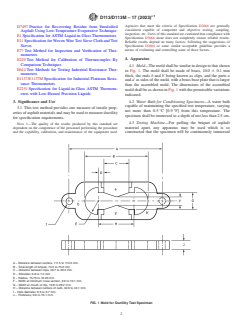
4.1 Mold—The mold shall be similar in design to that shown
E644 Test Methods for Testing Industrial Resistance Ther-
in Fig. 1. The mold shall be made of brass, 10.0 6 0.1 mm
mometers
thick, the ends b and b' being known as clips, and the parts a
E1137/E1137M Specification for Industrial Platinum Resis-
and a' as sides of the mold, with a brass base plate that is larger
tance Thermometers
than the assembled mold. The dimensions of the assembled
E2251 Specification for Liquid-in-Glass ASTM Thermom-
mold shall be as shown in Fig. 1 with the permissible variations
eters with Low-Hazard Precision Liquids
indicated.
4.2 Water Bath for Conditioning Specimens—A water bath
3. Significance and Use
capable of maintaining the specified test temperature, varying
3.1 This test method provides one measure of tensile prop-
not more than 0.5 °C [0.9 °F] from this temperature. The
erties of asphalt materials and may be used to measure ductility
specimen shall be immersed to a depth of not less than 2.5 cm.
for specification requirements.
4.3 Testing Machine—For pulling the briquet of asphalt
NOTE 1—The quality of the results produced by this standard are
material apart, any apparatus may be used which is so
dependent on the competence of the personnel performing the procedure
and the capability, calibration, and maintenance of the equipment used. constructed that the specimen will be continuously immersed
A – Distance between centers, 111.5 to 113.5 mm.
B – Total length of briquet, 74.5 to 75.5 mm.
C – Distance between clips, 29.7 to 30.3 mm.
D – Shoulder, 6.8 to 7.2 mm.
E – Radius, 15.75 to 16.25 mm.
F – Width at minimum cross section, 9.9 to 10.1 mm.
G – Width at mouth of clip, 19.8 to 20.2 mm.
H – Distance between centers of radii, 42.9 to 43.1 mm.
I – Hole diameter, 6.5 to 6.7 mm.
J – Thickness, 9.9 to 10.1 mm.
FIG. 1 Mold for Ductility Test Specimen
´1
D113/D113M − 17 (2023)
in water, while the two clips are pulled apart at a uniform 5.2 Unaged Sample—If the sample is an asphalt binder,
speed, as specified, without undue vibration. A 65 % variation carefully heat the sample in a covered container to prevent
of test speed is permissible. The water in the tank of the testing local overheating until it has become sufficiently fluid to pour.
machine shall cover the specimen both above and below it by Use an oven set at 135 6 5 °C [275 6 10 °F] for sample
at least 2.5 cm and shall be maintained within 60.5 °C heating.
[60.9 °F] of the test temperature. The testing machine shall
5.3 Aged Sample—If the sample is a conditioned residue
incorporate a means by which the elongation at the time of
obtained from Test Method D1754/D1754M or D2872, com-
rupture can be measured in centimeters.
bine the residue into a single container, cover, and heat in an
4.4 Thermometer—A calibrated liquid-in-glass thermometer oven set at 135 6 5 °C [275 6 10 °F]. (See Note 3.)
of suitable range with subdivisions and maximum scale error of
5.4 Cut-Back Asphalt Residue—If the sample is a residual
0.1 °C [0.2 °F] or any thermometric device of equal accuracy,
product recovered from cut-back distillation by means
...