

ASTM D7870/D7870M-20
(Practice)Standard Practice for Moisture Conditioning Compacted Asphalt Mixture Specimens by Using Hydrostatic Pore Pressure
General Information
- Abstract
SIGNIFICANCE AND USE
4.1 This practice provides an accelerated conditioning method under cyclic loading. This system is capable of operating at higher than normal temperatures and creating pore pressure within a compacted asphalt mixture to achieve an acceleration of the effects that a mixture would experience over time from traffic at normal temperatures and conditions. The accelerated conditioning in this practice is intended to simulate the stresses induced in a wet pavement by a passing vehicle tire. The pulse shape produced by this system approximates a Lorentzian function with a half peak width of approximately 1 s at 276 kPa [40 psi].
4.2 The factors that influence the potential for moisture damage to occur include aggregate mineralogy, mixture air voids, water, cyclic applied stress, and elevated temperature. This practice provides a method and apparatus that is capable of producing three of these factors: water, stress, and high temperature. Aggregate mineralogy and air voids are mixture properties.
4.3 Specimens conditioned by this system can be tested using a variety of different tests, including Test Method D6931, Test Method D6927, bulk specific gravity difference obtained by Test Method D6926 or D6752/D6752M for before and after conditioning, dynamic modulus, flow number, AASHTO T 378, and visual inspection for stripped aggregates.
Note 1: The quality of the results produced by this standard are dependent on the competence of the personnel performing the procedure and the capability, calibration, and maintenance of the equipment used. Agencies that meet the criteria of Specification D3666 are generally considered capable of competent and objective testing, sampling, inspection, etc. Users of this standard are cautioned that compliance with Specification D3666 alone does not completely ensure reliable results. Reliable results depend on many factors; following the suggestions of Specification D3666 or some similar acceptance guideline provides a means of evaluating ...
SCOPE
1.1 This practice includes procedures for preparing compacted asphalt mixture specimens, exposing the specimens to hydrostatic pore pressure inside an enclosed chamber, and guidance on testing the specimens for the effect of water on the tensile strength or change in other properties of the asphalt mixture, such as density, modulus, etc.
1.2 Specimens conditioned according to this practice can be tested using methods and test procedures referenced in this document, and those results may provide information as to the effect of the moisture conditioning of this practice on the moisture sensitivity of those mixtures.
1.3 The text of this standard references notes and footnotes which provide explanatory material. These notes and footnotes (excluding those in tables and figures) shall not be considered as requirements of the standard.
1.4 The values stated in either SI units or inch-pound units are to be regarded separately as standard. The values stated in each system may not be exact equivalents; therefore, each system shall be used independently of the other. Combining values from the two systems may result in nonconformance with the standard.
1.5 This standard does not purport to address all of the safety concerns, if any, associated with its use. It is the responsibility of the user of this standard to establish appropriate safety, health, and environmental practices and determine the applicability of regulatory limitations prior to use.
1.6 This international standard was developed in accordance with internationally recognized principles on standardization established in the Decision on Principles for the Development of International Standards, Guides and Recommendations issued by the World Trade Organization Technical Barriers to Trade (TBT) Committee.
- Status
- Published
- Publication Date
- 30-Apr-2020
- Technical Committee
- D04 - Road and Paving Materials
- Drafting Committee
- D04.22 - Effect of Water and Other Elements on Asphalt Coated Aggregates
Buy Documents
ASTM D7870/D7870M-20 - Standard Practice for Moisture Conditioning Compacted Asphalt Mixture Specimens by Using Hydrostatic Pore Pressure
REDLINE ASTM D7870/D7870M-20 - Standard Practice for Moisture Conditioning Compacted Asphalt Mixture Specimens by Using Hydrostatic Pore Pressure
Overview
ASTM D7870/D7870M-20: Standard Practice for Moisture Conditioning Compacted Asphalt Mixture Specimens by Using Hydrostatic Pore Pressure establishes a standardized procedure for preparing, conditioning, and evaluating asphalt mixture specimens. The method accelerates moisture conditioning under controlled hydrostatic pore pressure and cyclic loading, aiming to replicate and speed up the effects of water, temperature, and stress on asphalt mixtures as encountered in real pavement conditions. This practice supports the analysis of pavement durability and moisture sensitivity, a critical factor in predicting the long-term performance of asphalt pavements subject to traffic and weather exposure.
Key Topics
- Moisture Conditioning: Subjects compacted asphalt mixture specimens to hydrostatic pore pressure inside an enclosed chamber, simulating the impact of water and cyclic tire stresses commonly found in field scenarios.
- Cyclic Loading at Elevated Temperature: The method exposes specimens to high temperature and repeated stress, accelerating the detection of potential moisture damage mechanisms.
- Simulated Field Stresses: The conditioning pulse shape used closely approximates stress profiles induced by passing vehicle tires on wet pavements.
- Specimen Preparation: Includes guidance for preparing both laboratory mixed/lab compacted (LMLC) and plant mixed/lab compacted (PMLC) specimens.
- Testing Protocols: Conditioned specimens may then be evaluated for property changes such as tensile strength, density, and modulus, offering insight into the mixture's moisture sensitivity and potential durability.
- Result Quality Assurance: Emphasizes the importance of skilled personnel, properly calibrated equipment, and adherence to agency requirements (e.g., ASTM Specification D3666).
Applications
ASTM D7870/D7870M-20 is valuable for a range of industries and stakeholders, including:
- Asphalt Pavement Design and Testing: Enables laboratories, contractors, and agencies to simulate the adverse impacts of moisture and traffic stress on asphalt, supporting the development and selection of more resilient pavement materials.
- Performance Evaluation: Essential in quality control and research for assessing how various mixtures or additives (e.g., anti-stripping agents) withstand accelerated moisture conditioning.
- Comparative Analysis: Useful for comparative testing of field samples and laboratory-prepared mixes to verify the effect of different aggregate types, binder formulations, air void content, and anti-stripping treatments.
- Compliance and Specification: Facilitates compliance with performance-related specifications or standards by providing a reproducible methodology for moisture sensitivity evaluation.
Related Standards
This practice references several other ASTM and AASHTO standards critical for asphalt mixture preparation, testing, and performance evaluation, including:
- ASTM D6931: Indirect Tensile (IDT) Strength of Asphalt Mixtures
- ASTM D6927: Marshall Stability and Flow of Asphalt Mixtures
- ASTM D6925/D1561/D4013/D6926: Asphalt Mixture Specimen Preparation Methods
- ASTM D6752/D2726: Bulk Specific Gravity and Density of Compacted Asphalt Mixtures
- ASTM D3666: Requirements for Agencies Testing and Inspecting Road and Paving Materials
- ASTM D4867: Effect of Moisture on Asphalt Concrete Paving Mixtures
- AASHTO T 378: Dynamic Modulus and Flow Number Test Methods
Practical Value
Adopting ASTM D7870/D7870M-20 provides laboratories, material suppliers, and public agencies with a reliable, accelerated protocol for moisture conditioning compacted asphalt mixtures. The standard augments traditional testing by replicating challenging environmental and loading conditions in a controlled environment, thereby supporting data-driven decisions for pavement design, construction quality assurance, and material innovation. Utilizing this method can improve long-term pavement performance, reduce maintenance costs, and extend the lifecycle of asphalt surfaces in a variety of climates and traffic conditions.
Keywords: moisture conditioning, hydrostatic pore pressure, asphalt mixture, cyclic loading, pavement durability, moisture sensitivity, ASTM D7870, road materials testing, asphalt performance standards.
Relations
- Effective Date
- 01-May-2020
- Effective Date
- 01-Dec-2023
- Effective Date
- 01-Nov-2023
- Effective Date
- 01-Jan-2020
- Effective Date
- 01-Aug-2019
- Effective Date
- 15-Dec-2018
- Effective Date
- 15-Aug-2018
- Effective Date
- 15-Aug-2018
- Effective Date
- 01-Jul-2018
- Effective Date
- 01-Feb-2018
- Effective Date
- 15-Jul-2017
- Effective Date
- 01-Jul-2017
- Effective Date
- 15-Jun-2017
- Effective Date
- 01-Jun-2017
- Effective Date
- 01-Jun-2017
Buy Documents
ASTM D7870/D7870M-20 - Standard Practice for Moisture Conditioning Compacted Asphalt Mixture Specimens by Using Hydrostatic Pore Pressure
REDLINE ASTM D7870/D7870M-20 - Standard Practice for Moisture Conditioning Compacted Asphalt Mixture Specimens by Using Hydrostatic Pore Pressure
Get Certified
Connect with accredited certification bodies for this standard

Element Materials Technology
Materials testing and product certification.

ABS Group Brazil
ABS Group certification services in Brazil.

ABS Quality Evaluations Inc.
American Bureau of Shipping quality certification.
Sponsored listings
Frequently Asked Questions
ASTM D7870/D7870M-20 is a standard published by ASTM International. Its full title is "Standard Practice for Moisture Conditioning Compacted Asphalt Mixture Specimens by Using Hydrostatic Pore Pressure". This standard covers: SIGNIFICANCE AND USE 4.1 This practice provides an accelerated conditioning method under cyclic loading. This system is capable of operating at higher than normal temperatures and creating pore pressure within a compacted asphalt mixture to achieve an acceleration of the effects that a mixture would experience over time from traffic at normal temperatures and conditions. The accelerated conditioning in this practice is intended to simulate the stresses induced in a wet pavement by a passing vehicle tire. The pulse shape produced by this system approximates a Lorentzian function with a half peak width of approximately 1 s at 276 kPa [40 psi]. 4.2 The factors that influence the potential for moisture damage to occur include aggregate mineralogy, mixture air voids, water, cyclic applied stress, and elevated temperature. This practice provides a method and apparatus that is capable of producing three of these factors: water, stress, and high temperature. Aggregate mineralogy and air voids are mixture properties. 4.3 Specimens conditioned by this system can be tested using a variety of different tests, including Test Method D6931, Test Method D6927, bulk specific gravity difference obtained by Test Method D6926 or D6752/D6752M for before and after conditioning, dynamic modulus, flow number, AASHTO T 378, and visual inspection for stripped aggregates. Note 1: The quality of the results produced by this standard are dependent on the competence of the personnel performing the procedure and the capability, calibration, and maintenance of the equipment used. Agencies that meet the criteria of Specification D3666 are generally considered capable of competent and objective testing, sampling, inspection, etc. Users of this standard are cautioned that compliance with Specification D3666 alone does not completely ensure reliable results. Reliable results depend on many factors; following the suggestions of Specification D3666 or some similar acceptance guideline provides a means of evaluating ... SCOPE 1.1 This practice includes procedures for preparing compacted asphalt mixture specimens, exposing the specimens to hydrostatic pore pressure inside an enclosed chamber, and guidance on testing the specimens for the effect of water on the tensile strength or change in other properties of the asphalt mixture, such as density, modulus, etc. 1.2 Specimens conditioned according to this practice can be tested using methods and test procedures referenced in this document, and those results may provide information as to the effect of the moisture conditioning of this practice on the moisture sensitivity of those mixtures. 1.3 The text of this standard references notes and footnotes which provide explanatory material. These notes and footnotes (excluding those in tables and figures) shall not be considered as requirements of the standard. 1.4 The values stated in either SI units or inch-pound units are to be regarded separately as standard. The values stated in each system may not be exact equivalents; therefore, each system shall be used independently of the other. Combining values from the two systems may result in nonconformance with the standard. 1.5 This standard does not purport to address all of the safety concerns, if any, associated with its use. It is the responsibility of the user of this standard to establish appropriate safety, health, and environmental practices and determine the applicability of regulatory limitations prior to use. 1.6 This international standard was developed in accordance with internationally recognized principles on standardization established in the Decision on Principles for the Development of International Standards, Guides and Recommendations issued by the World Trade Organization Technical Barriers to Trade (TBT) Committee.
SIGNIFICANCE AND USE 4.1 This practice provides an accelerated conditioning method under cyclic loading. This system is capable of operating at higher than normal temperatures and creating pore pressure within a compacted asphalt mixture to achieve an acceleration of the effects that a mixture would experience over time from traffic at normal temperatures and conditions. The accelerated conditioning in this practice is intended to simulate the stresses induced in a wet pavement by a passing vehicle tire. The pulse shape produced by this system approximates a Lorentzian function with a half peak width of approximately 1 s at 276 kPa [40 psi]. 4.2 The factors that influence the potential for moisture damage to occur include aggregate mineralogy, mixture air voids, water, cyclic applied stress, and elevated temperature. This practice provides a method and apparatus that is capable of producing three of these factors: water, stress, and high temperature. Aggregate mineralogy and air voids are mixture properties. 4.3 Specimens conditioned by this system can be tested using a variety of different tests, including Test Method D6931, Test Method D6927, bulk specific gravity difference obtained by Test Method D6926 or D6752/D6752M for before and after conditioning, dynamic modulus, flow number, AASHTO T 378, and visual inspection for stripped aggregates. Note 1: The quality of the results produced by this standard are dependent on the competence of the personnel performing the procedure and the capability, calibration, and maintenance of the equipment used. Agencies that meet the criteria of Specification D3666 are generally considered capable of competent and objective testing, sampling, inspection, etc. Users of this standard are cautioned that compliance with Specification D3666 alone does not completely ensure reliable results. Reliable results depend on many factors; following the suggestions of Specification D3666 or some similar acceptance guideline provides a means of evaluating ... SCOPE 1.1 This practice includes procedures for preparing compacted asphalt mixture specimens, exposing the specimens to hydrostatic pore pressure inside an enclosed chamber, and guidance on testing the specimens for the effect of water on the tensile strength or change in other properties of the asphalt mixture, such as density, modulus, etc. 1.2 Specimens conditioned according to this practice can be tested using methods and test procedures referenced in this document, and those results may provide information as to the effect of the moisture conditioning of this practice on the moisture sensitivity of those mixtures. 1.3 The text of this standard references notes and footnotes which provide explanatory material. These notes and footnotes (excluding those in tables and figures) shall not be considered as requirements of the standard. 1.4 The values stated in either SI units or inch-pound units are to be regarded separately as standard. The values stated in each system may not be exact equivalents; therefore, each system shall be used independently of the other. Combining values from the two systems may result in nonconformance with the standard. 1.5 This standard does not purport to address all of the safety concerns, if any, associated with its use. It is the responsibility of the user of this standard to establish appropriate safety, health, and environmental practices and determine the applicability of regulatory limitations prior to use. 1.6 This international standard was developed in accordance with internationally recognized principles on standardization established in the Decision on Principles for the Development of International Standards, Guides and Recommendations issued by the World Trade Organization Technical Barriers to Trade (TBT) Committee.
ASTM D7870/D7870M-20 is classified under the following ICS (International Classification for Standards) categories: 75.140 - Waxes, bituminous materials and other petroleum products. The ICS classification helps identify the subject area and facilitates finding related standards.
ASTM D7870/D7870M-20 has the following relationships with other standards: It is inter standard links to ASTM D7870/D7870M-13, ASTM D6925-23, ASTM D6752/D6752M-23, ASTM D6926-20, ASTM D8-19, ASTM D8-18c, ASTM D8-18b, ASTM D6752/D6752M-18, ASTM D8-18a, ASTM D8-18, ASTM D8-17c, ASTM D6931-17, ASTM D8-17b, ASTM D6752/D6752M-17, ASTM D2726/D2726M-17. Understanding these relationships helps ensure you are using the most current and applicable version of the standard.
ASTM D7870/D7870M-20 is available in PDF format for immediate download after purchase. The document can be added to your cart and obtained through the secure checkout process. Digital delivery ensures instant access to the complete standard document.
Standards Content (Sample)
This international standard was developed in accordance with internationally recognized principles on standardization established in the Decision on Principles for the
Development of International Standards, Guides and Recommendations issued by the World Trade Organization Technical Barriers to Trade (TBT) Committee.
Designation: D7870/D7870M − 20
Standard Practice for
Moisture Conditioning Compacted Asphalt Mixture
Specimens by Using Hydrostatic Pore Pressure
This standard is issued under the fixed designation D7870/D7870M; the number immediately following the designation indicates the
year of original adoption or, in the case of revision, the year of last revision. A number in parentheses indicates the year of last
reapproval. A superscript epsilon (´) indicates an editorial change since the last revision or reapproval.
1. Scope 2. Referenced Documents
1.1 This practice includes procedures for preparing com-
2.1 ASTM Standards:
pacted asphalt mixture specimens, exposing the specimens to
D8 Terminology Relating to Materials for Roads and Pave-
hydrostatic pore pressure inside an enclosed chamber, and
ments
guidance on testing the specimens for the effect of water on the
D979/D979M Practice for Sampling Bituminous Paving
tensile strength or change in other properties of the asphalt
Mixtures
mixture, such as density, modulus, etc.
D1561/D1561M Practice for Preparation of Bituminous
MixtureTest Specimens by Means of California Kneading
1.2 Specimens conditioned according to this practice can be
Compactor
tested using methods and test procedures referenced in this
D2726/D2726M Test Method for Bulk Specific Gravity and
document, and those results may provide information as to the
Density of Non-Absorptive Compacted Asphalt Mixtures
effect of the moisture conditioning of this practice on the
D3665 Practice for Random Sampling of Construction Ma-
moisture sensitivity of those mixtures.
terials
1.3 The text of this standard references notes and footnotes
D3666 Specification for Minimum Requirements for Agen-
which provide explanatory material. These notes and footnotes
cies Testing and Inspecting Road and Paving Materials
(excluding those in tables and figures) shall not be considered
D4013 Practice for Preparation of Test Specimens of Bitu-
as requirements of the standard.
minous Mixtures by Means of Gyratory Shear Compactor
1.4 The values stated in either SI units or inch-pound units
(Withdrawn 2013)
are to be regarded separately as standard. The values stated in
D4867/D4867M Test Method for Effect of Moisture on
each system may not be exact equivalents; therefore, each
Asphalt Concrete Paving Mixtures
system shall be used independently of the other. Combining
D5361/D5361M Practice for Sampling Compacted Asphalt
values from the two systems may result in nonconformance
Mixtures for Laboratory Testing
with the standard.
D6752/D6752M Test Method for Bulk Specific Gravity and
Density of CompactedAsphalt Mixtures UsingAutomatic
1.5 This standard does not purport to address all of the
Vacuum Sealing Method
safety concerns, if any, associated with its use. It is the
D6925 Test Method for Preparation and Determination of
responsibility of the user of this standard to establish appro-
priate safety, health, and environmental practices and deter- the Relative Density ofAsphalt Mix Specimens by Means
mine the applicability of regulatory limitations prior to use. of the Superpave Gyratory Compactor
D6926 Practice for Preparation of Asphalt Mixture Speci-
1.6 This international standard was developed in accor-
mens Using Marshall Apparatus
dance with internationally recognized principles on standard-
D6927 Test Method for Marshall Stability and Flow of
ization established in the Decision on Principles for the
Development of International Standards, Guides and Recom- Asphalt Mixtures
mendations issued by the World Trade Organization Technical D6931 Test Method for Indirect Tensile (IDT) Strength of
Barriers to Trade (TBT) Committee. Asphalt Mixtures
1 2
This practice is under the jurisdiction of ASTM Committee D04 on Road and For referenced ASTM standards, visit the ASTM website, www.astm.org, or
Paving Materials and is the direct responsibility of Subcommittee D04.22 on Effect contact ASTM Customer Service at service@astm.org. For Annual Book of ASTM
of Water and Other Elements on Asphalt Coated Aggregates. Standards volume information, refer to the standard’s Document Summary page on
Current edition approved May 1, 2020. Published May 2020. Originally the ASTM website.
approved in 2013. Last previous edition approved in 2013 as D7870/D7870M – 13. The last approved version of this historical standard is referenced on
DOI: 10.1520/D7870_D7870M-20. www.astm.org.
Copyright © ASTM International, 100 Barr Harbor Drive, PO Box C700, West Conshohocken, PA 19428-2959. United States
D7870/D7870M − 20
2.2 AASHTO Standard: 5.3 System (similar to Fig. 1) having a specimen chamber
AASHTO T 378 Standard Method of Test for Determining capable of testing one or more specimens with diameters of
the Dynamic Modulus and Flow Number for Asphalt 150 mm [6 in.] or less. The system should be capable of
Mixtures Using the Asphalt Mixture Performance Tester applying a cyclic pressure peak of approximately Lorentzian
(AMPT) function in shape with a peak pressure within 630 kPa
[64 psi] of the pressure set point and a width of the pressure
3. Terminology
peak at half maximum of 1 6 0.5 s.
3.1 Refer to Terminology D8 for definitions relating to
5.3.1 The system shall be equipped with appropriate valves
materials for roads and pavements.
for automatically purging (de-airing) and removing air from
the specimen chamber and allowing replacement of the acces-
4. Significance and Use
sible air void spaces with water.
4.1 This practice provides an accelerated conditioning
5.3.2 The specimen chamber shall be capable of withstand-
method under cyclic loading. This system is capable of
ing pressures of up to 690 kPa [100 psi].
operating at higher than normal temperatures and creating pore
5.3.3 The system should be equipped with temperature
pressure within a compacted asphalt mixture to achieve an
controls to allow set point temperatures of between 30 and
accelerationoftheeffectsthatamixturewouldexperienceover
60 °C [86 to 140 °F] with measurements accurate to within
time from traffic at normal temperatures and conditions. The
61°C[62 °F].
accelerated conditioning in this practice is intended to simulate
5.3.4 The system shall be capable of producing and control-
the stresses induced in a wet pavement by a passing vehicle
ling cyclic pressures between 200 and 420 kPa [30 to 50 psi]
tire. The pulse shape produced by this system approximates a
with measurements accurate to within 630 kPa [64 psi].
Lorentzian function with a half peak width of approximately
5.3.5 The system should be capable of applying and con-
1 s at 276 kPa [40 psi].
trolling cyclic pressure and temperature and controlling the
4.2 The factors that influence the potential for moisture
water temperature and pressure within the enclosed specimen
damage to occur include aggregate mineralogy, mixture air
chamber at a desired level.
voids, water, cyclic applied stress, and elevated temperature.
5.4 One or more containers sufficient in size to hold water
This practice provides a method and apparatus that is capable
and specimen(s).
of producing three of these factors: water, stress, and high
temperature. Aggregate mineralogy and air voids are mixture
6. Preparation of Test Specimens
properties.
6.1 Preparation of Lab Mixed Lab Compacted (LMLC) Test
4.3 Specimens conditioned by this system can be tested
Specimens:
usingavarietyofdifferenttests,includingTestMethodD6931,
6.1.1 Prepare mixtures in batches of sufficient size to make
Test Method D6927, bulk specific gravity difference obtained
at least three specimens for each test as specified in 6.1.2.
byTest Method D6926 or D6752/D6752M for before and after
conditioning, dynamic modulus, flow number, AASHTO T
6.1.2 Use specimens 100 mm [4 in.] in diameter and 63 6
378, and visual inspection for stripped aggregates.
...
This document is not an ASTM standard and is intended only to provide the user of an ASTM standard an indication of what changes have been made to the previous version. Because
it may not be technically possible to adequately depict all changes accurately, ASTM recommends that users consult prior editions as appropriate. In all cases only the current version
of the standard as published by ASTM is to be considered the official document.
Designation: D7870/D7870M − 13 D7870/D7870M − 20
Standard Practice for
Moisture Conditioning Compacted Asphalt Mixture
Specimens by Using Hydrostatic Pore Pressure
This standard is issued under the fixed designation D7870/D7870M; the number immediately following the designation indicates the
year of original adoption or, in the case of revision, the year of last revision. A number in parentheses indicates the year of last
reapproval. A superscript epsilon (´) indicates an editorial change since the last revision or reapproval.
1. Scope
1.1 This practice includes procedures for preparing compacted asphalt mixture specimens, exposing the specimens to
hydrostatic pore pressure inside an enclosed chamber, and guidance on testing the specimens for the effect of water on the tensile
strength or change in other properties of the asphalt mixture, such as density, modulus, etc.
1.2 Specimens conditioned according to this practice can be tested using methods and test procedures referenced in this
document, and those results may provide information as to the effect of the moisture conditioning of this practice on the moisture
sensitivity of those mixtures.
1.3 The text of this standard references notes and footnotes which provide explanatory material. These notes and footnotes
(excluding those in tables and figures) shall not be considered as requirements of the standard.
1.4 The values stated in either SI units or inch-pound units are to be regarded separately as standard. The values stated in each
system aremay not necessarilybe exact equivalents; therefore, to ensure conformance with the standard, each system shall be used
independently of the other, andother. Combining values from the two systems shall not be combined.may result in nonconformance
with the standard.
1.5 This standard does not purport to address all of the safety concerns, if any, associated with its use. It is the responsibility
of the user of this standard to establish appropriate safety safety, health, and healthenvironmental practices and determine the
applicability of regulatory limitations prior to use.
1.6 This international standard was developed in accordance with internationally recognized principles on standardization
established in the Decision on Principles for the Development of International Standards, Guides and Recommendations issued
by the World Trade Organization Technical Barriers to Trade (TBT) Committee.
2. Referenced Documents
2.1 ASTM Standards:
D8 Terminology Relating to Materials for Roads and Pavements
D979D979/D979M Practice for Sampling Bituminous Paving Mixtures
D1561D1561/D1561M Practice for Preparation of Bituminous Mixture Test Specimens by Means of California Kneading
Compactor
D2726D2726/D2726M Test Method for Bulk Specific Gravity and Density of Non-Absorptive Compacted Asphalt Mixtures
D3665 Practice for Random Sampling of Construction Materials
D3666 Specification for Minimum Requirements for Agencies Testing and Inspecting Road and Paving Materials
D4013 Practice for Preparation of Test Specimens of Bituminous Mixtures by Means of Gyratory Shear Compactor (Withdrawn
2013)
D4867D4867/D4867M Test Method for Effect of Moisture on Asphalt Concrete Paving Mixtures
D5361D5361/D5361M Practice for Sampling Compacted Asphalt Mixtures for Laboratory Testing
D6752D6752/D6752M Test Method for Bulk Specific Gravity and Density of Compacted Asphalt Mixtures Using Automatic
Vacuum Sealing Method
This test method practice is under the jurisdiction of ASTM Committee D04 on Road and Paving Materials and is the direct responsibility of Subcommittee D04.22 on
Effect of Water and Other Elements on BituminousAsphalt Coated Aggregates.
Current edition approved June 1, 2013May 1, 2020. Published June 2013May 2020. Originally approved in 2013. Last previous edition approved in 2013 as
D7870/D7870M – 13. DOI: 10.1520/D7870_D7870M-1310.1520/D7870_D7870M-20.
For referenced ASTM standards, visit the ASTM website, www.astm.org, or contact ASTM Customer Service at service@astm.org. For Annual Book of ASTM Standards
volume information, refer to the standard’s Document Summary page on the ASTM website.
The last approved version of this historical standard is referenced on www.astm.org.
Copyright © ASTM International, 100 Barr Harbor Drive, PO Box C700, West Conshohocken, PA 19428-2959. United States
D7870/D7870M − 20
D6925 Test Method for Preparation and Determination of the Relative Density of Asphalt Mix Specimens by Means of the
Superpave Gyratory Compactor
D6926 Practice for Preparation of Asphalt Mixture Specimens Using Marshall Apparatus
D6927 Test Method for Marshall Stability and Flow of Asphalt Mixtures
D6931 Test Method for Indirect Tensile (IDT) Strength of Asphalt Mixtures
2.2 AASHTO Standards:Standard:
AASHTO TP 79T 378 Standard Method of Test for Determining the Dynamic Modulus and Flow Number for Hot Mix Asphalt
(HMA)Mixtures Using the Asphalt Mixture Performance Tester (AMPT)
3. Terminology
3.1 Refer to Terminology D8 for definitions relating to materials for roads and pavements.
4. Significance and Use
4.1 This practice provides an accelerated conditioning method under cyclic loading. This system is capable of operating at
higher than normal temperatures and creating pore pressure within a compacted asphalt mixture to achieve an acceleration of the
effects that a mixture would experience over time from traffic at normal temperatures and conditions. The accelerated conditioning
in this practice is intended to simulate the stresses induced in a wet pavement by a passing vehicle tire. The pulse shape produced
by this system approximates a Lorentzian function with a half peak width of approximately 1 s 1 s at 276 kPa [40 psi].
4.2 The factors that influence the potential for moisture damage to occur include aggregate mineralogy, mixture air voids, water,
cyclic applied stress, and elevated temperature. This practice provides a method and apparatus that is capable of producing three
of these factors: water, stress, and high temperature. Aggregate mineralogy and air voids are mixture properties.
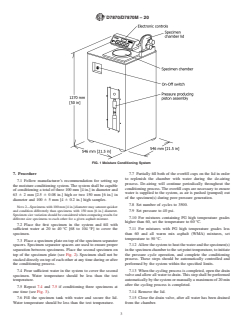
FIG. 1 Moisture Conditioning System
Available from American Association of State Highway and Transportation Officials (AASHTO), 444 N. Capitol St., NW, Suite 249, Washington, DC 20001,
http://www.transportation.org.
D7870/D7870M − 20
4.3 Specimens conditioned by this system can be tested using a variety of different tests including,tests, including Test Method
D6931, Test Method D6927, bulk specific gravity difference obtained by Test MethodsMethod D6926 or D6752D6752/D6752M
for before and after conditioning, dynamic modulus, flow number, AASHTO TP 79T 378, and visual inspection for stripped
aggregates.
NOTE 1—The quality of the results produced by this standard are dependent on the competence of the personnel performing the procedure and the
capability, calibration, and maintenance of the equipment used. Agencies that meet the criteria of PracticeSpecification D3666 are generally considered
capable of competent and objective testing, sampling, inspection, etc. Users of this standard are cautioned that compliance with PracticeSpecification
D3666 alone does not completely assureensure reliable results. Reliable results depend on many factors; following the suggestions of PracticeSpecifi-
cation D3666 or some similar acceptance guideline provides a means of evaluating and controlling some of those factors.
5. Apparatus
5.1 Balance in accordance with Test Method D2726D2726/D2726M.
5.2 Water bath capable of maintaining a temperature of 25 6 1°C1 °C [77 6 2°F].2 °F].
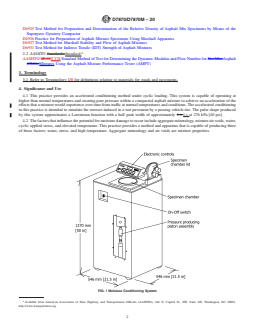
5.3 System (similar to Fig. 1) having a specimen chamber capable of testing one or more specimens with diameters of 150 mm
[6 in.] or less. The system should be capable of applying a cyclic pressure peak of approximately Lorentzian function in shape with
a peak pressure within 630 kPa [64 psi] [64 psi] of the pressure set point and a width of the pressure peak at half maximum of
1 6 0.5 s.
5.3.1 The system shall be equipped with appropriate valves for automaticall
...