

ASTM D6521-22
(Practice)Standard Practice for Accelerated Aging of Asphalt Binder Using a Pressurized Aging Vessel (PAV)
General Information
- Abstract
SIGNIFICANCE AND USE
5.1 This practice is designed to simulate the in-service oxidative aging that occurs in asphalt binders during pavement service. Residue from this conditioning practice may be used to estimate the physical or chemical properties of asphalt binders after several years of in-service aging in the field.
5.2 Binders conditioned using this practice are normally used to determine specification properties in accordance with Specification D6373 or D8239, or AASHTO M 320.
5.3 For asphalt binders of different grades or from different sources, there is no unique correlation between the time and temperature in this conditioning practice and in-service pavement age and temperature. Therefore, for a given set of in-service climatic conditions, it is not possible to select a single PAV conditioning time, temperature, and pressure that will predict the properties or the relative rankings of the properties of asphalt binders after a specific set of in-service exposure conditions.
5.4 The relative degree of hardening of different asphalt binders varies with conditioning temperatures and pressures in the PAV. Therefore, two asphalt binders may age at a similar rate at one condition of temperature and pressure, but age differently at another condition. Hence, the relative rates of aging for a set of asphalts at PAV conditions may differ significantly from the actual in-service relative rates at lower pavement temperatures and ambient pressures.
SCOPE
1.1 This practice covers the conditioning of asphalt binders to simulate accelerated aging (oxidation) by means of pressurized air and elevated temperature. This is intended to simulate the changes in rheology which occur in asphalt binders during in-service oxidative aging, but may not accurately simulate the relative rates of aging. It is normally intended for use with residue from Test Method D2872 (RTFOT), which is designed to simulate plant aging.
Note 1: PAV conditioning has not been validated for materials containing particulate materials.
1.2 The aging of asphalt binders during service is affected by ambient temperature and by mixture-associated variables, such as the volumetric proportions of the mix, the permeability of the mix, properties of the aggregates, and possibly other factors. This conditioning process is intended to provide an evaluation of the relative resistance of different asphalt binders to oxidative aging at selected elevated aging temperatures and pressures, but cannot account for mixture variables or provide the relative resistance to aging at in-service conditions.
1.3 The values stated in SI units are to be regarded as standard. No other units of measurement are included in this standard.
1.4 The text of this standard references notes and footnotes which provide explanatory material. These notes and footnotes (excluding those in tables and figures) shall not be considered as requirements of the standard
Note 2: The quality of the results produced by this standard are dependent on the competence of the personnel performing the procedure and the capability, calibration, and maintenance of the equipment used. Agencies that meet the criteria of Specification D3666 are generally considered capable of competent and objective testing, sampling, inspection, etc. Users of this standard are cautioned that compliance with Specification D3666 alone does not completely ensure reliable results. Reliable results depend on many factors; following the suggestions of Specification D3666 or some similar acceptable guideline provides a means of evaluating and controlling some of those factors.
1.5 This standard does not purport to address all of the safety concerns, if any, associated with its use. It is the responsibility of the user of this standard to establish appropriate safety, health, and environmental practices and determine the applicability of regulatory limitations prior to use.
1.6 This international standard was de...
- Status
- Published
- Publication Date
- 30-Apr-2022
- Technical Committee
- D04 - Road and Paving Materials
- Drafting Committee
- D04.46 - Durability and Distillation Tests
Buy Documents
ASTM D6521-22 - Standard Practice for Accelerated Aging of Asphalt Binder Using a Pressurized Aging Vessel (PAV)
REDLINE ASTM D6521-22 - Standard Practice for Accelerated Aging of Asphalt Binder Using a Pressurized Aging Vessel (PAV)
Overview
ASTM D6521-22 specifies the standard practice for simulating the accelerated aging of asphalt binder using a Pressurized Aging Vessel (PAV). The method is designed to mimic the in-service oxidative aging that asphalt binders undergo during pavement service. By conditioning asphalt binders under elevated temperature and pressure, this practice allows laboratories to estimate how binders will perform after years of field exposure, facilitating the prediction of pavement durability and compliance with various specifications.
Accelerated aging is critical for understanding long-term pavement performance, as binders can stiffen over time, affecting pavement flexibility and resistance to cracking. The standard supports the assessment of physical and chemical properties of asphalt binders to ensure quality and suitability for specific climate regions and service conditions.
Key Topics
- Simulated Oxidative Aging: Uses pressurized air and heat to replicate years of binder aging within a much shorter timeframe.
- Applicability: Primarily intended for residues from the Rolling Thin-Film Oven Test (RTFOT), further simulating aging beyond that seen during asphalt plant processing.
- Test Variables: Recognizes that aging rates can vary based on binder grade, source, conditioning time, temperature, and pressure settings. No universal setting can predict exact in-service aging, especially across different climatic conditions.
- Limitations: The procedure does not account for mixture variables such as aggregate properties, mix permeability, or volumetric composition which can also influence aging in real pavement.
- Data Reproducibility: Ensures results are consistent through recommendations for equipment calibration, sample preparation, and adherence to related laboratory standards.
Applications
The ASTM D6521 procedure is essential in:
- Performance Testing: Conditioned binders are commonly evaluated for specification properties as per ASTM D6373, ASTM D8239, or AASHTO M 320 to ensure they meet performance grading (PG) requirements.
- Pavement Design and Research: Provides critical input for selecting asphalt binders with optimal resistance to oxidative aging, supporting long-lasting pavement construction in diverse climates.
- Quality Assurance: Helps agencies and laboratories benchmark aging susceptibility of asphalt binders, aiding in the approval of materials for public infrastructure projects.
- Mix Design: Influences the selection of binder types during the formulation of hot-mix asphalt, ensuring a balanced approach to stiffness and flexibility over the pavement’s life cycle.
Related Standards
ASTM D6521-22 incorporates and references several key standards to ensure comprehensive testing and consistency:
- ASTM D2872: Standard Test Method for Effect of Heat and Air on a Moving Film of Asphalt Binder (RTFOT)
- ASTM D6373: Specification for Performance-Graded Asphalt Binder
- ASTM D8239: Specification for Performance-Graded Asphalt Binder Using the Multiple Stress Creep and Recovery (MSCR) Test
- AASHTO M 320: Performance-Graded Asphalt Binder (Superpave)
- AASHTO M 332: Performance-Graded Asphalt Binder Using MSCR Test
- ASTM D3666: Minimum Requirements for Agencies Testing and Inspecting Road and Paving Materials
- ASTM D8: Terminology Relating to Materials for Roads and Pavements
Practical Value
Adopting ASTM D6521-22 is essential for organizations involved in asphalt binder production, pavement engineering, and quality control. This standardized approach to accelerated aging:
- Reduces uncertainty in material performance over time
- Supports informed selection of binders for site-specific conditions
- Provides reproducible, comparable data for compliance and research
- Integrates seamlessly with established performance grading systems
By mirroring the physical effects of in-service aging, ASTM D6521-22 helps extend pavement life and optimize the cost-effectiveness of road construction and maintenance.
Relations
- Effective Date
- 01-Feb-2024
- Effective Date
- 01-Aug-2019
- Effective Date
- 15-Dec-2018
- Effective Date
- 15-Aug-2018
- Effective Date
- 01-Jul-2018
- Effective Date
- 01-Feb-2018
- Effective Date
- 15-Jul-2017
- Effective Date
- 15-Jun-2017
- Effective Date
- 01-May-2017
- Effective Date
- 01-Mar-2017
- Effective Date
- 01-Dec-2016
- Effective Date
- 01-Oct-2016
- Effective Date
- 15-Sep-2016
- Effective Date
- 01-Sep-2016
- Effective Date
- 01-Sep-2015
Buy Documents
ASTM D6521-22 - Standard Practice for Accelerated Aging of Asphalt Binder Using a Pressurized Aging Vessel (PAV)
REDLINE ASTM D6521-22 - Standard Practice for Accelerated Aging of Asphalt Binder Using a Pressurized Aging Vessel (PAV)
Get Certified
Connect with accredited certification bodies for this standard

DIBt (Deutsches Institut für Bautechnik)
German Institute for Building Technology.
DIN CERTCO
DIN Group product certification.

Element Materials Technology
Materials testing and product certification.
Sponsored listings
Frequently Asked Questions
ASTM D6521-22 is a standard published by ASTM International. Its full title is "Standard Practice for Accelerated Aging of Asphalt Binder Using a Pressurized Aging Vessel (PAV)". This standard covers: SIGNIFICANCE AND USE 5.1 This practice is designed to simulate the in-service oxidative aging that occurs in asphalt binders during pavement service. Residue from this conditioning practice may be used to estimate the physical or chemical properties of asphalt binders after several years of in-service aging in the field. 5.2 Binders conditioned using this practice are normally used to determine specification properties in accordance with Specification D6373 or D8239, or AASHTO M 320. 5.3 For asphalt binders of different grades or from different sources, there is no unique correlation between the time and temperature in this conditioning practice and in-service pavement age and temperature. Therefore, for a given set of in-service climatic conditions, it is not possible to select a single PAV conditioning time, temperature, and pressure that will predict the properties or the relative rankings of the properties of asphalt binders after a specific set of in-service exposure conditions. 5.4 The relative degree of hardening of different asphalt binders varies with conditioning temperatures and pressures in the PAV. Therefore, two asphalt binders may age at a similar rate at one condition of temperature and pressure, but age differently at another condition. Hence, the relative rates of aging for a set of asphalts at PAV conditions may differ significantly from the actual in-service relative rates at lower pavement temperatures and ambient pressures. SCOPE 1.1 This practice covers the conditioning of asphalt binders to simulate accelerated aging (oxidation) by means of pressurized air and elevated temperature. This is intended to simulate the changes in rheology which occur in asphalt binders during in-service oxidative aging, but may not accurately simulate the relative rates of aging. It is normally intended for use with residue from Test Method D2872 (RTFOT), which is designed to simulate plant aging. Note 1: PAV conditioning has not been validated for materials containing particulate materials. 1.2 The aging of asphalt binders during service is affected by ambient temperature and by mixture-associated variables, such as the volumetric proportions of the mix, the permeability of the mix, properties of the aggregates, and possibly other factors. This conditioning process is intended to provide an evaluation of the relative resistance of different asphalt binders to oxidative aging at selected elevated aging temperatures and pressures, but cannot account for mixture variables or provide the relative resistance to aging at in-service conditions. 1.3 The values stated in SI units are to be regarded as standard. No other units of measurement are included in this standard. 1.4 The text of this standard references notes and footnotes which provide explanatory material. These notes and footnotes (excluding those in tables and figures) shall not be considered as requirements of the standard Note 2: The quality of the results produced by this standard are dependent on the competence of the personnel performing the procedure and the capability, calibration, and maintenance of the equipment used. Agencies that meet the criteria of Specification D3666 are generally considered capable of competent and objective testing, sampling, inspection, etc. Users of this standard are cautioned that compliance with Specification D3666 alone does not completely ensure reliable results. Reliable results depend on many factors; following the suggestions of Specification D3666 or some similar acceptable guideline provides a means of evaluating and controlling some of those factors. 1.5 This standard does not purport to address all of the safety concerns, if any, associated with its use. It is the responsibility of the user of this standard to establish appropriate safety, health, and environmental practices and determine the applicability of regulatory limitations prior to use. 1.6 This international standard was de...
SIGNIFICANCE AND USE 5.1 This practice is designed to simulate the in-service oxidative aging that occurs in asphalt binders during pavement service. Residue from this conditioning practice may be used to estimate the physical or chemical properties of asphalt binders after several years of in-service aging in the field. 5.2 Binders conditioned using this practice are normally used to determine specification properties in accordance with Specification D6373 or D8239, or AASHTO M 320. 5.3 For asphalt binders of different grades or from different sources, there is no unique correlation between the time and temperature in this conditioning practice and in-service pavement age and temperature. Therefore, for a given set of in-service climatic conditions, it is not possible to select a single PAV conditioning time, temperature, and pressure that will predict the properties or the relative rankings of the properties of asphalt binders after a specific set of in-service exposure conditions. 5.4 The relative degree of hardening of different asphalt binders varies with conditioning temperatures and pressures in the PAV. Therefore, two asphalt binders may age at a similar rate at one condition of temperature and pressure, but age differently at another condition. Hence, the relative rates of aging for a set of asphalts at PAV conditions may differ significantly from the actual in-service relative rates at lower pavement temperatures and ambient pressures. SCOPE 1.1 This practice covers the conditioning of asphalt binders to simulate accelerated aging (oxidation) by means of pressurized air and elevated temperature. This is intended to simulate the changes in rheology which occur in asphalt binders during in-service oxidative aging, but may not accurately simulate the relative rates of aging. It is normally intended for use with residue from Test Method D2872 (RTFOT), which is designed to simulate plant aging. Note 1: PAV conditioning has not been validated for materials containing particulate materials. 1.2 The aging of asphalt binders during service is affected by ambient temperature and by mixture-associated variables, such as the volumetric proportions of the mix, the permeability of the mix, properties of the aggregates, and possibly other factors. This conditioning process is intended to provide an evaluation of the relative resistance of different asphalt binders to oxidative aging at selected elevated aging temperatures and pressures, but cannot account for mixture variables or provide the relative resistance to aging at in-service conditions. 1.3 The values stated in SI units are to be regarded as standard. No other units of measurement are included in this standard. 1.4 The text of this standard references notes and footnotes which provide explanatory material. These notes and footnotes (excluding those in tables and figures) shall not be considered as requirements of the standard Note 2: The quality of the results produced by this standard are dependent on the competence of the personnel performing the procedure and the capability, calibration, and maintenance of the equipment used. Agencies that meet the criteria of Specification D3666 are generally considered capable of competent and objective testing, sampling, inspection, etc. Users of this standard are cautioned that compliance with Specification D3666 alone does not completely ensure reliable results. Reliable results depend on many factors; following the suggestions of Specification D3666 or some similar acceptable guideline provides a means of evaluating and controlling some of those factors. 1.5 This standard does not purport to address all of the safety concerns, if any, associated with its use. It is the responsibility of the user of this standard to establish appropriate safety, health, and environmental practices and determine the applicability of regulatory limitations prior to use. 1.6 This international standard was de...
ASTM D6521-22 is classified under the following ICS (International Classification for Standards) categories: 75.140 - Waxes, bituminous materials and other petroleum products; 91.100.50 - Binders. Sealing materials; 93.080.20 - Road construction materials. The ICS classification helps identify the subject area and facilitates finding related standards.
ASTM D6521-22 has the following relationships with other standards: It is inter standard links to ASTM D4753-24, ASTM D8-19, ASTM D8-18c, ASTM D8-18b, ASTM D8-18a, ASTM D8-18, ASTM D8-17c, ASTM D8-17b, ASTM D8-17a, ASTM D8-17, ASTM D8-16b, ASTM D3666-16, ASTM D8-16a, ASTM D8-16, ASTM D8-15. Understanding these relationships helps ensure you are using the most current and applicable version of the standard.
ASTM D6521-22 is available in PDF format for immediate download after purchase. The document can be added to your cart and obtained through the secure checkout process. Digital delivery ensures instant access to the complete standard document.
Standards Content (Sample)
This international standard was developed in accordance with internationally recognized principles on standardization established in the Decision on Principles for the
Development of International Standards, Guides and Recommendations issued by the World Trade Organization Technical Barriers to Trade (TBT) Committee.
Designation: D6521 − 22
Standard Practice for
Accelerated Aging of Asphalt Binder Using a Pressurized
Aging Vessel (PAV)
This standard is issued under the fixed designation D6521; the number immediately following the designation indicates the year of
original adoption or, in the case of revision, the year of last revision. A number in parentheses indicates the year of last reapproval. A
superscript epsilon (´) indicates an editorial change since the last revision or reapproval.
means of evaluating and controlling some of those factors.
1. Scope
1.5 This standard does not purport to address all of the
1.1 This practice covers the conditioning of asphalt binders
safety concerns, if any, associated with its use. It is the
to simulate accelerated aging (oxidation) by means of pressur-
responsibility of the user of this standard to establish appro-
ized air and elevated temperature. This is intended to simulate
priate safety, health, and environmental practices and deter-
the changes in rheology which occur in asphalt binders during
mine the applicability of regulatory limitations prior to use.
in-service oxidative aging, but may not accurately simulate the
1.6 This international standard was developed in accor-
relative rates of aging. It is normally intended for use with
dance with internationally recognized principles on standard-
residue from Test Method D2872 (RTFOT), which is designed
ization established in the Decision on Principles for the
to simulate plant aging.
Development of International Standards, Guides and Recom-
NOTE 1—PAV conditioning has not been validated for materials
mendations issued by the World Trade Organization Technical
containing particulate materials.
Barriers to Trade (TBT) Committee.
1.2 The aging of asphalt binders during service is affected
by ambient temperature and by mixture-associated variables, 2. Referenced Documents
such as the volumetric proportions of the mix, the permeability
2.1 ASTM Standards:
of the mix, properties of the aggregates, and possibly other
D8 Terminology Relating to Materials for Roads and Pave-
factors. This conditioning process is intended to provide an
ments
evaluation of the relative resistance of different asphalt binders
D2872 Test Method for Effect of Heat and Air on a Moving
to oxidative aging at selected elevated aging temperatures and
Film of Asphalt Binder (Rolling Thin-Film Oven Test)
pressures, but cannot account for mixture variables or provide
D3666 Specification for Minimum Requirements for Agen-
the relative resistance to aging at in-service conditions.
cies Testing and Inspecting Road and Paving Materials
1.3 The values stated in SI units are to be regarded as
D4753 Guide for Evaluating, Selecting, and Specifying Bal-
standard. No other units of measurement are included in this
ances and Standard Masses for Use in Soil, Rock, and
standard.
Construction Materials Testing
D6373 Specification for Performance-Graded Asphalt
1.4 The text of this standard references notes and footnotes
Binder
which provide explanatory material. These notes and footnotes
D8239 Specification for Performance-Graded Asphalt
(excluding those in tables and figures) shall not be considered
Binder Using the Multiple Stress Creep and Recovery
as requirements of the standard
(MSCR) Test
NOTE 2—The quality of the results produced by this standard are
E1137/E1137M Specification for Industrial Platinum Resis-
dependent on the competence of the personnel performing the procedure
tance Thermometers
and the capability, calibration, and maintenance of the equipment used.
Agencies that meet the criteria of Specification D3666 are generally 2.2 AASHTO Standards:
considered capable of competent and objective testing, sampling,
M 320 Specification for Performance-Graded Asphalt
inspection, etc. Users of this standard are cautioned that compliance with
Binder
Specification D3666 alone does not completely ensure reliable results.
M 332 Specification for Performance-Graded Asphalt
Reliable results depend on many factors; following the suggestions of
Specification D3666 or some similar acceptable guideline provides a
For referenced ASTM standards, visit the ASTM website, www.astm.org, or
This practice is under the jurisdiction of ASTM Committee D04 on Road and contact ASTM Customer Service at service@astm.org. For Annual Book of ASTM
Paving Materials and is the direct responsibility of Subcommittee D04.46 on Standards volume information, refer to the standard’s Document Summary page on
Durability and Distillation Tests. the ASTM website.
Current edition approved May 1, 2022. Published June 2022. Originally Available from American Association of State Highway and Transportation
approved in 2000. Last previous edition approved in 2019 as D6521 – 19a. DOI: Officials (AASHTO), 444 N. Capitol St., NW, Suite 249, Washington, DC 20001,
10.1520/D6521-22. http://www.transportation.org.
Copyright © ASTM International, 100 Barr Harbor Drive, PO Box C700, West Conshohocken, PA 19428-2959. United States
D6521 − 22
Binder Using Multiple Stress Creep Recovery (MSCR) 6. Apparatus
Test
6.1 An equipment system consisting of a pressure vessel,
2.3 CGA Standard:
ovens, pressure controlling devices, temperature controlling
CGA G-7.1–1997 Commodity Specification for Air, Fourth
devices, pressure and temperature measuring devices, and a
Edition
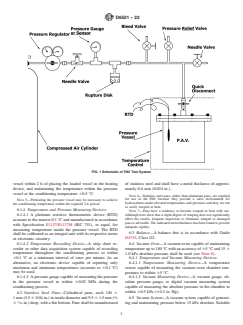
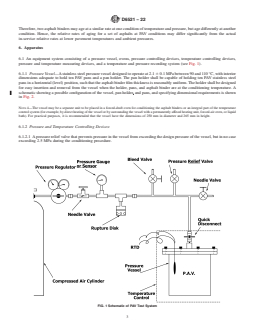
temperature and pressure recording system (see Fig. 1).
6.1.1 Pressure Vessel—A stainless steel pressure vessel
3. Terminology
designed to operate at 2.1 6 0.1 MPa between 90 and 110 °C,
with interior dimensions adequate to hold ten PAV pans and a
3.1 Definitions of Terms Specific to This Standard:
3.1.1 Definitionsoftermsusedinthispracticemaybefound pan holder.The pan holder shall be capable of holding ten PAV
stainlesssteelpansinahorizontal(level)position,suchthatthe
in Terminology D8, determined from common English usage,
or combinations of both. asphalt binder film thickness is reasonably uniform.The holder
shall be designed for easy insertion and removal from the
3.1.2 Terms related to standardization, calibration, and veri-
fication are defined in Specification D3666. vessel when the holder, pans, and asphalt binder are at the
conditioning temperature. A schematic showing a possible
4. Summary of Practice
configuration of the vessel, pan holder, and pans, and specify-
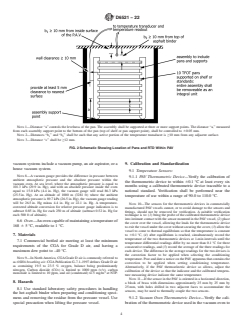
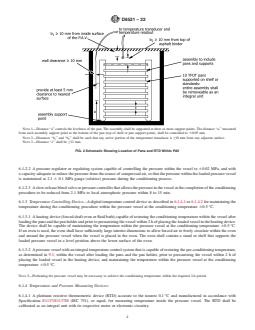
ing dimensional requirements is shown in Fig. 2.
4.1 Asphalt binder is normally first conditioned using Test
Method D2872 (RTFOT). Residue from the RTFOT is then
NOTE 4—The vessel may be a separate unit to be placed in a
placed in standard stainless steel pans and conditioned at the forced-draft oven for conditioning the asphalt binders or an integral part
of the temperature control system (for example, by direct heating of the
temperature and pressure specified in Section 10. The residue
vessel or by surrounding the vessel with a permanently affixed heating
may then be vacuum degassed. The applied high pressure is
unit, forced-air oven, or liquid bath). For practical purposes, it is
intendedtoimprovediffusionofairintotheasphaltbinderwith
recommended that the vessel have the dimensions of 250 mm in diameter
a focus on oxygen as the reactive component of interest.
and 265 mm in height.
NOTE 3—For more information on selecting the conditioning
6.1.2 Pressure and Temperature Controlling Devices:
temperature, see the applicable specification on performance-graded
6.1.2.1 A pressure relief valve that prevents pressure in the
asphalt binder. Examples include Specifications D6373 and D8239,
vessel from exceeding the design pressure of the vessel, but in
AASHTO M 320, and AASHTO M 332.
no case exceeding 2.5 MPa during the conditioning procedure.
6.1.2.2 Apressure regulator or regulating system capable of
5. Significance and Use
controlling the pressure within the vessel to 60.02 MPa, and
5.1 This practice is designed to simulate the in-service
withacapacityadequatetoreducethepressurefromthesource
oxidative aging that occurs in asphalt binders during pavement
of compressed air, so that the pressure within the loaded
service.Residuefromthisconditioningpracticemaybeusedto
pressurevesselismaintainedat2.1 60.1MPagauge(relative)
estimate the physical or chemical properties of asphalt binders
pressure during the conditioning process.
after several years of in-service aging in the field.
6.1.2.3 A slow-release bleed valve or pressure controller
5.2 Binders conditioned using this practice are normally
that allows the pressure in the vessel at the completion of the
used to determine specification properties in accordance with
conditioning procedure to be reduced from 2.1 MPa to local
Specification D6373 or D8239, or AASHTO M 320.
atmospheric pressure within 8 to 15 min.
5.3 For asphalt binders of different grades or from different
6.1.3 Temperature Controlling Device—A digital tempera-
sources, there is no unique correlation between the time and
ture control device as described in 6.1.4.1 or 6.1.4.2 for
temperature in this conditioning practice and in-service pave-
maintaining the temperature during the conditioning procedure
ment age and temperature. Therefore, for a given set of
within the pressure vessel at the conditioning temperature
in-service climatic conditions, it is not possible to select a
60.5 °C.
single PAV conditioning time, temperature, and pressure that
6.1.3.1 A heating device (forced-draft oven or fluid bath)
will predict the properties or the relative rankings of the
capable of restoring the conditioning temperature within the
properties of asphalt binders after a specific set of in-service
vessel after loading the pans and the pan holder and prior to
exposure conditions.
pressurizing the vessel within2hof placing the loaded vessel
in the heating device. The device shall be capable of maintain-
5.4 The relative degree of hardening of different asphalt
ing the temperature within the pressure vessel at the condition-
binders varies with conditioning temperatures and pressures in
ing temperature 60.5 °C. If an oven is used, the oven shall
the PAV. Therefore, two asphalt binders may age at a similar
havesufficientlylargeinteriordimensionstoallowforcedairto
rate at one condition of temperature and pressure, but age
freely circulate within the oven and around the pressure vessel
differently at another condition. Hence, the relative rates of
when the vessel is placed in the oven. The oven shall contain
aging for a set of asphalts at PAV conditions may differ
a stand or shelf that supports the loaded pressure vessel in a
significantly from the actual in-service relative rates at lower
level position above the lower surface of the oven.
pavement temperatures and ambient pressures.
6.1.3.2 A pressure vessel with an integral temperature con-
trol system that is capable of restoring the pre-conditioning
temperature, as determined in 9.3, within the vessel after
Available from Compressed Gas Association (CGA), 4221 Walney Rd., 5th
Floor, Chantilly, VA 20151-2923, http://www.cganet.com. loading the pans and the pan holder, prior to pressurizing the
D6521 − 22
FIG. 1 Schematic of PAV Test System
vessel within2hof placing the loaded vessel in the heating of stainless steel and shall have a metal thickness of approxi-
device, and maintaining the temperature within the pressure mately 0.6 mm (0.024 in.).
vessel at the conditioning temperature 60.5 °C.
NOTE 6—Stainless steel pans, rather than aluminum pans, are required
for use in the PAV because they provide a safer environment for
NOTE 5—Preheating the pressure vessel may be necessary to achieve
hydrocarbons under elevated temperatures and pressures and they are not
the conditioning temperature within the required 2-h period.
as easily warped or bent.
6.1.4 Temperature and Pressure Measuring Devices:
NOTE 7—Pans have a tendency to become warped or bent with use.
6.1.4.1 A platinum resistive thermometric device (RTD)
Although tests show that a slight degree of warping does not significantly
affect the results, frequent inspection to eliminate warped or damaged
accurate to the nearest 0.1 °C and manufactured in accordance
pans is advisable.The indicated metal thickness has been found to provide
with Specification E1137/E1137M (IEC 751), or equal, for
adequate rigidity.
measuring temperature inside the pressure vessel. The RTD
6.3 Balance—A balance that is in accordance with Guide
shall be calibrated as an integral unit with its respective metre
D4753, Class G2.
or electronic circuitry.
6.1.4.2 Temperature Recording Device—A strip chart re-
6.4 Vacuum Oven—A vacuum oven capable of maintaining
corder or other data acquisition system capable of recording temperature up to 180 °C with an accuracy of 65 °C and 15 6
temperature throughout the conditioning process to within
1.0 kPa absolute pressure shall be used (see Note 8).
60.1 °C at a minimum interval of once per minute. As an 6.4.1 Temperature and Vacuum Measuring Devices:
alternative, an electronic device capable of reporting only
6.4.1.1 Temperature Measuring Device—A temperature
maximum and minimum temperatures (accurate to 60.1 °C) sensor capable of measuring the vacuum oven chamber tem-
may be used.
perature to within 65 °C.
6.1.4.3 Apressure gauge capable of measuring the pressure 6.4.1.2 Vacuum Measuring Device—A vacuum gauge, ab-
in the pressure vessel to within 60.02 MPa during the
solute pressure gauge, or digital vacuum measuring system
conditioning process. capable of measuring the absolute pressure in the chamber to
within 60.5 kPa (60.2 in. Hg).
6.2 Stainless Steel Pans—Cylindrical pans, each 140 6
1 mm (5.5 6 0.04 in.) in inside diameter and 9.5 6 1.5 mm ( ⁄8 6.5 Vacuum System—A vacuum system capable of generat-
6 ⁄16 in.) deep, with a flat bottom. Pans shall be manufactured ing and maintaining pressure below 15 kPa absolute. Suitable
D6521 − 22
NOTE 1—Distance “a” controls the levelness of the pan. The assembly shall be supported at three or more support points. The distance “a,” measured
from each assembly support point to the bottom of the pan (top of shelf or pan support point), shall be controlled to 60.05 mm.
NOTE 2—Distances “b ” and “b ” shall be such that any active portion of the temperature transducer is ≥10 mm from any adjacent surface.
1 2
NOTE 3—Distance “c” shall be ≥12 mm.
FIG. 2 Schematic Showing Location of Pans and RTD Within PAV
vacuum systems include a vacuum pump, an air aspirator, or a 9. Calibration and Standardization
house vacuum system.
9.1 Temperature Sensors:
NOTE 8—A vacuum gauge provides the difference in pressure between
9.1.1 PAV Thermometric Device—Verify the calibration of
ambient atmospheric pressure and the absolute pressure within the
the thermometric device to within 60.1 °C at least every six
vacuum oven. At sea level, where the atmospheric pressure is equal to
months using a calibrated thermometric device traceable to a
101.3 kPa (29.9 in. Hg), and with an absolute pressure inside the oven
equal to 15.0 kPa (4.4 in. Hg), the vacuum gauge will read 86.3 kPa national standard. Verification shall be performed near the
(25.5 in. Hg). At an altitude of 1000 m (3281 ft) where the ambient
temperature of use within a range of 90.0 to 110.0 °C.
atmospheric pressure is 89.7 kPa (26.5 in. Hg), the vacuum gauge reading
will be 26.5 in. Hg minus 4.4 in. Hg or 22.1 in. Hg. A temperature-
NOTE 10—The sen
...
This document is not an ASTM standard and is intended only to provide the user of an ASTM standard an indication of what changes have been made to the previous version. Because
it may not be technically possible to adequately depict all changes accurately, ASTM recommends that users consult prior editions as appropriate. In all cases only the current version
of the standard as published by ASTM is to be considered the official document.
Designation: D6521 − 19a D6521 − 22
Standard Practice for
Accelerated Aging of Asphalt Binder Using a Pressurized
Aging Vessel (PAV)
This standard is issued under the fixed designation D6521; the number immediately following the designation indicates the year of
original adoption or, in the case of revision, the year of last revision. A number in parentheses indicates the year of last reapproval. A
superscript epsilon (´) indicates an editorial change since the last revision or reapproval.
1. Scope
1.1 This practice covers the conditioning of asphalt binders to simulate accelerated aging (oxidation) by means of pressurized air
and elevated temperature. This is intended to simulate the changes in rheology which occur in asphalt binders during in-service
oxidative aging, but may not accurately simulate the relative rates of aging. It is normally intended for use with residue from Test
Method D2872 (RTFOT), which is designed to simulate plant aging.
NOTE 1—PAV conditioning has not been validated for materials containing particulate materials.
1.2 The aging of asphalt binders during service is affected by ambient temperature and by mixture-associated variables, such as
the volumetric proportions of the mix, the permeability of the mix, properties of the aggregates, and possibly other factors. This
conditioning process is intended to provide an evaluation of the relative resistance of different asphalt binders to oxidative aging
at selected elevated aging temperatures and pressures, but cannot account for mixture variables or provide the relative resistance
to aging at in-service conditions.
1.3 The values stated in SI units are to be regarded as standard. No other units of measurement are included in this standard.
1.4 The text of this standard references notes and footnotes which provide explanatory material. These notes and footnotes
(excluding those in tables and figures) shall not be considered as requirements of the standard
NOTE 2—The quality of the results produced by this standard are dependent on the competence of the personnel performing the procedure and the
capability, calibration, and maintenance of the equipment used. Agencies that meet the criteria of Specification D3666 are generally considered capable
of competent and objective testing, sampling, inspection, etc. Users of this standard are cautioned that compliance with Specification D3666 alone does
not completely ensure reliable results. Reliable results depend on many factors; following the suggestions of Specification D3666 or some similar
acceptable guideline provides a means of evaluating and controlling some of those factors.
1.5 This standard does not purport to address all of the safety concerns, if any, associated with its use. It is the responsibility
of the user of this standard to establish appropriate safety, health, and environmental practices and determine the applicability of
regulatory limitations prior to use.
1.6 This international standard was developed in accordance with internationally recognized principles on standardization
established in the Decision on Principles for the Development of International Standards, Guides and Recommendations issued
by the World Trade Organization Technical Barriers to Trade (TBT) Committee.
This practice is under the jurisdiction of ASTM Committee D04 on Road and Paving Materials and is the direct responsibility of Subcommittee D04.46 on Durability
and Distillation Tests.
Current edition approved Nov. 1, 2019May 1, 2022. Published November 2019June 2022. Originally approved in 2000. Last previous edition approved in 2019 as
D6521 – 19.D6521 – 19a. DOI: 10.1520/D6521-19A.10.1520/D6521-22.
Copyright © ASTM International, 100 Barr Harbor Drive, PO Box C700, West Conshohocken, PA 19428-2959. United States
D6521 − 22
2. Referenced Documents
2.1 ASTM Standards:
D8 Terminology Relating to Materials for Roads and Pavements
D2872 Test Method for Effect of Heat and Air on a Moving Film of Asphalt Binder (Rolling Thin-Film Oven Test)
D3666 Specification for Minimum Requirements for Agencies Testing and Inspecting Road and Paving Materials
D4753 Guide for Evaluating, Selecting, and Specifying Balances and Standard Masses for Use in Soil, Rock, and Construction
Materials Testing
D6373 Specification for Performance-Graded Asphalt Binder
D8239 Specification for Performance-Graded Asphalt Binder Using the Multiple Stress Creep and Recovery (MSCR) Test
E1137/E1137M Specification for Industrial Platinum Resistance Thermometers
2.2 AASHTO Standards:
M 320 Specification for Performance-Graded Asphalt Binder
M 332 Specification for Performance-Graded Asphalt Binder Using Multiple Stress Creep Recovery (MSCR) Test
2.3 CGA Standard:
CGA G-7.1–1997 Commodity Specification for Air, Fourth Edition
3. Terminology
3.1 Definitions of Terms Specific to This Standard:
3.1.1 Definitions of terms used in this practice may be found in Terminology D8, determined from common English usage, or
combinations of both.
3.1.2 Terms related to standardization, calibration, and verification are defined in Specification D3666.
4. Summary of Practice
4.1 Asphalt binder is normally first conditioned using Test Method D2872 (RTFOT). Residue from the RTFOT is then placed in
standard stainless steel pans and conditioned at the temperature and pressure specified in Section 10. The residue may then be
vacuum degassed. The applied high pressure is intended to improve diffusion of air into the asphalt binder with a focus on oxygen
as the reactive component of interest.
NOTE 3—For more information on selecting the conditioning temperature, see the applicable specification on performance-graded asphalt binder.
Examples include Specifications D6373 and D8239, AASHTO M 320, and AASHTO M 332.
5. Significance and Use
5.1 This practice is designed to simulate the in-service oxidative aging that occurs in asphalt binders during pavement service.
Residue from this conditioning practice may be used to estimate the physical or chemical properties of asphalt binders after several
years of in-service aging in the field.
5.2 Binders conditioned using this practice are normally used to determine specification properties in accordance with
Specification D6373 or D8239, or AASHTO M 320.
5.3 For asphalt binders of different grades or from different sources, there is no unique correlation between the time and
temperature in this conditioning practice and in-service pavement age and temperature. Therefore, for a given set of in-service
climatic conditions, it is not possible to select a single PAV conditioning time, temperature, and pressure that will predict the
properties or the relative rankings of the properties of asphalt binders after a specific set of in-service exposure conditions.
5.4 The relative degree of hardening of different asphalt binders varies with conditioning temperatures and pressures in the PAV.
For referenced ASTM standards, visit the ASTM website, www.astm.org, or contact ASTM Customer Service at service@astm.org. For Annual Book of ASTM Standards
volume information, refer to the standard’s Document Summary page on the ASTM website.
Available from American Association of State Highway and Transportation Officials (AASHTO), 444 N. Capitol St., NW, Suite 249, Washington, DC 20001,
http://www.transportation.org.
Available from Compressed Gas Association (CGA), 4221 Walney Rd., 5th Floor, Chantilly, VA 20151-2923, http://www.cganet.com.
D6521 − 22
Therefore, two asphalt binders may age at a similar rate at one condition of temperature and pressure, but age differently at another
condition. Hence, the relative rates of aging for a set of asphalts at PAV conditions may differ significantly from the actual
in-service relative rates at lower pavement temperatures and ambient pressures.
6. Apparatus
6.1 An equipment system consisting of a pressure vessel, ovens, pressure controlling devices, temperature controlling devices,
pressure and temperature measuring devices, and a temperature and pressure recording system (see Fig. 1).
6.1.1 Pressure Vessel—A stainless steel pressure vessel designed to operate at 2.1 6 0.1 MPa between 90 and 110 °C, with interior
dimensions adequate to hold ten PAV pans and a pan holder. The pan holder shall be capable of holding ten PAV stainless steel
pans in a horizontal (level) position, such that the asphalt binder film thickness is reasonably uniform. The holder shall be designed
for easy insertion and removal from the vessel when the holder, pans, and asphalt binder are at the conditioning temperature. A
schematic showing a possible configuration of the vessel, pan holder, and pans, and specifying dimensional requirements is shown
in Fig. 2.
NOTE 4—The vessel may be a separate unit to be placed in a forced-draft oven for conditioning the asphalt binders or an integral part of the temperature
control system (for example, by direct heating of the vessel or by surrounding the vessel with a permanently affixed heating unit, forced-air oven, or liquid
bath). For practical purposes, it is recommended that the vessel have the dimensions of 250 mm in diameter and 265 mm in height.
6.1.2 Pressure and Temperature Controlling Devices:
6.1.2.1 A pressure relief valve that prevents pressure in the vessel from exceeding the design pressure of the vessel, but in no case
exceeding 2.5 MPa during the conditioning procedure.
FIG. 1 Schematic of PAV Test System
D6521 − 22
NOTE 1—Distance “a” controls the levelness of the pan. The assembly shall be supported at three or more support points. The distance “a,” measured
from each assembly support point to the bottom of the pan (top of shelf or pan support point), shall be controlled to 60.05 mm.
NOTE 2—Distances “b ” and “b ” shall be such that any active portion of the temperature transducer is ≥10 mm from any adjacent surface.
1 2
NOTE 3—Distance “c” shall be ≥12 mm.
FIG. 2 Schematic Showing Location of Pans and RTD Within PAV
6.1.2.2 A pressure regulator or regulating system capable of controlling the pressure within the vessel to 60.02 MPa, and with
a capacity adequate to reduce the pressure from the source of compressed air, so that the pressure within the loaded pressure vessel
is maintained at 2.1 6 0.1 MPa gauge (relative) pressure during the conditioning process.
6.1.2.3 A slow-release bleed valve or pressure controller that allows the pressure in the vessel at the completion of the conditioning
procedure to be reduced from 2.1 MPa to local atmospheric pressure within 8 to 15 min.
6.1.3 Temperature Controlling Device—A digital temperature control device as described in 6.1.4.1 or 6.1.4.2 for maintaining the
temperature during the conditioning procedure within the pressure vessel at the conditioning temperature 60.5 °C.
6.1.3.1 A heating device (forced-draft oven or fluid bath) capable of restoring the conditioning temperature within the vessel after
loading the pans and the pan holder and prior to pressurizing the vessel within 2 h of placing the loaded vessel in the heating device.
The device shall be capable of maintaining the temperature within the pressure vessel at the conditioning temperature 60.5 °C.
If an oven is used, the oven shall have sufficiently large interior dimensions to allow forced air to freely circulate within the oven
and around the pressure vessel when the vessel is placed in the oven. The oven shall contain a stand or shelf that supports the
loaded pressure vessel in a level position above the lower surface of the oven.
6.1.3.2 A pressure vessel with an integral temperature control system that is capable of restoring the pre-conditioning temperature,
as determined in 9.3, within the vessel after loading the pans and the pan holder, prior to pressurizing the vessel within 2 h of
placing the loaded vessel in the heating device, and maintaining the temperature within the pressure vessel at the conditioning
temperature 60.5 °C.
NOTE 5—Preheating the pressure vessel may be necessary to achieve the conditioning temperature within the required 2-h period.
6.1.4 Temperature and Pressure Measuring Devices:
6.1.4.1 A platinum resistive thermometric device (RTD) accurate to the nearest 0.1 °C and manufactured in accordance with
Specification E1137/E1137M (IEC 751), or equal, for measuring temperature inside the pressure vessel. The RTD shall be
calibrated as an integral unit with its respective metre or electronic circuitry.
D6521 − 22
6.1.4.2 Temperature Recording Device—A strip chart recorder or other data acquisition system capable of recording temperature
throughout the conditioning process to within 60.1 °C at a minimum interval of once per minute. As an alternative, an electronic
device capable of reporting only maximum and minimum temperatures (accurate to 60.1 °C) may be used.
6.1.4.3 A pressure gauge capable of measuring the pressure in the pressure vessel to within 60.02 MPa during the conditioning
process.
3 1
6.2 Stainless Steel Pans—Cylindrical pans, each 140 6 1 mm (5.5 6 0.04 in.) in inside diameter and 9.5 6 1.5 mm ( ⁄8 6 ⁄16
in.) deep, with a flat bottom. Pans shall be manufactured of stainless steel and shall have a metal thickness of approximately 0.6
mm (0.024 in.).
NOTE 6—Stainless steel pans, rather than aluminum pans, are required for use in the PAV because they provide a safer environment for hydrocarbons under
elevated temperatures and pressures and they are not as easily warped or bent.
NOTE 7—Pans have a tendency to become warped or bent with use. Although tests show that a slight degree of warping does not significantly affect the
results, frequent inspection to eliminate warped or damaged pans is advisable. The indicated metal thickness has been found to provide adequate rigidity.
6.3 Balance—A balance that is in accordance with Guide D4753, Class G2.
6.4 Vacuum Oven—A vacuum oven capable of maintaining temperature up to 180 °C with an accuracy of 65 °C and 15 6 1.0
kPa absolute pressure shall be used (see Note 8).
6.4.1 Temperature and Vacuum Measuring Devices:
6.4.1.1 Temperature Measuring Device—A temperature sensor capable of measuring the vacuum oven chamber temperature to
within 65 °C.
6.4.1.2 Vacuum Measuring Device—A vacuum gauge, absolute pressure gauge, or digital vacuum measuring system capable of
measuring the absolute pressure in the chamber to within 60.5 kPa (61.0(60.2 in. Hg).
6.5 Vacuum System—A vacuum system capable of generating and maintaining pressure below 15 kPa absolute. Suitable vacuum
systems include a vacuum pump, an air aspirator, or a house vacuum system.
NOTE 8—A vacuum gauge provides the difference in pressure between ambient atmospheric pressure and the absolute pressure within the vacuum oven.
At sea level, where the atmospheric pressure is equal to 101.3 kPa (29.9 in. Hg), and with an absolute pressure inside the oven equal to 15.0 kPa (4.4
in. Hg), the vacuum gauge will read 86.3 kPa (25.5 in. Hg). At an altitude of 1000 m (3281 ft) where the ambient atmospheric pressure is 89.7 kPa (26.5
in. Hg), the vacuum gauge reading will be 26.5 in. Hg minus 4.4 in. Hg or 22.1 in. Hg. A temperature-corrected altitude conversion for relative pressure
gauge indication is to subtract 0.85 in. Hg for each 250 m of altitude (subtract 0.52 in. Hg for each 500 ft of altitude).
6.6 Oven—An oven capable of maintaining a temperature of 168 6 5 °C, readable to 1 °C.
7. Materials
7.1 Commercial bottled air meeting
...