

ASTM D7403-19
(Test Method)Standard Test Method for Determination of Residue of Emulsified Asphalt by Low Temperature Vacuum Distillation
General Information
- Abstract
SIGNIFICANCE AND USE
3.1 This test method can be used for quantitative determination of residue in emulsified asphalts at a temperature of 135 °C (275 °F) with a 60-min distillation test using current distillation apparatus. This method is suitable to obtain residues for service evaluation, quality control, and research. This distillation method is not intended to produce residues equivalent to the Test Method D6997 260 °C (500 °F) distillation procedure.
Note 1: The quality of the results produced by this standard are dependent on the competence of the personnel performing the procedure and the capability, calibration, and maintenance of the equipment used. Agencies that meet the criteria of Specification D3666 are generally considered capable of competent and objective testing, sampling, inspection, etc. Users of this standard are cautioned that compliance with Specification D3666 alone does not completely ensure reliable results. Reliable results depend on many factors; following the suggestions of Specification D3666 or some similar acceptable guideline provides a means of evaluating and controlling some of those factors.
SCOPE
1.1 This method covers the quantitative determination of residue in emulsified asphalts composed principally of a semisolid or liquid asphaltic base, water, and an emulsifying agent. The emulsified asphalts will generally contain polymeric materials. It is especially suitable for emulsified asphalt residue properties that may be altered at the high-temperature 260 °C (500 °F) distillation. Since there is currently not a precision statement for this procedure, it is recommended to the user that this procedure not be used for buy/sell purposes at the present time.
1.2 Units—The values stated in SI units are to be regarded as standard. The values given in parentheses after SI units are provided for information only and are not considered standard.
1.3 The text of this standard reference notes and footnotes which provide explanatory material. These notes and footnotes (excluding those in tables and figures) shall not be considered as requirements of the standard.
1.4 This standard does not purport to address all of the safety concerns, if any, associated with its use. It is the responsibility of the user of this standard to establish appropriate safety, health, and environmental practices and determine the applicability of regulatory limitations prior to use.
1.5 This international standard was developed in accordance with internationally recognized principles on standardization established in the Decision on Principles for the Development of International Standards, Guides and Recommendations issued by the World Trade Organization Technical Barriers to Trade (TBT) Committee.
- Status
- Published
- Publication Date
- 14-Jul-2019
- Technical Committee
- D04 - Road and Paving Materials
- Drafting Committee
- D04.42 - Emulsified Asphalt Test
Buy Documents
ASTM D7403-19 - Standard Test Method for Determination of Residue of Emulsified Asphalt by Low Temperature Vacuum Distillation
REDLINE ASTM D7403-19 - Standard Test Method for Determination of Residue of Emulsified Asphalt by Low Temperature Vacuum Distillation
Overview
ASTM D7403-19: Standard Test Method for Determination of Residue of Emulsified Asphalt by Low Temperature Vacuum Distillation provides laboratories and quality control professionals with a quantitative test for determining the residue content in emulsified asphalts. Emulsified asphalt, a mixture mainly composed of asphaltic base, water, emulsifying agents, and often polymers, requires precise testing to ensure suitability for service evaluation, research, and quality assessment. This particular method uses low temperature vacuum distillation, operating at 135 °C (275 °F) for 60 minutes, instead of the higher temperatures used in other methods like ASTM D6997.
Developed under ASTM Committee D04 on Road and Paving Materials, this standard supports international harmonization in pavement material testing, following recognized principles by the World Trade Organization Technical Barriers to Trade (TBT) Committee.
Key Topics
- Scope of Application: The standard test is used for emulsified asphalt, especially those sensitive to high-temperature methods that may alter the material’s properties.
- Residue Determination: Quantifies the percent residue remaining after solvent removal at controlled conditions.
- Vacuum Distillation Technique: Employs a vacuum to reduce pressure, allowing distillation at reduced temperature, preserving the characteristics of sensitive asphalt emulsions.
- Test Apparatus: Specifies the use of aluminum alloy stills, rotary evaporators, thermometric devices, and a vacuum pump capable of maintaining a set vacuum.
- Temperature Control: The method maintains samples at 135 °C (275 °F), unlike more aggressive techniques, preventing decomposition of polymers and additives present in modern emulsions.
- Quality Assurance: Recognizes the relevance of laboratory accreditation per ASTM D3666 for competence, calibration, and maintenance, noting that agency qualification alone does not guarantee reliable results.
- Safety and Environmental Considerations: Highlights the need for compliance with appropriate safety, health, and environmental practices, including precautions when using mercury thermometers or other hazardous materials.
Applications
ASTM D7403-19 is highly valuable in the following practical applications:
- Service Evaluation: Provides accurate residue content essential for performance assessment of emulsified asphalts used in road construction and pavement maintenance.
- Quality Control: Assists manufacturers and suppliers in verifying batch consistency and material conformance during production.
- Research and Development: Enables scientists to analyze new emulsified asphalt formulations, especially those incorporating polymers or additives that might degrade at higher temperatures.
- Material Comparison: Facilitates evaluation when comparing different emulsified asphalt products, supporting decision-making in procurement and specification compliance.
The method is not recommended for buy/sell transactions due to the absence of a declared precision statement. However, it is widely used for internal monitoring and technical studies.
Related Standards
The following ASTM standards are commonly referenced or used in conjunction with ASTM D7403-19:
- ASTM D3666: Specification for Minimum Requirements for Agencies Testing and Inspecting Road and Paving Materials - sets competency criteria for labs conducting this and similar tests.
- ASTM D6997: Test Method for Distillation of Emulsified Asphalt - uses higher temperatures (260 °C / 500 °F), providing different residue results, and is not directly equivalent to D7403.
- ASTM E1: Specification for ASTM Liquid-in-Glass Thermometers - outlines requirements for temperature measurement devices used during testing.
Employing ASTM D7403-19 ensures reliable, reproducible determination of residue in emulsified asphalt, supporting industry best practices and contributing to the long-term performance of asphalt pavements.
Keywords: emulsified asphalt, vacuum distillation, asphalt residue, ASTM D7403-19, low-temperature distillation, road material testing, quality control, emulsified bitumen, paving materials, ASTM standards.
Relations
- Effective Date
- 15-Jul-2019
- Effective Date
- 01-Oct-2016
- Effective Date
- 01-Dec-2013
- Effective Date
- 01-Dec-2011
- Effective Date
- 01-Dec-2009
- Effective Date
- 01-Aug-2007
- Effective Date
- 01-Aug-2007
- Effective Date
- 15-Jan-2007
- Effective Date
- 15-Jan-2007
- Effective Date
- 15-Jan-2007
- Effective Date
- 01-Jun-2006
- Effective Date
- 01-Jun-2005
- Effective Date
- 01-Feb-2005
- Effective Date
- 01-Aug-2004
- Effective Date
- 01-Aug-2004
Buy Documents
ASTM D7403-19 - Standard Test Method for Determination of Residue of Emulsified Asphalt by Low Temperature Vacuum Distillation
REDLINE ASTM D7403-19 - Standard Test Method for Determination of Residue of Emulsified Asphalt by Low Temperature Vacuum Distillation
Get Certified
Connect with accredited certification bodies for this standard

DIBt (Deutsches Institut für Bautechnik)
German Institute for Building Technology.
DIN CERTCO
DIN Group product certification.

Element Materials Technology
Materials testing and product certification.
Sponsored listings
Frequently Asked Questions
ASTM D7403-19 is a standard published by ASTM International. Its full title is "Standard Test Method for Determination of Residue of Emulsified Asphalt by Low Temperature Vacuum Distillation". This standard covers: SIGNIFICANCE AND USE 3.1 This test method can be used for quantitative determination of residue in emulsified asphalts at a temperature of 135 °C (275 °F) with a 60-min distillation test using current distillation apparatus. This method is suitable to obtain residues for service evaluation, quality control, and research. This distillation method is not intended to produce residues equivalent to the Test Method D6997 260 °C (500 °F) distillation procedure. Note 1: The quality of the results produced by this standard are dependent on the competence of the personnel performing the procedure and the capability, calibration, and maintenance of the equipment used. Agencies that meet the criteria of Specification D3666 are generally considered capable of competent and objective testing, sampling, inspection, etc. Users of this standard are cautioned that compliance with Specification D3666 alone does not completely ensure reliable results. Reliable results depend on many factors; following the suggestions of Specification D3666 or some similar acceptable guideline provides a means of evaluating and controlling some of those factors. SCOPE 1.1 This method covers the quantitative determination of residue in emulsified asphalts composed principally of a semisolid or liquid asphaltic base, water, and an emulsifying agent. The emulsified asphalts will generally contain polymeric materials. It is especially suitable for emulsified asphalt residue properties that may be altered at the high-temperature 260 °C (500 °F) distillation. Since there is currently not a precision statement for this procedure, it is recommended to the user that this procedure not be used for buy/sell purposes at the present time. 1.2 Units—The values stated in SI units are to be regarded as standard. The values given in parentheses after SI units are provided for information only and are not considered standard. 1.3 The text of this standard reference notes and footnotes which provide explanatory material. These notes and footnotes (excluding those in tables and figures) shall not be considered as requirements of the standard. 1.4 This standard does not purport to address all of the safety concerns, if any, associated with its use. It is the responsibility of the user of this standard to establish appropriate safety, health, and environmental practices and determine the applicability of regulatory limitations prior to use. 1.5 This international standard was developed in accordance with internationally recognized principles on standardization established in the Decision on Principles for the Development of International Standards, Guides and Recommendations issued by the World Trade Organization Technical Barriers to Trade (TBT) Committee.
SIGNIFICANCE AND USE 3.1 This test method can be used for quantitative determination of residue in emulsified asphalts at a temperature of 135 °C (275 °F) with a 60-min distillation test using current distillation apparatus. This method is suitable to obtain residues for service evaluation, quality control, and research. This distillation method is not intended to produce residues equivalent to the Test Method D6997 260 °C (500 °F) distillation procedure. Note 1: The quality of the results produced by this standard are dependent on the competence of the personnel performing the procedure and the capability, calibration, and maintenance of the equipment used. Agencies that meet the criteria of Specification D3666 are generally considered capable of competent and objective testing, sampling, inspection, etc. Users of this standard are cautioned that compliance with Specification D3666 alone does not completely ensure reliable results. Reliable results depend on many factors; following the suggestions of Specification D3666 or some similar acceptable guideline provides a means of evaluating and controlling some of those factors. SCOPE 1.1 This method covers the quantitative determination of residue in emulsified asphalts composed principally of a semisolid or liquid asphaltic base, water, and an emulsifying agent. The emulsified asphalts will generally contain polymeric materials. It is especially suitable for emulsified asphalt residue properties that may be altered at the high-temperature 260 °C (500 °F) distillation. Since there is currently not a precision statement for this procedure, it is recommended to the user that this procedure not be used for buy/sell purposes at the present time. 1.2 Units—The values stated in SI units are to be regarded as standard. The values given in parentheses after SI units are provided for information only and are not considered standard. 1.3 The text of this standard reference notes and footnotes which provide explanatory material. These notes and footnotes (excluding those in tables and figures) shall not be considered as requirements of the standard. 1.4 This standard does not purport to address all of the safety concerns, if any, associated with its use. It is the responsibility of the user of this standard to establish appropriate safety, health, and environmental practices and determine the applicability of regulatory limitations prior to use. 1.5 This international standard was developed in accordance with internationally recognized principles on standardization established in the Decision on Principles for the Development of International Standards, Guides and Recommendations issued by the World Trade Organization Technical Barriers to Trade (TBT) Committee.
ASTM D7403-19 is classified under the following ICS (International Classification for Standards) categories: 75.140 - Waxes, bituminous materials and other petroleum products; 91.100.50 - Binders. Sealing materials; 93.080.20 - Road construction materials. The ICS classification helps identify the subject area and facilitates finding related standards.
ASTM D7403-19 has the following relationships with other standards: It is inter standard links to ASTM D7403-09(2017), ASTM D3666-16, ASTM D3666-13, ASTM D3666-11, ASTM D3666-09a, ASTM D3666-07ae1, ASTM D3666-07a, ASTM D3666-07e2, ASTM D3666-07e1, ASTM D3666-07, ASTM D3666-06, ASTM D3666-05a, ASTM D3666-05, ASTM D6997-04, ASTM D3666-04. Understanding these relationships helps ensure you are using the most current and applicable version of the standard.
ASTM D7403-19 is available in PDF format for immediate download after purchase. The document can be added to your cart and obtained through the secure checkout process. Digital delivery ensures instant access to the complete standard document.
Standards Content (Sample)
This international standard was developed in accordance with internationally recognized principles on standardization established in the Decision on Principles for the
Development of International Standards, Guides and Recommendations issued by the World Trade Organization Technical Barriers to Trade (TBT) Committee.
Designation:D7403 −19
Standard Test Method for
Determination of Residue of Emulsified Asphalt by Low
Temperature Vacuum Distillation
This standard is issued under the fixed designation D7403; the number immediately following the designation indicates the year of
original adoption or, in the case of revision, the year of last revision. A number in parentheses indicates the year of last reapproval. A
superscript epsilon (´) indicates an editorial change since the last revision or reapproval.
1. Scope D3666 Specification for Minimum Requirements for Agen-
cies Testing and Inspecting Road and Paving Materials
1.1 This method covers the quantitative determination of
D6997 Test Method for Distillation of Emulsified Asphalt
residue in emulsified asphalts composed principally of a
semisolid or liquid asphaltic base, water, and an emulsifying
3. Significance and Use
agent.Theemulsifiedasphaltswillgenerallycontainpolymeric
3.1 This test method can be used for quantitative determi-
materials.Itisespeciallysuitableforemulsifiedasphaltresidue
nation of residue in emulsified asphalts at a temperature of
properties that may be altered at the high-temperature 260 °C
135 °C (275 °F) with a 60-min distillation test using current
(500 °F) distillation. Since there is currently not a precision
distillation apparatus. This method is suitable to obtain resi-
statement for this procedure, it is recommended to the user that
dues for service evaluation, quality control, and research. This
this procedure not be used for buy/sell purposes at the present
distillation method is not intended to produce residues equiva-
time.
lent to the Test Method D6997 260 °C (500 °F) distillation
1.2 Units—The values stated in SI units are to be regarded
procedure.
as standard. The values given in parentheses after SI units are
NOTE 1—The quality of the results produced by this standard are
provided for information only and are not considered standard.
dependent on the competence of the personnel performing the procedure
and the capability, calibration, and maintenance of the equipment used.
1.3 The text of this standard reference notes and footnotes
Agencies that meet the criteria of Specification D3666 are generally
which provide explanatory material. These notes and footnotes
considered capable of competent and objective testing, sampling,
(excluding those in tables and figures) shall not be considered
inspection, etc. Users of this standard are cautioned that compliance with
as requirements of the standard.
Specification D3666 alone does not completely ensure reliable results.
Reliable results depend on many factors; following the suggestions of
1.4 This standard does not purport to address all of the
Specification D3666 or some similar acceptable guideline provides a
safety concerns, if any, associated with its use. It is the
means of evaluating and controlling some of those factors.
responsibility of the user of this standard to establish appro-
4. Apparatus
priate safety, health, and environmental practices and deter-
mine the applicability of regulatory limitations prior to use.
PROCEDURE A
1.5 This international standard was developed in accor-
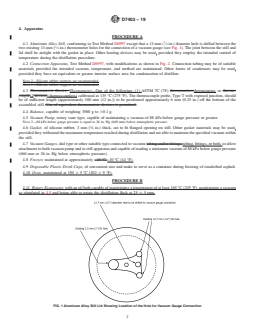
4.1 Aluminum Alloy Still, conforming to Test Method
dance with internationally recognized principles on standard-
D6997 except that a 13-mm ( ⁄2-in.) diameter hole is drilled
ization established in the Decision on Principles for the
betweenthetwoexisting13-mm( ⁄2-in.)thermometerholesfor
Development of International Standards, Guides and Recom-
the connection of a vacuum gauge (see Fig. 1). The joint
mendations issued by the World Trade Organization Technical
between the still and lid shall be airtight with the gasket in
Barriers to Trade (TBT) Committee.
place. Other heating devices may be used, provided they
2. Referenced Documents employ the intended control of temperature during the distil-
lation procedure.
2.1 ASTM Standards:
4.2 ConnectionApparatus, Test Method D6997, with modi-
fications as shown in Fig. 2. Connection tubing may be of
This test method is under the jurisdiction of ASTM Committee D04 on Road
suitable materials provided the intended vacuum, temperature,
and Paving Materials and is the direct responsibility of Subcommittee D04.42 on
and method are maintained. Other forms of condensers may be
Emulsified Asphalt Test.
Current edition approved July 15, 2019. Published August 2019. Originally
used, provided they have an equivalent or greater interior
approved in 2009. Last previous edition approved in 2017 as D7403 – 09 (2017).
surface area for condensation of distillate.
DOI: 10.1520/D7403-19.
For referenced ASTM standards, visit the ASTM website, www.astm.org, or
NOTE 2—Silicone rubber stoppers are recommended.
contact ASTM Customer Service at service@astm.org. For Annual Book of ASTM
4.3 Thermometer—Oneofthefollowing:(1)ASTM7C(7F)
Standards volume information, refer to the standard’s Document Summary page on
the ASTM website. thermometer, or (2) thermocouple(s) calibrated at 135 °C
Copyright © ASTM International, 100 Barr Harbor Drive, PO Box C700, West Conshohocken, PA 19428-2959. United States
D7403−19
FIG. 1Aluminum Alloy Still Lid Showing Location of the Hole for Vacuum Gauge Connection
FIG. 2Connection Apparatus Schematic
(275 °F). The thermocouple probe, Type T with exposed 4.6 Gasket, of silicone rubber, 3 mm ( ⁄8 in.) thick, cut to fit
junction, should be of sufficient length (approximately 300 mm flanged opening on still. Other gasket materials may be used,
(12 in.)) to be positioned approximately 6 mm (0.25 in.) off the
provided they withstand the maximum temperature reached
bottom of the assembled still.
during distillation and are able to maintain the specified
vacuum within the still.
4.4 Balance, capable of weighing 3500 g to 60.1 g.
4.5 Vacuum Pump, rotary vane type, capable of maintaining 4.7 Vacuum Gauges, dial type or other suitable type con-
a vacuum of 88 kPa below gauge pressure or greater.
nected to vacuum tubing, fittings, or both, to allow attachment
NOTE 3—88 kPa below gauge pressure is equal to 26 in. Hg (660 mm)
to both vacuum pump and to still apparatus and capable of
below atmospheric pressure.
D7403−19
reading a minimum vacuum of 88 kPa below gauge pressure 5. Hazards
(660 mm or 26 in. Hg below atmospheric pressure).
5.1 Warning—Mercury has been designated by the United
4.8 Freezer, maintained at approximately –10 °C (14 °F).
States Environmental ProtectionAgency (EPA) and many state
agencies as a hazardous material that can cause central nervous
4.9 Disposable Plastic Drink Cups, of convenient size and
system, kidney, and liver damage. Mercury, or its vapor, may
make to serve as a container during freezing of emulsified
be hazardous to health and corrosive to materials. Caution
asphalt.
should be taken when handling mercury and mercury-
4.10 Oven, maintained at 150 6 5 °C (302 6 9 °F).
containing products. See the applicable product Safety Data
Sheet (SDS) or Material Safety Data Sheet (MSDS) for details
PROCEDURE B
and the EPA’s website (www.epa.gov/mercury/faq.htm) for
4.11 Rotary Evaporator, with an oil bath capable of main-
additional information. Users should be aware that selling
taining a temperature of at least 165 °C (329 °F), maintaining
mercury and/or mercury-containing products in your state may
a vacuum as stipulated in 4.5 and being able to rotate the
be prohibited by state law.
distillation flask at 25 6 5 rpm.
NOTE 4—The recommended flask for this test is a 2-L Morton flask,
6. Procedure
also referred to as a modified German rolling flask; see Fig. 3. The 2-L
Morton flask is recommended because there is a fair amount of foaming
PROCEDURE A
when the emulsified asphalt is above 100 °C and under vacuum.As can be
seen in Fig. 3, the Morton flask has indentations arranged at 90° intervals 6.1 Weigh 200 to 201 g of a representative sample of the
around the flask perimeter. These indentations facilitate agitation of the
emulsified asphalt into the disposable plastic drink cup. Place
emulsified asphalt during the vacuum distillation procedure. A standard
cup and sample in freezer until thoroughly frozen.
pear-shaped rotary evaporator flask would not provide the same level of
NOTE 5—Typically, 0.5 g of frozen emulsion is lost in handling the
agitation and is therefore not recommended.The bath must be of sufficient
f
...
This document is not an ASTM standard and is intended only to provide the user of an ASTM standard an indication of what changes have been made to the previous version. Because
it may not be technically possible to adequately depict all changes accurately, ASTM recommends that users consult prior editions as appropriate. In all cases only the current version
of the standard as published by ASTM is to be considered the official document.
Designation: D7403 − 09 (Reapproved 2017) D7403 − 19
Standard Test Method for
Determination of Residue of Emulsified Asphalt by Low-
Temperature Low Temperature Vacuum Distillation
This standard is issued under the fixed designation D7403; the number immediately following the designation indicates the year of
original adoption or, in the case of revision, the year of last revision. A number in parentheses indicates the year of last reapproval. A
superscript epsilon (´) indicates an editorial change since the last revision or reapproval.
1. Scope
1.1 This method covers the quantitative determination of residue in emulsified asphalts composed principally of a semisolid or
liquid asphaltic base, water, and an emulsifying agent. The emulsified asphalts will generally contain polymeric materials. It is
especially suitable for emulsified asphalt residue properties that may be altered at the high-temperature 260 °C (500 °F) distillation.
Since there is currently not a precision statement for this procedure, it is recommended to the user that this procedure not be used
for buy/sell purposes at the present time.
1.2 Units—The values stated in SI units are to be regarded as the standard. Values standard. The values given in parentheses
in inch-poundafter SI units are provided for informational purposes only.information only and are not considered standard.
1.3 The text of this standard reference notes and footnotes which provide explanatory material. These notes and footnotes
(excluding those in tables and figures) shall not be considered as requirements of the standard.
1.4 This standard does not purport to address all of the safety concerns, if any, associated with its use. It is the responsibility
of the user of this standard to establish appropriate safety, health, and environmental practices and determine the applicability of
regulatory limitations prior to use.
1.5 This international standard was developed in accordance with internationally recognized principles on standardization
established in the Decision on Principles for the Development of International Standards, Guides and Recommendations issued
by the World Trade Organization Technical Barriers to Trade (TBT) Committee.
2. Referenced Documents
2.1 ASTM Standards:
D3666 Specification for Minimum Requirements for Agencies Testing and Inspecting Road and Paving Materials
D6997 Test Method for Distillation of Emulsified Asphalt
E1 Specification for ASTM Liquid-in-Glass Thermometers
3. Significance and Use
3.1 This test method can be used for quantitative determination of residue in emulsified asphalts at a temperature of 135 °C
(275 °F) with a 60-min distillation test using current distillation apparatus. This method is suitable to obtain residues for service
evaluation, quality control, and research. This distillation method is not intended to produce residues equivalent to the Test Method
D6997 260 °C (500 °F) distillation procedure.
NOTE 1—The quality of the results produced by this standard are dependent on the competence of the personnel performing the procedure and the
capability, calibration, and maintenance of the equipment used. Agencies that meet the criteria of Specification D3666 are generally considered capable
of competent and objective testing, sampling, inspection, etc. Users of this standard are cautioned that compliance with Specification D3666 alone does
not completely ensure reliable results. Reliable results depend on many factors; following the suggestions of Specification D3666 or some similar
acceptable guideline provides a means of evaluating and controlling some of those factors.
This test method is under the jurisdiction of ASTM Committee D04 on Road and Paving Materials and is the direct responsibility of Subcommittee D04.42 on Emulsified
Asphalt Test.
Current edition approved Oct. 1, 2017July 15, 2019. Published October 2017August 2019. Originally approved in 2009. Last previous edition approved in 20092017 as
D7403 – 09.D7403 – 09 (2017). DOI: 10.1520/D7403-09R17.10.1520/D7403-19.
For referenced ASTM standards, visit the ASTM website, www.astm.org, or contact ASTM Customer Service at service@astm.org. For Annual Book of ASTM Standards
volume information, refer to the standard’s Document Summary page on the ASTM website.
Copyright © ASTM International, 100 Barr Harbor Drive, PO Box C700, West Conshohocken, PA 19428-2959. United States
D7403 − 19
4. Apparatus
PROCEDURE A
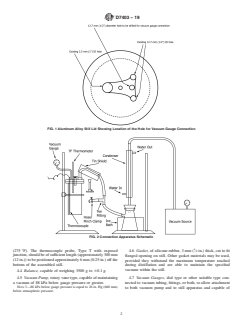
4.1 Aluminum Alloy Still, conforming to Test Method D6997 except that a 13-mm ( ⁄2-in.) diameter hole is drilled between the
two existing 13-mm ( ⁄2-in.) thermometer holes for the connection of a vacuum gauge (see Fig. 1). The joint between the still and
lid shall be airtight with the gasket in place. Other heating devices may be used, provided they employ the intended control of
temperature during the distillation procedure.
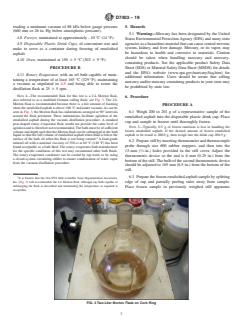
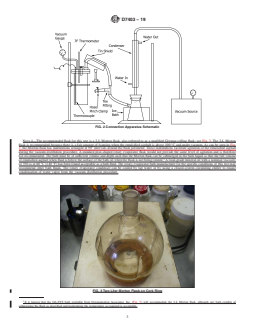
4.2 Connection Apparatus, Test Method D6997, with modifications as shown in Fig. 2. Connection tubing may be of suitable
materials provided the intended vacuum, temperature, and method are maintained. Other forms of condensers may be used,
provided they have an equivalent or greater interior surface area for condensation of distillate.
NOTE 2—Silicone rubber stoppers are recommended.
NOTE 1—Silicone rubber stoppers are recommended.
4.3 Thermometric Device, Thermometer—One of the following: (1) ASTM 7C (7F) thermometers,thermometer, or thermo-
couple(2 devices) thermocouple(s) calibrated at 135 °C (275 °F). The thermocouple probe, Type T with exposed junction, should
be of sufficient length (approximately 300 mm (12 in.)) to be positioned approximately 6 mm (0.25 in.) off the bottom of the
assembled still. Use of equivalent thermometric devices is permitted.
4.4 Balance, capable of weighing 3500 g to 60.1 g.
4.5 Vacuum Pump, rotary vane type, capable of maintaining a vacuum of 88 kPa below gauge pressure or greater.
NOTE 3—88 kPa below gauge pressure is equal to 26 in. Hg (660 mm) below atmospheric pressure.
4.6 Gasket, of silicone rubber, 3 mm ( ⁄8 in.) thick, cut to fit flanged opening on still. Other gasket materials may be used,
provided they withstand the maximum temperature reached during distillation and are able to maintain the specified vacuum within
the still.
4.7 Vacuum Gauges, dial type or other suitable type connected to vacuum tubing and/or fittings tubing, fittings, or both, to allow
attachment to both vacuum pump and to still apparatus and capable of reading a minimum vacuum of 88 kPa below gauge pressure
(660 mm or 26 in. Hg below atmospheric pressure).
4.8 Freezer, maintained at approximately –10 °C.–10 °C (14 °F).
4.9 Disposable Plastic Drink Cups, of convenient size and make to serve as a container during freezing of emulsified asphalt.
4.10 Oven, maintained at 150 6 5 °C (302 6 9 °F).
PROCEDURE B
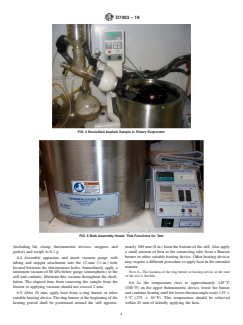
4.11 Rotary Evaporator, with an oil bath capable of maintaining a temperature of at least 165 °C (329 °F), maintaining a vacuum
as stipulated in 4.5 and being able to rotate the distillation flask at 25 6 5 rpm.
FIG. 1 Aluminum Alloy Still Lid Showing Location of the Hole for Vacuum Gauge Connection
D7403 − 19
FIG. 2 Connection Apparatus Schematic
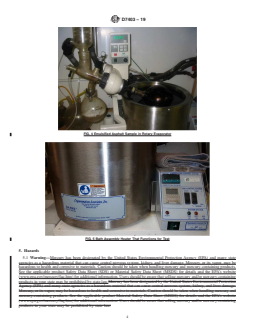
NOTE 4—The recommended flask for this test is a 2-L Morton flask, also referred to as a modified German rolling flask; see Fig. 3. The 2-L Morton
flask is recommended because there is a fair amount of foaming when the emulsified asphalt is above 100 °C and under vacuum. As can be seen in Fig.
3, the Morton flask has indentations arranged at 90° intervals around the flask perimeter. These indentations facilitate agitation of the emulsified asphalt
during the vacuum distillation procedure. A standard pear-shaped rotary evaporator flask would not provide the same level of agitation and is therefore
not recommended. The bath must be of sufficient volume and depth such that the Morton flask can be submerged in the bath liquid so that the full volume
of emulsified asphalt when fluid is below the surface of the bath oil when the flask is not being rotated. A food-grade mineral oil with a nominal viscosity
of 350 cs at 60 °C (140 °F) has been found acceptable as a bath fluid. The rotary evaporator bath manufacturer for the specific conditions of this test may
recommend other bath fluids. The rotary evaporator condenser can be cooled by tap water or by using a closed-system circulating chiller to ensure
condensation of water vapor from the vacuum distillation procedure.
FIG. 3 Two-Liter Morton Flask on Cork Ring
It is known that the OA-SYS bath available from Organomation Associates, Inc. (Fig. 5) will accommodate the 2-L Morton flask, although any bath capable of
submerging the flask as described and maintaining the temperature as required is acceptable.
D7403 − 19
FIG. 4 Emulsified Asphalt Sample in Rotary Evaporator
...