

ASTM D6926-20
(Practice)Standard Practice for Preparation of Asphalt Mixture Specimens Using Marshall Apparatus
General Information
- Abstract
SIGNIFICANCE AND USE
4.1 Compacted asphalt mixture specimens molded by this procedure are used for various physical tests such as stability, flow, indirect tensile strength, fatigue, creep, and modulus. Density and void analysis are also conducted on specimens for mixture design and evaluation of field compaction.
Note 3: Uncompacted mixtures are used for determination of theoretical maximum specific gravity.
Note 4: The quality of the results produced by this practice are dependent on the competence of the personnel performing the procedure and the capability, calibration, and maintenance of the equipment used. Agencies that meet the criteria of Specification D3666 are generally considered capable of competent and objective testing, sampling, inspection, etc. Users of this practice are cautioned that compliance with Specification D3666 alone does not completely ensure reliable results. Reliable results depend on many factors; following the suggestions of Specification D3666 or some similar acceptable guideline provides a means of evaluating and controlling some of those factors.
SCOPE
1.1 This practice covers preparation and compaction of 4 in. (101.6 mm) diameter by nominal 2.5 in. (63.5 mm) high cylindrical asphalt paving mixture specimens. This practice is intended for use with laboratory and plant-produced asphalt mixtures with aggregate up to 1 in. (25.4 mm) maximum size and for recompaction of asphalt paving mixture samples.
Note 1: Historically, 35, 50, and 75 blows per face has been practiced for this test.
Note 2: Manufacturers do not recommend applying an excessive number of blows per face of a sample. This practice has been known to cause fatigue and damage to machine components.
1.2 There are three types of Marshall compaction apparatus in use. The following types of hammer arrangements are included in this practice:
1.2.1 Manually held hammer handle (Type 1) is attached to a flat compaction foot through a spring-loaded swivel and is hand operated (see 5.3.1) (original standard developed by the United States Army Corps of Engineers).
1.2.2 Hammer handle restrained laterally (fixed) but not vertically (Type 2), attached to a flat compaction foot through a spring-loaded swivel and is either mechanically or hand operated (see 5.3.2). There may or may not be a constant surcharge on top of the hammer handle. Mechanical hammers (Type 2) are available that operate at a range of 55 to 68 blows per minute.
1.2.3 Hammer handle restrained laterally (fixed) with or without constant surcharge on top of hammer, is attached to a slanted compaction foot on a rotating mold base (Type 3), and is mechanically operated (see 5.3.3). This method must be used as a referee method.
1.3 Although the mass and height of mass drop for each apparatus are the same, density achieved in compacted specimens with the same number of blows will be different. It is up to the owner or specifier to establish the specific required number of blows to be used for compaction of the specimen in relation to the field.
1.4 Units—The values stated in inch-pound units are to be regarded as standard. The values given in parentheses are mathematical conversions to SI units that are provided for information only and are not considered standard.
1.5 The text of this standard references notes and footnotes which provide explanatory material. These notes and footnotes (excluding those in tables and figures) shall not be considered as requirements of the standard.
1.6 This international standard was developed in accordance with internationally recognized principles on standardization established in the Decision on Principles for the Development of International Standards, Guides and Recommendations issued by the World Trade Organization Technical Barriers to Trade (TBT) Committee.
- Status
- Published
- Publication Date
- 31-Dec-2019
- Technical Committee
- D04 - Road and Paving Materials
- Drafting Committee
- D04.20 - Mechanical Tests of Asphalt Mixtures
Buy Documents
ASTM D6926-20 - Standard Practice for Preparation of Asphalt Mixture Specimens Using Marshall Apparatus
REDLINE ASTM D6926-20 - Standard Practice for Preparation of Asphalt Mixture Specimens Using Marshall Apparatus
Overview
ASTM D6926-20: Standard Practice for Preparation of Asphalt Mixture Specimens Using Marshall Apparatus is a widely referenced ASTM standard used in the construction and engineering industries. This standard outlines best practices for preparing and compacting cylindrical asphalt mixture specimens, each with a nominal diameter of 4 inches (101.6 mm) and a height of 2.5 inches (63.5 mm), using the Marshall compaction method. The procedure is essential for laboratory and plant-produced asphalt mixtures with aggregate sizes up to 1 inch (25.4 mm) and is recognized for its role in asphalt mixture design, quality control, and research.
Key Topics
- Specimen Preparation: Specifies detailed guidance for batching, mixing, curing, and compacting asphalt samples to produce consistent cylindrical specimens suitable for physical testing.
- Types of Compaction Apparatus: Describes three types of Marshall compaction hammers:
- Manually held (Type 1) for hand operation.
- Fixed handle (Type 2) for manual or mechanical operation.
- Mechanically operated, rotating base (Type 3) for referee testing.
- Temperature Control: Provides requirements for mixing and compaction temperatures based on asphalt binder viscosity, ensuring reproducible sample properties.
- Sample Types: Covers laboratory mix-lab compacted (LMLC), plant-mix laboratory compacted (PMLC), and reheated plant mix laboratory compacted (RPMLC) specimens.
- Test Requirements: Ensures proper equipment calibration, use of specified materials, and adherence to precision and reporting guidelines for reliable results.
- Safety and Quality Control: Emphasizes the importance of trained personnel, equipment maintenance, and compliance with ASTM D3666 for laboratory competence.
Applications
ASTM D6926-20 is essential in several key applications within civil infrastructure and pavement engineering, including:
- Mixture Design: Used to prepare specimens for analyzing stability, flow, density, voids, fatigue, creep, and modulus in asphalt mixtures. Results guide the optimization of asphalt mix designs to achieve required pavement performance.
- Quality Control: Provides methods to prepare and compact asphalt samples from both laboratory and plant sources. PMLC and RPMLC specimens are commonly used for routine quality assurance and verification during asphalt pavement construction projects.
- Field Compaction Evaluation: Serves as a benchmark for assessing the effectiveness of field compaction, ensuring laboratory and field results are comparable.
- Research & Development: Supports academic and industrial research where consistency and repeatability in specimen preparation are critical for accurate comparison and validation of new material formulations or compaction techniques.
Related Standards
For comprehensive asphalt mixture testing and quality assurance, ASTM D6926-20 is used alongside several related standards, including:
- ASTM D6927: Test Method for Marshall Stability and Flow of Asphalt Mixtures, which utilizes specimens prepared according to D6926 to determine key performance metrics.
- ASTM D8: Terminology relating to materials for roads and pavements.
- ASTM D3666: Minimum requirements for agencies testing and inspecting road and paving materials.
- ASTM D4402/D4402M: Test Method for Viscosity Determination of Asphalt at Elevated Temperatures.
- ASTM E1, E11, E77, and E2251: Standards covering thermometers, sieve cloth, and precision liquid-in-glass thermometers relevant for temperature and gradation control.
Keywords: ASTM D6926-20, Marshall Apparatus, asphalt mixture specimens, laboratory compaction, asphalt mixture design, road construction standards, Marshall compaction method, pavement quality control, asphalt testing procedure, related ASTM standards.
Relations
- Effective Date
- 01-Jan-2020
- Effective Date
- 01-Aug-2019
- Effective Date
- 15-Dec-2018
- Effective Date
- 15-Aug-2018
- Effective Date
- 01-Jul-2018
- Effective Date
- 01-Feb-2018
- Effective Date
- 15-Jul-2017
- Effective Date
- 15-Jun-2017
- Effective Date
- 01-May-2017
- Effective Date
- 01-Mar-2017
- Effective Date
- 01-Dec-2016
- Effective Date
- 01-Oct-2016
- Effective Date
- 15-Sep-2016
- Effective Date
- 01-Sep-2016
- Effective Date
- 01-Sep-2015
Buy Documents
ASTM D6926-20 - Standard Practice for Preparation of Asphalt Mixture Specimens Using Marshall Apparatus
REDLINE ASTM D6926-20 - Standard Practice for Preparation of Asphalt Mixture Specimens Using Marshall Apparatus
Get Certified
Connect with accredited certification bodies for this standard

Zavod za gradbeništvo Slovenije (ZAG) - Inšpekcija
ZAG inspection body for construction products, structures, and materials.
Sponsored listings
Frequently Asked Questions
ASTM D6926-20 is a standard published by ASTM International. Its full title is "Standard Practice for Preparation of Asphalt Mixture Specimens Using Marshall Apparatus". This standard covers: SIGNIFICANCE AND USE 4.1 Compacted asphalt mixture specimens molded by this procedure are used for various physical tests such as stability, flow, indirect tensile strength, fatigue, creep, and modulus. Density and void analysis are also conducted on specimens for mixture design and evaluation of field compaction. Note 3: Uncompacted mixtures are used for determination of theoretical maximum specific gravity. Note 4: The quality of the results produced by this practice are dependent on the competence of the personnel performing the procedure and the capability, calibration, and maintenance of the equipment used. Agencies that meet the criteria of Specification D3666 are generally considered capable of competent and objective testing, sampling, inspection, etc. Users of this practice are cautioned that compliance with Specification D3666 alone does not completely ensure reliable results. Reliable results depend on many factors; following the suggestions of Specification D3666 or some similar acceptable guideline provides a means of evaluating and controlling some of those factors. SCOPE 1.1 This practice covers preparation and compaction of 4 in. (101.6 mm) diameter by nominal 2.5 in. (63.5 mm) high cylindrical asphalt paving mixture specimens. This practice is intended for use with laboratory and plant-produced asphalt mixtures with aggregate up to 1 in. (25.4 mm) maximum size and for recompaction of asphalt paving mixture samples. Note 1: Historically, 35, 50, and 75 blows per face has been practiced for this test. Note 2: Manufacturers do not recommend applying an excessive number of blows per face of a sample. This practice has been known to cause fatigue and damage to machine components. 1.2 There are three types of Marshall compaction apparatus in use. The following types of hammer arrangements are included in this practice: 1.2.1 Manually held hammer handle (Type 1) is attached to a flat compaction foot through a spring-loaded swivel and is hand operated (see 5.3.1) (original standard developed by the United States Army Corps of Engineers). 1.2.2 Hammer handle restrained laterally (fixed) but not vertically (Type 2), attached to a flat compaction foot through a spring-loaded swivel and is either mechanically or hand operated (see 5.3.2). There may or may not be a constant surcharge on top of the hammer handle. Mechanical hammers (Type 2) are available that operate at a range of 55 to 68 blows per minute. 1.2.3 Hammer handle restrained laterally (fixed) with or without constant surcharge on top of hammer, is attached to a slanted compaction foot on a rotating mold base (Type 3), and is mechanically operated (see 5.3.3). This method must be used as a referee method. 1.3 Although the mass and height of mass drop for each apparatus are the same, density achieved in compacted specimens with the same number of blows will be different. It is up to the owner or specifier to establish the specific required number of blows to be used for compaction of the specimen in relation to the field. 1.4 Units—The values stated in inch-pound units are to be regarded as standard. The values given in parentheses are mathematical conversions to SI units that are provided for information only and are not considered standard. 1.5 The text of this standard references notes and footnotes which provide explanatory material. These notes and footnotes (excluding those in tables and figures) shall not be considered as requirements of the standard. 1.6 This international standard was developed in accordance with internationally recognized principles on standardization established in the Decision on Principles for the Development of International Standards, Guides and Recommendations issued by the World Trade Organization Technical Barriers to Trade (TBT) Committee.
SIGNIFICANCE AND USE 4.1 Compacted asphalt mixture specimens molded by this procedure are used for various physical tests such as stability, flow, indirect tensile strength, fatigue, creep, and modulus. Density and void analysis are also conducted on specimens for mixture design and evaluation of field compaction. Note 3: Uncompacted mixtures are used for determination of theoretical maximum specific gravity. Note 4: The quality of the results produced by this practice are dependent on the competence of the personnel performing the procedure and the capability, calibration, and maintenance of the equipment used. Agencies that meet the criteria of Specification D3666 are generally considered capable of competent and objective testing, sampling, inspection, etc. Users of this practice are cautioned that compliance with Specification D3666 alone does not completely ensure reliable results. Reliable results depend on many factors; following the suggestions of Specification D3666 or some similar acceptable guideline provides a means of evaluating and controlling some of those factors. SCOPE 1.1 This practice covers preparation and compaction of 4 in. (101.6 mm) diameter by nominal 2.5 in. (63.5 mm) high cylindrical asphalt paving mixture specimens. This practice is intended for use with laboratory and plant-produced asphalt mixtures with aggregate up to 1 in. (25.4 mm) maximum size and for recompaction of asphalt paving mixture samples. Note 1: Historically, 35, 50, and 75 blows per face has been practiced for this test. Note 2: Manufacturers do not recommend applying an excessive number of blows per face of a sample. This practice has been known to cause fatigue and damage to machine components. 1.2 There are three types of Marshall compaction apparatus in use. The following types of hammer arrangements are included in this practice: 1.2.1 Manually held hammer handle (Type 1) is attached to a flat compaction foot through a spring-loaded swivel and is hand operated (see 5.3.1) (original standard developed by the United States Army Corps of Engineers). 1.2.2 Hammer handle restrained laterally (fixed) but not vertically (Type 2), attached to a flat compaction foot through a spring-loaded swivel and is either mechanically or hand operated (see 5.3.2). There may or may not be a constant surcharge on top of the hammer handle. Mechanical hammers (Type 2) are available that operate at a range of 55 to 68 blows per minute. 1.2.3 Hammer handle restrained laterally (fixed) with or without constant surcharge on top of hammer, is attached to a slanted compaction foot on a rotating mold base (Type 3), and is mechanically operated (see 5.3.3). This method must be used as a referee method. 1.3 Although the mass and height of mass drop for each apparatus are the same, density achieved in compacted specimens with the same number of blows will be different. It is up to the owner or specifier to establish the specific required number of blows to be used for compaction of the specimen in relation to the field. 1.4 Units—The values stated in inch-pound units are to be regarded as standard. The values given in parentheses are mathematical conversions to SI units that are provided for information only and are not considered standard. 1.5 The text of this standard references notes and footnotes which provide explanatory material. These notes and footnotes (excluding those in tables and figures) shall not be considered as requirements of the standard. 1.6 This international standard was developed in accordance with internationally recognized principles on standardization established in the Decision on Principles for the Development of International Standards, Guides and Recommendations issued by the World Trade Organization Technical Barriers to Trade (TBT) Committee.
ASTM D6926-20 is classified under the following ICS (International Classification for Standards) categories: 93.080.20 - Road construction materials. The ICS classification helps identify the subject area and facilitates finding related standards.
ASTM D6926-20 has the following relationships with other standards: It is inter standard links to ASTM D6926-16, ASTM D8-19, ASTM D8-18c, ASTM D8-18b, ASTM D8-18a, ASTM D8-18, ASTM D8-17c, ASTM D8-17b, ASTM D8-17a, ASTM D8-17, ASTM D8-16b, ASTM D3666-16, ASTM D8-16a, ASTM D8-16, ASTM D8-15. Understanding these relationships helps ensure you are using the most current and applicable version of the standard.
ASTM D6926-20 is available in PDF format for immediate download after purchase. The document can be added to your cart and obtained through the secure checkout process. Digital delivery ensures instant access to the complete standard document.
Standards Content (Sample)
This international standard was developed in accordance with internationally recognized principles on standardization established in the Decision on Principles for the
Development of International Standards, Guides and Recommendations issued by the World Trade Organization Technical Barriers to Trade (TBT) Committee.
Designation: D6926 − 20
Standard Practice for
Preparation of Asphalt Mixture Specimens Using Marshall
Apparatus
This standard is issued under the fixed designation D6926; the number immediately following the designation indicates the year of
original adoption or, in the case of revision, the year of last revision. A number in parentheses indicates the year of last reapproval. A
superscript epsilon (´) indicates an editorial change since the last revision or reapproval.
1. Scope to the owner or specifier to establish the specific required
number of blows to be used for compaction of the specimen in
1.1 This practice covers preparation and compaction of 4 in.
relation to the field.
(101.6 mm) diameter by nominal 2.5 in. (63.5 mm) high
1.4 Units—The values stated in inch-pound units are to be
cylindrical asphalt paving mixture specimens. This practice is
regarded as standard. The values given in parentheses are
intended for use with laboratory and plant-produced asphalt
mathematical conversions to SI units that are provided for
mixtures with aggregate up to 1 in. (25.4 mm) maximum size
information only and are not considered standard.
and for recompaction of asphalt paving mixture samples.
1.5 The text of this standard references notes and footnotes
NOTE 1—Historically, 35, 50, and 75 blows per face has been practiced
which provide explanatory material. These notes and footnotes
for this test.
(excluding those in tables and figures) shall not be considered
NOTE 2—Manufacturers do not recommend applying an excessive
number of blows per face of a sample. This practice has been known to
as requirements of the standard.
cause fatigue and damage to machine components.
1.6 This international standard was developed in accor-
1.2 There are three types of Marshall compaction apparatus
dance with internationally recognized principles on standard-
in use. The following types of hammer arrangements are
ization established in the Decision on Principles for the
included in this practice:
Development of International Standards, Guides and Recom-
1.2.1 Manually held hammer handle (Type 1) is attached to mendations issued by the World Trade Organization Technical
a flat compaction foot through a spring-loaded swivel and is
Barriers to Trade (TBT) Committee.
hand operated (see 5.3.1) (original standard developed by the
United States Army Corps of Engineers).
2. Referenced Documents
1.2.2 Hammer handle restrained laterally (fixed) but not
2.1 ASTM Standards:
vertically (Type 2), attached to a flat compaction foot through
D8 Terminology Relating to Materials for Roads and Pave-
a spring-loaded swivel and is either mechanically or hand
ments
operated (see 5.3.2). There may or may not be a constant
D3666 Specification for Minimum Requirements for Agen-
surcharge on top of the hammer handle. Mechanical hammers
cies Testing and Inspecting Road and Paving Materials
(Type 2) are available that operate at a range of 55 to 68 blows
D4402/D4402M TestMethodforViscosityDeterminationof
per minute.
Asphalt at Elevated Temperatures Using a Rotational
1.2.3 Hammer handle restrained laterally (fixed) with or
Viscometer
without constant surcharge on top of hammer, is attached to a
D6927 Test Method for Marshall Stability and Flow of
slanted compaction foot on a rotating mold base (Type 3), and
Asphalt Mixtures
ismechanicallyoperated(see5.3.3).Thismethodmustbeused
E1 Specification for ASTM Liquid-in-Glass Thermometers
as a referee method.
E11 Specification for Woven Wire Test Sieve Cloth and Test
Sieves
1.3 Although the mass and height of mass drop for each
E77 Test Method for Inspection and Verification of Ther-
apparatus are the same, density achieved in compacted speci-
mometers
mens with the same number of blows will be different. It is up
E2251 Specification for Liquid-in-Glass ASTM Thermom-
eters with Low-Hazard Precision Liquids
This practice is under the jurisdiction of ASTM Committee D04 on Road and
Paving Materials and is the direct responsibility of Subcommittee D04.20 on
Mechanical Tests of Asphalt Mixtures. For referenced ASTM standards, visit the ASTM website, www.astm.org, or
Current edition approved Jan. 1, 2020. Published January 2020. Originally contact ASTM Customer Service at service@astm.org. For Annual Book of ASTM
approved in 2004. Last previous edition approved in 2016 as D6926 – 16. DOI: Standards volume information, refer to the standard’s Document Summary page on
10.1520/D6926-20. the ASTM website.
Copyright © ASTM International, 100 Barr Harbor Drive, PO Box C700, West Conshohocken, PA 19428-2959. United States
D6926 − 20
3. Terminology lessthan3.95in.(100.3mm)indiameterand0.5in.(12.7mm)
thick. The steel disk is used for extracting compacted speci-
3.1 Definitions:
mens from molds with the use of the mold collar.Any suitable
3.1.1 For definitions of terms used in this practice, refer to
extraction device such as a hydraulic jack apparatus or a lever
Terminology D8.
arm device may be used, provided the specimens are not
3.2 Definitions of Terms Specific to This Standard:
deformed during the extraction process.
3.2.1 lab mix lab compacted (LMLC) asphalt mixture,
n—asphalt mix samples that are prepared in the laboratory by
5.3 Compaction Hammers:
weighing and blending each constituent then compacting the
5.3.1 Compaction Hammers with a Manually Held Handle
blended mixture after 2 h of curing at the compaction tempera-
(Type 1), as shown in Fig. 2, shall have a flat, circular
ture or curing time specified by the owner, using a laboratory
compaction foot with spring-loaded swivel and a 10 6 0.02-lb
compaction apparatus.
(4.536 6 0.009-kg) sliding mass with a freefall of 18 6
3.2.1.1 Discussion—LMLC typically occurs during the as-
0.06 in. (457.2 6 1.5 mm) (see Fig. 3 for hammer tolerances).
phalt mixture design phase.
NOTE 5—Type 1 and Type 2 manual hand-operated compaction
3.2.2 plant mix laboratory compacted (PMLC) asphalt
hammers should be equipped with a finger safety guard.
misture, n—asphalt mix samples that are manufactured in a
5.3.2 Compaction Hammers with a Fixed Handle (Type 2),
production plant, sampled prior to compaction, then immedi-
either mechanically or hand operated as shown in Fig. 4(a) and
ately compacted using a laboratory compaction apparatus.
Fig. 4(b), shall have a flat, circular compaction foot with
3.2.2.1 Discussion—PMLC specimens are often used for
spring-loaded swivel and a 10 6 0.02-lb (4.536 6 0.009-kg)
qualitycontroltesting.Thisdesignationislimitedtospecimens
sliding mass with a freefall of 18 6 0.06 in. (457.2 6 1.5 mm)
that have not been permitted to cool substantially, but PMLC
(see Fig. 3 for hammer tolerances).
samples may be placed in a laboratory oven to equilibrate the
5.3.3 Mechanically Operated Compaction Hammers with a
mix to the compaction temperature before molding.
Fixed Hammer Handle, used with a constantly rotating base
3.2.3 reheated plant mix lab compacted (RPMLC) asphalt
(Type 3) as shown in Fig. 5. There may or may not be a
mixture, n—asphalt mix samples that are manufactured in a
constant surcharge on top of the handle. It shall have a slanted,
production plant, sampled prior to compaction, allowed to cool
circular tamping face and a 10 6 0.02-lb (4.536 6 0.009-kg)
to room temperature, then reheated in a laboratory oven and
sliding weight with a free-fall of 18 6 0.06 in. (457.2 6 1.5
compacted using a laboratory compaction apparatus.
mm). See Fig. 6 (Hammer Bevel Detail) for hammer and
3.2.3.1 Discussion—RPMLCs are often used for quality
tamping face bevel angle and tolerances, respectively. A
acceptance and verification testing. The reheating is as brief as
rotating mechanism is incorporated in the base. The base
possibletoobtainuniformtemperaturewhileavoidingartificial
rotation rate and hammer blow rate shall be 18 to 30 rpm and
aging of the specimens. Asphalt mix conditioning, reheat
shall operate at a range of 55 to 68 blows per minute,
temperature, and reheat time should be defined in the appli-
respectively.
cable specification.
NOTE 6—Multiple hammer operation may affect the density of the
samples.
4. Significance and Use
5.4 Compaction Pedestal—The compaction pedestal shall
4.1 Compacted asphalt mixture specimens molded by this
consist of an 8.0 by 8.0-in. (203.2 by 203.2-mm) wooden post
procedure are used for various physical tests such as stability,
approximately 18 in. (457.2 mm) long, capped with a steel
flow, indirect tensile strength, fatigue, creep, and modulus.
plateapproximately12by12in.(304.8by304.8mm)and1in.
Density and void analysis are also conducted on specimens for
(25.4mm)thick.Thewoodenpostshallbeoak,yellowpine,or
mixture design and evaluation of field compaction.
other wood having an average dry density of 42 to
NOTE 3—Uncompacted mixtures are used for determination of theo-
3 3
retical maximum specific gravity. 48 lb⁄ft (674.2 to 770.5 kg/m ). The wooden post shall be
NOTE 4—The quality of the results produced by this practice are
secured by bolts through four angled brackets to a solid
dependent on the competence of the personnel performing the procedure
concrete slab.The steel cap shall be firmly fastened to the post.
and the capability, calibration, and maintenance of the equipment used.
The pedestal assembly shall be installed so that the post is
Agencies that meet the criteria of Specification D3666 are generally
plumb and the cap is level.
considered capable of competent and objective testing, sampling,
inspection, etc. Users of this practice are cautioned that compliance with
5.5 Specimen Mold Holder—With single-hammer
Specification D3666 alone does not completely ensure reliable results.
compactors, the holder shall be mounted on the compaction
Reliable results depend on many factors; following the suggestions of
Specification D3666 or some similar acceptable guideline provides a pedestal so as to center the compaction mold over the center of
means of evaluating and controlling some of those factors.
the post. The holders shall hold the compaction mold, collar,
and base plate securely in position during compaction of the
5. Apparatus
specimen.
5.1 Specimen Mold Assembly—Mold cylinders, base plates,
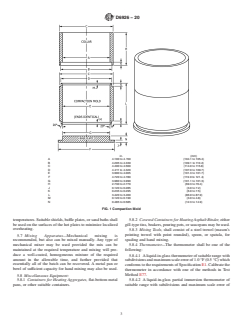
5.6 Ovens, Heating Pots, or Hot Plates—Circulating air
and extension collars shall conform to the details shown in Fig.
ovens or thermostatically controlled heating pots and hot plates
1 (Compaction Mold).
shall be provided for heating aggregates, asphalt material,
5.2 Specimen Extractor—The specimen extractor shall have specimen molds, compaction hammers, and other equipment to
a steel disk that will enter the mold without binding and not be within 5 °F (3 °C) of the required mixing and compaction
D6926 − 20
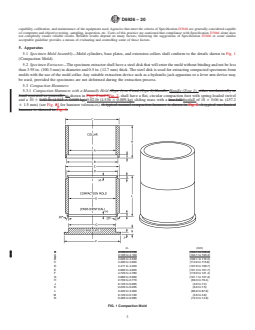
in. (mm)
A 4.100 to 4.150 (104.1 to 105.4)
B 4.295 to 4.339 (109.1 to 110.2)
C 4.490 to 4.560 (114.0 to 115.8)
D 4.211 to 4.320 (107.0 to 109.7)
E 3.990 to 4.005 (101.3 to 101.7)
F 4.720 to 4.780 (119.9 to 121.4)
G 3.980 to 3.990 (101.1 to 101.3)
H 2.730 to 2.770 (69.3 to 70.4)
J 0.120 to 0.285 (3.0 to 7.2)
K 0.235 to 0.295 (6.0 to 7.5)
L 3.420 to 3.460 (86.9 to 87.9)
M 0.120 to 0.190 (3.0 to 4.8)
N 0.485 to 0.585 (12.3 to 14.9)
FIG. 1 Compaction Mold
temperatures. Suitable shields, baffle plates, or sand baths shall 5.8.2 Covered Containers for Heating Asphalt Binder,either
be used on the surfaces of the hot plates to minimize localized gill-type tins, beakers, pouring pots, or saucepans may be used.
overheating.
5.8.3 Mixing Tools, shall consist of a steel trowel (mason’s
pointing trowel with point rounded), spoon, or spatula, for
5.7 Mixing Apparatus—Mechanical mixing is
spading and hand mixing.
recommended, but also can be mixed manually. Any type of
mechanical mixer may be used provided the mix can be 5.8.4 Thermometer—The thermometer shall be one of the
maintained at the required temperature and mixing will pro- following:
duce a well-coated, homogeneous mixture of the required
5.8.4.1 Aliquid-in-glass thermometer of suitable range with
amount in the allowable time, and further provided that
subdivisionsandmaximumscaleerrorof1.0 °F(0.5 °C)which
essentially all of the batch can be recovered. A metal pan or
conforms to the requirements of Specification E1. Calibrate the
bowl of sufficient capacity for hand mixing may also be used.
thermometer in accordance with one of the methods in Test
Method E77.
5.8 Miscellaneous Equipment:
5.8.1 Containers for Heating Aggregates, flat-bottom metal 5.8.4.2 A liquid-in-glass partial immersion thermometer of
suitable range with subdivisions and maximum scale error of
pans, or other suitable containers.
D6926 − 20
1to ⁄4 in. (25 to 19 mm)
3 1
⁄4 to ⁄2 in. (19 to 12.5 mm)
1 3
⁄2 to ⁄8 in. (12.5 to 9.5 mm)
⁄8 to No. 4 (9.5 to 4.75 mm)
No. 4 to No. 8 (
...
This document is not an ASTM standard and is intended only to provide the user of an ASTM standard an indication of what changes have been made to the previous version. Because
it may not be technically possible to adequately depict all changes accurately, ASTM recommends that users consult prior editions as appropriate. In all cases only the current version
of the standard as published by ASTM is to be considered the official document.
Designation: D6926 − 16 D6926 − 20
Standard Practice for
Preparation of Asphalt Mixture Specimens Using Marshall
Apparatus
This standard is issued under the fixed designation D6926; the number immediately following the designation indicates the year of
original adoption or, in the case of revision, the year of last revision. A number in parentheses indicates the year of last reapproval. A
superscript epsilon (´) indicates an editorial change since the last revision or reapproval.
1. Scope
1.1 This practice covers preparation and compaction of 4 in. (101.6 mm) diameter by nominal 2.5 in. (63.5 mm) high cylindrical
asphalt paving mixture specimens. This practice is intended for use with laboratory and plant-produced asphalt mixtures with
aggregate up to 1 in. (25.4 mm) maximum size and for recompaction of asphalt paving mixture samples.
NOTE 1—Historically, 35, 50, and 75 blows per face has been practiced for this test.
NOTE 2—Manufacturers do not recommend applying an excessive number of blows per face of a sample. This practice has been known to cause fatigue
and damage to machine components.
1.2 There are three types of Marshall compaction apparatus in use. The following types of hammer arrangements are included
in this practice:
1.2.1 Manually held hammer handle (Type 1) is attached to a flat compaction foot through a spring-loaded swivel and is hand
operated (see 5.3.1) (original standard developed by the United States Army Corps of Engineers).
1.2.2 Hammer handle restrained laterally (fixed) but not vertically, vertically (Type 2), attached to a flat compaction foot through
a spring-loaded swivel and is either mechanically or hand operated. operated (see 5.3.2). There may or may not be a constant
surcharge on top of the hammer handle. Mechanical hammers (Type 2) are available that operate at (1)a nominal 55 blows per
minute or range of 55 (2) equal to or greater than 75 to 68 blows per minute.
1.2.3 Hammer handle restrained laterally (fixed) with or without constant surcharge on top of hammer, is attached to a slanted
compaction foot on a rotating mold base, base (Type 3), and is mechanically operated. operated (see 5.3.3). This method must be
used as a referee method.
1.3 Although the mass and height of mass drop for each apparatus are the same, density achieved in compacted specimens with
the same number of blows will be different. It is up to the owner or specifier to establish the specific required number of blows
to be used for compaction of the specimen in relation to the field.
1.4 Units—The values stated in inch-pound units are to be regarded as standard. The values given in parentheses are
mathematical conversions to SI units that are provided for information only and are not considered standard.
1.5 The text of this standard references notes and footnotes which provide explanatory material. These notes and footnotes
(excluding those in tables and figures) shall not be considered as requirements of the standard.
1.6 This international standard was developed in accordance with internationally recognized principles on standardization
established in the Decision on Principles for the Development of International Standards, Guides and Recommendations issued
by the World Trade Organization Technical Barriers to Trade (TBT) Committee.
2. Referenced Documents
2.1 ASTM Standards:
D8 Terminology Relating to Materials for Roads and Pavements
D3666 Specification for Minimum Requirements for Agencies Testing and Inspecting Road and Paving Materials
D4402D4402/D4402M Test Method for Viscosity Determination of Asphalt at Elevated Temperatures Using a Rotational
Viscometer
This practice is under the jurisdiction of ASTM Committee D04 on Road and Paving Materials and is the direct responsibility of Subcommittee D04.20 on Mechanical
Tests of Asphalt Mixtures.
Current edition approved Dec. 15, 2016Jan. 1, 2020. Published January 2017January 2020. Originally approved in 2004. Last previous edition approved in 20102016 as
D6926 – 10.D6926 – 16. DOI: 10.1520/D6926-16.10.1520/D6926-20.
For referenced ASTM standards, visit the ASTM website, www.astm.org, or contact ASTM Customer Service at service@astm.org. For Annual Book of ASTM Standards
volume information, refer to the standard’s Document Summary page on the ASTM website.
Copyright © ASTM International, 100 Barr Harbor Drive, PO Box C700, West Conshohocken, PA 19428-2959. United States
D6926 − 20
D6927 Test Method for Marshall Stability and Flow of Asphalt Mixtures
E1 Specification for ASTM Liquid-in-Glass Thermometers
E11 Specification for Woven Wire Test Sieve Cloth and Test Sieves
E77 Test Method for Inspection and Verification of Thermometers
E2251 Specification for Liquid-in-Glass ASTM Thermometers with Low-Hazard Precision Liquids
3. Terminology
3.1 Definitions:
3.1.1 For definitions of terms used in this practice, refer to Terminology D8.
3.2 Definitions of Terms Specific to This Standard:
3.2.1 lab mix lab compacted (LMLC) asphalt mixture, n—asphalt mix samples that are prepared in the laboratory by weighing
and blending each constituent then compacting the blended mixture after two hours 2 h of curing at the compaction temperature
or curing time specified by the owner, using a laboratory compaction apparatus.
3.2.1.1 Discussion—
LMLC typically occurs during the asphalt mixture design phase.
3.2.1.1 Discussion—
LMLC typically occurs during the asphalt mixture design phase.
3.2.2 plant mix laboratory compacted (PMLC) asphalt misture, n—asphalt mix samples that are manufactured in a production
plant, sampled prior to compaction, then immediately compacted using a laboratory compaction apparatus.
3.2.2.1 Discussion—
PMLC specimens are often used for quality control testing. This designation is limited to specimens that have not been permitted
to cool substantially, but PMLC samples may be placed in a laboratory oven to equilibrate the mix to the compaction temperature
before molding.
3.2.2.1 Discussion—
PMLC specimens are often used for quality control testing. This designation is limited to specimens that have not been permitted
to cool substantially, but PMLC samples may be placed in a laboratory oven to equilibrate the mix to the compaction temperature
before molding.
3.2.3 reheated plant mix lab compacted (RPMLC) asphalt mixture, n—asphalt mix samples that are manufactured in a
production plant, sampled prior to compaction, allowed to cool to room temperature, then reheated in a laboratory oven and
compacted using a laboratory compaction apparatus.
3.2.3.1 Discussion—
RPMLCs are often used for quality acceptance and verification testing. The reheating is as brief as possible to obtain uniform
temperature while avoiding artificial aging of the specimens. Asphalt mix conditioning, reheat temperature, and reheat time should
be defined in the applicable specification.
3.2.3.1 Discussion—
RPMLCs are often used for quality acceptance and verification testing. The reheating is as brief as possible to obtain uniform
temperature while avoiding artificial aging of the specimens. Asphalt mix conditioning, reheat temperature, and reheat time should
be defined in the applicable specification.
4. Significance and Use
4.1 Compacted asphalt mixture specimens molded by this procedure are used for various physical tests such as stability, flow,
indirect tensile strength, fatigue, creep, and modulus. Density and void analysis are also conducted on specimens for mixture
design and evaluation of field compaction.
NOTE 3—Uncompacted mixtures are used for determination of theoretical maximum specific gravity.
NOTE 4—The quality of the results produced by this practice are dependent on the competence of the personnel performing the procedure and the
D6926 − 20
capability, calibration, and maintenance of the equipment used. Agencies that meet the criteria of Specification D3666 are generally considered capable
of competent and objective testing, sampling, inspection, etc. Users of this practice are cautioned that compliance with Specification D3666 alone does
not completely ensure reliable results. Reliable results depend on many factors; following the suggestions of Specification D3666 or some similar
acceptable guideline provides a means of evaluating and controlling some of those factors.
5. Apparatus
5.1 Specimen Mold Assembly—Mold cylinders, base plates, and extension collars shall conform to the details shown in Fig. 1
(Compaction Mold).
5.2 Specimen Extractor—The specimen extractor shall have a steel disk that will enter the mold without binding and not be less
than 3.95 in. (100.3 mm) in diameter and 0.5 in. (12.7 mm) thick. The steel disk is used for extracting compacted specimens from
molds with the use of the mold collar. Any suitable extraction device such as a hydraulic jack apparatus or a lever arm device may
be used, provided the specimens are not deformed during the extraction process.
5.3 Compaction Hammers:
5.3.1 Compaction Hammers with a Manually Held (Type 1) or Fixed (Type 2) Handle, Handle (Type 1), either mechanically or
hand operated as generally as shown in Figs. 2 and 3Fig. 2, shall have a flat, circular compaction foot with spring-loaded swivel
and a 10 6 0.02 lb (4.545 6 0.009 kg) 0.02-lb (4.536 6 0.009-kg) sliding mass with a free fall freefall of 18 6 0.06 in. (457.2
6 1.5 mm) (see Fig. 23 for hammer tolerances). A typical manual compaction hammer is shown in Fig. 2. A typical mechanical
hammer is showed in Fig. 3.
in. (mm)
A 4.100 to 4.150 (104.1 to 105.4)
A 4.100 to 4.150 (104.1 to 105.4)
B 4.295 to 4.339 (109.1 to 110.2)
C 4.490 to 4.560 (114.0 to 115.8)
D 4.211 to 4.320 (107.0 to 109.7)
E 3.990 to 4.005 (101.3 to 101.7)
F 4.720 to 4.780 (119.9 to 121.4)
G 3.980 to 3.990 (101.1 to 101.3)
H 2.730 to 2.770 (69.3 to 70.4)
J 0.120 to 0.285 (3.0 to 7.2)
K 0.235 to 0.295 (6.0 to 7.5)
L 3.420 to 3.460 (86.9 to 87.9)
M 0.120 to 0.190 (3.0 to 4.8)
N 0.485 to 0.585 (12.3 to 14.9)
FIG. 1 Compaction Mold
D6926 − 20
in. (mm)
O – P Drop Distance 17.94 to 18.06 (455.7 to 458.7)
O–P Drop Distance 17.94 to 18.06 (455.7 to 458.7)
Q Guide Bushing . . . . . .
R Guide Rod Nominal Diameter 0.625 (15.9)
S Face Diameter Hardened Impact Resistant 3.860 to 3.960 (98.0 to 100.6)
T Foot Thickness 0.450 to 0.550 (11.4 to 14.0)
U Weight Face Diameter 1.960 to 2.040 (49.8 to 51.8)
X Spring . . . . . .
Z Finger Guard 2.95 to 4.50 (75.0 to 114.3)
lb. (kg)
lb (kg)
W Weight Mass 9.98 to 10.02 (4.527 to 4.545)
NOTE 1—Finger guard required only for Type 1 and Type 2 manual hand-operated compaction hammers. Hammers used in Type 2 mechanical and Type
3 rotating mechanical compaction hammers do not require a finger guard.
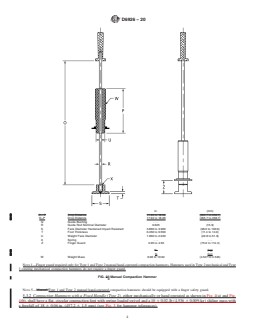
FIG. 23 Manual Compaction Hammer
NOTE 5—Manual Type 1 and Type 2 manual hand-operated compaction hammers should be equipped with a finger safety guard.
5.3.2 Compaction Hammers with a Fixed Handle (Type 2), either mechanically or hand operated as shown in Fig. 4(a) and Fig.
4(b), shall have a flat, circular compaction foot with spring-loaded swivel and a 10 6 0.02-lb (4.536 6 0.009-kg) sliding mass with
a freefall of 18 6 0.06 in. (457.2 6 1.5 mm) (see Fig. 3 for hammer tolerances).
D6926 − 20
FIG. 32 Typical Mechanical HammerManually Held Hammer (Type 1)
5.3.3 Mechanically Operated Compaction Hammers with a Fixed Hammer Handle, used with a constantly rotating base (Type
3) as shown in Fig. 5. There may or may not be a constant surcharge on top of handle, constantly rotating base, and mechanically
operated (Type 3), the handle. It shall have a slanted, circular tamping face and a 10 6 0.02 lb 0.02-lb (4.536 6 0.009 kg) 0.009-kg)
sliding weight with a free fall free-fall of 18 6 0.06 in. (457.2 6 1.5 mm). See Fig. 46 (Hammer Bevel Detail) for hammer and
tamping face bevel angle and tolerances, respectively. A rotating mechanism is incorporated in the base. The base rotation rate and
hammer blow rate shall be 18 to 30 rpm and 64 6 4 shall operate at a range of 55 to 68 blows per minute, respectively.
NOTE 6—Multiple hammer operation may affect the density of the samples.
5.4 Compaction Pedestal—The compaction pedestal shall consist of a 7.5 in. by 8.0 in. (191.0 mm by 203.2 mm) an 8.0 by
8.0-in. (203.2 by 203.2-mm) wooden post approximately 18 in. (457.2 mm) long, capped with a steel plate approximately 12 by
12 in. (304.8 by 304.8 mm) and 1 in. (25.4 mm) thick. The wooden post shall be oak, yellow pine, or other wood having an average
3 3
dry density of 42 to 48 lb ⁄ft (674.2 to 770.5 kg/m ). The wooden post shall be secured by bolts through four angleangled brackets
to a solid concrete slab. The steel cap shall be firmly fastened to the post. The pedestal assembly shall be installed so that the post
is plumb and the cap is level.
5.5 Specimen Mold Holder—With single-hammer compactors, the holder shall be mounted on the compaction pedestal so as to
center the compaction mold over the center of the post. The holders shall hold the compaction mold, collar, and base plate securely
in position during compaction of the specimen.
5.6 Ovens, Heating Pots, or Hot Plates—Circulating air ovens or thermostatically controlled heating pots and hot plates shall
be provided for heating aggregates, asphalt material, specimen molds, compaction hammers, and other equipment to within 5 °F
(3 °C) of the required mixing and compaction temperatures. Suitable shields, baffle plates, or sand baths shall be used on the
surfaces of the hot plates to minimize localized overhea
...