

ASTM D517-23
(Specification)Standard Specification for Asphalt Plank
General Information
- Abstract
ABSTRACT
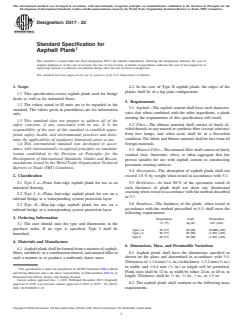
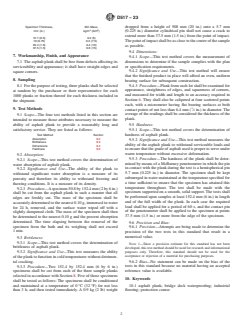
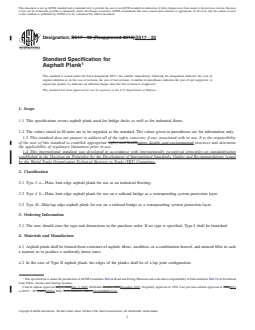
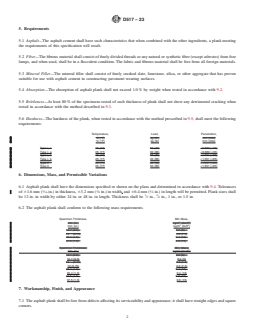
This specification covers asphalt plank used for bridge decks as well as for industrial floors. Asphalt planks shall be classified according to usage: Type Ia; Type Ib; and Type II. Asphalt plank shall be formed from a mixture of asphalt, fibers, modifiers, or a combination thereof, and mineral filler in such a manner as to produce a uniformly dense mass. The following test methods shall be intended to measure those attributes necessary to measure the ability of asphalt plank to provide a reasonably long and satisfactory service: absorption; brittleness; dimensions; and hardness.
SCOPE
1.1 This specification covers asphalt plank used for bridge decks as well as for industrial floors.
1.2 The values stated in SI units are to be regarded as the standard. The values given in parentheses are for information only.
1.3 This standard does not purport to address all of the safety concerns, if any, associated with its use. It is the responsibility of the user of this standard to establish appropriate safety, health, and environmental practices and determine the applicability of regulatory limitations prior to use.
1.4 This international standard was developed in accordance with internationally recognized principles on standardization established in the Decision on Principles for the Development of International Standards, Guides and Recommendations issued by the World Trade Organization Technical Barriers to Trade (TBT) Committee.
- Status
- Published
- Publication Date
- 30-Nov-2023
- Technical Committee
- D04 - Road and Paving Materials
- Drafting Committee
- D04.34 - Preformed Joint Fillers, Sealers and Sealing Systems



Overview
ASTM D517-23 - Standard Specification for Asphalt Plank is an internationally recognized standard developed by ASTM International, detailing requirements for asphalt plank utilized in bridge deck waterproofing and industrial flooring applications. This specification outlines material composition, classification, manufacturing guidelines, and essential physical properties, ensuring consistent quality and reliable performance. ASTM D517-23 plays a critical role in infrastructure durability, primarily focusing on applications where long-term service and protection against environmental factors are essential.
Key Topics
Classification:
Asphalt planks are classified into three types based on their application and construction:- Type Ia: Plain, butt-edge plank for industrial floors.
- Type Ib: Plain, butt-edge plank for use as a protection layer in railroad bridge deck waterproofing.
- Type II: Ship-lap edge plank designed for railroad bridge waterproofing protection.
Material Composition:
Asphalt planks are manufactured from a uniformly dense mixture of asphalt, fibers (natural or synthetic, excluding asbestos), modifiers, and mineral filler (such as slate, limestone, or silica).Physical Requirements:
The specification sets stringent criteria regarding:- Absorption: Maximum 1.0% by weight, measured to verify low porosity.
- Brittleness: Test ensures resistance to cracking in cold conditions.
- Hardness: Performance under specified temperatures and loads to guarantee structural integrity during use.
- Dimensions and Mass: Strict tolerances ensure planks fit design requirements and maintain consistent coverage.
Workmanship & Appearance:
Planks must be free from visible defects, have straight edges, and possess square corners for proper installation and functionality.
Applications
Bridge Deck Waterproofing:
Asphalt plank is widely used as a protection course in waterproofing systems for bridge decks, providing a durable barrier against water infiltration and extending the lifespan of the structure.Railroad Infrastructure:
Both Type Ib and Type II planks are specifically designed to safeguard waterproofing membranes on railroad bridges, enhancing resilience against vibrations and heavy loads.Industrial Flooring:
Type Ia planks serve as robust industrial flooring solutions in facilities subjected to high traffic, heavy equipment, and fluctuating environmental conditions.
By adhering to ASTM D517-23, project stakeholders-including engineers, contractors, and facility managers-ensure that asphalt plank materials meet uniform standards, optimizing performance and reducing the risk of premature failure.
Related Standards
For comprehensive project specifications and compatibility, consider referencing these related ASTM standards:
- ASTM D994 - Specification for Preformed Expansion Joint Filler for Concrete (Bituminous Type)
- ASTM D1752 - Specification for Preformed Sponge Rubber and Cork Expansion Joint Fillers for Concrete Paving and Structural Construction
- ASTM D6073 - Specification for Preformed Polychloroprene Expansion Joint Fillers
Each of these standards complements ASTM D517-23 by addressing adjacent material requirements and installation practices for paving, flooring, or bridge construction projects.
Practical Value
Using asphalt plank conforming to ASTM D517-23 guarantees:
- Consistent protection against water ingress and mechanical stress
- Extended service life for bridges and industrial floors
- Reliable performance under a variety of temperature and load conditions
- Ease of installation and reduced maintenance through strict dimensional controls
This standard is essential for professionals seeking durable, high-performance solutions in structural waterproofing and heavy-duty flooring, ensuring compliance with international best practices.
Keywords: asphalt plank, ASTM D517-23, bridge deck waterproofing, industrial flooring, protection course, railroad bridge, construction standards, material specification.
Relations
- Effective Date
- 01-Dec-2023
Get Certified
Connect with accredited certification bodies for this standard

DIBt (Deutsches Institut für Bautechnik)
German Institute for Building Technology.
DIN CERTCO
DIN Group product certification.
Zavod za gradbeništvo Slovenije (ZAG) - Inšpekcija
ZAG inspection body for construction products, structures, and materials.
Sponsored listings
Frequently Asked Questions
ASTM D517-23 is a technical specification published by ASTM International. Its full title is "Standard Specification for Asphalt Plank". This standard covers: ABSTRACT This specification covers asphalt plank used for bridge decks as well as for industrial floors. Asphalt planks shall be classified according to usage: Type Ia; Type Ib; and Type II. Asphalt plank shall be formed from a mixture of asphalt, fibers, modifiers, or a combination thereof, and mineral filler in such a manner as to produce a uniformly dense mass. The following test methods shall be intended to measure those attributes necessary to measure the ability of asphalt plank to provide a reasonably long and satisfactory service: absorption; brittleness; dimensions; and hardness. SCOPE 1.1 This specification covers asphalt plank used for bridge decks as well as for industrial floors. 1.2 The values stated in SI units are to be regarded as the standard. The values given in parentheses are for information only. 1.3 This standard does not purport to address all of the safety concerns, if any, associated with its use. It is the responsibility of the user of this standard to establish appropriate safety, health, and environmental practices and determine the applicability of regulatory limitations prior to use. 1.4 This international standard was developed in accordance with internationally recognized principles on standardization established in the Decision on Principles for the Development of International Standards, Guides and Recommendations issued by the World Trade Organization Technical Barriers to Trade (TBT) Committee.
ABSTRACT This specification covers asphalt plank used for bridge decks as well as for industrial floors. Asphalt planks shall be classified according to usage: Type Ia; Type Ib; and Type II. Asphalt plank shall be formed from a mixture of asphalt, fibers, modifiers, or a combination thereof, and mineral filler in such a manner as to produce a uniformly dense mass. The following test methods shall be intended to measure those attributes necessary to measure the ability of asphalt plank to provide a reasonably long and satisfactory service: absorption; brittleness; dimensions; and hardness. SCOPE 1.1 This specification covers asphalt plank used for bridge decks as well as for industrial floors. 1.2 The values stated in SI units are to be regarded as the standard. The values given in parentheses are for information only. 1.3 This standard does not purport to address all of the safety concerns, if any, associated with its use. It is the responsibility of the user of this standard to establish appropriate safety, health, and environmental practices and determine the applicability of regulatory limitations prior to use. 1.4 This international standard was developed in accordance with internationally recognized principles on standardization established in the Decision on Principles for the Development of International Standards, Guides and Recommendations issued by the World Trade Organization Technical Barriers to Trade (TBT) Committee.
ASTM D517-23 is classified under the following ICS (International Classification for Standards) categories: 91.100.50 - Binders. Sealing materials; 93.080.20 - Road construction materials. The ICS classification helps identify the subject area and facilitates finding related standards.
ASTM D517-23 has the following relationships with other standards: It is inter standard links to ASTM D517-98(2015). Understanding these relationships helps ensure you are using the most current and applicable version of the standard.
ASTM D517-23 is available in PDF format for immediate download after purchase. The document can be added to your cart and obtained through the secure checkout process. Digital delivery ensures instant access to the complete standard document.
Standards Content (Sample)
This international standard was developed in accordance with internationally recognized principles on standardization established in the Decision on Principles for the
Development of International Standards, Guides and Recommendations issued by the World Trade Organization Technical Barriers to Trade (TBT) Committee.
Designation: D517 − 23
Standard Specification for
Asphalt Plank
This standard is issued under the fixed designation D517; the number immediately following the designation indicates the year of
original adoption or, in the case of revision, the year of last revision. A number in parentheses indicates the year of last reapproval. A
superscript epsilon (´) indicates an editorial change since the last revision or reapproval.
This standard has been approved for use by agencies of the U.S. Department of Defense.
1. Scope 4.2 In the case of Type II asphalt plank, the edges of the
planks shall be of a lap joint configuration.
1.1 This specification covers asphalt plank used for bridge
decks as well as for industrial floors.
5. Requirements
1.2 The values stated in SI units are to be regarded as the
5.1 Asphalt—The asphalt cement shall have such character-
standard. The values given in parentheses are for information
istics that when combined with the other ingredients, a plank
only.
meeting the requirements of this specification will result.
1.3 This standard does not purport to address all of the
5.2 Fiber—The fibrous material shall consist of finely di-
safety concerns, if any, associated with its use. It is the
vided threads or any natural or synthetic fiber (except asbestos)
responsibility of the user of this standard to establish appro-
from free lumps, and when used, shall be in a flocculent
priate safety, health, and environmental practices and deter-
condition. The fabric and fibrous material shall be free from all
mine the applicability of regulatory limitations prior to use.
foreign materials.
1.4 This international standard was developed in accor-
dance with internationally recognized principles on standard-
5.3 Mineral Filler—The mineral filler shall consist of finely
ization established in the Decision on Principles for the
crushed slate, limestone, silica, or other aggregate that has
Development of International Standards, Guides and Recom-
proven suitable for use with asphalt cement in constructing
mendations issued by the World Trade Organization Technical
pavement wearing surfaces.
Barriers to Trade (TBT) Committee.
5.4 Absorption—The absorption of asphalt plank shall not
2. Classification exceed 1.0 % by weight when tested in accordance with 9.2.
2.1 Type I, a—Plain, butt-edge asphalt plank for use as an 5.5 Brittleness—At least 80 % of the specimens tested of
industrial flooring. each thickness of plank shall not show any detrimental
cracking when tested in accordance with the method described
2.2 Type I, b—Plain, butt-edge asphalt plank for use on a
in 9.3.
railroad bridge as a waterproofing system protection layer.
5.6 Hardness—The hardness of the plank, when tested in
2.3 Type II—Ship-lap edge asphalt plank for use on a
accordance with the method prescribed in 9.5, shall meet the
railroad bridge as a waterproofing system protection layer.
following requirements:
3. Ordering Information
Temperature, Load, Penetration,
°C (°F) kg (lb) mm (mils)
3.1 The user should state the type and dimensions in the
purchase order. If no type is specified, Type I shall be
Type I, a 25 (77) 30 (66) <0.889 (<35)
Type I, b 25 (77) 30 (66) <1.651 (<65)
furnished.
Type II 25 (77) 30 (66) <1.651 (<65)
4. Materials and Manufacture
6. Dimensions, Mass, and Permissible Variations
4.1 Asphalt plank shall be formed from a mixture of asphalt,
6.1 Asphalt plank shall have the dimensions specified or
fibers, modifiers, or a combination thereof, and mineral filler in
shown on the plans and determined in accordance with 9.4.
such a manner as to produce a uniformly dense mass.
1 1
Tolerances of 61.6 mm ( ⁄16 in.) in thickness, 63.2 mm ( ⁄8 in.)
in width, and 66.4 mm ( ⁄4 in.) in length will be permitted.
This specification is under the jurisdiction of ASTM Committee D04 on Road
Plank sizes shall be 12 in. in width by either 24 in. or 48 in. in
and Paving Materials and is the direct responsibility of Subcommittee D04.34 on
1 3
Preformed Joint Fillers, Sealers and Sealing Systems. length. Thickness shall be ⁄2 in., ⁄4 in., 1 in., or 1.5 in.
Current edition approved Dec. 1, 2023. Published December 2023. Originally
6.2 The asphalt plank shall conform to the following mass
approved in 1938. Last previous edition approved in 2015 as D517 – 98 (2015).
DOI: 10.1520/D0517-23. requirements.
Copyright © ASTM International, 100 Barr Harbor Drive, PO Box C700, West Conshohocken, PA 19428-2959. United States
D517 − 23
dropped from a height of 508 mm (20 in.) onto a 5.7 mm
Specimen Thickness, Min Mass,
2 2
mm (in.) kg/m (lb/ft )
(0.225 in.) diameter cylindrical pin shall not cause a crack to
extend more than 37.5 mm (1.5 in.) from the point of impact.
12.7 (0.5) 0.2 (5)
The point of impact shall be as close to the center of the sample
19 (0.75) 0.3 (7.5)
25.4 (1.0) 0.4 (10)
as possible.
37.5 (1.5) 0.6 (15)
9.4 Dimensions:
7. Workmanship, Finish, and Appearance
9.4.1 Scope—This test method covers the measurement of
dimensions to determine if the sample complies with the plan
7.1 The asphalt plank shall be free from defects affecting its
or specification requirements.
serviceability and appearance; it shall have straight edges and
9.4.2 Significance and Use—This test method will ensure
square corners.
that the finished product in place will afford an even, uniform
8. Sampling
bearing surface for subsequent construction.
9.4.3 Procedure—Plank from each lot shall be examined for
8.1 For the pu
...
This document is not an ASTM standard and is intended only to provide the user of an ASTM standard an indication of what changes have been made to the previous version. Because
it may not be technically possible to adequately depict all changes accurately, ASTM recommends that users consult prior editions as appropriate. In all cases only the current version
of the standard as published by ASTM is to be considered the official document.
Designation: D517 − 98 (Reapproved 2015) D517 − 23
Standard Specification for
Asphalt Plank
This standard is issued under the fixed designation D517; the number immediately following the designation indicates the year of
original adoption or, in the case of revision, the year of last revision. A number in parentheses indicates the year of last reapproval. A
superscript epsilon (´) indicates an editorial change since the last revision or reapproval.
This standard has been approved for use by agencies of the U.S. Department of Defense.
1. Scope
1.1 This specification covers asphalt plank used for bridge decks as well as for industrial floors.
1.2 The values stated in SI units are to be regarded as the standard. The values given in parentheses are for information only.
1.3 This standard does not purport to address all of the safety concerns, if any, associated with its use. It is the responsibility
of the user of this standard to establish appropriate safety and healthsafety, health, and environmental practices and determine
the applicability of regulatory limitations prior to use.
1.4 This international standard was developed in accordance with internationally recognized principles on standardization
established in the Decision on Principles for the Development of International Standards, Guides and Recommendations issued
by the World Trade Organization Technical Barriers to Trade (TBT) Committee.
2. Classification
2.1 Type I, a—Plain, butt-edge asphalt plank for use as an industrial flooring.
2.2 Type I, b—Plain, butt-edge asphalt plank for use on a railroad bridge as a waterproofing system protection layer.
2.3 Type II—Ship-lap edge asphalt plank for use on a railroad bridge as a waterproofing system protection layer.
3. Ordering Information
3.1 The user should state the type and dimensions in the purchase order. If no type is specified, Type I shall be furnished.
4. Materials and Manufacture
4.1 Asphalt plank shall be formed from a mixture of asphalt, fibers, modifiers, or a combination thereof, and mineral filler in such
a manner as to produce a uniformly dense mass.
4.2 In the case of Type II asphalt plank, the edges of the planks shall be of a lap joint configuration.
This specification is under the jurisdiction of ASTM Committee D04 on Road and Paving Materials and is the direct responsibility of Subcommittee D04.34 on Preformed
Joint Fillers, Sealers and Sealing Systems.
Current edition approved July 1, 2015Dec. 1, 2023. Published October 2015December 2023. Originally approved in 1938. Last previous edition approved in 20082015
as D517 – 98 (2008).(2015). DOI: 10.1520/D0517-98R15.10.1520/D0517-23.
Copyright © ASTM International, 100 Barr Harbor Drive, PO Box C700, West Conshohocken, PA 19428-2959. United States
D517 − 23
5. Requirements
5.1 Asphalt—The asphalt cement shall have such characteristics that when combined with the other ingredients, a plank meeting
the requirements of this specification will result.
5.2 Fiber—The fibrous material shall consist of finely divided threads or any natural or synthetic fiber (except asbestos) from free
lumps, and when used, shall be in a flocculent condition. The fabric and fibrous material shall be free from all foreign materials.
5.3 Mineral Filler—The mineral filler shall consist of finely crushed slate, limestone, silica, or other aggregate that has proven
suitable for use with asphalt cement in constructing pavement wearing surfaces.
5.4 Absorption—The absorption of asphalt plank shall not exceed 1.0 % by weight when tested in accordance with 9.2.
5.5 Brittleness—At least 80 % of the specimens tested of each thickness of plank shall not show any detrimental cracking when
tested in accordance with the method described in 9.3.
5.6 Hardness—The hardness of the plank, when tested in accordance with the method prescribed in 9.5, shall meet the following
requirements:
Temperature, Load, Penetration,
°C (°F) kg (lb.) mm (mils)
°C (°F) kg (lb) mm (mils)
Type I, a 25 (77) 66 (30) <0.889 (<35)
Type I, a 25 (77) 30 (66) <0.889 (<35)
Type I, b 25 (77) 66 (30) <1.651 (<65)
Type I, b 25 (77) 30 (66) <1.651 (<65)
Type II 25 (77) 66 (30) <1.651 (<65)
Type II 25 (77) 30 (66) <1.651 (<65)
6. Dimensions, Mass, and Permissible Variations
6.1 Asphalt plank shall have the dimensions specified or shown on the plans and determined in accordance with 9.4. Tolerances
1 1 1
of 61.6 mm ( ⁄16 in.) in thickness, 63.2 mm ( ⁄8 in.) in width, and 66.4 mm ( ⁄4 in.) in length will be permitted. Plank sizes shall
1 3
be 12 in. in width by either 24 in. or 48 in. in length. Thickness shall be ⁄2 in., ⁄4 in., 1 in., or 1.5 in.
6.2 The asphalt plank shall conform to the following mass requirements.
Specimen Thickness, Min Mass,
2 2
mm (in.) kg/m (lbs/ft )
2 2
mm (in.) kg/m (lb/ft )
12.7 (0.5) 0.2 (5)
19 (0.75) 0.3 (7.5)
25.4 (1.0) 0.4 (10)
37.5 (1.5) 0.6 (15)
Specimen Thickness, Min. Mass,
2 2
mm (in.) kg/m (lbs/ft )
12.7 (0.5) 0.2 (5)
12.7 (0.5) 0.2 (5)
19 (0.75) 0.3 (7.5)
19 (0.75) 0.3 (7.5)
25.4 (1.0) 0.4 (10)
25.4 (1.0) 0.4 (10)
37.5 (1.5) 0.6 (15)
37.5 (1.5) 0.6 (15)
7. Workmanship, Finish, and Appearance
7.1 The asphalt plank shall be free from defects affecting its serviceability and appearance; it shall have straight edges and square
corners.
D517 − 23
8. Sampling
8.1 For the purpose of testing, three planks shall be selected at random by the purchaser or histheir representative for each 1000
planks or fraction thereof for each thickness included in the shipment.
9. Test Methods
9.1 Scope—The four test methods listed in this section are intended to measure those attributes necessary to measure the ability
of asphalt plank to provide a reasona
...