

ASTM D139-23
(Test Method)Standard Test Method for Float Test for Asphalt Materials
General Information
- Abstract
SIGNIFICANCE AND USE
4.1 The float test characterizes the flow behavior or consistency of certain asphalt materials.
4.2 This test method is useful in determining the consistency of asphalt as one element in establishing the uniformity of certain shipments or sources of supply.
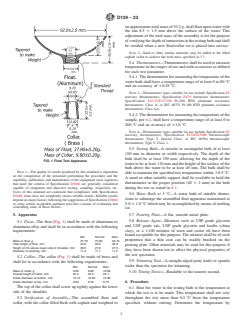
Note 1: The quality of results produced by this standard is dependent on the competence of the personnel performing the procedure and the capability, calibration, and maintenance of the equipment used. Agencies that meet the criteria of Specification D3666 are generally considered capable of competent and objective testing, sampling, inspection, etc. Users of this standard are cautioned that compliance with Specification D3666 alone does not completely ensure reliable results. Reliable results depend on many factors; following the suggestions of Specification D3666 or some similar acceptable guidance provides a means of evaluating and controlling some of those factors.
SCOPE
1.1 This test method covers the float test for asphalt materials.
1.2 The values stated in SI units are to be regarded as standard. No other units of measurement are included in this standard.
1.3 Warning—Mercury has been designated by EPA and many state agencies as a hazardous material that can cause central nervous system, kidney, and liver damage. Mercury, or its vapor, may be hazardous to health and corrosive to materials. Caution should be taken when handling mercury and mercury-containing products. See the applicable product Material Safety Data Sheet (MSDS) for details and EPA’s website (http://www.epa.gov/mercury/faq.htm) for additional information. Users should be aware that selling mercury or mercury-containing products, or both, in your state may be prohibited by state law.
1.4 The text of this standard references notes and footnotes which provide explanatory material. These notes and footnotes (excluding those in tables and figures) shall not be considered as requirements of the standard.
1.5 This standard does not purport to address all of the safety concerns, if any, associated with its use. It is the responsibility of the user of this standard to establish appropriate safety, health, and environmental practices and determine the applicability of regulatory limitations prior to use.
1.6 This international standard was developed in accordance with internationally recognized principles on standardization established in the Decision on Principles for the Development of International Standards, Guides and Recommendations issued by the World Trade Organization Technical Barriers to Trade (TBT) Committee.
- Status
- Published
- Publication Date
- 30-Nov-2023
- Technical Committee
- D04 - Road and Paving Materials
- Drafting Committee
- D04.44 - Rheological Tests

Overview
ASTM D139-23: Standard Test Method for Float Test for Asphalt Materials establishes a widely recognized procedure for determining the consistency and flow characteristics of various asphalt materials. Developed by ASTM, this international standard is vital for evaluating the quality, uniformity, and suitability of asphalt products-particularly those used in road construction and paving. The float test method offers an objective means to measure the behavior of asphalt under controlled conditions, supporting quality assurance and effective supply chain management.
Key Topics
- Consistency of Asphalt Materials: The float test assesses how asphalt materials behave when subjected to a specific temperature, providing a measure of their flow or deformation characteristics.
- Uniformity and Quality Assurance: Results from the float test help verify the consistency of shipments and sources of asphalt supply, supporting procurement and quality control efforts.
- Procedural Precision: The accuracy and reliability of float test results are influenced by the competence of personnel, proper calibration, and maintenance of equipment. It is recommended that laboratories comply with ASTM D3666 requirements for testing and inspection to help ensure reliable outcomes.
- Safety and Environmental Considerations: Cautions are provided regarding the handling of hazardous materials, such as mercury thermometers, and adherence to relevant health and environmental guidelines is emphasized.
- Measurement Standards: The method specifies the exclusive use of SI units for all measurements, fostering consistency and comparability across international contexts.
Applications
ASTM D139-23 is crucial in several practical contexts related to road and infrastructure development:
- Quality Control in Paving Projects: The float test is used by engineers, quality control laboratories, and asphalt producers to evaluate the suitability of asphalt materials for specific applications, helping to ensure consistent pavement performance.
- Material Acceptance and Verification: Agencies and contractors utilize this method to confirm compliance with project specifications and to detect material variability between different shipments or supply sources.
- Research and Development: The standardized approach enables comparative studies of new asphalt formulations and additives, supporting innovation and product improvement.
- Supplier Evaluation: The test results serve as a benchmark for evaluating suppliers, helping owners and contractors make informed sourcing decisions.
Related Standards
Professionals working with ASTM D139-23 may also reference these related standards for comprehensive asphalt material evaluation:
- ASTM D3666: Specification for Minimum Requirements for Agencies Testing and Inspecting Road and Paving Materials
- ASTM D6997: Test Method for Distillation of Emulsified Asphalt
- ASTM E1: Specification for ASTM Liquid-in-Glass Thermometers
- ASTM E230/E230M: Specification for Temperature-Electromotive Force (emf) Tables for Standardized Thermocouples
- ASTM E879: Specification for Thermistor Sensors for General Purpose and Laboratory Temperature Measurements
- ASTM E1137/E1137M: Specification for Industrial Platinum Resistance Thermometers
- IEC 60584: Thermocouples - EMF Specifications and Tolerances
- IEC 60751: Industrial Platinum Resistance Thermometers and Platinum Temperature Sensors
By adhering to ASTM D139-23, stakeholders ensure reliable assessment of asphalt material properties, enhancing the quality and durability of roadways and supporting the efficient functioning of construction and supply operations. This method contributes to international standardization and best practices in pavement engineering.
Relations
- Effective Date
- 01-Dec-2023
- Effective Date
- 01-Feb-2024
- Effective Date
- 01-Jan-2024
- Effective Date
- 01-Nov-2023
- Effective Date
- 01-May-2023
- Effective Date
- 01-Nov-2017
- Effective Date
- 15-Jun-2015
- Effective Date
- 01-Dec-2023
- Effective Date
- 01-Dec-2023
- Effective Date
- 01-Dec-2023
Get Certified
Connect with accredited certification bodies for this standard

DIBt (Deutsches Institut für Bautechnik)
German Institute for Building Technology.
DIN CERTCO
DIN Group product certification.
Zavod za gradbeništvo Slovenije (ZAG) - Inšpekcija
ZAG inspection body for construction products, structures, and materials.
Sponsored listings
Frequently Asked Questions
ASTM D139-23 is a standard published by ASTM International. Its full title is "Standard Test Method for Float Test for Asphalt Materials". This standard covers: SIGNIFICANCE AND USE 4.1 The float test characterizes the flow behavior or consistency of certain asphalt materials. 4.2 This test method is useful in determining the consistency of asphalt as one element in establishing the uniformity of certain shipments or sources of supply. Note 1: The quality of results produced by this standard is dependent on the competence of the personnel performing the procedure and the capability, calibration, and maintenance of the equipment used. Agencies that meet the criteria of Specification D3666 are generally considered capable of competent and objective testing, sampling, inspection, etc. Users of this standard are cautioned that compliance with Specification D3666 alone does not completely ensure reliable results. Reliable results depend on many factors; following the suggestions of Specification D3666 or some similar acceptable guidance provides a means of evaluating and controlling some of those factors. SCOPE 1.1 This test method covers the float test for asphalt materials. 1.2 The values stated in SI units are to be regarded as standard. No other units of measurement are included in this standard. 1.3 Warning—Mercury has been designated by EPA and many state agencies as a hazardous material that can cause central nervous system, kidney, and liver damage. Mercury, or its vapor, may be hazardous to health and corrosive to materials. Caution should be taken when handling mercury and mercury-containing products. See the applicable product Material Safety Data Sheet (MSDS) for details and EPA’s website (http://www.epa.gov/mercury/faq.htm) for additional information. Users should be aware that selling mercury or mercury-containing products, or both, in your state may be prohibited by state law. 1.4 The text of this standard references notes and footnotes which provide explanatory material. These notes and footnotes (excluding those in tables and figures) shall not be considered as requirements of the standard. 1.5 This standard does not purport to address all of the safety concerns, if any, associated with its use. It is the responsibility of the user of this standard to establish appropriate safety, health, and environmental practices and determine the applicability of regulatory limitations prior to use. 1.6 This international standard was developed in accordance with internationally recognized principles on standardization established in the Decision on Principles for the Development of International Standards, Guides and Recommendations issued by the World Trade Organization Technical Barriers to Trade (TBT) Committee.
SIGNIFICANCE AND USE 4.1 The float test characterizes the flow behavior or consistency of certain asphalt materials. 4.2 This test method is useful in determining the consistency of asphalt as one element in establishing the uniformity of certain shipments or sources of supply. Note 1: The quality of results produced by this standard is dependent on the competence of the personnel performing the procedure and the capability, calibration, and maintenance of the equipment used. Agencies that meet the criteria of Specification D3666 are generally considered capable of competent and objective testing, sampling, inspection, etc. Users of this standard are cautioned that compliance with Specification D3666 alone does not completely ensure reliable results. Reliable results depend on many factors; following the suggestions of Specification D3666 or some similar acceptable guidance provides a means of evaluating and controlling some of those factors. SCOPE 1.1 This test method covers the float test for asphalt materials. 1.2 The values stated in SI units are to be regarded as standard. No other units of measurement are included in this standard. 1.3 Warning—Mercury has been designated by EPA and many state agencies as a hazardous material that can cause central nervous system, kidney, and liver damage. Mercury, or its vapor, may be hazardous to health and corrosive to materials. Caution should be taken when handling mercury and mercury-containing products. See the applicable product Material Safety Data Sheet (MSDS) for details and EPA’s website (http://www.epa.gov/mercury/faq.htm) for additional information. Users should be aware that selling mercury or mercury-containing products, or both, in your state may be prohibited by state law. 1.4 The text of this standard references notes and footnotes which provide explanatory material. These notes and footnotes (excluding those in tables and figures) shall not be considered as requirements of the standard. 1.5 This standard does not purport to address all of the safety concerns, if any, associated with its use. It is the responsibility of the user of this standard to establish appropriate safety, health, and environmental practices and determine the applicability of regulatory limitations prior to use. 1.6 This international standard was developed in accordance with internationally recognized principles on standardization established in the Decision on Principles for the Development of International Standards, Guides and Recommendations issued by the World Trade Organization Technical Barriers to Trade (TBT) Committee.
ASTM D139-23 is classified under the following ICS (International Classification for Standards) categories: 91.100.50 - Binders. Sealing materials; 93.080.20 - Road construction materials. The ICS classification helps identify the subject area and facilitates finding related standards.
ASTM D139-23 has the following relationships with other standards: It is inter standard links to ASTM D139-16, ASTM C670-24a, ASTM C670-24, ASTM E230/E230M-23a, ASTM E230/E230M-23, ASTM E230/E230M-17, ASTM C670-15, ASTM D3666-16, ASTM D244-23, ASTM D977-20. Understanding these relationships helps ensure you are using the most current and applicable version of the standard.
ASTM D139-23 is available in PDF format for immediate download after purchase. The document can be added to your cart and obtained through the secure checkout process. Digital delivery ensures instant access to the complete standard document.
Standards Content (Sample)
This international standard was developed in accordance with internationally recognized principles on standardization established in the Decision on Principles for the
Development of International Standards, Guides and Recommendations issued by the World Trade Organization Technical Barriers to Trade (TBT) Committee.
Designation: D139 − 23
Standard Test Method for
Float Test for Asphalt Materials
This standard is issued under the fixed designation D139; the number immediately following the designation indicates the year of
original adoption or, in the case of revision, the year of last revision. A number in parentheses indicates the year of last reapproval. A
superscript epsilon (´) indicates an editorial change since the last revision or reapproval.
1. Scope 2. Referenced Documents
2.1 ASTM Standards:
1.1 This test method covers the float test for asphalt mate-
rials. C670 Practice for Preparing Precision and Bias Statements
for Test Methods for Construction Materials
1.2 The values stated in SI units are to be regarded as
D3666 Specification for Minimum Requirements for Agen-
standard. No other units of measurement are included in this
cies Testing and Inspecting Road and Paving Materials
standard.
D6997 Test Method for Distillation of Emulsified Asphalt
1.3 Warning—Mercury has been designated by EPA and
E1 Specification for ASTM Liquid-in-Glass Thermometers
many state agencies as a hazardous material that can cause
E230/E230M Specification for Temperature-Electromotive
central nervous system, kidney, and liver damage. Mercury, or
Force (emf) Tables for Standardized Thermocouples
its vapor, may be hazardous to health and corrosive to
E879 Specification for Thermistor Sensors for General Pur-
materials. Caution should be taken when handling mercury and
pose and Laboratory Temperature Measurements
mercury-containing products. See the applicable product Ma-
E1137/E1137M Specification for Industrial Platinum Resis-
terial Safety Data Sheet (MSDS) for details and EPA’s website
tance Thermometers
(http://www.epa.gov/mercury/faq.htm) for additional informa-
2.2 IEC Standards:
tion. Users should be aware that selling mercury or mercury-
IEC 60584 Thermocouples—Part 1: EMF Specifications and
containing products, or both, in your state may be prohibited by
Tolerances
state law.
IEC 60751 Industrial Platinum Resistance Thermometers
and Platinum Temperature Sensors
1.4 The text of this standard references notes and footnotes
which provide explanatory material. These notes and footnotes
3. Summary of Test Method
(excluding those in tables and figures) shall not be considered
3.1 A plug of asphalt is cast in a tapered collar. The
as requirements of the standard.
assembled float and collar is then floated in the testing bath at
1.5 This standard does not purport to address all of the
the specified temperature. The time, in seconds, between
safety concerns, if any, associated with its use. It is the
placing the apparatus on the water and the water breaking
responsibility of the user of this standard to establish appro-
through the material shall be taken as a measure of the
priate safety, health, and environmental practices and deter-
consistency of the material under examination.
mine the applicability of regulatory limitations prior to use.
1.6 This international standard was developed in accor-
4. Significance and Use
dance with internationally recognized principles on standard-
4.1 The float test characterizes the flow behavior or consis-
ization established in the Decision on Principles for the
tency of certain asphalt materials.
Development of International Standards, Guides and Recom-
mendations issued by the World Trade Organization Technical
4.2 This test method is useful in determining the consis-
Barriers to Trade (TBT) Committee. tency of asphalt as one element in establishing the uniformity
of certain shipments or sources of supply.
1 2
This test method is under the jurisdiction of ASTM Committee D04 on Road For referenced ASTM standards, visit the ASTM website, www.astm.org, or
and Paving Materials and is the direct responsibility of Subcommittee D04.44 on contact ASTM Customer Service at service@astm.org. For Annual Book of ASTM
Rheological Tests. Standards volume information, refer to the standard’s Document Summary page on
Current edition approved Dec. 1, 2023. Published December 2023. Originally the ASTM website.
approved in 1922. Last previous edition approved in 2016 as D139 – 16. DOI: Available from American National Standards Institute (ANSI), 25 W. 43rd St.,
10.1520/D0139-23. 4th Floor, New York, NY 10036, http://www.ansi.org.
Copyright © ASTM International, 100 Barr Harbor Drive, PO Box C700, West Conshohocken, PA 19428-2959. United States
D139 − 23
an approximate total mass of 53.2 g, shall float upon water with
the rim 8.5 6 1.5 mm above the surface of the water. This
adjustment of the total mass of the assembly is for the purpose
of verifying the depth of immersion in the testing bath and shall
be verified when a new float/collar set is placed into service.
NOTE 2—Sand or other similar materials may be added to the filled
asphalt collar to achieve the total mass specified in 5.3.
5.4 Thermometers—Thermometers shall be used to measure
temperature in the ranges of use and with accuracies as defined
for each test parameter.
5.4.1 The thermometer for measuring the temperature of the
water bath shall have a temperature range of at least 0 to 80 °C
and an accuracy of 60.25 °C.
NOTE 3—Thermometer types suitable for use include Specification E1
mercury thermometers; Specification E879 thermistor thermometer;
Specification E1137/E1137M Pt-100 RTD platinum resistance
thermometer, Class A; or IEC 60751 Pt-100 RTD platinum resistance
thermometer, Class AA.
5.4.2 The thermometer for measuring the temperature of the
sample, per 6.4, shall have a temperature range of at least 0 to
260 °C and an accuracy of 61.0 °C.
NOTE 4—Thermometer types suitable for use include Specification E1
mercury thermometers; Specification E230/E230M thermocouple
thermometer, Type T, Special Class; or IEC 60584 thermocouple
thermometer, Type T, Class 1.
5.5 Testing Bath—A circular or rectangular bath of at least
150 mm in diameter or width respectively. The depth of the
bath shall be at least 150 mm, allowing for the depth of the
FIG. 1 Float Test Apparatus
water to be at least 110 mm and the height of the surface of the
bath above the water to be at least 40 mm. The bath shall be
NOTE 1—The quality of results produced by this standard is dependent
able to maintain the specified test temperature within 60.5 °C.
on the competence of the personnel performing the procedure and the
A stand or other suitable support shall be available to hold the
capability, calibration, and maintenance of the equipment used. Agencies
thermometer in the proper position (40 6 2 mm) in the bath
that meet the criteria of Specification D3666 are generally considered
capable of competent and objective testing, sampling, inspection, etc. during the test as stated in 6.1.
Users of this standard are cautioned that compliance with Specification
5.6 Water Bath at 5 °C—A water bath of suitable dimen-
D3666 alone does not completely ensure reliable results. Reliable results
sions to submerge the assembled float apparatus maintained at
depend on many factors; following the suggestions of Specification D3666
or some similar acceptable guidance provides a means of evaluating and 5.0 6 1.0 °C which may be accomplished by means of melting
controlling so
...
This document is not an ASTM standard and is intended only to provide the user of an ASTM standard an indication of what changes have been made to the previous version. Because
it may not be technically possible to adequately depict all changes accurately, ASTM recommends that users consult prior editions as appropriate. In all cases only the current version
of the standard as published by ASTM is to be considered the official document.
Designation: D139 − 16 D139 − 23
Standard Test Method for
Float Test for BituminousAsphalt Materials
This standard is issued under the fixed designation D139; the number immediately following the designation indicates the year of
original adoption or, in the case of revision, the year of last revision. A number in parentheses indicates the year of last reapproval. A
superscript epsilon (´) indicates an editorial change since the last revision or reapproval.
1. Scope
1.1 This test method covers the float test for bituminousasphalt materials.
1.2 The values stated in SI units are to be regarded as standard. No other units of measurement are included in this standard.
1.3 Warning—Mercury has been designated by EPA and many state agencies as a hazardous material that can cause central
nervous system, kidney, and liver damage. Mercury, or its vapor, may be hazardous to health and corrosive to materials. Caution
should be taken when handling mercury and mercury-containing products. See the applicable product Material Safety Data Sheet
(MSDS) for details and EPA’s website (http://www.epa.gov/mercury/faq.htm) for additional information. Users should be aware
that selling mercury or mercury-containing products, or both, in your state may be prohibited by state law.
1.4 The text of this standard references notes and footnotes which provide explanatory material. These notes and footnotes
(excluding those in tables and figures) shall not be considered as requirements of the standard.
1.5 This standard does not purport to address all of the safety concerns, if any, associated with its use. It is the responsibility
of the user of this standard to establish appropriate safety and healthsafety, health, and environmental practices and determine
the applicability of regulatory limitations prior to use.For a specific precaution statement, see 6.1.
1.6 This international standard was developed in accordance with internationally recognized principles on standardization
established in the Decision on Principles for the Development of International Standards, Guides and Recommendations issued
by the World Trade Organization Technical Barriers to Trade (TBT) Committee.
2. Referenced Documents
2.1 ASTM Standards:
C670 Practice for Preparing Precision and Bias Statements for Test Methods for Construction Materials
D244 Test Methods and Practices for Emulsified Asphalts
D3666 Specification for Minimum Requirements for Agencies Testing and Inspecting Road and Paving Materials
D6997 Test Method for Distillation of Emulsified Asphalt
E1 Specification for ASTM Liquid-in-Glass Thermometers
E230/E230M Specification for Temperature-Electromotive Force (emf) Tables for Standardized Thermocouples
E879 Specification for Thermistor Sensors for General Purpose and Laboratory Temperature Measurements
E1137/E1137M Specification for Industrial Platinum Resistance Thermometers
This test method is under the jurisdiction of ASTM Committee D04 on Road and Paving Materials and is the direct responsibility of Subcommittee D04.44 on Rheological
Tests.
Current edition approved Nov. 15, 2016Dec. 1, 2023. Published December 2016December 2023. Originally approved in 1922. Last previous edition approved in 20122016
as D139 – 12.D139 – 16. DOI: 10.1520/D0139-16.10.1520/D0139-23.
For referenced ASTM standards, visit the ASTM website, www.astm.org, or contact ASTM Customer Service at service@astm.org. For Annual Book of ASTM Standards
volume information, refer to the standard’s Document Summary page on the ASTM website.
Copyright © ASTM International, 100 Barr Harbor Drive, PO Box C700, West Conshohocken, PA 19428-2959. United States
D139 − 23
2.2 IEC Standard:Standards:
IEC 6085460584 Methods of Measuring the Performance of Ultrasonic Pulse-Echo Diagnostic EquipmentThermocouples—Part
1: EMF Specifications and Tolerances
IEC 60751 Industrial Platinum Resistance Thermometers and Platinum Temperature Sensors
3. Summary of Test Method
3.1 A plug of bitumenasphalt is cast in a tapered collar. The assembled float and collar is then floated in the testing bath at the
specified temperature. The time, in seconds, between placing the apparatus on the water and the water breaking through the
material shall be taken as a measure of the consistency of the material under examination.
4. Significance and Use
4.1 The float test characterizes the flow behavior or consistency of certain bituminousasphalt materials.
4.2 This test method is useful in determining the consistency of bitumenasphalt as one element in establishing the uniformity of
certain shipments or sources of supply.
NOTE 1—The quality of results produced by this standard is dependent on the competence of the personnel performing the procedure and the capability,
calibration, and maintenance of the equipment used. Agencies that meet the criteria of Specification D3666 are generally considered capable of competent
and objective testing, sampling, inspection, etc. Users of this standard are cautioned that compliance with Specification D3666 alone does not completely
ensure reliable results. Reliable results depend on many factors; following the suggestions of Specification D3666 or some similar acceptable guidance
provides a means of evaluating and controlling some of those factors.
5. Apparatus
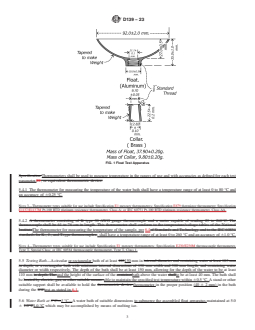
5.1 Float—The float (Fig. 1) shall be made of aluminum or aluminum alloy and shall be in accordance with the following
requirements:
Min Normal Max
Mass of float, g 37.70 37.90 38.10
Total height of float, mm 34.0 35.0 36.0
Height of rim above lower side of shoulder, mm 26.5 27.0 27.5
side of shoulder, mm
Thickness of shoulder, mm 1.3 1.4 1.5
Diameter of opening, mm 11.0 11.1 11.2
5.2 Collar—The collar (Fig. 1) shall be made of brass and shall be in accordance with the following requirements:
Min Normal Max
Mass of collar, g 9.60 9.80 10.00
Over-all height of collar, mm 22.3 22.5 22.7
Overall height of collar, mm 22.3 22.5 22.7
Inside diameter at bottom, mm 12.72 12.82 12.92
Inside diameter at top, mm 9.65 9.70 9.75
The top of the collar shall screw up tightly against the lower side of the shoulder.
5.3 Verification of Assembly—The assembled float and collar, with the collar filled flush with the bottom asphalt and weighted to
a an approximate total mass of 53.2 g, shall float upon water with the rim 8.5 6 1.5 mm above the surface of the water. This
adjustment of the total mass of the assembly is for the purpose only of standardizingverifying the depth of immersion in the testing
bath.bath and shall be verified when a new float/collar set is placed into service.
NOTE 2—Sand or other similar materials may be added to the filled asphalt collar to achieve the total mass specified in 5.3.
5.4 Thermometric Device—Thermometers—An ASTM Low Softening Point Thermometer, graduated in Celsius degrees as
specified, having a range from −2 to +80°C and conforming to the requirements for Thermometer 15C, as prescribed in
Available from American National Standards Institute (ANSI), 25 W. 43rd St., 4th Floor, New York, NY 10036, http://www.ansi.org.
D139 − 23
FIG. 1 Float Test Apparatus
Specification Thermometers shall be used to measure temperature in the ranges of use and with accuracies as defined for each test
parameter.E1, or equivalent thermometric device.
5.4.1 The thermometer for measuring the temperature of the water bath shall have a temperature range of at least 0 to 80 °C and
an accuracy of 60.25 °C.
NOTE 3—Thermometer types suitable for use include Specification E1 mercury thermometers; Specification E879 thermistor thermometer; Specification
E1137/E1137M Pt-100 RTD platinum resistance thermometer, Class A; or IEC 60751 Pt-100 RTD platinum resistance thermometer, Class AA.
5.4.2 A thermometer consisting of K type 30 AWG gauge thermocouple and a meter capable of reading 25 to 260°C. The
thermocouple shall be 61 to 76 cm in length. This thermometer shall conform to the temperature/voltage tables of the National
InstituteThe thermometer for measuring the temperature of the sample, per 6.4of Standards and Technology and to the IEC 60854
standards for K-, J-, and T-type thermocouples., shall have a temperature range of at least 0 to 260 °C and an accuracy of 61.0 °C.
NOTE 4—Thermometer types suitable for use include Specification E1 mercury thermometers; Specification E230/E230M thermocouple thermometer,
Type T, Special Class; or IEC 60584 thermocouple thermometer, Type T, Class 1.
5.5 Testing Bath—A circular or rectangular bath of at least 185150 mm in internal diameter and containing water at least 185 mm
in depth; or a rectangular bath with minimum internal dimensions of 150 mm width and 300 mm length, and containing water
diameter or width respectively. The depth of the bath shall be at least 150 mm, allowing for the depth of the water to be at least
110 mm in depth. The and the height of the surface of the containerbath above the water shallto be at least 40 mm. The bath shall
be heated by electric, gas, or other suitable means. able to maintain the specified test temperature within 60.5 °C. A stand or other
suitable support shall be
...