

ASTM E230/E230M-23a
(Specification)Standard Specification for Temperature-Electromotive Force (emf) Tables for Standardized Thermocouples
General Information
- Abstract
ABSTRACT
This specification contains reference tables that give temperature-electromotive force (emf) relationships for types B, E, J, K, N, R, S, T, and C thermocouples. These are the thermocouple types most commonly used in industry. Thermocouples and matched thermocouple wire pairs are normally supplied to the tolerances on initial values of emf versus temperature. Color codes for insulation on thermocouple grade materials, along with corresponding thermocouple and thermoelement letter designations are given. Four types of tables are presented: general tables, EMF versus temperature tables for thermocouples, EMF versus temperature tables for thermoelements, and supplementary tables.
SCOPE
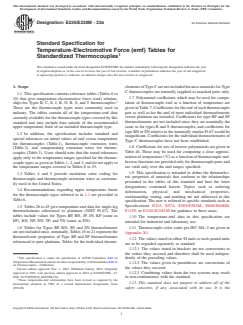
1.1 This specification contains reference tables (Tables 8 to 25) that give temperature-electromotive force (emf) relationships for Types B, C, E, J, K, N, R, S, and T thermocouples.2 These are the thermocouple types most commonly used in industry. The tables contain all of the temperature-emf data currently available for the thermocouple types covered by this standard and may include data outside of the recommended upper temperature limit of an included thermocouple type.
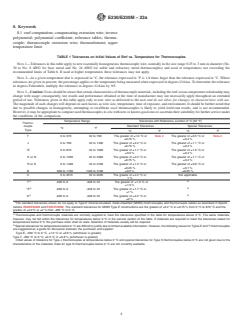
1.2 In addition, the specification includes standard and special tolerances on initial values of emf versus temperature for thermocouples (Table 1), thermocouple extension wires (Table 2), and compensating extension wires for thermocouples (Table 3). Users should note that the stated tolerances apply only to the temperature ranges specified for the thermocouple types as given in Tables 1, 2, and 3, and do not apply to the temperature ranges covered in Tables 8 to 25.
1.3 Tables 4 and 5 provide insulation color coding for thermocouple and thermocouple extension wires as customarily used in the United States.
1.4 Recommendations regarding upper temperature limits for the thermocouple types referred to in 1.1 are provided in Table 6.
1.5 Tables 26 to 45 give temperature-emf data for single-leg thermoelements referenced to platinum (NIST Pt-67). The tables include values for Types BP, BN, JP, JN, KP (same as EP), KN, NP, NN, TP, and TN (same as EN).
1.6 Tables for Types RP, RN, SP, and SN thermoelements are not included since, nominally, Tables 18 to 21 represent the thermoelectric properties of Type RP and SP thermoelements referenced to pure platinum. Tables for the individual thermoelements of Type C are not included because materials for Type C thermocouples are normally supplied as matched pairs only.
1.7 Polynomial coefficients which may be used for computation of thermocouple emf as a function of temperature are given in Table 7. Coefficients for the emf of each thermocouple pair as well as for the emf of most individual thermoelements versus platinum are included. Coefficients for type RP and SP thermoelements are not included since they are nominally the same as for types R and S thermocouples, and coefficients for type RN or SN relative to the nominally similar Pt-67 would be insignificant. Coefficients for the individual thermoelements of Type C thermocouples have not been established.
1.8 Coefficients for sets of inverse polynomials are given in Table 46. These may be used for computing a close approximation of temperature (°C) as a function of thermocouple emf. Inverse functions are provided only for thermocouple pairs and are valid only over the emf ranges specified.
1.9 This specification is intended to define the thermoelectric properties of materials that conform to the relationships presented in the tables of this standard and bear the letter designations contained herein. Topics such as ordering information, physical and mechanical properties, workmanship, testing, and marking are not addressed in this specification. The user is referred to specific standards such as Specifications E235, E574, E585/E585M, E608/E608M, E1159, or E2181/E2181M for guidance in these areas.
1.10 The temperature-emf data in this specifica...
- Status
- Published
- Publication Date
- 31-Oct-2023
- Technical Committee
- E20 - Temperature Measurement
- Drafting Committee
- E20.11 - Thermocouples - Calibration
Buy Documents
ASTM E230/E230M-23a - Standard Specification for Temperature-Electromotive Force (emf) Tables for Standardized Thermocouples
REDLINE ASTM E230/E230M-23a - Standard Specification for Temperature-Electromotive Force (emf) Tables for Standardized Thermocouples
Overview
ASTM E230/E230M-23a is the internationally recognized standard specification developed by ASTM International for temperature-electromotive force (emf) reference tables for standardized thermocouples. The standard provides comprehensive data and guidelines for the most widely used thermocouple types in industry, including Types B, C, E, J, K, N, R, S, and T. By establishing clear relationships between temperature and emf through standardized tables, color codes, and polynomial coefficients, ASTM E230/E230M-23a ensures accuracy and consistency in temperature measurement across diverse industrial and laboratory environments. Adherence to this specification supports global best practices and compliance with the International Temperature Scale of 1990 (ITS-90).
Key Topics
- Temperature-emf Reference Tables: The standard includes detailed tables that document the correlation between temperature and electromotive force for the primary thermocouple types. These are essential for calibration and performance validation.
- Standard and Special Tolerances: Tables define the permitted deviations for emf values at specific temperatures, covering thermocouples, extension wires, and compensating extension wires within specified ranges.
- Insulation Color Codes: The document specifies U.S. customary color codes for thermocouple and extension wire insulation, supporting error-free installation and maintenance.
- Thermoelement Data: Additional tables provide emf data for individual thermoelements referenced to platinum, expanding the standard’s utility for specialized applications.
- Polynomial Coefficients: Polynomial and inverse polynomial coefficients allow users to calculate emf from temperature, or vice versa, facilitating accurate electronic processing and instrument interfacing.
- Upper Temperature Limits: Recommendations guide users on the safe and practical upper temperature limits for different thermocouple types and wire sizes.
- International Alignment: The standard aligns with the requirements of the International Temperature Scale (ITS-90) and references color codes per IEC 584-3.
Applications
ASTM E230/E230M-23a is a critical reference for organizations and professionals involved in:
- Industrial Process Control: Ensures reliable temperature monitoring in manufacturing, chemical processing, metalworking, and other sectors where precision is crucial.
- Calibration Laboratories: Provides a foundation for calibrating thermocouple sensors and instrumentation according to recognized international standards.
- Quality Assurance: Facilitates compliance with industry standards and traceability in temperature measurement for audits and certification.
- Research and Development: Supports experimental setups and development projects requiring repeatable and accurate temperature measurements.
- Product Specification and Procurement: Allows engineers and purchasing teams to specify thermocouple types, tolerances, and color codes clearly in procurement and design documents.
Related Standards
For comprehensive coverage of thermocouple materials, installation, and calibration, users should consult the following ASTM and international standards:
- ASTM E235: Specification for Type K and Type N mineral-insulated, metal-sheathed thermocouples.
- ASTM E574: Specification for duplex, base metal thermocouple wire with glass or silica insulation.
- ASTM E585/E585M: Compacted, mineral-insulated, metal-sheathed base metal thermocouple cable specification.
- ASTM E608/E608M: Specification for mineral-insulated, metal-sheathed base metal thermocouples.
- ASTM E1159: Specification for platinum and platinum-rhodium thermocouple materials.
- ASTM E2181/E2181M: Specification for noble metal thermocouples and cables.
- NIST Monograph 175: Detailed emf tables for letter-designated thermocouples based on ITS-90.
- IEC 584-3: International standard for thermocouple extension and compensating cables' tolerances and colors.
Keywords: ASTM E230, thermocouple reference tables, temperature-emf tables, thermocouple tolerances, color codes, temperature measurement standard, emf computation, thermoelectric properties, calibration standard, ITS-90 compliance, industrial thermocouples, extension wires, compensating extension wires.
Relations
- Effective Date
- 01-Nov-2023
- Effective Date
- 01-Nov-2023
- Effective Date
- 01-Nov-2023
- Effective Date
- 01-Nov-2023
- Effective Date
- 01-Nov-2023
- Effective Date
- 01-Nov-2023
- Effective Date
- 01-Nov-2023
- Effective Date
- 01-Nov-2023
- Effective Date
- 01-Nov-2023
- Effective Date
- 01-Nov-2023
- Effective Date
- 01-Nov-2023
- Referred By
ASTM D5298-16 - Standard Test Method for Measurement of Soil Potential (Suction) Using Filter Paper - Effective Date
- 01-Nov-2023
- Effective Date
- 01-Nov-2023
- Effective Date
- 01-Nov-2023
- Effective Date
- 01-Nov-2023
Buy Documents
ASTM E230/E230M-23a - Standard Specification for Temperature-Electromotive Force (emf) Tables for Standardized Thermocouples
REDLINE ASTM E230/E230M-23a - Standard Specification for Temperature-Electromotive Force (emf) Tables for Standardized Thermocouples
Get Certified
Connect with accredited certification bodies for this standard

BSMI (Bureau of Standards, Metrology and Inspection)
Taiwan's standards and inspection authority.
Sponsored listings
Frequently Asked Questions
ASTM E230/E230M-23a is a technical specification published by ASTM International. Its full title is "Standard Specification for Temperature-Electromotive Force (emf) Tables for Standardized Thermocouples". This standard covers: ABSTRACT This specification contains reference tables that give temperature-electromotive force (emf) relationships for types B, E, J, K, N, R, S, T, and C thermocouples. These are the thermocouple types most commonly used in industry. Thermocouples and matched thermocouple wire pairs are normally supplied to the tolerances on initial values of emf versus temperature. Color codes for insulation on thermocouple grade materials, along with corresponding thermocouple and thermoelement letter designations are given. Four types of tables are presented: general tables, EMF versus temperature tables for thermocouples, EMF versus temperature tables for thermoelements, and supplementary tables. SCOPE 1.1 This specification contains reference tables (Tables 8 to 25) that give temperature-electromotive force (emf) relationships for Types B, C, E, J, K, N, R, S, and T thermocouples.2 These are the thermocouple types most commonly used in industry. The tables contain all of the temperature-emf data currently available for the thermocouple types covered by this standard and may include data outside of the recommended upper temperature limit of an included thermocouple type. 1.2 In addition, the specification includes standard and special tolerances on initial values of emf versus temperature for thermocouples (Table 1), thermocouple extension wires (Table 2), and compensating extension wires for thermocouples (Table 3). Users should note that the stated tolerances apply only to the temperature ranges specified for the thermocouple types as given in Tables 1, 2, and 3, and do not apply to the temperature ranges covered in Tables 8 to 25. 1.3 Tables 4 and 5 provide insulation color coding for thermocouple and thermocouple extension wires as customarily used in the United States. 1.4 Recommendations regarding upper temperature limits for the thermocouple types referred to in 1.1 are provided in Table 6. 1.5 Tables 26 to 45 give temperature-emf data for single-leg thermoelements referenced to platinum (NIST Pt-67). The tables include values for Types BP, BN, JP, JN, KP (same as EP), KN, NP, NN, TP, and TN (same as EN). 1.6 Tables for Types RP, RN, SP, and SN thermoelements are not included since, nominally, Tables 18 to 21 represent the thermoelectric properties of Type RP and SP thermoelements referenced to pure platinum. Tables for the individual thermoelements of Type C are not included because materials for Type C thermocouples are normally supplied as matched pairs only. 1.7 Polynomial coefficients which may be used for computation of thermocouple emf as a function of temperature are given in Table 7. Coefficients for the emf of each thermocouple pair as well as for the emf of most individual thermoelements versus platinum are included. Coefficients for type RP and SP thermoelements are not included since they are nominally the same as for types R and S thermocouples, and coefficients for type RN or SN relative to the nominally similar Pt-67 would be insignificant. Coefficients for the individual thermoelements of Type C thermocouples have not been established. 1.8 Coefficients for sets of inverse polynomials are given in Table 46. These may be used for computing a close approximation of temperature (°C) as a function of thermocouple emf. Inverse functions are provided only for thermocouple pairs and are valid only over the emf ranges specified. 1.9 This specification is intended to define the thermoelectric properties of materials that conform to the relationships presented in the tables of this standard and bear the letter designations contained herein. Topics such as ordering information, physical and mechanical properties, workmanship, testing, and marking are not addressed in this specification. The user is referred to specific standards such as Specifications E235, E574, E585/E585M, E608/E608M, E1159, or E2181/E2181M for guidance in these areas. 1.10 The temperature-emf data in this specifica...
ABSTRACT This specification contains reference tables that give temperature-electromotive force (emf) relationships for types B, E, J, K, N, R, S, T, and C thermocouples. These are the thermocouple types most commonly used in industry. Thermocouples and matched thermocouple wire pairs are normally supplied to the tolerances on initial values of emf versus temperature. Color codes for insulation on thermocouple grade materials, along with corresponding thermocouple and thermoelement letter designations are given. Four types of tables are presented: general tables, EMF versus temperature tables for thermocouples, EMF versus temperature tables for thermoelements, and supplementary tables. SCOPE 1.1 This specification contains reference tables (Tables 8 to 25) that give temperature-electromotive force (emf) relationships for Types B, C, E, J, K, N, R, S, and T thermocouples.2 These are the thermocouple types most commonly used in industry. The tables contain all of the temperature-emf data currently available for the thermocouple types covered by this standard and may include data outside of the recommended upper temperature limit of an included thermocouple type. 1.2 In addition, the specification includes standard and special tolerances on initial values of emf versus temperature for thermocouples (Table 1), thermocouple extension wires (Table 2), and compensating extension wires for thermocouples (Table 3). Users should note that the stated tolerances apply only to the temperature ranges specified for the thermocouple types as given in Tables 1, 2, and 3, and do not apply to the temperature ranges covered in Tables 8 to 25. 1.3 Tables 4 and 5 provide insulation color coding for thermocouple and thermocouple extension wires as customarily used in the United States. 1.4 Recommendations regarding upper temperature limits for the thermocouple types referred to in 1.1 are provided in Table 6. 1.5 Tables 26 to 45 give temperature-emf data for single-leg thermoelements referenced to platinum (NIST Pt-67). The tables include values for Types BP, BN, JP, JN, KP (same as EP), KN, NP, NN, TP, and TN (same as EN). 1.6 Tables for Types RP, RN, SP, and SN thermoelements are not included since, nominally, Tables 18 to 21 represent the thermoelectric properties of Type RP and SP thermoelements referenced to pure platinum. Tables for the individual thermoelements of Type C are not included because materials for Type C thermocouples are normally supplied as matched pairs only. 1.7 Polynomial coefficients which may be used for computation of thermocouple emf as a function of temperature are given in Table 7. Coefficients for the emf of each thermocouple pair as well as for the emf of most individual thermoelements versus platinum are included. Coefficients for type RP and SP thermoelements are not included since they are nominally the same as for types R and S thermocouples, and coefficients for type RN or SN relative to the nominally similar Pt-67 would be insignificant. Coefficients for the individual thermoelements of Type C thermocouples have not been established. 1.8 Coefficients for sets of inverse polynomials are given in Table 46. These may be used for computing a close approximation of temperature (°C) as a function of thermocouple emf. Inverse functions are provided only for thermocouple pairs and are valid only over the emf ranges specified. 1.9 This specification is intended to define the thermoelectric properties of materials that conform to the relationships presented in the tables of this standard and bear the letter designations contained herein. Topics such as ordering information, physical and mechanical properties, workmanship, testing, and marking are not addressed in this specification. The user is referred to specific standards such as Specifications E235, E574, E585/E585M, E608/E608M, E1159, or E2181/E2181M for guidance in these areas. 1.10 The temperature-emf data in this specifica...
ASTM E230/E230M-23a is classified under the following ICS (International Classification for Standards) categories: 17.200.20 - Temperature-measuring instruments. The ICS classification helps identify the subject area and facilitates finding related standards.
ASTM E230/E230M-23a has the following relationships with other standards: It is inter standard links to ASTM E230/E230M-23, ASTM E574-23, ASTM E207-21, ASTM E585/E585M-23, ASTM D139-23, ASTM D7820-19, ASTM D7840-12(2017), ASTM D3161/D3161M-20, ASTM C113-14(2019), ASTM D5869/D5869M-07a(2023), ASTM C372-94(2020), ASTM D5298-16, ASTM D7873-22a, ASTM D5931-20, ASTM E235/E235M-23. Understanding these relationships helps ensure you are using the most current and applicable version of the standard.
ASTM E230/E230M-23a is available in PDF format for immediate download after purchase. The document can be added to your cart and obtained through the secure checkout process. Digital delivery ensures instant access to the complete standard document.
Standards Content (Sample)
This international standard was developed in accordance with internationally recognized principles on standardization established in the Decision on Principles for the
Development of International Standards, Guides and Recommendations issued by the World Trade Organization Technical Barriers to Trade (TBT) Committee.
Designation: E230/E230M − 23a An American National Standard
Standard Specification for
Temperature-Electromotive Force (emf) Tables for
Standardized Thermocouples
This standard is issued under the fixed designation E230/E230M; the number immediately following the designation indicates the year
of original adoption or, in the case of revision, the year of last revision. A number in parentheses indicates the year of last reapproval.
A superscript epsilon (´) indicates an editorial change since the last revision or reapproval.
1. Scope elements of Type C are not included because materials for Type
C thermocouples are normally supplied as matched pairs only.
1.1 This specification contains reference tables (Tables 8 to
1.7 Polynomial coefficients which may be used for compu-
25) that give temperature-electromotive force (emf) relation-
tation of thermocouple emf as a function of temperature are
ships for Types B, C, E, J, K, N, R, S, and T thermocouples.
given in Table 7. Coefficients for the emf of each thermocouple
These are the thermocouple types most commonly used in
pair as well as for the emf of most individual thermoelements
industry. The tables contain all of the temperature-emf data
versus platinum are included. Coefficients for type RP and SP
currently available for the thermocouple types covered by this
thermoelements are not included since they are nominally the
standard and may include data outside of the recommended
same as for types R and S thermocouples, and coefficients for
upper temperature limit of an included thermocouple type.
type RN or SN relative to the nominally similar Pt-67 would be
1.2 In addition, the specification includes standard and
insignificant. Coefficients for the individual thermoelements of
special tolerances on initial values of emf versus temperature
Type C thermocouples have not been established.
for thermocouples (Table 1), thermocouple extension wires
1.8 Coefficients for sets of inverse polynomials are given in
(Table 2), and compensating extension wires for thermo-
Table 46. These may be used for computing a close approxi-
couples (Table 3). Users should note that the stated tolerances
mation of temperature (°C) as a function of thermocouple emf.
apply only to the temperature ranges specified for the thermo-
Inverse functions are provided only for thermocouple pairs and
couple types as given in Tables 1, 2, and 3, and do not apply to
are valid only over the emf ranges specified.
the temperature ranges covered in Tables 8 to 25.
1.9 This specification is intended to define the thermoelec-
1.3 Tables 4 and 5 provide insulation color coding for
tric properties of materials that conform to the relationships
thermocouple and thermocouple extension wires as customar-
presented in the tables of this standard and bear the letter
ily used in the United States.
designations contained herein. Topics such as ordering
1.4 Recommendations regarding upper temperature limits
information, physical and mechanical properties,
for the thermocouple types referred to in 1.1 are provided in
workmanship, testing, and marking are not addressed in this
Table 6.
specification. The user is referred to specific standards such as
Specifications E235, E574, E585/E585M, E608/E608M,
1.5 Tables 26 to 45 give temperature-emf data for single-leg
E1159, or E2181/E2181M for guidance in these areas.
thermoelements referenced to platinum (NIST Pt-67). The
tables include values for Types BP, BN, JP, JN, KP (same as
1.10 The temperature-emf data in this specification are
EP), KN, NP, NN, TP, and TN (same as EN).
intended for industrial and laboratory use.
1.6 Tables for Types RP, RN, SP, and SN thermoelements
1.11 Thermocouple color codes per IEC 584–3 are given in
are not included since, nominally, Tables 18 to 21 represent the
Appendix X1.
thermoelectric properties of Type RP and SP thermoelements
1.12 The values stated in either SI units or inch-pound units
referenced to pure platinum. Tables for the individual thermo-
are to be regarded separately as standard.
1.12.1 The values stated in brackets are not conversions to
the values they succeed and therefore shall be used indepen-
This specification is under the jurisdiction of ASTM Committee E20 on
dently of the preceding values.
Temperature Measurement and are the direct responsibility of Subcommittee E20.11
1.12.2 The values given in parentheses are conversions of
on Thermocouples - Calibration.
the values they succeed.
Current edition approved Nov. 1, 2023. Published January 2024. Originally
1.12.3 Combining values from the two systems may result
approved in 1963. Last previous edition approved in 2023 as E230/E230M – 23.
DOI: 10.1520/E0230_E0230M-23A.
in non-conformance with the standard.
These temperature-emf relationships have been revised as required by the
1.13 This standard does not purport to address all of the
international adoption in 1989 of a revised International Temperature Scale
(ITS-90). safety concerns, if any, associated with its use. It is the
Copyright © ASTM International, 100 Barr Harbor Drive, PO Box C700, West Conshohocken, PA 19428-2959. United States
E230/E230M − 23a
responsibility of the user of this standard to establish appro- are satisfactory for most industrial uses but may not be
priate safety, health, and environmental practices and deter- adequate for computer and similar applications. If greater
mine the applicability of regulatory limitations prior to use. precision is required, the reader should refer to NIST Mono-
1.14 This international standard was developed in accor- graph 175 which includes tables giving emf values to four
dance with internationally recognized principles on standard- decimal places (0.1 μV) for each type except Type C. Equa-
ization established in the Decision on Principles for the tions which permit easy and unique generation of the
Development of International Standards, Guides and Recom- temperature-emf relationships can be found in Table 7. For
mendations issued by the World Trade Organization Technical convenience, coefficients of inverse polynomials that may be
Barriers to Trade (TBT) Committee. used to calculate approximate temperature (°C) as a function of
thermocouple emf are given in Table 46.
2. Referenced Documents
4. Thermocouple Types and Letter Designations
2.1 ASTM Standards:
4.1 The letter symbols identifying each reference table are
E235 Specification for Type K and Type N Mineral-
those which are in common use throughout industry and
Insulated, Metal-Sheathed Thermocouples for Nuclear or
identify the following thermocouple calibrations:
for Other High-Reliability Applications
4.1.1 Type B—Platinum-30 % rhodium (+) versus platinum-
E574 Specification for Duplex, Base Metal Thermocouple
6 % rhodium (−).
Wire With Glass Fiber or Silica Fiber Insulation
4.1.2 Type E—Nickel-10 % chromium (+) versus copper-
E585/E585M Specification for Compacted Mineral-
45 % nickel (constantan) (−).
Insulated, Metal-Sheathed, Base Metal Thermocouple
4.1.3 Type J—Iron (+) versus copper-45 % nickel (constan-
Cable
tan) (−).
E608/E608M Specification for Mineral-Insulated, Metal-
4.1.4 Type K—Nickel-10 % chromium (+) versus nickel-
Sheathed Base Metal Thermocouples
5 % (aluminum, silicon) (−).
E1159 Specification for Thermocouple Materials, Platinum-
Rhodium Alloys, and Platinum
NOTE 2—Silicon, or aluminum and silicon, may be present in combi-
E2181/E2181M Specification for Compacted Mineral-
nation with other elements.
Insulated, Metal-Sheathed, Noble Metal Thermocouples
4.1.5 Type N—Nickel-14 % chromium, 1.5 % silicon (+)
and Thermocouple Cable
versus nickel-4.5 % silicon-0.1 % magnesium (−).
2.2 NIST Monograph:
4.1.6 Type R—Platinum-13 % rhodium (+) versus platinum
NIST Monograph 175 Temperature-Electromotive Force
(−).
Reference Functions and Tables for the Letter-Designated
4.1.7 Type S—Platinum-10 % rhodium (+) versus platinum
Thermocouple Types Based on the ITS-90
(−).
2.3 IEC Standard:
4.1.8 Type T—Copper (+) versus copper-45 % nickel (con-
IEC 584–3 Thermocouples – Part 3: Extension and Compen-
stantan) (−).
sating Cables Tolerances and Identification System, 1989
4.1.9 Type C—Tungsten-5 % Rhenium (+) versus Tungsten-
26 % Rhenium (−).
3. Source of Data
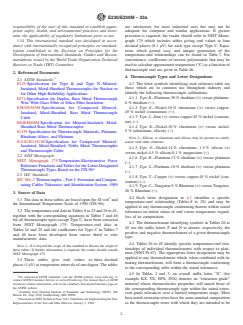
4.2 Each letter designation in 4.1 identifies a specific
3.1 The data in these tables are based upon the SI volt and
temperature-emf relationship (Tables 8 to 25) and may be
the International Temperature Scale of 1990 (ITS-90).
applied to any thermocouple conforming thereto within stated
3.2 The temperature-emf data in Tables 8 to 23 and 26 to 45,
tolerances on initial values of emf versus temperature, regard-
together with the corresponding equations in Tables 7 and 46
less of its composition.
for all thermocouple types except Type C, have been extracted
4.3 The thermoelement identifying symbols in Tables 26 to
from NIST Monograph 175. Temperature-emf data in
45 use the suffix letters P and N to denote, respectively, the
Tables 24 and 25 and the coefficients for Type C in Tables 7
positive and negative thermoelement of a given thermocouple
and 46 have been developed from curves fitted to wire
type.
manufacturers’ data.
4.4 Tables 26 to 45 identify specific temperature-emf rela-
NOTE 1—It is beyond the scope of this standard to discuss the origin of
tionships of individual thermoelements with respect to plati-
these tables. If further information is required, the reader should consult
num (NIST Pt-67). The appropriate letter designation may be
NIST Monograph 175.
applied to any thermoelement which, when combined with its
3.3 These tables give emf values to three decimal
mating thermoelement, will form a thermocouple conforming
places (1 μV) at temperature intervals of one degree. The tables
to the corresponding table within the stated tolerances.
4.5 In Tables 2 and 3, an overall suffix letter “X” (for
For referenced ASTM standards, visit the ASTM website, www.astm.org, or
example KX, TX, EPX, JNX) denotes an “extension grade”
contact ASTM Customer Service at service@astm.org. For Annual Book of ASTM
material whose thermoelectric properties will match those of
Standards volume information, refer to the standard’s Document Summary page on
the ASTM website.
the corresponding thermocouple type within the stated exten-
Available from National Institute of Standards and Technology (NIST), 100
sion grade tolerances over a limited temperature range. Most
Bureau Dr., Stop 1070, Gaithersburg, MD 20899.
base metal extension wires have the same nominal composition
Discussed in NIST Technical Note 1263, Guidelines for Implementing the New
Representations of the Volt and Ohm Effective January 1, 1990. as the thermocouple wires with which they are intended to be
E230/E230M − 23a
used, whereas the compensating extension wires for noble 7. List of Tables
metal or refractory metal thermocouple types (S, R, B, or C)
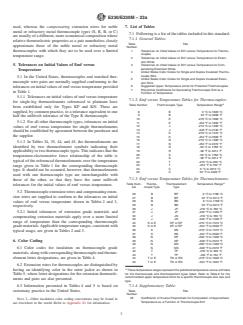
7.1 Following is a list of the tables included in this standard:
are usually of a different, more economical composition whose
7.1.1 General Tables:
relative thermoelectric properties as a pair nonetheless closely
Table Title
approximate those of the noble metal or refractory metal
Number
thermocouples with which they are to be used over a limited
1 Tolerances on Initial Values of Emf versus Temperature for Thermo-
couples
temperature range.
2 Tolerances on Initial Values of Emf versus Temperature for Exten-
sion Wires
5. Tolerances on Initial Values of Emf versus 3 Tolerances on Initial Values of Emf versus Temperature for Com-
pensating Extension Wires
Temperature
4 United States Color Codes for Single and Duplex Insulated Thermo-
couple Wire
5.1 In the United States, thermocouples and matched ther-
5 United States Color Codes for Single and Duplex Insulated Exten-
mocouple wire pairs are normally supplied conforming to the
sion Wire
6 Suggested Upper Temperature Limits for Protected Thermocouples
tolerances on initial values of emf versus temperature provided
7 Polynomial Coefficients for Generating Thermocouple Emf as a
in Table 1.
Function of Temperature
5.1.1 Tolerances on initial values of emf versus temperature
7.1.2 Emf versus Temperature Tables for Thermocouples:
for single-leg thermoelements referenced to platinum have
A
Table Number Thermocouple Type Temperature Range
been established only for Types KP and KN. These are
supplied, by common practice, to a tolerance equivalent to one
8 B 0 °C to 1820 °C
9 B 32 °F to 3308 °F
half the millivolt tolerance of the Type K thermocouple.
10 E -270 °C to 1000 °C
5.1.2 For all other thermocouple types, tolerances on initial
11 E -454 °F to 1832 °F
12 J -210 °C to 1200 °C
values of emf versus temperature for single thermoelements
13 J -346 °F to 2192 °F
should be established by agreement between the purchaser and
14 K -270 °C to 1372 °C
the supplier.
15 K -454 °F to 2500 °F
16 N -270 °C to 1300 °C
5.1.3 In Tables 34, 35, 44, and 45, the thermoelements are
17 N -454 °F to 2372 °F
identified by two thermoelement symbols indicating their
18 R -50 °C to 1768 °C
19 R -58 °F to 3214 °F
applicability to two thermocouple types. This indicates that the
20 S -50 °C to 1768 °C
temperature-electromotive force relationship of the table is
21 S -58 °F to 3214 °F
typical of the referenced thermoelements over the temperature
22 T -270 °C to 400 °C
23 T -454 °F to 752 °F
range given in Table 1 for the corresponding thermocouple
24 C 0 °C to 2315 °C
type. It should not be assumed, however, that thermoelements
25 C 32 °F to 4200 °F
used with one thermocouple type are interchangeable with
7.1.3 Emf versus Temperature Tables for Thermoelements:
those of the other, or that they have the same millivolt
A
Table Num- Thermo- Thermoelement Temperature Range
tolerances for the initial values of emf versus temperature.
ber couple Type Type
5.2 Thermocouple extension wires and compensating exten-
26 B BP 0 °C to 1768 °C
sion wires are supplied to conform to the tolerances on initial
27 B BP 32 °F to 3214 °F
28 B BN 0 °C to 1768 °C
values of emf versus temperature shown in Tables 2 and 3,
29 B BN 32 °F to 3214 °F
respectively.
30 J JP -210 °C to 760 °C
5.2.1 Initial tolerances of extension grade materials and 31 J JP -346 °F to 1400 °F
32 J JN -210 °C to 760 °C
compensating extension materials apply over a more limited
33 J JN -346 °F to 1400 °F
range of temperature than the corresponding thermocouple
34 K or E KP or EP -270 °C to 1372 °C
grade materials. Applicable temperature ranges, consistent with 35 K or E KP or EP -454 °F to 2500 °F
36 K KN -270 °C to 1372 °C
typical usage, are given in Tables 2 and 3.
37 K KN -454 °F to 2500 °F
38 N NP -200 °C to 1300 °C
6. Color Coding 39 N NP -328 °F to 2372 °F
40 N NN -200 °C to 1300 °C
6.1 Color codes for insulation on thermocouple grade 41 N NN -328 °F to 2372 °F
42 T TP -270 °C to 400 °C
materials, along with corresponding thermocouple and thermo-
43 T TP -454 °F to 752 °F
element letter designations, are given in Table 4.
44 T or E TN or EN -270 °C to 1000 °C
45 T or E TN or EN -454 °F to 1832 °F
6.2 Extension wires for thermocouples are distinguished by
A
having an identifying color in the outer jacket as shown in
These temperature ranges represent the published temperature versus emf data
for the thermocouple and thermoelement types listed. Refer to Table 6 for the
Table 5, where letter designations for the extension thermoele-
recommended upper temperature limits for a specific thermocouple wire size and
ments and pairs are also presented.
type.
7.1.4 Supplementary Table:
6.3 Information presented in Tables 4 and 5 is based on
customary practice in the United States. Table Title
Number
46 Coefficients of Inverse Polynomials for Computation of Approximate
NOTE 3—Other insulation color coding conventions may be found in
Temperature as a Function of Thermocouple Emf
use elsewhere in the world. Refer to Appendix X1 for information.
E230/E230M − 23a
8. Keywords
8.1 emf computation; compensating extension wire; inverse
polynomial; polynomial coefficient; reference tables; thermo-
couple; thermocouple extension wire; thermoelement; upper
temperature limit
TABLE 1 Tolerances on Initial Values of Emf vs. Temperature for Thermocouples
NOTE 1—Tolerances in this table apply to new essentially homogeneous thermocouple wire, normally in the size range 0.25 to 3 mm in diameter (No.
30 to No. 8 AWG for base metal and No. 24 AWG for noble and refractory metal thermocouples) and used at temperatures not exceeding the
recommended limits of Table 6. If used at higher temperatures these tolerances may not apply.
NOTE 2—At a given temperature that is expressed in °C, the tolerance expressed in °F is 1.8 times larger than the tolerance expressed in °C. Where
tolerances are given in percent, the percentage applies to the temperature being measured when expressed in degrees Celsius. To determine the tolerance
in degrees Fahrenheit, multiply the tolerance in degrees Celsius by 9/5.
NOTE 3—Caution: Users should be aware that certain characteristics of thermocouple materials, including the emf-versus-temperature relationship may
change with usage; consequently, test results and performance obtained at the time of manufacture may not necessarily apply throughout an extended
period of use. Tolerances given in this table apply only to new wire as delivered to the user and do not allow for changes in characteristics with use.
The magnitude of such changes will depend on such factors as wire size, temperature, time of exposure, and environment. It should be further noted that
due to possible changes in homogeneity, attempting to recalibrate used thermocouples is likely to yield irrelevant results, and is not recommended.
However, it may be appropriate to compare used thermocouples in-situ with new or known good ones to ascertain their suitability for further service under
the conditions of the comparison.
Temperature Range Tolerances with Reference Junction 0 °C [32 °F]
Thermo-
couple Standard Tolerances Special Tolerances
°C °F
Type
°C °F °C °F
T 0 to 370 32 to 700 The greater of ±1.0 °C or Note 2 The greater of ±0.5 °C or Note 2
±0.75 % ±0.4 %
J 0 to 760 32 to 1400 The greater of ±2.2 °C or The greater of ±1.1 °C or
±0.75 % ±0.4 %
*E 0 to 870 32 to 1600 The greater of ±1.7 °C or The greater of ±1.0 °C or
±0.5 % ±0.4 %
K or N 0 to 1260 32 to 2300 The greater of ±2.2 °C or The greater of ±1.1 °C or
±0.75 % ±0.4 %
R or S 0 to 1480 32 to 2700 The greater of ±1.5 °C or The greater of ±0.6 °C or
±0.25 % ±0.1 %
B 600 to 1700 1100 to 3100 ±0.5 % ±0.25 %
C 0 to 2315 32 to 4200 The greater of ±4.4 °C or Not applicable
1 %
A B
T -200 to 0 -328 to 32 The greater of ±1.0 °C or
±1.5 %
A B
*E -200 to 0 -328 to 32 The greater of ±1.7 °C or
±1 %
A B
K -200 to 0 -328 to 32 The greater of ±2.2 °C or
±2 %
*The standard tolerances shown do not apply to Type E mineral-insulated, metal-sheathed (MIMS) thermocouples and thermocouple cables as described in Specifi-
cations E608/E608M and E585/E585M. The standard tolerances for MIMS Type E constructions are the greater of ±2.2 °C or ±0.75 % from 0 °C to 870 °C and the
greater of ±2.2°C or ±2 % from -200 °C to 0 °C.
A
Thermocouples and thermocouple materials are normally supplied to meet the tolerances specified in the table for temperatures above 0 °C. The same materials,
however, may not fall within the tolerances for temperatures below 0 °C in the second section of the table. If materials are required to meet the tolerances stated for
temperatures below 0 °C the purchase order shall so state. Selection of materials usually will be required.
B
Special tolerances for temperatures below 0 °C are difficult to justify due to limited available information. However, the following values for Types E and T thermocouples
are suggested as a guide for discussion between the purchaser and supplier:
Type E, -200 °C to 0 °C, ±1.0 °C or ±0.5 % (whichever is greater)
Type T, -200 °C to 0 °C, ±0.5 °C or ±0.8 % (whichever is greater)
Initial values of tolerance for Type J thermocouples at temperatures below 0 °C and special tolerances for Type K thermocouples below 0 °C are not given due to the
characteristics of the materials. Data for type N thermocouples below 0 °C are not currently available.
E230/E230M − 23a
TABLE 2 Tolerances on Initial Values of Emf vs. Temperature for Extension Wires
NOTE 1—Tolerances in this table represent the maximum error contribution allowable from new and essentially homogeneous thermocouple extension
wire when exposed to the full temperature range given in the table below. Extension grade materials are not intended for use outside the temperature range
shown.
NOTE 2—Thermocouple extension wire makes a contribution to the thermocouple circuit output that is dependent upon the temperature difference
between the extreme ends of the extension wire length.
Tolerances—Reference Junction 0 °C [32 °F]
Temperature Range Standard Tolerances Special Tolerances
Thermocouple
Type
°C [°F] °C [°F] °C [°F]
TX -60 to 100 -75 to 200 ±1.0 ±1.8 ±0.5 ±0.9
JX 0 to 200 32 to 400 ±2.2 ±4.0 ±1.1 ±2.0
EX 0 to 200 32 to 400 ±1.7 ±3.0 ±1.0 ±1.8
KX 0 to 200 32 to 400 ±2.2 ±4.0 ±1.1 ±2.0
NX 0 to 200 32 to 400 ±2.2 ±4.0 ±1.1 ±2.0
TABLE 3 Tolerances on Initial Values of Emf vs. Temperature for Compensating Extension Wires
NOTE 1—Tolerances in this table apply to new and essentially homogeneous thermocouple compensating extension wire when used at temperatures
within the range given in the table below.
NOTE 2—Thermocouple compensating extension wire makes a contribution to the thermocouple circuit output that is dependent upon the temperature
difference between the extreme ends of the compensating extension wire length.
Tolerances—Reference Junction 0 °C [32 °F]
Temperature Range Standard Tolerances Special Tolerances
Thermocouple
Type
°C [°F] °C [°F]
A
SX 0 to 200 32 to 400 ±5 ±9
A
RX 0 to 200 32 to 400 ±5 ±9
B A
BX 0 to 200 32 to 400 ±4.2 ±7.6
C
B 0 to 100 32 to 200 ±3.7 ±6.7 .
CX 0 to 200 32 to 400 Initial Calibration Tolerance
±0.110 mV
A
Special tolerance grade compensating extension wires are not available.
B
Proprietary alloy compensating extension wire is available for use over a wide temperature range.
C
Special compensating extension wires are not necessary with Type B over the limited temperature range 0 °C to 50 °C [32 °F to 122 °F], where the use of
non-compensated (copper/copper) conductors introduces no significant error. For a somewhat larger temperature gradient of 0 °C to 100 °C [32 °F to 212 °F] across the
extension portion of the circuit, the use of non-compensated (copper/copper) extension wires may result in small errors, the magnitude of which will not exceed the
tolerances given for measurements above 1000 °C [1800 °F].
TABLE 4 United States Color Codes for Single and Duplex Insulated Thermocouple Wire
NOTE 1—Data in this table represents customary practice in the United States of America. Different color code conventions may be in use in other parts
of the world.
NOTE 2—For some types of insulations, colors may appear as a stripe or trace strand. High temperature braided insulations are normally supplied
without color coding.
NOTE 3—The noble metal thermocouples are not normally supplied with colored insulations. However, if they were so furnished, the color codes for
the corresponding single wire extensions would apply, with a brown overall jacket, where applicable.
Thermocouple Type Thermoelement Designation Individual Conductor Color Overall Jacket Color
T Brown
TP (+) Blue
TN (−) Red
J Brown
JP (+) White
JN (−) Red
E Brown
EP (+) Purple
EN (−) Red
K Brown
KP (+) Yellow
KN (−) Red
N Brown
NP (+) Orange
NN (−) Red
E230/E230M − 23a
TABLE 5 United States Color Codes for Single and Duplex Insulated Extension Wire
NOTE 1—Data in this table represents customary practice in the United States of America. Different color code conventions may be in use in other parts
of the world.
NOTE 2—For some types of insulations, colors may appear as a stripe or trace strand. High temperature braided insulations are normally supplied
without color coding.
Thermocouple Type Thermoelement Designation Individual Conductor Color Overall Jacket Color
TX Blue
TPX (+) Blue
TNX (−) Red, or Red/Blue Trace
JX Black
JPX (+) White
JNX (−) Red, or Red/Black Trace
EX Purple
EPX (+) Purple
ENX (−) Red, or Red/Purple Trace
KX Yellow
KPX (+) Yellow
KNX (−) Red, or Red/Yellow Trace
NX Orange
NPX (+) Orange
NNX (−) Red, or Red/Orange Trace
A
RX or SX Green
RPX/SPX (+) Black
RNX/SNX (−) Red, or Red/Black Trace
B
BX Gray
BPX (+) Gray
BNX (−) Red, or Red/Gray Trace
CX Red
CPX (+) Green
CNX (−) Red
A
Type R and S thermocouples utilize the same extension alloys.
B
Color code shown is applicable to constructions incorporating proprietary Type B compensating extension alloy wires. When uncompensated (copper/copper) extension
materials are used with Type B thermocouples, the extension wire insulation is not normally color coded.
TABLE 6 Suggested Upper Temperature Limits for Protected Thermocouples
NOTE 1—This table provides the recommended upper temperature limits for the various thermocouple types and wire sizes. These limits apply to
protected thermocouples, that is, thermocouples in conventional closed-end protecting tubes. They do not apply to compacted, mineral-insulated,
metal-sheathed thermocouples.
NOTE 2—The temperature limits given here are intended only as a guide to the user and they should not be taken as absolute values nor as guarantees
of satisfactory service life or performance. These types and sizes may be used at temperatures above the stated limits, but usually at the expense of stability
or service life or both. In some instances, it may be necessary to reduce the temperature limits in order to achieve satisfactory performance in service.
A
ASTM MNL-12 and other literature sources should be consulted for additional applications information.
Upper Temperature limit for Various Wire Sizes, °C [°F]
No. 8 AWG No. 14 AWG No. 20 AWG No. 24 AWG No. 28 AWG No. 30 AWG
Thermo-
(3.25 mm (1.63 mm (0.81 mm (0.51 mm (0.33 mm (0.25 mm
couple Type
[0.128 in.]) [0.064 in.]) [0.032 in.]) [0.020 in.]) [0.013 in.]) [0.010 in.])
T 370 [700] 260 [500] 200 [400] 200 [400] 150 [300]
J 760 [1400] 590 [1100] 480 [900] 370 [700] 370 [700] 320 [600]
E 870 [1600] 650 [1200] 540 [1000] 430 [800] 430 [800] 370 [700]
K and N 1260 [2300] 1090 [2000] 980 [1800] 870 [1600] 870 [1600] 760 [1400]
C
R and S 1480 [2700]
C
B 1700 [3100]
B C
C 2315 [4200]
A
Manual on the Use of Thermocouples in Temperature Measurement, ASTM MNL-12, 1993.
B
Type C thermoelements are not suitable for use in the presence of oxygen; therefore, protection for these thermocouples must provide an inert or non-oxidizing
environment.
C
No. 24 AWG thermoelements are common for this thermocouple type, but other sizes are available and, with adequate protection, are generally useable over the same
temperature range.
E230/E230M − 23a
TABLE 7 Polynomial Coefficients for Generating Thermocouple Emf as a Function of Temperature
NOTE 1—The following table contains sets of polynomial coefficients used to compute emfs for the various types of thermocouples and for their
individual thermoelements paired with Pt–67, when reference junctions are at 0 °C.
2 3 n
NOTE 2—The coefficients given are for an expression of the form: E = c + c t + c t + c t . + c t . In this expression, E is in millivolts, t is in °C,
0 1 2 3 n
and c , c , c . c are the coefficients given in the following table. For the Type K thermocouple and the Type KN thermoelement, coefficients b and
0 1 2 n 0
b 2
1(t − 126.9686)
b for an exponential term containing e, the natural logarithm base, also appear in the table. This term is of the form: b e and, where given,
1 0
it is to be evaluated and added to the polynomial result.
NOTE 3—If emf values on another temperature scale are desired, first convert the desired temperature to its equivalent in °C, then evaluate the
appropriate polynomial from the table below using the °C equivalent temperature.
TYPE B Thermocouple
0 °C 630.615 °C
Temperature
to to
Range
630.615 °C 1820 °C
c = 0.0 –3.893 816 862 1 .
–4 –2
c = –2.465 081 834 6 × 10 2.857 174 747 0 × 10
–6 –5
c = 5.904 042 117 1 × 10 –8.488 510 478 5 × 10
–9 –7
c = –1.325 793 163 6 × 10 1.578 528 016 4 × 10
–12 –10
c = 1.566 829 190 1 × 10 –1.683 534 486 4 × 10
–15 –13
c = –1.694 452 924 0 × 10 1.110 979 401 3 × 10
–19 –17
c = 6.299 034 709 4 × 10 –4.451 543 103 3 × 10
–21
c = 9.897 564 082 1 × 10
–25
c = –9.379 133 028 9 × 10
TYPE E Thermocouple
–270 °C 0 °C
Temperature
to to
Range
0 °C 1000 °C
c = 0.0 0.0
–2 –2
c = 5.866 550 870 8 × 10 5.866 550 871 0 × 10
–5 –5
c = 4.541 097 712 4 × 10 4.503 227 558 2 × 10
–7 –8
c = –7.799 804 868 6 × 10 2.890 840 721 2 × 10
–8 –10
c = –2.580 016 084 3 × 10 –3.305 689 665 2 × 10
–10 –13
c = –5.945 258 305 7 × 10 6.502 440 327 0 × 10
–12 –16
c = –9.321 405 866 7 × 10 –1.919 749 550 4 × 10
–13 –18
c = –1.028 760 553 4 × 10 –1.253 660 049 7 × 10
–16 –21
c = –8.037 012 362 1 × 10 2.148 921 756 9 × 10
–18 –24
c = –4.397 949 739 1 × 10 –1.438 804 178 2 × 10
–20 –28
c = –1.641 477 635 5 × 10 3.596 089 948 1 × 10
–23
c = –3.967 361 951 6 × 10
–26
c = –5.582 732 872 1 × 10
–29
c = –3.465 784 201 3 × 10
TYPE J Thermocouple
–210 °C 760 °C
Temperature
to to
Range
760 °C 1200 °C
c = 0.0 2.964 562 568 1 × 10
–2
c = 5.038 118 781 5 × 10 –1.497 612 778 6 .
–5 –3
c = 3.047 583 693 0 × 10 3.178 710 392 4 × 10
–8 –6
c = –8.568 106 572 0 × 10 –3.184 768 670 1 × 10
–10 –9
c = 1.322 819 529 5 × 10 1.572 081 900 4 × 10
–13 –13
c = –1.705 295 833 7 × 10 –3.069 136 905 6 × 10
–16
c = 2.094 809 069 7 × 10
–19
c = –1.253 839 533 6 × 10
–23
c = 1.563 172 569 7 × 10
TYPE K Thermocouple
–270 °C 0 °C
Temperature
to to
Range
0 °C 1372 °C
–2
c = 0.0 –1.760 041 368 6 × 10
–2 –2
c = 3.945 012 802 5 × 10 3.892 120 497 5 × 10
–5 –5
c = 2.362 237 359 8 × 10 1.855 877 003 2 × 10
–7 –8
c = –3.285 890 678 4 × 10 –9.945 759 287 4 × 10
–9 –10
c = –4.990 482 877 7 × 10 3.184 094 571 9 × 10
–11 –13
c = –6.750 905 917 3 × 10 –5.607 284 488 9 × 10
–13 –16
c = –5.741 032 742 8 × 10 5.607 505 905 9 × 10
–15 –19
c = –3.108 887 289 4 × 10 –3.202 072 000 3 × 10
–17 –23
c = –1.045 160 936 5 × 10 9.715 114 715 2 × 10
–20 –26
c = –1.988 926 687 8 × 10 –1.210 472 127 5 × 10
–23
c = –1.632 269 748 6 × 10
–1
Exponential Coefficients b = 1.185 976 × 10
–4
See Note 2 b = –1.183 432 × 10
TYPE N Thermocouple
–270 °C 0 °C
Temperature
to to
Range
0 °C 1300 °C
E230/E230M − 23a
TABLE 7 Continued
c = 0.0 0.0
–2 –2
c = 2.615 910 596 2 × 10 2.592 939 460 1 × 10
–5 –5
c = 1.095 748 422 8 × 10 1.571 014 188 0 × 10
–8 –8
c = –9.384 111 155 4 × 10 4.382 562 723 7 × 10
–11 –10
c = –4.641 203 975 9 × 10 –2.526 116 979 4 × 10
–12 –13
c = –2.630 335 771 6 × 10 6.431 181 933 9 × 10
–14 –15
c = –2.265 343 800 3 × 10 –1.006 347 151 9 × 10
–17 –19
c = –7.608 930 079 1 × 10 9.974 533 899 2 × 10
–20 –22
c = –9.341 966 783 5 × 10 –6.086 324 560 7 × 10
–25
c = 2.084 922 933 9 × 10
–29
c = –3.068 219 615 1 × 10
TYPE R Thermocouple
–50 °C 1064.18 °C 1664.5 °C
Temperature
to to to
Range
1064.18 °C 1664.5 °C 1768.1 °C
c = 0.0 2.951 579 253 16 . 1.522 321 182 09 × 10
–3 –3 –1
c = 5.289 617 297 65 × 10 –2.520 612 513 32 × 10 –2.688 198 885 45 × 10
–5 –5 –4
c = 1.391 665 897 82 × 10 1.595 645 018 65 × 10 1.712 802 804 71 × 10
–8 –9 –8
c = –2.388 556 930 17 × 10 –7.640 859 475 76 × 10 –3.458 957 064 53 × 10
–11 –12
c = 3.569 160 010 63 × 10 2.053 052 910 24 × 10 –9.346 339 710 46 × 10
–15
–16
c = –4.623 476 662 98 × 10 –2.933 596 681 73 × 10
–14
–17
c = 5.007 774 410 34 × 10
c = –3.731 058 861 91 × 10
–20
–23
c = 1.577 164 823 67 × 10
c = –2.810 386 252 51 × 10
–27
TYPE S Thermocouple
–50 °C 1064.18 °C 1664.5 °C
Temperature
to to to
Range
1064.18 °C 1664.5 °C 1768.1 °C
c = 0.0 1.329 004 440 85 . 1.466 282 326 36 × 10
–3 –3 –1
c = 5.403 133 086 31 × 10 3.345 093 113 44 × 10 –2.584 305 167 52 × 10
–5 –6 –4
c = 1.259 342 897 40 × 10 6.548 051 928 18 × 10 1.636 935 746 41 × 10
–8 –9 –8
c = –2.324 779 686 89 × 10 –1.648 562 592 09 × 10 –3.304 390 469 87 × 10
–11 –14
c = 3.220 288 230 36 × 10 1.299 896 051 74 × 10 –9.432 236 906 12 × 10
–15
c = –3.314 651 963 89 × 10
–14
–17
c = 2.557 442 517 86 × 10
c = –1.250 688 713 93 × 10
–20
–24
c = 2.714 431 761 45 × 10
TYPE T Thermocouple
–270 °C 0 °C
Temperature
to to
Range
0 °C 400 °C
c = 0.0 0.0
–2 –2
c = 3.874 810 636 4 × 10 3.874 810 636 4 × 10
–5 –5
c = 4.419 443 434 7 × 10 3.329 222 788 0 × 10
–7 –7
c = 1.184 432 310 5 × 10 2.061 824 340 4 × 10
–8 –9
c = 2.003 297 355 4 × 10 –2.188 225 684 6 × 10
–10 –11
c = 9.013 801 955 9 × 10 1.099 688 092 8 × 10
–11 –14
c = 2.265 115 659 3 × 10 –3.081 575 877 2 × 10
–13 –17
c = 3.607 115 420 5 × 10 4.547 913 529 0 × 10
–15 –20
c = 3.849 393 988 3 × 10 –2.751 290 167 3 × 10
–17
c = 2.821 352 192 5 × 10
–19
c = 1.425 159 477 9 × 10
–22
c = 4.876 866 228 6 × 10
–24
c = 1.079 553 927 0 × 10
–27
c = 1.394 502 706 2 × 10
–31
c = 7.979 515 392 7 × 10
TYPE C Coefficients
t = 0 °C to 2315 °C
0 °C to 630.615 °C 630.615 °C to 2315 °C
–1
c = 0.0000000 4.0528823 × 10
–2 –2
c = 1.3406032 × 10 1.1509355 × 10
–5 –5
c = 1.1924992 × 10 1.5696453 × 10
–9 –8
c = -7.9806354 × 10 –1.3704412 × 10
–12 –12
c = -5.0787515 × 10 5.2290873 × 10
–14 –16
c = 1.3164197 × 10 –9.2082758 × 10
–18 –20
c = -7.9197332 × 10 4.5245112 × 10
TYPE BP Thermoelement vs. Platinum (NIST Pt–67)
E230/E230M − 23a
TABLE 7 Continued
0 °C 630.615 °C
Temperature
to to
Range
630.615 °C 1768.1 °C
c = 0.0 –7.968 043 228 2 .
–3 –2
c = 4.822 787 568 7 × 10 6.394 111 021 3 × 10
–5 –4
c = 1.565 116 570 9 × 10 –1.710 242 141 0 × 10
–8 –7
c = –2.223 379 788 2 × 10 3.055 578 252 7 × 10
–11 –10
c = 2.833 324 407 4 × 10 –3.210 574 449 2 × 10
–14 –13
c = –2.025 894 044 7 × 10 2.090 910 279 4 × 10
–18 –17
c = 6.148 870 509 6 × 10 –8.233 582 542 6 × 10
–20
c = 1.782 284 151 5 × 10
–24
c = –1.618 707 418 7 × 10
TYPE BN Thermoelement vs. Platinum (NIST Pt–67)
0 °C 630.615 °C
Temperature
to to
Range
630.615 °C 1768.1 °C
c = 0.0 –4.074 226 366 2 .
–3 –2
c = 5.069 295 752 2 × 10 3.536 936 274 3 × 10
–6 –5
c = 9.747 123 592 0 × 10 –8.613 910 931 5 × 10
–8 –7
c = –2.090 800 471 8 × 10 1.477 050 236 2 × 10
–11 –10
c = 2.676 641 488 3 × 10 –1.527 039 962 9 × 10
–14 –14
c = –1.856 448 752 3 × 10 9.799 308 780 5 × 10
–18 –17
c = 5.518 967 038 6 × 10 –3.782 039 439 3 × 10
–21
c = 7.925 277 432 8 × 10
–25
c = –6.807 941 157 8 × 10
TYPE JP Thermoelement vs. Platinum (NIST Pt–67)
–210 °C
Temperature
to
Range
760 °C
c = 0.0
–2
c = 1.791 354 855 9 × 10
–6
c = 4.677 466 335 8 × 10
–8
c = –7.122 599 299 1 × 10
–10
c = 1.335 212 501 6 × 10
–13
c = –1.500 896 263 9 × 10
–16
c = 1.551 431 962 5 × 10
–20
c = –7.950 357 212 5 × 10
–24
c = 2.429 790 391 0 × 10
Platinum (NIST Pt–67) vs. TYPE JN Thermoelement
–210 °C
Temperature
to
Range
760 °C
c = 0.0
–2
c = 3.246 763 925 6 × 10
–5
c = 2.579 837 059 4 × 10
–8
c = –1.445 507 273 0 × 10
–12
c = –1.239 297 209 3 × 10
–14
c = –2.043 995 698 0 × 10
–17
c = 5.433 771 071 8 × 10
–20
c = –4.588 038 123 5 × 10
–23
c = 1.320 193 530 6 × 10
TYPE KP or EP Thermoelement vs. Platinum (NIST Pt–67)
–270 °C 0 °C
Temperature
to to
Range
0 °C 1372 °C
c = 0.0 0.0
–2 –2
c = 2.581 195 057 4 × 10 2.581 195 057 3 × 10
–5 –5
c = 2.299 008 894 3 × 10 2.683 139 535 5 × 10
–7 –8
c = –6.157 475 446 0 × 10 –3.867 519 441 2 × 10
–8 –11
c = –2.327 184 376 5 × 10 3.030 555 323 4 × 10
–10 –14
c = –5.457 033 359 6 × 10 –1.028 040 353 3 × 10
–12 –17
c = –7.845 394 226 4 × 10 –3.448 171 733 0 × 10
–14 –20
c = –7.251 284 060 8 × 10 8.251 289 448 0 × 10
–16 –23
c = –4.356 917 479 1 × 10 –7.889 338 217 7 × 10
–18 –26
c = –1.664 752 760 6 × 10 3.569 925 312 6 × 10
–21 –30
c = –3.737 720 750 1 × 10 –6.331 536 065 9 × 10
–24
c = –3.774 144 269 5 × 10
–27
c = 1.002 535 559 0 × 10
–30
c = 3.893 531 072 5 × 10
Platinum (NIST Pt–67) vs. TYPE KN Thermoelement
–270 °C 0 °C
Temperature
to to
Range
0 °C 1372 °C
–2
c = 0.0 –1.760 041 368 6 × 10
–2 –2
c = 1.363 817 745 2 × 10 1.310 925 440 3 × 10
–7 –6
c = 6.322 846 542 6 × 10 –8.272 625 323 0 × 10
E230/E230M − 23a
TABLE 7 Continued
–7 –8
c = 2.871 584 767 6 × 10 –6.078 239 846 2 × 10
–8 –10
c = 1.828 136 088 7 × 10 2.881 039 039 6 × 10
–10 –13
c = 4.781 942 767 9 × 10 –5.504 480 453 6 × 10
–12 –16
c = 7.271 290 952 1 × 10 5.952 323 079 2 × 10
–14 –19
c = 6.940 395 331 9 × 10 –4.027 200 945 1 × 10
–16 –22
c = 4.252 401 385 5 × 10 1.760 445 293 3 × 10
–18 –26
c = 1.644 863 493 8 × 10 –4.780 397 440 1 × 10
–21 –30
c = 3.721 398 052 6 × 10 6.331 536 065 9 × 10
–24
c = 3.774 144 269 5 × 10
–27
c = –1.002 535 559 0 × 10
–30
c = –3.893 531 072 5 × 10
–1
Exponential Coefficients b = 1.185 976 × 10
–4
See Note 2 b = –1.183 432 × 10
TYPE NP Thermoelement vs. Platinum (NIST Pt–67)
–200 °C 0 °C
Temperature
to to
Range
0 °C 1300 °C
c = 0.0 0.0
–2 –2
c = 1.541 798 843 0 × 10 1.544 538 594 7 × 10
–5 –5
c = 2.570 738 245 7 × 10 2.672 234 128 9 × 10
–8 –8
c = –9.018 782 577 1 × 10 –2.559 531 305 2 × 10
–10 –11
c = –5.365 479 300 5 × 10 –3.302 809 741 4 × 10
–12 –13
c = –3.352 621 597 6 × 10 2.007 532 297 1 × 10
–15 –16
c = –7.272 344 767 0 × 10 –4.270 815 423 0 × 10
–19
c = 5.181 347 352 2 × 10
–22
c = –3.688 712 493 1 × 10
–25
c = 1.426 873 470 8 × 10
–29
c = –2.312 130 215 4 × 10
Platinum (NIST Pt–67) vs. TYPE NN Thermoelement
–200 °C 0 °C
Temperature
to to
Range
0 °C 1300 °C
c = 0.0 0.0
–2 –2
c = 1.074 111 753 2 × 10 1.048 400 865 5 × 10
–5 –5
c = –1.474 989 822 9 × 10 –1.101 219 940 9 × 10
–9 –8
c = –3.653 285 783 2 × 10 6.942 094 028 9 × 10
–10 –10
c = 4.901 358 902 9 × 10 –2.195 836 005 3 × 10
–13 –13
c = 7.222 858 260 4 × 10 4.423 649 636 8 × 10
–14 –16
c = –1.538 109 323 6 × 10 –5.792 656 096 4 × 10
–17 –19
c = –7.608 930 079 1 × 10 4.793 186 547 0 × 10
–20 –22
c = –9.341 966 783 5 × 10 –2.397 612 067 6 × 10
–26
c = 6.580 494 631 8 × 10
–30
c = –7.560 893 996 5 × 10
TYPE TP Thermoelement vs. Platinum (NIST Pt–67)
–270 °C 0 °C
Temperature
to to
Range
0 °C 400 °C
c = 0.0 0.0
–3 –3
c = 5.894 548 229 7 × 10 5.894 548 226 5 × 10
–5 –5
c = 2.177 354 616 7 × 10 1.509 134 765 2 × 10
–7 –7
c = 2.826 761 733 1 × 10 1.385 988 324 2 × 10
–8 –9
c = 2.256 129 063 2 × 10 –1.827 351 164 9 × 10
–10 –11
c = 9.502 026 902 0 × 10 1.033 635 649 1 × 10
–11 –14
c = 2.412 716 823 3 × 10 –3.065 826 553 4 × 10
–13 –17
c = 3.910 747 567 8 × 10 4.681 530 823 5 × 10
–15 –20
c = 4.217 403 476 6 × 10 –2.974 071 681 2 × 10
–17 –24
c = 3.094 671 890 4 × 10 1.474 503 431 3 × 10
–19 –28
c = 1.551 930 033 9 × 10 –3.659 405 308 7 × 10
–22
c = 5.235 860 981 1 × 10
–24
c = 1.136 383 791 3 × 10
–27
c = 1.433 054 079 2 × 10
–31
c = 7.979 515 392 7 × 10
Platinum (NIST Pt–67) vs. TYPE TN or EN Thermoelement
–270 °C 0 °C
Temperature
to to
Range
0 °C 1000 °C
c = 0.0 0.0
–2 –2
c = 3.285 355 813 4 × 10 3.285 355 813 8 × 10
–5 –5
c = 2.242 088 818 1 × 10 1.820 088 022 7 × 10
–7 –8
c = –1.642 329 422 6 × 10 6.758 360 162 4 × 10
–9 –10
c = –2.528 317 078 0 × 10 –3.608 745 197 5 × 10
–11 –13
c = –4.882 249 460 9 × 10 6.605 244 362 3 × 10
–12 –16
c = –1.476 011 640 4 × 10 –1.574 932 377 1 × 10
–14 –18
c = –3.036 321 473 1 × 10 –1.336 172 944 2 × 10
–16 –21
c = –3.680 094 883 0 × 10 2.227 815 139 1 × 10
–18 –24
c = –2.733 196 978 5 × 10 –1.474 503 431 3 × 10
E230/E230M − 23a
TABLE 7 Continued
–20 –28
c = –1.267 705 560 5 × 10 3.659 405 308 7 × 10
–23
c = –3.589 947 524 7 × 10
–26
c = –5.682 986 428 0 × 10
–29
c = –3.855 137 308 5 × 10
E230/E230M − 23a
TABLE 8 Type B Thermocouple
Type B
Temperature in Degrees Celsius (ITS–90)
Reference Junctions at 0 °C
°C 0 1 2 3 4 5 6 7 8 9 10
Thermoelectric Voltage (emf) in Millivolts
0 0.000 –0.000 –0.000 –0.001 –0.001 –0.001 –0.001 –0.001 –0.002 –0.002 –0.002
10 –0.002 –0.002 –0.002 –0.002 –0.002 –0.002 –0.002 –0.002 –0.003 –0.003 –0.003
20 –0.003 –0.003 –0.003 –0.003 –0.003 –0.002 –0.002 –0.002 –0.002 –0.002 –0.002
30 –0.002 –0.002 –0.002 –0.002 –0.002 –0.001 –0.001 –0.001 0.001 –0.001 –0.000
40 –0.000 –0.000 –0.000 0.000 0.000 0.001 0.001 0.001 0.002 0.002 0.002
50 0.002 0.003 0.003 0.003 0.004 0.004 0.004 0.005 0.005 0.006 0.006
60 0.006 0.007 0.007 0.008 0.008 0.009 0.009 0.010 0.010 0.011 0.011
70 0.011 0.012 0.012 0.013 0.014 0.014 0.015 0.015 0.016 0.017 0.017
80 0.017 0.018 0.019 0.020 0.020 0.021 0.022 0.022 0.023 0.024 0.025
90 0.025 0.026 0.026 0.027 0.028 0.029 0.030 0.031 0.031 0.032 0.033
100 0.033 0.034 0.035 0.036 0.037 0.038 0.039 0.040 0.041 0.042 0.043
110 0.043 0.044 0.045 0.046 0.047 0.048 0.049 0.050 0.051 0.052 0.053
120 0.053 0.055 0.056 0.057 0.058 0.059 0.060 0.062 0.063 0.064 0.065
130 0.065 0.066 0.068 0.069 0.070 0.072 0.073 0.074 0.075 0.077 0.078
140 0.078 0.079 0.081 0.082 0.084 0.085 0.086 0.088 0.089 0.091 0.092
150 0.092 0.094 0.095 0.096 0.098 0.099 0.101 0.102 0.104 0.106 0.107
160 0.107 0.109 0.110 0.112 0.113 0.115 0.117 0.118 0.120 0.122 0.123
170 0.123 0.125 0.127 0.128 0.130 0.132 0.134 0.135 0.137 0.139 0.141
180 0.141 0.142 0.144 0.146 0.148 0.150 0.151 0.153 0.155 0.157 0.159
190 0.159 0.161 0.163 0.165 0.166 0.168 0.170 0.172 0.174 0.176 0.178
200 0.178 0.180 0.182 0.184 0.186 0.188 0.190 0.192 0.195 0.197 0.199
210 0.199 0.201 0.203 0.205 0.207 0.209 0.212 0.214 0.216 0.218 0.220
220 0.220 0.222 0.225 0.227 0.229 0.231 0.234 0.236 0.238 0.241 0.243
230 0.243 0.245 0.248 0.250 0.252 0.255 0.257 0.259 0.262 0.264 0.267
240 0.267 0.269 0.271 0.274 0.276 0.279 0.281 0.284 0.286 0.289 0.291
250 0.291 0.294 0.296 0.299 0.301 0.304 0.307 0.309 0.312 0.314 0.317
260 0.317 0.320 0.322 0.325 0.328 0.330 0.333 0.336 0.338 0.341 0.344
270 0.344 0.347 0.349 0.352 0.355 0.358 0.360 0.363 0.366 0.369 0.372
280 0.372 0.375 0.377 0.380 0.383 0.386 0.389 0.392 0.395 0.398 0.401
290 0.401 0.404 0.407 0.410 0.413 0.416 0.419 0.422 0.425 0.428 0.431
300 0.431 0.434 0.437 0.440 0.443 0.446 0.449 0.452 0.455 0.458 0.462
310 0.462 0.465 0.468 0.471 0.474 0.478 0.481 0.484 0.487 0.490 0.494
320 0.494 0.497 0.500 0.503 0.507 0.510 0.513 0.517 0.520 0.523 0.527
330 0.527 0.530 0.533 0.537 0.540 0.544 0.547 0.550 0.554 0.557 0.561
340 0.561 0.564 0.568 0.571 0.575 0.578 0.582 0.585 0.589 0.592 0.596
350 0.596 0.599 0.603 0.607 0.610 0.614 0.617 0.621 0.625 0.628 0.632
360 0.632 0.636 0.639 0.643 0.647 0.650 0.654 0.658 0.662 0.665 0.669
370 0.669 0.673 0.677 0.680 0.684 0.688 0.692 0.696 0.700 0.703 0.707
380 0.707 0.711 0.715 0.719 0.723 0.727 0.731 0.735 0.738 0.742 0.746
390 0.746 0.750 0.754 0.758 0.762 0.766 0.770 0.774 0.778 0.782 0.787
400 0.787 0.791 0.795 0.799 0.803 0.807 0.811 0.815 0.819 0.824 0.828
410 0.828 0.832 0.836 0.840 0.844 0.849 0.853 0.857 0.861 0.866 0.870
420 0.870 0.874 0.878 0.883 0.887 0.891 0.896 0.900 0.904 0.909 0.913
430 0.913 0.917 0.922 0.926 0.930 0.935 0.939 0.944 0.948 0.953 0.957
440 0.957 0.961 0.966 0.970 0.975 0.979 0.984 0.988 0.993 0.997 1.002
450 1.002 1.007 1.011 1.016 1.020 1.025 1.030 1.034 1.039 1.043 1.048
460 1.048 1.053 1.057 1.062 1.067 1.071 1.076 1.081 1.086 1.090 1.095
470 1.095 1.100 1.105 1.109 1.114 1.119 1.124 1.129 1.133 1.138 1.143
480 1.143 1.148 1.153 1.158 1.163 1.167 1.172 1.177 1.182 1.187 1.192
490 1.192 1.197 1.202 1.207 1.212 1.217 1.222 1.227 1.232 1.237 1.242
500 1.242 1.247 1.252 1.257 1.262 1.267 1.272 1.277 1.282 1.288 1.293
510 1.293 1.298 1.303 1.308 1.313 1.318 1.324 1.329 1.334 1.339 1.344
520 1.344 1.350 1.355 1.360 1.365 1.371 1.376 1.381 1.387 1.392 1.397
530 1.397 1.402 1.408 1.413 1.418 1.424 1.429 1.435 1.440 1.445 1.451
540 1.451 1.456 1.462 1.467 1.472 1.478 1.483 1.489 1.494 1.500 1.505
550 1.505 1.511 1.516 1.522 1.527 1.533 1.539 1.544 1.550 1.555 1.561
560 1.561 1.566 1.572 1.578 1.583 1.589 1.595 1.600 1.506 1.612 1.617
570 1.617 1.623 1.629 1.634 1
...
This document is not an ASTM standard and is intended only to provide the user of an ASTM standard an indication of what changes have been made to the previous version. Because
it may not be technically possible to adequately depict all changes accurately, ASTM recommends that users consult prior editions as appropriate. In all cases only the current version
of the standard as published by ASTM is to be considered the official document.
Designation: E230/E230M − 23 E230/E230M − 23a An American National Standard
Standard Specification for
Temperature-Electromotive Force (emf) Tables for
Standardized Thermocouples
This standard is issued under the fixed designation E230/E230M; the number immediately following the designation indicates the year
of original adoption or, in the case of revision, the year of last revision. A number in parentheses indicates the year of last reapproval.
A superscript epsilon (´) indicates an editorial change since the last revision or reapproval.
1. Scope
1.1 This specification contains reference tables (Tables 8 to 25) that give temperature-electromotive force (emf) relationships for
Types B, C, E, J, K, N, R, S, and T thermocouples. These are the thermocouple types most commonly used in industry. The tables
contain all of the temperature-emf data currently available for the thermocouple types covered by this standard and may include
data outside of the recommended upper temperature limit of an included thermocouple type.
1.2 In addition, the specification includes standard and special tolerances on initial values of emf versus temperature for
thermocouples (Table 1), thermocouple extension wires (Table 2), and compensating extension wires for thermocouples (Table 3).
Users should note that the stated tolerances apply only to the temperature ranges specified for the thermocouple types as given in
Tables 1, 2, and 3, and do not apply to the temperature ranges covered in Tables 8 to 25.
1.3 Tables 4 and 5 provide insulation color coding for thermocouple and thermocouple extension wires as customarily used in the
United States.
1.4 Recommendations regarding upper temperature limits for the thermocouple types referred to in 1.1 are provided in Table 6.
1.5 Tables 26 to 45 give temperature-emf data for single-leg thermoelements referenced to platinum (NIST Pt-67). The tables
include values for Types BP, BN, JP, JN, KP (same as EP), KN, NP, NN, TP, and TN (same as EN).
1.6 Tables for Types RP, RN, SP, and SN thermoelements are not included since, nominally, Tables 18 to 21 represent the
thermoelectric properties of Type RP and SP thermoelements referenced to pure platinum. Tables for the individual thermoelements
of Type C are not included because materials for Type C thermocouples are normally supplied as matched pairs only.
1.7 Polynomial coefficients which may be used for computation of thermocouple emf as a function of temperature are given in
Table 7. Coefficients for the emf of each thermocouple pair as well as for the emf of most individual thermoelements versus
platinum are included. Coefficients for type RP and SP thermoelements are not included since they are nominally the same as for
types R and S thermocouples, and coefficients for type RN or SN relative to the nominally similar Pt-67 would be insignificant.
Coefficients for the individual thermoelements of Type C thermocouples have not been established.
This specification is under the jurisdiction of ASTM Committee E20 on Temperature Measurement and are the direct responsibility of Subcommittee E20.11 on
Thermocouples - Calibration.
Current edition approved May 1, 2023Nov. 1, 2023. Published January 2024. Originally approved in 1963. Last previous edition approved in 20172023 as
E230/E230M – 17.E230/E230M – 23. DOI: 10.1520/E0230_E0230M-23.10.1520/E0230_E0230M-23A.
These temperature-emf relationships have been revised as required by the international adoption in 1989 of a revised International Temperature Scale (ITS-90).
Copyright © ASTM International, 100 Barr Harbor Drive, PO Box C700, West Conshohocken, PA 19428-2959. United States
E230/E230M − 23a
1.8 Coefficients for sets of inverse polynomials are given in Table 46. These may be used for computing a close approximation
of temperature (°C) as a function of thermocouple emf. Inverse functions are provided only for thermocouple pairs and are valid
only over the emf ranges specified.
1.9 This specification is intended to define the thermoelectric properties of materials that conform to the relationships presented
in the tables of this standard and bear the letter designations contained herein. Topics such as ordering information, physical and
mechanical properties, workmanship, testing, and marking are not addressed in this specification. The user is referred to specific
standards such as Specifications E235, E574, E585/E585M, E608/E608M, E1159, or E2181/E2181M for guidance in these areas.
1.10 The temperature-emf data in this specification are intended for industrial and laboratory use.
1.11 Thermocouple color codes per IEC 584–3 are given in Appendix X1.
1.12 The values stated in either SI units or inch-pound units are to be regarded separately as standard.
1.12.1 The values stated in brackets are not conversions to the values they succeed and therefore shall be used independently of
the preceding values.
1.12.2 The values given in parentheses are conversions of the values they succeed.
1.12.3 Combining values from the two systems may result in non-conformance with the standard.
1.13 This standard does not purport to address all of the safety concerns, if any, associated with its use. It is the responsibility
of the user of this standard to establish appropriate safety, health, and environmental practices and determine the applicability of
regulatory limitations prior to use.
1.14 This international standard was developed in accordance with internationally recognized principles on standardization
established in the Decision on Principles for the Development of International Standards, Guides and Recommendations issued
by the World Trade Organization Technical Barriers to Trade (TBT) Committee.
2. Referenced Documents
2.1 ASTM Standards:
E235 Specification for Type K and Type N Mineral-Insulated, Metal-Sheathed Thermocouples for Nuclear or for Other
High-Reliability Applications
E574 Specification for Duplex, Base Metal Thermocouple Wire With Glass Fiber or Silica Fiber Insulation
E585/E585M Specification for Compacted Mineral-Insulated, Metal-Sheathed, Base Metal Thermocouple Cable
E608/E608M Specification for Mineral-Insulated, Metal-Sheathed Base Metal Thermocouples
E1159 Specification for Thermocouple Materials, Platinum-Rhodium Alloys, and Platinum
E2181/E2181M Specification for Compacted Mineral-Insulated, Metal-Sheathed, Noble Metal Thermocouples and Thermo-
couple Cable
2.2 NIST Monograph:
NIST Monograph 175 Temperature-Electromotive Force Reference Functions and Tables for the Letter-Designated Thermo-
couple Types Based on the ITS-90
2.3 IEC Standard:
IEC 584–3 Thermocouples – Part 3: Extension and Compensating Cables Tolerances and Identification System, 1989
3. Source of Data
3.1 The data in these tables are based upon the SI volt and the International Temperature Scale of 1990 (ITS-90).
3.2 The temperature-emf data in Tables 8 to 23 and 26 to 45, together with the corresponding equations in Tables 7 and 46 for all
For referenced ASTM standards, visit the ASTM website, www.astm.org, or contact ASTM Customer Service at service@astm.org. For Annual Book of ASTM Standards
volume information, refer to the standard’s Document Summary page on the ASTM website.
Available from National Institute of Standards and Technology (NIST), 100 Bureau Dr., Stop 1070, Gaithersburg, MD 20899.
Discussed in NIST Technical Note 1263, Guidelines for Implementing the New Representations of the Volt and Ohm Effective January 1, 1990.
E230/E230M − 23a
thermocouple types except Type C, have been extracted from NIST Monograph 175. Temperature-emf data in Tables 24 and 25
and the coefficients for Type C in Tables 7 and 46 have been developed from curves fitted to wire manufacturers’ data.
NOTE 1—It is beyond the scope of this standard to discuss the origin of these tables. If further information is required, the reader should consult NIST
Monograph 175.
3.3 These tables give emf values to three decimal places (1 μV) at temperature intervals of one degree. The tables are
satisfactory for most industrial uses but may not be adequate for computer and similar applications. If greater precision is required,
the reader should refer to NIST Monograph 175 which includes tables giving emf values to four decimal places (0.1 μV) for each
type except Type C. Equations which permit easy and unique generation of the temperature-emf relationships can be found in
Table 7. For convenience, coefficients of inverse polynomials that may be used to calculate approximate temperature (°C) as a
function of thermocouple emf are given in Table 46.
4. Thermocouple Types and Letter Designations
4.1 The letter symbols identifying each reference table are those which are in common use throughout industry and identify the
following thermocouple calibrations:
4.1.1 Type B—Platinum-30 % rhodium (+) versus platinum-6 % rhodium (−).
4.1.2 Type E—Nickel-10 % chromium (+) versus copper-45 % nickel (constantan) (−).
4.1.3 Type J—Iron (+) versus copper-45 % nickel (constantan) (−).
4.1.4 Type K—Nickel-10 % chromium (+) versus nickel-5 % (aluminum, silicon) (−).
NOTE 2—Silicon, or aluminum and silicon, may be present in combination with other elements.
4.1.5 Type N—Nickel-14 % chromium, 1.5 % silicon (+) versus nickel-4.5 % silicon-0.1 % magnesium (−).
4.1.6 Type R—Platinum-13 % rhodium (+) versus platinum (−).
4.1.7 Type S—Platinum-10 % rhodium (+) versus platinum (−).
4.1.8 Type T—Copper (+) versus copper-45 % nickel (constantan) (−).
4.1.9 Type C—Tungsten-5 % Rhenium (+) versus Tungsten-26 % Rhenium (−).
4.2 Each letter designation in 4.1 identifies a specific temperature-emf relationship (Tables 8 to 25) and may be applied to any
thermocouple conforming thereto within stated tolerances on initial values of emf versus temperature, regardless of its
composition.
4.3 The thermoelement identifying symbols in Tables 26 to 45 use the suffix letters P and N to denote, respectively, the positive
and negative thermoelement of a given thermocouple type.
4.4 Tables 26 to 45 identify specific temperature-emf relationships of individual thermoelements with respect to platinum (NIST
Pt-67). The appropriate letter designation may be applied to any thermoelement which, when combined with its mating
thermoelement, will form a thermocouple conforming to the corresponding table within the stated tolerances.
4.5 In Tables 2 and 3, an overall suffix letter “X” (for example KX, TX, EPX, JNX) denotes an “extension grade” material whose
thermoelectric properties will match those of the corresponding thermocouple type within the stated extension grade tolerances
over a limited temperature range. Most base metal extension wires have the same nominal composition as the thermocouple wires
with which they are intended to be used, whereas the compensating extension wires for noble metal or refractory metal
thermocouple types (S, R, B, or C) are usually of a different, more economical composition whose relative thermoelectric
properties as a pair nonetheless closely approximate those of the noble metal or refractory metal thermocouples with which they
are to be used over a limited temperature range.
E230/E230M − 23a
5. Tolerances on Initial Values of Emf versus Temperature
5.1 In the United States, thermocouples and matched thermocouple wire pairs are normally supplied conforming to the tolerances
on initial values of emf versus temperature provided in Table 1.
5.1.1 Tolerances on initial values of emf versus temperature for single-leg thermoelements referenced to platinum have been
established only for Types KP and KN. These are supplied, by common practice, to a tolerance equivalent to one half the millivolt
tolerance of the Type K thermocouple.
5.1.2 For all other thermocouple types, tolerances on initial values of emf versus temperature for single thermoelements should
be established by agreement between the purchaser and the supplier.
5.1.3 In Tables 34, 35, 44, and 45, the thermoelements are identified by two thermoelement symbols indicating their applicability
to two thermocouple types. This indicates that the temperature-electromotive force relationship of the table is typical of the
referenced thermoelements over the temperature range given in Table 1 for the corresponding thermocouple type. It should not be
assumed, however, that thermoelements used with one thermocouple type are interchangeable with those of the other, or that they
have the same millivolt tolerances for the initial values of emf versus temperature.
5.2 Thermocouple extension wires and compensating extension wires are supplied to conform to the tolerances on initial values
of emf versus temperature shown in Tables 2 and 3, respectively.
5.2.1 Initial tolerances of extension grade materials and compensating extension materials apply over a more limited range of
temperature than the corresponding thermocouple grade materials. Applicable temperature ranges, consistent with typical usage,
are given in Tables 2 and 3.
6. Color Coding
6.1 Color codes for insulation on thermocouple grade materials, along with corresponding thermocouple and thermoelement letter
designations, are given in Table 4.
6.2 Extension wires for thermocouples are distinguished by having an identifying color in the outer jacket as shown in Table 5,
where letter designations for the extension thermoelements and pairs are also presented.
6.3 Information presented in Tables 4 and 5 is based on customary practice in the United States.
NOTE 3—Other insulation color coding conventions may be found in use elsewhere in the world. Refer to Appendix X1 for information.
7. List of Tables
7.1 Following is a list of the tables included in this standard:
7.1.1 General Tables:
Table Number Title
1 Tolerances on Initial Values of Emf versus Temperature for Thermocouples
2 Tolerances on Initial Values of Emf versus Temperature for Extension Wires
3 Tolerances on Initial Values of Emf versus Temperature for Compensating Extension Wires
4 United States Color Codes for Single and Duplex Insulated Thermocouple Wire
5 United States Color Codes for Single and Duplex Insulated Extension Wire
6 Suggested Upper Temperature Limits for Protected Thermocouples
7 Polynomial Coefficients for Generating Thermocouple Emf as a Function of Temperature
7.1.2 Emf versus Temperature Tables for Thermocouples:
A
Table Number Thermocouple Type Temperature Range
8 B 0 °C to 1820 °C
9 B 32 °F to 3308 °F
10 E -270 °C to 1000 °C
11 E -454 °F to 1832 °F
12 J -210 °C to 1200 °C
13 J -346 °F to 2192 °F
E230/E230M − 23a
14 K -270 °C to 1372 °C
15 K -454 °F to 2500 °F
16 N -270 °C to 1300 °C
17 N -454 °F to 2372 °F
18 R -50 °C to 1768 °C
19 R -58 °F to 3214 °F
20 S -50 °C to 1768 °C
21 S -58 °F to 3214 °F
22 T -270 °C to 400 °C
23 T -454 °F to 752 °F
24 C 0 °C to 2315 °C
25 C 32 °F to 4200 °F
7.1.3 Emf versus Temperature Tables for Thermoelements:
A
Table Number Thermocouple Type Thermoelement Type Temperature Range
26 B BP 0 °C to 1768 °C
27 B BP 32 °F to 3214 °F
28 B BN 0 °C to 1768 °C
29 B BN 32 °F to 3214 °F
30 J JP -210 °C to 760 °C
31 J JP -346 °F to 1400 °F
32 J JN -210 °C to 760 °C
33 J JN -346 °F to 1400 °F
34 K or E KP or EP -270 °C to 1372 °C
35 K or E KP or EP -454 °F to 2500 °F
36 K KN -270 °C to 1372 °C
37 K KN -454 °F to 2500 °F
38 N NP -200 °C to 1300 °C
39 N NP -328 °F to 2372 °F
40 N NN -200 °C to 1300 °C
41 N NN -328 °F to 2372 °F
42 T TP -270 °C to 400 °C
43 T TP -454 °F to 752 °F
44 T or E TN or EN -270 °C to 1000 °C
45 T or E TN or EN -454 °F to 1832 °F
A
These temperature ranges represent the published temperature versus emf data for the thermocouple and thermoelement types listed. Refer to Table 6 for the
recommended upper temperature limits for a specific thermocouple wire size and type.
7.1.4 Supplementary Table:
Table Number Title
46 Coefficients of Inverse Polynomials for Computation of Approximate Temperature as a Function of Thermocouple Emf
8. Keywords
8.1 emf computation; compensating extension wire; inverse polynomial; polynomial coefficient; reference tables; thermocouple;
thermocouple extension wire; thermoelement; upper temperature limit
E230/E230M − 23a
TABLE 1 Tolerances on Initial Values of Emf vs. Temperature for Thermocouples
NOTE 1—Tolerances in this table apply to new essentially homogeneous thermocouple wire, normally in the size range 0.25 to 3 mm in diameter (No.
30 to No. 8 AWG for base metal and No. 24 AWG for noble and refractory metal thermocouples) and used at temperatures not exceeding the
recommended limits of Table 6. If used at higher temperatures these tolerances may not apply.
NOTE 2—At a given temperature that is expressed in °C, the tolerance expressed in °F is 1.8 times larger than the tolerance expressed in °C. Where
tolerances are given in percent, the percentage applies to the temperature being measured when expressed in degrees Celsius. To determine the tolerance
in degrees Fahrenheit, multiply the tolerance in degrees Celsius by 9/5.
NOTE 3—Caution: Users should be aware that certain characteristics of thermocouple materials, including the emf-versus-temperature relationship may
change with usage; consequently, test results and performance obtained at the time of manufacture may not necessarily apply throughout an extended
period of use. Tolerances given in this table apply only to new wire as delivered to the user and do not allow for changes in characteristics with use.
The magnitude of such changes will depend on such factors as wire size, temperature, time of exposure, and environment. It should be further noted that
due to possible changes in homogeneity, attempting to recalibrate used thermocouples is likely to yield irrelevant results, and is not recommended.
However, it may be appropriate to compare used thermocouples in-situ with new or known good ones to ascertain their suitability for further service under
the conditions of the comparison.
Temperature Range Tolerances with Reference Junction 0 °C [32 °F]
Thermo-
couple Standard Tolerances Special Tolerances
°C °F
Type
°C °F °C °F
T 0 to 370 32 to 700 The greater of ±1.0 °C or Note 2 The greater of ±0.5 °C or Note 2
±0.75 % ±0.4 %
J 0 to 760 32 to 1400 The greater of ±2.2 °C or The greater of ±1.1 °C or
±0.75 % ±0.4 %
*E 0 to 870 32 to 1600 The greater of ±1.7 °C or The greater of ±1.0 °C or
±0.5 % ±0.4 %
K or N 0 to 1260 32 to 2300 The greater of ±2.2 °C or The greater of ±1.1 °C or
±0.75 % ±0.4 %
R or S 0 to 1480 32 to 2700 The greater of ±1.5 °C or The greater of ±0.6 °C or
±0.25 % ±0.1 %
B 600 to 1700 1100 to 3100 ±0.5 % ±0.25 %
C 0 to 2315 32 to 4200 The greater of ±4.4 °C or Not applicable
1 %
A B
T -200 to 0 -328 to 32 The greater of ±1.0 °C or The greater of
±1.5 % ±1.8 °F or
±1.5 %
A B
T -200 to 0 -328 to 32 The greater of ±1.0 °C or
±1.5 %
A B
*E -200 to 0 -328 to 32 The greater of ±1.7 °C or The greater of
±1 % ±3.1 °F or ±1 %
A B
*E -200 to 0 -328 to 32 The greater of ±1.7 °C or
±1 %
A B
K -200 to 0 -328 to 32 The greater of ±2.2 °C or The greater of
±2 % ±4.0 °F or ±2 %
A B
K -200 to 0 -328 to 32 The greater of ±2.2 °C or
±2 %
*The standard tolerances shown do not apply to Type E mineral-insulated, metal-sheathed (MIMS) thermocouples and thermocouple cables as described in Specifi-
cations E608/E608M and E585/E585M. The standard tolerances for MIMS Type E constructions are the greater of ±2.2 °C or ±0.75 % from 0 °C to 870 °C and the
greater of ±2.2°C or ±2 % from -200 °C to 0 °C.
A
Thermocouples and thermocouple materials are normally supplied to meet the tolerances specified in the table for temperatures above 0 °C. The same materials,
however, may not fall within the tolerances for temperatures below 0 °C in the second section of the table. If materials are required to meet the tolerances stated for
temperatures below 0 °C the purchase order shall so state. Selection of materials usually will be required.
B
Special tolerances for temperatures below 0 °C are difficult to justify due to limited available information. However, the following values for Types E and T thermocouples
are suggested as a guide for discussion between the purchaser and supplier:
Type E, -200 °C to 0 °C, ±1.0 °C or ±0.5 % (whichever is greater)
Type T, -200 °C to 0 °C, ±0.5 °C or ±0.8 % (whichever is greater)
Initial values of tolerance for Type J thermocouples at temperatures below 0 °C and special tolerances for Type K thermocouples below 0 °C are not given due to the
characteristics of the materials. Data for type N thermocouples below 0 °C are not currently available.
E230/E230M − 23a
TABLE 2 Tolerances on Initial Values of Emf vs. Temperature for Extension Wires
NOTE 1—Tolerances in this table represent the maximum error contribution allowable from new and essentially homogeneous thermocouple extension
wire when exposed to the full temperature range given in the table below. Extension grade materials are not intended for use outside the temperature range
shown.
NOTE 2—Thermocouple extension wire makes a contribution to the thermocouple circuit output that is dependent upon the temperature difference
between the extreme ends of the extension wire length.
Tolerances—Reference Junction 0 °C [32 °F]
Temperature Range Standard Tolerances Special Tolerances
Thermocouple
Type
°C [°F] °C [°F] °C [°F]
TX -60 to 100 -75 to 200 ±1.0 ±1.8 ±0.5 ±0.9
JX 0 to 200 32 to 400 ±2.2 ±4.0 ±1.1 ±2.0
EX 0 to 200 32 to 400 ±1.7 ±3.0 ±1.0 ±1.8
KX 0 to 200 32 to 400 ±2.2 ±4.0 ±1.1 ±2.0
NX 0 to 200 32 to 400 ±2.2 ±4.0 ±1.1 ±2.0
TABLE 3 Tolerances on Initial Values of Emf vs. Temperature for Compensating Extension Wires
NOTE 1—Tolerances in this table apply to new and essentially homogeneous thermocouple compensating extension wire when used at temperatures
within the range given in the table below.
NOTE 2—Thermocouple compensating extension wire makes a contribution to the thermocouple circuit output that is dependent upon the temperature
difference between the extreme ends of the compensating extension wire length.
Tolerances—Reference Junction 0 °C [32 °F]
Temperature Range Standard Tolerances Special Tolerances
Thermocouple
Type
°C [°F] °C [°F]
A
SX 0 to 200 32 to 400 ±5 ±9
A
RX 0 to 200 32 to 400 ±5 ±9
B A
BX 0 to 200 32 to 400 ±4.2 ±7.6
C
B 0 to 100 32 to 200 ±3.7 ±6.7 .
CX 0 to 200 32 to 400 Initial Calibration Tolerance
±0.110 mV
A
Special tolerance grade compensating extension wires are not available.
B
Proprietary alloy compensating extension wire is available for use over a wide temperature range.
C
Special compensating extension wires are not necessary with Type B over the limited temperature range 0 °C to 50 °C [32 °F to 122 °F], where the use of
non-compensated (copper/copper) conductors introduces no significant error. For a somewhat larger temperature gradient of 0 °C to 100 °C [32 °F to 212 °F] across the
extension portion of the circuit, the use of non-compensated (copper/copper) extension wires may result in small errors, the magnitude of which will not exceed the
tolerances given for measurements above 1000 °C [1800 °F].
TABLE 4 United States Color Codes for Single and Duplex Insulated Thermocouple Wire
NOTE 1—Data in this table represents customary practice in the United States of America. Different color code conventions may be in use in other parts
of the world.
NOTE 2—For some types of insulations, colors may appear as a stripe or trace strand. High temperature braided insulations are normally supplied
without color coding.
NOTE 3—The noble metal thermocouples are not normally supplied with colored insulations. However, if they were so furnished, the color codes for
the corresponding single wire extensions would apply, with a brown overall jacket, where applicable.
Thermocouple Type Thermoelement Designation Individual Conductor Color Overall Jacket Color
T Brown
TP (+) Blue
TN (−) Red
J Brown
JP (+) White
JN (−) Red
E Brown
EP (+) Purple
EN (−) Red
K Brown
KP (+) Yellow
KN (−) Red
N Brown
NP (+) Orange
NN (−) Red
E230/E230M − 23a
TABLE 5 United States Color Codes for Single and Duplex Insulated Extension Wire
NOTE 1—Data in this table represents customary practice in the United States of America. Different color code conventions may be in use in other parts
of the world.
NOTE 2—For some types of insulations, colors may appear as a stripe or trace strand. High temperature braided insulations are normally supplied
without color coding.
Thermocouple Type Thermoelement Designation Individual Conductor Color Overall Jacket Color
TX Blue
TPX (+) Blue
TNX (−) Red, or Red/Blue Trace
JX Black
JPX (+) White
JNX (−) Red, or Red/Black Trace
EX Purple
EPX (+) Purple
ENX (−) Red, or Red/Purple Trace
KX Yellow
KPX (+) Yellow
KNX (−) Red, or Red/Yellow Trace
NX Orange
NPX (+) Orange
NNX (−) Red, or Red/Orange Trace
A
RX or SX Green
RPX/SPX (+) Black
RNX/SNX (−) Red, or Red/Black Trace
B
BX Gray
BPX (+) Gray
BNX (−) Red, or Red/Gray Trace
CX Red
CPX (+) Green
CNX (−) Red
A
Type R and S thermocouples utilize the same extension alloys.
B
Color code shown is applicable to constructions incorporating proprietary Type B compensating extension alloy wires. When uncompensated (copper/copper) extension
materials are used with Type B thermocouples, the extension wire insulation is not normally color coded.
TABLE 6 Suggested Upper Temperature Limits for Protected Thermocouples
NOTE 1—This table provides the recommended upper temperature limits for the various thermocouple types and wire sizes. These limits apply to
protected thermocouples, that is, thermocouples in conventional closed-end protecting tubes. They do not apply to compacted, mineral-insulated,
metal-sheathed thermocouples.
NOTE 2—The temperature limits given here are intended only as a guide to the user and they should not be taken as absolute values nor as guarantees
of satisfactory service life or performance. These types and sizes may be used at temperatures above the stated limits, but usually at the expense of stability
or service life or both. In some instances, it may be necessary to reduce the temperature limits in order to achieve satisfactory performance in service.
A
ASTM MNL-12 and other literature sources should be consulted for additional applications information.
Upper Temperature limit for Various Wire Sizes, °C [°F]
No. 8 AWG No. 14 AWG No. 20 AWG No. 24 AWG No. 28 AWG No. 30 AWG
Thermo-
(3.25 mm (1.63 mm (0.81 mm (0.51 mm (0.33 mm (0.25 mm
couple Type
[0.128 in.]) [0.064 in.]) [0.032 in.]) [0.020 in.]) [0.013 in.]) [0.010 in.])
T 370 [700] 260 [500] 200 [400] 200 [400] 150 [300]
J 760 [1400] 590 [1100] 480 [900] 370 [700] 370 [700] 320 [600]
E 870 [1600] 650 [1200] 540 [1000] 430 [800] 430 [800] 370 [700]
K and N 1260 [2300] 1090 [2000] 980 [1800] 870 [1600] 870 [1600] 760 [1400]
C
R and S 1480 [2700]
C
B 1700 [3100]
B C
C 2315 [4200]
A
Manual on the Use of Thermocouples in Temperature Measurement, ASTM MNL-12, 1993.
B
Type C thermoelements are not suitable for use in the presence of oxygen; therefore, protection for these thermocouples must provide an inert or non-oxidizing
environment.
C
No. 24 AWG thermoelements are common for this thermocouple type, but other sizes are available and, with adequate protection, are generally useable over the same
temperature range.
E230/E230M − 23a
TABLE 7 Polynomial Coefficients for Generating Thermocouple Emf as a Function of Temperature
NOTE 1—The following table contains sets of polynomial coefficients used to compute emfs for the various types of thermocouples and for their
individual thermoelements paired with Pt–67, when reference junctions are at 0 °C.
2 3 n
NOTE 2—The coefficients given are for an expression of the form: E = c + c t + c t + c t . + c t . In this expression, E is in millivolts, t is in °C,
0 1 2 3 n
and c , c , c . c are the coefficients given in the following table. For the Type K thermocouple and the Type KN thermoelement, coefficients b and
0 1 2 n 0
b 2
1(t − 126.9686)
b for an exponential term containing e, the natural logarithm base, also appear in the table. This term is of the form: b e and, where given,
1 0
it is to be evaluated and added to the polynomial result.
NOTE 3—If emf values on another temperature scale are desired, first convert the desired temperature to its equivalent in °C, then evaluate the
appropriate polynomial from the table below using the °C equivalent temperature.
TYPE B Thermocouple
0 °C 630.615 °C
Temperature
to to
Range
630.615 °C 1820 °C
c = 0.0 –3.893 816 862 1 .
–4 –2
c = –2.465 081 834 6 × 10 2.857 174 747 0 × 10
–6 –5
c = 5.904 042 117 1 × 10 –8.488 510 478 5 × 10
–9 –7
c = –1.325 793 163 6 × 10 1.578 528 016 4 × 10
–12 –10
c = 1.566 829 190 1 × 10 –1.683 534 486 4 × 10
–15 –13
c = –1.694 452 924 0 × 10 1.110 979 401 3 × 10
–19 –17
c = 6.299 034 709 4 × 10 –4.451 543 103 3 × 10
–21
c = 9.897 564 082 1 × 10
–25
c = –9.379 133 028 9 × 10
TYPE E Thermocouple
–270 °C 0 °C
Temperature
to to
Range
0 °C 1000 °C
c = 0.0 0.0
–2 –2
c = 5.866 550 870 8 × 10 5.866 550 871 0 × 10
–5 –5
c = 4.541 097 712 4 × 10 4.503 227 558 2 × 10
–7 –8
c = –7.799 804 868 6 × 10 2.890 840 721 2 × 10
–8 –10
c = –2.580 016 084 3 × 10 –3.305 689 665 2 × 10
–10 –13
c = –5.945 258 305 7 × 10 6.502 440 327 0 × 10
–12 –16
c = –9.321 405 866 7 × 10 –1.919 749 550 4 × 10
–13 –18
c = –1.028 760 553 4 × 10 –1.253 660 049 7 × 10
–16 –21
c = –8.037 012 362 1 × 10 2.148 921 756 9 × 10
–18 –24
c = –4.397 949 739 1 × 10 –1.438 804 178 2 × 10
–20 –28
c = –1.641 477 635 5 × 10 3.596 089 948 1 × 10
–23
c = –3.967 361 951 6 × 10
–26
c = –5.582 732 872 1 × 10
–29
c = –3.465 784 201 3 × 10
TYPE J Thermocouple
–210 °C 760 °C
Temperature
to to
Range
760 °C 1200 °C
c = 0.0 2.964 562 568 1 × 10
–2
c = 5.038 118 781 5 × 10 –1.497 612 778 6 .
–5 –3
c = 3.047 583 693 0 × 10 3.178 710 392 4 × 10
–8 –6
c = –8.568 106 572 0 × 10 –3.184 768 670 1 × 10
–10 –9
c = 1.322 819 529 5 × 10 1.572 081 900 4 × 10
–13 –13
c = –1.705 295 833 7 × 10 –3.069 136 905 6 × 10
–16
c = 2.094 809 069 7 × 10
–19
c = –1.253 839 533 6 × 10
–23
c = 1.563 172 569 7 × 10
TYPE K Thermocouple
–270 °C 0 °C
Temperature
to to
Range
0 °C 1372 °C
–2
c = 0.0 –1.760 041 368 6 × 10
–2 –2
c = 3.945 012 802 5 × 10 3.892 120 497 5 × 10
–5 –5
c = 2.362 237 359 8 × 10 1.855 877 003 2 × 10
–7 –8
c = –3.285 890 678 4 × 10 –9.945 759 287 4 × 10
–9 –10
c = –4.990 482 877 7 × 10 3.184 094 571 9 × 10
–11 –13
c = –6.750 905 917 3 × 10 –5.607 284 488 9 × 10
–13 –16
c = –5.741 032 742 8 × 10 5.607 505 905 9 × 10
–15 –19
c = –3.108 887 289 4 × 10 –3.202 072 000 3 × 10
–17 –23
c = –1.045 160 936 5 × 10 9.715 114 715 2 × 10
–20 –26
c = –1.988 926 687 8 × 10 –1.210 472 127 5 × 10
–23
c = –1.632 269 748 6 × 10
–1
Exponential Coefficients b = 1.185 976 × 10
–4
See Note 2 b = –1.183 432 × 10
TYPE N Thermocouple
–270 °C 0 °C
Temperature
to to
Range
0 °C 1300 °C
E230/E230M − 23a
TABLE 7 Continued
c = 0.0 0.0
–2 –2
c = 2.615 910 596 2 × 10 2.592 939 460 1 × 10
–5 –5
c = 1.095 748 422 8 × 10 1.571 014 188 0 × 10
–8 –8
c = –9.384 111 155 4 × 10 4.382 562 723 7 × 10
–11 –10
c = –4.641 203 975 9 × 10 –2.526 116 979 4 × 10
–12 –13
c = –2.630 335 771 6 × 10 6.431 181 933 9 × 10
–14 –15
c = –2.265 343 800 3 × 10 –1.006 347 151 9 × 10
–17 –19
c = –7.608 930 079 1 × 10 9.974 533 899 2 × 10
–20 –22
c = –9.341 966 783 5 × 10 –6.086 324 560 7 × 10
–25
c = 2.084 922 933 9 × 10
–29
c = –3.068 219 615 1 × 10
TYPE R Thermocouple
–50 °C 1064.18 °C 1664.5 °C
Temperature
to to to
Range
1064.18 °C 1664.5 °C 1768.1 °C
c = 0.0 2.951 579 253 16 . 1.522 321 182 09 × 10
–3 –3 –1
c = 5.289 617 297 65 × 10 –2.520 612 513 32 × 10 –2.688 198 885 45 × 10
–5 –5 –4
c = 1.391 665 897 82 × 10 1.595 645 018 65 × 10 1.712 802 804 71 × 10
–8 –9 –8
c = –2.388 556 930 17 × 10 –7.640 859 475 76 × 10 –3.458 957 064 53 × 10
–11 –12
c = 3.569 160 010 63 × 10 2.053 052 910 24 × 10 –9.346 339 710 46 × 10
–15
–16
c = –4.623 476 662 98 × 10 –2.933 596 681 73 × 10
–14
–17
c = 5.007 774 410 34 × 10
c = –3.731 058 861 91 × 10
–20
–23
c = 1.577 164 823 67 × 10
c = –2.810 386 252 51 × 10
–27
TYPE S Thermocouple
–50 °C 1064.18 °C 1664.5 °C
Temperature
to to to
Range
1064.18 °C 1664.5 °C 1768.1 °C
c = 0.0 1.329 004 440 85 . 1.466 282 326 36 × 10
–3 –3 –1
c = 5.403 133 086 31 × 10 3.345 093 113 44 × 10 –2.584 305 167 52 × 10
–5 –6 –4
c = 1.259 342 897 40 × 10 6.548 051 928 18 × 10 1.636 935 746 41 × 10
–8 –9 –8
c = –2.324 779 686 89 × 10 –1.648 562 592 09 × 10 –3.304 390 469 87 × 10
–11 –14
c = 3.220 288 230 36 × 10 1.299 896 051 74 × 10 –9.432 236 906 12 × 10
–15
c = –3.314 651 963 89 × 10
–14
–17
c = 2.557 442 517 86 × 10
c = –1.250 688 713 93 × 10
–20
–24
c = 2.714 431 761 45 × 10
TYPE T Thermocouple
–270 °C 0 °C
Temperature
to to
Range
0 °C 400 °C
c = 0.0 0.0
–2 –2
c = 3.874 810 636 4 × 10 3.874 810 636 4 × 10
–5 –5
c = 4.419 443 434 7 × 10 3.329 222 788 0 × 10
–7 –7
c = 1.184 432 310 5 × 10 2.061 824 340 4 × 10
–8 –9
c = 2.003 297 355 4 × 10 –2.188 225 684 6 × 10
–10 –11
c = 9.013 801 955 9 × 10 1.099 688 092 8 × 10
–11 –14
c = 2.265 115 659 3 × 10 –3.081 575 877 2 × 10
–13 –17
c = 3.607 115 420 5 × 10 4.547 913 529 0 × 10
–15 –20
c = 3.849 393 988 3 × 10 –2.751 290 167 3 × 10
–17
c = 2.821 352 192 5 × 10
–19
c = 1.425 159 477 9 × 10
–22
c = 4.876 866 228 6 × 10
–24
c = 1.079 553 927 0 × 10
–27
c = 1.394 502 706 2 × 10
–31
c = 7.979 515 392 7 × 10
TYPE C Coefficients
t = 0 °C to 2315 °C
0 °C to 630.615 °C 630.615 °C to 2315 °C
–1
c = 0.0000000 4.0528823 × 10
–2 –2
c = 1.3406032 × 10 1.1509355 × 10
–5 –5
c = 1.1924992 × 10 1.5696453 × 10
–9 –8
c = -7.9806354 × 10 –1.3704412 × 10
–12 –12
c = -5.0787515 × 10 5.2290873 × 10
–14 –16
c = 1.3164197 × 10 –9.2082758 × 10
–18 –20
c = -7.9197332 × 10 4.5245112 × 10
TYPE BP Thermoelement vs. Platinum (NIST Pt–67)
E230/E230M − 23a
TABLE 7 Continued
0 °C 630.615 °C
Temperature
to to
Range
630.615 °C 1768.1 °C
c = 0.0 –7.968 043 228 2 .
–3 –2
c = 4.822 787 568 7 × 10 6.394 111 021 3 × 10
–5 –4
c = 1.565 116 570 9 × 10 –1.710 242 141 0 × 10
–8 –7
c = –2.223 379 788 2 × 10 3.055 578 252 7 × 10
–11 –10
c = 2.833 324 407 4 × 10 –3.210 574 449 2 × 10
–14 –13
c = –2.025 894 044 7 × 10 2.090 910 279 4 × 10
–18 –17
c = 6.148 870 509 6 × 10 –8.233 582 542 6 × 10
–20
c = 1.782 284 151 5 × 10
–24
c = –1.618 707 418 7 × 10
TYPE BN Thermoelement vs. Platinum (NIST Pt–67)
0 °C 630.615 °C
Temperature
to to
Range
630.615 °C 1768.1 °C
c = 0.0 –4.074 226 366 2 .
–3 –2
c = 5.069 295 752 2 × 10 3.536 936 274 3 × 10
–6 –5
c = 9.747 123 592 0 × 10 –8.613 910 931 5 × 10
–8 –7
c = –2.090 800 471 8 × 10 1.477 050 236 2 × 10
–11 –10
c = 2.676 641 488 3 × 10 –1.527 039 962 9 × 10
–14 –14
c = –1.856 448 752 3 × 10 9.799 308 780 5 × 10
–18 –17
c = 5.518 967 038 6 × 10 –3.782 039 439 3 × 10
–21
c = 7.925 277 432 8 × 10
–25
c = –6.807 941 157 8 × 10
TYPE JP Thermoelement vs. Platinum (NIST Pt–67)
–210 °C
Temperature
to
Range
760 °C
c = 0.0
–2
c = 1.791 354 855 9 × 10
–6
c = 4.677 466 335 8 × 10
–8
c = –7.122 599 299 1 × 10
–10
c = 1.335 212 501 6 × 10
–13
c = –1.500 896 263 9 × 10
–16
c = 1.551 431 962 5 × 10
–20
c = –7.950 357 212 5 × 10
–24
c = 2.429 790 391 0 × 10
Platinum (NIST Pt–67) vs. TYPE JN Thermoelement
–210 °C
Temperature
to
Range
760 °C
c = 0.0
–2
c = 3.246 763 925 6 × 10
–5
c = 2.579 837 059 4 × 10
–8
c = –1.445 507 273 0 × 10
–12
c = –1.239 297 209 3 × 10
–14
c = –2.043 995 698 0 × 10
–17
c = 5.433 771 071 8 × 10
–20
c = –4.588 038 123 5 × 10
–23
c = 1.320 193 530 6 × 10
TYPE KP or EP Thermoelement vs. Platinum (NIST Pt–67)
–270 °C 0 °C
Temperature
to to
Range
0 °C 1372 °C
c = 0.0 0.0
–2 –2
c = 2.581 195 057 4 × 10 2.581 195 057 3 × 10
–5 –5
c = 2.299 008 894 3 × 10 2.683 139 535 5 × 10
–7 –8
c = –6.157 475 446 0 × 10 –3.867 519 441 2 × 10
–8 –11
c = –2.327 184 376 5 × 10 3.030 555 323 4 × 10
–10 –14
c = –5.457 033 359 6 × 10 –1.028 040 353 3 × 10
–12 –17
c = –7.845 394 226 4 × 10 –3.448 171 733 0 × 10
–14 –20
c = –7.251 284 060 8 × 10 8.251 289 448 0 × 10
–16 –23
c = –4.356 917 479 1 × 10 –7.889 338 217 7 × 10
–18 –26
c = –1.664 752 760 6 × 10 3.569 925 312 6 × 10
–21 –30
c = –3.737 720 750 1 × 10 –6.331 536 065 9 × 10
–24
c = –3.774 144 269 5 × 10
–27
c = 1.002 535 559 0 × 10
–30
c = 3.893 531 072 5 × 10
Platinum (NIST Pt–67) vs. TYPE KN Thermoelement
–270 °C 0 °C
Temperature
to to
Range
0 °C 1372 °C
–2
c = 0.0 –1.760 041 368 6 × 10
–2 –2
c = 1.363 817 745 2 × 10 1.310 925 440 3 × 10
–7 –6
c = 6.322 846 542 6 × 10 –8.272 625 323 0 × 10
E230/E230M − 23a
TABLE 7 Continued
–7 –8
c = 2.871 584 767 6 × 10 –6.078 239 846 2 × 10
–8 –10
c = 1.828 136 088 7 × 10 2.881 039 039 6 × 10
–10 –13
c = 4.781 942 767 9 × 10 –5.504 480 453 6 × 10
–12 –16
c = 7.271 290 952 1 × 10 5.952 323 079 2 × 10
–14 –19
c = 6.940 395 331 9 × 10 –4.027 200 945 1 × 10
–16 –22
c = 4.252 401 385 5 × 10 1.760 445 293 3 × 10
–18 –26
c = 1.644 863 493 8 × 10 –4.780 397 440 1 × 10
–21 –30
c = 3.721 398 052 6 × 10 6.331 536 065 9 × 10
–24
c = 3.774 144 269 5 × 10
–27
c = –1.002 535 559 0 × 10
–30
c = –3.893 531 072 5 × 10
–1
Exponential Coefficients b = 1.185 976 × 10
–4
See Note 2 b = –1.183 432 × 10
TYPE NP Thermoelement vs. Platinum (NIST Pt–67)
–200 °C 0 °C
Temperature
to to
Range
0 °C 1300 °C
c = 0.0 0.0
–2 –2
c = 1.541 798 843 0 × 10 1.544 538 594 7 × 10
–5 –5
c = 2.570 738 245 7 × 10 2.672 234 128 9 × 10
–8 –8
c = –9.018 782 577 1 × 10 –2.559 531 305 2 × 10
–10 –11
c = –5.365 479 300 5 × 10 –3.302 809 741 4 × 10
–12 –13
c = –3.352 621 597 6 × 10 2.007 532 297 1 × 10
–15 –16
c = –7.272 344 767 0 × 10 –4.270 815 423 0 × 10
–19
c = 5.181 347 352 2 × 10
–22
c = –3.688 712 493 1 × 10
–25
c = 1.426 873 470 8 × 10
–29
c = –2.312 130 215 4 × 10
Platinum (NIST Pt–67) vs. TYPE NN Thermoelement
–200 °C 0 °C
Temperature
to to
Range
0 °C 1300 °C
c = 0.0 0.0
–2 –2
c = 1.074 111 753 2 × 10 1.048 400 865 5 × 10
–5 –5
c = –1.474 989 822 9 × 10 –1.101 219 940 9 × 10
–9 –8
c = –3.653 285 783 2 × 10 6.942 094 028 9 × 10
–10 –10
c = 4.901 358 902 9 × 10 –2.195 836 005 3 × 10
–13 –13
c = 7.222 858 260 4 × 10 4.423 649 636 8 × 10
–14 –16
c = –1.538 109 323 6 × 10 –5.792 656 096 4 × 10
–17 –19
c = –7.608 930 079 1 × 10 4.793 186 547 0 × 10
–20 –22
c = –9.341 966 783 5 × 10 –2.397 612 067 6 × 10
–26
c = 6.580 494 631 8 × 10
–30
c = –7.560 893 996 5 × 10
TYPE TP Thermoelement vs. Platinum (NIST Pt–67)
–270 °C 0 °C
Temperature
to to
Range
0 °C 400 °C
c = 0.0 0.0
–3 –3
c = 5.894 548 229 7 × 10 5.894 548 226 5 × 10
–5 –5
c = 2.177 354 616 7 × 10 1.509 134 765 2 × 10
–7 –7
c = 2.826 761 733 1 × 10 1.385 988 324 2 × 10
–8 –9
c = 2.256 129 063 2 × 10 –1.827 351 164 9 × 10
–10 –11
c = 9.502 026 902 0 × 10 1.033 635 649 1 × 10
–11 –14
c = 2.412 716 823 3 × 10 –3.065 826 553 4 × 10
–13 –17
c = 3.910 747 567 8 × 10 4.681 530 823 5 × 10
–15 –20
c = 4.217 403 476 6 × 10 –2.974 071 681 2 × 10
–17 –24
c = 3.094 671 890 4 × 10 1.474 503 431 3 × 10
–19 –28
c = 1.551 930 033 9 × 10 –3.659 405 308 7 × 10
–22
c = 5.235 860 981 1 × 10
–24
c = 1.136 383 791 3 × 10
–27
c = 1.433 054 079 2 × 10
–31
c = 7.979 515 392 7 × 10
Platinum (NIST Pt–67) vs. TYPE TN or EN Thermoelement
–270 °C 0 °C
Temperature
to to
Range
0 °C 1000 °C
c = 0.0 0.0
–2 –2
c = 3.285 355 813 4 × 10 3.285 355 813 8 × 10
–5 –5
c = 2.242 088 818 1 × 10 1.820 088 022 7 × 10
–7 –8
c = –1.642 329 422 6 × 10 6.758 360 162 4 × 10
–9 –10
c = –2.528 317 078 0 × 10 –3.608 745 197 5 × 10
–11 –13
c = –4.882 249 460 9 × 10 6.605 244 362 3 × 10
–12 –16
c = –1.476 011 640 4 × 10 –1.574 932 377 1 × 10
–14 –18
c = –3.036 321 473 1 × 10 –1.336 172 944 2 × 10
–16 –21
c = –3.680 094 883 0 × 10 2.227 815 139 1 × 10
–18 –24
c = –2.733 196 978 5 × 10 –1.474 503 431 3 × 10
E230/E230M − 23a
TABLE 7 Continued
–20 –28
c = –1.267 705 560 5 × 10 3.659 405 308 7 × 10
–23
c = –3.589 947 524 7 × 10
–26
c = –5.682 986 428 0 × 10
–29
c = –3.855 137 308 5 × 10
E230/E230M − 23a
TABLE 8 Type B Thermocouple
Type B
Temperature in Degrees Celsius (ITS–90)
Reference Junctions at 0 °C
°C 0 1 2 3 4 5 6 7 8 9 10
Thermoelectric Voltage (emf) in Millivolts
0 0.000 –0.000 –0.000 –0.001 –0.001 –0.001 –0.001 –0.001 –0.002 –0.002 –0.002
10 –0.002 –0.002 –0.002 –0.002 –0.002 –0.002 –0.002 –0.002 –0.003 –0.003 –0.003
20 –0.003 –0.003 –0.003 –0.003 –0.003 –0.002 –0.002 –0.002 –0.002 –0.002 –0.002
30 –0.002 –0.002 –0.002 –0.002 –0.002 –0.001 –0.001 –0.001 0.001 –0.001 –0.000
40 –0.000 –0.000 –0.000 0.000 0.000 0.001 0.001 0.001 0.002 0.002 0.002
50 0.002 0.003 0.003 0.003 0.004 0.004 0.004 0.005 0.005 0.006 0.006
60 0.006 0.007 0.007 0.008 0.008 0.009 0.009 0.010 0.010 0.011 0.011
70 0.011 0.012 0.012 0.013 0.014 0.014 0.015 0.015 0.016 0.017 0.017
80 0.017 0.018 0.019 0.020 0.020 0.021 0.022 0.022 0.023 0.024 0.025
90 0.025 0.026 0.026 0.027 0.028 0.029 0.030 0.031 0.031 0.032 0.033
100 0.033 0.034 0.035 0.036 0.037 0.038 0.039 0.040 0.041 0.042 0.043
110 0.043 0.044 0.045 0.046 0.047 0.048 0.049 0.050 0.051 0.052 0.053
120 0.053 0.055 0.056 0.057 0.058 0.059 0.060 0.062 0.063 0.064 0.065
130 0.065 0.066 0.068 0.069 0.070 0.072 0.073 0.074 0.075 0.077 0.078
140 0.078 0.079 0.081 0.082 0.084 0.085 0.086 0.088 0.089 0.091 0.092
150 0.092 0.094 0.095 0.096 0.098 0.099 0.101 0.102 0.104 0.106 0.107
160 0.107 0.109 0.110 0.112 0.113 0.115 0.117 0.118 0.120 0.122 0.123
170 0.123 0.125 0.127 0.128 0.130 0.132 0.134 0.135 0.137 0.139 0.141
180 0.141 0.142 0.144 0.146 0.148 0.150 0.151 0.153 0.155 0.157 0.159
190 0.159 0.161 0.163 0.165 0.166 0.168 0.170 0.172 0.174 0.176 0.178
200 0.178 0.180 0.182 0.184 0.186 0.188 0.190 0.192 0.195 0.197 0.199
210 0.199 0.201 0.203 0.205 0.207 0.209 0.212 0.214 0.216 0.218 0.220
220 0.220 0.222 0.225 0.227 0.229 0.231 0.234 0.236 0.238 0.241 0.243
230 0.243 0.245 0.248 0.250 0.252 0.255 0.257 0.259 0.262 0.264 0.267
240 0.267 0.269 0.271 0.274 0.276 0.279 0.281 0.284 0.286 0.289 0.291
250 0.291 0.294 0.296 0.299 0.301 0.304 0.307 0.309 0.312 0.314 0.317
260 0.317 0.320 0.322 0.325 0.328 0.330 0.333 0.336 0.338 0.341 0.344
270 0.344 0.347 0.349 0.352 0.355 0.358 0.360 0.363 0.366 0.369 0.372
280 0.372 0.375 0.377 0.380 0.383 0.386 0.389 0.392 0.395 0.398 0.401
290 0.401 0.404 0.407 0.410 0.413 0.416 0.419 0.422 0.425 0.428 0.431
300 0.431 0.434 0.437 0.440 0.443 0.446 0.449 0.452 0.455 0.458 0.462
310 0.462 0.465 0.468 0.471 0.474 0.478 0.481 0.484 0.487 0.490 0.494
320 0.494 0.497 0.500 0.503 0.507 0.510 0.513 0.517 0.520 0.523 0.527
330 0.527 0.530 0.533 0.537 0.540 0.544 0.547 0.550 0.554 0.557 0.561
340 0.561 0.564 0.568 0.571 0.575 0.578 0.582 0.585 0.589 0.592 0.596
350 0.596 0.599 0.603 0.607 0.610 0.614 0.617 0.621 0.625 0.628 0.632
360 0.632 0.636 0.639 0.643 0.647 0.650 0.654 0.658 0.662 0.665 0.669
370 0.669 0.673 0.677 0.680 0.684 0.688 0.692 0.696 0.700 0.703 0.707
380 0.707 0.711 0.715 0.719 0.723 0.727 0.731 0.735 0.738 0.742 0.746
390 0.746 0.750 0.754 0.758 0.762 0.766 0.770 0.774 0.778 0.782 0.787
400 0.787 0.791 0.795 0.799 0.803 0.807 0.811 0.815 0.819 0.824 0.828
410 0.828 0.832 0.836 0.840 0.844 0.849 0.853 0.857 0.861 0.866 0.870
420 0.870 0.874 0.878 0.883 0.887 0.891 0.896 0.900 0.904 0.909 0.913
430 0.913 0.917 0.922 0.926 0.930 0.935 0.939 0.944 0.948 0.953 0.957
440 0.957 0.961 0.966 0.970 0.975 0.979 0.984 0.988 0.993 0.997 1.002
450 1.002 1.007 1.011 1.016 1.020 1.025 1.030 1.034 1.039 1.043 1.048
460 1.048 1.053 1.057 1.062 1.067 1.071 1.076 1.081 1.086 1.090 1.095
470 1.095 1.100 1.105 1.109 1.114 1.119 1.124 1.129 1.133 1.138 1.143
480 1.143 1.148 1.153 1.158 1.163 1.167 1.172 1.177 1.182 1.187 1.192
490 1.192 1.197 1.202 1.207 1.212 1.217 1.2
...