

ASTM D7840-12(2017)
(Test Method)Standard Test Method for Foaming Tendencies of Non-Aqueous Engine Coolants in Glassware
General Information
- Abstract
SIGNIFICANCE AND USE
5.1 In the test method, coolants generally will be distinguished that have a tendency to foam excessively from those that are suitable for further evaluation to determine performance in actual service.
Note 1: In use, the foaming tendency of a coolant solution may be increased by service aging or contamination. A properly functioning pressure cap will tend to suppress foaming in coolant solutions.
SCOPE
1.1 This test method covers a simple glassware test for evaluating the tendency of non-aqueous engine coolants to foam under laboratory controlled conditions of aeration and temperature.
1.2 Units—The values stated in SI units are to be regarded as the standard. No other units of measurement are included in this standard.
1.3 This standard does not purport to address all of the safety concerns, if any, associated with its use. It is the responsibility of the user of this standard to establish appropriate safety and health practices and determine the applicability of regulatory limitations prior to use. For specific warning statements, see 7.2 and 7.3.
1.4 This international standard was developed in accordance with internationally recognized principles on standardization established in the Decision on Principles for the Development of International Standards, Guides and Recommendations issued by the World Trade Organization Technical Barriers to Trade (TBT) Committee.
- Status
- Published
- Publication Date
- 31-Mar-2017
- Technical Committee
- D15 - Engine Coolants and Related Fluids
- Drafting Committee
- D15.22 - Non-Aqueous Coolants
Overview
ASTM D7840-12(2017): Standard Test Method for Foaming Tendencies of Non-Aqueous Engine Coolants in Glassware is a recognized international standard published by ASTM International. This standard outlines a laboratory procedure to assess the foaming characteristics of non-aqueous engine coolants. Excessive foaming in engine coolants can lead to inefficient heat transfer, the potential for system malfunction, and can affect the overall performance and reliability of engines. Using this test method, manufacturers and laboratories can accurately distinguish coolants that have a high propensity to foam from those better suited for practical applications.
Key Topics
Test Methodology: The standard prescribes a straightforward glassware test to evaluate the foaming tendency of non-aqueous coolants. The test involves aerating the test coolant at a controlled temperature and measuring both the resulting foam volume and the time required for it to dissipate (break time).
Significance: Properly evaluating the foaming tendency is crucial, as coolants may become more prone to foaming due to aging, service use, or contamination. In practical applications, excessive foam can interfere with the coolant's ability to transfer heat and may compromise engine protection.
Reproducibility and Consistency: The method emphasizes strict cleaning protocols for glassware and aeration components to reduce contamination and improve test reproducibility. Test results are considered reliable only when a consistent cleaning process is observed between tests.
Safety Considerations: The standard notes that users must implement appropriate safety and health practices, especially when handling reagents such as acetone or cleaning solutions.
Applications
This standard finds practical value in several key areas:
Product Development and Quality Control: Manufacturers of non-aqueous engine coolants use ASTM D7840-12(2017) for routine quality control and during the development of new coolant formulations. The results help ensure that products on the market will not cause excessive foaming under expected operating conditions.
Performance Evaluation: Laboratories and research institutions evaluate new and used coolant samples to determine their suitability and performance over time. This is particularly important as foaming tendency may increase with age and service.
Regulatory Compliance and Validation: Compliance with ASTM D7840-12(2017) can support claims of product quality and reliability, meeting industry, regulatory, or client requirements concerning the physical properties of engine coolants.
Troubleshooting in Service Environments: Service professionals may use findings from this standard in investigations of in-field engine or cooling system issues, particularly when unusual coolant foaming is observed.
Related Standards
For comprehensive engine coolant testing and validation, consider these relevant ASTM standards:
- ASTM D1193 - Specification for Reagent Water: Defines the quality of water required for test procedures.
- ASTM E1 - Specification for ASTM Liquid-in-Glass Thermometers: Governs temperature measurement tools used in the test.
- ASTM E128 - Test Method for Maximum Pore Diameter and Permeability of Rigid Porous Filters for Laboratory Use: Related to testing aeration equipment for this method.
- ASTM E230/E230M - Specification for Standardized Thermocouples: Standardizes temperature measurement in laboratory settings.
Conclusion
ASTM D7840-12(2017) is the essential test method for evaluating the foaming tendency of non-aqueous engine coolants under controlled laboratory conditions. By following this standard, coolant manufacturers, independent laboratories, and quality assurance professionals can ensure their products deliver reliable performance, reducing risks associated with coolant foaming in modern engines. Adopting this standard supports better product consistency, regulatory compliance, and enhanced engine system operating life.
Relations
- Effective Date
- 01-Apr-2017
- Effective Date
- 01-Nov-2023
- Effective Date
- 01-May-2023
- Effective Date
- 01-Nov-2019
- Effective Date
- 01-May-2013
- Effective Date
- 01-Oct-2011
- Effective Date
- 15-May-2011
- Effective Date
- 15-May-2011
- Effective Date
- 01-Nov-2007
- Effective Date
- 01-Mar-2006
- Effective Date
- 01-Nov-2005
- Effective Date
- 01-May-2005
- Effective Date
- 01-Nov-2003
- Effective Date
- 10-May-2003
- Effective Date
- 10-Oct-2001
Get Certified
Connect with accredited certification bodies for this standard

ECOCERT
Organic and sustainability certification.

Eurofins Food Testing Global
Global leader in food, environment, and pharmaceutical product testing.

Intertek Bangladesh
Intertek certification and testing services in Bangladesh.
Sponsored listings
Frequently Asked Questions
ASTM D7840-12(2017) is a standard published by ASTM International. Its full title is "Standard Test Method for Foaming Tendencies of Non-Aqueous Engine Coolants in Glassware". This standard covers: SIGNIFICANCE AND USE 5.1 In the test method, coolants generally will be distinguished that have a tendency to foam excessively from those that are suitable for further evaluation to determine performance in actual service. Note 1: In use, the foaming tendency of a coolant solution may be increased by service aging or contamination. A properly functioning pressure cap will tend to suppress foaming in coolant solutions. SCOPE 1.1 This test method covers a simple glassware test for evaluating the tendency of non-aqueous engine coolants to foam under laboratory controlled conditions of aeration and temperature. 1.2 Units—The values stated in SI units are to be regarded as the standard. No other units of measurement are included in this standard. 1.3 This standard does not purport to address all of the safety concerns, if any, associated with its use. It is the responsibility of the user of this standard to establish appropriate safety and health practices and determine the applicability of regulatory limitations prior to use. For specific warning statements, see 7.2 and 7.3. 1.4 This international standard was developed in accordance with internationally recognized principles on standardization established in the Decision on Principles for the Development of International Standards, Guides and Recommendations issued by the World Trade Organization Technical Barriers to Trade (TBT) Committee.
SIGNIFICANCE AND USE 5.1 In the test method, coolants generally will be distinguished that have a tendency to foam excessively from those that are suitable for further evaluation to determine performance in actual service. Note 1: In use, the foaming tendency of a coolant solution may be increased by service aging or contamination. A properly functioning pressure cap will tend to suppress foaming in coolant solutions. SCOPE 1.1 This test method covers a simple glassware test for evaluating the tendency of non-aqueous engine coolants to foam under laboratory controlled conditions of aeration and temperature. 1.2 Units—The values stated in SI units are to be regarded as the standard. No other units of measurement are included in this standard. 1.3 This standard does not purport to address all of the safety concerns, if any, associated with its use. It is the responsibility of the user of this standard to establish appropriate safety and health practices and determine the applicability of regulatory limitations prior to use. For specific warning statements, see 7.2 and 7.3. 1.4 This international standard was developed in accordance with internationally recognized principles on standardization established in the Decision on Principles for the Development of International Standards, Guides and Recommendations issued by the World Trade Organization Technical Barriers to Trade (TBT) Committee.
ASTM D7840-12(2017) is classified under the following ICS (International Classification for Standards) categories: 71.100.45 - Refrigerants and antifreezes. The ICS classification helps identify the subject area and facilitates finding related standards.
ASTM D7840-12(2017) has the following relationships with other standards: It is inter standard links to ASTM D7840-12, ASTM E230/E230M-23a, ASTM E230/E230M-23, ASTM E128-99(2019), ASTM E1-13, ASTM E128-99(2011), ASTM E230/E230M-11, ASTM E230/E230M-11e1, ASTM E1-07, ASTM D1193-06, ASTM E1-05, ASTM E128-99(2005), ASTM E1-03a, ASTM E1-03, ASTM E1-98. Understanding these relationships helps ensure you are using the most current and applicable version of the standard.
ASTM D7840-12(2017) is available in PDF format for immediate download after purchase. The document can be added to your cart and obtained through the secure checkout process. Digital delivery ensures instant access to the complete standard document.
Standards Content (Sample)
This international standard was developed in accordance with internationally recognized principles on standardization established in the Decision on Principles for the
Development of International Standards, Guides and Recommendations issued by the World Trade Organization Technical Barriers to Trade (TBT) Committee.
Designation: D7840 − 12 (Reapproved 2017)
Standard Test Method for
Foaming Tendencies of Non-Aqueous Engine Coolants in
Glassware
This standard is issued under the fixed designation D7840; the number immediately following the designation indicates the year of
original adoption or, in the case of revision, the year of last revision. A number in parentheses indicates the year of last reapproval. A
superscript epsilon (´) indicates an editorial change since the last revision or reapproval.
1. Scope 3.1.1 break time, n—time required for the foam to collapse
(after the air supply has been shut off) to the first appearance of
1.1 This test method covers a simple glassware test for
an “eye” on the surface of the test solution.
evaluating the tendency of non-aqueous engine coolants to
3.1.2 eye, n—appearance of foam-free area on the surface of
foam under laboratory controlled conditions of aeration and
the test coolant surrounded by a ring of foam clinging to the
temperature.
cylinder walls.
1.2 Units—The values stated in SI units are to be regarded
as the standard. No other units of measurement are included in
4. Summary of Test Method
this standard.
4.1 The non-aqueous coolant of interest is blown with air at
1.3 This standard does not purport to address all of the
a constant rate for 5 min while maintained at a constant
safety concerns, if any, associated with its use. It is the
temperature of 88 6 1 °C by means of a suitable temperature
responsibility of the user of this standard to establish appro-
bath. The volume of foam and the time for such foam to break
priate safety and health practices and determine the applica-
are measured.
bility of regulatory limitations prior to use. For specific
warning statements, see 7.2 and 7.3.
5. Significance and Use
1.4 This international standard was developed in accor-
5.1 In the test method, coolants generally will be distin-
dance with internationally recognized principles on standard-
guished that have a tendency to foam excessively from those
ization established in the Decision on Principles for the
that are suitable for further evaluation to determine perfor-
Development of International Standards, Guides and Recom-
mance in actual service.
mendations issued by the World Trade Organization Technical
NOTE 1—In use, the foaming tendency of a coolant solution may be
Barriers to Trade (TBT) Committee.
increased by service aging or contamination. A properly functioning
pressure cap will tend to suppress foaming in coolant solutions.
2. Referenced Documents
6. Apparatus
2.1 ASTM Standards:
D1193 Specification for Reagent Water
6.1 Container, a 500-mL graduated container of heat-
E1 Specification for ASTM Liquid-in-Glass Thermometers
resistant glass having a diameter of 45 to 50 mm and a length
E128 Test Method for Maximum Pore Diameter and Perme-
of 380 mm.
ability of Rigid Porous Filters for Laboratory Use
6.2 Temperature Bath, a heat-resistant glass container large
E230/E230M Specification and Temperature-Electromotive
enough to permit immersion of the graduated container at least
Force (emf) Tables for Standardized Thermocouples
to the 350-mL graduation mark.A4000-mL beaker is satisfac-
tory.
3. Terminology
6.3 Heat Source, any heating system capable of maintaining
3.1 Definitions of Terms Specific to This Standard:
a uniform bath temperature of 61 °C. A 750-W electric hot
plate is satisfactory.
This test method is under the jurisdiction ofASTM Committee D15 on Engine
6.4 Aerator Tube, a 25.4-mm diameter spherical gas-
Coolants and Related Fluids and is the direct responsibility of Subcommittee
diffuser stone made of fused crystalline alumina grain that
D15.22 on Non-Aqueous Coolants.
Current edition approved April 1, 2017. Published April 2017. Originally
meets the following specifications when tested in accordance
approved in 2012. Last previous edition approved in 2012 as D7840-12. DOI:
with the method given in Annex A1:
10.1520/D7840-12R17.
For referenced ASTM standards, visit the ASTM website, www.astm.org, or
contact ASTM Customer Service at service@astm.org. For Annual Book of ASTM
Standards volume information, refer to the standard’s Document Summary page on For information on aerator supplier and specifications, contactASTM Subcom-
the ASTM website. mittee D15.06 through ASTM International Headquarters.
Copyright © ASTM International, 100 Barr Harbor Drive, PO Box C700, West Conshohocken, PA 19428-2959. United States
D7840 − 12 (2017)
6.8 Vent, a three-way stopcock inserted in the metered air
Maximum pore diameter, µm Not greater than 80
Permeability at a pressure of 2.45 kPa, 3000 to 6400
supply line immediately ahead of the aerator tube.
mL of air/min
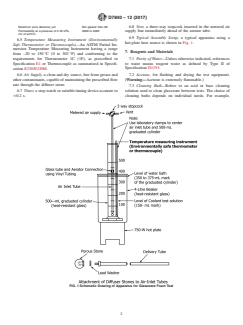
6.9 Typical Assembly Setup, a typical apparatus using a
6.5 Temperature Measuring Instrument (Environmentally
hot-plate heat source is shown in Fig. 1.
Safe Thermometer or Thermocouple)—An ASTM Partial Im-
mersion Temperature Measuring Instrument having a range
7. Reagents and Materials
from –20 to 150 °C (0 to 302 °F) and conforming to the
requirements for Thermometer 1C (1F), as prescribed in 7.1 Purity of Water—Unless otherwise indicated, references
Specification E1 or Thermocouple as summarized in Specifi- to water means reagent water as defined by Type II of
cation E230/E230M. Specification D1193.
6.6 Air Supply, a clean and dry source, free from grease and 7.2 Acetone, for flushing and drying the test equipment.
other contaminants, capable of maintaining the prescribed flow (Warning—Acetone is extremely flammable.)
rate through the diffuser stone.
7.3 Cleaning Bath—Refers to an acid or base cleaning
6.7 Timer, a stop watch or suitable timing device accurate to solution used to clean glassware between tests. The choice of
60.2 s. cleaning baths depends on individual needs. For example,
FIG. 1 Schematic Drawing of Apparatus for Glassware Foam Test
D7840 − 12 (2017)
Nochromix® and alcoholic sodium (potassium) hydroxide are 10.2 Connectairsupply,positionstopcocktopermitairflow
common acid and base cleaning baths, respectively. to aerator tube, and adjust the air flow rate of 1000 mL/min
(Warning—The cleaning baths are strong oxidants and strong using a manometer or other suitable instrument for accurately
acid and base, respectively. Avoid contact with skin, eyes, and measuring volumes of air flow.
clothing. Do not breathe vapor. Handle in a fume hood.)
10.3 The timing of the 5-min aeration period shall start at
the appearance of the first bubbles in the test coolant.
8. Test Coolant
10.4 At the end of 5 min, measure the volume of foam at the
8.1 The non-aqueous coolant is intended to be tested as-is,
highest level and subtract the initial volume read after inserting
without dilution or adulteration of any kind.
the aerator tube. Read the foam volume to the nearest 5-mL
9. Conditioning graduation.
10.5 Relieve the air pressure by positioning the three-way
9.1 Test Temperature—The temperature bath shall be kept at
a constant volume (350- to 375-mL mark of the graduated stopcock to shut off the air supply and vent the inlet tube to the
atmosphere simultaneously and record precisely (60.2 s) the
cylinder) throughout the test. The reference and test coolants
time for the foam to co
...