

ASTM E574-23
(Specification)Standard Specification for Duplex, Base Metal Thermocouple Wire With Glass Fiber or Silica Fiber Insulation
General Information
- Abstract
ABSTRACT
This specification sets forth the requirements for duplex, types E, J, K, N and T thermocouple wire, insulated with E-glass, S-glass, amorphous silica fiber or polycrystalline fiber. This specification presents the requirements for impregnated and non-impregnated fiber insulated thermocouple wire for normally accepted industrial use. The material shall be classified as follows: Class A-Duplex; Class B-Duplex; Class C-Duplex; Class D-Duplex; Class E-Duplex; and Class F-Duplex. Thermoelements shall be solid thermocouple grade materials with a smooth, bright finish and shall be fully annealed prior to insulating. Individual thermoelements shall be covered with a braid, or double wrap (one wrap in each direction) of glass fibers, a braid of glass fibers, or braid of fibers.
SIGNIFICANCE AND USE
4.1 This specification presents the requirements for impregnated and non-impregnated fiber-insulated thermocouple wire for normally accepted industrial use, but does not attempt to define such usage.
4.2 A supplement contains the requirements for insulated thermocouple wire that will be exposed to high humidity. The purchase order or inquiry shall specify if the requirements in this supplement are required.
SCOPE
1.1 This specification sets forth the requirements for duplex, types E, J, K, N and T thermocouple wire, insulated with E-glass, S-glass, amorphous silica fiber or polycrystalline fiber.
1.2 The values stated in SI units are to be regarded as standard. The values given in parentheses are for information only.
1.3 This standard does not purport to address all of the safety concerns, if any, associated with its use. It is the responsibility of the user of this standard to establish appropriate safety, health, and environmental practices and determine the applicability of regulatory limitations prior to use.
1.4 This international standard was developed in accordance with internationally recognized principles on standardization established in the Decision on Principles for the Development of International Standards, Guides and Recommendations issued by the World Trade Organization Technical Barriers to Trade (TBT) Committee.
- Status
- Published
- Publication Date
- 30-Apr-2023
- Technical Committee
- E20 - Temperature Measurement
- Drafting Committee
- E20.12 - Thermocouples - Specifications
Buy Documents

ASTM E574-23 - Standard Specification for Duplex, Base Metal Thermocouple Wire With Glass Fiber or Silica Fiber Insulation
REDLINE ASTM E574-23 - Standard Specification for Duplex, Base Metal Thermocouple Wire With Glass Fiber or Silica Fiber Insulation
Overview
ASTM E574-23: Standard Specification for Duplex, Base Metal Thermocouple Wire With Glass Fiber or Silica Fiber Insulation sets requirements for duplex thermocouple wire types E, J, K, N, and T insulated with E-glass, S-glass, amorphous silica fiber, or polycrystalline fiber. Developed by ASTM International, this standard governs the classification, physical properties, and quality assurance practices for fiber-insulated thermocouple wires widely used in industrial temperature measurement systems. Both impregnated and non-impregnated insulation types are addressed for typical industrial applications. The standard also supports considerations for high-humidity environments through supplementary requirements.
Key Topics
Wire Types and Classifications
Covered thermocouple types: E, J, K, N, and T, suitable for various temperature measurement needs.
Classified as Classes A-F based on insulation material and properties:- Class A: E-glass, impregnated, color-coded
- Class B: E-glass, non-impregnated
- Class C: Amorphous silica fiber, non-impregnated
- Class D: Polycrystalline fiber, non-impregnated
- Class E: S-glass, impregnated, color-coded
- Class F: S-glass, non-impregnated
Insulation Materials
Insulating fibers include E-glass for electrical applications, S-glass for higher mechanical strength and temperature resistance, amorphous silica fiber for superior heat insulation, and polycrystalline fiber for even higher temperature use.Manufacturing and Performance Requirements
- Solid thermoelements are required, fully annealed, with smooth, bright finish.
- Each thermoelement is individually wrapped or braided with fiber insulation before an overall fiber braid is applied.
- Maximum wire dimensions vary by size and insulation class and must be observed to ensure installability and performance.
- Color coding and impregnation are specified where applicable.
Quality Assurance and Documentation
The standard outlines required tests such as size verification, calibration, and insulation quality, which must be specified in the purchase order. Documentation and certification of compliance by the manufacturer are required as appropriate.
Applications
Industrial Temperature Measurement
Duplex, base metal thermocouple wire with glass fiber or silica fiber insulation is essential in environments where robust, precise, and durable temperature sensing is critical - such as chemical processing, power generation, metal production, and research laboratories.High-Temperature Operations
By specifying wire types and insulation materials with defined continuous temperature ratings, ASTM E574-23 supports high performance in applications where wires may be exposed to elevated temperatures, abrasion, or corrosive conditions.Custom and Demanding Installations
The standard’s clarity on insulation types, spool packaging, and supplemental resistance testing for high humidity enables users to specify and obtain thermocouple wire tailored to challenging operational environments or regulatory requirements.
Related Standards
- ASTM E230/E230M: Provides temperature-emf tables and color codes for standardized thermocouples.
- ASTM E207: Method for thermal EMF testing by comparison with reference thermoelements.
- ASTM E220: Method for calibration of thermocouples by comparison techniques.
- ASTM D1125: Test methods for electrical conductivity and resistivity of water, referenced for insulation resistance tests.
- ASTM E344: Terminology relating to thermometry and hydrometry, offering standard definitions used within ASTM E574-23.
Complying with ASTM E574-23 ensures reliable performance, interoperability, and safety across a range of industrial temperature measurement applications, enhancing quality and traceability in both manufacturing and field operations.
Relations
- Effective Date
- 01-Dec-2023
- Effective Date
- 01-Nov-2023
- Effective Date
- 01-May-2023
- Effective Date
- 01-Sep-2019
- Effective Date
- 01-Apr-2018
- Effective Date
- 01-Nov-2016
- Effective Date
- 01-May-2015
- Effective Date
- 01-Nov-2013
- Effective Date
- 01-May-2013
- Effective Date
- 01-May-2012
- Effective Date
- 15-May-2011
- Effective Date
- 15-May-2011
- Effective Date
- 01-Nov-2010
- Effective Date
- 15-Nov-2008
- Effective Date
- 01-May-2008
Buy Documents
ASTM E574-23 - Standard Specification for Duplex, Base Metal Thermocouple Wire With Glass Fiber or Silica Fiber Insulation
REDLINE ASTM E574-23 - Standard Specification for Duplex, Base Metal Thermocouple Wire With Glass Fiber or Silica Fiber Insulation
Get Certified
Connect with accredited certification bodies for this standard

BSMI (Bureau of Standards, Metrology and Inspection)
Taiwan's standards and inspection authority.
Sponsored listings
Frequently Asked Questions
ASTM E574-23 is a technical specification published by ASTM International. Its full title is "Standard Specification for Duplex, Base Metal Thermocouple Wire With Glass Fiber or Silica Fiber Insulation". This standard covers: ABSTRACT This specification sets forth the requirements for duplex, types E, J, K, N and T thermocouple wire, insulated with E-glass, S-glass, amorphous silica fiber or polycrystalline fiber. This specification presents the requirements for impregnated and non-impregnated fiber insulated thermocouple wire for normally accepted industrial use. The material shall be classified as follows: Class A-Duplex; Class B-Duplex; Class C-Duplex; Class D-Duplex; Class E-Duplex; and Class F-Duplex. Thermoelements shall be solid thermocouple grade materials with a smooth, bright finish and shall be fully annealed prior to insulating. Individual thermoelements shall be covered with a braid, or double wrap (one wrap in each direction) of glass fibers, a braid of glass fibers, or braid of fibers. SIGNIFICANCE AND USE 4.1 This specification presents the requirements for impregnated and non-impregnated fiber-insulated thermocouple wire for normally accepted industrial use, but does not attempt to define such usage. 4.2 A supplement contains the requirements for insulated thermocouple wire that will be exposed to high humidity. The purchase order or inquiry shall specify if the requirements in this supplement are required. SCOPE 1.1 This specification sets forth the requirements for duplex, types E, J, K, N and T thermocouple wire, insulated with E-glass, S-glass, amorphous silica fiber or polycrystalline fiber. 1.2 The values stated in SI units are to be regarded as standard. The values given in parentheses are for information only. 1.3 This standard does not purport to address all of the safety concerns, if any, associated with its use. It is the responsibility of the user of this standard to establish appropriate safety, health, and environmental practices and determine the applicability of regulatory limitations prior to use. 1.4 This international standard was developed in accordance with internationally recognized principles on standardization established in the Decision on Principles for the Development of International Standards, Guides and Recommendations issued by the World Trade Organization Technical Barriers to Trade (TBT) Committee.
ABSTRACT This specification sets forth the requirements for duplex, types E, J, K, N and T thermocouple wire, insulated with E-glass, S-glass, amorphous silica fiber or polycrystalline fiber. This specification presents the requirements for impregnated and non-impregnated fiber insulated thermocouple wire for normally accepted industrial use. The material shall be classified as follows: Class A-Duplex; Class B-Duplex; Class C-Duplex; Class D-Duplex; Class E-Duplex; and Class F-Duplex. Thermoelements shall be solid thermocouple grade materials with a smooth, bright finish and shall be fully annealed prior to insulating. Individual thermoelements shall be covered with a braid, or double wrap (one wrap in each direction) of glass fibers, a braid of glass fibers, or braid of fibers. SIGNIFICANCE AND USE 4.1 This specification presents the requirements for impregnated and non-impregnated fiber-insulated thermocouple wire for normally accepted industrial use, but does not attempt to define such usage. 4.2 A supplement contains the requirements for insulated thermocouple wire that will be exposed to high humidity. The purchase order or inquiry shall specify if the requirements in this supplement are required. SCOPE 1.1 This specification sets forth the requirements for duplex, types E, J, K, N and T thermocouple wire, insulated with E-glass, S-glass, amorphous silica fiber or polycrystalline fiber. 1.2 The values stated in SI units are to be regarded as standard. The values given in parentheses are for information only. 1.3 This standard does not purport to address all of the safety concerns, if any, associated with its use. It is the responsibility of the user of this standard to establish appropriate safety, health, and environmental practices and determine the applicability of regulatory limitations prior to use. 1.4 This international standard was developed in accordance with internationally recognized principles on standardization established in the Decision on Principles for the Development of International Standards, Guides and Recommendations issued by the World Trade Organization Technical Barriers to Trade (TBT) Committee.
ASTM E574-23 is classified under the following ICS (International Classification for Standards) categories: 17.200.20 - Temperature-measuring instruments. The ICS classification helps identify the subject area and facilitates finding related standards.
ASTM E574-23 has the following relationships with other standards: It is inter standard links to ASTM E344-23, ASTM E230/E230M-23a, ASTM E230/E230M-23, ASTM E344-19, ASTM E344-18, ASTM E344-16, ASTM E207-08(2015), ASTM E220-13, ASTM E344-13, ASTM E344-12, ASTM E230/E230M-11, ASTM E230/E230M-11e1, ASTM E344-10, ASTM E344-08, ASTM E207-08. Understanding these relationships helps ensure you are using the most current and applicable version of the standard.
ASTM E574-23 is available in PDF format for immediate download after purchase. The document can be added to your cart and obtained through the secure checkout process. Digital delivery ensures instant access to the complete standard document.
Standards Content (Sample)
This international standard was developed in accordance with internationally recognized principles on standardization established in the Decision on Principles for the
Development of International Standards, Guides and Recommendations issued by the World Trade Organization Technical Barriers to Trade (TBT) Committee.
Designation: E574 − 23 An American National Standard
Standard Specification for
Duplex, Base Metal Thermocouple Wire With Glass Fiber or
Silica Fiber Insulation
This standard is issued under the fixed designation E574; the number immediately following the designation indicates the year of
original adoption or, in the case of revision, the year of last revision. A number in parentheses indicates the year of last reapproval. A
superscript epsilon (´) indicates an editorial change since the last revision or reapproval.
1. Scope 3. Terminology
1.1 This specification sets forth the requirements for duplex, 3.1 Definitions—The definitions given in Terminology E344
types E, J, K, N and T thermocouple wire, insulated with shall apply to this standard.
E-glass, S-glass, amorphous silica fiber or polycrystalline fiber.
3.2 Definitions of Terms Specific to This Standard:
1.2 The values stated in SI units are to be regarded as 3.2.1 amorphous silica fiber, n—continuous filament of
standard. The values given in parentheses are for information heat-insulating material whose principal constituent is amor-
only. phous silica.
1.3 This standard does not purport to address all of the 3.2.2 duplex wire, n—matched pair of parallel, solid
safety concerns, if any, associated with its use. It is the thermoelements, individually insulated (double wrap or braid)
responsibility of the user of this standard to establish appro- with insulating fibers and a fiber braid of the same material
priate safety, health, and environmental practices and deter- overall.
mine the applicability of regulatory limitations prior to use.
3.2.3 E-glass, n—family of calcia-alumina-silicate glasses
1.4 This international standard was developed in accor-
that are used for general purposes and most electrical applica-
dance with internationally recognized principles on standard-
tions.
ization established in the Decision on Principles for the
3.2.4 impregnate, v—to saturate the fiber insulation of wires
Development of International Standards, Guides and Recom-
with a high-temperature electrical insulating compound to form
mendations issued by the World Trade Organization Technical
a moisture barrier around the wires and to inhibit fraying of the
Barriers to Trade (TBT) Committee.
fibers.
2. Referenced Documents 3.2.5 polycrystalline fiber, n—continuous polycrystalline
filament of heat-insulating material whose composition is
2.1 ASTM Standards:
alumina, boria, and silica in an approximate ratio of 3:1:2,
D1125 Test Methods for Electrical Conductivity and Resis-
respectively.
tivity of Water
3.2.6 S-glass, n—family of magnesia-alumina-silicate
E207 Test Method for Thermal EMF Test of Single Thermo-
glasses with a higher tensile strength and higher softening
element Materials by Comparison With Reference Ther-
temperature than E-glass.
moelement of Similar EMF-Temperature Properties
E220 Test Method for Calibration of Thermocouples By
4. Significance and Use
Comparison Techniques
E230/E230M Specification for Temperature-Electromotive
4.1 This specification presents the requirements for impreg-
Force (emf) Tables for Standardized Thermocouples
nated and non-impregnated fiber-insulated thermocouple wire
E344 Terminology Relating to Thermometry and Hydrom-
for normally accepted industrial use, but does not attempt to
etry
define such usage.
4.2 A supplement contains the requirements for insulated
thermocouple wire that will be exposed to high humidity. The
This specification is under the jurisdiction of ASTM Committee E20 on
purchase order or inquiry shall specify if the requirements in
Temperature Measurement and is the direct responsibility of Subcommittee E20.12
on Thermocouples - Specifications.
this supplement are required.
Current edition approved May 1, 2023. Published May 2023. Originally
approved in 1976. Last previous edition approved in 2019 as E574 – 19. DOI:
5. Classification
10.1520/E0574-23.
For referenced ASTM standards, visit the ASTM website, www.astm.org, or
5.1 Class A–Duplex—E-glass fiber insulated, impregnated
contact ASTM Customer Service at service@astm.org. For Annual Book of ASTM
with a high-temperature electrical insulating compound and
Standards volume information, refer to the standard’s Document Summary page on
the ASTM website. color-coded in accordance with Specification E230/E230M.
Copyright © ASTM International, 100 Barr Harbor Drive, PO Box C700, West Conshohocken, PA 19428-2959. United States
E574 − 23
TABLE 1 Maximum Outside Transverse Dimensions of Insulated
5.2 Class B–Duplex—E-glass fiber insulated (Note 1) not
Wire
impregnated and not color-coded.
Uninsulated Thermoelement Maximum Outside Dimensions
5.3 Class C–Duplex—Amorphous silica fiber insulated
Diameter
Gage Nominal Classes A, B, E and
(Note 2) not impregnated and not color-coded.
Classes C and D
(AWG) Diameter F
5.4 Class D–Duplex—Polycrystalline fiber insulated (Notes
mm (in.) mm (in.) mm (in.)
20 0.8 (0.032) 2.7 (0.106) 4.5 (0.177)
2 and 3) not impregnated and not color-coded.
22 0.6 (0.024) 2.3 (0.091) 4.1 (0.161)
5.5 Class E–Duplex—S-glass fiber insulated, impregnated 24 0.5 (0.020) 2.1 (0.083) 3.8 (0.150)
30 0.3 (0.012) 1.7 (0.067) none
with a high-temperature electrical insulating compound and
color-coded in accordance with Specification E230/E230M.
5.6 Class F–Duplex—S-glass fiber insulated (Note 1) not
impregnated and not color-coded.
7.2 Insulation Materials:
7.2.1 Individual thermoelements shall be covered with a
NOTE 1—May be heat treated to retard fraying when specified in the
ordering information (6.1.8). braid, or double wrap (one wrap in each direction) of glass
NOTE 2—Fibers may be pre-treated with an organic compound to
fibers (Classes A and E), a braid of glass fibers (Classes B and
facilitate braiding.
F), or braid of fibers (Classes C and D).
NOTE 3—May be thermally processed after braiding to remove organic
7.2.2 The outer covering shall consist of a braid of the same
compound when specified in the ordering information (6.1.8).
material applied over the bare thermoelements.
6. Ordering Information
7.2.3 For Classes A and E duplex thermoelements, the
insulation on the individual thermoelements and the outer braid
6.1 The purchase order shall specify the following informa-
shall be impregnated with a moisture and heat-resistant elec-
tion:
trical insulating compound. The fibers shall be bonded suffi-
6.1.1 Total insulated wire length,
ciently to each other to prevent fraying under normal condi-
6.1.2 Thermocouple type,
tions of installation and service.
6.1.3 Tolerance on initial values of emf versus temperature
7.2.4 Each individual Class A and E thermoelement wrap or
(standard or special),
braid and the outer braid shall be color-coded in accordance
6.1.4 Class of insulation (see Section 5);
with Specification E230/E230M.
6.1.5 Thermoelement diameter (see 7.1.2);
7.2.5 The purchase order may specify that an enamel
6.1.6 Minimum acceptable continuous length per spool, if
coating be applied to each bare thermoelement designated as
applicable;
Class A and Class E.
6.1.7 Supplementary testing, if required (see Supplementary
7.2.6 Classes B, C, D and F insulated thermoelements are
Requirements);
supplied without impregnation, color coding, or enamel (Notes
6.1.8 Special requirements (if any);
1-4).
6.1.9 Deviations or special requirements not covered herein;
7.2.7 Insulating materials shall be suitable for continuous
and
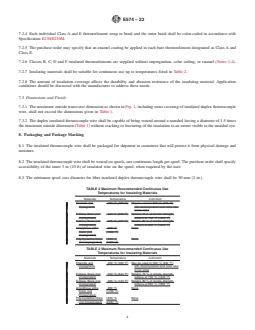
use up to temperatures listed in Table 2.
6.1.10 Required documentation (see Section 9).
7.2.8 The amount of insulation coverage affects the durabil-
7. Technical Requirements
ity and abrasion resistance of the insulating materia
...
This document is not an ASTM standard and is intended only to provide the user of an ASTM standard an indication of what changes have been made to the previous version. Because
it may not be technically possible to adequately depict all changes accurately, ASTM recommends that users consult prior editions as appropriate. In all cases only the current version
of the standard as published by ASTM is to be considered the official document.
Designation: E574 − 19 E574 − 23 An American National Standard
Standard Specification for
Duplex, Base Metal Thermocouple Wire With Glass Fiber or
Silica Fiber Insulation
This standard is issued under the fixed designation E574; the number immediately following the designation indicates the year of
original adoption or, in the case of revision, the year of last revision. A number in parentheses indicates the year of last reapproval. A
superscript epsilon (´) indicates an editorial change since the last revision or reapproval.
1. Scope
1.1 This specification sets forth the requirements for duplex, types E, J, K, N and T thermocouple wire, insulated with E-glass,
S-glass, amorphous silica fiber or polycrystalline fiber.
1.2 The values stated in SI units are to be regarded as standard. The values given in parentheses are for information only.
1.3 This standard does not purport to address all of the safety concerns, if any, associated with its use. It is the responsibility
of the user of this standard to establish appropriate safety, health, and environmental practices and determine the applicability of
regulatory limitations prior to use.
1.4 This international standard was developed in accordance with internationally recognized principles on standardization
established in the Decision on Principles for the Development of International Standards, Guides and Recommendations issued
by the World Trade Organization Technical Barriers to Trade (TBT) Committee.
2. Referenced Documents
2.1 ASTM Standards:
D1125 Test Methods for Electrical Conductivity and Resistivity of Water
E207 Test Method for Thermal EMF Test of Single Thermoelement Materials by Comparison With Reference Thermoelement
of Similar EMF-Temperature Properties
E220 Test Method for Calibration of Thermocouples By Comparison Techniques
E230/E230M Specification for Temperature-Electromotive Force (emf) Tables for Standardized Thermocouples
E344 Terminology Relating to Thermometry and Hydrometry
3. Terminology
3.1 Definitions—The definitions given in Terminology E344 shall apply to this standard.
3.2 Definitions of Terms Specific to This Standard:
3.2.1 amorphous silica fiber, n—continuous filament of heat-insulating material whose principal constituent is amorphous silica.
3.2.2 duplex wire, n—matched pair of parallel, solid thermoelements, individually insulated (double wrap or braid) with insulating
fibers and a fiber braid of the same material overall.
This specification is under the jurisdiction of ASTM Committee E20 on Temperature Measurement and is the direct responsibility of Subcommittee E20.12 on
Thermocouples - Specifications.
Current edition approved May 1, 2019May 1, 2023. Published June 2019May 2023. Originally approved in 1976. Last previous edition approved in 20132019 as
E574 – 13.E574 – 19. DOI: 10.1520/E0574-19. 10.1520/E0574-23.
For referenced ASTM standards, visit the ASTM website, www.astm.org, or contact ASTM Customer Service at service@astm.org. For Annual Book of ASTM Standards
volume information, refer to the standard’s Document Summary page on the ASTM website.
Copyright © ASTM International, 100 Barr Harbor Drive, PO Box C700, West Conshohocken, PA 19428-2959. United States
E574 − 23
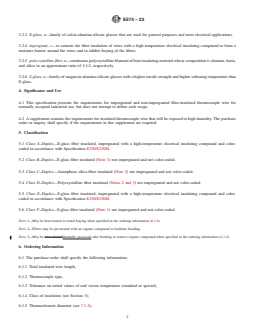
3.2.3 E-glass, n—family of calcia-alumina-silicate glasses that are used for general purposes and most electrical applications.
3.2.4 impregnate, v—to saturate the fiber insulation of wires with a high-temperature electrical insulating compound to form a
moisture barrier around the wires and to inhibit fraying of the fibers.
3.2.5 polycrystalline fiber, n—continuous polycrystalline filament of heat-insulating material whose composition is alumina, boria,
and silica in an approximate ratio of 3:1:2, respectively.
3.2.6 S-glass, n—family of magnesia-alumina-silicate glasses with a higher tensile strength and higher softening temperature than
E-glass.
4. Significance and Use
4.1 This specification presents the requirements for impregnated and non-impregnated fiber-insulated thermocouple wire for
normally accepted industrial use, but does not attempt to define such usage.
4.2 A supplement contains the requirements for insulated thermocouple wire that will be exposed to high humidity. The purchase
order or inquiry shall specify if the requirements in this supplement are required.
5. Classification
5.1 Class A–Duplex—E-glass fiber insulated, impregnated with a high-temperature electrical insulating compound and color-
coded in accordance with Specification E230/E230M.
5.2 Class B–Duplex—E-glass fiber insulated (Note 1) not impregnated and not color-coded.
5.3 Class C–Duplex—Amorphous silica fiber insulated (Note 2) not impregnated and not color-coded.
5.4 Class D–Duplex—Polycrystalline fiber insulated (Notes 2 and 3) not impregnated and not color-coded.
5.5 Class E–Duplex—S-glass fiber insulated, impregnated with a high-temperature electrical insulating compound and color-
coded in accordance with Specification E230/E230M.
5.6 Class F–Duplex—S-glass fiber insulated (Note 1) not impregnated and not color-coded.
NOTE 1—May be heat treated to retard fraying when specified in the ordering information (6.1.8).
NOTE 2—Fibers may be pre-treated with an organic compound to facilitate braiding.
NOTE 3—May be heat cleanedthermally processed after braiding to remove organic compound when specified in the ordering information (6.1.8).
6. Ordering Information
6.1 The purchase order shall specify the following information:
6.1.1 Total insulated wire length,
6.1.2 Thermocouple type,
6.1.3 Tolerance on initial values of emf versus temperature (standard or special),
6.1.4 Class of insulation (see Section 5);
6.1.5 Thermoelement diameter (see 7.1.2);
E574 − 23
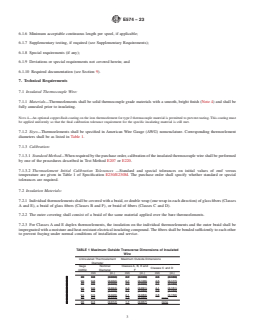
6.1.6 Minimum acceptable continuous length per spool, if applicable;
6.1.7 Supplementary testing, if required (see Supplementary Requirements);
6.1.8 Special requirements (if any);
6.1.9 Deviations or special requirements not covered herein; and
6.1.10 Required documentation (see Section 9).
7. Technical Requirements
7.1 Insulated Thermocouple Wire:
7.1.1 Materials—Thermoelements shall be solid thermocouple grade materials with a smooth, bright finish (Note 4) and shall be
fully annealed prior to insulating.
NOTE 4—An optional copper-flash coating on the iron thermoelement for type J thermocouple material is permitted to prevent rusting. This coating must
be applied uniformly so that the final calibration tolerance requirement for the specific insulating material is still met.
7.1.2 Sizes—Thermoelements shall be specified in American Wire Gauge (AWG) nomenclature. Corresponding thermoelement
diameters shall be as listed in Table 1.
7.1.3 Calibration:
7.1.3.1 Standard Method—When required by the purchase order, calibration of the insulated thermocouple wire shall be performed
by one of the procedures described in Test Method E207 or E220.
7.1.3.2 Thermoelement Initial Calibration Tolerances —Standard and special tolerances on initial values of emf versus
temperature are given in Table 1 of Specification E230/E230M. The purchase order shall specify whether standard or special
tolerances are required.
7.2 Insulation Materials:
7.2.1 Individual thermoelements shall be covered with a braid, or double wrap (one wrap in each direction) of glass fibers (Classes
A and E), a braid of glass fibers (Classes B and F), or braid of fibers (Classes C and D).
7.2.2 The outer covering shall consist of a braid of the same material applied over the bare thermoelements.
7.2.3 For Classes A and E duplex thermoelements, the insulation on the individual thermoelements and the outer braid shall be
impregnated with a moisture and heat-resistant electrical insulating compound. The fibers shall be bonded sufficiently to each other
to prevent fraying under normal conditions of installation and service.
TABLE 1 Maximum Outside Transverse Dimensions of Insulated
Wire
Uninsulated Thermoelement Maximum Outside Dimensions
Diameter
Gage Nominal Classes A, B, E and
Classes C and D
(AWG) Diameter F
mm
...