

ASTM E235/E235M-23
(Specification)Standard Specification for Type K and Type N Mineral-Insulated, Metal-Sheathed Thermocouples for Nuclear or for Other High-Reliability Applications
General Information
- Abstract
ABSTRACT
This specification covers the requirements for sheathed, Type K and N thermocouples for nuclear service. This specification can be used for sheathed thermocouples which are required for laboratory or general commercial applications where the environmental conditions exceed normal service requirements. The measuring junction styles for thermocouples are as follows: Style G2 (grounded) in which measuring junction is electrically connected to conductive sheaths and Style U2 (ungrounded) in which measuring junctions are electrically isolated from conductive sheaths and from reference ground. Different properties of the sheath such as integrity, cracks, voids, inclusions, surface finish, surface defect, and metallurgical structure shall be determined by performing different tests. Insulation resistance between thermoelements and the sheath shall be measured as well.
SCOPE
1.1 This specification covers the requirements for simplex, compacted mineral-insulated, metal-sheathed (MIMS), Type K and N thermocouples for nuclear or other high reliability service. Depending on size, these thermocouples are normally suitable for operating temperatures to 1652 °F [900 °C]; special conditions of environment and life expectancy may permit their use at temperatures in excess of 2012 °F [1100 °C]. This specification was prepared to detail requirements for this type of MIMS thermocouple for use in nuclear environments, but they can also be used for laboratory or general commercial applications where the environmental conditions exceed normal service requirements. The intended use of a MIMS thermocouple in a specific nuclear application will require evaluation of the compatibility of the thermocouple, including the effect of the temperature, atmosphere, and integrated neutron flux on the materials and accuracy of the thermoelements in the proposed application by the purchaser.
1.2 This specification does not attempt to include all possible specifications, standards, etc., for materials that may be used as sheathing, insulation, and thermocouple wires for sheathed-type construction. The requirements of this specification include only the austenitic stainless steels and other alloys as allowed by Specification E585/E585M for sheathing, magnesium oxide or aluminum oxide as insulation, and Type K and N thermocouple wires for thermoelements (see Note 1).
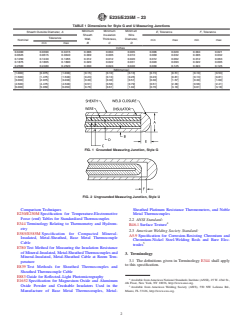
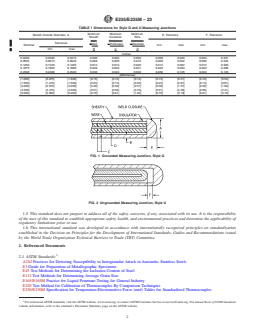
1.3 General Design—Nominal sizes of the finished thermocouples shall be 0.0400 in., 0.0625 in., 0.125 in., 0.1875 in., or 0.250 in. [1.000 mm, 1.500 mm, 3.000 mm, 4.500 mm, or 6.000 mm]. Sheath dimensions and tolerances for each nominal size shall be in accordance with Table 1 and Figs. 1 and 2. The measuring junction styles for thermocouples covered by this specification are as follows:
FIG. 1 Grounded Measuring Junction, Style G
FIG. 2 Ungrounded Measuring Junction, Style U
1.3.1 Style G2 (grounded)—The measuring junction is electrically connected to its conductive sheath, and
1.3.2 Style U2 (ungrounded)—The measuring junction is electrically isolated from its conductive sheath and from reference ground.
1.4 The values stated in either SI units or inch-pound units are to be regarded separately as standard. The values stated in each system are not exact equivalents or conversions; therefore, each system shall be used independently of the other. Combining values from the two systems may result in non-conformance with the standard.
1.5 This standard does not purport to address all of the safety concerns, if any, associated with its use. It is the responsibility of the user of this standard to establish appropriate safety, health, and environmental practices and determine the applicability of regulatory limitations prior to use.
1.6 This international standard was developed in accordance with internationally recognized principles on standardization established in the Decision on Principles for the Development of International Standards, Guides and Recomm...
- Status
- Published
- Publication Date
- 30-Jun-2023
- Technical Committee
- E20 - Temperature Measurement
- Drafting Committee
- E20.12 - Thermocouples - Specifications
Buy Documents
ASTM E235/E235M-23 - Standard Specification for Type K and Type N Mineral-Insulated, Metal-Sheathed Thermocouples for Nuclear or for Other High-Reliability Applications
REDLINE ASTM E235/E235M-23 - Standard Specification for Type K and Type N Mineral-Insulated, Metal-Sheathed Thermocouples for Nuclear or for Other High-Reliability Applications
Overview
ASTM E235/E235M-23 is the internationally recognized standard specification for Type K and Type N mineral-insulated, metal-sheathed (MIMS) thermocouples, designed for nuclear and other high-reliability applications. Developed by ASTM International, this specification ensures that thermocouples meet stringent requirements for performance, durability, and safety in environments where reliability is critical. While originally tailored for nuclear service, the standard is also well-suited for laboratory and other commercial applications with demanding environmental conditions.
Key Topics
Thermocouple Types & Construction:
This standard covers the requirements for simplex, compacted mineral-insulated, metal-sheathed thermocouples using either Type K (Nickel-Chromium/Nickel-Aluminum) or Type N (Nickel-Chromium-Silicon/Nickel-Silicon-Magnesium) thermoelements.Measuring Junction Styles:
- Style G2 (Grounded): Measuring junction electrically connected to the conductive sheath.
- Style U2 (Ungrounded): Junction electrically isolated from both the sheath and reference ground.
Operating Temperatures:
Thermocouples compliant with ASTM E235/E235M-23 are typically suitable for continuous operation up to 900°C (1652°F), with select designs capable of operation beyond 1100°C (2012°F), subject to environmental and life expectancy considerations.Material Requirements:
- Sheathing: Austenitic stainless steels and other approved alloys per ASTM E585/E585M.
- Insulation: High-purity magnesium oxide (MgO) or aluminum oxide (Al2O3) for electrical insulation and stability.
- Wires: Type K and N thermoelement wires meeting defined tolerance requirements.
Quality Assurance:
The specification mandates comprehensive inspection and testing, including:- Sheath integrity, surface finish, and absence of cracks or defects.
- Metallurgical analysis to confirm structure and composition.
- Insulation resistance and density testing.
- Dimensional checks according to specified tolerances.
- Radiographic and dye penetrant inspections for defect detection.
- Calibration at specified temperatures to confirm conformance to standardized electromotive force (emf) tables.
Applications
ASTM E235/E235M-23 mineral-insulated, metal-sheathed thermocouples are widely utilized for:
- Nuclear Power Plants:
Providing reliable temperature monitoring within reactors, containment systems, and associated safety-critical environments. - High-Reliability Industrial Installations:
Supporting processes requiring continuous, accurate, and stable temperature measurement under severe conditions, such as in petrochemical plants, aerospace, and energy sectors. - Laboratory and Research:
Facilitating precise temperature measurement in high-temperature experiments and materials testing, especially when protection from contamination and electrical interference is needed.
Their robust construction, resistance to harsh environments, and long-term stability make them ideal wherever dependable temperature measurement is essential.
Related Standards
- ASTM E230/E230M: Standard specification for temperature-electromotive force (emf) tables for standardized thermocouples.
- ASTM E585/E585M: Specification for compacted mineral-insulated, metal-sheathed base metal thermocouple cable.
- ASTM E780: Test method for measuring insulation resistance of MIMS thermocouples and cables at room temperature.
- ASTM E839: Test methods for sheathed thermocouples and cable, including radiographic inspection.
- ANSI B46.1: Surface texture standard for ensuring appropriate sheath surface finish.
- ASTM E45, E112, A262: Methods for metallurgical assessment and testing of inclusion content and grain size in metals.
- AWS A5.9: Specification for corrosion-resisting chromium and chromium-nickel steel welding rods and bare electrodes.
By adhering to ASTM E235/E235M-23, users ensure compliance with critical industry requirements for accuracy, safety, and reliability in challenging applications involving mineral-insulated, metal-sheathed thermocouples.
Relations
- Effective Date
- 01-Apr-2024
- Effective Date
- 01-Dec-2023
- Effective Date
- 01-Nov-2023
- Refers
ASTM E839-23 - Standard Test Methods for Sheathed Thermocouples and Sheathed Thermocouple Cable - Effective Date
- 01-Nov-2023
- Effective Date
- 01-Nov-2023
- Effective Date
- 01-May-2023
- Effective Date
- 01-Sep-2019
- Effective Date
- 01-Apr-2018
- Effective Date
- 01-Jun-2017
- Effective Date
- 01-Nov-2016
- Effective Date
- 01-Nov-2016
- Effective Date
- 01-May-2014
- Effective Date
- 15-Jan-2014
- Effective Date
- 01-Nov-2013
- Effective Date
- 01-May-2013
Buy Documents
ASTM E235/E235M-23 - Standard Specification for Type K and Type N Mineral-Insulated, Metal-Sheathed Thermocouples for Nuclear or for Other High-Reliability Applications
REDLINE ASTM E235/E235M-23 - Standard Specification for Type K and Type N Mineral-Insulated, Metal-Sheathed Thermocouples for Nuclear or for Other High-Reliability Applications
Get Certified
Connect with accredited certification bodies for this standard

BSMI (Bureau of Standards, Metrology and Inspection)
Taiwan's standards and inspection authority.
Sponsored listings
Frequently Asked Questions
ASTM E235/E235M-23 is a technical specification published by ASTM International. Its full title is "Standard Specification for Type K and Type N Mineral-Insulated, Metal-Sheathed Thermocouples for Nuclear or for Other High-Reliability Applications". This standard covers: ABSTRACT This specification covers the requirements for sheathed, Type K and N thermocouples for nuclear service. This specification can be used for sheathed thermocouples which are required for laboratory or general commercial applications where the environmental conditions exceed normal service requirements. The measuring junction styles for thermocouples are as follows: Style G2 (grounded) in which measuring junction is electrically connected to conductive sheaths and Style U2 (ungrounded) in which measuring junctions are electrically isolated from conductive sheaths and from reference ground. Different properties of the sheath such as integrity, cracks, voids, inclusions, surface finish, surface defect, and metallurgical structure shall be determined by performing different tests. Insulation resistance between thermoelements and the sheath shall be measured as well. SCOPE 1.1 This specification covers the requirements for simplex, compacted mineral-insulated, metal-sheathed (MIMS), Type K and N thermocouples for nuclear or other high reliability service. Depending on size, these thermocouples are normally suitable for operating temperatures to 1652 °F [900 °C]; special conditions of environment and life expectancy may permit their use at temperatures in excess of 2012 °F [1100 °C]. This specification was prepared to detail requirements for this type of MIMS thermocouple for use in nuclear environments, but they can also be used for laboratory or general commercial applications where the environmental conditions exceed normal service requirements. The intended use of a MIMS thermocouple in a specific nuclear application will require evaluation of the compatibility of the thermocouple, including the effect of the temperature, atmosphere, and integrated neutron flux on the materials and accuracy of the thermoelements in the proposed application by the purchaser. 1.2 This specification does not attempt to include all possible specifications, standards, etc., for materials that may be used as sheathing, insulation, and thermocouple wires for sheathed-type construction. The requirements of this specification include only the austenitic stainless steels and other alloys as allowed by Specification E585/E585M for sheathing, magnesium oxide or aluminum oxide as insulation, and Type K and N thermocouple wires for thermoelements (see Note 1). 1.3 General Design—Nominal sizes of the finished thermocouples shall be 0.0400 in., 0.0625 in., 0.125 in., 0.1875 in., or 0.250 in. [1.000 mm, 1.500 mm, 3.000 mm, 4.500 mm, or 6.000 mm]. Sheath dimensions and tolerances for each nominal size shall be in accordance with Table 1 and Figs. 1 and 2. The measuring junction styles for thermocouples covered by this specification are as follows: FIG. 1 Grounded Measuring Junction, Style G FIG. 2 Ungrounded Measuring Junction, Style U 1.3.1 Style G2 (grounded)—The measuring junction is electrically connected to its conductive sheath, and 1.3.2 Style U2 (ungrounded)—The measuring junction is electrically isolated from its conductive sheath and from reference ground. 1.4 The values stated in either SI units or inch-pound units are to be regarded separately as standard. The values stated in each system are not exact equivalents or conversions; therefore, each system shall be used independently of the other. Combining values from the two systems may result in non-conformance with the standard. 1.5 This standard does not purport to address all of the safety concerns, if any, associated with its use. It is the responsibility of the user of this standard to establish appropriate safety, health, and environmental practices and determine the applicability of regulatory limitations prior to use. 1.6 This international standard was developed in accordance with internationally recognized principles on standardization established in the Decision on Principles for the Development of International Standards, Guides and Recomm...
ABSTRACT This specification covers the requirements for sheathed, Type K and N thermocouples for nuclear service. This specification can be used for sheathed thermocouples which are required for laboratory or general commercial applications where the environmental conditions exceed normal service requirements. The measuring junction styles for thermocouples are as follows: Style G2 (grounded) in which measuring junction is electrically connected to conductive sheaths and Style U2 (ungrounded) in which measuring junctions are electrically isolated from conductive sheaths and from reference ground. Different properties of the sheath such as integrity, cracks, voids, inclusions, surface finish, surface defect, and metallurgical structure shall be determined by performing different tests. Insulation resistance between thermoelements and the sheath shall be measured as well. SCOPE 1.1 This specification covers the requirements for simplex, compacted mineral-insulated, metal-sheathed (MIMS), Type K and N thermocouples for nuclear or other high reliability service. Depending on size, these thermocouples are normally suitable for operating temperatures to 1652 °F [900 °C]; special conditions of environment and life expectancy may permit their use at temperatures in excess of 2012 °F [1100 °C]. This specification was prepared to detail requirements for this type of MIMS thermocouple for use in nuclear environments, but they can also be used for laboratory or general commercial applications where the environmental conditions exceed normal service requirements. The intended use of a MIMS thermocouple in a specific nuclear application will require evaluation of the compatibility of the thermocouple, including the effect of the temperature, atmosphere, and integrated neutron flux on the materials and accuracy of the thermoelements in the proposed application by the purchaser. 1.2 This specification does not attempt to include all possible specifications, standards, etc., for materials that may be used as sheathing, insulation, and thermocouple wires for sheathed-type construction. The requirements of this specification include only the austenitic stainless steels and other alloys as allowed by Specification E585/E585M for sheathing, magnesium oxide or aluminum oxide as insulation, and Type K and N thermocouple wires for thermoelements (see Note 1). 1.3 General Design—Nominal sizes of the finished thermocouples shall be 0.0400 in., 0.0625 in., 0.125 in., 0.1875 in., or 0.250 in. [1.000 mm, 1.500 mm, 3.000 mm, 4.500 mm, or 6.000 mm]. Sheath dimensions and tolerances for each nominal size shall be in accordance with Table 1 and Figs. 1 and 2. The measuring junction styles for thermocouples covered by this specification are as follows: FIG. 1 Grounded Measuring Junction, Style G FIG. 2 Ungrounded Measuring Junction, Style U 1.3.1 Style G2 (grounded)—The measuring junction is electrically connected to its conductive sheath, and 1.3.2 Style U2 (ungrounded)—The measuring junction is electrically isolated from its conductive sheath and from reference ground. 1.4 The values stated in either SI units or inch-pound units are to be regarded separately as standard. The values stated in each system are not exact equivalents or conversions; therefore, each system shall be used independently of the other. Combining values from the two systems may result in non-conformance with the standard. 1.5 This standard does not purport to address all of the safety concerns, if any, associated with its use. It is the responsibility of the user of this standard to establish appropriate safety, health, and environmental practices and determine the applicability of regulatory limitations prior to use. 1.6 This international standard was developed in accordance with internationally recognized principles on standardization established in the Decision on Principles for the Development of International Standards, Guides and Recomm...
ASTM E235/E235M-23 is classified under the following ICS (International Classification for Standards) categories: 17.200.20 - Temperature-measuring instruments. The ICS classification helps identify the subject area and facilitates finding related standards.
ASTM E235/E235M-23 has the following relationships with other standards: It is inter standard links to ASTM E883-11(2024), ASTM E344-23, ASTM E230/E230M-23a, ASTM E839-23, ASTM E45-18a(2023), ASTM E230/E230M-23, ASTM E344-19, ASTM E344-18, ASTM E883-11(2017), ASTM E839-11(2016), ASTM E344-16, ASTM E1652-14a, ASTM E1652-14, ASTM E220-13, ASTM E344-13. Understanding these relationships helps ensure you are using the most current and applicable version of the standard.
ASTM E235/E235M-23 is available in PDF format for immediate download after purchase. The document can be added to your cart and obtained through the secure checkout process. Digital delivery ensures instant access to the complete standard document.
Standards Content (Sample)
This international standard was developed in accordance with internationally recognized principles on standardization established in the Decision on Principles for the
Development of International Standards, Guides and Recommendations issued by the World Trade Organization Technical Barriers to Trade (TBT) Committee.
Designation: E235/E235M − 23 An American National Standard
Standard Specification for
Type K and Type N Mineral-Insulated, Metal-Sheathed
Thermocouples for Nuclear or for Other High-Reliability
Applications
This standard is issued under the fixed designation E235/E235M; the number immediately following the designation indicates the year
of original adoption or, in the case of revision, the year of last revision. A number in parentheses indicates the year of last reapproval.
A superscript epsilon (´) indicates an editorial change since the last revision or reapproval.
1. Scope 1.3.1 Style G (grounded)—The measuring junction is elec-
trically connected to its conductive sheath, and
1.1 This specification covers the requirements for simplex,
1.3.2 Style U (ungrounded)—The measuring junction is
compacted mineral-insulated, metal-sheathed (MIMS), Type K
electrically isolated from its conductive sheath and from
and N thermocouples for nuclear or other high reliability
reference ground.
service. Depending on size, these thermocouples are normally
1.4 The values stated in either SI units or inch-pound units
suitable for operating temperatures to 1652 °F [900 °C]; spe-
are to be regarded separately as standard. The values stated in
cial conditions of environment and life expectancy may permit
each system are not exact equivalents or conversions;
their use at temperatures in excess of 2012 °F [1100 °C]. This
therefore, each system shall be used independently of the other.
specification was prepared to detail requirements for this type
Combining values from the two systems may result in non-
of MIMS thermocouple for use in nuclear environments, but
conformance with the standard.
they can also be used for laboratory or general commercial
applications where the environmental conditions exceed nor-
1.5 This standard does not purport to address all of the
mal service requirements. The intended use of a MIMS
safety concerns, if any, associated with its use. It is the
thermocouple in a specific nuclear application will require
responsibility of the user of this standard to establish appro-
evaluation of the compatibility of the thermocouple, including
priate safety, health, and environmental practices and deter-
the effect of the temperature, atmosphere, and integrated
mine the applicability of regulatory limitations prior to use.
neutron flux on the materials and accuracy of the thermoele-
1.6 This international standard was developed in accor-
ments in the proposed application by the purchaser.
dance with internationally recognized principles on standard-
ization established in the Decision on Principles for the
1.2 This specification does not attempt to include all
Development of International Standards, Guides and Recom-
possible specifications, standards, etc., for materials that may
mendations issued by the World Trade Organization Technical
be used as sheathing, insulation, and thermocouple wires for
Barriers to Trade (TBT) Committee.
sheathed-type construction. The requirements of this specifi-
cation include only the austenitic stainless steels and other
2. Referenced Documents
alloys as allowed by Specification E585/E585M for sheathing,
2.1 ASTM Standards:
magnesium oxide or aluminum oxide as insulation, and Type K
A262 Practices for Detecting Susceptibility to Intergranular
and N thermocouple wires for thermoelements (see Note 1).
Attack in Austenitic Stainless Steels
1.3 General Design—Nominal sizes of the finished thermo-
E3 Guide for Preparation of Metallographic Specimens
couples shall be 0.0400 in., 0.0625 in., 0.125 in., 0.1875 in., or
E45 Test Methods for Determining the Inclusion Content of
0.250 in. [1.000 mm, 1.500 mm, 3.000 mm, 4.500 mm, or
Steel
6.000 mm]. Sheath dimensions and tolerances for each nominal
E112 Test Methods for Determining Average Grain Size
size shall be in accordance with Table 1 and Figs. 1 and 2. The
E165/E165M Practice for Liquid Penetrant Testing for Gen-
measuring junction styles for thermocouples covered by this
eral Industry
specification are as follows:
E220 Test Method for Calibration of Thermocouples By
1 2
This specification is under the jurisdiction of ASTM Committee E20 on Style G and Style U measuring junctions were previously termed Class 1 and
Temperature Measurement and is the direct responsibility of Subcommittee E20.12 Class 2 measuring junctions respectively.
on Thermocouples - Specifications. For referenced ASTM standards, visit the ASTM website, www.astm.org, or
Current edition approved July 1, 2023. Published July 2023. Originally approved contact ASTM Customer Service at service@astm.org. For Annual Book of ASTM
in 1964. Last previous edition approved in 2019 as E235/E235M – 19. DOI: Standards volume information, refer to the standard’s Document Summary page on
10.1520/E0235_E0235M-23. the ASTM website.
Copyright © ASTM International, 100 Barr Harbor Drive, PO Box C700, West Conshohocken, PA 19428-2959. United States
E235/E235M − 23
TABLE 1 Dimensions for Style G and U Measuring Junctions
Minimum Minimum Minimum
Sheath Outside Diameter, A E, Tolerance F, Tolerance
Sheath Insulation Wire
Tolerance
Wall, Thickness, Diameter,
Nominal min max min max
min max B C D
Inches
0.0400 0.0390 0.0415 0.006 0.004 0.005 0.006 0.020 0.004 0.021
0.0625 0.0615 0.0640 0.009 0.005 0.010 0.009 0.032 0.005 0.032
0.1250 0.1240 0.1265 0.012 0.012 0.020 0.012 0.062 0.012 0.063
0.1875 0.1865 0.1890 0.020 0.022 0.031 0.020 0.093 0.022 0.095
0.2500 0.2480 0.2520 0.030 0.024 0.040 0.030 0.125 0.024 0.125
[Millimetres]
[1.000] [0.975] [1.038] [0.15] [0.10] [0.13] [0.15] [0.51] [0.10] [0.53]
[1.500] [1.475] [1.538] [0.23] [0.13] [0.25] [0.23] [0.81] [0.13] [0.81]
[3.000] [2.975] [3.038] [0.30] [0.30] [0.51] [0.30] [1.57] [0.30] [1.60]
[4.500] [4.475] [4.538] [0.51] [0.56] [0.79] [0.51] [2.36] [0.56] [2.41]
[6.000] [5.950] [6.050] [0.76] [0.61] [1.02] [0.76] [3.18] [0.61] [3.18]
FIG. 1 Grounded Measuring Junction, Style G
FIG. 2 Ungrounded Measuring Junction, Style U
Comparison Techniques Sheathed Platinum Resistance Thermometers, and Noble
E230/E230M Specification for Temperature-Electromotive Metal Thermocouples
Force (emf) Tables for Standardized Thermocouples
2.2 ANSI Standard:
E344 Terminology Relating to Thermometry and Hydrom-
B46.1 Surface Texture
etry
2.3 American Welding Society Standard:
E585/E585M Specification for Compacted Mineral-
A5.9 Specification for Corrosion-Resisting Chromium and
Insulated, Metal-Sheathed, Base Metal Thermocouple
Chromium-Nickel Steel-Welding Rods and Bare Elec-
Cable 5
trodes
E780 Test Method for Measuring the Insulation Resistance
of Mineral-Insulated, Metal-Sheathed Thermocouples and
3. Terminology
Mineral-Insulated, Metal-Sheathed Cable at Room Tem-
3.1 The definitions given in Terminology E344 shall apply
perature
to this specification.
E839 Test Methods for Sheathed Thermocouples and
Sheathed Thermocouple Cable
E883 Guide for Reflected–Light Photomicrography
Available from American National Standards Institute (ANSI), 25 W. 43rd St.,
E1652 Specification for Magnesium Oxide and Aluminum
4th Floor, New York, NY 10036, http://www.ansi.org.
Oxide Powder and Crushable Insulators Used in the 5
Available from American Welding Society (AWS), 550 NW LeJeune Rd.,
Manufacture of Base Metal Thermocouples, Metal- Miami, FL 33126, http://www.aws.org.
E235/E235M − 23
3.2 Definitions of Terms Specific to This Standard: 5.1.1.2 The grain size of the sheath shall be determined by
3.2.1 lot, n—a quantity of finished MIMS thermocouples a specimen taken in accordance with Test Methods E112. Grain
manufactured from the same lot of MIMS cable, then as-
size shall be as specified in Table 3, or finer, as determined by
sembled and processed at the same time under the same the Comparison Procedure of Test Methods E112.
controlled production conditions to their required final configu-
5.1.1.3 Each lot of sheath material used shall be sampled
ration.
using Practices A262 as follows. Samples shall be tested by
Practice A, and further tested as outlined by Table 1 in
4. Ordering Information and Basis of Purchase
Practices A262, where screening tests so indicate. Acceptance
4.1 The purchase order documents shall specify the follow-
levels for these tests shall be agreed upon between the
ing information:
purchaser and the producer.
4.1.1 The quantity, length, and nominal diameter of the
5.1.2 Thermoelement—Thermoelements referred to in this
MIMS thermocouple,
specification shall be Type K or Type N with a standard
4.1.2 The thermocouple type and tolerance on the initial
tolerance on initial values of emf versus temperature as
values of emf versus temperature per Table 2, if other than
specified in Table 2 unless otherwise specified by the pur-
standard,
chaser.
4.1.3 The type of ceramic insulation required, either alu-
mina (Al O ) or magnesia (MgO), NOTE 1—The purchaser may specify an alternative type of thermoele-
2 3
ment as designated in Specification E230/E230M by indicating this
4.1.4 The type of sheath material and other information
deviation in the ordering documents. The supplier and the purchaser shall
required (see 5.1.1),
then agree upon a tolerance.
4.1.5 The style of thermocouple measuring junction (see
5.1.3 Insulation—The insulating material shall be either
1.2),
4.1.6 The type of dye-penetrant inspection procedure to be magnesia (MgO) or alumina (Al O ) and shall comply with
2 3
used, and Specification E1652 Type 1P material requirements:
4.1.7 Any deviations from this specification or the refer-
5.1.3.1 A certified analysis of the composition of the insu-
enced specifications.
lating material as supplied to the thermocouple manufacturer
shall be furnished to the purchaser. The thermocouple manu-
5. Materials and Manufacture
facturer shall be responsible for maintaining the purity in the
5.1 All materials used shall be in accordance with the finished product within the specified limits.
following requirements:
5.1.4 Welding Rod—Filler rod material used for welding on
5.1.1 Sheath Materials—The sheath material used for the
the sheath or for welding the end of the thermocouple closed
thermocouples described in this specification shall meet the
shall comply with the requirements of AWS Specification A5.9
requirements of Specification E585/E585M. The purchaser of
for the sheath material specified on the ordering documents.
the thermocouples shall specify only the name of the material
5.2 Processing:
(seamless or welded), grade, optional requirements, test report
5.2.1 Cleanliness—The outer surface of the completed ther-
required, and ASTM designation.
5.1.1.1 The inclusion level of the sheath shall be determined mocouples at the time of delivery shall be free of residues
by mounting a 1-in. minimum length of a longitudinal section containing nuclear poisons (such as boron and cadmium
of the sheath using Test Methods E45, Microscopical Method compounds) or foreign substances (such as chlorine
A, for examination. The inclusion level shall be less than 3 A compounds, strong acids or bases, oils, greases, or dust) that
through D, thin or heavy. could become the source of corrosion or chemistry changes in
TABLE 2 Tolerances on Initial Values of EMF versus Temperature for MIMS Thermocouples
NOTE 1—Tolerances in this table apply to new MIMS thermocouples.
NOTE 2—Tolerances apply to new material as produced and do not allow for changes in thermoelectric characteristics of the materials during use. The
magnitude of such changes depends upon such factors as sheath and thermoelement size, temperature, time of exposure, and the environment.
NOTE 3—Where tolerances are given in percent, the percentage applies to the temperature being measured when expressed in degrees Celsius.
NOTE 4—To determine the tolerance in degrees Fahrenheit, multiply the tolerance in degrees Celsius by 9/5.
Tolerances—Reference Junction 32 °F [0 °C]
Thermocouple Temperature Range
Standard Tolerances Special Tolerances
Type
°F [°C] °F [°C] °F [°C]
K or N 32 to 2300 [0 to 1260] Note 4 [The greater of ±2.2 °C or Note 4 [The greater of ±1.1 °C or ±0.4 %]
±0.75 %]
A B
K –328 to 32 [–200 to 0] [The greater of ±2.2 °C or ±2 %]
A
MIMS the thermocouples are normally supplied to meet the tolerances specified in the table for temperatures above 0 °C. The same materials, however, may not fall
within the sub-zero tolerances given in the second section of the table. If materials are required to meet the sub-zero limits, the purchase order shall so state. Selection
of materials shall be required.
B
Little information is available to justify establishing special tolerances for sub-zero temperatures. Such special sub-zero tolerances, if required, shall be agreed upon
between the purchaser and the producer.
E235/E235M − 23
TABLE 3 Maximum Grain Sizes
6.3.1 Measure the outside diameter of each thermocouple’s
Sheath Outside Diameter, in. [mm] Maximum sheath per Test Methods E839 to verify that it is in confor-
0.0400 [1.000] 6
mance with Table 1.
6.3.2 Using the section of each sample thermocouple taken
0.0625 [1.500]
0.1250 [3.000] in 6.1.2, measure the sheath wall, insulation thickness, and
0.1875 [4.5
...
This document is not an ASTM standard and is intended only to provide the user of an ASTM standard an indication of what changes have been made to the previous version. Because
it may not be technically possible to adequately depict all changes accurately, ASTM recommends that users consult prior editions as appropriate. In all cases only the current version
of the standard as published by ASTM is to be considered the official document.
Designation: E235/E235M − 19 E235/E235M − 23 An American National Standard
Standard Specification for
Type K and Type N Mineral-Insulated, Metal-Sheathed
Thermocouples for Nuclear or for Other High-Reliability
Applications
This standard is issued under the fixed designation E235/E235M; the number immediately following the designation indicates the year
of original adoption or, in the case of revision, the year of last revision. A number in parentheses indicates the year of last reapproval.
A superscript epsilon (´) indicates an editorial change since the last revision or reapproval.
1. Scope
1.1 This specification covers the requirements for simplex, compacted mineral-insulated, metal-sheathed (MIMS), Type K and N
thermocouples for nuclear or other high reliability service. Depending on size, these thermocouples are normally suitable for
operating temperatures to 1652 °F [900 °C]; special conditions of environment and life expectancy may permit their use at
temperatures in excess of 2012 °F [1100 °C]. This specification was prepared to detail requirements for this type of MIMS
thermocouple for use in nuclear environments, but they can also be used for laboratory or general commercial applications where
the environmental conditions exceed normal service requirements. The intended use of a MIMS thermocouple in a specific nuclear
application will require evaluation of the compatibility of the thermocouple, including the effect of the temperature, atmosphere,
and integrated neutron flux on the materials and accuracy of the thermoelements in the proposed application by the purchaser.
1.2 This specification does not attempt to include all possible specifications, standards, etc., for materials that may be used as
sheathing, insulation, and thermocouple wires for sheathed-type construction. The requirements of this specification include only
the austenitic stainless steels and other alloys as allowed by Specification E585/E585M for sheathing, magnesium oxide or
aluminum oxide as insulation, and Type K and N thermocouple wires for thermoelements (see Note 1).
1.3 General Design—Nominal sizes of the finished thermocouples shall be 0.0400 in., 0.0625 in., 0.125 in., 0.1875 in., or 0.250
in. [1.000 mm, 1.500 mm, 3.000 mm, 4.500 mm, or 6.000 mm]. Sheath dimensions and tolerances for each nominal size shall be
in accordance with Table 1 and Figs. 1 and 2. The measuring junction styles for thermocouples covered by this specification are
as follows:
1.3.1 Style G (grounded)—The measuring junction is electrically connected to its conductive sheath, and
1.3.2 Style U (ungrounded)—The measuring junction is electrically isolated from its conductive sheath and from reference
ground.
1.4 The values stated in either SI units or inch-pound units are to be regarded separately as standard. The values stated in each
system are not exact equivalents or conversions; therefore, each system shall be used independently of the other. Combining values
from the two systems may result in non-conformance with the standard.
This specification is under the jurisdiction of ASTM Committee E20 on Temperature Measurement and is the direct responsibility of Subcommittee E20.12 on
Thermocouples - Specifications.
Current edition approved May 1, 2019July 1, 2023. Published May 2019July 2023. Originally approved in 1964. Last previous edition approved in 20182019 as
E235/E235M – 12 (2018).E235/E235M – 19. DOI: 10.1520/E0235_E0235M-19.10.1520/E0235_E0235M-23.
Style G and Style U measuring junctions were previously termed Class 1 and Class 2 measuring junctions respectively.
Copyright © ASTM International, 100 Barr Harbor Drive, PO Box C700, West Conshohocken, PA 19428-2959. United States
E235/E235M − 23
TABLE 1 Dimensions for Style G and U Measuring Junctions
Minimum Minimum Minimum
Sheath Outside Diameter, A E, Tolerance F, Tolerance
Sheath Insulation Wire
Wall, Thickness, Diameter,
Tolerance
BWall, CThickness, DDiameter,
Nominal min max min max
min max B C D
Inches
0.0400 0.0390 0.0415 0.006 0.004 0.005 0.006 0.020 0.004 0.021
0.0625 0.0615 0.0640 0.009 0.005 0.010 0.009 0.032 0.005 0.032
0.1250 0.1240 0.1265 0.012 0.012 0.020 0.012 0.062 0.012 0.063
0.1875 0.1865 0.1890 0.020 0.022 0.031 0.020 0.093 0.022 0.095
0.2500 0.2480 0.2520 0.030 0.024 0.040 0.030 0.125 0.024 0.125
[Millimetres]
[1.000] [0.975] [1.038] [0.15] [0.10] [0.13] [0.15] [0.51] [0.10] [0.53]
[1.500] [1.475] [1.538] [0.23] [0.13] [0.25] [0.23] [0.81] [0.13] [0.81]
[3.000] [2.975] [3.038] [0.30] [0.30] [0.51] [0.30] [1.57] [0.30] [1.60]
[4.500] [4.475] [4.538] [0.51] [0.56] [0.79] [0.51] [2.36] [0.56] [2.41]
[6.000] [5.950] [6.050] [0.76] [0.61] [1.02] [0.76] [3.18] [0.61] [3.18]
FIG. 1 Grounded Measuring Junction, Style G
FIG. 2 Ungrounded Measuring Junction, Style U
1.5 This standard does not purport to address all of the safety concerns, if any, associated with its use. It is the responsibility
of the user of this standard to establish appropriate safety, health, and environmental practices and determine the applicability of
regulatory limitations prior to use.
1.6 This international standard was developed in accordance with internationally recognized principles on standardization
established in the Decision on Principles for the Development of International Standards, Guides and Recommendations issued
by the World Trade Organization Technical Barriers to Trade (TBT) Committee.
2. Referenced Documents
2.1 ASTM Standards:
A262 Practices for Detecting Susceptibility to Intergranular Attack in Austenitic Stainless Steels
E3 Guide for Preparation of Metallographic Specimens
E45 Test Methods for Determining the Inclusion Content of Steel
E112 Test Methods for Determining Average Grain Size
E165/E165M Practice for Liquid Penetrant Testing for General Industry
E220 Test Method for Calibration of Thermocouples By Comparison Techniques
E230/E230M Specification for Temperature-Electromotive Force (emf) Tables for Standardized Thermocouples
For referenced ASTM standards, visit the ASTM website, www.astm.org, or contact ASTM Customer Service at service@astm.org. For Annual Book of ASTM Standards
volume information, refer to the standard’s Document Summary page on the ASTM website.
E235/E235M − 23
E344 Terminology Relating to Thermometry and Hydrometry
E585/E585M Specification for Compacted Mineral-Insulated, Metal-Sheathed, Base Metal Thermocouple Cable
E780 Test Method for Measuring the Insulation Resistance of Mineral-Insulated, Metal-Sheathed Thermocouples and
Mineral-Insulated, Metal-Sheathed Cable at Room Temperature
E839 Test Methods for Sheathed Thermocouples and Sheathed Thermocouple Cable
E883 Guide for Reflected–Light Photomicrography
E1652 Specification for Magnesium Oxide and Aluminum Oxide Powder and Crushable Insulators Used in the Manufacture of
Base Metal Thermocouples, Metal-Sheathed Platinum Resistance Thermometers, and Noble Metal Thermocouples
2.2 ANSI Standard:
B46.1 Surface Texture
2.3 American Welding Society Standard:
A5.9 Specification for Corrosion-Resisting Chromium and Chromium-Nickel Steel-Welding Rods and Bare Electrodes
3. Terminology
3.1 The definitions given in Terminology E344 shall apply to this specification.
3.2 Definitions of Terms Specific to This Standard:
3.2.1 lot, n—a quantity of finished MIMS thermocouples manufactured from the same lot of MIMS cable, then assembled and
processed at the same time under the same controlled production conditions to their required final configuration.
4. Ordering Information and Basis of Purchase
4.1 The purchase order documents shall specify the following information:
4.1.1 The quantity, length, and nominal diameter of the MIMS thermocouple,
4.1.2 The thermocouple type and tolerance on the initial values of emf versus temperature per Table 2, if other than standard,
4.1.3 The type of ceramic insulation required, either alumina (Al O ) or magnesia (MgO),
2 3
4.1.4 The type of sheath material and other information required (see 5.1.1),
4.1.5 The style of thermocouple measuring junction (see 1.2),
4.1.6 The type of dye-penetrant inspection procedure to be used, and
TABLE 2 Tolerances on Initial Values of EMF versus Temperature for MIMS Thermocouples
NOTE 1—Tolerances in this table apply to new MIMS thermocouples.
NOTE 2—Tolerances apply to new material as produced and do not allow for changes in thermoelectric characteristics of the materials during use. The
magnitude of such changes depends upon such factors as sheath and thermoelement size, temperature, time of exposure, and the environment.
NOTE 3—Where tolerances are given in percent, the percentage applies to the temperature being measured when expressed in degrees Celsius.
NOTE 4—To determine the tolerance in degrees Fahrenheit, multiply the tolerance in degrees Celsius by 9/5.
Tolerances—Reference Junction 32 °F [0 °C]
Thermocouple Temperature Range
Standard Tolerances Special Tolerances
Type
°F [°C] °F [°C] °F [°C]
K or N 32 to 2300 [0 to 1260] Note 4 [The greater of ±2.2 °C or Note 4 [The greater of ±1.1 °C or ±0.4 %]
±0.75 %]
A B
K –328 to 32 [–200 to 0] [The greater of ±2.2 °C or ±2 %]
A
MIMS the thermocouples are normally supplied to meet the tolerances specified in the table for temperatures above 0 °C. The same materials, however, may not fall
within the sub-zero tolerances given in the second section of the table. If materials are required to meet the sub-zero limits, the purchase order shall so state. Selection
of materials shall be required.
B
Little information is available to justify establishing special tolerances for sub-zero temperatures. Such special sub-zero tolerances, if required, shall be agreed upon
between the purchaser and the producer.
Available from American National Standards Institute (ANSI), 25 W. 43rd St., 4th Floor, New York, NY 10036, http://www.ansi.org.
Available from American Welding Society (AWS), 550 NW LeJeune Rd., Miami, FL 33126, http://www.aws.org.
E235/E235M − 23
4.1.7 Any deviations from this specification or the referenced specifications.
5. Materials and Manufacture
5.1 All materials used shall be in accordance with the following requirements:
5.1.1 Sheath Materials—The sheath material used for the thermocouples described in this specification shall meet the requirements
of Specification E585/E585M. The purchaser of the thermocouples shall specify only the name of the material (seamless or
welded), grade, optional requirements, test report required, and ASTM designation.
5.1.1.1 The inclusion level of the sheath shall be determined by mounting a 1-in. minimum length of a longitudinal section of the
sheath using Test Methods E45, Microscopical Method A, for examination. The inclusion level shall be less than 3 A through D,
thin or heavy.
5.1.1.2 The grain size of the sheath shall be determined by a specimen taken in accordance with Test Methods E112. Grain size
shall be as specified in Table 3, or finer, as determined by the Comparison Procedure of Test Methods E112.
5.1.1.3 Each lot of sheath material used shall be sampled using Practices A262 as follows. Samples shall be tested by Practice A,
and further tested as outlined by Table 1 in Practices A262, where screening tests so indicate. Acceptance levels for these tests shall
be agreed upon between the purchaser and the producer.
5.1.2 Thermoelement—Thermoelements referred to in this specification shall be Type K or Type N with a standard tolerance on
initial values of emf versus temperature as specified in Table 2 unless otherwise specified by the purchaser.
NOTE 1—The purchaser may specify an alternative type of thermoelement as designated in Specification E230/E230M by indicating this deviation in the
ordering documents. The supplier and the purchaser shall then agree upon a tolerance.
5.1.3 Insulation—The insulating material shall be either magnesia (MgO) or alumina (Al O ) and shall comply with Specification
2 3
E1652 Type 1P material requirements:
5.1.3.1 A certified analysis of the composition of the insulating material as supplied to the thermocouple manufacturer shall be
furnished to the purchaser. The thermocouple manufacturer shall be responsible for maintaining the purity in the finished product
within the specified limits.
5.1.4 Welding Rod—Filler rod material used for welding on the sheath or for welding the end of the thermocouple closed shall
comply with the requirements of AWS Specification A5.9 for the sheath material specified on the ordering documents.
5.2 Processing:
5.2.1 Cleanliness—The outer surface of the completed thermocouples at the time of delivery shall be free of residues containing
nuclear poisons (such as boron and cadmium compounds) or foreign substances (such as chlorine compounds, strong acids or
bases, oils, greases, or dust) that could become the source of corrosion or chemistry changes in a primary coolant or heat-transfer
medium. The use of compounds containing halogens for final cleaning is prohibited. Alcohol, or methyl isobutyl ketone may be
used unless otherwise specified.
5.2.2 Annealing—The sheath of the finished thermocouple shall be solution annealed and shall not be sensitized.
TABLE 3 Maximum Grain Sizes
Sheath Outside Diam
...