

ASTM E1350-18(2023)
(Guide)Standard Guide for Testing Sheathed Thermocouples, Thermocouple Assemblies, and Connecting Wires Prior to, and After Installation or Service
General Information
- Abstract
SIGNIFICANCE AND USE
5.1 These test procedures confirm and document that the thermocouple assembly was not damaged prior to or during the installation process and that the extension wires are properly connected.
5.2 The test procedures should be used when thermocouple assemblies are first installed in their working environment.
5.3 In the event of subsequent thermocouple failure, these procedures will provide benchmark data to verify failure and may help to identify the cause of failure.
5.4 The usefulness and purpose of the applicable tests will be found within each category.
5.5 These tests are not meant to ensure that the thermocouple assembly will measure temperatures accurately. Such assurance is derived from proper thermocouple and instrumentation selection and proper placement in the location at which the temperature is to be measured. For further information, the reader is directed to MNL 12, Manual on the Use of the Thermocouples in Temperature Measurement2 which is an excellent reference document on metal sheathed thermocouple uses.
SCOPE
1.1 This guide covers methods for users to test metal sheathed thermocouple assemblies, including the extension wires just prior to and after installation or some period of service.
1.2 The tests are intended to ensure that the thermocouple assemblies have not been damaged during storage or installation, to ensure that the extension wires have been attached to connectors and terminals with the correct polarity, and to provide benchmark data for later reference when testing to assess possible damage of the thermocouple assembly after operation. Some of these tests may not be appropriate for thermocouples that have been exposed to temperatures higher than the recommended limits for the particular type.
1.3 The tests described herein include methods to measure the following characteristics of installed sheathed thermocouple assemblies and to provide benchmark data for determining if the thermocouple assembly has been subsequently damaged in operation:
1.3.1 Loop Resistance:
1.3.1.1 Thermoelements,
1.3.1.2 Combined extension wires and thermoelements.
1.3.2 Insulation Resistance:
1.3.2.1 Insulation, thermocouple assembly,
1.3.2.2 Insulation, thermocouple assembly and extension wires.
1.3.3 Seebeck Voltage:
1.3.3.1 Thermoelements,
1.3.3.2 Combined extension wires and thermocouple assembly.
1.4 This standard does not purport to address all of the safety concerns, if any, associated with its use. It is the responsibility of the user of this standard to establish appropriate safety, health, and environmental practices and determine the applicability of regulatory limitations prior to use.
1.5 This international standard was developed in accordance with internationally recognized principles on standardization established in the Decision on Principles for the Development of International Standards, Guides and Recommendations issued by the World Trade Organization Technical Barriers to Trade (TBT) Committee.
- Status
- Published
- Publication Date
- 30-Jun-2023
- Technical Committee
- E20 - Temperature Measurement
- Drafting Committee
- E20.14 - Thermocouples - Testing
Overview
ASTM E1350-18(2023): Standard Guide for Testing Sheathed Thermocouples, Thermocouple Assemblies, and Connecting Wires Prior to, and After Installation or Service is a key international standard developed by ASTM International. This guide provides recommended procedures for testing metal-sheathed thermocouple assemblies and their connecting extension wires. The primary objective is to confirm that thermocouples and associated wiring have not been damaged during storage, handling, installation, or service, and to establish reliable benchmark data for future reference.
Thermocouples are widely used in industrial and laboratory environments for temperature measurement. Ensuring their integrity both before installation and after service periods helps reduce the risk of costly equipment failures and production downtime, and may aid in diagnosing the cause of unexpected thermocouple failure.
Key Topics
Purpose of Testing:
The provided test methods are designed to:- Confirm thermocouple assemblies and connecting wires are undamaged prior to and after installation.
- Ensure extension wires are attached correctly and with proper polarity.
- Establish benchmark data for future comparison, particularly useful in the event of system failures.
Testing Procedures Include:
- Loop Resistance: Measurement of circuit continuity and potential open or short circuits within thermoelements, extension wires, or at the connection points.
- Insulation Resistance: Verification of the insulation integrity between thermocouple elements and protective sheath, and between wires, to prevent electrical shorts and moisture ingress.
- Seebeck Voltage Tests: Validation of circuit polarity and detection of wiring or assembly errors by measuring voltage response to thermal changes.
Limitations of the Standard:
- The guide focuses on detecting physical and wiring integrity, rather than the accuracy of temperature measurement, which depends on proper component selection and placement.
- Safety and regulatory compliance remain the responsibility of the user.
Applications
ASTM E1350-18(2023) is applicable across a wide range of industries that utilize sheathed thermocouples for critical temperature monitoring, including:
- Industrial Manufacturing: For continuous process monitoring, heat treatment, and equipment calibration.
- Energy and Power Generation: Monitoring boiler temperatures, turbine components, and reactor systems.
- Aerospace and Automotive: Ensuring reliability in engines, exhaust systems, and materials testing.
- Chemical Processing: For safe and controlled reactions, storage, and transport of temperature-sensitive materials.
- Laboratory and Research: In test set-ups and experimental apparatus where temperature measurement reliability is critical.
Organizations implementing this standard benefit from improved traceability, decreased risk of catastrophic failures, and better maintenance practices by routinely benchmarking and documenting thermocouple circuit conditions.
Related Standards
If you are engaged in temperature measurement applications or system validation, consider consulting these associated ASTM standards for further guidance:
- ASTM E230: Specification for Temperature-Electromotive Force (emf) Tables for Standardized Thermocouples
- ASTM E344: Terminology Relating to Thermometry and Hydrometry
- ASTM E780: Test Method for Measuring the Insulation Resistance of Mineral-Insulated, Metal-Sheathed Thermocouples and Cable at Room Temperature
- ASTM E839: Test Methods for Sheathed Thermocouples and Sheathed Cable
- ASTM E1129/E1129M: Specification for Thermocouple Connectors
- MNL 12: Manual on the Use of Thermocouples in Temperature Measurement
- ASTM E608/E608M, E1684, E2181/E2181M: Additional related standards for materials, assembly, and testing practices
Implementing ASTM E1350-18(2023) ensures reliable performance and longevity of thermocouple systems through structured field testing and documentation, ultimately supporting operational safety and efficiency.
Relations
- Effective Date
- 01-Dec-2023
- Refers
ASTM E839-23 - Standard Test Methods for Sheathed Thermocouples and Sheathed Thermocouple Cable - Effective Date
- 01-Nov-2023
- Effective Date
- 01-Sep-2019
- Effective Date
- 01-Apr-2018
- Effective Date
- 01-Nov-2016
- Effective Date
- 01-Nov-2016
- Effective Date
- 01-Dec-2015
- Effective Date
- 01-Sep-2014
- Effective Date
- 01-May-2013
- Effective Date
- 01-May-2012
- Effective Date
- 01-Nov-2011
- Refers
ASTM E839-11 - Standard Test Methods for Sheathed Thermocouples and Sheathed Thermocouple Cable - Effective Date
- 01-Nov-2011
- Effective Date
- 01-May-2011
- Effective Date
- 01-Nov-2010
- Effective Date
- 01-Nov-2010
Get Certified
Connect with accredited certification bodies for this standard

BSMI (Bureau of Standards, Metrology and Inspection)
Taiwan's standards and inspection authority.
Sponsored listings
Frequently Asked Questions
ASTM E1350-18(2023) is a guide published by ASTM International. Its full title is "Standard Guide for Testing Sheathed Thermocouples, Thermocouple Assemblies, and Connecting Wires Prior to, and After Installation or Service". This standard covers: SIGNIFICANCE AND USE 5.1 These test procedures confirm and document that the thermocouple assembly was not damaged prior to or during the installation process and that the extension wires are properly connected. 5.2 The test procedures should be used when thermocouple assemblies are first installed in their working environment. 5.3 In the event of subsequent thermocouple failure, these procedures will provide benchmark data to verify failure and may help to identify the cause of failure. 5.4 The usefulness and purpose of the applicable tests will be found within each category. 5.5 These tests are not meant to ensure that the thermocouple assembly will measure temperatures accurately. Such assurance is derived from proper thermocouple and instrumentation selection and proper placement in the location at which the temperature is to be measured. For further information, the reader is directed to MNL 12, Manual on the Use of the Thermocouples in Temperature Measurement2 which is an excellent reference document on metal sheathed thermocouple uses. SCOPE 1.1 This guide covers methods for users to test metal sheathed thermocouple assemblies, including the extension wires just prior to and after installation or some period of service. 1.2 The tests are intended to ensure that the thermocouple assemblies have not been damaged during storage or installation, to ensure that the extension wires have been attached to connectors and terminals with the correct polarity, and to provide benchmark data for later reference when testing to assess possible damage of the thermocouple assembly after operation. Some of these tests may not be appropriate for thermocouples that have been exposed to temperatures higher than the recommended limits for the particular type. 1.3 The tests described herein include methods to measure the following characteristics of installed sheathed thermocouple assemblies and to provide benchmark data for determining if the thermocouple assembly has been subsequently damaged in operation: 1.3.1 Loop Resistance: 1.3.1.1 Thermoelements, 1.3.1.2 Combined extension wires and thermoelements. 1.3.2 Insulation Resistance: 1.3.2.1 Insulation, thermocouple assembly, 1.3.2.2 Insulation, thermocouple assembly and extension wires. 1.3.3 Seebeck Voltage: 1.3.3.1 Thermoelements, 1.3.3.2 Combined extension wires and thermocouple assembly. 1.4 This standard does not purport to address all of the safety concerns, if any, associated with its use. It is the responsibility of the user of this standard to establish appropriate safety, health, and environmental practices and determine the applicability of regulatory limitations prior to use. 1.5 This international standard was developed in accordance with internationally recognized principles on standardization established in the Decision on Principles for the Development of International Standards, Guides and Recommendations issued by the World Trade Organization Technical Barriers to Trade (TBT) Committee.
SIGNIFICANCE AND USE 5.1 These test procedures confirm and document that the thermocouple assembly was not damaged prior to or during the installation process and that the extension wires are properly connected. 5.2 The test procedures should be used when thermocouple assemblies are first installed in their working environment. 5.3 In the event of subsequent thermocouple failure, these procedures will provide benchmark data to verify failure and may help to identify the cause of failure. 5.4 The usefulness and purpose of the applicable tests will be found within each category. 5.5 These tests are not meant to ensure that the thermocouple assembly will measure temperatures accurately. Such assurance is derived from proper thermocouple and instrumentation selection and proper placement in the location at which the temperature is to be measured. For further information, the reader is directed to MNL 12, Manual on the Use of the Thermocouples in Temperature Measurement2 which is an excellent reference document on metal sheathed thermocouple uses. SCOPE 1.1 This guide covers methods for users to test metal sheathed thermocouple assemblies, including the extension wires just prior to and after installation or some period of service. 1.2 The tests are intended to ensure that the thermocouple assemblies have not been damaged during storage or installation, to ensure that the extension wires have been attached to connectors and terminals with the correct polarity, and to provide benchmark data for later reference when testing to assess possible damage of the thermocouple assembly after operation. Some of these tests may not be appropriate for thermocouples that have been exposed to temperatures higher than the recommended limits for the particular type. 1.3 The tests described herein include methods to measure the following characteristics of installed sheathed thermocouple assemblies and to provide benchmark data for determining if the thermocouple assembly has been subsequently damaged in operation: 1.3.1 Loop Resistance: 1.3.1.1 Thermoelements, 1.3.1.2 Combined extension wires and thermoelements. 1.3.2 Insulation Resistance: 1.3.2.1 Insulation, thermocouple assembly, 1.3.2.2 Insulation, thermocouple assembly and extension wires. 1.3.3 Seebeck Voltage: 1.3.3.1 Thermoelements, 1.3.3.2 Combined extension wires and thermocouple assembly. 1.4 This standard does not purport to address all of the safety concerns, if any, associated with its use. It is the responsibility of the user of this standard to establish appropriate safety, health, and environmental practices and determine the applicability of regulatory limitations prior to use. 1.5 This international standard was developed in accordance with internationally recognized principles on standardization established in the Decision on Principles for the Development of International Standards, Guides and Recommendations issued by the World Trade Organization Technical Barriers to Trade (TBT) Committee.
ASTM E1350-18(2023) is classified under the following ICS (International Classification for Standards) categories: 17.200.20 - Temperature-measuring instruments. The ICS classification helps identify the subject area and facilitates finding related standards.
ASTM E1350-18(2023) has the following relationships with other standards: It is inter standard links to ASTM E344-23, ASTM E839-23, ASTM E344-19, ASTM E344-18, ASTM E344-16, ASTM E839-11(2016), ASTM E1129/E1129M-15, ASTM E1129/E1129M-14, ASTM E344-13, ASTM E344-12, ASTM E2181/E2181M-11, ASTM E839-11, ASTM E780-06(2011), ASTM E1684-10, ASTM E344-10. Understanding these relationships helps ensure you are using the most current and applicable version of the standard.
ASTM E1350-18(2023) is available in PDF format for immediate download after purchase. The document can be added to your cart and obtained through the secure checkout process. Digital delivery ensures instant access to the complete standard document.
Standards Content (Sample)
This international standard was developed in accordance with internationally recognized principles on standardization established in the Decision on Principles for the
Development of International Standards, Guides and Recommendations issued by the World Trade Organization Technical Barriers to Trade (TBT) Committee.
Designation: E1350 − 18 (Reapproved 2023) An American National Standard
Standard Guide for
Testing Sheathed Thermocouples, Thermocouple
Assemblies, and Connecting Wires Prior to, and After
Installation or Service
This standard is issued under the fixed designation E1350; the number immediately following the designation indicates the year of
original adoption or, in the case of revision, the year of last revision. A number in parentheses indicates the year of last reapproval. A
superscript epsilon (´) indicates an editorial change since the last revision or reapproval.
INTRODUCTION
Thermocouples are widely used in industry and provide reliable service when used within their
specified temperature range. However, if thermocouples fail in service the consequences can range
from insignificant to life-threatening. Often, a costly loss of equipment, product, or operating time will
result. The user should weigh the potential consequences of thermocouple failure when considering
which tests should be performed either prior to, during, or after installation.
This standard is a guide for the field testing of thermocouples, thermocouple assemblies, and their
connecting wires to ensure that they were not damaged during storage, installation, or use rather than
being a guide for acceptance testing of thermocouples as delivered from the vendor. The test methods
range from basic tests to verify that the thermocouple was properly installed to tests necessary for
failure analysis. Thermocouple tests such as homogeneity, capacitance, and loop-current step-response
require elaborate equipment and sophisticated analysis and are not included in this guide.
Faulty installation practices and in-service operation beyond prescribed limits are frequently the
cause of failure in properly made sheathed thermocouples. Many of the most common types of these
application errors may be identified through use of the test methods described in this document. For
further information, the reader is directed to MNL 12, Manual on the Use of Thermocouples in
Temperature Measurement, which is an excellent reference document on metal sheathed thermo-
couples.
1. Scope thermocouples that have been exposed to temperatures higher
than the recommended limits for the particular type.
1.1 This guide covers methods for users to test metal
sheathed thermocouple assemblies, including the extension
1.3 The tests described herein include methods to measure
wires just prior to and after installation or some period of the following characteristics of installed sheathed thermo-
service.
couple assemblies and to provide benchmark data for deter-
mining if the thermocouple assembly has been subsequently
1.2 The tests are intended to ensure that the thermocouple
damaged in operation:
assemblies have not been damaged during storage or
1.3.1 Loop Resistance:
installation, to ensure that the extension wires have been
1.3.1.1 Thermoelements,
attached to connectors and terminals with the correct polarity,
1.3.1.2 Combined extension wires and thermoelements.
and to provide benchmark data for later reference when testing
to assess possible damage of the thermocouple assembly after 1.3.2 Insulation Resistance:
operation. Some of these tests may not be appropriate for
1.3.2.1 Insulation, thermocouple assembly,
1.3.2.2 Insulation, thermocouple assembly and extension
wires.
1.3.3 Seebeck Voltage:
This guide is under the jurisdiction of ASTM Committee E20 on Temperature
Measurement and is the direct responsibility of Subcommittee E20.14 on Thermo-
1.3.3.1 Thermoelements,
couples - Testing.
1.3.3.2 Combined extension wires and thermocouple assem-
Current edition approved July 1, 2023. Published July 2023. Originally approved
in 1991. Last previous edition approved in 2018 as E1350 – 18. DOI: 10.1520/ bly.
E1350-18R23.
1.4 This standard does not purport to address all of the
Manual on the Use of Thermocouples in Temperature Measurement, MNL 12,
ASTM. Available from ASTM International, www.astm.org. safety concerns, if any, associated with its use. It is the
Copyright © ASTM International, 100 Barr Harbor Drive, PO Box C700, West Conshohocken, PA 19428-2959. United States
E1350 − 18 (2023)
responsibility of the user of this standard to establish appro- electrically joined to form a thermocouple, or thermocouples,
priate safety, health, and environmental practices and deter- with its associated parts.
mine the applicability of regulatory limitations prior to use. 3.2.4.1 Discussion—An assembly may include associated
1.5 This international standard was developed in accor- parts such as a terminal block and a connection head. The metal
dance with internationally recognized principles on standard- protecting tube, or sheath, has a moisture seal at the reference
ization established in the Decision on Principles for the junction end. Usually the metal sheath is welded closed at the
Development of International Standards, Guides and Recom- measuring end. However, if the thermocouple has an exposed
mendations issued by the World Trade Organization Technical junction, it must have an effective moisture seal at the
Barriers to Trade (TBT) Committee. measuring end as well as at the reference junction end.
3.2.5 terminal block, n—a terminal device for mechanical
2. Referenced Documents
connection of thermoelements and extension wires or for the
2.1 ASTM Standards:
connection of extension wires to each other or to instruments.
E230 Specification for Temperature-Electromotive Force
3.2.6 thermocouple connector, n—a quick-connect plug and
(emf) Tables for Standardized Thermocouples
jack in which the electrically connecting components have
E344 Terminology Relating to Thermometry and Hydrom-
temperature-emf characteristics matching the extension wires
etry
or thermoelements they are intended to connect.
E780 Test Method for Measuring the Insulation Resistance
3.2.6.1 Discussion—The temperature-emf characteristics of
of Mineral-Insulated, Metal-Sheathed Thermocouples and
the connector parts will match the extension wires or the
Mineral-Insulated, Metal-Sheathed Cable at Room Tem-
thermoelements only over a specified temperature range. Ther-
perature
mocouple connectors are described in Specifications E1129/
E839 Test Methods for Sheathed Thermocouples and
E1129M and E1684.
Sheathed Thermocouple Cable
E1129/E1129M Specification for Thermocouple Connectors
4. Summary of Tests
E608/E608M Specification for Mineral-Insulated, Metal-
4.1 Loop Resistance Measurements:
Sheathed Base Metal Thermocouples
4.1.1 Thermocouple—The electrical loop resistance is com-
E1684 Specification for Miniature Thermocouple Connec-
pared to the resistance measured before installation to ensure
tors
that the thermoelements have not been broken or been short
E2181/E2181M Specification for Compacted Mineral-
circuited (for example, at the thermocouple connector) during
Insulated, Metal-Sheathed, Noble Metal Thermocouples
the installation process.
and Thermocouple Cable
4.1.2 Sensing Circuit—The measurements may be used to
MNL 12 Manual on the Use of Thermocouples in Tempera-
establish the loop resistance of the combined thermocouple
ture Measurement
assembly and extension wires and to ensure that the extension
3. Terminology
wires are not shorted and that all connections are secure. The
resistance of the extension wires should be measured sepa-
3.1 Definitions—The definitions given in Terminology E344
rately before they are connected to the thermocouple assembly.
shall apply to this guide.
4.2 Insulation Resistance Measurements:
3.2 Definitions of Terms Specific to This Standard:
4.2.1 Thermocouple Assembly—The room temperature in-
3.2.1 extension wires, n—pair of wires having temperature-
sulation resistance of the installed Style U thermocouple
emf characteristics that match the thermocouple temperature-
assembly is compared to the resistance measured before
emf characteristics over a specified temperature range.
installation to ensure that the sheath and moisture seal have not
3.2.2 junction class, n—Style U junctions are electrically
been damaged and that the thermoelements were not shorted to
isolated from conductive sheaths and from reference ground
the sheath during installation.
and Style G junctions are electrically connected to conductive
sheaths. NOTE 1—This test applies only to thermocouple assemblies with Style
U thermocouple junctions or exposed junction thermocouples with an
3.2.3 sensing circuit, n—the combination of the thermoele-
effective moisture seal at the junction. Thermocouples having Style G
ments and extension wires, but excluding active signal condi-
junctions cannot be tested in this manner.
tioning components such as reference junction compensators,
4.2.2 Sensing Circuit—The measurement is to establish that
amplifiers, and transmitters.
the electrical isolation of the Style U thermocouples has not
3.2.4 sheathed-thermocouple assembly, n—an assembly
been degraded by the extension circuit.
consisting of one or more pairs of thermoelements within
4.2.3 Extension Wires—The measurement is to establish that
ceramic insulation contained within a metal protective sheath
the extension wires are continuous and not shorted to each
(also referred to as MIMS), having a junction, or junctions,
other, or to any other component, including earth ground. This
is a necessary measurement when Style G thermocouples are
3 tested.
For referenced ASTM standards, visit the ASTM website, www.astm.org, or
contact ASTM Customer Service at service@astm.org. For Annual Book of ASTM
4.3 Seebeck Voltage Measurements:
Standards volume information, refer to the standard’s Document Summary page on
4.3.1 Thermocouple Assembly—The measurement, depen-
the ASTM website.
Historically referred to as class 1 and class 2 junctions. dent on a temperature difference between the measuring
E1350 − 18 (2023)
junction and the terminal block, is to verify that the thermo- 7.4 For all connections the color codes and material com-
couple connector is mated to the thermocouple with proper position of the extension wires should be appropriate for the
polarity. particular thermocouple type being tested. See Specification
4.3.2 Sensing Circuit—The measurement, dependent on a E230 for standard thermocouple type color codes.
temperature difference between the measuring junction and the
terminating hardware, is to verify that correct polarity has been 8. Procedure: Loop Resistance Measurements
maintained in connecting the extension wires to the thermo-
8.1 Thermocouple Loop Resistance—With the thermo-
couple.
couple disconnected from its extension wires and temperature
measuring instrument, measure the loop resistance at the plug
5. Significance and Use
connector pins or at the terminal block. The basic measurement
5.1 These test procedures confirm and document that the
is simply to establish circuit continuity. For accurate loop
thermocouple assembly was not damaged prior to or during the
resistance measurements to establish benchmark data and to
installation process and that the extension wires are properly
ensure that the thermoelements are not shorted to each other
connected.
(for example, at the thermocouple connector) use a digital
5.2 The test procedures should be used when thermocouple
ohmmeter able to measure resistance with a resolution less than
assemblies are first installed in their working environment. 0.01 ohm. Because any Seebeck voltage generated by the
thermocouple will affect the resistance value measured, two
5.3 In the event of subsequent thermocouple failure, these
resistance measurements shall be made, with the second
procedures will provide benchmark data to verify failure and
measurement taken with reversed polarity from the first. The
may help to identify the cause of failure.
average of the two measurements is the thermocouple’s true
5.4 The usefulness and purpose of the applicable tests will
loop resistance. Warning—Ohm-meters function by measur-
be found within each category.
ing the voltage produced by passing a small DC current
5.5 These tests are not meant to ensure that the thermo- through the unknown resistance. If the thermocouple is in a
couple assembly will measure temperatures accurately. Such temperature gradient zone such that the measuring and refer-
assurance is derived from proper thermocouple and instrumen- ence junctions are at different temperatures, the thermocouple’s
tation selection and proper placement in the location at which Seebeck voltage will add to or subtract from the voltage
the temperature is to be measured. For further information, the
measured by the ohm-meter. The objective of averaging the
reader is directed to MNL 12, Manual on the Use of the loop resistance measurements in forward and reverse polarities
Thermocouples in Temperature Measurement which is an is to eliminate the effect of the thermocouple’s Seebeck
excellent reference document on metal sheathed thermocouple voltage. However, if a thermocouple with low loop resistance
uses. is tested while it is installed in a high temperature zone, the
Seebeck voltage may be greater than the voltage produced by
6. Apparatus
the ohm-meter, resulting in a negative voltage at the ohm-
6.1 Digital Ohm-meter or Multi-meter, a direct current meter’s terminals (see 8.1.3). Some digital multimeters may
not indicate negative resistance and thus averaging the forward
resistance measurement instrument having a measuring range
from zero ohms to at least 1 megohm with a resolution of and reverse polarity measurements will result in an erroneous
loop resistance measurement.
10 milliohms or better. If a digital multimeter is used, readings
require the capability to indicate a negative resistance. 8.1.1 If very accurate resistance measurements are required,
measure the ohm-meter’s test lead resistance. If the ohm-
6.2 Megohmeter or Megohm Bridge, with ranges from 5 ×
4 12 meter’s lead resistance is significant (>0.1 % compared to the
10 ohm to 10 ohm with an accuracy of better than 610.0 %
thermocouple’s loop resistance), subtract the ohm-meter’s test
of the measured resistance and a test voltage selectable
lead resistance from all subsequent measurements of the
between 10 and 500 dc volts (VDC).
thermocouple’s loop resistance.
6.3 Heat Source or Cold Source, a small propane type torch
NOTE 2—An installed thermocouple will often be at a different
or an electric heat gun as a heat source. Freeze spray can be
temperature than when it was tested before installation. The different
used as a cold source.
temperature will result in a different loop resistance that should not be
interpreted as a thermocouple defect.
7. General Requirements
8.1.2 If several thermocouples of the same type are installed
7.1 The following test procedures assume that the loop
near the same location and in the same thermal environment,
resistance and room temperature insulation resistance of the
compare the resistance per unit length, for all thermocouples in
delivered thermocouple were already found to be acceptable by
the group before and after installation. Damage may be
Test Method E839 prior to installation.
suspected in a given thermocouple if its resistance per unit
7.2 All thermocouple assemblies to be tested should be
length is significantly different (>10 %) from the before and
identified by a serial number or by some other type of unique
after installation readings compared to companion thermo-
identifier traceable to pre-installation tests and to a manufac-
couples in the group.
turer’s production run.
NOTE 3—A loop resistance measurement, taken after the thermocouple
7.3 These procedures require that all circuits have electrical
assembly has been installed, which differs significantly from the initial
continuity. loop resistance measurement will require replacement or repair of the
E1350 − 18 (2023)
thermocouple. If, for example, the thermocouple connector was rotated in
replaced. For failure analysis, re-measure the total loop resis-
relation to the sheath during installation, the thermoelements might have
tance of the extension wire and the thermocouple assembly and
been broken or shorted at the connector and may be repairable.
compare the measurement with the circuit’s benchmark data. If
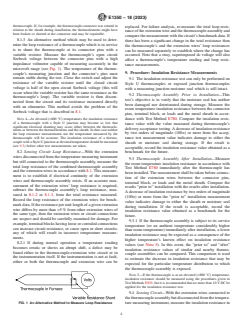
8.1.3 An alternative method which may be used to deter-
there has been a significant change in the total resistance then
mine the loop resistance of a thermocouple which is in service
the thermocouple’s and the extension wires’ loop resistances
is to shunt the thermocouple at its connector pins with a
can be measured separately to establish where the change has
variable resistor. Measure the thermocouple’s open circuit
occurred. Note that a stray, superimposed dc voltage will also
Seebeck voltage between the connector pins with a high
affect a thermocouple’s temperature reading and loop resis-
impedance voltmeter capable of measuring accurately in the
tance measurements.
microvolt range (see Fig. 1). The temperature of the thermo-
9. Procedure: Insulation Resistance Measurements
couple’s measuring junction and the connector’s pins must
remain stable during the test. Close the switch and adjust the
9.1 The insulation resistance test can only be performed on
resistance of the variable resistor until the closed circuit
Style U thermocouples or exposed junction thermocouples
voltage is half of the open circuit Seebeck voltage (this will
with a measuring junction moisture seal which is still intact.
occur when the variable resistor has the same resistance as the
9.2 Thermocouple Assembly Prior to Installation—This
thermocouple’s loop). The variable resistor is then discon-
test’s objective is to verify that the moisture seal has neither
nected from the circuit and its resistance measured directly
been damaged nor deteriorated during storage. Measure the
with an ohmmeter. This method avoids the problem of the
room temperature insulation resistance between the connector
Seebeck voltage that is described in 8
...