

ASTM E207-21
(Test Method)Standard Test Method for Thermal EMF Test of Single Thermoelement Materials by Comparison With Reference Thermoelement of Similar EMF-Temperature Properties
General Information
- Abstract
SIGNIFICANCE AND USE
5.1 This test method is designed to calibrate a thermoelement at one or more test temperatures. The data obtained are sometimes referred to as initial values of emf because the time at the test temperature is limited.
5.2 This test method is employed mainly by providers of spools or coils of wire or strips of thermoelectric material. Generally more than one specimen at a time is tested, and the resultant emfs of individual thermoelements are used to match to companion thermoelements for use as thermocouples or in extension wiring.
5.3 The emf of a thermocouple comprised of two different thermoelements as tested with this test method may be determined by algebraically subtracting the emf of the negative thermoelement from the emf of the positive thermoelement at a particular temperature. The emf of a thermocouple may also be determined by the test described in Test Method E220, but Test Method E220 does not take into account the values of the emf of the individual thermoelements relative to Pt-67.
5.4 This test method is normally used for the calibration of thermocouple materials during their production or distribution, not for the accurate determination of the properties of a used thermocouple. If the test samples were subjected to previous use, the test results may not reflect the same emf as the thermocouple did while in service. For example, inhomogeneities may have been induced in the wires because of a chemical or metallurgical reaction while in service. Since emf is developed in the thermal gradient, and it is unlikely that the temperature profile along the wire under testing conditions will be the same as it was while in service, the test results may be misleading.
5.5 The test results are suitable for specification acceptance, manufacturing control, design, or research and development purposes.
SCOPE
1.1 This test method covers a test for determining the thermoelectric electromotive force (emf) of a thermoelement versus National Instruments of Standards and Technology (NIST) platinum 67 (Pt-67) by means of measuring the difference between the emf of the test thermoelement and the emf of a reference thermoelement (previously referred to as a secondary standard), which has a known relationship to NIST Pt-67.
1.2 This test method is applicable to new thermocouple materials over the temperature ranges normally associated with thermocouples and their extension wires. The table on Suggested Upper Temperature Limits for Protected Thermocouples in Specification E230/E230M lists the ranges associated with the letter-designated types of thermocouples. ASTM MNL122 lists the temperature range of extension circuit materials.
1.3 This test method is not applicable to stability testing or inhomogeneity testing.
1.4 The values stated in SI units are to be regarded as standard. The values given in parentheses after SI units are provided for information only and are not considered standard.
1.5 This standard does not purport to address all of the safety concerns, if any, associated with its use. It is the responsibility of the user of this standard to establish appropriate safety, health, and environmental practices and determine the applicability of regulatory limitations prior to use.
1.6 This international standard was developed in accordance with internationally recognized principles on standardization established in the Decision on Principles for the Development of International Standards, Guides and Recommendations issued by the World Trade Organization Technical Barriers to Trade (TBT) Committee.
- Status
- Published
- Publication Date
- 30-Apr-2021
- Technical Committee
- E20 - Temperature Measurement
- Drafting Committee
- E20.11 - Thermocouples - Calibration
Buy Documents
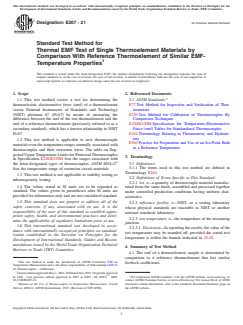
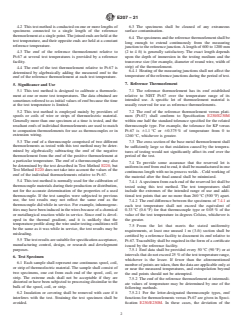
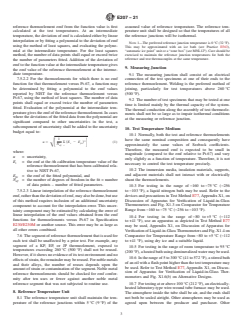
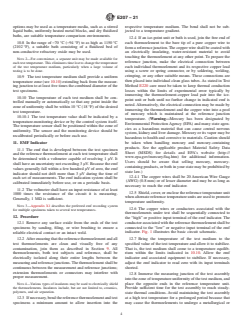
ASTM E207-21 - Standard Test Method for Thermal EMF Test of Single Thermoelement Materials by Comparison With Reference Thermoelement of Similar EMF-Temperature Properties
REDLINE ASTM E207-21 - Standard Test Method for Thermal EMF Test of Single Thermoelement Materials by Comparison With Reference Thermoelement of Similar EMF-Temperature Properties
Overview
ASTM E207-21: Standard Test Method for Thermal EMF Test of Single Thermoelement Materials by Comparison With Reference Thermoelement of Similar EMF-Temperature Properties provides a reliable procedure for calibrating thermoelement materials used in thermocouple manufacturing. This standard, issued by ASTM International, focuses on determining the thermoelectric electromotive force (emf) of a test thermoelement compared to a reference thermoelement with a known relationship to NIST platinum 67 (Pt-67). The resulting data assist manufacturers and suppliers of thermoelectric wires or strips in ensuring quality, consistency, and traceability in temperature measurement applications.
Key Topics
Calibration of New Thermoelement Materials:
The standard is primarily employed to calibrate new, unused thermocouple materials at one or more specified test temperatures, establishing initial emf values used for subsequent matching and assembly.Comparison With Reference Thermoelement:
The emf of the test thermoelement is measured against a reference thermoelement already calibrated relative to NIST Pt-67. This enables high-accuracy and traceable results.Application Scope:
Applicable to new thermocouple and extension wire materials across the standard temperature ranges defined in ASTM E230/E230M and relevant manuals. The method is not intended for in-service or used thermocouples due to possible material inhomogeneities from previous exposure.Testing Strategy:
Multiple specimens, typically from both ends of a spool, coil, or strip, are tested together. The measured emfs are used to match materials for paired applications or for use in extension wires.Calculation Approach:
Results are calculated based on measured emf values at controlled test and reference temperatures. The emf of a complete thermocouple is determined by subtracting the negative element’s emf from the positive’s at the same temperature, allowing for accurate thermoelectric property determination.Quality and Traceability:
The method mandates the use of certified reference materials and traceability to national standards, ensuring data reliability for manufacturing control, specification acceptance, and research.
Applications
Manufacturing Control:
Enables manufacturers to assess and balance batches of thermoelement material, verifying conformity with technical specifications and ensuring product consistency in thermocouple performance.Specification Acceptance & Matching:
Used during production or distribution to confirm materials meet specified emf values at required temperatures, facilitating precise matching of thermoelements for assembly into thermocouples or extension wires.Design and R&D:
Provides essential emf data for design engineering, materials development, and research in temperature measurement technologies.Certification:
Offers a standardized basis for issuing certificates of conformance, indicating that materials have been tested in compliance with ASTM E207, with traceable data to NIST standards.
Related Standards
- ASTM E220 - Standard Test Method for Calibration of Thermocouples by Comparison Techniques
- ASTM E230/E230M - Specification for Temperature-Electromotive Force Tables for Standardized Thermocouples
- ASTM E344 - Terminology Relating to Thermometry and Hydrometry
- ASTM E563 - Practice for Preparation and Use of an Ice-Point Bath as a Reference Temperature
- ASTM MNL12 - Manual on the Use of Thermocouples in Temperature Measurement
These related standards offer additional guidance for thermocouple calibration, terminology, reference temperature maintenance, and temperature-emf relationships, supporting comprehensive control and quality in the thermoelectric measurement industry.
By following ASTM E207-21, organizations standardize the calibration and quality confirmation of thermoelement materials, contributing to the dependability and global traceability of temperature measurement systems. Keywords: thermoelement calibration, thermal emf, reference thermoelement, NIST Pt-67, thermocouple manufacturing, ASTM E207, traceability, temperature measurement standards.
Relations
- Effective Date
- 01-Dec-2023
- Effective Date
- 01-Nov-2023
- Effective Date
- 01-May-2023
- Effective Date
- 01-Sep-2019
- Effective Date
- 01-Apr-2018
- Effective Date
- 01-Nov-2016
- Effective Date
- 01-May-2014
- Effective Date
- 01-Nov-2013
- Effective Date
- 01-May-2013
- Effective Date
- 01-May-2012
- Effective Date
- 15-May-2011
- Effective Date
- 15-May-2011
- Effective Date
- 01-May-2011
- Effective Date
- 01-Nov-2010
- Effective Date
- 15-Nov-2008
Buy Documents
ASTM E207-21 - Standard Test Method for Thermal EMF Test of Single Thermoelement Materials by Comparison With Reference Thermoelement of Similar EMF-Temperature Properties
REDLINE ASTM E207-21 - Standard Test Method for Thermal EMF Test of Single Thermoelement Materials by Comparison With Reference Thermoelement of Similar EMF-Temperature Properties
Get Certified
Connect with accredited certification bodies for this standard

BSMI (Bureau of Standards, Metrology and Inspection)
Taiwan's standards and inspection authority.
Sponsored listings
Frequently Asked Questions
ASTM E207-21 is a standard published by ASTM International. Its full title is "Standard Test Method for Thermal EMF Test of Single Thermoelement Materials by Comparison With Reference Thermoelement of Similar EMF-Temperature Properties". This standard covers: SIGNIFICANCE AND USE 5.1 This test method is designed to calibrate a thermoelement at one or more test temperatures. The data obtained are sometimes referred to as initial values of emf because the time at the test temperature is limited. 5.2 This test method is employed mainly by providers of spools or coils of wire or strips of thermoelectric material. Generally more than one specimen at a time is tested, and the resultant emfs of individual thermoelements are used to match to companion thermoelements for use as thermocouples or in extension wiring. 5.3 The emf of a thermocouple comprised of two different thermoelements as tested with this test method may be determined by algebraically subtracting the emf of the negative thermoelement from the emf of the positive thermoelement at a particular temperature. The emf of a thermocouple may also be determined by the test described in Test Method E220, but Test Method E220 does not take into account the values of the emf of the individual thermoelements relative to Pt-67. 5.4 This test method is normally used for the calibration of thermocouple materials during their production or distribution, not for the accurate determination of the properties of a used thermocouple. If the test samples were subjected to previous use, the test results may not reflect the same emf as the thermocouple did while in service. For example, inhomogeneities may have been induced in the wires because of a chemical or metallurgical reaction while in service. Since emf is developed in the thermal gradient, and it is unlikely that the temperature profile along the wire under testing conditions will be the same as it was while in service, the test results may be misleading. 5.5 The test results are suitable for specification acceptance, manufacturing control, design, or research and development purposes. SCOPE 1.1 This test method covers a test for determining the thermoelectric electromotive force (emf) of a thermoelement versus National Instruments of Standards and Technology (NIST) platinum 67 (Pt-67) by means of measuring the difference between the emf of the test thermoelement and the emf of a reference thermoelement (previously referred to as a secondary standard), which has a known relationship to NIST Pt-67. 1.2 This test method is applicable to new thermocouple materials over the temperature ranges normally associated with thermocouples and their extension wires. The table on Suggested Upper Temperature Limits for Protected Thermocouples in Specification E230/E230M lists the ranges associated with the letter-designated types of thermocouples. ASTM MNL122 lists the temperature range of extension circuit materials. 1.3 This test method is not applicable to stability testing or inhomogeneity testing. 1.4 The values stated in SI units are to be regarded as standard. The values given in parentheses after SI units are provided for information only and are not considered standard. 1.5 This standard does not purport to address all of the safety concerns, if any, associated with its use. It is the responsibility of the user of this standard to establish appropriate safety, health, and environmental practices and determine the applicability of regulatory limitations prior to use. 1.6 This international standard was developed in accordance with internationally recognized principles on standardization established in the Decision on Principles for the Development of International Standards, Guides and Recommendations issued by the World Trade Organization Technical Barriers to Trade (TBT) Committee.
SIGNIFICANCE AND USE 5.1 This test method is designed to calibrate a thermoelement at one or more test temperatures. The data obtained are sometimes referred to as initial values of emf because the time at the test temperature is limited. 5.2 This test method is employed mainly by providers of spools or coils of wire or strips of thermoelectric material. Generally more than one specimen at a time is tested, and the resultant emfs of individual thermoelements are used to match to companion thermoelements for use as thermocouples or in extension wiring. 5.3 The emf of a thermocouple comprised of two different thermoelements as tested with this test method may be determined by algebraically subtracting the emf of the negative thermoelement from the emf of the positive thermoelement at a particular temperature. The emf of a thermocouple may also be determined by the test described in Test Method E220, but Test Method E220 does not take into account the values of the emf of the individual thermoelements relative to Pt-67. 5.4 This test method is normally used for the calibration of thermocouple materials during their production or distribution, not for the accurate determination of the properties of a used thermocouple. If the test samples were subjected to previous use, the test results may not reflect the same emf as the thermocouple did while in service. For example, inhomogeneities may have been induced in the wires because of a chemical or metallurgical reaction while in service. Since emf is developed in the thermal gradient, and it is unlikely that the temperature profile along the wire under testing conditions will be the same as it was while in service, the test results may be misleading. 5.5 The test results are suitable for specification acceptance, manufacturing control, design, or research and development purposes. SCOPE 1.1 This test method covers a test for determining the thermoelectric electromotive force (emf) of a thermoelement versus National Instruments of Standards and Technology (NIST) platinum 67 (Pt-67) by means of measuring the difference between the emf of the test thermoelement and the emf of a reference thermoelement (previously referred to as a secondary standard), which has a known relationship to NIST Pt-67. 1.2 This test method is applicable to new thermocouple materials over the temperature ranges normally associated with thermocouples and their extension wires. The table on Suggested Upper Temperature Limits for Protected Thermocouples in Specification E230/E230M lists the ranges associated with the letter-designated types of thermocouples. ASTM MNL122 lists the temperature range of extension circuit materials. 1.3 This test method is not applicable to stability testing or inhomogeneity testing. 1.4 The values stated in SI units are to be regarded as standard. The values given in parentheses after SI units are provided for information only and are not considered standard. 1.5 This standard does not purport to address all of the safety concerns, if any, associated with its use. It is the responsibility of the user of this standard to establish appropriate safety, health, and environmental practices and determine the applicability of regulatory limitations prior to use. 1.6 This international standard was developed in accordance with internationally recognized principles on standardization established in the Decision on Principles for the Development of International Standards, Guides and Recommendations issued by the World Trade Organization Technical Barriers to Trade (TBT) Committee.
ASTM E207-21 is classified under the following ICS (International Classification for Standards) categories: 17.200.20 - Temperature-measuring instruments. The ICS classification helps identify the subject area and facilitates finding related standards.
ASTM E207-21 has the following relationships with other standards: It is inter standard links to ASTM E344-23, ASTM E230/E230M-23a, ASTM E230/E230M-23, ASTM E344-19, ASTM E344-18, ASTM E344-16, ASTM E77-14, ASTM E220-13, ASTM E344-13, ASTM E344-12, ASTM E230/E230M-11, ASTM E230/E230M-11e1, ASTM E563-11, ASTM E344-10, ASTM E344-08. Understanding these relationships helps ensure you are using the most current and applicable version of the standard.
ASTM E207-21 is available in PDF format for immediate download after purchase. The document can be added to your cart and obtained through the secure checkout process. Digital delivery ensures instant access to the complete standard document.
Standards Content (Sample)
This international standard was developed in accordance with internationally recognized principles on standardization established in the Decision on Principles for the
Development of International Standards, Guides and Recommendations issued by the World Trade Organization Technical Barriers to Trade (TBT) Committee.
Designation: E207 − 21 An American National Standard
Standard Test Method for
Thermal EMF Test of Single Thermoelement Materials by
Comparison With Reference Thermoelement of Similar EMF-
Temperature Properties
This standard is issued under the fixed designation E207; the number immediately following the designation indicates the year of
original adoption or, in the case of revision, the year of last revision.Anumber in parentheses indicates the year of last reapproval.A
superscript epsilon (´) indicates an editorial change since the last revision or reapproval.
1. Scope 2. Referenced Documents
1.1 This test method covers a test for determining the 2.1 ASTM Standards:
thermoelectric electromotive force (emf) of a thermoelement E77Test Method for Inspection and Verification of Ther-
versus National Instruments of Standards and Technology mometers
(NIST) platinum 67 (Pt-67) by means of measuring the E220Test Method for Calibration of Thermocouples By
difference between the emf of the test thermoelement and the Comparison Techniques
emf of a reference thermoelement (previously referred to as a E230/E230MSpecification for Temperature-Electromotive
secondary standard), which has a known relationship to NIST Force (emf) Tables for Standardized Thermocouples
Pt-67. E344Terminology Relating to Thermometry and Hydrom-
etry
1.2 This test method is applicable to new thermocouple
E563Practice for Preparation and Use of an Ice-Point Bath
materialsoverthetemperaturerangesnormallyassociatedwith
as a Reference Temperature
thermocouples and their extension wires. The table on Sug-
gestedUpperTemperatureLimitsforProtectedThermocouples
3. Terminology
in Specification E230/E230M lists the ranges associated with
3.1 Definitions:
the letter-designated types of thermocouples. ASTM MNL12
3.1.1 The terms used in this test method are defined in
lists the temperature range of extension circuit materials.
Terminology E344.
1.3 This test method is not applicable to stability testing or
3.2 Definitions of Terms Specific to This Standard:
inhomogeneity testing.
3.2.1 lot, n—a quantity of thermocouple material manufac-
1.4 The values stated in SI units are to be regarded as
tured from the same batch, assembled and processed together
standard. The values given in parentheses after SI units are
under controlled production conditions having uniform char-
providedforinformationonlyandarenotconsideredstandard.
acteristics.
1.5 This standard does not purport to address all of the
3.2.2 reference facility, n—NIST, or a testing laboratory
safety concerns, if any, associated with its use. It is the
whose physical standards are traceable to NIST or another
responsibility of the user of this standard to establish appro-
national standards laboratory.
priate safety, health, and environmental practices and deter-
3.2.3 test temperature, n—the temperature of the measuring
mine the applicability of regulatory limitations prior to use.
junction.
1.6 This international standard was developed in accor-
3.2.3.1 Discussion—Inreportingtheresults,thevalueofthe
dance with internationally recognized principles on standard-
test temperature may be rounded off, provided the stated test
ization established in the Decision on Principles for the
temperature is within the bounds indicated in 10.10.
Development of International Standards, Guides and Recom-
mendations issued by the World Trade Organization Technical
4. Summary of Test Method
Barriers to Trade (TBT) Committee.
4.1 The emf of a thermoelement sample is determined by
comparison to a reference thermoelement that has similar
This test method is under the jurisdiction of ASTM Committee E20 on
Seebeck coefficients.
Temperature Measurement and is the direct responsibility of Subcommittee E20.11
on Thermocouples - Calibration.
CurrenteditionapprovedMay1,2021.PublishedJuly2021.Originallyapproved
ε1
in 1962 . Last previous edition approved in 2015 as E207–08 (2015) . DOI: For referenced ASTM standards, visit the ASTM website, www.astm.org, or
10.1520/E0207-21. contact ASTM Customer Service at service@astm.org. For Annual Book of ASTM
Manual on the Use of Thermocouples in Temperature Measurement, Fourth Standards volume information, refer to the standard’s Document Summary page on
Edition, MNL12, ASTM International, 1993. (Revision of STP 407B). the ASTM website.
Copyright © ASTM International, 100 Barr Harbor Drive, PO Box C700, West Conshohocken, PA 19428-2959. United States
E207 − 21
4.2 Thistestmethodisconductedononeormorelengthsof 6.3 The specimens shall be cleaned of any extraneous
specimens connected to a single length of the reference surface contamination.
thermoelementatasinglepoint.Thejoinedendsareheldatthe
6.4 Thespecimensandthereferencethermoelementshallbe
test temperature, and their opposite ends are held at a constant
long enough to extend continuously from the measuring
reference temperature.
junction to the reference junction.Alength of 600 to 1200 mm
4.3 The emf of the reference thermoelement relative to
(2 to 4 ft) is generally satisfactory. The exact length depends
Pt-67 at several test temperatures is provided by a reference upon the depth of immersion in the testing medium and the
facility.
transverse size (for example, diameter of round wire, width of
strip) of the thermoelement.
4.4 The emf of the test thermoelement relative to Pt-67 is
6.4.1 Heating of the measuring junctions shall not affect the
determined by algebraically adding the measured emf to the
temperatureofthereferencejunctionsduringtheperiodoftest.
emf of the reference thermoelement at each test temperature.
7. Reference Thermoelement
5. Significance and Use
5.1 This test method is designed to calibrate a thermoele- 7.1 The reference thermoelement has its emf established
ment at one or more test temperatures. The data obtained are relative to NIST Pt-67 over the temperature range of its
sometimes referred to as initial values of emf because the time intended use. A specific lot of thermoelement material is
at the test temperature is limited. usually reserved for use as reference thermoelements.
5.2 This test method is employed mainly by providers of
7.2 The emf of the reference thermoelement versus plati-
spools or coils of wire or strips of thermoelectric material. num (Pt-67) shall conform to Specification E230/E230M
Generally more than one specimen at a time is tested, and the
within one half the standard tolerance specified for the related
resultant emfs of individual thermoelements are used to match thermocouple type. For example, the tolerance for KP versus
to companion thermoelements for use as thermocouples or in Pt-67 is 61.1°C or 60.375% of temperature from 0 to
extension wiring. 1260°C, whichever is greater.
5.3 The emf of a thermocouple comprised of two different 7.3 The cross section of the base metal thermoelement shall
thermoelements as tested with this test method may be deter-
be sufficiently large so that oxidation caused by the tempera-
mined by algebraically subtracting the emf of the negative tures of testing would not significantly affect its emf over the
thermoelement from the emf of the positive thermoelement at
period of the test.
a particular temperature. The emf of a thermocouple may also
7.4 To provide some assurance that the reserved lot is
be determined by the test described in Test Method E220, but
uniforminemffromendtoend,itshallbemanufacturedinone
Test Method E220 does not take into account the values of the
continuous length with no in-process welds. . Cold working of
emf of the individual thermoelements relative to Pt-67.
the material after the final anneal shall be minimized.
5.4 This test method is normally used for the calibration of
7.4.1 Aspecimen from each end of the reserved lot shall be
thermocouplematerialsduringtheirproductionordistribution,
tested using this test method. The test temperatures shall
not for the accurate determination of the properties of a used
include the extremes of the intended range of use and addi-
thermocouple. If the test samples were subjected to previous
tional test points that are no more than 260°C (500°F) apart.
use, the test results may not reflect the same emf as the
7.4.2 The emf difference between the specimens of 7.4.1 at
thermocouple did while in service. For example, inhomogene-
each test temperature shall not exceed the equivalent of
itiesmayhavebeeninducedinthewiresbecauseofachemical
0.33°C (0.6°F) for that thermocouple type or 0.05% of the
or metallurgical reaction while in service. Since emf is devel-
value of the test temperature in degrees Celsius, whichever is
oped in the thermal gradient, and it is unlikely that the
the greater.
temperatureprofilealongthewireundertestingconditionswill
7.5 From the lot that meets the stated uniformity
be the same as it was while in service, the test results may be
requirements, at least one unused 1m (3-ft) section shall be
misleading.
certified by a reference facility to document its emf relative to
5.5 Thetestresultsaresuitableforspecificationacceptance,
Pt-67.Traceability shall be required in the form of a certificate
manufacturing control, design, or research and development
issued by the reference facility.
purposes.
7.5.1 Emf data shall be provided every 50°C (90°F) or at
intervalsthatdonotexceed25%ofthetesttemperaturerange,
6. Test Specimen
whichever is the lesser. If fewer than the aforementioned
6.1 Each sample shall represent one continuous spool, coil,
numberofpointsaretaken,thenthedataareapplicableonlyat
or strip of thermoelectric material. The sample shall consist of
or near the measured temperatures, and extrapolation beyond
two specimens, one cut from each end of the spool, coil, or
the end points should not be attempted.
strip. The extreme ends shall not be acceptable if they are
7.5.2 The emf of the reference thermoelement at intermedi-
distortedorhavebeensubjectedtoprocessingdissimilartothe
ate values of temperature may be determined by one of the
bulk of the spool, coil, or strip.
following methods.
6.2 Insulation or covering shall be removed with care if it 7.5.2.1 For the letter-designated thermocouple types, emf
interferes with the test. Straining the test specimen shall be functions for thermoelements versus Pt-67 are given in Speci-
avoided. fication E230/E230M. In these cases, the deviation of the
E207 − 21
reference thermoelement emf from the function value is first assumed value of reference temperature. The reference tem-
calculated at the test temperatures. At an intermediate perature unit shall be designed so that the temperatures of all
temperature, the deviation of emf is calculated either by linear the reference junctions will be isothermal.
interpolation or by fitting a polynomial to the deviation of emf
NOTE 1—The preferred reference junction temperature is 0°C (32°F).
using the method of least squares, and evaluating the polyno-
This may be approximated with an ice bath (see Practice E563),
mial at the intermediate temperature. For the least squares
“automatic ice point” unit or a “zone box” (see MNL12 ). Care should be
exercised to maintain the reference junction temperatures for both the
method, the number of data points shall equal or exceed twice
reference and test thermocouples at the same temperature.
the number of parameters fitted. Addition of the deviation of
emftothefunctionvalueattheintermediatetemperaturegives
9. Measuring Junction
the emf value of the reference thermoelement at the interme-
diate temperature. 9.1 The measuring junction shall consist of an electrical
7.5.2.2 For the thermoelements for which there is no emf connection of the test specimens at one of their ends to the
function for that thermoelement versus Pt-67, a function may reference thermoelement. Welding is the preferred method of
be determined by fitting a polynomial to the emf values joining, particularly for test temperatures above 260 °C
reported by NIST for the reference thermoelement versus (500°F).
Pt-67, using the method of least squares. The number of data
9.2 The number of test specimens that may be tested at one
points shall equal or exceed twice the number of parameters
time is limited mainly by the thermal capacity of the system.
fitted. Evaluation of the polynomial at the intermediate tem-
The thermal conduction along the assembly of test thermoele-
peraturegivestheemfofthereferencethermoelement.Incases
ments shall not be so large as to impair isothermal conditions
where the deviations of the fitted data from the polynomial are
at the measuring or reference junction.
significant compared to other uncertainties in the test, a
subcomponent of uncertainty shall be added to the uncertainty
10. Test Temperature Medium
budget equal to:
10.1 Normally, both the test and reference thermoelements
have the same nominal composition and consequently have
u 5 Σ ~E 2 E ! (1)
ŒF G
i fit
N
approximately the same values of Seebeck coefficients.
df i
Therefore, the measured emf is expected to be small in
where:
magnitude (compared to the emf relative to Pt-67) and vary
u = uncertainty,
only slightly as a function of temperature. Therefore, it is not
E = the emf at the ith calibration temperature value of the
i
necessary to control the test temperature precisely.
reference thermoelement that has been calibrated rela-
10.2 The immersion media, insulation materials, supports,
tive to NIST Pt-67,
and adjacent materials shall not interact with or electrically
E = the emf of the fitted polynomial, and
fit
N = the number of degrees of freedom in the fit = number shunt the thermoelements.
df
of data points – number of fitted parameters.
10.3 For testing in the range of−160 to−75°C (−256
7.5.2.3 Linear interpolation of the reference thermoelement to−103°F), a liquid nitrogen bath may be used. Refer to the
devices and precautions inTest Method E77,Appendix X1, on
emf,ratherthanthedeviationofemf,mayalsobedone,butuse
of this method requires inclusion of an additional uncertainty Discussion of Apparatus for Verification of Liquid-in-Glass
Thermometers and Fig. X1.3 on Comparator for Temperature
component to account for the interpolation error. This uncer-
tainty component may be estimated by calculating the error of Range from−160 to−75°C (−256 to−103°F).
linear interpolation of the emf values obtained from the emf
10.4 For testing in the range of −80 to +5 °C (−112
functions for thermoelements versus Pt-67 in Specification
to+41°F), use an apparatus as depicted in Test Method E77
E230/E230M or another source. This error may be as large as
may be used, Appendix X1, on Discussion of Apparatus for
all other errors combined.
VerificationofLiquid-in-GlassThermometersandFig.X1.4on
Comparator for Temperature Range from−80 to+5°C (−112
7.6 Thesegmentofreferencethermoelementthatisusedfor
to+41°F), using dry ice and a suitable liquid.
each test shall be unaffected by a prior test. For example, any
segment of a KP, EP, or JP thermoelement, exposed to
10.5 For testing in the range of room temperature to 95°C
temperatures exceeding 260°C (500°F) shall not be reused.
(200°F),aheatedbathusingdemineralizedwatermaybeused.
However,ifitshowsnoevidenceofitstestenvironmentandno
10.6 Intherangeof5to300°C(41to572°F),astirredbath
effectsofstrain,theremaindermaybereused.Fornoblemetals
ofanoilwithaflashpointhigherthanthetesttemperaturemay
and their alloys, the number of reuses depends upon the
be used. Refer to Test Method E77,Appendix X1, on Discus-
amountofstrainorcontaminationofthesegment.Noblemetal
sion of Apparatus for Verification of Liquid-in-Glass Ther-
reference thermoelements should be checked for emf confor-
mometers and Fig. X1.6(b) on Alternative Designs.
mity after ten uses or fewer against another noble metal
reference segment that was not subjected to routine use. 10.7 Fortestingatorabove100°C(212°F),anelectrically-
heated laboratory-type wire-wound tube furnace may be used.
8. Reference Temperature Unit
The atmosphere inside the tube shall be air, and the ends s
...
This document is not an ASTM standard and is intended only to provide the user of an ASTM standard an indication of what changes have been made to the previous version. Because
it may not be technically possible to adequately depict all changes accurately, ASTM recommends that users consult prior editions as appropriate. In all cases only the current version
of the standard as published by ASTM is to be considered the official document.
´1
Designation: E207 − 08 (Reapproved 2015) E207 − 21 An American National Standard
Standard Test Method for
Thermal EMF Test of Single Thermoelement Materials by
Comparison with a With Reference Thermoelement of
Similar EMF-Temperature Properties
This standard is issued under the fixed designation E207; the number immediately following the designation indicates the year of
original adoption or, in the case of revision, the year of last revision. A number in parentheses indicates the year of last reapproval. A
superscript epsilon (´) indicates an editorial change since the last revision or reapproval.
ε NOTE—Editorial changes were made throughout in June 2015.
1. Scope
1.1 This test method covers a test for determining the thermoelectric emf electromotive force (emf) of a thermoelement versus
NIST National Instruments of Standards and Technology (NIST) platinum 67 (Pt-67) by means of measuring the difference
between the emf of the test thermoelement and the emf of a reference thermoelement (previously referred to as a secondary
standard), which has a known relationship to NIST Pt-67.
1.2 This test method is applicable to new thermocouple materials over the temperature ranges normally associated with
thermocouples and their extension wires. The table on Suggested Upper Temperature Limits for Protected Thermocouples in
Specification E230E230/E230M lists the ranges associated with the letter-designated types of thermocouples. ASTM MNL-
12MNL12 lists the temperature range of extension circuit materials.
1.3 This test method is not applicable to stability testing or inhomogeneity testing.
1.4 The values stated in SI units are to be regarded as the standard. The values given in parentheses are for information only. after
SI units are provided for information only and are not considered standard.
1.5 This standard does not purport to address all of the safety concerns, if any, associated with its use. It is the responsibility
of the user of this standard to establish appropriate safety safety, health, and healthenvironmental practices and determine the
applicability of regulatory limitations prior to use.
1.6 This international standard was developed in accordance with internationally recognized principles on standardization
established in the Decision on Principles for the Development of International Standards, Guides and Recommendations issued
by the World Trade Organization Technical Barriers to Trade (TBT) Committee.
2. Referenced Documents
2.1 ASTM Standards:
E77 Test Method for Inspection and Verification of Thermometers
This test method is under the jurisdiction of ASTM Committee E20 on Temperature Measurement and is the direct responsibility of Subcommittee E20.11 on
Thermocouples - Calibration.
Current edition approved May 1, 2015May 1, 2021. Published May 2015July 2021. Originally approved in 1962 . Last previous edition approved in 20082015 as
ε1
E207 – 08.E207 – 08 (2015) . DOI: 10.1520/E0207-08R15E01.10.1520/E0207-21.
Manual on the Use of Thermocouples in Temperature Measurement, ASTM MNL-12,Fourth Edition, MNL12, Fourth Edition, ASTM, April ASTM International, 1993.
(Revision of STP 407B).
For referenced ASTM standards, visit the ASTM website, www.astm.org, or contact ASTM Customer Service at service@astm.org. For Annual Book of ASTM Standards
volume information, refer to the standard’s Document Summary page on the ASTM website.
Copyright © ASTM International, 100 Barr Harbor Drive, PO Box C700, West Conshohocken, PA 19428-2959. United States
E207 − 21
E220 Test Method for Calibration of Thermocouples By Comparison Techniques
E230E230/E230M Specification for Temperature-Electromotive Force (emf) Tables for Standardized Thermocouples
E344 Terminology Relating to Thermometry and Hydrometry
E563 Practice for Preparation and Use of an Ice-Point Bath as a Reference Temperature
3. Terminology
3.1 Definitions—The terms used in this test method are defined in Terminology E344.
3.1 Definitions:
3.1.1 The terms used in this test method are defined in Terminology E344.
3.2 Definitions of Terms Specific to This Standard:
3.2.1 lot, n—a quantity of thermocouple material manufactured from the same batch, assembled and processed together under
controlled production conditions having uniform characteristics.
3.2.2 reference facility, n—NIST, or a testing laboratory whose physical standards are traceable to NIST or another national
standards laboratory.
3.2.3 test temperature, n—the temperature of the measuring junction.
3.2.3.1 Discussion—
In reporting the results, the value of the test temperature may be rounded off, provided the stated test temperature is within the
bounds indicated in 10.10.
4. Summary of Test Method
4.1 The emf of a thermoelement sample is determined by comparison to a reference thermoelement that has similar Seebeck
coefficients.
4.2 This test method is conducted on one or more lengths of specimens connected to a single length of the reference
thermoelement at a single point. The joined ends are held at the test temperature, and their opposite ends are held at a constant
reference temperature.
4.3 The emf of the reference thermoelement relative to Pt-67 at several test temperatures areis provided by a reference facility.
4.4 The emf of the test thermoelement relative to Pt-67 is determined by algebraically adding the measured emf to the emf of the
reference thermoelement at each test temperature.
5. Significance and Use
5.1 This test method is designed to calibrate a thermoelement at one or more test temperatures. The data obtained are sometimes
referred to as initial values of emf because the time at the test temperature is limited.
5.2 This test method is employed mainly by providers of spools or coils of wire or strips of thermoelectric material. Generally
more than one specimen at a time is tested, and the resultant emfs of individual thermoelements are used to match to companion
thermoelements for use as thermocouples or in extension wiring.
5.3 The emf of a thermocouple comprised of two different thermoelements as tested with this test method may be determined by
algebraically subtracting the emf of the negative thermoelement from the emf of the positive thermoelement at a particular
temperature. The emf of a thermocouple may also be determined by the test described in Test Method E220, but Test Method E220
does not take into account the values of the emf of the individual thermoelements relative to Pt-67.
5.4 This test method is normally used for the calibration of thermocouple materials during their production or distribution, not for
the accurate determination of the properties of a used thermocouple. If the test samples were subjected to previous use, the test
results may not reflect the same emf as the thermocouple did while in service. For example, inhomogeneities may have been
E207 − 21
induced in the wires because of a chemical or metallurgical reaction while in service. Since emf is developed in the thermal
gradient, and it is unlikely that the temperature profile along the wire under testing conditions will be the same as it was while in
service, the test results may be misleading.
5.5 The test results are suitable for specification acceptance, manufacturing control, design, or research and development purposes.
6. Test Specimen
6.1 Each sample shall represent one continuous spool, coil, or strip of thermoelectric material. The sample shall consist of two
specimens, one cut from each end of the spool, coil, or strip. The extreme ends shall not be acceptable if they are distorted or have
been subjected to processing dissimilar to the bulk of the spool, coil, or strip.
6.2 Insulation or covering shall be removed with care if it interferes with the test. Straining the test specimen shall be avoided.
6.3 The specimens shall be cleaned of any extraneous surface contamination.
6.4 The specimens and the reference thermoelement shall be long enough to extend continuously from the measuring junction to
the reference junction. A length of 600 to 1200 mm (2 to 4 ft) is generally satisfactory. The exact length depends upon the depth
of immersion in the testing medium and the transverse size (for example, diameter of round wire, width of strip) of the
thermoelement.
6.4.1 Heating of the measuring junctions shall not affect the temperature of the reference junctions during the period of test.
7. Reference Thermoelement
7.1 The reference thermoelement has its emf established relative to NIST Pt-67 over the temperature range of its intended use.
A specific lot of thermoelement material is usually reserved for use as reference thermoelements.
7.2 The emf of the reference thermoelement versus platinum (Pt-67) shall conform to Specification E230E230/E230M within one
half the standard tolerance specified for the related thermocouple type. For example, the tolerance for KP versus Pt-67 is 6 1°C
or 6 0.375% 61.1 °C or 60.375 % of temperature from 0 to 1260°C,1260 °C, whichever is greater.
7.3 The cross section of the base metal thermoelement shall be sufficiently large so that oxidation caused by the temperatures of
testing would not significantly affect its emf over the period of the test.
7.4 To provide some assurance that the reserved lot is uniform in emf from end to end, it shall be manufactured in one continuous
length with no in-process welds. . Cold working of the material after the final anneal shall be minimized.minimized.
7.4.1 A specimen from each end of the reserved lot shall be tested using this test method. The test temperatures shall include the
extremes of the intended range of use and additional test points that are no more than 260°C (500°F)260 °C (500 °F) apart.
7.4.2 The emf difference between the specimens of 7.4.1 at each test temperature shall not exceed the equivalent of 0.33°C
(0.6°F)0.33 °C (0.6 °F) for that thermocouple type or 0.05 % of the value of the test temperature in degrees Celsius, whichever
is the greater.
7.5 From the lot that meets the stated uniformity requirements, at least one unused 1 m (3-ft) section shall be certified by a
reference facility to document its emf relative to Pt-67. Traceability shall be required in the form of a certificate issued by the
reference facility.
7.5.1 Emf data shall be provided every 50°C (100°F)50 °C (90 °F) or at intervals that do not exceed 25 % of the test temperature
range, whichever is the lesser. If fewer than the aforementioned number of points are taken, then the data are applicable only at
or near the measured temperatures, and interpolation beyond them extrapolation beyond the end points should not be attempted.
7.5.2 The emf of the reference thermoelement at intermediate values of temperature may be determined by one of the following
methods.
E207 − 21
7.5.2.1 For the letter-designated thermocouple types, emf functions for thermoelements versus Pt-67 are given in Specification
E230E230/E230M. In these cases, the deviation of the reference thermoelement emf from the function value is first calculated at
the test temperatures. At an intermediate temperature, the deviation of emf is calculated either by linear interpolation or by fitting
a polynomial to the deviation of emf using the method of least squares, and evaluating the polynomial at the intermediate
temperature. For the least squares method, the number of data points shall equal or exceed twice the number of parameters fitted.
Addition of the deviation of emf to the function value at the intermediate temperature gives the emf value of the reference
thermoelement at the intermediate temperature.
7.5.2.2 For the thermoelements for which there is no emf function for that thermoelement versus Pt-67, a function may be
determined by fitting a polynomial to the emf values reported by NIST for the reference thermoelement versus Pt-67, using the
method of least squares. The number of data points shall equal or exceed twice the number of parameters fitted. Evaluation of the
polynomial at the intermediate temperature gives the emf of the reference thermoelement. In cases where the deviations of the fitted
data from the polynomial are significant compared to other uncertainties in the test, a subcomponent of uncertainty shall be added
to the uncertainty budget equal to:
u 5 Σ E 2 E (1)
Π~ !
F i fit G
N
df i
where:
u = uncertainty,
E = the emf at the ith calibration temperature value of the reference thermoelement that has been calibrated relative to NIST
i
Pt-67,
E = the emf of the fitted polynomial, and
fit
N = the number of degrees of freedom in the fit = number of data points – number of fitted parameters.
df
7.5.2.3 Linear interpolation of the reference thermoelement emf, rather than the deviation of emf, may also be done, but use of
this method requires inclusion of an additional uncertainty component to account for the interpolation error. This uncertainty
component may be estimated by calculating the error of linear interpolation of the emf values obtained from the emf functions for
thermoelements versus Pt-67 in Specification E230E230/E230M or another source. This error may be as large as all other errors
combined.
7.6 The segment of reference thermoelement that is used for each test shall be unaffected by a prior test. For example, any segment
of a KP, EP, or JP thermoelement, exposed to temperatures exceeding 260°C (500°F)260 °C (500 °F) shall not be reused. However,
if it shows no evidence of its test environment and no effects of strain, the remainder may be reused. For noble metals and their
alloys, the number of reuses depends upon the amount of strain or contamination of the segment. Noble metal reference
thermoelements should be checked for emf conformity after ten uses or lessfewer against another noble metal reference segment
that was not subjected to routine use.
8. Reference Temperature Unit
8.1 The reference temperature unit shall maintain the temperature of the reference junctions within 5°C (9°F)5 °C (9 °F) of the
assumed value of reference temperature. The reference temperature unit shall be designed so that the temperatures of all the
reference junctions will be isothermal.
NOTE 1—The preferred reference junction temperature is 0°C (32°F).0 °C (32 °F). This may be approximated with an ice bath (see Practice E563),
“automatic ice point” unit or a “zone box” (see MNL-12).MNL12 ). Care should be exercised to maintain the reference junction temperatures for both
the reference and test thermocouples at the same temperature.
9. Measuring Junction
9.1 The measuring junction shall consist of an electrical connection of the test specimens at one of their ends to the reference
thermoelement. Welding is the preferred method of joining, particularly for test temperatures above 260°C (500°F).260 °C
(500 °F).
9.2 The number of test specimens that may be tested at one time is limited mainly by the thermal capacity of the system. The
thermal conduction along the assembly of test thermoelements shall not be so large as to impair isothermal conditions at the
measuring or reference junction.
E207 − 21
10. Test Temperature Medium
10.1 Normally, both the test and reference thermoelements have the same nominal composition and consequently have
approximately the same values of Seebeck coefficients. Therefore, the measured emf is expected to be small in magnitude
(compared to the emf relative to Pt-67) and vary only slightly as a function of temperature. Therefore, it is not necessary to control
the test temperature precisely.
10.2 The immersion media, insulation materials, supports, and adjacent materials shall not interact with or electrically shunt the
thermoelements.
10.3 For testing in the range of −160 to −75°C (−250 to −100°F),to −75 °C (−256 to −103 °F), a liquid nitrogen bath may be used.
Refer to the devices and precautions in Test Method E77, Appendix X1, on Discussion of Apparatus for Verification of
Liquid-in-Glass Thermometers and Fig. X1.3 on Comparator for Temperature Range from −160 to −75°Cto −75 °C (−256
to −103°F).to −103 °F).
10.4 For testing in the range of −80 to +5°C (−110 to +40°F),to +5 °C (−112 to +41 °F), use an apparatus as depicted in Test
Method E77, may be used, Appendix X1, on Discussion of Apparatus for Verification of Liquid-in-Glass Thermometers and Fig.
X1.4 on Comparator for Temperature Range from −80 to +5°Cto +5 °C (−112 to +41°F),to +41 °F), using dry ice and a suitable
liquid.
10.5 For testing in the range of room temperature to 95°C (200°F),95 °C (200 °F), a heated bath using demineralized water may
be used.
10.6 In the range of 5 to 300°C (40300 °C (41 to 600°F),572 °F), a stirred bath of an oil with a flash point higher than the test
temperature may be used. Refer to Test Method E77, Appendix X1, on Discussion of Apparatus for Verification of Liquid-in-Glass
Thermometers and Fig. X1.6(b) on Alternative Designs.
10.7 For testing at or above 100°C (200°F),100 °C (212 °F), an electrically-heated laboratory-type wire-wound tube furnace is
generallymay be used. The atmosphere inside the tube shall be air, and the ends shall not both be sealed airtight. Other atmospheres
may be used as agreed upon between the producer and purchaser. Other options may be used as a temperature media, such as a
stirred liquid baths, uniformly heated metal blocks, and dry fluidized baths, are suitable temperature comparison environment
...