

ASTM D140/D140M-16(2023)
(Practice)Standard Practice for Sampling Asphalt Materials
General Information
- Abstract
SIGNIFICANCE AND USE
4.1 Sampling is as important as testing, and precautions shall be taken to obtain samples to show the true nature and condition of the materials.
4.2 Samples are taken for either of the following two purposes:
4.2.1 To represent as nearly as possible an average of the bulk of the materials sampled, or
4.2.2 To ascertain the maximum variation in characteristics which the material possesses.
SCOPE
1.1 This practice applies to the sampling of asphalt materials at points of manufacture, storage, or delivery.
1.2 The values stated in either SI units or inch-pound units are to be regarded separately as standard. The values stated in each system may not be exact equivalents; therefore, each system shall be used independently of the other. Combining values from the two systems may result in nonconformance with the standard.
1.3 This standard does not purport to address all of the safety concerns, if any, associated with its use. It is the responsibility of the user of this standard to establish appropriate safety, health, and environmental practices and determine the applicability of regulatory limitations prior to use.
1.4 This international standard was developed in accordance with internationally recognized principles on standardization established in the Decision on Principles for the Development of International Standards, Guides and Recommendations issued by the World Trade Organization Technical Barriers to Trade (TBT) Committee.
- Status
- Published
- Publication Date
- 30-Nov-2023
- Technical Committee
- D04 - Road and Paving Materials
- Drafting Committee
- D04.30 - Methods of Sampling
Overview
ASTM D140/D140M-16(2023), Standard Practice for Sampling Asphalt Materials, is an internationally recognized standard developed and published by ASTM International. This practice provides guidance on the correct procedures for sampling asphalt materials at various stages, including points of manufacture, storage, and delivery. Accurate sampling is crucial as it directly affects the reliability of subsequent testing, ensuring that the samples accurately reflect the material’s true nature and conditions. This standard is widely used by agencies, industries, and engineers involved in road construction, paving materials, and quality assurance of asphalt products.
Key Topics
- Purpose of Sampling: The standard outlines two main objectives:
- To obtain samples that closely represent the average characteristics of the entire batch of material.
- To capture the maximum possible variation within the material.
- Sampling Locations: Procedures are defined for sampling at the point of manufacture, during storage, and upon delivery, ensuring comprehensive coverage throughout the asphalt material lifecycle.
- Sample Types and Sizes: Guidance is provided on the appropriate sample sizes for various forms of asphalt, such as liquids, emulsified asphalts, semisolids, and powders. For example, liquid samples typically range from 500 mL to 4 L, while solid materials require 1 to 2 kg per sample.
- Containers and Preservation: The standard specifies requirements for clean, new sample containers (e.g., wide-mouth cans, lined screw caps) and emphasizes the importance of protecting samples from contamination and environmental exposure.
- Sampling Methods: Several sampling techniques are included, such as:
- Use of sampling valves for bulk storage tanks.
- Thief samplers for vertical tanks.
- Throwaway container methods.
- In-line pipe sampling during loading/unloading.
- Identification and Labeling: Each sample must be appropriately labeled with essential details, such as material identification and sampling date, and labels must withstand high temperatures.
- Precautions and Safety: Users are reminded to maintain proper safety, health, and environmental practices during sampling, especially given the risks of contamination and exposure to hazardous substances.
Applications
ASTM D140/D140M-16(2023) is essential for a broad range of practical purposes in the construction and quality verification of asphalt products:
- Quality Control: Ensures that samples used for testing accurately represent the asphalt materials to confirm compliance with specifications.
- Project Acceptance: Enables engineers and quality assurance personnel to validate asphalt materials delivered to infrastructure projects such as roads, highways, and airports.
- Material Certification: Used by producers and suppliers to certify that materials meet client and regulatory requirements prior to shipment.
- Dispute Resolution: Provides standardized sampling procedures that help resolve disputes related to material quality between suppliers and users.
- Regulatory Compliance: Supports adherence to local and international standards in the transportation and handling of asphalt materials.
Related Standards
For a holistic approach to asphalt sampling and testing, several related ASTM standards are commonly referenced alongside ASTM D140/D140M-16(2023):
- ASTM D8 - Terminology Relating to Materials for Roads and Pavements
- ASTM D346/D346M - Practice for Collection and Preparation of Coke Samples for Laboratory Analysis
Organizations relying on ASTM D140/D140M-16(2023) may also reference project-specific or regional standards for asphalt material evaluation, ensuring comprehensive compliance and quality assurance in public and private infrastructure projects.
Keywords: ASTM D140, asphalt sampling, asphalt materials, asphalt quality control, road paving materials, emulsion sampling, construction material standards, sample preservation, sampling methodology, infrastructure quality assurance.
Relations
- Effective Date
- 01-Dec-2023
- Effective Date
- 01-Dec-2023
- Effective Date
- 01-Dec-2023
- Effective Date
- 01-Dec-2023
- Effective Date
- 01-Dec-2023
- Effective Date
- 01-Dec-2023
- Effective Date
- 01-Dec-2023
- Effective Date
- 01-Dec-2023
- Effective Date
- 01-Dec-2023
- Effective Date
- 01-Dec-2023
- Effective Date
- 01-Dec-2023
- Effective Date
- 01-Dec-2023
- Effective Date
- 01-Dec-2023
- Effective Date
- 01-Dec-2023
- Effective Date
- 01-Dec-2023
Get Certified
Connect with accredited certification bodies for this standard

DIBt (Deutsches Institut für Bautechnik)
German Institute for Building Technology.
DIN CERTCO
DIN Group product certification.
Zavod za gradbeništvo Slovenije (ZAG) - Inšpekcija
ZAG inspection body for construction products, structures, and materials.
Sponsored listings
Frequently Asked Questions
ASTM D140/D140M-16(2023) is a standard published by ASTM International. Its full title is "Standard Practice for Sampling Asphalt Materials". This standard covers: SIGNIFICANCE AND USE 4.1 Sampling is as important as testing, and precautions shall be taken to obtain samples to show the true nature and condition of the materials. 4.2 Samples are taken for either of the following two purposes: 4.2.1 To represent as nearly as possible an average of the bulk of the materials sampled, or 4.2.2 To ascertain the maximum variation in characteristics which the material possesses. SCOPE 1.1 This practice applies to the sampling of asphalt materials at points of manufacture, storage, or delivery. 1.2 The values stated in either SI units or inch-pound units are to be regarded separately as standard. The values stated in each system may not be exact equivalents; therefore, each system shall be used independently of the other. Combining values from the two systems may result in nonconformance with the standard. 1.3 This standard does not purport to address all of the safety concerns, if any, associated with its use. It is the responsibility of the user of this standard to establish appropriate safety, health, and environmental practices and determine the applicability of regulatory limitations prior to use. 1.4 This international standard was developed in accordance with internationally recognized principles on standardization established in the Decision on Principles for the Development of International Standards, Guides and Recommendations issued by the World Trade Organization Technical Barriers to Trade (TBT) Committee.
SIGNIFICANCE AND USE 4.1 Sampling is as important as testing, and precautions shall be taken to obtain samples to show the true nature and condition of the materials. 4.2 Samples are taken for either of the following two purposes: 4.2.1 To represent as nearly as possible an average of the bulk of the materials sampled, or 4.2.2 To ascertain the maximum variation in characteristics which the material possesses. SCOPE 1.1 This practice applies to the sampling of asphalt materials at points of manufacture, storage, or delivery. 1.2 The values stated in either SI units or inch-pound units are to be regarded separately as standard. The values stated in each system may not be exact equivalents; therefore, each system shall be used independently of the other. Combining values from the two systems may result in nonconformance with the standard. 1.3 This standard does not purport to address all of the safety concerns, if any, associated with its use. It is the responsibility of the user of this standard to establish appropriate safety, health, and environmental practices and determine the applicability of regulatory limitations prior to use. 1.4 This international standard was developed in accordance with internationally recognized principles on standardization established in the Decision on Principles for the Development of International Standards, Guides and Recommendations issued by the World Trade Organization Technical Barriers to Trade (TBT) Committee.
ASTM D140/D140M-16(2023) is classified under the following ICS (International Classification for Standards) categories: 91.100.50 - Binders. Sealing materials; 93.080.20 - Road construction materials. The ICS classification helps identify the subject area and facilitates finding related standards.
ASTM D140/D140M-16(2023) has the following relationships with other standards: It is inter standard links to ASTM D140/D140M-16, ASTM D450/D450M-07(2018), ASTM D2521/D2521M-76(2021), ASTM D6932/D6932M-21, ASTM D6114/D6114M-19, ASTM D8237-21, ASTM D6945/D6945M-03(2023), ASTM D244-23, ASTM D2027/D2027M-19, ASTM D8099/D8099M-17(2023), ASTM D6626-15(2021), ASTM D5505-14(2020), ASTM D2397/D2397M-20, ASTM D3381/D3381M-18, ASTM D8188-23. Understanding these relationships helps ensure you are using the most current and applicable version of the standard.
ASTM D140/D140M-16(2023) is available in PDF format for immediate download after purchase. The document can be added to your cart and obtained through the secure checkout process. Digital delivery ensures instant access to the complete standard document.
Standards Content (Sample)
This international standard was developed in accordance with internationally recognized principles on standardization established in the Decision on Principles for the
Development of International Standards, Guides and Recommendations issued by the World Trade Organization Technical Barriers to Trade (TBT) Committee.
Designation: D140/D140M − 16 (Reapproved 2023)
Standard Practice for
Sampling Asphalt Materials
This standard is issued under the fixed designation D140/D140M; the number immediately following the designation indicates the year
of original adoption or, in the case of revision, the year of last revision. A number in parentheses indicates the year of last reapproval.
A superscript epsilon (´) indicates an editorial change since the last revision or reapproval.
This standard has been approved for use by agencies of the U.S. Department of Defense.
1. Scope 4. Significance and Use
4.1 Sampling is as important as testing, and precautions
1.1 This practice applies to the sampling of asphalt materi-
shall be taken to obtain samples to show the true nature and
als at points of manufacture, storage, or delivery.
condition of the materials.
1.2 The values stated in either SI units or inch-pound units
4.2 Samples are taken for either of the following two
are to be regarded separately as standard. The values stated in
purposes:
each system may not be exact equivalents; therefore, each
4.2.1 To represent as nearly as possible an average of the
system shall be used independently of the other. Combining
bulk of the materials sampled, or
values from the two systems may result in nonconformance
4.2.2 To ascertain the maximum variation in characteristics
with the standard.
which the material possesses.
1.3 This standard does not purport to address all of the
safety concerns, if any, associated with its use. It is the
5. Precautions
responsibility of the user of this standard to establish appro-
5.1 Because of the numerous types and grades of asphalt
priate safety, health, and environmental practices and deter-
materials that are alternately shipped and stored in the same or
mine the applicability of regulatory limitations prior to use.
similar containers, the opportunity for contaminating these
1.4 This international standard was developed in accor-
containers with residues, precipitates, or cleaning solvents is
dance with internationally recognized principles on standard-
ever present. Numerous opportunities also exist for obtaining
ization established in the Decision on Principles for the
samples which are not strictly representative of the material or
Development of International Standards, Guides and Recom-
are contaminated after removal. Therefore, it is incumbent
mendations issued by the World Trade Organization Technical
upon the producer, transporter, user, and sampler to exercise
Barriers to Trade (TBT) Committee.
continuous precaution in the sampling and handling of these
materials.
2. Referenced Documents
6. Selection of Samples
2.1 ASTM Standards:
D8 Terminology Relating to Materials for Roads and Pave- 6.1 Whenever practicable, asphalt materials shall be
ments
sampled at the point of manufacture or storage, and at such
D346/D346M Practice for Collection and Preparation of
time as to allow the tests controlling acceptance or rejection to
Coke Samples for Laboratory Analysis
be made in advance of shipment.
6.2 When the samples cannot be taken at the point of
3. Terminology
manufacture or storage, they shall be taken from the shipment
immediately upon delivery.
3.1 Refer to Terminology D8.
7. Size of Samples
7.1 The sample size of liquid materials shall be as follows:
This practice is under the jurisdiction of ASTM Committee D04 on Road and
7.1.1 For routine laboratory examination and from barrels
Paving Materials and is the direct responsibility of Subcommittee D04.30 on
Methods of Sampling.
or drums, 500 mL to 1 L [1 pt to 1 qt].
Current edition approved Dec. 1, 2023. Published December 2023. Originally
7.1.2 From bulk storage, 4 L [1 gal].
approved in 1922. Last previous edition approved in 2016 as D140/D140M – 16.
7.1.3 For emulsified asphalts, 1 L [1 qt].
DOI: 10.1520/D0140_D0140M-16R23.
For referenced ASTM standards, visit the ASTM website, www.astm.org, or
7.2 The sample size of semisolid or solid materials shall be
contact ASTM Customer Service at service@astm.org. For Annual Book of ASTM
as follows:
Standards volume information, refer to the standard’s Document Summary page on
the ASTM website. 7.2.1 From barrels, drums, or cakes, 1 to 2 kg [2 to 3 lb].
Copyright © ASTM International, 100 Barr Harbor Drive, PO Box C700, West Conshohocken, PA 19428-2959. United States
D140/D140M − 16 (2023)
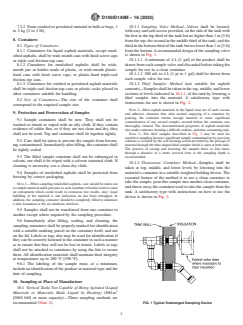
7.2.2 From crushed or powdered material in bulk or bags, 1 10.1.1 Sampling Valve Method—Valves shall be located,
to 2 kg [2 to 3 lb]. with easy and safe access provided, on the side of the tank with
the first in the top third of the tank but no higher than 1 m [3 ft]
8. Containers
from the top; the second in the middle third of the tank; and the
third in the bottom third of the tank but no lower than 1 m [3 ft]
8.1 Types of Containers:
from the bottom. A recommended design of the sampling valve
8.1.1 Containers for liquid asphalt materials, except emul-
is shown in Fig. 1.
sified asphalts, shall be wide-mouth cans with lined screw caps
10.1.1.1 A minimum of 4 L [1 gal] of the product shall be
or triple-seal friction-top cans.
drawn from each sample valve and discarded before taking the
8.1.2 Containers for emulsified asphalts shall be wide-
sample for test in a clean container.
mouth jars or bottles made of plastic, or wide-mouth plastic-
10.1.1.2 500 mL to 4 L [1 pt to 1 gal] shall be drawn from
lined cans with lined screw caps, or plastic-lined triple-seal
each sample valve for test.
friction-top cans.
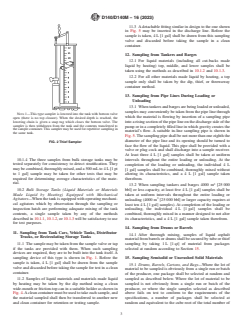
10.1.2 Thief Sampler Method (not suitable for asphalt
8.1.3 Containers for crushed or powdered asphalt materials
cements)—Samples shall be taken in the top, middle, and lower
shall be triple-seal friction-top cans or plastic sacks placed in
sections at levels indicated in 10.1.1, of the tank by lowering a
other containers suitable for handling.
thief sampler into the material. A satisfactory type with
8.2 Size of Containers—The size of the container shall
instructions for use is shown in Fig. 2.
correspond to the required sample size.
NOTE 2—Most asphalt materials in the liquid state are of such viscous
9. Protection and Preservation of Samples
and adhesive character that, after normal emptying of a container by
pouring, the container retains enough material to cause significant
9.1 Sample containers shall be new. They shall not be
contamination of any second samples secured before the container was
washed or rinsed or wiped with an oily cloth. If they contain
thoroughly cleaned. The aforementioned properties of asphalt materials
evidence of solder flux, or if they are not clean and dry, they
also make container cleaning a difficult, tedious, and time-consuming task.
NOTE 3—The thief sampler described in Fig. 2 may be used for
shall not be used. Top and container shall fit together tightly.
repetitive sampling because significant sample contamination by previous
9.2 Care shall be taken to prevent the sample from becom-
contents is avoided by the self-cleaning action provided by the passage of
ing contaminated. Immediately after filling, the container shall material through the tube-shaped thief sampler which is open at both ends.
The practice of raising and lowering the sampler three or four times
be tightly sealed.
through a distance of a metre (several feet) at the sampling depth is
9.3 The filled sample container shall not be submerged in
recommended.
solvent, nor shall it be wiped with a solvent saturated cloth. If
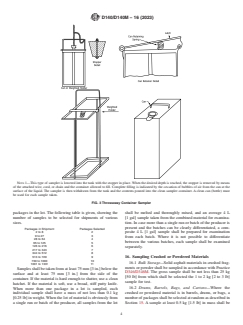
10.1.3 Throwaway Container Method—Samples shall be
cleaning is necessary, use a clean dry cloth.
taken at top, middle, and lower levels by lowering into the
9.4 Samples of emulsified asphalts shall be protected from
material a container in a suitable weighted holding device. The
freezing by correct packaging. essential feature of the method is to use a clean container to
take the sample, pour this sample into another clean container,
NOTE 1—When sampling emulsified asphalts, care should be taken not
and throw away the container used to take the sample from the
to sample material under pressure as such resultant velocities tend to cause
tank. A satisfactory type with instructions on how to use the
air entrapment which could result in erroneous test results. Any visual
bubbling of the material is one indication air has been entrapped. In
device is shown in Fig. 3.
addition, the sampling container should be completely filled to minimize
a skin formation at the air-emulsion interface.
9.5 Samples shall not be transferred from one container to
another except where required by the sampling procedure.
9.6 Immediately after filling, sealing, and cleaning, the
sampling containers shall be properly marked for identification
with a suitable marking pencil on the container itself, and not
on the lid. Labels or tags also may be used for identification if
they can be securely fastened to the container in such a manner
as to ensure that they will not be lost in transit. Labels or tags
shall not be attached to containers by using the lids to secure
them. All identification materials shall maintain their integrity
at temperatures up to 200 °C [390 °F].
9.6.1 The labeling of the sample must, at a minimum,
include an identification of the product or material type and the
date of sampling.
10. Sampling at Place of Manufacture
10.1 Vertical Tanks Not Capable of Being Agitated (Liquid
Materials or Materials Made Liquid by Heating) (800 m
[5000 bbl] or more capacity)—Three sampling methods are
recommended (Note 2): FIG. 1 Typical Submerged Sampling Device
D140/D140M − 16 (2023)
11.3 A detachable fitting similar in design to the one shown
in Fig. 5 may be inserted in the discharge line. Before the
sample is taken, 4 L [1 gal] shall be drawn from this sampling
valve and discarded before taking the sample in a clean
container.
12. Sampling from Tankers and Barges
12.1 For liquid materials (including all cut-backs made
liquid by heating) top, middl
...