

ASTM D8237-21
(Test Method)Standard Test Method for Determining Fatigue Failure of Asphalt-Aggregate Mixtures with the Four-Point Beam Fatigue Device
General Information
- Abstract
SIGNIFICANCE AND USE
5.1 The laboratory fatigue life determined by this standard for beam specimens has been used to estimate the fatigue life of asphalt mixture pavement layers under repeated traffic loading. Although the field performance of asphalt mixtures is impacted by many factors (traffic variation, loading rate, and wander; climate variation; rest periods between loads; aging; etc.), it has been more accurately predicted when laboratory properties are known along with an estimate of the strain level induced at the layer depth by the traffic wheel load traveling over the pavement.
Note 2: The quality of the results produced by this standard are dependent on the competence of the personnel performing the procedure and the capability, calibration, and maintenance of the equipment used. Agencies that meet the criteria of Specification D3666 are generally considered capable of competent and objective testing, sampling, inspection, etc. Users of this standard are cautioned that compliance with Specification D3666 alone does not completely ensure reliable results. Reliable results depend on many factors; following the suggestions of Specification D3666 or some similar acceptable guideline provides a means of evaluating and controlling some of those factors.
SCOPE
1.1 This test method provides a procedure for determining a fatigue curve that is developed using three or more strain levels. The resulting data can be used in the fatigue models for mechanistic-empirical pavement design (that is, Pavement ME). Failure points are determined for estimating the fatigue life of 380 mm long by 50 mm thick by 63 mm in breadth (width) asphalt mixture beam (rectangular prism) specimens sawed from laboratory or field-compacted asphalt mixture, which are subjected to repeated flexural bending.
1.2 The largest nominal maximum aggregate size (NMAS) recommended for beams 50 mm thick is 19 mm. Beams made with an NMAS greater than 19 mm might significantly interfere with the material response, thereby affecting the repeatability of the test.
1.3 The text of this standard references notes and footnotes which provide explanatory material. These notes and footnotes (excluding those in tables and figures) shall not be considered as requirements of the standard.
1.4 Units—The values stated in SI units are to be regarded as standard. No other units of measurement are included in this standard, with the exception of degrees (°) where angle is specified in accordance with IEEE/ASTM SI 10.
1.5 This standard does not purport to address all of the safety concerns, if any, associated with its use. It is the responsibility of the user of this standard to establish appropriate safety, health, and environmental practices and determine the applicability of regulatory limitations prior to use.
1.6 This international standard was developed in accordance with internationally recognized principles on standardization established in the Decision on Principles for the Development of International Standards, Guides and Recommendations issued by the World Trade Organization Technical Barriers to Trade (TBT) Committee.
- Status
- Published
- Publication Date
- 30-Jun-2021
- Technical Committee
- D04 - Road and Paving Materials
- Drafting Committee
- D04.26 - Fundamental/Mechanistic Tests
Buy Documents
ASTM D8237-21 - Standard Test Method for Determining Fatigue Failure of Asphalt-Aggregate Mixtures with the Four-Point Beam Fatigue Device
REDLINE ASTM D8237-21 - Standard Test Method for Determining Fatigue Failure of Asphalt-Aggregate Mixtures with the Four-Point Beam Fatigue Device
Overview
ASTM D8237-21, published by ASTM International, outlines the standard test method for determining the fatigue failure of asphalt-aggregate mixtures using the four-point beam fatigue device. Fatigue failure is a critical performance parameter for asphalt pavements, as it measures the ability of an asphalt mixture to withstand repeated traffic loading over time. By providing a laboratory procedure for creating and testing prismatic beam specimens under controlled flexural bending, this standard enables engineers and researchers to estimate the fatigue life of asphalt pavement layers with greater accuracy. This method is widely used in mechanistic-empirical pavement design-helping optimize materials and structural designs for long-term roadway performance.
Key Topics
- Fatigue Life Determination: The method produces fatigue curves using three or more strain levels, allowing for the estimation of the number of cycles before failure of asphalt mixtures under repeated loading.
- Specimen Preparation and Testing: Specifies dimensions of beam specimens (typically 380 mm length, 50 mm thickness, 63 mm breadth), which are cut from laboratory or field-compacted asphalt mixtures. The test uses sinusoidal cyclic loading at controlled temperatures and strain levels.
- Measurement and Analysis: Involves recording stresses, strains, displacements, and stiffness as the specimen undergoes repeated flexural bending until failure. Calculations include initial beam stiffness and identification of the failure point through normalized stiffness versus cycle plots.
- Quality and Precision: Emphasizes the importance of qualified personnel, proper calibration, and maintenance of testing equipment-referencing ASTM D3666 for minimum laboratory quality standards. Repeatability and precision of results are discussed, although between-laboratory reproducibility is still being evaluated.
- Reporting Requirements: Requires comprehensive documentation of specimen properties (e.g., binder content, aggregate gradation, air voids), test conditions (e.g., temperature), results (e.g., maximum tensile stress, strain, number of cycles to failure), and graphical representation of fatigue behavior.
Applications
ASTM D8237-21 is widely employed in the mechanistic-empirical design of asphalt pavements, specifically within Pavement ME and similar models. The test assists highway engineers, researchers, and material designers by:
- Predicting Pavement Durability: Laboratory fatigue life correlates with field performance, especially when combined with site-specific traffic and loading data.
- Material Optimization: Enables comparison of different asphalt mixtures for improved fatigue resistance, supporting the selection of materials for long-life pavement applications.
- Quality Control and Assurance: Useful for both research and practical quality assurance during material development, pavement construction, and forensic evaluation of pavement failures.
- Performance Specifications: Vital for agencies and contractors developing or meeting performance-related specifications for flexible pavements.
This standard is essential for anyone involved in the evaluation and design of asphalt mixtures where long-term fatigue resistance is a critical requirement.
Related Standards
ASTM D8237-21 references several related standards crucial for sampling, specimen preparation, and equipment calibration, including:
- ASTM D8: Terminology relating to materials for roads and pavements
- ASTM D75/D140/D979: Practices for sampling aggregates, asphalt materials, and bituminous mixtures
- ASTM D2041 and D2726: Determining theoretical and bulk specific gravity of asphalt mixtures
- ASTM D3203: Measuring percent air voids in compacted asphalt mixtures
- ASTM D3666: Minimum requirements for agencies testing road and paving materials
- ASTM D3549: Specimen dimensions verification
- AASHTO R 30: Conditioning of hot-mix asphalt for lab testing
- IEEE/ASTM SI 10: American National Standard for Metric Practice
Understanding and referencing these standards promotes consistency, reliable test results, and compliance with international best practices in pavement material evaluation.
Keywords: ASTM D8237-21, asphalt mixture fatigue, four-point beam fatigue test, mechanistic-empirical pavement design, asphalt mixture testing, pavement fatigue life, asphalt flexural fatigue, road and paving material standards.
Relations
- Effective Date
- 01-Dec-2023
- Effective Date
- 01-Nov-2023
- Effective Date
- 15-Mar-2020
- Effective Date
- 01-Feb-2020
- Effective Date
- 01-Nov-2019
- Effective Date
- 01-Aug-2019
- Effective Date
- 01-Jun-2019
- Effective Date
- 15-Dec-2018
- Effective Date
- 15-Aug-2018
- Effective Date
- 01-Jul-2018
- Effective Date
- 01-Feb-2018
- Effective Date
- 01-Oct-2017
- Effective Date
- 15-Jul-2017
- Effective Date
- 15-Jun-2017
- Effective Date
- 01-Jun-2017
Buy Documents
ASTM D8237-21 - Standard Test Method for Determining Fatigue Failure of Asphalt-Aggregate Mixtures with the Four-Point Beam Fatigue Device
REDLINE ASTM D8237-21 - Standard Test Method for Determining Fatigue Failure of Asphalt-Aggregate Mixtures with the Four-Point Beam Fatigue Device
Get Certified
Connect with accredited certification bodies for this standard

Zavod za gradbeništvo Slovenije (ZAG) - Inšpekcija
ZAG inspection body for construction products, structures, and materials.
Sponsored listings
Frequently Asked Questions
ASTM D8237-21 is a standard published by ASTM International. Its full title is "Standard Test Method for Determining Fatigue Failure of Asphalt-Aggregate Mixtures with the Four-Point Beam Fatigue Device". This standard covers: SIGNIFICANCE AND USE 5.1 The laboratory fatigue life determined by this standard for beam specimens has been used to estimate the fatigue life of asphalt mixture pavement layers under repeated traffic loading. Although the field performance of asphalt mixtures is impacted by many factors (traffic variation, loading rate, and wander; climate variation; rest periods between loads; aging; etc.), it has been more accurately predicted when laboratory properties are known along with an estimate of the strain level induced at the layer depth by the traffic wheel load traveling over the pavement. Note 2: The quality of the results produced by this standard are dependent on the competence of the personnel performing the procedure and the capability, calibration, and maintenance of the equipment used. Agencies that meet the criteria of Specification D3666 are generally considered capable of competent and objective testing, sampling, inspection, etc. Users of this standard are cautioned that compliance with Specification D3666 alone does not completely ensure reliable results. Reliable results depend on many factors; following the suggestions of Specification D3666 or some similar acceptable guideline provides a means of evaluating and controlling some of those factors. SCOPE 1.1 This test method provides a procedure for determining a fatigue curve that is developed using three or more strain levels. The resulting data can be used in the fatigue models for mechanistic-empirical pavement design (that is, Pavement ME). Failure points are determined for estimating the fatigue life of 380 mm long by 50 mm thick by 63 mm in breadth (width) asphalt mixture beam (rectangular prism) specimens sawed from laboratory or field-compacted asphalt mixture, which are subjected to repeated flexural bending. 1.2 The largest nominal maximum aggregate size (NMAS) recommended for beams 50 mm thick is 19 mm. Beams made with an NMAS greater than 19 mm might significantly interfere with the material response, thereby affecting the repeatability of the test. 1.3 The text of this standard references notes and footnotes which provide explanatory material. These notes and footnotes (excluding those in tables and figures) shall not be considered as requirements of the standard. 1.4 Units—The values stated in SI units are to be regarded as standard. No other units of measurement are included in this standard, with the exception of degrees (°) where angle is specified in accordance with IEEE/ASTM SI 10. 1.5 This standard does not purport to address all of the safety concerns, if any, associated with its use. It is the responsibility of the user of this standard to establish appropriate safety, health, and environmental practices and determine the applicability of regulatory limitations prior to use. 1.6 This international standard was developed in accordance with internationally recognized principles on standardization established in the Decision on Principles for the Development of International Standards, Guides and Recommendations issued by the World Trade Organization Technical Barriers to Trade (TBT) Committee.
SIGNIFICANCE AND USE 5.1 The laboratory fatigue life determined by this standard for beam specimens has been used to estimate the fatigue life of asphalt mixture pavement layers under repeated traffic loading. Although the field performance of asphalt mixtures is impacted by many factors (traffic variation, loading rate, and wander; climate variation; rest periods between loads; aging; etc.), it has been more accurately predicted when laboratory properties are known along with an estimate of the strain level induced at the layer depth by the traffic wheel load traveling over the pavement. Note 2: The quality of the results produced by this standard are dependent on the competence of the personnel performing the procedure and the capability, calibration, and maintenance of the equipment used. Agencies that meet the criteria of Specification D3666 are generally considered capable of competent and objective testing, sampling, inspection, etc. Users of this standard are cautioned that compliance with Specification D3666 alone does not completely ensure reliable results. Reliable results depend on many factors; following the suggestions of Specification D3666 or some similar acceptable guideline provides a means of evaluating and controlling some of those factors. SCOPE 1.1 This test method provides a procedure for determining a fatigue curve that is developed using three or more strain levels. The resulting data can be used in the fatigue models for mechanistic-empirical pavement design (that is, Pavement ME). Failure points are determined for estimating the fatigue life of 380 mm long by 50 mm thick by 63 mm in breadth (width) asphalt mixture beam (rectangular prism) specimens sawed from laboratory or field-compacted asphalt mixture, which are subjected to repeated flexural bending. 1.2 The largest nominal maximum aggregate size (NMAS) recommended for beams 50 mm thick is 19 mm. Beams made with an NMAS greater than 19 mm might significantly interfere with the material response, thereby affecting the repeatability of the test. 1.3 The text of this standard references notes and footnotes which provide explanatory material. These notes and footnotes (excluding those in tables and figures) shall not be considered as requirements of the standard. 1.4 Units—The values stated in SI units are to be regarded as standard. No other units of measurement are included in this standard, with the exception of degrees (°) where angle is specified in accordance with IEEE/ASTM SI 10. 1.5 This standard does not purport to address all of the safety concerns, if any, associated with its use. It is the responsibility of the user of this standard to establish appropriate safety, health, and environmental practices and determine the applicability of regulatory limitations prior to use. 1.6 This international standard was developed in accordance with internationally recognized principles on standardization established in the Decision on Principles for the Development of International Standards, Guides and Recommendations issued by the World Trade Organization Technical Barriers to Trade (TBT) Committee.
ASTM D8237-21 is classified under the following ICS (International Classification for Standards) categories: 93.080.20 - Road construction materials. The ICS classification helps identify the subject area and facilitates finding related standards.
ASTM D8237-21 has the following relationships with other standards: It is inter standard links to ASTM D140/D140M-16(2023), ASTM D8079-23, ASTM D7981-20, ASTM E2309/E2309M-20, ASTM D75/D75M-19, ASTM D8-19, ASTM D2041/D2041M-19, ASTM D8-18c, ASTM D8-18b, ASTM D8-18a, ASTM D8-18, ASTM D3549/D3549M-17, ASTM D8-17c, ASTM D8-17b, ASTM D2726/D2726M-17. Understanding these relationships helps ensure you are using the most current and applicable version of the standard.
ASTM D8237-21 is available in PDF format for immediate download after purchase. The document can be added to your cart and obtained through the secure checkout process. Digital delivery ensures instant access to the complete standard document.
Standards Content (Sample)
This international standard was developed in accordance with internationally recognized principles on standardization established in the Decision on Principles for the
Development of International Standards, Guides and Recommendations issued by the World Trade Organization Technical Barriers to Trade (TBT) Committee.
Designation: D8237 − 21
Standard Test Method for
Determining Fatigue Failure of Asphalt-Aggregate Mixtures
with the Four-Point Beam Fatigue Device
This standard is issued under the fixed designation D8237; the number immediately following the designation indicates the year of
original adoption or, in the case of revision, the year of last revision.Anumber in parentheses indicates the year of last reapproval.A
superscript epsilon (´) indicates an editorial change since the last revision or reapproval.
1. Scope 2. Referenced Documents
1.1 Thistestmethodprovidesaprocedurefordetermininga 2.1 ASTM Standards:
fatigue curve that is developed using three or more strain D8Terminology Relating to Materials for Roads and Pave-
levels.The resulting data can be used in the fatigue models for ments
mechanistic-empirical pavement design (that is, Pavement D75/D75MPractice for Sampling Aggregates
ME). Failure points are determined for estimating the fatigue D140/D140MPractice for Sampling Asphalt Materials
life of 380mm long by 50mm thick by 63mm in breadth D979/D979MPractice for Sampling Bituminous Paving
(width) asphalt mixture beam (rectangular prism) specimens Mixtures
sawed from laboratory or field-compacted asphalt mixture, D2041/D2041MTest Method for Theoretical Maximum
which are subjected to repeated flexural bending. Specific Gravity and Density of Asphalt Mixtures
D2726/D2726MTest Method for Bulk Specific Gravity and
1.2 The largest nominal maximum aggregate size (NMAS)
Density of Non-Absorptive Compacted Asphalt Mixtures
recommended for beams 50mm thick is 19mm. Beams made
D3203/D3203MTest Method for PercentAirVoids in Com-
with an NMAS greater than 19mm might significantly inter-
pacted Asphalt Mixtures
fere with the material response, thereby affecting the repeat-
D3549/D3549MTest Method for Thickness or Height of
ability of the test.
Compacted Asphalt Mixture Specimens
1.3 The text of this standard references notes and footnotes
D3666Specification for Minimum Requirements for Agen-
whichprovideexplanatorymaterial.Thesenotesandfootnotes
cies Testing and Inspecting Road and Paving Materials
(excluding those in tables and figures) shall not be considered
D5361/D5361MPractice for Sampling Compacted Asphalt
as requirements of the standard.
Mixtures for Laboratory Testing
D7981Practice for Compaction of PrismaticAsphalt Speci-
1.4 Units—The values stated in SI units are to be regarded
asstandard.Nootherunitsofmeasurementareincludedinthis mens by Means of the Shear Box Compactor
D8079Practice for Preparation of Compacted Slab Asphalt
standard, with the exception of degrees (°) where angle is
specified in accordance with IEEE/ASTM SI 10. Mix Samples Using a Segmented Rolling Compactor
E4Practices for Force Verification of Testing Machines
1.5 This standard does not purport to address all of the
E29Practice for Using Significant Digits in Test Data to
safety concerns, if any, associated with its use. It is the
Determine Conformance with Specifications
responsibility of the user of this standard to establish appro-
E2309/E2309MPractices for Verification of Displacement
priate safety, health, and environmental practices and deter-
Measuring Systems and Devices Used in MaterialTesting
mine the applicability of regulatory limitations prior to use.
Machines
1.6 This international standard was developed in accor-
IEEE/ASTM SI 10American National Standard for Metric
dance with internationally recognized principles on standard-
Practice
ization established in the Decision on Principles for the
2.2 AASHTO Standard:
Development of International Standards, Guides and Recom-
R30StandardPracticeforMixtureConditioningofHot-Mix
mendations issued by the World Trade Organization Technical
Asphalt (HMA)
Barriers to Trade (TBT) Committee.
For referenced ASTM standards, visit the ASTM website, www.astm.org, or
This test method is under the jurisdiction of ASTM Committee D04 on Road contact ASTM Customer Service at service@astm.org. For Annual Book of ASTM
and Paving Materials and is the direct responsibility of Subcommittee D04.26 on Standards volume information, refer to the standard’s Document Summary page on
Fundamental/Mechanistic Tests. the ASTM website.
CurrenteditionapprovedJuly1,2021.PublishedJuly2021.Originallyapproved Available from American Association of State Highway and Transportation
in 2018. Last previous edition approved in 2018 as D8237–18. DOI: 10.1520/ Officials (AASHTO), 444 N. Capitol St., NW, Suite 249, Washington, DC 20001,
D8237-21. http://www.transportation.org.
Copyright © ASTM International, 100 Barr Harbor Drive, PO Box C700, West Conshohocken, PA 19428-2959. United States
D8237 − 21
3. Terminology location. A fully executed peak-to-peak displacement (δ )at
p-p
the articulating H-frame third points of the beam is induced.
3.1 Definitions of Terms Specific to This Standard:
The outer third points are held in an articulating fixed position
3.1.1 σ ,n—peak-to-peak stress amplitude at load cycle i.
p-p
about the neutral axis of the beam. The frequency rate has a
3.1.2 σ,n—maximumtensilestressatthefiberofthebeam.
t
default frequency of 10 Hertz (Hz) and a test temperature of
3.1.3 ɛ ,n—peak-to-peak tensile strain at load cycle i.
p-p 20°C. This produces a constant bending moment over the
center third (L/3, length between outside clamps divided by 3)
3.1.4 ɛ,n—maximum tensile strain at the bottom fiber of
t
span of 119mm 6 0.5mm (distance may vary between
the beam.
manufacturers; check with manufacturers’ specifications) be-
3.1.5 δ ,n—peak-to-peak displacement as determined in
p-p
tween the H-frame contact points on the beam specimen. The
Fig. 1.
level of desired strain is pre-calculated and an input value for
3.1.6 S, n—flexural beam stiffness, which is the stress
the equipment peak-to-peak deflection. The peak-to-peak de-
divided by the strain.
flection at mid-length position (L/2, length between outside
3.1.7 S,n—the initial beam stiffness determined at 50 load
frames divided by 2) of a beam specimen is regulated by the
i
cycles.
closed-loop control system measured from the mid-height
position (neutral axis). The peak-to-peak deflection is mea-
3.1.8 failure point, n—the number of cycles to failure, N,
f
sured relative to a fixed reference point located at the outer
which corresponds to the maximum or peak normalized beam
articulating fixed position.
stiffness × normalized cycles when plotted versus number of
cycles (9.9).
NOTE 1—Caution should be applied when using frequencies above
10Hz, Pronk (2).
3.1.9 normalized stiffness × normalized cycles, n—see
Rowe and Bouldin (1).
5. Significance and Use
3.2 Fordefinitionsofothertermsusedinthisstandard,refer
5.1 The laboratory fatigue life determined by this standard
to Terminology D8.
for beam specimens has been used to estimate the fatigue life
4. Summary of Test Method
of asphalt mixture pavement layers under repeated traffic
loading.Although the field performance of asphalt mixtures is
4.1 The four-point flexural bending test method is con-
impacted by many factors (traffic variation, loading rate, and
ducted on compacted beam specimens to evaluate the fatigue
wander; climate variation; rest periods between loads; aging;
properties of viscoelastic asphalt mixtures using a fixed refer-
etc.), it has been more accurately predicted when laboratory
ence point bending beam fixture. A cyclic sinusoidal loading
properties are known along with an estimate of the strain level
pattern is initiated having no rest periods from the start
induced at the layer depth by the traffic wheel load traveling
over the pavement.
The boldface numbers in parentheses refer to a list of references at the end of
NOTE 2—The quality of the results produced by this standard are
this standard.
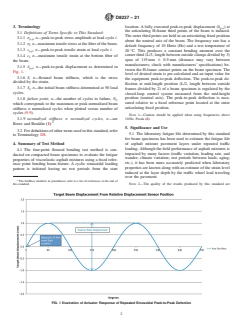
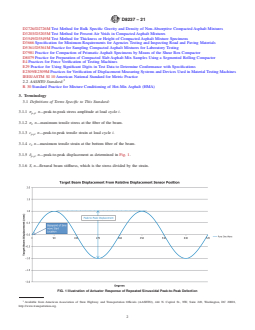
FIG. 1 Illustration of Actuator Response of Repeated Sinusoidal Peak-to-Peak Defection
D8237 − 21
dependent on the competence of the personnel performing the procedure
specimen and maintain the specimen at the default test tem-
and the capability, calibration, and maintenance of the equipment used.
perature of 20°C. The temperature shall be within 60.5°C
Agencies that meet the criteria of Specification D3666 are generally
throughout the conditioning and testing times.
considered capable of competent and objective testing, sampling,
inspection, etc. Users of this standard are cautioned that compliance with
NOTE 5—Replacing an incandescent, florescent, or halogen light bulb
Specification D3666 alone does not completely ensure reliable results.
with light emitting diode (LED) for your environmental chamber reduces
Reliable results depend on many factors; following the suggestions of
the heat signature and improves the chamber’s ability to control within
Specification D3666 or some similar acceptable guideline provides a
60.5°C. Globe-style bulb design improves illumination of fixture and
means of evaluating and controlling some of those factors.
inside of chamber.
6.1.3 Control and Data Acquisition System—During each
6. Apparatus
load cycle, the control and data acquisition system shall be
6.1 Test System—The test system shall consist of a load
capable of measuring the peak-to-peak displacement of the
frame, an environmental chamber (temperature control
beam specimen, and adjusting the load applied by the loading
system),andaclosed-loopcontrolanddataacquisitionsystem.
device such that the specimen experiences a constant level of
The test system shall include a closed-loop, computer-
displacementoneachloadcycle.Inaddition,itshallbecapable
controlledloadingcomponentwhich,duringeachloadcyclein
of recording load cycles, applied loads, beam displacements,
response to commands from the data processing and control
and temperature. Minimum data capture rate and sampling
component, adjusts and applies a load such that the specimen
intervals are listed in Table 2. The minimum number of data
experiences a constant level of controlled maximum deflection
samples for each load cycle is 200.
(and resulting strain) during each load cycle. The test system
6.2 Miscellaneous Apparatus and Materials—Means or
shall meet the minimum requirements specified in Table 1.
toolsfortargetingthedisplacementsensortotheneutralaxisof
NOTE 3—Test system unit calibrations are performed in mm for
the specimen and proper glue (cyanoacrylate) are required for
displacement and kN for load measurements (Practices E4 and E2309/
attaching the target to the specimen.Asaw suitable for cutting
E2309M). Unit conversions will need to be made when applying to
the beams with parallel faces to the proper dimensions of
calculations in Section 10.
380mm 6 3mm in length, 50mm 6 2mm in height, and
6.1.1 Loading Device—The loading device shall be capable
63mm 6 2mm in breadth (width).Aclamp alignment gauge
of: (1) providing repeated sinusoidal loading at a frequency
is required for setting the proper clamp spacing between the
rangeof5to25Hz,and(2)subjectingspecimenstofour-point
frames, ensuring parallelism and perpendicularity. A rigid
bending with free rotation and horizontal translation at all
material beam having the dimensions specified in 6.2 and
clamped load and reaction points as shown in Figs. 2 and 3.
tolerance of 0.254mm across the beam (measured using a
Floating reference point bending beam fixtures are not recog-
straightedgeandfeelergauge)willbetherequiredbeamgauge
nized by this standard.
for setting the proper clamping height. Yearly verification is
NOTE 4—The fundamental equations are more viable with dual con-
required for the beam gauge to be in compliance.
trolling displacement sensors. The on-specimen displacement sensor
controls the peak-to-peak displacement for the waveform loading of the NOTE 6—Hard, high-strength 7075 aluminum is found to be adequate
maximum deflection value at the L/2 location, and the frame-mounted for the beam gauge.The aluminum bar off the shelf will require being cut
to a length of 380mm (McMaster – Carr Item #9055K31).
displacement sensor controls the H-frame point of origin location. An
even better approach is the use of four displacement sensors. Two dual
controllingsensors,aslistedpreviouslyinthisnote,andtworecordingthe
7. Hazards
L/6 and 5L/6 locations to better understand the deflections between each
7.1 Observe standard laboratory safety precautions when
of the frames.
preparing and testing asphalt mixture specimens.
6.1.2 Environmental Chamber (Temperature Control
System)—The environmental chamber shall enclose the entire
8. Sampling and Test Specimen Preparation
8.1 Laboratory-Mixed and Compacted Specimens—Sample
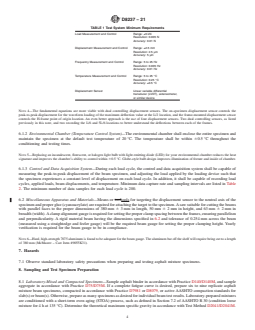
TABLE 1 Test System Minimum Requirements
asphalt binder in accordance with Practice D140/D140M, and
Load Measurement and Control Range: ±5 kN
sample aggregate in accordance with Practice D75/D75M.Ifa
Resolution: 0.005 N
complete fatigue curve is desired, prepare six to nine replicate
Accuracy: 0.01 N
asphalt mixture beam specimens, compacted in accordance
Displacement Measurement and Control Range: ±2.5 mm
withPracticeD7981orD8079,oractiveAASHTOcompaction
Resolution: 2.5 µm
standards for slab(s) or beam(s). Otherwise, prepare as many
Accuracy: 5 µm
specimens as desired for individual beam test results.
Frequency Measurement and Control Range: 5 to 25 Hz
Laboratory-prepared mixtures are conditioned with a short-
Resolution: 0.005 Hz
term oven aging (STOA) process, such as defined in Section
Accuracy: 0.01 Hz
7.2 of AASHTO R30 (condition loose mixture for 4h at
Temperature Measurement and Control Range: 5 to 25 °C
135°C). Determine the theoretical maximum specific gravity
Resolution: 0.25 °C
in accordance with Test Method D2041/D2041M. Determine
Accuracy: ±0.5 °C
the bulk specific gravity in accordance with Test Method
Displacement Sensor Linear variable differential
D2726/D2726M. Calculate the percent air voids in accordance
transducer (LVDT), extensometer,
with Test Method D3203/D3203M. Test at least six replicate
or similar device
asphalt mixture beam specimens at different strain levels in
D8237 − 21
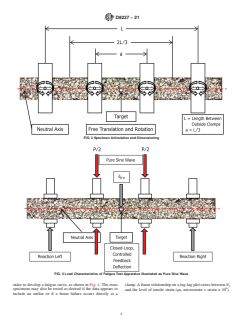
FIG. 2 Specimen Articulation and Dimensioning
FIG. 3 Load Characteristics of Fatigue Test Apparatus Illustrated as Pure Sine Wave
order to develop a fatigue curve, as shown in Fig. 4. The extra clamp.Alinearrelationshiponalog-logplotexistsbetween N
f
specimens may also be tested as desired if the data appears to and the level of tensile strain (µε, microstrain = strain × 10 ).
include an outlier or if a beam failure occurs directly at a
D8237 − 21
TABLE 2 Minimum Data Capture Rate and Sampling Intervals
Intervals Cycles at each collection points
Repetitions
(Spaced equally within each range) (Included in average reported)
0 to 10 1–10 Report individual cycles
10 to 1000 10 5
1000 to 10 000 90 5
10 000 to 100 000 At least one every 1000 repetitions 5
100 000 to end of test At least one every 10 000 repetitions 5
FIG. 4 Example Fatigue Curve
NOTE 7—AASHTO R 30 also contains additional information on
8.3 Roadway Specimens—Obtain compacted asphalt mix-
long-term oven aging (LTOA) of compacted specimens for five days at
ture samples from the roadway in accordance with Practice
85°C. In addition, new research in Braham et al. (3) and NCHRPReport
D5361/D5361M. Determine the theoretical maximum specific
871 (4) provides information on long-term aging loose mixture.
gravity in accordance with Test Method D2041/D2041M.
NOTE 8—The type of compaction device (linear kneading, rolling
wheel, vibratory) may influence the test results relative to representing Determine the bulk specific gravity in accordance with Test
actual construction. Check with the manufacturer recommendations on
Method D2726/D2726M. Calculate the percent air voids in
compaction procedures or applicable ASTM or AASHTO standards.
accordance with Test Method D3203/D3203M.
8.2 Plant-Mixed, Laboratory-Compacted Specimens—
8.4 Specimen Trimming—Saw at least 6mm from all sides
Obtain asphalt mixture samples in accordance with Practice
of each compacted slab edge to mitigate end effects and
D979/D979M. If a complete fatigue curve is desired, prepare
provide smooth, parallel (saw-cut) surfaces for mounting the
six to nine replicate asphalt mixture beam specimens, com-
neutral axis target. The final required dimensions of the test
pacted in accordance with Practice D7981 orAASHTO active
specimen,aftersawing,are380mm 63mminlength,50mm
compaction standards for slab(s) or beam(s). Otherwise, pre-
6 2 mm in height, and 63mm 6 2 mm in breadth (width).
pare as many specimens as desired for individual beam test
Measure the height and breadth of the specimen to the nearest
results. See Note 7 for long-term oven aging of specimens, if
0.01mm at three or more different points along the middle
that is necessary. Determine the theoretical maximum specific
100mm of the specimen length in accordance with the
gravity in accordance with Test Method D2041/D2041M.
applicable sections of Test Method D3549/D3549M. Deter-
Determine the bulk specific gravity in accordance with Test
mine the average of the measurements for each dimension and
Method D2726/D2726M. Calculate the percent air voids in
record the average to the nearest 0.01mm. The allowed
accordancewithTestMethodD3203/D3203M.Testatleastsix
difference between maximum and minimum measured values
replicate asphalt mixture beam specimens at different strain
of breadth and height is 1mm. If the difference of the
levels in order to develop a fatigue curve, as shown in Fig. 4.
maximum and minimum values of either dimension exceeds
The extra specimens may also be tested as desired if the data
1mm, then the beam shall be recut or discarded.
appearstoincludeanoutlierorifabeamfailureoccursdirectly
at a clamp. A linear relationship on a log-log plot exists
NOTE 9—Previous experience has shown that in order to minimize
between N and the level of tensile strain (µε, microstrain =
f specimen variability, it is recommended that the beams be immediately
–6
strain × 10 ). labeled to ensure consistent orientation (top and sides) during testing,
D8237 − 21
relative to the compaction process. Masad et al. (5) shows that the air
9.2 Place the specimen on a stiff, flat surface in an environ-
voidsatthecompactionplate/compactionkeysarelowerthantheairvoids
mentholdingthedesiredtesttemperaturefor2htoensurethat
at the bottom of the sample.
the specimen has equilibrated to the desired test temperature
8.5 Specimen Storage—The specimens should be stored on
priortobeginningthetest.Temperature(T)forthistestmethod
a12.7-mmsteelplateorsimilarmaterialcapableofsupporting
will have a default T = 20°C. The temperature shall be within
the beams, with a flatness of 0.508mm across the surface of
60.5°C throughout the conditioning and testing times.
the shortest section of plate from end to end. This flat surface
NOTE 10—Two hours is sufficient to equilibrate the temp
...
This document is not an ASTM standard and is intended only to provide the user of an ASTM standard an indication of what changes have been made to the previous version. Because
it may not be technically possible to adequately depict all changes accurately, ASTM recommends that users consult prior editions as appropriate. In all cases only the current version
of the standard as published by ASTM is to be considered the official document.
Designation: D8237 − 18 D8237 − 21
Standard Test Method for
Determining Fatigue Failure of Asphalt-Aggregate Mixtures
Withwith the Four-Point Beam Fatigue Device
This standard is issued under the fixed designation D8237; the number immediately following the designation indicates the year of
original adoption or, in the case of revision, the year of last revision. A number in parentheses indicates the year of last reapproval. A
superscript epsilon (´) indicates an editorial change since the last revision or reapproval.
1. Scope
1.1 This test method provides a procedure for determining a fatigue curve that is developed using three or more strain levels. The
resulting data can be used in the fatigue models for mechanistic-empirical pavement design (that is, Pavement ME). Failure points
are determined for estimating the fatigue life of 380 mm long by 50 mm thick by 63 mm in breadth (width) asphalt mixture beam
(rectangular prism) specimens sawed from laboratory or field-compacted asphalt mixture, which are subjected to repeated flexural
bending.
1.2 The largest nominal maximum aggregate size (NMAS) recommended for beams 50 mm thick is 19 mm. Beams made with an
NMAS greater than 19 mm might significantly interfere with the material response, thereby affecting the repeatability of the test.
1.3 The text of this standard references notes and footnotes which provide explanatory material. These notes and footnotes
(excluding those in tables and figures) shall not be considered as requirements of the standard.
1.4 Units—The values stated in SI units are to be regarded as standard. No other units of measurement are included in this
standard, with the exception of degrees (°) where angle is specified in accordance with IEEE/ASTM SI 10.
1.5 This standard does not purport to address all of the safety concerns, if any, associated with its use. It is the responsibility
of the user of this standard to establish appropriate safety, health, and environmental practices and determine the applicability of
regulatory limitations prior to use.
1.6 This international standard was developed in accordance with internationally recognized principles on standardization
established in the Decision on Principles for the Development of International Standards, Guides and Recommendations issued
by the World Trade Organization Technical Barriers to Trade (TBT) Committee.
2. Referenced Documents
2.1 ASTM Standards:
D8 Terminology Relating to Materials for Roads and Pavements
D75/D75M Practice for Sampling Aggregates
D140/D140M Practice for Sampling Asphalt Materials
D979/D979M Practice for Sampling Bituminous Paving Mixtures
D2041/D2041M Test Method for Theoretical Maximum Specific Gravity and Density of Asphalt Mixtures
This test method is under the jurisdiction of ASTM Committee D04 on Road and Paving Materials and is the direct responsibility of Subcommittee D04.26 on
Fundamental/Mechanistic Tests.
Current edition approved Dec. 1, 2018July 1, 2021. Published December 2018July 2021. Originally approved in 2018. Last previous edition approved in 2018 as
D8237 – 18. DOI: 10.1520/D8237-18.10.1520/D8237-21.
For referenced ASTM standards, visit the ASTM website, www.astm.org, or contact ASTM Customer Service at service@astm.org. For Annual Book of ASTM Standards
volume information, refer to the standard’s Document Summary page on the ASTM website.
Copyright © ASTM International, 100 Barr Harbor Drive, PO Box C700, West Conshohocken, PA 19428-2959. United States
D8237 − 21
D2726/D2726M Test Method for Bulk Specific Gravity and Density of Non-Absorptive Compacted Asphalt Mixtures
D3203/D3203M Test Method for Percent Air Voids in Compacted Asphalt Mixtures
D3549/D3549M Test Method for Thickness or Height of Compacted Asphalt Mixture Specimens
D3666 Specification for Minimum Requirements for Agencies Testing and Inspecting Road and Paving Materials
D5361/D5361M Practice for Sampling Compacted Asphalt Mixtures for Laboratory Testing
D7981 Practice for Compaction of Prismatic Asphalt Specimens by Means of the Shear Box Compactor
D8079 Practice for Preparation of Compacted Slab Asphalt Mix Samples Using a Segmented Rolling Compactor
E4 Practices for Force Verification of Testing Machines
E29 Practice for Using Significant Digits in Test Data to Determine Conformance with Specifications
E2309/E2309M Practices for Verification of Displacement Measuring Systems and Devices Used in Material Testing Machines
IEEE/ASTM SI 10 American National Standard for Metric Practice
2.2 AASHTO Standard:
R 30 Standard Practice for Mixture Conditioning of Hot-Mix Asphalt (HMA)
3. Terminology
3.1 Definitions of Terms Specific to This Standard:
3.1.1 σ , n—peak-to-peak stress amplitude at load cycle i.
p-p
3.1.2 σ , n—maximum tensile stress at the fiber of the beam.
t
3.1.3 ɛ , n—peak-to-peak tensile strain at load cycle i.
p-p
3.1.4 ɛ , n—maximum tensile strain at the bottom fiber of the beam.
t
3.1.5 δ , n—peak-to-peak displacement as determined in Fig. 1.
p-p
3.1.6 S, n—flexural beam stiffness, which is the stress divided by the strain.
FIG. 1 Illustration of Actuator Response of Repeated Sinusoidal Peak-to-Peak Defection
Available from American Association of State Highway and Transportation Officials (AASHTO), 444 N. Capitol St., NW, Suite 249, Washington, DC 20001,
http://www.transportation.org.
D8237 − 21
3.1.7 S , n—the initial beam stiffness determined at 50 load cycles.
i
3.1.8 failure point, n—the number of cycles to failure, N , which corresponds to the maximum or peak normalized beam stiffness
f
× normalized cycles when plotted versus number of cycles (9.9).
3.1.9 normalized stiffness × normalized cycles, n—see Rowe and Bouldin (1).
3.2 For definitions of other terms used in this standard, refer to Terminology D8.
4. Summary of Test Method
4.1 The four-point flexural bending test method is conducted on compacted beam specimens to evaluate the fatigue properties of
viscoelastic asphalt mixtures using a fixed reference point bending beam fixture. A cyclic sinusoidal loading pattern is initiated
having no rest periods from the start location. A fully executed peak-to-peak displacement (δ ) at the articulating H-frame third
p-p
points of the beam is induced. The outer third points are held in an articulating fixed position about the neutral axis of the beam.
The frequency rate has a default frequency of 10 Hertz (Hz) and a test temperature of 20 °C. This produces a constant bending
moment over the center third (L/3, length between outside clamps divided by 3) span of 119 mm 6 0.5 mm (distance may vary
between manufacturers; check with manufacturersmanufacturers’ specifications) between the H-frame contact points on the beam
specimen. The level of desired strain is pre-calculated and an input value for the equipment peak-to-peak deflection. The
peak-to-peak deflection at mid-length position (L/2, length between outside frames divided by 2) of a beam specimen is regulated
by the closed-loop control system measured from the mid-height position (neutral axis). The peak-to-peak deflection is measured
relative to a fixed reference point located at the outer articulating fixed position.
NOTE 1—Caution should be applied when using frequencies above 10 Hz, Pronk (2).
5. Significance and Use
5.1 The laboratory fatigue life determined by this standard for beam specimens has been used to estimate the fatigue life of asphalt
mixture pavement layers under repeated traffic loading. Although the field performance of asphalt mixtures is impacted by many
factors (traffic variation, loading rate, and wander; climate variation; rest periods between loads; aging; etc.), it has been more
accurately predicted when laboratory properties are known along with an estimate of the strain level induced at the layer depth by
the traffic wheel load traveling over the pavement.
NOTE 2—The quality of the results produced by this standard are dependent on the competence of the personnel performing the procedure and the
capability, calibration, and maintenance of the equipment used. Agencies that meet the criteria of Specification D3666 are generally considered capable
of competent and objective testing, sampling, inspection, etc. Users of this standard are cautioned that compliance with Specification D3666 alone does
not completely ensure reliable results. Reliable results depend on many factors; following the suggestions of Specification D3666 or some similar
acceptable guideline provides a means of evaluating and controlling some of those factors.
6. Apparatus
6.1 Test System—The test system shall consist of a load frame, an environmental chamber (temperature control system), and a
closed-loop control and data acquisition system. The test system shall include a closed-loop, computer-controlled loading
component which, during each load cycle in response to commands from the data processing and control component, adjusts and
applies a load such that the specimen experiences a constant level of controlled maximum deflection (and resulting strain) during
each load cycle. The test system shall meet the minimum requirements specified in Table 1.
NOTE 3—Test system unit calibrations are performed in mm for displacement and kN for load measurements (Practices E4 and E2309/E2309M). Unit
conversions will need to be made when applying to calculations in Section 10.
6.1.1 Loading Device—The loading device shall be capable of: (1) providing repeated sinusoidal loading at a frequency range of
5 to 25 Hz, and (2) subjecting specimens to four-point bending with free rotation and horizontal translation at all clamped load and
reaction points as shown in Figs. 2 and 3. Floating reference point bending beam fixtures are not recognized by this standard.
The boldface numbers in parentheses refer to a list of references at the end of this standard.
D8237 − 21
TABLE 1 Test System Minimum Requirements
Load Measurement and Control Range: ±5 kN
Resolution: 0.005 N
Accuracy: 0.01 N
Displacement Measurement and Control Range: ±2.5 mm
Resolution: 2.5 μm
Accuracy: 5 μm
Frequency Measurement and Control Range: 5 to 25 Hz
Resolution: 0.005 Hz
Accuracy: 0.01 Hz
Temperature Measurement and Control Range: 5 to 25 °C
Resolution: 0.25 °C
Accuracy: ±0.5 °C
Displacement Sensor Linear variable differential
transducer (LVDT), extensometer,
or similar device
NOTE 4—The fundamental equations are more viable with dual controlling displacement sensors. The on-specimen displacement sensor controls the
peak-to-peak displacement for the waveform loading of the maximum deflection value at the L/2 location, and the frame-mounted displacement sensor
controls the H-frame point of origin location. An even better approach is the use of four displacement sensors. Two dual controlling sensors, as listed
previously in this note, and two recording the L/6 and 5L/6 locations to better understand the deflections between each of the frames.
6.1.2 Environmental Chamber (Temperature Control System)—The environmental chamber shall enclose the entire specimen and
maintain the specimen at the default test temperature of 20 °C. The temperature shall be within 60.5 °C throughout the
conditioning and testing times.
NOTE 5—Replacing an incandescent, florescent, or halogen light bulb with light emitting diode (LED) for your environmental chamber reduces the heat
signature and improves the chamber’s ability to control within 60.5 °C. Globe-style bulb design improves illumination of fixture and inside of chamber.
6.1.3 Control and Data Acquisition System—During each load cycle, the control and data acquisition system shall be capable of
measuring the peak-to-peak displacement of the beam specimen, and adjusting the load applied by the loading device such that
the specimen experiences a constant level of displacement on each load cycle. In addition, it shall be capable of recording load
cycles, applied loads, beam displacements, and temperature. Minimum data capture rate and sampling intervals are listed in Table
2. The minimum number of data samples for each load cycle is 200.
6.2 Miscellaneous Apparatus and Materials—Means or tooltools for targeting the displacement sensor to the neutral axis of the
specimen and proper glue (cyanoacrylate) are required for attaching the target to the specimen. A saw suitable for cutting the beams
with parallel faces to the proper dimensions of 380 mm 6 3 mm in length, 50 mm 6 2 mm in height, and 63 mm 6 2 mm in
breadth (width). A clamp alignment gauge is required for setting the proper clamp spacing between the frames, ensuring parallelism
and perpendicularity. A rigid material beam having the dimensions specified in 6.2 and tolerance of 0.254 mm across the beam
(measured using a straightedge and feeler gauge) will be the required beam gauge for setting the proper clamping height. Yearly
verification is required for the beam gauge to be in compliance.
NOTE 6—Hard, high-strength 7075 aluminum is found to be adequate for the beam gauge. The aluminum bar off the shelf will require being cut to a length
of 380 mm (McMaster – Carr Item #9055K31).
7. Hazards
7.1 Observe standard laboratory safety precautions when preparing and testing asphalt mixture specimens.
8. Sampling and Test Specimen Preparation
8.1 Laboratory-Mixed and Compacted Specimens—Sample asphalt binder in accordance with Practice D140/D140M, and sample
aggregate in accordance with Practice D75/D75M. If a complete fatigue curve is desired, prepare six to nine replicate asphalt
mixture beam specimens, compacted in accordance with Practice D7981 or D8079, or active AASHTO compaction standards for
slab(s) or beam(s). Otherwise, prepare as many specimens as desired for individual beam test results. Laboratory-prepared mixtures
are conditioned with a short-term oven aging (STOA) process, such as defined in Section 7.2 of AASHTO R 30 (condition loose
mixture for 4 h at 135 °C). Determine the theoretical maximum specific gravity in accordance with Test Method D2041/D2041M.
D8237 − 21
FIG. 2 Specimen Articulation and Dimensioning
FIG. 3 Load Characteristics of Fatigue Test Apparatus Illustrated as Pure Sine Wave
Determine the bulk specific gravity in accordance with Test Method D2726/D2726M. Calculate the percent air voids in accordance
with Test Method D3203/D3203M. Test at least six replicate asphalt mixture beam specimens at different strain levels in order to
develop a fatigue curve, as shown in Fig. 4. The extra specimens may also be tested as desired if the data appears to include an
D8237 − 21
TABLE 2 Minimum Data Capture Rate and Sampling Intervals
Intervals Cycles at each collection points
Repetitions
(Spaced equally within each range) (Included in average reported)
0 to 10 1–10 Report individual cycles
10 to 1000 10 5
1000 to 10 000 90 5
10 000 to 100 000 At least one every 1000 repetitions 5
100 000 to end of test At least one every 10 000 repetitions 5
FIG. 4 Example Fatigue Curve
outlier or if a beam failure occurs directly at a clamp. A linear relationship on a log-log plot exists between N and the level of
f
tensile strain (με, microstrain = strain × 10 ).
NOTE 7—AASHTO R 30 also contains additional information on long-term oven aging (LTOA) of compacted specimens for five days at 85 °C. In
addition, new research in Braham et al. (3) and NCHRP Report 871 (4) provides information on long-term aging loose mixture.
NOTE 8—The type of compaction device (linear kneading, rolling wheel, vibratory) may influence the test results relative to representing actual
construction. Check with the manufacturer recommendations on compaction procedures or applicable ASTM or AASHTO standards.
8.2 Plant-Mixed, Laboratory-Compacted Specimens—Obtain asphalt mixture samples in accordance with Practice D979/D979M.
If a complete fatigue curve is desired, prepare six to nine replicate asphalt mixture beam specimens, compacted in accordance with
Practice D7981 or AASHTO active compaction standards for slab(s) or beam(s). Otherwise, prepare as many specimens as desired
for individual beam test results. See Note 7 for long-term oven aging of specimens, if that is necessary. Determine the theoretical
maximum specific gravity in accordance with Test Method D2041/D2041M. Determine the bulk specific gravity in accordance
with Test Method D2726/D2726M. Calculate the percent air voids in accordance with Test Method D3203/D3203M. Test at least
six replicate asphalt mixture beam specimens at different strain levels in order to develop a fatigue curve, as shown in Fig. 4. The
extra specimens may also be tested as desired if the data appears to include an outlier or if a beam failure occurs directly at a clamp.
–6
A linear relationship on a log-log plot exists between N and the level of tensile strain (με, microstrain = strain × 10 ).
f
8.3 Roadway Specimens—Obtain compacted asphalt mixture samples from the roadway in accordance with Practice D5361/
D5361M. Determine the theoretical maximum specific gravity in accordance with Test Method D2041/D2041M. Determine the
bulk specific gravity in accordance with Test Method D2726/D2726M. Calculate the percent air voids in accordance with Test
Method D3203/D3203M.
8.4 Specimen Trimming—Saw at least 6 mm from all sides of each compacted slab edge to mitigate end effects and provide
smooth, parallel (saw-cut) surfaces for mounting the neutral axis target. The final required dimensions of the test specimen, after
D8237 − 21
sawing, are 380 mm 6 3 mm in length, 50 mm 6 2 mm in height, and 63 mm 6 2 mm in breadth (width). Measure the height
and breadth of the specimen to the nearest 0.01 mm at three or more different points along the middle 100 mm of the specimen
length in accordance with the applicable sections of Test Method D3549/D3549M. Determine the average of the measurements for
each dimension and record the average to the nearest 0.01 mm. The allowed difference between maximum and minimum measured
values of breadth and height is 1 mm. If the difference of the maximum and minimum values of either dimension exceeds 1 mm,
then the beam shall be recut or discarded.
NOTE 9—Previous experience has shown that in order to minimize specimen variability, it is recommended that the beams be immediately labeled to
ensure consistent orientation (top and sides) during testing, relative to the compaction process. Masad et al. (5) shows that the air voids at the compaction
plate/compaction keys are lower than the air voids at the bottom of the sample.
8.5 Specimen Storage—The specimens should be stored on a 12.7-mm steel plate or similar material capable of supporting the
beams, with a flatness of 0.508 mm across the surface of the shortest section of plate from end to end. This flat surface keeps the
beam specimens from being pre-strained before testing. It is permissible to stack a second beam on top of the first beam on storage
racks.
9. Procedure
9.1 Attaching the Target to the Neutral Axis of Specimen—Locate the center of a specimen on one of its 50-mm high lengthwise
sides (that is, mid-height and mid-length of the beam). Place the beam so that the side having the target is face-up before gl
...