

ASTM D6084/D6084M-21
(Test Method)Standard Test Method for Elastic Recovery of Asphalt Materials by Ductilometer
General Information
- Abstract
SIGNIFICANCE AND USE
3.1 This test method is useful in confirming that a material has been added to the asphalt to provide a significant elastomeric characteristic. It does not necessarily identify the type or amount of material added.
Note 1: The quality of results produced by this standard is dependent on the competence of the personnel performing the procedure and the capability, calibration, and maintenance of the equipment used. Agencies that meet the criteria of Specification D3666 are generally considered capable of competent and objective testing, sampling, inspection, etc. Users of this standard are cautioned that compliance with Specification D3666 alone does not completely ensure reliable results. Reliable results depend on many factors; following the suggestions of Specification D3666 or some similar acceptable guidance provides a means of evaluating and controlling some of those factors.
SCOPE
1.1 This test method assesses the elastic recovery of an asphalt material measured by the recoverable strain determined after severing an elongated briquet specimen of the material of the form described in 4.1. The specimens are pulled to a specified distance at a specified speed and at a specified temperature. Unless otherwise specified, the test shall be made at a temperature of 25 ± 0.5 °C [77 ± 0.9 °F] and with a speed of 5 cm/min ± 5 %.
1.2 The values stated in either SI units or inch-pound units are to be regarded separately as standard. The values stated in each system are not necessarily exact equivalents; therefore, to ensure conformance with the standard, each system shall be used independently of the other, and values from the two systems shall not be combined.
1.3 Warning—Mercury has been designated by the United States Environmental Protection Agency and many state agencies as a hazardous material that can cause central nervous system, kidney, and liver damage. Mercury, or its vapor, may be hazardous to health and corrosive to materials. Caution should be taken when handling mercury and mercury-containing products. See the applicable Material Safety Data Sheet (MSDS) for details and EPA’s website (http://www.epa.gov/mercury/index.htm) for additional information. Users should be aware that selling mercury and/or mercury-containing products in your state may be prohibited by state law.
1.4 The text of this standard references notes and footnotes which provide explanatory material. These notes and footnotes (excluding those in tables and figures) shall not be considered as requirements of the standard.
1.5 This standard does not purport to address all of the safety concerns, if any, associated with its use. It is the responsibility of the user of this standard to establish appropriate safety, health, and environmental practices and determine the applicability of regulatory limitations prior to use.
1.6 This international standard was developed in accordance with internationally recognized principles on standardization established in the Decision on Principles for the Development of International Standards, Guides and Recommendations issued by the World Trade Organization Technical Barriers to Trade (TBT) Committee.
- Status
- Published
- Publication Date
- 31-Oct-2021
- Technical Committee
- D04 - Road and Paving Materials
- Drafting Committee
- D04.44 - Rheological Tests
Buy Documents
ASTM D6084/D6084M-21 - Standard Test Method for Elastic Recovery of Asphalt Materials by Ductilometer
REDLINE ASTM D6084/D6084M-21 - Standard Test Method for Elastic Recovery of Asphalt Materials by Ductilometer
Overview
ASTM D6084/D6084M-21: Standard Test Method for Elastic Recovery of Asphalt Materials by Ductilometer is a recognized test procedure established by ASTM International for evaluating the elastic recovery of asphalt binders and emulsified asphalts. This method determines the recoverable strain after an asphalt specimen, shaped into a standardized briquet form, is elongated and then severed. Elastic recovery testing is crucial in confirming the presence of elastomeric modifiers in asphalt materials, ensuring their suitability for modern road and paving applications where flexibility and resistance to cracking are essential.
Key Topics
Elastic Recovery Measurement: The standard provides a systematic approach for assessing how well an asphalt material returns to its original length after being stretched and cut. This characteristic is fundamental in evaluating the elastic properties conferred by polymer or other additives.
Test Method: Specimens are prepared using a specified mold and conditioned in a controlled temperature environment-typically 25 ± 0.5 °C (77 ± 0.9 °F). The samples are elongated at a defined rate (5 cm/min ± 5%). Recovery is calculated as a percentage after the specimen is cut and left to recover for a set period.
Separate Use of Units: Results can be reported in SI or inch-pound units, but units must not be combined in a single analysis, ensuring consistency and comparability of data.
Competence and Equipment Reliability: Outcomes depend heavily on operator skill and the maintenance, calibration, and capability of testing equipment. Labs meeting ASTM D3666 requirements are generally competent for such analyses, though consistent quality assurance is emphasized.
Safety Considerations: Caution is advised where mercury thermometers are used, considering the hazardous nature of mercury. Users must adhere to legal and environmental regulations governing hazardous materials.
Applications
ASTM D6084/D6084M-21 serves several practical purposes in the road construction and paving materials industry:
Quality Control for Polymer-Modified Asphalt: This test is especially useful for verifying that elastomeric or polymer materials have been incorporated effectively in asphalt binders, enhancing their flexibility and crack resistance.
Performance Assessment of Asphalt Emulsions: Agencies and contractors use this method to select and validate materials that will withstand thermal and mechanical stresses in real-world conditions.
Material Development and Specification Compliance: The method supports research and development of advanced asphalt materials and ensures compliance with regional or international paving material specifications.
Interlaboratory and Production Consistency: By following this standard, different laboratories and material suppliers can ensure consistent performance metrics for asphalt products, aiding in market competitiveness and regulatory adherence.
Related Standards
The ASTM D6084/D6084M-21 standard is referenced alongside several other key ASTM standards relevant to asphalt testing and quality assurance, including:
- ASTM D5/D5M - Penetration of Bituminous Materials
- ASTM D113 - Ductility of Asphalt Materials
- ASTM D1754/D1754M - Effects of Heat and Air on Asphalt (Thin-Film Oven Test)
- ASTM D2872 - Effect of Heat and Air on a Moving Film of Asphalt (Rolling Thin-Film Oven Test)
- ASTM D3666 - Requirements for Agencies Testing and Inspecting Road and Paving Materials
- ASTM E1, E11, E77, E220, E644, E1137/E1137M, E2251 - Thermometer and temperature calibration specifications used for laboratory precision
Practical Value
Implementing ASTM D6084/D6084M-21 allows material suppliers, engineers, and quality control managers to:
- Demonstrate the effectiveness of asphalt modifiers in enhancing elasticity
- Maintain consistent product quality for paving projects
- Comply with industry, regional, and international material specifications
- Reduce pavement failures related to low flexibility, especially in climates subject to temperature fluctuations
Adhering to this standard underpins the reliability, performance, and longevity of modern asphalt pavements in diverse infrastructure projects.
Relations
- Effective Date
- 01-Feb-2024
- Effective Date
- 01-Jan-2024
- Effective Date
- 15-Dec-2019
- Effective Date
- 01-Nov-2019
- Effective Date
- 15-Jul-2019
- Effective Date
- 01-Oct-2017
- Effective Date
- 01-Oct-2016
- Effective Date
- 01-May-2014
- Effective Date
- 01-Dec-2013
- Effective Date
- 01-Oct-2013
- Effective Date
- 01-Jul-2013
- Effective Date
- 01-May-2013
- Effective Date
- 01-Jan-2013
- Effective Date
- 01-Aug-2012
- Effective Date
- 01-Aug-2012
Buy Documents
ASTM D6084/D6084M-21 - Standard Test Method for Elastic Recovery of Asphalt Materials by Ductilometer
REDLINE ASTM D6084/D6084M-21 - Standard Test Method for Elastic Recovery of Asphalt Materials by Ductilometer
Get Certified
Connect with accredited certification bodies for this standard

Element Materials Technology
Materials testing and product certification.

ABS Group Brazil
ABS Group certification services in Brazil.

ABS Quality Evaluations Inc.
American Bureau of Shipping quality certification.
Sponsored listings
Frequently Asked Questions
ASTM D6084/D6084M-21 is a standard published by ASTM International. Its full title is "Standard Test Method for Elastic Recovery of Asphalt Materials by Ductilometer". This standard covers: SIGNIFICANCE AND USE 3.1 This test method is useful in confirming that a material has been added to the asphalt to provide a significant elastomeric characteristic. It does not necessarily identify the type or amount of material added. Note 1: The quality of results produced by this standard is dependent on the competence of the personnel performing the procedure and the capability, calibration, and maintenance of the equipment used. Agencies that meet the criteria of Specification D3666 are generally considered capable of competent and objective testing, sampling, inspection, etc. Users of this standard are cautioned that compliance with Specification D3666 alone does not completely ensure reliable results. Reliable results depend on many factors; following the suggestions of Specification D3666 or some similar acceptable guidance provides a means of evaluating and controlling some of those factors. SCOPE 1.1 This test method assesses the elastic recovery of an asphalt material measured by the recoverable strain determined after severing an elongated briquet specimen of the material of the form described in 4.1. The specimens are pulled to a specified distance at a specified speed and at a specified temperature. Unless otherwise specified, the test shall be made at a temperature of 25 ± 0.5 °C [77 ± 0.9 °F] and with a speed of 5 cm/min ± 5 %. 1.2 The values stated in either SI units or inch-pound units are to be regarded separately as standard. The values stated in each system are not necessarily exact equivalents; therefore, to ensure conformance with the standard, each system shall be used independently of the other, and values from the two systems shall not be combined. 1.3 Warning—Mercury has been designated by the United States Environmental Protection Agency and many state agencies as a hazardous material that can cause central nervous system, kidney, and liver damage. Mercury, or its vapor, may be hazardous to health and corrosive to materials. Caution should be taken when handling mercury and mercury-containing products. See the applicable Material Safety Data Sheet (MSDS) for details and EPA’s website (http://www.epa.gov/mercury/index.htm) for additional information. Users should be aware that selling mercury and/or mercury-containing products in your state may be prohibited by state law. 1.4 The text of this standard references notes and footnotes which provide explanatory material. These notes and footnotes (excluding those in tables and figures) shall not be considered as requirements of the standard. 1.5 This standard does not purport to address all of the safety concerns, if any, associated with its use. It is the responsibility of the user of this standard to establish appropriate safety, health, and environmental practices and determine the applicability of regulatory limitations prior to use. 1.6 This international standard was developed in accordance with internationally recognized principles on standardization established in the Decision on Principles for the Development of International Standards, Guides and Recommendations issued by the World Trade Organization Technical Barriers to Trade (TBT) Committee.
SIGNIFICANCE AND USE 3.1 This test method is useful in confirming that a material has been added to the asphalt to provide a significant elastomeric characteristic. It does not necessarily identify the type or amount of material added. Note 1: The quality of results produced by this standard is dependent on the competence of the personnel performing the procedure and the capability, calibration, and maintenance of the equipment used. Agencies that meet the criteria of Specification D3666 are generally considered capable of competent and objective testing, sampling, inspection, etc. Users of this standard are cautioned that compliance with Specification D3666 alone does not completely ensure reliable results. Reliable results depend on many factors; following the suggestions of Specification D3666 or some similar acceptable guidance provides a means of evaluating and controlling some of those factors. SCOPE 1.1 This test method assesses the elastic recovery of an asphalt material measured by the recoverable strain determined after severing an elongated briquet specimen of the material of the form described in 4.1. The specimens are pulled to a specified distance at a specified speed and at a specified temperature. Unless otherwise specified, the test shall be made at a temperature of 25 ± 0.5 °C [77 ± 0.9 °F] and with a speed of 5 cm/min ± 5 %. 1.2 The values stated in either SI units or inch-pound units are to be regarded separately as standard. The values stated in each system are not necessarily exact equivalents; therefore, to ensure conformance with the standard, each system shall be used independently of the other, and values from the two systems shall not be combined. 1.3 Warning—Mercury has been designated by the United States Environmental Protection Agency and many state agencies as a hazardous material that can cause central nervous system, kidney, and liver damage. Mercury, or its vapor, may be hazardous to health and corrosive to materials. Caution should be taken when handling mercury and mercury-containing products. See the applicable Material Safety Data Sheet (MSDS) for details and EPA’s website (http://www.epa.gov/mercury/index.htm) for additional information. Users should be aware that selling mercury and/or mercury-containing products in your state may be prohibited by state law. 1.4 The text of this standard references notes and footnotes which provide explanatory material. These notes and footnotes (excluding those in tables and figures) shall not be considered as requirements of the standard. 1.5 This standard does not purport to address all of the safety concerns, if any, associated with its use. It is the responsibility of the user of this standard to establish appropriate safety, health, and environmental practices and determine the applicability of regulatory limitations prior to use. 1.6 This international standard was developed in accordance with internationally recognized principles on standardization established in the Decision on Principles for the Development of International Standards, Guides and Recommendations issued by the World Trade Organization Technical Barriers to Trade (TBT) Committee.
ASTM D6084/D6084M-21 is classified under the following ICS (International Classification for Standards) categories: 75.140 - Waxes, bituminous materials and other petroleum products. The ICS classification helps identify the subject area and facilitates finding related standards.
ASTM D6084/D6084M-21 has the following relationships with other standards: It is inter standard links to ASTM C670-24a, ASTM C670-24, ASTM D5/D5M-19a, ASTM E644-11(2019), ASTM D7403-19, ASTM D7403-09(2017), ASTM D3666-16, ASTM E77-14, ASTM D3666-13, ASTM E11-13, ASTM C670-13, ASTM E1-13, ASTM D5/D5M-13, ASTM D2872-12e1, ASTM D2872-12. Understanding these relationships helps ensure you are using the most current and applicable version of the standard.
ASTM D6084/D6084M-21 is available in PDF format for immediate download after purchase. The document can be added to your cart and obtained through the secure checkout process. Digital delivery ensures instant access to the complete standard document.
Standards Content (Sample)
This international standard was developed in accordance with internationally recognized principles on standardization established in the Decision on Principles for the
Development of International Standards, Guides and Recommendations issued by the World Trade Organization Technical Barriers to Trade (TBT) Committee.
Designation: D6084/D6084M − 21
Standard Test Method for
Elastic Recovery of Asphalt Materials by Ductilometer
This standard is issued under the fixed designation D6084/D6084M; the number immediately following the designation indicates the
year of original adoption or, in the case of revision, the year of last revision. A number in parentheses indicates the year of last
reapproval. A superscript epsilon (´) indicates an editorial change since the last revision or reapproval.
1. Scope 1.6 This international standard was developed in accor-
dance with internationally recognized principles on standard-
1.1 This test method assesses the elastic recovery of an
ization established in the Decision on Principles for the
asphaltmaterialmeasuredbytherecoverablestraindetermined
Development of International Standards, Guides and Recom-
after severing an elongated briquet specimen of the material of
mendations issued by the World Trade Organization Technical
the form described in 4.1. The specimens are pulled to a
Barriers to Trade (TBT) Committee.
specified distance at a specified speed and at a specified
temperature. Unless otherwise specified, the test shall be made
2. Referenced Documents
at a temperature of 25 6 0.5 °C [77 6 0.9 °F] and with a speed
of 5 cm/min 65%.
2.1 ASTM Standards:
C670 Practice for Preparing Precision and Bias Statements
1.2 The values stated in either SI units or inch-pound units
for Test Methods for Construction Materials
are to be regarded separately as standard. The values stated in
D5/D5M Test Method for Penetration of Bituminous Mate-
each system are not necessarily exact equivalents; therefore, to
rials
ensure conformance with the standard, each system shall be
D113 Test Method for Ductility of Asphalt Materials
used independently of the other, and values from the two
D1754/D1754M Test Method for Effects of Heat andAir on
systems shall not be combined.
Asphaltic Materials (Thin-Film Oven Test)
1.3 Warning—Mercury has been designated by the United
D2872 Test Method for Effect of Heat andAir on a Moving
States Environmental ProtectionAgency and many state agen-
Film of Asphalt (Rolling Thin-Film Oven Test)
cies as a hazardous material that can cause central nervous
D3666 Specification for Minimum Requirements for Agen-
system, kidney, and liver damage. Mercury, or its vapor, may
cies Testing and Inspecting Road and Paving Materials
be hazardous to health and corrosive to materials. Caution
D6934 Test Method for Residue by Evaporation of Emulsi-
should be taken when handling mercury and mercury-
fied Asphalt
containing products. See the applicable Material Safety Data
D6997 Test Method for Distillation of Emulsified Asphalt
Sheet (MSDS) for details and EPA’s website (http://
D7403 Test Method for Determination of Residue of Emul-
www.epa.gov/mercury/index.htm) for additional information.
sified Asphalt by Low Temperature Vacuum Distillation
Users should be aware that selling mercury and/or mercury-
D7497 Practice for Recovering Residue from Emulsified
containing products in your state may be prohibited by state
Asphalt Using Low-Temperature Evaporative Technique
law.
E1 Specification for ASTM Liquid-in-Glass Thermometers
1.4 The text of this standard references notes and footnotes
E11 Specification for Woven Wire Test Sieve Cloth and Test
which provide explanatory material. These notes and footnotes
Sieves
(excluding those in tables and figures) shall not be considered
E77 Test Method for Inspection and Verification of Ther-
as requirements of the standard.
mometers
E644 Test Methods for Testing Industrial Resistance Ther-
1.5 This standard does not purport to address all of the
mometers
safety concerns, if any, associated with its use. It is the
E1137/E1137M Specification for Industrial Platinum Resis-
responsibility of the user of this standard to establish appro-
tance Thermometers
priate safety, health, and environmental practices and deter-
E2251 Specification for Liquid-in-Glass ASTM Thermom-
mine the applicability of regulatory limitations prior to use.
eters with Low-Hazard Precision Liquids
This test method is under the jurisdiction of ASTM Committee D04 on Road
and Paving Materials and is the direct responsibility of Subcommittee D04.44 on
Rheological Tests. For referenced ASTM standards, visit the ASTM website, www.astm.org, or
Current edition approved Nov. 1, 2021. Published November 2021. Originally contact ASTM Customer Service at service@astm.org. For Annual Book of ASTM
approved in 1997. Last previous edition approved in 2018 as D6084/D6084M – 18. Standards volume information, refer to the standard’s Document Summary page on
DOI: 10.1520/D6084_D6084M-21. the ASTM website.
Copyright © ASTM International, 100 Barr Harbor Drive, PO Box C700, West Conshohocken, PA 19428-2959. United States
D6084/D6084M − 21
Spacer
A 36.0 ± 0.5 mm
B 30±0.5mm
C 17±0.25mm
D 6±0.1mm
E 10±0.1mm
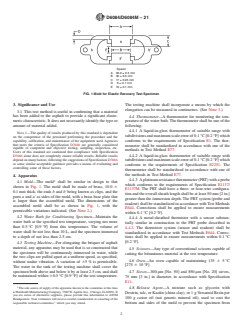
FIG. 1 Mold for Elastic Recovery Test Specimen
3. Significance and Use The testing machine shall incorporate a means by which the
elongation can be measured in centimetres. (See Note 3.)
3.1 This test method is useful in confirming that a material
has been added to the asphalt to provide a significant elasto- 4.4 Thermometer—A thermometer for monitoring the tem-
meric characteristic. It does not necessarily identify the type or
perature of the water bath.The thermometer shall be one of the
amount of material added. following:
4.4.1 A liquid-in-glass thermometer of suitable range with
NOTE 1—The quality of results produced by this standard is dependent
subdivisionsandmaximumscaleerrorof0.1 °C[0.2 °F]which
on the competence of the personnel performing the procedure and the
capability, calibration, and maintenance of the equipment used. Agencies
conforms to the requirements of Specification E1. The ther-
that meet the criteria of Specification D3666 are generally considered
mometer shall be standardized in accordance with one of the
capable of competent and objective testing, sampling, inspection, etc.
methods in Test Method E77.
Users of this standard are cautioned that compliance with Specification
4.4.2 A liquid-in-glass thermometer of suitable range with
D3666 alone does not completely ensure reliable results. Reliable results
dependonmanyfactors;followingthesuggestionsofSpecificationD3666 subdivisionsandmaximumscaleerrorof0.1 °C[0.2 °F]which
or some similar acceptable guidance provides a means of evaluating and
conforms to the requirements of Specification E2251. The
controlling some of those factors.
thermometer shall be standardized in accordance with one of
the methods in Test Method E77.
4. Apparatus
4.4.3 Aplatinumresistancethermometer(PRT)withaprobe
4.1 Mold—The mold shall be similar in design to that
which conforms to the requirements of Specification E1137/
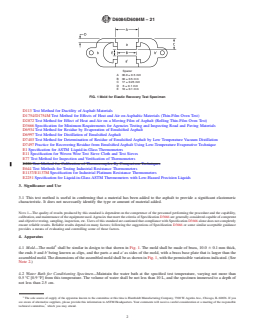
shown in Fig. 1. The mold shall be made of brass, 10.0 6
E1137M. The PRT shall have a three- or four-wire configura-
0.1 mm thick, the ends b and b' being known as clips, and the
tionandtheoverallsheathlengthshallbeatleast50mm[2in.]
parts a and a' as sides of the mold, with a brass base plate that
greater than the immersion depth. The PRT system (probe and
is larger than the assembled mold. The dimensions of the
readout)shallbestandardizedinaccordancewithTestMethods
assembled mold shall be as shown in Fig. 1, with the
E644. Corrections shall be applied to ensure measurements
permissible variations indicated. (See Note 2.)
within 0.1 °C [0.2 °F].
4.2 Water Bath for Conditioning Specimen—Maintain the
4.4.4 A metal-sheathed thermistor with a sensor substan-
water bath at the specified test temperature, varying not more
tially similar in construction to the PRT probe described in
than 0.5 °C [0.9 °F] from this temperature. The volume of
4.4.3. The thermistor system (sensor and readout) shall be
water shall be not less than 10 L, and the specimen immersed
standardized in accordance with Test Methods E644. Correc-
to a depth of not less than 2.5 cm.
tions shall be applied to ensure measurements within 0.1 °C
[0.2 °F].
4.3 Testing Machine—For elongating the briquet of asphalt
material, any apparatus may be used that is so constructed that
4.5 Scissors—Any type of conventional scissors capable of
the specimen will be continuously immersed in water, while
cutting the bituminous material at the test temperature.
the two clips are pulled apart at a uniform speed, as specified,
4.6 Oven—An oven capable of maintaining 135 6 5°C
without undue vibration. A variation of 65 % is permissible.
[275 6 10 °F].
The water in the tank of the testing machine shall cover the
specimen both above and below it by at least 2.5 cm, and shall
4.7 Sieves—300-µm [No. 50] and 850-µm [No. 20] sieves,
be maintained within 60.5 °C [0.9 °F] of the test temperature.
75 mm [3 in.] in diameter, in accordance with Specification
E11.
The sole source of supply of the apparatus known to the committee at this time
4.8 Release Agent—A mixture such as glycerin with
is Humboldt Manufacturing Company, 7300 W.AgatiteAve., Chicago, IL60656. If
Dextrin, talc, or Kaolin (china clay), or 1 gVersamid Resin per
you are aware of alternative suppliers, please provide this information to ASTM
100 g castor oil (not generic mineral oil), used to coat the
Headquarters.Your comments will receive careful consideration at a meeting of the
responsible technical committee, which you may attend. bottom and sides of the mold to prevent the specimen from
D6084/D6084M − 21
sticking to the mold. Other materials may be used for this temperature for 30 6 5 min. Remove the test specimens from
purpose if they have been shown not to affect the physical the water bath and immediately trim the excess material with a
properties of the test specimen. hot trimming tool to make the molds just level full. (See Note
7.)
4.9 Trimming Tool—Astraight-edged putty knife or spatula.
6.2 Keeping Specimens at Standard Temperature—Place the
NOTE 2—Clips for the mold are the same as specified in Fig. 1 of Test
trimmed specimen and mold in the water bath at the specified
Method D113.
NOTE 3—The testing machine may be the same as specified in Test
test temperature for 90 6 5 min prior to testing. Remove the
Method D113.
specimen from the plate by a shearing action between speci-
NOTE 4—In those cases where the elastic recovery specimens are
men and plate, avoiding any bending of the test specimen.
conditioned in the standard penetration bath at 25 °C [77 °F], the
Remove the side pieces a and a', being careful not to distort or
t
...
This document is not an ASTM standard and is intended only to provide the user of an ASTM standard an indication of what changes have been made to the previous version. Because
it may not be technically possible to adequately depict all changes accurately, ASTM recommends that users consult prior editions as appropriate. In all cases only the current version
of the standard as published by ASTM is to be considered the official document.
Designation: D6084/D6084M − 18 D6084/D6084M − 21
Standard Test Method for
Elastic Recovery of Asphalt Materials by Ductilometer
This standard is issued under the fixed designation D6084/D6084M; the number immediately following the designation indicates the
year of original adoption or, in the case of revision, the year of last revision. A number in parentheses indicates the year of last
reapproval. A superscript epsilon (´) indicates an editorial change since the last revision or reapproval.
1. Scope
1.1 This test method assesses the elastic recovery of an asphalt material measured by the recoverable strain determined after
severing an elongated briquet specimen of the material of the form described in 4.1. The specimens are pulled to a specified
distance at a specified speed and at a specified temperature. Unless otherwise specified, the test shall be made at a temperature of
25 6 0.5 °C [77 6 0.9 °F] and with a speed of 5 cm/min 6 5 %.
1.2 The values stated in either SI units or inch-pound units are to be regarded separately as standard. The values stated in each
system are not necessarily exact equivalents; therefore, to ensure conformance with the standard, each system shall be used
independently of the other, and values from the two systems shall not be combined.
1.3 Warning—Mercury has been designated by the United States Environmental Protection Agency and many state agencies as
a hazardous material that can cause central nervous system, kidney, and liver damage. Mercury, or its vapor, may be hazardous
to health and corrosive to materials. Caution should be taken when handling mercury and mercury-containing products. See the
applicable Material Safety Data Sheet (MSDS) for details and EPA’s website (http://www.epa.gov/mercury/index.htm) for
additional information. Users should be aware that selling mercury and/or mercury-containing products in your state may be
prohibited by state law.
1.4 The text of this standard references notes and footnotes which provide explanatory material. These notes and footnotes
(excluding those in tables and figures) shall not be considered as requirements of the standard.
1.5 This standard does not purport to address all of the safety concerns, if any, associated with its use. It is the responsibility
of the user of this standard to establish appropriate safety, health, and environmental practices and determine the applicability of
regulatory limitations prior to use.
1.6 This international standard was developed in accordance with internationally recognized principles on standardization
established in the Decision on Principles for the Development of International Standards, Guides and Recommendations issued
by the World Trade Organization Technical Barriers to Trade (TBT) Committee.
2. Referenced Documents
2.1 ASTM Standards:
C670 Practice for Preparing Precision and Bias Statements for Test Methods for Construction Materials
D5/D5M Test Method for Penetration of Bituminous Materials
This test method is under the jurisdiction of ASTM Committee D04 on Road and Paving Materials and is the direct responsibility of Subcommittee D04.44 on Rheological
Tests.
Current edition approved July 1, 2018Nov. 1, 2021. Published July 2018November 2021. Originally approved in 1997. Last previous edition approved in 20132018 as
D6084/D6084M – 13.D6084/D6084M – 18. DOI: 10.1520/D6084_D6084M-18.10.1520/D6084_D6084M-21.
For referenced ASTM standards, visit the ASTM website, www.astm.org, or contact ASTM Customer Service at service@astm.org. For Annual Book of ASTM Standards
volume information, refer to the standard’s Document Summary page on the ASTM website.
Copyright © ASTM International, 100 Barr Harbor Drive, PO Box C700, West Conshohocken, PA 19428-2959. United States
D6084/D6084M − 21
Spacer
A 36.0 ± 0.5 mm
B 30 ± 0.5 mm
C 17 ± 0.25 mm
D 6 ± 0.1 mm
E 10 ± 0.1 mm
FIG. 1 Mold for Elastic Recovery Test Specimen
D113 Test Method for Ductility of Asphalt Materials
D1754/D1754M Test Method for Effects of Heat and Air on Asphaltic Materials (Thin-Film Oven Test)
D2872 Test Method for Effect of Heat and Air on a Moving Film of Asphalt (Rolling Thin-Film Oven Test)
D3666 Specification for Minimum Requirements for Agencies Testing and Inspecting Road and Paving Materials
D6934 Test Method for Residue by Evaporation of Emulsified Asphalt
D6997 Test Method for Distillation of Emulsified Asphalt
D7403 Test Method for Determination of Residue of Emulsified Asphalt by Low Temperature Vacuum Distillation
D7497 Practice for Recovering Residue from Emulsified Asphalt Using Low-Temperature Evaporative Technique
E1 Specification for ASTM Liquid-in-Glass Thermometers
E11 Specification for Woven Wire Test Sieve Cloth and Test Sieves
E77 Test Method for Inspection and Verification of Thermometers
E220 Test Method for Calibration of Thermocouples By Comparison Techniques
E644 Test Methods for Testing Industrial Resistance Thermometers
E1137/E1137M Specification for Industrial Platinum Resistance Thermometers
E2251 Specification for Liquid-in-Glass ASTM Thermometers with Low-Hazard Precision Liquids
3. Significance and Use
3.1 This test method is useful in confirming that a material has been added to the asphalt to provide a significant elastomeric
characteristic. It does not necessarily identify the type or amount of material added.
NOTE 1—The quality of results produced by this standard is dependent on the competence of the personnel performing the procedure and the capability,
calibration, and maintenance of the equipment used. Agencies that meet the criteria of Specification D3666 are generally considered capable of competent
and objective testing, sampling, inspection, etc. Users of this standard are cautioned that compliance with Specification D3666 alone does not completely
ensure reliable results. Reliable results depend on many factors; following the suggestions of Specification D3666 or some similar acceptable guidance
provides a means of evaluating and controlling some of those factors.
4. Apparatus
4.1 Mold—The mold shall be similar in design to that shown in Fig. 1. The mold shall be made of brass, 10.0 6 0.1 mm thick,
the ends b and b' being known as clips, and the parts a and a' as sides of the mold, with a brass base plate that is larger than the
assembled mold. The dimensions of the assembled mold shall be as shown in Fig. 1, with the permissible variations indicated. (See
Note 2.)
4.2 Water Bath for Conditioning Specimen—Maintain the water bath at the specified test temperature, varying not more than
0.5 °C [0.9 °F] from this temperature. The volume of water shall be not less than 10 L, and the specimen immersed to a depth of
not less than 2.5 cm.
The sole source of supply of the apparatus known to the committee at this time is Humboldt Manufacturing Company, 7300 W. Agatite Ave., Chicago, IL 60656. If you
are aware of alternative suppliers, please provide this information to ASTM Headquarters. Your comments will receive careful consideration at a meeting of the responsible
technical committee, which you may attend.
D6084/D6084M − 21
4.3 Testing Machine—For elongating the briquet of asphalt material, any apparatus may be used that is so constructed that the
specimen will be continuously immersed in water, while the two clips are pulled apart at a uniform speed, as specified, without
undue vibration. A variation of 65 % is permissible. The water in the tank of the testing machine shall cover the specimen both
above and below it by at least 2.5 cm, and shall be maintained within 60.5 °C [0.9 °F] of the test temperature. The testing machine
shall incorporate a means by which the elongation can be measured in centimetres. (See Note 3.)
4.4 Thermometer—A thermometer for monitoring the temperature of the water bath. The thermometer shall be one of the
following:
4.4.1 A liquid-in-glass thermometer of suitable range with subdivisions and maximum scale error of 0.1 °C [0.2 °F] which
conforms to the requirements of Specification E1. The thermometer shall be standardized in accordance with one of the methods
in Test Method E77.
4.4.2 A liquid-in-glass thermometer of suitable range with subdivisions and maximum scale error of 0.1 °C [0.2 °F] which
conforms to the requirements of Specification E2251. The thermometer shall be standardized in accordance with one of the
methods in Test Method E77.
4.4.3 A platinum resistance thermometer (PRT) with a probe which conforms to the requirements of Specification E1137/E1137M.
The PRT shall have a three- or four-wire configuration and the overall sheath length shall be at least 50 mm [2 in.] greater than
the immersion depth. The PRT system (probe and readout) shall be standardized in accordance with Test Methods E644.
Corrections shall be applied to ensure measurements within 0.1 °C [0.2 °F].
4.4.4 A metal-sheathed thermistor with a sensor substantially similar in construction to the PRT probe described in 4.4.3. The
thermistor system (sensor and readout) shall be standardized in accordance with Test Methods E644. Corrections shall be applied
to ensure measurements within 0.1 °C [0.2 °F].
4.5 Scissors—Any type of conventional scissors capable of cutting the bituminous material at the test temperature.
4.6 Oven—An oven capable of maintaining 135 6 5 °C [275 6 10 °F].
4.7 Sieves—300-μm [No. 50] and 850-μm [No. 20] sieves, 75 mm [3 in.] in diameter, in accordance with Specification E11.
4.8 Release Agent—A mixture such as glycerin with Dextrin, talc, or Kaolin (china clay), or 1 g Versamid Resin per 100 g castor
oil (not generic mineral oil), used to coat the bottom and sides of the mold to prevent the specimen from sticking to the mold. Other
materials may be used for this purpose if they have been shown not to affect the physical properties of the test specimen.
4.9 Trimming Tool—A straight-edged putty knife or spatula.
NOTE 2—Clips for the mold are the same as specified in Fig. 1 of Test Method D113.
NOTE 3—The testing machine may be the same as specified in Test Method D113.
NOTE 4—In those cases where the elastic recovery specimens are conditioned in the standard penetration bath at 25 °C [77 °F], the thermometer as
prescribed for Test Method D5/D5M may be used.
5. Sample Preparation
5.1 Emulsified Asphalt Residue—If the sample is a residual product recovered from emulsified asphalt by means of the methods
described in Test Methods D6934, D6997, D7403, or Practice D7497, stir the heated residue and immediately pour portions of the
residue into suitable molds for making the required tests. If it is suspected that there is foreign matter in the residue, pour the
material through a 300-μm [No. 50] sieve that has been preheated at
...