

ASTM D5/D5M-20
(Test Method)Standard Test Method for Penetration of Bituminous Materials
General Information
- Abstract
SIGNIFICANCE AND USE
5.1 The penetration test is used as a measure of consistency. Higher values of penetration indicate softer consistency.
Note 2: The quality of the results produced by this standard are dependent on the competence of the personnel performing the procedure and the capability, calibration, and maintenance of the equipment used. Agencies that meet the criteria of Specification D3666 are generally considered capable of competent and objective testing, sampling, inspection, etc. Users of this standard are cautioned that compliance with Specification D3666 alone does not completely ensure reliable results. Reliable results depend on many factors; following the suggestions of Specification D3666 or some similar acceptable guideline provides a means of evaluating and controlling some of those factors.
SCOPE
1.1 This test method covers determination of the penetration of semi-solid and solid bituminous materials.
1.2 The needles, containers, and other conditions described in this test method provide for the determinations of penetrations up to 500.
Note 1: See the section on Penetration of Test Methods D244 for information and precision and bias on testing emulsion residue.
1.3 The values stated in either SI units or inch-pound units are to be regarded separately as standard. The values stated in each system may not be exact equivalents; therefore, each system shall be used independently of the other. Combining values from the two systems may result in nonconformance with the standard.
1.4 The text of this standard references notes and footnotes which provide explanatory material. These notes and footnotes (excluding those in tables and figures) shall not be considered as requirements of the standard.
1.5 This standard does not purport to address all of the safety concerns, if any, associated with its use. It is the responsibility of the user of this standard to establish appropriate safety, health, and environmental practices and determine the applicability of regulatory limitations prior to use.
1.6 This international standard was developed in accordance with internationally recognized principles on standardization established in the Decision on Principles for the Development of International Standards, Guides and Recommendations issued by the World Trade Organization Technical Barriers to Trade (TBT) Committee.
- Status
- Published
- Publication Date
- 30-Apr-2020
- Technical Committee
- D04 - Road and Paving Materials
- Drafting Committee
- D04.44 - Rheological Tests

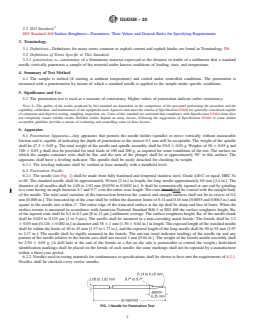
Overview
ASTM D5/D5M-20, Standard Test Method for Penetration of Bituminous Materials, is an internationally recognized standard published by ASTM International. This test method provides a procedure to determine the penetration of semi-solid and solid bituminous materials, such as asphalt and bitumen. Penetration is defined as the distance a standard needle vertically penetrates a sample under controlled conditions of loading, time, and temperature. This value is used as a measure of material consistency - with higher penetration indicating a softer material.
The consistency of bituminous materials is crucial for their effective use in pavements, road construction, and roofing applications. Understanding the material’s ability to withstand traffic, temperature fluctuations, and other service conditions depends on reliable penetration testing. The standard supports quality control and uniformity in manufacturing, construction, and research settings.
Key Topics
Scope of Testing
- Applies to both semi-solid and solid bituminous materials
- Penetration values obtained using prescribed needles, containers, and controlled test conditions, allowing determinations up to 500 units
Testing Methodology
- Involves sample preparation, temperature conditioning, and use of a standard penetrometer with precise load, time, and temperature controls
- The standard provides guidance on equipment calibration, sample container size, and necessary test environment
Precision and Reporting
- Outlines the required number of test repetitions and maximum allowable differences between results
- Emphasizes the significance of test operator competence and equipment maintenance for producing reliable results
Measurement Units
- Results may be reported in either SI units or inch-pound units; units must not be intermingled within a single report
Safety and Compliance
- Users must implement suitable safety, health, and environmental practices
- Reference to industry best practices and supporting ASTM standards ensures comprehensive quality assurance
Applications
The penetration test standard is widely used across the infrastructure and construction sectors. Its applications include:
Road and Pavement Engineering
- Evaluating asphalt binder consistency for paving mixtures
- Selection and quality assessment of bituminous binders for flexible pavements
Quality Control in Manufacturing
- Ensuring the manufactured bituminous materials meet specified consistency requirements before delivery to job sites
Material Research and Development
- Supporting the formulation and testing of new bitumen blends and modified asphalts
Regulatory Compliance
- Meeting mandatory test standards for highway, airport, and municipal paving projects
Inspection and Certification
- Used by accredited laboratories and inspection agencies for product certification and performance validation
Related Standards
Several ASTM and international standards are referenced within ASTM D5/D5M-20 to promote consistency and accuracy:
- ASTM D8: Terminology Relating to Materials for Roads and Pavements
- ASTM D36/D36M: Test Method for Softening Point of Bitumen (Ring-and-Ball Apparatus)
- ASTM D244: Test Methods and Practices for Emulsified Asphalts
- ASTM D3666: Specification for Minimum Requirements for Agencies Testing and Inspecting Road and Paving Materials
- ASTM E1, E77, E1137/E1137M, E2251, E644: Standards covering thermometer calibration and temperature measurement
- ANSI B46.1: Surface Texture
- ISO 468: Surface Roughness Parameters
Using ASTM D5/D5M-20 ensures standardized, reliable penetration testing of bituminous materials, supporting quality assurance and regulatory compliance in road construction, paving, and bitumen production.
Relations
- Effective Date
- 01-Oct-2023
- Effective Date
- 01-May-2020
- Effective Date
- 01-Nov-2019
- Effective Date
- 01-Aug-2019
- Effective Date
- 15-Dec-2018
- Effective Date
- 15-Aug-2018
- Effective Date
- 01-Jul-2018
- Effective Date
- 01-Feb-2018
- Effective Date
- 01-Oct-2017
- Effective Date
- 15-Jul-2017
- Effective Date
- 15-Jun-2017
- Effective Date
- 01-May-2017
- Effective Date
- 01-Mar-2017
- Effective Date
- 01-Dec-2016
- Effective Date
- 01-Oct-2016
Get Certified
Connect with accredited certification bodies for this standard

Element Materials Technology
Materials testing and product certification.

ABS Group Brazil
ABS Group certification services in Brazil.

ABS Quality Evaluations Inc.
American Bureau of Shipping quality certification.
Sponsored listings
Frequently Asked Questions
ASTM D5/D5M-20 is a standard published by ASTM International. Its full title is "Standard Test Method for Penetration of Bituminous Materials". This standard covers: SIGNIFICANCE AND USE 5.1 The penetration test is used as a measure of consistency. Higher values of penetration indicate softer consistency. Note 2: The quality of the results produced by this standard are dependent on the competence of the personnel performing the procedure and the capability, calibration, and maintenance of the equipment used. Agencies that meet the criteria of Specification D3666 are generally considered capable of competent and objective testing, sampling, inspection, etc. Users of this standard are cautioned that compliance with Specification D3666 alone does not completely ensure reliable results. Reliable results depend on many factors; following the suggestions of Specification D3666 or some similar acceptable guideline provides a means of evaluating and controlling some of those factors. SCOPE 1.1 This test method covers determination of the penetration of semi-solid and solid bituminous materials. 1.2 The needles, containers, and other conditions described in this test method provide for the determinations of penetrations up to 500. Note 1: See the section on Penetration of Test Methods D244 for information and precision and bias on testing emulsion residue. 1.3 The values stated in either SI units or inch-pound units are to be regarded separately as standard. The values stated in each system may not be exact equivalents; therefore, each system shall be used independently of the other. Combining values from the two systems may result in nonconformance with the standard. 1.4 The text of this standard references notes and footnotes which provide explanatory material. These notes and footnotes (excluding those in tables and figures) shall not be considered as requirements of the standard. 1.5 This standard does not purport to address all of the safety concerns, if any, associated with its use. It is the responsibility of the user of this standard to establish appropriate safety, health, and environmental practices and determine the applicability of regulatory limitations prior to use. 1.6 This international standard was developed in accordance with internationally recognized principles on standardization established in the Decision on Principles for the Development of International Standards, Guides and Recommendations issued by the World Trade Organization Technical Barriers to Trade (TBT) Committee.
SIGNIFICANCE AND USE 5.1 The penetration test is used as a measure of consistency. Higher values of penetration indicate softer consistency. Note 2: The quality of the results produced by this standard are dependent on the competence of the personnel performing the procedure and the capability, calibration, and maintenance of the equipment used. Agencies that meet the criteria of Specification D3666 are generally considered capable of competent and objective testing, sampling, inspection, etc. Users of this standard are cautioned that compliance with Specification D3666 alone does not completely ensure reliable results. Reliable results depend on many factors; following the suggestions of Specification D3666 or some similar acceptable guideline provides a means of evaluating and controlling some of those factors. SCOPE 1.1 This test method covers determination of the penetration of semi-solid and solid bituminous materials. 1.2 The needles, containers, and other conditions described in this test method provide for the determinations of penetrations up to 500. Note 1: See the section on Penetration of Test Methods D244 for information and precision and bias on testing emulsion residue. 1.3 The values stated in either SI units or inch-pound units are to be regarded separately as standard. The values stated in each system may not be exact equivalents; therefore, each system shall be used independently of the other. Combining values from the two systems may result in nonconformance with the standard. 1.4 The text of this standard references notes and footnotes which provide explanatory material. These notes and footnotes (excluding those in tables and figures) shall not be considered as requirements of the standard. 1.5 This standard does not purport to address all of the safety concerns, if any, associated with its use. It is the responsibility of the user of this standard to establish appropriate safety, health, and environmental practices and determine the applicability of regulatory limitations prior to use. 1.6 This international standard was developed in accordance with internationally recognized principles on standardization established in the Decision on Principles for the Development of International Standards, Guides and Recommendations issued by the World Trade Organization Technical Barriers to Trade (TBT) Committee.
ASTM D5/D5M-20 is classified under the following ICS (International Classification for Standards) categories: 75.140 - Waxes, bituminous materials and other petroleum products. The ICS classification helps identify the subject area and facilitates finding related standards.
ASTM D5/D5M-20 has the following relationships with other standards: It is inter standard links to ASTM D244-23, ASTM D36/D36M-14(2020), ASTM E644-11(2019), ASTM D8-19, ASTM D8-18c, ASTM D8-18b, ASTM D8-18a, ASTM D8-18, ASTM D244-09(2017), ASTM D8-17c, ASTM D8-17b, ASTM D8-17a, ASTM D8-17, ASTM D8-16b, ASTM D3666-16. Understanding these relationships helps ensure you are using the most current and applicable version of the standard.
ASTM D5/D5M-20 is available in PDF format for immediate download after purchase. The document can be added to your cart and obtained through the secure checkout process. Digital delivery ensures instant access to the complete standard document.
Standards Content (Sample)
This international standard was developed in accordance with internationally recognized principles on standardization established in the Decision on Principles for the
Development of International Standards, Guides and Recommendations issued by the World Trade Organization Technical Barriers to Trade (TBT) Committee.
Designation: D5/D5M − 20
Standard Test Method for
Penetration of Bituminous Materials
This standard is issued under the fixed designation D5/D5M; the number immediately following the designation indicates the year of
original adoption or, in the case of revision, the year of last revision. A number in parentheses indicates the year of last reapproval. A
superscript epsilon (´) indicates an editorial change since the last revision or reapproval.
This standard has been approved for use by agencies of the U.S. Department of Defense.
1. Scope 2. Referenced Documents
1.1 Thistestmethodcoversdeterminationofthepenetration 2.1 ASTM Standards:
of semi-solid and solid bituminous materials. D8 Terminology Relating to Materials for Roads and Pave-
ments
1.2 The needles, containers, and other conditions described
D36/D36M Test Method for Softening Point of Bitumen
in this test method provide for the determinations of penetra-
(Ring-and-Ball Apparatus)
tions up to 500.
D244 Test Methods and Practices for Emulsified Asphalts
NOTE 1—See the section on Penetration of Test Methods D244 for
D3666 Specification for Minimum Requirements for Agen-
information and precision and bias on testing emulsion residue.
cies Testing and Inspecting Road and Paving Materials
1.3 The values stated in either SI units or inch-pound units
D8055 Guide for Selecting an Appropriate Electronic Ther-
are to be regarded separately as standard. The values stated in
mometer for Replacing Mercury Thermometers in D04
each system may not be exact equivalents; therefore, each
Road and Paving Standards
system shall be used independently of the other. Combining
E1 Specification for ASTM Liquid-in-Glass Thermometers
values from the two systems may result in nonconformance
E77 Test Method for Inspection and Verification of Ther-
with the standard.
mometers
E563 Practice for Preparation and Use of an Ice-Point Bath
1.4 The text of this standard references notes and footnotes
as a Reference Temperature
which provide explanatory material. These notes and footnotes
E644 Test Methods for Testing Industrial Resistance Ther-
(excluding those in tables and figures) shall not be considered
mometers
as requirements of the standard.
2.2 ANSI Standard:
1.5 This standard does not purport to address all of the
B46.1 Surface Texture
safety concerns, if any, associated with its use. It is the
2.3 ISO Standard:
responsibility of the user of this standard to establish appro-
ISO Standard 468 Surface Roughness—Parameters, Their
priate safety, health, and environmental practices and deter-
Values and General Rules for Specifying Requirements
mine the applicability of regulatory limitations prior to use.
1.6 This international standard was developed in accor-
3. Terminology
dance with internationally recognized principles on standard-
3.1 Definitions—Definitions for many terms common to
ization established in the Decision on Principles for the
asphalt cement and asphalt binder are found in Terminology
Development of International Standards, Guides and Recom-
D8.
mendations issued by the World Trade Organization Technical
Barriers to Trade (TBT) Committee. 3.2 Definitions of Terms Specific to This Standard:
1 2
This test method is under the jurisdiction of ASTM Committee D04 on Road For referenced ASTM standards, visit the ASTM website, www.astm.org, or
and Paving Materials and is the direct responsibility of Subcommittee D04.44 on contact ASTM Customer Service at service@astm.org. For Annual Book of ASTM
Rheological Tests. Standards volume information, refer to the standard’s Document Summary page on
Current edition approved May 1, 2020. Published May 2020. Originally the ASTM website.
approved in 1959. Last previous edition approved in 2019 as D5/D5M – 19a. DOI: Available fromAmerican National Standards Institute (ANSI), 25 W. 43rd St.,
10.1520/D0005_D0005M-20. 4th Floor, New York, NY 10036, http://www.ansi.org.
Copyright © ASTM International, 100 Barr Harbor Drive, PO Box C700, West Conshohocken, PA 19428-2959. United States
D5/D5M − 20
3.2.1 penetration, n—consistency of a bituminous material intersection between the conical and straight surfaces shall not
expressed as the distance in tenths of a millimetre that a be in excess of 0.2 mm [0.008 in.]. The truncated tip of the
standard needle vertically penetrates a sample of the material cone shall be within the diameter limits of 0.14 and 0.16 mm
under known conditions of loading, time, and temperature. [0.0055and0.0063in.]andsquaretotheneedleaxiswithin2°.
Theentireedgeofthetruncatedsurfaceatthetipshallbesharp
4. Summary of Test Method
and free of burrs. When the surface texture is measured in
accordance with American National Standard B46.1 or ISO
4.1 The sample is melted (if starting at ambient tempera-
468 the surface roughness height, Ra, of the tapered cone shall
ture) and cooled under controlled conditions. The penetration
be 0.2 to 0.3 µm [8 to 12 µin.] arithmetic average. The surface
is measured with a penetrometer by means of which a standard
roughness height, Ra, of the needle shank shall be 0.025 to
needle is applied to the sample under specific conditions.
0.125 µm [1 to 5 µin.]. The needle shall be mounted in a
5. Significance and Use
non-corroding metal ferrule. The ferrule shall be 3.2 6
0.05 mm [0.126 6 0.002 in.] in diameter and 38 6 1 mm [1.50
5.1 The penetration test is used as a measure of consistency.
6 0.04 in.] in length. The exposed length of the standard
Higher values of penetration indicate softer consistency.
needle shall be within the limits of 40 to 45 mm [1.57 to
NOTE 2—The quality of the results produced by this standard are
1.77 in.], and the exposed length of the long needle shall be 50
dependent on the competence of the personnel performing the procedure
to 55 mm [1.97 to 2.17 in.]. The needle shall be rigidly
and the capability, calibration, and maintenance of the equipment used.
mounted in the ferrule. The run-out (total indicator reading) of
Agencies that meet the criteria of Specification D3666 are generally
considered capable of competent and objective testing, sampling, the needle tip and any portion of the needle relative to the
inspection, etc. Users of this standard are cautioned that compliance with
ferrule axis shall not exceed 1 mm [0.04 in.].The weight of the
Specification D3666 alone does not completely ensure reliable results.
ferrule needle assembly shall be 2.50 6 0.05 g. (Adrill hole at
Reliable results depend on many factors; following the suggestions of
the end of the ferrule or a flat on the side is permissible to
Specification D3666 or some similar acceptable guideline provides a
control the weight.) Individual identification markings shall be
means of evaluating and controlling some of those factors.
placed on the ferrule of each needle; the same markings shall
6. Apparatus
not be repeated by a manufacturer within a three-year period.
6.2.2 Needles used in testing materials for conformance to
6.1 Penetration Apparatus—Any apparatus that permits the
specifications shall be shown to have met the requirements of
needle holder (spindle) to move vertically without measurable
6.2.1. Needles shall be checked every twelve months.
friction and is capable of indicating the depth of penetration to
the nearest 0.1 mm will be acceptable. The weight of the
6.3 Sample Container—A metal or glass cylindrical, flat-
spindle shall be 47.5 6 0.05 g. The total weight of the needle
bottom container of essentially the following dimensions shall
and spindle assembly shall be 50.0 6 0.05 g. Weights of 50 6
be used:
0.05 g and 100 6 0.05 g shall also be provided for total loads
For penetrations below 40:
of 100 and 200 g, as required for some conditions of the test.
Diameter, mm 33–50
Internal depth, mm 8–16
The surface on which the sample container rests shall be flat,
For penetrations below 200:
andtheaxisoftheplungershallbeatapproximately90°tothis
Diameter, mm 48–56
surface. The apparatus shall have a leveling indicator. The Internal depth, mm 34–40
For penetrations between 200 and 350:
spindle shall be easily detached for checking its weight.
Diameter, mm 55–80
6.1.1 The leveling indicator shall be verified at least annu-
Internal depth, mm 45–70
ally with a handheld level. For penetrations 350 to 500
Diameter, mm 55–70
6.2 Penetration Needle:
Internal depth, mm 70–80
6.2.1 The needle (see Fig. 1) shall be made from fully
NOTE3—Commonlyavailablemetalcontainersizesare33by8mm,40
hardened and tempered stainless steel, Grade 440-C or equal,
by 15 mm, 55 by 35 mm, 70 by 45 mm, 80 by 50 mm, and 70 by 80 mm.
HRC 54 to 60. The standard needle shall be approximately
6.3.1 For referee testing, the container shall essentially be
50 mm [2 in.] in length, the long needle approximately 60 mm
55 by 35 mm for materials with penetrations below 200; 70 by
[2.4 in.]. The diameter of all needles shall be 1.00 to 1.02 mm
45 mm for penetrations between 200 and 350; and 70 by
[0.0394 to 0.0402 in.]. It shall be symmetrically tapered at one
80 mm for penetrations above 350.
endbygrindingtoaconehavingananglebetween8.7and9.7°
over the entire cone length. The cone shall be coaxial with the 6.4 Water Bath—A bath capable of maintaining a tempera-
straight body of the needle. The total axial variation of the ture of 25 6 0.1 °C [77 6 0.2 °F] or any other temperature of
test within 0.1 °C [0.2 °F]. The bath shall have a perforated
shelf supported in a position not less than 50 mm from the
bottom and not less than 100 mm below the liquid level in the
bath. If penetration tests are to be made in the bath itself, an
additional shelf strong enough to support the penetrometer
shall be provided. Brine may be used in the bath for determi-
nations at low temperatures.
NOTE 4—The use of distilled water is recommended for the bath. Take
FIG. 1 Needle for Penetration Test care to avoid contamination of the bath water by surface active agents,
D5/D5M − 20
release agents, or other chemicals, as their presence may affect the
overheating, until it has become sufficiently fluid to pour. In no
penetration values obtained.
case should the temperature be raised to more than 60 °C
6.5 Transfer Dish—When used, the transfer dish shall have [140 °F] ab
...
This document is not an ASTM standard and is intended only to provide the user of an ASTM standard an indication of what changes have been made to the previous version. Because
it may not be technically possible to adequately depict all changes accurately, ASTM recommends that users consult prior editions as appropriate. In all cases only the current version
of the standard as published by ASTM is to be considered the official document.
Designation: D5/D5M − 19a D5/D5M − 20
Standard Test Method for
Penetration of Bituminous Materials
This standard is issued under the fixed designation D5/D5M; the number immediately following the designation indicates the year of
original adoption or, in the case of revision, the year of last revision. A number in parentheses indicates the year of last reapproval. A
superscript epsilon (´) indicates an editorial change since the last revision or reapproval.
This standard has been approved for use by agencies of the U.S. Department of Defense.
1. Scope
1.1 This test method covers determination of the penetration of semi-solid and solid bituminous materials.
1.2 The needles, containers, and other conditions described in this test method provide for the determinations of penetrations
up to 500.
NOTE 1—See the section on Penetration of Test Methods D244 for information and precision and bias on testing emulsion residue.
1.3 The values stated in either SI units or inch-pound units are to be regarded separately as standard. The values stated in each
system may not be exact equivalents; therefore, each system shall be used independently of the other. Combining values from the
two systems may result in nonconformance with the standard.
1.4 The text of this standard references notes and footnotes which provide explanatory material. These notes and footnotes
(excluding those in tables and figures) shall not be considered as requirements of the standard.
1.5 This standard does not purport to address all of the safety concerns, if any, associated with its use. It is the responsibility
of the user of this standard to establish appropriate safety, health, and environmental practices and determine the applicability of
regulatory limitations prior to use.
1.6 This international standard was developed in accordance with internationally recognized principles on standardization
established in the Decision on Principles for the Development of International Standards, Guides and Recommendations issued
by the World Trade Organization Technical Barriers to Trade (TBT) Committee.
2. Referenced Documents
2.1 ASTM Standards:
D8 Terminology Relating to Materials for Roads and Pavements
D36/D36M Test Method for Softening Point of Bitumen (Ring-and-Ball Apparatus)
D244 Test Methods and Practices for Emulsified Asphalts
D3666 Specification for Minimum Requirements for Agencies Testing and Inspecting Road and Paving Materials
D8055 Guide for Selecting an Appropriate Electronic Thermometer for Replacing Mercury Thermometers in D04 Road and
Paving Standards
E1 Specification for ASTM Liquid-in-Glass Thermometers
E77 Test Method for Inspection and Verification of Thermometers
E1137/E1137ME563 Specification for Industrial Platinum Resistance ThermometersPractice for Preparation and Use of an
Ice-Point Bath as a Reference Temperature
E2251E644 Specification for Liquid-in-Glass ASTM Thermometers with Low-Hazard Precision LiquidsTest Methods for
Testing Industrial Resistance Thermometers
2.2 ANSI Standard:
B46.1 Surface Texture
This test method is under the jurisdiction of ASTM Committee D04 on Road and Paving Materials and is the direct responsibility of Subcommittee D04.44 on Rheological
Tests.
Current edition approved Dec. 15, 2019May 1, 2020. Published January 2020May 2020. Originally approved in 1959. Last previous edition approved in 2019 as
D5/D5M – 19.D5/D5M – 19a. DOI: 10.1520/D0005_D0005M-19A.10.1520/D0005_D0005M-20.
For referenced ASTM standards, visit the ASTM website, www.astm.org, or contact ASTM Customer Service at service@astm.org. For Annual Book of ASTM Standards
volume information, refer to the standard’s Document Summary page on the ASTM website.
Available from American National Standards Institute (ANSI), 25 W. 43rd St., 4th Floor, New York, NY 10036, http://www.ansi.org.
Copyright © ASTM International, 100 Barr Harbor Drive, PO Box C700, West Conshohocken, PA 19428-2959. United States
D5/D5M − 20
2.3 ISO Standard:
ISO Standard 468 Surface Roughness—Parameters, Their Values and General Rules for Specifying Requirements
3. Terminology
3.1 Definitions—Definitions for many terms common to asphalt cement and asphalt binder are found in Terminology D8.
3.2 Definitions of Terms Specific to This Standard:
3.2.1 penetration, n—consistency of a bituminous material expressed as the distance in tenths of a millimetre that a standard
needle vertically penetrates a sample of the material under known conditions of loading, time, and temperature.
4. Summary of Test Method
4.1 The sample is melted (if starting at ambient temperature) and cooled under controlled conditions. The penetration is
measured with a penetrometer by means of which a standard needle is applied to the sample under specific conditions.
5. Significance and Use
5.1 The penetration test is used as a measure of consistency. Higher values of penetration indicate softer consistency.
NOTE 2—The quality of the results produced by this standard are dependent on the competence of the personnel performing the procedure and the
capability, calibration, and maintenance of the equipment used. Agencies that meet the criteria of Specification D3666 are generally considered capable
of competent and objective testing, sampling, inspection, etc. Users of this standard are cautioned that compliance with Specification D3666 alone does
not completely ensure reliable results. Reliable results depend on many factors; following the suggestions of Specification D3666 or some similar
acceptable guideline provides a means of evaluating and controlling some of those factors.
6. Apparatus
6.1 Penetration Apparatus—Any apparatus that permits the needle holder (spindle) to move vertically without measurable
friction and is capable of indicating the depth of penetration to the nearest 0.1 mm will be acceptable. The weight of the spindle
shall be 47.5 6 0.05 g. The total weight of the needle and spindle assembly shall be 50.0 6 0.05 g. Weights of 50 6 0.05 g and
100 6 0.05 g shall also be provided for total loads of 100 and 200 g, as required for some conditions of the test. The surface on
which the sample container rests shall be flat, and the axis of the plunger shall be at approximately 90° to this surface. The
apparatus shall have a leveling indicator. The spindle shall be easily detached for checking its weight.
6.1.1 The leveling indicator shall be verified at least annually with a handheld level.
6.2 Penetration Needle:
6.2.1 The needle (see Fig. 1) shall be made from fully hardened and tempered stainless steel, Grade 440-C or equal, HRC 54
to 60. The standard needle shall be approximately 50 mm [2 in.] in length, the long needle approximately 60 mm [2.4 in.]. The
diameter of all needles shall be 1.00 to 1.02 mm [0.0394 to 0.0402 in.]. It shall be symmetrically tapered at one end by grinding
to a cone having an angle between 8.7 and 9.7° over the entire cone length. The cone shouldshall be coaxial with the straight body
of the needle. The total axial variation of the intersection between the conical and straight surfaces shall not be in excess of 0.2
mm [0.008 in.]. The truncated tip of the cone shall be within the diameter limits of 0.14 and 0.16 mm [0.0055 and 0.0063 in.] and
square to the needle axis within 2°. The entire edge of the truncated surface at the tip shall be sharp and free of burrs. When the
surface texture is measured in accordance with American National Standard B46.1 or ISO 468 the surface roughness height, Ra,
of the tapered cone shall be 0.2 to 0.3 μm [8 to 12 μin.] arithmetic average. The surface roughness height, Ra, of the needle shank
shall be 0.025 to 0.125 μm [1 to 5 μin.]. The needle shall be mounted in a non-corroding metal ferrule. The ferrule shall be 3.2
6 0.05 mm [0.126 6 0.002 in.] in diameter and 38 6 1 mm [1.50 6 0.04 in.] in length. The exposed length of the standard needle
shall be within the limits of 40 to 45 mm [1.57 to 1.77 in.], and the exposed length of the long needle shall be 50 to 55 mm [1.97
to 2.17 in.]. The needle shall be rigidly mounted in the ferrule. The run-out (total indicator reading) of the needle tip and any
portion of the needle relative to the ferrule axis shall not exceed 1 mm [0.04 in.]. The weight of the ferrule needle assembly shall
be 2.50 6 0.05 g. (A drill hole at the end of the ferrule or a flat on the side is permissible to control the weight.) Individual
identification markings shall be placed on the ferrule of each needle; the same markings shall not be repeated by a manufacturer
within a three-year period.
6.2.2 Needles used in testing materials for conformance to specifications shall be shown to have met the requirements of 6.2.1.
Needles shall be checked every twelve months.
FIG. 1 Needle for Penetration Test
D5/D5M − 20
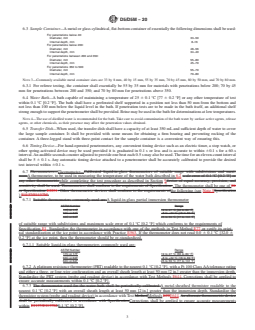
6.3 Sample Container—A metal or glass cylindrical, flat-bottom container of essentially the following dimensions shall be used:
For penetrations below 40:
Diameter, mm 33–50
Internal depth, mm 8–16
For penetrations below 200:
Diameter, mm 48–56
Internal depth, mm 34–40
For penetrations between 200 and 350:
Diameter, mm 55–80
Internal depth, mm 45–70
For penetrations 350 to 500
Diameter, mm 55–70
Internal depth, mm 70–80
NOTE 3—Commonly available metal container sizes are 33 by 8 mm, 40 by 15 mm, 55 by 35 mm, 70 by 45 mm, 80 by 50 mm, and 70 by 80 mm.
6.3.1 For referee testing, the container shall essentially be 55 by 35 mm for materials with penetrations below 200; 70 by 45
mm for penetrations between 200 and 350; and 70 by 80 mm for penetrations above 350.
6.4 Water Bath—A bath capable of maintaining a temperature of 25 6 0.1 °C [77 6 0.2 °F] or any other temperature of test
within 0.1 °C [0.2 °F]. The bath shall have a perforated shelf supported in a position not less than 50 mm from the bottom and
not less than 100 mm below the liquid level in the bath. If penetration tests are to be made in the bath itself, an additional shelf
strong enough to support the penetrometer shall be provided. Brine may be used in the bath for determinations at low temperatures.
NOTE 4—The use of distilled water is recommended for the bath. Take care to avoid contamination of the bath water by surface active agents, release
agents, or other chemicals, as their presence may affect the penetration values obtained.
6.5 Transfer Dish—When used, the transfer dish shall have a capacity of at least 350 mL and sufficient depth of water to cover
the large sample container. It shall be provided with some means for obtaining a firm bearing and preventing rocking of the
container. A three-legged stand with three-point contact for the sample container is a convenient way of ensuring this.
6.6 Timing Device—For hand-operated penetrometers, any convenient timing device such as an electric timer, a stop watch, or
other spring-activated device may be used provided it is graduated in 0.1 s or less and is accurate to within 60.1 s for a 60-s
interval. An audible seconds counter adjusted to provide o
...