

ASTM D7863-22
(Guide)Standard Guide for Evaluation of Convective Heat Transfer Coefficient of Liquids
General Information
- Abstract
SIGNIFICANCE AND USE
5.1 The reported values of convective heat transfer coefficients are somewhat dependent upon measurement technique and it is therefore the purpose of this guide to focus on methods to provide accurate measures of heat transfer and precise methods of reporting. The benefit of developing such a guide is to provide a well-understood basis by which heat transfer performance of fluids may be accurately compared and reported.
5.2 For comparison of heat transfer performance of heat transfer fluids, measurement methods and test apparatus should be identical, but in reality heat transfer rigs show differences from rig to rig. Therefore, methods discussed in the guide are generally restricted to the use of heated tubes that have wall temperatures higher than the bulk fluid temperature and with turbulent flow conditions.
5.3 Similar test methods are found in the technical literature, however it is generally left to the user to report results in a format of their choosing and therefore direct comparisons of results can be challenging.
SCOPE
1.1 This guide covers general information, without specific limits, for selecting methods for evaluating the heating and cooling performance of liquids used to transfer heat where forced convection is the primary mode for heat transfer. Further, methods of comparison are presented to effectively and easily distinguish performance characteristics of the heat transfer fluids.
1.2 The values stated in SI units are to be regarded as standard. No other units of measurement are included in this standard.
1.3 This standard does not purport to address all of the safety concerns, if any, associated with its use. It is the responsibility of the user of this standard to establish appropriate safety, health, and environmental practices and determine the applicability of regulatory limitations prior to use.
1.4 This international standard was developed in accordance with internationally recognized principles on standardization established in the Decision on Principles for the Development of International Standards, Guides and Recommendations issued by the World Trade Organization Technical Barriers to Trade (TBT) Committee.
- Status
- Published
- Publication Date
- 30-Jun-2022
- Technical Committee
- D02 - Petroleum Products, Liquid Fuels, and Lubricants
- Drafting Committee
- D02.L0.06 - Non-Lubricating Process Fluids
Overview
ASTM D7863-22: Standard Guide for Evaluation of Convective Heat Transfer Coefficient of Liquids provides comprehensive guidance for selecting proper methods to assess the heating and cooling performance of liquids used in forced convection heat transfer applications. Developed by ASTM International, this standard aims to establish consistent methodologies for measuring and reporting convective heat transfer coefficients, allowing for accurate and comparable data across laboratories and industries. By focusing on standardized test apparatus and data reporting criteria, ASTM D7863-22 supports both engineers and researchers in evaluating heat transfer fluids efficiently and reliably.
Key Topics
- Convective Heat Transfer Coefficient (h): Discusses how to determine the coefficient for fluids flowing in tubes under turbulent flow, considering measurement techniques and apparatus design.
- Test Methods and Apparatus:
- Emphasizes the use of heated tubes with wall temperatures higher than the bulk fluid temperature under turbulent flow for accurate measurement.
- Importance of identical test methods and equipment for fluid performance comparison.
- Fluid Properties: Addresses the need for detailed documentation of fluid properties (viscosity, density, specific heat, thermal conductivity) at relevant temperatures.
- Measurement and Reporting:
- Specifies how to measure wall and fluid temperatures, flow rates, and apparatus dimensions.
- Advises on presenting results, including plot types (e.g., Nusselt number vs. Reynolds number) and tabulation of key fluid functions for comparison.
- Calibration and Accuracy:
- Recommends using well-characterized fluids for calibrating heat transfer rigs.
- Discusses considerations for minimizing errors (thermal losses, apparatus calibration, uncertainty analysis).
Applications
ASTM D7863-22 is vital in industries where precise evaluation of heat transfer fluids is required, particularly in:
- Industrial Process Heating and Cooling: Supports selection and benchmarking of heat transfer fluids in chemical and petrochemical plants, power generation, and manufacturing.
- Thermal System Design: Assists engineers in designing and optimizing systems such as heat exchangers, reactors, and cooling loops by providing reliable performance data of candidate fluids.
- Research and Development: Facilitates the comparison of new or proprietary heat transfer fluids under standardized conditions, enabling faster product development and market introduction.
- Quality Assurance: Establishes best practices for testing and reporting, ensuring consistency in material qualification and process verification.
Related Standards
ASTM D7863-22 references and is complemented by several other ASTM standards, which provide methods for characterizing fluid properties necessary in evaluating heat transfer performance:
- ASTM D445: Kinematic viscosity of liquids
- ASTM D1298 & D4052: Density and relative density of liquids
- ASTM D2270: Viscosity index calculation
- ASTM D4530: Determination of carbon residue
- ASTM D6743: Thermal stability of organic heat transfer fluids
- ASTM D7042: Dynamic viscosity and density by Stabinger viscometer
- ASTM E659: Autoignition temperature of chemicals
- ASTM D4175: Terminology for petroleum products, liquid fuels, and lubricants
Practical Value
Implementing ASTM D7863-22 ensures:
- Consistency in Comparison: Results from different laboratories and apparatus can be directly compared, enhancing decision-making in fluid selection.
- Improved System Reliability: Accurate data on heat transfer coefficients helps prevent design errors and potential operational failures.
- Industry Confidence: A well-established, internationally recognized test protocol bolsters trust among stakeholders, end-users, and regulatory bodies.
- Enhanced Reporting Clarity: Standardized data presentation facilitates transparent communication and technical documentation.
Keywords
convective heat transfer, heat transfer coefficient, heat transfer fluids, forced convection, heat transfer apparatus, industrial cooling, ASTM D7863, thermal systems, standardized testing, fluid comparison
Relations
- Effective Date
- 01-Apr-2024
- Refers
ASTM D4175-23a - Standard Terminology Relating to Petroleum Products, Liquid Fuels, and Lubricants - Effective Date
- 15-Dec-2023
- Effective Date
- 01-Dec-2023
- Effective Date
- 01-Nov-2023
- Refers
ASTM D4175-23e1 - Standard Terminology Relating to Petroleum Products, Liquid Fuels, and Lubricants - Effective Date
- 01-Jul-2023
- Effective Date
- 01-Jul-2023
- Effective Date
- 01-Jul-2019
- Effective Date
- 01-Dec-2018
- Effective Date
- 15-Dec-2016
- Effective Date
- 01-Jul-2015
- Effective Date
- 01-Jul-2014
- Effective Date
- 01-Jul-2014
- Effective Date
- 01-May-2014
- Effective Date
- 01-Feb-2014
- Effective Date
- 15-Oct-2013
Get Certified
Connect with accredited certification bodies for this standard

DNV
DNV is an independent assurance and risk management provider.

Lloyd's Register
Lloyd's Register is a global professional services organisation specialising in engineering and technology.
DNV Energy Systems
Energy and renewable energy certification.
Sponsored listings
Frequently Asked Questions
ASTM D7863-22 is a guide published by ASTM International. Its full title is "Standard Guide for Evaluation of Convective Heat Transfer Coefficient of Liquids". This standard covers: SIGNIFICANCE AND USE 5.1 The reported values of convective heat transfer coefficients are somewhat dependent upon measurement technique and it is therefore the purpose of this guide to focus on methods to provide accurate measures of heat transfer and precise methods of reporting. The benefit of developing such a guide is to provide a well-understood basis by which heat transfer performance of fluids may be accurately compared and reported. 5.2 For comparison of heat transfer performance of heat transfer fluids, measurement methods and test apparatus should be identical, but in reality heat transfer rigs show differences from rig to rig. Therefore, methods discussed in the guide are generally restricted to the use of heated tubes that have wall temperatures higher than the bulk fluid temperature and with turbulent flow conditions. 5.3 Similar test methods are found in the technical literature, however it is generally left to the user to report results in a format of their choosing and therefore direct comparisons of results can be challenging. SCOPE 1.1 This guide covers general information, without specific limits, for selecting methods for evaluating the heating and cooling performance of liquids used to transfer heat where forced convection is the primary mode for heat transfer. Further, methods of comparison are presented to effectively and easily distinguish performance characteristics of the heat transfer fluids. 1.2 The values stated in SI units are to be regarded as standard. No other units of measurement are included in this standard. 1.3 This standard does not purport to address all of the safety concerns, if any, associated with its use. It is the responsibility of the user of this standard to establish appropriate safety, health, and environmental practices and determine the applicability of regulatory limitations prior to use. 1.4 This international standard was developed in accordance with internationally recognized principles on standardization established in the Decision on Principles for the Development of International Standards, Guides and Recommendations issued by the World Trade Organization Technical Barriers to Trade (TBT) Committee.
SIGNIFICANCE AND USE 5.1 The reported values of convective heat transfer coefficients are somewhat dependent upon measurement technique and it is therefore the purpose of this guide to focus on methods to provide accurate measures of heat transfer and precise methods of reporting. The benefit of developing such a guide is to provide a well-understood basis by which heat transfer performance of fluids may be accurately compared and reported. 5.2 For comparison of heat transfer performance of heat transfer fluids, measurement methods and test apparatus should be identical, but in reality heat transfer rigs show differences from rig to rig. Therefore, methods discussed in the guide are generally restricted to the use of heated tubes that have wall temperatures higher than the bulk fluid temperature and with turbulent flow conditions. 5.3 Similar test methods are found in the technical literature, however it is generally left to the user to report results in a format of their choosing and therefore direct comparisons of results can be challenging. SCOPE 1.1 This guide covers general information, without specific limits, for selecting methods for evaluating the heating and cooling performance of liquids used to transfer heat where forced convection is the primary mode for heat transfer. Further, methods of comparison are presented to effectively and easily distinguish performance characteristics of the heat transfer fluids. 1.2 The values stated in SI units are to be regarded as standard. No other units of measurement are included in this standard. 1.3 This standard does not purport to address all of the safety concerns, if any, associated with its use. It is the responsibility of the user of this standard to establish appropriate safety, health, and environmental practices and determine the applicability of regulatory limitations prior to use. 1.4 This international standard was developed in accordance with internationally recognized principles on standardization established in the Decision on Principles for the Development of International Standards, Guides and Recommendations issued by the World Trade Organization Technical Barriers to Trade (TBT) Committee.
ASTM D7863-22 is classified under the following ICS (International Classification for Standards) categories: 27.200 - Refrigerating technology; 75.100 - Lubricants, industrial oils and related products. The ICS classification helps identify the subject area and facilitates finding related standards.
ASTM D7863-22 has the following relationships with other standards: It is inter standard links to ASTM D445-24, ASTM D4175-23a, ASTM D2879-23, ASTM D445-23, ASTM D4175-23e1, ASTM D2887-23, ASTM D2887-19, ASTM D2879-18, ASTM D445-16, ASTM D2887-15, ASTM D445-14e1, ASTM D445-14, ASTM D7042-14, ASTM E659-14, ASTM E659-13. Understanding these relationships helps ensure you are using the most current and applicable version of the standard.
ASTM D7863-22 is available in PDF format for immediate download after purchase. The document can be added to your cart and obtained through the secure checkout process. Digital delivery ensures instant access to the complete standard document.
Standards Content (Sample)
This international standard was developed in accordance with internationally recognized principles on standardization established in the Decision on Principles for the
Development of International Standards, Guides and Recommendations issued by the World Trade Organization Technical Barriers to Trade (TBT) Committee.
Designation: D7863 − 22
Standard Guide for
Evaluation of Convective Heat Transfer Coefficient of
Liquids
This standard is issued under the fixed designation D7863; the number immediately following the designation indicates the year of
original adoption or, in the case of revision, the year of last revision. A number in parentheses indicates the year of last reapproval. A
superscript epsilon (´) indicates an editorial change since the last revision or reapproval.
1. Scope* matic Viscosity at 40 °C and 100 °C
D2717 Test Method for Thermal Conductivity of Liquids
1.1 This guide covers general information, without specific
(Withdrawn 2018)
limits, for selecting methods for evaluating the heating and
D2766 Test Method for Specific Heat of Liquids and Solids
cooling performance of liquids used to transfer heat where
(Withdrawn 2018)
forced convection is the primary mode for heat transfer.
D2879 Test Method for Vapor Pressure-Temperature Rela-
Further, methods of comparison are presented to effectively
tionship and Initial Decomposition Temperature of Liq-
and easily distinguish performance characteristics of the heat
uids by Isoteniscope
transfer fluids.
D2887 Test Method for Boiling Range Distribution of Pe-
1.2 The values stated in SI units are to be regarded as
troleum Fractions by Gas Chromatography
standard. No other units of measurement are included in this
D4052 Test Method for Density, Relative Density, and API
standard.
Gravity of Liquids by Digital Density Meter
1.3 This standard does not purport to address all of the
D4175 Terminology Relating to Petroleum Products, Liquid
safety concerns, if any, associated with its use. It is the Fuels, and Lubricants
responsibility of the user of this standard to establish appro-
D4530 Test Method for Determination of Carbon Residue
priate safety, health, and environmental practices and deter- (Micro Method)
mine the applicability of regulatory limitations prior to use.
D6743 Test Method for Thermal Stability of Organic Heat
1.4 This international standard was developed in accor- Transfer Fluids
dance with internationally recognized principles on standard-
D7042 Test Method for Dynamic Viscosity and Density of
ization established in the Decision on Principles for the Liquids by Stabinger Viscometer (and the Calculation of
Development of International Standards, Guides and Recom-
Kinematic Viscosity)
mendations issued by the World Trade Organization Technical
E659 Test Method for Autoignition Temperature of Chemi-
Barriers to Trade (TBT) Committee. cals
2. Referenced Documents
3. Terminology
2.1 ASTM Standards:
3.1 Definitions of Terms Specific to This Standard:
D445 Test Method for Kinematic Viscosity of Transparent
3.1.1 For definitions of terms used in this guide, refer to
and Opaque Liquids (and Calculation of Dynamic Viscos-
Terminology D4175.
ity)
3.1.2 heat transfer fluid, n—a fluid which remains essen-
D1298 Test Method for Density, Relative Density, or API
tially a liquid while transferring heat to or from an apparatus or
Gravity of Crude Petroleum and Liquid Petroleum Prod-
process,althoughthisguidedoesnotprecludetheevaluationof
ucts by Hydrometer Method
a heat transfer fluid that may be used in its vapor state.
D2270 Practice for Calculating Viscosity Index from Kine-
3.1.2.1 Discussion—Heat transfer fluids may be hydrocar-
bon or petroleum based such as polyglycols, esters, hydroge-
nated terphenyls, alkylated aromatics, diphenyl-oxide/biphenyl
This guide is under the jurisdiction of ASTM Committee D02 on Petroleum
blends, and mixtures of di- and triaryl-ethers. Small percent-
Products, Liquid Fuels, and Lubricants and is the direct responsibility of Subcom-
ages of functional components such as antioxidants, anti-wear
mittee D02.L0.06 on Non-Lubricating Process Fluids.
Current edition approved July 1, 2022. Published August 2022. Originally and anti-corrosion agents, TBN, acid scavengers, or
approved in 2013. Last previous edition approved in 2017 as D7863 – 17. DOI:
dispersants, or a combination thereof, can be present.
10.1520/D7863-22.
For referenced ASTM standards, visit the ASTM website, www.astm.org, or
contact ASTM Customer Service at service@astm.org. For Annual Book of ASTM
Standards volume information, refer to the standard’s Document Summary page on The last approved version of this historical standard is referenced on
the ASTM website. www.astm.org.
*A Summary of Changes section appears at the end of this standard
Copyright © ASTM International, 100 Barr Harbor Drive, PO Box C700, West Conshohocken, PA 19428-2959. United States
D7863 − 22
3.1.3 heat transfer coeffıcient, n—a term, h, used to relate oped turbulent velocity profile. The use of a vertical heated
the amount of heat transfer per unit area at a given temperature section also helps in this regard due to less likelihood of
difference between two media and for purposes of this guide, forming voids near the walls. To minimize the contribution of
the temperature difference is between a flow media and its radiation heat transfer, which is proportional to the fourth
surrounding conduit.
power of temperature, high wall temperatures (350 °C +)
3.1.3.1 Discussion—The heat transfer coefficient for condi- should be avoided. However, for those cases where high wall
tions applicable to fluids flowing in circular conduits under
temperatures are present, corrections for the radiant heat
turbulent flow is referred to as the convective heat transfer contribution are necessary. Conduction (heat flow through
coefficient.
materials) will always be present to some extent and the design
of any test apparatus must account for all conduction paths,
4. Summary of Guide
some of which contribute to heat losses. Energy balance, that
is, accounting for all heat flows in and out of the system, is
4.1 The convective heat transfer coefficient for flow in a
important for accurate determination of heat transfer coeffi-
circular conduit depends in a complicated way on many
cients.
variables including fluid properties (thermal conductivity, k,
fluid viscosity, µ, fluid density, ρ, specific heat capacity, c ), 6.1.1 A conventional convective heat transfer apparatus
p
system geometry, the flow velocity, the value of the character-
pumps the fluid of interest through a heated tube where the
istic temperature difference between the wall and bulk fluid, amount of energy absorbed by the fluid from the hot wall is
and surface temperature distribution. It is because of this
measured. By allowing the walls to be cooler that the fluid,
complicated interaction of variables, test results can be biased
then cooling transfer coefficients could be derived, but fluid
because of the inherent characteristics of the heat transfer
heating is the focus of this guide. The heat transfer coefficient,
apparatus, measurement methods, and the working definition
h(W/cm °C)maybederivedthroughappropriatecalculations.
for the heat transfer coefficient. Direct measurement of the
Two types of wall boundary conditions are generally em-
convective heat flow in circular conduits is emphasized in this
ployed: a constant wall temperature or a constant heat flux
guide.
where heat is distributed over a given area such as W/m.Itis
importanttodefinethewallconditionsbecausethetemperature
4.2 This guide provides information for assembling a heat
distributions in the axial flow direction, dT/dz, for the wall and
transfer apparatus and stresses the importance of providing
bulk fluid differ depending on wall condition. Measurement of
reporting information regarding the use and operation of the
the wall temperature distribution may be used to verify
apparatus.
boundary conditions and to obtain estimates of experimental
error.
5. Significance and Use
6.1.2 A reliable method for setting up a constant heat flux
5.1 The reported values of convective heat transfer coeffi-
condition is to utilize resistive heating of the conduit (the
cients are somewhat dependent upon measurement technique
conduit acts as a resistor when connected to the terminals of an
anditisthereforethepurposeofthisguidetofocusonmethods
electrical power supply). One advantage of this method is the
to provide accurate measures of heat transfer and precise
relative ease for measuring the electrical power input (Watts)
methodsofreporting.Thebenefitofdevelopingsuchaguideis
and inferring the wall temperature from the temperature
to provide a well-understood basis by which heat transfer
coefficient of resistance (α) for the wall material. Constant wall
performance of fluids may be accurately compared and re-
temperature boundary conditions are established by surround-
ported.
ing the heat transfer conduit with a medium at constant
5.2 For comparison of heat transfer performance of heat
temperature (such as a thermal bath). A suggested setup for a
transferfluids,measurementmethodsandtestapparatusshould
constant flux heat transfer apparatus is shown in Fig. 1.
be identical, but in reality heat transfer rigs show differences
6.1.3 The apparatus shown in Fig. 1 exhibits a free surface
from rig to rig. Therefore, methods discussed in the guide are
at atmospheric pressure within the reservoir and therefore the
generally restricted to the use of heated tubes that have wall
system is open and non-pressurized. For fluids with low vapor
temperatures higher than the bulk fluid temperature and with
pressure, it may be necessary to run a closed and pressurized
turbulent flow conditions.
system. Desired bulk fluid temperature and wall temperatures
5.3 Similar test methods are found in the technical
will significantly impact the design and operation of the loop.
literature, however it is generally left to the user to report
Select seals within the pump to be compatible with the fluid
results in a format of their choosing and therefore direct
and withstand the operating pressure and temperature. For the
comparisons of results can be challenging.
loop shown, a constant speed pump with external bypass
controlisemployed.Variablespeedpumpswithnobypassmay
6. Test Apparatus and Supporting Equipment
be used; however, a pump speed control unit will be necessary.
The installation of a safety relief valve to prevent pressure
6.1 Background—Convective heat transfer may be free
buildup is recommended.
(buoyant) or forced. Forced convection is associated with the
forced movement of the fluid and heat transfer of this type is 6.1.4 The electrically heated test section is shown in a
emphasized herein. To greatly minimize to the buoyant vertical position. This arrangement generally prevents hot
contribution, the Reynolds number should be sufficiently high spots on the walls from forming mainly due to fluid voids or
to eliminate thermal stratification and provide a fully devel- the development of “convection cells” and stratified flows.The
D7863 − 22
FIG. 1 Apparatus for Measuring the Convective Heat Transfer Coefficient
electrical resistance of a steel or copper tube will be quite low, advantageous to accommodate sectioning of the tube upon the
and therefore extremely high electrical currents are necessary completion of a test sequence for the purpose of examining
to produce the desired heat flux. For 0.5 in. diameter tubes of deposits on the tube wall via carbon burn off methods (Test
a few feet in length, it is not uncommon to see currents in the Method D4530) or Auger electron spectroscopy. The latter
1000 amp range. Employ large copper buss bars to carry method is a widely used analytical technique for obtaining
current to the heated tube. Accurate measurement of voltage chemical composition of solid surfaces.
and current will provide an accurate measure of power deliv- 6.1.8 Do not exceed temperature limitations set by pump
ered. Because of the presence of high currents, adequate safety seals and other seals. For many installations, this means that
systems should be employed. extremely hot fluids going through the loop (and heated
6.1.5 Due to the high electrical currents and potentially section)willneedtobecooledbeforetheyenterthepump.This
extremely high tube temperature, both electrical and thermal cooling will set up thermal cycling of the fluid by heating and
isolation are needed at each end of the heated section. Use cooling the fluid every time the fluid circulates through the
ceramics that can be machined to manufacture isolators of loop.
desired characteristics. Many ceramic materials can handle
6.2 Required Measurements—Measure temperature (wall
1500 °Finanuntreatedcondition,whereassimpleheattreating
and fluid) and flow rate to obtain sufficient information for
of these materials will allow for operation above 2500 °F. To
calculating the heat transfer coefficient. However, when com-
further reduce heat losses, the heated tube will require substan-
paring test results to observations of others, it is necessary to
tial insulation. Ceramic blankets work very well, especially for
obtain fluid property data and dimensions of the test sections.
high temperature applications.
The reason, convective heat transfer predictions are usually
6.1.6 Document wall roughness of the heated section. Com-
cast in terms of non-dimensional groups of Nusselt number,
mercially drawn stainless steel tubing is preferred, but tube
Reynolds number, and Prandtl number. Other non-dimensional
wall roughness shall approach hydraulically smooth conditions
groups may also be applicable. Therefore values of fluid
with Darcy-Weisbach relative roughness values approaching
0.00001 or better.
6.1.7 The heated test section shall be easily removed for
Chourasia,A. R., and Chopra, D. R., Handbook of Instrumental Techniques for
inspection and for possibly changing tube sizes. It is especially Analytical Chemistry, Chapter 42, 1997.
D7863 − 22
viscosity (Test Method D445 or D7042, Practice D2270), where:
thermal conductivity (Test Method D2717), fluid density (Test
Q = heat flow into the fluid (W),
Method D1298 or D4052), and heat capacity (Test Method
A = characteristic area,
D2766) all as a function of temperature are necessary for ∆T = characteristic temperature
various heat transfer correlations.
difference, and
proportionality factor h = heat transfer coefficient.
6.2.1 Other properties of fluids are required for complete
documentation and safety of operation. These include boiling
6.3.1.1 Note that the heat transfer coefficient is not clearly
range distributions (Test Method D2887), vapor pressure-
defined until a specific area and characteristic temperature
temperature relationship (Test Method D2879), and autoigni-
difference are stipulated, and it is for this reason, that a precise
tion temperature (Test Method E659).
description of the methodology for obtaining the heat transfer
6.2.2 Suggested test section temperature measurements are coefficient shall be fully documented along with the reported
show in Fig. 2.This figure shows a constant heat flux
...
This document is not an ASTM standard and is intended only to provide the user of an ASTM standard an indication of what changes have been made to the previous version. Because
it may not be technically possible to adequately depict all changes accurately, ASTM recommends that users consult prior editions as appropriate. In all cases only the current version
of the standard as published by ASTM is to be considered the official document.
Designation: D7863 − 17 D7863 − 22
Standard Guide for
Evaluation of Convective Heat Transfer Coefficient of
Liquids
This standard is issued under the fixed designation D7863; the number immediately following the designation indicates the year of
original adoption or, in the case of revision, the year of last revision. A number in parentheses indicates the year of last reapproval. A
superscript epsilon (´) indicates an editorial change since the last revision or reapproval.
1. Scope*
1.1 This guide covers general information, without specific limits, for selecting methods for evaluating the heating and cooling
performance of liquids used to transfer heat where forced convection is the primary mode for heat transfer. Further, methods of
comparison are presented to effectively and easily distinguish performance characteristics of the heat transfer fluids.
1.2 The values stated in SI units are to be regarded as standard. No other units of measurement are included in this standard.
1.3 This standard does not purport to address all of the safety concerns, if any, associated with its use. It is the responsibility
of the user of this standard to establish appropriate safety, health, and environmental practices and determine the applicability of
regulatory limitations prior to use.
1.4 This international standard was developed in accordance with internationally recognized principles on standardization
established in the Decision on Principles for the Development of International Standards, Guides and Recommendations issued
by the World Trade Organization Technical Barriers to Trade (TBT) Committee.
2. Referenced Documents
2.1 ASTM Standards:
D445 Test Method for Kinematic Viscosity of Transparent and Opaque Liquids (and Calculation of Dynamic Viscosity)
D1298 Test Method for Density, Relative Density, or API Gravity of Crude Petroleum and Liquid Petroleum Products by
Hydrometer Method
D2270 Practice for Calculating Viscosity Index from Kinematic Viscosity at 40 °C and 100 °C
D2717 Test Method for Thermal Conductivity of Liquids (Withdrawn 2018)
D2766 Test Method for Specific Heat of Liquids and Solids (Withdrawn 2018)
D2879 Test Method for Vapor Pressure-Temperature Relationship and Initial Decomposition Temperature of Liquids by
Isoteniscope
D2887 Test Method for Boiling Range Distribution of Petroleum Fractions by Gas Chromatography
D4052 Test Method for Density, Relative Density, and API Gravity of Liquids by Digital Density Meter
D4175 Terminology Relating to Petroleum Products, Liquid Fuels, and Lubricants
D4530 Test Method for Determination of Carbon Residue (Micro Method)
D6743 Test Method for Thermal Stability of Organic Heat Transfer Fluids
This guide is under the jurisdiction of ASTM Committee D02 on Petroleum Products, Liquid Fuels, and Lubricants and is the direct responsibility of Subcommittee
D02.L0.06 on Non-Lubricating Process Fluids.
Current edition approved Aug. 1, 2017July 1, 2022. Published August 2017August 2022. Originally approved in 2013. Last previous edition approved in 20132017 as
D7863 – 13.D7863 – 17. DOI: 10.1520/D7863-17.10.1520/D7863-22.
For referenced ASTM standards, visit the ASTM website, www.astm.org, or contact ASTM Customer Service at service@astm.org. For Annual Book of ASTM Standards
volume information, refer to the standard’s Document Summary page on the ASTM website.
The last approved version of this historical standard is referenced on www.astm.org.
*A Summary of Changes section appears at the end of this standard
Copyright © ASTM International, 100 Barr Harbor Drive, PO Box C700, West Conshohocken, PA 19428-2959. United States
D7863 − 22
D7042 Test Method for Dynamic Viscosity and Density of Liquids by Stabinger Viscometer (and the Calculation of Kinematic
Viscosity)
E659 Test Method for Autoignition Temperature of Chemicals
3. Terminology
3.1 Definitions of Terms Specific to This Standard:
3.1.1 For definitions of terms used in this guide, refer to Terminology D4175.
3.1.2 heat transfer fluid, n—a fluid which remains essentially a liquid while transferring heat to or from an apparatus or process,
although this guide does not preclude the evaluation of a heat transfer fluid that may be used in its vapor state.
3.1.2.1 Discussion—
Heat transfer fluids may be hydrocarbon or petroleum based such as polyglycols, esters, hydrogenated terphenyls, alkylated
aromatics, diphenyl-oxide/biphenyl blends, and mixtures of di- and triaryl-ethers. Small percentages of functional components
such as antioxidants, anti-wear and anti-corrosion agents, TBN, acid scavengers, or dispersants, or a combination thereof, can be
present.
3.1.3 heat transfer coeffıcient, n—a term, h, used to relate the amount of heat transfer per unit area at a given temperature
difference between two media and for purposes of this guide, the temperature difference is between a flow media and its
surrounding conduit.
3.1.3.1 Discussion—
The heat transfer coefficient for conditions applicable to fluids flowing in circular conduits under turbulent flow is referred to as
the convective heat transfer coefficient.
4. Summary of Guide
4.1 The convective heat transfer coefficient for flow in a circular conduit depends in a complicated way on many variables
including fluid properties (thermal conductivity, k, fluid viscosity, μ, fluid density, ρ, specific heat capacity, c ), system geometry,
p
the flow velocity, the value of the characteristic temperature difference between the wall and bulk fluid, and surface temperature
distribution. It is because of this complicated interaction of variables, test results can be biased because of the inherent
characteristics of the heat transfer apparatus, measurement methods, and the working definition for the heat transfer coefficient.
Direct measurement of the convective heat flow in circular conduits is emphasized in this guide.
4.2 This guide provides information for assembling a heat transfer apparatus and stresses the importance of providing reporting
information regarding the use and operation of the apparatus.
5. Significance and Use
5.1 The reported values of convective heat transfer coefficients are somewhat dependent upon measurement technique and it is
therefore the purpose of this guide to focus on methods to provide accurate measures of heat transfer and precise methods of
reporting. The benefit of developing such a guide is to provide a well-understood basis by which heat transfer performance of fluids
may be accurately compared and reported.
5.2 For comparison of heat transfer performance of heat transfer fluids, measurement methods and test apparatus should be
identical, but in reality heat transfer rigs show differences from rig to rig. Therefore, methods discussed in the guide are generally
restricted to the use of heated tubes that have wall temperatures higher than the bulk fluid temperature and with turbulent flow
conditions.
5.3 Similar test methods are found in the technical literature, however it is generally left to the user to report results in a format
of their choosing and therefore direct comparisons of results can be challenging.
6. Test Apparatus and Supporting Equipment
6.1 Background—Convective heat transfer may be free (buoyant) or forced. Forced convection is associated with the forced
movement of the fluid and heat transfer of this type is emphasized herein. To greatly minimize to the buoyant contribution, the
Reynolds number should be sufficiently high to eliminate thermal stratification and provide a fully developed turbulent velocity
profile. The use of a vertical heated section also helps in this regard due to less likelihood of forming voids near the walls. To
D7863 − 22
minimize the contribution of radiation heat transfer, which is proportional to the fourth power of temperature, high wall
temperatures (350 °C +) should be avoided. However, for those cases where high wall temperatures are present, corrections for
the radiant heat contribution are necessary. Conduction (heat flow through materials) will always be present to some extent and
the design of any test apparatus must account for all conduction paths, some of which contribute to heat losses. Energy balance,
that is, accounting for all heat flows in and out of the system, is important for accurate determination of heat transfer coefficients.
6.1.1 A conventional convective heat transfer apparatus pumps the fluid of interest through a heated tube where the amount of
energy absorbed by the fluid from the hot wall is measured. By allowing the walls to be cooler that the fluid, then cooling transfer
coefficients could be derived, but fluid heating is the focus of this guide. The heat transfer coefficient, h (W/cm °C) may be derived
through appropriate calculations. Two types of wall boundary conditions are generally employed: a constant wall temperature or
a constant heat flux where heat is distributed over a given area such as W/m . It is important to define the wall conditions because
the temperature distributions in the axial flow direction, dT/dz, for the wall and bulk fluid differ depending on wall condition.
Measurement of the wall temperature distribution may be used to verify boundary conditions and to obtain estimates of
experimental error.
6.1.2 A reliable method for setting up a constant heat flux condition is to utilize resistive heating of the conduit (the conduit acts
as a resistor when connected to the terminals of an electrical power supply). One advantage of this method is the relative ease for
measuring the electrical power input (Watts) and inferring the wall temperature from the temperature coefficient of resistance (α)
for the wall material. Constant wall temperature boundary conditions are established by surrounding the heat transfer conduit with
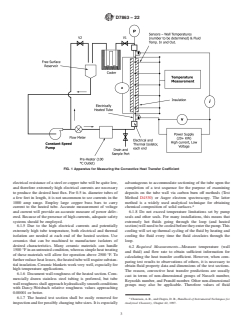
a medium at constant temperature (such as a thermal bath). A suggested setup for a constant flux heat transfer apparatus is shown
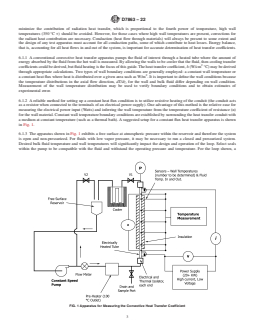
in Fig. 1.
6.1.3 The apparatus shown in Fig. 1 exhibits a free surface at atmospheric pressure within the reservoir and therefore the system
is open and non-pressurized. For fluids with low vapor pressure, it may be necessary to run a closed and pressurized system.
Desired bulk fluid temperature and wall temperatures will significantly impact the design and operation of the loop. Select seals
within the pump to be compatible with the fluid and withstand the operating pressure and temperature. For the loop shown, a
FIG. 1 Apparatus for Measuring the Convective Heat Transfer Coefficient
D7863 − 22
constant speed pump with external bypass control is employed. Variable speed pumps with no bypass may be used; however, a
pump speed control unit will be necessary. The installation of a safety relief valve to prevent pressure buildup is recommended.
6.1.4 The electrically heated test section is shown in a vertical position. This arrangement generally prevents hot spots on the walls
from forming mainly due to fluid voids or the development of “convection cells” and stratified flows. The electrical resistance of
a steel or copper tube will be quite low, and therefore extremely high electrical currents are necessary to produce the desired heat
flux. For 0.5 in. diameter tubes of a few feet in length, it is not uncommon to see currents in the 1000 amp range. Employ large
copper buss bars to carry current to the heated tube. Accurate measurement of voltage and current will provide an accurate measure
of power delivered. Because of the presence of high currents, adequate safety systems should be employed.
6.1.5 Due to the high electrical currents and potentially extremely high tube temperature, both electrical and thermal isolation are
needed at each end of the heated section. Use ceramics that can be machined to manufacture isolators of desired characteristics.
Many ceramic materials can handle 1500 °F in an untreated condition, whereas simple heat treating of these materials will allow
for operation above 2500 °F. To further reduce heat losses, the heated tube will require substantial insulation. Ceramic blankets
work very well, especially for high temperature applications.
6.1.6 Document wall roughness of the heated section. Commercially drawn stainless steel tubing is preferred, but tube wall
roughness shall approach hydraulically smooth conditions with Darcy-Weisbach relative roughness values approaching 0.00001
or better.
6.1.7 The heated test section shall be easily removed for inspection and for possibly changing tube sizes. It is especially
advantageous to accommodate sectioning of the tube upon the completion of a test sequence for the purpose of examining deposits
on the tube wall via carbon burn off methods (Test Method D4530) or Auger electron spectroscopy. The latter method is a widely
used analytical technique for obtaining chemical composition of solid surfaces.
6.1.8 Do not exceed temperature limitations set by pump seals and other seals. For many installations, this means that extremely
hot fluids going through the loop (and heated section) will need to be cooled before they enter the pump. This cooling will set up
thermal cycling of the fluid by heating and cooling the fluid every time the fluid circulates through the loop.
6.2 Required Measurements—Measure temperature (wall and fluid) and flow rate to obtain sufficient information for calculating
the heat transfer coefficient. However, when comparing test results to observations of others, it is necessary to obtain fluid property
data and dimensions of the test sections. The reason, convective heat transfer predictions are usually cast in terms of
non-dimensional groups of Nusselt number, Reynolds number, and Prandtl number. Other non-dimensional groups may also be
applicable. Therefore values of fluid viscosity (Test Method D445 or D7042, Practice D2270), thermal conductivity (Test Method
D2717), fluid density (Test Method D1298 or D4052), and heat capacity (Test Method D2766) all as a function of temperature are
necessary for various heat transfer correlations.
6.2.1 Other properties of fluids are required for complete documentation and safety of operation. These include boiling range
distributions (Test Method D2887), vapor pressure-temperature relationship (Test Method D2879), and autoignition temperature
(Test Method E659).
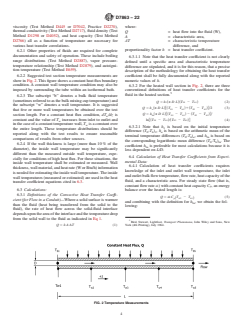
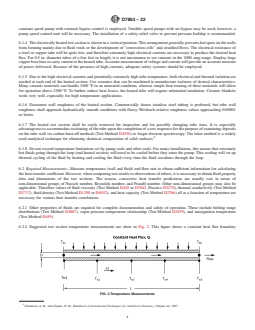
6.2.2 Suggested test section temperature measurements are show in Fig. 2. This figure shows a constant heat flux boundary
FIG. 2 Temperature Measurements
Chourasia, A. R., and Chopra, D. R., Handbook of Instrumental Techniques for Analytical Chemistry, Chapter 42, 1997.
D7863 − 22
condition. A constant wall temperature condition may also be imposed by surrounding the tube within an isothermal bath.
6.2.3 The subscript “b” denotes a bulk fluid temperature (sometimes referred to as the bulk mixing cup temperature) and the
subscript “w” denotes a wall temperature. It is suggested that five or more wall temperatures be obtained over the test section
length. For a constant heat flux condition, dT /dz is constant
...