

ASTM D5716/D5716M-20
(Test Method)Standard Test Method for Measuring the Rate of Well Discharge by Circular Orifice Weir
General Information
- Abstract
SIGNIFICANCE AND USE
5.1 This test method provides design information for construction of an orifice weir. It also describes setup, operation, inspection, calculation of discharge, and reporting. The accuracy of a circular weir decreases at low flows. The use of a circular orifice weir requires a constant flow velocity over the period of measurement. The results may be affected by the piezometers distance from the orifice plate. This equipment may not be appropriate for measuring flows on small wells, or wells with limited recharge.
5.2 Aquifer testing has been conducted for the purposes of production and pressure relief well design and water resource assessment. Production wells are used for public and industrial water supplies, hydraulic controls, and groundwater capture. Pressure relief wells are for hydraulic controls. Test wells are for the purpose of water resource assessment.
5.3 Discharge must also be known for certain methods to evaluate well and pump performance.
Note 1: Practice D3740 provides evaluation factors for the activities in this standard. The quality of the result produced by this standard is dependent on the competence of the personnel performing it and the suitability of the equipment and facilities used. Agencies that meet the criteria of Practice D3740 are generally considered capable of competent and objective testing/sampling/inspection/etc. Users of this standard are cautioned that compliance with Practice D3740 does not in itself assure reliable results. Reliable results depend on many factors; Practice D3740 provides a means of evaluating some of those factors.
SCOPE
1.1 This test method covers construction and operation of a circular orifice weir for measuring the discharge from a well. This test method is a part of a series of standards prepared on the in situ determination of hydraulic properties of aquifer systems by single- or multiple-well tests. Selection of a well discharge measurement test method is described in Guide D5737M.
1.2 The discharge rate determined by this test method is commonly used for a number of aquifer test methods and to provide information for the evaluation of well and pump performance.
1.3 Limitations—This test method is limited to the description of a method common to hydraulic engineering for the purpose of groundwater discharge measurement in temporary or test conditions.
1.4 Much of the information presented in this test method is based on work performed by the Civil Engineering Department of Purdue University during the late 1940s. The essentials of that work have been presented in a pamphlet prepared by Layne-Bowler, Inc.2 and updated by Layne Western Company, Inc.3
1.5 All observed and calculated values shall be conform to the guidelines for significant digits and rounding established in Practice D6026.
1.5.1 The procedures used to specify how data are collected/recorded and calculated in this standard are regarded as the industry standard. In addition they are representative of the significant digits that should generally be retained. The procedures used do not consider material variation, purpose for obtaining the data, special purpose studies, or any considerations for the user’s objectives; and it is common practice to increase or reduce significant digits of reported data to be commensurate with these considerations. It is beyond the scope of this document to consider significant digits sused analysis methods for engineering design.
1.6 Units—The values stated in either SI units or inch-pound units are to be regarded separately as standard. The values stated in each system may not be exact equivalents; therefore, each system shall be used independently of the other. Combining values from the two systems may result in non-conformance with the standard. Reporting of test results in units other than SI shall not be regarded as nonconformance with this standard.
1.7 This standard does not purport to address all of th...
- Status
- Published
- Publication Date
- 31-May-2020
- Technical Committee
- D18 - Soil and Rock
- Drafting Committee
- D18.21 - Groundwater and Vadose Zone Investigations
Buy Documents
ASTM D5716/D5716M-20 - Standard Test Method for Measuring the Rate of Well Discharge by Circular Orifice Weir
REDLINE ASTM D5716/D5716M-20 - Standard Test Method for Measuring the Rate of Well Discharge by Circular Orifice Weir
Overview
ASTM D5716/D5716M-20 is the internationally recognized standard test method for measuring the rate of well discharge by circular orifice weir. Developed by ASTM International, this method outlines the procedure for constructing, setting up, operating, and reporting on the use of circular orifice weirs to determine groundwater discharge rates. The standard is an important resource in the field of groundwater hydrology and hydraulic engineering, particularly for temporary or test setups where accurate measurement of well discharge is critical.
This test method provides the necessary guidelines for selecting, designing, and implementing a circular orifice weir, describing detailed apparatus requirements, operational instructions, calculation methods, and documentation practices.
Key Topics
Purpose and Scope
- Designed to support aquifer testing and assessment for both production and pressure relief wells.
- Commonly used for evaluating groundwater supplies and well or pump performance in temporary scenarios.
- Applicable for determining hydraulic properties of aquifer systems through single or multiple-well tests.
Apparatus and Setup
- Specifies requirements for the orifice plate, discharge pipe, and manometer.
- Emphasizes proper installation: the orifice plate should have smooth, clean edges; the discharge pipe needs to be straight, level, and unobstructed.
- The manometer or piezometer tube must be correctly positioned and free from air bubbles for precise head measurement.
Measurement and Calculation
- Requires continuous, constant velocity of flow during the test period.
- Describes use of a piezometer to measure pressure head, which is used to calculate discharge using the orifice equation.
- Provides tables for flow rates across various pipe and orifice sizes.
- Flow accuracy may decrease at low discharge or if the equipment is improperly installed.
Limitations and Considerations
- Not suitable for small wells or wells with limited recharge.
- Results can be affected by the placement of the piezometer relative to the orifice.
- Outlines the importance of reporting in either SI or inch-pound units, used independently.
Quality and Compliance
- Emphasizes that the competence of personnel and equipment suitability critically impact results.
- Adherence to relevant practices for data recording and significant digits is required for consistency and comparability.
Applications
The ASTM D5716/D5716M-20 standard is applied extensively in:
- Aquifer Testing: Essential for the in situ determination of aquifer characteristics needed for groundwater resource management.
- Well and Pump Evaluation: Utilized to measure discharge needed to assess the performance efficiency of wells and pumps.
- Production and Relief Well Design: Supports the hydraulic design and analysis for public water supplies, industrial groundwater extraction, and hydraulic control systems.
- Temporary and Field Measurements: Ideally suited to short-term tests where permanent flow measurement installations are unnecessary or impractical.
- Research and Regulatory Assessments: Provides standardized methodology for environmental studies, compliance checks, and water resource investigations.
Related Standards
- ASTM D5737/D5737M: Guide for methods for measuring well discharge.
- ASTM D653: Terminology relating to soil, rock, and contained fluids.
- ASTM D3740: Practice for minimum requirements for agencies engaged in testing and/or inspection of soil and rock.
- ASTM D6026: Practice for the use of significant digits in geotechnical data.
- USGS GWPD 10: Estimating discharge from a pumping well using a circular orifice weir.
This ASTM standard provides a robust, industry-accepted method for the measurement of groundwater discharge using a circular orifice weir, ensuring accurate data collection vital for hydrogeological studies and groundwater management. For organizations involved in groundwater assessment, well testing, and hydraulic engineering, implementing ASTM D5716/D5716M-20 ensures reliable, repeatable, and internationally recognized measurement practices.
Relations
- Effective Date
- 01-Nov-2023
- Effective Date
- 01-Oct-2019
- Effective Date
- 01-Aug-2014
- Effective Date
- 01-May-2012
- Effective Date
- 01-Mar-2012
- Effective Date
- 01-Sep-2011
- Effective Date
- 01-Sep-2011
- Effective Date
- 01-Mar-2010
- Effective Date
- 01-Jan-2009
- Effective Date
- 01-Dec-2008
- Effective Date
- 01-Nov-2008
- Effective Date
- 01-Mar-2008
- Effective Date
- 15-Dec-2007
- Effective Date
- 01-Nov-2007
- Effective Date
- 01-Aug-2007
Buy Documents
ASTM D5716/D5716M-20 - Standard Test Method for Measuring the Rate of Well Discharge by Circular Orifice Weir
REDLINE ASTM D5716/D5716M-20 - Standard Test Method for Measuring the Rate of Well Discharge by Circular Orifice Weir
Get Certified
Connect with accredited certification bodies for this standard

Zavod za gradbeništvo Slovenije (ZAG) - Inšpekcija
ZAG inspection body for construction products, structures, and materials.
Sponsored listings
Frequently Asked Questions
ASTM D5716/D5716M-20 is a standard published by ASTM International. Its full title is "Standard Test Method for Measuring the Rate of Well Discharge by Circular Orifice Weir". This standard covers: SIGNIFICANCE AND USE 5.1 This test method provides design information for construction of an orifice weir. It also describes setup, operation, inspection, calculation of discharge, and reporting. The accuracy of a circular weir decreases at low flows. The use of a circular orifice weir requires a constant flow velocity over the period of measurement. The results may be affected by the piezometers distance from the orifice plate. This equipment may not be appropriate for measuring flows on small wells, or wells with limited recharge. 5.2 Aquifer testing has been conducted for the purposes of production and pressure relief well design and water resource assessment. Production wells are used for public and industrial water supplies, hydraulic controls, and groundwater capture. Pressure relief wells are for hydraulic controls. Test wells are for the purpose of water resource assessment. 5.3 Discharge must also be known for certain methods to evaluate well and pump performance. Note 1: Practice D3740 provides evaluation factors for the activities in this standard. The quality of the result produced by this standard is dependent on the competence of the personnel performing it and the suitability of the equipment and facilities used. Agencies that meet the criteria of Practice D3740 are generally considered capable of competent and objective testing/sampling/inspection/etc. Users of this standard are cautioned that compliance with Practice D3740 does not in itself assure reliable results. Reliable results depend on many factors; Practice D3740 provides a means of evaluating some of those factors. SCOPE 1.1 This test method covers construction and operation of a circular orifice weir for measuring the discharge from a well. This test method is a part of a series of standards prepared on the in situ determination of hydraulic properties of aquifer systems by single- or multiple-well tests. Selection of a well discharge measurement test method is described in Guide D5737M. 1.2 The discharge rate determined by this test method is commonly used for a number of aquifer test methods and to provide information for the evaluation of well and pump performance. 1.3 Limitations—This test method is limited to the description of a method common to hydraulic engineering for the purpose of groundwater discharge measurement in temporary or test conditions. 1.4 Much of the information presented in this test method is based on work performed by the Civil Engineering Department of Purdue University during the late 1940s. The essentials of that work have been presented in a pamphlet prepared by Layne-Bowler, Inc.2 and updated by Layne Western Company, Inc.3 1.5 All observed and calculated values shall be conform to the guidelines for significant digits and rounding established in Practice D6026. 1.5.1 The procedures used to specify how data are collected/recorded and calculated in this standard are regarded as the industry standard. In addition they are representative of the significant digits that should generally be retained. The procedures used do not consider material variation, purpose for obtaining the data, special purpose studies, or any considerations for the user’s objectives; and it is common practice to increase or reduce significant digits of reported data to be commensurate with these considerations. It is beyond the scope of this document to consider significant digits sused analysis methods for engineering design. 1.6 Units—The values stated in either SI units or inch-pound units are to be regarded separately as standard. The values stated in each system may not be exact equivalents; therefore, each system shall be used independently of the other. Combining values from the two systems may result in non-conformance with the standard. Reporting of test results in units other than SI shall not be regarded as nonconformance with this standard. 1.7 This standard does not purport to address all of th...
SIGNIFICANCE AND USE 5.1 This test method provides design information for construction of an orifice weir. It also describes setup, operation, inspection, calculation of discharge, and reporting. The accuracy of a circular weir decreases at low flows. The use of a circular orifice weir requires a constant flow velocity over the period of measurement. The results may be affected by the piezometers distance from the orifice plate. This equipment may not be appropriate for measuring flows on small wells, or wells with limited recharge. 5.2 Aquifer testing has been conducted for the purposes of production and pressure relief well design and water resource assessment. Production wells are used for public and industrial water supplies, hydraulic controls, and groundwater capture. Pressure relief wells are for hydraulic controls. Test wells are for the purpose of water resource assessment. 5.3 Discharge must also be known for certain methods to evaluate well and pump performance. Note 1: Practice D3740 provides evaluation factors for the activities in this standard. The quality of the result produced by this standard is dependent on the competence of the personnel performing it and the suitability of the equipment and facilities used. Agencies that meet the criteria of Practice D3740 are generally considered capable of competent and objective testing/sampling/inspection/etc. Users of this standard are cautioned that compliance with Practice D3740 does not in itself assure reliable results. Reliable results depend on many factors; Practice D3740 provides a means of evaluating some of those factors. SCOPE 1.1 This test method covers construction and operation of a circular orifice weir for measuring the discharge from a well. This test method is a part of a series of standards prepared on the in situ determination of hydraulic properties of aquifer systems by single- or multiple-well tests. Selection of a well discharge measurement test method is described in Guide D5737M. 1.2 The discharge rate determined by this test method is commonly used for a number of aquifer test methods and to provide information for the evaluation of well and pump performance. 1.3 Limitations—This test method is limited to the description of a method common to hydraulic engineering for the purpose of groundwater discharge measurement in temporary or test conditions. 1.4 Much of the information presented in this test method is based on work performed by the Civil Engineering Department of Purdue University during the late 1940s. The essentials of that work have been presented in a pamphlet prepared by Layne-Bowler, Inc.2 and updated by Layne Western Company, Inc.3 1.5 All observed and calculated values shall be conform to the guidelines for significant digits and rounding established in Practice D6026. 1.5.1 The procedures used to specify how data are collected/recorded and calculated in this standard are regarded as the industry standard. In addition they are representative of the significant digits that should generally be retained. The procedures used do not consider material variation, purpose for obtaining the data, special purpose studies, or any considerations for the user’s objectives; and it is common practice to increase or reduce significant digits of reported data to be commensurate with these considerations. It is beyond the scope of this document to consider significant digits sused analysis methods for engineering design. 1.6 Units—The values stated in either SI units or inch-pound units are to be regarded separately as standard. The values stated in each system may not be exact equivalents; therefore, each system shall be used independently of the other. Combining values from the two systems may result in non-conformance with the standard. Reporting of test results in units other than SI shall not be regarded as nonconformance with this standard. 1.7 This standard does not purport to address all of th...
ASTM D5716/D5716M-20 is classified under the following ICS (International Classification for Standards) categories: 93.025 - External water conveyance systems. The ICS classification helps identify the subject area and facilitates finding related standards.
ASTM D5716/D5716M-20 has the following relationships with other standards: It is inter standard links to ASTM D3740-23, ASTM D3740-19, ASTM D653-14, ASTM D3740-12a, ASTM D3740-12, ASTM D653-11, ASTM D3740-11, ASTM D3740-10, ASTM D653-09, ASTM D653-08a, ASTM D653-08, ASTM D3740-08, ASTM D653-07f, ASTM D653-07e, ASTM D653-07d. Understanding these relationships helps ensure you are using the most current and applicable version of the standard.
ASTM D5716/D5716M-20 is available in PDF format for immediate download after purchase. The document can be added to your cart and obtained through the secure checkout process. Digital delivery ensures instant access to the complete standard document.
Standards Content (Sample)
This international standard was developed in accordance with internationally recognized principles on standardization established in the Decision on Principles for the
Development of International Standards, Guides and Recommendations issued by the World Trade Organization Technical Barriers to Trade (TBT) Committee.
Designation: D5716/D5716M −20
Standard Test Method for
Measuring the Rate of Well Discharge by Circular Orifice
Weir
This standard is issued under the fixed designation D5716/D5716M; the number immediately following the designation indicates the
year of original adoption or, in the case of revision, the year of last revision. A number in parentheses indicates the year of last
reapproval. A superscript epsilon (´) indicates an editorial change since the last revision or reapproval.
1. Scope* ations for the user’s objectives; and it is common practice to
increase or reduce significant digits of reported data to be
1.1 This test method covers construction and operation of a
commensuratewiththeseconsiderations.Itisbeyondthescope
circular orifice weir for measuring the discharge from a well.
of this document to consider significant digits sused analysis
This test method is a part of a series of standards prepared on
methods for engineering design.
the in situ determination of hydraulic properties of aquifer
systems by single- or multiple-well tests. Selection of a well 1.6 Units—The values stated in either SI units or inch-
discharge measurement test method is described in Guide pound units are to be regarded separately as standard. The
D5737M. values stated in each system may not be exact equivalents;
therefore,eachsystemshallbeusedindependentlyoftheother.
1.2 The discharge rate determined by this test method is
Combining values from the two systems may result in non-
commonly used for a number of aquifer test methods and to
conformance with the standard. Reporting of test results in
provide information for the evaluation of well and pump
units other than SI shall not be regarded as nonconformance
performance.
with this standard.
1.3 Limitations—This test method is limited to the descrip-
1.7 This standard does not purport to address all of the
tion of a method common to hydraulic engineering for the
safety concerns, if any, associated with its use. It is the
purpose of groundwater discharge measurement in temporary
responsibility of the user of this standard to establish appro-
or test conditions.
priate safety, health, and environmental practices and deter-
1.4 Muchoftheinformationpresentedinthistestmethodis
mine the applicability of regulatory limitations prior to use.
basedonworkperformedbytheCivilEngineeringDepartment
1.8 This international standard was developed in accor-
of Purdue University during the late 1940s. The essentials of
dance with internationally recognized principles on standard-
that work have been presented in a pamphlet prepared by
ization established in the Decision on Principles for the
Layne-Bowler, Inc. and updated by LayneWestern Company,
Development of International Standards, Guides and Recom-
Inc.
mendations issued by the World Trade Organization Technical
Barriers to Trade (TBT) Committee.
1.5 All observed and calculated values shall be conform to
theguidelinesforsignificantdigitsandroundingestablishedin
2. Referenced Documents
Practice D6026.
2.1 ASTM Standards:
1.5.1 Theproceduresusedtospecifyhowdataarecollected/
D653Terminology Relating to Soil, Rock, and Contained
recorded and calculated in this standard are regarded as the
Fluids
industry standard. In addition they are representative of the
D3740Practice for Minimum Requirements for Agencies
significant digits that should generally be retained. The proce-
Engaged in Testing and/or Inspection of Soil and Rock as
dures used do not consider material variation, purpose for
Used in Engineering Design and Construction
obtaining the data, special purpose studies, or any consider-
D5737MGuide for Methods for Measuring Well Discharge
D6026Practice for Using Significant Digits in Geotechnical
Data
ThistestmethodisunderthejurisdictionofASTMCommitteeD18onSoiland
2.2 Other Documents:
Rock and is the direct responsibility of Subcommittee D18.21 on Groundwater and
Vadose Zone Investigations.
GWPD10Estimatingdischargefromapumpingwellbyuse
Current edition approved June 1, 2020. Published June 2020. Originally
of a circular orifice weir, United States Geological Survey
approved in 1995. Last previous edition approved in 2015 as D5716–15. DOI:
10.1520/D5716_D5716M-20.
2 4
Measurement of Water Flow Through Pipe Orifice With Free Discharge, For referenced ASTM standards, visit the ASTM website, www.astm.org, or
Bulletin 501, Layne-Bowler, Inc., Mission, KS, 1958. contact ASTM Customer Service at service@astm.org. For Annual Book of ASTM
Measurement of Water Flow Through Pipe Orifice With Free Discharge, Standards volume information, refer to the standard’s Document Summary page on
Layne-Western Company, Inc., Mission, KS, 1988. the ASTM website.
*A Summary of Changes section appears at the end of this standard
Copyright © ASTM International, 100 Barr Harbor Drive, PO Box C700, West Conshohocken, PA 19428-2959. United States
D5716/D5716M − 20
3. Terminology racy of a circular weir decreases at low flows. The use of a
circular orifice weir requires a constant flow velocity over the
3.1 Definitions:
period of measurement. The results may be affected by the
3.1.1 Fordefinitionsofcommontechnicaltermsusedinthis
piezometers distance from the orifice plate. This equipment
standard, refer to Terminology D653.
may not be appropriate for measuring flows on small wells, or
3.2 Definitions of Terms Specific to This Standard:
wells with limited recharge.
3.2.1 circular orifice weir—a circular restriction in a pipe
5.2 Aquifer testing has been conducted for the purposes of
thatcausesbackpressurethatcanbemeasuredinapiezometer
production and pressure relief well design and water resource
tube.
assessment. Production wells are used for public and industrial
3.2.1.1 Discussion—Also called orifice tube and orifice
water supplies, hydraulic controls, and groundwater capture.
meter.
Pressure relief wells are for hydraulic controls. Test wells are
3.3 Symbols and Dimensions Used in this Standard:
for the purpose of water resource assessment.
3.3.1 A—orifice plate open area [ L ].
5.3 Discharge must also be known for certain methods to
3.3.2 C—coefficient of discharge for the orifice [nd].
evaluate well and pump performance.
−2
3.3.3 g—acceleration due to gravity [ LT ].
NOTE 1—Practice D3740 provides evaluation factors for the activities
in this standard. The quality of the result produced by this standard is
3.3.4 h—head in manometer [ L].
dependent on the competence of the personnel performing it and the
3 −1
3.3.5 Q—control well discharge [ L T ]. suitability of the equipment and facilities used. Agencies that meet the
criteria of Practice D3740 are generally considered capable of competent
3.3.6 o—orifice diameter [ L].
and objective testing/sampling/inspection/etc. Users of this standard are
3.3.7 d—pipe inside diameter [ L]. cautioned that compliance with Practice D3740 does not in itself assure
reliable results. Reliable results depend on many factors; Practice D3740
provides a means of evaluating some of those factors.
4. Summary of Test Method
4.1 This test method involves pumping a control well at a
6. Apparatus
constant or variable rate through a circular orifice weir for a
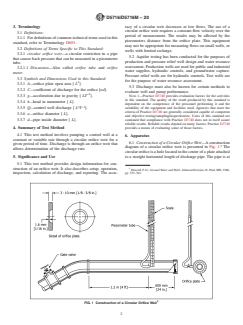
6.1 Construction of a Circular Orifice Weir—Aconstruction
given period of time. Discharge is through an orifice weir that
diagram of a circular orifice weir is presented in Fig. 1. The
allows determination of the discharge rate.
circularorificeisaholelocatedinthecenterofaplateattached
to a straight horizontal length of discharge pipe. The pipe is at
5. Significance and Use
5.1 This test method provides design information for con-
struction of an orifice weir. It also describes setup, operation, 5
Driscoll,F.G., Ground Water and Wells,JohnsonDivision,St.Paul,MN,1986,
inspection, calculation of discharge, and reporting. The accu- pp. 537–541.
FIG. 1 Construction of a Circular Orifice Weir
D5716/D5716M − 20
least 1.8 m [6 ft] in length. Approximately 600 mm [24 in.] 6.2 The diameter of the orifice should be less than 80% of
from the end plate and at least 1.2 m [4 ft] from the other end the inside diameter of the approach channel pipe.
of the discharge pipe, a piezometer is attached to the discharge
7. Procedure
pipe so that the head in the discharge pipe can be measured.
6.1.1 Orifice Plate—The orifice is a round hole with clean,
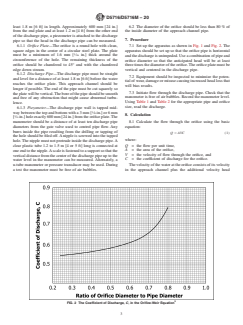
7.1 Set up the apparatus as shown in Fig. 1 and Fig. 2. The
square edges in the center of a circular steel plate. The plate
apparatus should be set up so that the orifice pipe is horizontal
must be a minimum of 1.6 mm [ ⁄16 in.] thick around the
andthedischargeisunimpeded.Useacombinationofpipeand
circumference of the hole. The remaining thickness of the
orifice diameter so that the anticipated head will be at least
orifice should be chamfered to 45° and with the chamfered
threetimesthediameteroftheorifice.Theorificeplatemustbe
edge down stream.
vertical and centered in the discharge pipe.
6.1.2 Discharge Pipe—The discharge pipe must be straight
7.2 Equipment should be inspected to minimize the poten-
and level for a distance of at least 1.8 m [6 ft] before the water
tialofwear,damageormisusecausingincreasedheadlossthat
reaches the orifice plate. This approach channel should be
will bias results.
longer if possible. The end of the pipe must be cut squarely so
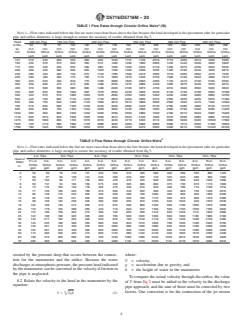
7.3 Initiate flow through the discharge pipe. Check that the
theplatewillbevertical.Theboreofthepipeshouldbesmooth
manometer is free of air bubbles. Record the manometer level.
and free of any obstruction that might cause abnormal turbu-
Using Table 1 and Table 2 for the appropriate pipe and orifice
lence.
size, read the discharge.
6.1.3 Piezometer—The discharge pipe wall is tapped mid-
way between the top and bottom witha3mm[ ⁄8-in.] or 6 mm
8. Calculation
[ ⁄4-in.]holeexactly600mm[24in.]fromtheorificeplate.The
8.1 Calculate the flow through the orifice using the basic
manometer should be a distance of at least ten discharge pi
...
This document is not an ASTM standard and is intended only to provide the user of an ASTM standard an indication of what changes have been made to the previous version. Because
it may not be technically possible to adequately depict all changes accurately, ASTM recommends that users consult prior editions as appropriate. In all cases only the current version
of the standard as published by ASTM is to be considered the official document.
Designation: D5716/D5716M − 15 D5716/D5716M − 20
Standard Test Method for
Measuring the Rate of Well Discharge by Circular Orifice
Weir
This standard is issued under the fixed designation D5716/D5716M; the number immediately following the designation indicates the
year of original adoption or, in the case of revision, the year of last revision. A number in parentheses indicates the year of last
reapproval. A superscript epsilon (´) indicates an editorial change since the last revision or reapproval.
1. Scope*
1.1 This test method covers construction and operation of a circular orifice weir for measuring the discharge from a well. This
test method is a part of a series of standards prepared on the in situ determination of hydraulic properties of aquifer systems by
single- or multiple-well tests. Selection of a well discharge measurement test method is described in Guide D5737D5737M.
1.2 The discharge rate determined by this test method is commonly used for a number of aquifer test methods and to provide
information for the evaluation of well and pump performance.
1.3 Limitations—This test method is limited to the description of a method common to hydraulic engineering for the purpose
of groundwater discharge measurement in temporary or test conditions.
1.4 Much of the information presented in this test method is based on work performed by the Civil Engineering Department
of Purdue University during the late 1940s. The essentials of that work have been presented in a pamphlet prepared by
2 3
Layne-Bowler, Inc. and updated by Layne Western Company, Inc.
1.5 All observed and calculated values shall be conform to the guidelines for significant digits and rounding established in
Practice D6026.
1.5.1 The procedures used to specify how data are collected/recorded and calculated in this standard are regarded as the industry
standard. In addition they are representative of the significant digits that should generally be retained. The procedures used do not
consider material variation, purpose for obtaining the data, special purpose studies, or any considerations for the user’s objectives;
and it is common practice to increase or reduce significant digits of reported data to be commensurate with these considerations.
It is beyond the scope of this document to consider significant digits sused analysis methods for engineering design.
1.6 Units—The values stated in either SI units or inch-pound units are to be regarded separately as standard. The values stated
in each system may not be exact equivalents; therefore, each system shall be used independently of the other. Combining values
from the two systems may result in non-conformance with the standard. Reporting of test results in units other than SI shall not
be regarded as nonconformance with this standard.
1.7 This standard does not purport to address all of the safety concerns, if any, associated with its use. It is the responsibility
of the user of this standard to establish appropriate safety safety, health, and healthenvironmental practices and determine the
applicability of regulatory limitations prior to use.
1.8 This international standard was developed in accordance with internationally recognized principles on standardization
established in the Decision on Principles for the Development of International Standards, Guides and Recommendations issued
by the World Trade Organization Technical Barriers to Trade (TBT) Committee.
2. Referenced Documents
2.1 ASTM Standards:
D653 Terminology Relating to Soil, Rock, and Contained Fluids
This test method is under the jurisdiction of ASTM Committee D18 on Soil and Rock and is the direct responsibility of Subcommittee D18.21 on Groundwater and Vadose
Zone Investigations.
Current edition approved Nov. 1, 2015June 1, 2020. Published December 2015June 2020. Originally approved in 1995. Last previous edition approved in 20062015 as
D5716–95(2006)D5716, which was withdrawn July 2015 and reinstated in November 2015. DOI: 10.1520/D5716-15.–15. DOI: 10.1520/D5716_D5716M-20.
Measurement of Water Flow Through Pipe Orifice With Free Discharge, Bulletin 501, Layne-Bowler, Inc., Mission, KS, 1958.
Measurement of Water Flow Through Pipe Orifice With Free Discharge, Layne-Western Company, Inc., Mission, KS, 1988.
For referenced ASTM standards, visit the ASTM website, www.astm.org, or contact ASTM Customer Service at service@astm.org. For Annual Book of ASTM Standards
volume information, refer to the standard’s Document Summary page on the ASTM website.
*A Summary of Changes section appears at the end of this standard
Copyright © ASTM International, 100 Barr Harbor Drive, PO Box C700, West Conshohocken, PA 19428-2959. United States
D5716/D5716M − 20
D3740 Practice for Minimum Requirements for Agencies Engaged in Testing and/or Inspection of Soil and Rock as Used in
Engineering Design and Construction
D5737D5737M Guide for Methods for Measuring Well Discharge
D6026 Practice for Using Significant Digits in Geotechnical Data
2.2 Other Documents:
GWPD 10 Estimating discharge from a pumping well by use of a circular orifice weir, United States Geological Survey
3. Terminology
3.1 Definitions:
3.1.1 For definitions of common technical terms used in this standard, refer to Terminology D653.
3.2 Definitions of Terms Specific to This Standard:
3.2.1 circular orifice weir—a circular restriction in a pipe that causes back pressure that can be measured in a piezometer tube.
3.2.1.1 Discussion—
Also called orifice tube and orifice meter.
3.3 Symbols and Dimensions Used in this Standard:
3.3.1 A—orifice plate open area [ L ].
3.3.2 C—coefficient of discharge for the orifice [nd].
−2
3.3.3 g—acceleration due to gravity [ LT ].
3.3.4 h—head in manometer [ L].
3 −1
3.3.5 Q—control well discharge [ L T ].
3.3.6 o—orifice diameter [ L].
3.3.7 d—pipe inside diameter [ L].
4. Summary of Test Method
4.1 This test method involves pumping a control well at a constant or variable rate through a circular orifice weir for a given
period of time. Discharge is through an orifice weir that allows determination of the discharge rate.
4.2
5. Significance and Use
5.1 This test method provides design information for construction of an orifice weir. It also describes setup, operation,
inspection, calculation of discharge, and reporting. The accuracy of a circular weir decreases at low flows. The use of a circular
orifice weir requires a constant flow velocity over the period of measurement. The results may be affected by the piezometers
distance from the orifice plate. This equipment may not be appropriate for measuring flows on small wells, or wells with limited
recharge.
5.2 Aquifer testing has been conducted for the purposes of production and pressure relief well design and water resource
assessment. Production wells are used for public and industrial water supplies, hydraulic controls, and groundwater capture.
Pressure relief wells are for hydraulic controls. Test wells are for the purpose of water resource assessment.
5.3 Discharge must also be known for certain methods to evaluate well and pump performance.
NOTE 1—Practice D3740 provides evaluation factors for the activities in this standard. The quality of the result produced by this standard is dependent
on the competence of the personnel performing it and the suitability of the equipment and facilities used. Agencies that meet the criteria of Practice D3740
are generally considered capable of competent and objective testing/sampling/inspection/etc. Users of this standard are cautioned that compliance with
Practice D3740 does not in itself assure reliable results. Reliable results depend on many factors; Practice D3740 provides a means of evaluating some
of those factors.
6. Apparatus
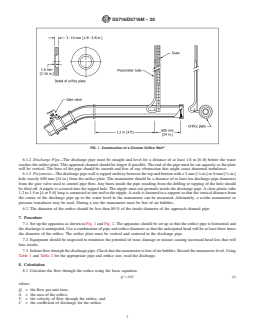
6.1 Construction of a Circular Orifice Weir—A construction diagram of a circular orifice weir is presented in Fig. 1. The
circular orifice is a hole located in the center of a plate attached to a straight horizontal length of discharge pipe. The pipe is at
least 1.8 m [6 ft] in length. Approximately 600 mm [24 in.] from the end plate and at least 1.2 m [4 ft] from the other end of the
discharge pipe, a piezometer is attached to the discharge pipe so that the head in the discharge pipe can be measured.
6.1.1 Orifice Plate—The orifice is a round hole with clean, square edges in the center of a circular steel plate. The plate must
be a minimum of 1.6 mm [ ⁄16 in.] thick around the circumference of the hole. The remaining thickness of the orifice should be
chamfered to 45° and with the chamfered edge down stream.
Driscoll, F. G., Ground Water and Wells, Johnson Division, St. Paul, MN, 1986, pp. 537–541.
D5716/D5716M − 20
FIG. 1 Construction of a Circular Orifice Weir
6.1.2 Discharge Pipe—The discharge pipe must be straight and level for a distance of at least 1.8 m [6 ft] before the water
reaches the orifice plate. This approach channel should be longer if possible. The end of the pipe must be cut squarely so the plate
will be vertical. The bore of the pipe should be smooth and free of any obstruction that might cause abnormal turbulence.
1 1
6.1.3 Piezometer—The discharge pipe wall is tapped midway between the top and bottom with a 3 mm [ ⁄8-in.] or 6 mm [ ⁄4-in.]
hole exactly 600 mm [24 in.] from the orifice plate. The manometer should be a distance of at least ten discharge pipe diameters
from the gate valve used to control pipe flow. Any burrs inside the pipe resulting from the drilling or tapping of the hole should
be filed off. A nipple is screwed into the tapped hole. The nipple must not protrude inside the discharge pipe. A clear plastic tube
1.2 to 1.5 m [4 or 5 ft] long is connected at one end to the nipple. A scale is fastened to a support so that the vertical distance from
the center of the discharge pipe up to the water level in the manometer can be measured. Alternately, a u-tube manometer or
pressure transducer may be used. During a test the manometer must be free of air bubbles.
6.2 The diameter of the orifice should be less than 80 % of the inside diameter of the approach channel pipe.
7. Procedure
7.1 Set up the apparatus as shown in Fig. 1 and Fig. 2. The apparatus should be set up so that the orifice pipe is horizontal and
the discharge is unimpeded. Use a combination of pipe and orifice diameter so that the anticipated head will be at least three times
the diameter of the orifice. The orifice plate must be vertical and centered in the discharge pipe.
7.2 Equipment should be inspected to minimize the pote
...